
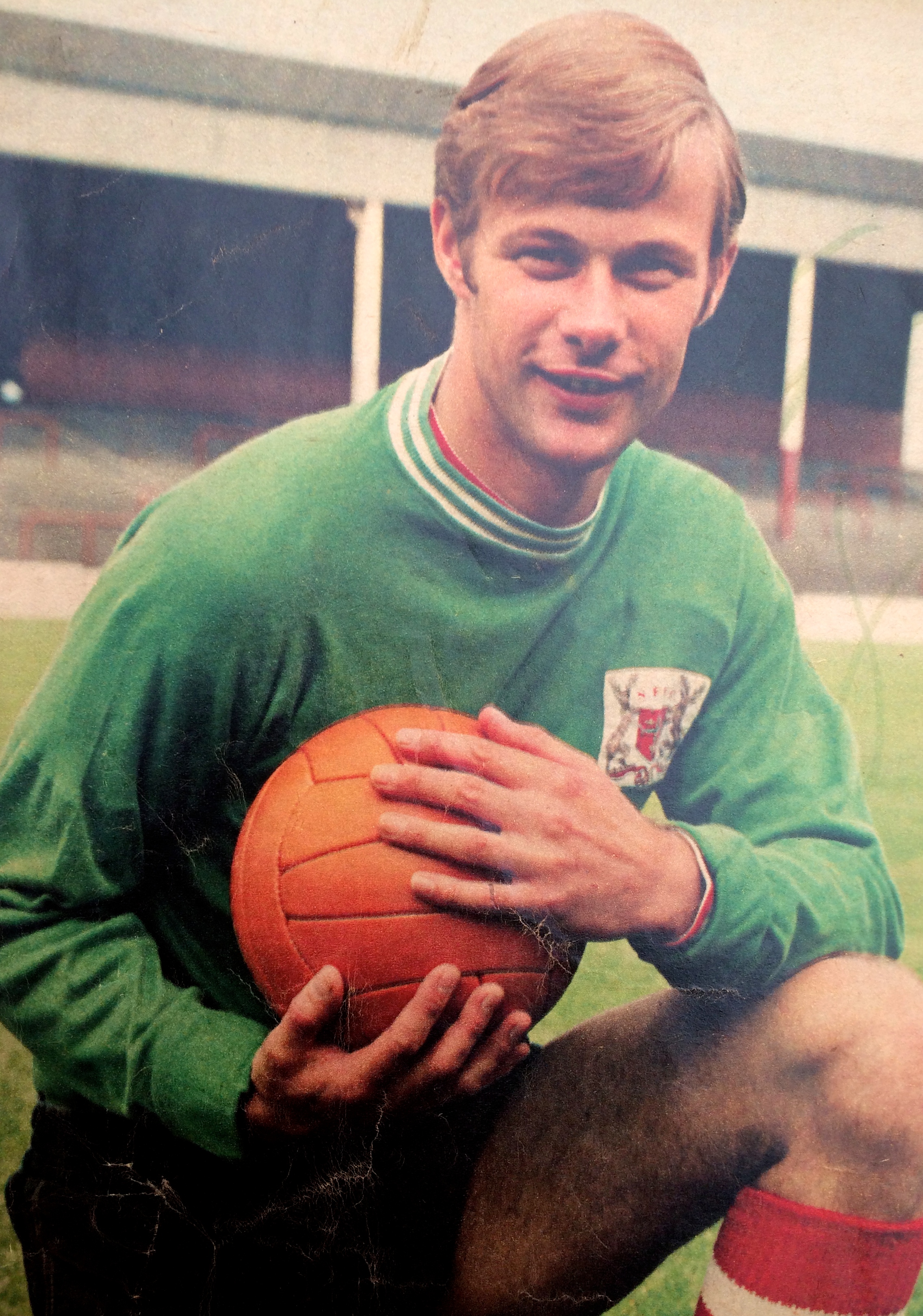
 ONE OF the best goalkeepers I’ve ever seen play for Brighton and Hove Albion previously spent a decade with Nottingham Forest and was an England under 23 international.
Peter Grummitt was outstanding between the sticks and racked up an impressive career total of more than 650 league and cup appearances, virtually half of them in what is now the Premiership.
Born in Bourne (the Lincolnshire market town) on 19 August 1942, he was the last line of defence for Forest between 1960 and 1969, and credited Forest reserve team coach Joe Mallett, a former Southampton stalwart as a player, as the biggest influence on his career.
 But he also made 158 appearances for the Albion between 1974 and 1977. Signed on loan initially from Sheffield Wednesday in the wake of the famous 8-2 defeat to Bristol Rovers, he went on to be a key part of the side that was on the up in the mid ‘70s until injury cut short his career, albeit that he was in his mid 30s by then.
Grummitt headed south having been edged out as first choice at Wednesday, where he’d played 130 games after leaving the City Ground. He knew Brian Clough’s sidekick Peter Taylor well having played in the same Nottingham Taxis cricket team, and Taylor had called him to ask if he fancied the move.

“The fact Brighton were in the Third Division didn’t bother me at all, ” he said. “I knew what sort of managers they both were and I knew straight away that I wanted to go. I met Clough at a motorway service station, we had a chat, and I signed there and then.”
His arrival at the Goldstone was Clough and Taylor’s direct response to that horrendous home defeat to Rovers in front of the TV cameras. Long-standing no.1 Brian Powney was axed and Grummitt was drafted in for the next game – but in his first match even he had to fish the ball out of his net four times as Tranmere ran out 4-1 winners.
As it turned out, Powney did reclaim the ‘keeper’s jersey when Grummitt was injured in a game against Shrewsbury in a challenge with Ricky Marlowe, who the following season became a teammate.
Looking back, though, the signing of a goalkeeper of Grummitt’s undoubted pedigree was very much the beginning of what was to become a memorable era in the club’s history.
Mrs Grummitt was pleased with the move too, as the matchday programme enlightened us. Jill said the couple had found a house in Saltdean with a sea view. “Both of us have always wanted to live by the sea,” she said.
Their mutual love of horses was also satisfied by Brighton’s closeness to Hickstead, where they were visitors to see shows. Additionally we learned: “Peter’s main interest outside football is golf. Apart from that he is really a home-bird. He’s a master at relaxing and can just switch off by settling fown for a night in front of the television.”
Handyman Grummitt had also concreted part of the garden at the house in Mannings Vale and built a stone fireplace in the lounge.
In the 1960s, he was a contemporary of Chelsea’s Peter Bonetti, and they vied for the number one spot for the England Under 23 team.
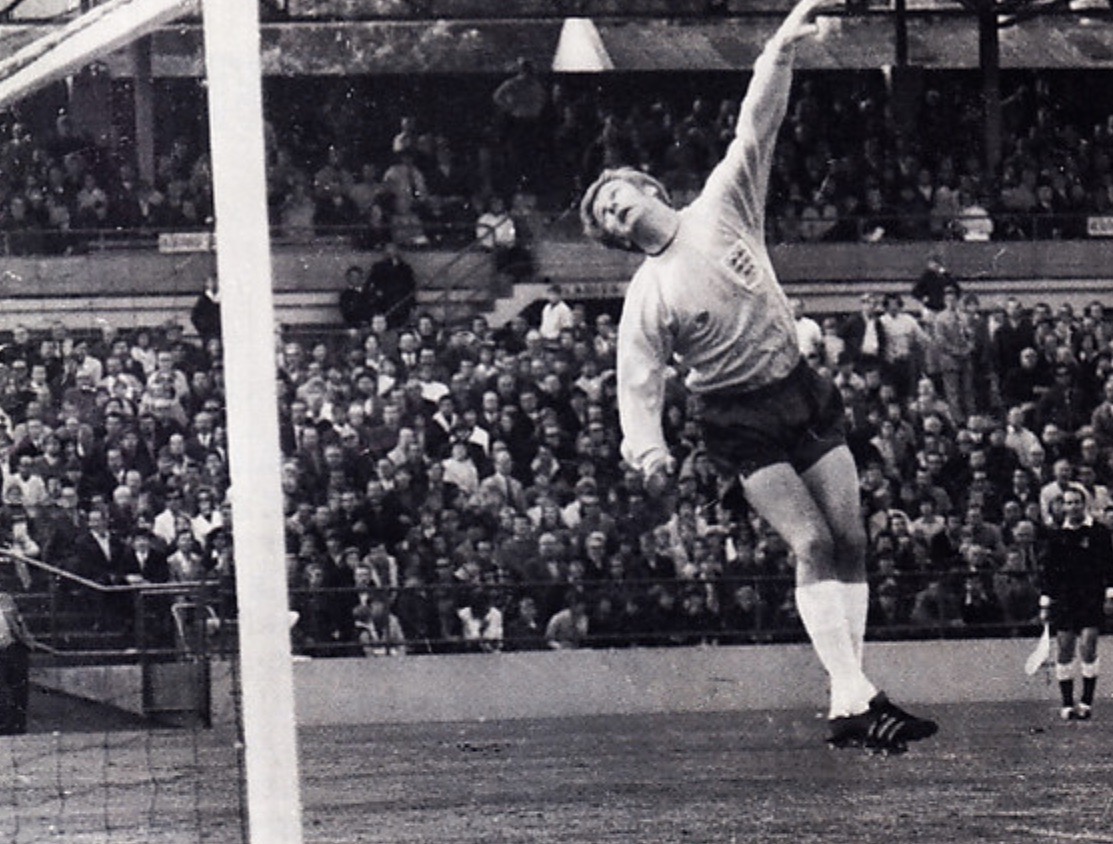 Grummitt made his debut in a 5-2 win over the Netherlands in Rotterdam on 29 November 1961 when his teammates included future England World Cup winning captain Bobby Moore and future Brighton manager Alan Mullery.
While Bonetti reclaimed the shirt for the next seven matches, Grummitt was back between the sticks two years later when on 13 November 1963 he played in England’s 1-1 draw against Wales at Ashton Gate, Bristol. Those other West Ham World Cup winners, Martin Peters and Geoff Hurst, were in that under 23 line-up, together with Graham Cross, who would also later play for Brighton.
A fortnight later, Grummitt was again in goal when the national under-23s beat West Germany 4-1 at Anfield. But that was his last cap as Bonetti and Jim Montgomery (Sunderland) were selected ahead of him.
However, in 1971, Grummitt went on an end-of-season tour to Australia with an English FA squad that also included Barry Bridges (then of Millwall) and Dennis Mortimer (of Coventry at the time). The group played the Republic of Ireland in Dublin, drawing 1-1, before heading Down Under where they won all nine of the matches they played in various locations across a month.
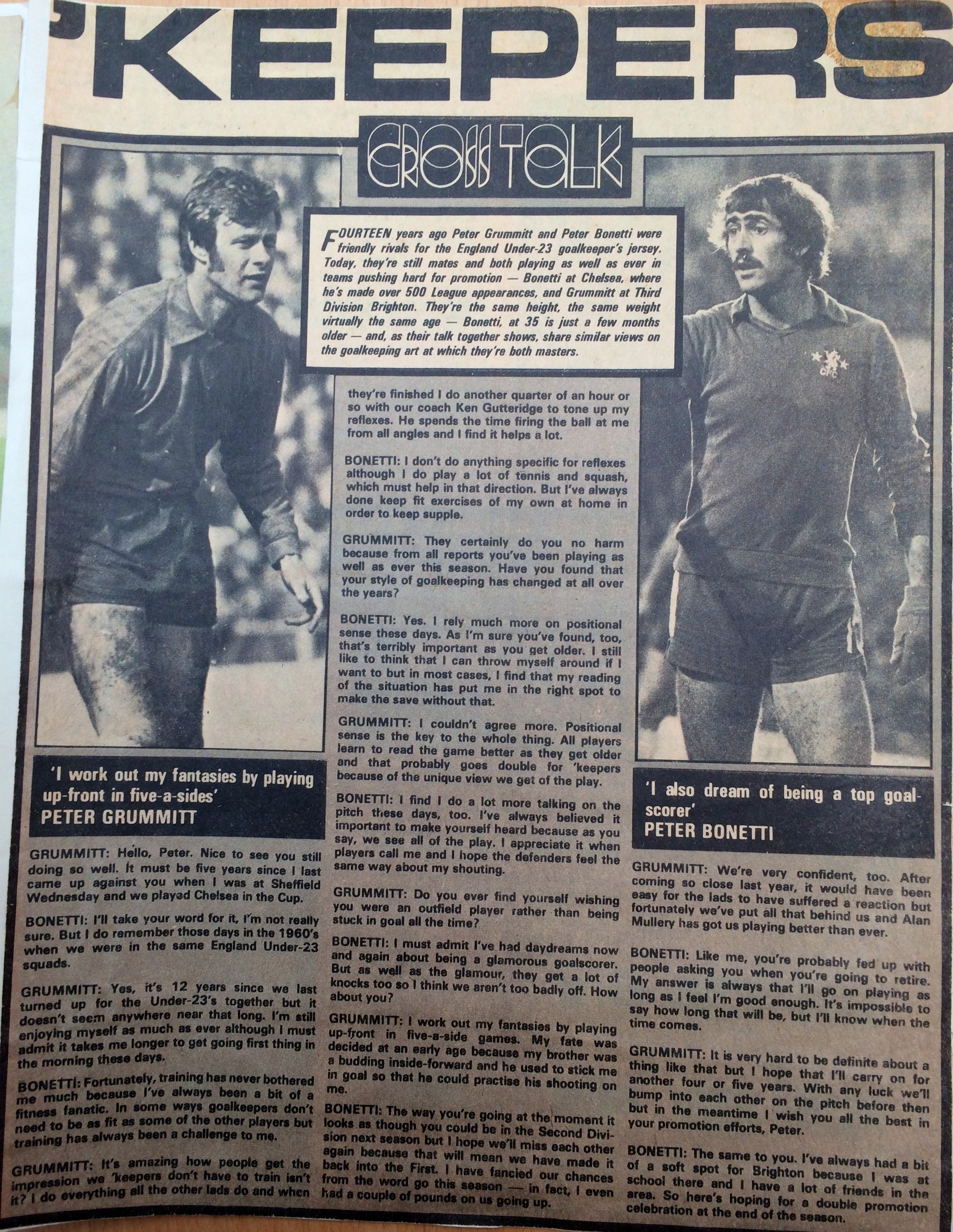
Looking back through my scrapbooks, I found a feature from Shoot! magazine in which Grummitt and Bonetti, by then both 35, exchanged views and memories.
Grummitt revealed how he ended up being a ‘keeper. “My fate was decided at an early age because my brother was a budding inside forward and he used to stick me in goal so that he could practice his shooting on me,” he told the magazine.
In the same article, Grummitt said he hoped he would be able to carry on for another four or five years. Sadly that wasn’t to be. His last game was against the same opponents he’d made his Brighton debut against, Tranmere, and he suffered a knee injury which, together with an arthritic hip, prevented him regaining full fitness and forced him to retire in December 1977.
Grummitt explained in an interview with Spencer Vignes in a 2015-16 matchday programme how his right knee completely let him down. “I’d been going down on the hard ground on my knees for years and I think it got to the point where it just couldn’t take any more,” he said. An operation he underwent involved drilling and scraping the knee to try to make it grow again.
“It did grow eventually, but it was too late for me to stay on at the club,” he said. “If I’d had nine months to recover, then maybe I’d have been okay.” He subsequently had a knee replacement.
Grummitt added: “I’d have liked another two or three years at Brighton, what with us starting to go places, but it wasn’t to be.”
On 2 May 1978, a testimonial for him took place between Albion and an Alan Mullery All Stars XI in front of a crowd of 5,615. In the match programme notes, Mullery admitted when he took over as manager he thought Grummitt might be too old to continue in the first team, but he pointed out: “Until he got his injury, he was as good a goalkeeper as there was in the country at that time.”
Describing him as “a first class goalkeeper”, Mullery praised Grummitt’s character and loyalty. “With players of Peter’s quality they are never forgotten. He has had a tremendous time here at the Goldstone and I certaiinly don’t think anyone will forget him.”
Vignes discovered in his interview how Grummitt used the proceeds from the testimonial to buy a newsagent’s shop in Queens Road, Brighton, as well as briefly managing Lewes and working as a youth coach at Worthing. He also had brief spells playing part-time for Worthing and Dover Athletic but eventually returned to the East Midlands, settling in Newark.
One small claim to fame on my part – I once played in the same team as Grummitt at Withdean Stadium.
Former Argus sports reporter Jamie Baker put together a team of Sussex sports writers for a game and, as one who reported on local football at the time, I was invited to play.
Imagine my surprise as we were getting changed before the match to discover sitting alongside us in the dressing room was Peter Grummitt, who Jamie had drafted in as a “ringer” to try to ensure at least our last line of defence was sound!



 In parallel lines
11 thoughts on “Peter Grummitt a contender for Brighton’s best ever no.1”