Steve Gatting’s three Brighton Wembley dates after missing out with Arsenal

1 MAIN gat sees GS goal.jpgSTEVE Gatting played at Wembley three times for Brighton having twice been denied the opportunity by Arsenal.

After being left out of Arsenal’s FA Cup Final sides in both 1979 and 1980 he finally got to step out onto the hallowed turf twice in the space of five days in 1983.

And his appearance in Brighton’s 3-1 defeat to Notts County in the 1991 play-off final at the famous old stadium was also his last in an Albion shirt after 10 years at the club.

In Match Weekly’s 1983 Cup Final preview edition, Gatting revealed his heartache at missing out with Arsenal in 1979. “I expected to be at least substitute after playing in five of the games leading up to Wembley, including the semi-final,” he said. “I was desperately sick when I didn’t get a chance. Although I really wanted the lads to do well, I couldn’t help feeling pangs of regret as the cup was paraded around the ground.”

Born on 29 May 1959 in Park Royal, London, two years after his famous brother Mike, the former Middlesex and England cricket captain, Steve was no mean batsman himself.

Instead of joining the ground staff at Middlesex County Cricket Club, though, Gatting shone at football with Middlesex and London Schoolboys teams and became an associate schoolboy with Arsenal before joining as an apprentice in July 1975. Terry Neill signed him as a professional at the age of 17 and a year later he made his First Division debut against Southampton at Highbury.

Gatting made 76 appearances for Arsenal over three seasons, his most memorable being the 1979 FA Cup semi-final against Wolves at Villa Park. He said his biggest disappointment was missing out on the May 1980 European Cup Winners Cup Final against Valencia in Brussels.

In his youth career, Gatting played in the centre of the back four but Arsenal generally played him in midfield, where competition for places was fierce with the likes of Liam Brady and Graham Rix. He admitted after joining Brighton: “When they bought Brian Talbot from Ipswich, I sensed I was on my way out.”

It was rumoured Albion would take Gatting as part of a swap deal that would see Mark Lawrenson join Arsenal but, of course, Lawrenson went to Liverpool instead. Albion were still interested in Gatting, though, and in September 1981 new manager Mike Bailey met him and his displaced colleague Sammy Nelson at Gatwick Airport and agreed terms to buy the pair of them; £200,000 the fee for the young Gatting.

Albion offered Gatting the chance of regular first team football and, although the expectation was for him to occupy a midfield spot, he quickly stepped in alongside Steve Foster in the back four and completed 45 appearances that season.

Aside from a rare couple of spells back in midfield, he remained a defender for the rest of his career, often slotting in at left back – apart from when he played right-back in the Cup Final replay.

Gatting had a terrific game alongside Gary Stevens in the 2-2 drawn first game against Man United, but Jimmy Melia unwisely chose to play the left-footed Gatting in place of injured Chris Ramsey (he should have put Stevens there) and the back line was noticeably unbalanced as they went down 4-0.

The Paul Camillin / Stewart Weir book Albion The first 100 years said: “Played out of position at right-back in the replay, he endured an uncomfortable evening in an unfamiliar role.”

Even so, interviewed three years later in the Albion matchday programme, Gatting spoke fondly about his memories of the whole occasion.

“The helicopter flight to Wembley was a new experience. We flew over the stadium and saw all our fans below,” he said. “That was a great moment. We landed and drove to the ground and went straight out onto the pitch to get a taste of the atmosphere. I met my brother Mike out there and to be honest he was more nervous than me!

“The greatest part of the whole day was walking out of the tunnel and seeing all the fans and being deafened by the cheering. That is an ambition every footballer has, to play in the Cup Final at Wembley. It was a dream come true for us and I think it lifted our game.”

Gatting had made only eight first team appearances in the 1984-85 season before, in November 1984, he sustained a serious pelvic injury which threatened his career. After five months, it was decided the only solution was a bone graft to the pelvis.

He had to remain motionless in hospital for a month and then rest on his couch when he was allowed home.

His wife Joy told Tony Norman in March 1986: “I felt sorry for Steve. He’s usually such an active person but suddenly he just had to sit there. It must have been very difficult. But Steve never got into self-pity. He stayed very positive and I respected him for that.”

Norman reported: “It was a long hard road for Steve. He started taking long walks in July, to build up strength and that progressed into jogging, light training and finally full training. He made his comeback game in the Reserves on 26 October.

Gatting told the interviewer: “When you are playing regularly, you tend to take things for granted. But when something like a serious injury comes along, it makes you realise how lucky you are to be fit and playing the game you enjoy so much. When you’re sitting on the sidelines week in week out it brings it home to you.”

The injury restricted him to only 17 appearances in the 1985-86 season but he was restored fully to the side in 1986-87 when financial issues clouded Alan Mullery’s return to the manager’s chair and successor Barry Lloyd couldn’t stop the inexorable slide to relegation from the second tier.

In a League Cup game replay away against First Division leaders Nottingham Forest, Gatting had to take over in goal when Perry Digweed  was forced off with a broken cheekbone. Gatting completed 45 appearances that season and said: “Dropping into the Third Division was far worse than going out of the First.

'keeper Gatt - webb on ground

Makeshift ‘keeper Gatting claims the ball with Nottingham Forest’s Neil Webb grounded

“All the players at the time felt they were good enough to stay up, but it didn’t happen and we gave a lot of silly goals away.

“The whole club was unsettled, too, but things became better again. Getting back into the Second Division was a boost for everybody.”

Gatting was ever-present in the 1987-88 promotion-winning campaign, even though in July 1987 Lloyd had given him a free transfer! The defender had other ideas and managed to play his way back into contention to such an extent that he ended up the season as captain, taking over from Doug Rougvie.

“It was nice to know I was wanted, particularly after relegation the year before,” he said.

Having made his 200th league appearance for the Albion against Chester on 12 December 1987, it was no surprise he viewed with some relish a FA Cup tie against his old club.

“Quite honestly, as a Third Division club, we don’t expect to go all the way, but I think we have the ability to scrape a result against Arsenal,” he said. “It gives me the opportunity to renew old friendships with Kenny Sansom, David O’Leary, Graham Rix and Paul Davis who were all members of the Arsenal staff when I was there.”

Albion pushed the Gunners all the way in front of a packed house and Garry Nelson rifled a memorable goal, but Arsenal prevailed 2-1.

Evening Argus Albion reporter John Vinicombe profiled Gatting warmly in a piece produced for a pre-season supplement ahead of the 1989-90 season, headlined “ice-cool Gatt”.

He described Gatting as “surely one of the most laid-back of individuals, whose natural personality is quiet and reserved”.

The report continued: “He shuns being the centre of attention, but the fact that he stays cool, even in nerve-wracking situations, is an important consideration when assessing leadership qualities.

“Leadership runs in the family, and many would say that older brother Mike was unlucky to lose the captaincy of England’s cricket team.”

On another occasion, Gatting said of his brother: “I’m proud of what Mike has achieved and I keep up to date with the latest news and enjoy watching the highlights on TV.

“We are close, we always have been, but the funny thing is I hardly ever go to see Mike play. When I do go, he never seems to make runs. So I think it’s best to stay at home and watch the Tests on TV.”

As mentioned previously, Steve was a good batsman in his own right and played for Middlesex Second XI. In Sussex, he enjoyed a summer tour with Brighton Brunswick as well as making runs for Preston Nomads.

Vincombe wrote: “Gatting occupies a special niche in the affections of Albion regulars. They see in him a thoroughly decent and well-behaved person whose standards on and off the field are high. Albion have been good to him and Gatting, after not a few periods of uncertainty, has been good for Albion.”

Gatting for his part said: “I’ve seen a lot of changes since arriving here, and I’ve played under five managers who have all had different ideas.”

testimonialA cut glass decanter and glasses from chairman Dudley Sizen at Gatting’s testimonial

He was granted a testimonial for his long service and a curtain-raiser to his 10th season with the club saw Albion draw 2-2 with Arsenal in front of a crowd of 5,517. The Gunners included their recent big money signings David Seaman, Andy Linighan and Anders Limpar.

Injury niggles continued to plague him towards the end of his 10 years at the club but he worked his way back into the side in 1990-91, slotting in at left-back and culminating in that 1991 play-off final against Notts County at Wembley.

Long after all the other members of the Brighton 1983 Cup Final side had departed, Gatting was still pulling on the stripes, and, but for those injuries, he would surely have made many more appearances than the 366 + three as sub (21 goals) that stand as his record.

Given another free transfer in 1991, he departed for Second Division Charlton Athletic along with Garry Nelson, linking up with former Albion teammate Alan Curbishley who at the time was joint manager with Steve Gritt.

Charlton only narrowly missed out on a play-off place while Albion were relegated!

By the end of the following season, when Gatting retired, he had played a total of 64 games for the Addicks.

He then turned his attention to coaching and spent seven years at independent school Christ’s Hospital, Horsham, before returning to Arsenal in 2007 to work as an academy coach. Gatting was working as Arsenal’s under-23s coach until May 2018 when he and his assistant Carl Laraman were suspended after accusations of bullying were made against them, and neither returned to their roles.

Gatting subsequently joined League Two Stevenage as assistant coach under Dino Maamria just before Christmas 2018 but he left the Hertfordshire club shortly before the end of the 2018-19 season.

• There have not been many father-son combos during my time watching Albion (Gerry and Darragh Ryan were the first that spring to mind) but it must have given Steve great pride to see his son Joe make it through the youth ranks at Brighton and go on to play for the first team. He made 44 appearances and I recall an away game at Carrow Road when Steve and Uncle Mike were both watching the youngster in Albion’s forward line. Eventually, after he left the Seagulls in 2008, he turned to cricket and was good enough to play at county level for Sussex and Hampshire.

Barça boy Orlandi twice denied promotion with the Seagulls

andrea-orlandi-brightonARTICULATE Andrea Orlandi would probably rank as one of my favourite Albion players of recent times. It was just a shame he seemed bedevilled by injuries which curtailed his contribution.
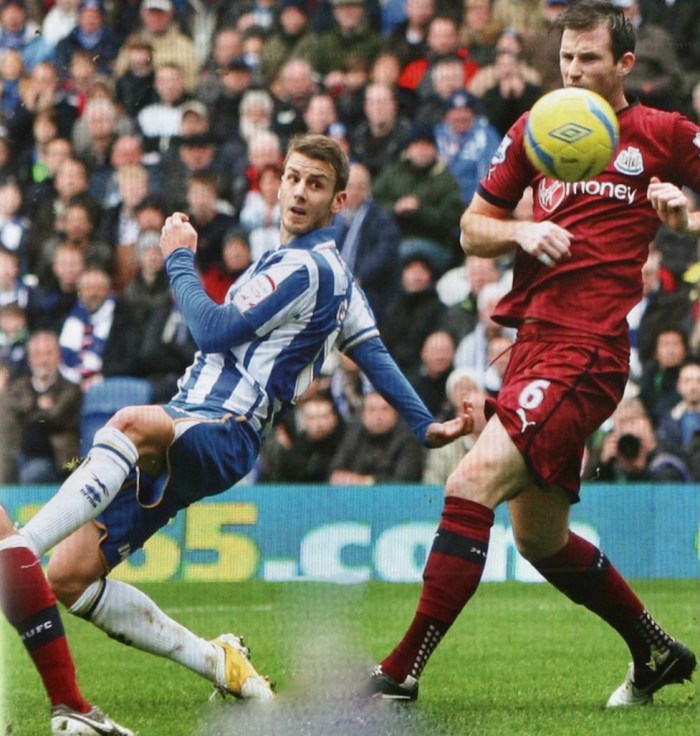
On his day, his technical ability definitely improved Brighton’s creativity going forward and I guess he’ll always be remembered for the goal he scored against Premier League Newcastle in the third round of the FA Cup on 5 January 2013 which he somehow guided in from what seemed an impossible angle.

On bbc.co.uk, the match report recorded: “A rejuvenated Wayne Bridge surged down the left flank, gathered Gordon Greer’s raking 50-yard pass and crossed for Orlandi, who flicked the ball up with his left foot and delightfully fired home with the outside of the same boot.”

Orlandi Newc goal

Orlandi was 28 when Gus Poyet signed him on a two-year contract on transfer deadline day in August 2012. “Andrea provides us with versatility and creativity across the midfield,” Poyet told the club’s official website.

“He can play as a typical winger, or more central in a number 10 role. He has played a lot of games in the Championship for Swansea, helping them win promotion, and he has played at the top level.”

It was crowd favourite Craig Noone’s departure to Cardiff that created the opening for Orlandi’s arrival, although they were very different players.

At Brighton, Orlandi had the chance to renew his great friendship with Seagulls legend Inigo Calderon, a former Alavés B side teammate, and there was quite a contingent of Spanish players at the club during that 2012-13 season.

As the Seagulls finished fourth and the Poyet era came to a close after the Palace play-off farce, Orlandi had played 30 games plus five as sub and added six league goals to that one in the FA Cup.

Under Poyet’s successor, Oscar Garcia, Orlandi picked up a knee injury in the opening game of the season, against Leeds, which required surgery.

“The doctor I went to see is regarded as one of the best in Europe so although it was disappointing that I had to undergo surgery, I was in the best hands,” he told the club website. “Although I was hoping rest would cure the problem, I was told I would risk further damage if I didn’t have surgery.”

As it turned out, he managed just 12 starts plus six as sub as the season culminated in yet more play-off heartache, this time at the hands of Derby County.

Orlandi played in both legs against the Rams and, although Garcia decided to quit, he recommended Orlandi be given a contract extension. As soon as Garcia had gone, though, head of football David Burke called him in to the club and told him he was being released.

Orlandi told the club website: “I’m sad. My youngest daughter was born here and I was hoping to stay here a lot longer but that is football.

“I really felt loved by everyone, especially the fans who were incredible to me whether I was on the pitch or off of it and that is something that nothing will ever take away from me.

“The city and all the people in it are wonderful and I wish everyone nothing but the best going forward and I hope the club can fulfil the dream of playing in the Premier League soon. I’m just sorry I couldn’t help to make that happen.

“It is a real shame that in my two years we got so close but we just couldn’t get over the finish line, but I will take away some magnificent memories with me.

“Once again I just want to pay tribute to the tremendous support I have felt during my time here.”

In a subsequent matchday programme article, Orlandi said: “Just running out at the Amex in front of a full house was an amazing experience – I loved every minute of my time at the club and loved playing for the fans.

“I will always hold Brighton close to my heart.”

Born in Barcelona on 3 August 1984 to Italian parents (a Juventus-supporting dad and an AC Milan-supporting mum), he played as a youth at Espanyol but at 17 moved to Alavés where he made 58 appearances for their B team between 2003 and 2005.

When loaned to Barcelona, he continued to be a B team player but he did play two first team games for the Catalan giants: as left back under Frank Rijkaard in a 3-1 defeat to Athletic Bilbao and a Copa Cataluyna win over Espanyol.

When Alavés released him in 2007, fellow Spaniard Roberto Martinez picked him up as a free agent and took him to Swansea City, where he stayed for five years.

Orlandi yellowManagerial changes at the Swans meant he wasn’t always first choice although on signing a contract extension in July 2011, chairman Huw Jenkins said: “He has grown into the squad over the past few years and his technical ability is well suited to the Premier League.”

He was part of Brendan Rogers’ squad promoted to the Premier League via a 4-2 play-off final win over Reading, appearing 24 times over the season, although he didn’t feature in the final at Wembley.

AO SwansIn one of his last Swansea games, on 28 April 2012, Orlandi scored after just 25 seconds of a Premier League game against already-relegated Wolves, but the game finished 4-4.

After his release from Brighton, he joined chaotic Championship side Blackpool, the day before the 2014-15 season started – with only a week to go, they had only eight registered professionals.

Under initially Jose Riga and then Lee Clark, Orlandi played 25 games plus five as sub, but the Tangerines finished rock bottom of the league, and the club was in disarray.

Orlandi revealed some of the strange goings-on in a weekly blog he wrote for Spanish website am14, including the time the goalkeeper Joe Lewis had to wear an autographed shirt intended for a presentation to a sponsor because there was no other top available.

In April 2015, Orlandi wrote: “When you first arrive in England in mid-April you imagine yourself spending your Sundays in the garden or having a drink on the terrace… you don’t imagine yourself stuck at home, listening to the wind and spending hours hiding from a hurricane.

“I have been living in England for almost eight years and the sun has always shone. This year is nothing like that, not in any sense. I will be patient and hopefully the nice weather will arrive before the end of the month. In terms of the football, the sun did not appear for Blackpool either.”

Orlandi also used the blog to talk about a defeat at Ipswich. “We started well, I scored a good goal thanks to a great assist from Cameron, and we lost. In part, this was thanks to my mistake which helped lead to their second goal.

“It was an error without explanation. ‘The pitch condition, the bounce of the ball, it came from a rebound’… excuses do not sit well with me. Unfortunately, sometimes we make inexplicable errors and that happened to me. I have to take responsibility, accept it and move on. The worst is that we equalised again and finally conceded 3-2 due to another silly play. It is the story of this season.

“When the league is finished, I will look at all the results and I shudder to think of the points that we have lost in, to put it mildly, a stupid fashion. Maybe we would not have avoided relegation but we would be in a different position, that is for sure.”

As the scorer of four goals, he was Blackpool’s second highest goalscorer for the season and, despite relegation, they hoped to keep him, but he invoked a release clause in his contract and became a free agent.

In August 2015, Orlandi signed for Cypriot First Division side Anorthosis Famagusta on a one-year deal but it didn’t sound like it was the greatest of experiences when Argus reporter Brian Owen caught up with him in February 2016, with Orlandi disappointed he hadn’t been able to find another English club in the Championship.

Orlandi switched clubs in Cyprus and joined APOEL but his one-year deal was terminated in January 2017 after he’d made 19 appearances.

He switched to Italy where he played 31 matches for Novara Calcio in Serie B and then joined his old pal Calde to spend half a season in the Indian Super League at Chennaiyin (under head coach John Gregory). On returning to Italy and signing for Serie C side Virtus Entella, during the medical a cardiologist discovered he’d got scarring in the left ventricle of his heart, and he was forced to retire without playing a game.

The popular Spaniard revealed in Richard Newman’s Football the Albion and Me podcast how he has gone on to become a scout for an agency as well as working as a TV pundit on La Liga and writing a column on that competition for the Evening Standard.Orlandi pundit

Pictures from various online sources and the Albion matchday programme

Coventry’s legendary skipper Ernie Machin also led Brighton

3 Machin Shoot!A MIDFIELD dynamo who captained Coventry City during their glory years at the top of English football’s pyramid was instantly installed as captain when he signed for third tier Brighton.
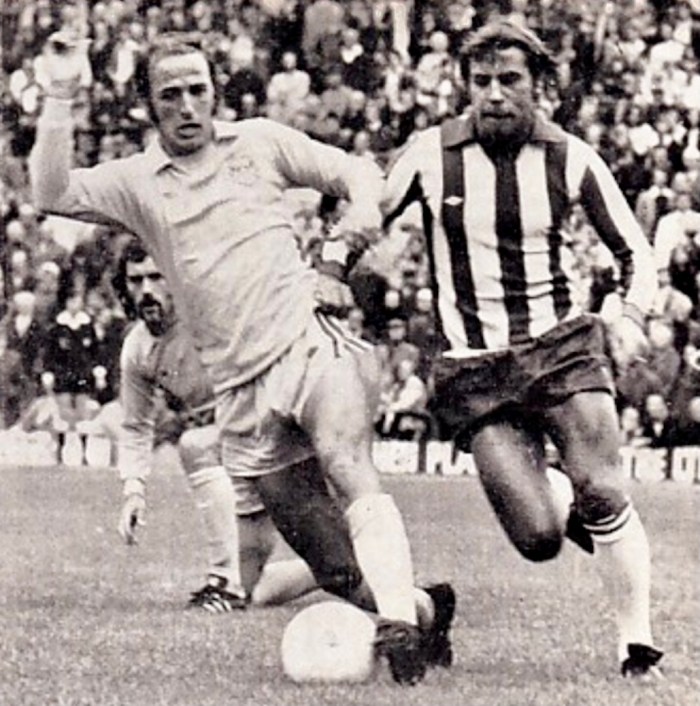
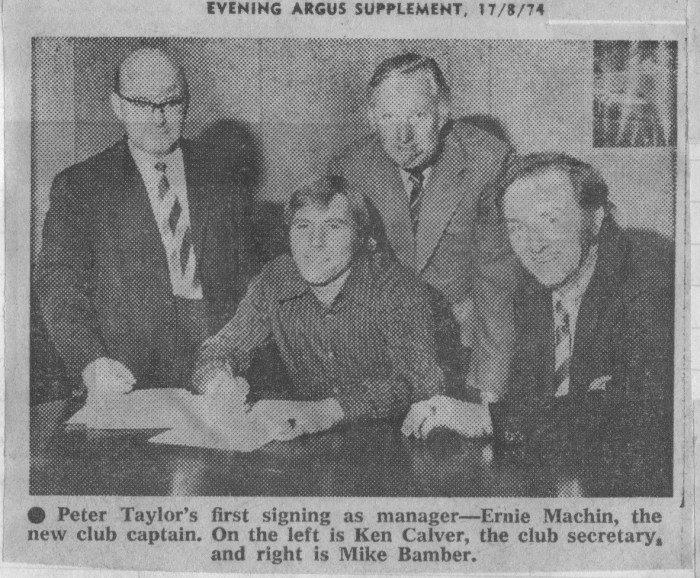
Ernie Machin was the first signing Peter Taylor made on taking sole charge of the Albion following Brian Clough’s decision to quit and join Leeds United.

Taylor, a former Coventry goalkeeper, had a well-earned reputation for his detailed knowledge of Midlands footballers.

Although Machin had moved to Plymouth Argyle in 1972, after 10 years at Highfield Road, he fitted the bill perfectly to add a bit of bite, experience and leadership to Taylor’s side.

A £30,000 fee took him to the Goldstone in the summer of 1974 but he was still nursing an injury sustained in training at Plymouth and when rushed into action too soon he broke down and missed quite a chunk of matches in the first part of the season.

Eventually he took up a regular spot in the centre of midfield and Argus reporter John Vinicombe observed in his end of season summary: “It wasn’t until the latter part of the season that Machin started to display known form.”

Machin actionThe midfielder eventually completed 31 games (plus three as sub) but manager Taylor took the captaincy from him and appointed his new centre back signing, Graham Winstanley.
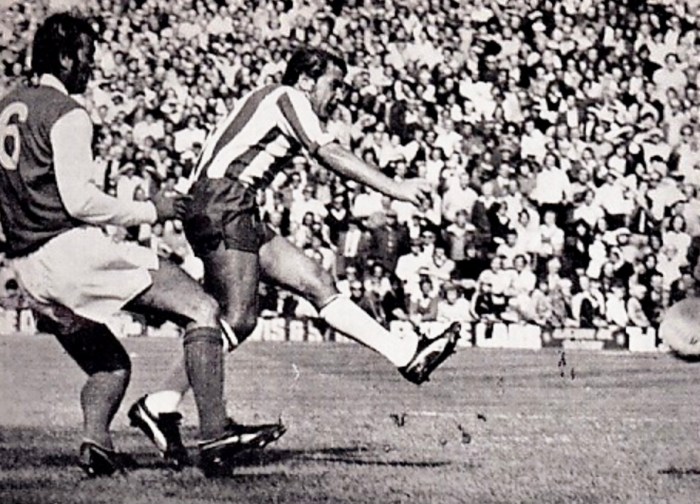
Nevertheless, Machin began the following season and got what would be his one and only Albion goal in the opening fixture, a 3-0 home win over Rotherham United.

He remained ever-present until the arrival in March 1976 of the on-pitch leader who would guide Albion to the promised land – Brian Horton.

Machin shootsMachin played 41 games that season and only shared the midfield with Horton once – in what turned out to be his final game in the stripes, a 4-2 home win over Grimsby Town.
I hadn’t been aware until reading the excellent thegoldstonewrap.com that Machin didn’t move to Sussex during his time with the Albion. “He never settled on the south coast, and still lived in Coventry and trained in the Midlands,” they reported.

So perhaps it was no surprise that when Jimmy Hill, the manager who signed him for City and went on to be Coventry chairman, offered Machin a job back at his old club, he was only too happy to accept.

He took on the role of youth team coach, but it didn’t work out and he left football and went to work for Car Bodies and Massey Ferguson.

Machin was a member of the Coventry City Former Players Association after his career ended and they paid due respect to his part in the club’s history when he died aged 68 on 22 July 2012.
In an extended obituary on their website, they related how he had been born in Walkden, Manchester, on 26 April 1944, and had trials alongside future World Cup winner Alan Ball at Bolton Wanderers, but was not considered good enough.

Instead Machin joined non-league Nelson FC and, in 1962, was spotted by Coventry’s North West scout Alf Walton, who suggested Hill sign him up.

Hill wasn’t entirely convinced but admired the fact he rarely wasted a pass when in possession, and paid the princely sum of £50 to take him to Highfield Road, adding a further £200 when he made it into the first team.

That breakthrough came in April 1963, aged 18, in a 2-0 win over Millwall, and by the start of the following season he was first choice in the number 10 shirt as the Sky Blues headed for promotion.

However, they did it without Machin who sustained a bad knee injury in a home game with Watford in November, and missed the rest of the season, and beyond. Indeed, it was 18 months before he played again, having endured several operations.

Eventually he returned to play a pivotal role in the club’s Second Division title win in 1967, scoring 11 goals along the way.

When regular captain George Curtis broke his leg in the club’s second game in Division One, Machin took over as skipper and missed only three games in the club’s first two years amongst the elite.

ccfpa.co.uk recalled: “Older fans will remember his stunning goal in the 2-0 victory over European champions elect Manchester United in March 1968.

“His never-say-die attitude won him the respect of all his playing colleagues and the fans. He continued to be a regular, when fit, right up to the time of his departure in 1972 but a bad car accident put him out for three months in 1970 and his ‘dodgy’ knee continued to trouble him.”

The history books record that in 1972 he was the first English footballer to go through the courts to challenge a FA fine and suspension using TV evidence. He was sent off in a game at Newcastle for allegedly kicking an opponent, but the footage proved his innocence.

Even so, the FA spotted something else he’d done and upheld the disciplinary action on the basis of that without allowing him to present a defence. The courts ruled against the FA, and the PFA subsequently established the rights of players to legal representation in disciplinary cases.

By the time Coventry’s new managers Joe Mercer and Gordon Milne sold him to Plymouth for £35,000, he had played 289 games and scored 39 goals.

The website greensonscreen.co.uk says: “When Machin moved to Home Park in December 1972 he soon showed his class and intelligence, controlling games from midfield. He was named the Player of the Year in his only full season with the club but, much to the dismay of the fans, requested a transfer and moved to Brighton and Hove Albion.”

Despite his relatively short stay at Home Park, he made such an impression that in 2004 he was named in Plymouth’s Team of the Century.

Although suffering from poor health, Machin attended a reunion of Coventry’s 1967 promotion-winning team in 2007 and in 2008 he was one of 30 former players inducted into the club’s Legends Group for services to the football club.

1 main ernie + cant2 machin signs

Pictures include one from my scrapbook of Machin in a Coventry team line-up alongside manager Noel Cantwell who kindly gave me his autograph when the Sky Blues played Brighton in a friendly. Also pictured, the Evening Argus coverage of his signing. And a Shoot! magazine portrait. Plus a montage of other images.

Striker who talks a good game helped Albion win promotion

ChrisI Stoke actionCHRIS Iwelumo played a vital cameo role in Brighton’s 2004 promotion from the third tier via that memorable play-off final in Cardiff.

After his playing days were over, he was a regular TV studio pundit offering his opinions on games, and he obtained a first class honours degree in sports writing and broadcasting from Staffordshire University.

Of the many clubs he played for – and there were EIGHTEEN of them – he obviously still has a deep affection for his first English club, Stoke City, and he continues to live in the area.

Born in Coatbridge, Scotland, on 1 August 1978 of a Nigerian father and Scottish mother, Iwelumo joined St Mirren as a youngster, and worked his way through the youth ranks before heading to Denmark and spending two years at Aarhus Fremad.

It was from there that he joined Stoke in 2000. His four-year stay on their books was the longest spell at any of his clubs, although it included three loan spells – the last of which saw him play 13 games for the Seagulls.

C Iwel stokeIwelumo reckons his proudest moment as a Stoke player was being part of the City side who beat Brentford 2-0 in a play-off final in Cardiff in 2002 (pictured above). It was to be useful experience to take to the Albion.

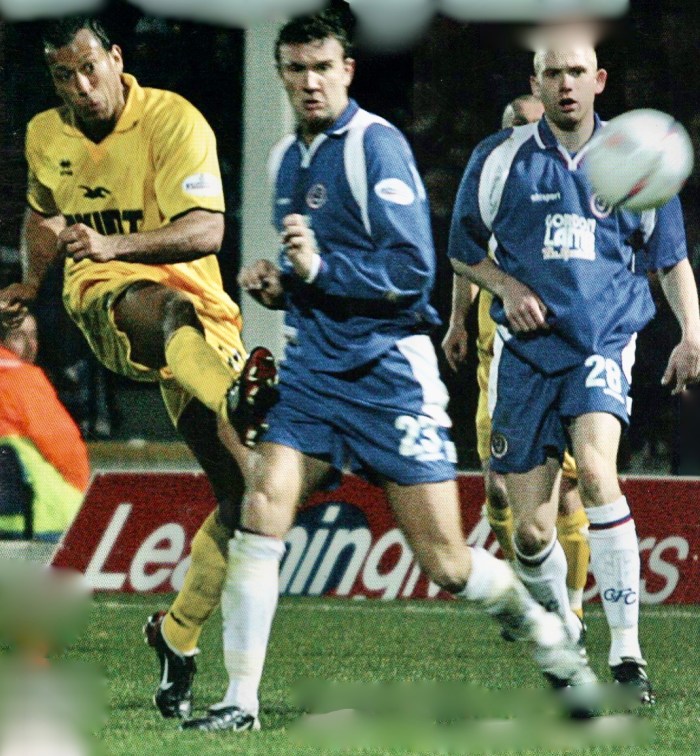
I can remember being at Saltergate on 16 March 2004, the evening he made his Brighton debut – and what a start he made. Iwelumo lashed in a long-range thunderbolt of a goal (below) seven minutes from time which earned the Seagulls a 2-0 win over Chesterfield on an unbelievably windy night.

Guy Butters had given Albion the lead with a header from a Nathan Jones corner just after half time, and very nearly repeated the feat with a carbon copy of the move but second time round the ball struck the bar.

Iwelumo’s strike was the first of four goals in his 13 Brighton appearances but undoubtedly the most memorable was that game at the Millennium Stadium, Cardiff.

Here’s how bbc.co.uk saw it: “At the start of the second-half, City camped inside the Brighton half as Doherty and Tinnion took control of the midfield, though Danny Wilson’s side were unable to convert that possession into chances. But Brighton survived that period of pressure and gradually Iwelumo began to come into the game.

“His first contribution was not too impressive as he rushed his shot after being released by Adam Virgo’s wonderful diagonal pass. He went closer when his flicked header from John Piercy’s superb cross momentarily worried Steve Phillips.

“With seven minutes to go Iwelumo broke into the City box and as he prepared to shoot the striker was upended by (Danny) Coles’ clumsy tackle.

“(Leon) Knight calmly slotted his spot-kick into the corner past Phillips’s despairing dive.”

Iwelumo described what happened in a subsequent matchday programme article. “It was a clumsy challenge. I’d played a little one-two and nicked the ball in ahead of him and he’s just swung a leg and taken me out – it was a blatant penalty.”

Albion’s victory meant McGhee finally banished play-off disappointment – he had lost out in the play-offs three times as a manager and once as a player. Iwelumo, meanwhile, was keen to make the move to Brighton permanent – but he wanted Albion to pay relocation costs.

McGhee suddenly went under the radar on holiday in America and couldn’t be contacted to try to resolve the impasse and, in the meantime, Iwelumo was offered the chance to go to Germany, and Alemannia Aachen, who had qualified to play in the UEFA Cup.

In a subsequent matchday programme interview with Iwelumo, the Scot told Spencer Vignes that he loved his time at Brighton and had hoped to stay. “I was devastated at the time because the whole club was perfect for me,” he said.

An irritated McGhee made some unwise comments suggesting Iwelumo probably wasn’t good enough to play at the higher level anyway. What followed in the striker’s career certainly proved that theory wrong.

In 2005, he returned to the UK to join League One Colchester United and was part of the promotion-winning side who went up to the Championship, rattling in an impressive 37 goals in 103 games in two seasons.

He then spent the 2007-08 season in the Championship with Charlton Athletic, scoring 10 in 50 appearances for the Addicks.

Cost cuts at The Valley saw him made available and Mick McCarthy took him to Wolverhampton Wanderers where he notched 16 in 35 appearances, although he missed out on the end of season promotion run-in after sustaining a medial ligament injury. In the autumn of 2008, though, his performances for Wolves had caught the eye of the Scotland selectors.

Mind you, what happened on his Scotland debut on 11 October 2008 has haunted him ever since and is the stuff of YouTube legend. After coming on as a substitute in what was a World Cup qualifier, as the Daily Record reported: “On his debut in a 0-0 draw v Norway at Hampden, he missed from two yards out. Manager George Burley turned away in disbelief.”CI miss

“That miss against Norway was a low which ultimately, I like to think, represented a bump in the road of an otherwise successful journey through professional football lasting over two decades,” he told the Terrace Scottish Football podcast.

“Representing my country, enjoying five promotions, and collecting two cup winner’s medals. You cannot dwell too much on any single moment because it will impact upon the next performance.

“The highs are to be celebrated but, like the lows, are also to be learned from.”

He added: “I’ve looked at it over and over. The reason I missed that? I have no idea. I went back and scored ten goals in the next six or seven games for Wolves. I was on absolute fire. I’d already scored a few in the games before the call-up.

“The media were very harsh over the next two or three weeks. I think I was fortunate because I was playing down in England. I missed a lot of it.

“It is one of those things that haunts you. It was the highest and lowest moment of my career rolled into one. I got to go out and represent my country but then I’ve got that miss on my debut.”

As he pointed out in an interview with one of his former clubs, Scunthorpe United: “I was a centimetre away from being a national hero and I’m a very proud Scot, so that would’ve been a dream come true had it been the other way round.”

Although he played 15 league games and two cup games following Wolves’ promotion to the Premier League, he didn’t manage to score and in 2010 he was loaned out to Bristol City in the Championship, where he scored twice in seven matches.

For the start of the 2010-11 season, he was at yet another new club, in newly-relegated Burnley’s Championship side under Brian Laws (replaced by Eddie Howe in January 2011). Iwelumo made a total of 31 starts for the Clarets, plus 19 appearances as a sub, and got on the scoresheet 11 times.

After just one season at Turf Moor, Iwelumo was on the move again, this time joining Sean Dyche’s Watford on a two-year deal for an undisclosed fee. By now he was 32. In his first season he played 39 games but managed only three goals and endured a five-month barren spell in front of goal.

The following season he played just eight times for the Hornets and was sent on loan to two League One sides, Notts County and Oldham Athletic, only managing one goal in a total of 14 games at that level.

At Oldham, Iwelumo found himself playing under a manager – and a former Bristol City teammate – who was three years younger. Lee Johnson, at 31, had become the youngest permanent manager in English football in 2013 when he was appointed by the League One Latics.

“Chris actually wanted the job as well when I went to Oldham, so we were having discussions about the job and the club,” Johnson told The Athletic. “One of my first conversations with Chris — remembering he was my friend and helped me get the job — was literally to say: ‘Listen mate, I think your legs have gone, I’m not going to play you’.

“He was saying, ‘This guy has got a bit of b******s to tell me that’. I asked him to effectively be one of my assistants, still come on, still make a difference. He did that fantastically well. That was important. I had to get him onside.”

On his release from Watford, Iwelumo joined League Two Scunthorpe United for the 2013-14 season but only scored twice in 14 games and, after six months, he moved on to Scottish Premier side St Johnstone for a six-game spell but didn’t get on the scoresheet.

In June 2014, Iwelumo signed for Conference side Chester but after scoring just once in 10 matches decided to call it a day. Chester chairman Grenville Millington (who was once Brighton’s back-up goalkeeper to Brian Powney) said: “Chris has had a glittering career in football for over 20 years. I’m sure that he retires with a heavy heart but I’ve no doubt that he will continue his relationship with professional football for many years to come.”

Prescient words because a couple of years later he was back at the club as an assistant manager and then striker coach after stints doing media work for Stoke City and a week-long stay as coach of Wolves’ under 18s.

Albion picture from  Bennett Dean / Pitch Publishing’s We Are Brighton / Play Off Special; celebrating a goal from the Stoke City programme;  appearing on Channel 5’s Championship programme, and, as seen on the PFA’s website, graduating at Staffordshire University. 

Small big hit for Albion before bubble burst at Hammers

1 short n small

FOOTBALL might well have changed a lot over the years but there are few sights that please fans more than seeing a great pair of strikers doing the business for their team.

The first excellent striking duo I witnessed playing for the Albion were Peter Ward and Ian Mellor, who complemented each other ideally in the mid ‘70s.

Kevin Bremner and Garry Nelson provided a potent third tier pairing, especially in the promotion-winning season of 1987-88, and Brighton’s next top pairing nearly took the Albion back to the top, only for Wembley play-off final heartbreak to dash all our hopes.

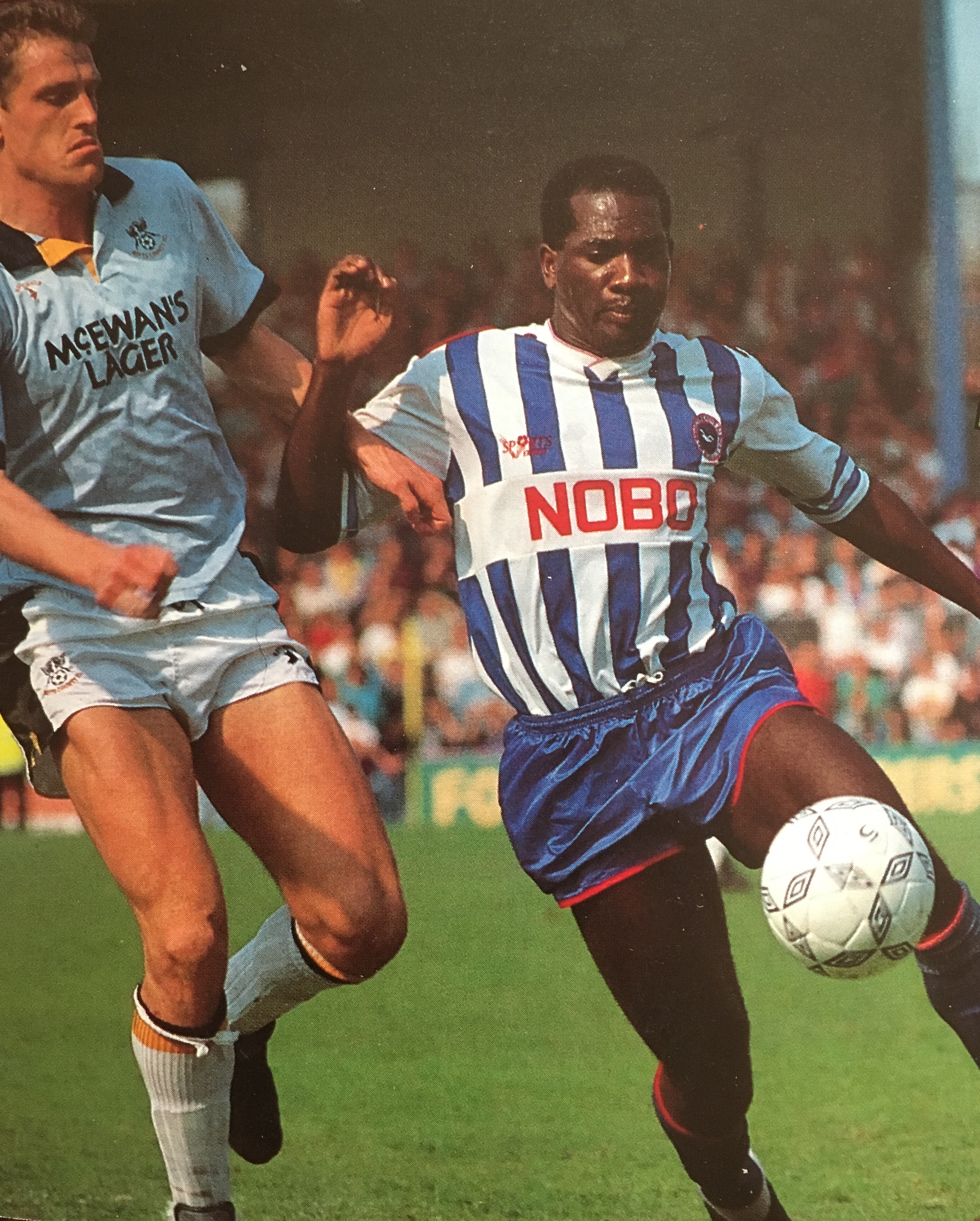
Step forward Mike Small and John Byrne, forever etched in the memories of those Albion followers who go back as far as the 1990-91 season. Small scored 21 goals in 49 games that campaign while Byrne chipped in with 11 in 38 (plus four as sub).

The history books haven’t always looked favourably on Barry Lloyd’s time in Brighton’s managerial chair but few could deny him the plaudits for bringing together two players who had drifted away from the UK in pursuit of developing their careers.

Small had what could only be described as a nomadic career. Born in Selly Oak, Birmingham, on 2 April 1962, his talent on the football field earned him England Youth international honours and he joined Luton Town under David Pleat.

His first team chances were limited with the Hatters because of the form of Brian Stein, Steve White and Paul Walsh although in December 1981 I witnessed, along with one of the smallest crowds ever seen at the Goldstone – 2,282 – a brief substitute appearance Small made for Luton.

It was in the 1981-82 season when I was briefly a news reporter on the Luton Herald. In what was quite a bad winter, several postponements left certain teams with empty Saturdays. Division 2 Luton and Division 1 Brighton filled one of these with a friendly at the Goldstone Ground.

Knowing my affiliation with Brighton, the editor kindly allowed me to dust off my sports reporter notebook and take myself off to Hove. It was my one and only time in the Goldstone press box, sitting alongside that Argus veteran, John Vinicombe, and I dutifully recorded how Small got a run-out as a sub for the last 20 minutes of a game which finished 1-0 to the Albion.

With playing time limited at Kenilworth Road, Small had a brief loan spell at Peterborough before taking himself off to Europe where he started showing his goalscoring capabilities.

In two spells with Go Ahead Eagles (1983-85 and 1986-87) he scored 22 goals in 78 appearances either side of 25 games for Standard Liege in Belgium.

The goals dried up in 23 games on loan to NAC Breda but at Vitesse Arnhem in 1987-88, he scored 12 in 26.

From the Low Countries, he travelled to Greece and had two years with PAOK Salonika, where he encountered some unwanted fanaticism from their supporters, on one occasion ending up with a cut eye after an attack by 50 local ‘fans’ at a practice session and also receiving letters threatening his life.

In an article about the striker’s arrival at Brighton by the aforementioned Vinicombe, he wrote: “Nobody knew much about Small save a thumbnail history of his low-key wanderings in Europe. Even the fee to PAOK Salonika was undisclosed, but the grapevine whispered £70,000 and Lloyd issued no contradiction.

“It was as if Small had returned to his native land by stealth after an absence of nearly ten years and Lloyd, through a close-linked chain of overseas contacts, soon realised he might be on to something good.”

His return of four goals in pre-season friendlies having joined on a trial basis were a good indicator of what might follow and he turned down offers from overseas clubs to re-establish himself in the UK with Brighton.

Vinicombe summed up the goalscoring Small’s contribution thus: “A muscular six footer who weighs over 13 stone, he cuts a fearsome figure for opposition defences. Off the pitch he’s a remarkably quiet guy who doesn’t really relish the ‘big target man’ tag.”

Small told the Argus man: “I like it when the ball is played through and not just lumped up the middle. John Byrne is a great foil and a good link-up player and I don’t think I should be in there crowding him out.

“John is a real showman. When he takes a breather, I take over and we work as a team.”

Of Small’s 21 goals in 1990-91, seven were from the penalty spot.

“His coolness and accuracy in one-for-one situations has served Albion well on many an occasion and the only interruption during the season was recovering from a pulled hamstring,” Vinicombe observed.

The story of Small’s partnership with Byrne was told in the short-lived Seagull News magazine, when an interview with the pair revealed some of the chemistry that produced what it described as the “hottest Goldstone striking duo for over a decade”.

In a relatively parlous state at the time, Albion had been forced to sell ‘keeper John Keeley to Oldham (£238,000) and Keith Dublin to Watford (£275,000), but it meant Lloyd had funds to pay reasonable fees for Small and Byrne; a £120,000 fee acquiring Byrne’s services from Le Havre, where he’d been playing up front with his Republic of Ireland teammate, Frank Stapleton.

“I knew of a John Byrne in France but didn’t know what he was like or how he played,” Small told Seagull News. “But we soon hit it off. He’s such a good player on and off the ball and he’s got bags of experience which helps me a lot.”

The two got to know each other well when staying in the same Brighton hotel after their respective moves, before finding homes for their families.

Both made the most of the limelight of a high profile FA Cup tie between Liverpool and Brighton and got themselves on the scoresheet.

“It’s been a tremendous season for us so far,” said Mike. “We’ve developed a great understanding but it’s Budgie who leads. He’s involved a lot more in the play linking midfield and attack and creates a lot of openings and situations – far more than people realise – by dragging players away.

“Opponents have been finding it difficult to cope with us because we both like to run at defences and get behind them.”

Byrne added: “We hit it off from the very beginning. We’re great mates off the pitch and that helps. But the big boost for us and the team is that we always feel we can score.

“Mike’s impressed me immensely. He’s got great touch for a big man, he scores goals and is a real handful for any defender – I wouldn’t like to mark him!”

Small’s last goal for the Seagulls came in one of the most memorable games: the 4-1 play-off first leg win over Millwall at the Goldstone.

Sadly, Albion’s failure to win the play-off final spelled the end of the glorious goalscoring partnership and, in that canny way he had in the transfer market, Lloyd managed to get a sum of £400,000 for Small – quite amazing considering the club’s initial outlay barely a year earlier – but West Ham were prepared to stump up the readies and Brighton were more than happy.

Likewise, Byrne was sold to Sunderland for £235,000, delivering a sizeable profit on the club’s original investment.

Manager Billy Bonds must have thought he was a managerial genius when Small continued his rich vein of goalscoring form in the top division. He scored 13 goals in just 19 starts.

A West Ham side that included future Albion boss Chris Hughton in its defence had been promoted but was in need of new firepower after only Trevor Morley (12) and Frank McAvennie (10) had hit double figures. Iain Dowie and Jimmy Quinn had also chipped in but, with Dowie departed, Bonds needed a physical presence up front.

Writer Sid Lambert on thewesthamway.co.uk takes up the story.

“Small fit the bill perfectly. He was in-form and, more importantly, very affordable at just £400,000.

“Incredibly, Small took that red-hot form straight into the top tier. He took just two games to get off the mark, scoring in a 1-1 draw at Sheffield United. In the next home game he scored as the Hammers beat Aston Villa 3-1.

“We had five points from our first four games and had only suffered defeat once. Things were looking promising. As is the West Ham way, that promise started to fade. But Small’s ruthlessness in front of goal didn’t. He scored in successive games against Chelsea, Norwich and Crystal Palace, where a precious three points kept us out of the relegation zone.

“It wasn’t just sheer volume, Small was scoring every type of goal: tap-ins, headers, one-on-ones. The Birmingham-born man was brimming with confidence. Everything he hit turned to gold.

Small Hammer

“A seven-day spell at the end of October 1991 was Small’s finest hour in claret and blue. He scored the equaliser – cancelling out an early strike from Gary Lineker – as we beat Tottenham 2-1 at Upton Park. In midweek a penalty helped us to a 2-0 League Cup win at Sheffield United before we travelled to Highbury to face George Graham’s Arsenal.

“After absorbing heavy pressure throughout, the marauding Mitchell Thomas led a rare Hammers’ break into the Arsenal half. Tim Breacker fed the ball to Small, who easily eluded Tony Adams before unleashing a left-foot screamer past David Seaman. In a split-second he’d embarrassed two of England’s very best.”

West Ham were 14th place and Small could seemingly do no wrong.

“By now, he was the country’s in-form striker and there were even whispers that Graham Taylor might consider him for England duty,” said Lambert.

“The only thing to match his meteoric rise was the fall that followed. It took three months for Small to score again, a winner at Luton Town. By now, we were mired in the bottom three. Small’s confidence, like the team, had completely evaporated. The first touch was less assured and the finishing hesitant.”

A niggling back injury was thought to have contributed to Small’s malaise but he and the team failed to replicate their early season form and finished rock bottom of the division.

When Clive Allen arrived at Upton Park, Small fell down the pecking order and towards the end of 1993-94 was sent out on loan to Wolves and Charlton.

After leaving the Hammers, he played briefly for BK Häcken in Sweden, Stevenage Borough, then Sligo Rovers and Derry City in Ireland, but the heady days were well and truly over.

A brief foray into coaching and management saw him involved with non-league clubs Haringey Borough, Kingsbury Town and Waltham Forest but all were shortlived.

Further reading

http://www.thewesthamway.co.uk/2016/11/22/forgotten-man-mike-small/