

 CHRIS Iwelumo played a vital cameo role in Brighton’s 2004 promotion from the third tier via that memorable play-off final in Cardiff.
After his playing days were over, he was a regular TV studio pundit offering his opinions on games, and he obtained a first class honours degree in sports writing and broadcasting from Staffordshire University.
Of the many clubs he played for – and there were EIGHTEEN of them – he obviously still has a deep affection for his first English club, Stoke City, and he continues to live in the area.
Born in Coatbridge, Scotland, on 1 August 1978 of a Nigerian father and Scottish mother, Iwelumo joined St Mirren as a youngster, and worked his way through the youth ranks before heading to Denmark and spending two years at Aarhus Fremad.
It was from there that he joined Stoke in 2000. His four-year stay on their books was the longest spell at any of his clubs, although it included three loan spells – the last of which saw him play 13 games for the Seagulls.
 Iwelumo reckons his proudest moment as a Stoke player was being part of the City side who beat Brentford 2-0 in a play-off final in Cardiff in 2002 (pictured above). It was to be useful experience to take to the Albion.
I can remember being at Saltergate on 16 March 2004, the evening he made his Brighton debut – and what a start he made. Iwelumo lashed in a long-range thunderbolt of a goal (below) seven minutes from time which earned the Seagulls a 2-0 win over Chesterfield on an unbelievably windy night.
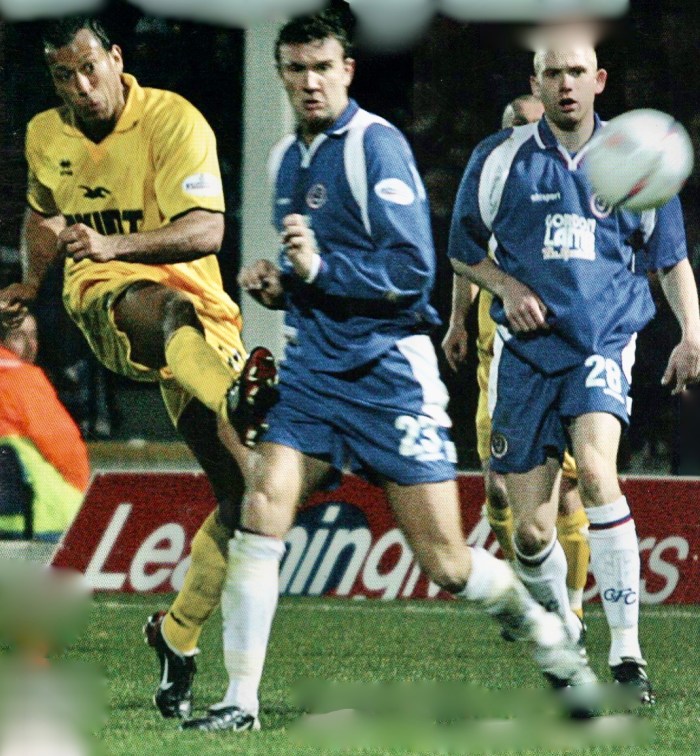
Guy Butters had given Albion the lead with a header from a Nathan Jones corner just after half time, and very nearly repeated the feat with a carbon copy of the move but second time round the ball struck the bar.


Iwelumo’s strike was the first of four goals in his 13 Brighton appearances but undoubtedly the most memorable was that game at the Millennium Stadium, Cardiff.
Here’s how bbc.co.uk saw it: “At the start of the second-half, City camped inside the Brighton half as Doherty and Tinnion took control of the midfield, though Danny Wilson’s side were unable to convert that possession into chances. But Brighton survived that period of pressure and gradually Iwelumo began to come into the game.
“His first contribution was not too impressive as he rushed his shot after being released by Adam Virgo’s wonderful diagonal pass. He went closer when his flicked header from John Piercy’s superb cross momentarily worried Steve Phillips.
“With seven minutes to go Iwelumo broke into the City box and as he prepared to shoot the striker was upended by (Danny) Coles’ clumsy tackle.
“(Leon) Knight calmly slotted his spot-kick into the corner past Phillips’s despairing dive.”
Iwelumo described what happened in a subsequent matchday programme article. “It was a clumsy challenge. I’d played a little one-two and nicked the ball in ahead of him and he’s just swung a leg and taken me out – it was a blatant penalty.”
Albion’s victory meant McGhee finally banished play-off disappointment – he had lost out in the play-offs three times as a manager and once as a player. Iwelumo, meanwhile, was keen to make the move to Brighton permanent – but he wanted Albion to pay relocation costs.
McGhee suddenly went under the radar on holiday in America and couldn’t be contacted to try to resolve the impasse and, in the meantime, Iwelumo was offered the chance to go to Germany, and Alemannia Aachen, who had qualified to play in the UEFA Cup.
In a subsequent matchday programme interview with Iwelumo, the Scot told Spencer Vignes that he loved his time at Brighton and had hoped to stay. “I was devastated at the time because the whole club was perfect for me,” he said.
An irritated McGhee made some unwise comments suggesting Iwelumo probably wasn’t good enough to play at the higher level anyway. What followed in the striker’s career certainly proved that theory wrong.
In 2005, he returned to the UK to join League One Colchester United and was part of the promotion-winning side who went up to the Championship, rattling in an impressive 37 goals in 103 games in two seasons.
He then spent the 2007-08 season in the Championship with Charlton Athletic, scoring 10 in 50 appearances for the Addicks.
Cost cuts at The Valley saw him made available and Mick McCarthy took him to Wolverhampton Wanderers where he notched 16 in 35 appearances, although he missed out on the end of season promotion run-in after sustaining a medial ligament injury. In the autumn of 2008, though, his performances for Wolves had caught the eye of the Scotland selectors.
Mind you, what happened on his Scotland debut on 11 October 2008 has haunted him ever since and is the stuff of YouTube legend. After coming on as a substitute in what was a World Cup qualifier, as the Daily Record reported: “On his debut in a 0-0 draw v Norway at Hampden, he missed from two yards out. Manager George Burley turned away in disbelief.”
“That miss against Norway was a low which ultimately, I like to think, represented a bump in the road of an otherwise successful journey through professional football lasting over two decades,” he told the Terrace Scottish Football podcast.
“Representing my country, enjoying five promotions, and collecting two cup winner’s medals. You cannot dwell too much on any single moment because it will impact upon the next performance.
“The highs are to be celebrated but, like the lows, are also to be learned from.”
He added: “I’ve looked at it over and over. The reason I missed that? I have no idea. I went back and scored ten goals in the next six or seven games for Wolves. I was on absolute fire. I’d already scored a few in the games before the call-up.
“The media were very harsh over the next two or three weeks. I think I was fortunate because I was playing down in England. I missed a lot of it.
“It is one of those things that haunts you. It was the highest and lowest moment of my career rolled into one. I got to go out and represent my country but then I’ve got that miss on my debut.”
As he pointed out in an interview with one of his former clubs, Scunthorpe United: “I was a centimetre away from being a national hero and I’m a very proud Scot, so that would’ve been a dream come true had it been the other way round.”
Although he played 15 league games and two cup games following Wolves’ promotion to the Premier League, he didn’t manage to score and in 2010 he was loaned out to Bristol City in the Championship, where he scored twice in seven matches.
For the start of the 2010-11 season, he was at yet another new club, in newly-relegated Burnley’s Championship side under Brian Laws (replaced by Eddie Howe in January 2011). Iwelumo made a total of 31 starts for the Clarets, plus 19 appearances as a sub, and got on the scoresheet 11 times.
After just one season at Turf Moor, Iwelumo was on the move again, this time joining Sean Dyche’s Watford on a two-year deal for an undisclosed fee. By now he was 32. In his first season he played 39 games but managed only three goals and endured a five-month barren spell in front of goal.
The following season he played just eight times for the Hornets and was sent on loan to two League One sides, Notts County and Oldham Athletic, only managing one goal in a total of 14 games at that level.
At Oldham, Iwelumo found himself playing under a manager – and a former Bristol City teammate – who was three years younger. Lee Johnson, at 31, had become the youngest permanent manager in English football in 2013 when he was appointed by the League One Latics.
“Chris actually wanted the job as well when I went to Oldham, so we were having discussions about the job and the club,” Johnson told The Athletic. “One of my first conversations with Chris — remembering he was my friend and helped me get the job — was literally to say: ‘Listen mate, I think your legs have gone, I’m not going to play you’.
“He was saying, ‘This guy has got a bit of b******s to tell me that’. I asked him to effectively be one of my assistants, still come on, still make a difference. He did that fantastically well. That was important. I had to get him onside.”
On his release from Watford, Iwelumo joined League Two Scunthorpe United for the 2013-14 season but only scored twice in 14 games and, after six months, he moved on to Scottish Premier side St Johnstone for a six-game spell but didn’t get on the scoresheet.
In June 2014, Iwelumo signed for Conference side Chester but after scoring just once in 10 matches decided to call it a day. Chester chairman Grenville Millington (who was once Brighton’s back-up goalkeeper to Brian Powney) said: “Chris has had a glittering career in football for over 20 years. I’m sure that he retires with a heavy heart but I’ve no doubt that he will continue his relationship with professional football for many years to come.”
Prescient words because a couple of years later he was back at the club as an assistant manager and then striker coach after stints doing media work for Stoke City and a week-long stay as coach of Wolves’ under 18s.


Albion picture from Bennett Dean / Pitch Publishing’s We Are Brighton / Play Off Special; celebrating a goal from the Stoke City programme; appearing on Channel 5’s Championship programme, and, as seen on the PFA’s website, graduating at Staffordshire University.
 In parallel lines
6 thoughts on “Striker who talks a good game helped Albion win promotion”