Irish international pals brought wing wonder Steve Penney to Brighton

BRIGHTON & Hove Albion can thank former Middlesbrough goalkeeper Jim Platt for landing one of the most exciting players ever to play for the Seagulls.

Platt was the Teesside club’s man between the sticks for 12 years. During his call-ups on international duty with Northern Ireland, he struck up a friendship with Arsenal defender Sammy Nelson, who joined Brighton towards the end of his career.

When Platt took over as manager of Ballymena United, he quickly recognised that a talented teenage winger at his disposal –  Steve Penney – could make a career for himself in England.

Platt tipped the wink to his old pal Nelson, newly-appointed as Albon’s assistant manager to Chris Cattlin at the time, and the youngster was invited for a trial.

Penney was put up in a house near the Goldstone recently vacated by the sacked Jimmy Melia. His housemate was another young triallist: Ian Wright! Penney was taken on while Wright was released. Whatever happened to him?!

Penney’s Albion story is told in fine detail by journalist Spencer Vignes who devotes 12 pages of his excellent book A Few Good Men (Breedon Books) to a player who, for the record, played 148 games (plus 14 as sub) in eight years with Brighton.

Unfortunately, that rather low figure tells its own story, a succession of injuries robbing him of probably twice as many games as you might have expected him to have played over that length of time.

“He was, in short, a breath of fresh air, a flying winger whose close control and devastating pace left opponents and spectators alike lost for words,” said Vignes.

Among former teammates who voiced their appreciation of Penney, full back Graham Pearce told Vignes: “I always thought of Steve as a bright young winger, very naturally talented, who had all the attributes you need in that position, especially pace.”

Born in Ballymena on 6 January 1964, the son of a teacher and a nurse, although he played football at primary school, he went to what he described himself as “a fairly posh grammar school” where rugby was the preferred sport for boys, and he was a scrum half.

He got the chance to play football in the Boys Brigade, where Nigel Worthington, who later managed Northern Ireland, also played.

“I had to choose between rugby and football and when I decided to join Ballymena United, the school were so furious they suspended me,” he told interviewer Dave Beckett in a matchday programme feature.

“Playing for my home town was excellent, although I had the chance to join Linfield who were one of the best teams in the country.

“I guested for them in Holland a couple of times so I knew they were interested and that’s where I expect I’d have ended up if I hadn’t moved abroad.”

Instead, Platt alerted Nelson and, bearing in mind Albion’s high profile having only recently played against Manchester United in the Cup Final, Penney didn’t take much persuading.

Beckett recounted: “Penney, at 19 years old, made his debut in a 3-1 defeat by Barnsley but was soon a hot favourite on the terraces. Even in his opening match he set up the goal goal for Alan Young, and John Vinicombe wrote in the Evening Argus: ‘The eye for an opening that Penney unquestionably has will serve Albion well. The Goldstone are going to like him’.”

It wasn’t long before he was playing to a much bigger gallery when he was part of the Albion side who toppled Liverpool in the FA Cup (for the second season running), winning 2-0 in front of a live television audience.

Penney tormented the experienced Liverpool left-back Alan Kennedy and his perfectly-flighted pass over the top of the Liverpool defence played in Terry Connor to score the decisive second goal.

His first goal came in a 3-0 win at Derby County in March 1984 and such was his impact in that first season that he was voted runner-up to Jimmy Case as player of the season.

Away from football, Penney was a decent golfer, his regular companions on the golf course being Dean Saunders, Chris Hutchings, Steve Gatting and former Albion favourite Peter O’Sullivan.

During the winter, he loved nothing more than playing snooker at a club in Hove, especially taking on Saunders and competing for a trophy awarded each week to the winner.

So, life was sweet for the young Irishman and it got even better when his form with Brighton led to full international honours.
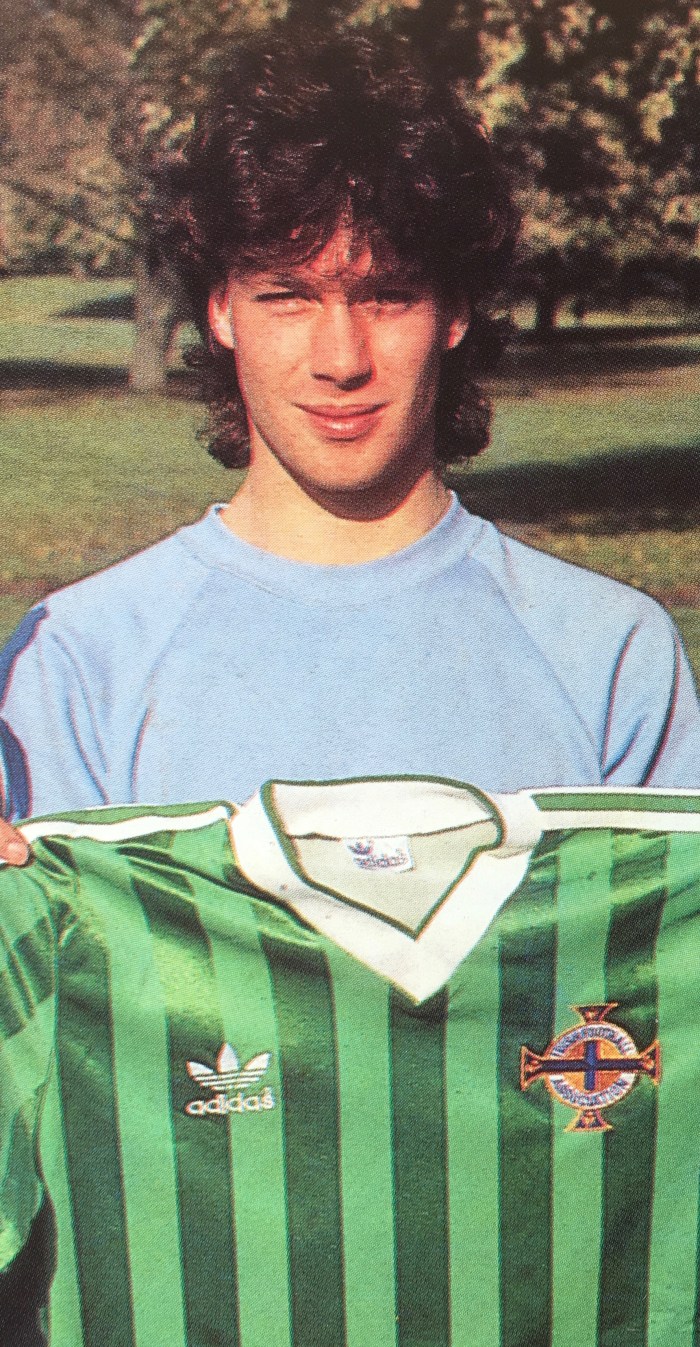
SP w Irish shirt

At the time of writing, he remains the highest-capped Albion player, all of his 17 caps for Northern Ireland being won while with the Seagulls.

After making his debut on 16 October 1984 in a 3-0 friendly win over Israel in Belfast, he was a regular for four years, playing his last game on 21 December 1988 in a 4-0 defeat to Spain in a World Cup qualifying match. He scored twice for his country, in a 1-1 draw with Israel on 18 February 1987 and in a 3-0 win over Malta on 21 May 1988.

The highlight of his international career was playing for Northern Ireland at the 1986 Mexico World Cup.

“The whole experience of going to the World Cup was something I’ll never forget,” he said three months later, in a matchday programme interview.

“Six weeks away from home is a long time, but the spirit in the squad was very good and I wouldn’t have missed it for the world.”

Steve had been in the side that qualified for that World Cup by drawing 0-0 against England at Wembley. “We only needed a draw to get to Mexico and we got it,” he said.

“(Manager) Billy Bingham had been a right winger and obviously appreciated what I could do, which was a source of great strength to me. He’d been part of the team that had played in the World Cup in Sweden in 1958, a lovely man who was very good at getting the best out of his players and encouraged me no end, something I’ll always be grateful to him for.”

Unfortunately, Steve’s World Cup came to a juddering halt after Spain’s hard man Emilio Butragueno went over the top in a tackle and did his ankle in only the second group game.

On his return to Brighton, Penney found himself sufficiently impressed by Cattlin’s successor, Alan Mullery, that he was persuaded to sign a new, three-year contract.

However, it wasn’t long afterwards that Penney started having problems with his left knee and, although he played through the pain barrier, in a game against Derby County in March 1987 a bad tackle damaged his ankle ligaments, sidelining him for the rest of the season.

Barry Lloyd had succeeded Mullery and Penney was in the team at the start of the next season but, after only two games, found himself back on the treatment table after a chip of bone was found floating in a knee.

That kept him out for an agonising seven months before he was able to return to the side in March 1988 to play a crucial part in the final 11 games, scoring three times as the Seagulls earned promotion in second place behind Sunderland.

Penney told Vignes: “At that time, playing for Barry was great. The two of us were getting on even though I always thought there was something not quite right between us. To be honest, he had to play me because I strengthened the team and made a difference.”

Halfway through the 1988-89 season, Crystal Palace tried to sign Penney but weren’t prepared to meet Albion’s £175,000 asking price. And then his left knee went again.

Vignes tells the whole gory story in detail, which I won’t repeat here, but, suffice to say, the wrong treatment by one doctor had to be put right by a Harley Street expert.

Penney rowManager Lloyd and Penney also fell out, principally over Penney putting country before club. “He’d play for them, then come back injured. That didn’t please me,” said Lloyd. “It was a crying shame. He just wanted to play but was so plagued with injuries it was beyond belief.”

The split came in 1991 when Lloyd clearly thought the player’s level of fitness didn’t merit a new contract. Interest was shown in him by Heart of Midlothian, managed by Joe Jordan, and Charlton Athletic, where the joint manager was his ex-Albion teammate Alan Curbishley.

Having played a couple of trial games for Hearts, he plumped for them but suffered a groin strain early on and only played 14 games all season.

A 15th game would have triggered the award of another one-year deal – and it quickly became apparent that it wasn’t going to happen. Freed at the end of the season, he signed for Burnley, newly-promoted from the old Fourth Division, in August 1992. Continue reading “Irish international pals brought wing wonder Steve Penney to Brighton”
World Cup legend Armstrong too often warmed Albion bench

IMG_3807

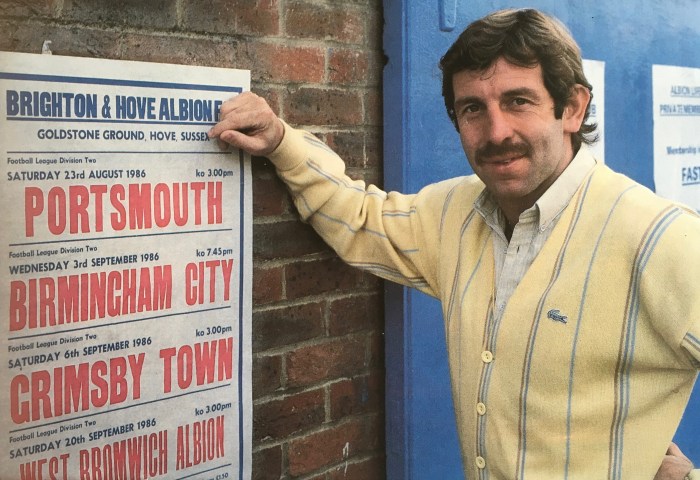
IN THE SPACE of 10 weeks, Gerry Armstrong went from 71st minute substitute for Northern Ireland against Brazil at the 1986 World Cup in front of 51,000 in the Estadio Jalisco, Guadalajara, Mexico, to centre forward for Brighton & Hove Albion in front of 13,723 at the Goldstone Ground in a season-opening 0-0 draw against Portsmouth.

That 3-0 defeat to the mighty Brazilians signalled the end of an international career in which Armstrong had written his name in Northern Irish football history at the 1982 World Cup in Spain four years earlier. He had scored 12 goals in 63 appearances for his country but none as important as the one which beat hosts Spain to send the Irish through to the quarter-finals, which I shall come on to.

Screenshot

Four years later, while away with Ireland in Mexico, former Spurs striker Armstrong took a call at the team’s hotel from someone else who had made his name with the North London club – Alan Mullery – who had recently been restored to the managerial chair at Brighton.

“Alan knew I was a free agent and I promised to talk things over with him when I got back from Mexico,” Armstrong said in a matchday programme article. “I was impressed by the manager’s ideas for the future and Brighton appealed to me because I have always liked the club,” he said.

“I always got the impression that there is a good, family atmosphere here and I liked that.

“In many ways, Brighton reminds me of Watford. I had three very happy years there and I’m looking forward to enjoying myself just as much here at Brighton.”

Born in Belfast on 23 May 1954, Armstrong grew up in the Falls Road area and initially played Gaelic football and could have made that his chosen sport. But while he was banned from playing, he took up soccer with junior Irish clubs St Paul’s Swifts and Cromac Albion before beginning a three-year spell playing semi-professionally with Bangor between 1972 and 1975.

Spurs manager Terry Neill had family in Bangor and Tottenham paid a £25,000 fee for Armstrong’s services in November 1975. He made his Spurs debut in a 3-1 defeat at Ipswich Town on 21 August 1976. The season ended in relegation for the North Londoners but the young Armstrong was trying to make his way.GA Spurs

He said: “I was basically big, strong and courageous but that wasn’t enough alone so Spurs made me skilful as well.

“I set myself the task of gradually playing more first team games each season and managed to achieve it.”

After scoring 16 goals in 98 league and cup games for Spurs, Armstrong was sold to Watford for £250,000 in November 1980.

When the Hornets made it to the top division for the first time in their history, Armstrong scored their first goal at that level, against Everton, and they finished the season as runners up.

“Graham Taylor influenced me more than anybody,” he said. “My time at Spurs was going stale because they were using me in all sorts of different positions but, at Vicarage Road, Graham taught me about forward play and then gave me the chance to repay him.”

Nevertheless, it was breaking through at Spurs that helped Armstrong onto the international stage. He made his debut for Northern Ireland playing up front with George Best in a 5-0 defeat to West Germany in Cologne in April 1977. And in November the same year he scored his first goals for his country, netting twice in a 3-0 win against Iceland in Belfast.

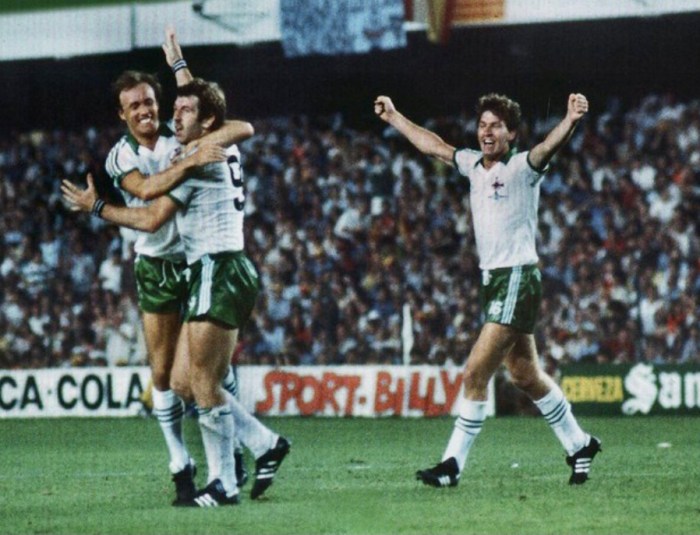
His stand-out moment in football which fans still talk about came when Northern Ireland were minnows at the 1982 World Cup in Spain. In front of a crowd of 49,562 – mostly Spanish – packed into Valencia’s Estadio Luis Casanova, on 25 June 1982, Ireland beat the hosts 1-0 and Armstrong fired home the only goal of the game in the 47th minute.

“I cracked it in between a couple of defenders, but couldn’t really believe it because there was this deathly hush. Fifty-five thousand people (a bit of Irish overstatement) all there to see Spain, and we ruined the party!”

He added: “It was a very satisfying one to get for the team, because it was a great win for us. “The odds were against us because there was a huge crowd in the stadium and virtually all of them were backing Spain. Nobody really gave us a chance, but it was a great team performance.

Armstrong Spain

“All the players worked hard for each other and that game summed up the excellent team spirit I have enjoyed with the national side over the years.”

Armstrong also scored Ireland’s only goal in their 4-1 quarter-final defeat to France.

The Spanish climate obviously agreed with Armstrong because in the summer of 1983, having scored 12 goals in 76 league games for Watford, Real Mallorca signed him for £200,000. Although he got stick from certain sections of Spanish supporters who remembered the goal he scored against them, he spent two years with Real Mallorca scoring 13 times in 55 league games.

On his return to the UK in August 1985, he initially signed for West Brom on a free transfer but struggled with travelling to and from London to train and play, didn’t see eye to eye with manager Ron Saunders, and picked up some injuries. He spent the second half of the season at Chesterfield, where former Spurs teammate John Duncan was boss, so he could get some game time to put him in contention to be selected by Northern Ireland for the upcoming World Cup.

irish news gerry arm

A free agent on his return, he joined Mullery’s Brighton having heard good things about the former Spurs captain from his Irish international colleague Pat Jennings, who’d played in the same Tottenham team as Mullery. However, it was 17 games before Armstrong managed to get on the scoresheet – in a 3-1 defeat at Leeds – although he did score again in the very next game, as Shrewsbury were beaten 3-0 at the Goldstone.

When Mullery’s second spell as manager ended rather abruptly, in January 1987, Armstrong was loaned to Millwall. New manager Barry Lloyd did restore him to the Albion line-up for the final eight games of the season, but the side finished in bottom place.

Back in Division 3, Armstrong was transfer listed along with Steve Gatting and Chris Hutchings as Lloyd was forced to shuffle the pack. He stayed with the club, but only got one full game, in a league cup tie, all season: he came off the bench 11 times and was a non-playing sub on 14 other occasions.

He was suitably philosophical about his involvement from the bench, however, and said in another matchday programme interview: “Over the years I’ve gained a bit of a reputation for grabbing goals when it matters most, and I figure that if I only get on for the last 20 minutes then there’s even more reason to take the game by the throat and get stuck in.”

In the 1988-89 season, Armstrong managed four starts but was once more on the bench more often than not and eventually was appointed reserve team player-coach.

But his time with the club ended ignominiously. In a Sussex Senior Cup tie at Southwick in January 1989, following the first ever red card of his career, as he walked off, he took exception to a comment from a supporter, jumped into the crowd and headbutted the person concerned.

The incident is referred to amongst the annals of assaults by players on fans. Armstrong left the club a fortnight after the altercation but the matter ended up in court and the footballer received a conditional discharge.

His final games as a player were at Glenavon back in Ireland after he had spent some time as a player-coach at Crawley Town, who were in the Beazer Homes League at the time.

In November 1991, he became manager of Worthing and led them to a promotion before being appointed assistant manager of Northern Ireland by his former teammate Bryan Hamilton.

He continued to live in Hove, though, and worked as a cable advisor for Nynex Communications. He even carried on playing football for Sussex Sunday League side James Lytle.

Although he left the national assistant role in 1996, he reprised it under Lawrie Sanchez between 2004 and 2006. Then, in 2011, the Irish FA recruited him as an elite player mentor – in essence to try to persuade young Catholic Northern Irishmen considering playing for the Republic of Ireland (a choice made by Shane Duffy, for example) to stick with the country of their birth.

Throughout all of this time, Armstrong has also forged a successful media career and is probably best known for his work with Sky Sports coverage of La Liga.

In 2015, the Belfast Telegraph did an interview with Armstrong and his wife Debbie in which they spoke about running a restaurant in Majorca, and his involvement as part-owner of a football club in Portugal.

The player’s autobiography, Gerry Armstrong: My Story, My Journey, written in conjunction with Dave Bowler, was published in November 2021 by Curtis Sport.Armstrong autobiog

Pictures from the Albion matchday programme and in the international shirt from the Irish News.

Boyhood Brighton fan Simon Rodger’s 11 seasons at Palace

S Rodger v Ivor IngimarssonSHOREHAM-born Simon Rodger was a boyhood Brighton fan but spent the bulk of his professional playing career with arch rivals Crystal Palace.

It was only at the end of his career he finally got the chance to play for the Seagulls having been rescued from football’s scrapheap by the man who had given him his chance with Palace.

Rodger in fact was on Albion’s books as a youngster and a report appeared in a matchday programme when, as a 14-year-old, he won a Soccer Skills competition run by Bobby Charlton Schools in association with The Trustee Savings Bank.

“Simon has been training with our own youngsters for two years but he is a guest today at Manchester United, where he will be seeing the match between United and Ipswich at Old Trafford,” the programme reported.

young RodgerHe didn’t progress through the levels at Brighton, though, and instead joined non-league Bognor Regis Town as an apprentice in 1989. Palace manager Alan Smith snapped him up from there for £1,000 in 1990.

It was Smith’s successor in the managerial chair, Steve Coppell, who gave Rodger his first team debut in 1993 away to Sheffield Wednesday. Although that game ended in a 4-1 defeat, Rodger was part of the side who went on to secure the Division One title in 1994.

Gordon Law on holmesdale.net summed up his Palace contribution thus: “His workrate, professionalism and unsung, gritty, performances in the midfield engine room contributed to Palace’s success in the 1990s. He was never one of the club’s high earners and missed out on lucrative signing-on fees to stay in SE25.”

He did leave Selhurst Park temporarily in the mid 90s, though, having fallen out with Coppell’s successor, Dave Bassett. He went on loan to Manchester City for three months in 1996 and to Stoke for a month in 1997.

When Coppell returned to Palace, so did Rodger and was part of the 1997 promotion-winning squad.

His Palace career came to an end after 11 seasons and 328 games  – all in the top two divisions – when manager Trevor Francis released him aged 31 in 2002.

It was a worrying time for a lot of players because the collapse of ITV Digital meant football finance was in a state of flux and clubs didn’t have the money to retain large squads.

Rodger had earned decent money from football and also had the financial cushion of being married to QVC TV presenter Alison Young, but she talked about her husband’s concerns in an interview with football reporter Matt Hughes.

After Brighton’s disastrous run of 11 defeats under Martin Hinshelwood during the early part of the 2002-03 season, ex-Palace boss Coppell was brought in by Dick Knight and Rodger, together with Dean Blackwell from Wimbledon, were among his first recruits to try to salvage the season.

He came off the bench in Coppell’s second game in charge, when Albion were thumped 5-0 at Selhurst Park, but the following week he scored on his home debut against Bradford City on 2 November 2002, a volley which wearebrighton.com described as the best goal of the season.

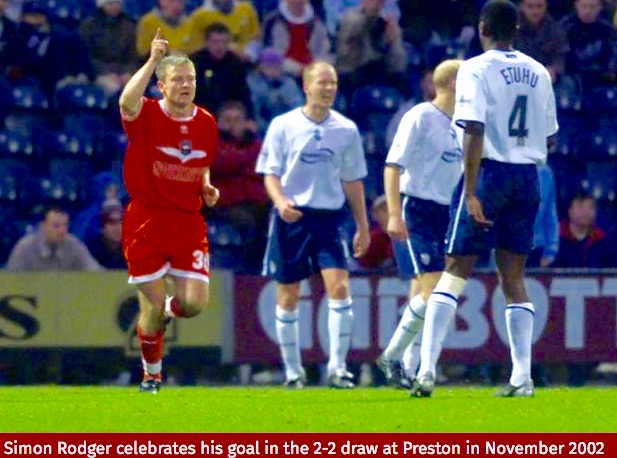
Later the same month he scored again, along with on-loan Steve Sidwell, away at Preston North End, as the Seagulls clawed back to draw 2-2 having gone 2-0 down.

Rodger talked about the shock of his Palace departure in an interview with The Guardian in January 2003, but said: “I’m just grateful to be back in professional football with Brighton, doing something that I love.”

Rodger had become a regular in the side but, despite a sterling effort in the latter part of the season, relegation was confirmed following a 2-2 draw away to Grimsby Town.

The defensive midfielder began the following season in the third tier but the league cup tie away to Middlesbrough at the Riverside in September 2003 was the last of his 38 games for Brighton.

He was stretchered off early in the second half following a tackle by current England manager Gareth Southgate and never recovered sufficiently to resume his professional career.

Albion physio Malcolm Stuart said Rodger couldn’t have worked harder to try to return to his previous level of fitness. However,  he explained that the player had developed a rare growth on a skin graft called Cyclops Legion and, although it had been cut away, it returned. Stuart said it wasn’t felt fair to put him through a fourth operation.

Captain Danny Cullip told the matchday programme: “We’ve seen Simon working in the gym to get back, and he’s been working his socks off. We’re gutted for him after he fought hard to get back; he’s a very good footballer and a really nice lad.”

After his playing days ended, Rodger became a private hire chauffeur.

Screen Shot 2018-03-08 at 08.45.12

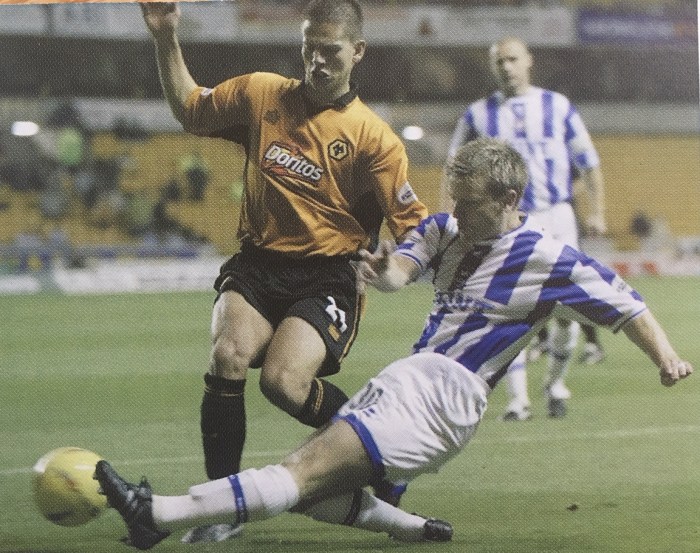
Main picture (top) shows Rodger putting in a slide tackle on Ivar Ingimarsson, who later joined Albion on loan from Wolves. Also (above), from the Argus, after scoring away at Preston.

Kieran O’Regan came close to dramatic FA Cup semi-final debut

OREGANWHEN just 19, unbeknown to thousands of expectant Brighton fans, Kieran O’Regan was on the brink of making a sensational debut for the Seagulls in the FA Cup semi-final.
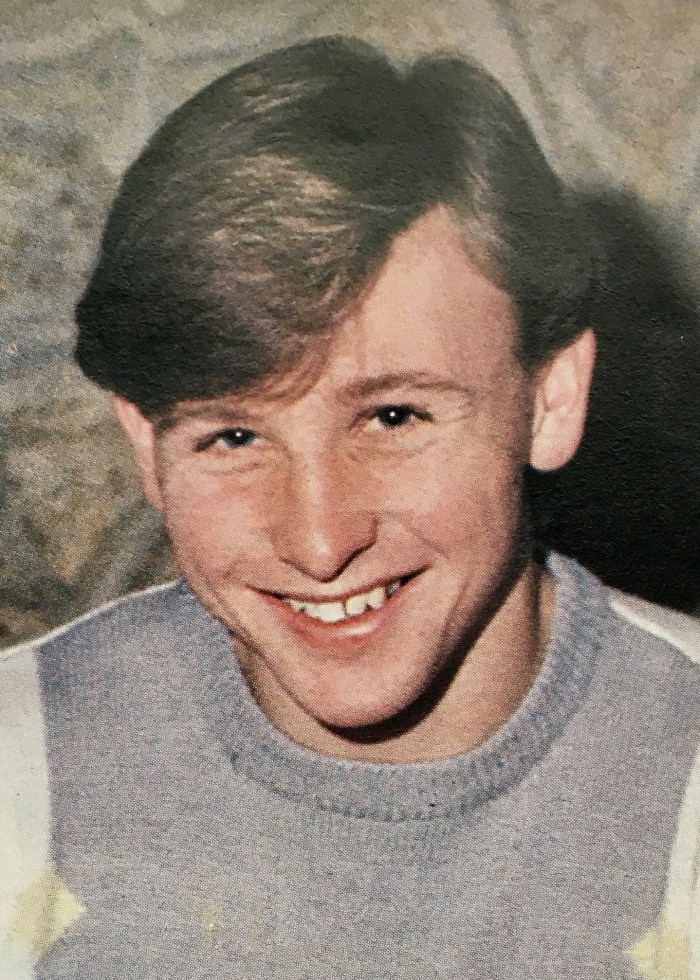
The versatile Irishman, who went on to play nearly 100 games for the Albion, and more than 200 for Huddersfield Town, was nearly drafted into Brighton’s back line for that momentous occasion against Sheffield Wednesday in front of a packed house at Highbury on 16 April 1983.

Only captain Steve Foster’s bravery and sterling work by the club’s medics prevented the youngster having to step in at the last minute.

The potential drama only came to light in the post-match analysis by Evening Argus reporter, John Vinicombe, who recounted: “On the morning of the tie, (Jimmy) Melia had problems that were wisely confined only to those with a need to know.

“A crisis arose when Steve Foster’s right elbow started to swell and hurt. A streptococcal infection was diagnosed, extremely painful, and dangerous.

“To not only get him fit to play, but counter the possibility of blood poisoning, he was pumped full of antibiotics, the elbow encased in plaster and, just before kick-off, a painkilling jab administered.

“Had it been a run-of-the-mill game, Foster would not have played, but to go into a semi-final without the lynchpin was unthinkable.

“If there had been no alternative, then Kieran O’Regan, who has yet to make his debut, would have been drafted in from the sub’s bench.”

As it was, O’Regan remained on the bench throughout the game; Michael Robinson’s winner in the 2-1 victory meaning manager Melia didn’t need to introduce the youngster on such a momentous occasion.

When he eventually made his first team debut a few weeks later, it was in a less pressurised situation, although only then with special dispensation from the Football League.

Melia was down to the bare bones because of injuries and suspensions so the youngster was needed, but he had not been signed as a pro before the deadline. The way the authorities saw it was, because Albion were already relegated and Norwich were safe, it was “a game of no consequence” and O’Regan got the green light to play.

cup cutting

Veteran football reporter Harry Harris interviewed the youngster and built a story (above) around the possibility that if he did well he might be in with a shout of a place in the Cup Final against Manchester United.

Ever the one for an eye to publicity, manager Melia kept those thoughts alive by saying: “Kieran is going to be a hell of a player. He only looks about 14 but he’s mature enough as a player to figure in my Wembley plans.”

KOR portIn the event, forward Gerry Ryan got the nod for the one substitute’s place on the day, and rather ironically had to come on and play right-back in place of the crocked Chris Ramsey.

Melia was certainly a big fan of O’Regan. In the summer of 1982, as Albion’s chief scout, he had recommended the youngster to manager Mike Bailey after seeing him go on as a second half substitute for the Republic of Ireland youth team against Welsh Schools and score two goals.

Born in Cork on 9 November 1963, O’Regan attended a secondary school noted for its prowess at Gaelic football but he was determined to pursue a soccer career instead. He had been playing for Tramore Athletic in County Cork’s Munster League when he got his call-up to the national youth team.

Brighton invited him over to England for a trial. “I’d gone to Brighton on a one week trial; that became two, then I was asked to stay for three months. That came and went, and I never went back,” he said.

He had come close to packing it all in because he was homesick, but the presence of fellow Irishmen Gary Howlett and Ryan helped him adapt, and the silver-tongued Melia managed to talk him round.

“I didn’t feel as though I was playing very well,” he told the Mirror’s Harris. “I wasn’t fit or doing myself justice so I wanted to go home. Luckily enough, Jimmy talked me out of it.”

When Melia took over as caretaker manager, he swiftly dispensed with the services of Bailey’s pick at right-back, Don Shanks, promoted Ramsey to the first-team and then converted O’Regan from a midfield player to a right-back to become Ramsey’s understudy.

On the eve of that Norwich game, Melia told the Argus: “I must bring on the youngsters because they are the long-term future of the club.

“They are a smashing bunch of lads and I would like to play some more of them at Norwich. But with the Cup Final coming up, I can’t for obvious reasons.”

In fact, he picked young striker Chris Rodon on the bench and he got on in place of Gordon Smith, but it was the one and only time he saw first team action.

In respect of O’Regan, though, Melia stuck to his word, and the youngster filled the right-back berth from the off at the start of the new season back in the second tier, keeping his place even after his mentor’s sacking.

Melia’s successor, Chris Cattlin, also gave him some games in midfield, and, by the season’s end, he’d played 33 games plus once as sub. He also notched his first goal, in a 2-1 defeat away to Sheffield Wednesday.

However, his biggest disappointment that season was when he and Howlett were both dropped for the televised FA Cup game against Liverpool at the Goldstone. He told Spencer Vignes in an interview published in a matchday programme of February 2005: “We’d thrashed Oldham at home 4-0 and played Carlisle away on an icy pitch and won 2-1, and me and Gary had played in both.

“The Liverpool game was on a Sunday so we all came in for training on the Saturday to find out what the team was. And Gary and I weren’t in it. We’d been dropped.

“Instead we were off to Highbury that afternoon to play for the reserves. That’s still probably the low point of my career. I really wanted to play. Cattlin said he was going for experience, and you can’t really fault him because the lads went out and beat Liverpool 2-0. But I was still gutted.”

Making the grade with Brighton caught the eye of the Republic of Ireland selectors and O’Regan was called up to play for his country on four occasions.

He made his debut in November 1983 in an 8-0 thrashing of Malta in Dublin, when Mark Lawrenson and future Albion manager Liam Brady each scored twice.

Against Poland, the following May, also at Dalymount Park, Dublin, O’Regan featured in a 0-0 draw, and three months later, same venue, same scoreline, against Mexico. His fourth and final cap came as a sub against Spain, in May 1985, which also ended goalless.

Meanwhile, his Albion game time in the 1984-85 season was a lot more restricted and, apart from a mid-season 10-game spell in midfield, he was on the sidelines, especially when a promising young defender called Martin Keown arrived on loan from Arsenal.

Vignes observed in that 2005 interview: “His ability to play at either right-back or midfield meant that when the likes of Chris Hutchings, Danny Wilson or Jimmy Case were unavailable, Albion always had a reliable deputy to call on.”

There was yet more benchwarming to be endured during the 1985-86 season but on Alan Mullery’s return to the manager’s chair, he found himself back in the first team on a more regular basis.

Indeed, he played under five managers in five years with Brighton, and told Vignes that Mullery was the best to work with. “He was great with everyone, but especially the young lads.”

By contrast he didn’t get on with Barry Lloyd who kept O’Regan in the dark when interest was shown in him by Swindon Town, where his former rival for the right-back spot, Ramsey, was assistant manager to Lou Macari.

In the end, in 1987, he did make the move to the County Ground having made 80 starts for the Albion, plus 19 substitute appearances.

After just a year at Swindon, he was on his way again, this time to join Huddersfield Town where the manager was Eoin Hand, who had been the Ireland manager when he won his four international caps.

O’Regan spent six seasons with Town, playing over 200 games in midfield, and it was an association which would reap its benefits after his playing days were over.

He spent two seasons at West Brom under former Spurs boss Keith Burkinshaw (and latterly Alan Buckley) but returned to West Yorkshire in 1995 as captain of Halifax Town, going on to become joint manager with George Mulhall for 18 months and then taking on the role alone in August 1998.

His tenure lasted less than a season and when the axe fell in April 1999, he turned his back on football and became warehouse manager at Brighouse Textiles, run by Halifax’s former chairman, and subsequently became a carpet salesman at a shop in Huddersfield.

O'Regan mikeHowever, in 2001, he was offered the chance to be the expert summariser on Huddersfield games for BBC Radio Leeds, and he lined up alongside commentator Paul Ogden for the next 15 years, before hanging up the microphone in May 2016.

Pictures from the Albion matchday programme and my scrapbook.