
 SIMON MORGAN was “Mr Fulham” and, in more than 400 appearances in 11 years, he saw relegation to the basement division and promotion to the Premiership.
It was one of his former Fulham managers, Micky Adams, who was responsible for him joining Brighton – who he also helped to promotion.
The move south followed Morgan’s release by Fulham in 2001. Having steered Brighton to promotion from Division 3, Adams wanted to bring some added experience to the back line.
Almost three decades earlier, the signing of former Leicester stalwart Graham Cross had been an inspired move that helped Albion gain promotion from the third tier, and in 2001-02, the signing of the experienced Morgan had the same effect.
Cross had been the final signing made by Peter Taylor before he left to rejoin Brian Clough, and, just as his replacement Alan Mullery had reaped the benefit of the experienced defender, so did the younger Peter Taylor benefit from Morgan’s contribution, after he had taken over as boss from Adams, who was lured to Leicester as Dave Bassett’s no.2.
To add in yet another Leicester dimension to this story, the Foxes were Birmingham-born Morgan’s first club. He made 182 appearances (168 starts + 14 as sub) in six years at Filbert Street, Gordon Milne giving him his debut in October 1985 at left-back in a 3-0 defeat away to Coventry City.
His first two seasons were played in the top division but Leicester then dropped down to the second tier and, in the 1989-90 season, by which time David Pleat was in charge, Morgan featured in only 20 games, his final appearance coming as a sub in a 3rd round FA Cup exit to Barnsley. Alan Dicks paid a £100,000 fee to take him to Third Division Fulham in October 1990.
Managers came and went at Craven Cottage but Morgan remained for 11 years and was described by sport.co.uk as “a significant and full-blooded contributor during a dark time in the club’s history”.
The Fulham fanzine There’s Only One F in Fulham published a tribute-packed, fund-raising brochure devoted to Morgan during his testimonial year, which rather appropriately was sponsored by Captain Morgan rum.

Morgan’s influence alongside Danny Cullip in Brighton’s third tier promotion side was highlighted by Dick Knight, club chairman at the time, in his autobiography Mad Man: From the Gutter to the Stars, the Ad Man who saved Brighton.
Knight said Morgan was “a very experienced cripple – chronic knee problems meant that he couldn’t train, could hardly run.” He explained: “On the pitch, he never moved beyond an area about the size of my kitchen, but he read the game brilliantly, positioned himself perfectly to pick up everything that came into the box.
“I’ve never seen a player who used his brain more, apart from Bobby Moore. Simon was superb. What a player, and a great personality.”
Knight also talked about Morgan’s hilarious Simon says weekly column in The Argus about the escapades of the players. “He wrote it himself – it wasn’t ghosted. I encouraged it because it was another way of showing the human side of the club. It revealed the players as characters, real people rather than distant idols.”
Darren Freeman, a former Fulham colleague, who also played for Brighton, told theleaguepaper.com that Morgan was the “funniest player I ever knew – and the most miserable at the same time”.
Freeman said: “He’d moan about anything and everything. If he hadn’t been a footballer, we always said he’d have made a great Victor Meldrew impersonator.
“But he was also a great captain and a great character with quite a dry sense of humour. He used to make me laugh a lot and he used to get the best out of everyone he played with, especially the younger lads coming through.”
A sample of his wit appeared in one of his first Argus columns in 2001 and he concluded it by wishing well to his old club Fulham as they began their Premiership campaign. “Five years ago, on August 17, 1996, Fulham kicked off their Third Division campaign at home to Hereford,” Morgan wrote. “A certain Mr M. Adams was the manager and the squad included Messrs Cullip, Watson, Morgan and Brooker. It just shows what is possible. Where will Brighton be in five years’ time?”
Well, as we know, it took Albion slightly longer to reach the promised land but nonetheless they had secured promotion back to the second tier by that season’s end and Morgan once again used his Argus column to sum up the achievement, having a dig along the way at the various critics who had doubted Brighton’s ability to finish off the job.
“This current Brighton team is only the eighth in the history of League football to win back-to-back championships. Records have been smashed as the team has surged into the First Division. Is it a fairy tale or a miracle? However you describe the wonderful adventure, it certainly hasn’t been lucky,” he wrote.
“Amazingly we lost only six league games this season. Three of those were on a Friday night and two live on television. The demise of ITV digital will not be mourned in Sussex.”
Meanwhile Argus reporter Andy Naylor’s verdict on Morgan declared: “Dependable partner for Cullip. Hardly put a foot wrong. Adding the former Fulham stalwart to the squad was the best bit of business Micky Adams did last summer. Will be sorely missed if a knee problem forces him to retire.”
Unfortunately, Morgan accepted specialist advice that he wouldn’t manage a season at the higher level and, after only 10 months away, he returned to Fulham in an off-field capacity, heading up the club’s community scheme, before finally bidding farewell in June 2007.
He took up a position as the Premier League’s Head of Community Development – a role overseeing the community schemes of all 20 Premiership clubs. He subsequently became Head of Football Relations.
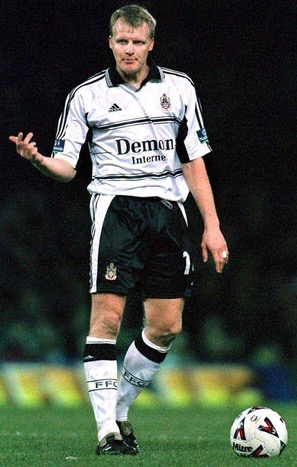
Main picture: Simon Morgan welcomed to the Withdean by Micky Adams, also, with manager Peter Taylor with the Division 2 winners’ trophy (photo Simon Dack). In Fulham colours below.


 When Lawrenson was fit to return, Mullery sprung a surprise by utilising him in midfield, but it was an inspired decision and he stayed there for the rest of the season, helping Albion to finish a respectable 16th of 22.
 STEVE Coppell was not the first former Manchester United player I saw become manager of Brighton. More than 30 years previously Busby Babe


 Watford boss Malky Mackay gave him a three-and-a-half-year contract and described him as “an exciting young talent”. The fee was officially ‘undisclosed’ although reports suggested it was around £200,000.

 In parallel lines