


GARY O’REILLY was one of those rare players who had two different spells with Brighton – and played for rivals Crystal Palace in between.
Indeed, his career highlight came when he played – and scored – in the 1990 FA Cup Final for Crystal Palace against Manchester United.
It was from Phil Barber’s free-kick on the right that O’Reilly put Palace ahead after 18 minutes, his header looping over goalkeeper Jim Leighton.
United recovered to lead 2-1 before Ian Wright, only six weeks after breaking his leg, came on to score twice, in the 72nd minute and again at the start of extra-time. But Mark Hughes got an equaliser for United seven minutes from the end of extra-time, and, just as they had against Brighton in 1983, United went on to win the replay.
Born in Isleworth on 21 March 1961, O’Reilly started to make a name for himself with the Essex Boys team and, as a schoolboy, played for both England and the Republic of Ireland because his father was from Dublin and his mother English.
Arsenal wanted him on associate schoolboy forms, but it was Spurs who snapped him up at the age of 13. His youth team-mates at White Hart Lane included Kerry Dixon and Mick Hazard.
 O’Reilly also had the offer of a sports scholarship at Columbia University before signing for Spurs as a professional. Among a total of 45 first-team appearances in five seasons at Tottenham were games in the Charity Shield at Wembley against Liverpool and a quarter-final victory in the UEFA Cup over German giants Bayern Munich.
Ironically it was the arrival of Gary Stevens from Albion shortly after the 1983 FA Cup Final that began to signal the end of his time at White Hart Lane, together with the emergence of Danny Thomas.


Even though he still had two years of his contract remaining, O’Reilly requested a transfer and, in August 1984, he became part of Chris Cattlin’s Albion squad after signing for a fee of £45,000.
Cattlin recalled: “I watched him eight times before signing him, and six times with Tottenham Reserves he had stinkers. But I thought then he had great potential.”
O’Reilly made his debut at right-back in a notorious home game against Notts County which saw centre-backs Jeff Clarke and Eric Young both hospitalised after clashes with County’s Justin Fashanu, meaning the new arrival hastily shifting into his more familiar position in the centre.
In what was an eventful first few weeks, he also joined that illustrious list of players to score a winning goal AGAINST Palace. That came on 15 September 1984 when 15,044 at the Goldstone Ground saw O’Reilly score the only goal of the game.


His centre-back partner that day – and for most of his time at the Goldstone – was Young, who also later joined the Eagles, having left Brighton for Wimbledon.
O’Reilly made 79 appearances in three seasons with Albion, scoring three goals, and was virtually an ever-present for the first two seasons.
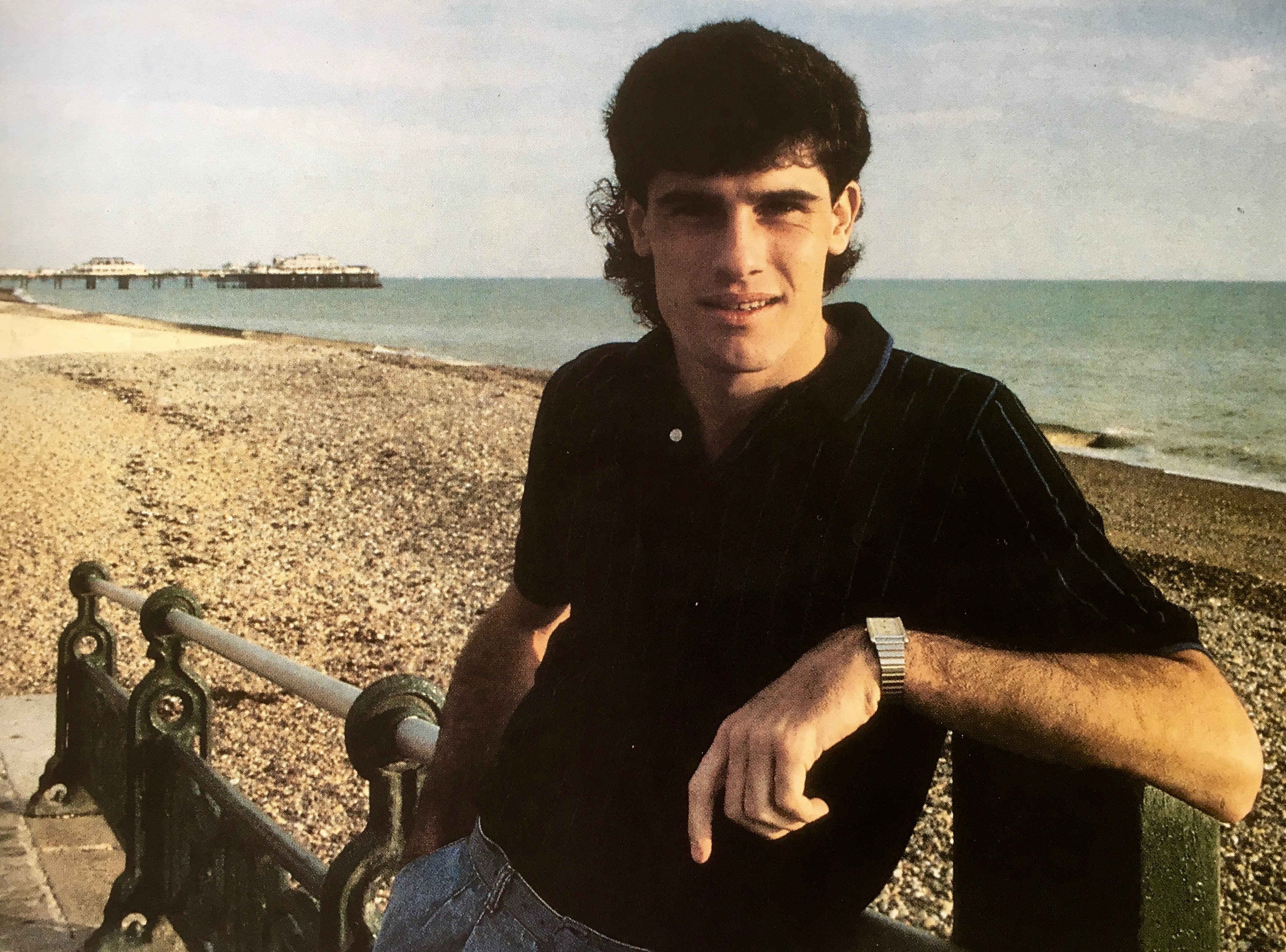
 Off the field, he became a popular figure with a social conscience, leading a campaign to help youngsters fight drug addiction and becoming president of the Junior Seagulls.
Unfortunately, injuries, including a worrying hamstring condition, restricted him to just eight games in the ill-fated 1986-87 season.
Then, on 3 January 1987, manager Alan Mullery reluctantly sold him to Palace for £40,000. Mullery later recounted: “I remember Gary O”Reilly coming in the day before we were going up to Grimsby. I asked him: ‘Do you want your wages next month?’ He thought it was some kind of quiz question, but I said ‘If you do, you are going to have to leave the club’. That’s how bad it was. We couldn’t afford the wages.” Albion won 2-1 at Grimsby but two days later, Mullery was gone himself – his second spell as manager ending in a sacking.
O’Reilly played 70 times in his first four seasons at Selhurst Park but he did not figure in Steve Coppell’s plans in the 1990-91 season and had just one game on loan with Birmingham City.
At the age of 30, the versatile defender returned to the Seagulls and was given a two-year contract by Barry Lloyd.


“There’s no substitute for first-team football,” he said. “There is nothing like playing regularly to give a player the right degree of confidence.”
Although he made 31 appearances in the 1991-92 season, he was unable to prevent Albion’s relegation back to the third tier and, after a series of unsuccessful knee operations, he was forced to retire from the game in April 1993.
After hanging up his boots, he embarked on a successful broadcasting career for Sky Sports, BBC, ART Prime in Dubai and Trans World International’s Premier League international feed.
On Twitter, with the handle @mythreeleftfeet, he describes himself as “global TV presenter, co commentator, ex professional football player all round sports broadcaster, writer, amateur photographer & someone you might just like…”
worldsoccertalk.com caught up with him in May 2017 to discuss a new venture in which O’Reilly is joint host (alongside stand-up comedian Chuck Nice) of a weekly podcast in America Playing With Science, which explores fascinating topics linking sport and science.
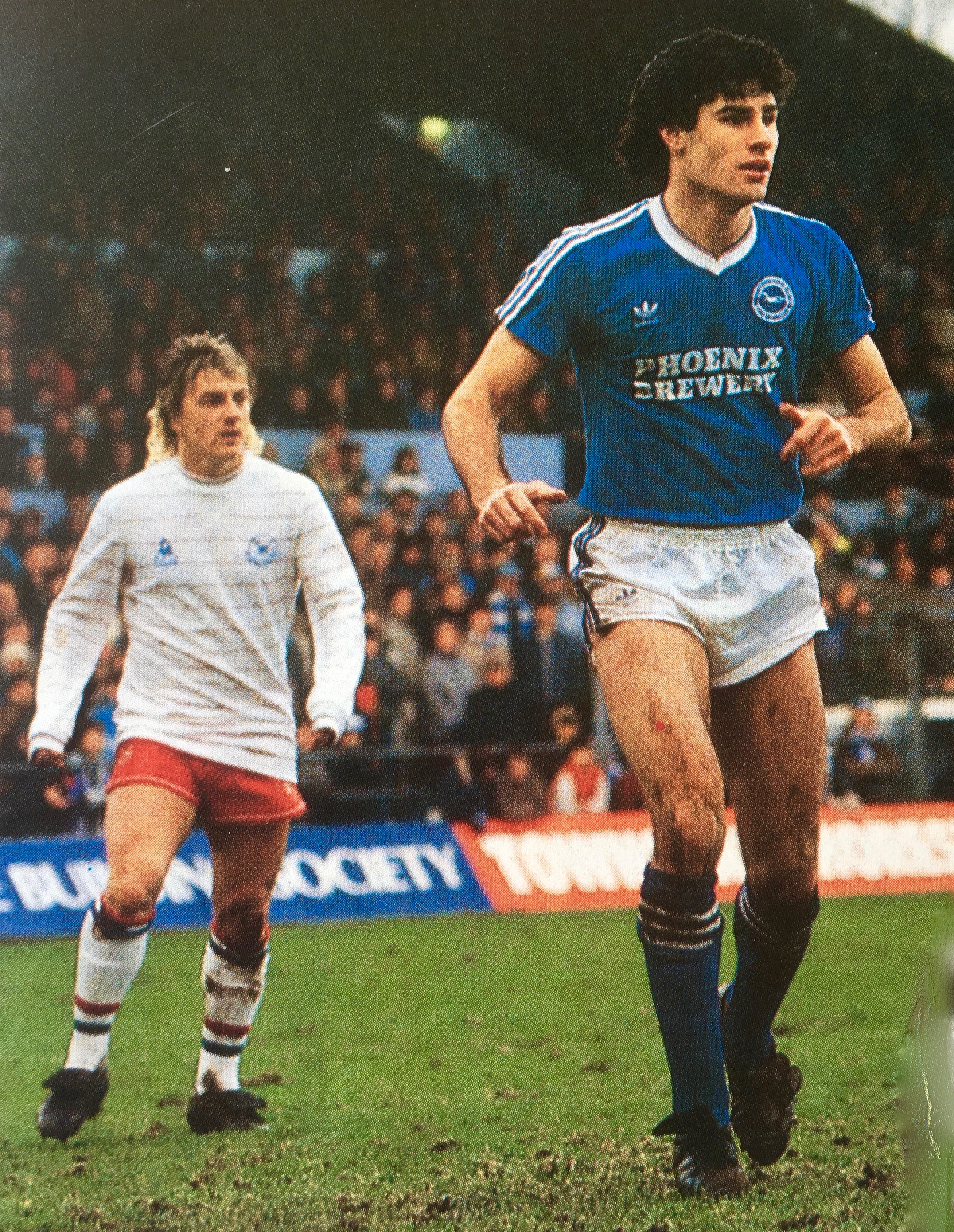
Pictures mainly from the matchday programme.
Above, defending against Portsmouth’s Alan Biley, who later played alongside him.
 In parallel lines
2 thoughts on “Eagles’ Cup Final scorer Gary O’Reilly had two Seagulls spells”