

A POCKET dynamo of a striker who became a Manchester City cult hero never forgot the goalscoring platform a short spell with Brighton provided him.
Paul Dickov is fondly remembered by the City faithful, particularly for his equalising goal (above) in the fifth minute of added on time in the League Two play-off final at Wembley in 1999 (City famously went on to win the penalty shoot-out in which Guy Butters missed a vital spot-kick for Gillingham).
The diminutive Dickov had wowed Brighton fans during the dark days of the 1993-94 season when Barry Lloyd’s replacement as manager, legendary Liam Brady, had secured the striker’s services on loan from his old club Arsenal.
Dickov had managed to break through to the Arsenal first team under George Graham in the latter stages of the 1992-93 season. But his chances were limited by the manager’s preference for the more experienced Ian Wright and Kevin Campbell.
Earlier in the 1993-94 season, the young forward left Highbury for a 15-game spell with League One Luton Town, but only managed one goal.
His goalscoring fortunes changed when Brady persuaded his former employers to let Dickov join the struggling Seagulls, who, at the time, were fighting to avoid relegation from League Two.
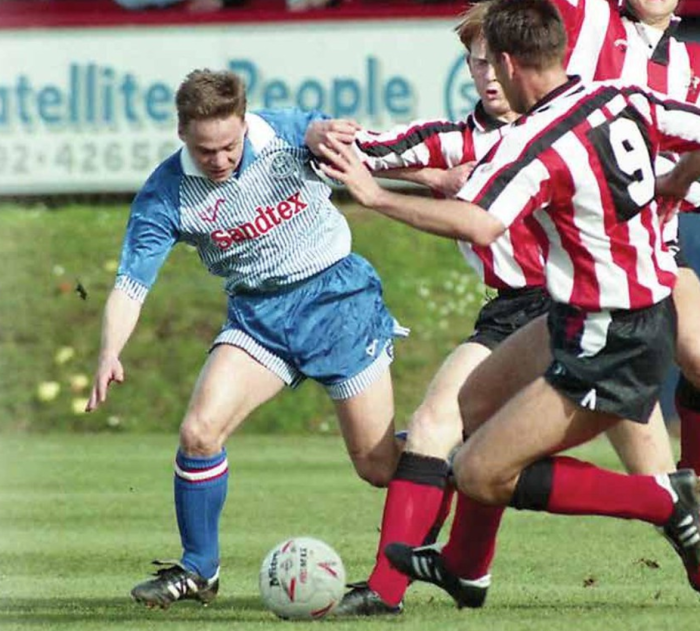
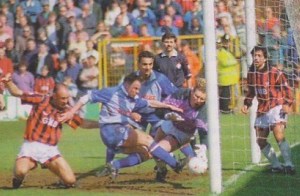
The tenacious Dickov relished the opportunity and scored on his debut in a 2-0 home win over Plymouth Argyle on 30 March 1994. It was the first of five goals in eight games to help Brighton avoid the drop. (Pictured below, Dickov scores from close range against Fulham).
“I had a great time there. I loved every minute of it, and it has stuck with me,” Dickov told the Argus some years later. “I’ve always looked out for Brighton since then and I want them to do well.”
Born in Livingston, Scotland, on 1 November 1972, Dickov came to the attention of the Gunners while playing for Scotland at the 1989 FIFA Under-16 World Championship.
Having shown his goalscoring potential in Arsenal’s reserve side, Dickov got his first team opportunity when Graham rested players ahead of the FA Cup Final (in which they beat Sheffield Wednesday after a replay).
Dickov made his Arsenal debut against Southampton on 20 March 1993, and he went on to score against Crystal Palace and Tottenham Hotspur at the end of the season.
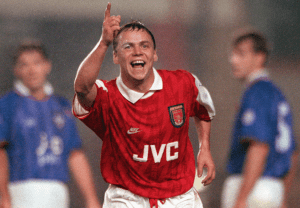
Over the following three seasons, although on the fringes of the first team, he was competing against the likes of Dennis Bergkamp, Wright and John Hartson and he was restricted to just 17 appearances in which he scored once.
Despite the disappointment of not quite making it at Arsenal, he is still fondly remembered there, with their history recording: “He never gave anything less than his all in an Arsenal shirt and, despite question marks over his height, Dickov compensated for his 5’5” frame with heart and endeavour.
“He was quick, skilful and scurried around up front causing problems for defenders.”
On 23 August 1996, City paid £1m to take him to Maine Road.
Over six seasons with the club, he was involved in two promotions and two relegations, which saw him play in three different divisions.
For all their success in more recent times, that memorable play-off at Wembley in 1999 was still being talked about 20 years later.
In 2000, Dickov won his first full international cap for Scotland and he earned 10 caps between then and 2004.
By then, he had moved on from City to try to keep Dave Bassett’s Leicester City in the top division. He joined the Foxes in February 2002, and, although he scored four goals as Leicester valiantly tried to maintain their Premiership status, they were not enough to prevent them being relegated to the Championship.
When former Albion boss Micky Adams took over the following season, Dickov thrived up front, netting a career-high 20 goals as Leicester won an instant return to the top-flight, finishing second behind champions Portsmouth.
Dickov scored 13 goals in the Premier League the following season but once again the Foxes were relegated. Even so, Dickov almost had a dream final game of the season against the team who had first give him his chance in the English game.
Arsenal were unbeaten throughout the season going into the Highbury finale but Dickov gave Leicester a shock headed lead before Thierry Henry and Patrick Vieira turned the game back in the Gunners’ favour to earn them the ‘Invincibles’ crown for their achievement.
That season at Leicester was also blighted by a shocking series of events during a training camp in La Manga, Spain, when Dickov and teammates Keith Gillespie and Frank Sinclair were falsely accused of sexual assault.
 At the season’s end, Dickov took up an option on his contract which allowed him to leave for a top-flight club and Graeme Souness signed him for Blackburn Rovers. It was not long before Mark Hughes took over and Dickov scored 10 goals in 35 games. Craig Bellamy was Rovers’ main man up front the following season and Dickov’s Premier League appearances were confined to 17 games plus four as a sub.
With his contract at an end, he rejoined Manchester City for the 2006-07 season but his time there was dogged by a series of injuries and he ended up having loan spells at Crystal Palace and Blackpool before returning to Leicester in 2008.
During that spell, when City were in League One, he was mainly back-up to Matty Fryatt and Steve Howard, but managed a further 20 appearances and scored two goals to help the club to promotion back to the Championship.
Eventually, he ended up going out on loan, this time to Derby County to help them out in an injury crisis. His Leicester contract was terminated in February 2010 and he took up a short-term deal to the end of the season with League One Leeds United, who ended the season earning promotion to the Championship.
Dickov’s next move, though, was into management. He initially joined Oldham Athletic as player-manager, before packing up playing in May 2011.
In Dickov’s first game as manager, a young Dale Stephens scored both goals as the Latics beat Tranmere Rovers 2-1. The highlight of his tenure at Oldham was leading the Latics to a shock 3-2 win over Liverpool in the FA Cup fourth round in January 2013, but he resigned a few weeks later because of the side’s poor league form.
Three months later, he took over at Doncaster Rovers, with former Albion captain and manager Brian Horton as his assistant.
Since leaving Rovers in September 2015, Dickov has been on the football speakers circuit and is also a frequent eloquent contributor as a pundit.


 Unfortunately, he managed just two more games in a season when Albion finished bottom of the Championship table. One fond memory I have of his contribution to Albion’s cause came in a game at QPR in March 2006.

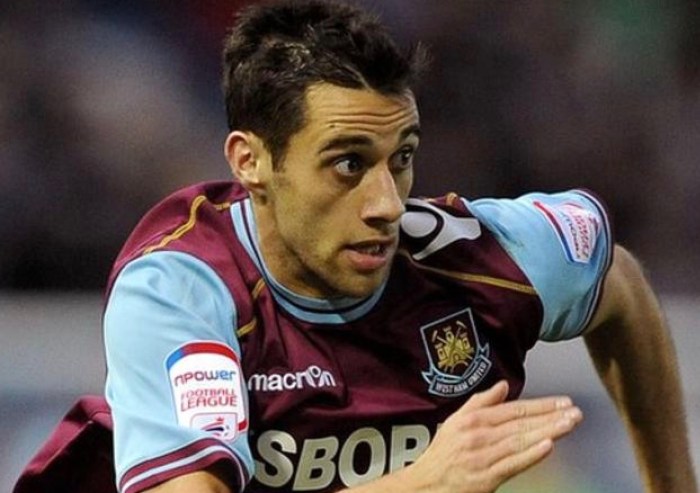 West Ham United, under Sam Allardyce, gave Baldock a platform to take his lower-league goalscoring prowess to a higher level when they began the 2011-12 season in the Championship. But, after a bright start, he disappointed and eventually only stayed for one year of a four-year deal.
 Former Albion captain,

 He couldn’t have asked for a better start when he scored five times in his first six games for the Hammers. Unfortunately, as has been the case throughout his career, he picked up an injury that sidelined him, and, in his absence, Nicky Maynard and the aforementioned Vaz Te became first choices in the forward line.


 Royals boss Paul Clement told the
 “When he signed for Watford I was hoping for more of the same. All we ever got was one long range effort away to Southend in the First Round of the Coca-Cola, and a couple of seasons of strolling around the pitch preserving his hairstyle and energy for (page three model girlfriend) Maria Whitaker.”
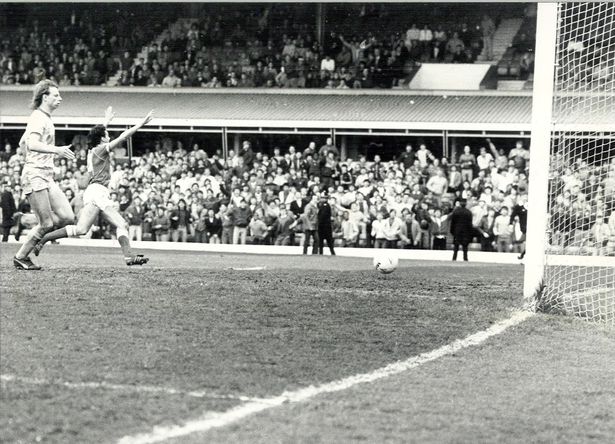 Kennedy displays a more conventional goalscoring celebration for Birmingham
 It was a ‘phone call from
  Several fans remember how he didn’t react well to observations from the terraces pointing out his shortcomings. Bladders was amused to recall: “One time, when he lazily chased a ball that went out of play, my old man told him to ‘put some bloody effort in Kennedy’. Kennedy then threatened to jump into the South Stand and smash his face in if he gave him any more lip.”


 In parallel lines