Wearside hero Gary Rowell blighted by injury after leaving Sunderland

gary rowell tony normanBRIGHTON fans never got to witness the best of prolific goalscorer Gary Rowell who, to this day, Sunderland fans eulogise in the same way Albion fans still sing about Peter Ward.

He died aged 68 on 13 December 2025, exactly 50 years to the day of his first appearance for the Black Cats following a long battle with leukaemia.

Rowell has a place in Sunderland’s best all time XI selection, in 2005 he topped a Football Focus poll as Sunderland’s all-time cult hero and, in 2020, was inducted into the SAFC Hall of Fame, which he described as ‘the best night of my life’.

There is a website that details every one of the 103 goals the Seaham-born footballer scored for the Wearsiders in 297 games after making his debut as a 71st minute substitute for Mel Holden in a 1-0 Sunderland win over Oxford United at Roker Park.

Unfortunately, the free-scoring striker-turned-midfielder was struck by a knee injury which hampered the latter part of his career, including his spells with Norwich City and the Seagulls.

Having left Sunderland on a free transfer after 12 years at the club, Rowell tore ligaments in his right knee on a pre-season tour of Scandinavia with Norwich before he even managed to kick a ball in anger.

In a year at Carrow Road, he made only six appearances – four as a substitute – and scored just the once, coming off the bench to net against Aston Villa. Typical of this spell between August 1984 and July 1985, he was substituted after only 16 minutes of his reserve team debut.

The following season, a £35,000 fee took him back to the North East to play for Middlesbrough, but, at the time, they were in the middle of a financial crisis and lost their second-tier status. Rowell top-scored with 10 goals in 27 appearances – two of them against the Albion at the Goldstone in January 1986 – but Boro were relegated in second-to-last spot (Brighton finished in 11th place that season).

Brighton were not exactly flush with cash themselves in the summer of 1986 when Alan Mullery, the manager who’d previously led them from third tier to the elite, returned to the club to replace Chris Cattlin.

Mullery found a very different set-up to the one he’d left acrimoniously in the summer of 1981. With little money available to be spent on new arrivals, hard-up Albion, not for the first time, had turned to the supporters in an effort to raise transfer funds.

Money from a scheme called the Lifeline fund went towards buying goalkeeper John Keeley for £1,500 from non-league Chelmsford, Darren Hughes for £30,000 from Shrewsbury Town, and Rowell from Middlesbrough on a free transfer (the Lifeline funds being used to help with his relocation to the South Coast).

Mullery explained the Rowell signing thus in his programme notes: “I see his role with us as coming forward from midfield and adding to our power in the box.

“We know he can get goals and he is a versatile player. When we further improve the squad, we may use him a little differently.”

Rowell , who discovered Mullery had tried to sign him back in 1979 (but Sunderland hadn’t informed him), joined just after the start of the season, in time to be given a place on the bench for the away 1-1 draw with his former club Sunderland. He went on for Kieran O’Regan with 18 minutes left.

He kept the bench warm for two more matches before getting his first start in place of Northern Irish centre-forward Gerry Armstrong in a 2-2 draw away to Plymouth Argyle on 13 September.

Unfortunately, it wasn’t long before Mullery was reporting his absence from the side because of an ankle injury sustained in training.

Nevertheless, interviewed by Tony Norman in the matchday programme, Rowell, who was 29 and married with two small children, said: “I’m delighted with the move. I’ve found it to be a very friendly club and people have gone out of their way to make us feel at home. Now I want to repay the club by playing well for the team.”

The longest run of games he got in an Albion shirt came in November and December 1986 when he took over from winger Steve Penney for six matches (two wins, two draws, two defeats).

rowell BW HS

A broken toe and a troublesome hamstring made him feel injury-jinxed but, during his run back in the side, he had what Mullery described as “his best game since joining us” in a 3-0 win over Shrewsbury Town on 21 December. Six days later, the toe went again, and he didn’t play for the rest of the season.

Mullery was then controversially dismissed the following month and Rowell had to wait until the start of the following season for successor Barry Lloyd to select him.

He featured in three pre-season friendlies, all of which ended in defeats and wore the no.4 shirt in the opening two fixtures of the 1987-88 season, but those were his only first-team starts that campaign. His midfield berth was taken over by the experienced Alan Curbishley.

By October, the matchday programme reported Rowell and fellow midfielder Dale Jasper had been placed on the transfer list following long discussions with Lloyd. Curiously, it added: “However, both players are keen to stay with the club, regardless of any offers made, and will be battling hard for first team places.”

Rowell subsequently appeared seven times as a substitute for the first team, but he was largely confined to the Reserves for whom he made 20 appearances and scored once. In February 1988, he moved to Dundee on trial, but, when not taken on, moved the following month to Carlisle United.

After just seven games for the Cumbrians, he finished his professional career at Burnley, where he scored once in 19 appearances.

Born in Sunderland on 6 June 1957, Rowell grew up in the mining village of Seaham, became an apprentice at Sunderland in 1972 and two years later turned professional.

In 1976, when Sunderland were struggling in the First Division, manager Jimmy Adamson gambled on the introduction of the 19-year-old Rowell: it paid off in spades as he scored 44 goals in two and a half seasons.

During that prolific spell, Rowell was in the squad for two end of season England Under 21 Championship preliminary matches; he went on for Laurie Cunningham in a 1-0 win over Finland in Helsinki on 26 May 1977 but wasn’t involved in a 2-1 win over Norway in Bergen six days later. This was an England side including future full internationals Peter Barnes and Peter Reid.

He was also a non-playing member of Dave Sexton’s squad that assembled at the Goldstone Ground three months later, but he had to watch as an over-age Peter Ward (22), playing on home turf, of course, scored a hat-trick in a 6-0 win over Norway. The aforementioned Curbishley was also a non-playing onlooker in that squad.

footballinprint.comUndoubtedly, the stand-out moment of Rowell’s Sunderland career came when he scored a hat-trick in a 4-1 win over arch rivals Newcastle United at St James’ Park, which he referred to in a profile article (see above).

In a vote for Sunderland’s best players of the 1970s, Rowell was described as “a lovely footballer. Though not blessed with blistering pace, he would ghost into goal-scoring positions and his finishing was deadly.” Rowell was an expert penalty taker, scoring 25 of 26 he took for Sunderland.

Some observers reckon but for injury he would surely have gone on to gain full England international honours. However, his career was severely disrupted by a serious knee injury sustained in a March 1979 game against Leyton Orient.

After a lengthy recovery, he resumed scoring goals regularly but there were doubts over his being able to maintain fitness for the duration of a whole season.

As part of a big team rebuilding exercise carried out by manager Len Ashurst in 1984, Rowell was allowed to move to Norwich.

After his playing days ended, Rowell became a financial consultant in Burnley and those loyal Sunderland supporters still got to hear their hero because, for a number of years, he was a commentator on Sunderland games for Metro Radio.

  • Pictures mainly from matchday programmes. Sunderland profile article: footballinprint.com.

Sweet left foot but McLeod wasn’t to Albion fans’ taste

McLeod stripesWHEN MICKY Adams returned to the Albion for a second spell as manager, he brought in a number of players who, for whatever reason, struggled to deliver what was expected of them on the pitch.

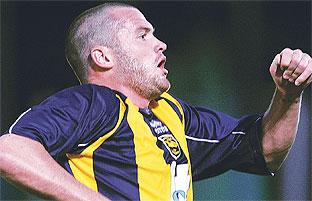
One was Kevin McLeod, a Liverpudlian who, earlier in his career, had come through the Everton academy and briefly made it through to the Everton first team.

During Adams’ previous reign at Brighton, he’d made a habit of recruiting players he had worked with before – with plenty of success. Second time around, it was not the same outcome. McLeod was a player who had played under Adams at Colchester United, joining Albion on a Bosman free transfer on 1 July 2008.

“He is a left winger with good pace. He can deliver crosses and he offers a goal threat,” Adams told the media at the time. “At this level, he’s going to be a terrific signing for us.”

McLeod scored in only the second minute of a pre-season friendly against Worthing at Woodside Road and followed up three days later with two goals against Bognor.

When the proper League One action got under way at Gresty Road, Crewe, McLeod was on fire in the opening 45 minutes and Albion went on to win 2-1.

Three days later, Adam Virgo scored twice from McLeod corner kicks as Barnet were swept aside 4-0 in the League Cup. But McLeod picked up a knee injury in that game which forced him off just before half time. Some critics maintain he never properly recovered from it for the rest of his time with the Albion. In the middle of September, he had to undergo an operation on the troublesome knee.

He returned to the line-up after a month, in a 0-0 home draw v Peterborough, and in his Argus match report, Andy Naylor observed: “McLeod once again demonstrated his ability to deliver quality crosses, which is why he has been so badly missed.”

However, by his own admission, McLeod rushed back rather too soon, and playing when not properly fit didn’t do him any favours.

650057It didn’t seem to stop him being the joker in the pack during training, though, on one occasion taking the key to loan signing Robbie Savage’s Lamborghini and hiding it. Former teammate Jim McNulty remembered him as being “hilarious for so many different reasons”, adding: “He was funny when he meant to be, he was funny when he didn’t mean to be and he was funny when he told a story because we never knew whether it was true or false. We could have so much humour with him from so many different angles and he probably wasn’t even aware of 95 per cent of them.”

McNulty detailed one stupid stunt in an interview with express.co.uk: “Macca took the car keys from the pants of one of the young lads in the changing room and decided to drive his brand new 4×4 straight onto the training pitches, over the grass and locked it between two goals.

“The goals would get chained up so he pushed two goals over the top of this lad’s BMW and locked them together. It was hilarious watching the lad trying to unlock them from his car.”

Poster ‘Basil Fawlty’ opined on North Stand Chat: “He never recovered after that knee injury against Barnet. His wages could have been used on somebody decent who can actually play left wing!”

‘Finchley Seagull’ added: “Most of the time he was here he was being paid for being injured or useless” and ‘EssBee’ declared: “Never have I seen such an unlikely professional footballer than that bloke. He looked like a poor pub team footballer…barrel chested, ill-physiqued, he was like a tub of f***ing lard with no control, no nothing.”

McLeodWell-known Albion watcher Harty observed: “I cannot think of any player, in recent years, who had a better first 45 mins for the club, vs Crewe in August 2008… then had an Albion career peter out in the manner it did.”

‘Twinkle Toes’ agreed: “I remember marvelling in his performance that day at Gresty Rd. He was absolutely terrorising the Crewe right-back with his pace and ability: he looked absolutely awesome.

“How the hell could somebody with that kind of ability turn into the no-hoper we all know and loathe?”

wearebrighton.com summed him up thus: “Another player to be filed under the umbrella of players signed by Adams who just wanted money. You could see that McLeod had talent, he just couldn’t be bothered to use it.”

While he made 28 appearances in the 2008-09 season, he only appeared eight times in 2009-10 and by the time Gus Poyet was in the manager’s chair, he let McLeod join Wycombe Wanderers on loan.

After the move he further riled Brighton supporters by claiming the humble Buckinghamshire club had “a better squad than Brighton, better ground, better fans”.

McLeod played just 11 more times as a professional for the Chairboys before going on to join a Sunday League side in Colchester.

Born in Liverpool on 12 September 1980, McLeod joined Everton as a schoolboy in 1991 and did well enough to become part of a decent youth side before establishing himself in their reserves. In the 2000-01 season, he was player of the season as they topped the reserve league.

His form was recognised by manager Walter Smith who called him up to the first team and gave him five substitute appearances in the Premier League. He made his debut v Ipswich on 30 September 2000; called off the bench for the last 15 minutes when the Toffees were already 3-0 down.

His next two appearances, two months later, were happier, though: he featured in a winning team against Arsenal and Chelsea.

Fellow youth team product Danny Cadamarteri had already given Everton a second-half lead over the Gunners when, within a minute of McLeod’s introduction, Kevin Campbell sealed the points against his old club.

The following week, the same two goalscorers gave Everton a 2-1 victory against a Chelsea line-up including the likes of Marcel Desailly, Eidur Gudjohnsen and Gianfranco Zola.

McLeod reflected some years later: “That’s not bad to have on your CV is it? Being an Evertonian it was great.

“When you are on the same pitch as Dennis Bergkamp, Ashley Cole, Ray Parlour, Lee Dixon, Martin Keown and the rest of them you don’t know whether to laugh or cry.

“It was a good experience and I thoroughly enjoyed it. In my age group there was Cadamarteri, Leon Osman, Francis Jeffers, Tony Hibbert, George Pilkington and Peter Clarke.”

The Arsenal-Chelsea double was as good as it got for McLeod. He made two more substitute appearances that season, in defeats at Ipswich and Chelsea.

The following season he made his only start for Everton as a team-mate of Paul Gascoigne in a League Cup defeat on penalties at home to Crystal Palace on 13 September 2001.

The excellent toffeeweb.com probably hit the nail on the head in describing the rising star.

“He may fall into the Everton black hole for promising youngsters who are good… but just not quite good enough,” it said. “He only has one weakness, and that is within himself when he will sometimes hide in a game if things don’t go to well in the first 10 to 15 mins.”

McLeod only got one chance under Smith’s successor David Moyes, coming on as a last-minute sub in a FA Cup defeat v Shrewsbury Town on 4 January 2003.

Ten years later he admitted to the Liverpool Echo that things might have turned out different if he had been more responsive towards Moyes.

Instead, he joined QPR on loan between March and May 2003, helping them reach the second division play-offs before joining them permanently for £250,000 on 18 August 2003.

McLeod said: “I didn’t like it at first when I moved to London. I didn’t want to go but I sat down and talked about it with my family and they said you can stay here and work hard or go and play League football.

“I went away and enjoyed it and got promotions (in his first season with both QPR and Swansea).

1068376

“You look at Leon Osman and Tony Hibbert. They stayed there for the extra year and now they are playing week in and week out but I am not one of those people who looks too much at the past.

“I’d rather go forward. I made my decision and I live with it to this day.”

McLeod initially joined Swansea on loan in February 2005 and made 11 appearances as the Swans won promotion to League One. The move was made pemanent for a fee of £60,000 at the start of the 2005-06 season and he went on to make 52 appearances (14 as a sub), before the move to Colchester.

In November 2015, McLeod was in trouble with the law, appearing before magistrates in Colchester accused of assault.

Two goals that etched Sammy Morgan’s place in Albion history

HAVING A cheekbone broken in four places during a pre-season friendly summed up the bad luck of never-say-die Northern Irish international striker Sammy Morgan.

His cause wasn’t helped when the manager who signed him six months earlier quit. And, to top it off, while he was recovering from that horrific injury, an Albion footballing legend in the shape of Peter Ward burst onto the scene.

When a £30,000 fee brought him to Brighton from Aston Villa just before Christmas 1975, it looked like the side had found the perfect strike partner for Fred Binney as they pushed for promotion from the third tier.

Unfortunately, the man with the swashbuckling, fearless approach went eight games without registering a goal. However, in his ninth game he made amends in memorable fashion.

Morgan scored both goals in a 2-0 win over Crystal Palace in front of an all-ticket Goldstone Ground crowd of 33,300 – with another 4,000 locked out.

It was 24 February 1976 and the Daily Mail’s Brian Scovell reported the goals thus: “In the 12th minute, Ernie Machin struck an early ball into the middle from the right and Ian Mellor headed on intelligently behind the defence for Morgan to steer the ball into the corner of the net.

“The second goal, in the 55th minute, came when Tony Towner took the ball off Jeffries and set off on a 40-yard run which ended with his shot rebounding off goalkeeper Paul Hammond. Morgan tapped in the rebound.”

Gritty, angular and awkward, Morgan scored five more before the end of the season, including another brace at home to Swindon.

However, Albion narrowly missed out on promotion and Peter Taylor, the manager who bought Morgan, quit the club in the close season. The new season under Alan Mullery hadn’t even begun when, in a pre-season friendly against Luton Town, Morgan fractured his cheekbone in four places.

“I know I’m probably more prone to injuries than other players because of my style of play, but there’s no way I can change it, even if I wanted to,” Morgan told Shoot! magazine. “I made up my mind as soon as I got back in the team that I’d have a real go and that’s what I’ve done. People say I’m a brave player but I don’t really know if that’s true. I just like to give 100 per cent and that way no-one can ever come back at you.”

In the season before he joined Brighton, a groin injury had restricted him to just three top-flight appearances for Villa and, when he was fit to return, Villa had signed Andy Gray, whose form kept him out of the side.

Initially reluctant to move on, he admitted in that Shoot! interview: “I was sad at the time because I had a lot of happy times at Villa but now I think they may have done me a favour. Brighton are a very good ambitious club and I’ve just bought a house in Peacehaven. Really, I couldn’t be happier.”

Born in Belfast on 3 December 1946, Morgan’s family moved to England to settle in Great Yarmouth and, with an eye to a teaching career, he combined studies with playing part-time football for non-league Gorleston Town.

“Deep down I knew I could make the grade, but the opportunity just wasn’t there,” he told Goal magazine in a 1974 interview. “The local league club was Norwich City and in those days they didn’t seem that keen on local talent.”

Morgan enrolled at teacher training college in Nottingham and just when he thought a professional football career might elude him, Port Vale made an approach.

“I jumped at the chance,” he said. “They let me stay at Nottingham to complete my studies and I would travel up to train and play with them. Deep down I thought that the Third Division was as high as I could get, unless, of course, Vale were promoted.”

In his three years with Vale, where his teammates included Albion legend Brian Horton, he scored 24 goals in 113 appearances, and he caught the eye of the Northern Ireland international selectors. He scored on his debut in a European Championship qualifier with Spain on 16 February 1972 when he took over at centre-forward from the legendary Derek Dougan.

Amongst his illustrious teammates that day were Pat Jennings in goal and the mercurial George Best. Future Brighton left-back, Sammy Nelson (then with Arsenal) was also in the side. The game was played at Boothferry Park, Hull, because of the ‘troubles’ in Northern Ireland at that time and it finished 1-1.

Morgan won 18 caps in total over the next six years, scoring twice more, in 3-0 home wins over Cyprus on 8 May 1973 and Norway on 29 October 1975.

The Goal article noted Morgan “earned a reputation of being a hard, no-nonsense striker who could unsettle defences and goalkeepers with his aggression”.

Aston Villa boss Vic Crowe liked what he saw and reckoned he’d be an ideal replacement for that tough Scottish centre-forward Andy Lochhead, who was coming to the end of his career.

Morgan was by now 27 but, in the summer of 1973, Villa paid a £20,000 fee for his services.

“The offer came right out of the blue and I had no second thoughts about the move at all,” he said. “Being part of such a famous club naturally brings pressures, but I wouldn’t have it any other way.

There was a famous incident in a televised game between Arsenal and Aston Villa when the normally calm, cool and collected Arsenal goalkeeper Bob Wilson went ballistic because of the way Morgan tried to stop him clearing his lines.

Swindon goal celeb“The bigger the atmosphere, the more I like it. For instance, my best two games this season were against Arsenal, and in the replay there was a crowd of 47,000.”

At Brighton, new manager Mullery quickly decided he preferred Ward to Binney and, with Morgan sidelined by that pre-season injury, opted to put former midfielder Ian Mellor up front to partner him.

Wardy MorgBetween them, they literally couldn’t stop scoring goals, and the success of their striking partnership restricted Morgan to only two starts in 1976-77. He was on the sub’s bench throughout that first promotion season under Alan Mullery, and he scored just once in 16 appearances as the no.12.

He subsequently moved on to Cambridge United before a spell in Holland, where he played for Sparta Rotterdam and FC Groningen.

When his playing days were over, he became a teacher back in Gorleston. He also became involved in the Norwich youth team in 1990, signing full time as the youth development officer in 1998 and becoming the club’s first football academy director (he holds a UEFA Class A coaching licence). He resigned in 2004 and moved to Ipswich as education officer.

In 2014, Morgan was diagnosed with stomach cancer and underwent chemo to tackle it. Through that association, in September 2017 he gave his backing to Norfolk and Suffolk Youth Football League’s choice of the oesophago-gastric cancer department at the Norfolk and Norwich University Hospital (NNUH) as its charity of the year.

Even when he could have had his feet up, he was helping to coach youngsters at independent Langley School in Norwich.

  • Pictures from various sources: Goal, Shoot! and the Evening Argus.

Jeff Minton a rare bright light in Albion’s gloom after dream Spurs debut

Screenshot

AFTER 10 years at Tottenham Hotspur, Jeff Minton spent five years with Brighton & Hove Albion making just one short of 200 appearances and scoring 32 goals.

He was arguably the stand-out player in an otherwise gloom-laden period for the club when off-field issues overshadowed the playing side.

Minton’s spell in Seagulls’ colours remarkably straddled the reigns of five managers and he eventually left the south to rejoin one of them, Brian Horton, at Port Vale.

It was Liam Brady who brought him to the Albion on a free transfer and it is good to read how he viewed the genial Irishman as “like a father figure to me” and “somebody who had great confidence in my ability during his spell as manager”.

He made his Brighton debut away to Swansea in August 1994 and remained a mainstay of the midfield until the summer of 1999.

It doesn’t say a huge amount about the rest of the Albion side in the 1997-98 season that Minton was the top scorer with seven goals.

It’s to his credit though that, the following season, despite Albion finishing a lowly 17th in the fourth tier, Minton was chosen by his fellow professionals in the division in the PFA team of the year.

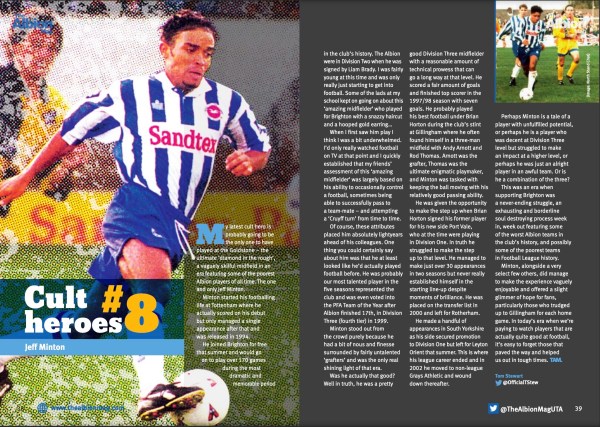
In the October 2017 issue (no.9) of The Albion Mag (below), Tom Stewart featured Minton as one of his cult heroes of yesteryear.

minton albion magNot exactly a glowing endorsement – “a vaguely skillful midfielder in an era featuring some of the poorest Albion players of all time” – Stewart nonetheless reckoned for the five seasons he was at the club he was “probably our most talented player”.

He went on to say: “Minton stood out from the crowd purely because he had a bit of nous and finesse surrounded by fairly untalented ‘grafters’ and was the only real shining light of that era.”

Stewart posed the conundrum: “Perhaps Minton is a tale of a player with unfulfilled potential, or perhaps he is a player who was decent at Divison Three level but struggled to make an impact at a higher level, or perhaps he was just an alright player in an awful team. Or is he a combination of the three?”

In April 2017, Brighton & Hove Independent gathered together player and fan memories of Albion’s iconic former home, the Goldstone Ground, and Minton was among the contributors.

“I loved the Goldstone, it was a great stadium and it’s a shame it got sold off,” he said. “The fans were all brilliant. I’m not too sure if they took to me in the first couple of years I was there, but the last two or three seasons I got on really well with them. “They were always fantastic and got right behind their side at the Goldstone. You don’t see that at a lot of teams.”

Born on 28 December 1973 in Hackney, Minton initially started training with Arsenal but, as a Spurs fan, he jumped at the chance to join Tottenham as a schoolboy.

“I joined the club as a 10-year-old after the scout Dick Moss watched me playing a district game for Hackney against Enfield in which I scored a hat-trick,” Minton recounted in a January 2018 interview with superhotspur.com (pictured below).

“Joining as a 10-year-old and leaving as a 20-year-old gave me 10 very valuable learning years at a club I supported, and also one of the country’s top clubs which is steeped in so much tradition and history. Those treasured memories will forever live with me.”

Like fellow Spurs schoolboy Junior McDougald, at 14 Minton was invited to become a member of the FA School of Excellence at Lilleshall.

J Minton SpursHaving successfully worked his way through the ranks, Minton was given his first team debut by boss Peter Shreeves on 25 April 1992 in a game that turned out to be Gary Lineker’s last home match for Spurs.

If reaching that promised land wasn’t good enough, the dream debut was complete when he scored in a 3-3 draw against Everton, with Paul Stewart and Paul Allen also on the scoresheet.

However, Minton only played two more games for the Spurs first team: one in the league seven days later in a 3-1 defeat away to Manchester United, the other in the league cup, going on as a substitute for Darren Anderton in a 3-1 win over Brentford.

Managerial upheaval probably didn’t help his cause: Terry Venables had been in charge when he joined, after Shreeves’ spell in charge, Doug Livermore and Ray Clemence took over, and it was Ossie Ardiles who ended up releasing him on a free transfer in July 1994.

It’s interesting to read that Minton’s former youth team manager, Keith Waldon, was disappointed that Minton didn’t make more of a name for himself. Waldon told superhotspur.com: “One of those who disappointed me with how far he went in the game was Jeffrey Minton.

“Jeffrey had phenomenal ability with his feet, was quick off the mark and had wonderful skill. But he didn’t go as far as I hoped he would, and I think that he’d tell you that he wasn’t the most disciplined person, but he was a wonderful player.”

While welcoming the chance to play first division football for Port Vale after his Brighton career came to a close, he struggled to settle in the Potteries and in his second year there moved on loan to second division Rotherham United, who he helped to promotion.

He then returned to London for the 2001-02 season and played 39 league and cup games for Third Division Leyton Orient.

Although offered a contract extension by the O’s, Minton says excessive demands from his agent scuppered a deal and he ended up playing non-league football with Canvey Island for three seasons.

He moved on to Chelmsford City in August 2006 where he played for a further three years, had a brief spell at Welling United and ended his playing days with Isthmian League Ware.