
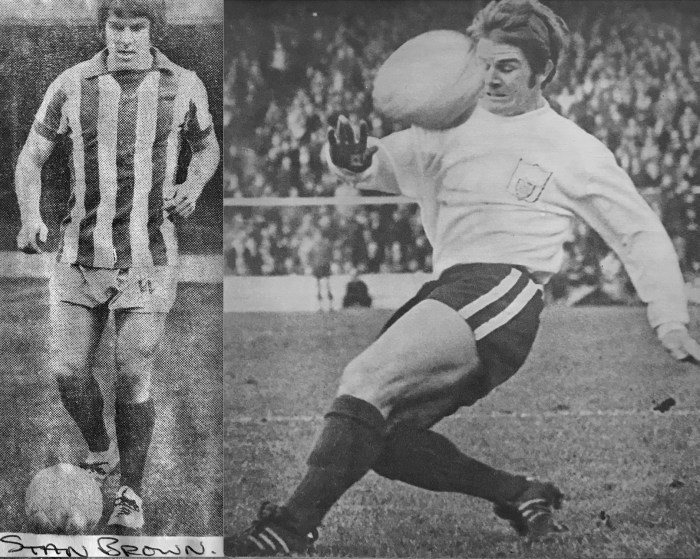
A WIN ON his debut was as good as it got in Sussex-born tenacious midfielder Stan Brown’s two months as a Brighton player.
Brown, who spent 15 years with Fulham, was one of too many loan signings manager Pat Saward turned to as he dismantled his 1972 promotion-winning side and tried in vain to get Albion to adapt to the old Second Division.
Brown had six seasons as a Fulham regular in the old First Division, two in the Second and two in the Third before his two-month loan with the Albion.
He was following in the footsteps of two of his five brothers, Irvin and Alan, who had both played briefly for Brighton several years earlier.
Stan certainly couldn’t have wished for a better start, in a side with another loanee debutant, Luton’s John Moore (in as a replacement for sold ex-skipper John Napier), for an away match at Huddersfield Town on 14 October 1972.
With only one win (ironically against Fulham) in the opening 12 league games, there was cause for optimism that a corner had been turned when the Albion earned a surprise 2-0 victory in south Yorkshire (Eddie Spearritt and Barry Bridges the scorers).

“It was as if I had been playing for Albion all my life,” Brown told the matchday programme. “You see, I live at Lewes, the training ground is only four miles from my house and I have known Bert Murray and Barry Bridges for a long time.
“As for the rest of the lads, I felt I knew them too from reading about them in the Evening Argus every night. So, when it actually came to turn out for Albion at Huddersfield I knew all the players by their first names.”
Manager Saward was certainly impressed by the impact of his two new acquisitions. “The new men played a major part in our success,” he said. “It was quite remarkable really the way they slotted into the side as if they had been playing for Albion all season.
“They are, of course, experienced professionals who have been around the game a long time. But even the best professionals sometimes take time to settle into new environments and this is why the performances of these two was so outstanding.”
Injuries to regular midfielders John Templeman and Brian Bromley had provided an opening for Brown and his subsequent involvement helped the side to three successive draws. But the wheels fell off big time in his last five games as Albion lost the lot without scoring a goal.
Brown returned briefly to Craven Cottage before moving on to Colchester United while Albion’s losing streak continued through to the following February!

Although fortunes eventually improved in the final third of the season, the damage had been done and Albion dropped straight back down to the old Third Division.
Born in Lewes on 15 September 1941, Brown played for East Sussex schoolboys and captained Sussex Schools. It was in that representative side that he was spotted by Fulham, who took him on as a 16-year-old apprentice in 1957.
Older brother Irvin, a centre-half, had joined Albion’s staff in 1951 but only played three games in the 1957-58 season before moving on to greater success with Bournemouth; signed by Don Welsh, the manager who’d taken him to Brighton.
The day after Irvin left the Albion in 1958, 6’4” brother Alan signed for the club as a centre-half but was converted into a centre-forward and scored twice in eight first team games before moving on to Exeter City; signed by former Brighton teammate Glen Wilson.
Stan was undoubtedly the most successful of the three although, when he made his Fulham first team debut on 21 January 1961, it was memorable for all the wrong reasons: he was in for the injured Johnny Haynes and Fulham lost 6-1 at home to Sheffield Wednesday.

Initially a centre-forward, at 5ft 7ins he was on the small side to lead the attack, so switched to midfield – his preferred position – but he also featured in the back four.
It was in the 1962-63 season that he earned a regular place in the side and was known as a “player’s player” for his selflessness and desire to put the team before his own ambitions. He enjoyed playing in midfield alongside Haynes and Alan Mullery but was prepared to slot in anywhere if necessary.
Fulham fan Pete Grinham summed him up as “a high octane team player of the highest calibre without the individual skills of his more illustrious teammates but with the heart of a lion”.
The supporter added: “He was a very effective, tenacious tackler, and his distribution was extremely good. He did the lion’s share of the hard graft allowing others to shine.
“This selfless work for the team was not always appreciated in some fan quarters but if you could ask any player who played with him, they would commend his importance to the team.”
His loyalty to Fulham was rewarded with a testimonial game in late 1970, Fulham losing 2-0 to Chelsea at Craven Cottage watched by a crowd of 11,024.
His total of 393 appearances for Fulham, plus five as a substitute, put him in the Cottagers’ top 20 appearances’ chart. It was only when Mullery returned to the Cottage from Spurs in the summer of 1972 that Brown lost his place.
Grinham was staggered to see Brown appear at the age of 59 in a testimonial for Simon Morgan, another Fulham stalwart, who won promotion with the Albion in 2002.
The game, on 2 August 2000, saw Brown play for a Fulham veterans side against Chelsea veterans, still displaying a remarkable level of fitness.
It was that fitness that had seen his post-Fulham career continue at Colchester for five months (he played 23 matches through to the end of the 1972-73 season), then Wimbledon (1973-74) and Margate.
He continued to play at Sussex County League level for a number of years, turning out for Haywards Heath, Ringmer, Southwick and Burgess Hill, and also playing for the county representative side.
When he died aged 76 on 16 March 2017, the Argus remembered how Brown helped to nurture young talent by coaching junior football teams Lewes Bridge View and Ringmer Rovers, as well as setting up and organising the Lewes Saturday Soccer School.

 In parallel lines
One thought on “Great start, but Fulham stalwart Stan Brown couldn’t help slide”