

TRICKY Mickey Thomas earned a dream move to Manchester United but it turned into a nightmare.
Thomas is now a wisecracking ex-pro with a raft of entertaining self-deprecating stories about his colourful life and career, which included an unhappy spell playing in the top-flight for Brighton.
But before laughs became his stock in trade there was genuine fear.
Former Brighton player Dave Sexton was the United boss who signed Thomas from Wrexham to provide left-wing crosses into centre-forwards Jimmy Greenhoff and Joe Jordan, but the Welshman admitted: “I was petrified.”
He told interviewer Helen Evans: “I was scared to walk into the dressing room. I came over as a confident person, but I pretended I was. I got away with it.”
And in an interview with the Mirror, he said: “I played a lot of games – 110 – in a short space of time at United, but it wasn’t me.
“I wasn’t relaxed, I didn’t feel comfortable. I found it hard there. I couldn’t relay to anyone what I was going through.”
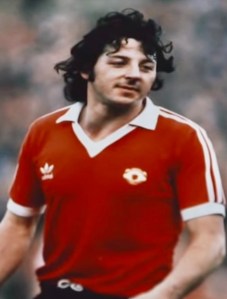
He expanded on the theme in his autobiography, Kickups, Hiccups, Lockups. “I was like a startled rabbit in the Old Trafford headlights,” he said. “I always played well within myself. There was a lot more pressure than I could have ever imagined, especially in front of the home supporters, even though I knew they loved me.”
Born in Mochdre, Conwy, in north Wales, on 7 July 1954, Thomas was brought up in poverty on a council estate and left school unable to read or write properly. He relied on a local factory to buy him his football boots and returned the favour by turning out on the left-wing for the factory’s men’s team, aged just 13.
He signed for nearby Wrexham at 15 and made his first team debut when just 17, under manager John Neal. Over six years, he made 230 appearances for Wrexham, scoring 33 goals along the way He made his debut for the Welsh national team in 1976 (in 10 years he won 51 caps) before moving to United in 1978.
“Sometimes it was too much to bear,” he said in Kickups, Hiccups, Lockups. “Fear of not being the person I was at Wrexham. Gone was the happy-go-lucky lad, and I knew he wouldn’t come back while I was at United. I didn’t feel as though I deserved to be a Manchester United player.”
He said it would take two bottles of wine the night before a match to help ease his nerves. “I was playing in front of 50,000 United fans and I was desperate to please them. In the end the pressure brought me down and I walked out.”
There was some degree of mystery exactly why he left Old Trafford in August 1981 (the Argus reported on 4 February 1982: “It wasn’t a gambling debt but Thomas needed the cash fast, and a move was the only answer”).
Moving to his boyhood favourite team, Everton, was, on the face it, a perfect next step but it didn’t take long for the move to turn sour.
After a bright 11-game start, he sustained a hamstring injury which sidelined him for several weeks. When fit again, he’d only trained for two days and expected to be restored to the first team. Manager Howard Kendall wanted him to prove his fitness in the reserves first – but Thomas refused to play.
Kendall said: “I put a high regard on discipline. I couldn’t let Thomas get away with refusing to play for the reserves.” He was fined two weeks’ wages with Kendall adding: “The whole club and all the fundamentals I believe in would have gone out of the window if I had let him get away with it.”
The hoped-for first team return never happened because Brighton manager Mike Bailey stepped in and snapped him up for £350,000 – on a four-year contract.
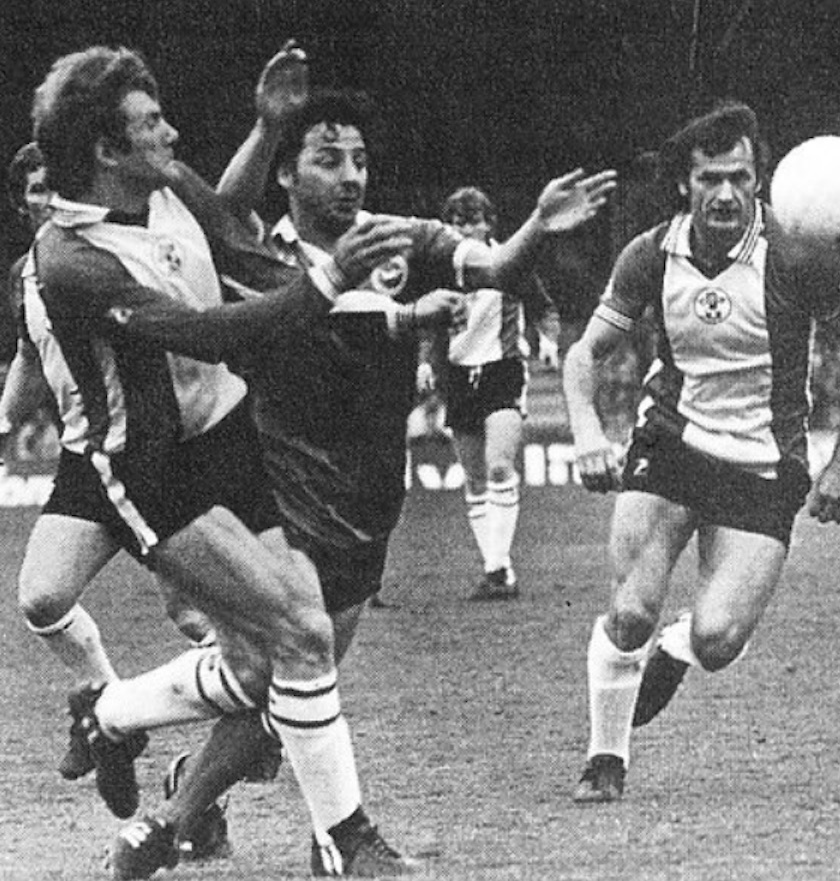

With long-serving left-sided midfield player Peter O’Sullivan – ironically also from north Wales and a former United youngster – having left the Albion in the summer of 1981, Thomas fitted the bill as his replacement.
“It was no secret that I had been looking for a left-sided player and I had made an approach for Mickey in the summer, before he moved from Manchester United to Everton,” Bailey wrote in his programme notes.
“I am now confident that we have the depth of squad we need to continue our progress and now we are all together we will work to improve in both our teamwork and individually. We have the competition we want for places and the whole squad is aware of what we are trying to achieve.”
Three months later the manager was making completely different noises. Thomas made an impressive cameo debut performance for the Seagulls as a substitute in a 1-1 draw with Birmingham. Blues midfielder and future Albion player Alan Curbishley made a hash of a back pass that enabled Michael Robinson to seize the chance to equalise for Albion.
The Sunday People reported: “Brighton cast new signing Mickey Thomas into a crazy, helter skelter 23-minute debut. And within seconds of his going on as a substitute, patched-up Birmingham cracked under the pressure.”
And the Sunday Express added: “Thomas, a £350,000 signing from Everton, came on as a substitute for Andy Ritchie and eight minutes from time he was floored in the box. But despite protests from the Brighton players, referee Colin Downey refused a penalty.”
Thomas made his full debut in a 2-2 draw at home to Notts County and in only his third start in an Albion shirt he was back at Old Trafford. A less than memorable return, though, saw Albion go down 2-0 – and Thomas picked up a booking.

Nevertheless, he kept the shirt for 12 games, getting on the scoresheet in a 3-1 FA Cup 3rd round game in which opposition full-back Graham Pearce did so well that Bailey promptly signed him.
It would later emerge, however, that Thomas’ 20-year-old wife, Debbie, had been unable to settle in Sussex – the word was that she gave it only five days, living in a property at Telscombe Cliffs – and had gone back to Colwyn Bay with their baby son.
Thomas meanwhile stayed at the Courtlands Hotel in Hove and the club bent over backwards to give him extra time off so he could travel to and from north Wales. But he began to return late or go missing from training.
Stories abounded across the press and in a candid interview with the Argus, Thomas admitted: “My wife will never live in Brighton, and I can see her point of view. All our roots are up north.
“Everything is fine in our marriage, but I want to be with Debbie and see our little son grow up. I just can’t settle down at Brighton.
“It’s a marvellous club but it’s in the wrong place. If it was up here, I would be the happiest player in Britain.
“My dream club was Everton, but things didn’t work out there, although I don’t think it was my fault.
“I was more or less shoved down to Brighton and really Debbie and I should have been given another couple of days before making up our minds.
“The signing was done in too much of a hurry, so I could turn out in the next match.”
Bailey was incandescent with rage and after the third occasion that he went missing, declared: “Thomas has s*** on us….the sooner the boy leaves, the better.”
Thomas claimed he had a bad back “probably caused by all the travelling I’ve been doing the length of the country.
“I’m sick of everything. I’m made out to be a bad boy, but I’m not. I’ve got a genuine reason for this problem and people know what it is.
“The strain of the whole business on myself and my family has been immense. People don’t realise what I’ve been going through – it’s been an absolute nightmare.”
When he went missing again and was fined another fortnight’s wages, Bailey once again went on the front foot and told the Argus: “He came in and trained which allowed him to play for Wales.
“He is just using us, and yet I might have played him against Wolves. Thomas is his own worst enemy and I stand by what I’ve said before – the sooner he goes the better.”
At one point, in March, it was hoped a swap deal could be worked out that would have brought England winger Peter Barnes to the Goldstone from Leeds, but they weren’t interested and so the saga dragged out to the end of the season.
Thomas was ‘shop windowed’ in the final two games and during the close season was sold to Stoke City for £200,000.
Unfortunately for Albion, it was only a matter of months before Thomas came back to haunt them again. Away to Stoke on 16 October 1982, the game was only four minutes old when Thomas seized on a Sammy McIlroy pass to put the Potters a goal up. Mark Chamberlain, who would have a spell at Brighton several years later, scored a second and McIlroy added a third as the Seagulls lost 3-0.
It was with some relief that Thomas left the field with a gashed ankle with 19 minutes remaining.
Tony Lamb in the Sunday People said Thomas had “mesmerised” Albion and added: “The little Welshman gave one of those brilliant all-action performances that used to delight the fans in his days with Manchester United before his unhappy stay in the south.”
Based closer to home, Thomas did indeed hit some of the form he had previously shown, scoring 22 times in 122 appearances for Stoke.
His old Wrexham manager, John Neal, had taken the reins at then Division 2 Chelsea, and, in January 1984, Thomas headed to London and clocked up 44 appearances for them, also weighing in with nine goals.
After John Hollins took over, though, he was sold to West Brom for £100,000 but he only made 20 appearances for the Baggies. He played nine games on loan to Derby and then tried his luck in the United States, spending two years with Wichita Wings where former Chelsea and Scotland international Charlie Cooke was the head coach.
Back in the UK, Thomas had spells with Shrewsbury Town and, ironically, Leeds. In an interview with respected football writer Henry Winter, in 2008, Thomas told him: “Howard Wilkinson paid me the biggest compliment when I signed for Leeds at 36. He said, ‘I’ve done my homework, you’re a player I’ve always admired, and I talked to Dave Sexton and he said, ‘Just get him on the pitch and he’ll be fine. Off it, I’m not sure what you can do with him’.’’
After helping Leeds win promotion, he went back for a second spell at Stoke City and earned the player of the year award.
In 1991 he made another return journey and went back to where it had started – Wrexham – during which time, at the age of 37, he memorably scored an oft-televised free kick when the mighty Arsenal were beaten in the FA Cup by the Welsh minnows.
Remarkably, considering the troubles he had along the way, by the time he hung up his boots professionally, he had amassed 727 appearances and scored 92 goals.
Perhaps unsurprisingly, Thomas is delighted to see his old club making waves again under the ownership of Hollywood stars Ryan Reynolds and Rob McElhenney, telling the Wrexham website in August 2023: “It was Wrexham that gave me my life. My first club will always be Wrexham, and I will never forget that. To see where it is now makes me walk tall and proud knowing that Wrexham are back.”

He added: “I came from a council estate in North Wales dreaming of becoming a footballer and our manager John Neal believed in both me and Joey Jones.
“The club gave me an opportunity to do something I always wanted to do, and it gave me a great life.”
After his football career was finished, Thomas was back in the headlines for involvement in counterfeit currency and was sentenced to an 18-month jail term in 1993.
“Prison taught me a lot,” he told Henry Winter. “It taught me to sleep with one eye open! It gave me the confidence I’d lacked. I had to be sure of myself. It taught me not to trust anyone any more, to choose my friends carefully.’’
‘Mickey T’, with 52,000 followers on Twitter (or X as we’re now supposed to call it), later became a frequent contributor to MUTV and is a regular in the hospitality suites at Old Trafford.
He had a well-publicised battle with stomach cancer in January 2019, which required surgery, and he went on to make a full recovery, sharing the news on social media.
What he went through was documented in an emotional edition of UTD Unscripted, when he explained how football had helped him. “The reaction I’ve had, from inside and outside football, has been incredible,” he said.
“Manchester United have been absolutely amazing,” he said. “They give me the biggest lift that I could possibly want. I know it might seem nothing to some people, but to go to a game, and see people there – I’m thankful for that. Coming to the home games and meeting up with players, it’s great. I go home after and I feel 10 feet tall – even though I’m a midget!”
Reflecting on his many and varied experiences, Thomas told the Mirror: “Fans see players on the pitch and think they’re superhuman, but they’ve got lives away from football, with their own problems.
“There’s more awareness now of mental health, of the pressure on players and what it can do to them. But my era was a tough era, you had to be a proper man. If you said you were a bit scared, they’d say ‘f***-o**’ and knock you out.”
He added: “We’re all human, we don’t know what goes on behind closed doors, in people’s lives.
“Everyone used to think I was cocky, but it was the complete opposite. That was all a front.”
 In parallel lines