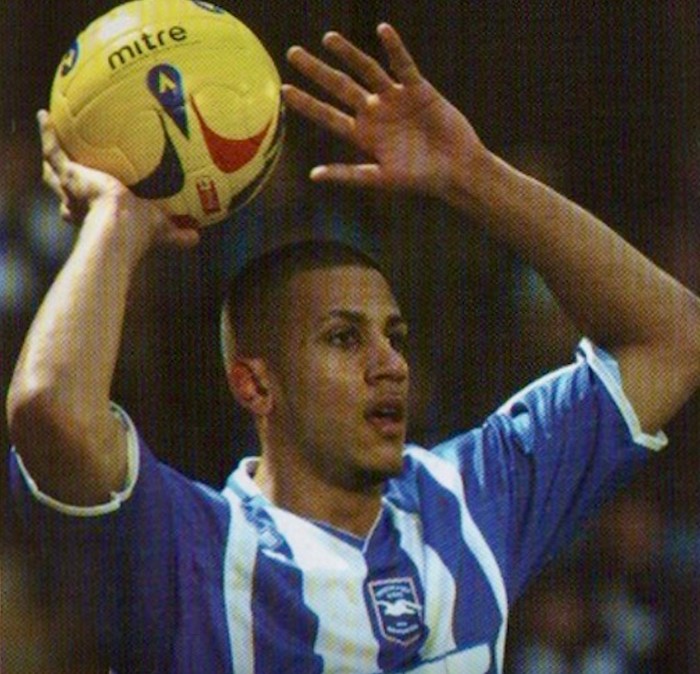
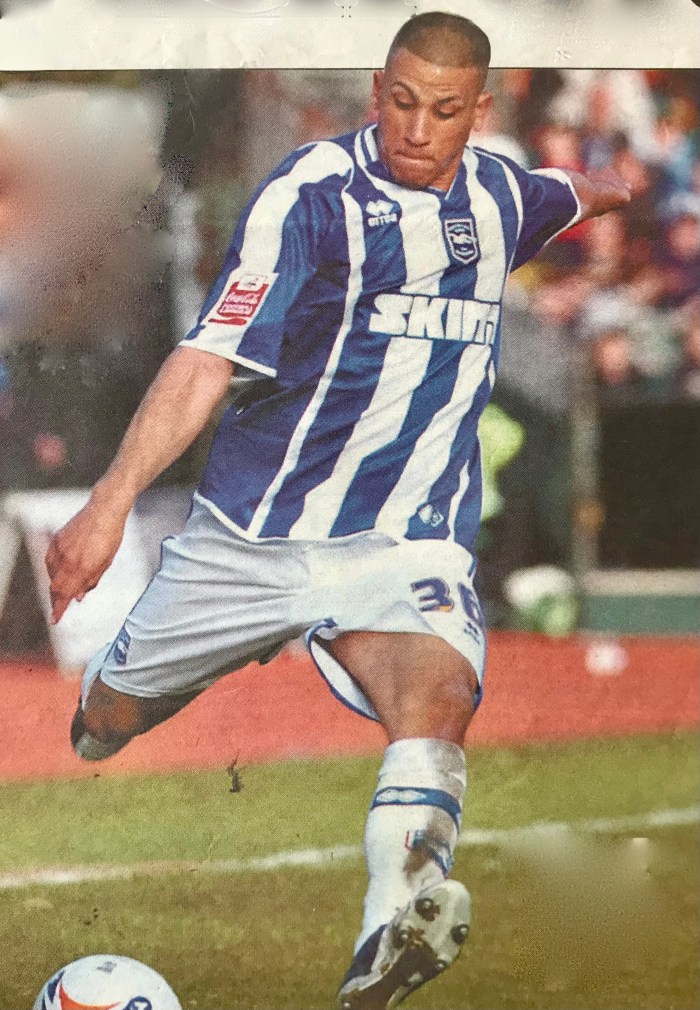
TEENAGE Arsenal defender Joe O’Cearuill certainly had a baptism of fire when he moved to the Albion on loan in early 2007.
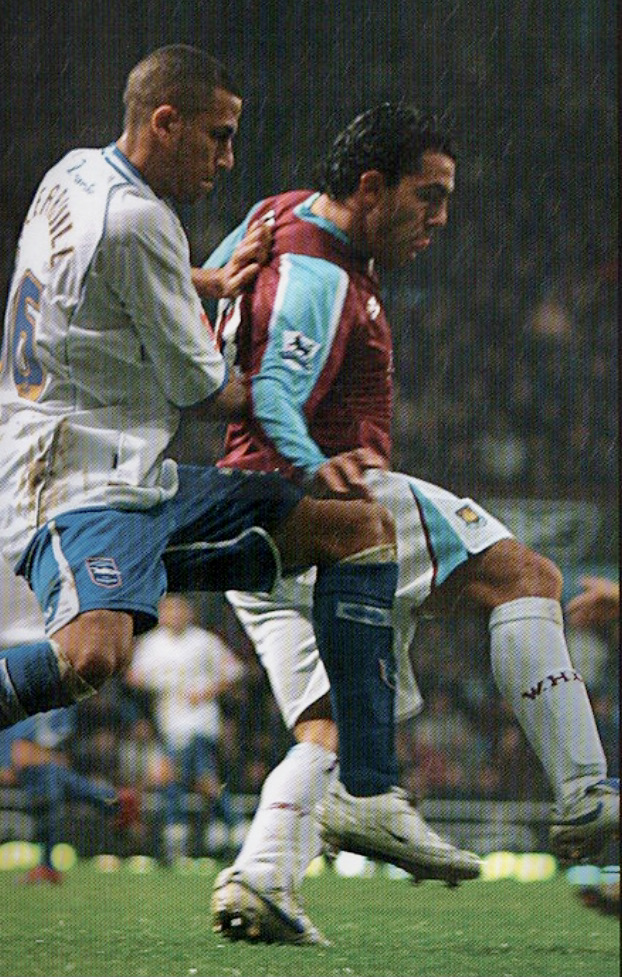
The youngster was played out of position at right-back in a third round FA Cup tie away to West Ham.
The match at the old Boleyn Ground on 6 January 2007 pitched the Premier League Hammers under Alan Curbishley up against his old Seagulls teammate Dean Wilkins, who had taken over the reigns at League One Brighton just four months previously.
West Ham, FA Cup finalists the previous season, were just too good for the mainly young lower league side on the day and, with big-money Argentine striker Carlos Tevez up front, comfortably won the tie 3-0 (Mark Noble, Carlton Cole and Haydn Mullins the scorers).
Albion put up a reasonable fight in a goalless first half although O’Cearuill was fortunate not to concede a penalty when he put in a clumsy challenge on debutant Luis Boa Morte which referee Mark Halsey chose not to penalise.
The second half was only four minutes old when Noble scored his first ever West Ham goal, Cole added a second nine minutes later before being replaced by former Albion favourite Bobby Zamora, and Mullins struck in injury time to round off the win.
Wilkins had turned to the Arsenal youngster when Jack Hinshelwood’s dad Adam suffered a cruciate ligament injury in a Boxing Day match against Yeovil that ruled him out for nine months.
O’Cearuill’s stay on the south coast lasted three months during which he made seven starts and three sub appearances. His final Seagulls match came in a 1-1 home draw against Scunthorpe United.
The Argus reckoned his form was “patchy” and at one point he was dropped to the bench “after a below-par performance” in defeat at Brentford.
Only on a couple of occasions did he get the chance to play in his favoured centre back position; those positions were occupied most of the time by Joel Lynch and Guy Butters.
But after he’d gone on for the injured Lynch in the centre away to Gillingham, he helped the visitors to a 1-0 win and Wilkins said: “I thought he fitted in well. He went into the game at a difficult period. There were a lot of high balls to deal with, which he coped with well.”
That first half of 2007 was pretty much the highlight of his career because on an end of season tour of America he won two full caps for the Republic of Ireland.
Although born in Edmonton on 9 February 1987, he elected to represent the Republic of Ireland and having played for them at under-17, under-19 and under-21 level,
A senior cap for the Republic of Ireland
His first senior cap came when he was one of six substitutes made by manager Steve Staunton in a 1-1 draw against Ecuador at the Giants Stadium, New Jersey, on 23 May 2007.
He replaced Stephen O’Halloran in the 73rd minute and managed to pick up a yellow card in his short time on the pitch. Kevin Doyle headed the Irish equaliser a minute before half time.
O’Cearuill then started at right-back three days later in the Republic’s 1-1 draw with Bolivia in Boston. Shane Long scored his first goal for his country and in the second half former Albion goalkeeper Wayne Henderson took over in goal from Barnsley’s Nick Colgan. The side was captained by Kevin Kilbane.
Curiously, O’Cearuill had been let go by both Leyton Orient and Watford before he was given a chance by Arsenal. He played 27 youth team games for the Os in 2004-05 but was released in August 2005.
Watford picked him up and he played for their youth and reserve teams for a season, but again found himself released. Then, in the summer of 2006, after impressing Arsenal’s reserve team coach Neil Banfield in a trial game against Watford, he joined the Gunners.
He made his debut in a goalless pre-season friendly at Barnet on 15 July and a week later played in half of Dennis Bergkamp’s testimonial against Ajax of Amsterdam.
On a tour of Austria, he played another half as Arsenal beat Mattersburg 2-1 and got 30 minutes as a sub when the Gunners trounced Schwadorf 8-1.
The closest he came to competitive first team action was when he was on the bench for Arsenal’s Carling Cup match away to West Bromwich Albion on October 24, 2006, although he did not get on in the 2-0 win in which Jeremie Aliadiere scored both the goals.
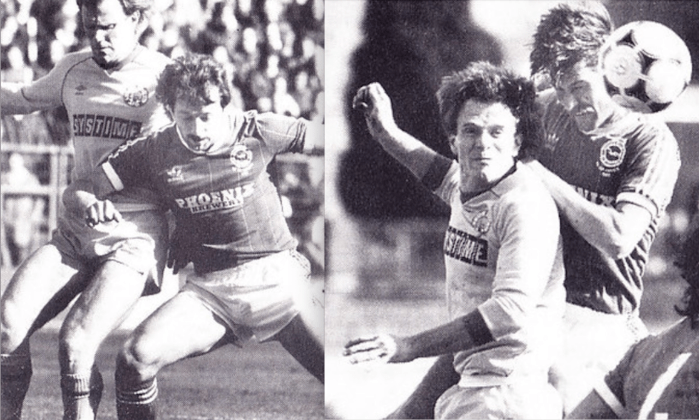
Released by Arsenal, O’Cearuill’s career then drifted from one non-league club to another: Barnet, St Patrick’s Athletic (Dublin), Harlow Town, Borehamwood, Forest Green Rovers (pictured left), Bishop’s Stortford, Tooting & Mitcham United, Haringey Borough, Enfield and Heybridge Swifts.
When he sought to resurrect his career with Conference Premier side Dover Athletic in 2015, he was suitably phlegmatic in an interview with Kent Online.
“It’s certainly been a journey,” he said. “From getting everything on a plate at Arsenal and then for Ireland, to then be washing your own kit and boots.
“I took being a professional for granted and I wasn’t really ready for it – I was too young to take it all in.
“When Arsenal released me, I discovered there was a lot more to life than playing football and I lost the motivation to play at a decent level. I even gave the game up for a while.
“I was then happy to play wherever and go with the flow. I had a couple of great years playing with my mates at Haringey Borough. But that’s all in the past now. The days for playing for fun are behind me.
“I am ready for the next chapter in my life because I’ve got the hunger and desire back to play the game at a level I know I am capable of.”
Released by Dover at the end of the season, former Albion striker Nicky Forster, by then manager of Staines Town, took him on for the Isthmian League Premier Division team.
“We are delighted to have secured the services of Joe this season, he has a great attitude for success and will sit well alongside Darren Purse at the back,” he told the club website.
His last port of call was back at Haringey in the summer of 2016 and he retired from playing in October that year.
In his LinkedIn profile, O’Cearuill describes himself as a senior manager for The Elms Sport in Schools programme.
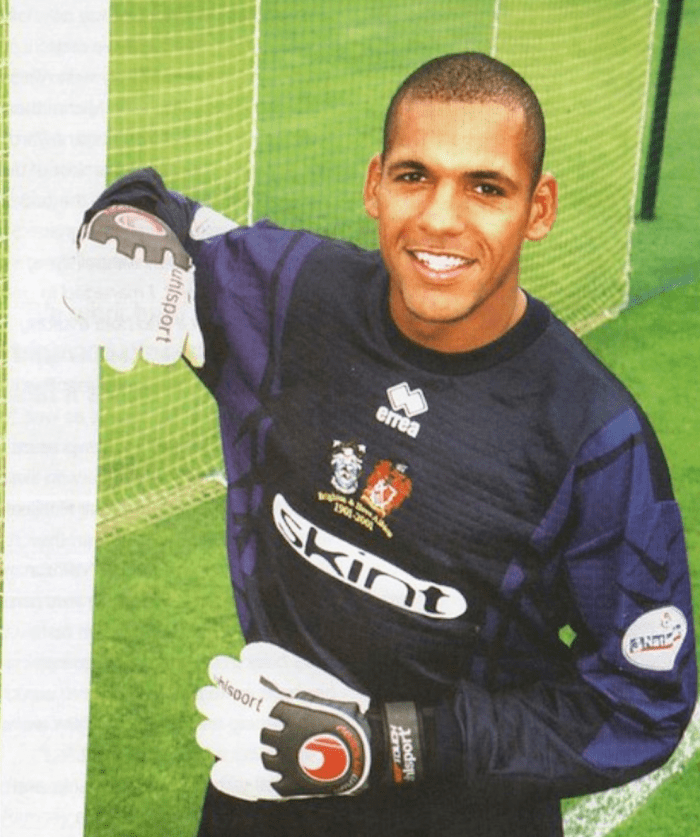
FORMER DUTCH MARINE Michel Kuipers earned back-to-back promotions with Brighton and Hove Albion and Crawley Town.
He was between the sticks for the Albion when they won promotion from the basement division in 2000-01 and the third tier in 2001-02.
And after 10 years with the Seagulls, during which he made a total of 287 appearances, he spent two years with Crawley where, over 49 matches, he won promotion from the Conference in 2011 and League Two in 2012.
Undeniably, it was Kuipers’ years with the Seagulls that defined his career after an inauspicious start when Micky Adams subbed him off at half-time on his debut away to Southend United. Replaced by Mark Cartwright in that match, he was left out of the next 11 matches before an injury to Cartwright enabled him to win back the shirt. He didn’t look back after that, though, and only missed three more matches as the Seagulls were crowned champions.
Early days between the sticks
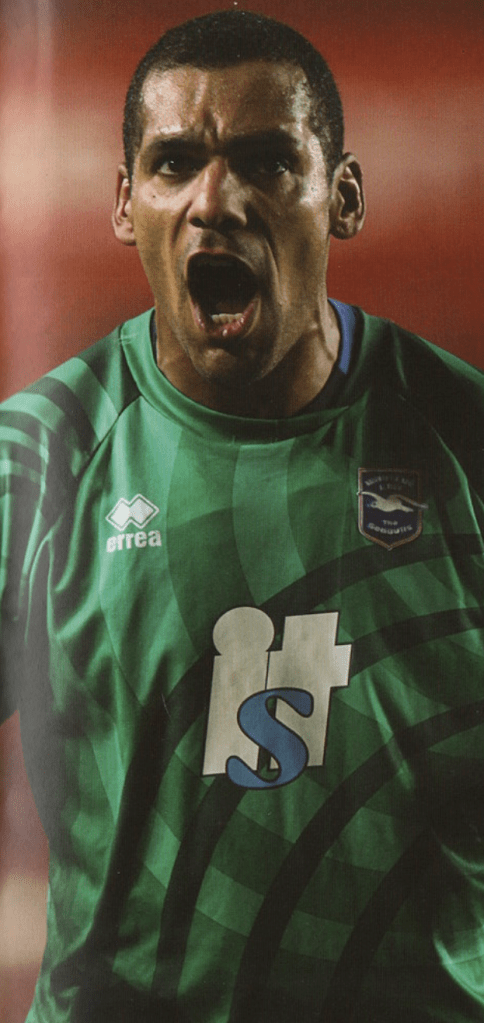
Although there were to be plenty of ups and downs over the following years, when he wasn’t always first choice, Kuipers remained a crowd favourite for his agility as a shot stopper and his fanlike celebrations of goals and wins.
“I was a player but I also turned into a fan of the Albion,” he said in an interview with the matchday programme. “On the pitch I would celebrate each goal we scored like I was on the terraces with our supporters.
“After we had a good result in the game, I would celebrate with the players but always expressed my joy and gratefulness to the supporters.”
A sensational double-save in a televised game away to Wolves in November 2002 was a highlight for many and a one-handed reaction stop at Blackpool earned him a ‘save of the month’ award from sponsor Nationwide.
He didn’t always see eye to eye with Mark McGhee, who reckoned his kicking let him down, and the Scot said: “His desire to do well is unquestioned, but I had to make a decision and it was not always one he agreed with.”
McGhee was nonetheless full of admiration for the Dutchman and in a programme for Kuipers’ testimonial match v Reading in 2012, he recounted a specific role he played when Albion’s back-up goalie at the 2004 Second Division play-off final against Bristol City.
“I asked Michel to warm up, but in truth to get the supporters going. I remember him going down to the corner and waving with those huge arms – he absolutely galvanised the support.
“What was brilliant for me was that he did it despite his huge disappointment not to be playing himself – he did it for the team. The rest is history as the fans got behind the team. We got the penalty and went on to win the game.”
Later that evening, the trophy Albion won got bent when someone fell on it: with his bare hands, Kuipers straightened it!
Five years (from 19 to 24) in the Dutch Marines during which he’d parachuted from aeroplanes and learned to survive in harsh conditions, definitely left their mark. His training had taken him into jungles, deserts and the Arctic, but he said: “My love and passion for football was always there. In my spare hours I played for the Marines team.”
Born in Amsterdam on 26 June 1974, as a childKuipers played football with his mates in front of some garages near the flats where he lived. He recalled they would be told off for hitting the ball against the garage doors, so he went in goal to try to save the ball from making loud bangs every time one of his friends scored.
“I was doing OK, so from that day onwards I played as a goalkeeper,” he said. He played for the local Blauw-wit under six team and went all the way through the age groups to the first team at 18.
A keen Ajax fan as a youngster, his idol was their goalkeeper Stanley Menzo – “one of the best goalkeepers of his generation” – and he also admired Menzo’s successor, Edwin Van Der Sar, who later played in England for Fulham and Manchester United.
Although Kuipers went straight from full-time education into the Marines, he also played part time for AFC Door Wilskracht Sterk (it means Strong Through Willpower) and Kuipers explained: “We won the Amsterdam regional league for the first time in 25 years and this brought me to the attention of Ian Holloway at Bristol Rovers.
“When I was offered a contract by him, I wasn’t sure I could leave the Army, but the officers knew I’d put 110 per cent into my job, so they were happy to release me.”
But in 18 months with Rovers, Kuipers only managed one first team appearance (against Bournemouth in March 1999). Indeed, it was while playing for Rovers Reserves against Brighton at Worthing that he caught the eye of Brighton boss Adams. He jumped at the chance when Albion offered him a trial and he played well enough in a Sussex Senior Cup semi-final against Langney Sports for Adams to persuade him to make a permanent move to the Seagulls with the intention of being back-up to Mark Walton.
When Walton suddenly upped sticks and joined Cardiff before the 2000-01 season had started, Kuipers found himself in the starting line-up for the opening game away to Southend.
Understandably, Kuipers was distraught at being taken off at half time but he knuckled down to try to win back the shirt and said: “If you’re mentally strong and you’ve got good self-confidence and belief then you just fight back and that’s the way I approached it in the following months.”
He credited the work he put in with goalkeeping coaches John Keeley and Mike Kelly, admitting: “They improved my technique and made me more professional.”
Even when Adams left for Leicester, Kuipers remained no.1 under Peter Taylor as the Seagulls soared to a second successive promotion.
Injury meant Kuipers missed the second half of the season when Steve Coppell’s side only just missed out on avoiding an immediate drop back to the third tier.
When Ben Roberts was preferred as first choice goalkeeper, Taylor, by then manager of Hull City, took Kuipers on loan in September 2003.
Albion rebuffed Hull’s attempt to sign him on a free transfer but shortly after his return to Sussex he was involved in a horror car smash on his way to training.
Remarkably, considering he was airlifted to hospital, he escaped serious injury although club physio Malcom Stuart reported: “Michel knows he was very lucky. There’s a degree of shock and he will need time for that to clear his system. Structurally there are no serious injuries, but he’s had several stitches and is very sore and uncomfortable muscularly.”
Manager McGhee added: “My God, we feared the worst. But in a sense it’s an absolute bonus, a miracle – they sent him home with a few cuts and bruises, a swollen face, a sore back and a sore neck, which in a week or two will be fine.”
Nevertheless, it was Roberts who kept his place as Albion won promotion via the aforementioned play-off final win in Cardiff. But in the first half of the 2004-05 Championship season, Kuipers was back in the saddle courtesy of injury to Roberts.
All was fine until a home game v Nottingham Forest on 22 January 2005 when Kuipers came off worse in a challenge with Kris Commons and the shoulder injury he sustained kept him out for the rest of the season. Former Arsenal ‘keeper Rami Shabaan and Southampton loanee Alan Blayney took over the gloves.
New competition arrived in the shape of Aston Villa loanee Wayne Henderson, who took over in goal at the start of the 2005-06 season and with the brief return of Blayney as well as Frenchman Florent Chaigneau as back-up, it seemed Kuipers’ Albion days might be over.
He was sent out on two loan spells at League Two Boston United – initially playing four times in December 2005, then 11 matches between February and April 2006.
With Brighton back in the third tier for the 2006-07 season, and another change of manager when McGhee gave way to Dean Wilkins, Kuipers found himself vying for the jersey with Henderson, who had been signed permanently. Local lad John Sullivan was beginning to emerge too. But there was no keeping a good man down and Kuipers was the ever-present first choice goalkeeper throughout the 2007-08 season.
At that time, he admitted he was still learning ways to improve thanks to goalkeeping coach Paul Crichton and told the matchday programme: “I am very pleased with the progress I have been making under Paul.
“My game has definitely improved and it is great to see the results of hard work on the training ground coming out in games.”
When Adams returned ahead of the 2008-09 season, Kuipers was still in pole position and he famously saved Michael Ball’s penalty when League One Albion beat Manchester City 5-3 on penalties in a second round League Cup tie at Withdean.
Although Sullivan had a run in the side, and Adams’ successor Russell Slade briefly turned to loanee Mikkel Andersen, Kuipers was once again in the box seat come the end of the season.
It wasn’t long after the arrival of Gus Poyet that Kuipers’ time at Brighton finally came to an end. A 2-1 home defeat to Norwich City in February 2010 was his last Albion start as Poyet turned instead to his ‘keeper of choice, Peter Brezovan.
The Dutchman continued his association with the Seagulls through involvement in the Albion in the Community programme and his long service was rewarded with a testimonial game at the Amex (a 1-1 draw v Reading when he played 15 minutes). He told BBC Radio Sussex: “Bar my family, this football club is the closest thing to my heart.
“I’ve been bleeding blue and white for the last 12 years so this is a very proud moment for me and my family.”
He added: “I love the Brighton supporters. They’ve been absolutely fantastic to me and a lot of the times when we had our backs against the wall, they were the 12th man.
“Especially as a goalkeeper, I really appreciate them backing the team. I think people appreciated me because I threw my body on the line for the club.”
Kuipers early days at Crawley saw him making headlines for all the wrong reasons – he was sent off twice in the first month, v Grimsby Town and v Forest Green Rovers – but he was in the Blue Square Bet Premier league side that had a terrific run in the FA Cup, only narrowly losing in the fifth round, 1-0 to Man Utd at Old Trafford in February 2011.
Kuipers’ loyalty was rewarded with a testimonial in 2012
On leaving Crawley in early 2013, he said: “When I joined, the club had finished mid-table in the Conference and I leave challenging for the play-offs in League One.
“The supporters have always backed me and I am really proud of the part I have played in raising the profile of Crawley Town with two successive promotions.
“It’s been a fantastic part of my career and I will always remember my time at the club.”
The final four months of his playing days were spent on the subs bench at Barnet, as back-up to first choice Graham Stack.
In 2020, Kuipers was behind the setting up of the PHX gym at Hollingbury.
WHEN ANDY RITCHIE scored at the Goldstone Ground on 7 September 1996, it was a very different place to the stadium he’d graced as Player of the Year 14 years previously.
Ritchie was in his 20th season as a professional when he scored his 200th career goal for Scarborough against his former Albion teammate Jimmy Case’s Seagulls in a Nationwide Division 3 match.
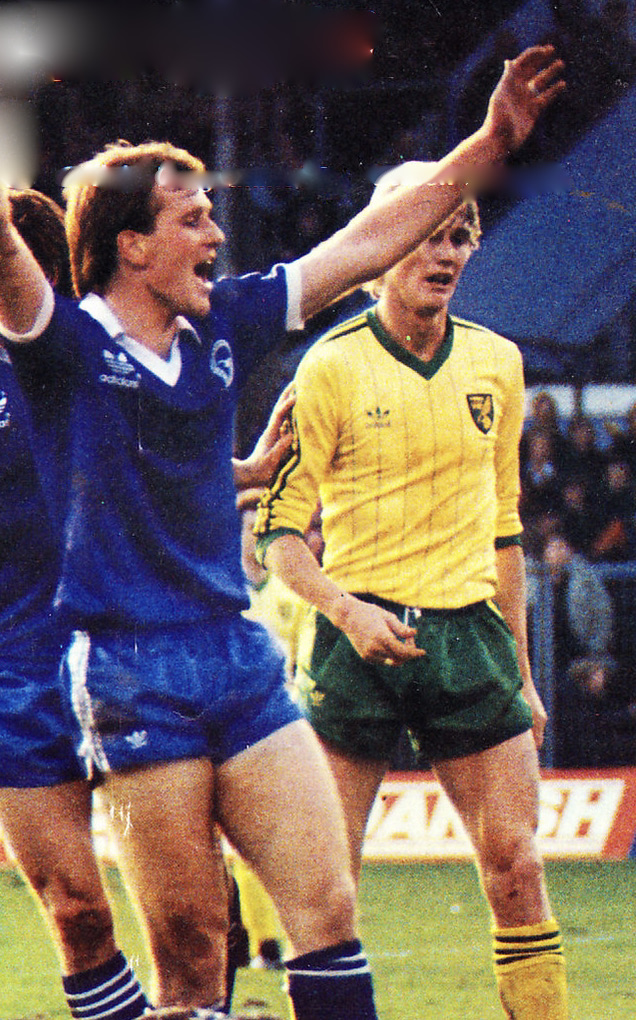
Just 4,008 hardy souls dotted around the crumbling old stadium supported the Albion that afternoon compared to the sell-out 28,800 crowd who packed in to see Ritchie’s last home match in Albion’s attack when they beat Norwich City 1-0, courtesy of a Case goal, in a quarter-final of the 1983 FA Cup.
Ritchie’s last endeavours in Albion’s colours came a week later and, ironically, were in front of 36,700 at Old Trafford on 19 March 1983 when he had a goal disallowed against the club who sold him to the Seagulls for what at the time was a record £500,000.
The curiosity of that deal was covered in my 2017 blog post about Ritchie and I’ve since discovered how a number of observers were dumbfounded by Dave Sexton’s decision to let him leave United.
That Sexton more often preferred the strike pairing of Joe Jordan and Jimmy Greenhoff baffled football writer Mike Anderson who, after Ritchie’s switch to the Albion, detailed how the departed forward’s numbers were more favourable.
“Since making his debut for United against Everton three seasons ago he has proved himself to be a more consistent marksman than the Scottish international,” wrote Anderson.
“By the end of the 1978-9 season Ritchie had scored 10 goals in only 20 full League appearances, compared with Jordan’s nine goals in 44 games. And when last season finished he had hit 13 goals in 23 full games (plus six substitute appearances), whereas Jordan had taken his tally to only 22 goals in 76 games.”
Anderson’s opinion was shared by Tony Kinsella, writing in When Saturday Comes in November 1997, he described Ritchie as “a muscular whippet of a striker with two scorching feet, a delicious first touch, and a bonce of solid granite”.
Kinsella wrote: “In four frustrating campaigns, Ritchie notched an admirable average of a goal every two games, a somewhat superior rate to his cohorts. In retrospect, I guess Ritchie was in the right place at the wrong time. He possessed more skill than Jordan and cut a more daunting physical presence than Greenhoff, but fell short of both when it came to vice versa.
“Sexton, notorious for fielding sides greyer than a Mancunian sky, had the courage to blood a teenage goalkeeper, Gary Bailey, but got cold feet when dealing with the loose cannon that was Andy Ritchie.”
A young Ritchie at Manchester United
In a lengthy chat for the Fore Four 2 podcast, Ritchie revealed how it was Steve Coppell who took him under his wing as a newcomer to the United first team and ensured he got fixed up with a pension; something Ritchie hadn’t even considered.
And his roommate at United was wandering winger Mickey Thomas, who ended up following him to Brighton and also to Leeds!
While Sexton may have had reservations about Ritchie, plenty of other managers were keen to take him from United. Tommy Docherty, who had first signed Ritchie for the Red Devils, had wanted to take him to Queen’s Park Rangers but he was sacked as Rangers’ manager before a bid was in the offing. Chelsea and Newcastle made inquiries too.
Aston Villa offered United £350,000 for him but, after attending with his dad a face-to-face meeting with the glum-faced manager Ron Saunders, they turned down the move feeling he hadn’t conveyed that he really wanted him.
Ritchie also declared: “United were my home town team and I loved it at Old Trafford.
“It had been my aim since joining the United staff to be a success in their first team. I would have got a large amount of money had I gone to Villa, but I put self-satisfaction before money. I had received a lot of encouragement from the training staff at Old Trafford and I wanted to justify their faith in me by doing well at United.
“I knew that a transfer would mean adjusting to a side playing a different style of football. I felt that I might just as well spend that time proving I was worthy of a place at United where I was part of possibly the best club in the country. Unfortunately, I found myself playing reserve team football again until Brighton came in for me.”
In a 2019 interview with the Albion website, Ritchie remembered: “We always had a good team spirit and we all used to go out together. Everyone played golf and we’d be out in the nightclubs, Bonsoir and others where you had to wipe your feet on the way out.
“Great times, absolutely fantastic. And the spirit transferred itself onto the pitch. I used to joke at Q&As that we had so many great individuals but put us together and we were crap because the social life got in the way of our football. But no, it was a fantastic club to be involved in.”
Ritchie attended a rugby-playing grammar school and played cricket and hockey for Cheshire, only turning to football at 13 or 14. He played for Manchester and Stockport Boys and scored six goals in nine games for England schoolboys under skipper Brendan Ormsby, who went on to play for Aston Villa.
In the 1983 Shoot! album, Ritchie explained: “It was while I was playing for Stockport Boys that I first realised I had a chance of a career as a professional footballer.
“I was selected for the England Under-15 side and played at Wembley Stadium. The first was against Wales. We won 4-2 and I scored a couple of goals. I then scored another when England beat France 6-1. They were great moments for me and my family.
“Appearing for England was definitely the highlight of my young career but I also enjoyed playing for Stockport and in local Sunday football.
“I played for a team called Whitehill, who were sponsored by Manchester City. It was then that I realised I could play for the Maine Road club.
“I had trials with Leeds United, Burnley and Aston Villa, but I only wanted to play for City.”
It was while playing for Stockport Boys v Manchester Boys that former United captain Johnny Carey, scouting for his old club, spotted Ritchie and made an approach.
“I went down to The Cliff (United’s training ground) and never looked back,” he said. “It didn’t take me very long to soak in the atmosphere and appreciate the tradition and name of Manchester United and, in the end, I was quite happy to sign for the Old Trafford club.”
Ritchie was 15 when he put pen to paper, and he turned professional on 5th December 1977.
Handed his first start in United’s first team shortly after his 17th birthday, he played four matches without scoring but had caught the eye of the England Youth selectors. He made four appearances under joint managers Brian Clough and Ken Burton, making his debut in a 3-1 win over France on 8 February 1978. England drew the return leg of that UEFA Youth tournament preliminary match 0-0.
He went with the England squad to Poland for the 31st UEFA Youth tournament in May 1978, played in a 1-1 draw v Turkey and a 1-0 defeat v Spain but a trapped nerve in his hip meant he sat out the 2-0 defeat to Poland that meant England didn’t qualify from their group. That squad included Terry Fenwick and Vince Hilaire, Tony Gale and Ray Ranson.
“The following year I was selected for England Youth again for the Mini World Cup in Austria. Unfortunately, I went over on my ankle in training and could not make the trip,” Ritchie recalled.
Ritchie hoped his move to Brighton might boost his chances of gaining a full England cap, but he ended up winning a solitary England under-21 cap when he was called up by the same Dave Sexton who’d sold him from United! “That really was a bit bizarre,” Ritchie later recalled.
He featured in a 2-2 draw with Poland at West Ham’s Boleyn Ground on 7 April 1982. Fellow striker Mark Hateley scored both England’s goals.
Ritchie in action for Leeds against Brighton
Ritchie’s time with Leeds was something of a mixed bag. The record books show he scored 44 times in 159 matches after he was signed by player-manager Eddie Gray. Playing in the second tier at the time, Leeds still had Gray, Peter Lorimer and David Harvey from the Revie era but Ritchie joined a mainly young side where the likes of John Sheridan, Tommy Wright and Scott Sellars were developing.
As Tony Hill observed on motforum.com: “Much of his time at Leeds was spent in dispute over his contract and for over a year he was on a weekly contract before moving to Oldham Athletic for £50,000 in August 1987.”
It was at Oldham where Ritchie really made his mark, scoring 82 goals in 217 league games (including 30 as a substitute) and helping them reach the League Cup Final and the FA Cup semi-final in 1990 and to win the old Second Division in 1991.
In 2020 the club’s official website declared: “Andy Ritchie is regarded as a club legend at Oldham Athletic and one of the greatest players to play for the club, having served Latics as a player as well as having a spell as manager.”
That goalscoring return to the Goldstone with Scarborough in early September 1996 came a year after he had joined the Seadogs as player coach on a free transfer. It was one of 17 he netted in the league from 59 starts and nine appearances from the bench.
By then a couple of months short of his 36th birthday, thankfully the Seagulls prevailed 3-2 courtesy of goals from Stuart Storer and two from Craig Maskell (the 99th and 100th of his career).
It certainly wasn’t the first time Ritchie had netted against the Seagulls. Twenty months after departing the Goldstone he scored the only goal of the game, tapping in from eight yards out, when Leeds beat the Seagulls at Elland Road.
He also scored for Oldham to knock Albion out of the FA Cup when the Latics won 2-1 in the fourth round on 27 January 1990. In a 1-1 draw at the Goldstone two months later, Ritchie missed a penalty but he made amends the following season scoring home and away against the Albion, netting twice in their 1 December 1990 6-1 thumping of the Seagulls on Oldham’s plastic pitch and scoring both when the Latics left the Goldstone 2-1 winners on 2 March.
He returned to Oldham on 21 February 1997 after Neil Warnock took him to Boundary Park as his player-assistant manager. He scored three times in 32 appearances, many of which were as a sub.
But when Warnock left to join Bury at the end of the following season, Ritchie was appointed as his successor. He managed 179 games, winning 59, drawing 45 and losing 75 with a win percentage of 32.96%.
After being sacked in 2001, he was out of work for three months before being appointed academy director at Leeds at a time when fellow ex-Man Utd player and coach Brian Kidd was head coach under Terry Venables and David O’Leary.
He found himself out of work again in 2003 when Peter Reid took charge but six months later he joined Barnsley, initially as academy manager before becoming first team coach under Paul Hart.
When Hart left Barnsley in March 2005, Ritchie was appointed caretaker manager and then landed the position permanently in two months later.
At the end of the following season, he led the club to a penalty shoot-out win over Swansea City in the League One play-off final at the Millennium Stadium, Cardiff.
But the Championship season was only four months old when Ritchie was relieved of his duties with the Tykes struggling in the relegation zone.
Four months later, he was appointed manager of League One Huddersfield Town and told the club’s website: “There’s such massive potential here.
“There is no doubt that the club is geared up for promotion to the Championship and that has to be the aim now. It’s now a case of getting the players re-motivated and once we get into the Championship, we can reassess the situation.
“I tasted promotion last season and it was a great feeling – now I want to do it again as soon as possible.”
Unfortunately, he wasn’t able to steer the Terriers to that goal and, after a 4-1 defeat against his former employers Oldham, he parted company in April 2008.
They won only 22 of his 51 games in charge although they did enjoy their best FA Cup run for 10 years which only came to an end in the fifth round when they were beaten 3-1 by a Chelsea side under Avram Grant that included Wayne Bridge and Steve Sidwell.
After all that, Ritchie returned in a watching brief to where it all began: at Old Trafford.
On matchdays, he worked as an ambassador in a hospitality lounge, and contributed to MUTV and Radio Manchester.
STEELE is a familiar name in an Albion goalkeeper’s shirt. In the current set-up, there’s Jason. Back in the 1970s there was Eric. And very briefly, in the early 1980s, there was Simon.
After three years as an Everton youth player, Simon Steele joined the Albion a few weeks after they’d lost to Manchester United in the 1983 FA Cup Final.
When the Albion went on a pre-season tour in Majorca, the new arrival suddenly found himself keeping goal for the Seagulls in a match against the mighty Real Madrid.
“It may well only have been the City of Palma Tournament, a four-team pre-season competition, but Steele will never forget that evening on August 18, 1983,” The Argus reported in a 2004 article.
By then 40 and with 14 years behind him as a detective with Sussex Police, Steele recalled: “I had joined Brighton just after the FA Cup final. I had done a bit of pre-season training and then we went out to Majorca for this tournament.
“I was really surprised to be selected for the game. I think Perry thought we would get a good hiding and threw an injury.”
A crowd of more than 20,000 watched the game and Steele told the newspaper: “They had a good side with plenty of internationals. We had quite a bit of support so the atmosphere was really good, especially considering it was a pre-season game with not a lot resting on it. There were a lot of Brits out there who came to support us and we were playing for personal pride.
“I just remember them scoring in injury time. Santillana turned on a sixpence and put the ball in the bottom corner from eight or ten yards out.
“Other than that we held them at bay. Although I had quite a bit to do, I dealt with it comfortably. I never felt under any great pressure and it was gutting when the goal went in.”
Indeed, The Argus said the match report of the time raved about Steele’s performance, in particular picking out “one breathtaking stop” from Camacho, who had played for Spain at the 1982 World Cup.
Steele retained his place when Albion beat Hungarian side Vasas Diosgyori 3-2 in the tournament’s third place play-off, with goals from Steve Gatting, Tony Grealish and a Terry Connor penalty.
However, although Steele reckoned he had done enough to earn a place when the action proper began, he was to be disappointed.
“I did play well and it catapulted me on to the fringes of the first team,” he told The Argus. “I really thought I would start the season, then I got a call the day before the season started and Jimmy Melia said he would start with Moseley in the first game at Oldham.
“It was a bolt out of the blue because I thought I had played well in pre-season.”
Thankfully, he didn’t have long to wait for his chance, though. Two days later, with Moseley injured and Digweed suspended, the youngster made his League debut in a 3-2 defeat against Leeds at Elland Road.
Simon Steele keeping goal for the Albion at Elland Road
Grealish gave the Seagulls the lead before, as the matchday programme highlighted, Steele came out well to make saves at the feet of Andy Ritchie and John Sheridan.
He also “saved brilliantly” from George McCluskey but was beaten by an equaliser from Andy Watson and a Frank Gray penalty.
Connor levelled the match, rising high to head home against his old club, but, agonisingly, a last-minute 25-yard right-footed shot from Sheridan left Steele helpless and gave Leeds the win.
Melia turned to the more experienced Digweed for the next match, at home to Chelsea, and within a matter of days, former England international Joe Corrigan arrived to dominate the goalkeeper pecking order – and Steele’s brief Albion career was over.
He went on loan to fourth tier Blackpool and Melia explained in his matchday programme notes: “With the surfeit of goalkeepers at present at the Goldstone, his opportunities are limited and I felt that he could get some valuable experience in the league with Blackpool which will stand him in good stead.
“He is only nineteen and I think he has a great future; we feel that a loan spell will sharpen up his game, but it certainly doesn’t mean he has left the Goldstone permanently.”
Steele played three games for the Tangerines and the following spring went on loan to third tier strugglers Scunthorpe United, where he featured five times.
The Iron, managed by ex-Leeds and England striker Allan Clarke, actually wanted to keep him but Steele said he was not happy with the terms being offered and reckoned he would be better off getting a job and playing part-time football instead.
Born in Southport on 29 February 1964, Steele went to Ainsdale High School in the seaside town between 1975 and 1979. He joined Everton at the same time as Shaun Teale (according to the website efcstatto.com), who later won the League Cup with Aston Villa.
Despite his best efforts in goal for Everton’s youth side in the 1982 FA Youth Cup, they lost 2-0 to Villa in the third round. The Liverpool Echo report of the game noted: “Paul Kerr picked up a free kick rebound and seemed certain to score until Steele denied him with a spectacular save. But the Midlanders went ahead after 41 minutes when winger Obi beat Steele with a powerful swerving shot from 25 yards.”
It added: “After Mark Walters had struck the face of the Everton bar, Kerr chipped the advancing Simon Steele with devastating accuracy to notch Villa’s second in the 83rd minute.”
After turning his back on the chance to play lower league football with Scunthorpe, Steele turned out for a variety of Sussex non-league sides – Worthing, Bognor, Pagham, Peacehaven, Whitehawk and Withdean – and became a detective constable with Sussex Police in October 1990.
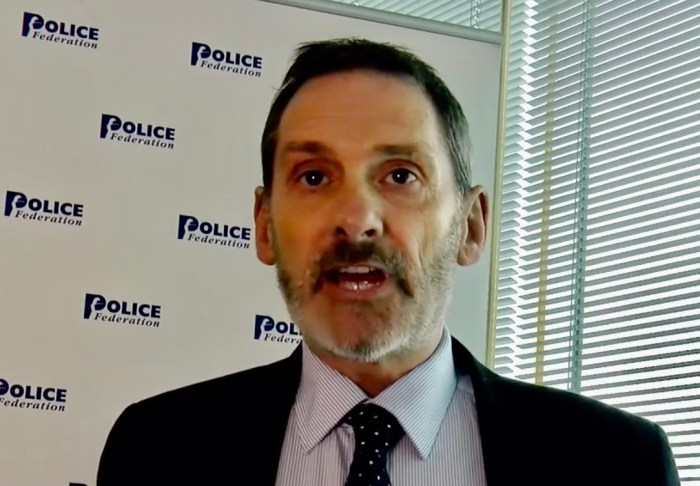
He was in the news in 2019 when, in his role as secretary of the Sussex Police Federation, he spoke out about the lack of investment in detectives in the county.
Speaking up on behalf of police colleagues
He said victims of crime weren’t getting the service they should have done because of a lack of sufficient detectives in the force.
“It used to be easy to fill the detective roles,” he said. “Now officers don’t want to go into the department for whatever reason, down to the workloads that they’re carrying, the pressures, the hours that they’re working, and a lot of them are pretty close to breaking point.”
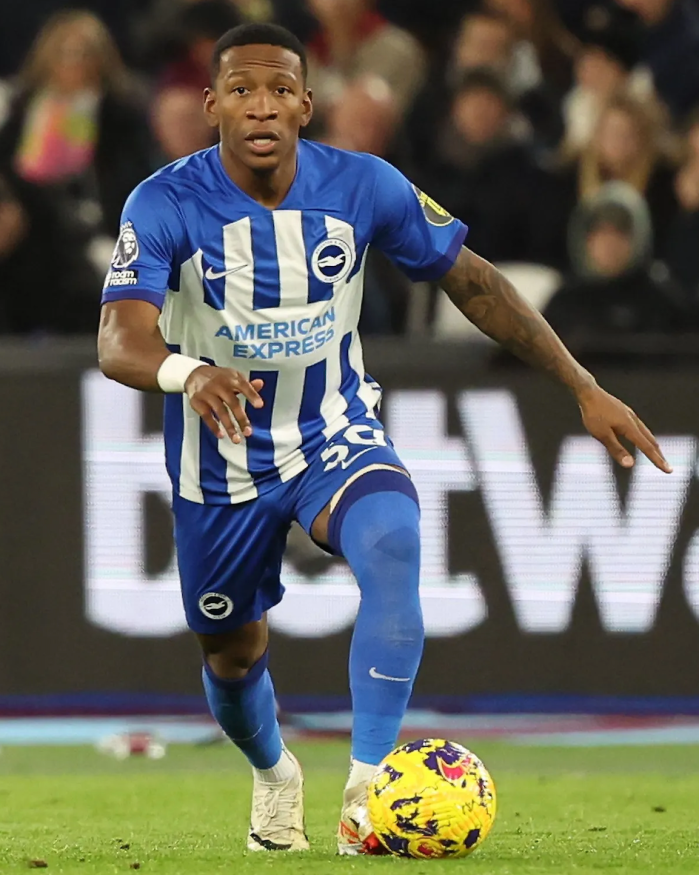
ECUADOR international Pervis Estupiñán stepped comfortably into the boots of Marc Cucurella when Albion signed him from Villarreal in the summer of 2022.
Rampaging runs down the left wing, pinpoint crosses and the occasional spectacular goal unleashed from distance all endeared the player to the Albion faithful.
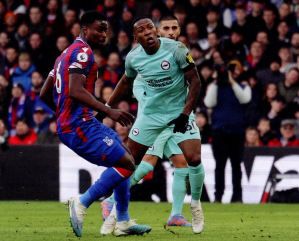
A terrific goal he scored away to Crystal Palace in February 2023 was ruled out by VAR – and to compound the injustice, the referees body PGMOL subsequently admitted the strike had mistakenly been ruled out when John Brooks drew the offside line against the wrong Palace player.
“I was very sad about that disallowed goal because I don’t score a lot,” Estupiñán said later. “I remember it was a very equal game, but we played well.” The game finished 1-1.
One that did count, though, sealed Albion’s impressive 3-0 win away to Arsenal on 14 May 2023.
It was a fitting end to what was an impressive first season with the Seagulls during which he made 35 starts and six appearances off the bench.
His performances as the straightforward replacement for the previous season’s player of the year meant Albion could glow in the warmth of having trousered £62m for Cucurella and replaced him with a top quality defender for whom they paid £14.9m.
After he had scored his second goal for the Seagulls in a 4-1 win at Wolves at the beginning of the 2023-24 season, Brighton manager Roberto De Zerbi said he believed the defender had the potential to become one of the best left-backs in the world if he continued to improve his first touch and his passing.
“Pervis is one of the most crucial players for us because he started from left-back, but you can find him in a striker position,” he said. “He’s very smart, he’s one of our secrets I think.”
Praising Albion’s recruitment department for “yet again delivering another masterstroke” in signing Estupiñán, The Professional Football Scouts Association declared: “Full of determination, tenacity, energy and running power, his impact has been felt heavily on both ends of the pitch, as his all-round contribution has been a major asset for Roberto De Zerbi’s Seagulls.
“While his defensive work has been solid, with him feisty in his duels, aggressive in the press, good at tracking runners and positionally sound, it’s been his offensive impact that’s really caught the eye.”
The organisation talked about his “devastating and varied movement” and highlighted the way he dovetailed with Kaoru Mitoma in front of him. “The pair’s astute interchanges and ability to create space for each other by drawing or pinning adversaries has been a joy to watch,” it said.
“Be it making headway with wicked infield underlapping runs, blistering overlaps or making room for his colleagues by acting as a decoy, his movement has been a huge source of inspiration going forward for Brighton.”
Brighton certainly felt his loss with a muscle injury over the course of several months in the 2023-24 season, with The Athletic maintaining: “None of the replacements who tried to fill the void created by his absence possess the adventurous Estupiñán’s blend of athleticism, power and stamina.”
In a detailed analysis of his stats, the platform suggested in January 2024 that Estupiñán had a strong claim to be considered the best left back in the Premier League, comparing him favourably against Liverpool’s Andy Robertson, Man Utd’s Luke Shaw and Arsenal’s Oleksandr Zinchenko.
Although he scored two stunning goals (in a 4-2 home win over Spurs and a 4-2 win at Stoke City in the FA Cup) within a matter of nine days mid-season, too often on his return to the Albion side in the second half of the season, Estupiñán didn’t look anything like the player fans had enjoyed watching the previous campaign.
And then his season ended too early when he was subbed off in the first half of the 1-1 draw at Burnley in April with an ankle injury that subsequently required surgery, ruling him out of playing for his country in the Copa America summer competition.
De Zerbi reckoned Estupiñán would not be fit enough to start the new season and it remains to be seen when Albion fans might see him return to the starting line-up. In the meantime, another south American, Valentin Barco, has slotted into that position with aplomb.
Born in the coastal Ecuadorian city of Esmeraldas on 21 January 1998, Estupiñán’s footballing journey began aged 13 in the youth set up at Liga Deportiva Universitaria de Quito, in the country’s capital.
Given his professional debut shortly after his 17th birthday in 2015, he made 40 appearances in Ecuador’s top division and represented his country in the 2015 South American under-17 Championship and the FIFA under-17 World Cup. He was also given an early taste of international club competition in the Copa Sudamericana and the Copa Libertadores.
Not long after being selected in the best XI of the 2015 Ecuadorian Serie A season, Estupiñán joined the Pozzo-family-owned Watford, although he didn’t actually play a game for the Hornets in four years on their books. At the time, the Pozzos also owned Granada in Spain where Estupiñán spent the 2016-17 season on loan.
It was said he would return to be part of Watford’s side for the 2020-21 season but their relegation from the Premier League led to him being sold instead.
In action for Villarreal
When Villarreal’s regular left-back Alberto Moreno was sidelined for six months after rupturing his ACL in pre-season, they signed Estupiñán for £15m to plug the gap. Lowy described him as “an athletic, technically sound left back who marauds up the flank with pace and panache and can deliver a deadly cross like few others”.
Lowy said Estupiñán excelled under Unai Emery as Villarreal finished seventh and won the Europa League for the first time in the club’s history (although Estupiñán was an unused substitute when they beat Manchester United on penalties in the final). He went on to make 74 appearances for them, including helping them to reach the semi-finals of the Champions League.
Having played at under 17 and under 20 levels for his country, Estupiñán made his first senior start for Ecuador in a 6-1 defeat to Argentina in 2019 but he went on the same year to play in that year’s Copa America when they reached the quarter finals and he played in all three Ecuador matches at the 2022 World Cup (together with fellow countrymen and Albion teammates Moises Caicedo and Jeremy Sarmiento).












 In parallel lines