Cucurella a Euros winner despite the boos backdrop 

MARC CUCURELLA has got used to going from hero to zero in the eyes of fickle football fans.

A revelation in his one and only season playing for Brighton, he scored a stunning goal in a 4-0 thrashing of Manchester United and was crowned both Players’ Player and Player of the Season.

But he pushed for a transfer only one year into a five-year contract and, although he didn’t get his hoped-for move to Manchester City, joined Chelsea for £62m.

While his first few months at Stamford Bridge were tough on and off the pitch, he finished the season as a regular in Mauricio Pochettino’s side and then went on to bigger and better things for his country.

He became a cult hero for his impressive performances at left-back during Spain’s winning run to claim the European Championship in July.

Euro winners: Cucurella with Nico Williams

Capping an excellent tournament by supplying the inch-perfect pass for Mikel Oyarzabal’s late winner, Cucurella was justified in having a dig at pundit Gary Neville who’d previously said the defender was “probably one of the reasons why Spain could not go all the way” in the tournament.

“We went all the way, Gary. Thanks for your support,” was Cucurella’s social media retort after the 2-1 win over England rounded off a tournament that he might not have been involved in if Valencia’s Jose Gaya and Barcelona’s Alejandro Balde hadn’t been injured.

The left-back with the “massive” hair also let his feet do the talking in response to German fans who booed his every touch of the ball in the semi-final and final because they reckoned he was guilty of a handball in the penalty area against the host nation but a penalty wasn’t given.

“I did not care too much, but at the same time, it felt a bit sad that some people came to that game just to boo a single player,” Cucurella told The Athletic. “Some people wasted tickets that could have gone to fans who would have really enjoyed the match.”

But, he pointed out, it wasn’t a new experience because Brighton fans, angered by the manner of his big money departure from the club after only one season, reacted similarly when he returned to the Amex playing for Chelsea.

“It was another night when the boos were really loud every time I touched the ball, so I got used to it,” he said. “The first time I went through this… I won’t say it’s an unbearable feeling but it’s unpleasant. Now I’m more used to it.”

Some players move on stylishly, others go about it in what is perceived to be the wrong way – thus incurring the opprobrium of supporters who remain loyal to the club.

A sizeable enough contingent of Albion fans were aggrieved by the manner of Cucurella’s departure from the club to vent spleen whenever he touched the ball as a Chelsea player back at the Amex.

It was a toss-up between Cucurella and Graham Potter as to who was the bigger pantomime villain when Chelsea were thumped 4-1 at Falmer in October 2022. “The Spaniard was booed and jeered relentlessly for over an hour on his first game at Brighton since his transfer,” The Athletic noted.

The online sports news outlet continued: “According to Whoscored, Cucurella’s defensive output included no tackles, no interceptions and just one clearance.”

They noted it was the fourth time in five starts that Cucurella had been taken off early, and said: “This change would have hurt the most. The taunts grew louder as he made his way off the pitch and the look on his face spoke volumes.”

Things might not have been going well for him at the time, but Potter was not unduly concerned and said: “He’s a resilient character, he’s a really good person. Sometimes when you move clubs it goes really well, and sometimes it can be a little bit of an up-and-down period. Marc’s a little bit up and down but he’s a top player and he will show his quality.”

Cucurella was an unused sub when Albion clinched the double over the Londoners that season with a 2-1 win at Stamford Bridge. But the next time he faced his old teammates, he demonstrated a level of commitment that in some quarters earned him the man of the match accolade.

When Potter’s successor Mauricio Pochettino selected him at right-back in the Carabao Cup against Brighton in September 2023, previously critical Chelsea supporters couldn’t believe what they saw as the home side edged the match 1-0. One said: “Pocketed Mitoma and Joao Pedro . What a shift for him.”

Agreeing he was ‘man of the match’, another said: “Cucurella was absolutely brilliant in that second half, playing that well at right-back was not something that I expected, fair play to him, maybe he should be given more opportunities.”

Arguably, he answered Brighton supporters’ criticism even more effectively – in a similar style to what he did in the Euros final v England – on 15 May 2024 at the Amex when his pinpoint cross in the 34th minute was comprehensively buried in the back of Albion’s net by Cole Palmer’s head.

But let’s remember a much happier time, when the Spaniard was the toast of the Albion faithful with a quite magnificent contribution to that 4-0 thumping of Manchester United.

Muhammad Butt on squawka.com positively purred about Cucurella’s performance declaring his man of the match accolade as “a richly deserved reward for a player who could truly ascend to any height in the world game”.

The writer’s colourful report observed:“What Cucurella did to poor Diogo Dalot all afternoon recalled The Avengers when Hulk whipped Loki around like a caveman trying to dry a wet sock on some rocks.

“Cucurella has the instantly iconic look of a comic book hero, a wiry frame with a face that is all prominent eyebrows and colossal curly hair giving him an instantly iconic silhouette.

“And he plays with the kind of ceaseless energy that one would attribute to those spandex-adorned heroes for whom stamina never seems to be an issue.”

Warming to his theme, Butt continued: “Cucurella grabbed the game by the scruff of the neck and was the dominant force on the pitch. Even when he played no part in the goals, the overall pressure that was weighing on United and keeping them pinned back in their own half was born of the Catalan’s drive and determination.
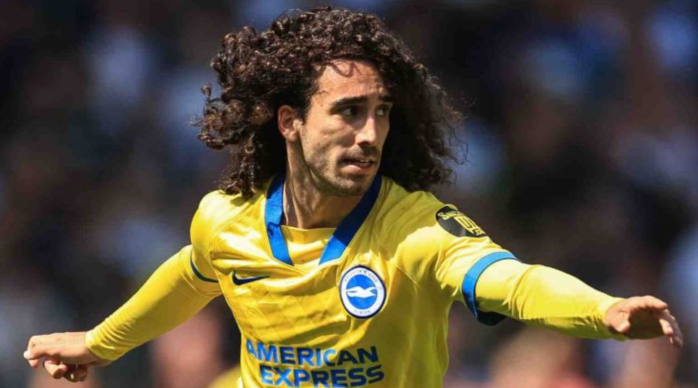
‘Such was Cucurella’s power against United that when he scored Brighton’s second goal, arriving late in the box like some left-sided Frank Lampard to lash the ball home violently at the near-post leaving David de Gea in the early stages of a Bee Gees tribute dance, it wasn’t even surprising. It made perfect sense, as though he had been doing it all season when, in fact, it was his first goal of the campaign.”

Sadly for Brighton fans, that showing seemed to be like an audition for a bigger and better stage and he had only two more matches in Albion’s colours.

Born in the Catalan village of Allela on 22 July 1998, he played futsal with his local club before linking up with the junior sides of Espanyol, where he was made captain. From there, at the age of 14, he joined Catalan giants Barcelona in 201

A rare appearance for Barcelona

“Barcelona were always my team,” he told the Albion matchday programme. “I liked the style of play and the big players the club always attracted.”

He went on: “For me to join such a special club, at such a special time in its history, was a proud moment for my family.”

He made his debut for the club’s B team at the age of 18 but also had the chance to train with the stars of the first team.

“While I was still in the academy, I would sometimes train with Messi or Neymar, which was really exciting,” he said. “I’d train with Busquets, Jordi Alba, sometimes Suarez, and it was scary the first time I stepped up.

“I was very nervous, training alongside players I’d only seen on TV or on the PlayStation, but these are the moments you remember for the rest of your life.”

He only made one brief substitute appearance for the Barcelona first team, going on for Lucas Digne in a 3-0 Copa del Rey win at Real Murcia in October 2017, and he said: “It was a very nice moment for me but it was a shame I never got to play for the team at Camp Nou.”

Cucurella got to play in La Liga on loan at Eibar (in 2018-19) and Getafe (in 2019-2020) before moving permanently to Getafe for the 2020-21 season.

When Albion signed him, fellow former Barca B graduate and ex-Albion midfielder Andrea Orlandi, now a TV pundit, told the Albion matchday programme: “Marc is a super-energetic player whose main assets are his energy, attitude and intensity.

“He was in the top three in every physical study in La Liga for the last three seasons and can’t play without giving it 100 per cent. He has the perfect attributes to be a success in the Premier League.”

Perhaps it should be no surprise that he shone for Spain at the 2024 Euros because he had been selected by his country at almost every age group level and won a silver medal as part of the under-23 side at the 2020 Olympic Games.

His first senior appearance was in a friendly against Lithuania in June 2021 when he captained the side to a 4-0 win. A second cap followed in a 3-3 draw with Brazil at the Bernabeu in Madrid in March 2024. The run through to the final took his caps tally to 10.

In an in-depth interview with Pol Ballus for The Athletic in July 2024, Cucurella opened up on the turbulence he had suffered after making the move to Chelsea. “Until the summer of 2022, my football career had been great: a constant progression, always upwards with no setbacks. Then I arrived at a club where the expectations were so, so high.

“Until then, I had played at clubs where every victory felt really special, where every point is celebrated. Then you go to Chelsea, where you win a game because that’s what you have to do. There is no time to chill or enjoy.”

Not only was managerial change disruptive, things didn’t go well for him off the field. “I spent the first two months living in a hotel with my family, then soon after we found a place to live we had thieves breaking into our home. After this, I spent two days hospitalised for a virus. I lost a lot of weight and had to start from scratch to get in shape again. It wasn’t easy to come back. The team couldn’t find their way on the pitch, either.”

Cucurella said fans had expectations of him because of the size of the fee Chelsea played Brighton but he pointed out: “People expect that, with certain price tags, you need to be a machine. Sometimes it’s difficult to understand that we are normal people who have our own problems off the pitch. We have worse and better phases in our lives.”

He worked with a psychologist to try to help him through his struggles, admitting: “Confidence is the most important thing. You miss it when you struggle, but it flows when you thrive. I’ve worked a lot on this, to stabilise those moments.”

Certain he could improve, he knuckled down in training and eventually seized his chance when it was given.

Towards the end of the 2023-24 season, Pochettino tinkered with Chelsea’s formation and successfully deployed Cucurella in a midfield role, drawing praise from observers such as Nick Purewal in The Standard, who said: “Cucurella’s ability in possession, to act as an auxiliary pivot and progress the ball has transformed Chelsea.”

The player himself had some fun on social media in the summer (right) when, with a nod to the chant Brighton fans conjured up during his time at the Amex, he filmed himself with a bottle of Estrella and sang the song… “he drinks Estrella, eats paella…” but his normally “massive” hair was neatly matted down!

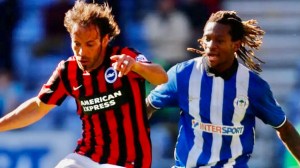
An Albion promotion winner but Bong didn’t chime at Forest

IT WAS WHILE I was adding the DW Stadium, Wigan, to my list of grounds visited that I first noticed Gaetan Bong.

On the afternoon of 18 April 2015, Bong was playing AGAINST Brighton in one of 14 appearances for Wigan Athletic having moved to the UK on a short term contract from Greek side Olympiakos three months earlier.

Bong up against Inigo Calderon while playing for Wigan

Within three months, he was playing FOR Brighton, joining Chris Hughton’s side as a free agent.

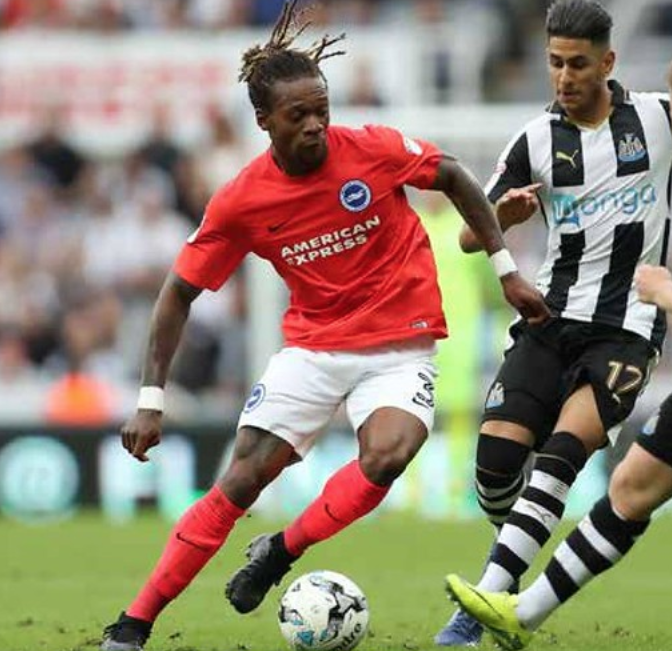
The Cameroon international, who had played top flight football in France and Greece, became a regular in the left-back berth for four seasons, including being a Championship promotion winner in 2017, playing 102 times for Brighton, including 51 games in the Premier League.

Bong was the first permanent left-back Albion had signed since the days of Marcos Painter, having had three successive seasons of season-long loan players in that position: Wayne Bridge, Stephen Ward and Joe Bennett.

“Gaetan is a player that we were aware of while he was at Olympiakos,” said Hughton, on signing the player. “He is very athletic, he is a natural left-sided player and it is important to have that balance in the squad.”

Back to that bottom-of-the-table battle in April, though, and Bong was on the left of a back four that also included a certain Harry Maguire (on loan from Hull City).

It was former player Gary Caldwell’s first match in charge after the sacking of Malky Mackay and both sides were struggling to avoid the drop from the Championship.

I probably decided to go to that game anticipating a win for Brighton because Wigan hadn’t won at home since the previous August! But, as sure as eggs is eggs when watching the Albion, Athletic finally registered another win in front of their own supporters: 2-1. It’s always the hope that kills you!

Albion played Player of the Season full-back Inigo Calderon as a makeshift right-winger that day and he got so little change out of his attempts to get past Athletic’s left-back that he was eventually subbed off.

In spite of the result that day, Albion managed to stay up while Wigan went down with Blackpool and Millwall.

Bong made his Brighton debut in the season-opener at home to Nottingham Forest (a 1-0 win courtesy of a Kazenga LuaLua goal), the club he would join four and a half years later, after he’d lost his regular place at the Albion.

Introduced to Brighton fans in the programme for that match, Bong said: “Once I had spoken to the manager and learned of the plans for the club, then I wanted to be part of this adventure.

“I could have gone elsewhere, I had offers, but I was excited by coming to Brighton. Now I just want to get playing and show the fans what I am about.”

Hughton had problems at left-back in the 2015-16 season when Bong was out for four months with a thigh injury, and back-up Liam Rosenior was also sidelined. Inigo Calderon filled in on occasion and Liam Ridgewell was signed on a short-term deal from Portland Timbers. Although Bong returned to the squad in March, the rest of the season was mainly a watching brief from the bench as Rosenior played out the season in that position.

Back as first choice the following season, a knee injury robbed him of his place for several weeks – loan signing Sebastien Pocognoli filled in – but he still played in 28 matches as the Albion finally won promotion to the Premier League.

Born on 25 April 1988 in Sackbayeme, a suburb of Cameroon’s capital Yaounde, he moved to France as a teenager to join Metz, where he rose through their youth ranks before making his professional debut at 17.

Injuries meant his progress wasn’t as rapid as it might have been but he had a successful loan spell with French second tier side Tours, and then moved to Valenciennes in 2009.

Bong won an under-21 cap for France but went on to win 16 caps for Cameroon. He was in their 2010 World Cup squad but only played in their final group game against Holland. Not entirely happy with the country’s set-up, he briefly retired from international football but returned when renowned former Dutch international Clarence Seedorf was appointed head coach in 2018. Bong even captained his country in a 1-0 friendly defeat against Brazil played at MK Dons in November 2018.

Cameroon international Bong

Bong played for Valenciennes for four years (for the first two playing under former Forest boss Philippe Montanier) and made 117 appearances.

Greek club Olympiakos took him to Athens in August 2013 and he went on to establish himself as a first-team regular, including playing in four Champions League matches and featuring in their league title winning side of 2013-14, before falling out with a new head coach.

Asked by The Athletic to sum up Bong’s attributes, his former Brighton teammate, David Stockdale said: “He comes to win a game. Nothing else. He is strong, he is athletic, he is enthusiastic.

“He is a good person to have around a squad, because he is very professional, he always does his homework before games and generally just looks after himself. He is just strong — that is the word. He is strong, reliable and does what it says on the tin.”

Stockdale added: “He had that drive; that inner drive. He was always going off to do his own work in the gym, to make sure he was properly fit all the time.

“He is one who will say what he wants to say when he feels he needs to. He does know a lot about football, he certainly knows a lot about his position and what he needs to get out of the players around him.”

The goalkeeper pointed out that Bong always had a desire to do well for the team, pointing out: “He was very much a mainstay of the side when I was at Brighton. He is a player you can rely on.”

Unfortunately, a small part of Bong’s time playing in Albion’s colours will also be remembered for an unsavoury incident when he alleged he was racially abused by West Brom’s former Burnley striker Jay Rodriguez.

Rodriguez appeared to pinch his nose after the players clashed during WBA’s 2-0 win over the Seagulls in January 2018, and Bong spoke to the referee about what he said he heard.

A subsequent FA investigation into the matter said the allegation was “not proven” and added there was “no suggestion by any party involved in this case that this was a malicious or fabricated complaint”.

Nevertheless, Bong insisted he heard Rodriguez say: “You’re black and you stink.” The striker denied what he described as a “false allegation” – he claimed he had instead said “breath fucking stinks”.

The dispute led Bong to issue a statement in which he said: “Please let me be clear: I know what I heard and I did not mishear. My conscience in raising the complaint is therefore entirely clear.

“This was my first such experience in more than three years in this country and I would never seek to bring a false charge against a fellow professional. Those who have accused me of doing that do not know me.

“Equally those who have expressed an opinion were not there on the pitch at the time and only Mr Rodriguez and I know exactly what was said and I stand by my original complaint.”

If everyone involved thought that was the end of the matter, Burnley fans had other ideas and I was at Turf Moor in April that year when the home ‘support’ disgracefully booed Bong every time he got the ball.

Albion manager Chris Hughton described their reaction as “shameful” and said of the player: “He’s an incredibly disciplined and straight individual – as honest a person as you will meet. It’s something that happened, it’s not nice at all and of course he’s big enough and strong enough to cope with it. As showed by his performance (the game finished 0-0).”

The respect Albion held for the player was best demonstrated as his time at the club was coming to an end. Bong was going to be a free agent after four years with the club but was handed a one-year extension shortly before Hughton was replaced by Graham Potter.

Chief executive Paul Barber explained to The Argus: “We all felt Gaetan had earned another contract. It is a position we felt we had an opportunity with a player we know, who is a fantastic character.

“The supporters will see what Gaetan does on the pitch — solid, consistent, strong, difficult to get around — but what they won’t know is off the pitch he is a very high-quality person, someone who is very respected and liked throughout the club. Just a decent man, supportive of the young players.

“Those sort of attributes and qualities are so valuable in a club of our size and for the coaching staff and the players. You know whether he plays 10 games, 20 games or 38 games, he is going to be fit, reliable, positive, focused, enthusiastic, consistent and decent.

“All of those things, if you were going out to recruit a left-back, you would be looking for.”

Ultimately, Potter preferred Dan Burn or Bernardo in that position and Bong moved on having made 91 starts and 11 substitute appearances, but only four appearances from the bench in the Premier League under Potter.

His final appearance for Brighton came in the disappointing 1-0 FA Cup third round home defeat to Championship side Sheffield Wednesday. Sadly, when he was subbed off in the 71st minute, there was a chorus of ironic cheers from the home crowd.

Nevertheless, Potter said of the player: “I have only worked with Gaetan for six months or so, but I do know all about the part he played in helping the club get to the Premier League and then establish itself at this level. I’m sure his contribution over the last four years will not be forgotten by our supporters.”

Somewhat bizarrely, it appears that Bong’s move to Nottingham Forest (in the Championship) wasn’t exactly welcomed by head coach Sabri Lamouchi and Nick Miller for The Athletic was brutal in his description of the player’s debut.

“Bong lasted 59 minutes against Charlton, a harrowing hour in which he lost his man for the only goal in the first half, and his eventual removal felt more like an act of mercy than a substitution.”

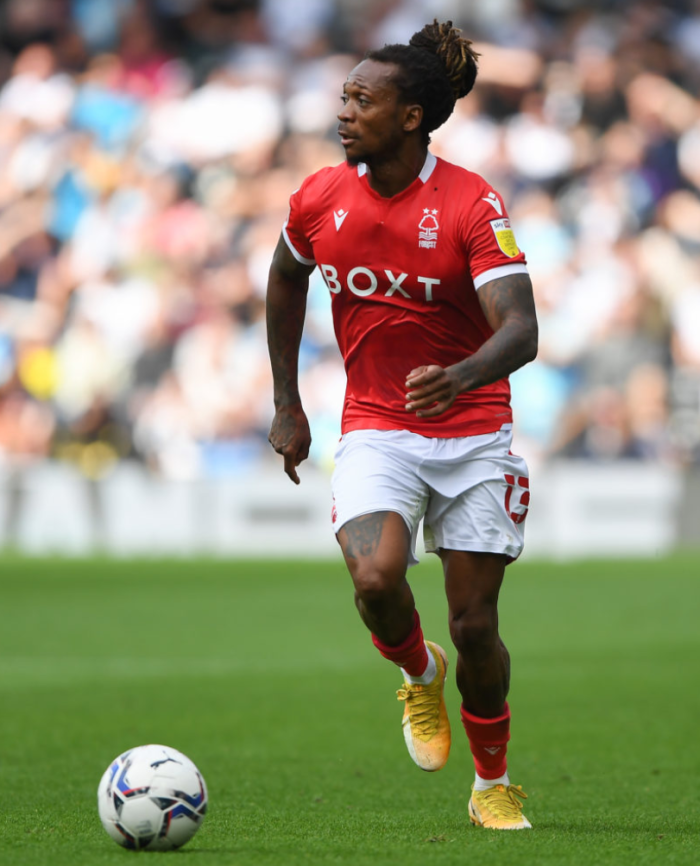
He didn’t even make the bench for the rest of the season and it was only when his old boss Hughton arrived at the City Ground that he got back into the Forest first team. He played 11 matches under Hughton but only seven in 2021-22 when Hughton’s successor Steve Cooper got them promotion via a play-off final win over Huddersfield Town.

Even so, Cooper was appreciative of the defender’s contributions off the pitch. “We have a good mix of old players – good role models, like Gaetan Bong,” he told The Athletic.

“He doesn’t play much but is a positive influence and I’m sure has conversations with the younger players, which I encourage. The learning players do with each other is a powerful thing.”

After hanging up his boots, Bong set up Ballers & Family Consulting Ltd, a consulting agency which, according to his LinkedIn profile, helps aspiring players to optimise their potential, families to understand the demands of professional football and football clubs to manage/avoid issues concerning certain players.

Brighton v Wolves under the lights 55 years ago!

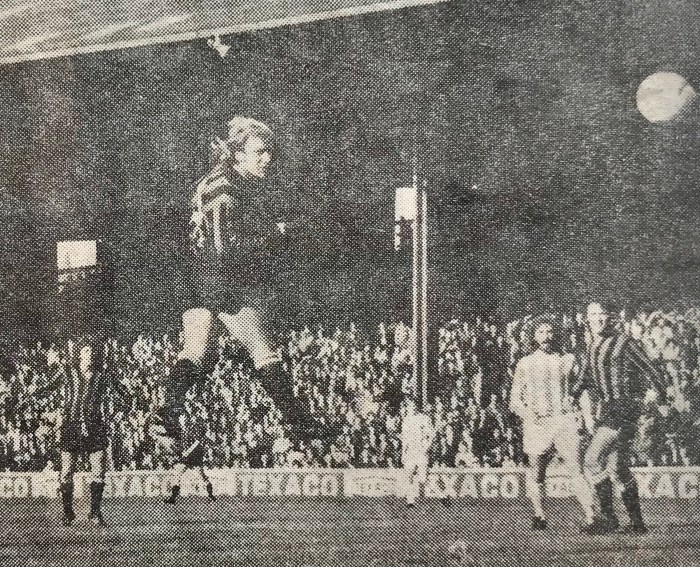
Eddie Spearritt celebrates putting Albion ahead

BRIGHTON being drawn at home to Wolverhampton Wanderers in the third round of the League Cup takes me right back to the very first floodlit match I saw at the Goldstone Ground.

The date was 24 September 1969 and although I had started following the Albion earlier that year, I hadn’t seen an evening game before.

At the time, I also hadn’t experienced such a huge crowd, either. Average attendances tended to be around 12,000 but for the visit of First Division Wolves to humble Third Division Brighton, 32,539 crammed into the stadium.

I hadn’t been to the games in the previous two rounds of the competition, when Albion had beaten Portsmouth and Birmingham City, who were both in the division above.

Hopes were high that Brighton, managed by Freddie Goodwin, might be able to deliver a remarkable giant-killing hat-trick, although Wolves were clearly going to be a tougher nut to crack than their fellow Midlanders and Albion’s south coast rivals.

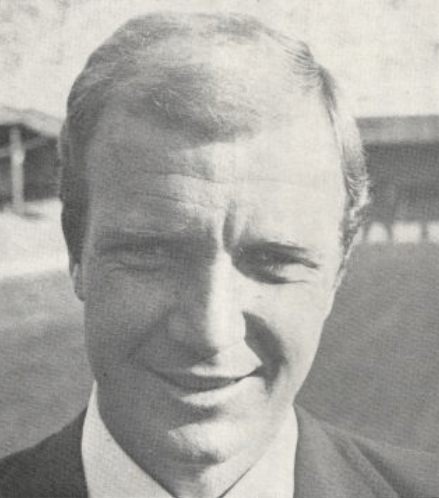
All the pre-match talk was about the star names in the Wolves line-up: formidable Irish centre-forward Derek Dougan and captain Mike Bailey (who 12 years later became Brighton’s manager). In the event, neither played, and Dougan’s place up front was taken by young Bertie Lutton (who would help Brighton to promotion three years later).

It was a special match for two of Albion’s players: goalkeeper Geoff Sidebottom and utility player Eddie Spearritt.

Wolves had given Sidebottom his break into professional football after plucking him from schoolboy football in Barnsley. He went on to play in the European Cup for Wolves and also appeared in the second leg of the very first League Cup Final (in 1961) when Aston Villa beat Rotherham United 3-2 on aggregate.

“It is always nice to play against your old club and I know what this draw means to our supporters,” Sidebottom told John Vinicombe, in an Argus preview of the big game. “They don’t come much bigger than the Wolves – wherever they play the crowds flock to see them.”

The size of the Goldstone crowd certainly wouldn’t have fazed Sidebottom: he had made his Wolves debut 11 years earlier in a Black Country derby against West Brom in front of 48,898 at The Hawthorns.

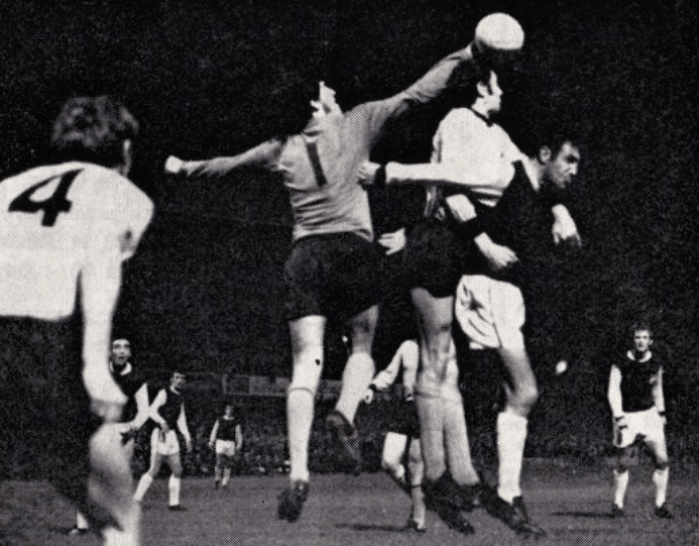
Albion captain Nobby Lawton (no.8) gets a foot in as goalkeeper Phil Parkes pounces

The occasion wouldn’t have bothered Albion captain Nobby Lawton or centre-forward Alex Dawson either, both having played at Wembley in the FA Cup Final in 1964 when Preston North End lost narrowly to West Ham. Left-back Willie Bell had also played in the FA Cup Final at Wembley, in the Leeds United line-up that lost to Liverpool in 1965.

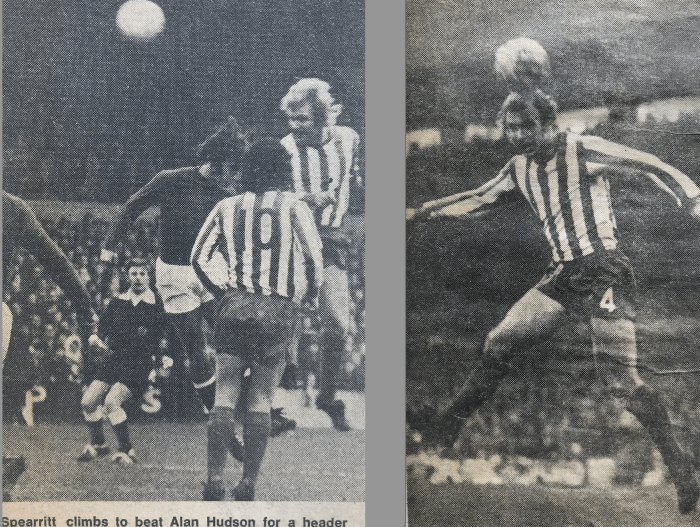
For Spearritt, it was a chance to show his old Ipswich manager Bill McGarry, who’d given him his debut at Portman Road before switching to Wolves, that he still had something about him. And he took that chance when he buried a header from Kit Napier’s free kick to put Albion 2-1 ahead just before half-time (aftermath pictured above)..

Allan Gilliver had given Brighton a shock lead in the 19th minute, squeezing the ball in at the far post after bustling Dawson had distracted Phil Parkes in the Wolves goal.

Albion’s Alex Dawson puts Phil Parkes under pressure

The visitors got back on terms 12 minutes later when winger Dave Wagstaffe intercepted Lawton’s pass and went on a lengthy run before slipping the ball to David Woodfield to equalise.

An upset might have looked on the cards, but Wolves had the canny Scot Hugh Curran up front and he raced on to a huge defence-spliting goal kick from Parkes to notch an equaliser on 70 minutes.

Curran struck again just eight minutes later, seizing on a mix-up between Sidebottom and Dave Turner to dispatch Wagstaffe’s cross.

Argus reporter Vinicombe perhaps over-egged his account in the following day’s paper when he reckoned “Albion should have beaten Wolves out of sight” maintaining: “The 3-2 skin-of-the-teeth success was highly flattering to a side standing fourth in the First Division.”

He did concede though: “In the final analysis, they displayed their class by twice coming back to steal a place in the last 16. They owed it all to Curran whose stealth stamped him as a superb turner of half-chances into goals.”

Wolves were knocked out of the competition in the following round (3-1) away to 1967 League Cup winners QPR while their Black Country neighbours West Brom went all the way to the final only to lose 2-1 to Manchester City.

While some observers of Albion’s cup exploits thought it augured well for a tilt at promotion, come the end of the season they disappointingly missed out on promotion when finishing fifth, five points adrift of runners up Luton Town, who were promoted behind champions Orient.

And before the new season got under way, manager Goodwin was lured away to manage Birmingham.

Steady Eddie had plenty of strings to his bow

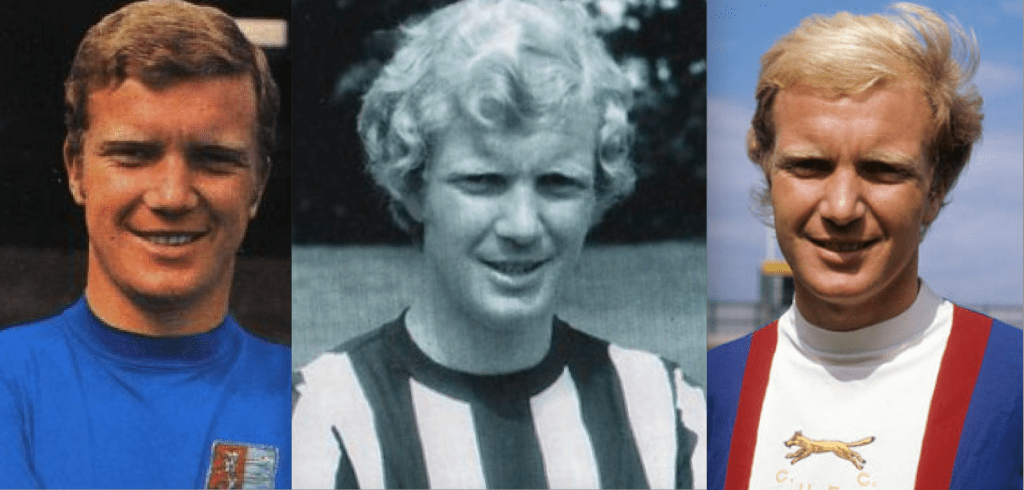
ONE TIME Albion captain and utility player Eddie Spearritt played in the top flight for Ipswich Town and Carlisle United.

He made five starts and five appearances off the bench for second tier champions Ipswich at the beginning of the 1968-69 season before joining third tier Brighton for £20,000 in January 1969.

Play anywhere Spearritt was then a permanent fixture in the Albion line-up for almost five years, making 225 appearances, before Brian Clough turfed him out at the end of the 1973-74 season.

But he found himself back amongst the elite when newly promoted Carlisle United snapped him up for their one and only season (1974-75) amongst the big boys.

Spearritt made 17 starts and six appearances as a sub for the Cumbrians but, in spite of a superb winning start when they briefly topped the division, United finished the season in bottom spot.

Spearritt shapes to challenge Aston Villa’s Ray Graydon

Equally comfortable playing in midfield, at full back or sweeper, Spearritt had on-off spells as Albion’s chosen penalty-taker as well as chipping in with goals from open play. He even turned his hand to goalkeeping when necessary.

Another key attribute to his game was an ability to send in long throw-ins which could sometimes be as effective as a free kick or corner. It was a skill which earned him a place in a Longest Throw competition staged by BBC’s sport show Grandstand in 1970-71, although he didn’t win it.

Born in Lowestoft on 31 January 1947, Spearritt went to Lowestoft Grammar School and on leaving school was picked up by Arsenal. But when the Gunners didn’t keep him on, he returned to East Anglia and joined Ipswich as an apprentice in August 1963.

He signed a professional contract with Town in February 1965 and, as Tim Hodge details on prideofanglia.com, he made his league debut in the 1965-66 season in a 1-0 win away to Preston in the old Division Two.

That was the season when substitutes were first introduced into the English game and the record books show that Spearritt was the first Ipswich sub to score a goal.

He went on for Irish international Danny Hegan in a match away to Derby County on 15 January 1966 and scored Ipswich’s second goal. The game finished 2-2; Gerry Baker having scored Town’s first.

Over the next three years, Spearritt made a total of 69 appearances (plus 10 as sub) for Bill McGarry’s side, scoring 14 goals along the way. Twenty of those games came in the 1967-68 season when Ipswich won the old Second Division.

A 1-0 home defeat to Spurs in October 1968 was his last for the Suffolk club and he parted company with Town shortly after McGarry left Portman Road to take over at Wolverhampton Wanderers.

A debut v Crewe (left) and slaloming through the Plymouth Argyle defence (right)

Spearritt was one of Freddie Goodwin’s first signings for Brighton – just a few weeks before my first ever Albion game. He made his debut in a 3-1 home win over Crewe Alexandra and kept the number 10 shirt to the end of the season, by which time he had scored five times, including both Albion’s goals in a 2-2 draw at home to Tranmere Rovers.

In the 1969-70 season, not only was he part of the Third Division Albion side who pushed his old manager McGarry’s First Division Wolves side all the way in a memorable third round League Cup tie, it was his header from Kit Napier’s free kick that put the Albion 2-1 ahead just before half-time.

Scottish international Hugh Curran scored twice in eight second half minutes to clinch the win for Wolves but a bumper Goldstone Ground crowd of 32,539 witnessed a terrific effort by their side.

A few weeks’ later, in a marathon FA Cup second round tie with Walsall that required three replays before the Saddlers finally prevailed 2-1, Spearritt took over in goal during the second replay when a concussed Geoff Sidebottom was stretchered off on 65 minutes. Albion hung on for a 1-1 draw.

Spearritt was a midfield regular in his first two seasons but Goodwin’s successor, Pat Saward, switched him to left back halfway through the 1970-71 season and that’s where he stayed throughout 1971-72 when Albion won promotion from the old Third Division as runners up behind Saward’s old club, Aston Villa.

It was in the first half of that season that Spearritt took a call from ex-Ipswich teammate Ray Crawford, the former England international centre forward, who had returned homesick from a short stint playing in South Africa.

He persuaded Saward to offer Crawford a trial and although he didn’t make the league side he scouted upcoming opponents, played for the reserves and subsequently ran the youth team.

Meanwhile, Spearritt was a key part of the promotion side and player-of-the-season Bert Murray generously declared the award could have gone to Eddie for his consistency that season. As it happened, Spearritt did get the award the following season, although somewhat more ignominiously considering Albion were relegated.

All smiles as Pat Saward’s side toast promotion in 1972

In the close season after promotion, Spearritt tied the knot with Penelope Biddulph, “an accomplished professional dancer,” the matchday programme told us, and they moved into a new home in Kingston-by-Sea.

Spearritt started out at left back in Division Two but after ten games was ousted by the arrival of George Ley from Portsmouth. He then switched back into midfield, but by the end of that relegation season was playing sweeper alongside Norman Gall (for nine games) and Steve Piper (for two).

He scored (pictured above), along with Barry Bridges, in a 2-0 win at Huddersfield on 14 October but the team went on a disastrous run of 16 games without a win, although Spearritt did get on the scoresheet three times, including notching two penalties.

When Albion went to that footballing outpost Carlisle on 16 December, they had lost five in a row without managing a single goal. Carlisle were 5-0 up, goalkeeper Brian Powney was carried off with a broken nose, replaced between the sticks by Murray, then Albion won a penalty.

Spearritt took up the story in a subsequent matchday programme. “I used to be the club’s penalty taker but, after I had missed an important one at Mansfield in 1970, I lost the job. Penalty-taking is really all about confidence,” he said. “After I had missed that one at Mansfield, which cost us a point, the players lost confidence in me and the job went first to John Napier and was then taken over by Murray.

“Bert would have taken the penalty at Carlisle. He has already scored two this season. But he had gone in goal and it was decided it was too risky to fetch Bert out of goal to take the penalty.

“Nobody else seemed to want to take it so I just picked the ball up and put it on the spot. We were 5-0 down by then but I thought from a morale point of view that it was extremely important that I scored. You can understand my relief when I saw the ball hit the back of the net.

“Everybody was beginning to wonder when we would score again. I suppose with the run of bad luck we have been having it was almost inevitable that we should break our goal famine from the penalty spot.”

Towards the end of the dismal run, Albion drew First Division Chelsea at home in the third round of the FA Cup. The game was won 2-0 by Chelsea but it was an ugly, violent affair – The Argus labelled it ‘Goldstone day of shame’ – in which five players were booked and each side had a player sent off.

Spearritt, the first to be booked, found himself caught up in a huge controversy which resulted in Chelsea hard man Ron Harris being sent off by Leicester referee Peter Reeves; remarkably the only time in his career he was dismissed.

The Brighton man insisted he’d been hit by the defender and Saward said in diplomatic terms after the game: “Spearritt said he was struck on the mouth and that it was not an involuntary action but a blow. From what I saw, I couldn’t understand it.”

Esteemed football writer Norman Giller subsequently recorded it like this: “Harris got involved in a tussle with Spearritt, and, as he pushed him, Spearritt went down holding his face as if he had been punched. The referee directed Ron to an early bath. All the bones he had kicked, and here was Harris being sent off for a playground push.

“A Brighton-supporting vicar, with a pitchside view, wrote to the Football Association telling them what he had witnessed, and ‘Chopper’ was vindicated.”

Whatever the truth of the matter, Spearritt told Argus Albion reporter John Vinicombe that he’d been threatened by a Chelsea player after the incident. “He spoke to me several times and made it quite clear what he had in mind.”

Albion’s Ley was sent off for bringing down Tommy Baldwin and then getting involved in an altercation with Peter Osgood, who scored both Chelsea goals. Two minutes later David Webb went into the book for a ‘blatant foul’ on Spearritt.

Albion finally returned to winning ways the following month with a 2-0 win over Luton (on 10 February), and then beat Huddersfield, Carlisle and Swindon, prompting Saward to refer to “some outstanding individual performances” and adding: “I have been particularly pleased with the way Eddie Spearritt has been playing in recent weeks.

“He has maintained a high level of consistency this season and his work in defence and in midfield has been invaluable as the side has plugged away trying to turn the tide of results.”

Saward made Spearritt Albion’s captain at the start of the 1973-74 season back in Division Three and with the return of central defender Ian Goodwin and then the emergence of Piper in the sweeping role, he was soon back in midfield.

But when Saward was sacked in October and sensationally replaced by former Derby County League title winning management duo Brian Clough and Peter Taylor, Spearritt was one of the first to have his nose put out of joint by the new arrivals.

Journalist Spencer Vignes described what happened in Bloody Southerners (Biteback Publishing, 2018), his excellent book about that era.

Clough sought out long-serving centre back Norman Gall and, because he hailed from the same part of the country (ie the north east), told him he was making him the captain. Gall told Vignes: “Suddenly I’m captain, which I was really happy about. Eddie Spearritt didn’t like it though. He’d been captain up until then. In fact, he didn’t talk to me after that. That was the beginning of the end for Eddie.”

Spearritt was part of the side who capitulated 4-0, 8-2 and 4-1 in successive games against Walton & Hersham, Bristol Rovers and Tranmere Rovers, and he was dropped for six games, along with Ley (who never played for Albion again). Clough went into the transfer market and brought in midfielder Ronnie Welch and left back Harry Wilson from Burnley.

Although Spearritt was restored to the team in mid January, and had a run of seven games — including his 200th league game for Albion — when he was subbed off in a home win over Hereford United on 10 March 1974, it was to be his last appearance in an Albion shirt.

In five years he’d played 225 games (plus seven as sub) and scored 25 goals.

Come the end of the season, Spearritt was one of 12 players released by the club in what became known as the great Clough clear-out.

Perhaps surprisingly, though, his next step was UP two divisions to play in the First Division with then newly promoted Carlisle United.

One of his teammates there was defender Graham Winstanley, who later joined the Albion. The side was captained by Chris Balderstone, who was also a top cricketer. Journeyman striker Hugh McIlmoyle played up front while John Gorman, who later played for Spurs and became Glenn Hoddle’s managerial sidekick, was also in the team.

They memorably topped the division after three games…but predictably finished bottom of the pile by the end. In his two-year stay with the Cumbrians, Spearritt played 29 times, was sub twice and scored a single goal.

He moved back south in August 1976, signed by Gerry Summers at Gillingham, and made his debut in a League Cup first round second leg tie against Aldershot, then made his league debut against Reading.

In total, he made 22 appearances in his one season at the club — one of them at the Goldstone Ground on December 29 1976, when the Albion won 2-0 on a slippery, snow-covered pitch. Spearritt scored just the once for the Gills, from the penalty spot against Rotherham United at Priestfield.

He emigrated to Australia the following summer and settled in Brisbane where he played 56 games for the Brisbane Lions between 1977 and 1980 and was their head coach in 1979. He subsequently coached Rochedale Rovers in the Brisbane Intermediate League, steering them to promotion to the Premier League in 1983.

Outside of football, he became estates manager for L’Oréal and in later years was better known as the uncle of Hannah Spearritt, once of the pop group S Club 7, who became an actress in the ITV drama Primevil.