The spectre of Trelford haunted them for ages at St James’

BRIGHTON travel to Newcastle in the fifth round of the FA Cup with the backdrop of having won there twice in the competition in the 1980s – not to mention a 1-0 win in the Premier League this season.

The 1-0 third round win at St. James’ Park in January 1983 set Albion en route to that season’s FA Cup final – but Toon supporters of that era blamed the game’s unusually-named referee, Trelford Mills, from Barnsley, for their exit.

Think I’m exaggerating? Newcastle fans’ website themag.co.uk had this to say ahead of another FA Cup game between the two sides in 2013: “It is doubtful that anything could match the anger and frustration that many of us felt nearly thirty years ago.

“Wednesday 12 January 1983 will always be synonymous with the name Trelford Mills, etched into the consciousness of an entire generation of Newcastle fans, convinced he cheated us out of the FA Cup. Well, a chance of the fourth round anyway!”

Neil Smillie, goalscorer Peter Ward, Steve Gatting, Chris Ramsey and Andy Ritchie celebrate after the 1983 win.

Mills disallowed two Newcastle ‘goals’ while Albion nicked it courtesy of a penalty area pounce by Peter Ward, back at the club on loan from Nottingham Forest, on 62 minutes. They did it without captain Steve Foster who was suspended (as, of course, he would be for the final too).

The game was a third round replay four days after the sides drew 1-1 at the Goldstone Ground when Andy Ritchie’s mis-hit shot in the 56th minute put Albion ahead and Terry McDermott (below right, with Tony Grealish) equalised on 77 minutes.

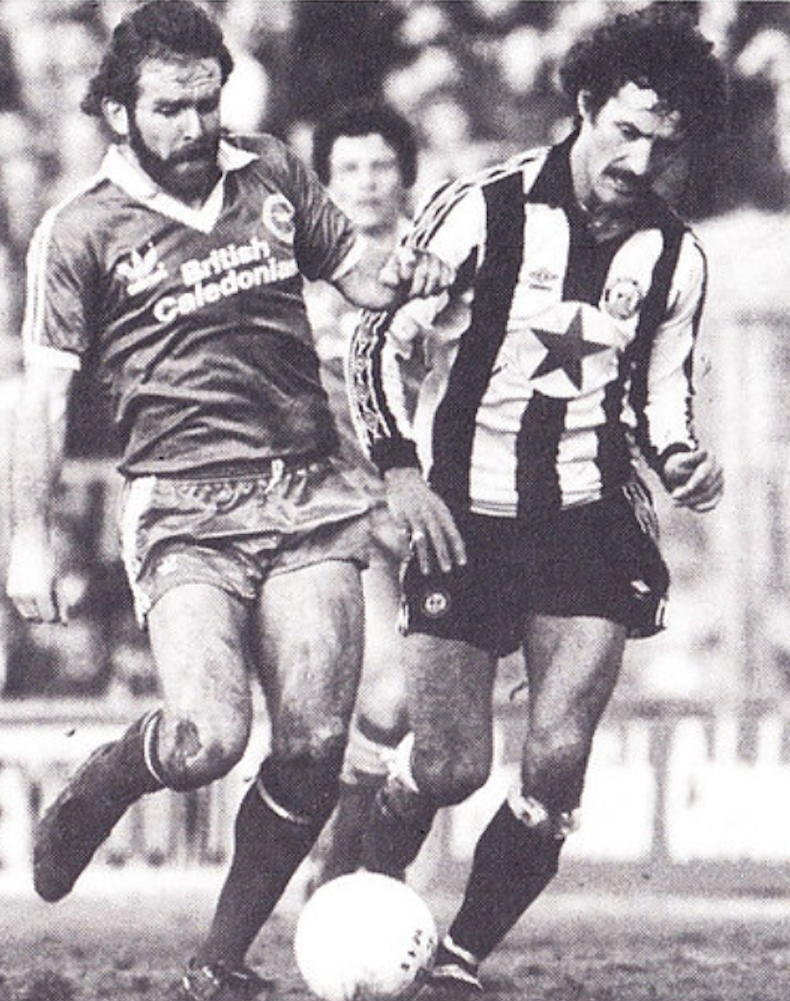
Even though the Magpies were in the old Division Two at the time, they had Kevin Keegan and Chris Waddle in their line-up, and they fully expected to win because Brighton hadn’t previously won away that season.

Albion, competing in the top division for the fourth season in a row, with joint caretaker managers Jimmy Melia and George Aitken in charge, had goalkeeper Graham Moseley to thank for some heroic stops to keep them in the first game.

The replay at St. James’s Park was in front of a typically noisy crowd of 32,687 and Newcastle did everything but score: they had shots cleared off the line and hit the woodwork and, when they thought they’d scored, Mr Mills disallowed them – twice!

In the meantime, Ward made the most of a counter attack to put the Seagulls ahead. It turned out to be the last goal he scored for the Albion, although he was in the side that pulled off a shock 2-1 win at Anfield to knock out Liverpool in the fifth round.

Enterprising reporter Tim Hodges searched out Mr Mills all those years later to hear his version of the events.

“I remember Brighton went one up, then Imre Varadi went through on goal, but quite clearly controlled the ball with his wrist,” said Mills.

“I think the Brighton keeper realised this, just as most of the players did, and let the ball go into the goal just to waste a bit of time. I just restarted with a free kick. I have spoken to Imre since. I think he accepts my version now.”

Mills continued: “Jeff Clarke managed to win a ball in the penalty area, but only because he had his arm around the defender’s neck. Keegan bundled the ball into the goal, but I had blown up a few seconds before it went in.

“Keegan did his Mick Channon cartwheel arm in front of the Gallowgate end, but I just jogged across to where I wanted the free kick taken from and indicated as to why I had disallowed the goal.”

Mills also recalled how he and his fellow officials needed a police escort away from the ground after the match. “When we sat in the dressing room after the match, I remember chatting to one of my linesmen, John Morley, when this police officer turns up,” he said. The copper said to him: “You’d better hang on here a while, Trelford. There are 2,000 Geordies outside and they all want your autograph!”

Three years later, the status of the teams had been reversed with Newcastle promoted back to the top division in 1984 and Albion back in the second tier, relegated the same year as the cup final appearance.
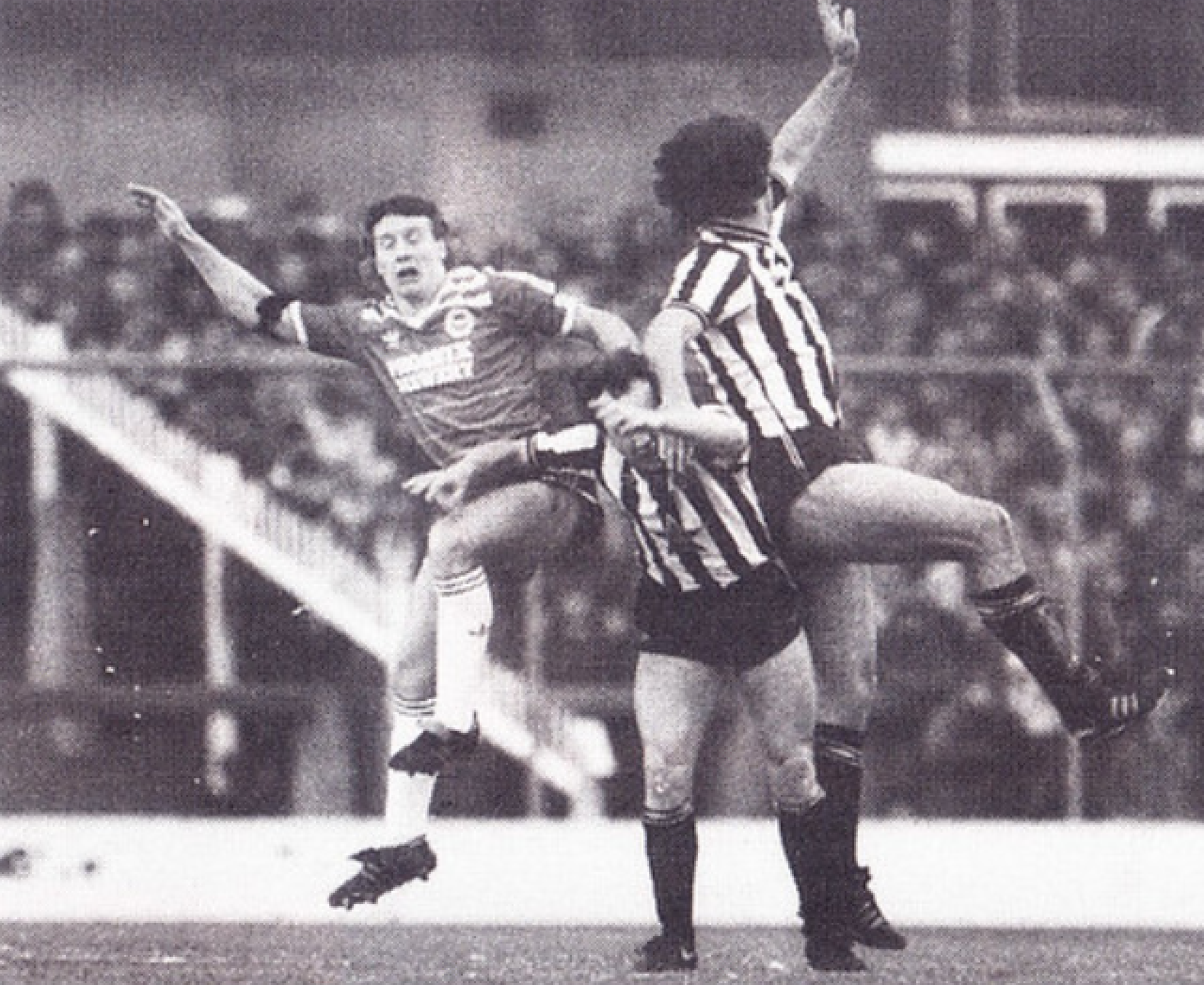
While Keegan had retired, Willie McFaul’s side had a young Paul Gascoigne in midfield and Peter Beardsley in the forward line. Clarke, who’d played four games on loan at Brighton two years earlier, was still in the centre of United’s defence and it was his foul on Terry Connor in the first minute of the game that saw Albion take a shock early lead.

Danny Wilson floated in a free kick from 30 yards out on the right which found centre back Eric Young on the far edge of the penalty box. He hooked the ball into the Newcastle net with only 50 seconds on the clock!

Albion, wearing their change strip of red, had to endure a relentless series of attacks (Toon had 23 corners to Albion’s one!) and Perry Digweed in Brighton’s goal put in a man of the match performance between the sticks, notable saves keeping out shots from John Bailey, Beardsley and Billy Whitehurst.

With five minutes left of the game, against the run of play, a quick throw-in by Graham Pearce found Dean Saunders and he rifled home an unstoppable shot past Martin Thomas for his 10th goal of the season.

Manager Chris Cattlin summed up afterwards: “It was really tough and we had a little luck on our side, but to go away to a club who have won the cup no fewer than six times and come away winners was quite an achievement.

“With the Geordie fervour up there the noise their supporters created was something special, but our efforts speak volumes for everyone connected with our club.”

There would be no fairytale ending that season, though, with Albion being dumped out of the cup 2-0 by Southampton in a quarter-final tie at the Goldstone Ground.

John Barnes and Steve Harper were on pundit duty for ESPN for the 2012 match

Younger fans will doubtless recall two more recent FA Cup meetings between Brighton and Newcastle, in consecutive seasons during Gus Poyet’s reign, at the Amex in 2012 and 2013.

The Championship Seagulls beat the Premier League Magpies on both occasions – 1-0 in the fourth round in 2012 and 2-0 in the third round the following year.
Getting to grips with Will Buckley

A Mike Williamson own goal was enough to give Albion the edge over Alan Pardew’s side in the first of those games; Will Buckley’s 76th minute shot deflecting off the defender and looping over Tim Krul for the only goal of the game. Leon Best, who would later have a torrid time at Brighton, missed two good chances for the visitors.

The 2013 fixture was a more convincing win for Brighton against a weakened Newcastle side who had Shola Ameobi sent off. Andrea Orlandi gave Albion the lead on the half-hour mark and substitute Will Hoskins added a second late on.
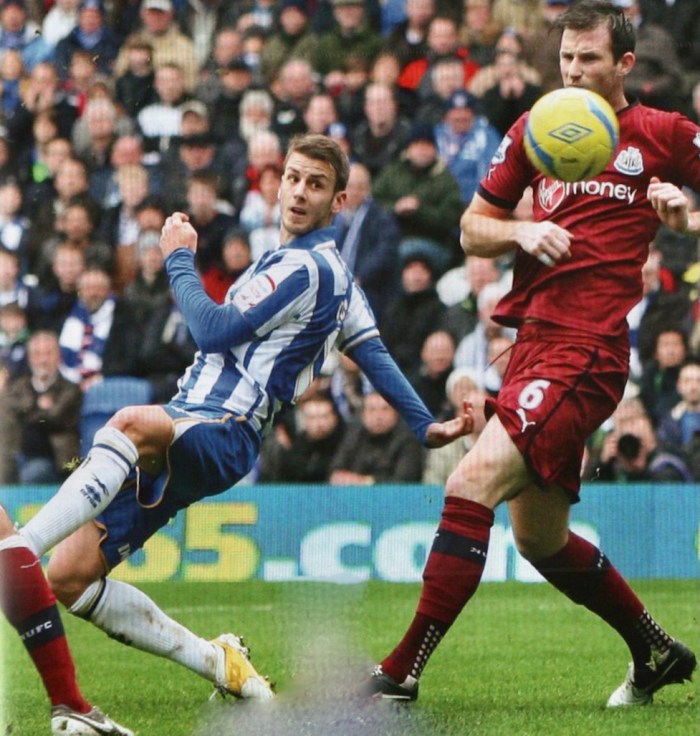
Andrea Orlandi hooks in Albion’s first goal
Praise for Liam Bridcutt

“This was an impressive victory for Brighton, a result that will add to the optimism that surrounds this upwardly mobile club and strengthen their resolve to host Newcastle in next season’s Premier League,” wrote Ben Smith, for BBC Sport. “The cool passing game of Liam Bridcutt at the heart of their midfield was tremendous.”

The reporter added: “Sharper to the ball, and swifter to make use of it, the Seagulls toyed with their more celebrated opponents for much of the opening 45 minutes, producing some stylish attacking moves while tackling, battling and dominating territory in their uncomplicated and effective way.”
Will Hoskins buries Albion’s second goal in 2013

Saint Christer: Albion flop but blossomed with Cherries

CHRISTER WARREN played in three defeats for bottom-of-the-league Brighton against a backdrop of turmoil behind the scenes.

With a winless run stretching back six games, reluctant boss Jimmy Case had returned to his old club, Southampton, to take the youngster on loan in October 1996.

Warren joined a squad comprising several familiar faces because in the Spring of that year Paul McDonald, Craig Maskell and Derek Allan had all moved along the coast from The Dell.

Instead of his arrival meriting mention in the matchday programme, its pages were devoted to Case urging fans not to invade the pitch in protest at what the owners were doing to the club and hated chairman Bill Archer claiming their beefs should be with the local authorities for thwarting plans for a new stadium.

Christer Warren in action for Brighton

On the pitch, the introduction of Warren failed to bring about a change in fortunes: in his three matches the sorry Seagulls lost 2-1 at home to Cambridge United, 1-0 at home to fellow strugglers Hereford United and 3-0 at Doncaster Rovers.

He returned to the Saints and made one more sub appearance for the first team before making a £50,000 move to AFC Bournemouth. After scoring on his debut, he went on to net 14 goals in 127 appearances for the Cherries.

He is one of a number of players who’ve played for Southampton, Bournemouth and Brighton; others include Case, goalkeeper Alan Blayney and more recently Adam Lallana.

Born in Poole, Dorset, on 10 October 1974, Warren was playing for Dorset Schools against Gloucestershire when he caught the eye of former Bristol Rovers full-back Lindsay Parsons, scouting as Cheltenham Town’s youth development officer.

Warren subsequently joined the Whaddon Road outfit and rose through the YTS ranks to become a first team regular in a side that was often close to the top of the Southern League and on 5 December 1992 he scored Cheltenham’s goal in a 1–1 second round FA Cup game against future employer Bournemouth.

His performances playing wide on the left side of the midfield attracted the attention of League clubs and just as he was about to attend a trial at second-tier Derby County, Premier League Southampton’s boss Alan Ball stepped in to sign him for £40,000 (plus appearance-related add-ons) – a record fee for Cheltenham at the time.

He made his Saints debut as a substitute away to Arsenal on 23 September 1995, going on for Neil Shipperley in the 78th minute in a 4-2 defeat. Dave Beasant was in goal for Saints and Jason Dodd at right-back. 

Warren started a 2-1 League Cup defeat to Reading on 28 November 1995 but his only league start under Dave Merrington was in a 3-0 defeat at QPR on 30 March 1996. He also made six sub appearances for Saints that season.

The temporary Albion move was one of two loan spells away from The Dell; he also spent time at Fulham in the final months of the 1996-97 season, helping them gain promotion from Division 3 under Micky Adams.

Saints recouped £50,000 of Ball’s outlay when Warren dropped two divisions and made the switch to the Cherries in October 1997. He was in the Bournemouth side that lost 2-1 to Grimsby Town in the 1998 Auto Windscreens Shield final – the club’s only Wembley appearance.

His versatility meant Bournemouth boss Mel Machin used him as a midfielder or striker, but he later settled into a left wing-back role.

A free transfer to QPR in June 2000 saw him move up a division and he was full of optimism about the move, telling the Rangers website: “It came totally out of the blue and I just can’t wait to get started now.
“Obviously, Rangers are a division above Bournemouth, so it is a great move and hopefully I can adapt to Division One football.

“I started my career as a centre-forward. Then I went to left midfield before moving back to left-back. I think my game is mostly about my speed.

“I’m quite fast and I like to get at people. I played at left back all last season, so obviously I didn’t get the chance to get forward and get at people as much as I’d like. But at QPR you play wing-backs, so it is a better position for me to play.”

Warren said he was relishing the chance to work under former QPR and England captain Gerry Francis. “You only have to look at the players that he’s brought through, so obviously he must be a good coach. Hopefully, he can make me a better player as well.

“Everyone’s main ambition is to get as high as you can and get into the Premiership. Last time I was in the top flight, I was at Southampton but I think I was too young then.

“Hopefully, I can get a chance to play for Rangers in the Premier League and hopefully this time around I’ll be better equipped for it.”

Sadly it all went pear-shaped for Rangers who won only seven games all season. Francis was sacked in February 2001 (and replaced by Ian Holloway) and the side was relegated to the third tier for the first time since 1967.

After occasional appearances for them at left-back in 2001-02, Warren was released at the end of his two-year contract and was offered the chance to train with Bristol Rovers by former Southampton youth coach Ray Graydon.

He spent a month with the Gas, making two substitute appearances, but preferred to drop into non-league to play football closer to his Bournemouth home.

He played in Hampshire with Eastleigh and Winchester City and Dorset with Lymington & New Milton and Wimborne Town, while working for Snows, an industrial stationery company in Southampton.

Warren briefly ventured into management at Wimborne but reverted to playing – in lower-division football, in western France for FC Boutonnais and US Melle – before returning to the UK and playing for Sydenhams Wessex One club Christchurch and then Verwood, where he coached.

Christchurch manager Adie Arnold told Andy Mitchell of the Bournemouth Daily Echo in 2015: “He has been playing in France at a reasonable level but recently decided to come back to England.

“I go back a long way with Christer and he wants to continue playing. He is as fit as a flea and can play a number of positions so his experience, football knowledge and, most importantly, ability will be a massive asset to us.”

Arnold pointed out: “He has played at the highest level and everyone can learn from him, particularly the youngsters at the club. He is a role model and the sort of player you should look up to, watch and see how he handles himself.”

High hopes have followed Billy Gilmour on his football journey

NAPOLI might well be riding high in Serie A but it’s mainly a watching brief for midfielder Billy Gilmour who moved to the Italian club from Brighton in August 2024.

The former Chelsea midfielder has found game-time harder to come by than fellow countryman Scott McTominay, who has shone in midfield as Antonio Conte’s side have been involved in an intriguing Italian title race with Atalanta and Inter Milan.

Most of Gilmour’s involvement has been from the bench apart from during October and November 2024 when he started five consecutive league matches. Stanislas Lobotka has more often been Conte’s pick for the no 6 role.

Nonetheless Conte said: “I’m happy that we have him here, he is a great player. He is an important option for us.”

While some Brighton supporters lamented Gilmour’s departure, it could be seen as a shrewd piece of business considering the Seagulls received a reported fee of £12m plus £4m in add-ons, turning a profit on the £9m paid to Chelsea two years earlier.

Veteran Albion watcher Andy Naylor reckoned Gilmour was a key player, citing Opta stats highlighting Gilmour’s 92.15 per cent passing accuracy in 2023-24 to back up his view. “He helps to control games and dictate the tempo with slick and reliable passing,” he wrote for The Athletic.

Indeed, after Gilmour had once again earned plaudits playing for his country at the 2024 Euros tournament, Naylor declared that the player “is going to become increasingly important to Brighton” even going so far as to say: “The midfielder is the future for his club under new head coach Fabian Hurzeler.” As it happened, that couldn’t have been more wrong.

The arrival of two £25m signings in Dutch international Mats Wieffer from Feyenoord and Danish international Matt O’Riley from Celtic, together with the emerging influence of young Carlos Baleba must have sounded a warning signal to the Scot. And a central midfield starting berth for veteran James Milner meant Hurzeler had something quite different in mind. Not to mention other midfield options of Jack Hinshelwood and Yasin Ayari.

Although Gilmour went on as a sub in the opening day 3-0 win at Everton and started alongside Milner in the 2-1 home win over Manchester United, the growing rumours of his imminent departure to Italy proved true as former Chelsea manager Conte signed him along with McTominay from Manchester United.

Gilmour admitted in an interview with AreaNapoli: “Scott arrived here before me, and we were texting each other, in the days when I was also hoping to move to Naples.

“When Scott told me he was on the plane to come here, all that was left to do was close my transfer. The day I arrived in Naples was something incredible. I got off the plane, ran to do the medical and then went to the stadium.”

Gilmour and McTominay together at Napoli

Gilmour added: “My dream as a footballer is to reach the highest levels and win trophies here in Naples. That’s what I will try to do.”

Apart from starting one cup match, and the autumn run referred to earlier, Gilmour’s had to reprise the situation he found himself in at Brighton when he first arrived – he only made six starts plus seven appearances off the bench as Moises Caicedo, Alexis Mac Allister and Pascal Gross lorded it in midfield.

Gilmour heard only good things about Brighton from former Chelsea teammate Tariq Lamptey before making the move south, and on arrival there was also a familiar face behind the scenes in David Weir, who he’d known from his days at Glasgow Rangers.

After that low key start to life with the Seagulls, in April 2023 Roberto De Zerbi decided to rest key players for the home game with Wolves and give Gilmour and striker Deniz Undav starts. Albion won 6-0 and the manager confessed afterwards: “Gilmour, I think, was the best player on the pitch and I must admit possibly in the past I made some mistakes with him and with Undav because I didn’t give them many possibilities to play.

“But for me it’s difficult. To play without Mac Allister, Mitoma, Solly March, Moises Caicedo, it’s difficult.”

Once Mac Allister and Caicedo had flown the Seagulls nest, De Zerbi showed his faith in Gilmour, giving him 32 starts and nine appearances off the bench as Albion competed in the Europa League for the first time.

“Billy is a unique player,” reckoned De Zerbi. “We have only one playmaker in our squad and he is Billy Gilmour.”

Gilmour in action for the Albion v Arsenal

In early December 2023, he was full of praise for the young Scot, telling the media: “The improvement of Gilmour is incredible. I completely love him, because now he is playing very much like a leader on the pitch.

“Big quality, big attitude, big player. He is improving in the quality of the pass, in the personality, how he can drive and control the game, drive the team. To understand the play before he receives the ball.

“He understood when he has to play a long ball and a short pass because the defensive space starts from how long is the pass. In his reaction, when we lose the ball. I am very pleased for his performances.”

Born on 11 June 2001 in Irvine, Ayrshire, Gilmour grew up in the county’s coastal town of Ardrossan where he went to Stanley Primary School. He moved on to Grange Academy in Kilmarnock which was part of the Scottish FA performance school programme.

When he and fellow graduate Nathan Patterson made it into the full international squad, programme director Malky Mackay told The Scotsman: “Billy is someone I’ve been impatient about for a number of years now. We took him to the Toulon tournament with Scotland under-21s when he was 17 because I had a firm belief this kid is something special.

“He ended up playing, becoming the breakthrough player at a tournament of that esteem, scoring a goal and captaining the team. It was only a matter of time but it’s terrific he and Nathan have been picked for the squad. That makes me more happy than you could ever know.”

At a young age, Gilmour spent three months at Celtic (his dad supported the Hoops) but switched to Rangers (who his mum supported) because it was easier to get to training.

He progressed through the youth ranks and was still only 15 when he was called up to train with the first team squad during Mark Warburton’s reign as manager.

“I came on the scene at a young age and there was a lot of talk, a lot of people putting my name out there, but you have to learn to live with that – and the best way is by playing well and keeping your consistency,” Gilmour told the Albion matchday programme.

It was a disappointing snub by Rangers caretaker manager Graeme Murty that led to his £500,000 departure from Glasgow to London, as recounted by sports writer Ewan Paton in rangersreview.co.uk.

Gilmour was due to become Rangers’ youngest-ever player at 15 years old in a Scottish Cup tie against Hamilton in March 2017; Murty indicating the teenager would be on the bench and would get the chance to fulfil his lifelong dream of playing for Rangers.

But, just hours before kick-off, Murty changed his mind, with Gilmour being left out of the matchday squad.

“I felt like I was going to be on the bench and maybe even come on that game. It works in its weird ways, so it does, football,” said Gilmour.

Two months later, when he was eligible to turn professional aged 16, the incident was in the back of his mind and he opted to move to Chelsea.

“Of course, I would’ve loved to have played for Rangers,” he said. “But I ended up moving on and maybe it’s a wee part of my journey that made the decision a bit easier.”

Remarkably, Gilmour scored in each of his first three games for Chelsea’s under 18 side and he signed a professional contract aged 17 in July 2018.

A year later, it was newly-appointed manager Frank Lampard who gave him his senior debut in a pre-season friendly. His league debut was as a late substitute for Tammy Abraham against Sheffield United and his first start was shortly afterwards in a 7-1 EFL Cup thrashing of Grimsby Town, a game in which Reece James made his debut.

Lampard said afterwards: “I thought Billy Gilmour ran the game from midfield, and Marc Guehi was solid. They’ve been outstanding this year.”

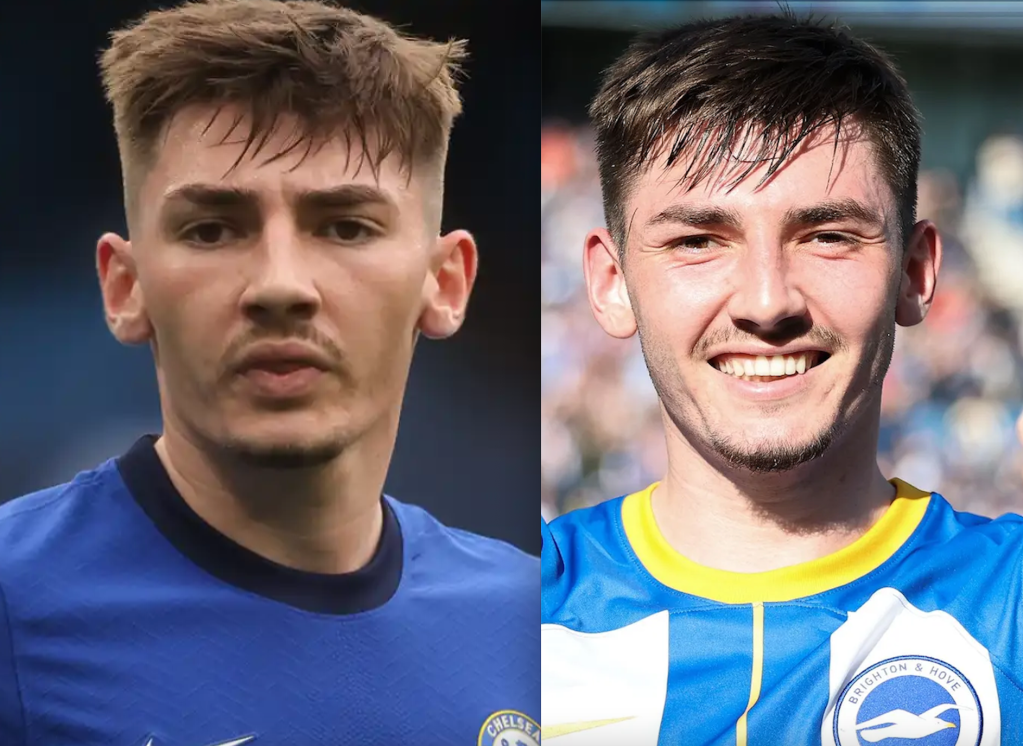
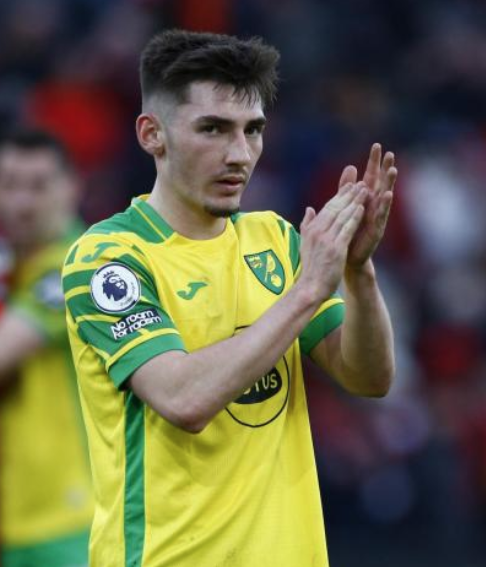
After making 11 league and cup appearances for Chelsea in each of 2019-20 and 2020-21, Gilmour went on a season-long loan to Norwich City where, although he got more games (23 starts, five off the bench), he didn’t enjoy the experience and wasn’t a permanent fixture in the struggling Canaries side that eventually ended up being relegated.

Gilmour didn’t enjoy his time at Norwich

“Things had been going so well and then I went on loan to Norwich which I thought would be good for me,” Gilmour told Men’s Health. “It turned out to be a fight, a battle. I learned a lot.”

He continued: “I was just a young kid and it was a low time for me.

“I learned how strong I was. I put a smile on my face, even though I was hurting, especially when I was living on my own in Norwich. Some nights, I’d be sitting there thinking, ‘This is c**p’, but that’s where my family helped me. You can only learn from that.”

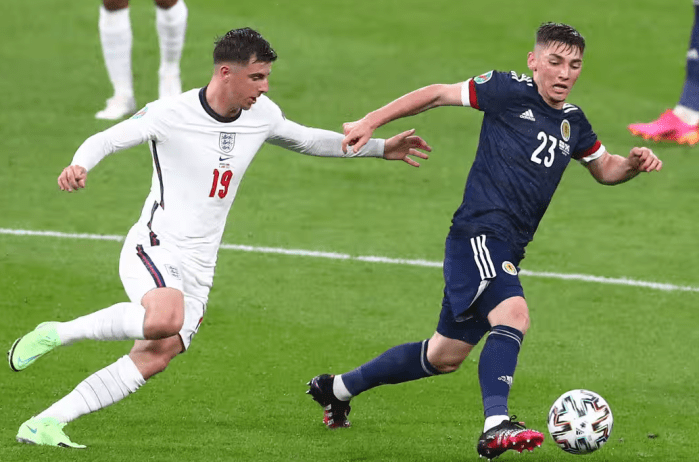
Gilmour, when aged just 20, was named man of the match in his first full start for Scotland as they held England to a 0-0 draw at Wembley in a Euro 2020 match (played in June 2021 because of Covid).

“The ease with which he has transitioned into international football implies that he possesses some very special skills,” reckoned Ewan Murray, writing in The Guardian.

“It was his big moment and he didn’t let us down,” said Scotland manager Steve Clarke. “Nobody is surprised by that. Not in our camp.”

But a word that has hung heavy around Gilmour’s neck is expectation. When the permanent move to Brighton came about, Tuchel admitted that Chelsea hadn’t wanted to let him go and would rather he had only left on loan.

He told reporters: “We had high hopes [for him] and he played for us in the first half a year when I was at Chelsea. He played some important matches for us and looked for a new challenge that did not go so well for him with Norwich.

“We expected more, he expected more so it was like, without pointing a finger, but it is difficult also for him and for us to not succeed, to not play at Norwich, to be relegated and then suddenly be a central midfielder for Chelsea and competing for top four and for every title.

“There’s a huge step in between so we were looking. The ideal solution would have been maybe that he goes again on loan as the concurrence is huge for us in central midfield and we felt like he is not the age where he can live again with five or six or seven matches during a whole season to fulfill his own potential so, ideally, it would have been another loan.

“Billy did not want to go on loan, it was a no-go for him so in the end, we agreed to a sale.”

Gilmour’s version of events differed a little, as he revealed in an interview with talkSPORT in September 2023, saying that after his season-long loan at Norwich, he was told he wasn’t part of the first-team plans at Chelsea and would have to be content with playing in the reserves.

That was despite Chelsea exercising an option to extend his contract to the end of the 2023-24 season earlier that summer.

“When I came back from my loan from Norwich, I came back and had pre-season and I just wasn’t in the plans,” Gilmour told talkSPORT host Jim White. “At that point I was thinking, well, I want to be at a club that really appreciates me and I want to be part of the team.

“I want to play first-team football. I’ve had a taste for it. I’ve played for my country, so I want to try and push on now. For me, it was the right time to leave. I spoke with the manager at the time, and he thought the same.

“I want to play football, I want to really settle down and try and find a house and home and be here and give my all.”

It remains to be seen where the young Scot’s career goes next but even though his playing time in Italy hasn’t quite lived up to expectations, the midfielder told broadcaster DAZN: “I am fit and well, I’m enjoying it.  Of course, we are doing well as a team, so we want to keep building on that.”

Sparks flew in Brighton v Chelsea FA Cup clashes

BRIGHTON v Chelsea in the FA Cup sparks memories for supporters of my generation stretching back several decades.

Many began as Albion followers the day the then First Division side from Stamford Bridge visited the Goldstone Ground in February 1967 when a dubious refereeing decision denied Third Division Brighton a shock win.

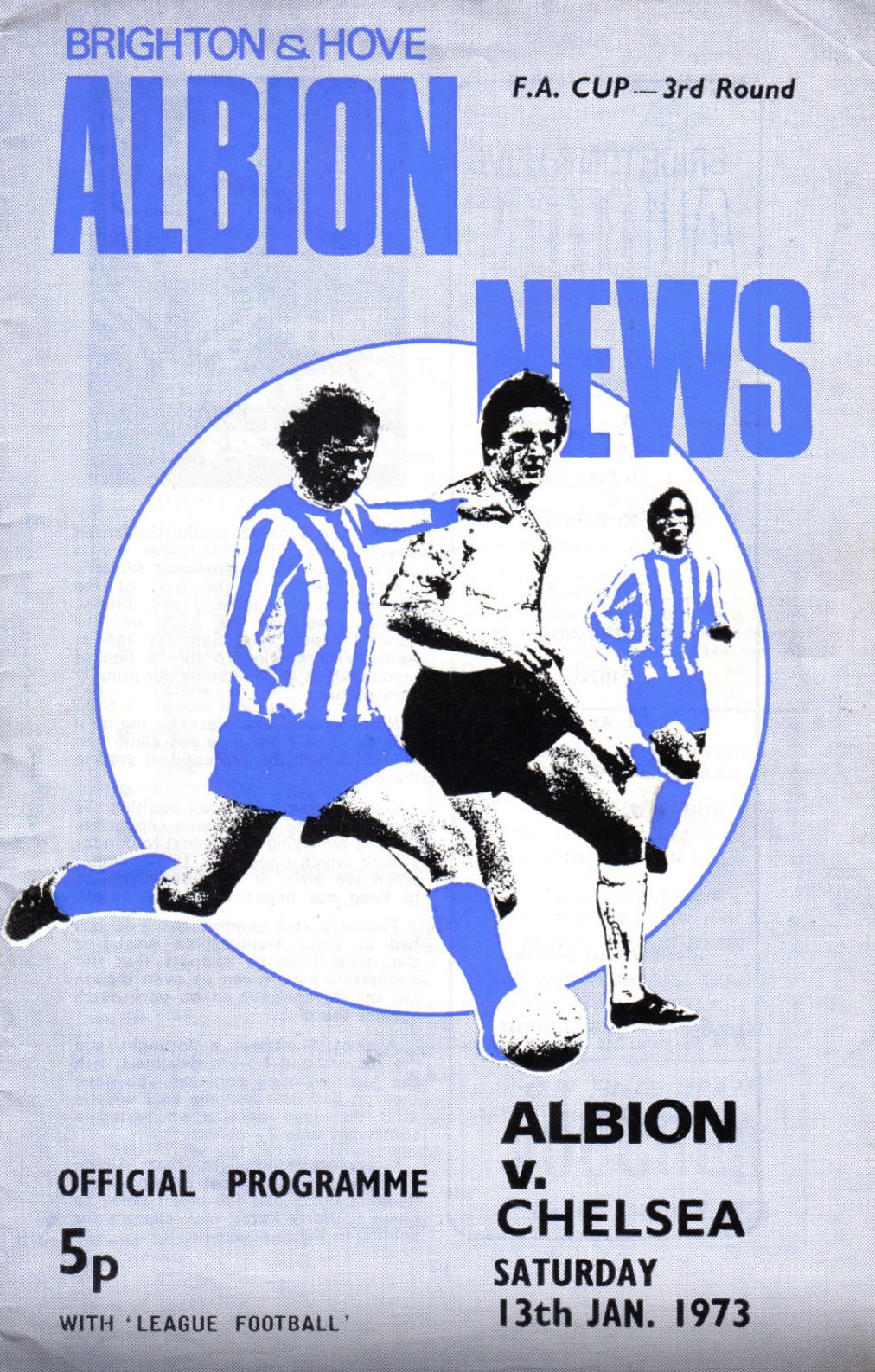
Others, me included, recall a fiery encounter in Hove six years later when Second Division strugglers Brighton were beaten 2-0 courtesy of two Peter Osgood goals in a game marred by violence on and off the pitch.

That third-round tie in January 1973 was dubbed “a day of shame” in the newspapers after two players were sent off, five were booked and crowd trouble erupted.

The chance for lower ranked teams to pitch their lesser talents against the big boys has always been at the heart of the FA Cup’s appeal.

That was certainly the case when Archie Macaulay’s mid-table Albion hosted Tommy Docherty’s top 10 Chelsea on 18 February 1967. To give it musical context, Georgy Girl by The Seekers had just taken over from The Monkees’ I’m A Believer at no.1 in the pop charts!

At a time when home crowds were normally 12,000 – 13,000, a sell-out gate of 35,000 packed into the Goldstone.

Cup fever had certainly captured the imagination of the Sussex public. In the previous round, 29,208 watched Albion beat Aldershot 3-1 in a third-round replay for the chance to take on the top division Pensioners (as Chelsea were called back then).

The two clubs hadn’t met in any other competition for 34 years – back in January 1933 Brighton beat the London side 2-1 in a third round FA Cup tie.

After such a long gap, maybe it was understandable that Albion’s young captain, Dave Turner, at 22, fell off the settee at home in excitement when he saw the cup draw made on the television.

Canny Brighton decided to sell tickets for the game at a reserve home fixture against Notts County, meaning a stunning 22,229 paid to watch the second string win 1-0 in order to secure their entry to the big game.

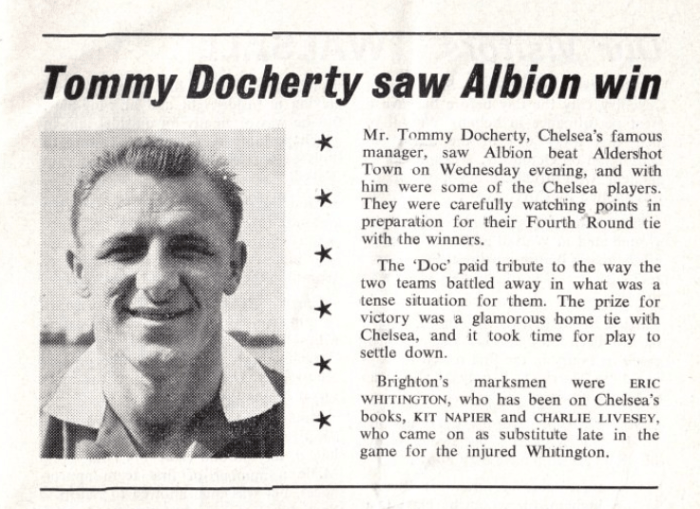
The matchday programme revealed how Docherty and several of his players had watched the Aldershot match to check out what would be in store for them.

Docherty meanwhile was very complimentary in his programme notes, declaring: “Chelsea know that we have a hard and difficult task today, and are not facing it in a complacent manner.”

He added: “We know that there is great potential for the Albion club. They have a First Division set-up at the Goldstone Ground, and First Division ideas, as well as a first-class pitch.

“The day cannot be very far away when they become one of our top clubs, and I am just one of many people in the game who will welcome their promotion to a higher class.”

However, the game was only five minutes old when Bobby Tambling gave Chelsea the lead. But before half-time, Chelsea’s John Boyle (who would several years later joined Albion on loan) was sent off for kicking Wally Gould. And just four minutes into the second half, Turner gave Albion parity.

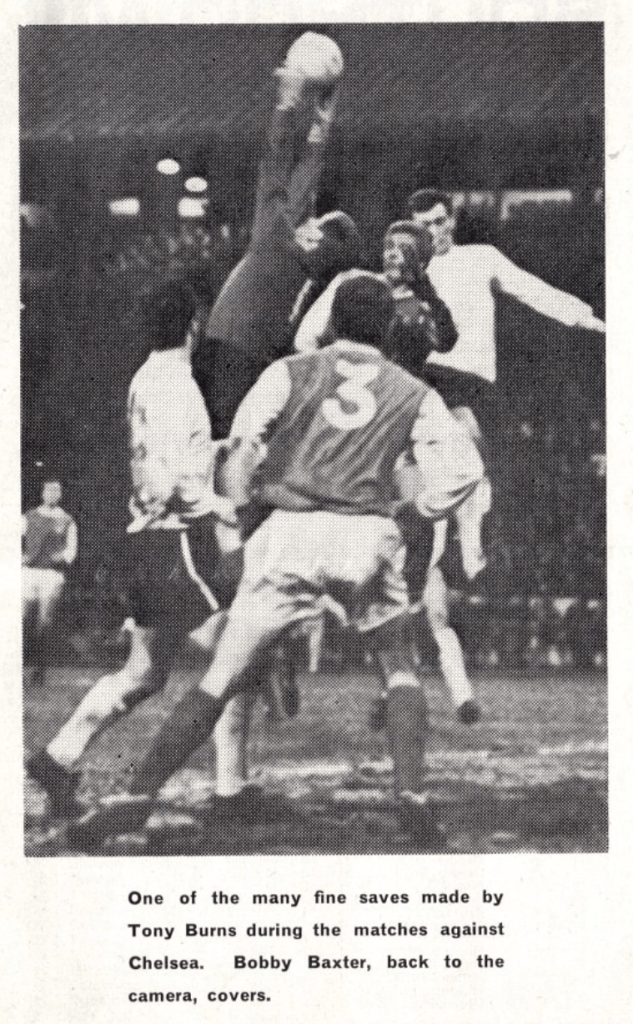
Goalkeeper Tony Burns, who had top flight experience with Arsenal, made several decent saves in the game and, with the clock ticking down, a cracking strike by winger Brian Tawse in the closing minutes of the game looked to have won it for the Third Division side.

“I smashed a volley past Peter Bonetti from 20 yards out with the score at 1-1 and thought I’d got the winner,” Tawse told Brian Fowlie of the Sunday Post in 2015. “It was a goal that could have made my career – but the referee chalked it off.”

Unfortunately, the official had spotted an infringement by Kit Napier and the ‘goal’ was disallowed.

As Brighton would discover again only too painfully in the 1983 final, these winning chances rarely happen twice, and, sure enough, in the replay at Stamford Bridge Chelsea ran out 4-0 winners in front of a massive crowd of 54,852.

Chelsea went on to reach that season’s final at Wembley only to lose 2-1 to a Spurs side that had Joe Kinnear at right-back and Alan Mullery in midfield.

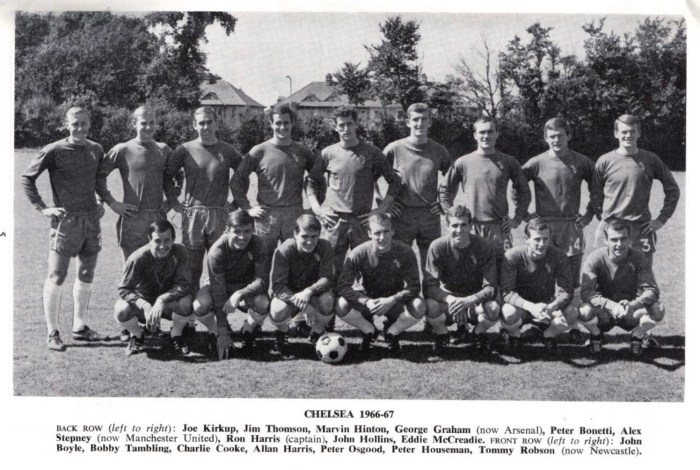
Hardman Ron ‘Chopper’ Harris, their captain in 1967, was still leading the side by the time of the 13 January 1973 game and John Hollins and Tommy Baldwin also played in both. The dismissed Boyle was on the Chelsea bench in 1973. Only John Templeman (right) played in both games for Brighton.

The UK had just joined the European Economic Community (as it was then called) and You’re So Vain by Carly Simon was no.1 in the charts. Albion had moved up a division under Pat Saward having won promotion the previous May, but the side was struggling at the foot of the Second Division, unable to cope at the higher level.

Nevertheless, there were two players looking forward to the cup tie: Bert Murray and £28,000 signing Barry Bridges had both won silverware at Chelsea in the 1960s.

Barry Bridges slots home for Chelsea in a FA Cup tie v Peterborough and, pictured by the Daily Mirror’s Monte Fresco, ahead of the 1973 match against his old club.

“It’s a tremendous draw for the club and a dream draw for Bert Murray and myself who both started our careers at Chelsea,” Bridges told Goal magazine. “Personally, it will be nice to see most of the Chelsea lads again. I grew up with Peter Bonetti, Ron Harris and Ossie (Peter Osgood).”

Unfortunately the Albion game was one of several former Worthing schoolboy Bonetti missed through injury and illness in the 1972-73 season, John Phillips deputising in goal at the Goldstone.

How this young supporter recorded the team info in his scrapbook

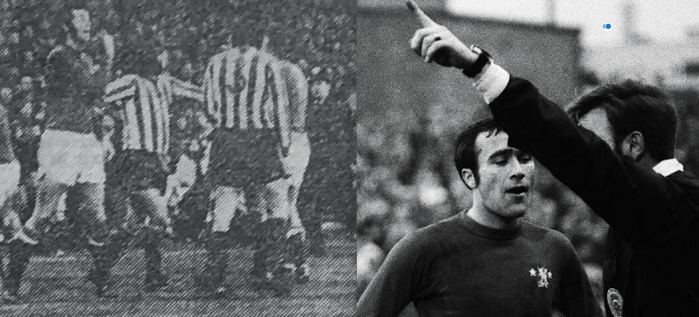
Dave Sexton, a promotion winner with Brighton in 1958, saw his Chelsea side put the ball in Albion’s net within the first 10 seconds of the game but Bill Garner’s effort was ruled out for offside, to the bemusement of the football writers watching. As the game unfolded, not only did it end in defeat for the Albion but it attracted ugly headlines for all the wrong reasons as Harris and Brighton left back George Ley were sent off.

Ley was dismissed in the 85th minute for bringing down Baldwin from behind and then getting involved in a punch-up with England international Osgood, the scorer of Chelsea’s goals in the 17th and 60th minutes, who himself was booked for his part in the altercation.

Albion’s Eddie Spearritt had been the first to go in the book on 23 minutes (for a foul on Alan Hudson) and on 73 minutes was involved in the incident which led to Harris being sent off for the first time in his career.

Esteemed football writer Norman Giller recorded it like this: “Harris got involved in a tussle with Spearritt, and, as he pushed him, Spearritt went down holding his face as if he had been punched. The referee directed Ron to an early bath. All the bones he had kicked, and here was Harris being sent off for a playground push.”

1970 Cup winner Dave Webb went in the book for wiping out Spearritt, joining colleague Steve Kember who was cautioned for fouling Steve Piper. Albion’s Graham Howell also went into referee Peter Reeves’ notebook for taking down Baldwin.

The kicking and aggression on the pitch led to fighting on the terraces with 25 people arrested. And Leicester referee Reeves had to be given a police escort off the pitch.

Former Spurs captain-turned-journalist Danny Blanchflower, writing in the Sunday Express: declared: “This FA Cup third-round tie was as disgraceful as any match I’ve ever seen.”

In the opinion of Albion scribe John Vinicombe in the Evening Argus: “Football anarchy gripped the Goldstone during the last 20 minutes of Albion’s FA Cup tie with Chelsea.

“In the frenzy, players fought one another, hacked and kicked, and the violence tiggered an all-too-predictable chain reaction on the terraces where rival factions became one mass of writhing, mindless hooligans.”

Interestingly, Harris’ dismissal was subsequently overturned, Giller recording: “A Brighton-supporting vicar, with a pitchside view, wrote to the Football Association telling them what he had witnessed, and ‘Chopper’ was vindicated.”

Chelsea made it through to the quarter-finals of that season’s tournament before losing 2-1 to Arsenal in a replay. Arsenal lost in the semis to Sunderland, the Second Division side who stunned the football world at the time by beating Leeds United in the final.