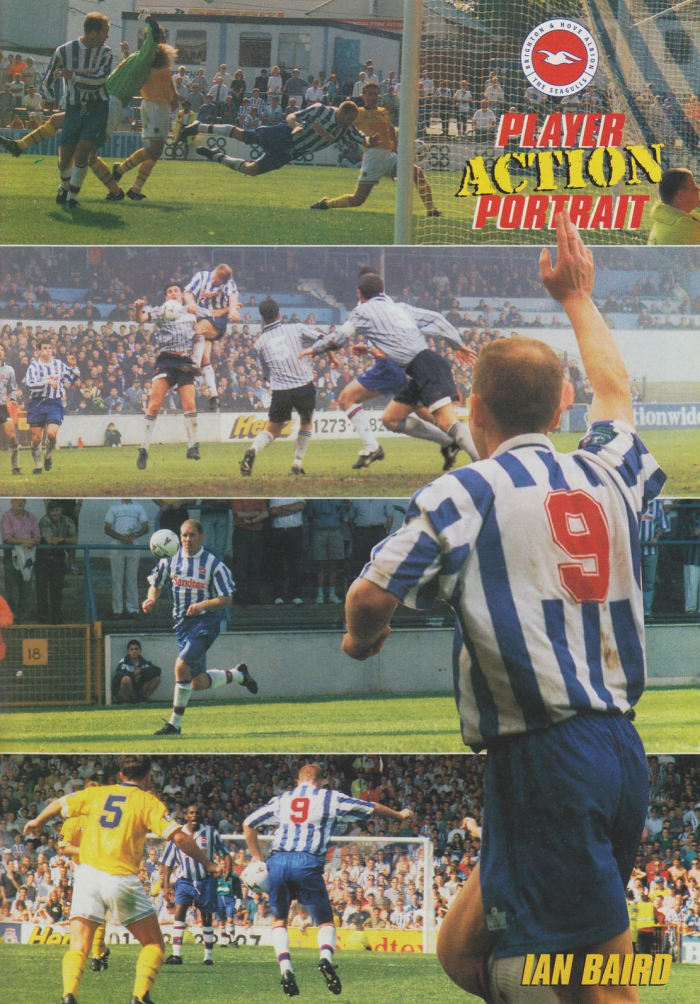
Crunching tackler ‘Tank’ Clark: a legend at two seaside clubs

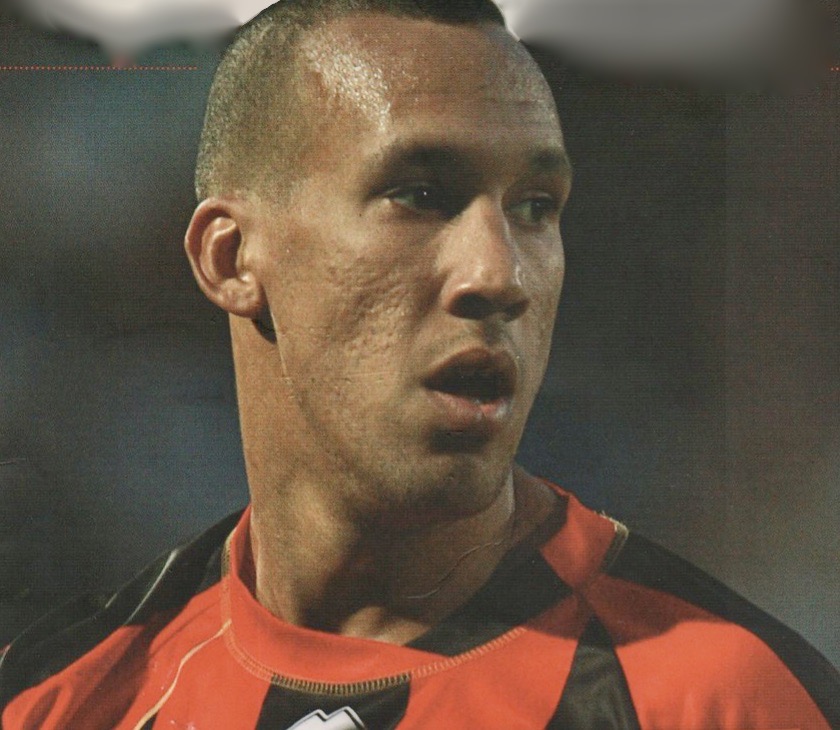
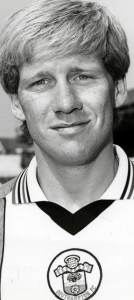
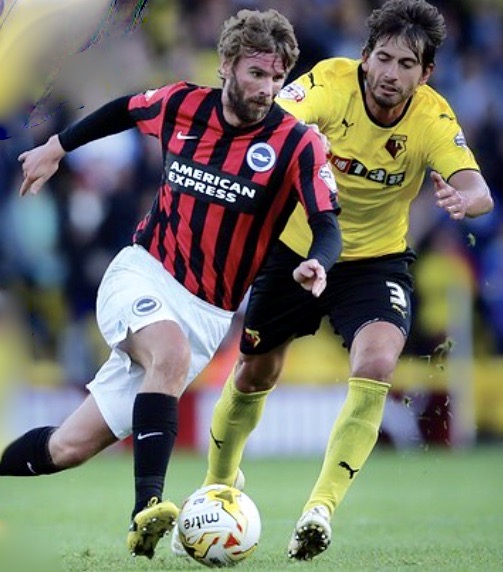
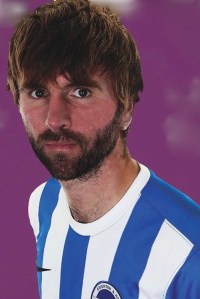
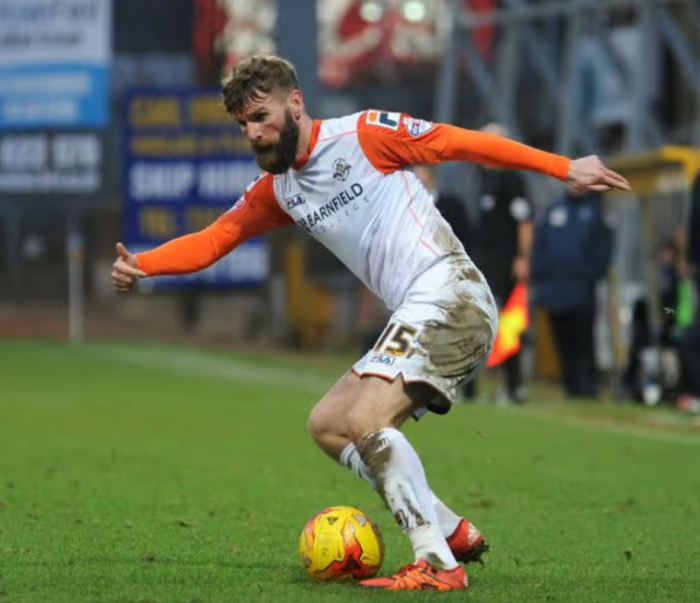
VIKING lookalike Paul Clark made a lasting impression on plenty of players with robust tackling which earned him ‘legend’ status among fans of Brighton and Southend United.

Described in one programme article as “the big bustling blond with the biting tackle”, Clark was given the nickname ‘Tank’ for his no-nonsense approach. A Southend fan lauded “his crunching tackles and never say die attitude”.

Clark himself reflected: “Wherever you go the supporters tend to like someone who is wholehearted and when it came to 50-50 challenges, or even sometimes 60-40, I didn’t shy away from too many, and the supporters just took to it.”

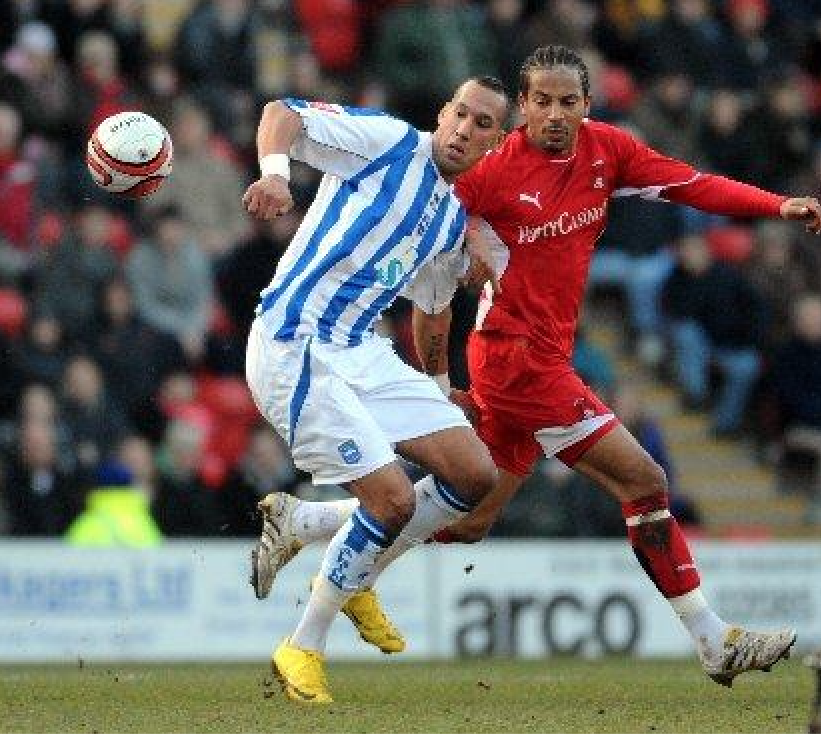
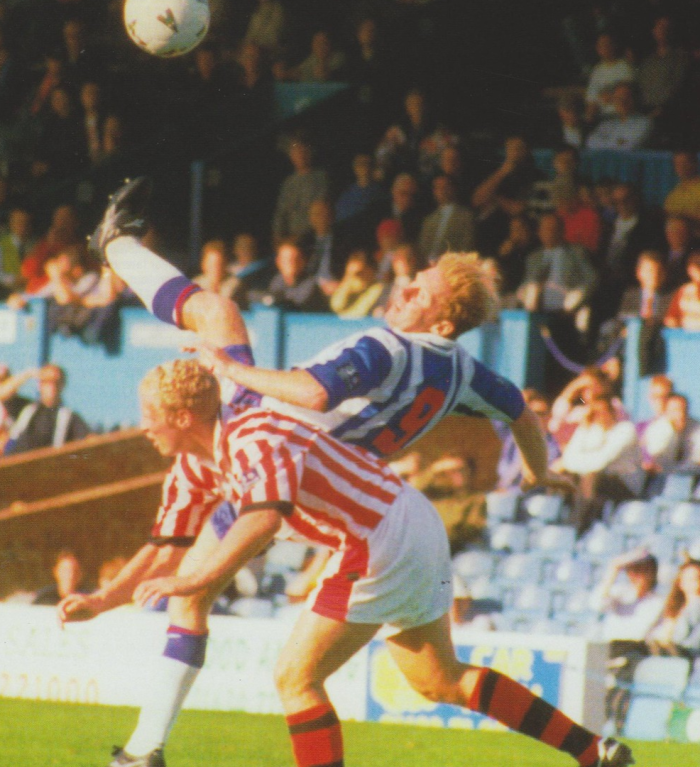
In Albion yellow against Palace

Giving further insight to his approach, he said: “You can go right up to the line – as long as you don’t step over it, then you’re OK.

“I used to pick up a booking during the first five or 10 minutes, then I knew I had to behave myself for the rest of the game. Despite the reputation I had, I was never sent off in over 500 games.”

A trademark strike at home to West Ham

Former teammate Mark Lawrenson said of him: “You would hate to have to play against him because quite often he would cut you in two. With him and ‘Nobby’ (Brian Horton) in the side, we definitely didn’t take any prisoners. One to rely on.”

A former England schoolboy international, it was said of the player in a matchday programme:

“Paul is the first to admit that skill is not his prime asset but there is no doubt as to the strength of his tackle. He is a real competitor and is also deceptively fast, being one of the best sprinters on the Goldstone staff.”

Born in south Benfleet, Essex, on 14 September 1958, Clark went to Wickford Junior School where he played for the school football team and the district primary schools’ side. When he moved on to Beauchamp Comprehensive, selection for his school team led to him playing for the Basildon Schools’ FA XI.

Clark as an England schoolboy

This in turn led to him being selected to play for England Schools at under 15 level, featuring against Scotland, Ireland, Wales, West Germany and France before going on a tour of Australia with the same age group. Contemporaries included future full time professionals Mark Higgins, Ray Deakin, Kevin Mabbutt and Kenny Sansom.

Clark left school at 16 before taking his O levels when Fourth Division Southend offered him an apprenticeship. He made his first team debut shortly before his 18th birthday in a 2-1 win over Watford.

Two months later, he won the first of six England Youth caps. He made his debut in the November 1976 mini ‘World Cup’ tournament in Monaco against Spain and West Germany alongside future full England internationals Chris Woods, Ricky Hill and Sammy Lee.

The following March, he played in England’s UEFA Youth tournament preliminary match against Wales when they won 1-0 at The Hawthorns. Sansom was also in that side. And he featured in all three group matches at the tournament that May (England beat Belgium 1-0, drew 0-0 with Iceland and 1-1 with Greece). Teammates included Russell Osman and Vince Hilaire.

Clark was only a third of the way into his second season at Southend when Alan Mullery sought to beef up his newly-promoted Brighton side in the autumn of 1977, and, in a part exchange deal involving Gerry Fell moving to Roots Hall, Clark arrived at the Goldstone. He made his debut for the Seagulls in a goalless draw at White Hart Lane on 19 November 1977 in front of a crowd of 48,613. And he came close to crowning it with a goal but for an outstanding save by Spurs ‘keeper Barry Daines.

In full flight, as captured by photographer George Erringshaw

When Spurs visited the Goldstone later that season, Clark put in a man of the match performance and scored a memorable opener, following a solo run. A subsequent matchday programme article was suitably poetic about it.

“It showed all the qualities looked for in a player: determination, speed, skill and most of all the ability to finish….if any goal was singled out, Paul’s was certainly one to treasure.”

Albion went on to beat Spurs 3-1, although the game was remembered more because it was interrupted twice when the crowd spilled onto the pitch.

After only 12 minutes, referee Alan Turvey took the players off for 13 minutes while the pitch was cleared of Albion fans who’d sought safety on the pitch from fighting Spurs’ hooligan fans.

In the 74th minute, with Spurs 3-1 down and defender Don McAllister sent-off, their fans rushed the pitch to try to get the game abandoned. But police stopped the invasion getting out of hand and the game continued after another four-minute delay.

Clark’s goal on 16 minutes had been cancelled out six minutes later when Chris Jones seized on a bad goal kick by Eric Steele but defender Graham Winstanley made it 2-1 just before half-time.

Albion’s third goal was surrounded in controversy. Sub Eric Potts claimed the final touch but Spurs argued bitterly that Malcolm Poskett was offside.

Clark remembered the game vividly when interviewed many years later by Spencer Vignes for the matchday programme. The tenacious midfielder put in an early crunching tackle on Glenn Hoddle and after the game the watching ex-Spurs’ manager Bill Nicholson told him: “Well done. You won that game in the first five minutes when you nailed Hoddle.”

Said Clark: “I was 19 at the time so to get a pat on the back from him was much appreciated.”

It was one of three goals Clark scored in his 26 appearances that season (nine in 93 overall for Albion) but he wasn’t always guaranteed a starting berth and in five years at the club had a number of long spells stuck in the reserves.

Midfield enforcer or emergency defender were his primary roles but Clark was capable of unleashing unstoppable shots from distance and among those nine goals he scored were some memorable strikes.

For instance, as Albion closed in on promotion in the spring of 1979, at home to Charlton Athletic, Clark opened the scoring with a scorching 25-yard left foot volley in the 11th minute. Albion went on to win 2-0.

The following month, Clark demonstrated his versatility at St James’ Park on 3 May 1979 when Albion beat Newcastle 3-1 to win promotion to football’s elite level for the first time. Clark played in the back four alongside Andy Rollings because Mark Lawrenson was out injured with a broken arm.

Celebrating promotion with Peter O’Sullivan and Malcolm Poskett

“Not many people can say they played in a side that got Brighton up to the top flight,” said Clark. “It’s something I’m still immensely proud of.”

Once they were there, Clark missed the opening two matches (defeats at home to Arsenal and away to Aston Villa) and had an ignominious start to life at the higher level when he conceded a penalty within three minutes of going on as a sub for Rollings away to Manchester City on 25 August 1979.

Some observers thought Clark had played the ball rather than foul Ray Ranson but referee Pat Partridge thought otherwise and Michael Robinson stepped up to score his first goal for City from the resultant penalty. It put the home side 3-1 up: Teddy Maybank had equalised Paul Power’s opener but Mike Channon added a second before half-time.

Partridge subsequently evened up the penalty awards but Brian Horton blazed his spot kick wide of the post with Joe Corrigan not needing to make a save. Peter Ward did net a second for the Seagulls but they left Maine Road pointless.

Ahead of Albion’s fourth attempt to get league points on the board, Clark played his part in beating his future employer Cambridge United 2-0 in a second round League Cup match.

Three days later, he was on the scoresheet together with Ward and Horton as Albion celebrated their first win at the higher level, beating Bolton Wanderers 3-1 at the Goldstone.

It was Clark’s neat one-two with Ward that produced the opening goal and on 22 minutes, Maybank teed the ball up for Clark, who “belting in from the edge of the box, gave it everything and his shot kept low and sped very fast past (‘Jim’) McDonagh’s right hand,” said Evening Argus reporter John Vinicombe.

Gerry Ryan replaced Clark late in the game and after 12 starts, when he was subbed off three times, and four appearances off the bench, his season was over, and it wasn’t even Christmas.

A colour photo of a typical Clark tackle (on QPR’s Dave Clement) adorned the front cover of that season’s matchday programmes throughout but he didn’t start another game after a 4-0 League Cup defeat at Arsenal on 13 November.

Programme cover shot

He was sub for the following two games; the memorable 1-0 win at Nottingham Forest and a 1-1 draw at Middlesbrough, but Mullery had signed the experienced Peter Suddaby to play alongside Steve Foster, releasing Lawrenson to demonstrate his considerable repertoire of skills in midfield alongside skipper Horton and Peter O’Sullivan.

Young Giles Stille also began to press for a place and later in the season, Neil McNab was added to the midfield options, leaving Clark well down the pecking order in the reserves. Portsmouth wanted him but he rejected a move along the coast, although he had a brief loan spell at Reading, where he played a couple of games.

But Clark wasn’t finished yet in Albion’s colours and, remarkably, just over a year after his last first team appearance, with the Seagulls struggling in 20th spot in the division, he made a comeback in a 1-0 home win over Aston Villa on 20 December 1980.

Albion had succumbed 4-3 to Everton at Goodison Park in the previous match and Mullery told the Argus: “We badly needed some steel in the side and I think Clark can do that sort of job.”

Under the headline ‘The forgotten man returns’ Argus reporter Vinicombe said Mullery hadn’t changed his opinion that Clark was not a First Division class player, but nevertheless reckoned: “Paul’s attitude is right and I know he’ll go out and do a good job for me.”

For his part, Vinicombe opined: “The strength of Clark’s game is a daunting physical presence. His tackling is second to none in the club and Mullery believes he will respond to the challenge.”

Clark kept the shirt for another nine matches (plus one as a sub), deputising for Horton towards the end of his run, but his last first team game was in a 3-1 defeat at Norwich at the end of February.

Clark remained on the books throughout Mike Bailey’s first season in charge (1981-82) but, with Jimmy Case, Tony Grealish and McNab ahead of him, didn’t make a first team appearance and left on a free transfer at the end of it.

Back to Southend

He returned to Southend where he stayed for nine years and was player-manager on two occasions. Fans website shrimperzone.com moderator ‘Yorkshire Blue’ summed up his contribution to their cause thus: “In the top five all-time list for appearances, an inspiration in four promotions, one of the toughest tacklers of all-time and a man whose commitment for his home-town club could never be doubted.”

Clark was still only 27 when he had his first spell as manager, in caretaker charge after Dave Webb had quit following a bust-up with the club chairman, and he managed to steer United to promotion back to the third tier.

When Webb’s successor Dick Bate lasted only eight games of the new season, Clark was back at the helm, in turn becoming the youngest manager in the league.

His first hurdle ended in a League Cup giant killing over top flight Derby County (who included his old teammate John Gregory) when the Us had another former Albion teammate, Eric Steele, in goal.

A Roy McDonough penalty past England goalkeeper Peter Shilton at Roots Hall settled the two-legged tie (the second leg was goalless at the Baseball Ground) which the writer described as “arguably their biggest ever cup shock”.

In the league, player-manager Clark guided Southend to a safe 17th place but it went pear-shaped the following season. Clark only played 16 games, Southend were relegated, and Webb returning midway through the season as general manager.

Back-to-back promotions in 1989-90 and 1990-91 proved to be a more than satisfactory swansong to his Southend career, and in the first of those he found himself forming an effective defensive partnership with on-loan Guy Butters in the second half of the season.

In 1990-91, he missed only six games all season as the Shrimpers earned promotion to the second tier for the first time in their history, and he had a testimonial game against Arsenal.

But, after a total of 358 games for Southend, he left Roots Hall to join Gillingham on a free transfer.

Over three seasons, he played 90 league games, and was caretaker manager in 1992, before retiring at the end of the 1993-94 season. Gillingham’s top goalscorer with 18 that season was a young Nicky Forster and other Albion connections in that squad included Mike Trusson, Paul Watson, Neil Smillie, Andy Arnott and Richard Carpenter.

After Gillingham, Clark played non-league for Chelmsford City but left to become assistant manager to Tommy Taylor at Cambridge United. In 1996 he followed Taylor in a similar role to Leyton Orient.

Southend fans hadn’t heard the last of him, though – quite literally. He became a co-commentator on Southend games for BBC Radio Essex.

In the 2009-10 season, Clark was temporarily assistant manager to Joe Dunne at Colchester United.

Bank clerk Fell on his speedy feet at the Albion

In full flight for the Albion

NOT TOO many professional footballers start out as bank clerks, but Gerry Fell broke that mould when he signed for Brighton.

Six-foot winger Fell had worked at the Newark branch of NatWest for five years, combining bank clerk duties with playing semi-professional football for Lincolnshire-based Stamford in the United Counties League.

In the latter part of 1973, Stamford played Long Eaton United in a FA Trophy second round qualifying match and Long Eaton’s manager, Brian Daykin, having liked what he saw, signed Fell for the Derbyshire side the following summer.

Within weeks, Daykin left Long Eaton to become no.2 to Peter Taylor at the Albion – and one of his first moves was to persuade Taylor to sign Fell. Taylor watched the player a couple of times and endorsed his assistant’s opinion.

Fell was 23 when he packed up his NatWest job to move to Sussex and turn professional.

“I loved Brighton from the moment I arrived, absolutely loved it, especially considering where I came from,” he said. “It was a totally different ball game to Newark and I loved the idea of living by the sea. It was so cosmopolitan and a massive eye-opener for me.”

In a matchday programme article, Fell told Spencer Vignes: “I was always very fit and a good trainer, so I didn’t find the training difficult at all. But obviously the step up in terms of actually playing took a bit of getting used to.

“I thought it was great because, as you can imagine, it was a stars-in-my-eyes job for me. I got into the first team within three months of arriving, so it was fantastic. I’ve never regretted any of it.”

Pointing out that he wasn’t the only member of that squad who was late to the game and from non-league (Peter Ward and Brian Horton were too), he said: “You had a few of us who’d experienced the outside world and perhaps appreciated what it meant to be a professional footballer that little bit more because of it.”

Born in Newark on 1 March 1951, Fell’s first football memory was as the mascot for Newark Central, a local team that his grandfather ran. He was educated at Magnus Grammar School in Newark where he earned a reputation for athletic achievements, gaining honours in high jump and 800 metre running.

Fell certainly hit the ground running at the Albion as a pacy goalscoring winger, netting five goals in 20 appearances in the season he arrived plus eight in 28 the following season (1975-76).

His initial first team involvement was as a non-playing sub for a 2-0 home win over Southend United on 7 December 1974 (Tommy Mason and Jim Walker the scorers), but once he’d made his debut at the end of the following month in a 2-0 win over Colchester United, he kept the shirt previously worn by Ian Mellor through to the end of the season (bar one game when Mellor replaced him).

In 1975-76, when Taylor’s much-changed side only narrowly missed out on promotion, Fell twice hit braces in 6-0 wins at the Goldstone, the first pair against Chester in September (Fred Binney 2, Peter O’Sullivan and Mellor also scorers), the other when Colchester United were dispatched by the same scoreline in January 1976 (Binney another two, Andy Rollings and Mellor also scoring).

He revelled in switching from playing in front of 200-300 people to turning out at the Goldstone where crowds could often be more than 20,000 – even for Third Division games.

“To play in front of that amount of people on that ground, well, it was a dream come true,” Fell told Vignes. “The Goldstone was a bit of a fortress at that time and the players in the team were so confident.”

Apart from that first half-season, Fell generally competed with Brighton-born Tony Towner for the no.7 shirt and Taylor’s successor Alan Mullery went with Fell for the final run-in to promotion from the third tier in the spring of 1977. He started 11 games and scored the only goal of the game as top-of-the-table Albion secured a vital 1-0 win over Port Vale in their penultimate home game.

“It wasn’t easy being on the sidelines looking on, but Gerry was a breath of fresh air,” Towner said in a matchday programme interview. “He was the opposite of me; though still a winger, he had loads of pace, though not too much skill!

“He’d knock the ball ahead of him and run past the defender to get it. I’d try to trick my way past.”

Ironically, although Brighton secured promotion by beating Sheffield Wednesday 3-2 in the last home game, the man of the match was the visitors’ Eric Potts – and his next game at the Goldstone was in Albion’s colours… as a replacement for Fell and Towner!

Having liked what he saw in that exciting encounter under the lights in front of a bumper crowd of 30,756, Mullery promptly signed Potts for £14,000 in the close season.

The diminutive winger had previously played for Wednesday at the level of today’s equivalent of the Championship and he was installed in the no.7 shirt for the first 21 games of the season.

Fell played and scored in his first start of the season (a 2-0 home win over Hull City) in September and the following game, his last start in an Albion shirt, was in a 2-2 League Cup second round replay draw at Oldham Athletic.

But Fell wasn’t done with the Seagulls just yet. He proved to be a matchwinner after going on as a 57th minute substitute for the injured Steve Piper in the last league game of September, a 3-2 night game win over Luton Town in front of a Goldstone crowd of 25,132.

The game was finely poised at 1-1 (Ward and Ron Futcher on target) when on 84 minutes Fell, unmarked at the far post, headed in a second Albion goal when Mellor flicked on a corner by Potts. Three minutes later, Fell was once again played in by Mellor and a turn-and-volley into the top corner from the edge of the box put Albion 3-1 up. There was still time for Jimmy Husband to pull one back for the Hatters, but Albion held on to take all the points.

Those goals didn’t earn him a starting place, though. On six further occasions Fell was sub (three playing, three not getting on) before Mullery traded him as a makeweight in the signing of 19-year-old powerhouse midfielder Paul Clark from Southend United.

In the three years between his first involvement with the first team as a non-playing sub at home to those future employers and his last, going on for Potts in a 1-0 defeat away to Notts County on 5 November 1977, only three other players were involved in both fixtures: Graham Winstanley, O’Sullivan and Mellor. Fell departed with the impressive record of 20 goals in 72 starts plus 19 sub appearances.

In his first season in Essex, he helped Dave Smith’s Shrimpers to promotion from Division Four when they were runners up behind Watford. Third-placed Swansea City and Brentford in fourth also went up.

The next season, while his old Albion teammates were celebrating promotion to the elite for the first time in the club’s history, Fell’s Southend finished mid-table in the third tier, although they did have the excitement of a memorable FA Cup third round encounter with mighty Liverpool: he was part of the Southend team that memorably held the European champions to a 0-0 draw in the FA Cup in January 1979 when 31,033 crowded into Roots Hall.

“It was snowy and frosty and we could’ve beaten them on the night,” United manager Smith later told the local Echo newspaper.

“Derrick (Parker) missed a sitter at the end but I remember turning to one of my coaches and saying I was glad he missed. They thought I was mad but it meant we got to go to Anfield and I’d never managed a team there before.”

How did Southend manage such a result against a full-strength Liverpool side captained by Emlyn Hughes with Ray Clemence in goal, Jimmy Case and Graeme Souness in midfield and Kenny Dalglish up front?

In the lead-up to the game, Smith said: “We couldn’t find anywhere to train so we went to the bottom of the pier. We ended up in a pub there drinking hot port and this was only a few days before the game. Maybe that’s the answer to playing so well.”

Liverpool made up for it in the replay a week later when they won 3-0 (goals from Case, Dalglish and Ray Kennedy) and Fell was subbed off on 75 minutes.

The last season of the decade would end in the disappointment of relegation, and Fell’s departure from the club, but they once again had excitement in a cup competition against higher level opposition, winning 2-1 away at Bolton Wanderers (and drawing 0-0 at home in the second leg) in the second round of the League Cup and then twice forcing draws against West Ham in the third round, before losing 5-1 in a second replay.

When it came to the FA Cup though, United were on the wrong end of a giant killing as Isthmian League Harlow Town beat them 1-0 in the second round.

Not long after joining Southend in 1977, Fell had helped them beat Torquay United 2-1 in the first round of the FA Cup and it was to Plainmoor that he headed in July 1980 on a free transfer.

That cup match was remembered in Torquay’s Into The Eighties pre-season magazine which said: “The pace and power of Gerry Fell left a painful memory with us when he helped Southend knock us out of the FA Cup here at Plainmoor three years ago. He had cost the Shrimpers £20,000 then but now he arrives on the south coast on a free transfer and has already impressed in pre-season training. Gerry certainly knows how to score.”

United supporter and programme statistician John Lovis added: “A complete forward who’s got the lot.”

Alongside big-name new arrival Bruce Rioch as a player-coach, Fell had a terrific first season scoring 17 league and cup goals, seven of them from the penalty spot.

Delighted manager Mike Green said in his matchday programme notes: “We certainly look forward to free kicks now because in Gerry Fell and Bruce Rioch we possess two of the hardest and most accurate dead ball kickers in the game.”

Although he was in the side as the 1981-82 season began under ex-Manchester United boss Frank O’Farrell’s third stint as Gulls manager, he lost his starting berth and later that season had a loan spell at York City, where a young John Byrne was finding his feet in a struggling side.

He briefly joined a mini-exodus of ex-Football League pros in Hong Kong at Happy Valley – future Brighton coach and manager Jeff Wood also played for them – but he returned to Brighton and played non-league football with Sussex County League Whitehawk, finishing the 1983-84 season as leading goalscorer with 35 goals, captaining them to the league championship and also representing the Sussex county side.

He finally hung up his boots in 1986 and was a partner for an independent financial adviser before setting up his own financial services company. He remained in Brighton until 2004 before heading back north and settling in Broom Hills, a Lincolnshire rural farming community to the north west of the city of Lincoln.

Fell died from cancer at the age of 74 in May 2025.

Managerial turnover played havoc with goalscorer Bent’s career

FORMER England striker Darren Bent, who now shares his opinion of the game with listeners to talkSPORT, was still only 30 when he pulled on the stripes of Brighton, one of nine clubs he represented in the Premier League and Championship.

He couldn’t have got off to a better start when he scored on his debut at the Amex, netting against one of his former clubs, Fulham. Unfortunately, the visitors turned the game on its head and won 2-1.

Timing is everything in football and perhaps if Bent had joined the Albion in happier circumstances, there may have been a better story to tell. The Seagulls were about the ditch the manager who brought him to the club – an all-too-familiar scenario Bent encountered on many occasions throughout an 18-year playing career.

At Spurs he played under three different managers – he later described it as “the worst two years of my career” – and his temporary move from Aston Villa to Brighton came about because he’d been frozen out by Paul Lambert even though Gerard Houllier had smashed Villa’s transfer fee record to sign Bent from Sunderland for £18m in January 2011.

Bent arrived at the Amex in November 2014 with 184 goals in 464 career appearances behind him, and only three years earlier had won the last of 13 caps for England, for whom he scored four goals.

“His record speaks for itself,” said Albion boss Sami Hyypia. “He is a top-class striker with more than 100 Premier League goals with Charlton, Spurs, Sunderland and Aston Villa. I hope he will score plenty of goals for us during his time with us.

“There is no doubting his ability to score goals. He also wants to play regular games and that is evident in his willingness to step down from the Premier League to the Championship.”

The player himself told the matchday programme: “Anyone who knows me knows that all I care about is football.

“It has never been about money or anything like that. It has always been about playing football. I’m always at my happiest when I’m playing.”

Bent added: “Brighton felt like the perfect place to come and play football, especially for someone like Sami Hyypia, who I’ve played against many times over the years.

“As a manager, I think he is the right man. He is the kind of guy I want to play for.”

It was a generous assessment in the circumstances because Brighton had managed only two wins in 16 matches before Bent’s arrival.

The experienced striker’s second goal for the Albion looked like it might have earned the beleaguered coach a reprieve from the inevitable. He scored in the 10th minute away at Wolves, stooping to head Inigo Calderon’s first-time cross past goalkeeper Carl Ikeme. It was a lead that lasted until the 88th-minute but was cancelled out by a Danny Batth equaliser after Albion had played 30 second half minutes with 10 men following a red card shown to Bruno. Brighton parted company with the big Finn shortly afterwards.

Bent played one more game, under caretaker Nathan Jones, when Albion fought back from 2-0 down (both scored by on-loan Glenn Murray against his old club) to earn a home draw against Reading, but he was forced off injured after less than half an hour and the knock kept him out of the next game at Fulham, when Brighton won 2-0.

Hyypia’s replacement, Chris Hughton, spoke at his first press conference of trying to keep the player, but Bent had the chance to join a side at the opposite end of the Championship and he moved to promotion-seeking Derby County instead, scoring 12 times in 13 starts as the Rams missed out on a play-off spot by one point.

Released by Villa at the end of the season, he subsequently joined the Rams on a permanent basis in the summer of 2015. He saw even more managerial churn at Pride Park – Paul Clement and Darren Wassall in 2015-16 and three – Nigel Pearson, Steve McLaren and Gary Rowett – in 2016-17. Across the two seasons in the Championship, Bent scored 14 in 67 matches, but a hamstring injury sidelined him for the start of the 2017-18 season.

In January 2018 he went on loan to Championship strugglers Burton Albion under Nigel Clough where he scored twice in 14 appearances (nine starts + five off the bench) including netting the equaliser against his old club Sunderland when Burton’s 2-1 win relegated the Black Cats to the third tier of English football for only the second time in the club’s history. Burton also went down.

Released by Derby in the summer of 2018, he announced his retirement at 35 in July 2019.

Funny that he should end his career at Derby County because it was against them that he scored his first competitive goal for Tottenham in a 4–0 home victory in August 2007.

Bent had previously scored 37 goals in 79 matches over two seasons at Premier League Charlton Athletic before making what at the time was a record £16.5m move to White Hart Lane, where Dutch boss Martin Jol greeted him enthusiastically.

On target for Spurs

Although he already had Robbie Keane, Dimitar Berbatov, Jermain Defoe and Mido as forward options, Jol said of the new signing: “Darren’s strength is his stamina. Normally players will make runs three or four times in 45 minutes, he will do it all the time and if you manage to play balls behind the defence, he will be there.

“He has pace, he links play well and can see a pass – he can exploit the space and play as well.”

What happened subsequently is covered superbly in a 2019 article by Jack Beresford on Planet Football, but, to fast forward a little, Jol was shown the White Hart Lane exit and his replacement, Spaniard Juande Ramos (assisted by Gus Poyet) was a lot less enamoured by the big money signing.

Indeed, Beresford writes: “Bent later recalled how Tottenham became ‘a horrible place to be’ under Ramos, who regularly lambasted players over a lack of professionalism in regards to training and nutrition, demoting several senior figures to the reserves.”

Although Bent struggled to cement a regular starting spot in his first season at White Hart Lane, he was Spurs’ top scorer at the end of the 2008-09 campaign with 17 goals.

While things initially looked good under Bent’s third Spurs boss, Harry Redknapp, the manager’s decision to publicly humiliate the striker eventually brought an unhappy spell to an end.

Bent missed a golden chance to score in a match against Portsmouth and Redknapp told reporters after the game: “You will never get a better chance to win a match than that. My missus could have scored that one.

“Bent did not only have part of the goal to aim for, but he had the entire net – and he put it wide. Unbelievable. I was just so frustrated.”

Bent put in a transfer request and said: “No one goes out to deliberately miss. When you miss a chance and your manager comes out and supports you rather than criticises you, it’s a big help.”

Ironically, circumstances meant Bent went on to make 12 more appearances for Tottenham, scoring five times and his 12 league goals made him the club’s top scorer.

Although Redknapp said Bent had a future at the club, he signed Peter Crouch and Beresford reported Bent later said: “I didn’t feel Redknapp wanted me there. It’s massive to have the support of your manager and that’s not been the case for the last two years.

“My career stood still at Tottenham. There’s a lot of politics going on there. I scored a lot of goals, but it was the hardest two years of my life.”

In those two years, he scored 25 goals in 79 games for Tottenham, but 36 of those appearances had been as a substitute.

Born in Tooting, south London, on 6 February 1984, Bent seemed always destined to be a footballer because his dad Mervyn had been on the books of Wimbledon and Brentford as a youngster.

The family moved to Cambridgeshire when the young Bent was only 10 and his early football career was nurtured at Godmanchester Rovers.

Ipswich Town picked him up as a 14-year-old and nurtured him through their youth ranks until he signed his first professional deal on 2 July 2001. George Burley gave him his debut five months later as a sub in a 3-1 UEFA Cup win away to Helsingborgs IF.

He scored twice in seven league and cup appearances that first season but the Tractor Boys were relegated from the top flight. Burley was soon replaced, temporarily by Tony Mowbray, then Joe Royle, under whom he cemented a regular starting berth in the second tier over the next three seasons.

By the time he left Ipswich in 2005, he’d scored 56 goals in 141 appearances. Former Brighton midfielder Alan Curbishley was at the helm of the Addicks when they paid a fee of £2.5m to take him to The Valley.

He scored five goals in Charlton’s first four league games (including two in the opening day 3-1 win over future employer Sunderland), finished his first season with 22 league and cup goals and was named Charlton’s Player of the Year.

Bent top scored again the following season, with 15, but under three different managers – Iain Dowie, Les Reed and Alan Pardew – they were relegated to the Championship along with Watford and Sheffield United.

As described earlier, Spurs presented the opportunity for him to continue playing in the Premier League, and he continued playing at that level when Sunderland bought him for £16.5million in the summer of 2009. Demonstrating the knack he had at several clubs, he scored on his debut, giving the Black Cats a 1-0 win at Bolton.

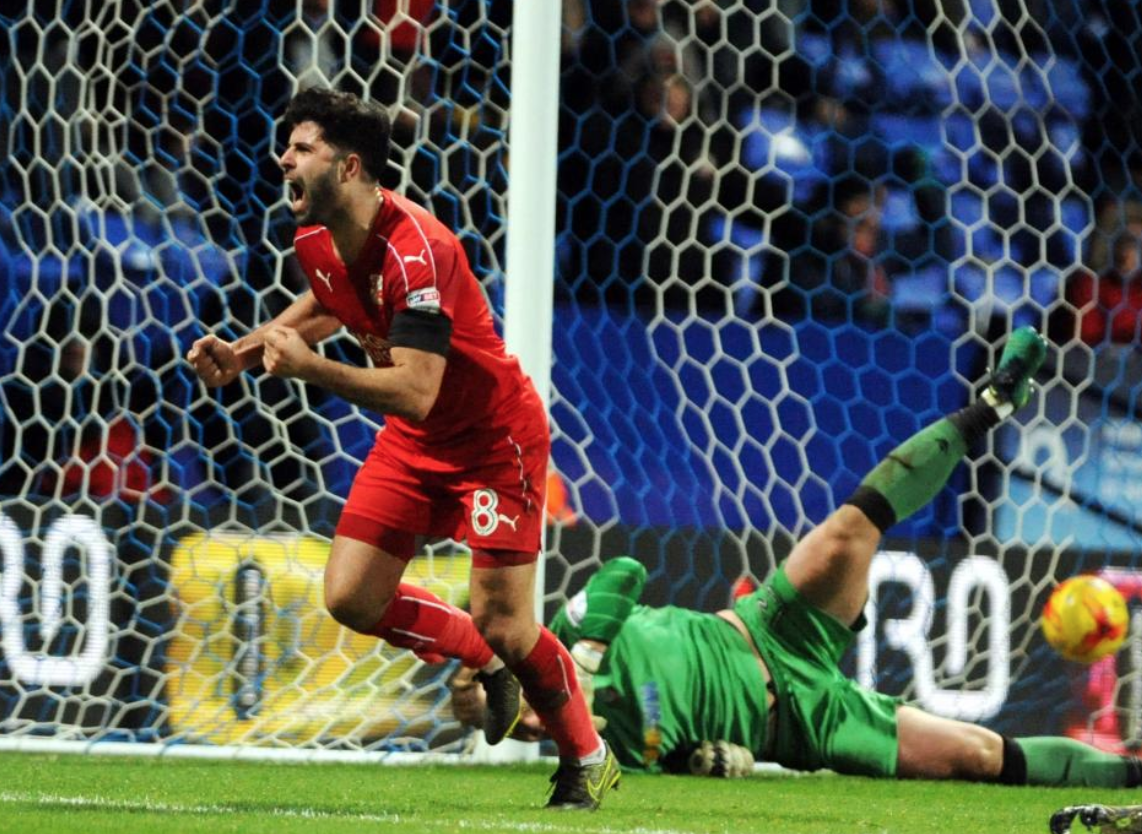
Bent went on to score 24 league goals for the Black Cats in his debut season at the club – and you can only imagine how delighted he was (pictured below) to net two in a 3-1 win over Spurs at the Stadium of Light!

The first came after just 34 seconds of the game on 3 April 2010, and a 29th-minute penalty gave him his 23rd goal of the season, although incredibly Bent also saw two other penalties saved by Spurs ‘keeper Heurelho Gomes. He had also missed a penalty in the reverse fixture at White Hart Lane the previous November, when Spurs won 2-0.

He obviously wasn’t the most reliable from 12 yards: I witnessed a Bent penalty miss myself back in 2003 when he’d gone on as a sub for Ipswich against Brighton at Portman Road. With the score at 1-1, Richard Carpenter’s foul on Chris Makin gave Bent the chance to restore the home side’s advantage from the spot. But he blasted the ball over without goalkeeper Dave Beasant needing to make a save. Tony Rougier then put Albion ahead but a Martin Reuser thunderbolt evened it up.

Bent’s 18-month stay with Steve Bruce’s Sunderland proved to be his most prolific goalscoring spell in football, netting 38 goals in just 52 appearances.

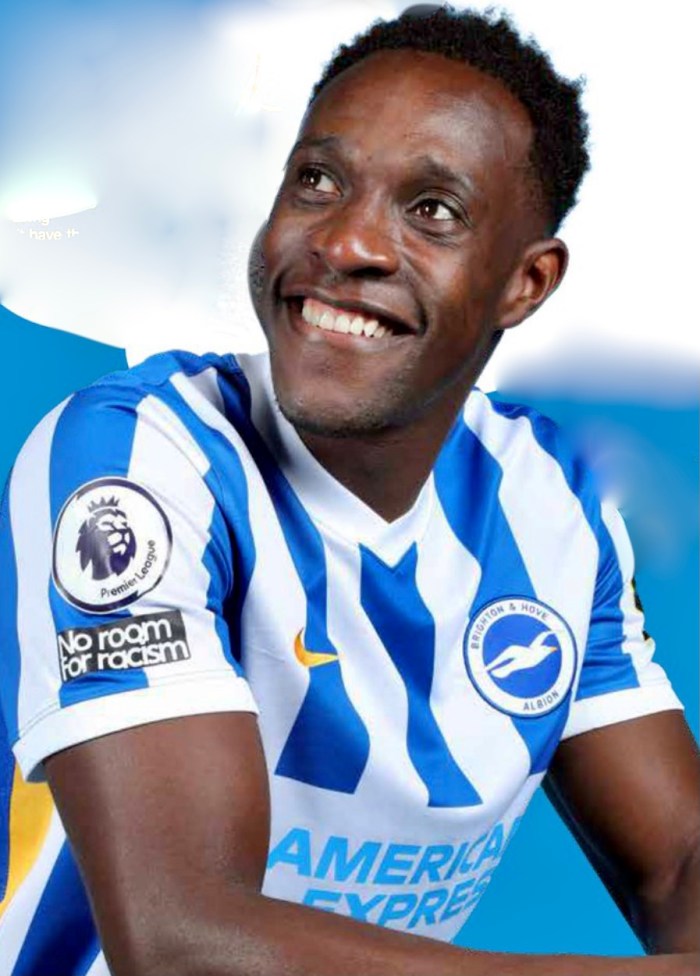
In the first half of the 2010-11 season, his partner up front was young Manchester United loanee Danny Welbeck, but in the January 2011 transfer window Bent was on the move again, this time to Villa.

Once again, he got off to a great start for a new club, marking his debut with the only goal of the game in a win over Manchester City. It was the first of nine goals in 16 league appearances which put him joint top scorer with Ashley Young, even though he’d only arrived at the club in January.

After health issues forced Houllier to step down as Villa boss, Alex McLeish took over for what was a tumultuous and under-performing season when relegation was only avoided by two points, although Bent was top scorer with 10.

McLeish’s successor Lambert not only took the captaincy off Bent, he also froze him out, only selecting him for 13 Premier League appearances. If he thought it was difficult enough to have three different managers in three seasons at Villa, when he spent the whole of the 2013-14 season on loan to Fulham, they had three different managers in one season!

Bent’s old Spurs boss Jol was in charge as the campaign got under way but, with only two wins in 14, he was replaced by former Man Utd no.2 René Meulensteen in December before Felix Magath took over in February. All the upheaval saw Fulham relegated with a team that included David Stockdale, Steve Sidwell, Aaron Hughes and Dan Burn. Bent scored six in 14 starts + 15 sub appearances.

If Bent was used to managerial change at club level, it wasn’t much better with the England national team: he played under three different managers in five years!

He had previously earned selection for his country at under 15, 16, 19 and 21 levels – he scored nine in 14 matches for the under-21s – and he was first called up to the full squad by Sven-Goran Eriksson shortly after he’d made the move from Ipswich to Charlton, although he didn’t play in a 4-1 defeat to Denmark.

“Making my Premiership debut for a new club, scoring my first brace in the Premiership and then to get the England call-up on the back of that was just a dream come true,” he told the FA website.

It was another six months before he made his full England debut, in a 2-1 win over Uruguay but he didn’t do enough to stake a claim for a place in the World Cup squad.

His next cap came as an 80th minute substitute for Joe Cole in the 3-2 defeat to Croatia in November 2007 that cost Steve McLaren his job when England failed to qualify for the Euro 2008 tournament.

By the time he made his second start for England, on 14 November 2009, Fabio Capello was in charge. England lost 1-0 in a friendly to Brazil in Qatar when Bent’s teammates included Matthew Upson, Wayne Bridge and James Milner.

“Bent was struggling to make an impact as he attempted to convince Capello of his worth, not helped by a lack of service that rendered his task almost impossible,” reported the BBC’s Phil McNulty. “He had one opportunity, but could not direct a header on target from Milner’s cross.”

He didn’t make the cut for the 2010 World Cup squad but in September was back in the fold and scored his first England goal after going on as a 70th minute sub for Jermain Defoe as England beat Switzerland 3-1 in Basle.

By now at Villa, it was the first of three goals in three games (he also netted against Denmark and Wales) after which he told the Birmingham Mail: “I’d love to be No 9 for as long as possible, there are a lot of top strikers about but Fabio keeps picking me and hopefully I can keep producing the goods.

“Even when the goals weren’t going in, I always believed I was good enough to score at this level and hopefully it’s showing now. I’m finally getting my chance and getting a good run in the side. I’m delighted with it.

“It has been years since my first chance and it’s certainly been a long, long wait but it’s finally come.”

He started the 2-2 Euro 2012 qualifier with Montenegro in October 2011 and the following month was in the side that beat World Cup holders Spain 1-0 at Wembley; it was his header from Milner’s cross that rebounded off a post for Frank Lampard to nod in.

Three days later, he played what turned out to be his – and Capello’s – last game for England as a 70th minute sub for Bobby Zamora when England beat Sweden 1-0 at Wembley.

Yet another man was at the helm when it came to selection for the Euro 2012 tournament and Roy Hodgson didn’t reckon Bent had recovered sufficiently from an injury to merit inclusion.

For all the highs and lows of a lengthy playing career, nothing came close to what he suffered in front of a nation of TV quiz viewers: he scored only three points over two rounds of Celebrity Mastermind and admitted to talkSPORT listeners: “Honestly? It was probably the worst experience of my life!”

He explained: “As a footballer you get nervous before games, when you take a penalty in front of thousands of people, when you join a new club, but when you’re sitting in that chair opposite John Humphrys, it’s pitch black in there and all you can see is him, his eyes looking at you and he’s asking you questions and you just go blank.”

Loanee João Teixeira lit up a gloomy Championship season

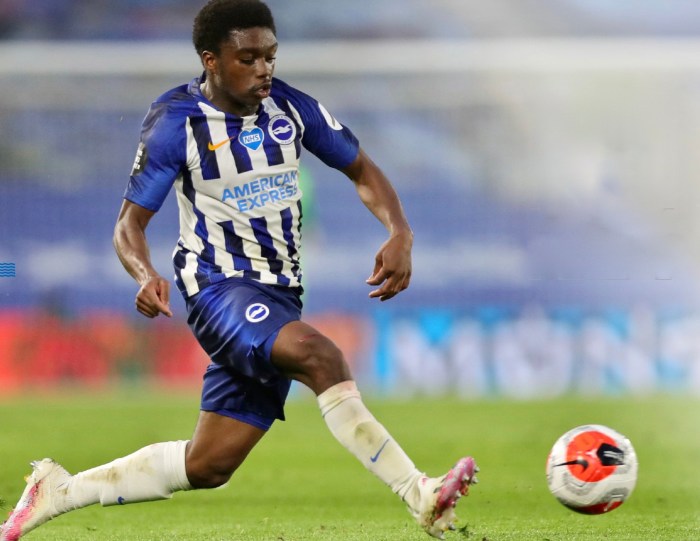
BRIGHTON provided a handy platform on which João Teixeira could parade his undoubted talent but he was unable subsequently to nail down a regular starting spot with parent club Liverpool.

The young Portuguese midfielder impressed sufficiently on loan to the Seagulls in 2014-15 to earn the club’s Young Player of the Season award.

His time at Brighton was certainly a whole lot more successful than a loan move made to League One Brentford the previous season: a six-month arrangement was cut short in October after only two substitute appearances because the Bees couldn’t guarantee him the game time Liverpool had been expecting him to get.

Brentford move didn’t go well

It was a different story with the Seagulls although it was a shame his efforts were overshadowed by the side’s struggle to stay in the Championship and it ended prematurely for him when he suffered a broken leg.

On his return to fitness back at Liverpool, he was a frequent first team benchwarmer under Jurgen Klopp but chose to move back home to Portugal to seek regular playing time.

Liverpool paid Sporting Lisbon £830,000 in the January 2012 transfer window to take Teixeira to Anfield and it was Brendan Rodgers who gave him his Reds debut on 12 February 2014 when he was sent on as a substitute for Raheem Sterling in a 3-2 win at Fulham.

Captain Steven Gerrard told the Liverpool website at the time: “I watched this kid a couple of years ago playing for Sporting Lisbon against Liverpool at Anfield in a youth game; I could see straight away he was the best player on the pitch.

“Credit to him, he has kept working hard. He has been invited to train with the first team. He is competing, he is trying to improve and learn. He listens – I’ve just been speaking to him in the dressing room and you can see he wants to learn and listen.

“He has got respect for the other players in the dressing room. This is the start for him now; I’ve just told him that he needs to push on, keep learning and building on what he has just achieved. He deserved his debut and he made a special tackle which helped us get over the line.”

As it turned out, his next senior action came in Brighton’s Championship visit to St Andrew’s six months later when he went on as a 64th minute substitute for Kazenga LuaLua in a 1-0 defeat.

Brighton’s newly-appointed head coach, Sami Hyypiä, had returned to his old club to clinch Teixeira’s signature on a season-long loan and he told the matchday programme: “My former colleagues at Liverpool have told me he is a very bright young prospect who is held in high regard at the club at all levels.

“João is an attacking player who likes to be on the ball and do his best work in the final third of the pitch. I hope he will bring that extra edge to the team and our play – and give us an extra dimension.”

No sooner said than done because when given a starting spot three days after the Birmingham defeat, he made an immediate impact by putting Brighton ahead in the fifth minute at Elland Road and Albion went on to beat Leeds 2-0, handing Hyypiä his first win.

A joyful scorer for Brighton at Elland Road

The boss told Sky Sports: “I am grateful to them for letting João come to us and get the games he needs, but it works both ways. They can benefit too because his time with us can hopefully be a stepping stone towards Liverpool’s first team.

“He is a young player and Liverpool have a very big squad. A player of his age needs to play games to improve. We have a quality player and I am very happy to have him with us.”

The instant impact earned Teixeira the fans vote for performance of the month which gave the player the chance to take a 48-hour demonstration drive in a Porsche.

The Portuguese youngster was on the scoresheet again on his home debut for Brighton, netting the winner against Bolton in the 64th minute after Craig Mackail-Smith had cancelled out the visitors’ lead shortly before half-time.

Teixeira seized on a pass from debut-making left-back Joe Bennett to score through the legs of goalkeeper Andy Lonergan, on as a sub for Adam Bogdan, who’d been injured in a collision with Mackail-Smith.

If it looked like a corner had been turned after the season had begun with two defeats, sadly the opposite was the case and Albion went on an 11-game winless run with the players at Hyypia’s disposal seemingly baffled by how he wanted them to play.

After he and the club parted ways, and Chris Hughton begun the task of ensuring the Albion didn’t lose their Championship status, Teixeira got back on the goal trail.

He twice scored braces (in a 3-2 home win over Ipswich on 21 January and a 4-3 home win over Birmingham on 21 February).

It said it all about Albion’s close shave with relegation that his six goals in 35 games (28 starts + seven as sub) for the Seagulls made him second top scorer behind centre back Lewis Dunk’s seven that season.

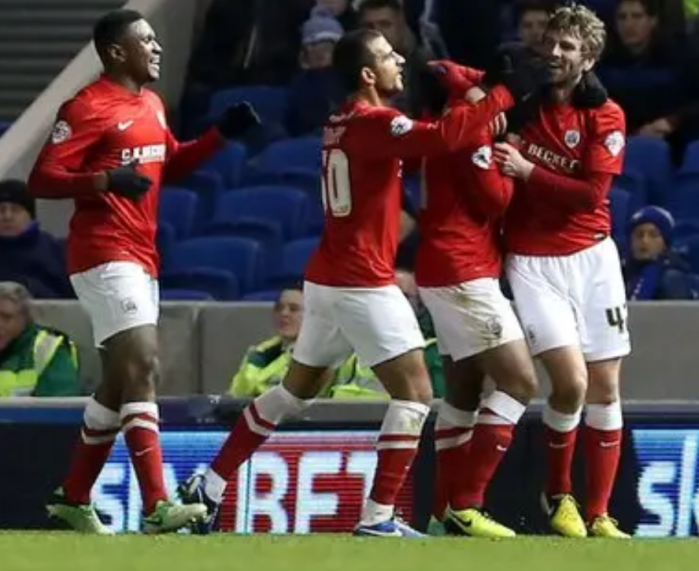
Sadly, a leg break in a home game against Huddersfield Town on 14 April brought his season, and Albion career, to a premature end. Teixeira was stretchered off after a challenge by Nahki Wells that resulted in a fracture just above the ankle.

“This is a real blow to him after such a good season for the club – and we all wish him a speedy recovery and return to action,” said Hughton.

“He’s been an important player for the club this season, both before and after I came to the club, and I would like to thank him for his efforts during his time on loan here, and also Liverpool for allowing him to come.”

The player had talked of his dream to return to Liverpool and to break into the first-team.

“I came to Brighton to become more mature and get more experience, and hopefully next year I will be playing for Liverpool. That is my dream,” he told The Guardian.

He was included in the 30-man squad that went on a four-game pre-season tour in Asia and after Rodgers was sacked he was named as a non-playing sub in the 18-man squad for Klopp’s first game in charge in October 2015 (a 0-0 draw at Tottenham, when James Milner and Adam Lallana were starters).

He did start a League Cup game against Bournemouth, which was won 1-0, and he went on to make five cup appearances for Liverpool in 2015-16. He appeared only once as a sub in the Premier League and scored his only goal for the club in a 3-0 FA Cup third round win over Exeter City.

Klopp liked Teixeira

“I like João. As a person, as a footballer,” Klopp said after that game. “But of course, players like him need matches, and if you can’t get it then you have to leave.”

And that’s what he did. Although he was offered a new contract by the Reds, at the age of 23 he chose to move back to Portugal in search of regular first team football and signed for his boyhood team, Porto.

“I am from the north [of Portugal] and to wear blue and white has always been a dream for me,” he said.

“Now I can work at my club in my region and my country. I had other offers but do not want anything other than to wear blue and white.”

Born in Braga, Portugal, on 18 January 1993, Teixeira first caught the eye with his hometown club, before being snapped up by Sporting Lisbon where he continued to make progress through its youth teams. He also represented Portugal from under-16 through to under-21 level.

It was while playing for Sporting in the NextGen Series, the under-19 tournament for academy teams of Europe’s top clubs, that he played against Liverpool and caught the eye of Liverpool’s academy director, Frank McParland.

On arrival at Anfield, he was part of the under-21 set up and made 20 appearances in the inaugural Barclays Under-21 Premier League.

“I was 18, it’s hard to say no to Liverpool, it was a unique opportunity. I went and I don’t regret it,” Teixeira reflected in an interview with Portuguese sports newspaper A Bola.

“I had wonderful experiences, I played with great players, things were happening. I don’t regret going. I still played eight games, seven of them under Klopp.”

But the return home in 2016 didn’t work out for him, and after making only eight appearances for Porto during the 2016-17 season, Teixeira returned to his first club, Braga, on a season-long loan.

It was something of a surprise when in July 2018 he joined Braga’s local rivals Vitoria Guimaraes on a three-year deal, scoring 10 times in 53 appearances across two seasons.

In September 2020, he signed a two-year contract with Eredivisie Feyenoord, telling the club’s in-house channel: “I’m very happy to be here. It’s a beautiful chance for me and I’m very excited to start training and helping the team.

“Why Feyenoord? It’s a great club with a great history. I spoke with a few people in Portugal that played here and they told me the same thing: they have the greatest fans in Holland, and I’m happy to join.”

Describing himself, Teixeira said: “I’m an attacking midfielder. I like to score, I like to assist and that’s what I’ll try to do. But the main thing is to help the team.”

That help tended to be mainly from the bench, and suffering a broken foot didn’t help either, so in the second half of the 2021-22 season he returned to Portugal again to play for FC Famalicão.

When Liverpool discovered in the spring of 2024 that Feyenoord boss Arne Slot would be taking over from Klopp, Teixeira was interviewed by Reds’ fans channel The Redmen TV about what they might expect from the incoming head coach.

By then, Teixeira had already made two other moves: in June 2022, he’d moved to Qatar to play for Umm Salal where he scored five goals in 22 appearances. And 10 months later he switched to Chinese Super League side Shanghai Shenhua. The player posts his achievements at the club to 197,000 followers on Instagram.

A hit on Instagram

The Doog signed Brighton-bred Tiger for top tier Wolves

Tony Towner on the wing for Brighton at the Goldstone Ground

TONY TOWNER finally got to play in the equivalent of the Premier League only for it to end in disappointment.

Just over ten years after Towner burst onto the football scene with hometown club Brighton, with his old club going in the other direction, he pulled on the old gold of newly-promoted Wolverhampton Wanderers.

It was at the start of the 1983-84 season, with Liverpool at home first up, while relegated Albion faced Oldham away as they reverted to second tier football after four years at the top.

In those days, the competition was known as the Canon League First Division – and it went off in the wrong direction as far as Wolves were concerned, failing to win in their first 14 league matches although that opener ended in a 1-1 draw against the Reds, when Towner joined the action as a sub in the 69th minute.

My previous blog post about Towner in 2017 focused on his early days at Brighton and his subsequently achieving cult hero status at Rotherham United. He had experienced promotions and relegations with both clubs, playing in the second and third tiers.

He had moved on (to Millwall) from Brighton before they reached the elite level for the first time so linking up with Wolves finally gave him the top tier platform that had previously eluded him, signing for a side who’d bounced straight back to the top after relegation in 1982.

The history books record that Towner wasn’t even signed by manager Graham Hawkins, who was on holiday when former Wolves legend Derek Dougan sealed the winger’s £80,000 move from Rotherham in the summer of 1983.

Wolves legend Derek Dougan

While a pundit for Yorkshire TV, Dougan had seen plenty of Towner playing for the Millers and, as chairman and chief executive of Wolves, he reckoned he could do a job at Molineux.

“They needed to add more players, they needed to strengthen, which is always the case for any team getting promoted to the top league,” Towner recalled in a 2021 interview with the Express & Star.

“In the end, I was the only one who came in through the door. I did feel a bit of pressure because of that but I was just concentrating on doing everything I could to be a success.”

Wolves’ finances at the time were not at all healthy and Hawkins’ assistant Jim Barron told wolvesheroes.com: “We started to discover that signing players was going to be difficult. I was on holiday when Graham rang me to say that The Doog had signed Tony Towner – a lovely lad but certainly not one we would have considered to be high-priority.”

Wolves winger Towner tussles for the ball with Tottenham’s Chris Hughton

As it turned out, he made 29 league and cup starts plus six appearances off the bench. He scored just the two goals: in a 3-2 defeat at Sunderland on 7 September 1983 (Gary Rowell was among the Mackem scorers) and with a long range header past Chris Woods in Wolves’ New Year’s Eve 2-0 win over Norwich City.

Sadly, that was one of only six wins all season and in what became a disastrous campaign they were relegated in last place. Hawkins left in February 1984 and Barron was in caretaker charge as they went down.

The fan website alwayswolves.co.uk said: “Towner was a one-season wonder, whom we wondered what all the fuss was about, despite his previous good form at the likes of Brighton and Rotherham.”

Nevertheless, the player himself revelled in the experience, telling Paul Berry in that 2021 interview: “We had some good players in the squad, but we just never got going that year. Every day you could sense around the place that something just wasn’t right.

“We were getting beat game after game, and I mean game after game, and it got so demoralising in the end.

“We were up against it and just weren’t able to bring in the sort of players they needed to strengthen, the money just wasn’t there.

“A lot of it was trying to gamble on younger players, and even though it was my first season at that level, at 28 I was one of the more experienced. In the end, we had a shocking year.”

While it was mostly doom and gloom that season, Wolves did pull off a shock 1-0 win at Anfield on 14 January 1984, which gave Towner a happy memory to look back on.

Against a Liverpool side that included Mark Lawrenson and Michael Robinson in their line-up,

John Humphrey was making his 100th League appearance for the bottom-of-the-league visitors and Steve Mardenborough scored his first goal for Wolves in only the 10th minute.

“After that, I’m not sure we even got out of our penalty area,” said Towner. “What a day that was. They hit the post I don’t know how many times but, somehow, we held on and won the game.

“To play at Liverpool is special enough, and you don’t get many chances to do that, but to win as well, that is something I will never forget even if I didn’t touch the ball that often!”

Even though Wanderers went down (with Notts County and Birmingham) fully 21 points behind 19th-placed Coventry City, Towner reflected: “I loved being associated with Wolves, even though it was such a difficult season.

“It was my only experience of the top division, and even though I was in and out of the side, it was a fantastic one and something I enjoyed.

“Life’s too short to worry too much and think about the ‘if onlys’ – of course we needed more wins and who knows if I could have stayed there longer but it just wasn’t to be.

“I still feel it was a real achievement for me to get there and to play for Wolves and I loved it.”

While not all Wolves fans liked what they saw in Towner, interviewer Berry was one who did appreciate his attributes.

“Towner was one of those exciting wingers, direct, able to employ a trick or two to get past defenders or relying on his genuine pace,” he wrote.

“Wolves fans have always loved their wingers, those with the capabilities to beat opponents, get fans off their seats, and while it was a step-up for Towner at a time when Wolves were struggling, he still had chances to show what he could do.

“As a young whippersnapper, I remember sitting on the wall of the Family Enclosure near the South Bank, gradually wrecking my nice white trainers in the pitchside RedGra, and loving watching Towner – bedecked in Tatung pin-striped shirt, shorts and those magnificent hooped socks – picking the ball up on the halfway line and then running at the opposing full back.”

Towner at the Amex supporting his hometown club

Mullery’s deputy Ken Craggs had a keen eye for football talent

ONCE A PROMISING Newcastle United youth team footballer, Ken Craggs didn’t make it as a player but went on to serve Albion as a ‘backroom boy’.

Indeed, he had three separate spells with the club, the first being the most prominent. Having joined the Albion in 1978, Craggs was at Alan Mullery’s side as assistant manager when Brighton first climbed to the top of English football.

In partnership with Alan Mullery

He later worked as a scout for Jimmy Melia, who himself had been a scout for the Albion under Mullery.

And Brian Horton, the captain who led the Seagulls all the way from the Third Division to the First, appointed Craggs as a scout when he managed the Albion between 1998 and 1999.

Craggs had also worked for Horton when he was the manager at Manchester City, Huddersfield Town and Hull City.

Horton viewed Craggs as a mentor and kept in touch with him long after their footballing days were over.

When Craggs died aged 85 in July 2021, Horton told Brian Owen of The Argus: “Ken knew an awful lot of people in the game. We got on great. He was just fun to be around.”

In a team line-up

Referring to how Mullery and Craggs worked together, he said: “Mullers was a hard task master, which I enjoyed. I like people who demand more. Ken was his back stop.

“He would be the buffer between manager and players. They would work in tandem and they were good for each other.”

It was chairman Mike Bamber’s instruction for Mullery to sack Craggs, Melia and coach George Aitken as a cost-cutting measure that prompted the ebullient ex-Spurs and Fulham captain to quit the club in 1981.

“He even wanted to get rid of the kit-man Glen Wilson, who had been at Brighton for years,” Mullery wrote in his autobiography. “The club meant the world to him. I couldn’t have lived with myself if I’d fired these people.”

Mullery swapped managerial chairs with Mike Bailey and moved to newly-promoted Charlton Athletic and Craggs went with him. When Mullery left the club after a year, his assistant took over the Second Division side.

Craggs was in the job for six months and the club history books record how he was the manager when the Addicks pulled off something of a coup in October 1982 by signing former European footballer of the year and Danish international Allan Simonsen from Barcelona for £324,000 after he had been forced out by the signing of Diego Maradona. It had been thought Simonsen would either go to Tottenham or Real Madrid but he revealed publicly that he wanted to play for a club at a less stressful level.

With only five wins in 16 league matches, Craggs’ last game in charge at The Valley saw Rotherham United wallop the home side 5-1 with ex-Brighton winger Tony Towner proving a handful on the right and scoring one of the goals and Ronnie Moore hitting a hat-trick.

Craggs was born on 10 April 1936 in Quarrington Hill, a small mining community in County Durham, close to Cassop Colliery, where his father worked and he expected to follow him.

But he was noticed playing for the local village school football team and he was selected to play inside forward for the Durham Schools representative side. That got him noticed by Newcastle United.

He joined them as an amateur and played in the club’s youth team, although it wasn’t uncommon for him to play two games in a day, turning out for United and then his local youth club side as well.

Young Craggs was invited to have a trial for the England Youth team and it was during one of these sessions that he was spotted by Fulham scout Bill Rochford.

At the tender age of 17, he seized the chance to leave home and head for the bright lights of London and a career as a professional at Fulham.

Craggs shared digs with Bobby Robson, another miner’s son from Durham who had joined Fulham.

“Ken never won a first team place, but he was a powerful centre-half for the reserves,” Mullery remembered.

Craggs spent seven years on the playing staff without breaking into the first team.

He dropped into non-league football, initially with King’s Lynn in the summer of 1960 and later played for Folkestone, Tunbridge Wells United, Dartford and Hounslow, where he was the player-coach.

He then returned to Fulham in September 1968 as a part-time youth team coach and scout under Robson. He found and developed the likes of Brian Greenaway, Les Strong, Tony Mahoney, Terry Bullivant and goalkeeper Perry Digweed, who later moved to Brighton for £150,000.

He eventually joined Fulham in a full-time coaching capacity and Robert Wilson, who went on to make 256 appearances for the Cottagers, recalled: “I joined Fulham as a 16-year-old in 1977, when Ken Craggs was in charge of the youth side and from there the likes of Tony Gale, Dean Coney, Paul Parker, Jeff Hopkins, Jim Stannard, Peter Scott, John Marshall and many others all progressed to the league team.”

Team line-ups of that time show Craggs pictured alongside Barry Lloyd and Teddy Maybank, who later followed Craggs to the Goldstone for a fee of £238,000.

Another striker who caught Craggs’ eye when he was a coach at Fulham was Malcolm Poskett. After Craggs moved to Brighton, the player’s goalscoring form at Hartlepool eventually led to a transfer to the Goldstone, the £60,000 fee representing a tidy profit for the struggling north east minnows.

Clothes modelling with Gary Stevens and Mark Lawrenson

Others who benefited from his acumen included Gary Stevens, who was released by the aforementioned Robson when he was manager at Ipswich Town, but picked up by Brighton.

Stevens said: “Ken played a huge part in many of our careers. He was the main reason I came to Brighton as a 16-year-old and I will always be grateful for his contribution.”

Giles Stille was a part-time player at Kingstonian when Craggs spotted him and after turning pro he made his top flight debut against Manchester City in December 1979 when going on as a sub for Horton in Albion’s 4-1 win. Unfortunately, his time at Brighton was beset by injuries and illness and he was forced to retire prematurely when only 26.

The Albion was quite a different club when Craggs returned for a third spell in 1998, not least because the side was playing home games in exile at Gillingham. His role was to help Horton and his no.2 Jeff Wood to look for bargain signings.

For instance, Craggs and Wood unearthed Gary Hart, who signed from Stansted for £1,000 and a set of playing kit and he went on to become something of a club legend.

“Ken and Jeff knew more players from down south than me ,” said Horton. “He would have definitely gone to watch him on Jeff’s recommendation.

“We put him into a reserve game at Worthing and he only needed one game for me and that was it, we were doing the deal.”

Tigana ‘disciple’ Paul Nevin the respected analytical coach

PAUL NEVIN didn’t rise to great heights as a player but he became “one of the most respected and most widely experienced coaches in the country”.

He was a Premier League coach at Brighton and West Ham, not to mention being part of Gareth Southgate’s coaching team for England.

They were just three of a broad variety of coaching jobs he has filled in different corners of the world – and, interestingly, Jean Tigana, one of the top French footballers of his generation, influenced Nevin the most (more of which, later).

All a far cry for a lad born in Lewisham, south east London, on 23 June 1969 who had a humble playing career that began at Division Two Shrewsbury Town and later involved short spells at Carlisle United and Yeovil Town.

Nevin the player

He was a former teammate of Albion’s head of football David Weir for three years when both played for the University of Evansville’s Purple Aces team in Missouri, America.

Having taken his A-levels while playing for Shrewsbury reserves, Nevin wanted a back-up career in case football didn’t work out and he took a scholarship to gain a bachelor’s degree in communications while playing for the American college team.

After gaining his degree, he returned to the UK and spent the 1991-92 season with Fourth Division Carlisle before moving south to join then Conference side Yeovil. He was there for two years but suffered a bad back injury that forced him to retire from playing when still only 24.

Nevin picked up the story in an interview with the Albion matchday programme. “While I was playing at Yeovil, I also volunteered at a children’s home and as a result I was soon offered a job as a social worker in Wandsworth, south London.”

He later explained: “That gave me the opportunity to develop a lot of skills that transcend into coaching – counselling skills, working with young people, trying to build self-esteem and motivation – which I can take into a sporting arena.”

He kept in touch with football, though, by working part-time for Fulham’s Centre of Excellence.

It was during the period when since-disgraced Mohamed Al Fayed took over Fulham, sacked Micky Adams and appointed Ray Wilkins and Kevin Keegan.

In the shake-up, Nevin worked his way up the academy system, eventually becoming youth team coach and then reserve team manager working alongside Chris Coleman. Within a year he had become full-time and by 2000 was working under Fulham boss Tigana.

“He had a major influence on my coaching career and my philosophy towards football,” said Nevin.

“The methodology of training, his highly technical approach, working with sports scientist and nutritionists, it was all new in this country and made a big impression on me.”

Together with Christian Damiano, the pair’s methods had been nurtured at the French national academy in Clairefontaine and had a profound effect on Nevin.

“We had a core of good young players coming through the club, the likes of Liam Rosenior, Zat Knight, Sean Davies, Zesh Rehman and Mark Hudson, who all went on the have successful careers in the game.”

In 2006, by which time he already held the Uefa Pro Licence as a coach, he moved with his wife and two children to Auckland to become manager of the New Zealand Knights, who played in the Australian A League.

That lasted a year before he moved to the Middle East and spent five years as football performance manager at the Aspire Academy in Qatar working with young players and coaches.

Chris Hughton brought him back to the UK to become first team coach at Norwich City when they were in the Premier League in the 2013-14 season.

Nevin was reunited with Chris Hughton at Brighton having worked with him at Norwich.

From Carrow Road, he then worked as head of coaching for the Premier League, a role that saw him run a diploma course to develop coaches with great potential as well as acting as a sounding board for coaches working in Premier League academies.

Nevin was reunited with Hughton at Brighton just ahead of the club’s debut season in the Premier League, replacing Simon Rusk who had stepped up temporarily from being under 21 coach when Nathan Jones left to become manager of Luton Town.

Hughton said: “Paul is an excellent coach and a good appointment for the club. I’m delighted he is on board and looking forward to working with him again.”

Asked whether his lack of high level playing experience was a hindrance to working as a Premier League coach, Nevin replied: “Coaching and playing are very different things. While I might not have played Premier League football, I am a real student of the game and have worked alongside some great coaches and managers. I have developed a healthy understanding of top-level football from a coaching perspective.”

On England duty with Gareth Southgate

When Lewis Dunk made his England debut in a 3-0 friendly win over USA at Wembley in October, 2018, Nevin was part of the coaching team supporting Gareth Southgate as part of an initiative to place black, Asian and minority ethnic coaches in all England squads. Formally known as the Elite Coach Placement programme, it was a key strand of the FA’s Pursuit of Progress strategy, designed to increase diversity in coaching roles.

However, Nevin and Southgate were already known to each other. At Fulham, he was assistant academy manager to former Crystal Palace boss Alan Smith, who had managed Southgate at Selhurst. Nevin got to know Southgate through Smith.

“I was a little unsure as to what the setup would be like, but to get the opportunity to work with Gareth Southgate, Steve Holland (the assistant manager) and the rest of the senior men’s setup was something I couldn’t turn down,” Nevin told the FA’s in-house media.

“The biggest challenge I found was that, if working inside a club, you get to work with the players and other coaches on ideas each day. You start preparing for a match at the weekend at the beginning of the week, with days to get the clarity of message through.

“But on the international stage, there’s a finite amount of time to get critical information across and to develop strong harmony across the squad. It’s a challenge that makes you acutely aware that every moment during an international camp counts.”

It wasn’t the first time that Nevin had worked for the FA, though. When he was head of coaching at the Premier League, between August 2014 and April 2016, he coached England’s under-16s who at the time included Phil Foden and Jadon Sancho.

Nevin, by then 49, said: “When I got the call, I was absolutely delighted and feel it’s a very privileged position. First and foremost, I’m very thankful to Gareth and The FA for the opportunity.”

Albion happy to see Nevin develop with England

He appreciated Brighton giving him the time to do something which was a development opportunity and added: “This is a chance to work with the best players in the country. Obviously, I see them week-to-week in the Premier League but working with them en-masse in a squad setting is going to be immense.

“Having had a brief experience of working at international youth development levels, it’s a chance to see the final product that’s coming through the system while working alongside the top coaches in the country.

“Being a part of that environment at the highest level of international football and looking at how they work and function will have the biggest impact on me. I previously had a spell working in coach development at the Premier League so I’m aware of the need to give opportunities to the quality BAME coaches out there.”

Nevin parted company with the Seagulls when Hughton was relieved of his duties at the end of the 2018-19 season but he wasn’t away from football’s top table for long because in February 2020 he joined West Ham along with former Hammers captain Kevin Nolan to work with David Moyes and his assistant Alan Irvine.

In October 2022, Malik Ouzia in The Standard wrote: “Nevin is one of the most respected and most widely experienced coaches in the country, a key lieutenant under David Moyes, as well as Gareth Southgate at England.”

According to Roshane Thomas, writing for The Athletic in December 2022, Nevin’s role at West Ham was to focus on creation and delivery in attacking set-plays and analysing opponents’ set-plays.

“I’m fluent in analysis tools so I can do my own analysis, I have done that for 20-odd years,” Nevin explained in an interview with premierleague.com.

Hammering home a point

The Hammers achieved European qualification in each of Nevin’s three seasons with them and he left shortly after they won the UEFA Europa Conference League trophy. Manager Moyes said: “Paul has played an important role for us during his time here and I would like to thank him for all his support and hard work during his time at West Ham United.
“He is highly ambitious as a coach and is keen to test himself in a new environment and we wish him well in doing so.”

Nevin said: “I’ll always look back on my time and the opportunity I had to work at West Ham with great fondness.

“In the three and a half years, we enjoyed a period of great success in West Ham’s history, culminating in the Europa Conference League win last season, which gives the club a fantastic opportunity and platform to go on to even greater levels in the future.”

From West Ham, he moved to French Ligue 1 side Strasbourg, where he worked as first-team coach under Patrick Vieira, who was appointed head coach by the club’s new owners, BlueCo, who also own Chelsea. Nevin didn’t stay on when Vieira left after one season to be replaced by former Albion player Liam Rosenior.

Last minute instructions for Cole Palmer at the 2024 Euros

Nevin had rejoined the senior England men’s team coaching staff in August 2021 and was part of Southgate’s support team through to the 2024 Euros in Germany. In August 2024, he took charge of England’s Elite League Squad on an interim basis when Ben Futcher stepped up to Under-21s manager following Lee Carsley’s temporary rise to take the full England team.

When asked whether he held ambitions to become a manager in his own right, Nevin told The Standard: “I owe it to myself and the people I’ve worked with.

“If the right opportunity came at the right time, then I need to give it a go because maybe with that nudge at the door, if I’m successful, it can allow me to bring others in and give others opportunities.”

Expanding on his experience in that premierleague.com interview, he said:“I’ve worked with young people outside of football, within social work, trying to study languages as well. When I’ve worked with French players and Spanish players – and I’m not saying I’m fluent by any means – but just a little bit of connection there, those little things help.

“I’ve worked in this game around the globe as well, so it’s not like I’ve just been at domestic level. I was a manager in the Australian League, I’ve worked in Qatar with the junior national teams. It’s just getting that variety and taking opportunities when they come.

“It may not necessarily be the thing you want at that particular moment, but if it opens an opportunity to show what you can do and to learn, then I think it’s always worth grasping that.”

And on a philosophical note about the art of coaching, he said: “A coach, first and foremost, has to have the knowledge and credibility to deliver, but you’re dealing with human beings.

“A lot of people can have the knowledge, but it’s about transmitting that, making the players feel valued and being able to develop relationships which help them reach their fullest potential.

“It’s probably that aspect, really getting into the human being that drives the performance, which is my strongest.”

Nevin returned to club football in January 2025 when he was appointed as one of two assistant managers to Mark Robins at Stoke City. He stood down from his role as interim England under-20s manager, where he was undefeated in six matches, to take the job.

The Foxes hero who led Albion’s line in an hour of need

STEVE CLARIDGE became a Leicester City hero long before briefly coming to Brighton’s rescue.

He scored the winner in a play-off final at Wembley to take the Foxes up to the Premier League at the expense of Crystal Palace, who’d discarded him at an early age.

Both sides had been relegated from the top flight the year before and Claridge’s right-foot strike past Nigel Martyn in the 120th minute meant it was an immediate return for Martin O’Neill’s side.

“The high is not equal to anything,” Claridge told Leicestershire Live.

Scoring play-off winner v Palace

It came in 1996 and a year later he scored the only goal of the game (past Ben Roberts) in the 100th minute of a replay against Middlesbrough to win Leicester the League Cup, leading to him being named FourFourTwo’s ‘Cult Hero of 1997’.

Claridge had only completed a £1.2m move from Birmingham City two months before that play-off and he labelled it the most important goal of his life coming after a worrying period in which he wasn’t sure he’d ever be able to play again.

A mystery illness had ravaged his form and in only his fifth Leicester game he was taken off after 15 minutes. “Pins and needles from my knees down were so extreme, I could not even feel the ball,” he recalled.

It turned out a drug prescribed for a thyroid problem he’d had since the age of 12 was destroying his thyroid gland. “The main energy provider of my body was no longer functioning,” said Claridge.

However, once on the right medication, he made an almost unbelievable recovery, was restored to the side and helped to secure a play-off place.

After beating Stoke City in the semi-finals, they went a goal down to Palace in the final but pulled it back through a Garry Parker penalty before Claridge seized his chance in the dying moments of extra time.

Wembley winners for Leicester: Garry Parker and Steve Claridge

He collected a quick free kick from Parker and took aim, his shot from distance kissing the stanchion with goalkeeper Martyn motionless.

“The crowd is just really stunned in disbelief, I don’t know if that was because I’d hit it,” laughed Claridge. “It was so far out, and everybody was used to me scoring goals inside the six-yard box.”

He reflected: “To finish off after the lows I went through, the absolute lows where you’re thinking, ‘my career is over I can’t see a way out of this,’ to doing that and taking you to the ultimate high – winning that game of football. It’s unparalleled.”

Albion cover ‘boy’

Such experience was exactly what Championship strugglers Albion required when, on the back of three defeats, they faced the daunting prospect of promotion-seeking West Ham away on 13 November 2004.

Manager Mark McGhee, who’d previously signed Claridge when he was at Wolves and Millwall, was desperate to stem a tide which had seen eight goals conceded and no points on the board.

“He is one of the fittest players I’ve worked with and I had no doubt that after 18 months away from this level he would be able to perform,” said McGhee.

Claridge’s professional career looked to have run its course after he left Millwall in 2003 and became player-manager of Southern League side Weymouth.

But the disappointment of missing out on promotion had seen him and chairman Ian Ridley leave the club and Claridge, at the age of 38, was keen to give league football another go.

In what turned out to be a real backs-to-the-wall smash and grab raid, Albion earned the unlikeliest of 1-0 wins courtesy of a Guy Butters header from Richard Carpenter’s free kick.

Albion held firm despite a relentless wave of attacks by the home side and afterwards McGhee said: “We approached the game differently. Whereas before we thought we could win, today we did not, and played to make sure we didn’t get beaten.

“We kept the ball up front more which is important. Steve Claridge was key to that.”

Unfortunately, Brighton were not able to build on the win at the Boleyn Ground and there was only one more win (1-0 at home to Rotherham) during Claridge’s month with the club.

His fifth and final game for the Seagulls came away to his old club Millwall on 11 December 2004, when Albion lost 2-0.

In a programme feature about him that day, Claridge likened the circumstances of both clubs. “The club has no money and it is tough just to survive, but everyone is in it together,” he said. “At Millwall we had a great team spirit and togetherness, and that is very much the case here.”

McGhee’s tight budget prevented Claridge’s stay at Albion being extended and, after his deal was over, rather than it being one last hurrah, he went on to continue his league playing days at Brentford, Wycombe Wanderers, Gillingham, Bradford City and Walsall.

And, at the age of 40, and with him needing just one more game to fulfil the landmark of 1,000 professional games, his old club Bournemouth – where he’d started out as a professional in 1984 – gave him a match against Port Vale on 9 December 2006. No fairy tale, though, as they lost 4-0.

Born in Portsmouth on 10 April 1966, Claridge was brought up in Titchfield and began his football career at nearby Fareham Town in 1983. His initial foray into the pro game at Bournemouth only amounted to seven games before he moved to Weymouth for three years.

Crystal Palace offered him a route back to the full professional game in 1988 but he didn’t make their league side and after three months moved on to fourth tier Aldershot Town.

Two spells with Cambridge United followed between 1990 and 1994 for whom he scored 46 goals in 132 games. A falling out with manager John Beck saw him sold to Luton Town in 1992, but he was then bought back after Beck’s departure.

Birmingham City paid £350,000 to take Claridge to St Andrews and he became one of the club’s most prolific goalscorers, netting 35 in 88 games, and was top scorer with 25 goals when part of Barry Fry’s Blues side that won the Second Division title and the Auto Windscreens Shield (Football League Trophy) in the 1994-95 season.

After spending two years at Leicester, he went on a two-month loan to his hometown club, Portsmouth, but, in March 1998, McGhee signed him for the first time – and it didn’t go well.

The Scot, who had controversially left Leicester to take over at Wolves, took Claridge to Molineux for a £350,000 fee. But Wolves fans were not impressed, as Levelle revealed in this 2012 piece, and after just six games and no goals in the famous old gold shirt, he was sold to Portsmouth for £250,000 at the end of the season.

Even more galling for Wolves followers was that no sooner had Claridge made the switch to Portsmouth, he scored all three in a 3-1 win at Fratton Park!

David Miller in The Telegraph wrote: “The 34-year-old Steve Claridge, who had failed to score in five months when previously with Wolves, now gave sun-blessed Portsmouth a bank holiday funfair with a first- half hat-trick that was as easy as licking an ice-lolly.”

On the ball for Pompey

The goals and games came thick and fast for Claridge back on home turf – 34 in 104 – but his reign as player-manager at Fratton Park in 2000 was curtailed after just 25 games by the quirky chairman Milan Mandarić.

Remembering the player he’d seen only briefly a couple of years earlier, McGhee, by now in charge at Millwall, offered the striker a lifeline with the Lions, initially on loan and then as a permanent signing.

Going through the pain barrier at Millwall

Over two seasons in south east London, he became something of a fans’ favourite, scoring 26 in 85 matches, his efforts summed up by writer Mark Litchfield. “His style was unconventional, to say the least: shirt untucked, one sock down and no shin pads, any naïve defender probably thought they could eat him for breakfast. But hard work was a pre-requisite for Claridge – he wouldn’t give any opposition player a moment’s rest and would more often than not always get the better of them, too.”

Claridge had a less happy association with Millwall too when in July 2005 he was sacked after just 36 days as manager when the chairman who appointed him, Jeff Burnidge, was replaced by  Theo Paphitis, who wanted Colin Lee instead.

Even after achieving the 1,000-game landmark courtesy of Bournemouth, Claridge couldn’t resist the lure of another game, turning out for Worthing, Harrow Borough, Weymouth and Gosport Borough.

He was one of a group of five that formed Salisbury FC at the end of 2014, and as team manager was involved in gaining two promotions in the Southern League before leaving in October 2022.

Although he had officially hung up his boots in 2012 after helping Gosport to promotion to the Southern League Premier Division, in 2017 he played in a friendly defeat to Portsmouth in July and then put himself on against Paulton Rovers in the league a few weeks later.

His final ever game as a player came in a 3-2 victory over Fareham Town, when he was a remarkable 51, but he had to go off in the 71st-minute after picking up an injury. 

Pundit Claridge contributed his thoughts on radio and TV

Claridge also became a familiar face and voice working as a pundit for the BBC on TV at Football Focus and Final Score and on BBC Radio 5 Live. He also wrote scouting reports on promising players for The Guardian, numbering future Brighton signing Matt Sparrow among them.

“He is easy on the eye, links well with his forwards but also protects and helps his defenders by tackling from the wrong side and makes sure he tracks his runner whenever he threatens to get goal-side,” wrote Claridge of the then Scunthorpe United player in 2007.

Claridge later set up his own coaching scheme for youngsters in Salisbury and Warsash.

In 2023, he took over as manager of Gosport-based Wessex League Division One side Fleetlands FC for the 2023-24 season. In August 2024 they announced he was stepping down from the role “due to personal reasons”.  
On its website, a statement added: “The club would like to place on record our huge thanks to Steve for taking up the role in our hour of need and taking us to a fantastic 5th place finish last season.”

Coppell’s Palace signing Humphrey knew all about ups and downs

FULL-BACK John Humphrey signed for Crystal Palace in lieu of rent his previous club, newly-relegated Charlton Athletic, owed for playing home matches at Selhurst Park!

Humphrey was 29 and with more than 350 senior appearances behind him when Steve Coppell added him to an experienced defence to play alongside Eric Young and Andy Thorn in the old First Division.

It was a level Humphrey was well used to having started out there with Wolves (where he played in the same side as Tony Towner) and at Charlton in a defence that included  Colin Pates.

All that came before Humphrey came to Albion’s rescue in the dark days of the 1996-97 season, as I recounted in my 2020 blog post about him.

This time I’m highlighting his time at Selhurst Park, which he spoke about at length in a January 2023 interview with cpfc.co.uk.

“I saw myself as one of the senior players,” Humphrey remembered. “We had the likes of Richard Shaw coming through and Gareth [Southgate] coming through and we signed people like Chris Coleman and Chris Armstrong. Alongside that we had some experience with Eric Young and [Andy] Thorny, so I hoped I fitted in to part of the jigsaw.

“[The challenge] for me was getting used to the style of play, because at that time I know Stevie was not so much direct but he wanted to get the ball forward as early as possible because of the threat of [Ian] Wright and [Mark] Bright. So, it took me a while to get used to that.

“I do remember after a few games Stevie dropped me for a game to say: ‘This is what I want you to do.’ Then he put me back in… I was part of his restructuring and in that first year it worked out very well.”

So much so that at the end of his first year at the club Palace reached third – their highest league finish in history – and won the Zenith Data Systems trophy (otherwise known as the Full Members’ Cup) at Wembley, beating Everton 4-1.

Humphrey was still playing in the Premier League at the age of 34 and clocked up 203 appearances for the Eagles before briefly returning to Charlton for the 1995-96 season, moving on to Gillingham and then helping out his old Charlton teammate Steve Gritt in Brighton’s hour of need.

Revered at Charlton, chicagoaddick.com wrote of him: “In the five seasons he patrolled our right side of defence he missed only one league game and faced the best wingers and strikers playing in the country at that time: Barnes, Waddle, Le Tissier, Lineker, Rush, Aldridge, Beardsley, Fashanu.

“Maybe it was because we stood in the decrepit Arthur Wait Stand but Humphrey was fantastic to watch up close. Graceful, but strong in the tackle. He was a quick-thinker and a quick mover. He would glide down the right wing and put in some peaches of a cross.”

Humphrey won three consecutive player of the year awards (1988, 1989, 1990) – an honour no other Charlton player has received.

Humphrey in action for the Albion at Gillingham

By the time he arrived at Brighton, he was 36 and had played close on 650 professional matches.

“Steve wanted me because I was experienced, could get the players organised and was able to talk them through matches,” Humphrey told the Argus in a January 2002 interview. “He knew I was steady, reliable and dependable, that nine games out of ten I’d play pretty well and that I would give 100 per cent.

“It was a lot of pressure but I’d been through a few promotions (three) and relegations (six) with Wolves, Charlton and Crystal Palace.” He continued: “The stressful situations I had gone through with those other clubs had given me experience of how to try and keep a season alive.

“I could do a job for Brighton and I felt I did that and the team turned out to be good enough to hang on. It was one of the biggest achievements of my career.”

He added: “It might have been going out of the frying pan of Gillingham into the fire at Albion but I’m glad I made the jump.”

Humphrey looked back fondly on those difficult times and told the newspaper: “They have great fans and the Goldstone was always packed for the home games.

“You couldn’t help but be lifted by the crowd. The team couldn’t win away, but managed to win at home. So, one win every two games was decent and led to that eventful day at Hereford.”

When he left the Albion as part of a cost-saving measure the following season, he turned semi-pro and played initially for Chesham in the Ryman League premier division, then Carshalton, Dulwich Hamlet and Walton and Hersham.

“Having come from the professional ranks to semi-pro it was difficult to adjust to the different standards like some of the attitudes of players to training for instance,” Humphrey said. “Also, I found the training itself wasn’t that enjoyable.

“I remember at Walton and Hersham turning up for a session, but we weren’t allowed on the pitch and had to do a road run. That was frustrating and I begun to think that maybe there were other things in life than just playing football.”

Former teammate Pates was his conduit to a new career as a teacher at Whitgift School in Croydon, where ex-Palace and Chelsea midfielder Steve Kember also joined them.

“I knew Colin from Charlton when we roomed together,” he explained. “I was aware he was at the school and he said he needed help for after-school sessions and asked me to come along.

“So I did and the football took off at the school and I got involved in other sports like rugby and basketball and got a full-time job there.”

He also retained his links with Charlton, coaching their under-15 team, and told the Argus in that 2002 piece: “I deal with privileged kids at Whitgift who may go on to be doctors, lawyers or solicitors while at Charlton the kids usually aren’t so privileged.

“To a lot of them, football is a way of making something of themselves. It gives me a great buzz when one of the Charlton youngsters makes positive progress.”

Humphrey later moved on to become head of football at Highgate School in north London.

Hero and Villain Sammy Morgan got off Albion mark v Palace

FEARLESS NORTHERN Ireland international centre forward Sammy Morgan and his former Port Vale teammate Brian Horton were bought to win promotion for the Albion.

The gamble by manager Peter Taylor didn’t quite pay off and although midfield dynamo and captain Horton went on to fulfil that promise under Alan Mullery, Morgan’s part in the club’s future success was eclipsed by the emergence of Peter Ward.

Morgan, who was in the same Northern Irish primary school year as George Best, was the first to arrive, a £35,000 signing from Aston Villa in December 1975, replacing the out-of-favour Neil Martin alongside Fred Binney. He wasn’t able to find the net in his first seven matches but when he did it was memorable and went down in the annals of Albion history.

Morgan opens his Albion account in style against Crystal Palace

He scored both goals in a 2-0 win over Crystal Palace in front of a 33,000 Goldstone Ground crowd that took Albion into second place in the table, manager Taylor saying afterwards: “I am delighted for Morgan. It must have given him a great boost to get a couple of goals like this.”

That breakthrough looked like opening the floodgates for the aggressive, angular forward who went on to score in five consecutive home games in a month.

And when Horton arrived in March 1976, with Albion still in second place and only 11 games to go, promotion looked a strong possibility.

But an Easter hiccup, losing 3-1 to rivals Millwall, followed by three 1-1 draws to end the season, saw Albion drop to fourth, three points behind the south London club, who went up behind Hereford United and Cardiff City.

Short-sighted Morgan – he wore contact lenses to play – might not have seen it coming, but it was something of a watershed moment for him too.

The man who signed him decided to quit, saying: “I signed two players gambling on them to win us promotion. We didn’t get it, and the only consolation I have in leaving is I feel I have helped build a good team which is capable of going up next time.”

Before he managed to kick a ball in anger under new boss Mullery, Morgan suffered a fractured cheekbone in a collision with Paul Futcher in a pre-season friendly with Luton in August 1976. The injury sidelined him for months.

Morgan shares a training ground joke with Peter Ward

By the time he was fit to resume towards the end of November, young Ward and midfielder-turned-striker Ian Mellor had formed such an effective goalscoring partnership that Morgan could only look on from the substitute’s bench where he sat on no fewer than 29 occasions.

He got on in 18 matches but only scored once, in a 2-1 home win over Chesterfield. Of his two starts that season, one was a New Year’s Day game at Swindon in which Albion were trailing 4-0 when it got abandoned on 67 minutes because of a waterlogged pitch (and he was back to the bench for the rescheduled game at the end of the season).

Nonetheless, Taylor’s promotion premonition was duly achieved at the completion of Mullery’s first season, and Ward had scored a record-setting 36 goals.

Morgan wasn’t involved in Albion’s first two games of the new season – consecutive 0-0 draws against Third Division Cambridge United, in home and away legs of the League Cup – and, by the time of the replay, he had signed for the opponents, who were managed by Ron Atkinson.

So, in a strange quirk of fate, £15,000 signing Morgan’s first match for the Us saw him relishing a bruising encounter up against former teammate Andy Rollings, although Albion prevailed 3-1.

Morgan spoke about the encounter and his long career in the game in a fascinating 2015 televised interview for 100 Years of Coconuts, a Cambridge United fans website.

Morgan’s easing out at Brighton followed a similar pattern to his experience at Aston Villa who replaced him with 19-year-old Andy Gray, a £110,000 signing from Dundee United. Morgan only made three top flight performances for Villa after a pelvic injury had restricted his involvement in Villa’s second tier promotion in 1975 to just 12 games (although he did score four goals – three in the same match, a 6-0 win over Hull City early in the season). He was injured during a 1-1 draw at Fulham in November and subsequently lost his place in the team to Keith Leonard.

Villa scorer

Morgan had been 26 when Vic Crowe signed him from Port Vale as a replacement for the legendary Andy Lochhead. The fee was an initial £22,222 in August 1973 with the promise of further instalments of £10,000 for every 10 goals up to 20. Vale’s chairman panicked when the goals tally dried up with the total on nine but Morgan eventually came good and Villa ended up paying the extra.

He made his Villa debut on 8 September 1973 as a sub for Trevor Hockey on the hour in a 2-0 home win over Oxford United, the first of five sub appearances and 25 starts that season, when he scored nine goals.

Villa writer Eric Woodward said of him: “Sammy was never a purist but he was a brave, lively, enterprising sort who put fear into opposing defences.”

He carved his name into Villa legend during a fourth round FA Cup tie against Arsenal at Highbury in January 1974 when he was both hero and villain.

Morgan put the Second Division visitors ahead with a diving header in the 11th minute but in the second half was booked and sent off for challenges on goalkeeper Bob Wilson. After his dismissal, Arsenal equalised through Ray Kennedy.

Esteemed football writer Brian Glanville reckoned: “Morgan had scored Villa’s goal and had played with fiery initiative but, alas, he crossed the line dividing virility from violence.

“He should have taken heed earlier, when booked for fouling Wilson. But a few minutes later, going in unreasonably hard and fractionally late as Wilson dived, he knocked the goalkeeper out and off he went.”

An incensed Morgan saw it differently, though, telling Ian Willars of the Birmingham Post: “Neither my booking nor the sending-off were justified. I never touched Wilson the first time and the second time I was going for the ball, not the man. It was a 50-50.

“I actually connected with the ball not Wilson. I went over to check if he was hurt and, in my opinion, he was play-acting.”
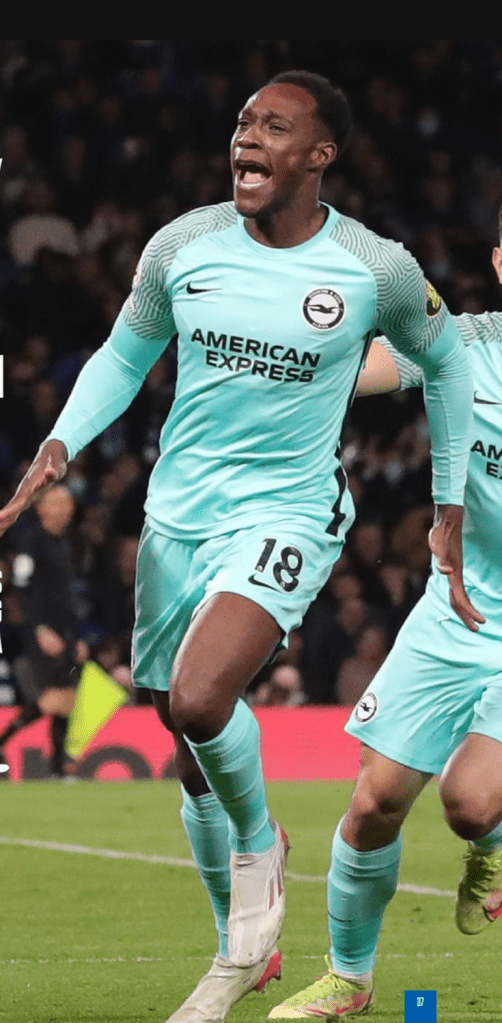
Morgan had sweet revenge four days later. No automatic ban meant he was able to play and score in the replay at Villa Park which Villa won 2-0 in front of a bumper crowd of 47,821.

Randall Northam of the Birmingham Mail wrote: “Providing the sort of material from which story books are written, the Northern Ireland international Sammy Morgan, who was sent off on Saturday, scored in the 12th minute.

“He had scored in the opening game in the 11th minute and to increase the feeling of déjà vu it was another diving header.” Fellow striker Alun Evans scored Villa’s second.

Northam added: “It was never a great match but the crowd’s enthusiasm lifted it to a level which often made it exciting and they had their reward for ignoring the torrential rain in a driving Villa performance which outclassed their First Division opponents.”

For his part, an unrepentant Morgan said: “It was obvious that we had to put Wilson under pressure as anyone would have done in the circumstances. My goal could not have happened at a better time.”

How heartening to hear in that 100 Years of Coconuts interview that when Morgan was struck down with cancer 40 years later, one of several well-wishing calls he received came from Bob Wilson.

Best and Morgan (back row, left) in the same Belfast school photo

Born in East Belfast on 3 December 1946, Morgan went to the same Nettlefield Primary School as George Best and the first year at Grosvenor High. But Morgan left Belfast as an 11-year-old with his family, settling in Gorleston, near Great Yarmouth (his mother’s birthplace).

His Irish father, a professional musician, took over the running of the Suspension Bridge tavern in Yarmouth and Morgan’s footballing ability continued to develop under the watchful eye of his teacher, the Rev Arthur Bowles, and he went on to represent Gorleston and Norfolk Schools.

Morgan went to the same technical high school in Gorleston that also spawned his great friend Dave Stringer (a former Norwich player and manager), former Arsenal centre back Peter Simpson and ex-Wolves skipper Mike Bailey, who managed Brighton in the top flight in 1981 and 1982.

Morgan’s early hopes of a professional career were dented when he had an unsuccessful trial at Ipswich Town. Alf Ramsey was manager at the time and the future England World Cup winning boss considered him too small. He also had an unsuccessful trial with Arsenal.

Morgan continued to play as an amateur with Gorleston FC and although on leaving school he initially began working as an accountant he decided to study to become a maths and PE teacher at Nottingham University. It was Gorleston manager Roger Carter who recommended him to the then Port Vale manager Gordon Lee, who was a former Aston Villa colleague.

“I loved my time under Roger and my playing days under him were the most enjoyable years of my footballing career even though I went on to play at a higher level,” said Morgan.

He was the relatively late age of 23 when, in January 1970, he had a successful trial with Vale and signed amateur forms. But by July that year he was forced to make a decision between full-time professional football or teaching. He chose football and made a scoring Football League debut against Swansea in August 1970.

However, that summer he was spotted as a future talent by Brian Clough and Peter Taylor when he played against their Derby County side in a pre-season friendly. Clough inquired about taking him on loan but he cemented his place in the Vale side and it didn’t go any further.

nifootball.blogspot.com wrote of him: “The burly centre-forward, he weighed in at up to thirteen and a half stone during his career, proved highly effective in an unadventurous Vale side.”

His strength and aggression in Third Division football caught the attention of Northern Ireland boss Terry Neill and he scored on his debut for his country in a February 1972 1-1 draw with Spain, played at Hull because of the troubles in the province, when he teamed up with old school chum Best.

Morgan remembered turning up at the team hotel, the Grand in Scarborough, and encountering a press camera posse awaiting Best’s arrival – and he didn’t show! The mercurial talent did make it in time for the game though, when another debutant was Best’s 17-year-old Manchester United teammate Sammy McIlroy, who earned the first of 88 caps.

In the home international tournament that followed, Morgan was overlooked in favour of Derek Dougan and Albion’s Willie Irvine who, having helped Brighton win promotion from Division Three (and scored what was selected as Match of the Day’s third best goal of the season against Aston Villa) earned a recall three years after his previous appearance.

In October of 1972, though, Morgan was selected again and took his cap total to seven while at Vale Park, for many years a club record.

While at Brighton, he earned two caps during the 1976 home international tournament, starting in the 3-0 defeat to Scotland and going on as a sub in a 1-0 defeat to Wales.

He earned his 18th and final cap two years later during his time at Sparta Rotterdam in a 2-1 win over Denmark in Belfast. The legendary Danny Blanchflower was briefly the Irish manager and he selected Morgan up front alongside Gerry Armstrong but he reflected that he didn’t play well, was struggling with a hamstring injury at the time, and was deservedly subbed off on the hour mark.

Morgan’s knack for helping sides win promotion had worked at Cambridge too, where he partnered Alan Biley and Tom Finney (no, not that one!) in attack, but after Atkinson left to manage West Brom, he fell out with his successor, John Docherty, and in August 1978 made the switch to Rotterdam.

After one season there, he moved on to Groningen in the Eeste Divisie (level two) and although he helped them win the title, he suffered a knee injury and called time on his professional playing days.

He returned to Norfolk to teach maths and PE in Gorleston, at Cliff Park High School and then Lynn Grove High School, and carried on playing with his first club, Gorleston, where, in 1981, he was appointed manager.

As well as coaching Great Yarmouth schoolboys, he also got involved in coaching Norwich City’s schoolboys in 1990 and in January 1998 he left teaching to work full-time as the club’s youth development manager. As the holder of a UEFA Class A licence, he went on to become the club’s first football academy director, a position he held until May 2004.

In October that year, Morgan was unveiled as Ipswich Town’s education officer, a role that involved ensuring Town’s young players received tuition on more than just football as they went through the academy system. In 2009, he became academy manager and during his three years notable youngsters who made it as professionals included strikers Connor Wickham and Jordan Rhodes.

He admitted in an interview with independent fan website TWTD: “If I’ve contributed to anybody in particular it probably would be the big number nine [Wickham] and Jordan because I was a number nine, and I kick the ball through them – I play the game through the number nines.”

He went on: “I’m very proud to have played a part in the development of a lot of young players. I’m equally proud of those lads who haven’t quite got there in the professional ranks but have maybe gone on to university and have forged other careers and are still playing football at non-league level, still enjoying their football. That means a lot to me as well.”

Morgan continued: “I finished playing in 1980 and I’ve been in youth development since then. I did the Norfolk schools, Great Yarmouth schools, representative sides and the Bobby Robson Soccer Schools. That’s 32 years, I’ve given it a fair crack and I love my football as much now as I ever did.

“I’ve been privileged to work with young people, very privileged. It’s kept me young, kept my passion and kept my enthusiasm going. One thing you could never accuse me of is not having any enthusiasm or passion for the game, and that will remain.”

In 2014, Morgan was diagnosed with stomach cancer and underwent chemo to tackle it. Through that association, in September 2017 he gave his backing to Norfolk and Suffolk Youth Football League’s choice of the oesophago-gastric cancer department at the Norfolk and Norwich University Hospital (NNUH) as its charity of the year.

Even when he could have had his feet up, he was helping to coach youngsters at independent Langley School in Norwich.

Morgan was on good form in this interview for 100 Years of Coconuts TV