A MAN-OF-THE-MATCH home debut was as good as it got when Abdul Razak joined Albion on loan from Manchester City in February 2012.
Already being mentioned as a possible successor to Yaya Toure, there were high hopes for the Ivorian 19-year-old.
He joined originally on a three-month loan with fellow City youngster Gai Assulin (pictured together below), who came on as a substitute for Razak when manager Gus Poyet gave him his debut in a goalless draw away to Hull City.
With regular midfielder Gary Dicker sidelined through injury, Poyet needed reinforcements in the middle of the park and the promising City youngster looked like he might be a great solution.
He’d already had a month’s loan at Portsmouth earlier the same season, and he was the stand-out performer when the Seagulls beat Ipswich Town 3-0 at the Amex on 25 February 2012.
Two goals from Ashley Barnes and one from Craig Mackail-Smith sealed the win, Brian Owen in the Argus, writing: “Victory extended their unbeaten league run to nine games and was largely inspired by Abdul Razak, who was superb in midfield on his home debut.”
Poyet was concerned about the level of fitness of the City pair, but after that game at Hull told the Argus: “Abdul was better than in training, because of the space, the way he attacks and the ability he has got and strength. He has been missing playing 90 minutes.
“He is stronger than he looks. He can hold the ball, do a trick, have a shot. He is good passing the ball, we just need to make him play the way we play, especially without the ball.”
When signing for the Seagulls, Razak told the official club website: “I like to pass the ball and that’s why I decided to come to Brighton.
“I had a few options, but I chose Brighton because I like the way that they play football. I have seen some of the games and the way Brighton play is different, so I have got to adapt to that. I have spoken to the manager and he is going to give me plenty of information and we will take it from there.”
Unfortunately for him, the more experienced Dicker returned from injury quicker than expected and, after just four starts and two appearances off the bench, the displaced Razak cut short his loan and returned to Manchester.
Wearebrighton.comrecently said Razak admitted some while later in a TV interview that he fell out with Poyet, prompting his early departure from the south coast.
There was a similar story when he went on loan to Charlton Athletic later the same year. He joined at the end of September, ostensibly on a three-month deal, but went back to City after a month having made only two first team appearances.
A year later, Razak signed for Russian side Anzhi Makhachkala on a season-long loan deal with the aim of it becoming a permanent arrangement, which it did within a month. He left City having made three starts and seven substitute appearances for the first team.
The following January, Razak moved back to the UK on a short-term contract with West Ham, but he didn’t make an appearance for the first team and left in April.
“It didn’t work at West Ham due to Sam Allardyce, as I like to play football and that’s not his style,” Razak told Will Unwin, in an extended interview in March 2017. “Then my work permit expired, so I had to wait for another one. The Home Office take a long time to reply, so then I was without a club. So I ended up four months without a club.”
Eventually, he moved to Greece and played a handful of games for Crete outfit OFI in 2014-15, and, in the same season, tried his luck back in England when former City legend Paul Dickov gave him a short-term contract with League One Doncaster Rovers, for whom he played nine matches.
After taking advice from Swedish international and former City colleague John Guidetti, Razak started to rebuild his career in Sweden with AFC United in Eskilstuna and, after a dozen games, he was picked up on a three-year deal by leading Swedish club IFK Gothenburg. But in 2018, he moved on again; this time to Uppsala-based IK Sirius.
Born on 11 November 1992 in Bouake, in the south west African country of Ivory Coast, Razak was a youth team player on the books of Crystal Palace initially but joined Manchester City’s elite development squad in July 2010.
Within seven months, he had made his first team debut when manager Roberto Mancini sent him on as a substitute for David Silva in the final minute of a Premier League game against West Brom on 5 February 2011.
Five days later, he came on as an 80th minute sub for Yaya Toure, and then had a starting spot on 21 September in a League Cup game against Birmingham City. He next appeared in the same competition’s second round, against Wolverhampton Wanderers.
The midfielder played one league game in that 2011-12 season, when City dramatically won the title, beating QPR 3-2 with that Sergio Aguerro goal right at the end of the last game of the season.
In the following season’s curtain-raiser, the FA Community Shield, played at Villa Park, Razak was an unused substitute in City’s 3-2 win over Chelsea.
He has played five times for his country; twice in 2012 and three times in 2013.
A FORMER midfield partner of Steven Gerrard scored a memorable winner for the Seagulls at Elland Road, but it was a rare highlight in a promising career dogged by injuries.
Alan Navarro trained alongside Gerrard and played with him for Liverpool Reserves. While one went on to become a Liverpool legend and captain his country, the other had to forge a career mainly in the lower leagues.
Navarro talked to the Liverpool Echo about his former illustrious teammate when he prepared to return to Anfield with Brighton a decade after leaving the Merseyside giants.
“I came through as a full-back but then they decided to try me in midfield and I played with Steven a few times,” said Navarro. “It was a good thing but also a bad thing because you knew that you were going to be competing for a place with Steven.
“I trained with him every day for a few seasons….he was always head and shoulders above everyone else. His football, his brain, his pace, his strength, the way he tackles, everything about him was brilliant. He was the player you wanted to be.”
Navarro was talking in a preview to the FA Cup 5th round tie which saw Liverpool steamroller the Seagulls 6-1, courtesy of three own goals (two for Liam Bridcutt, one for Lewis Dunk).
Apart from the disastrous result, Navarro also picked up a booking on his return to Anfield. It was the second time the Liverpudlian had played against the side who nurtured him: he was also in the Albion side who lost 2-1 to the Reds in a League Cup game at the Amex in September 2011.
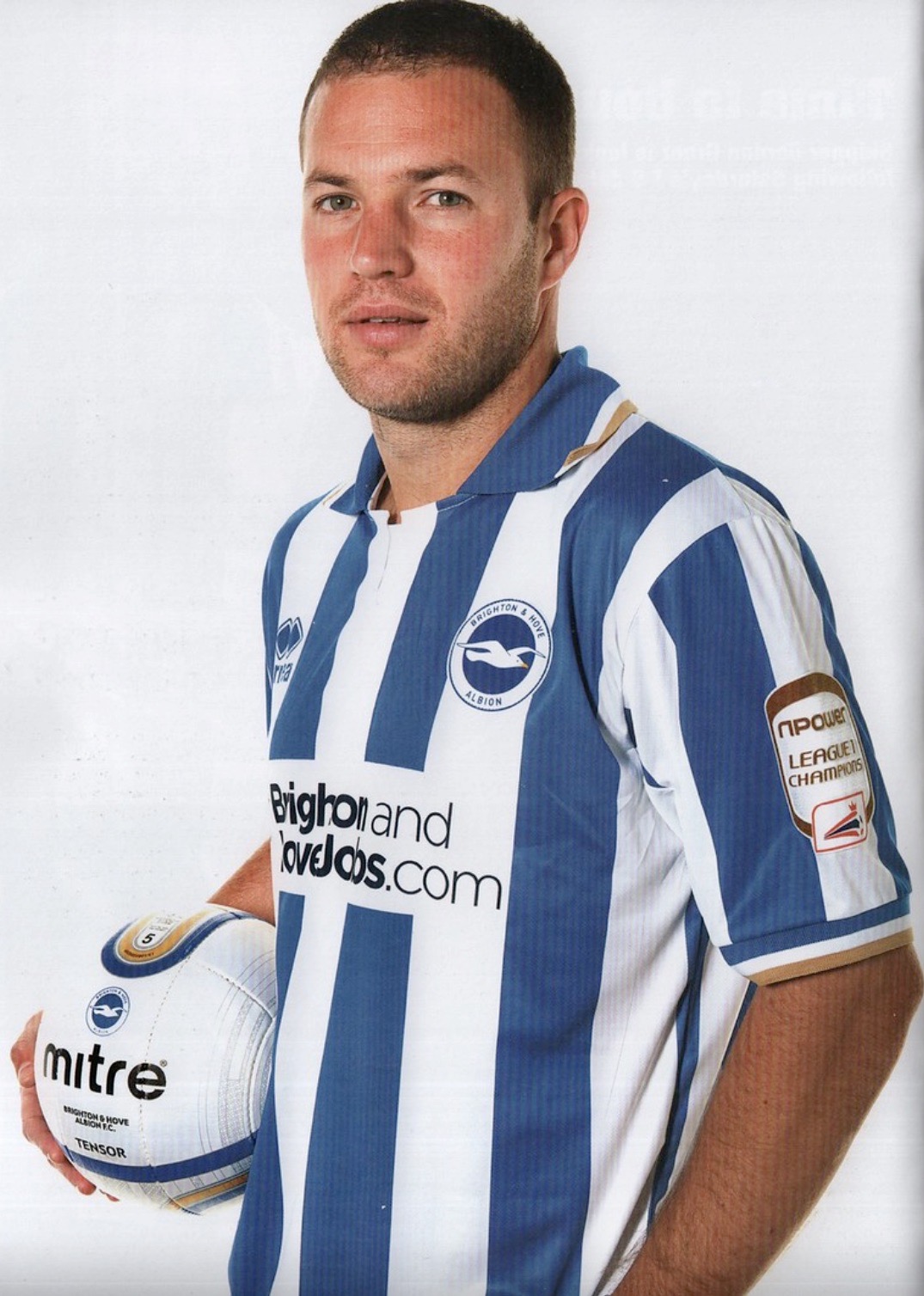
The Scouser joined the Seagulls on a free transfer from MK Dons in the summer of 2009, and manager Russell Slade told the Argus: “Alan likes to get on the ball. He is the passer, the one that links you up and tries to make you play. He’s impressed us.”
After picking up an injury early on, he found it difficult to get back in the side until Gus Poyet arrived, and, with his ability to pick a pass for teammates to benefit from, slotted in well.
A cruciate ligament injury in his right knee, suffered in a League Cup game against Northampton Town at the beginning of the 2010-11 season, ruled him out for the season.
Having previously suffered a similar injury in his other knee eight years earlier, he knew what to expect, which he described to Andy Naylor in the Argus.
He later recalled how he feared it might have been the end of his career, but, after proving his fitness to Poyet, he went on to play 39 games for the Albion in the 2011-12 season – finally getting the chance to perform at a level he always felt he was capable of.
Navarro had previously had to contend with life in the bottom two tiers, but he enjoyed a new lease of life playing in the Championship, as he talked about in the Argus.
He played a total of 85 games for the Albion between 2009 and 2012 and only ever scored one goal. But what a memorable one!
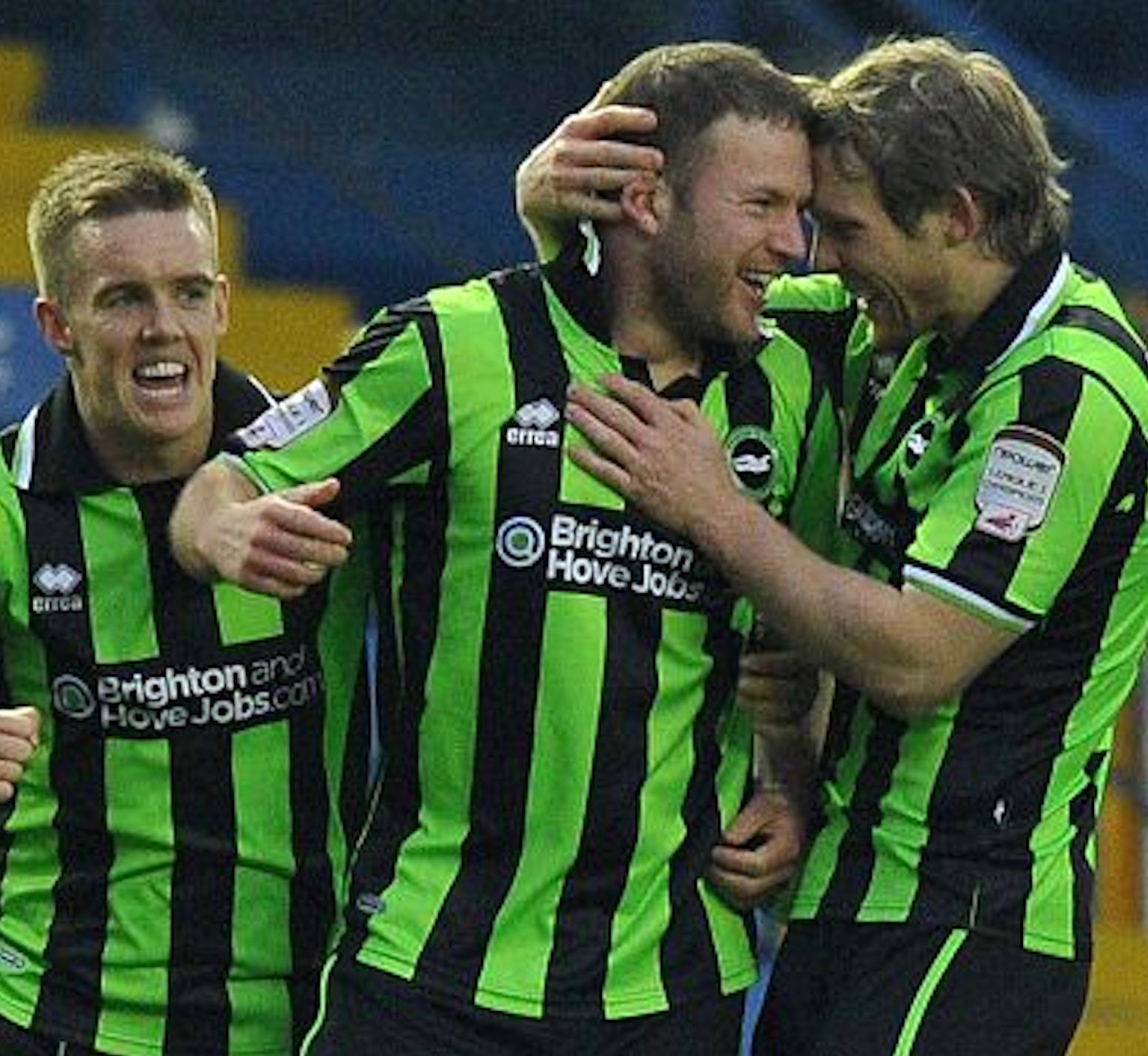
It came in the 90th minute of a Championship game at Elland Road on 11 February 2012, when his final touch after good work from Liam Bridcutt proved to be the winner as the Seagulls prevailed 2-1.
Craig Mackail-Smith (pictured above celebrating with Navarro and Craig Noone) had opened the scoring for the Seagulls but Luciano Becchio equalised and, just as it appeared the game would finish in a draw, up popped unlikely scorer Navarro.
Born in Liverpool on 31 May 1981, Navarro’s home was in Venmore Street, close to Anfield. “Funnily enough I was a Blue when I was younger,” he told the Albion matchday programme. “My family were Evertonians and a couple of cousins really drilled the club into me from an early age. But when I was 10 or 11, we moved to a house right next to Anfield and I fell in love with Liverpool.
“I loved watching John Barnes, Ronnie Whelan and then Robbie Fowler, even though he was not that much older than me. My mum still lives there, six doors away from The Kop.”
He joined the Reds in 1996, signed professional in 2000, and was a regular in the Reserves. He also had occasional travels with the first team, for example to Russia, Porto and Rome, as well as Chelsea, Newcastle and Sunderland for league games.
“It was strange going from fan to playing for the club, but an unbelievable experience,” he said. “From growing up on the club’s doorstep, I was in the youth team, then playing for the reserves and travelling with the first team to some big games.”
In the 1999-2000 season, Liverpool Reserves won the Premier Reserve League title with Navarro and Layton Maxwell pulling the strings in midfield.
Navarro only made it onto the first team substitutes’ bench twice but got his first taste of competitive action on loan at League One Crewe Alexandra.
He also went on loan to nearby Tranmere Rovers, whose manager, Dave Watson, told the Liverpool Echo: “Alan is a good quality player who has been in Liverpool’s reserves for a while now.
“I have seen him play several times and so have my assistant, Ray Mathias, and our chief scout, Dave Philpotts. (Anfield coach) Sammy Lee speaks very highly of the lad’s work at Liverpool and he’s certainly worth a look.”
After impressing on loan, Navarro made a permanent switch to Rovers in January 2002, signing a three-and-a-half-year contract. “It was difficult to leave because I love the club and a big part of my heart will always be there, but I needed to get my career up and running. I cherish my time there; I was taught the game by the best.”
Things didn’t go according to plan at Tranmere where he suffered a cruciate knee ligament injury and he went out on loan to Chester City and Macclesfield Town.
Navarro moved on from Tranmere in the summer of 2005, initially linking up with Conference National side Accrington Stanley for a month before Macclesfield boss Brian Horton secured his services on a permanent basis. Horton told the club website: “I’m delighted Alan has joined the team. I think he’s going to fit in extremely well.
“We had him here last season and couldn’t quite come to an agreement with Tranmere to sign him, so he went back there and we missed him badly.
“It was no coincidence that his departure came at the time when our form dipped so we’ve been keeping an eye on him for a long time and we’re delighted to have him.”
After his experience at Tranmere made him contemplate quitting the game altogether, it was Horton’s successor at Macclesfield, former Liverpool midfielder Paul Ince, who helped to reignite his passion for football.
“When he came to Macclesfield, he got me wanting to play football again,” he told the matchday programme. “He gave me the spark that helped me fall back in love with the game, and he took me from Macclesfield to MK Dons, where we had a lot of success.
“He remembered me from Liverpool, while his assistant Ray Mathias had me at Tranmere and knew me really well. It just clicked. I knew what Paul wanted from me and vice-versa.”
In August 2007, Navarro followed Ince to MK Dons, where he made 89 appearances over two seasons.
After his three years with the Seagulls, and following a season in which he played 33 matches, it was a little surprising that he was released in the summer of 2012, although supporter Alan Wares told thewashbag.com: “He will be remembered as a player who never gave less than 100 per cent every time he pulled on the shirt.
“It’s a shame to see such a quality player leave, but it shows how far Brighton have come as a club that Gus Poyet feels he can afford to release him.”
How ironic that his debut for new club Swindon should come in the League Cup against Brighton in August 2012 – Navarro scored twice and made the other in a 3-0 win!
However, that was pretty much as good as it got in his spell with the Robins. His Town career comprised only 15 starts plus five as a substitute, and a subsequent knee injury brought his career to an end.
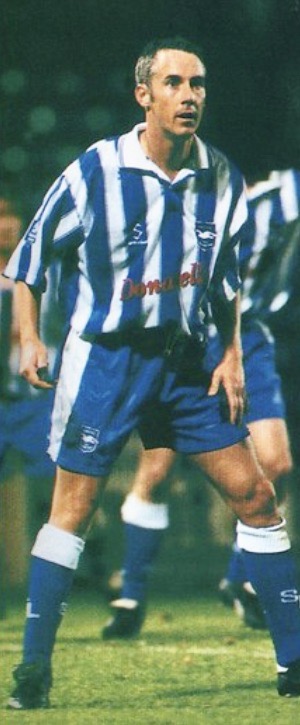
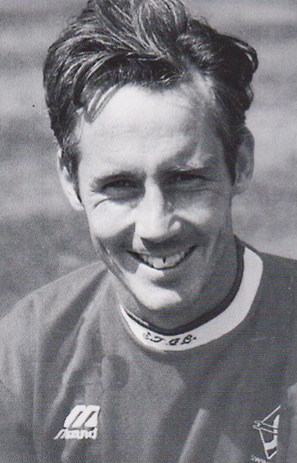
A DEFENDER who enjoyed Norwich City’s European journey in the early 90s ended his playing days as captain of the Seagulls before embarking on a coaching career running the reserves.
Ian Culverhouse was part of some of the Canaries’ best years flying high in the football pyramid – later being named by fans as their best ever right-back.
In February 1999, Albion’s then chairman, Dick Knight, told the Argus: “Ian has impressed me greatly with not only his experience but his attitude. He has been a real leader in the dressing room as well as on the field and we are giving him a chance to bring that know-how to bear on the coaching side.”
Manager Jeff Wood added: “Ian has shown on the field that he is a player of immense ability. In his new coaching role, he will now have the opportunity to pass his knowledge on to the younger players at the club.”
Culverhouse added: “This is a good opportunity for me and I am looking forward to it.
“It’s the first chance I’ve had to coach and it’s something I wanted to do anyway when my career finished. It has just come at a nice time.”
It was former boss Brian Horton who first brought Culverhouse to the Albion, from non-league Kingstonian, signing him on a month-to-month contract in August 1998.
In October, it looked like he was being released, but when captain and sweeper Gary Hobson picked up an injury, Horton reinstated Culverhouse on a contract to the end of the season, and appointed him captain.
Culverhouse, by then 34, could look back on the experience of 369 games for Norwich, and 115 for Swindon Town. He said: “The future of Brighton is looking very exciting and it’s great to be considered a part of the plans.”
When Wood was sacked with six games of the season still to be played, Culverhouse told the Argus: “I am shocked and absolutely gutted for the bloke.
“It’s down to the players he puts out there. We have let him down.”
Culverhouse survived the managerial upheaval and when new manager Micky Adams took charge, he told the Argus: “Ian reminds me a bit of myself. You have got to get on the ladder somewhere. He is enthusiastic, has had a good career and sets himself high standards.
“He has a lot to learn in terms of coaching, but I hope he will become fully qualified along with the rest of my staff.
“He will still be registered as a player as well in case we need him in emergencies, but I don’t envisage him playing too many games.”
In 2000, Culverhouse became youth coach at Barnet and two years later joined Leyton Orient in a similar role before being elevated to assistant manager. He left the Os in August 2005 – replaced by future Villa boss Dean Smith – but was then appointed coach at Wycombe Wanderers by Glenn Hoddle’s former no.2, John Gorman.
When Paul Lambert succeeded Gorman, he and Culverhouse developed a strong bond. He followed Lambert to Colchester United to become assistant manager, then returned to Norwich in the same role, where he didn’t forget Wood’s role in setting him on the coaching ladder, being instrumental in the former Albion manager’s appointment as Norwich’s goalkeeping coach.
When Lambert upped sticks from Norwich to join Aston Villa, Culverhouse went with him, and, in June 2013, the Birmingham Mail carried a lengthy article talking about the trust Lambert placed in his right-hand man, and how much he rated his judgement.
But in April 2014 Culverhouse was suspended by the club and, following an internal investigation into “off the field matters”, was dismissed.
Between January 2016 and February 2017, Culverhouse was assistant manager to veteran boss John Still at Dagenham & Redbridge. He left Dagenham to become manager of Southern League Premier Division side King’s Lynn Town. In May 2018, he moved on to Grantham Town but left after only five months and returned to King’s Lynn where he recently signed a new two-and-a-half-year contract.
Born on 22 September 1964 in Bishop’s Stortford, Culverhouse spent his early football career at Tottenham Hotspur and was capped at England Youth level. He impressed in Spurs’ youth and reserve sides and spent three years at the Lane.”I was playing alongside players like Ricky Villa, Ossie Ardiles and Glenn Hoddle, which was tremendous experience,” he said.
He even collected a UEFA Cup winners’ medal in 1984 as an unused substitute in the first leg of Spurs’ win (on penalties) over Anderlecht; future Albion boss Chris Hughton was left-back and recent signing from Albion, Gary Stevens, was in midfield, and scored one of the decisive penalties.
But Culverhouse only made one full appearance for the first team, plus one as a substitute, and in October 1985 moved to Norwich City under Ken Brown for a £50,000 fee.
He was part of the Norfolk club’s old Second Division title-winning side of 1985-86 and became an established defender, usually as a right-back but also as a sweeper, as the Canaries flew high in the Premier League, finishing third in 1992-93 after enjoying three top five finishes in the old First Division.
After nine years as a player at Carrow Road, he was somewhat controversially sold for £150,000 to Swindon where he was a key part of their League One Championship winning squad in 1995-96 but left in May 1998 after falling out with boss Steve McMahon.
He began the 1998-99 season with Kingstonian before Horton revived his league career with the Seagulls.
TOUGH-TACKLING midfielder Bobby Smith made more than 200 appearances for Manchester United’s reserve side.
He played alongside emerging talents such as George Best and Nobby Stiles but wasn’t able to follow them in making the step up to the first team.
Like many before and since, he had to look elsewhere to establish a career in the game, and 85 of his 307 senior career appearances came in the colours of Brighton & Hove Albion, the fourth of seven clubs he served as a player.
Smith stayed in the game as a manager and coach for 26 years after hanging up his boots, his most notable achievement coming in December 1979 as boss of Third Division Swindon Town when they overcame the mighty Arsenal in a thrilling League Cup quarter final.
Born in Prestbury, Cheshire, on 14 March 1944, Smith won six England Schoolboys (under 15s) caps, playing right-half with future World Cup winner Martin Peters playing on the left.
He went on to win two England Youth caps: on 9 March 1961, he was in an England side (which also included John Jackson in goal and future Luton and Spurs boss David Pleat) that lost 1-0 to the Netherlands in Utrecht and three days later was again on the losing side, this time 2-0, to West Germany in Flensburg, when teammates included John Milkins, Portsmouth’s ‘keeper for many years, and striker John O’Rourke, who played for various clubs. Smith turned professional with United the following month.
I’ve discovered an old programme (above) for a Man Utd reserve fixture against West Brom during that era. It shows Smith alongside Wilf Tranter (who also later played for Brighton, and was Smith’s assistant manager at Swindon), Nobby Stiles in midfield, and George Best on the left wing.
In 1964, when a first team call-up continued to elude Smith, he lowered his sights and went to play for a former United colleague at Scunthorpe United. That colleague was Freddie Goodwin who would later be his manager at Brighton as well.
At Scunthorpe, Smith finally saw league action and played 87 games in two seasons before being transferred for £8,000 to Grimsby Town. In two years with the Mariners, he played 56 games before joining the Albion in June 1968.
My distant memory of Smith was of a tough-tackling midfielder who was in the shadow of the likes of Nobby Lawton and Dave Turner when it came to his popularity with supporters. And manager Goodwin hit back strongly when a section of fans voiced their disapproval of the player.
Smith scored the only goal of the game after only 50 seconds away to Stockport County on 23 January 1970, but in the previous home game (a 2-1 win over Bradford City) there had been a few shouts from the terraces in Smith’s direction.
In his weekly article for the Brighton and Hove Herald, Goodwin said: “I was most disappointed to hear certain sections of the crowd getting at Bobby Smith.
“He has done nothing to warrant this behaviour. He is a 90-minute aggressive player and his value to the team lies in his ability to win the ball from the opposition.
“He is well aware of his limitations as a player, but there is no-one who can accuse him of ever giving less than 100 per cent.
“This sort of behaviour by a small minority of spectators does nothing to help the team or the individual players.
“Any player who takes the field as a representative of Brighton and Hove Albion does so because he has been selected for the team by me.
“It is my responsibility that a player represents the Albion. So, to barrack any player is most unfair to him.”
Smith in action against the backdrop of the packed East Terrace at the Goldstone. Albion won 4-0
His 85 games for the Albion came across three seasons: 33 in 1968-69 and 26 in each of the following two seasons. Goodwin’s successor, Pat Saward, released him at the end of the 1970-71 season, and, in June 1971, he went on a free transfer to Chester City.
After only four months in the North West, he switched to the North East, joining Hartlepool United, initially on loan. Over two years, in which Len Ashurst’s side only just avoided the old re-election places, Smith played in 76 matches before moving on to Bury in August 1973. He signed as a player-coach but didn’t feature in the league side, instead taking over as manager – aged only 29 – from Allan Brown in December 1973.
It was the start of a coaching and managerial career that would span more than a quarter of a century.
He took Bury to promotion from the fourth tier by the end of that 1973-74 season, and remained in charge for just under four years, He was at the helm for a total of 215 games; the record books showing he achieved a 41.9 per cent win rate.
A six-month stint followed at Port Vale, between November 1977 and May 1978, but, of his 33 games in charge, he only presided over six wins (there were 14 draws and 13 defeats).
Swindon paid £10,000 compensation to lure him to the County Ground, where, as mentioned, his assistant manager was the aforementioned Tranter.
The official Swindon website remembered: “Despite being a relatively young manager, he guided Swindon to a promotion challenge in his first season in charge – missing out by three points, after losing the last two games of the season.”
Part of the secret had been Smith’s signing of strikers Andy Rowland and Alan Mayes.
Smith (far right) as manager of Swindon, with Tranter (far left), Chris Kamara (circled back row) and skipper Ray McHale (centre front row).
His major achievement came the following year, when Town beat Arsenal 4-3 in a replay to reach the League Cup semi-final.
When one considers the size of League Cup game crowds now, it seems extraordinary to discover around 7,000 Swindon fans (in a gate of 38,024) had made the trip to Highbury for the initial tie, which finished 1-1.
The Gunners had famously lost to lowly Swindon in the 1969 League Cup Final at Wembley, so the humble Wiltshire club smelled history repeating itself.
In the replay, with 21,795 packed into the County Ground, Steve Walford and John Hollins scored own goals and future Brighton manager Liam Brady scored twice for Arsenal. One of the key players for Swindon was future Sky Sports reporter Chris Kamara.
Unsurprisingly, the giant killing attracted plenty of media attention and Smith was interviewed live on Football Focus by presenter Bob Wilson.
Smith pointed out that his side had been well grounded and, after the initial draw against Arsenal, had thumped his old club Bury 8-0, equalling Swindon’s biggest winning margin in a league game. Amongst the scorers were Rowland and Billy Tucker – two of four ex-Bury players in Swindon’s starting line-up. Another was Brian Williams – Bury’s youngest ever player – and one of the other goalscorers, Ray McHale, (later to play for Brighton in the top division) went on to have a loan spell at Gigg Lane later in his career.
The Robins beat top-flight opponents Wolverhampton Wanderers 2-1 at home in the first leg of the semi-final but went down 3-1 at Molineux in controversial circumstances, Wolves scoring the decisive goal five minutes from the end.
“We were so unfortunate because Wolves should have been down to 10 men,” Kamara told the Swindon Advertiser. “Alan Mayes got hit by the goalkeeper (Paul Bradshaw). He came out of his goal, didn’t get anywhere near the ball and he clattered Alan and broke his two front teeth and his nose but didn’t get sent off.
“I know everyone looks at situations and says ‘You were unlucky’ but that was a turning point in the game, and we ended up losing.”
It later emerged that the tie could have had a dramatic impact on Kamara’s playing career. In a 2010 interview with FourFourTwo magazine, he explained how he was once on Manchester United’s radar during Ron Atkinson’s reign.
“I was at Swindon and my manager Bobby Smith said, ‘Big Ron’s coming to watch you.’ We were playing in the 1980 semi-final of the League Cup against Wolves, but I had the ’flu and didn’t play so well. I’m not saying that’s the reason he didn’t sign me, but Ron went back to his old club, West Brom, and signed Remi Moses instead.”
With the benefit of hindsight, the cup run took its toll on the Swindon side. Before the semi, they were just five points from a promotion place, with four games in hand. But only five of their last 18 games were won, and they lost nine away games on the trot, resulting in a disappointing 10th place finish.
Smith had spent large – by Swindon’s standards – including £250,000 on two players, David Peach and Glenn Cockerill, both of whom never fitted in at the club.
When Swindon lost their first five matches of the 1980-81 season, Smith was relieved of his duties.
He later took charge at Newport County and Swansea City, as well as coaching at the Swans, Blackpool, Cardiff City, and Sheffield Wednesday, together with a spell as assistant manager of Hereford United.
He was assistant manager to Frank Burrows at the Vetch Field but when the chairman at the time announced his intention to sell up, and no funds were being made available for new players, Burrows left of his own accord and Smith became caretaker manager.
Contributor Colin_swansea, on the fans website scfc2.co.uk, observed: “After Tosh left we had caretakers Doug Livermore for 30 days, Les Chappell for 23 days prior to Tosh returning, and after Tosh had left for a second time on the 5th March 1984 Les returned as caretaker until the end of the season.
“Our manager’s position was even more farcical after Frankie Burrows left with his assistant Bobby Smith taking over until a bust up during the Xmas period when Doug Sharp wouldn’t sanction the buying of rubber studded boots to combat the winter conditions.
Smith interviewed after his Swindon side held Spurs to a 0-0 draw in the FA Cup
“Smith left on 22 December 1995, Jimmy Rimmer was caretaker to 7 February 1996, Kevin Cullis became manager for a week, a two-game spell of two defeats, Rimmer returned for eight days as caretaker, before Jan Molby’s appointment on 22 February 1996. Molby’s replacement as manager on 9 October 1997 was Micky Adams who lasted 13 days and three league defeats with his assistant Alan Cork taking over until the end of the season.
“Cork didn’t fit the profile for the club’s new owners, Silver Shield, and he was offloaded at the end of the season. Ironically his successor, John Hollins, didn’t sign one player the following season when the club reached the play offs.
“Never a dull moment being manager of the Swans during the 80s and 90s!”
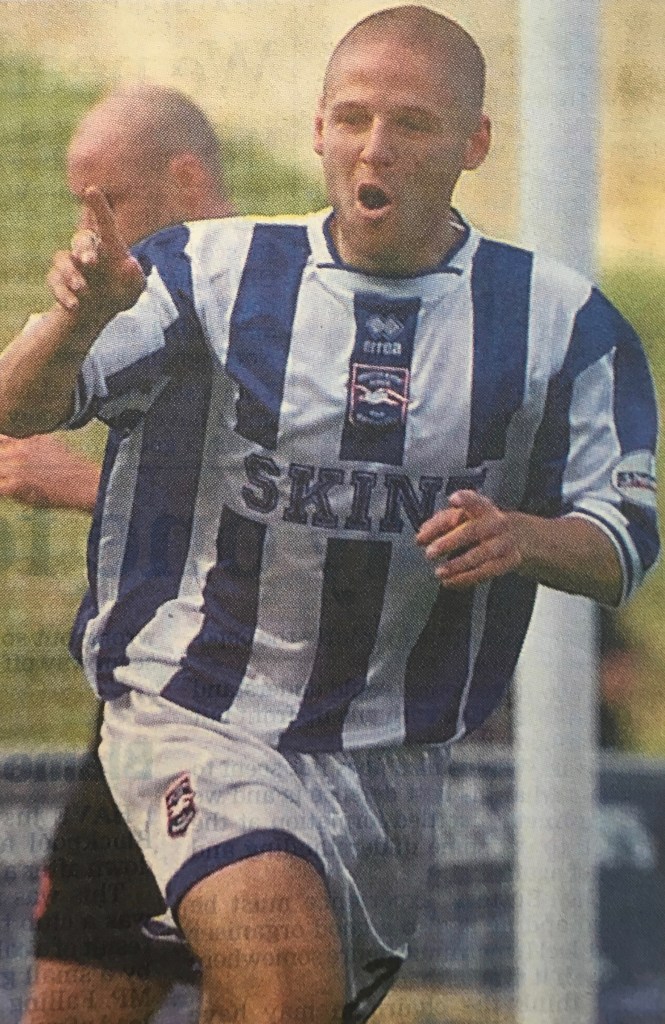
SELDOM in his remarkable 29-club career did Trevor Benjamin enjoy such a successful spell as the 10 games he spent on loan at Brighton.
The bustling striker who had thrived under Micky Adams at Leicester City the season before scored five times for Mark McGhee’s promotion-chasing side in 2004.
McGhee was keen to keep him through to the end of the season but because of the timing of the three-month deal he wouldn’t have been eligible to play in the play-offs.
As a result, he went back to Leicester and McGhee brought in Chris Iwelumo instead, and, with a goalscoring debut in an away win at Chesterfield, there was no looking back.
Born on 8 February 1979 in Kettering, Benjamin was brought up in Wellingborough, Northants, and, having done well for Wellingborough Colts, was picked up by Kettering Town, playing for their youth team and reserves.
Cambridge United took him on as a trainee and he made his first team debut aged only 16 against Gillingham and went on to score 46 goals in 146 appearances.
Such a scoring record caught the eye of Leicester boss Peter Taylor and, on 12 July 2000, Benjamin joined the Foxes for a fee of £1.3 million.
However, he managed only a single goal in the 2000-01 season and the following season was sent out on loan to Crystal Palace, Norwich City and West Bromwich Albion.
He returned to Leicester for the whole of the 2002-03 season, including playing against the Albion at Withdean.
He said in a matchday programme article for that season’s return match against Brighton on 19 April 2003: “Brighton are a very similar team to ourselves. They have got a good work ethic and never give up.
“I came on as a substitute for the last 10 minutes when we played against them at the Withdean Stadium just before Christmas and that was a tough night.
“The conditions were terrible and both sides had to work hard to beat the elements. But I think our quality shone through on the night.” (Leicester won 1-0).
The following season, Benjamin was back on his travels, initially to Gillingham, then Rushden & Diamonds and, in January 2004, to Brighton.
Benjamin’s first Brighton goal came after just 12 minutes of Albion’s home game against Plymouth Argyle, who were then top of the league table. Leon Knight added a second goal before a jubilant celebration in front of the Sky cameras and Albion prevailed 2-1.
He followed that up by netting Albion’s goal in a 1-1 draw away to Wycombe Wanderers, and was again on the scoresheet in the 2-1 away defeat to Grimsby Town.
A 3-0 home win over AFC Bournemouth saw Benjamin score the second of Albion’s three goals at Withdean. When Tranmere Rovers were dispatched by the same score, he once again scored the second goal.
Back at Leicester, when Craig Levein was installed as boss, he cancelled Benjamin’s contract in January 2005. Benjamin initially dropped down a couple of divisions to play for Northampton but, three months later, his old Leicester boss, Adams, took him to Championship side Coventry City. He helped to set up both goals on his debut for the Sky Blues as they beat Reading 2-1.
In Coventry’s matchday programme for their home game against Brighton on 2 April 2005, he talked about how he had been settling in and the efforts he’d been making to try to improve his game.
“I’ve been training quite hard with Alan Cork on my finishing since I got here and he’s great to work with. He’s trying to get me to focus on what I am best at and hopefully when the games start again the practice will pay off.”
Benjamin’s arrival at Coventry may have seen him make a leap of two divisions but he was by no means unfamiliar with football at that level having played with Leicester for five years in both the Premiership and the Championship.
David Antill wrote: ‘During his time with the Foxes he was loaned out to no fewer than seven clubs before eventually signing permanently with Northampton Town but he is delighted to be back in a league he enjoys playing, for a manager he believes can get the best out of him.
“I’ve always believed in my own ability and thought I could play at this level and it was great to be given the chance to return to this league with Coventry,” said Benjamin. “My confidence never really slipped – I never had a doubt about coming here and being able to deliver the goods.
“I know what Micky Adams is all about and he knows what I’m all about so I enjoy working with him. What he’s brought here is exactly what he brought to Leicester and that’s what brought him success there. He’s a hard-working manager and he wants exactly the same thing from all of his players and I think he’s getting that.”
After scoring only once for the Sky Blues, in the summer of 2005 the burly forward linked up with Peterborough United, where he signed a three-year deal. However, he was loaned out several times, appearing for Watford, Swindon Town, Boston United and Walsall.
There was some stability and a return to goalscoring when he moved to Hereford United. He scored 10 in 34 games for the Bulls but was released in May 2008 and ended up drifting across the non-league scene for the next four years, popping up at no fewer than 13 different clubs.
It was all a far cry from the heady days of 2001 and 2002 when he briefly reached the international arena.
He went on as a substitute for Howard Wilkinson’s England under 21s as they beat Mexico 3-0 in a friendly at Filbert Street on 24 May 2001. Because he hadn’t played in a competitive fixture, he was then able to swap allegiances and played two matches for the full Jamaica international side in 2002.
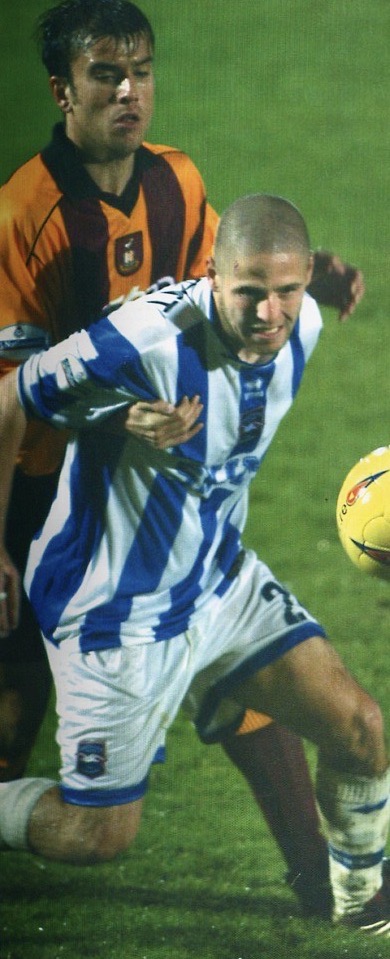
GRAHAM Barrett did his level best to impress when new boss Steve Coppell took charge for the first time at Withdean.
The on-loan Arsenal forward put in an inviting cross from the right wing for Gary Hart to score midway through the first half of the 19 October 2002 game against Sheffield United.
Barrett himself then got on the end of a precision pass from Bobby Zamora out wide on the left to put Albion 2-0 up in the 34th minute.
Unfortunately, the young forward’s contribution was overshadowed by events at the other end of the pitch in the second half. Firstly, the Blades hit back through Michael Brown and then substitute Carl Asaba equalised.
Referee Phil Prosser became the villain of the peace by awarding United two penalties in the final four minutes of the game, both converted by Asaba.
The first was given when Prosser reckoned goalkeeper Michel Kuipers had brought down Asaba in the box; the second when Adam Virgo pushed over Wayne Allison in the penalty area.
“Albion fans were so incensed by Prosser’s first penalty decision that several hundred left their seats in the south stand to protest from the running track,” The Argus reported. “Police and stewards gathered in front of them to prevent the threat of a pitch invasion.”
Even Albion-supporting MP Ivor Caplin got in on the act, subsequently calling for an FA inquiry into Prosser’s “totally inept” display. Needless to say, that went nowhere.
Barrett, meanwhile, was far less impressive the following Saturday when he and his temporary teammates were thrashed 5-0 by Crystal Palace at Selhurst Park.
He started 20 games for the Albion in that season, as well as making 10 substitute appearances – but that single strike against Sheffield United was his only goal.
Born in Dublin on 6 October 1981, Barrett was one of several Irish youngsters who began their football careers with Arsenal having been spotted by ex-Albion boss, and fellow Irishman, Liam Brady, playing in an Ireland U15s game against England at Blackburn.
Brady had become Arsenal’s head of youth development and academy director after his spell at Brighton. Barrett agreed professional terms with Arsenal in 1998 and went on to captain their FA Youth Cup winning team of 2000.
He earned a call-up to the Republic of Ireland’s under 21 team and went on to play 24 times at that level, scoring five goals. Between 2002 and 2004, he stepped up to the full Eire side and scored twice in six matches.
Try as he did, Barrett couldn’t add to his single goal against Sheffield United
Barrett managed to break through to the first team squad at Arsenal in December 1999 and made his debut as a substitute for Thierry Henry in a 3-0 win over Leicester City. The following month, again as a substitute, he appeared in a 4-1 win over Sunderland, and he also played in a league cup match.
“I was around the first team for a good four or five months, travelled a lot with them and got to train every day with them, played a little bit,” Barrett told the42.ie, in an April 2018 interview.
Facing stiff competition for a first team place, Barrett was sent out on loan to gain playing time at a lower level. He went to Bristol Rovers but only managed one game before being struck down with glandular fever, causing him to be out of the game for six months.
When he’d recovered, he went on loan to Crewe Alexandra and Colchester United who had wanted him back for the 2002-03 season, but he opted to join Brighton instead.
With little chance of dislodging the likes of Bergkamp, Henry, Wiltord and Suker at Arsenal, Barrett was given a free transfer by Arsenal in May 2003 and opted to join Coventry City on a three-year contract.
Although he made 32 league starts plus 23 as a sub, ex-Albion boss Micky Adams made it plain he didn’t fit into his plans. He went to spend the last year of his contract on loan at Livingston in Scotland but after only six games suffered a season-ending knee injury.
He subsequently stayed in Scotland and played for Falkirk and St Johnstone before returning to Ireland to play for Shamrock Rovers, who his dad, Gary, had played for in the Eighties under Johnny Giles.
A GUNNER from the age of nine gained valuable first team experience with the Seagulls but ultimately fell short of reaching the same heights as his brother.
Commonwealth Games gold-medal winning sprinter Wendy Hoyte saw sons Justin and Gavin climb through the academy and reserve ranks at Arsenal.
Justin played 68 first-team games for the Gunners and went on to make a name for himself in the North East, but younger brother Gavin only played four first-team games for Arsenal and had to set his sights lower to pursue a professional career.
The younger Hoyte spent most of the 2009-10 season as a Brighton player and, although only 19 at the time, got a rough ride from Seagulls supporters who expected more from someone who’d played at the top level of the game.
Initially signed on loan in October 2009 by Russell Slade to cover for the injured regular right-back Andrew Whing, Hoyte was handed his debut against Slade’s former club Yeovil Town at Huish Park.
“I am delighted to know the club wants me,” the youngster told The Argus. “They have got a lot of games this month and I just want to get out there and play.”
As it turned out, Hoyte outlasted Slade at the Withdean, and his temporary transfer was extended when Gus Poyet took over as manager.
The young full-back in the no.27 shirt gained a good amount of game time until Poyet unearthed Inigo Calderon in January 2010.
Even then, Poyet was happy to retain the services of the Arsenal youngster, telling the Argus: “We explained to Gavin before asking Arsenal that there was probably a player coming.
“Arsenal knew that as well, so nothing has been hidden. Everyone knows where they stand.
“We are working on different aspects of the game with Gavin, because he has got something which is very difficult to find sometimes in football, the speed to recover.
“When you have that ability, you don’t need to go to ground, because you are quicker than most players.
“He is young and there is plenty to come. We want to help him become a Premier League player or top Championship player.”
Hoyte got another chance to prove himself when Calderon picked up a nasty hip injury in April, bringing his total number of Albion games over the season to 21.
When it looked like the popular Spaniard was going to move to Southampton instead of accepting a contract offer from the Seagulls, Argus reporter Andy Naylor ventured: “Gavin Hoyte’s encouraging conclusion to the campaign suggests he might even be capable of rising to the occasion if he returns on loan from Arsenal.”
It didn’t come to that, though, and, over the next two years, he dropped down another division with loan spells at Lincoln City and AFC Wimbledon.
When he realised there was little hope of him ever getting close to the Arsenal first team, he left for Dagenham and Redbridge, having spoken to Arsenal goalkeeping coach Tony Roberts, who’d played for the Daggers himself.
Born in Leytonstone on 6 June 1990, Hoyte followed in his brother’s footsteps to Arsenal and progressed to the point of being appointed the under 18 team captain in the 2006-07 season when he was still only 16.
“I am very vocal during games, although I wouldn’t quite say that I was a Tony Adams, but that’s the sort of captaining style I try to emulate,” Hoyte told the Arsenal matchday programme. “I have captained at schoolboy level and in particular in tournaments and so I do have some experience, but I did not expect to be captain of the under 18s so early.”
Hoyte captained Arsenal’s under 18s when he was only 16
Hoyte was also capped at England under 17, under 18, under 19 and under 20 levels. In the 2009 UEFA under 19 championships, he played in two qualifiers in the space of four days when England beat Slovakia 4-1 and Scotland 2-1; his teammates including current Albion no.3 Jason Steele in goal, and future full international Kieran Trippier.
He was part of the squad who took part in the finals in Ukraine, starting twice and coming on as a substitute three times as England finished runners up to the hosts. The side was managed by Brian Eastick, who’d been an Albion coach during the Mike Bailey era.
Hoyte’s one game for the under 20s came as a substitute in a 1-1 draw away to Uzbekistan on 2 October 2009, when a fellow substitute was Sam Baldock. Two non-playing subs in that game were Jonathan Obika and Gary Gardner, who both had spells on loan with the Seagulls.
Hoyte looked back on his Arsenal time in an interview with Will Unwin for planetfootball.com and said: “When you’re there you always think you’re going to make it – I was pretty confident.
“I had my older brother there as well, so that helped a lot, seeing how he progressed.
“That was a big thing for me, seeing him play every week, watching him, thinking, ‘I want to try and get to where he is’.”
Hoyte was an unused substitute for several first team games before making his debut in a 6-0 League Cup win over Sheffield United, and starting in the next two rounds, against Wigan and Burnley. His Arsenal career only seemed to be heading in one direction.
“Just to play at the Emirates was massive, coming out to a big crowd,” he told Unwin. “There were a lot of young boys in the team so that helped me with confidence and eased it.
“But there were a lot of players in front of me, so I didn’t think about playing in the Premier League. It was always in the back of my mind, but I wasn’t thinking I was going to play immediately.”
But 11 days after the second of those League Cup appearances, Hoyte was handed his Premier League debut, after William Gallas had been stripped of the club captaincy for criticising team-mates amid a poor run of only one win in four games.
Up against Robinho of Manchester City, he was taken off after an hour of a 3-0 defeat, and it would prove to be both the start and end of his top-flight career.
Hoyte didn’t recall getting much feedback after the game, although it wasn’t long before he was awarded a new contract. He made his fourth appearance for the club in a League Cup quarter-final defeat to Burnley at the start of December – but he didn’t play for Arsenal again.
He was sent out on loan to Championship side Watford for the second half of the 2008-09 season, featuring in 10 matches, and he eventually left Arsenal in 2012 when his contract expired.
After two seasons in League Two with Dagenham, he spent the 2014-15 season with League One Gillingham, featuring in 35 matches. He dropped down to League Two with Barnet, ended up at National League Eastleigh until the end of the 2017-18 season before returning to Dagenham in 2018-19.
It proved to be a frustrating season for him under the managership of former Albion boss Peter Taylor, but, reunited with former manager John Still at Maidstone United, he has been a regular at right-back in 2019-20 and scored just the third goal of his career against Dulwich Hamlet in December.
Along with his brother, the younger Hoyte has enjoyed the opportunity to play international football with Trinidad and Tobago, as he told socawarriors.net, and spent 20 minutes on the same pitch as Lionel Messi in a friendly as Argentina warmed up for the 2014 World Cup.
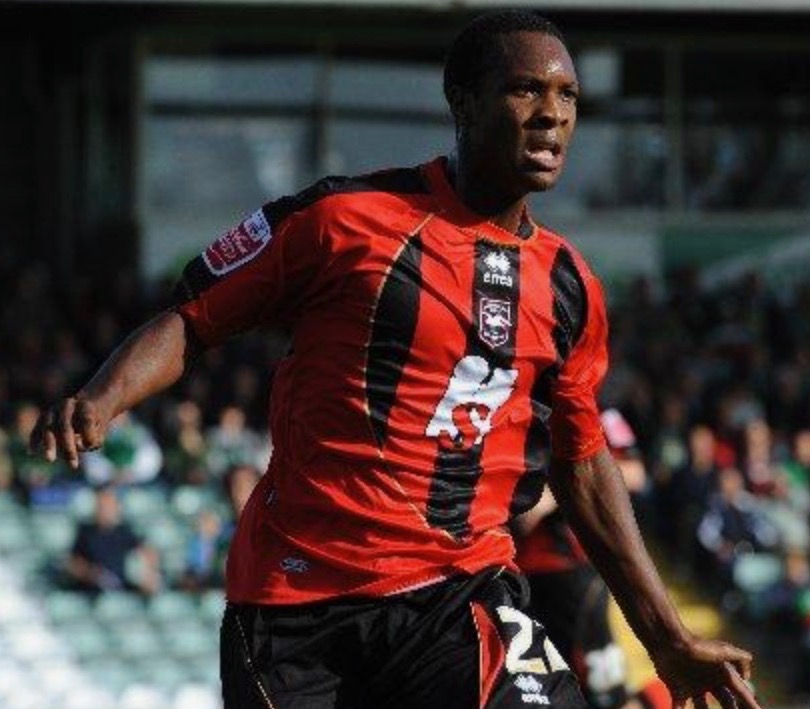
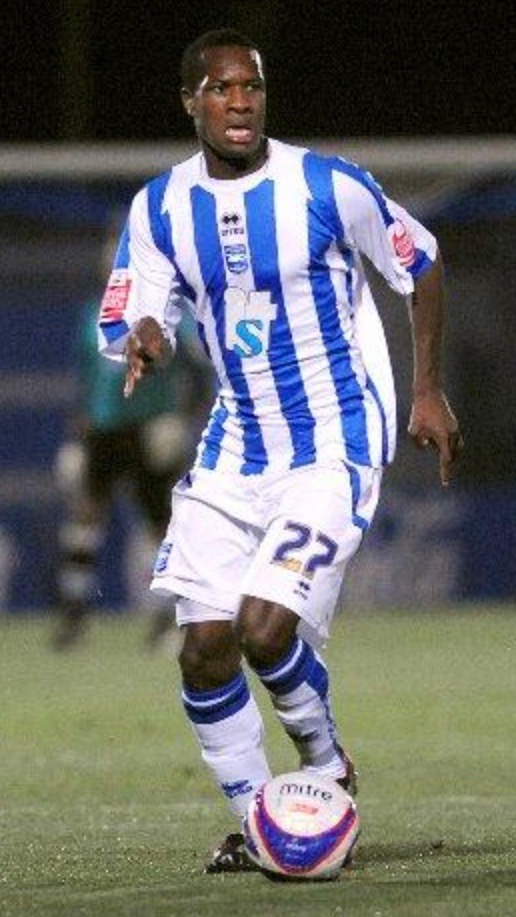
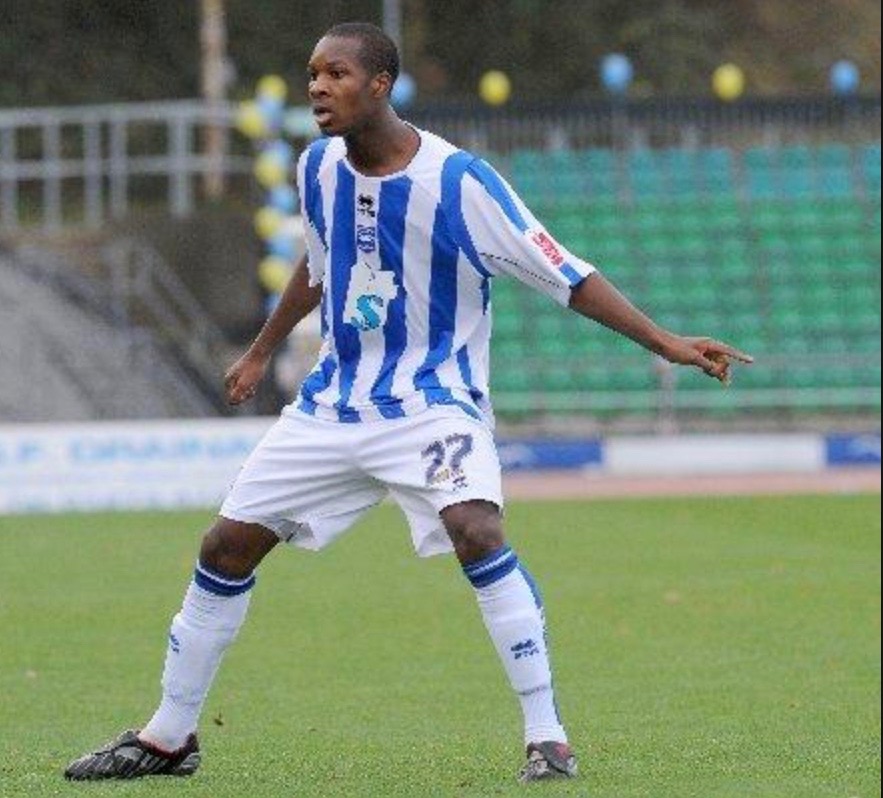
WHEN Wolverhampton Wanderers slipped into the third tier, they urgently needed to loan out some of their higher-paid players – hence, in August 2013, the arrival at Brighton of left-back Stephen Ward.
Most Seagulls supporters were not sure of his attributes having had the pleasure the previous season of watching the imperious Wayne Bridge shine in that position while on loan from Manchester City.
However, Albion fans were delighted to be proved wrong after Ward helped to shore up a defence that had leaked seven goals in the first eight days of the season. The Irish international defender went on to make a total of 47 appearances and was runner-up to Matt Upson as Albion’s 2013-14 player of the year.
Ward also chipped in with four goals, including the tide-turning equaliser at Nottingham Forest on the final day of the season.
Although injury-hit Albion failed to get past Derby County in the play-off semi-finals, it was thought Ward would sign permanently for the Seagulls that summer. But Burnley stepped in, offering Wolves and the defender more money, not to mention the more immediate chance of Premier League football.
Ward’s agent, Scott Fisher, later told the Argus that dithering or perhaps a bit of brinkmanship by then head of recruitment David Burke had scuppered the deal.
“We really tried our best to make Stephen Ward a permanent Brighton player. Had they done their business earlier this wouldn’t have happened,” he said.
Previously, as the season drew to a close, Ward told the Argus: “If I’m going to move on, I don’t see why this wouldn’t be one of the better options for me. I’ve been here for a year; I’ve really enjoyed it.
“I couldn’t say one bad thing about the club. The crowd we get, the stadium we have is phenomenal, probably the best in the Championship, and with the new training ground the club is on a real up and a real high.
“If I was to move on from Wolves, Brighton would definitely be high on the list. It’s not in my hands, it’s going to be in other people’s hands to discuss the future, but it has been a great move for me. I’ve really enjoyed it. It’s a really good club and one people should be privileged to play for.”
Ward went on to spend five years at Turf Moor, making 110 appearances, but only featured 11 times in the 2018-19 season, and manager Sean Dyche told punditarena.com: “He (Ward) has been brilliant for us, absolutely brilliant, he’s done a fantastic job.”
Perhaps it was no surprise that former Albion coach Nathan Jones stepped in to sign the experienced defender for Stoke City, where he’d taken on an often-perilous managerial hotseat.
Jones said: “He’s had a fantastic career, the only downside for him is his age, because he isn’t what we normally go for.
“But I feel we need to add certain things to the changing room and the environment and Stephen brings those.
“He’s a wonderful player, a great character, very experienced. He’s been promoted – won the Championship twice. He’s an Irish international, I worked with him, he’s technically very, very good so he ticks every box. It’s just the aging process is the only drawback.
“With Stephen, he’s a specialist in what we need and he will provide vital competition and good strength in that area.”
Unfortunately Ward couldn’t claim a regular starting place and in December 2019 picked up a calf injury which sidelined him for four months. Having made only 17 appearances for City, in August 2020 he switched to League One Ipswich Town on a free transfer.
After playing 29 games for them in the 2020-21 season, the club announced on 5 May 2021 he would be released at the end of the season (one more appearance would have triggered a 12-month extension to his contract).
Born in Dublin on 20 August 1985, Ward grew up in Portmarnock and, as a schoolboy, played football for Home Farm and Portmarnock before joining League of Ireland side Bohemians.
He attributed his eventual success in making it as a player to staying in Ireland when he was younger and continuing to live at home rather than going to play at a UK club’s academy.
In an excellent lengthy interview with the Irish Independent, he said: “I had a few trials – Leicester a couple of times, I went to Aston Villa a lot and Hibs for some reason – nothing worked out and I signed for Bohs. And the most important thing for me then was living at home and having my family around me.
“It does depend on the academy, but you are in a bubble from a young age. You train in a certain way, everything is done for you; I know you get your jobs, but not that many now, and sometimes there is a mentality that once you are in an academy, you’ve made it. I was 17 and played in a league where players were playing for their mortgages and to put food on the table.”
Originally a forward, he scored 26 goals in 93 appearances, and, having been looked at by Sunderland boss Mick McCarthy and deemed not quite ready, McCarthy kept tabs on him when he took over at Wolves.
“I signed for Wolves as a striker,” Ward told the Irish Independent. “I was not a typical number nine, scoring 20 or 30 a season, but an old-fashioned centre-forward running round, closing down.
“We signed a couple of strikers – Sylvan Ebanks-Blake and Chris Iwelumo – and I knew if I was going to play consistently it was probably not as a centre-forward. So, I went to left-wing for a bit.
“I played at left-back at Norwich for 30 minutes or so when we went down to nine men. We scraped a draw and afterwards Mick said, ‘You could make a career playing there.’ I thought, ‘Yeah, whatever’. Next season, three games in, and new left-back George Elokobi suffers an awful injury, the window was shut and Mick had no one else . . .”
On the international stage, Ward played through the age levels for the Republic of Ireland and had a dream full international debut in May 2011 as he scored in a 5-0 win over Northern Ireland.
He went on to play 50 times for his country before announcing his retirement from international football in March 2019.
DEFENDER Gary Borrowdale couldn’t have been more aptly named for a loanee which is just as well because he found himself in that situation half a dozen times over five years.
He made a temporary switch to Brighton from QPR in March 2009 to fill the spot vacated when Albion’s regular left-back Jim McNulty suffered a shocking injury in a 4-0 home defeat to Crewe Alexandra.
While McNulty needed an operation to remove a kidney, former England under 20 international Borrowdale had the chance to resurrect his flagging career with the Seagulls.
For a player who’d clocked up 100 appearances for Crystal Palace by the time he was 21, there was the inevitable ‘noise’ about helping out the arch rivals, but Borrowdale just wanted some game time, and he was one of five debutants who pulled on Albion’s sky blue second kit for the game at Brisbane Road on 7 March 2009.
Brighton lost that match 2-1 but, under Russell Slade’s astute stewardship, Borrowdale acquitted himself well during 12 matches through to the end of the season and the Albion just managed to retain their third-tier status.
“I made my debut for Palace at 17 and played my first game in the Premiership at 18, so it was a great start and Palace will always be dear to me as a result,” Borrowdale told Spencer Vignes for a matchday programme article.
“The highlight of my career would be the promotion I had with Palace when we went from the Championship to the Premiership,” he said, referring to the play-off win over West Ham, the day before Albion beat Bristol City in their own divisional play-off.
Borrowdale returned to west London after his spell on the south coast but in March 2010 he went on loan to Charlton Athletic and the following year had temporary spells at Carlisle United and Barnet.
His league career seemed to be over when QPR released him in June 2012 and he went over to Northern Ireland to join second tier outfit Carrick Rangers.
In January 2014, he looked to have got a foothold back in the English professional game when loaned by Margate to Gillingham, but he didn’t play any first-team games and was released at the end of the season.
Former Albion boss Peter Taylor told the club’s official website: “He’s done very well, lost weight every week and looked fitter every week.
“I just don’t think he’s ready for League One football, especially considering if we have to play Saturday and Tuesday. As a result, I have decided to let him go.”
Borrowdale then linked up with Greenwich Borough, initially as a player, before becoming a coach.
Born in Worcester Park, south London, on 16 July 1985, Borrowdale came through the youth ranks at Selhurst Park and Trevor Francis handed him his debut for Crystal Palace in December 2002.
When Iain Dowie took over as manager, Borrowdale quickly became a regular in the first team. He also represented England at each of the age groups from 16 to 20, playing alongside the likes of Gary Cahill in defence.
In a 2-2 draw with the Netherlands, played at Turf Moor, Borrowdale’s teammates included fellow Palace youngster Scott Flinders in goal and future Albion player Will Hoskins.
Borrowdale won Palace’s Young Player of the Year award in 2006-07, but, when Dowie moved on to manage Coventry City, Borrowdale joined him there, a tribunal fixing the transfer fee at £650,000.
The move didn’t work out, though, and, with Dowie gone, Borrowdale was sidelined, eventually being sent out on loan to Colchester United and then QPR.
Paulo Sousa took him on loan in November 2008 and, although he didn’t feature, made the move permanent in January 2009 on a three-and-a-half-year deal. He made just 22 appearances for QPR during that time.
• Pictures as featured in the Albion matchday programme.
TIME was of the essence when utility player Greg Halford agreed to make a temporary move to Brighton.
He penned a deal to join the Seagulls temporarily at Nottingham Forest’s training ground at 12.30pm and then got in his car to drive to Brighton for 6pm in time to be involved in the squad for that evening’s game at the Amex against Wigan Athletic.
It was 4 November 2014 and he was Sami Hyypia’s sixth loan signing – even though only five were eligible to play in any matchday squad (emergency loan goalkeeper Ali Al-Habsi only played one game).
Regular centre backs Gordon Greer and Lewis Dunk were perilously close to suspension and deputy Aaron Hughes was sidelined with an ankle injury, so Hyypia moved to bring in an experienced back-up.
Albion hadn’t registered a win in the previous 11 league matches but the 29-year-old Halford proved to be a lucky charm as the side finally reacquainted themselves with the taste of victory. Fellow loanee Gary Gardner got the only goal of the game and Halford made an appearance off the bench towards the end of the game.
“I wasn’t really expecting to get any game time. I thought I’d just be in and around the lads, to get a feel for how everything works,” he told the club programme. “But I’m glad I got a few minutes at the end.”
Halford explained how he’d agreed to join the Seagulls because he’d been frozen out at Forest after Stuart Pearce took over as manager.
The player said he was familiar with the south coast having previously played for Portsmouth.
Asked what he could bring to the side, he added: “I can add a bit of height, I can score goals and obviously I can defend, which is my main attribute. I’m here to help the team and manager in any way I can.”
It wasn’t long before he was helping out a different manager as the side’s run of poor form brought a premature end to Hyypia’s brief time in charge.
Halford, though, hung around at the Amex, his loan extended by Hyypia’s successor, Chris Hughton, and he had made 14 starts and five substitute appearances by the season’s end, when the Seagulls narrowly escaped the drop back to the third tier.
Born on 8 December 1984 in Chelmsford, Essex, Halford began his professional career at nearby Colchester United. I well remember a Chelmsford-based work colleague telling me about this talented young footballer who’d been head and shoulders the best player in a local schoolboy football team his son had played for.
That player was Halford, who progressed from Colchester’s youth team and made his first team debut in April 2003. Loan spells at non-league Aylesbury Town and Braintree Town were part of his development, but he eventually made his mark at Colchester and was named in the PFA League One team of the year in 2005-06.
Played mainly at right-back, Halford’s speciality was his ability to deliver searching long throws which led to a good proportion of goals for Colchester.
After playing more than 150 games in five years for the Us, Halford wanted to prove himself at the highest level. He got a move to Premier League Reading in January 2007 but he couldn’t make the breakthrough there and ended up switching to Sunderland, signed by Roy Keane.
Just six months later, Sunderland made him available on loan and he joined Championship side Charlton until the end of the season. Then he spent the whole of the 2008-09 season on loan to Sheffield United, featuring in 49 of their 56 games that season.
His personal highlight was scoring the only goal of the game as United beat Preston to reach the 2008-09 play-off final.
Unfortunately, United lost the final 1-0 to Burnley, and that summer Halford was on the move again, this time to newly-promoted Wolverhampton Wanderers. Although he featured in 20 games, a regular starting berth eluded him and, in October 2010, he joined Championship side Portsmouth. Initially on loan, he eventually joined Pompey on a permanent basis but relegation to the third tier brought with it the need to trim budgets and in July 2012, they offloaded Halford to Nottingham Forest.
Under Billy Davies, Halford was generally deployed as a striker but when Pearce took over at the City Ground, he didn’t get close to the first team. On his return from Brighton at the end of the 2014-15 season, he was released by Forest and joined Rotherham United on a free transfer.
Manager Steve Evans appointed him captain but, after a winless run of five games, he was deposed and only played one more game for the Millers before joining Birmingham City on loan.
That spell was also brief and although he returned to Rotherham and played 15 games for them in the 2016-17 season, he then joined Cardiff City and made 33 appearances in two seasons for Neil Warnock’s side.


 A MAN-OF-THE-MATCH home debut was as good as it got when Abdul Razak joined Albion on loan from Manchester City in February 2012.
 Five days later, he came on as an 80th minute sub for Yaya Toure, and then had a starting spot on 21 September in a League Cup game against Birmingham City. He next appeared in the same competition’s second round, against Wolverhampton Wanderers.
 The Scouser joined the Seagulls on a free transfer from MK Dons in the summer of 2009, and manager Russell Slade told the Argus: “Alan likes to get on the ball. He is the passer, the one that links you up and tries to make you play. He’s impressed us.”


 In the 1999-2000 season, Liverpool Reserves won the Premier Reserve League title with Navarro and Layton Maxwell pulling the strings in midfield.


 TOUGH-TACKLING midfielder Bobby Smith made more than 200 appearances for Manchester United’s reserve side.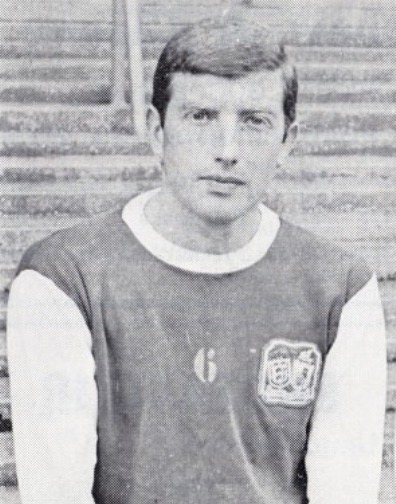


 Smith (far right) as manager of Swindon, with Tranter (far left), Chris Kamara (circled back row) and skipper Ray McHale (centre front row).

 SELDOM in his remarkable 29-club career did Trevor Benjamin enjoy such a successful spell as the 10 games he spent on loan at Brighton.

 “The conditions were terrible and both sides had to work hard to beat the elements. But I think our quality shone through on the night.” (Leicester won 1-0).


 Born in Dublin on 6 October 1981, Barrett was one of several Irish youngsters who began their football careers with Arsenal having been spotted by ex-Albion boss, and fellow Irishman, Liam Brady, playing in an Ireland U15s game against England at Blackburn.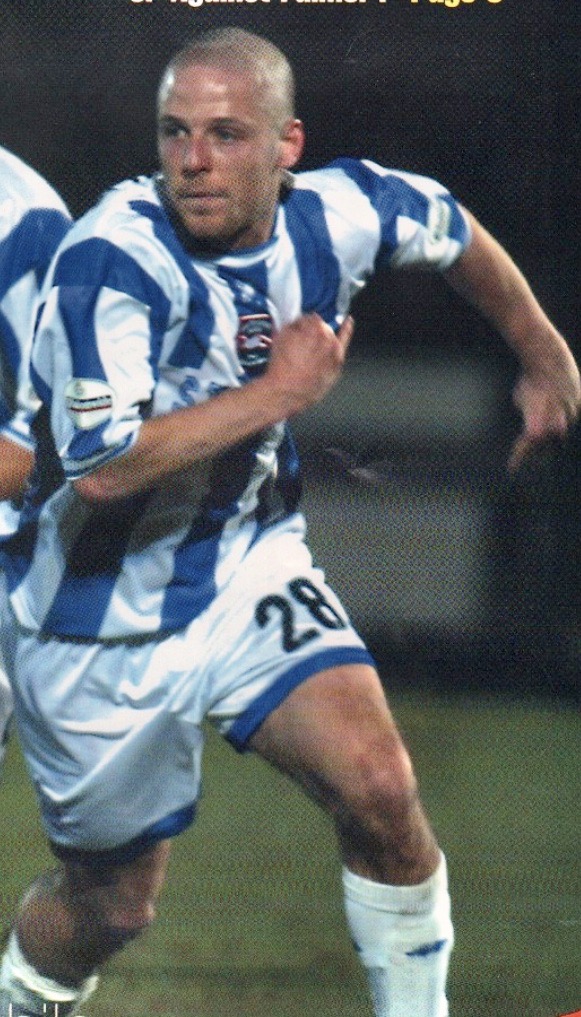

 Although he made 32 league starts plus 23 as a sub, ex-Albion boss


 WHEN Wolverhampton Wanderers slipped into the third tier, they urgently needed to loan out some of their higher-paid players – hence, in August 2013, the arrival at Brighton of left-back Stephen Ward.

 Perhaps it was no surprise that former Albion coach Nathan Jones stepped in to sign the experienced defender for Stoke City, where he’d taken on an often-perilous managerial hotseat.


 “I made my debut for Palace at 17 and played my first game in the Premiership at 18, so it was a great start and Palace will always be dear to me as a result,” Borrowdale told Spencer Vignes for a matchday programme article.


 Under Billy Davies, Halford was generally deployed as a striker but when Pearce took over at the City Ground, he didn’t get close to the first team. On his return from Brighton at the end of the 2014-15 season, he was released by Forest and joined Rotherham United on a free transfer.
 That spell was also brief and although he returned to Rotherham and played 15 games for them in the 2016-17 season, he then joined Cardiff City and made 33 appearances in two seasons for Neil Warnock’s side.
 In parallel lines