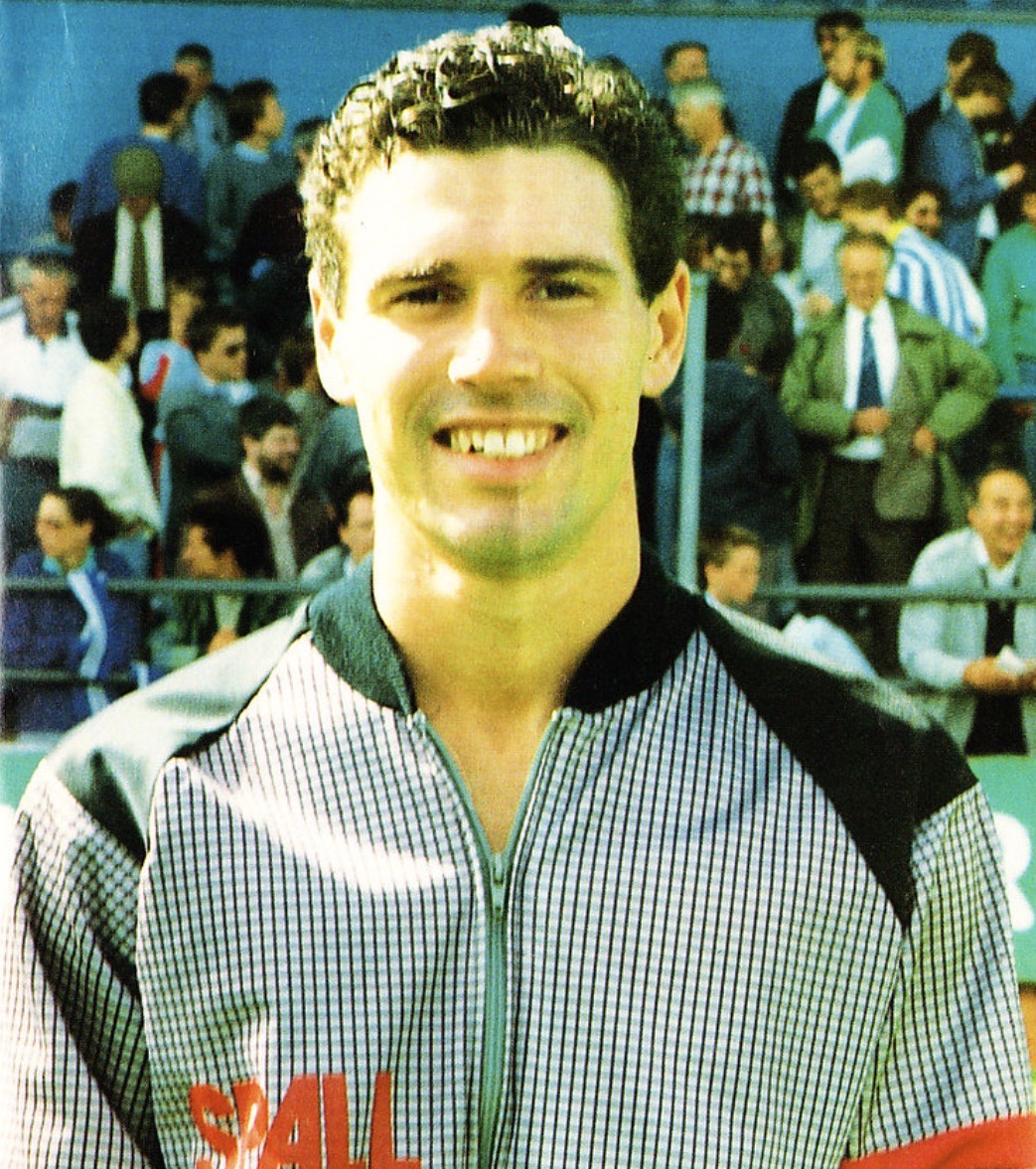
Striker who talks a good game helped Albion win promotion

ChrisI Stoke actionCHRIS Iwelumo played a vital cameo role in Brighton’s 2004 promotion from the third tier via that memorable play-off final in Cardiff.

After his playing days were over, he was a regular TV studio pundit offering his opinions on games, and he obtained a first class honours degree in sports writing and broadcasting from Staffordshire University.

Of the many clubs he played for – and there were EIGHTEEN of them – he obviously still has a deep affection for his first English club, Stoke City, and he continues to live in the area.

Born in Coatbridge, Scotland, on 1 August 1978 of a Nigerian father and Scottish mother, Iwelumo joined St Mirren as a youngster, and worked his way through the youth ranks before heading to Denmark and spending two years at Aarhus Fremad.

It was from there that he joined Stoke in 2000. His four-year stay on their books was the longest spell at any of his clubs, although it included three loan spells – the last of which saw him play 13 games for the Seagulls.

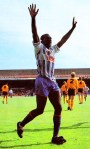
C Iwel stokeIwelumo reckons his proudest moment as a Stoke player was being part of the City side who beat Brentford 2-0 in a play-off final in Cardiff in 2002 (pictured above). It was to be useful experience to take to the Albion.

I can remember being at Saltergate on 16 March 2004, the evening he made his Brighton debut – and what a start he made. Iwelumo lashed in a long-range thunderbolt of a goal (below) seven minutes from time which earned the Seagulls a 2-0 win over Chesterfield on an unbelievably windy night.
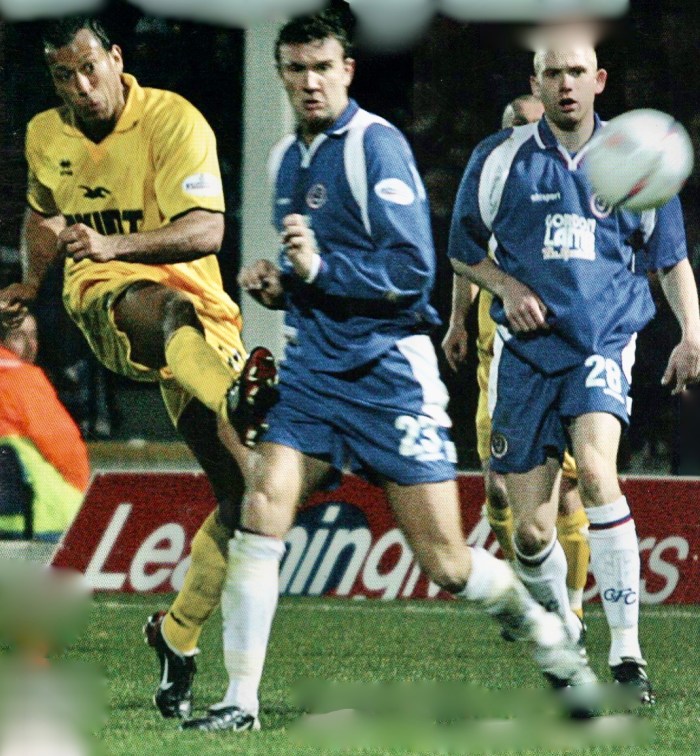
Guy Butters had given Albion the lead with a header from a Nathan Jones corner just after half time, and very nearly repeated the feat with a carbon copy of the move but second time round the ball struck the bar.

Iwelumo’s strike was the first of four goals in his 13 Brighton appearances but undoubtedly the most memorable was that game at the Millennium Stadium, Cardiff.

Here’s how bbc.co.uk saw it: “At the start of the second-half, City camped inside the Brighton half as Doherty and Tinnion took control of the midfield, though Danny Wilson’s side were unable to convert that possession into chances. But Brighton survived that period of pressure and gradually Iwelumo began to come into the game.

“His first contribution was not too impressive as he rushed his shot after being released by Adam Virgo’s wonderful diagonal pass. He went closer when his flicked header from John Piercy’s superb cross momentarily worried Steve Phillips.

“With seven minutes to go Iwelumo broke into the City box and as he prepared to shoot the striker was upended by (Danny) Coles’ clumsy tackle.

“(Leon) Knight calmly slotted his spot-kick into the corner past Phillips’s despairing dive.”

Iwelumo described what happened in a subsequent matchday programme article. “It was a clumsy challenge. I’d played a little one-two and nicked the ball in ahead of him and he’s just swung a leg and taken me out – it was a blatant penalty.”

Albion’s victory meant McGhee finally banished play-off disappointment – he had lost out in the play-offs three times as a manager and once as a player. Iwelumo, meanwhile, was keen to make the move to Brighton permanent – but he wanted Albion to pay relocation costs.

McGhee suddenly went under the radar on holiday in America and couldn’t be contacted to try to resolve the impasse and, in the meantime, Iwelumo was offered the chance to go to Germany, and Alemannia Aachen, who had qualified to play in the UEFA Cup.

In a subsequent matchday programme interview with Iwelumo, the Scot told Spencer Vignes that he loved his time at Brighton and had hoped to stay. “I was devastated at the time because the whole club was perfect for me,” he said.

An irritated McGhee made some unwise comments suggesting Iwelumo probably wasn’t good enough to play at the higher level anyway. What followed in the striker’s career certainly proved that theory wrong.

In 2005, he returned to the UK to join League One Colchester United and was part of the promotion-winning side who went up to the Championship, rattling in an impressive 37 goals in 103 games in two seasons.

He then spent the 2007-08 season in the Championship with Charlton Athletic, scoring 10 in 50 appearances for the Addicks.

Cost cuts at The Valley saw him made available and Mick McCarthy took him to Wolverhampton Wanderers where he notched 16 in 35 appearances, although he missed out on the end of season promotion run-in after sustaining a medial ligament injury. In the autumn of 2008, though, his performances for Wolves had caught the eye of the Scotland selectors.

Mind you, what happened on his Scotland debut on 11 October 2008 has haunted him ever since and is the stuff of YouTube legend. After coming on as a substitute in what was a World Cup qualifier, as the Daily Record reported: “On his debut in a 0-0 draw v Norway at Hampden, he missed from two yards out. Manager George Burley turned away in disbelief.”CI miss

“That miss against Norway was a low which ultimately, I like to think, represented a bump in the road of an otherwise successful journey through professional football lasting over two decades,” he told the Terrace Scottish Football podcast.

“Representing my country, enjoying five promotions, and collecting two cup winner’s medals. You cannot dwell too much on any single moment because it will impact upon the next performance.

“The highs are to be celebrated but, like the lows, are also to be learned from.”

He added: “I’ve looked at it over and over. The reason I missed that? I have no idea. I went back and scored ten goals in the next six or seven games for Wolves. I was on absolute fire. I’d already scored a few in the games before the call-up.

“The media were very harsh over the next two or three weeks. I think I was fortunate because I was playing down in England. I missed a lot of it.

“It is one of those things that haunts you. It was the highest and lowest moment of my career rolled into one. I got to go out and represent my country but then I’ve got that miss on my debut.”

As he pointed out in an interview with one of his former clubs, Scunthorpe United: “I was a centimetre away from being a national hero and I’m a very proud Scot, so that would’ve been a dream come true had it been the other way round.”

Although he played 15 league games and two cup games following Wolves’ promotion to the Premier League, he didn’t manage to score and in 2010 he was loaned out to Bristol City in the Championship, where he scored twice in seven matches.

For the start of the 2010-11 season, he was at yet another new club, in newly-relegated Burnley’s Championship side under Brian Laws (replaced by Eddie Howe in January 2011). Iwelumo made a total of 31 starts for the Clarets, plus 19 appearances as a sub, and got on the scoresheet 11 times.

After just one season at Turf Moor, Iwelumo was on the move again, this time joining Sean Dyche’s Watford on a two-year deal for an undisclosed fee. By now he was 32. In his first season he played 39 games but managed only three goals and endured a five-month barren spell in front of goal.

The following season he played just eight times for the Hornets and was sent on loan to two League One sides, Notts County and Oldham Athletic, only managing one goal in a total of 14 games at that level.

At Oldham, Iwelumo found himself playing under a manager – and a former Bristol City teammate – who was three years younger. Lee Johnson, at 31, had become the youngest permanent manager in English football in 2013 when he was appointed by the League One Latics.

“Chris actually wanted the job as well when I went to Oldham, so we were having discussions about the job and the club,” Johnson told The Athletic. “One of my first conversations with Chris — remembering he was my friend and helped me get the job — was literally to say: ‘Listen mate, I think your legs have gone, I’m not going to play you’.

“He was saying, ‘This guy has got a bit of b******s to tell me that’. I asked him to effectively be one of my assistants, still come on, still make a difference. He did that fantastically well. That was important. I had to get him onside.”

On his release from Watford, Iwelumo joined League Two Scunthorpe United for the 2013-14 season but only scored twice in 14 games and, after six months, he moved on to Scottish Premier side St Johnstone for a six-game spell but didn’t get on the scoresheet.

In June 2014, Iwelumo signed for Conference side Chester but after scoring just once in 10 matches decided to call it a day. Chester chairman Grenville Millington (who was once Brighton’s back-up goalkeeper to Brian Powney) said: “Chris has had a glittering career in football for over 20 years. I’m sure that he retires with a heavy heart but I’ve no doubt that he will continue his relationship with professional football for many years to come.”

Prescient words because a couple of years later he was back at the club as an assistant manager and then striker coach after stints doing media work for Stoke City and a week-long stay as coach of Wolves’ under 18s.

Albion picture from  Bennett Dean / Pitch Publishing’s We Are Brighton / Play Off Special; celebrating a goal from the Stoke City programme;  appearing on Channel 5’s Championship programme, and, as seen on the PFA’s website, graduating at Staffordshire University. 
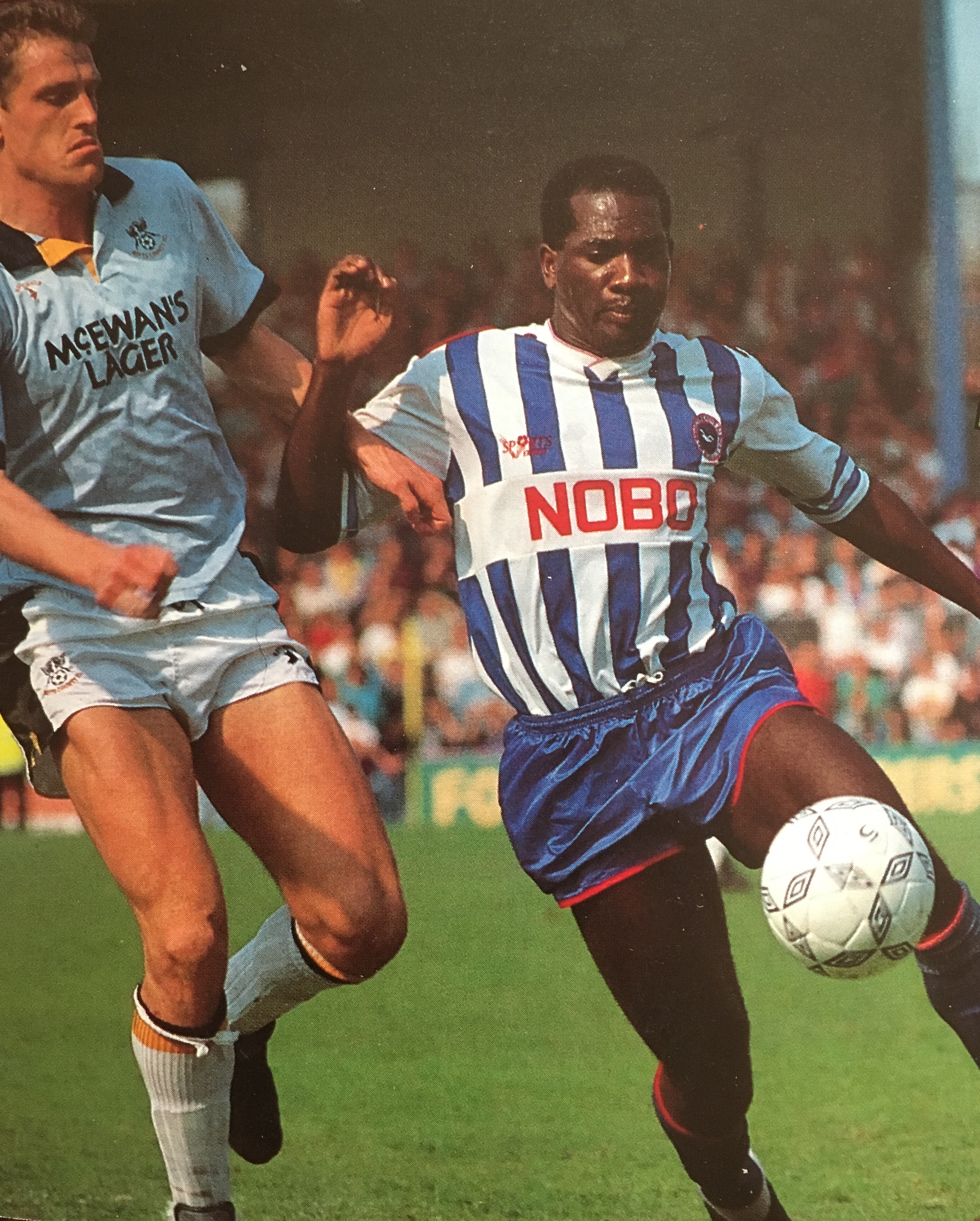
Small big hit for Albion before bubble burst at Hammers

1 short n small

FOOTBALL might well have changed a lot over the years but there are few sights that please fans more than seeing a great pair of strikers doing the business for their team.

The first excellent striking duo I witnessed playing for the Albion were Peter Ward and Ian Mellor, who complemented each other ideally in the mid ‘70s.

Kevin Bremner and Garry Nelson provided a potent third tier pairing, especially in the promotion-winning season of 1987-88, and Brighton’s next top pairing nearly took the Albion back to the top, only for Wembley play-off final heartbreak to dash all our hopes.

Step forward Mike Small and John Byrne, forever etched in the memories of those Albion followers who go back as far as the 1990-91 season. Small scored 21 goals in 49 games that campaign while Byrne chipped in with 11 in 38 (plus four as sub).

The history books haven’t always looked favourably on Barry Lloyd’s time in Brighton’s managerial chair but few could deny him the plaudits for bringing together two players who had drifted away from the UK in pursuit of developing their careers.

Small had what could only be described as a nomadic career. Born in Selly Oak, Birmingham, on 2 April 1962, his talent on the football field earned him England Youth international honours and he joined Luton Town under David Pleat.

His first team chances were limited with the Hatters because of the form of Brian Stein, Steve White and Paul Walsh although in December 1981 I witnessed, along with one of the smallest crowds ever seen at the Goldstone – 2,282 – a brief substitute appearance Small made for Luton.

It was in the 1981-82 season when I was briefly a news reporter on the Luton Herald. In what was quite a bad winter, several postponements left certain teams with empty Saturdays. Division 2 Luton and Division 1 Brighton filled one of these with a friendly at the Goldstone Ground.

Knowing my affiliation with Brighton, the editor kindly allowed me to dust off my sports reporter notebook and take myself off to Hove. It was my one and only time in the Goldstone press box, sitting alongside that Argus veteran, John Vinicombe, and I dutifully recorded how Small got a run-out as a sub for the last 20 minutes of a game which finished 1-0 to the Albion.

With playing time limited at Kenilworth Road, Small had a brief loan spell at Peterborough before taking himself off to Europe where he started showing his goalscoring capabilities.

In two spells with Go Ahead Eagles (1983-85 and 1986-87) he scored 22 goals in 78 appearances either side of 25 games for Standard Liege in Belgium.

The goals dried up in 23 games on loan to NAC Breda but at Vitesse Arnhem in 1987-88, he scored 12 in 26.

From the Low Countries, he travelled to Greece and had two years with PAOK Salonika, where he encountered some unwanted fanaticism from their supporters, on one occasion ending up with a cut eye after an attack by 50 local ‘fans’ at a practice session and also receiving letters threatening his life.

In an article about the striker’s arrival at Brighton by the aforementioned Vinicombe, he wrote: “Nobody knew much about Small save a thumbnail history of his low-key wanderings in Europe. Even the fee to PAOK Salonika was undisclosed, but the grapevine whispered £70,000 and Lloyd issued no contradiction.

“It was as if Small had returned to his native land by stealth after an absence of nearly ten years and Lloyd, through a close-linked chain of overseas contacts, soon realised he might be on to something good.”

His return of four goals in pre-season friendlies having joined on a trial basis were a good indicator of what might follow and he turned down offers from overseas clubs to re-establish himself in the UK with Brighton.

Vinicombe summed up the goalscoring Small’s contribution thus: “A muscular six footer who weighs over 13 stone, he cuts a fearsome figure for opposition defences. Off the pitch he’s a remarkably quiet guy who doesn’t really relish the ‘big target man’ tag.”

Small told the Argus man: “I like it when the ball is played through and not just lumped up the middle. John Byrne is a great foil and a good link-up player and I don’t think I should be in there crowding him out.

“John is a real showman. When he takes a breather, I take over and we work as a team.”

Of Small’s 21 goals in 1990-91, seven were from the penalty spot.

“His coolness and accuracy in one-for-one situations has served Albion well on many an occasion and the only interruption during the season was recovering from a pulled hamstring,” Vinicombe observed.

The story of Small’s partnership with Byrne was told in the short-lived Seagull News magazine, when an interview with the pair revealed some of the chemistry that produced what it described as the “hottest Goldstone striking duo for over a decade”.

In a relatively parlous state at the time, Albion had been forced to sell ‘keeper John Keeley to Oldham (£238,000) and Keith Dublin to Watford (£275,000), but it meant Lloyd had funds to pay reasonable fees for Small and Byrne; a £120,000 fee acquiring Byrne’s services from Le Havre, where he’d been playing up front with his Republic of Ireland teammate, Frank Stapleton.

“I knew of a John Byrne in France but didn’t know what he was like or how he played,” Small told Seagull News. “But we soon hit it off. He’s such a good player on and off the ball and he’s got bags of experience which helps me a lot.”

The two got to know each other well when staying in the same Brighton hotel after their respective moves, before finding homes for their families.

Both made the most of the limelight of a high profile FA Cup tie between Liverpool and Brighton and got themselves on the scoresheet.

“It’s been a tremendous season for us so far,” said Mike. “We’ve developed a great understanding but it’s Budgie who leads. He’s involved a lot more in the play linking midfield and attack and creates a lot of openings and situations – far more than people realise – by dragging players away.

“Opponents have been finding it difficult to cope with us because we both like to run at defences and get behind them.”

Byrne added: “We hit it off from the very beginning. We’re great mates off the pitch and that helps. But the big boost for us and the team is that we always feel we can score.

“Mike’s impressed me immensely. He’s got great touch for a big man, he scores goals and is a real handful for any defender – I wouldn’t like to mark him!”

Small’s last goal for the Seagulls came in one of the most memorable games: the 4-1 play-off first leg win over Millwall at the Goldstone.

Sadly, Albion’s failure to win the play-off final spelled the end of the glorious goalscoring partnership and, in that canny way he had in the transfer market, Lloyd managed to get a sum of £400,000 for Small – quite amazing considering the club’s initial outlay barely a year earlier – but West Ham were prepared to stump up the readies and Brighton were more than happy.

Likewise, Byrne was sold to Sunderland for £235,000, delivering a sizeable profit on the club’s original investment.

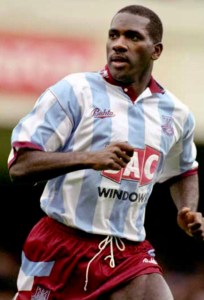
Manager Billy Bonds must have thought he was a managerial genius when Small continued his rich vein of goalscoring form in the top division. He scored 13 goals in just 19 starts.

A West Ham side that included future Albion boss Chris Hughton in its defence had been promoted but was in need of new firepower after only Trevor Morley (12) and Frank McAvennie (10) had hit double figures. Iain Dowie and Jimmy Quinn had also chipped in but, with Dowie departed, Bonds needed a physical presence up front.

Writer Sid Lambert on thewesthamway.co.uk takes up the story.

“Small fit the bill perfectly. He was in-form and, more importantly, very affordable at just £400,000.

“Incredibly, Small took that red-hot form straight into the top tier. He took just two games to get off the mark, scoring in a 1-1 draw at Sheffield United. In the next home game he scored as the Hammers beat Aston Villa 3-1.

“We had five points from our first four games and had only suffered defeat once. Things were looking promising. As is the West Ham way, that promise started to fade. But Small’s ruthlessness in front of goal didn’t. He scored in successive games against Chelsea, Norwich and Crystal Palace, where a precious three points kept us out of the relegation zone.

“It wasn’t just sheer volume, Small was scoring every type of goal: tap-ins, headers, one-on-ones. The Birmingham-born man was brimming with confidence. Everything he hit turned to gold.

Small Hammer

“A seven-day spell at the end of October 1991 was Small’s finest hour in claret and blue. He scored the equaliser – cancelling out an early strike from Gary Lineker – as we beat Tottenham 2-1 at Upton Park. In midweek a penalty helped us to a 2-0 League Cup win at Sheffield United before we travelled to Highbury to face George Graham’s Arsenal.

“After absorbing heavy pressure throughout, the marauding Mitchell Thomas led a rare Hammers’ break into the Arsenal half. Tim Breacker fed the ball to Small, who easily eluded Tony Adams before unleashing a left-foot screamer past David Seaman. In a split-second he’d embarrassed two of England’s very best.”

West Ham were 14th place and Small could seemingly do no wrong.

“By now, he was the country’s in-form striker and there were even whispers that Graham Taylor might consider him for England duty,” said Lambert.

“The only thing to match his meteoric rise was the fall that followed. It took three months for Small to score again, a winner at Luton Town. By now, we were mired in the bottom three. Small’s confidence, like the team, had completely evaporated. The first touch was less assured and the finishing hesitant.”

A niggling back injury was thought to have contributed to Small’s malaise but he and the team failed to replicate their early season form and finished rock bottom of the division.

When Clive Allen arrived at Upton Park, Small fell down the pecking order and towards the end of 1993-94 was sent out on loan to Wolves and Charlton.

After leaving the Hammers, he played briefly for BK Häcken in Sweden, Stevenage Borough, then Sligo Rovers and Derry City in Ireland, but the heady days were well and truly over.

A brief foray into coaching and management saw him involved with non-league clubs Haringey Borough, Kingsbury Town and Waltham Forest but all were shortlived.

Further reading

http://www.thewesthamway.co.uk/2016/11/22/forgotten-man-mike-small/

‘Save of the season’ one of few bouquets for goalkeeping florist Alan Blayney

blayney intenseGOALKEEPER Alan Blayney only played 15 games on loan to Brighton from Southampton but if finances had been better at the time he could have signed permanently and his career may have taken a different turn.
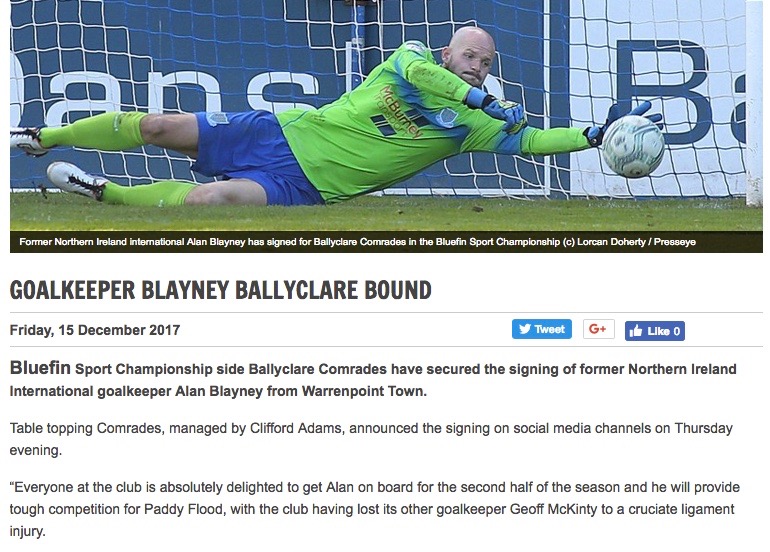
Blayney is still playing, nifootballleague.com reporting only in December 2017 a move to Ballyclare Comrades from Warrenpoint Town. He also runs a florist business with his wife Laura in Newtownabbey.

Only a month earlier he opened his heart to the belfasttelegraph.co.uk and talked about the demons he’s had to face during a career that rarely hit the heights in England but has seen him represent his country and enjoy success in his native Northern Ireland.

Born in Belfast on 9 October 1981, Blayney was picked up by the city’s Irish league side Glentoran at 16 before moving to the UK aged 19 to join Premier League Southampton.

Blayney was initially loaned out to Stockport County, but his time there was cut short by a broken finger.

He also had a couple of games along the coast at Bournemouth when he suffered one of his most embarrassing goalkeeping moments. In a Q and A for the Albion programme, Blayney told interviewer Dan Tester: “I’d rolled the ball outside the 18-yard box in readiness to kick it up field. The Rochdale striker, my former Northern Ireland under 21 teammate Lee McEvilly, was running away and it hit him on the head and flew over mine into the back of the net.”

Back at Southampton, the young ‘keeper finally got a first team chance in May 2004, a couple of months after Paul Sturrock had replaced Gordon Strachan as manager.

It was some debut because the game against Newcastle United finished 3-3 and a save Blayney made from an Alan Shearer header won him the accolade of Sky Sports save of the season.

The young Irishman kept his place for the following game, a 2-1 defeat at Charlton and he played twice more the following season, in a 2-2 league draw against West Bromwich Albion and a 5-2 League Cup defeat to Watford.

With future Albion goalkeeping coach Antti Niemi and Paul Smith ahead of him in the pecking order, Blayney went on loan to Rushden & Diamonds, where he played four games, before securing the first loan to Brighton in early 2005.

Albion’s regular ‘keeper Michel Kuipers had sustained a horrific shoulder injury in a home game against Nottingham Forest and the no.2 at the time, Chris May, had no experience so manager Mark McGhee needed emergency reinforcements.

Initially he obtained David Yeldell from Blackburn Rovers and also brought in Rami Shabaan from Arsenal, but Blayney, no doubt recommended by McGhee’s old pal Strachan, became the preferred option and played seven games at the end of the season.

Amongst several impressive displays was a game I went to with my son, Rhys, at Burnley, on 16 April 2005.

Against the odds, it finished 1-1 but the media was keener to focus on the post-match news that striker Mark McCammon had been ordered off the team bus by McGhee for his reaction to being substituted at half time.

Reporter Peter Gardner, on telegraph.co.uk, said: “The incident overshadowed a rousing second-half comeback to a game Brighton might ultimately have won, not least through the contribution of Jake Robinson, McCammon’s half-time replacement.

“However, McGhee’s men were equally fortunate not to have been overwhelmed by the home side in the opening 45 minutes when only splendid saves by Alan Blayney from Graham Branch (twice) and Mo Camara, plus Burnley’s own profligacy, prevented an avalanche of goals.”

Blayney was also between the sticks for the nail-biting final game of the season when a 1-1 draw with Ipswich Town kept the Seagulls in the Championship by the skin of their teeth.

Such had been Blayney’s contribution that McGhee was keen to sign him permanently, the manager telling skysports.com: “Alan did absolutely brilliantly here for us. We have to see how realistic an option that is, and whether they’re even prepared to consider letting him go, and what the conditions would be.”

The answer was that Brighton couldn’t afford the fee Southampton wanted so at the start of the following season Wayne Henderson was brought in instead on a three-month loan from Aston Villa.

When Henderson returned to Villa, McGhee was keen to buy him outright but in the meantime brought Blayney back for an eight-game stint.

Blayney told BBC Southern Counties Radio: “If I don’t perform they’ll end up going for Wayne instead of me. I have to come in and show I’m as good as Wayne, if not better. This first game at Stoke is really important.”

Unfortunately, the game at Stoke ended in a 3-0 defeat and a 3-2 reverse at home to Crystal Palace followed.

After a point was gained away at Cardiff City, Blayney saved a penalty from Inigo Idiakez in a 0-0 draw with Derby at Withdean on 26 November 2005, and the following week he helped earn another point, repeating the feat against Watford’s Marlon King.

The Watford Observer reported: “King passed up a glorious chance to fire Watford ahead on 58 minutes when he saw his penalty saved. King’s tame penalty was parried by Blayney, who dived low to his left, and the keeper then gathered the rebound.”

After a 5-1 hammering away to Reading, Blayney returned to Southampton in mid-December and within a matter of weeks Southampton’s technical support director, Sir Clive Woodward, informed him he had been sold to Doncaster Rovers for £50,000.

Blayney told the Belfast Telegraph in November 2017: “My response was, ‘Do I not have any say in this?’ He said the deal was done but I didn’t want to live in Doncaster. I loved it in Southampton. I didn’t settle in Doncaster, they gave me an apartment, but it was a tip. If I was getting those wages now I would bite your arm off but then it felt I wasn’t getting much and it was a terrible time.”

Although he started out as no.1, and made 24 appearances for Rovers, following an ankle injury he slipped to third choice behind Ben Smith and Jan Budtz, and came to an agreement to terminate his two and a half year contract early.

Blayney admitted in his Belfast Telegraph interview: “I do regret going out and drinking in my later career in England when I was at Doncaster. I was getting injuries and was a bit disillusioned with the game. I regret it because people had opinions of me at that club which is not the real me. They only saw me behave like that for a few months.”

He wasn’t quite done with England, though, and in February 2007 joined League One Oldham Athletic until the end of the season, after impressing in a reserve team match. However, he only played one first team game, in a 1-2 home defeat against Bournemouth.

There had been the possibility of a return to Brighton to replace Henderson, who had been sold to Preston, but the Argus reported on 2 February 2007: “Albion are not re-signing goalkeeper Alan Blayney after all. They have not been able to agree a length of contract with the former loan signing.”

On his return to Northern Ireland, he initially managed just three games as an understudy at Bohemians, but then he played 32 times for Ballymena United in 2008-09 as a prelude to what would turn out to be the most successful period of his career.

In five seasons with NIFL premiership side Linfield, he played 164 games and, in 2010-11, when Linfield won the league and cup double, he was named Ulster Footballer of the Year.

His form for Linfield also earned him a recall to the Northern Ireland squad. He had initially made his debut in 2006 under Lawrie Sanchez on a summer tour of the United States.

An appearance from the bench in a drawn friendly against Morocco in November 2010 saw Blayney concede an embarrassing goal as his clearance rebounded off Marouane Chamakh, then of Arsenal, to give the Africans the lead.

Manager Nigel Worthington put the incident into context after the game, telling the media Blayney had travelled to the ground just hours after his partner had given birth to a son.

“I was disappointed for Alan but it has been a terrific day for him and we have come out of the game unbeaten,” said Worthington. “He’s fine and I have given him every encouragement. It is one of those you learn from. You cannot take a split second to delay.”

Blayney said it was the worst moment of his career. He told the Belfast Telegraph: “I came on at half-time for Jonny Tuffey but took a terrible touch and Chamakh came in to challenge me. I kicked the ball off him and it went into the net.

“Everybody had welcomed me onto the pitch and you don’t forget moments like that. You aren’t used to playing against players who are as quick as that. I looked up and he was there. I wanted the ground to swallow me up but earlier that same day Phoenix was born. It was a bittersweet day.”

In May 2011 Blayney shared goalkeeping duties with Tuffey as an inexperienced Northern Ireland team endured an embarrassing Carling Nations Cup defeat to the Republic of Ireland. Although left exposed by a threadbare defence, Blayney was culpable in at least two of the goals in a 5-0 hammering, one of which was scored by debut-making Stephen Ward, a future left back loanee for the Seagulls. bbc.co.uk reported: “Blayney was badly at fault six minutes later as he spilled a tame Treacy cross which allowed Ward to poke home from close range.”

With Linfield, Blayney continued to rack up honours until they signed Tuffey in 2013, and he was no longer first choice. In January 2014, he joined Ards on loan but couldn’t help them avoid relegation.

After spending 2014-15 with Glenavon, he returned to Ballymena where he had two successful seasons, before losing his place. In January 2017, he dropped down to the Premier Intermediate League with Dundela. At the start of this season, he returned to the higher division with Warrenpoint Town but, in December, moved to be closer to home, with semi-professional Ballyclare.

Blayney savedec 17 blay cutBlayney cover

Further reading

https://www.not606.com/threads/whatever-happened-to-alan-blayney-part-5-of-many.126334/

https://www.belfasttelegraph.co.uk/sport/football/irish-league/footballers-lives-with-alan-blayney-why-ive-been-gripped-by-selfdoubt-and-how-i-almost-died-after-training-36284956.html

http://news.bbc.co.uk/sport1/hi/football/teams/b/brighton/4102810.stm

http://nifootball.blogspot.co.uk/2006/08/alan-blayney.html

Injury-plagued ‘keeper Ben Roberts part of ‘Boro Cup folklore before Brighton promotion

2 pen shoot-outBEN ROBERTS might only have played a handful of games for Middlesbrough in seven years on their books but one of them will never be forgotten.

He was between the sticks for ‘Boro when Chelsea’s Roberto di Matteo scored one of the quickest ever FA Cup Final goals.

Thankfully, Brighton fans prefer to remember him as the ‘keeper who helped the Seagulls to promotion from the third tier via the play-offs in 2004.

“That season at Brighton remains one of my best experiences in football,” Roberts told beatsandrhymesfc.com’s Christian Brookes, in a 2011 interview.

“Apart from enjoying living in the city, I remained relatively injury-free and played the most games of my career. So for a full season’s work to come down to one day in the Millennium Stadium with a full house in attendance was a very special memory.”

No-one knew at the time, of course, but it was also Roberts’ last game in goal for the Albion because a back injury forced him to retire from the game prematurely in 2005, aged just 29.

In an extended interview with Dominic Shaw for gazettelive.co.uk in December 2017, Roberts looked back on his time at ‘Boro and a playing career that was beset with injury.

Born in Bishop Auckland on 22 June 1975, the young Roberts was spotted playing for South Durham Boys by Dennis Cooper, father of ‘Boro legend Colin Cooper, and the club took up his recommendation. Roberts would set off by bus from his home in Crook at 6am each day to get to training on time in Middlesbrough, nearly 30 miles away.

At one point, it looked like he wouldn’t get the chance to continue his career because he was deemed too short, but he fed his face throughout the summer, shot up the required inches, and was rewarded with a two-year scholarship.

In fact, he was still a YTS scholar when he got his first involvement with the first team, being named on the bench for two of Boro’s first three games in the inaugural season of the Premier League (1992-93).

However, it was another two seasons before he actually got into first-team action, making his debut in an Anglo-Italian Cup game against Ancona, with Bryan Robson by then in the managerial hotseat.

In the 1994-95 season, Roberts got league experience under his belt during loan spells with Hartlepool and Wycombe Wanderers and the following season he went on loan to Bradford City before returning to Middlesbrough to help out a goalkeeping crisis.

Injury to Gary Walsh presented Roberts with his chance, and, aged 21, he made his ‘Boro league debut on 18 January 1997 in a 4-2 win at home to Sheffield Wednesday.

Although Mark Schwarzer arrived at the club, he was also hit by injury – and was cup-tied in the FA Cup – leaving Roberts, 21 at the time, as the stand-in No.1.

On 1 April that year, he also earned his one and only international cap, coming on as a sub for Chris Day as England under 21s drew 0-0 with Switzerland at Swindon’s County Ground. Also in the team for that friendly were Rio Ferdinand, Jamie Carragher, Darren Huckerby and Lee Bowyer.

Two of Roberts’ 17 appearances for ‘Boro that season were in cup finals: in the replay of the League Cup Final against Leicester City, and then the FA Cup Final against Chelsea at Wembley.

Roberts started the following season as first choice because Schwarzer was still out injured, but his final appearance of the season – at home to Birmingham in the September – was his final appearance for the club.

Several treatments for a back injury were unsuccessful and at one stage, still only 24, he feared he’d be forced to retire, until he underwent surgery in London. As well as operating on problematic discs, the surgeon found a blood clot in his back.

In between back operations, Roberts went out on loan again and in 1999 played 14 games for Division Two side Millwall, including another Wembley appearance, this time against Wigan in the Auto Windscreens Shields Trophy. The Latics won 1-0 with the winning goal scored by future Albion captain, Paul Rogers.

The following season, Roberts had another loan spell, this time at Lennie Lawrence’s Luton Town and in the summer of 2000 he finally left ‘Boro and joined Charlton Athletic. However, he played only once for the Addicks, coming on as a sub in the final game of the 2002-03 season after regular no.1 Dean Kiely had been sent off.

Roberts greenPrior to that, Roberts had been out on loan again, initially at Reading and then returning to Luton. His first association with Brighton also came in that season, as Steve Coppell’s Seagulls were battling hard to avoid relegation from the second tier.

He played three times and I remember one of those games was one I went to away at Bradford City (a 1-0 win) on 15 February 2003, when he pulled off some terrific stops on a rock-hard pitch. The most memorable came early in the game and Roberts rated it as his best as a Brighton player.

“It was only after five minutes and Ashley Ward had a clear header inside the six yard box, but I got to it. I shouldn’t have, but I did,” he recalled in a matchday programme interview. “It (the game) shouldn’t have been played because the goalmouth was like a skating rink and that kind of set the tone.”

Unluckily for Roberts, he then picked up a dose of ‘flu and veteran Dave Beasant took over and kept the shirt until the end of the season.

However, Coppell saw enough to persuade him to sign Roberts permanently and, as referred to earlier, the 2003-04 season was to be the one time when he finally made his mark, culminating in the 1-0 win over Bristol City at the Millennium Stadium in Cardiff.

When his back injury problems returned and ruled him out of the whole of the 2004-05 season, he quit the game and went travelling to South America, Asia and India before returning to the UK and going to Roehampton University to take a sports science and coaching degree.

Not only did he achieve first class honours, his dissertation on biomechanics (which applies the laws of mechanics and physics to human performance) earned him a ‘Pursuit of Excellence’ award from Adidas.

Although he intended to stay in the world of academia, his old Brighton teammate, Nathan Jones, persuaded him to join the coaching staff at Yeovil Town.

“I was at a stage where I missed the banter, the day-to-day interaction and being outside,” he said. “I went down and loved it and that turned into my career. ”

While at Yeovil, he worked with Alex McCarthy, who later played for Southampton in the Premier League, and the much-travelled Stephen Henderson, who has played for Charlton, Nottingham Forest and Crystal Palace.

Roberts himself had the briefest of returns to league action when in October 2010 he appeared as a substitute in a 3-3 draw against Swindon, replacing the injured Henderson at half-time and conceding two late goals.

At the end of that year, he followed Jones to Charlton Athletic and in four and a half years at The Valley worked with Rob Elliot (later with Newcastle), Ben Hamer (Leicester), David Button (who became Mat Ryan’s deputy at Brighton) and Nick Pope (Burnley).

When, in the summer of 2015, the goalkeeping coach role at Brighton was vacated by Antti Niemi, who returned to Finland for family reasons, Roberts jumped at the chance to link up once more with coach Jones, then part of Chris Hughton’s management team.

Skysports.com quoted Roberts at the time, saying: “I’m ecstatic to be back at Brighton. I’ve made no secret that my happiest years as a professional footballer were spent down here, as I had a special affinity with the fans at Withdean.”

While that role continues it would be remiss not to mention THAT ‘Boro v Brighton Championship clash at the Riverside in May 2016. He told gazettelive.co.uk: “Obviously you want to win and it was so, so tight. My best mate and best man, Adam Reed, is a physio at ‘Boro and seeing him in the tunnel afterwards so happy with his kids, that levelled out the disappointment a little bit for me.

“It was still so hard to take, though. Adam said he felt a bit awkward as well and didn’t want to celebrate too much, but we were on holiday together a couple of weeks later and I was philosophical about it.”

Roberts continued as Albion’s senior goalkeeping coach after Hughton was succeeded by Graham Potter and, somewhat controversially, followed Potter to Chelsea when the manager took almost all of his backroom team to Stamford Bridge in September 2022. He retained the goalkeeper coach role at Chelsea after Potter was sacked.

Brighton pictures from Bennett Dean / Pitch Publishing’s We Are Brighton / Play Off Special;  from online, celebrating ‘Boro promotion with Bryan Robson and Nigel Pearson; flying the flag for Reading, and the Albion matchday programme.

Colin Pates added class to Brighton’s defence

1 Pates profile.jpgFORMER Chelsea captain Colin Pates added a touch of class when he joined Albion, initially on loan (1990-91) from Arsenal and then permanently (1993-95).

He was a key figure in the team which reached the 1991 Division Two play-off final against Notts County, playing in the same side as his former Chelsea teammate Clive Walker.

Young Irish centre back Paul McCarthy had been at the centre of Albion’s defence (alongside Gary Chivers) for the opening part of the season but when injury ruled him out, manager Barry Lloyd pulled off something of a coup to persuade his old Chelsea teammate, George Graham, then manager of Arsenal, to loan Pates to the Seagulls for three months.

In a special Argus supplement Go for it Seagulls! previewing the play-off final, Albion reporter John Vinicombe described it as a “masterstroke” and added: “It is doubtful if Albion would have made it without him.”

In the same publication, Lloyd’s faithful no. 2, Martin Hinshelwood said Pates had got better and better since joining. “He has steadied us a little bit. He talks to players, he is a great trainer and he has brought a lot to our back four.”

In an extended interview with the Argus in October 2001, Pates recalled: “It was a good time. The result in the play-off final didn’t go our way but it was a fantastic experience for the team to play at Wembley, the side was so close to the Premiership, or First Division as it was called then.

“I’d been lucky to have played there before but to others it was the pinnacle of their careers.”

Reflecting in a subsequent matchday programme article, Pates said: “We came with a fantastic late run in the league but it proved to be a game too far for us. We made a slow start to the game and that defeat still hurts, knowing what it meant to everyone connected with the club.

“I know we changed formation that day and maybe that contributed to our defeat but I didn’t look at it like that – it was just one of those games where it wasn’t meant to be.”

After the disappointment of the loss to Neil Warnock’s County, there was a suggestion Pates might make the move to Albion permanent, but he recalled: “I think Arsenal’s valuation was much higher than the club could afford, so I went back.

“I was a bit-part player but it was a good time to be at the club with the cup finals and being part of the squads.”

With Tony Adams and Steve Bould the first choice centre backs, and David O’Leary and Andy Linighan in reserve, first team games were few and far between, but he did play 13 times (plus two as sub) in 1991-92 then twice (plus five as sub) in 1992-93, before being released in the summer of 1993.

Lloyd’s time in the Albion manager’s chair was nearing its end but he picked up Pates on a free transfer and the defender played 61 games before a bad knee injury brought his professional career to an end in January 1995.

Towards the end of his time at the Albion, he’d moved out of the centre to play left back.

In that Argus interview in 2001, he explained how he had been grateful to accept the advice of Lloyd’s successor as manager, Liam Brady. “Liam told me that I should think of my health before my playing career and that I would be a fool to myself if I carried on playing.

“My knee had fallen apart and it was the right advice. If I’d ignored it I could well have ended up not being able to walk. Footballers need to be told when it is the end. I’ll always be grateful to Liam for that.”

Born in Carshalton on 10 August 1961, Pates made his way through the youth teams at Chelsea and made his debut at Stamford Bridge in an astonishing game which saw Chelsea beat Orient 7-3!

“I just remember Geoff Hurst, who was our manager at the time, coming up to me on the Friday and telling me that we had a few injuries so I was playing,” Pates told the official Chelsea website. “He literally just said: ‘Tomorrow you play,’ and that was it. Micky Droy was injured but he was brilliant with me, he gave me loads of advice and came to the game to support me.

“It certainly wasn’t a good advertisement for defenders but as long as you come away with the win the fans are happy. It’s one of those days where you’re so fired up it just goes so quickly. You come off the pitch at the end and have no recollection of what happened really. I was up against some good, experienced pros and it was quite daunting, but I really enjoyed it.”

It seems remarkable now but Chelsea only narrowly avoided relegation to the old Third Division in 1983, and, as a result, manager John Neal had quite a clear-out of players but Pates’ performances and attitude earned him the captain’s armband just before his 22nd birthday.

pates connor“I think he wanted someone who had come through the ranks and knew the club,” Pates said. “I was fortunate enough to be one of the few players – along with the likes of John Bumstead – who he kept on from before.”

Pates added: “I loved John Neal, he was a man of few words but when he said something you listened because it was going to be something poignant or important. He was a good man-manager and would always take care of you if you had problems and be there for a chat. You wanted to play for him.”

The club’s fortunes changed after they brought in the likes of Kerry Dixon, David Speedie and Pat Nevin and they soon returned to the elite as Second Division champions in 1984.

Two years later, Pates was holding another trophy aloft – the Full Members’ Cup – after a dramatic 5-4 win over Manchester City at Wembley which, extraordinarily, was played the day after they’d played a league game in which they’d won 1-0 at Southampton. Pates made history by becoming the first-ever Chelsea player to lift a trophy at the iconic stadium (when Ron Harris lifted the FA Cup in 1970 it was at Old Trafford, where the replay had taken place after a 2-2 draw at Wembley).

“It’s great to play at Wembley with thousands of fans screaming their heads off, and once you’re on the pitch you don’t care what cup it is, you just want to win it,” said Pates.

After 346 league and cup appearances for Chelsea, he was surprisingly sold to Charlton Athletic for £430,000. When the Albion visited Chelsea for a Division 2 league game on 29 October 1988, the matchday programme carried an article headlined ‘Colin’s farewell’, detailing the circumstances.

“The transfer of Colin Pates to Charlton Athletic not only surprised many Blues fans but Colin himself,” it began.

“It came right out of the blue,” said Pates. “Bobby Campbell told me that a First Division club wanted to sign me. At first, I was taken aback. I have been at Stamford Bridge since I was a schoolkid. Chelsea has become a way of life.”

However, he agreed to talk to Charlton boss Lennie Lawrence and was delighted to have made the move.

“After 11 years at Stamford Bridge, this is a new lease of life for me,” Pates told the programme.

In January 1990, aged 28, he joined Arsenal for £500,000, even though it was clear he would be a back-up. “I knew this was going to be the last opportunity to have a move like this in my career and although I knew I was only being signed as cover, I couldn’t turn it down.

“When I first met George (Graham) in his office at Highbury, he was honest and straight talking. He told me I’d have to work hard to get into the side.”

However, within a month he made his Gunners debut at left back in place of the injured Nigel Winterburn in a 1-0 defeat to Sheffield Wednesday.

Although he found it difficult to motivate himself for reserve team football, he pointed out: “I still enjoyed the training sessions with the first team and I did learn a lot about defending from George, even at that late stage in my career.”

Pates also famously scored a goal in a European Cup match at Highbury against a Benfica side managed by Sven-Goran Eriksson.

On his release from Brighton, Pates had a spell as player-manager of Crawley, played a handful of games for non-league Romford, and coached youngsters in various places including Mumbai in India and the Arsenal School of Excellence.

He subsequently became head of football at the independent Whitgift School in South Croydon, where he coached most sports and saw pupils Victor Moses and Callum Hudson-Odoi go on to have professional careers.

Pates also went back to Stamford Bridge on matchdays working in the hospitality lounges.

Further reading

http://www.theargus.co.uk/sport/6772423.Pates_is_on_a_mission_with_a_squad_of_1_400/

http://www.chelseafc.com/news/latest-news/2017/02/foot-in-both-camps–colin-pates.html

2 Pates in Chel prog

Controversial Gonzalo Jara Reyes won’t forget Brighton

Jara BHA blue and white

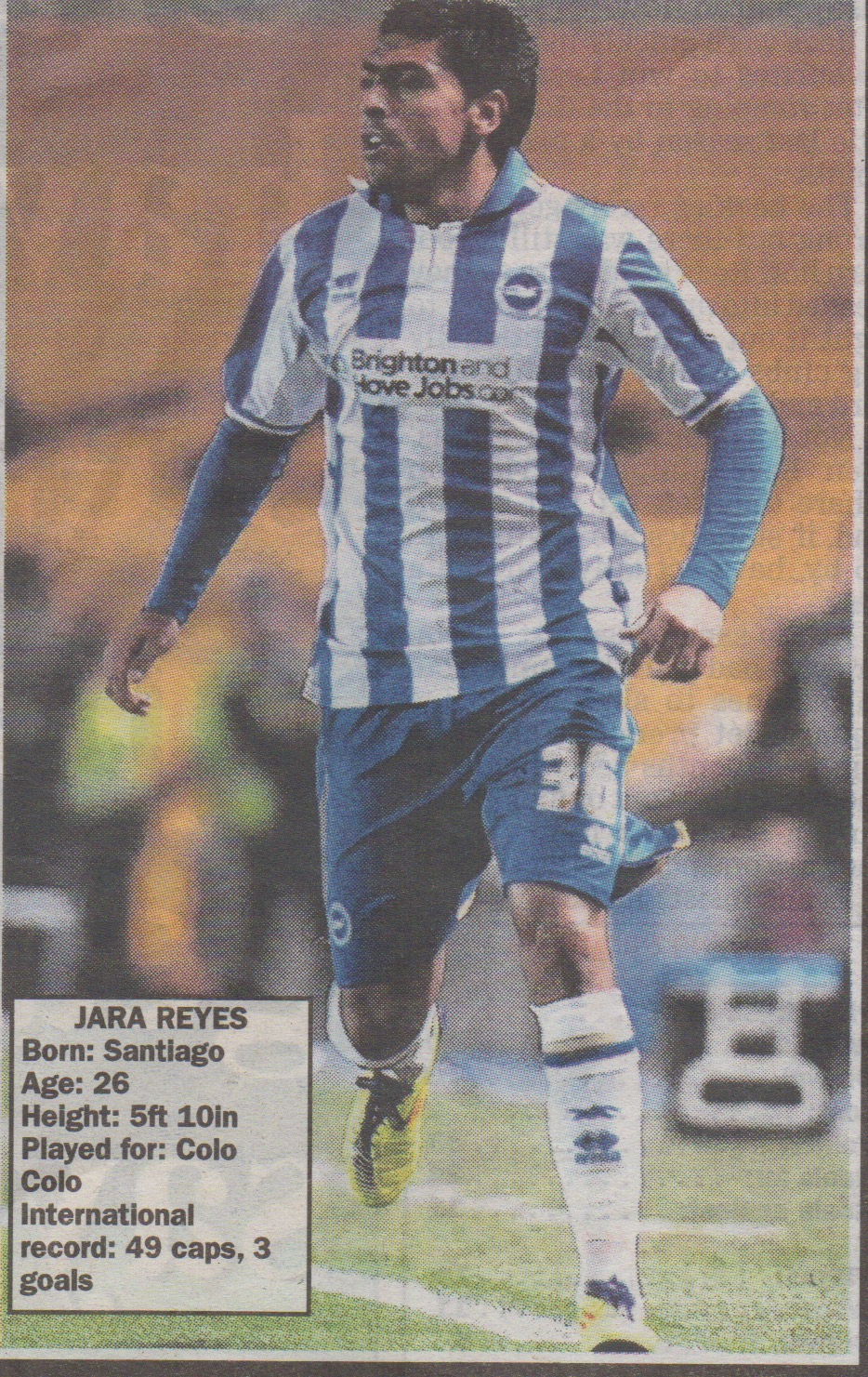
GONZALO JARA Reyes has never been far from the headlines for all the wrong reasons and his spell on loan to Brighton from West Bromwich Albion was no different.

The defender had two separate spells on loan with the Seagulls during the 2011-12 season but he hit the headlines for off-field matters.

He appeared before Brighton magistrates in January 2012 for driving his car in the city while already banned for drink driving.

He admitted driving an Audi Q7 sports car in Richmond Terrace, Brighton, while disqualified and driving without insurance and collected a £3,500 fine, having been banned for 17 months the previous July.

The Brighton bench handed him a further 12 month ban and ordered him to pay £100 costs.

Having joined Gus Poyet’s Brighton on loan in October 2011, he had only played four matches before missing that memorable December 2011 1-0 defeat against Burnley – when Ashley Barnes and Romain Vincelot were sent off in the first 12 minutes of the game.

It transpired he had been arrested by Sussex Police on the morning of the match, and was still in custody when the game kicked off.

It was an eventful few days for the Chile international because, two days after his arrest, West Brom recalled him early from the planned 13-game loan to the Seagulls as cover for the Baggies’ Christmas programme.

West Brom manager at the time, Roy Hodgson, was confident it wouldn’t affect his game, telling the Express & Star: “Most footballers have got something else going on in their lives that they have to deal with when they go onto the football field and they put it into another compartment.

“His is perhaps a bit more serious than others but he’ll have to learn to deal with it.”

On the final day of the transfer window in January 2012, Jara eventually returned to Brighton for the remainder of the season. But it wasn’t long before he was in trouble again.

On 17 March 2012, in a 3-1 defeat away to Blackpool, referee Simon Hooper showed Jara a red card in the 57th minute when he lunged in with a late challenge to take down Keith Southern. It wasn’t the first time he’d seen red at Bloomfield Road and it earned him a three-match ban. By the season’s end he’d played a total of just 14 games for Brighton.

Born in Hualpén on 29 August 1985, Jara grew up there, playing for Huachipato before winning three league titles in Chile with Colo-Colo.

He represented Chile in the 2005 World Youth Championship in the Netherlands and he came to the attention of West Brom’s head of EU recruitment Tony Spearing while captaining the Chile Under-23 team in Toulon in 2008.

He had actually already played for the full international side, on a 2006 European tour, and has since played more than a hundred games for his country.

Known for his versatility, he can play in either full back positions, central defence or as a holding midfielder.

He was 24 when West Brom head coach Roberto Di Matteo signed him in August 2009 for £1.4m. Di Matteo told the club’s website: “Gonzalo is an exciting, quick, technical and aggressive player.

“He’s still young and has a strong desire to achieve. Gonzalo wants to go to that next level and prove himself in Europe.”

He was a regular in his first season at The Hawthorns before breaking a metatarsal. He played right back in the Baggies’ Premier League side but he got himself sent off in a game away to Blackpool when the side were already down to 10 men. After that, he was in and out of the team and new manager Roy Hodgson preferred Steven Reid, although Hodgson reckoned the move to Brighton was simply about giving him game time.

The future England manager said at the time: “I’m hoping he’ll get three good months down in Brighton which is better than three months here playing reserve team football because Jara is not a reserve team player.”

Di Matteo no doubt tipped off his old Chelsea pal Poyet about Jara’s capabilities, prompting his eventful time with the Seagulls.

He returned to West Brom at the end of the 2011-12 season, and the following season went out on loan again, this time to Nottingham Forest. On his release from West Brom in 2013, he joined Forest on a permanent deal but was one of seven players released a year later. It meant he went to the 2014 World Cup in Brazil without a club.

It has been while on international duty that Jara has made even more of a name for himself – and not in a good way!

After Jara had left Forest and moved to Germany he was caught up in a most unsavoury incident while playing for his country.

In a Copa America quarter-final in Santiago, which the hosts won 1-0 with a late goal, television images appeared to show Jara anally fingering Uruguay striker Edinson Cavani before then falling to the ground holding his face after the Uruguayan responded by flicking his hand onto the Chilean’s chin.

Cavani was shown a second yellow card for his role in the incident, but Jara escaped unpunished by the referee.

The South American confederation investigated the incident, and Jara was subsequently fined £4,775 and banned for three matches.

Jara’s club side, Mainz, were singularly unimpressed. Sporting director Christian Heidel told Bild: “We do not tolerate that. What makes me more angry than the prod, however, is what happens after. There is nothing I hate more than theatrics.”

Jara had previous against Uruguay too. During a running battle with the then-Liverpool striker Luis Suarez during a 2013 World Cup qualifier between Chile and Uruguay, Jara grabbed Suarez by the testicles, with Suarez responding with a punch in the face.

In January 2016, Jara left Mainz to return to Chile “for personal reasons” after his contract was terminated prematurely.

He now plays for the Santiago-based Club Universidad de Chile, one of the top sides in the country.

Pictures from The Argus show the Chilean in both Brighton strips and in West Brom’s colours.

Winger Neil Smillie was a Wembley winner eventually

NS v MU Wemb

AN UNSUNG hero of Brighton’s 1983 FA Cup Final side, winger Neil Smillie, had the distinction of being the first ever apprentice the legendary Malcolm Allison signed for Crystal Palace.

Big Mal had enjoyed league and FA Cup success at Manchester City as Joe Mercer’s sidekick but he swept into Palace in the early 70s as a boss in his own right, courting publicity with his flamboyant fedora hat and giant cigar.

Smillie admitted: “I was going to West Ham but Allison persuaded me to take a look at Palace.

“The place was so alive and vibrant under him that I went there instead.”

Born in Barnsley on 19 July 1958, Neil followed in the footsteps of his dad, Ron, a former professional who played for Barnsley and Lincoln.

After joining Palace in 1974, Smillie turned professional a year later and was on Palace’s books for seven years, although he had three loan spells away from Selhurst.

In 1977, he went briefly to Brentford, who he ultimately would have a long association with later in his career.

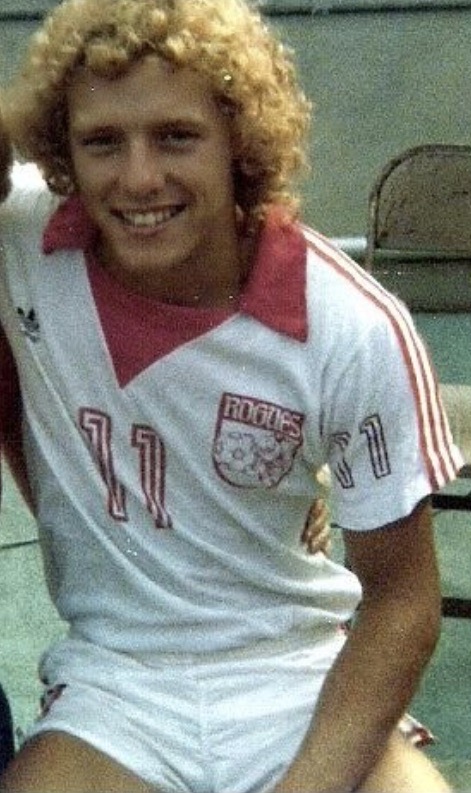
Smillie MemphisThe following two years, he went to play in America for Memphis Rogues (pictured left) where his teammates were players from the English game winding down their careers: the likes of former Albion players Tony Burns and Phil Beal, ex-Chelsea, Leicester and Palace striker Alan Birchenall and former Chelsea winger Charlie Cooke; the side being managed by former Chelsea defender Eddie McCreadie.

At the end of the 1981-82 season, Smillie was denied a pay rise by Palace so he decided to quit and wrote letters to clubs in the top two divisions in England asking for a job!

Brighton had managed to offload the troublesome Mickey Thomas to Stoke City so had a need for a left winger. They were the first to come up with an offer, and with full back Gary Williams surplus to requirements since the arrival of experienced defender Sammy Nelson, Brighton offered him in exchange for Smillie.

The bubble-haired winger gratefully accepted the switch to the Seagulls. While he made the starting line-up for the opening game of the new season, a heavy (5-0) defeat away at West Brom in the next game then saw him dropped and sidelined for months.

It was only once ultra-cautious manager Mike Bailey had left that Smillie got back in contention, and only then – in January 1983 – through someone else’s misfortune.

He said: “I was out in the cold and only got my break when Giles Stille was injured during the Cup game against Newcastle United.”

Smillie seized his opportunity and remained in the side for the rest of the season, culminating in the two Wembley FA Cup Final matches against Manchester United.

Back in the second tier following Brighton’s relegation, Smillie played 28 games plus once as a sub but following new manager Chris Cattlin’s signing of Northern Irish winger Steve Penney, there was competition in the wide areas.

Throughout the 1984-85 campaign, Smillie was more often than not a substitute rather than a starter. He did manage a seven-game run of appearances in the late autumn and began the final three games of the season, but the last game, a 1-0 home win over Sheffield United, proved to be his farewell.

Smillie revealed in a 2003 interview with Spencer Vignes that he’d discovered Manchester City had been keen to take him on loan but Cattlin hadn’t sanctioned it, even though he wasn’t selecting him.

“Chris had turned them down, saying I was a good player and he needed me. Yet he wasn’t even playing me! I just couldn’t believe he’d done it,” he said. Although he and his family were settled in Sussex, he realised he had to move.

Several eyebrows were raised when Cattlin managed to secure a £100,000 fee from Watford for Smillie’s services in the summer of 1985. The winger joined Graham Taylor’s beaten FA Cup finalists but he failed to establish himself in the side and made just 16 first team appearances in a season with the Hornets.

In the summer of 1986, he moved on to Reading for two years and, in 1988, after his disappointment with Brighton, Smillie was finally a winner at Wembley, scoring and setting up two goals as Reading beat Luton 4-1 in the Simod Cup Final.

The Hatters were led by former Albion captain Steve Foster and another of Smillie’s former teammates, Danny Wilson, was in their midfield. Mick Harford scored the opening goal for Luton, but Smillie’s pass allowed Michael Gilkes to bundle home an equaliser.

Smillie then won a spot kick converted by Stuart Beavon, and, in the second half, Mick Tait swept home another Smillie assist. Smillie then rounded off a great afternoon by scoring himself. It was hailed as one of the best days in Reading’s history, witnessed by over 45,000 loyal Royals fans.

Nevertheless, Smillie didn’t hang around and instead joined Brentford, where his former Palace teammate Phil Holder was assisting the manager at the time, Steve Perryman.NS Bees

Nick Bruzon interviewed Smillie in depth for a Where are they now? feature on the Brentford FC website in July 2010.

“Representing Brentford over three different decades, initially on loan in 1977 and then for five years from 1988 to 1993, Neil Smillie combined raw pace with ceaseless energy to make him one of the most popular players to patrol the New Road touchline,” said Bruzon. “Whilst with Brentford he experienced promotion, relegation and play off heartbreak, scoring 18 goals in 185 games.”

Smillie said: “I’ve got to say, the five years I spent at Brentford (and I was 30 when I signed) I thoroughly enjoyed.

“I’d reached a point in my career where I felt comfortable in terms of what I could give on the pitch. I’d always been a hard worker and I got the feeling that the supporters appreciated someone who worked hard.”

In the 1992-93 season, he played alongside Chris Hughton, who, like Smillie, was winding down his playing career.

“I loved taking people on and I loved getting crosses in for people to score so that just seemed to fit in nicely at the time with the team that we had,” he said. “I played my part as well as others who played theirs in getting the ball to me. We all did our bit and for me it was a great part of my career.”

On leaving Brentford, Smillie became a player-coach at Gillingham when his old Palace teammate Mike Flanagan was the manager. When Flanagan was sacked, Smillie took over the managerial reigns on a caretaker basis while the club tried to stabilise during financial troubles.

Smillie told Bruzon: “We were in a fairly precarious position and ended up in a decent position. So there was some enjoyment to it but the situation at a club without any money and struggling was difficult.”

Some names familiar to Brighton fans were at Gillingham at the time. Smillie played up front with Nicky Forster. Paul Watson was in defence and Richard Carpenter in midfield.

His three-month reign came to an end when Gillingham appointed Tony Pulis as the new manager and former Palace manager Alan Smith took Smillie to Wycombe Wanderers to look after their youth team.

When Smith left, Smillie was caretaker manager until former Albion full back John Gregory got the managerial post. Smillie then became Gregory’s successor in the hot seat for a year.

When the inevitable sack came, Smillie stepped outside of day to day running of football to become sports marketing manager for Nike in the UK. His role was to identify emerging talent for Nike to associate themselves with, and, as a result he stayed in touch with the game.

Among the players he signed to Nike were Theo Walcott, Darren Bent, Gabby Agbonlahor, James Milner, Tom Huddlestone, Danny Welbeck and Johnny Evans.

Pictures show (top) Smillie in action on the cover of the Albion programme; walking his dog; in Match magazine, on the cover of Shoot! being tackled by Liverpool’s Sammy Lee; a Simod Cup winner with Reading.

South Coast suited utility man Paul Wood at Brighton, Bournemouth and Pompey

paul wood (red)

THE quote at the top of an Albion matchday programme feature about Paul Wood sums up his Brighton career perfectly.

“I’ve played so many positions at the Albion. I’m not sure that I consider myself a centre-forward any more.

“Actually, playing on the right as I am now takes my career virtually full circle – I always used to be a winger before I joined Portsmouth.”

Manager Barry Lloyd bought Wood from Portsmouth for £40,000 in the summer of 1987 to play up front alongside Kevin Bremner, with Garry Nelson wide on the left.

Nelson, of course, thought otherwise – and 32 goals in a promotion season playing down the middle rather proved him right.

Thus Wood found himself deployed in that rather dubious-sounding role of ‘utility player’.

“A couple of goals would have done me great guns when I got a chance up front,” Wood admitted. “I don’t think I let anybody down when Nelson and Bremner were injured but I wasn’t putting them away.

“It didn’t really bother me too much. I was most happy just to be getting first team football, especially as I had spent the previous year at Portsmouth, while they got promoted to Division One, watching from the stands.”

A pelvis ligament problem had sidelined Wood at Fratton Park so the new lease of life as part of a promotion-winning squad was a welcome break.

After making his Albion debut in a 2-0 home win over Fulham on 29 August 1987, Wood admitted: “I found it very tiring after playing only one hour of reserve football in the last nine months. But I enjoyed the experience and I’m looking forward to creating and taking more chances.”

PW colBorn in Saltburn-by-the-Sea in the north east on 1 November 1964, at one point it was thought Wood’s football career was over almost before it had begun.

As a talented schoolboy footballer, he was spotted playing for Middlesbrough Boys as the side won the English Schools’ Trophy. His school headteacher had connections at Elland Road so he went for a trial but only 15 minutes into the game broke a leg.

It seems he had broken a knuckle at the back of his knee and the Leeds physio, Bob English, took a look at the injury and said: “Sorry son, you’ve broken your leg, ripped all the ligaments, and I think you’re finished.”

Thankfully for the budding young footballer, the dire diagnosis was wrong, but it put him off trying to make it at Leeds and instead he got picked up by Portsmouth whose scout in the north had seen him playing for Guisborough under-16s.

It was a long way from home, but he appreciated the club’s more caring nature and when a homesick Wood mentioned how he was feeling, manager Frank Burrows took £30 from his own pocket to send the youngster home for a break.

Wood’s Pompey debut eventually came, ironically at Middlesbrough, after Bobby Campbell had taken over in the manager’s chair.

Originally, he had only travelled with the squad so that he could visit friends and relatives but a couple of players fell ill and Wood got his big chance.

“Before I knew it, I was in the team,” he said. “I think that’s the best game I’ve ever played, although it flew past so fast.”

Another favourite moment came when he scored two in a 4-0 win over Shrewsbury. England World Cup winner Alan Ball had succeeded Campbell as manager and said after the 21-year-old’s performance ‘a star is born’. Wood told portsmouth.co.uk: “That will stay with me for the rest of my life. For somebody who has achieved what he has in football and the respect he commands to come out and give me that compliment was a great feeling.

“It was a game where everything seemed to go right. I scored a couple and was in confident form.”

A run in the team followed for Wood, who made 25 league appearances as Pompey fell just short of promotion.

The following season, he only played seven games at the start of the season before sustaining the pelvic injury he put down to playing three times on plastic pitches in the space of three weeks.

paul wood portrait

By the time Wood had made his recovery, Pompey were playing in the top flight and he had fallen down the pecking order. The move to Brighton came about after Wood scored a hat-trick for Portsmouth’s reserves.

He told portsmouth.co.uk: “I was disappointed to go because I never really wanted to leave but I had a mortgage to pay and no bonuses on appearance money was forthcoming.”

Ironically it was the long-term injury problems to crowd favourite Steve Penney that presented Wood with a lot of his games at Brighton and when Penney got back into the side in 1989, Wood put in a transfer request because he felt he was doing well enough to merit a place.

Penney was to move on before Wood but eventually, after two and a half seasons with the Seagulls in which he played 88 games + 17 as sub, and scored just eight goals, he was sold.

That canny transfer market operator Lloyd had acquired the services of one-time England international wideman Mark Barham, who had been written off elsewhere because of injury issues, so he dispensed with Wood’s services by selling him to promotion-chasing Sheffield United.

On 5 May 1990, Wood was on the scoresheet as Dave Bassett’s United beat Leicester City 5-2 to earn promotion to the top division. Playing alongside him were future Blades manager Chris Wilder, former Albion assistant manager Bob Booker and Mark Morris, who went on to play for Bournemouth and Brighton.

In 1991, Wood played 21 games for Bournemouth on loan from United, before making the move permanent, and in three years with the Cherries he scored 18 times in 78 appearances.

Then, in a deal that saw the Cherries acquire out-of-favour Portsmouth striker Warren Aspinall (known to BBC Radio Sussex listeners as a matchday summariser) Wood returned to Fratton Park.

He said: “It was fantastic for me to get the opportunity to return to the club.”

Pompey used him as more of a utility player than ever before, Jim Smith playing him in midfield and his successor Terry Fenwick even trying him at wing-back. Sadly, though, he suffered a bad knee injury that curtailed his professional career, causing him to retire in 1996.

He managed to play 20 games and score 15 goals for a Hong Kong side, Happy Valley, in 1997-98 and back in the UK linked up with National League South side Havant & Waterlooville.

He spent five years there, retiring at the end of the 2002-03 season after playing 137 games and scoring 48 goals.

Wood now runs his own Bournemouth-based decorating business.

Read more at: http://www.portsmouth.co.uk/sport/football/pompey/big-interview-paul-wood-1-7109817

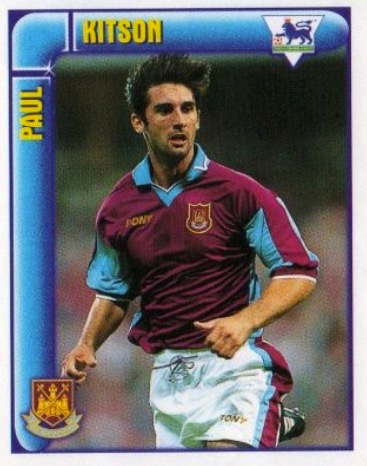
£2m man Paul Kitson seldom off Brighton’s treatment table

main Kitson

OVER THE years there have been certain players, often strikers, who have fallen victim to the Brighton boo boys.

In recent times there was Chuba Akpom, a little further back Billy Paynter and former Newcastle United striker Leon Best, but, for the subject of this post, I’m going to recall another former Newcastle forward, Paul Kitson.

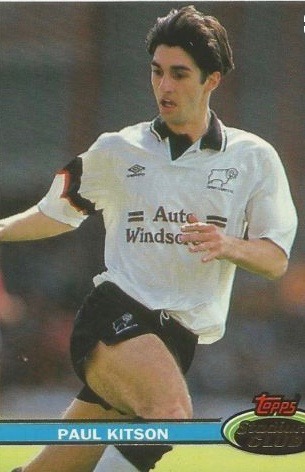
Kitson clocked up a total of just over 300 games across 16 years for nine different English clubs, and won seven caps for England under 21s, four of them in the same side as Dean Blackwell.

But, in an unhappy spell with the Seagulls in 2002-03, he managed only seven starts and three substitute appearances and scored just twice.

For whatever reason, he just never seemed to be fit and Brighton fans were short on patience. Even his surname is nearly an anagram of sicknote!

Back in August 2002, newly appointed manager Martin Hinshelwood was like the cat that got the cream. He told The Argus: “I’m very pleased. It’s my first signing and he is somebody we have been chasing for a couple of weeks.

“He’s had a lot of experience at Leicester, Derby, Newcastle and West Ham and he’s played with some quality strikers. That will help the younger players we have got in the squad.

“We have been patient, but it just shows we want to go for a bit of quality. He has played in the Premier League and hopefully he will be right for us.

“We are looking forward to playing him with Bobby Zamora. It will be a couple of weeks yet before he (Kitson) is fit, but it is a great signing for the club to get somebody of that calibre. It has taken a while, but he has agreed with us and I am really looking forward to working with him.”

Sadly, initially Zamora was injured and then Kitson suffered one injury after another and made just two substitute appearances between the middle of September and the start of April.

In one of its ‘rolling back the years’ features, The Argus recalled: “Albion fans who had been excited by his arrival had all but given up hope on Kitson.

“But manager Steve Coppell said all along the forward had something to offer and he came good in a Friday night game away to Reading.”

That was on 4 April 2003 and I remember it well having travelled to the game with Kev Bennett, who somehow managed to blag us into the hotel at the Madejski Stadium for pre-match drinks despite a ‘no away fans’ sign on the door!

Although the season would ultimately end in the disappointment of relegation, at the time Coppell’s side were battling to avoid the drop and they stepped up that battle at Reading.

Paul Brooker put them ahead on 16 minutes but most people felt it was just a matter of time before Reading hit back,” said the Argus.

Cometh the hour, cometh the man – well 77 minutes actually. Kitson had been a surprise inclusion on the substitutes’ bench, but, five minutes after replacing the ineffectual Graham Barrett to play alongside Zamora, he finally earned his money when he headed home a Richard Carpenter free-kick to make it 2-0.

Jamie Cureton did pull one back for Reading in the closing minutes but Albion held on to win 2-1 to keep their slim survival hopes alive a little longer.

David Alexander for The Guardian wrote: “Reading’s lone striker Nicky Forster missed three clear chances to level after Brooker’s goal and Glen Little, the Burnley winger making his debut after joining Reading on loan, was twice denied, a header cleared off the line and a fierce volley saved by Dave Beasant.”

Kitson’s goal was his first in 17 months and, almost embarrassed by that statistic, didn’t celebrate. His teammates came out in the media afterwards to defend him.

Beasant, who like Kitson had spent most of his career at the top level, told The Argus: “He came on and did well. He’s a big, strong lad and every time I had the ball he wanted it from me.

“He’s played in the Premier Division and he showed he’s quick in mind as well. He wants to do well now. I think a lot of people have taken Kits the wrong way at this club.

“People are saying he hasn’t justified himself here, but he’s had a problem. He’s been injured and you can’t do anything when you are injured.”

Screen Shot 2021-05-01 at 19.50.40Zamora added: “The lads see him in training, so we know what a quality player he is. Hopefully he will be injury free for the run-in.
“I was looking forward to playing with him when he signed. Nathan Jones has been playing with him in the Reserves recently and he’s had nothing but praise for him.”

Meanwhile boss Coppell acknowledged: “The supporters are like everybody here, we just want to see him play and play regularly.

“It’s like having a present you can’t open. Hopefully now we can take a few layers off and see what he’s made of.”

Born in County Durham, on 9 January 1971, Kitson was picked up by Leicester City as a youngster and came through their youth ranks before breaking through to the first team in 1989.

Dub + Kitson

A young Paul Kitson in action for Leicester up against Albion’s Keith Dublin

He scored 11 goals in 63 games for Leicester and was called up for international duty with England under 21s, at the time managed by Ray Harford.

He made his debut as a substitute in a 2-1 win over Senegal in the Toulon tournament in the summer of 1991 when Alan Shearer scored England’s two goals and David James was in goal.

Kitson started the next game alongside Shearer and scored in a 6-0 win over Mexico. He also played in the final against France which England won 1-0, courtesy of a goal from Shearer.

Lawrie McMenemy then took over as manager for the 1991-92 season and Kitson played in four of their seven games, scoring twice.

In his last game, a 0-0 draw away to France in May 1992, he was replaced by future teammate Andy Cole.

By then, his club career had taken a major turn, promotion-chasing Derby, bankrolled by new chairman Lionel Pickering, having snapped him up for £1.3 million (with Phil Gee and Ian Ormondroyd going in the opposite direction as part of the deal).

County missed out on promotion to what would have been the first season of the Premier League when they lost in the play-offs….to Kitson’s old club, Leicester!

Under Arthur Cox at Derby, Kitson scored 49 goals in 132 appearances over two and a half years but not long into the season after they lost 2-1 in the play-off final – again to Leicester – he was heading back to his native north east.

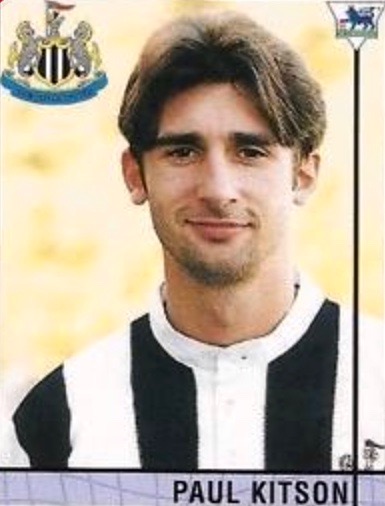
It seems remarkable to think that Newcastle paid Derby an eyewatering £2,250,000 for Kitson in September 1994, especially as he was mainly a back-up to first choices Cole and Peter Beardsley.

Nevertheless, maybe the Magpies knew they would be selling Cole to Manchester United in January 1995. That departure gave Kitson the chance to start up front and he finished the season with eight goals in 26 games.

Goalscoring centre forwards are part of football folklore on Tyneside and the summer of 1995 saw the arrival of Les Ferdinand to fill that famous role.

With Faustino Asprilla also added to the mix as Newcastle challenged for top spot, only to finish five points behind Manchester United, Kitson’s chances were limited and he played only seven league games in the whole season.

It didn’t get much better in the summer of 1996 when Shearer arrived for a £15m fee. By February 1997, Kitson had played just three league games and, after playing only 36 games in three years, he was sold to struggling West Ham for £2.3m.

Manager Harry Redknapp also spent £3.3m on the bustling Welsh striker John Hartson and between them they scored the goals which kept the Hammers in the top division. Kitson scored on his debut in a 4-3 win over Spurs and finished with eight in 14 league games.

When he signed, Redknapp’s assistant, Frank Lampard senior, said: “The last man we signed from Newcastle was Bryan ‘Pop’ Robson in the 1970s and Paul has the same qualities. He is quick, sharp and has good physical attributes.”

In a game against Everton at Upton Park, Kitson scored twice for the Hammers but missed a penalty that would have given him a hat-trick and Everton nicked a point with a 90th minute equaliser from Duncan Ferguson.

Redknapp was fuming in his post-match interviews, telling Dave Hadfield of the Independent: “If we had scored it, the game’s over,” he said. “But we’ve given it to a boy who isn’t interested in taking penalties. What is it? A testimonial match? We’re in a relegation battle.”

Normal penalty taker Julian Dicks was injured and Hartson was West Ham’s designated penalty taker but a heart-rules-head decision gave the task to Kitson. “That was the killer for us. I can’t believe the unprofessionalism of it,” Redknapp railed.

Hadfield reported: “Kitson, up to that point, was having the sort of game in which anyone would have backed him to put away the spot-kick with ease. His failure to do so could prove monumentally costly at the end of the season, which is a harsh judgement on a player who had looked a world beater in that first half.”

But the great escape was achieved and is re-told in the media from time to time. For example, it was recalled by Sid Lowe in The Guardian in 2010, when he described the signing of Kitson and Hartson as “footballing Red Adairs”.

“On the final day of the season, they slaughtered Sheffield Wednesday 5-1 to complete an implausible survival,” said Lowe. “Kitson got a hat-trick; Hartson got two. It could hardly be any other way. They had scored 12 in the last 13 games. ‘Without them, we would certainly have gone down,’ insisted Redknapp.”

At the time, West Ham fans hailed Kitson and Hartson as the best striking partnership since Tony Cottee and Frank McAvennie. While he would ultimately spend five years on West Ham’s books, it was never as good for Kitson after those final months of the 1996-97 season.

He did, though, get the chance to show Newcastle what they were missing when he scored against them in a 2-0 win at Upton Park in March 1999. After a couple of glaring misses, he finally got on the scoresheet in the 83rd minute, as described by Gerry Cox in The Guardian: “The former Newcastle striker chased a long ball from Lampard, turned defenders Charvet and Andrew Griffin on the edge of the penalty area and slotted a low shot into the far corner of the goal.”

Kitson’s appearances became fewer than a handful, especially after Glenn Roeder became manager, although in November 2001 he produced a hat-trick in a 4-4 draw with Charlton that he has said was the highlight of his career.

The game was live on Sky and, after scoring the opening goal, Kitson twice equalised for the Hammers to claim the matchball…but they were the only goals he scored in the 2001-2002 season, and were his last in claret and blue.

West Ham sent him out on loan spells to both Charlton and Crystal Palace before finally releasing him on a Bosman free transfer to Brighton in the summer of 2002.

After his injury-plagued season with the Seagulls ended in relegation for the club, Kitson was released and moved to Rushden and Diamonds, who, at the time, had risen to the dizzy heights of English football’s third tier.

They were managed by the former Ipswich, Arsenal and England midfielder Brian Talbot.

On 30 September 2003, I recall my one and only visit to Nene Park to watch Brighton take on Rushden.

Goals from Guy Butters, Leon Knight and Zesh Rehman earned the Albion a 3-1 win. Kitson was on the Rushden subs bench and, although he did get on in the 62nd minute in place of David Bell, he wasn’t able to score against his old club.

At the time, he was on non-contract terms and playing for nothing but eventually he managed 28 appearances for them and helped himself to five goals.

The following year, Aldershot was to be his final club before retiring after just one game for them.

Reports say he returned to the north east after his playing days were over.

2 montage PK - Derby3 montage PK -Newcastle

4 montage PK - W Ham

European Cup Winners’ Cup winner Doug Rougvie left Chelsea to become Brighton captain

Rougvie portrait

THE SUMMER of 1987 saw Brighton & Hove Albion back in the old Third Division for the first time in 10 years.

It was the start of manager Barry Lloyd’s first full season in charge and he had gone back to his old club Chelsea to recruit his no.2, head coach Martin Hinshelwood, and a new captain for the Seagulls in rugged centre half Doug Rougvie, for a fee of £73,000.

Many years later, Gus Poyet brought in another Scottish captain in Gordon Greer. Rougvie certainly didn’t have Greer’s ability on the ball but he had been a European Cup Winners’ Cup winner with Aberdeen and he wasn’t afraid to put himself about.

Rougvie had a regular Captain’s Column in the 1987-88 season’s matchday programme, and for the opening game against York City, he wrote: “I’m delighted to be rewarded with the captaincy. It’s a great honour for me and my family.

“With five new players at the club, a new coach in Martin Hinshelwood and Barry Lloyd beginning his first full season in charge, I’m sure I won’t be the only person feeling a bit nervous in the dressing room.”

Born in Ballingry, Fife, on 24 May 1956, Rougvie signed schoolboy forms for Dunfermline Athletic at the age of 12 and his favourite player was another uncompromising centre half, Roy Barry, who after playing for Dunfermline headed south and played for Coventry City when they were regulars amongst the elite.

Rougvie joined Aberdeen in 1972 and had a loan spell at junior club Rosemount before getting a first team chance under future Scotland manager Ally McLeod in the 1975-76 season. He was largely overlooked by McLeod’s successor, Billy McNeill, but when Alex Ferguson arrived his fortunes changed.

It was a leg break for regular centre half Willie Garner that gave him his opportunity to step in and he eventually made 279 appearances for the Dons over eight years. Ferguson sparked a huge revival in Aberdeen’s fortunes and Rougvie was involved as they won two Scottish league titles, three Scottish Cups, and the European Super Cup. The highlight, though, was undoubtedly being part of the side that beat Real Madrid 2-1 in the final of the 1983 European Cup Winners’ Cup in Gothenburg.

That side was captained by Willie Miller and included Alex McLeish at centre back, Gordon Strachan in midfield and future Albion manager Mark McGhee up front.

On 13 December that year, Jock Stein selected him at left back for his one and only Scotland cap, featuring in a 2-0 defeat against Northern Ireland at Windsor Park, Belfast, in what was the last game of the old British Championship.

afcheritage.org recalls: “Big Doug had no international pedigree to speak of at youth or under-21 level, but was picked on the strength of his impressive club performances, particularly in big European competitions.” He was one of five Aberdeen players in that side, the others being goalkeeper Jim Leighton, McLeish, Strachan and Peter Weir, and McGhee came on in the second half as a substitute.

At the start of the 1984-85 season, to coincide with Chelsea’s promotion back to the top division, Rougvie headed to Stamford Bridge. The size of the fee involved varies depending on what source you read. It’s most commonly said to have been £150,000 although Rougvie told Brighton’s matchday programme it was £215,000.

Pates+Rougvie

In a highly entertaining interview Rougvie gave to The Scotsman in 2014 about the move south, he told reporter Alan Patullo: “He (Ferguson) called me a mercenary and told me to f**k off, so I f**ked off.”

Rougvie’s three seasons at Chelsea were far from plain-sailing and by popular opinion it would seem his capacity for tough tackling was counterbalanced by a lack of pace that was cruelly exposed.

In the highly irreverent footie banter magazine thedaisycutter.co.uk, writer Noel Draper took an amusing swipe at Rougvie on 9 February 2012.

“Footballers are fickle creatures,” he wrote. “Watch them in one team and they appear to be footballing gods, commanding the game, making outrageous passes and winning every tackle. Watch them play for someone else and they turn into a shadow of their former selves, hiding in full view, hitting passes into the crowd and missing tackles. Doug Rougvie was such a footballer.”

Draper continues: “One rather unkind journalist said, ‘If he were any more limited he could be quoted on the Stock Exchange’.”

The piece maintains: “The Chelsea fans loved him instantly, not for his skills, but for his passion and commitment. He also seemed to love scoring own goals and pulling defeat from the jaws of victory. A reckless challenge here, a sending off there, it seemed that nothing would stop Doug ‘Rambo’ Rougvie.”

He was sent off whilst playing against Wimbledon after 10 minutes for head butting John Fashanu and “scored an own goal at Wembley that resulted in an easy 5-1 victory becoming a heart stopping 5-4 win against Manchester City”.

On another occasion, he was in a Chelsea side on the wrong end of a 6-0 thumping from QPR in the days of their artificial pitch at Loftus Road. The future Albion striker John Byrne was playing up front for QPR alongside Gary Bannister, who scored a hat-trick, and in an interview with bbc.co.uk, Byrne recalled: “We tore them to shreds. Doug Rougvie, who was playing at centre-back for Chelsea, was a fearsome player and he was absolutely furious. By the end, Doug was looking for blood.

“We had the Milk Cup final coming up a couple of weeks later. Banno and me didn’t want to get injured so having destroyed Chelsea, we spent the last part of the match avoiding Doug, who was an angry man.

“We stayed away from him. Banno went to play on one wing and I went and played on the other!”

In Brighton’s Division 3 side in the 1987-88 season, Rougvie was virtually ever-present until March, as the Seagulls hovered close to the promotion places as well as having enjoyed the distraction of playing Arsenal at home in the fourth round of the FA Cup.

Rougvie wrote in his programme notes: “The most important thing for us is to win promotion although the FA Cup is a great diversion for the lads and we’ll be doing our utmost to spring a surprise.”

The average Brighton home crowd that season was around 8,000 but for the Arsenal game 26,467 packed into the Goldstone. A terrific volleyed goal from Garry Nelson gave the Albion hope, but Arsenal won through 2-1.

With parallels of 1972, when Pat Saward dropped captain John Napier for the final run-in towards promotion from the same division, after a 1-0 defeat away at Rotherham, Lloyd dropped Rougvie in favour of another former Chelsea defender, Robert Isaac, and the captain’s armband switched to Steve Gatting.

Rougvie returned for what would be his last game in the stripes – a 2-0 home win over Gillingham – but Isaac regained the no.5 shirt for the remaining seven games of the season, including the promotion-clinching 2-1 win against Bristol Rovers in front of 19,800 at the Goldstone.

So, after playing a total of 46 league and cup games, Rougvie’s Albion career was over and at the end of the season he departed for Shrewsbury Town, where he made 21 appearances.

He then went back to West London to play 18 games for Fulham before returning to his first club, Dunfermline, to help their 1989-90 promotion push.

He subsequently became player-manager at Montrose before ending his playing days at Highland League team Huntly. In the late 90s, Rougvie was still pulling on his boots, turning out for Aberdeen amateur league side Kincorth AFC.

That 2014 interview in The Scotsman revealed that Rougvie was back in Aberdeen working for the engineering firm Costain, having gone back to college in his mid-forties to complete studies he had begun before his football career and gain an HNC in electrical engineering.

His only football involvement at that time was watching Aberdeen and he said: “If I was still in football I would be divorced right now. Whether you are part-time or full-time, if you aren’t watching football, you are talking about it, on the phone to players, taking training. It is non-stop. I admire the boys who are in the game but still able to have that happy home life too.”

Pictures from the Albion programme and the Argus plus a Shoot! magazine Q&A when Rougvie was at Chelsea.
Further reading

http://www.scotsman.com/sport/football/doug-rougvie-pulls-no-punches-on-sir-alex-ferguson-1-3331981

http://www.afcheritage.org/history/darkbluedons/index.cfm?player_id=212