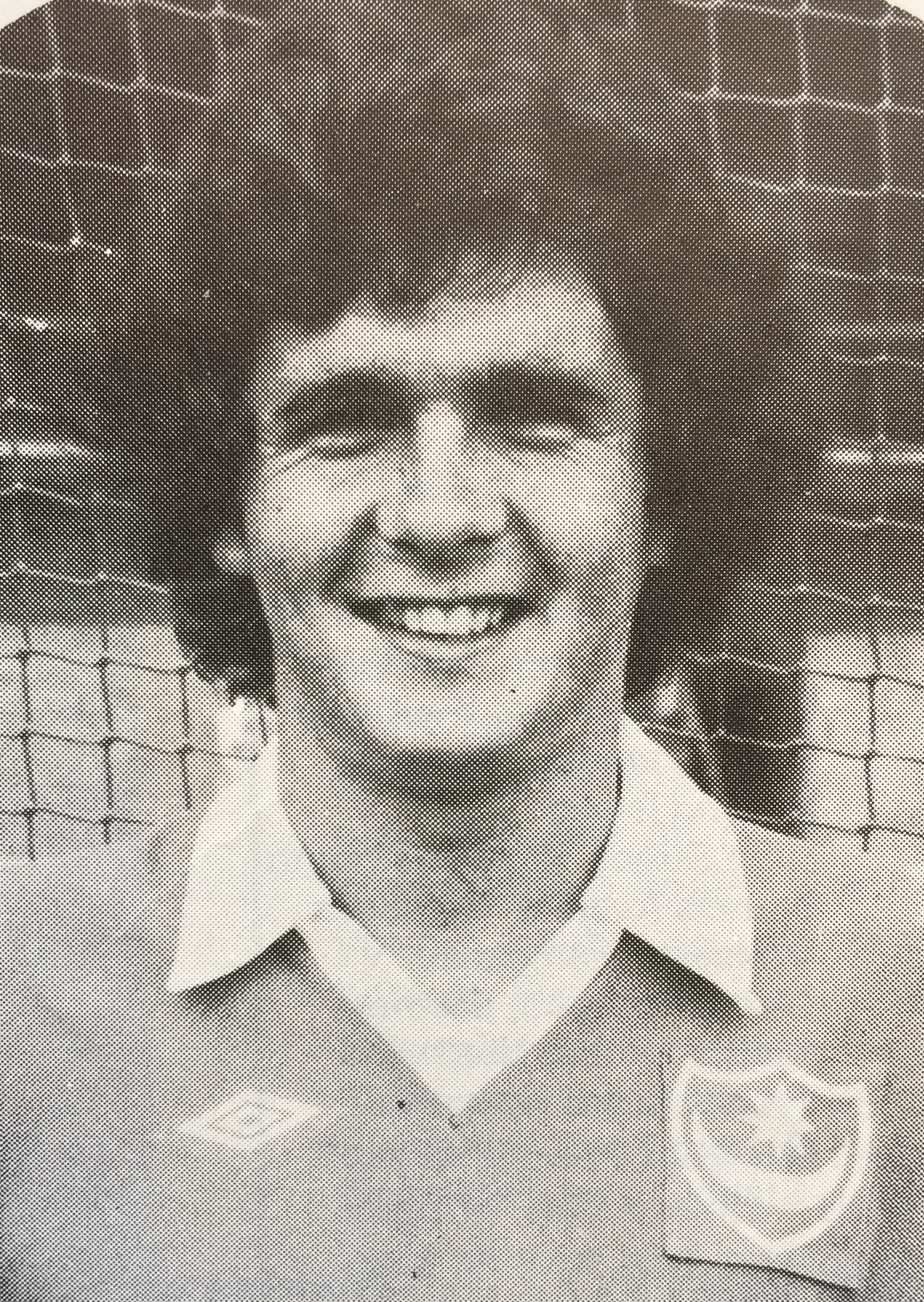
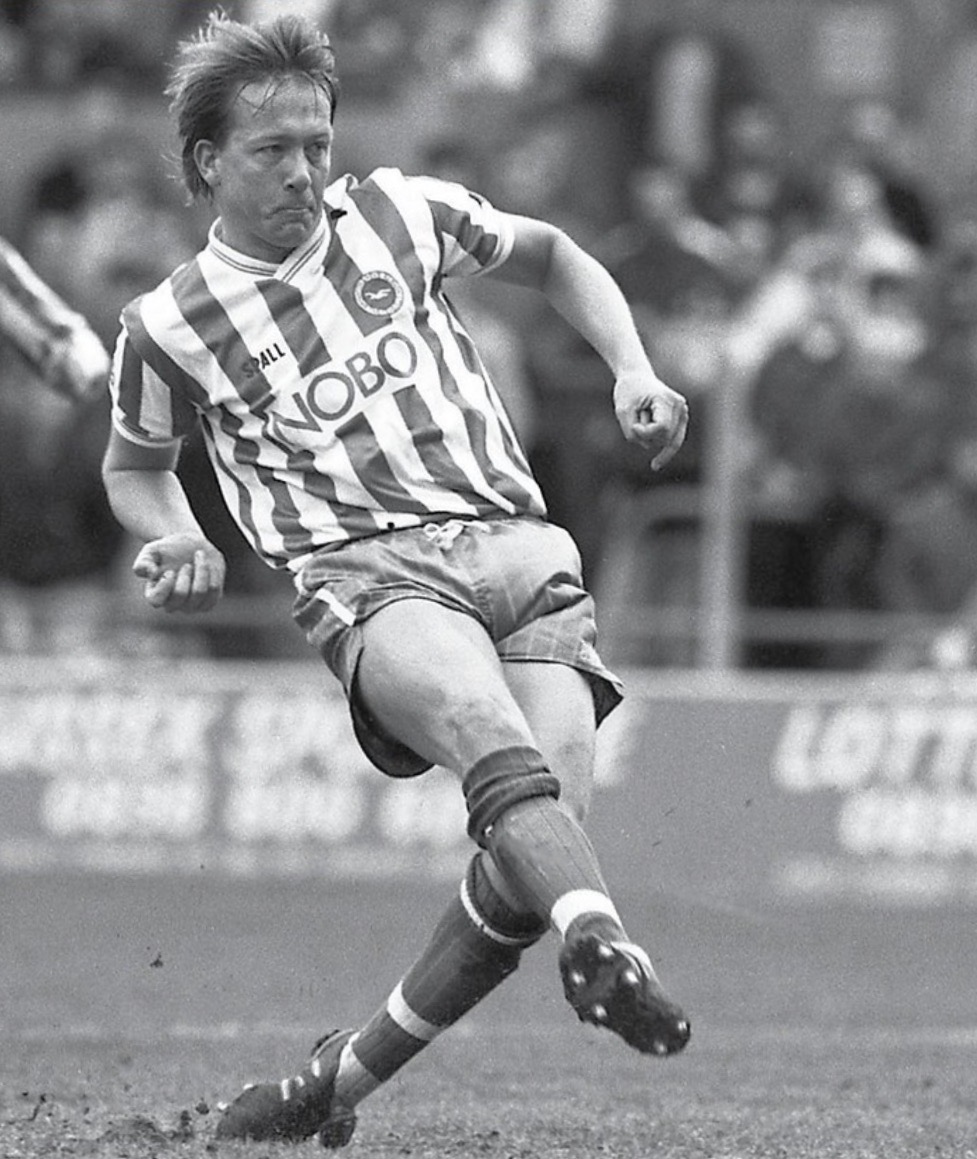
Twelve goals in 26 games for Scottish striker Alan Young

GARY LINEKER’S former strike partner at Leicester City had a good goals to appearances ratio for Brighton & Hove Albion.

Sadly, Scotsman Alan Young only managed 26 appearances in his one season (1983-84) with the Albion, although his 12 goals meant he finished second top goalscorer behind Terry Connor.

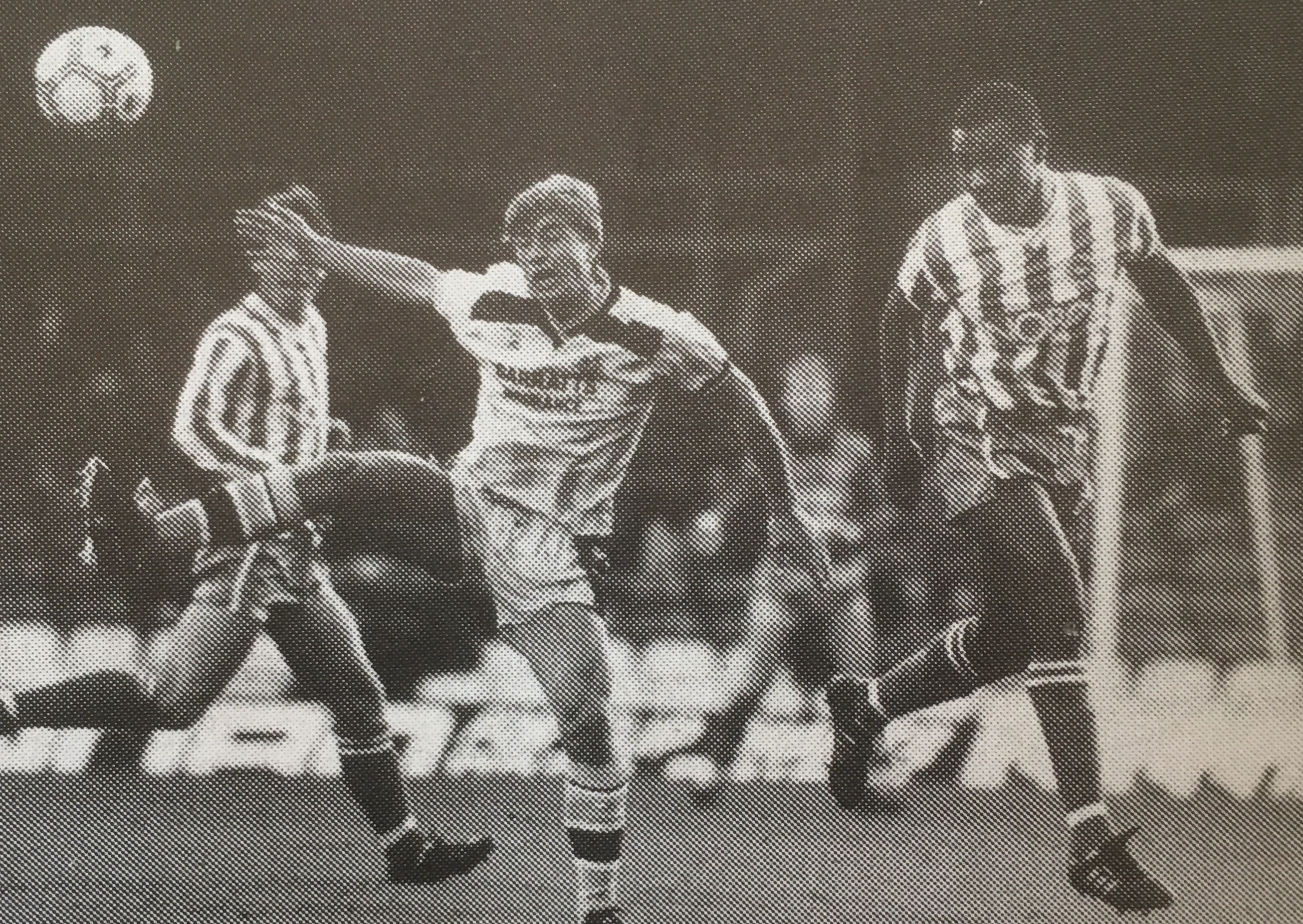
His brief Brighton career got off to a great start with a memorable debut goal, an overhead kick to net against Chelsea at the Goldstone. Young twice scored braces for the Seagulls but his season was injury-hit and, with manager Chris Cattlin bringing in his old pal Frank Worthington for the 1984-85 season, Young was sold to Notts County.

In more recent times, Young courted controversy as a radio pundit sharing his opinions about Leicester, and in 2014 BBC Radio Leicester dropped him from his role supporting commentator Ian Stringer.

alanyoung6 2

Back in September 2013, Young was berated online for his criticism of winger Anthony Knockaert. Foxello, on ja606.co.uk, wrote: “If there’s one thing that annoys me more than just about anything else at this football club, it is that grumpy, nasty egotist Alan Young and his never-ending agenda against certain members of the football club.”

The correspondent bemoaned: “Knocky is now the butt of every joke, and the object of every jibe Young throws out…. It’s almost as if he doesn’t want us to have skilful players who occasionally misplace a pass due to their advanced vision, and just have hoofers and cloggers like in his day.”

So let’s take a look back at ‘his day’. Born in Kirkcaldy on 26 October 1955, Young was football-daft and showed sufficient promise to earn Scottish schoolboy international honours.

His boyhood favourite team was Raith Rovers, whose star player at the time was Ian Porterfield, who famously scored the winning goal when Second Division Sunderland beat Leeds in the 1973 FA Cup Final.

Surprisingly overlooked by Scottish professional clubs, Young also experienced early disappointment in England when Nottingham Forest rejected him. “Nottingham Forert didn’t want me and I left there thinking I was no good,” he told Shoot! magazine.

Nonetheless, when he was playing as an unattached player for Scotland Schoolboys against England at Old Trafford, Oldham Athletic scout Colin McDonald, a former Burnley and England international goalkeeper, noted his promise and persuaded the young forward to head south of the border to begin his professional career.

In five years at Boundary Park he scored 30 goals in 122 games, and, to a large extent, learned his trade from old pro Andy Lochhead, a prolific goalscorer in his day for Burnley, Leicester and Aston Villa.

In the 1978-79 season, Young netted a hat-trick against Leicester which caught the eye of fellow Scot and former Rangers boss, Jock Wallace, who had taken over at Filbert Street and was building a team with his fellow countrymen at its core.

When Young joined Leicester, and played alongside his boyhood pal Martin Henderson, it began a love affair with Leicester that endures to this day.

In three years at Leicester, Young scored 26 times in 104 games, eventually forming a partnership with the emerging Lineker. TV’s favourite football frontman was generous enough to pen the foreword to Young’s 2013 autobiography, Youn9y (written in conjunction with Simon Kimber and published by the historypress.co.uk) and said of him: “He was an old-fashioned, aggressive centre forward. He possessed, though, a delicate touch and finesse that belied his big target man status – the perfect partner for a nippy little goalhanger trying to make a name for himself.”

Screenshot
Leicester strike partner for Gary Lineker

Young scored on his full debut for City in a league cup game v Rotherham and followed it up with two on his league debut at home to Watford.

The only time Young was sent off while playing for Leicester was, ironically, at the Goldstone Ground in 1981, at Easter, which was the second of four games at the end of the season that Albion won to stay in the top division.

Young was dismissed for two bookable offences, the first for clattering into goalkeeper Graham Moseley and the other a clash with Steve Foster, although, in his autobiography, he says Foster play-acted a knee injury, which the referee bought. Foster even teased him about it when he joined the Seagulls two years later. In that Easter 1981 fixture, Young’s teammate Kevin McDonald was also sent off, Brighton won 2-1 – and Leicester ended up being relegated together with Norwich and bottom-placed Crystal Palace.

Back in the old Second Division, Young did his cartilage in a game on QPR’s plastic pitch which he says was the beginning of the end of his career, because his knee was never the same afterwards (years later he had a knee replacement).

He also had the disappointment of losing to Spurs in the 1982 FA Cup semi final, although he maintains if a certain Chris Hughton had been sent off for two fouls on Lineker, it might all have been a different story.

Before the next season kicked off, Jock Wallace, the manager he idolised, decided to move back to Scotland to manage Motherwell and his successor at Filbert Street, Gordon Milne, swiftly chose to pair the emerging Alan Smith up front with Lineker, signalling the exit for Young.

Managerial upheaval was to become a familiar cause of Young’s departures in the years that followed, too. But I am getting ahead of myself.

Ian Porterfield, his footballing hero from yesteryear, had taken over as manager at Fourth Division Sheffield United and, although he didn’t really want to drop down the leagues, the Blades were a big club so Young moved to Bramall Lane.

A year later, though, after Brighton’s relegation from the elite in 1983, striker Michael Robinson was sold to Liverpool so there was a centre forward vacancy – and manager Jimmy Melia chose Young to fill it.

The fee was either £140,000 or £150,000 depending on which account you believe, but Young was happy because he pocketed a £20,000 signing on fee (four times what he had received only a year earlier when moving to Sheffield).

His first involvement with the squad was on a close-season tour of the Balearic Islands (with associated eye-opening tales recalled by thegoldstonewrap.com) but he also picked up an injury that was to dog his season on the south coast.

While Young had a lot of time for Melia, when Cattlin took over it was a different story and, in his book, there are plenty of colourful expletives used to describe exactly what he thought! He also castigates physio Mike Yaxley – “the most useless physio I have ever worked with” – although he says the team spirit was very good…seemingly fuelled by long post-training ‘sessions’ in Woody’s wine bar.

A youngHe said: “The football was very enjoyable there and never more so than when Jimmy Case and I were playing together; I loved playing with Jimmy.”
For a short time in that 1983-84 season, Albion had three Youngs in their squad, none of whom were related. Along with Young the forward, there were centre backs Eric Young and on-loan Willie Young.

When Cattlin decided to bring in his old Huddersfield teammate Worthington the following season, Young was on his way, this time to Notts County. The manager who signed him was the former Liverpool and Nottingham Forest defender Larry Lloyd, but his tenure in the managerial chair was very short so, once again, Young found himself playing for a manager who hadn’t chosen him.

In two years at Meadow Lane, Young scored 12 in 43 games for County. He moved on to Rochdale where the Leeds legend Eddie Gray was in charge, but injury took its toll and he only scored twice in 28 games in the 1986-87 season before retiring at 31. He had scored a career total of 89 goals in 349 appearances.

While there were a few non-league appearances, he eventually landed a job back at Notts County in the early days of community football schemes. He made a success of the job, obtained his coaching qualifications and eventually they combined the community scheme with the centre of excellence.

Brighton fans will be interested to know that among the young lads who emerged during Young’s time there were Will Hoskins and Leon Best. The star player, though, was Jermaine Pennant.

Young has fond memories of Neil Warnock’s time as County manager, because of his interest in the work being done at grassroots level. However, the mood changed when Sam Allardyce took over.

Allardyce initially cut Young’s salary and then showed him the door. “I can’t and I never will forgive Sam Allardyce,” he said.

Away from football, Young has had a tempestuous love life – read the book to gather the detail – and has three sons and a daughter. While he also had spells working for Chesterfield and Leeds, he dropped out of the game and then had a very dark period dominated by heavy drinking in isolation, including a time living alone in a caravan on the banks of Loch Lomond.

Eventually a return to England and his break into radio punditry brought him back from the brink.

In 2013, his autobiography Youn9y was published, the sleeve notes describing the story of “a talented, brave striker who played at the highest level of the domestic game but also experienced human misery at its lowest once his playing career was over”.

The notes add: “Youngy doesn’t just recount the good times of his playing career; he also offers valuable insight and moments of perception and understanding of some of the darkest days of his life.”

After four years as match summariser, in 2014 BBC Radio Leicester dispensed with his services and replaced him with another former Fox, Gerry Taggart.

However, Young still gives his opinions about Leicester on the community radio station Hermitage FM.

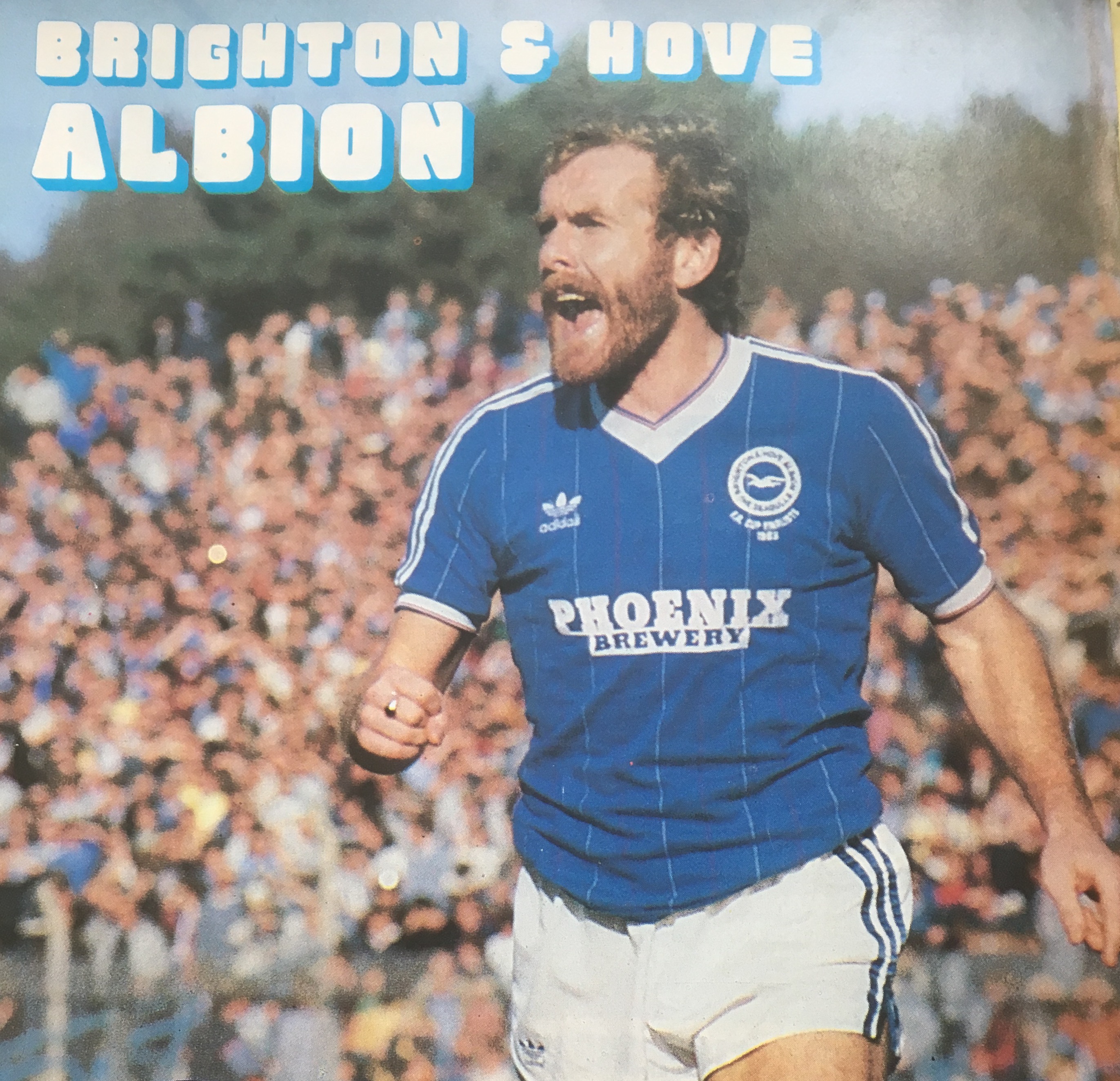
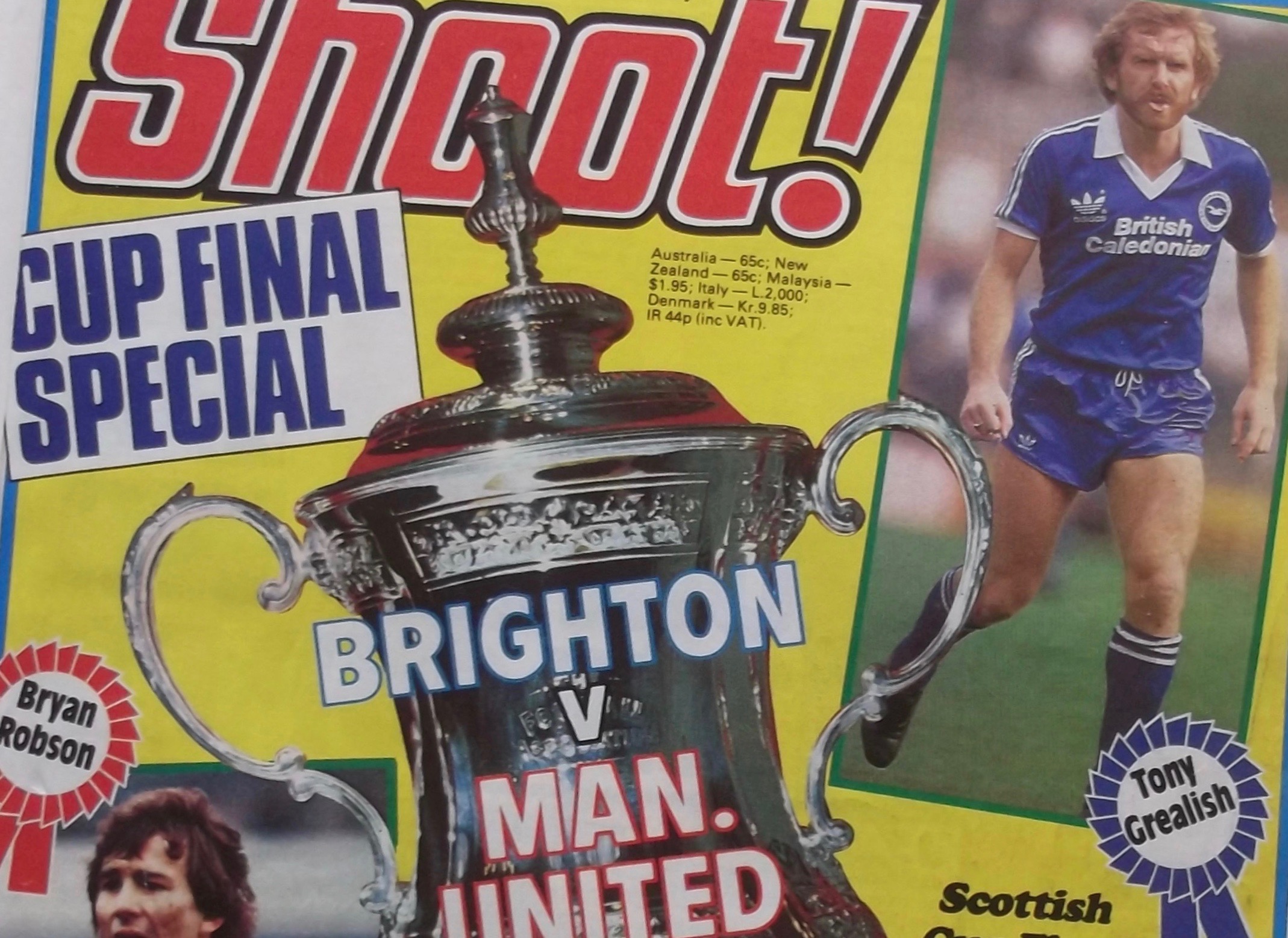
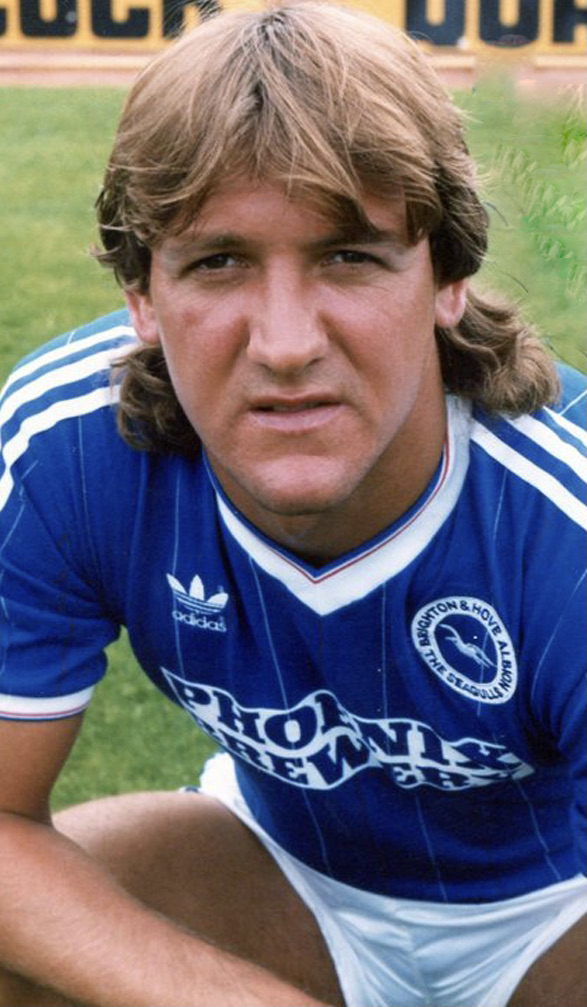
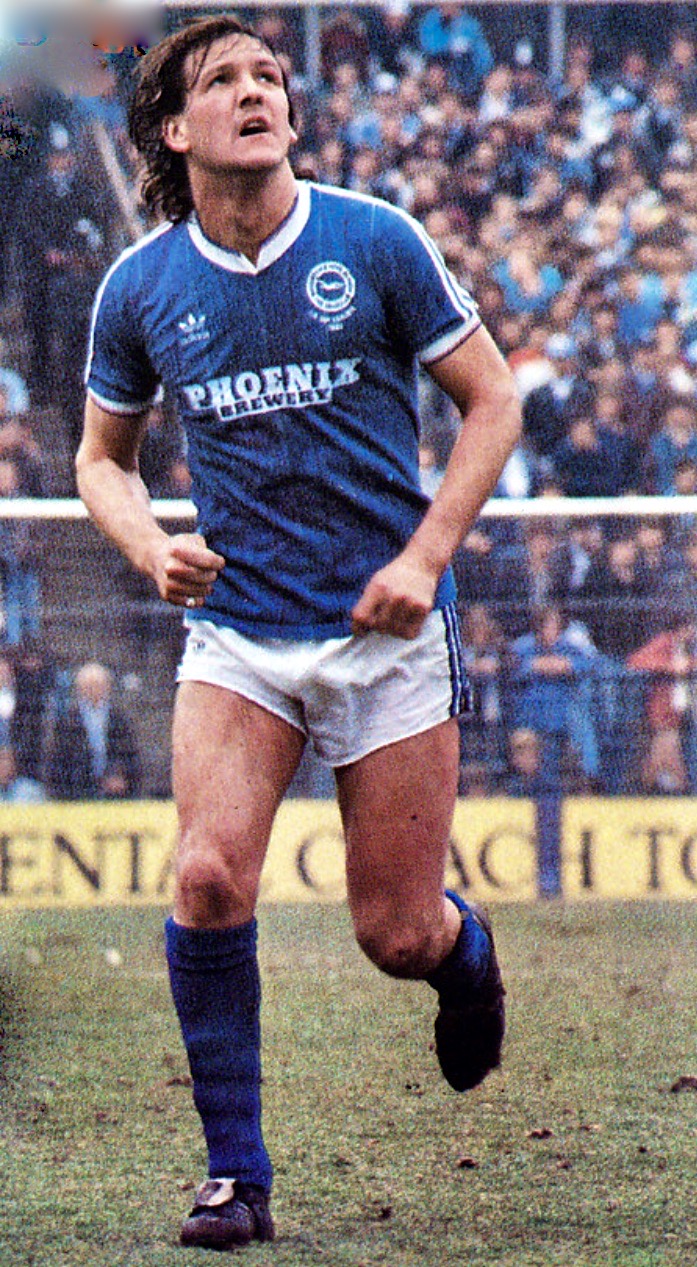
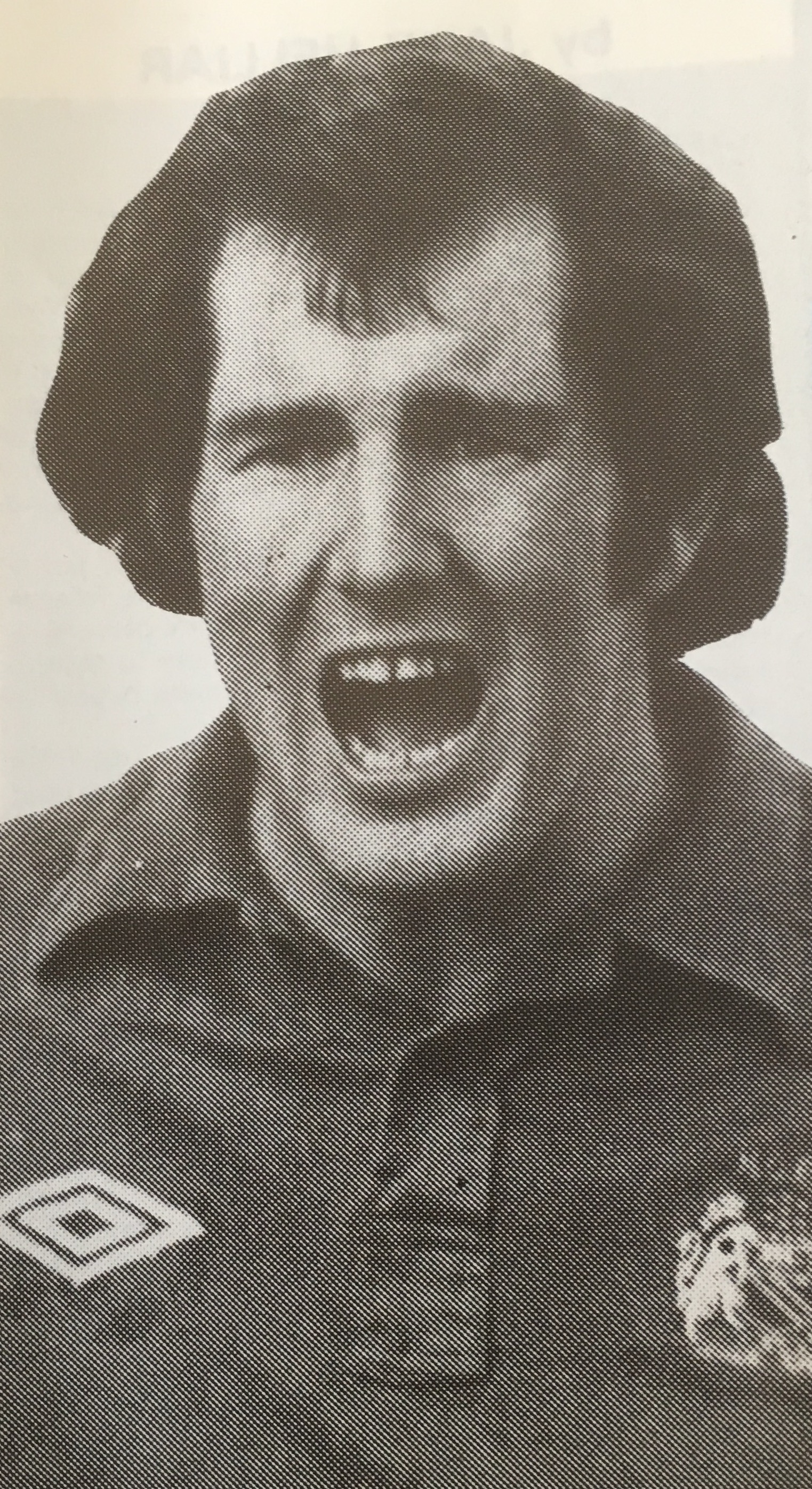
Pictures show a shot of Alan on Brighton seafront from an Albion matchday programme; the front cover of his autobiography; other matchday programme action shots, and in the Hermitage FM radio studio from Twitter.

Man City legend Joe Corrigan played the clown in Brighton

1 Joe punchingBRIGHTON fans often enter into a debate about the best goalkeeper ever to play for the club.
Although he was past his best when he joined the Seagulls, former England international Joe Corrigan would certainly be a contender.

Corrigan was, quite literally, at 6’4” a giant among goalkeepers and a colossus for Manchester City at the highest level before a second tier spell with Brighton towards the end of his playing career.

He subsequently became a top goalkeeping coach and amongst the ‘keepers he worked with was another former Seagulls favourite, Tomasz Kuszczak, when at West Brom.

After taking over from Harry Dowd, Corrigan was a near permanent fixture in goal for Manchester City between 1970 and 1983, winning a European Cup Winners’ Cup medal at the end of his debut season.

But for his career coinciding with Peter Shilton and Ray Clemence, he would surely have won more than the nine England caps he accumulated.

In total Corrigan made 592 appearances for City, a club record for a goalkeeper, and he was City’s Player of the Year three times.

In 1983, at the age of 34, Corrigan was sold to American club Seattle Sounders for £30,000, but he stayed in the US only a few months, and, in September that year, returned to England with Brighton.

Unfortunately for Joe it was at that turbulent time when, although Jimmy Melia was still the manager, chairman Mike Bamber had installed Chris Cattlin as first team coach behind Melia’s back.

Within a matter of weeks of the 1983-84 season starting, Melia was fired and Cattlin took over.

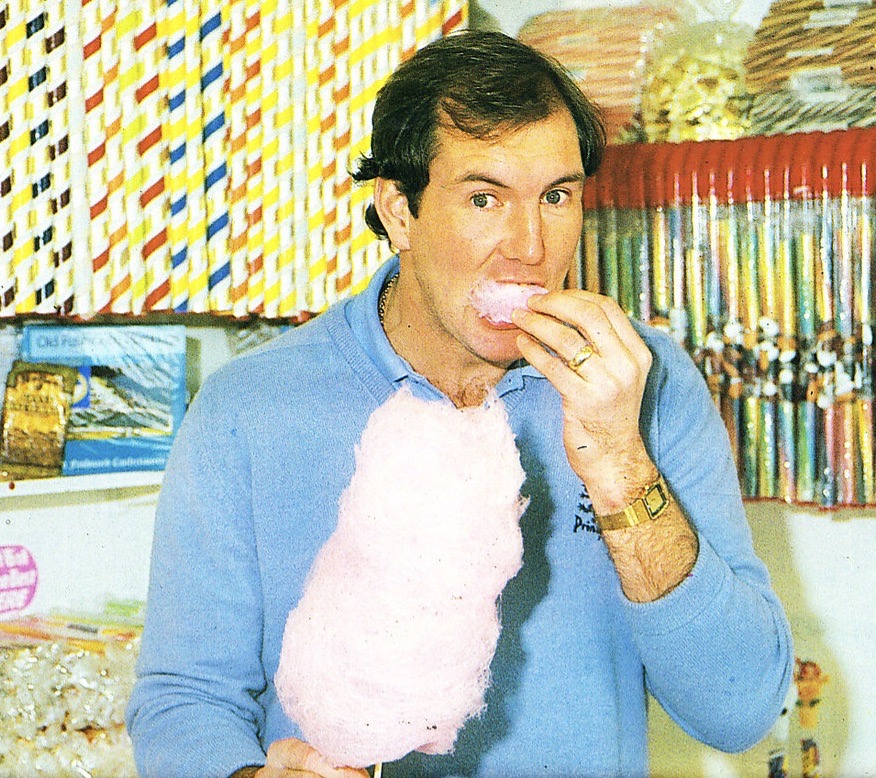
Corrigan was not impressed. In his 2008 autobiography (Big Joe, The Joe Corrigan Story) he declared Cattlin “the worst manager I’d ever played under” although he described his teammates as “a terrific bunch of lads” and he seemed to enjoy a decent social life on the south coast (pictured below for the matchday programme by Tony Norman, tucking into candy floss on the pier).

corrigan candyFor instance, at the annual players Christmas ‘do’ – if the account in Jimmy Case’s autobiography is anything to go by.

Corrigan became big pals with Case during his time at Brighton and the Scouse midfield favourite recounts in Hard Case (John Blake Publishing), a time the players went out on their Christmas ‘bash’ in Brighton wearing fancy dress.

Corrigan wore white tights and a tutu and at one point stood in the middle of the road directing traffic while his teammates crossed –  beckoning cars facing a red light to go and stopping cars that were on a green light. “I am still not sure how he survived that incident without having his collar felt,” said Case.

“Joe is a big, soft lad with a heart of gold but he has a painful way of showing it.”

One of his party pieces was to catch people off guard with a short jab in the ribs or arm. One playful punch landed on physio Mike Yaxley broke two of his ribs!

Case described Joe as “a star performer on the pitch and a bloody clown off it”.

Corrigan played 36 times for the Seagulls, including performing heroics in the famous 2-0 1984 FA Cup win over Liverpool, when goals by Terry Connor and Gerry Ryan meant the Seagulls dumped the mighty reds out of the cup two years in succession (following the 2-1 win at Anfield during the 1983 run to the cup final).

IMG_5197Sadly, as revealed in Big Joe, The Joe Corrigan Story, his time with Brighton ended on a sour note and when Cattlin opted for Perry Digweed as his first choice ‘keeper for the 1984-85 season, it all turned publicly ugly.
The club fined Corrigan for speaking out of turn to the press but Corrigan successfully got the fine overturned thanks to help from the PFA.

Under a heading ‘Truth’ Cattlin wrote in his matchday programme notes: “Our club made the papers this week for the wrong reasons, when a Football League tribunal upheld an appeal by Joe Corrigan against a club fine imposed upon him recently.

“Obviously I must accept the decision of the tribunal, just as I expect my players to accept a referee’s decision on the field. However, my dispute with Joe was not about his right to say anything to the press, but simply about what he said.

“At this club I don’t mind players speaking to the press in a responsible manner. I must though reiterate that I don’t want them slagging the staff, fellow players, fellow managers or the club.”

As it became clear he would never play for Brighton again, he went out on loan to Stoke City and Norwich but then back in Brighton Reserves sustained an injury to his neck that ended his career.

Corrigan retired from playing and initially helped to run a haulage business back in Manchester. But the lure of goalkeeping drew him into coaching at a number of clubs: City, Barnsley, Bradford, Tranmere and Stoke all on a part-time basis. Most notably, though, he spent 10 years at Liverpool, until the arrival of Rafa Benitez, then had spells at Celtic, Middlesbrough and West Brom.

The seeds for that part of his career were sown at Brighton, courtesy of John Jackson, the former Crystal Palace goalkeeper, who used to coach the Albion ‘keepers once a week.

Corrigan told the Manchester City matchday programme on 29 September 2018: “I got talking to him and it inspired me to look into doing something similar. So it was down to Brighton indirectly that I moved into the next phase of my career.”

When at 60 in 2009 he brought down the curtain on a 42-year career in the game, Tony Mowbray, manager of West Brom at the time, told the Birmingham Mail’s Chris Lepkowski: “Joe has been a pleasure to work with. His knowledge and experience have been a big help to me and I’ll be sorry to see him go.

“He’s a great character, a true gentleman and everyone at the club wishes him a long and happy retirement.”

Corrigan told the Mail: “Everyone says you know when the time is right to retire – and I feel this is mine.

“I’ve had just over four great years at this club and want to say a massive thank you to the Albion fans, who have always been very supportive of me and made me feel really welcome.

“The staff and players – particularly the keepers – have also been a pleasure to work with.

“Ironically, my final home game here will be against Liverpool, a club where I spent ten happy years, and we went to City two weeks ago, which obviously is always a special occasion for me.”

In the 2025 New Year’s honours list, Corrigan received an MBE for services to charitable fundraising.

2 Joe diving3 Joe shouting4 JC w GR SG EY

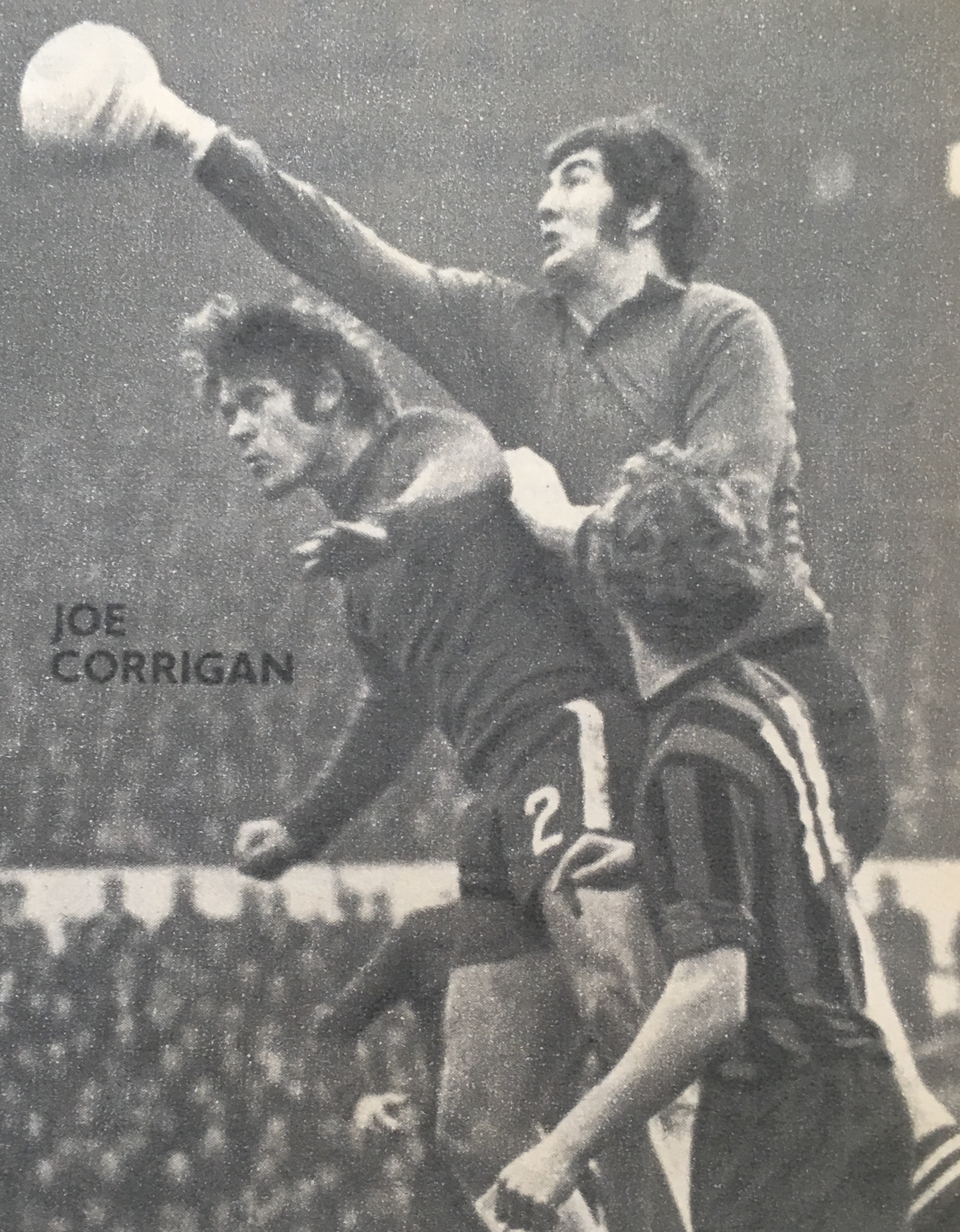
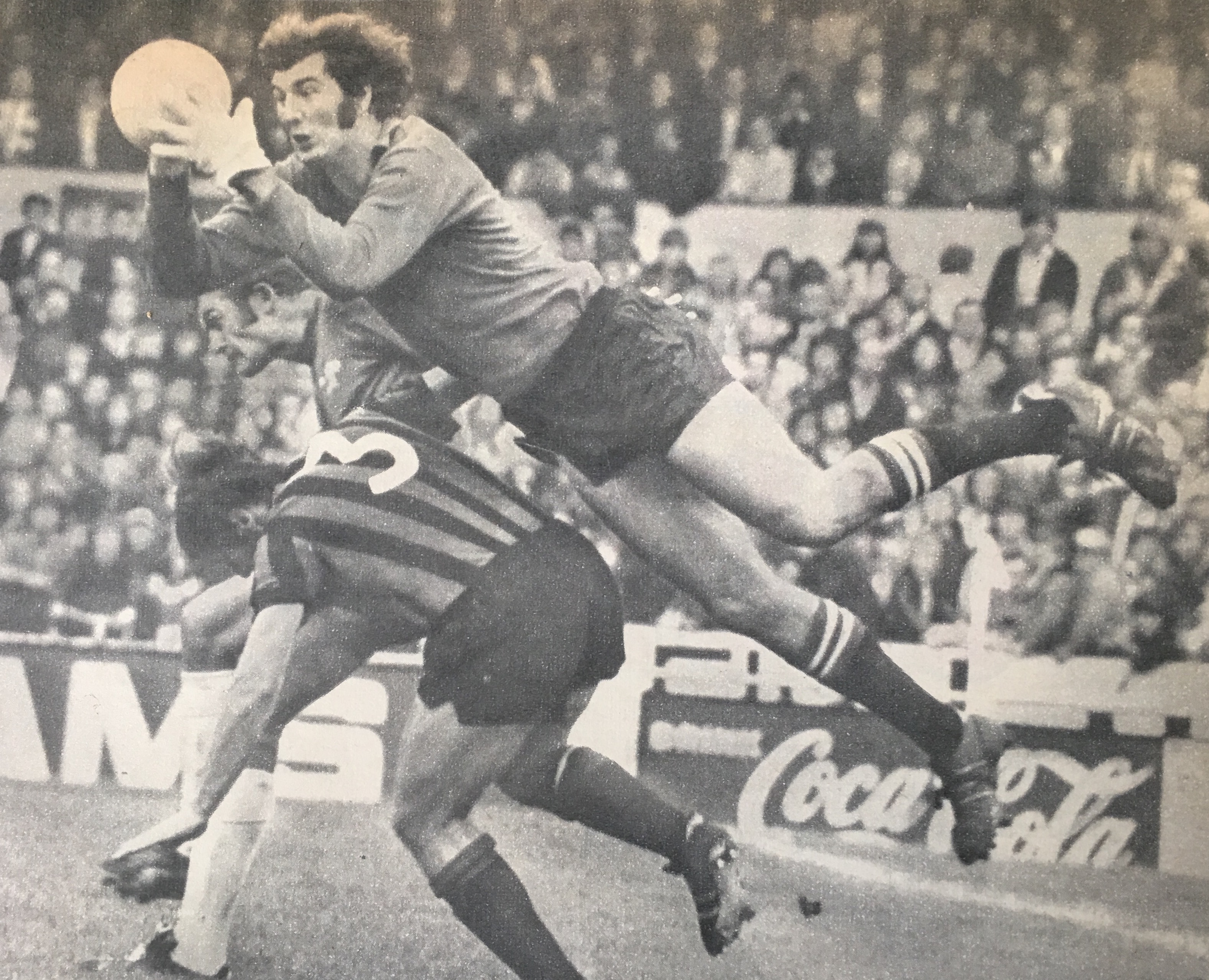
  • Pictures from my scrapbook show Corrigan punching clear of Chelsea’s David Webb, diving headlong to deny Chelsea’s Keith Weller, letting his teammates know his thoughts, and in an Albion squad line-up alongside Eric Young and behind Gerry Ryan and Steve Gatting.

J Cor sept 18

  • Joe pictured in the Man City matchday programme in September 2018.


Corrigan in 2025

Will transfer ins and outs mirror the comings and goings of 1979?


Foster big 79 signingPortsmouth’s Steve Foster was the big summer signing in 1979

IF WE’RE to learn from history and marry it to what we as fans have been told to expect as Brighton once more rise to play amongst the elite, what squad strengthening might we see?

Back in 1979, the core of the team who won promotion from the second tier under Alan Mullery was largely kept together – but there were some crucial comings and goings nonetheless.

First to go was the goalkeeper, Eric Steele. If, as it appears, David Stockdale is on his way, who do Brighton have lined up as his successor? Too soon for Christian Walton? Finally a chance for Finnish international Niki Mäenpää? Or might we see the arrival of Wojciech Szczęsny – another Pole In Goal? Perhaps John Ruddy, freed from Norwich?

A player who went on to become synonymous with the history of Brighton & Hove Albion arrived at the club in the summer of 1979 and ended up playing for England at the World Cup. Steve Foster was an uncompromising defender who achieved legendary status, albeit at the expense of Andy Rollings, the centre half who had journeyed from Third Division to First with the Seagulls. So, a question: is Shane Duffy going to cut it in the Premier League? Or do we need someone with a bit more pace and finesse? There’s no doubting Duffy’s aerial ability; not so sure how he’ll fare against some of the craftsmen in the Premiership.

Lewis Dunk has in some quarters been compared to the great Mark Lawrenson although for me he has some way to go to reach that level. Dunk may possibly be good enough to break into the England squad if he continues to perform as he has in the Championship. It’s in his hands and only time will tell but I can see him taking on the captain’s armband and successfully stepping up to the next level. However, rather like Lawrenson, there’s every chance that eventually big money will lure him away.

In 1979, Mullery needed to replace an ageing right back and brought in John Gregory to take over from Chris Cattlin. The outstanding Bruno does not have age on his side and, fit though he is, will surely struggle to complete a full season in that right back berth. Liam Rosenior is an able deputy but arguably a more permanent fixture in that position is needed. Carl Jenkinson anyone?

Chris Hughton, a quality left back at the highest level during his playing career, has to decide whether to look beyond the out of contract Gaëtan Bong or West Brom’s Sébastien Pocognoli to fill a position that has had too many temporary incumbents since that memorable season when Wayne Bridge wowed us with his quality.

In 1979, Gary Williams continued to hold down the left back position although the young Gary Stevens was emerging as a defender who could play in any position across the back four, left back included. Williams was eventually ousted when Mullery’s successor Mike Bailey went for the experienced former Arsenal and Northern Ireland international Sammy Nelson.

Canny Mullery also recognised he needed to improve the quality in midfield and turned to Neil McNab, a former Tottenham midfielder, to bring a bit more craft to Brighton’s engine room. He also introduced a seasoned pro in Peter Suddaby to play alongside Foster at the back to free up Lawrenson to weave his magic in midfield.

Albion have done well to secure the services of Dale Stephens on a long term contract but I can see someone with a good deal of Premier League experience being brought in to play alongside him. Rather like Bruno, Steve Sidwell doesn’t have age on his side so the Seagulls probably need to look to someone in their late 20s or just turned 30. Lucas Leiva at Liverpool has already been touted in the football gossip columns.

Teddy Maybank may have spearheaded Brighton’s promotion from the second tier in 1979 but when he didn’t cut it at the higher level, Mullery was quick to move him on and bring in Ray Clarke, a former Tottenham teammate who had been scoring goals for fun in Holland.

Glenn Murray has publicly admitted he feels he has unfinished business in the top flight and briefly showed previously that he’s still capable of finding the net in the top division. As to how many games he’ll manage, and who might partner him in the process, I would say the jury is out.

Personally I don’t expect Tomer Hemed or Sam Baldock to feature much, even if they are retained. More likely I would expect to see the arrival of a fringe striker from one of the Premiership’s top six: Tammy Abraham would be a good shout.

And after his failure to secure the hoped-for ‘no.10’ at the beginning of the season just gone, I would imagine Chris Hughton will be keen to put that right in the summer, this time aiming higher in quality than Alex Pritchard. Has Richie Towell got it in his locker to play that role? He’s had very few chances at Championship level so there must be serious doubt about him coming through.

So, speculation will doubtless be rife throughout the next couple of months but my expectation is that Brighton will look to add six players to the squad.

As they say, watch this space.


Midfielder Alan Curbishley helped Seagulls to promotion

Screenshot

ALAN Curbishley completed a hat-trick of promotions with new clubs when he was part of Brighton’s successful third tier side in 1988.

He’d previously been promoted after switching from West Ham to Birmingham City and also when moving from Aston Villa to Charlton Athletic.

Curbishley was what you might call West Ham through and through.

Born at Forest Gate on 8 November 1957, within a mile of West Ham station, he was one of five children (elder brother Bill famously promoted and managed The Who and Led Zeppelin and was producer of the films Tommy and Quadrophenia).

Curbishley first played in Brighton at under 11 level, in a Newham Boys side against Brighton Boys at Longhill School, in May 1967. He was later capped for England Boys aged 15 and after joining the Hammers straight from school played for England Youth.

Curbishley won nine England Youth caps under Ken Burton, scoring on his debut in a 1-1 draw against Poland in Las Palmas on 21 January 1975 when England went on to win the Atlantic Cup. Among his teammates were future England captain Bryan Robson, Peter Barnes and Keith Bertschin.

He vied for a starting berth with Mark Nightingale (Palace, Bournemouth, Norwich, Peterborough), making six starts and three appearances off the bench. His last appearance was in a 1-0 win over Wales in Cardiff on 11 February 1976, playing alongside Glenn Hoddle and Gary Owen.

Almost a year earlier, on 29 March 1975, he had made his first team Hammers debut at the tender age of 17, lining up in midfield alongside Trevor Brooking and Graham Paddon in a 1-0 home defeat against Chelsea. Mervyn Day was in goal for West Ham and guarding the opposition net was John Phillips.

At the time, Curbishley was the youngest to play in the senior team although that record was subsequently eclipsed by Paul Allen.

A contemporary of Geoff Pike, Paul Brush and Alvin Martin, they were all in the West Ham youth team defeated 5-1 on aggregate by Ipswich in the 1975 FA Youth Cup Final.

In a midfield dominated by Brooking, Paddon and Pat Holland, and later Alan Devonshire and Pike, Curbishley found first team chances limited, although in 1977-78 he made 36 appearances.

After 85 matches for the Hammers, in 1979 he moved to Birmingham for £275,000. Manager Jim Smith used the proceeds of the £1m transfer of Trevor Francis to Nottingham Forest to buy Curbishley, Frank Worthington, Colin Todd and Archie Gemmill. Curbishley was still only 21 when he made his debut for the Blues on 18 August 1979 in a 4-3 defeat at home to Fulham and he went on to be ever present for Birmingham in that 1979-80 season.

Curbishley earned his one and only England Under 21 cap in a 5-0 thrashing of Switzerland at Portman Road when Justin Fashanu was among the scorers. He had hopes of going to the 1982 World Cup with England, having broken into the England B squad but fractured a kneecap sliding into a tackle with Albion’s Brian Horton. “I missed the rest of the season and the start of the next, and the World Cup squad which I might have broken into otherwise,” he said. “It was the worst disappointment I’ve ever faced.”

He was on the front cover of the matchday programme for a game I went to watch at St Andrew’s on 27 March 1982 when he played for Ron Saunders’ Blues in a 1-0 win over Brighton. But financial issues meant the side was broken up and, the following year, after a total of 155 games, he committed what today seems to be viewed as a cardinal sin by signing for Villa for £100,000, ironically making his debut against Birmingham in a 1-0 win on 4 April 1983.

“I had high hopes of success there with them just having won the European Cup,” he told Dave Beckett in an Albion matchday programme article. “It was soon obvious though that Tony Barton was under pressure from the moment he took over and all the players thought it was just a matter of time before he was sacked.

“He got a raw deal. That season we finished ninth in the league, got to the semis of the League Cup and were knocked out of the UEFA Cup in the last minute on the away goals rule. Villa have never been near that form since, but Tony Barton’s face didn’t fit and he was soon on his way along with all the men he signed.”

After only 36 appearances, scoring once, Curbishley returned to London, dropping back down to the 2nd division, to begin what would be a long association with Charlton Athletic, punctuated only by his spell at Brighton.

Amazingly, although homeless at the time and playing at Selhurst Park, Charlton won promotion back to the 1st Division. Unfortunately Curbishley sustained an achilles tendon injury and only played 10 games in the 1986-87 season.

“I knew I had an achilles injury but the operation was delayed until a week before the start of the new season and consequently I wasn’t fit again until December,” he said. “The manager bought two new midfield players, which I understood, but when I was fit again I couldn’t get back into the side.

“It became apparent that I wouldn’t get much of a chance unless something drastic happened so I’m pleased to have a fresh start.”

After 13 seasons playing in the top two divisions, he left Charlton having scored six times in 63 games and dropped down to the Third to join the Albion for £32,500.

He made his debut in a goalless draw at Chesterfield on 22 August 1987 in front of a crowd of just 2,286.

After the departure of Jimmy Case in 1985, the centre of Albion’s midfield had been crying out for someone who could put their foot on the ball and pass it, and Curbishley stepped neatly into that role, scoring six goals – mostly penalties – in 34 appearances as Brighton won promotion.

“Alan was a very level-headed guy, an excellent passer and really disciplined,” Albion boss Barry Lloyd told Spencer Vignes in a matchday programme article.

In total, over three years on the south coast, Curbishley played 127 games (plus five as sub)  – making his 400th league appearance during the 1988-89 season – and scored 15 goals.

curbs penThe Albion matchday programme featured Curbishley when the Seagulls hosted the Hammers for a Barclays League Division 2 game on 16 September 1989. Describing his time with the East London club, he said: “It was a brilliant set up although I was definitely a bit headstrong in my early days.

“I didn’t really grow up until I moved to St Andrew’s and that’s where I had my best playing days.”

Lou Macari’s side in 1989 included Curbishley’s old pal Alvin Martin and future Albion manager Liam Brady but the Seagulls ran out 3-0 winners (goals from Kevin Bremner, Robert Codner and Garry Nelson).

In 1990, Curbishley began his coaching career, returning to Charlton initially as player-coach under Lennie Lawrence. When Lawrence left in 1991, Charlton made the somewhat unusual decision to appoint joint managers: Curbishley and Steve Gritt (who would later be at the helm when Albion narrowly escaped dropping out of the league).

Curbishley’s first signings for Charlton were former Albion teammates Nelson and Steve Gatting and he later plundered young winger John Robinson from the Seagulls. After four years, Curbishley took sole charge at The Valley and led Charlton to some of the most successful times in their history.

Considering their resources, Curbishley turned Charlton into a steady top flight club and model of stability, consistently securing a mid-table finish.

Sean Cole in The Bleacher Report described him as “one of the most promising managerial talents of the new millennium” and in 2006, in the wake of Sven-Goran Eriksson’s departure as England manager, Curbs had ‘tea and biscuits’ with then chief executive Brian Barwick – but Steve McLaren got the job instead.

In December 2006, Curbishley landed what surely would have been considered his dream job – manager of West Ham.

It was quite a reunion of old pals when Brighton visited Upton Park for one of his first games in charge, in the third round of the FA Cup in January 2007. Albion boss Dean Wilkins and coach Ian Chapman had both been teammates while physiotherapist Malcolm Stuart was still wielding the magic spray.

In front of 32,874, Hammers ran out fairly comfortable 3-0 winners with Mark Noble scoring his first senior West Ham goal and Carlos Tevez a real handful up front. These were the respective line-ups:

West Ham: Carroll, Dailly, Ferdinand (Spector 45), Gabbidon, McCartney, Benayoun, Mullins, Noble, Boa Morte (Newton 73), Cole (Bobby Zamora 68), Tevez.
Subs not used: Green, Sheringham. Goals: Noble 49, Cole 58, Mullins 90.

Brighton: Wayne Henderson, Joe O’Cearuill, Joel Lynch, Guy Butters, Kerry Mayo, Tommy Fraser (Gary Hart 51), Adam El-Abd, Dean Hammond, Alexandre Frutos (Sam Rents 67), Alex Revell (Joe Gatting 84), Jake Robinson. Subs not used: Michel Kuipers, Richard Carpenter.

Fans’ website westhamtillidie recalled: “Perhaps Curbs’ greatest legacy at the club was the £7m signing of his former Charlton protégé Scott Parker, who went on to win the Hammer of the Year prize three times and pick up a Football Writers’ Player of the Year Award during his time at the club.”

Sadly, though it was to all end in tears and Curbishley quit in protest at the then Icelandic owners’ failure to consult him over the sale of defenders Anton Ferdinand and George McCartney.

In what must have been a tough heart-v-head decision, he resorted to a legal resolution of the situation and eventually won a case for constructive dismissal, eventually receiving £2.2m in compensation. But it was the last manager’s job he had.

“It took me a year to sort out my problem at West Ham,” he told The Independent. “And then, after that, I was perhaps a little too picky. I was told by other senior managers ‘don’t be out too long’ but I was waiting for a job that I thought was the job for me.”

Job vacancies came and went, Curbishley’s name was generally on all the shortlists, but he never again made it through to the manager’s chair. There was a brief moment at Fulham when he was technical director assisting Rene Meulensteen but when Meulensteen was swiftly axed, new manager Felix Magath brought in his own people.

He rejoined the Fulham coaching staff in March 2015 and took charge of training in November 2015 when Kit Symons was relieved of his managerial duties but Stuart Gray took charge of the team before Slavisa Jokanovic was appointed.

In 2016, Curbishley brought out a book, Game Changers: Inside English Football: From the Boardroom to the Bootroom (published by HarperSport) and was a regular pundit on the Football on 5 programme covering Football League games.

Further reading

https://www.westhamtillidie.com/posts/2014/11/07/preview-aston-villa

http://bleacherreport.com/articles/1415997-the-curious-case-of-alan-curbishley-footballs-forgotten-man

https://www.whufc.com/club/history/managers/alan-curbishley#C1vPoA9yPR1kYluJ.99

  • Pictures show westhamtillidie’s image of Curbishley in West Ham colours; the midfielder on the front of a Birmingham matchday programme 1982; in Villa’s colours from a Match Weekly annual, an Argus shot of Curbs scoring a penalty for Brighton against Man City, and other images from the Albion match programme.

Moonwalk maestro Bas Savage was scoring for fun a decade ago

CAN anyone really believe it was 10 years ago when the few thousand of us who watched the Albion at Withdean were marvelling at the goalscoring prowess of Bas Savage?

A quick check at the yellowing newsprint from 2007 reveals a clutch of Argus headlines extolling the virtues of a forward who, let’s face it, few could fathom.

After scoring twice in an away game at Northampton to take his tally to six in 11 games, Argus reporter Andy Naylor reminded us: “The gentle giant scored only twice in 66 appearances for Reading, Wycombe Wanderers, Bury, Bristol City and Gillingham before joining the Seagulls on a free transfer from the Gills at the beginning of February.”

Savage attributed his sudden burst of goalscoring on the coaching methods of manager Dean Wilkins, telling Naylor: “He is first out on the training pitch setting up sessions, and that enthusiasm rubs off on the squad.

“He may be young but tactically some of the sessions he has put on I have never seen before from experienced coaches, so I would say he has a good future ahead of him.

“He has worked on my movement as a striker, which has helped me in games, and being a bit more dangerous around the box.”

A prerequisite for a striker, though, you would have thought!

The movement most remember Savage for was his moonwalk goal celebration which was certainly a lot more entertaining than the ungainly style he displayed in pursuit of goals.

So good was his popping, sliding and gliding across the grass a la Michael Jackson that the Soccer AM programme on Sky Sports had him on to perform, a display which can still be found on YouTube.

There can be little doubt Savage’s goalscoring helped lift the Albion clear of the threat of relegation in the spring of 2007 and Wilkins told the Argus: “Bas has played a big part. We are very pleased with his ratio of chances and goals per game.

“We just felt that from what we had seen of him he would add to the squad and create different kind of problems to what we had in the side at that time.”

Naylor pondered whether the Seagulls might finally have found a talismanic striker in the mould of Bobby Zamora and Leon Knight. Savage replied: “I will definitely give it my best shot. I haven’t got the best record out there but I try in every game to score a goal.”

Savage scored the first goal of his professional career for Bristol City against Scunthorpe United in 2005 (his only goal in 23 appearances) but City fans were very divided in their opinion of his performances under current manager Lee Johnson’s dad Gary.

One of the more supportive comments, on otib.co.uk, came from RedTop, who said: “Yes he’s unorthodox, and no he doesn’t do everything right but this is third tier football and he causes havoc.”

Curiously, Scunthorpe were also the opponents when he scored his first home goal for the Albion in March 2007.

When Nicky Forster arrived at Brighton from Hull, there was the opportunity to resurrect what had been a very brief partnership at Reading but, at the Albion too, the partnership had a limited number of games.

A brief highlight in the autumn of 2007 saw a Savage-inspired 2-0 win away to Bournemouth. After Savage made one and scored one, Naylor began his assessment of the game: “Bas Savage may be unorthodox, even clumsy at times, but life is rarely dull with Albion’s moonwalking front man in the side.”

After scoring a total of nine in 36 games for Brighton, Savage moved on to Millwall, Tranmere, Dagenham and Redbridge and Northampton Town before ending up playing in Thailand.

In fact Savage was part of the Dagenham and Redbridge squad that caused a scare at Withdean when Albion were going for promotion from League One in 2011.

The Daily Mail reported how “the striker attempted to inspire them for their clash against league leaders Brighton with a Spiderman design sprayed on his head.

“But the man capable of performing the best moonwalk in the game and no stranger to dodgy barnets (having already had a red and blue pattern, a tiger skin style and many others… all this season) failed to come off the bench and John Still’s struggling side duly lost 4-3 at the Withdean.”

Albion twice had to come from behind but eventually ground out the win to secure their return to the second tier after a five-year absence.

Savage had started out with Walton & Hersham and got his league break with Reading in 2002 before a career-threatening injury kept him out of the game for over a year.

By the time he returned to action, Steve Coppell had arrived from Brighton and gave Savage few chances, resulting in his going out on loan to Bury and Wycombe. He spent 2005-06 at Ashton Gate and the earlier part of 2006-07 at Priestfield.

  • Bas Savage pictures and articles from the Argus in 2007.


Winger Mark Barham was no stranger to Wembley

1 Barham progBRIGHTON’S wingers in the 1991 Division Two play-off final had previously been on opposing sides in a Wembley final.

Mark Barham was a winner with Norwich City as they beat Sunderland 1-0 in the 1985 League Cup Final and Clive Walker missed a penalty for the Wearsiders.

Six years on, Barham had levelled for Albion in the first leg of the semi-final at home to Millwall (more of which later) and Walker got the third when the Seagulls upturned the form book and beat Bruce Rioch’s side 4-1.

The 6-2 aggregate victory pitched the Albion against Neil Warnock’s Notts County under the shadow of the famous Twin Towers of Wembley.

Walker saw a Wembley post prevent him from scoring as Brighton’s dream of promotion was ended in a 3-1 defeat.

Folkestone-born Barham joined the Seagulls on a two-year contract after an initial trial and made his debut as a substitute for Kevin Bremner in a 1-0 home defeat to Oxford United on 30 December 1989.

He got his first start two days later in a 3-0 defeat at West Brom, who he’d played for briefly under ex-Ipswich and Arsenal midfielder Brian Talbot earlier that season.

On the second Saturday of the new decade he scored his first Albion goal in a 1-1 draw at home to Barnsley and had played 18 games by the end of the season.

Young John Robinson was beginning to get first team opportunities but Barham managed 42 appearances in 1990-91, culminating in that Wembley appearance against Notts County, although he was subbed off on 10 occasions.

That play-off first leg game against Millwall was Lloyd’s selection in Paul Camillin’s 2009 Match of My Life book (www.knowthescorebooks.com). He said: “Perry Digweed put in one of his incredibly long punts and the ball was about to bounce on the edge of the Millwall box when the centre half (David) Thompson ducked under it, I think intending to allow it to bounce through to Brian Horne in the visitors’ goal.

“But as he took his eye off the ball he also turned his back and the ball actually landed on the back of his head and squirted off right into Mark’s path. The little winger raced in and cracked the ball into the bottom corner. It really was a vital goal so close to the interval and the fans knew it.”

The goal also gave Barham much personal pleasure because he’d not seen eye-to-eye with Millwall boss Rioch when he’d been his manager at Middlesbrough.

With Robinson winning the shirt more frequently in the disastrous relegation season of 1991-92, Barham managed 25 appearances plus two as a sub but he was released at the end of the season and moved on to Shrewsbury Town.

Born on 12 July 1962, Barham’s football career began when he joined Norwich as an apprentice in 1978.

He was part of the City youth team that won the South East Counties League in 1979-80 and in the same season, at the tender age of just 17, manager John Bond gave him his first team debut. No fairytale start, though, as City lost 5-0 to Manchester United at Old Trafford.

However, he went on to make himself a regular in the City first team, making 213 appearances and scoring 25 goals for the Canaries.

Screenshot
Barham in action for England v Australia

He also won two full England caps on the 1983 tour of Australia in a side captained by Peter Shilton and also featuring Trevor Francis and Terry Butcher. Barham spoke warmly of Bond when he died in 2012 telling the local pinkun:

“When I first came up from Folkestone I had what you might call long hair. The first time he played me in a five-a-side in training he told me ‘I’m letting you play this one but if you don’t go out and get your hair cut you won’t be playing another one’.”

Barham continued: “He was my first manager, he gave me my debut at 17 and I went on to play for England so he must have done something right.

“He loved wingers but you had to adhere to certain rules. You had to play wide with your foot on the line, it was your responsibility to score goals, get crosses in and defend at the same time.”

A knee injury suffered in a match against Spurs was a major blow to Barham’s career. He ruptured cruciate ligaments in his left knee and he ended up in plaster for 14 months.

Although he remained at Carrow Road for four more seasons, Dale Gordon and Ruel Fox emerged as challengers for his place and eventually, in July 1987, Barham moved on to Huddersfield Town.

It was there that he teamed up with former Albion full back Chris Hutchings who spoke favourably about his time on the south coast with the Seagulls. Barham only played 27 games for the Terriers and, with former England striker Malcolm MacDonald replacing Steve Smith as manager, found himself released on a free transfer in 1988.

He joined Middlesbrough on an 18-month contract but as Rioch’s Middlesbrough were relegated he only played four games in eight months and was on the move again, ending up at non-league Hythe Town.

Determined he still had what it took to hold down a league career, Barham wrote to all 92 clubs. He joined Division Two West Brom and played four times for them but they didn’t keep him on.

Barham tight crop“I knew I hadn’t suddenly become a bad player and that I could succeed again,” Barham told the Albion matchday programme in March 1990. “So I wrote to all the clubs again and that’s when Barry (Lloyd) contacted me. His was only one of six replies.

“Since being here I’ve found that all Hutch said about the club and the area was right and now I want to prove myself, show that managers were wrong to ignore me and enjoy my time in Brighton in the hope that my two-year contract will be extended.”

After the disappointments elsewhere, Barham certainly got his career going again at Brighton.

He scored once in eight matches for the Shrews but his career was on the wane in 1992-93 and he had short spells in Hong Kong and played non-league with the likes of Sittingbourne, Southwick and Fakenham Town, who he managed for 20 months from April 1996.

According to Mike Davage’s excellent article Canaries Flown From The Nest in the 1998-99 club handbook, Barham joined Mulbarton in February 1998.

At a Norwich centenary dinner in 2002, Barham told Davage he’d had more than 20 operations on his knee. By the time he was interviewed by Spencer Vignes for Albion’s matchday programme in 2015, he’d had 38 operations on it!

After retiring from the game he ran a toolhire business in Norwich and according to his LinkedIn profile he’s now a business development manager with facilities management company, Mitie.

2 Barham stripesBarham 1

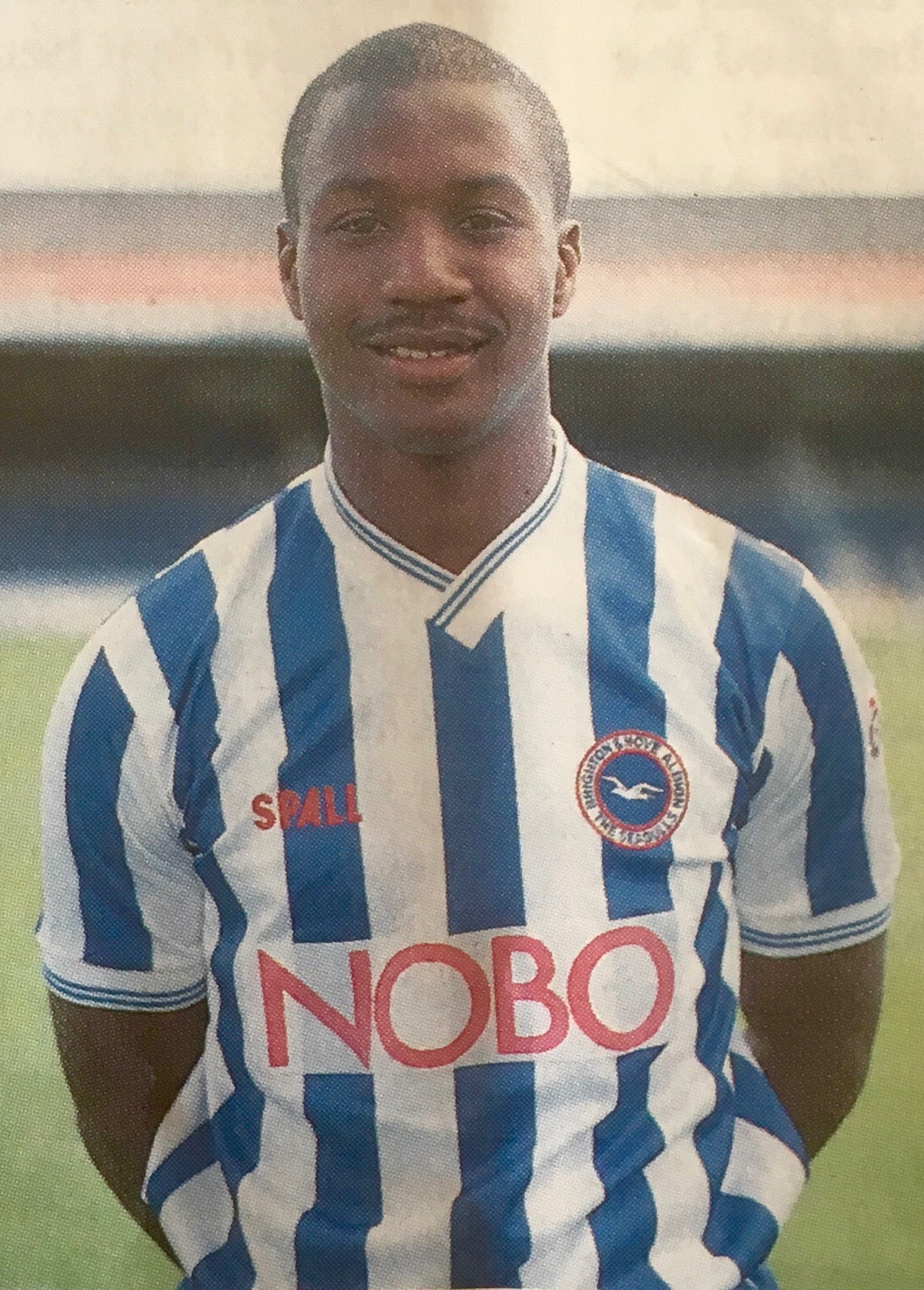
  • Pictures show Barham in Albion’s NOBO kit, from the Wembley play-offs programme, a portrait from a matchday programme and in a team line-up wearing the dreadful pyjama kit.

Promotion captain Brian Bromley ‘a class above’

Bromleycolour

BRIAN Bromley was one of the key players in Brighton’s 1972 promotion-winning team.

Having played the majority of his career in the second tier, he brought a touch of guile and class to the midfield – and some important goals – as the team gained promotion from the old Division Three.

Bromley initially joined on loan from Portsmouth in November 1971 and made his debut as sub for Dave Turner away to Chesterfield. He started the next game and kept his place until the end of the season.

The loan was turned into a permanent deal in exchange for a £14,000 fee. At the end of the promotion season, John Vinicombe wrote in the Argus: “His transfer was a giveaway and to this day Portsmouth fans still bemoan his departure.”

Ray Crawford, the former England international striker who was living in Portsmouth when he joined the backroom team during that season, tells a funny story about Bromley in his autobiography Curse of the Jungle Boy (PB Publishing, 2007).

‘Brom’ didn’t drive and Crawford was asked to give him a lift into training to save on train fares. “Most days, when I arrived at his digs, Brom was still asleep when I knocked on his door.

“After letting me in, I would have to watch him whilst he slowly drank a big mug of strong black tea with the leaves floating in it before he was ready to go.

“As a player, he was a class above most of the Brighton lads, a good passer of the ball with a good work rate and, just like his tea drinking, was never rushed in anything he did on the pitch.”

Bromley’s first goal for Brighton was the decider in a 1-0 win away to Mansfield Town but it was the opener in a 2-0 home win over Tranmere Rovers that lived long in the memory.

Manager Pat Saward said: “I think all followers will agree that Brian Bromley’s goal was one they will remember for a long, long time.

“It came early in the game, at just the right time for us, and I have to search way back in my memory to recall such an exciting goal, with Brian starting his run in his own half, after a neat bit of tackling, and finishing with a brilliant shot from the left which left even that experienced campaigner Tommy Lawrence (former Liverpool no. 1) flatfooted.”

Saward positively purred about Bromley’s capture. He told the Football League Review in 1972 that signing Bromley was “the best move I’ve made” adding: “He’s an exceptional player, one who instils and builds confidence in those around him. He can do anything I ask for because he has both ability and character.”

It was a bit of a mutual admiration society because Bromley played against Saward during his Bolton days and said: “I remember the boss playing a cultured game, the type of football I appreciate, making the ball do the work.”

Bromley took over the captaincy when his former Bolton teammate John Napier was dropped for the oft talked-about televised home game with Aston Villa.

As the excitement grew towards the promotion goal, one of the best performances I recall from that run-in was a night game when Blackburn Rovers were beaten 3-0. Bromley scored the third goal and it was described thus by Vinicombe in the Argus:

“Eighty-nine minutes: After Irvine was fouled just outside the box, Napier executed a brilliant free-kick and Bromley read it expertly. Jones was slow off his line as Bromley raced in to head home, 3-0.”

A Goal magazine article after promotion was won revealed how special it was to Bromley. It said when he had been transferred from Portsmouth earlier in mid-season there was talk that injury might end his career.

“I was heartbroken at the time,” Bromley said. “I really felt my career might be finished. But now I’ve led a side back into the Second Division and everything is just great.”

At the start of the 1972-73 season, Bromley was installed as the new club captain and, as a player with eight years’ experience of Second Division football, in an August matchday programme he wrote: “Although the majority of my footballing career has been spent in the second division, my debut came in the First Division with Bolton Wanderers when I was only 16 years old.

“And one of my greatest ambitions now is to play in the First Division again – with Brighton and Hove Albion.”

Bromley was born in Burnley on 20 March 1946, and, having represented Lancashire Schools, he began his career at Bolton.

After making that debut in March 1963 against Sheffield United, he went on to play 184 games for the Trotters, chipping in with 26 goals, and played many games alongside Gordon Taylor, who was later chairman of the PFA for more than 40 years.

On 27 February 1964, Bromley played for England Youth in a friendly against Spain in Murcia and scored along with Wolves’ Peter Knowles as the visitors won 2-1. His teammates that day included West Ham’s Harry Redknapp, John Hollins of Chelsea and Don Rogers of Swindon Town.

Bromley looked back on his Bolton days and said: “It was storybook stuff for me in the First Division, as you can imagine, playing alongside such great performers as Francis Lee, Wyn Davies and Freddie Hill in Bolton’s forward line. We were all disappointed when we got relegated.

“I spent five years in the 2nd Division with Bolton before moving on to Portsmouth where I had three and a half seasons at Fratton Park.”

Pompey paid a £25,000 fee for him in 1968 and he went on to make 95 appearances for the Fratton Park outfit, scoring three times.

“When I joined Brighton last season, first as a loan player and then permanently, I was impressed with the standard of Albion’s play and the attacking football that was adopted,” he said.

“I always thought promotion was on for us. The four clubs at the top and maybe Rotherham as well had too much class for the rest. And this was exactly how it turned out.”

In an only-to-be-expected rallying cry, he continued: “I believe now that the Albion have the ability to do well in the Second Division. Everyone here thinks like a big club and we are ambitious.

“The biggest difference I think you will see between the Second and Third Divisions is that there are better professionals in the Second. They are better drilled and they think and read the game more cleverly than in the lower divisions.

“An early look through the teams doesn’t appear to throw up any exceptional outfits. Blackpool impressed me very much last season. They’re a good side and it will be interesting to see how Nottingham Forest and Huddersfield go.

“But in my opinion, Albion have nothing to fear. We could be a surprise side but are unlikely to win by four and five goals away like we did in the Third Division.”

Sadly as history records, it was to be a disastrous season which ended in an automatic return to the Third Division. The season was only a couple of months old when Bromley was reunited with his former Pompey teammate George Ley.

Interviewed several years later, Ley recalled: “One of my best mates, Brian Bromley, had gone to Brighton and they had just won promotion.

“He used to play just in front of me in midfield when I was at full back, that was one of the reasons why I left – to go and play with Brom again in that position.”

I discovered a nice little anecdote about the pair’s friendship which happened during an FA Cup fourth round replay in 1971 in which Arsenal narrowly got the better of Pompey by 3-2.

With only two minutes of the game to go, Ley hit Gunners full back Pat Rice and Bromley tried to intervene to hold his pal back – and was promptly sent off by the ref. Arsenal went on to win the cup that year.

Bromley played less than half of Albion’s games in Division 2 but was back in the team as they returned to Division 3 at the start of 1973-74.

Saward was struggling to get the side to gel, though, and after only three games, a 2-0 defeat at home to Bournemouth, was Bromley’s last in the stripes and he moved to Reading in September 1973. He had played 52 games for the Albion in total, plus three as a sub, but he made his mark when it mattered.

He spent the 1974-75 season with Reading but only made 14 appearances for Charlie Hurley’s side and was sent out on loan to Darlington.

The following season he moved on to Wigan Athletic, who at that time were in the Northern Premier League, and in a season with the Latics played 23 times.

In 1976-77, he linked up with his former Pompey teammate David Munks at Southern League Waterlooville.

After he’d finished playing, he did what many players of that generation did and moved into the licensed trade.

At one time he was the landlord of the Black Dog in Arundel Street, Portsmouth, and also the White Hart pub in Portchester.

He was working at a social club in Portchester in 2012 and a Portsmouth fan – pompeyblue1980 – takes up the story:

“He looked very ill and was advised by a friend of mine to go home. He was back in the club on Wednesday and looked even worse. He was taken to the QA (Queen Alexandra Hospital) on Wednesday and transferred to Southampton General Hospital on Thursday. He passed away on Friday in the hospital.”

He was 11 days short of his 66th birthday.

  • Top picture shows Bromley captured in Shoot magazine; in the montage, pictures show Bromley’s portrait in Goal magazine, depicted on a Pompey football card collection, signing for the Albion, from the Argus scoring THAT goal against Tranmere (beating the legendary Ron Yeats), and, a matchday programme action shot.

Head injury end to ‘keeper Geoff Sidebottom’s career

GEOFF Sidebottom, who played in the European Cup for Wolverhampton Wanderers and the very first League Cup Final for Aston Villa, kept goal for Brighton & Hove Albion when I first started watching them.

Brighton were the third club manager Freddie Goodwin had brought him to, and he vied for the no. 1 jersey with local lad Brian Powney.

However, a game he revelled in, that I have referred to in the post about Eddie Spearritt, came in September 1969 when he faced his old club in a League Cup third round tie in front of a packed house at the Goldstone.

In John Vinicombe’s Argus preview of the big game, Sidebottom told him: “It is always nice to play against your old club and I know what this draw means to our supporters. They don’t come much bigger than the Wolves – wherever they play the crowds flock to see them.”

I came across the programme for the game only the other day, annotated by my dad with the team changes, and, in the annals of Albion history over the years, it stands out as one of the great nights.

I was only 11 at the time and had just started high school so it was probably a big deal to skip homework that evening and head over to Hove from home in Shoreham.

Up to then I had only ever seen a handful of ‘daylight’ games (played Saturday afternoons or bank holidays) so it was my first ever game under the floodlights (I’d not been to the games in the previous two rounds, when Albion had beaten Portsmouth and Birmingham, at the time both one division higher).

At a time when the average crowd for league games was around the 12,000 mark, 32,539 packed in to the Goldstone to see if Albion could pull off a remarkable hat-trick of results. No thoughts of a weakened team for Albion but, even back then Wolves didn’t put out their big guns, neither captain Mike Bailey, who would later become Albion manager, nor fearsome centre forward Derek Dougan played. Dougan had been a teammate of Sidebottom’s at Villa.

The size of the crowd certainly wouldn’t have fazed Sidebottom. He had made his Wolves debut 11 years earlier in the Black Country derby against West Brom in front of 48,898 at The Hawthorns.

Although goals from Allan Gilliver and Spearritt had Brighton 2-1 up at half-time, Wolves ultimately showed their superiority in the second half when Scottish international Hugh Curran got the ball past Sidebottom twice in eight second half minutes to clinch the tie.

It was during another cup match two months later, a marathon FA Cup second round tie with Walsall, that Sidebottom sustained the first worrying head injury that would ultimately lead to his forced retirement from the game.

In those days cup games weren’t decided on the lottery of penalties so they just kept having replays until there was a conclusive result.

It required three replays before the Saddlers finally prevailed 2-1, and it was during the first of the four games when a concussed Sidebottom was stretchered off on 65 minutes, outfield player Spearritt taking over in goal (in the days before substitute goalkeepers) and Albion hung on for a 1-1 draw.

At 5’10”, Sidebottom wasn’t the tallest ‘keeper around but no-one doubted his courage.

He missed the following nine games but played another nine times before the end of the season. After Goodwin departed for Birmingham, his successor, Pat Saward, preferred Powney and Sidebottom played only a handful of games in 1970-71, his last appearance coming in a 3-0 win over Doncaster in January 1971.

But where did it all begin? Back in the day, Wolves were one of the top teams in the country, league title winners in 1957-58 and 1958-59 and FA Cup winners in 1960. They had a feeder nursery club based near Rotherham called Wath Wanderers.

Sidebottom (circled) with the 1960 FA Cup winning Wolves squad

It was run by a former Wolves player turned scout, Mark Crook, who would scour Sheffield, Barnsley, Doncaster, Rotherham and the area between Hull and Newcastle searching for youngsters who might make it in the famous old gold.

Sidebottom, born on Boxing Day 1936 in Mapplewell, three miles north of Barnsley, worked in a foundry near Barnsley in his teens and was spotted playing for Barnsley Boys and ended up at Wath Wanderers.

He signed pro for Wolves aged 17 in 1954 and played in the Wolves side beaten by a Manchester United featuring the mighty Duncan Edwards in the final of the 1954 FA Youth Cup.

With England international Bert Williams and Scot Malcolm Finlayson ahead of him in the first team, it was four years before he made that debut in a 2-1 defeat to arch rivals WBA. Subsequently he vied for the jersey with Nigel Sims and Noel Dwyer but

Sidebottom would go on to play 35 times for Wolves including two of the matches en route to the 1960 FA Cup Final win over Blackburn Rovers, and in the 1960 Charity Shield draw with Burnley.

He also appeared in a 5-2 European Cup second-round defeat at home to Barcelona, as well as the Cup Winners’ Cup.

Most of his senior outings for Wolves came in the early part of the 1960-61 season, featuring in 18 of the first 22 League games as deputy for the injured Finlayson.

In February 1961 he was transferred to Villa for £15,000 where, in September that year, he played in goal as Joe Mercer’s side beat Rotherham 3-0 in the second leg of what was, in that inaugural season of the competition, a two-legged final, Rotherham having won the first game 2-0.

Interesting to look back now and see that among his teammates that day were John Neal, who later became manager of Chelsea, Gordon Lee, a future Everton manager, and Vic Crowe, who managed Villa in the early ‘70s.

Over the next four years, Sidebottom made 88 appearances for Villa before linking up with Freddie Goodwin for the first time in 1965 when he joined Division 3 Scunthorpe United.

Goodwin had joined Scunny as player-manager in 1964. Waiting in the wings behind the experienced Sidebottom was a goalkeeper who would eventually emerge as one of England’s finest: Ray Clemence.

Sidebottom kept the youngster at bay during the 1965-66 season but eventually, after 59 games for The Iron, lost his place to the ‘keeper who went on to join Liverpool and Spurs and earn 61 caps for England before becoming the country’s goalkeeping coach.

When Goodwin tried his luck in America in 1967-68, Sidebottom was one of his first signings at New York Generals, and the ‘keeper played 44 games over there.

Almost, it seemed, as night followed day, shortly after Goodwin took over as Brighton manager, Sidebottom followed on 31 December 1968.

He would ultimately play 45 times for the Albion. After that earlier concussion incident against Walsall, he also had to leave the field with severe concussion when he cracked his head against a goalpost playing for the Reserves at Southwick.

He couldn’t shake off pains and double vision, and there followed a series of consultations. Even when the club’s own doctor advised him to pack up, he still didn’t want to accept the verdict.

It was only when he saw leading Harley Street neurologist Dr Roger Bannister (the same chap who ran the first sub-four minute mile) that he finally had to accept that he would have to quit the game at the age of 35.

“We went to the top to find out just why Geoff has been getting these pains,” manager Saward told the Argus. “I cannot say how sorry we all are. Geoff is the finest sort of professional; he is admired and liked throughout the game.”

Goodwin, who brought his Birmingham City side to the Goldstone to play in a testimonial match for Sidebottom in May 1972, said: “He was certainly the bravest goalkeeper I have ever seen.

“He was a marvellous club man. I signed him for Scunthorpe, New York Generals and Brighton and he never destroyed the faith I had in him.”

In the Birmingham side for that testimonial were striker Bob Latchford, who later played for Everton and England, and Gordon Taylor, who became chief executive of the PFA.

Sidebottom became a window cleaner and a building contractor after his playing days were over and he died aged 71 in November 2008.

Further reading

http://www.wolvesheroes.com/2008/11/06/keeper-passes-away/

http://www.birminghammail.co.uk/news/local-news/former-aston-villa-goalkeeper-geoff-72339

www.nasljerseys.com/Players/S/Sidebottom.Geoff.htm

New signings Sidebottom (left) and Barrie Wright with boss Freddie Goodwin

Stan Bowles’ best pal at QPR played a part in Brighton’s highest-ever finish

AMID the fairly seismic changes Brighton & Hove Albion went through in the summer of 1981, the arrival of full back Don Shanks was quite low key.

Manager Alan Mullery had quit in a fit of pique over chairman Mike Bamber selling Mark Lawrenson to Liverpool (when he’d already done a deal to sell him to Manchester United).

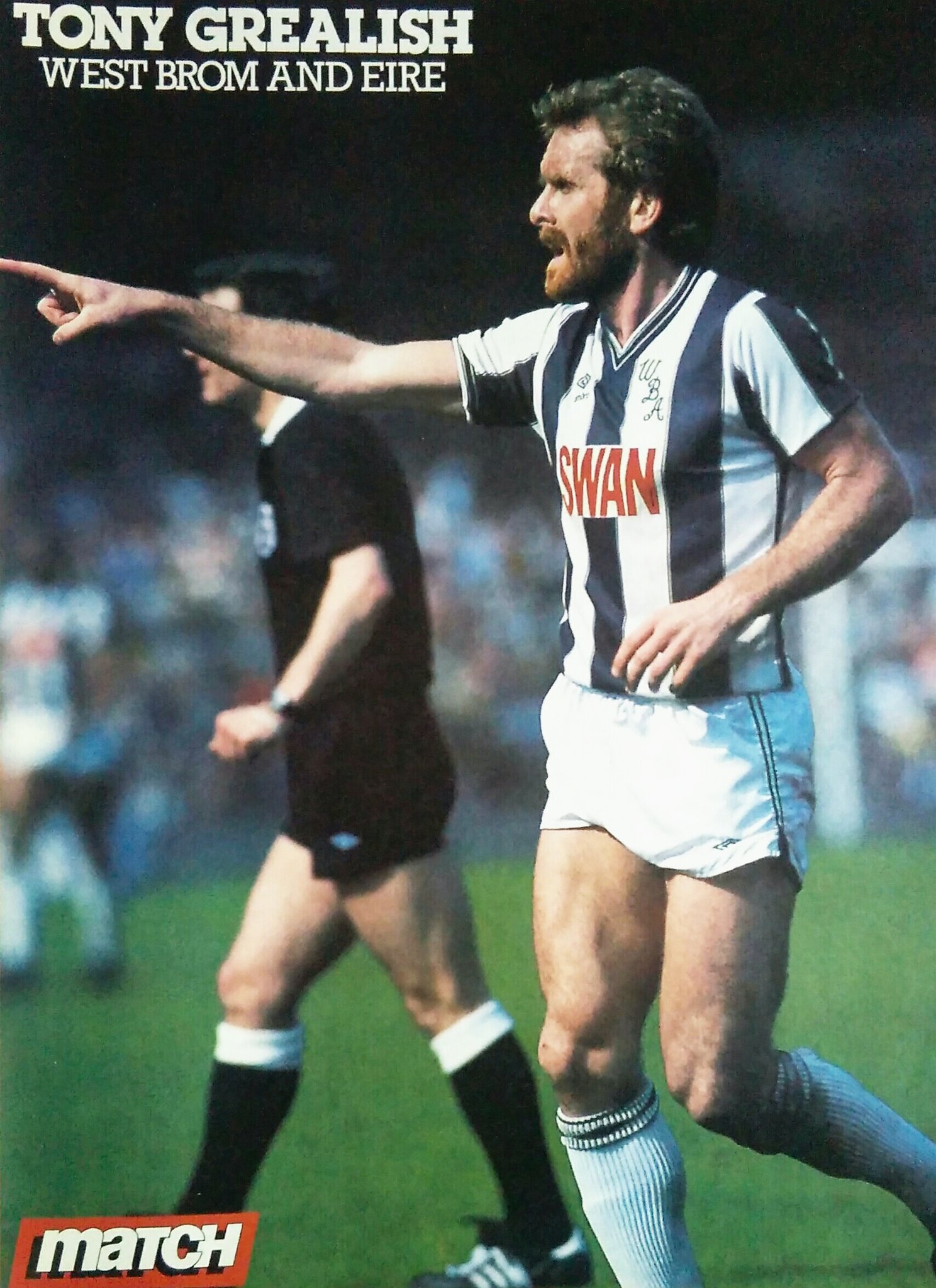
Brian Horton, the skipper throughout Albion’s rise from Third Division to First, left the club to join Luton Town with Tony Grealish coming in the opposite direction.

John Gregory, whose end of season switch from right back to midfield had played a big part in Albion’s narrow escape from relegation, moved to Second Division Queens Park Rangers.

In Gregory’s place, 28-year-old Hammersmith-born Shanks arrived at the Goldstone from Loftus Road.

He had been a part of that very successful QPR squad of the mid 1970s but had more of a reputation for activities off the field, getting into scrapes with his best mate Stan Bowles and living with former Miss World, Mary Stavin.

Shanks told Shoot magazine how he had been about to sign for Third Division Millwall despite having been on trial at Brighton, and playing on a pre-season tour, but Mike Bailey’s no. 2, John Collins, who’d been at Luton at the same time as Shanks recommended him to the boss and he agreed a one-year deal to play at the top level.

Bailey clearly favoured experience over youth. The inexperienced Chris Ramsey had come in at right back and impressed at the end of the 1980-81 season but didn’t get a look-in under Bailey, who also added top level nous on the left side with the free transfer capture of former Arsenal left back Sammy Nelson who he favoured over the long-serving Gary Williams.

With a midfield strengthened by the arrival of former European Cup winner Jimmy Case, who had moved from Anfield as part of the Lawrenson deal, there was a solid but not flamboyant look to the new line-up.

However unpopular Bailey’s defence-minded approach appeared, the fact remains he steered Brighton to their highest ever finish (13th) in the football pyramid – a feat which stands to this day.

don shanksShanks certainly played his part in that achievement and spoke about his time at the club on the popular Albion Roar podcast in October 2018. Shanks finished that historic season having completed 41 league and cup games, plus one as sub and was non-playing sub in two.

All the while Bailey was at the helm, Shanks was a regular and he began the 1982-83 season in the number 2 shirt again.

However, the talented and versatile Gary Stevens was always able to slot in comfortably as a right back or centre back and before long Shanks was not first choice. He made his last – 54th – appearance in a 2-0 defeat away to Coventry on 4 December 1982, after which Bailey was sacked.

The new management team of George Aitken and Jimmy Melia instantly reinstated Ramsey at right back and Shanks never played for the Seagulls again.

On his release he linked up with Wimbledon and played a game for them before moving into non-league football with Wealdstone.

Born on 27 October 1952, Shanks began his football career as a junior at Fulham during the Johnny Haynes era, but was released aged 17. Shanks made seven appearances for the England Youth side between March and May 1971, when his teammates included future England international Trevor Francis.

After leaving Fulham, Shanks joined Luton Town where he played 90 games for the Hatters under manager Harry Haslam. He was in their 1973-74 promotion side along with Barry Butlin and Ken Goodeve, who both later had spells at Brighton, and former Man Utd European Cup winner John Aston, former United player and coach Jimmy Ryan and ex-Everton striker Jimmy Husband.

QPR signed him for £35,000 and he made his debut for the Hoops on 7 December 1974.

Shanks was generally regarded as back-up to first choice right back Dave Clement but nonetheless was part of QPR’s Championship runners-up squad in 1975-76. Manager Dave Sexton’s team was captained by Gerry Francis and included Phil Parkes in goal, Frank McLintock and David Webb in defence and Shanks’ great mate Stan Bowles up front with Don Givens.

In one interview, Bowles said: “Sexton signed Don Shanks from Luton to keep me happy. He was my best mate – and a bigger gambler than me!”

In another, he told sabotagetimes.com: “Everyone talks about George Best and Rodney Marsh. They were characters, all right. But they weren’t the only ones. Back in the 70s, there’d be a few characters in every team. At QPR we had Don Shanks, a very decent full-back who’d do just about anything for a laugh.”

And former QPR midfield player and subsequent England manager, Terry Venables, told journalist Joe Lovejoy: “Stan was game for a wind-up and formed a double act with Don Shanks which was different class. They never had any money and they always used to be borrowing or wanting an advance from the club secretary, Ron Phillips.”

Speaking exclusively to The Inside’R’ magazine, Shanks – who played 206 games and scored 11 goals for QPR between 1974 and 1981 – admitted: “I had a few situations with Stanley when it came to greyhounds. We bought a couple of them together, which was basically disastrous. Why? Well, they just weren’t very good.”

The pair also shared a flat for a short time. “We had this flat just off the Uxbridge Road in Ealing,” Shanks said. “We were there for four or five months until we ran out of money to pay the rent. I remember when the landlord came for the rent. I‘d paid it a couple of times, and I said to Stan, ‘It’s your turn to pay.’

“He said, ‘Let him knock, I’ll answer it.’

“So this big fella knocks on our door, and fair play to Stan, he got up to answer it. He said to him, ‘What do you want?’

“And the fella says, ‘I’m looking for my rent’.

“So Stan says, ‘You better come in and we can all look for it!’

“That was our last weekend there, and there was no more flat-sharing after that. It was an interesting four or five months because Stan knew a lot of interesting people, in the pop business and on the TV, all that sort of carry-on.

“It was fun. You’d go everywhere, and everyone knew Stan. I was just seen as Stan’s mate – I liked it that way!”

Many of the old QPR squad were reunited in December 2014 for a gathering largely organised by Shanks to raise money for his old pal who is now suffering from Alzheimer’s, and in 2015 Shanks returned to Loftus Road as a matchday guest for a half-time Q&A session.
Read more at

http://www.qpr.co.uk/news/article/don-shanks-stan-bowles-qpr-the-insider-2105386.aspx#8LCqydUhMqofR1e5.99

http://sabotagetimes.com/football/stan-bowles-chopper-harris-and-charlie-george-on-the-glory-days-part-2

http://www.wearetherangersboys.com/forum/archive/index.php/t-95833.html

http://www.qpr.vitalfootball.co.uk/article.asp?a=156071#ixzz4b2YjdOdt

2 shanks action v Birtles3 Shanks at fund-raiser

  • Pictures show a portrait of Don Shanks shortly after signing for the Albion; in action against Nottingham Forest’s Garry Birtles, and a still from a video on wn.com shot in October 2016.


Freddie Goodwin left Albion in lurch after missing promotion

Screen Shot 2021-05-01 at 19.13.47

FOLLOWING Archie Macaulay’s decision to stand down as Albion manager two months into the 1968-69 season, former Busby Babe Freddie Goodwin, still only 35, was brought in as his successor.

Goodwin had already managed Scunthorpe United and had recently been in the United States at the helm of New York Generals. The then Third Division Brighton side responded positively to his arrival, going 15 games unbeaten at home.

Utility player John Templeman, who was at the Albion throughout Goodwin’s reign, told the Argus: “When I heard he was taking over I thought the news was brilliant. His youth was a really big plus for the players.

“For many of us, we were working with someone from the same age group. We talked about the same things after training or on away trips.”

Goodwin was Albion’ manager when I first started watching them and it hadn’t been long into his reign when he populated his side with players whose attributes he had witnessed first hand in other settings.

Two former Manchester United teammates were already at the Albion before he arrived: Nobby Lawton, who was captain, and former United reserve Bobby Smith who’d played for him at Scunthorpe United.

Centre forward Alex Dawson, a teammate in United’s losing 1958 FA Cup final side, was one of his first signings at the Goldstone, and Brighton were the third club for who he signed former Wolves and Villa goalkeeper Geoff Sidebottom.

At the start of the 1969-70 season, he brought in his former Leeds teammate Willie Bell as player-coach from 1969 FA Cup finalists, Leicester City.

freddie goodwinIf Goodwin appeared to be relying on experienced pros on the way down the football pyramid, he wasn’t afraid to blend them with talented younger players, signing utility player Eddie Spearritt from Ipswich Town and bustling striker Alan Duffy from Newcastle United, both of whom went straight into the side and kept their places.

Before he arrived at the Goldstone, Goodwin had already given a league debut to goalkeeper Ray Clemence, who went on to play for Liverpool and Tottenham Hotspur and won 61 caps for England. And, after he left Brighton, Goodwin gave a Birmingham City debut to 16-year-old Trevor Francis who was England’s first £1 million player when transferred to Nottingham Forest in 1979, and he played 52 times for England.

As young lads, we always got to the Goldstone as the gates opened at 1.30pm and as we claimed our places at the front of the perimeter wall near the players’ tunnel, Goodwin would have a few words with us as he came out to inspect the pitch, one time in particular I recall him commenting how heavy going it would be after an almighty downpour.

In his only full season in charge, 1969-70, Brighton were looking good bets for promotion to Division Two. They were top after a cracking 2-1 Good Friday win over Reading but lost 1-0 the following day at Halifax and 4-1 at Fulham on Easter Monday.

With three games to go, they lost two of them, away to Rochdale and home to Mansfield (only managing to beat Rotherham 2-1 at the Goldstone) and ended up fifth, seven points behind champions Orient.

Goodwin’s last signing for the Albion saw him return to his old club, Manchester United, to bring exciting young Welshman Peter O’Sullivan to Hove. Although he didn’t stay to see the youngster flourish, O’Sullivan ended up staying for 10 years.

In the summer after narrowly missing out on promotion, Goodwin still had 18 months left on his contract but Birmingham came in an offered him a three-year deal to succeed Stan Cullis.

“Albion’s board were stunned,” wrote Evening Argus Albion reporter John Vinicombe. “They felt Goodwin was the man to take them up, and initially tried to prevent his release.

“The atmosphere was strained for a day or two. When the Albion board realised it was unrealistic in attempting to hold Goodwin, they came to a financial arrangement with City.”

When Birmingham played Albion in a First Division match at The Goldstone on 7 November 1981, Vinicombe wrote about his memories of Goodwin’s time at the helm.

“I recall him telling me that during his time at New York Generals he occupied his spare time by studying Spanish, book-keeping and accountancy,” wrote Vinicombe. And when he arrived at the Albion he told the players: “Results are nothing to do with you. They are my problem. Forget them and just give me 90 minutes effort, whatever the score.”

Templeman told the Argus: “He was a success for Brighton because he represented a fresh start. Who knows what would have happened if he had stayed at the club? He won promotion with Birmingham and I think he would probably have done the same at Brighton.”

Albion’s stuation with Birmingham was further soured because Goodwin decided he wanted to take Bell and youth coach George Dalton with him. So eager was he to hire them that he made an illegal approach while they were still under contract at Brighton and Birmingham were later fined £5,000 for a breach of regulations.

Born in Heywood, Lancashire, on 28 June 1933, Goodwin came to the attention of Manchester United when playing for Chorlton County Secondary School and became a professional under Matt Busby in October 1953. He made his senior debut for the club on 20 November 1954 against Arsenal in a 2-1 home win.

However, he wasn’t able to hold down a regular spot until the Munich air disaster in February 1958 decimated the United first team. Alongside Dawson, Goodwin was given a chance to establish himself and he played in the side which lost 2-0 in that year’s FA Cup Final to Bolton Wanderers (pre-match line-up at Wembley, below).Wembley line-up

By the time United decided to sell him for £10,000 to Leeds United in March 1960, he’d played 107 games over five seasons.

From being a teammate of Bobby Charlton, Goodwin partnered Bobby’s brother Jack in the Leeds defence and captained the side until the arrival of Bobby Collins in 1962.

After 120 games for Leeds, his playing career was virtually ended when a tackle, ironically by former Leeds legend John Charles, playing for Cardiff, on 4 January 1964, fractured a leg in three places.

Goodwin went on to become player-manager at Division Three Scunthorpe (his injury restricted him to just six appearances) where he first signed Sidebottom whose place was eventually taken by the emerging Clemence.

When Goodwin tried his luck in America in 1967-68, Sidebottom was one of his first signings at New York Generals, and the ‘keeper played 44 games over there.

Birmingham fans will always remember how Goodwin launched the career of teenager Francis. In 1972, Francis, Bob Latchford and Bob Hatton spearheaded promotion for the Blues and a place in the FA Cup semi finals.

The 1973-74 season saw Birmingham escape relegation from the elite by a single point. They were marginally safer the following season, and reached the semi-final of the FA Cup again (losing in a replay to Fulham).

With Blues struggling at the foot of the table at the start of the 1975-76 season, Goodwin was sacked in September and Bell took over.

In 1976 Goodwin returned to America to become the first coach and president of the Minnesota Kicks where he remained until the early 1980s before retiring.

He settled in the US and lived there until his death from cancer aged 82 in Gig Harbour, Washington, on 19 February 2016.

In paying tribute to the man who gave him his big break, Francis told the Birmingham Mail: “I will forever be indebted to him for having the courage to put me into the team at such a young age – that tends to be overlooked.

“I had only had a season of youth football and not even a handful of reserve team games but he still gave me my opportunity.

“I held him in very high regard and had enormous respect for him. I was most saddened the day he was sacked.

“He looked after me and took care of me. He was like a father figure to me. He knew when to play me and when to take me out and give me a little bit of a rest – not that I understood that at 16 years old.

“Just before I went to Detroit, Freddie was already in the States coaching the Minnesota Kicks and he put a very lucrative offer in front of me to go out there and play.

“That alerted a lot of other NASL clubs and in the end I went to Detroit, who were managed by Jimmy Hill. I owe much of that to Freddie’s foresight.”

Read more here:

http://www.ozwhitelufc.net.au/players_profiles/G/GoodwinF.php

Pictures from the Albion matchday programme and online sources; Goodwin in a Leeds team line-up from 1962-63 alongside Billy Bremner and Jack Charlton.