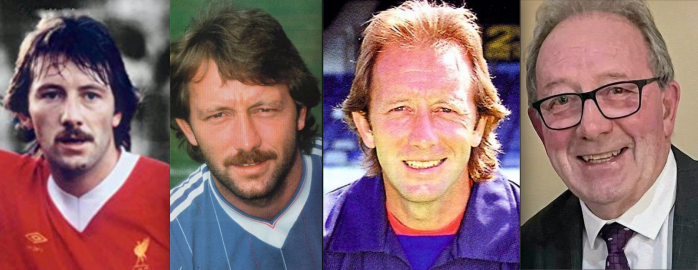
Alexis Mac Allister: the history-making World Cup winner

IF WINNING the World Cup is the pinnacle of any footballer’s career, there can be no question that Alexis Mac Allister has no equal as the greatest ever Brighton and Hove Albion player.

Several players have achieved the honour of representing their country on the back of their performances for Brighton, but never before December 2022 had the club boasted a World Cup winner, an international teammate of world-renowned Lionel Messi.

Argentinian Mac Allister has got the lot in his locker: equally adept as a holding or attacking midfielder, a great eye for pinpoint passes, deadly from the penalty spot, and with thunderbolt shots from distance to boot.

Indeed, one of the most memorable long-range strikes he scored for Brighton – against Leicester in Graham Potter’s last game in charge – would have been a goal of the season contender had it not been ruled out by the narrowest of VAR calls. It took the video assistant referee more than four minutes to chalk it off for offside which Potter conceded was “probably a millimetre or two the right decision”.

Thankfully, Mac Allister managed two that did count in that 5-2 win, converting a penalty for Albion’s fourth and then curling in an excellent 25-yard free-kick in injury time.

Potter’s input to making Mac Allister a more complete player was acknowledged in an interview with SunSport, not long after the coach departed forChelsea.

“He was very helpful — improving my versatility and physicality. I’m a much better player today because of it so I can thank him a lot,” said Mac Allister, who admitted how at first he found it difficult to transition from a more advanced player to a deeper-lying midfielder.

“The first year wasn’t easy for me. I found it very hard coming from Argentina with a different language and different way to play football. I physically wasn’t as strong as I am today,” he said.

In fact, he came close to jacking it all in at Brighton in December 2020, as he revealed in an in-depth interview with theplayerstribune.com, but was talked round in a FaceTime call with his mum in Buenos Aires.

“By that Christmas, with no fans in the stadiums, I had my bags packed. Literally, they were packed. I had two offers to leave — one from Russia and another from Spain, and my mind was made up.

“At the time, I was barely playing for Brighton. It was embarrassing, because I had the no. 10 shirt for a Premier League club, which is the dream of so many kids in Argentina, but I was a nobody. My name was nothing. I thought that I was cursed,” he said.

He got on FaceTime with his mum and he admitted: “I was sobbing. I was at my flat in Brighton, and she was back home in Buenos Aires. I had lost my head. I said, ‘Mum, I can’t do it anymore. I’m coming home. I need to get out of here’.” 

He continued: “I wanted to go home so bad. But my mum made me see the light. ‘Ale, remember how much you always wanted this?’ she said. ‘You have to be brave. You can’t quit now’.” 

In the new year, Mac Allister started many more games and eventually cemented his place in the heart of Albion’s midfield.

No longer a nobody; Mac Allister now has a staggering 8.6 million followers of his Instagram account!

“I like to play as a no. 10, I like to play as a no. 6,” he said. “The most important thing for me is to help my teammates win football games and try to be as central as I can so I can be as close to the ball to get on it as much as possible.”

Potter himself spoke highly about the way Mac Allister handled the transition, saying in January 2021: “Sometimes when players make the move there can be an assumption that it will all happen for them straight away.

“He’s moved from South America and was adapting to a new country before COVID and then picked up a couple of injuries.

“But he’s a determined individual and he’s a really good guy to work with. He reads the game really well and has a good footballing brain.”

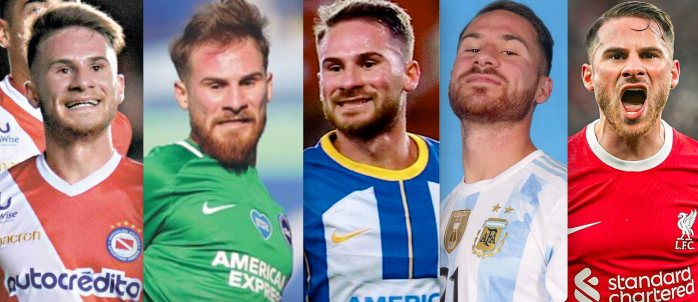
Born in the Argentine lowland city of Santa Rosa on Christmas Eve 1998, Mac Allister started his career with Club Social y Deportivo Parque before joining the youth team of Argentinos Juniors in Buenos Aires.

He made his senior team debut there in October 2016 and a year later he and his older brothers Kevin and Francis all played in the same side. Their father Carlos, a left back known as El Colorado — “the Redhead”—  had also played for Argentinos Juniors and Boca Juniors (and won three caps for Argentina).

Alexis signed for Brighton in January 2019 on a four-and-a-half-year contract and said at the time: “The main reason I signed was because the club came to Argentina looking for me and they seemed very convinced about me.

Mac Allister liked the direction Albion saw for him before signing

“They made a big effort, told me about their project and their ideas to keep growing in this league, and I liked their ideas. I liked what they said.”

He was loaned back to Argentinos Juniors until the end of the 2018-19 season and then moved on loan again to Boca Juniors, where brother Kevin was playing, for the first half of the 2019-20 season. This was a Boca side that had one of the players he used to admire from afar – former Man Utd and West Ham striker Carlos Tevez – up front.

Mac Allister told GQ magazine in September 2025: “When I was younger, there weren’t many Argentinians in the Premier League but I used to wake up very early in the mornings to watch players like Carlos Tevez and Maxi Rodriguez.

“I was a big fan of the Premier League, so I hope the next generations are doing the same with us, not just with me but with Argentinian players in general.”

Albion recalled Mac Allister in January 2020 a couple of months before the Covid pandemic began to bite. “My time at Boca helped me mature and I learned a lot of things,” he told the Albion website.

Mac Allister made his debut as a substitute at Molineux in the last fixture before matches were halted for three months. I was at that Wolves match and even in a few short minutes on the pitch there were glimpses of what the young Argentinian was going to add to Potter’s side.

But the break hit Mac Allister hard. “Everything shut down. No football. No friends. And the worst part was that I was stuck in a country where I didn’t speak the language, he told theplayerstribune.com.

“When I first came here, I thought ‘I’ve played for Boca Juniors, one of the best teams in South America, I am ready’,” Mac Allister said in an interview on the Albion website in February 2022. “We had the Covid situation and I didn’t train for two or three months with my teammates. When we returned, I realised I wasn’t at the level I needed to be. I had to work.”

The year which would end with Mac Allister as a World Cup winner began well too when he scored twice at Goodison Park in Albion’s first ever win at Everton on 2 January. The player himself saw it as pivotal moment.

Mac Allister reckoned everything clicked for him when he scored twice at Goodison Park

The game was only three minutes old when Mac Allister latched on to Neal Maupay’s knockdown to score in the third minute before Dan Burn put Albion 2-0 up on 21 minutes.

Anthony Gordon pulled one back but Mac Allister found the top-right corner with a superb strike to make it 3-1 on 71 minutes. Gordon struck again 14 minutes from the end, but Brighton held on to win.

“When I scored two against Everton in January 2022, it felt like everything clicked for me,” he said. “That day at Goodison, I became something different.”

Admitting he had been hoping to improve on the goalscoring front, Mac Allister told the club website: “When I played in Argentina I would score and assist a lot more. I have scored a few times for Brighton now, it’s nice to get the confidence from that.

“I had a few games where I was on the bench and that’s not what I want, so I knew I had to keep working because I knew I would get my chance and when I did, I wanted to be ready. When that chance came along, I thought I took it well.

“The message from the gaffer and my teammates was to keep my head down and work hard. It’s not just the 11 who start, the people on the bench are important too.”

Always deadly from the penalty spot

The next step change in his career came with the appointment of Roberto De Zerbi as Potter’s successor. “A few months before the World Cup, it changed everything for me,” he said.

“The main thing that he helped me improve was my scanning of the field — my “profiling” of the situation. Taking little mental pictures of the chess board every two seconds. We looked at Ødegaard as an example of this. For me, he’s one of the best in the world at scanning. His head never stops moving. De Zerbi gave me this gift, and it really elevated my game.”

Mac Allister told theplayerstribune.com: “Playing every week, with the manager’s trust, the idea of the World Cup started to seem not so distant.

“I will never forget, we were away at Wolverhampton, and I was in the hotel whenI received the call of my dreams. I was in the squad. I was actually going to Qatar.”

He called his parents and they cried together. He reflected: “Two years earlier, I couldn’t get off the bench at Brighton. Now I was going to the World Cup with Argentina, trying to make history.”

When he helped his country to lift the World Cup on 18 December 2022 (beating France 4-2 on penalties after the game finished 3-3), Mac Allister’s stock had already been rising. He was man of the match after scoring for his country for the first time in a 2-0 win over Poland that took Argentina through to the last 16. In the final, he delivered an inch-perfect cross for Angel di Maria to give Argentina a 2-0 lead in the first half and De Zerbi observed how well he played alongside maestro Messi.

“Messi and Mac Allister speak the same (football) language and Messi understands very well the quality of Alexis,” De Zerbi told The Athletic. “If you watch the game, Messi was looking for Alexis lots of times and they made a lot of passes to each other. Alexis was always giving back to Messi a clean pass.”

With Mac Allister playing further forward for his country than with the Albion, it had De Zerbi pondering. “I’d like to speak to him when he comes back,” the Italian told The Athletic. “I like him a lot in the other position (deeper).

“I spoke with his father the other day and he told me he prefers the Argentina position, but in that position we have (Adam) Lallana and Lallana is a teacher.

“If a team wants to become big, the quality needs to be further back. For me the midfielder can play on the defensive line, because he’s bringing more quality.”

But he added: “Alexis can play anywhere on the pitch. I don’t know if he’s better as a playmaker or 20 metres further forward.”

Established as a kingpin in Albion’s midfield alongside Moises Caicedo — almost certainly, Albion have never had a better pairing in that area of the team — it was inevitable that they would move on.

In May 2023, De Zerbi was phlegmatic about losing them both. “I think it’s right they can leave, can change teams and play in a level higher,” he said. “If you ask me about Caicedo and Mac Allister, I love them and they are two big, big players and can be in a big, big European team.

“They can play in every competition and are ready to compete for a big team and I hope for them they can play in the best team in the world.”

The manner of their departures differed, of course, and after Mac Allister had moved to Liverpool, De Zerbi admitted: “With me and with my staff he was super correct. Before we could read it in the newspapers, in the press, the possibility he could go to Liverpool, he went into my office to communicate it in front of me and to explain the reason.

“I understood logically and I appreciated a lot because he was clear and he was honest. Not all other players were the same. Of course, he was happy to go to Liverpool and we can understand it. But, in the same way, he was sad to leave his teammates and this club.”

Mac Allister revealed how he had a secret rendezvous with Jürgen Klopp ahead of the £35m deal being done. “He flew down and we met in secret somewhere halfway to Brighton,” he said. “I was a bit shocked that he did that for me.

“I had won a World Cup, but I was not a star at all. We had a coffee, and he explained to me that he really wanted me to come to Liverpool, because I reminded him a bit of Gündogan, who he developed at Dortmund into one of the best box-to-box midfielders in the world.”

After observing how well Mac Allister had settled in with the Reds, De Zerbi maintained: “He became a great, great player. I’m happy and I’m proud for him because I worked with him and he deserves to be an important player in a big team.”

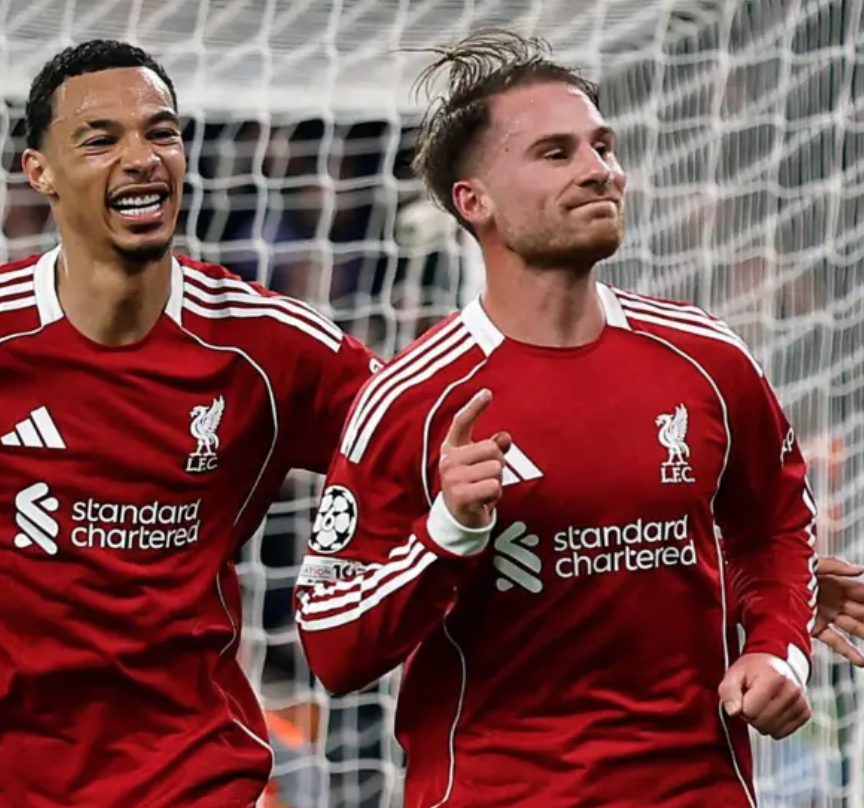
The Argentinian’s first goal for the club, in a 4-3 Premier League win over Fulham at Anfield in December 2023, turned out to be Liverpool’s goal of the 2023-24 season.

It was a perfect half-volley that dipped and swerved into the top right corner of the net from around 30 yards.

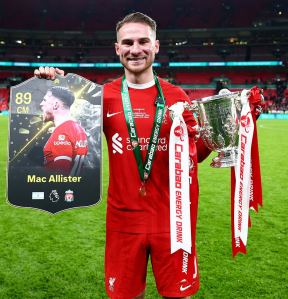
He collected his first domestic honour that season, too, when Liverpool beat Chelsea 1-0 to win the Carabao Cup (right).

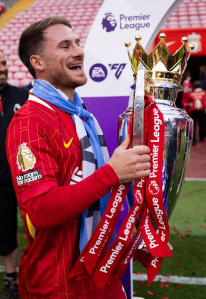
Under Klopp’s successor Arne Slot, Mac Allister made 35 appearances (30 starts + five as sub) when Liverpool won the Premier League title (left) in May 2025.

Wembley hero Liam Dickinson’s nomadic football journey

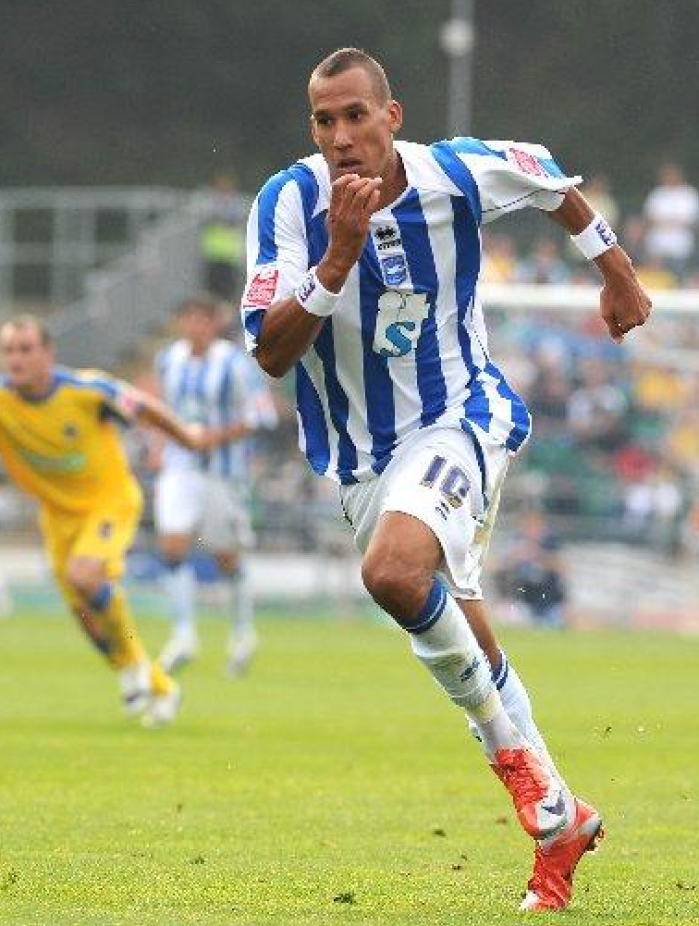
HE’D SCORED a decisive play-off final goal at Wembley for Stockport County but a subsequent £750,000 move to Derby County didn’t work out for Liam Dickinson and Brighton signed him for £300,000 only a year after the Rams had shelled out that big money.

Dickinson didn’t even get a game for the Rams, instead being sent out on loan to Huddersfield Town, Blackpool (where he’d begun his career in their school of excellence) and Leeds United.  He was a player who didn’t stay in the same place for long; in total he featured for 23 different clubs.

Like many before and since, changes of manager were often the cause of him moving on. At Derby, for instance, he was signed by Paul Jewell, recalled from his loan at Blackpool by caretaker manager Chris Hutchings and eventually let go by Nigel Clough.

It had been intended he’d join Leeds in January 2009 but the necessary paperwork didn’t arrive until 14 minutes after the deadline! Further discussions led to a revised deal, but the move was called off because he was injured. He eventually joined up with United in the second week of March and although he scored in a behind-closed-doors friendly against Sheffield United (1-1), he didn’t get on the scoresheet in eight League One games (four starts, four as a sub) under Simon Grayson.

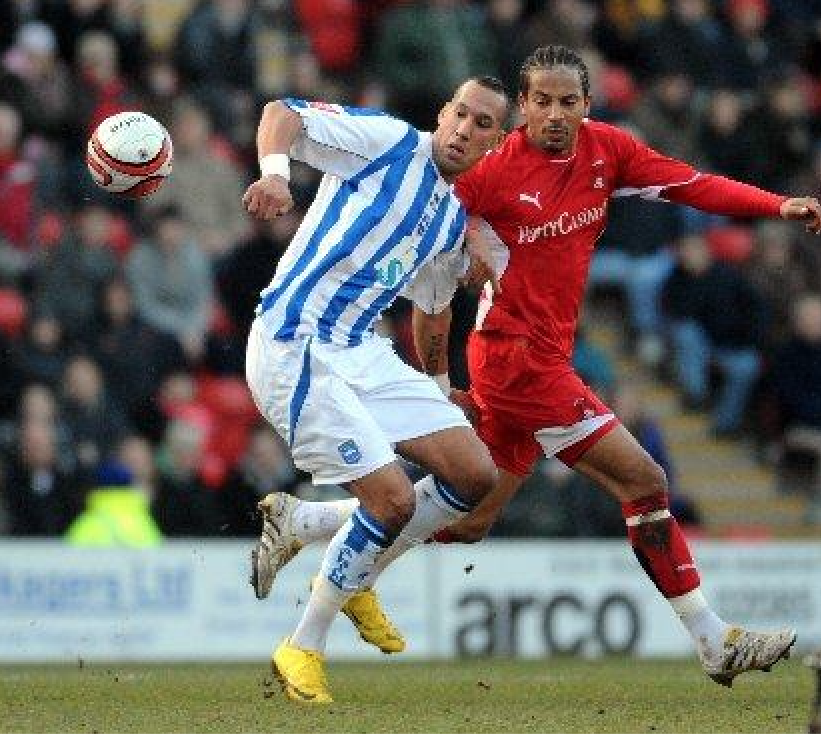
His first start was in a 3-2 win at Crewe and he managed three successive starts, in a 2-2 draw at Leyton Orient, a 1-0 win over old club Stockport and a 1-0 defeat at Leicester but he was not involved in the end-of-season play-offs when Leeds (with Casper Ankergren in goal) lost out to Millwall in the semi-finals.

An enclave of former Stockport teammates – James Tunnicliffe, Jim McNulty, Gary Dicker and Craig Davies – helped Dickinson to choose Brighton as his next club

After Brighton boss Russell Slade welcomed the 6’4” forward to Withdean on a three-year contract, he told the club website: “He brings something different to the table. His goalscoring record is very good and he has a good goals-per-game ratio, and like one or two of the other signings I have made this summer, he is hungry to get his career back on track. I’m sure there is a lot more to come from him.”

He scored in his third and fourth games for the Albion, but both came in defeats against former clubs: the first in a 7-1 capitulation to Huddersfield and the next in a 4-2 defeat to Stockport.

He was on the scoresheet in the home 3-3 draw against Hartlepool (Nicky Forster scored Albion’s other two goals) that spelled the end of Slade’s tenure as manager. But it is what happened two days later that many will remember him for.

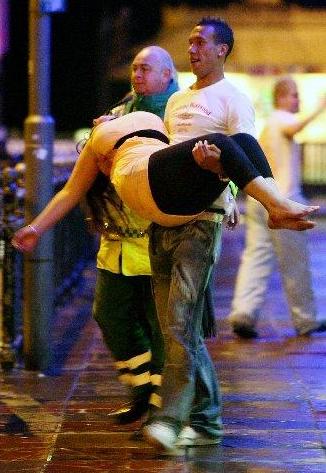
Unluckily for him, he was pictured carrying a seemingly comatosed young woman in his arms in the middle of Brighton at 1am. The Sun newspaper was covering a renowned student pub crawl ritual at the time and didn’t realise who they’d snapped.

Eagle-eyed Albion supporters did, though, and, after discussion about the incident on fans’ forum North Stand Chat, The Argus picked up the story, running an article headlined ‘Samaritan Brighton and Hove striker scores an own goal’.

For his part, Dickinson told reporter Ben Parsons how he was on his way home after a meal out in the city when he helped a girl to a car waiting to pick her up.

He said it was simply a coincidence that he was helping the girl when the photos were taken, adding: “I saw two girls holding another girl up. She collapsed in front of us. Her mum or her auntie picked her up in a car. I picked the girl up and put her in the car.
“I didn’t want to just leave her. Anybody else would have done the same thing.”

Albion said they would deal with the matter internally. Dickinson was omitted from the squad for the following game, a 4-4 FA Cup draw with Wycombe Wanderers with caretaker manager Martin Hinshelwood in charge, but he was back in the fold for Gus Poyet’s first game as Slade’s replacement.

In the televised away game at Southampton, he went on as a sub for Forster in Albion’s 3-1 win at St Mary’s. Dan Harding, Dean Hammond and Adam Lallana were in the Saints side.

Dickinson got occasional starts under Poyet but more often than not was sent on as a sub to replace either Glenn Murray or Forster.

Given a start in the FA Cup second round win over Rushden and Diamonds, he scored twice, in the third and 86th minutes, as Albion edged the tie 3-2. He was preferred to Murray in a Boxing Day clash with Leyton Orient that finished goalless but, perhaps to prove a point, two days later the restored Murray hit four at Wycombe in a 5-2 Seagulls win.

Dickinson was back on familiar territory at Edgeley Park in January 2010, but only got a half an hour run-out as a sub against his old club (replacing another former County man in Dicker) as the game finished 1-1, Andrew Crofts salvaging a point with a 90th minute equaliser.

In a 1-1 draw at Leyton Orient, Dickinson started the game and, when he was denied a penalty, incandescent Poyet was sent from the dug-out for protesting.

“If you ask anyone, they will tell you it was a penalty and a red card,” Poyet maintained afterwards. “The referee is 10 yards away and he doesn’t give it. You’ve got a chance to score a penalty and it’s 2-0. It’s a different game.”

Dickinson took to the field against another of his former clubs in Huddersfield wearing distinctive ‘banana yellow’ boots. “I don’t like dull, boring colours. I like to brighten the pitch up a bit. I’ve had a bit of stick off the lads,” he told The Argus.

The striker, who’d scored six goals in 13 games for the Terriers while on loan, didn’t manage to get on the scoresheet and was replaced by Murray as the game petered out to a 0-0 draw.

At that stage, Dickinson was deputising for Forster who was out of favour with Poyet over a contract dispute.

As the Uruguayan began to bring in his own selections, such as on-loan Kazenga LuaLua, Dickinson chose to go on loan to Championship strugglers Peterborough United, who were managed by his former Stockport boss Jim Gannon. Dickinson scored three in nine games for Posh. On his return to Brighton, he was sold to Barnsley, who were in the Championship at the time, for reportedly half the fee paid out for him just a year earlier.

Tykes boss Mark Robins declared: “He is different to the strikers we have here already and will give us something else up front.

“He is only 24 and still has room for improvement. He has a decent scoring record both in the Championship and in the lower leagues.

“Liam fits in to what we are trying to do here both in terms of on the pitch and within our budget.”

But he made just one start, in a League Cup match, and three sub appearances in the league for Barnsley when his old Derby caretaker manager, Hutchings, took him on loan to Walsall. He didn’t find the net in seven League One games.

Next stop, from January to the end of the season, was Rochdale, the side against which he had scored that 2008 League Two play-off final winner.

But a goalless run of 14 games (seven starts and seven off the bench) prompted this comment from AtThePeake on fansnetwork.co.uk in 2021: “In terms of expectation versus reality, few signings can have disappointed Rochdale fans quite like the loan signing of Liam Dickinson in January 2011.”

The supporter wrote: “Dale were looking for someone to become the fulcrum of an attack that included Chris O’Grady drifting in from the left and the emerging Matt Done playing as a second striker.

“Having seen first-hand the threat Dickinson could be with his aerial prowess, strength and touch in front of goal, Dale fans were reasonably excited that the answer to their striker problem had been found, but it quickly became apparent that the struggles with Derby and Barnsley had affected Dickinson’s confidence.

“During his spell, Dickinson was all too easy to defend against, struggled to hold the ball up and lacked any cutting edge when it came to finishing the chances he did manage to fashion for himself.”

A projected move to Plymouth Argyle was called off after just eight days, with personal reasons being cited, but the nomadic striker’s next stop was League Two Southend United under Paul Sturrock, where he netted 12 goals in 37 matches (33 starts plus four as a sub).

Dickinson scored a dozen times for Southend United

Not for the first time, he found himself in the headlines for the wrong reason when he and two others were reprimanded for a breach of club discipline over an unspecified incident at a hotel the evening before a match at Morecambe.

A broken ankle brought a premature end to his season with the Shrimpers, and it proved problematic in trying to continue his league career elsewhere.

He trained with Port Vale but even his agent Phil Sproson was quoted as saying: “Liam will admit he has been no choirboy in the past.

“He has had quite a few clubs and that’s probably because he has been no angel.

“He is loud and vocal and has had too many nights out over the years – but he has matured.

“He realises he will have to change and toe the line because he has a darker side that has dragged him down in the past.”

As it turned out, he was eventually out for a year because his broken ankle didn’t heal properly. He played two pre-season friendlies for Vale in 2013 but manager Micky Adams didn’t take him on because of ongoing problems with the ankle.

Born in Salford on 4 October 1985, Dickinson was originally a centre-half when he was on the youth books of Blackpool, Bolton and Blackburn. He stepped away from professional football at 16 and studied to be a graphic artist but continued to play in non-league sides. He appeared for Irlam, Swinton, Trafford and Woodley Sports before he was taken on as a pro by Stockport in 2005 after a successful trial.

He scored on his County debut, only five minutes after going on as a 71st-minute sub against Cheltenham Town at Edgeley Park. In three years under Jim Gannon, he hit 33 goals in 94 appearances.

The 2007-08 season was his most prolific term as a league player, netting 21 times from 32 starts and six games from the bench. It also earned him Stockport’s Player of the Year award.

It was to Stockport, then in the Conference North league, that he returned in 2013, but he only managed one goal in 13 games before returning to the non-league arena.

Between 2014 and 2019, he turned out for Stalybridge Celtic, Guiseley, Bradford Park Avenue, FC United of Manchester and finally Droylsden before calling it a day.

In an online chat with Stockport County Live towards the end of the Covid lockdown, in August 2020, Dickinson opened up about his mental health, admitting he’d been through a period when he was suffering with depression.

Post playing, he told his interviewer, he was working installing signage for a print company.

Andy Crosby enjoyed the taste of success with Brighton

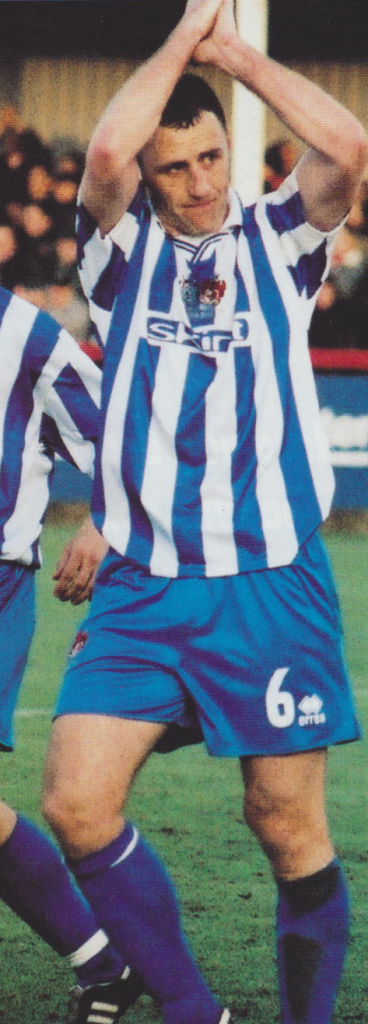
ROCK-solid centre-half Andy Crosby won a Division 3 Championship medal with the Albion in 2001 before experiencing two frustrating near-miss seasons as captain of Oxford United.

Brighton’s achievement provided him with his first-ever promotion, but it didn’t turn out to be his last: he climbed out of the same division with Scunthorpe United and then, against all the odds, reached the Championship with the Iron – twice.

Micky Adams, who was a player at Leeds when Crosby was in their youth ranks, had been unsuccessful in trying to sign the defender when he was in charge of Brentford.

But as Adams set about building his first squad at the Albion, he managed to secure Crosby’s services for a £10,000 fee in the summer of 1999.

“I didn’t need any convincing at all to sign,” said Crosby. “It was good timing for me and it worked out fantastically well,” he told Richard Walker. “Sometimes it’s hard to see where you’re going when you’re just keeping your head down and working hard at a struggling club so the Albion did wonders for my career.”

In a matchday programme interview with Spencer Vignes, he added: “I couldn’t wait to sign. Even at that level, I still thought of them as a big club.

“My only reservations were that I’d never lived down south and that we’d just bought a house. We also had a one-year-old daughter. But in the end the pros outweighed the cons.”

The family moved into a house at Stone Cross, near Eastbourne, and Crosby made his debut (albeit with a broken toe!) in the 6-0 Withdean win over Mansfield (as featured in my recent blog post about Darren Freeman).

He developed an effective central defensive partnership with Danny Cullip, and he said: “Although we were very different characters away from the 90 minutes, something really clicked between us and everyone knows how vital it is to have a good centre-half pairing, just as much as a good front two working for each other.

“Our paths have crossed since, and the talk’s always of great memories from Brighton days.”

Hired as a stopper rather than a scorer, Crosby helpfully weighed in with five goals as Albion found their feet back in Sussex.

Then in the following season, Crosby was at the heart of the defence when Albion won the league. “That win down at Plymouth and the home game against Chesterfield where we sealed the Championship will stay with me forever,” he said. “It was just an amazing ride.”

Crosby continued: “We had this great spirit, a team desperate to do really well.

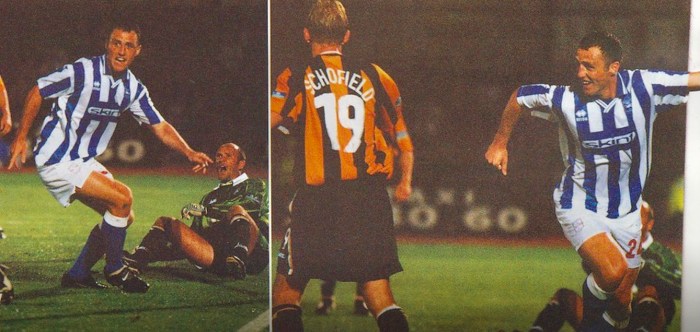
Pouncing to score and celebrate against future employer Hull City

“I’ve got nothing but good memories of the place. It was the first time I’d ever been involved in a promotion campaign as a player. For the first time in my life, I was seeing on a day-to-day basis what it takes to be successful.

“We played some great football and the fans were fantastic. I’ve said it before but if you can’t play for them you can’t play for anyone.”

He added: “Withdean was a funny place but somehow we were able to use it to our advantage. Other clubs didn’t like playing there.”

Getting to grips with Paul Watson

Once elevated to the higher level, Crosby lost his starting place to Simon Morgan and Adams’ successor Peter Taylor continued with Cullip and Morgan as his preferred centre-back pairing.

By then 28, Crosby didn’t fancy a watching brief and in December 2001 he moved on a free transfer to Oxford, the first United signing made by Ian Atkins. He said: “I didn’t want to go, and Peter said he wanted me to stay, but I wanted to play. Going to Oxford meant first team football.”

Although Crosby’s first half season with Oxford saw them struggle near the foot of the division, the 2002-03 campaign ended with them only a point off the play-off places and the central defender scored winning goals in four of the 53 matches he played.

It got better for him on a personal level the next season when his fellow pros named him in the 2003-04 PFA team of the year, but United missed out on the play-offs by three points.

Another string to Crosby’s bow at Oxford was being an accomplished penalty taker. He never missed a spot kick in normal play and, in 2003-04, one of the five he buried was at Scunthorpe’s Glanford Park.

In the summer of 2004, he declined a new contract believed to have been on worse terms than the previous one and chose to move back to the north to join Scunny.

Nonetheless, the Oxford Mail said of him: “The 31-year-old centre back has been a model of consistency in his time at the Kassam Stadium.

“Ideally suited to the Third Division with his uncompromising, no-nonsense style, the hard-tackling defender, who is also good in the air, was also greatly respected by his teammates for his cool professionalism.”

He may have started out in the basement division with Scunthorpe, but what followed was the stuff of dreams. Crosby himself later admitted: “When I joined, if someone had told me I’d be playing for Scunthorpe in the Championship, I would have called them a doctor.

“But it reaffirms your belief in football a little bit, especially when you’re involved first-hand, to see a club of Scunthorpe’s size still being able to pull off what was nothing short of a minor miracle.”

In an interview with the Scunny website, Crosby pointed out: “I was 31 when I arrived at Scunthorpe and I had to use my knowledge and experience in whatever capacity I could, and set standards on and off the pitch. It was something I enjoyed doing and I think it’s something that’s either in you or it’s not.

“My whole time at Scunthorpe was great and I never thought when I signed that we’d get to the Championship twice. It was fantastic and the highlight of my career without a shadow of a doubt.

“I was captain of a promotion-winning team from League One to the Championship, playing at some massive stadiums.”

Although knee injury issues limited him to nine appearances in the 2008-09 season, he was restored to the side for the play-offs and led Scunny to a 3-2 League One play-off final win over Millwall at Wembley in May 2009 (Matt Sparrow scored twice for Scunny).

“It was a great way to end playing,” he admitted. “I have some fantastic memories and look back at my time at the club with nothing but fondness.”

By then he had already been working as assistant manager to Nigel Adkins, the former Iron physio and after playing a total of 715 games for six league clubs he was also Adkins’ assistant manager at Southampton, Reading, Sheffield United, Hull City and Tranmere Rovers.

Crosby, who took over from Adkins as manager of League Two Tranmere in February 2025, said “I’ve got a fantastic relationship with Nigel. He’s been fantastic for me, changed me as a person and polished off a few of the rough edges. I’ve got nothing but great words to say about him.”

Into the manager’s chair

In an interview with tribalfootball.com, he said: “My coaching journey has been full of learning experiences, and I’m a much better coach now than when I started. I was fortunate to work with some fantastic players.

“My best experience was at Southampton, where we achieved back-to-back promotions from League One to the Premier League, working with incredible players like Lallana, Lambert, and Schneiderlin. Even the difficult moments teach you a lot, though. Results didn’t always go our way, but even then, those experiences helped me grow as a coach.”

Crosby also saw the development of the likes of Alex Oxlade-Chamberlain, James Ward-Prowse and Luke Shaw during nearly two and a half years at Southampton. While at Bramall Lane, he also worked with future England internationals Aaron Ramsdale and Dominic Calvert-Lewin.

Even at Hull, he had the fortune to work with Fikayo Tomori, on loan from Chelsea, and Jarrod Bowen.

Born in Rotherham on 3 March 1973, miner’s son Crosby was raised in the village of Maltby. He supported the Millers as a youngster but was rejected by them as a player when he was 11. At 14, though, he was taken on at Leeds.

When he didn’t progress beyond the youth team at Elland Road, former Leeds captain and manager Billy Bremner took him on at Doncaster Rovers and gave him his league debut aged 18.

He played 60 times for Donny over a couple of seasons (and spent a month on loan at Conference side Halifax) before moving to the north east and spending five years at Darlington, notching up a total of 211 appearances.

He was captain of the losing side in the 1996 Third Division play-off final at Wembley when Jim Platt’s Darlo lost by a single goal to Neil Warnock’s Plymouth Argyle.

Off-field financial issues marred his time at Chester City in the 1998-99 season, so his move to Brighton was a welcome change.

Reflecting on that time with the Seagulls, he said: “In any walk of life, if you get a really good group together, recruit well and get good characters in who complement each other well, then you should succeed. A lot of that was down to Micky.

“It was the fittest I’ve ever been – that was down to him – but that work and organisation brought its reward which is something I’ve taken with me into my own coaching career.”

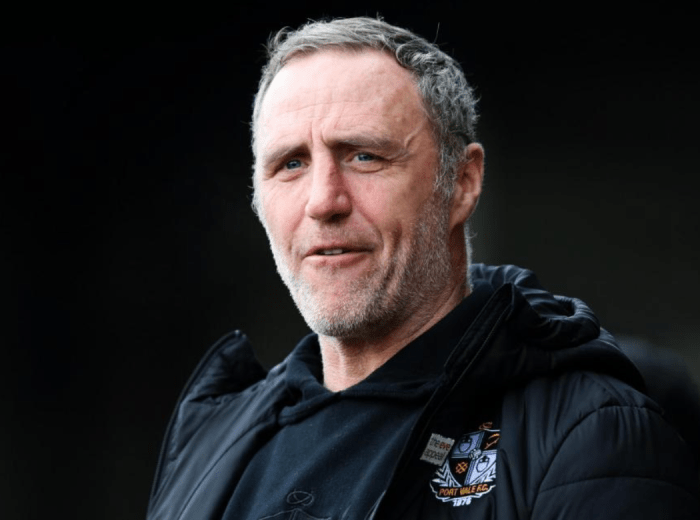
Before his current (August 2025) position at Prenton Park, he also coached the Northern Ireland under 21 international side and spent three years coaching and managing at Port Vale.

Loanee João Teixeira lit up a gloomy Championship season

BRIGHTON provided a handy platform on which João Teixeira could parade his undoubted talent but he was unable subsequently to nail down a regular starting spot with parent club Liverpool.

The young Portuguese midfielder impressed sufficiently on loan to the Seagulls in 2014-15 to earn the club’s Young Player of the Season award.

His time at Brighton was certainly a whole lot more successful than a loan move made to League One Brentford the previous season: a six-month arrangement was cut short in October after only two substitute appearances because the Bees couldn’t guarantee him the game time Liverpool had been expecting him to get.

Brentford move didn’t go well

It was a different story with the Seagulls although it was a shame his efforts were overshadowed by the side’s struggle to stay in the Championship and it ended prematurely for him when he suffered a broken leg.

On his return to fitness back at Liverpool, he was a frequent first team benchwarmer under Jurgen Klopp but chose to move back home to Portugal to seek regular playing time.

Liverpool paid Sporting Lisbon £830,000 in the January 2012 transfer window to take Teixeira to Anfield and it was Brendan Rodgers who gave him his Reds debut on 12 February 2014 when he was sent on as a substitute for Raheem Sterling in a 3-2 win at Fulham.

Captain Steven Gerrard told the Liverpool website at the time: “I watched this kid a couple of years ago playing for Sporting Lisbon against Liverpool at Anfield in a youth game; I could see straight away he was the best player on the pitch.

“Credit to him, he has kept working hard. He has been invited to train with the first team. He is competing, he is trying to improve and learn. He listens – I’ve just been speaking to him in the dressing room and you can see he wants to learn and listen.

“He has got respect for the other players in the dressing room. This is the start for him now; I’ve just told him that he needs to push on, keep learning and building on what he has just achieved. He deserved his debut and he made a special tackle which helped us get over the line.”

As it turned out, his next senior action came in Brighton’s Championship visit to St Andrew’s six months later when he went on as a 64th minute substitute for Kazenga LuaLua in a 1-0 defeat.

Brighton’s newly-appointed head coach, Sami Hyypiä, had returned to his old club to clinch Teixeira’s signature on a season-long loan and he told the matchday programme: “My former colleagues at Liverpool have told me he is a very bright young prospect who is held in high regard at the club at all levels.

“João is an attacking player who likes to be on the ball and do his best work in the final third of the pitch. I hope he will bring that extra edge to the team and our play – and give us an extra dimension.”

No sooner said than done because when given a starting spot three days after the Birmingham defeat, he made an immediate impact by putting Brighton ahead in the fifth minute at Elland Road and Albion went on to beat Leeds 2-0, handing Hyypiä his first win.

A joyful scorer for Brighton at Elland Road

The boss told Sky Sports: “I am grateful to them for letting João come to us and get the games he needs, but it works both ways. They can benefit too because his time with us can hopefully be a stepping stone towards Liverpool’s first team.

“He is a young player and Liverpool have a very big squad. A player of his age needs to play games to improve. We have a quality player and I am very happy to have him with us.”

The instant impact earned Teixeira the fans vote for performance of the month which gave the player the chance to take a 48-hour demonstration drive in a Porsche.

The Portuguese youngster was on the scoresheet again on his home debut for Brighton, netting the winner against Bolton in the 64th minute after Craig Mackail-Smith had cancelled out the visitors’ lead shortly before half-time.

Teixeira seized on a pass from debut-making left-back Joe Bennett to score through the legs of goalkeeper Andy Lonergan, on as a sub for Adam Bogdan, who’d been injured in a collision with Mackail-Smith.

If it looked like a corner had been turned after the season had begun with two defeats, sadly the opposite was the case and Albion went on an 11-game winless run with the players at Hyypia’s disposal seemingly baffled by how he wanted them to play.

After he and the club parted ways, and Chris Hughton begun the task of ensuring the Albion didn’t lose their Championship status, Teixeira got back on the goal trail.

He twice scored braces (in a 3-2 home win over Ipswich on 21 January and a 4-3 home win over Birmingham on 21 February).

It said it all about Albion’s close shave with relegation that his six goals in 35 games (28 starts + seven as sub) for the Seagulls made him second top scorer behind centre back Lewis Dunk’s seven that season.

Sadly, a leg break in a home game against Huddersfield Town on 14 April brought his season, and Albion career, to a premature end. Teixeira was stretchered off after a challenge by Nahki Wells that resulted in a fracture just above the ankle.

“This is a real blow to him after such a good season for the club – and we all wish him a speedy recovery and return to action,” said Hughton.

“He’s been an important player for the club this season, both before and after I came to the club, and I would like to thank him for his efforts during his time on loan here, and also Liverpool for allowing him to come.”

The player had talked of his dream to return to Liverpool and to break into the first-team.

“I came to Brighton to become more mature and get more experience, and hopefully next year I will be playing for Liverpool. That is my dream,” he told The Guardian.

He was included in the 30-man squad that went on a four-game pre-season tour in Asia and after Rodgers was sacked he was named as a non-playing sub in the 18-man squad for Klopp’s first game in charge in October 2015 (a 0-0 draw at Tottenham, when James Milner and Adam Lallana were starters).

He did start a League Cup game against Bournemouth, which was won 1-0, and he went on to make five cup appearances for Liverpool in 2015-16. He appeared only once as a sub in the Premier League and scored his only goal for the club in a 3-0 FA Cup third round win over Exeter City.

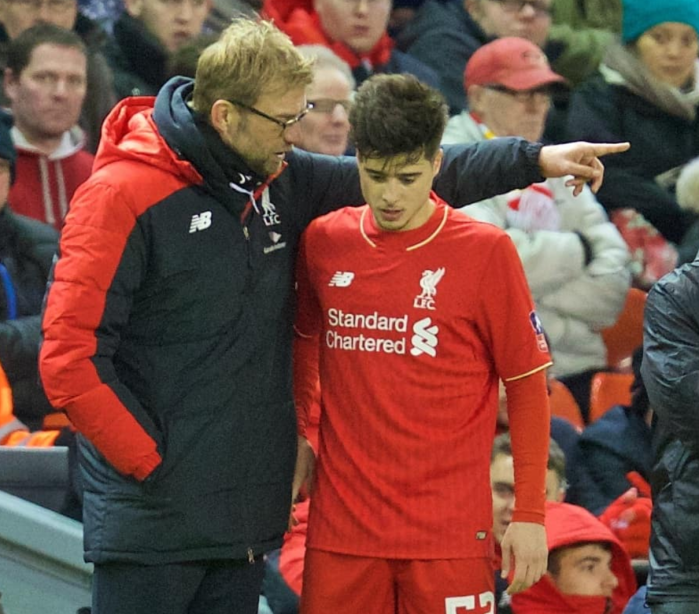
Klopp liked Teixeira

“I like João. As a person, as a footballer,” Klopp said after that game. “But of course, players like him need matches, and if you can’t get it then you have to leave.”

And that’s what he did. Although he was offered a new contract by the Reds, at the age of 23 he chose to move back to Portugal in search of regular first team football and signed for his boyhood team, Porto.

“I am from the north [of Portugal] and to wear blue and white has always been a dream for me,” he said.

“Now I can work at my club in my region and my country. I had other offers but do not want anything other than to wear blue and white.”

Born in Braga, Portugal, on 18 January 1993, Teixeira first caught the eye with his hometown club, before being snapped up by Sporting Lisbon where he continued to make progress through its youth teams. He also represented Portugal from under-16 through to under-21 level.

It was while playing for Sporting in the NextGen Series, the under-19 tournament for academy teams of Europe’s top clubs, that he played against Liverpool and caught the eye of Liverpool’s academy director, Frank McParland.

On arrival at Anfield, he was part of the under-21 set up and made 20 appearances in the inaugural Barclays Under-21 Premier League.

“I was 18, it’s hard to say no to Liverpool, it was a unique opportunity. I went and I don’t regret it,” Teixeira reflected in an interview with Portuguese sports newspaper A Bola.

“I had wonderful experiences, I played with great players, things were happening. I don’t regret going. I still played eight games, seven of them under Klopp.”

But the return home in 2016 didn’t work out for him, and after making only eight appearances for Porto during the 2016-17 season, Teixeira returned to his first club, Braga, on a season-long loan.

It was something of a surprise when in July 2018 he joined Braga’s local rivals Vitoria Guimaraes on a three-year deal, scoring 10 times in 53 appearances across two seasons.

In September 2020, he signed a two-year contract with Eredivisie Feyenoord, telling the club’s in-house channel: “I’m very happy to be here. It’s a beautiful chance for me and I’m very excited to start training and helping the team.

“Why Feyenoord? It’s a great club with a great history. I spoke with a few people in Portugal that played here and they told me the same thing: they have the greatest fans in Holland, and I’m happy to join.”

Describing himself, Teixeira said: “I’m an attacking midfielder. I like to score, I like to assist and that’s what I’ll try to do. But the main thing is to help the team.”

That help tended to be mainly from the bench, and suffering a broken foot didn’t help either, so in the second half of the 2021-22 season he returned to Portugal again to play for FC Famalicão.

When Liverpool discovered in the spring of 2024 that Feyenoord boss Arne Slot would be taking over from Klopp, Teixeira was interviewed by Reds’ fans channel The Redmen TV about what they might expect from the incoming head coach.

By then, Teixeira had already made two other moves: in June 2022, he’d moved to Qatar to play for Umm Salal where he scored five goals in 22 appearances. And 10 months later he switched to Chinese Super League side Shanghai Shenhua. The player posts his achievements at the club to 197,000 followers on Instagram.

A hit on Instagram

The Withdean visitors’ teenage winger went on to great things

MY FIRST memory of watching James Milner play was at Withdean Stadium when he was on loan to Swindon Town from Leeds United.

Even then, as a seventeen-year-old, he had something about him – but I certainly didn’t imagine I would be watching him playing in the Premier League and Europe for Brighton 20 years later!

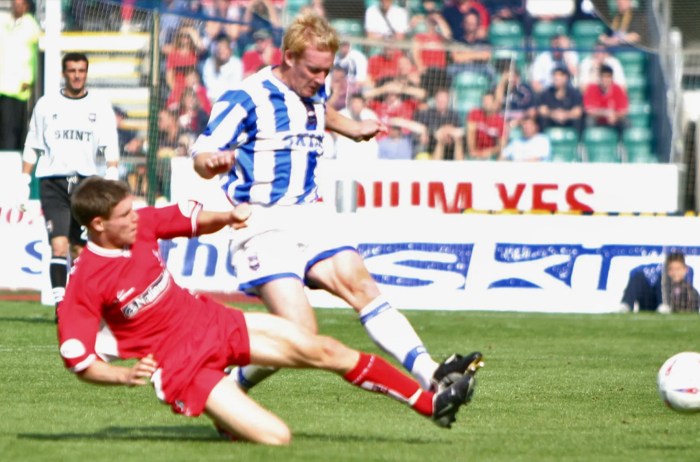
Young Milner tackles Brighton’s Kerry Mayo

That League One game on 6 September 2003 finished 2-2. Sam Parkin scored twice for Town and Albion’s goals came from Gary Hart and a penalty from on-loan Darius Henderson.

The Albion matchday programme subsequently recorded: “Kerry Mayo had a fine match, mainly subduing the impressive teenager James Milner.” (although, as the picture suggests, he wasn’t afraid to launch himself into a tackle).

Swindon’s manager Andy King had persuaded his old Everton teammate, Peter Reid (in charge of Leeds at the time) to loan Milner to the Robins for a month. In just six matches, the young winger scored twice.

“The boy is a terrific talent and everyone has been able to see the skills he has and I have no doubt he will go on to perform in the Premiership,” King told Sky Sports.

Milner already had two goals to his name for his parent club having scored twice in the Premier League in 2002-03 while still only 16.

On Boxing Day 2002, ten days short of his 17th birthday, he became the youngest player to score in the elite division, with a goal in a 2–1 win at Sunderland (the record had been set a couple of months earlier by Wayne Rooney for Everton and was subsequently taken by James Vaughan, also for the Toffees).

Milner had gone on as a 36th-minute sub for Alan Smith, a player he had admired when a boy growing up in Leeds. Terry Venables, Leeds manager at the time, said: “It’s not just a case of him simply coming through and helping out because every day he is getting better and better.”

Milner scored again three days later after going on as a 31st minute sub for Harry Kewell as Leeds beat Chelsea 2-0 at Elland Road.

“Picking up Mark Viduka’s pass in first-half injury time, Milner beat his man before thumping a right-foot shot low into the net with Blues keeper Ed de Goey powerless to stop him,” said the BBC report of the match.

“I am very pleased with him,” said Venables. “He is growing in this group and he has taken advantage of every day’s training to show what he can do.

“He has two good feet, he is courageous and everyone likes him a lot. He also is not only a nice, solid, good, well-mannered boy, he is a very talented player.

“It’s early days for the boy. At the moment he has not achieved anything and he is the first to admit that.

“But I think a lot of people are confident about his development. We have just got to take it easy.”

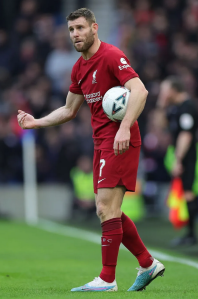
Wind on the clock more than two decades and Albion are now enjoying the benefit of Milner’s vast experience gained winning trophies galore for two of the country’s top clubs and playing for his country.

Born in Wortley, Leeds, on 4 January 1986, Milner broke through with Leeds United before joining Newcastle United at 18 and having loan and permanent spells at Aston Villa.

Milner went on to make more than 200 league and cup appearances for Manchester City and more than 300 for Liverpool as well as earning 61 full England caps and a record 46 at under 21 level.

Against Wolves on 22 January 2024, 38-year-old Milner overtook Ryan Giggs to go second outright on the Premier League’s all-time appearance list when he played in his 633rd top-flight match, 20 short of record holder Gareth Barry.

“I’ve had some luck,” Milner told TNT Sports. “I’ve worked hard and you have to enjoy it to put the work in every day. I’ve hopefully got a few more games in me.”

Milner’s free transfer move to Liverpool from Manchester City in the summer of 2015 proved an inspiration that brought him even more medals than he had won with the Sky Blues.

Over eight seasons, he made 332 appearances, scored 26 goals and lifted seven trophies along the way.  

“He’s a role model,” said manager Jürgen Klopp. “Nothing we have achieved in the last few years would have happened without James Milner, it’s as easy as that.

“Whether he was on the pitch or not, he’s set standards in a way not a lot of people can set standards, and it educated all of us.”

In a heartfelt tribute to the player, Klopp added: “From the first moment for me, he was a super-important player reference point.

“When you have a meeting and you look at Millie’s eyes and he’s not shaking his head, you know you’re on the right way. Nothing would have happened here without Millie because he kept it always going.

“From the player who was super-angry when he didn’t play, to the player when he did play, the way he pushed the whole dressing room before a game is absolutely second to none.”

For his part, Milner enjoyed a good relationship with Klopp, apart from once during a half-time flashpoint when the manager lost it, as Milner revealed to The High Performance Podcast.

“We had one moment where he was sharing his thoughts and I was sharing mine and I remember him smashing his hands on down the table and shouting, ‘Will you shut the f**k up!’ But Jurgen was brilliant, we had a great relationship and we were great off the pitch.”

It was Klopp’s predecessor, Brendan Rodgers, who persuaded Milner to make the journey along the M62, and he said at the time he signed him: “He had won the Premier League, he had won cups. His whole ambition was to win the Champions League and he felt that he would have a better opportunity to win it at Liverpool.”

Rodgers revealed that when Liverpool were trying to persuade him to sign, his wife Charlotte spent time chatting to Mrs Milner while he spent time with her husband!

“His actual football talent has probably gone under the radar because he’s played around some outstanding talents, but this is a guy who works tirelessly at his game,” said Rodgers.

“He’s in here at 7.45am making sure he’s prepared for his training, getting all of his food supplements and getting everything correct before training – he’s in two-and-a-half hours before he trains and then does his work, gives his maximum.

“He prepares himself like an elite player should. He’s also got big character and a big mentality.”

Rodgers was effusive in his praise of the new signing even before a ball had been kicked in anger after he scored the winner in a 2-1 pre-season victory over Brisbane Roar. Playing in the central role he preferred, he also provided a pass for Adam Lallana’s 27th-minute equaliser.

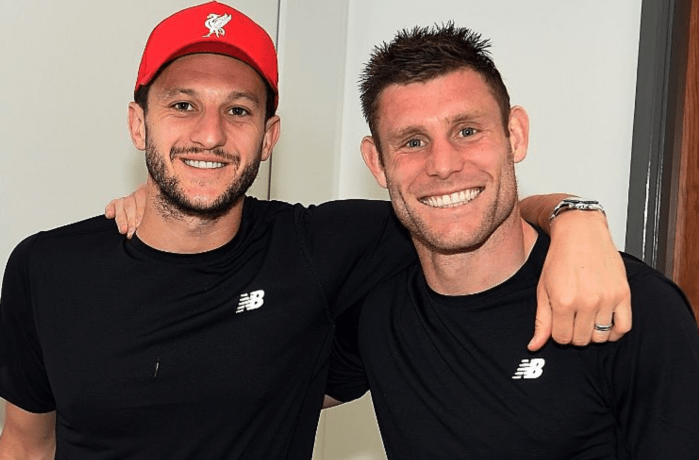
Former Liverpool teammates Adam Lallana and James Milner reunited at Brighton

“James Milner is a class act,” he told reporters. “We had to work very hard to get him in but I think we’ll see over the course of the season how important he is for us.

“He’s a wonderful personality and a top class footballer. When you see him play in his favourite position, you see all these qualities come out.”

Milner in action for Liverpool against Brighton during a lockdown match

Rodgers departed Anfield not long after Milner’s arrival but the player grew in stature under Klopp and, although it wasn’t his favourite position, he spent much of 2016-17, filling in at left-back.

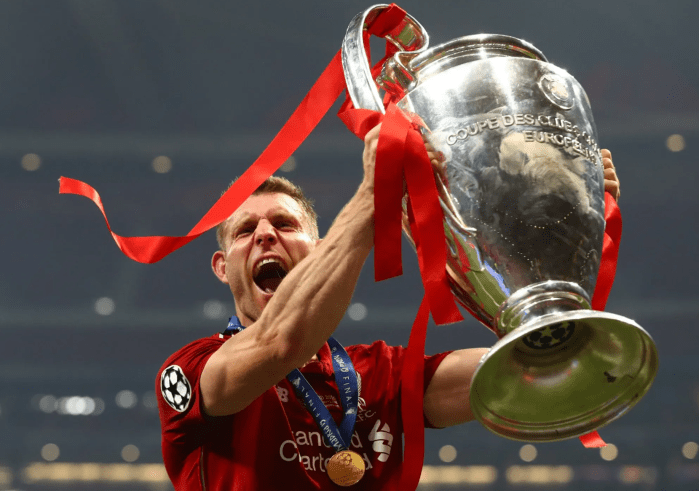
That season he made 40 appearances – 36 in the Premier League – as Liverpool qualified for the Champions League. They made it all the way to the final, only to lose to Real Madrid in Kyiv. But they made amends the following season and returned from Madrid with Liverpool’s sixth European Cup.

Milner went on as a second-half substitute in the Estadio Metropolitano in the 2-0 win over Tottenham Hotspur. “It will be nice going to Melwood seeing No.6 there,” he said. “Liverpool has a great history and when I signed for the club, I was desperate to add trophies as this club expects to win trophies and it has an amazing history – but we want to create our own history.”

Not only did they add the UEFA Super Cup and FIFA Club World Cup, Milner made 22 appearances as Liverpool clinched the Premier League title in 2019-20 with 99 points.

In 2021-22, Milner scored the first in Liverpool’s 11-10 penalty shoot-out win in Liverpool’s Carabao Cup defeat of Chelsea at Wembley, having gone on as an 80th minute sub, and he repeated the feat (as a 74th-minute sub) when the teams were also goalless at the end of the Emirates FA Cup final three months later. Liverpool won that 6-5 on penalties.

In his final season at Anfield, Milner featured 43 times and moved up to third spot on the Premier League’s all-time appearances list.

“I’m Leeds through and through and always have been and always will be – but I never probably thought that another club would get into me as much as Liverpool has,” said Milner.

The player he followed from Anfield to the Amex, Lallana, told the BBC exactly what Milner brings to a squad, especially in setting an example to younger players.

“He helps the management team in so many ways with the experience he’s built up,” said Lallana. “He knows what it takes to win. He knows what sacrifices need to be made.

“I’m not sure how he got the boring James Milner label, but he couldn’t be further away from that. He’s one of the loudest in the dressing room for sure. Full of life. Full of banter. But he’s definitely old school.”

Lallana added: “Those basics are always there and they’ll never change. I think that’s what’s made him who he is and given him his success. Those values that he’ll always live by. He taught me how to be a better professional and a better role model.”

It all began at Westbrook Lane Primary School in Horsforth and the secondary Horsforth School. He played local amateur football with Rawdon whose coach Graeme Coulson had first noticed Milner as a nine-year-old.

“I first came across him when I was refereeing a junior match involving Westbrook under nines at Horsforth,” Coulson told the Craven Herald and Pioneer. “He was so outstanding then that I asked some of the Horsforth parents who he was.

“I noted his name and it was one not to be forgotten. He was an outstanding talent scoring lots of goals but he was also very strong.”

Horsforth School spokeswoman Fran Morris said: “He was a first class student and he did really well at his GCSEs (he got eleven).

“He was very sporty at school and he won the PE prize which was handed out just before we broke up.

“He was the most wonderful young man and he was very popular, so we wish him all the best in his career. I am very sure he will do well and we are all proud of him at the school.”

Let alone his football ability, the young Milner also played cricket for Yorkshire Schools and excelled as an athlete: he was Leeds Schools’ cross-country champion for three successive years and district 100 metres champion for successive years.

Milner was a season ticket holder at Elland Road along with his parents Peter and Lesley before becoming a ball boy. He joined the Leeds United Academy after being spotted playing for Westbrook in Horsforth.

The sporty youngster was forced to decide between cricket and football, explaining in one interview: “I played for Yorkshire at the ages of 10 and 11 as a wicketkeeper-batsman. It was something I enjoyed but you get to a stage where you have to make a choice.

“I stopped playing cricket at 16 when I moved full time to the Leeds United Academy. They couldn’t take the risk of me getting injured, having my foot broken by a yorker or something like that.

“A couple of months later I made my Leeds debut. I still can’t take the risk for the same reason, but as soon as I retire from football, I’ll look forward to taking up cricket again.”

He completed his formal education at sports college Boston Spa School, which works in partnership with Leeds United, and, as soon as he left school, he was taken on as a trainee.

As he worked his way through United’s youth ranks, he also played for England at under-15 and under-17 levels.

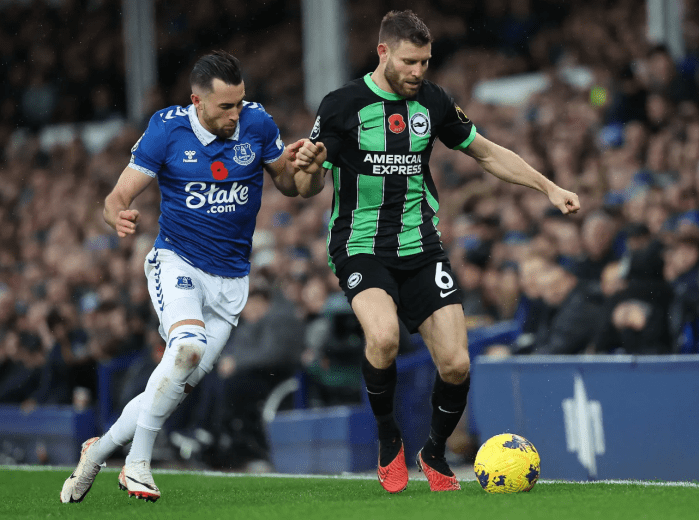
Milner in action for the Albion against Everton at Goodison Park

The midfield pivot in Albion’s rise to the Premier League

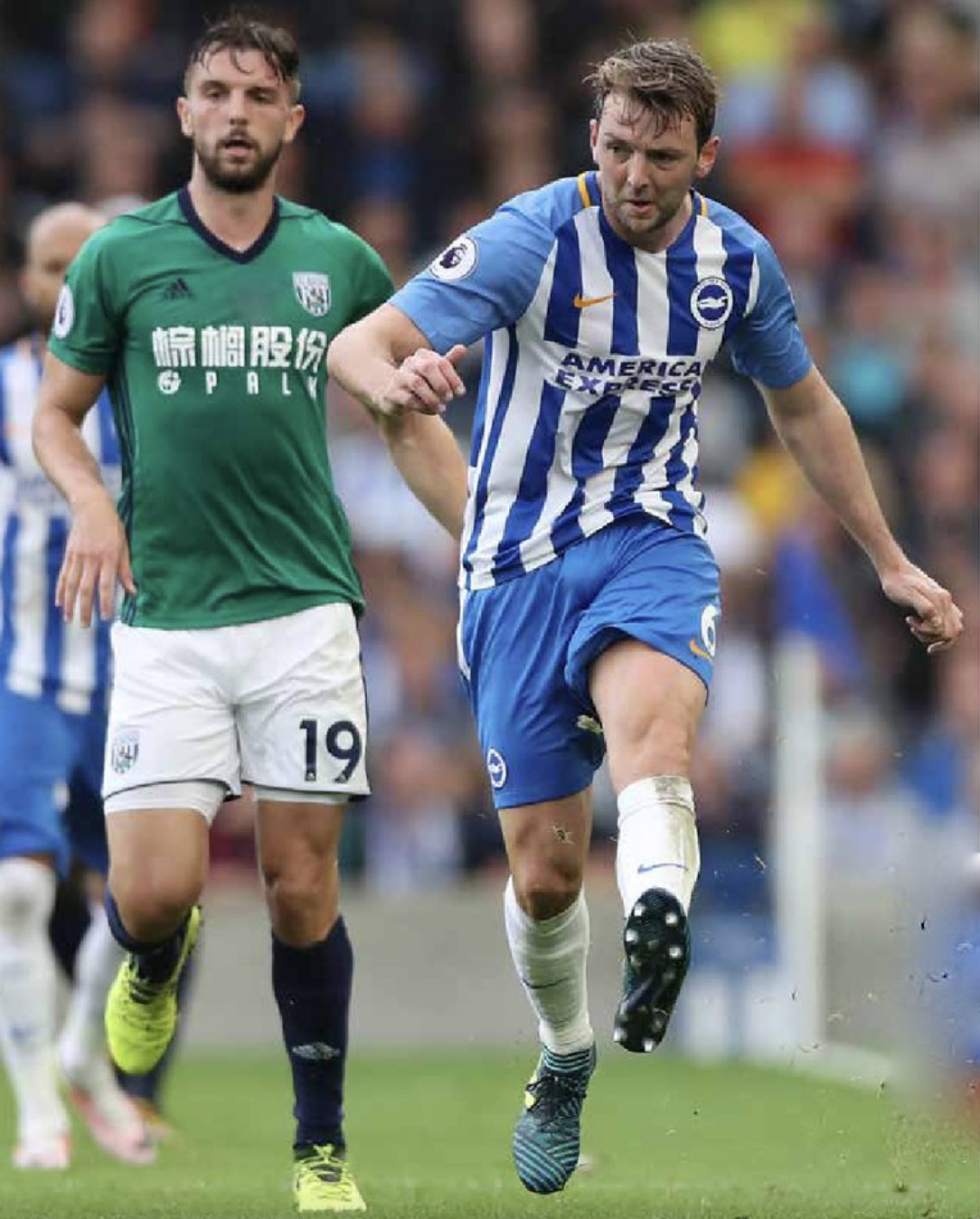
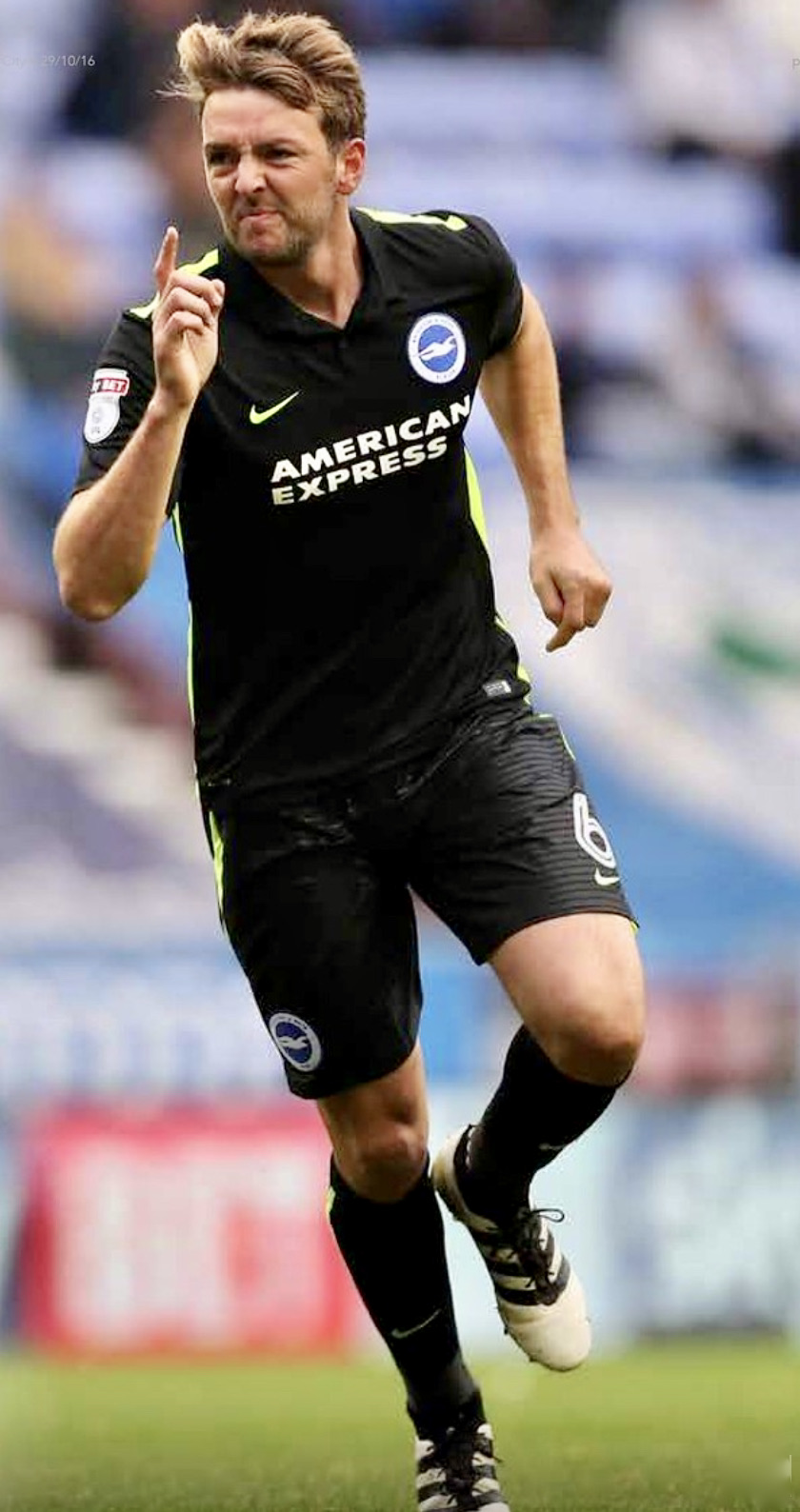
DALE STEPHENS spent nearly seven years at the Albion and was a pivotal cog in the club’s rise from the Championship to the Premier League.

He got his first taste of life at a big club playing alongside Adam Lallana and Dean Hammond….for Southampton!

That was back in 2011 when Saints won promotion from League One as runners up behind the Albion although he was an unused sub when Saints left Withdean on St George’s Day with all three points from a last gasp 2-1 win.

Stephens had gone on loan at St Mary’s from Oldham Athletic to cover an injury to Morgan Sneiderlin. “It was a strange one actually, there were only six or seven weeks left of the season,” he told the Albion matchday programme.

“Oldham weren’t really in any fear of going down or making the play-offs, so when Southampton came in for me, I was allowed to leave.”

The loanee played in six of the final 10 games of the season, making his debut against future employer Charlton Athletic alongside Lallana and Hammond.

“I looked at it almost as a trial period for being at a big club,” he said. “It was a chance for me to showcase myself. Playing for a club like Southampton at that level, with the players they had, was good for my experience and I really enjoyed being in a big-club environment.

“It was a good experience but just a shame that it was cut short by the season coming to an end.”

Explaining that everything was a level above what he’d previously been used to, Stephens added: “I didn’t feel out of place, though. I felt comfortable in that environment and it gave me the belief and the confidence that I could reach the next level.”

That didn’t turn out to be with Southampton, because his next club turned out to be the Addicks, where Chris Powell was building a side to try to get back into the Championship. Stephens found them to be similar to Saints, and like in his stint in Hampshire, he once again became a League One promotion-winner.

“I had a great first season there, helping the club win the League One title,” he recalled.

He then established himself as a Championship player before switching to the Albion in January 2014 when Andrew Crofts was ruled out by injury.

It was Nathan Jones, the former Albion player who had returned to assist Oscar Garcia, who recommended the move for Stephens, having seen him close-up when working as a coach at Charlton.

“Dale was one I recommended very strongly to the club and staked my reputation on, really,” he told the Argus. “When I was at Charlton, I saw Dale in probably three or four training sessions and a friendly at Welling and I knew then he could play at the highest level.”

Garcia needed little convincing and told the newspaper: “He’s a midfielder who can do everything and he does it all well. He’s got great physical capacity, a very good strike, he gets into the opposition box, and he is aggressive without the ball.”

It would be fair to say he was something of a Marmite player for many fans, often accused of being too slow and favouring a sideways pass. I’d say I wasn’t a fan at first but grew to appreciate his importance to the way the side played.

By his own admission, Stephens said: “With the sort of player I am, I’m not going to get fans on the edge of their seat. I’m not going to be a crowd pleaser, but I know my job and the levels I need to hit.”

Credit to him that his time at the club actually spanned the reigns of four different managers: Garcia; Sami Hyypia – although injuries prevented him appearing under him; Chris Hughton, who successfully paired him with Beram Kayal, and the early part of the Graham Potter era which saw him partner Dutchman Davy Pröpper.

Stephens’ arrival pretty much put the tin hat on the progress Rohan Ince had been making as a defensive midfielder with the Albion and, together with Kayal, he formed the key midfield duo as Albion sought to climb from the Championship under Chris Hughton.

A rare goal from Dale Stephens, this one away to West Ham

Once the promised land had been reached, Pröpper took over from Kayal but Stephens retained his place, proving a few doubters wrong about his ability to play at the higher level.

It was only with the emergence of Yves Bissouma as the consummate holding midfielder that Stephens found himself gradually edged out.

Born in Bolton on 12 June 1989, Stephens was football daft from an early age and although he had a try-out at Manchester City when he was 12, nothing further came of it.

After his final year at Ladybridge High School, he went onto a building site to do plastering and joinery.

But the coach of North Walkden, the local side for whom he was playing weekend football, wrote to Bury asking if they would take him on trial. After impressing in a work-out involving 28 triallists in front of youth team coach Chris Casper, he was invited back on a six-week trial basis.

Young Dale at Bury

“After two weeks, I played for the reserves and was offered a two-year scholarship,” Stephens explained. “I then became a first-year pro, making my debut as a sub against Peterborough, and never looked back. I was actually a striker when I joined but was quickly converted to a midfielder and I went on to play 12 first team games.”

Out of contract in 2008, he had the opportunity to step up a league and join Oldham Athletic. When game time was limited in his first season with them, he had loan spells with Droylsden, Hyde United and Rochdale, where he played alongside Will Buckley.

Back at Boundary Park, he became a regular for 18 months, in a side managed by former Brighton loanee striker Paul Dickov, and when Oldham visited Withdean in the 2010-11 season, a matchday programme article drew attention to him. “He is a big player for us in midfield,” wrote contributor Gavin Browne, sports editor of the Oldham Advertiser. “He has a great range of passing and has the ability to play at a higher level.”

A serious ankle ligament injury sustained when Albion beat bottom-of-the-table Yeovil 2-0 on 25 April 2014 sidelined him for 10 months but he returned to play a part in helping Hughton’s relegation-threatened side maintain their Championship status in 2015.

The promotion-deciding match at Middlesbrough in May 2016 will live long in the memory of those who saw it and witnessed referee Mike Dean’s controversial dismissal of Stephens four minutes after he’d brought the Albion back level with a narrow-angled header.

Once Brighton finally got to show what they could do amongst the elite, Stephens declared: “I was always confident of competing at this level but the more you play the more confident you become and the more belief you get.”

He ended up playing 99 Premier League games for the Seagulls out of a total of 223 appearances and perhaps as a mark of respect when he finally left the club for Burnley in September 2020, chairman Tony Bloom said: “He was key in both our promotion from the Championship and in establishing the club in the Premier League. 

“Albion fans will have great memories of Dale as a regular in the midfield in that promotion-winning campaign, and also for the way he comfortably adapted to life in the Premier League – where he has been a model of consistency.”

His last game for Brighton saw him wear the captain’s armband in a 4-0 Carabao Cup win over Portsmouth.

Things didn’t pan out as expected when he moved to Burnley. Due to injury, he was limited to 14 appearances in two seasons, and he told talkSPORTs Sunday Session programme: “It was disappointing on both sides. When I initially went there I was excited for the challenge, but for whatever reason it didn’t work for me or the football club.

“It probably sums my time up there, but I found out on Twitter, of all places, that I wouldn’t be getting a new contract.”

Stephens expected to find a new club, probably at Championship level, who would be interested in using his experience, and although he came close to joining Middlesbrough, and there was some interest from Watford and West Brom, nothing materialised.

“I’d played in the Premier League for the last five years, but I understood I hadn’t played much for two,” he told Andy Naylor of The Athletic. “I thought people would see the reasons behind it and that I’d get the opportunity to play at a club that wants to try to get promoted.”

Apart from being allowed to join in pre-season training at Brighton and spending six weeks with his former Bury captain Dave Challinor at Bury, he trained alone to keep up his fitness level, but, when he was unable to get fixed up with a club, in March 2023 he announced his retirement from playing.

Ongoing problems with the ankle injury suffered during his time at Brighton also contributed to his decision to retire.

In his interview with Naylor, he said he aimed to take the UEFA B licence course to try to become a coach, having spent time out following ankle surgery watching Sean Dyche’s managerial methods, as well as opposing bosses.

One of Guardiola’s first City signings never played for the club

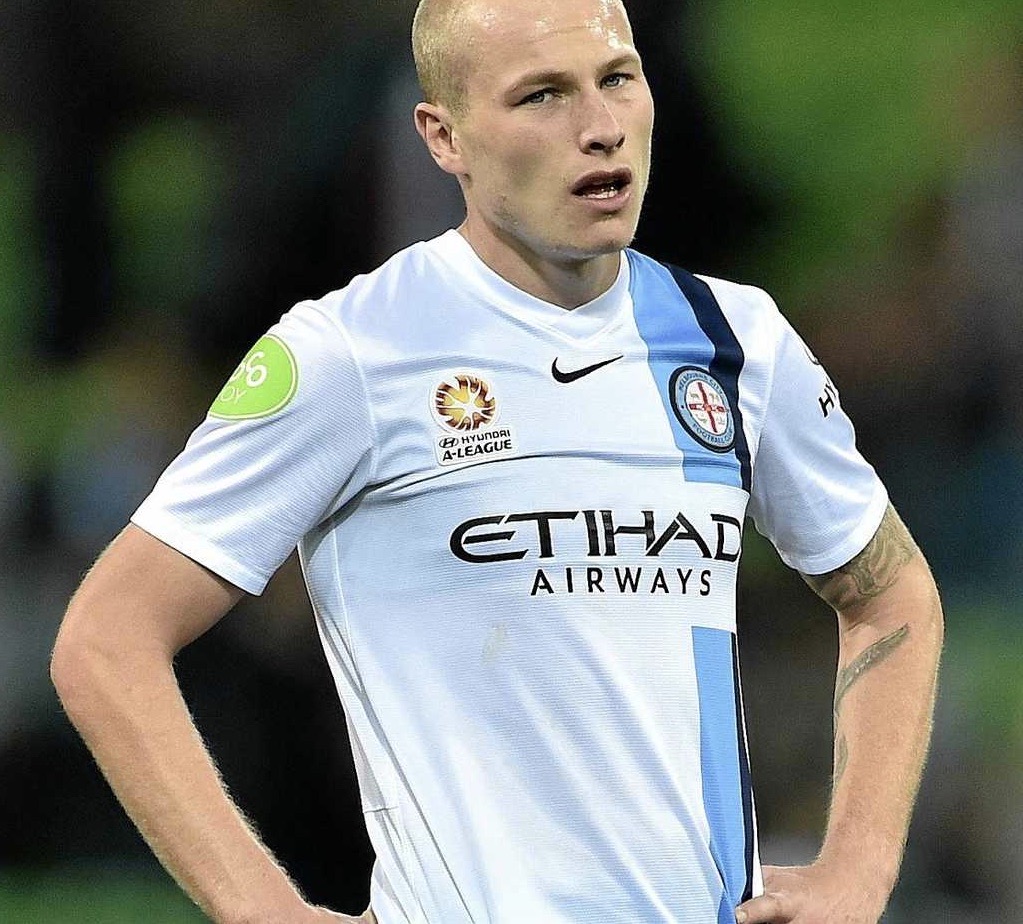
AARON MOOY spent a year as a Manchester City player without playing a game for the club and left Brighton only seven months into a three-and-a-half-year contract.

Such is the at-times puzzling nature of moves in the modern game where multiple club ownership is a factor and players have release clauses inserted into contracts before they’ve set foot onto the field for their new club.

Having starred for City’s sister club Melbourne City in his native Australia, Mooy switched to the rather better-known City Football Group operation – Manchester City FC – in June 2016, signing a three-year deal with the English Premier League side.

His arrival coincided with Pep Guardiola taking over the reins at the Etihad and was one of the first moves between the various clubs bought by the Abu Dhabi-owned City Football Group.

Brian Marwood, managing director of City Football Services, said at the time: “Aaron is an extremely talented player who possesses the attributes we hope to foster and encourage within the City Football Group.

“With the unique model CFG provides, Aaron’s move to Manchester allows us to further expose him to a high standard of opportunities to ensure his professional growth.” 

However, just six days later, Mooy was sent on loan to Championship side Huddersfield Town, where he ended up spending three seasons.

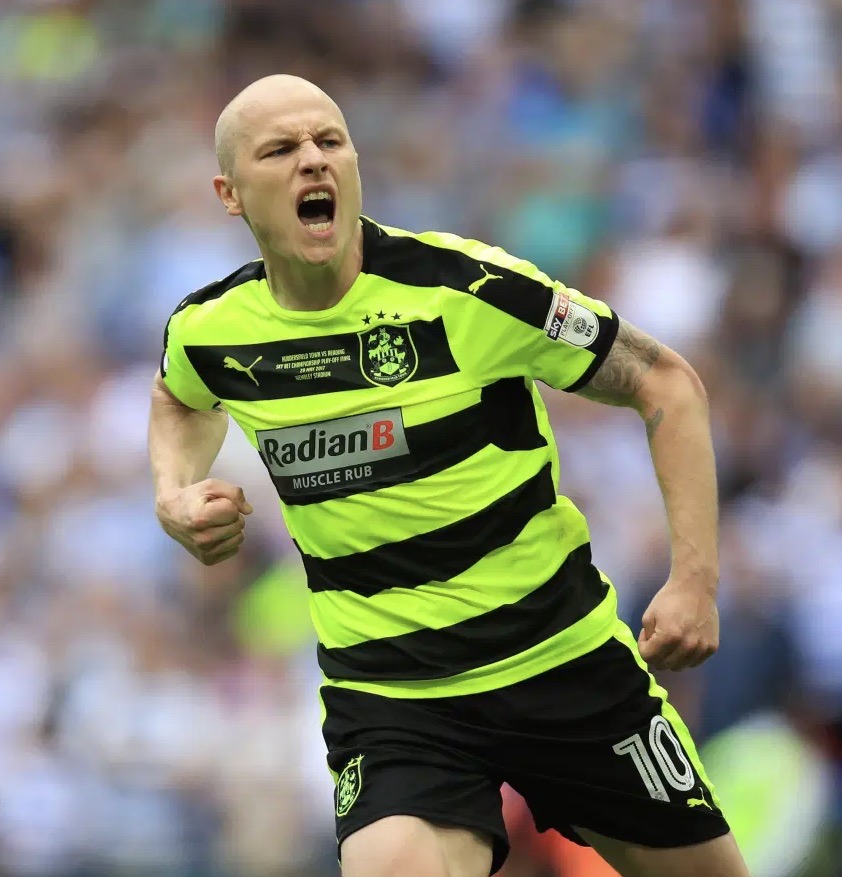
He was their player of the year as he helped them to win promotion from the Championship via the play-offs in 2017, he signed permanently for Town and then featured in their two seasons back in the Premier League.

But when they were relegated from the elite in 2019, he didn’t fancy dropping back down and seized the opportunity provided by Brighton to remain in the top division. Town neatly got him to pen a new three-year deal before allowing him to join the Seagulls on loan.

Huddersfield head coach Jan Siewert said: “Aaron was adamant that he wanted to test himself again in the Premier League when Brighton’s interest came in, and we didn’t want an issue where we had a disillusioned player on the pitch in the final year of his contract.”

However, after he’d made 15 appearances (plus three off the bench) in the first half of Graham Potter’s first season in charge, the 29-year-old was signed on a permanent basis on 24 January 2020 on “undisclosed terms”.

“He’s been an important player for us and will have a key part to play going forward,” said Potter. “We knew what Aaron would bring, and he’s proved to be an excellent addition to our squad and a great professional both on and off the pitch.”

Mooy’s deal with Brighton was not due to expire until June 2023 but, sensing one day he might have the opportunity to make big money in China, his contract at both Huddersfield and Brighton contained a clause allowing him to be released if a Chinese club offered to pay £4m – which, in the summer of 2020, Shanghai Port FC were willing to do.

Maybe the player also sensed the arrival at Brighton of Adam Lallana, together with the emergence of Alexis Mac Allister, might mean reduced playing time in the Premiership. However, perhaps the lure of being paid £60,000 a week to play the game he’s loved since a boy back home watching David Beckham on the TV might just have swayed it.

The shaven-headed Mooy had often stood out when playing for Huddersfield against Brighton and their fans were full of admiration for him. David Wood on Twitter said: “It was an absolute privilege to watch Aaron Mooy wear the blue and white of Huddersfield Town. A true class act.” Graeme Rayner added: “Without doubt the best player I’ve seen in a Town shirt. He was immense for us. He gave us some great memories, and was a model pro.”

Seagulls supporters took to him quickly too. ‘Farehamseagull’ on North Stand Chat declared: “Mooy is a wonderful player for us. We’ve been crying out for a player like him for years. His ability on the ball and appreciation of space is second to none. You can just always rely on him to make the right decision with the ball; that is a talent only truly gifted players who can see the game two, three moves ahead have.”

Mooy certainly shone in games against Spurs and Arsenal but possibly his best performance in a Brighton shirt came in the 28 December 2019 home game against Bournemouth when his 79th minute goal completed a 2-0 win for the Seagulls.

Mooy produced a headlinegrabbing performance against Bournemouth

Newspaper headlines hailed the Australian’s contribution to the win and Sky Sports commentator Alan Smith capped the lot in analysing Mooy’s goal. “What a way to settle it,” he said. “Shades of Dennis Bergkamp here, the way he took it on his chest and chipped it in.

“A quite brilliant goal from a really talented player. Great awareness and look at that finish. Bergkamp would’ve been proud.”

Mooy was born in Sydney on 15 September 1990. His German father walked out when he was a toddler and his Dutch mother, Sam, brought him up using her maiden surname. Mooy has said his earliest football memories were of playing for Carlingford Redbacks who were coached by his stepdad, Alan Todd.

His early life, as chronicled by Hale Hendrix on lifeblogger.com, was pretty much football obsessed and he went to the same high school, Westfield Sports High, as Albion goalkeeper Mat Ryan (who was in the year below). Former Leeds and Liverpool player Harry Kewell also went to Westfield.

Mooy played for Sydney-based Hajduk Wanderers and the former National Soccer League team Northern Spirit FC, as well as enhancing his potential at the New South Wales Institute of Sport, based at Sydney Olympic Park, an organisation which nurtures the country’s high performing sports people.

But he was spotted playing for his school as a 14-year-old by Bolton Wanderers’ former head of youth Chris Sulley and he was invited to the UK with his family for an assessment.

“It was a big decision to move to England but I knew it was a great opportunity,” Mooy told the Bolton News.

A serious knee injury threatened to halt his progress but Wanderers’ youth team coaches were convinced they had an outstanding prospect who was eager to earn a professional contract.

In his third season as a scholar, he managed to get some minutes in Alan Cork’s reserve team, and he said: “It’s a big year for me and I have got to show the coaches what I have got, so when I got injured, I knew I had to get back as quickly as possible.

“My rehabilitation involved lots of weight sessions and time on the bike, but I am feeling much sharper now.”

Unfortunately for Mooy, the club’s then-manager, Gary Megson, thought it unlikely he would develop into first-team material – a decision which baffled former Wanderers youth team coach, Peter Farrell.

“I couldn’t believe they released him,” Farrell told Bolton News reporter Marc Iles. “I always thought he was going to make it as a footballer but, as with anything, it’s all about opportunity.

“If Big Sam would have been in charge, or Phil Brown would have taken over I think he would still be there now. They valued that type of player and built their team around him.

“For me, Aaron had it all – he could go with his left foot, his right foot, he was physically strong on the ball and I don’t think he has changed at all from what I saw of him playing for Huddersfield.”

He added: “People thought he was maybe a bit lazy. You’ll never see him tackle. You need players around him to do that. But he reminds me a bit of Zidane – he’s even got the bald head.

“He isn’t as good a player, of course, but he has that grace about the way he plays. He’s a lovely balanced player but he wasn’t Gary Megson’s type of player, and that was the end of it.”

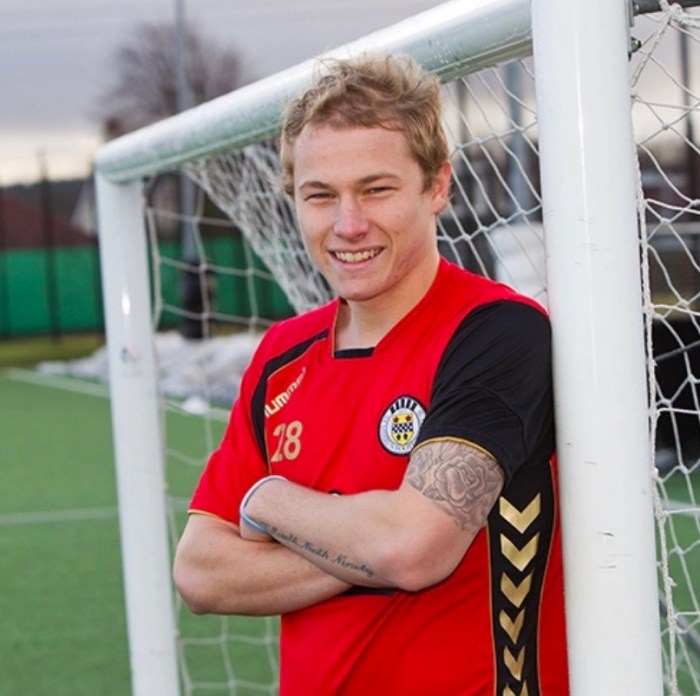
Six months after he left Bolton, Mooy surprisingly turned up in the unlikely surroundings of Paisley, Scotland, for a two-year stint at Scottish Premier League St Mirren (where former Albion midfielder Steven Thomson was at the other end of his career).

“It was a big decision to leave Bolton,” he told The Daily Record at the time. “But I wanted to try to get some first-team action and I’m doing that so I’m happy.

“Some people were a little surprised, but it didn’t bother me. I just thought I wasn’t really going to get much of a chance at Bolton. At St Mirren, I knew I was going to get some decent game time.”

Mooy later told The Scottish Sun: “St Mirren was the start for me. It was the first time I had really experienced proper football. I always remember how much I learned there. I was in the reserves at Bolton, but St Mirren was the first club I was at where winning and collecting points mattered hugely and I had to buy into that mentality.”

Mooy featured in 18 matches for Danny Lennon’s side in the 2010-11 season but he suffered a stress fracture in his back during pre-season and he managed only 12 appearances in 2011-12 and was released on a free transfer at the end of it.

At that point he decided to return to Australia and he joined Western Sydney Wanderers on a two-year deal. Mooy’s story was told excellently by Paul Doyle in The Guardian in a November 2017 article. He wrote:“Although he did well at Western Sydney, even there he was not a guaranteed starter, having to compete with two other players for a deep midfield spot as the team’s playmaking rights were entrusted to Shinji Ono, the former Japan international and 2002 Asian player of the year who would end his career in Australia.”

At the end of his contract, Mooy moved on to Melbourne City where he had an impressive 2015-16 campaign in which he was named Australian Players’ Player of the Year after scoring 17 goals from midfield and setting an A-League assist record.

Although Man City sent him to Huddersfield on loan, news of his strong performances hadn’t escaped Guardiola’s attention, as he noted in media interviews before Town took on City in the FA Cup in January 2017. “Aaron Mooy is playing amazing this season and we are glad at that,” Guardiola said. “It is not easy coming from Australia and going to the Championship and play as good as he is.

“We are going to consider what will happen at the end of the season but it’s good.”

Mooy responded to Guardiola’s praise, telling Huddersfield’s official website: “It’s obviously excellent and I’m very humbled and all that sort of stuff.

“It’s great to know he’s watching me and has his eye on how I’m doing, that’s great.

“They come to watch the games and stay in contact and hopefully they like what they see,” he said.

The Manchester Evening News even ran a story about Mooy headlined ‘The midfielder who could save Pep Guardiola and Man City a fortune this summer’.

However, at the end of June 2017, with Huddersfield preparing for their return to the Premier League, Mooy made the switch from City permanent for a club record fee of £8m.

Boss David Wagner told BBC Radio Leeds: “He was one of our key targets because he was the heart of our team last season.

“When we had the chance to get him permanently, we all agreed that we needed to get it done as quickly as we could.”

Chairman Dean Hoyle added: “Aaron made it very clear to us last season that he wanted to play in the Premier League this season and, if we were there, he would want to do that with us.

“I think we had a duty to try to make that happen for him because he made a huge contribution last season. He was a true terrier for us.”

Mooy drew praise for his role in Wagner’s gegenpressing style of play – bringing an energy and creative use of the ball in a slightly deep-lying midfield role – and Doyle observed in his Guardian article: “Strong on the ball, genuinely two-footed and blessed with vision and precision, he is the conduit of most Terriers attacks and never shirks defensive duties in a team that made more tackles than any other Premier League side during the first 12 matches of the season.”

Through his parents, Mooy could have played internationally for Germany or the Netherlands but he opted to play for the country where he was born and has played at several age group levels for the Australian national side. He made his full debut in 2012, scoring in a 9-0 win over Guam, and has since won more than 40 caps.

After Mooy played well for Australia at the 2018 World Cup, there was speculation City might activate a £20m buy-back clause but this was an unfounded rumour and reporter Stuart Brennan said in the Manchester Evening News: “Mooy has been playing well but has not done enough to suggest he could handle the rarefied atmosphere of Pep Guardiola’s midfield.”

City’s loss was Huddersfield and Brighton’s gain, but amongst the reasons suggested for his sudden departure after only a season with the Seagulls was Shanghai taking advantage of an overseas players loophole which allows Australian players to be counted as Asian.

Mooy certainly hit the ground running in China, scoring within 25 minutes of making his debut on his 30th birthday. He came off the bench in Shanghai’s 2-1 win against Wuhan Zall, scoring the winner after fellow Premier League export Marko Arnautovic had scored Shanghai’s first.

Mooy scored with a delightful one-two down the flank and easy chip over the onrushing keeper.

“I have only just arrived so my physical condition is not what it could be,” Mooy told Chinese television after the game.

“The coach asked me before kick-off if I could play some part in the game and of course I was happy to do so.”

Mooy’s career has certainly been of interest to a number of football observers around the world and Marco Jackson chipped in on onsideview.com, discussing the rationale behind his move to China.

Mooy’s recent playing time has been non-existent because the Chinese Super League is having a three-and-a-half month break to enable the national side to prepare for World Cup qualifiers. The West Australian reported on 4 October 2021 how Mooy had returned to Scotland to be with his family while keeping fit working on a programme devised by Socceroos strength and conditioning coach Andrew Clark.

Why Saint Dan riled the Albion

DAN HARDING was promoted twice with Southampton and once with the Seagulls and later cut short his career because of family tragedy.

Personally, I’m not sure he really need to be cast as ‘public enemy no.1’ because of the way he left Brighton.

With the benefit of hindsight, it was really no surprise that he chose to turn his back on playing at Withdean in favour of Elland Road, Leeds.

OK, the stringing-out of the contract negotiations, and public slanging match that accompanied them, didn’t help matters.

But football careers are short and the Amex was a long way off becoming a reality when Harding decided to opt for pastures new.

“I really enjoyed my time at Brighton but you can’t compare the size of the two clubs or the facilities,” he told the Leeds matchday programme at the time. “It has been like going from one world to another.”

Ironically, it seems his success on the pitch with Brighton, which led to him gaining international recognition, might well have been the unsettling influence.

Former Albion boss Peter Taylor selected him for England under-21s as the 2004-05 season got underway. He made his England debut as a substitute for Micah Richards in a 3-1 win over Ukraine at the Riverside Stadium, Middlesbrough, on 17 August 2004. Future full internationals James Milner and Darren Bent were in the same squad.

He started the 8 October 2004 match against Wales at Ewood Park, Blackburn: a 2-0 win courtesy of goals from Milner and Bent. He also started the game four days later when the under 21s drew 0-0 away to Azerbaijan in Baku. His last cap came the following month in a 1-0 defeat away to Spain when he was replaced by Ben Watson. Future Albion loanee Liam Ridgewell was also a substitute in that game.

It was this platform that sowed the seeds of discord, according to former chairman Dick Knight’s take on the circumstances surrounding Harding’s acrimonious departure from the Albion.

In his autobiography Mad Man: From the Gutter to the Stars, Knight reckoned it was while on international duty that Harding was “egged on by his agent about his value after talking to players with bigger clubs, on bigger wages”.

Knight went on: “Early on, I offered him a sizeable contract renewal but he sat on it. He kept saying he wanted to stay, but I don’t think he had any intention of doing so.

“Because he was under 24, we were entitled to compensation. Shaun Harvey, the Leeds chief executive – who became CEO of the Football League in July 2013 – tested me with a couple of paltry sums before finally offering £250,000, which I rejected.”

DH Leeds action 2Via the Football League tribunal system, Knight managed to get the figure up to £850,000, part achievement-based, and with a 20 per cent sell-on clause.

All in all, not a bad return for a player who came through the Albion’s youth and reserve ranks after being spotted at 15 playing for Hove Park Colts.

Born in Gloucester on 23 December 1983, the young Harding loved kicking a football from the moment he could walk and enjoyed watching his dad, Kevan, turn out for the Army team.

The family was posted to Brighton, and Harding was taken to the Goldstone Ground by his mum, Linda. One of his earliest memories was on 23 September 1992 seeing a 17-year-old David Beckham make his Manchester United debut as a substitute for Andrei Kanchelskis in a League Cup tie that finished 1-1.

Harding joined the Albion initially on schoolboy terms for a year and was then taken on as a YTS trainee, progressing through the juniors and reserves before eventually making his first team debut on 17 August 2002, during Martin Hinshelwood’s brief reign, as a substitute for Shaun Wilkinson in a 2-0 home defeat to Norwich City.

After Hinshelwood was replaced by Steve Coppell, and Harding sustained a back injury, the youngster played no further part in the first team picture that season, but he was awarded a new contract in April 2003.

In the first part of the 2003-04 season, Harding was a regular on the bench, but, on 21 February 2004, Coppell’s successor, Mark McGhee, gave him his full debut in place of the suspended Kerry Mayo in a 3-0 win over Bournemouth.

Dan Harding

Harding kept his place through to the end of the season, making a total of 23 appearances, including being part of the side that lifted the divisional play-off trophy at the Millennium Stadium, Cardiff, as the Seagulls beat Bristol City 1-0.

“In hindsight, it was a very lucky time for me. I broke into a team that was winning games and was promoted,” he told the Daily Echo. “Looking back now, I don’t think I appreciated at the time what a big achievement it was.”

Sent off in only the second game of the following season for two bookable offences, it wasn’t long before his contract discussions were aired publicly, with McGhee telling the Argus in October: “It’s starting to really frustrate me.

“Dan keeps telling us and saying publicly he wants to sign but we cannot tie his agent down to have a meeting with us. He has to be honest with us.”

Harding in turn denied he was being difficult, telling the Argus that talks were ongoing.

The off-field issues certainly seemed to be troubling Harding and McGhee publicly blamed the defender for a 2-0 defeat at Millwall in December. He was also outmuscled by Stoke City’s Ade Akinbiyi in a game at Withdean, leading to a late winner for the visitors. Across the season, McGhee dropped him on four occasions because of such inconsistency.

When he won his place back in February, he told the Argus: “I had to prove not only to the gaffer but to the other players and the fans that I want that position back.

“That’s where I prefer to play. I like to call that my position. I don’t mind playing on the left hand side of midfield or centre midfield, but I do love playing at left-back.

“Hopefully I can reproduce the same sort of form and keep my confidence up. Everyone wants to be playing, so when you are left out it’s a bit of a kick in the teeth. It’s not nice, but you have to pick yourself up and try to get back into the team.”

DH leeds action 1However, the Brighton contract offer was declined and on 7 June that summer, Harding put pen to paper on a deal with Leeds, whose fans were no doubt delighted to read that he used to follow their fortunes when he was a youngster.

“When I lived in Germany, they showed quite a lot of Leeds games on telly and, in a strange way, I kind of ended up supporting them because it was the only football I really got to see out there,” he said.

His dad later took him to a Leeds FA Cup match v Wolves, and he added: “I have to admit I have been a closet Leeds fan. Obviously, I didn’t shout about it when I was playing for Brighton and it’s kind of strange now that this move has happened.”

If Harding doubted the size of the task at Elland Road, he’d only have had to read the comments of manager Kevin Blackwell, often Neil Warnock’s no.2, who was the Leeds manager at the time.

In an article about Harding in the club programme, Blackwell said: “It has been a big transition for him. No disrespect to Brighton, but coming from the scaffolding at Withdean to Elland Road was a big step-up for Dan. He was nervous in the first couple of games, but he has started to settle down.”

He talked about how he needed to cement his place at United, and added: “If he does succeed here, all the doors will be open to him. I have no doubt that once he develops certain aspects of his game and his self-confidence, he will go a long way because he is a real athlete with a great left foot.”

Brighton fans vented their displeasure at how things had turned out every time Harding touched the ball when Leeds entertained the Seagulls on 12 September 2005; a game which finished 3-3. The fact two of Albion’s goals came from crosses on Harding’s flank prompted Blackwell to drop him for the following match.

After only seven games, Harding picked up an injury and, over the course of the season, played just 21 matches for United. In August 2006, the Yorkshire club used the full-back as a makeweight in a deal which took future Albion loanee Ian Westlake from Ipswich to Leeds.

He was a regular at Portman Road for a couple of seasons but, in his third season, manager Jim Magilton deemed him surplus to requirements and sent him out on loan to Southend United. I recall going to a match at Roots Hall and seeing him have an outstanding game against Brighton.

Later the same season, with Ipswich bobbing along in mid-table, Harding seized the chance to join Steve Coppell’s promotion-chasing Reading, and he played in their play-offs defeat to Burnley.

When Roy Keane took over at Ipswich in 2009, Harding was sold to Southampton; manager Alan Pardew’s first signing for the Saints. Harding’s former Albion youth coach, Dean Wilkins, was part of Pardew’s coaching team.

Harding reflected in an interview with the Southern Daily Echo that what followed were the happiest three years of his career, in which he played 121 games and chipped in with five goals.

In 2010-11, he was named in the PFA League One team of the year along with teammates Kelvin Davies, Jose Fonte, Adam Lallana and Alex Oxlade-Chamberlain.

In the harsh and fickle world of football, Brighton fans relished Brighton’s 3-0 win over Southampton at the Amex on 2 January 2012 when Albion winger Will Buckley gave Harding such a torrid time that, to compound his humiliation, the former Brighton player was subbed off by boss Nigel Adkins with five minutes of the first half still to play.

Although part of the Saints side that won promotion back to the Premier League that May, Harding didn’t get the chance to play at the top level because Adkins moved him on to Nottingham Forest.

Harding talked in detail to the Echo’s Paul McNamara about life at Forest, which he found an unstable place, especially when Sean O’Driscoll, the manager who signed him, was sacked.

Although he played some games under that legendary left-back Stuart Pearce, when he took over, Harding eventually went on loan to Millwall, but wasn’t able to help them stave off relegation from the Championship.

He reveals in his interview with McNamara how disillusioned he became with the amount of dishonesty in football and, coupled with his pregnant wife losing two of the triplets she was expecting, he put family before football and, at the age of only 31, dropped down four divisions to play non-league with Eastleigh.

He talked about the tough decisions he’d had to make in an interview before a FA Cup tie Eastleigh played against Bolton Wanderers.

In 2016, Harding joined Whitehawk as a player, then became part of the coaching set-up, and was briefly caretaker manager before the appointment of Steve King.

Tidy full back Stewart Henderson polished Saints diamonds

1 SH monoALBION’S right back when I first started watching them in the late 1960s was someone who would go on to make much more of a mark as a coach.
Gareth Bale, Theo Walcott and Adam Lallana were among the players developed by Stewart Henderson. Wayne Bridge and Chris Baird, too.

That was all to come for Stewart when I first saw him wearing the number 2 shirt in Freddie Goodwin’s Division 3 side.

hendo biog

Henderson, who shares the same June birthday as me, albeit he was born 11 years earlier, was only 5’6″ tall but he had noticeably muscular thighs. Hailing from Bridge of Allan in Scotland, his stature didn’t stop him earning Scottish schoolboy international honours and he was on the winning side in three matches.

The Scots beat Northern Ireland 5-1 at Windsor Park, Belfast – when future Albion teammate John Napier was playing for the home side – Wales at Ninian Park, Cardiff, and England at Ibrox Park where a 30,000 crowd watched.

That recognition followed his success playing for his school team, St Modans High School in Stirling, and Stirlingshire Schoolboys. It eventually took him to England at the age of 17 in 1964 to join Chelsea.

Tommy Docherty was their manager at that time and he obviously wasn’t convinced Henderson was good enough for the First Division, so he dropped down to the Third with Brighton where, for a couple of seasons, he had the unenviable task of trying to oust captain and Northern Irish international Jimmy Magill from the right back slot.


Stew Hendo blue

He made his debut on 3 May 1966 away to Exeter a month before his 19th birthday and didn’t make his home debut until 1 October that year, stepping up when Magill was injured and helping Albion to a 5-2 win over Peterborough.

It wasn’t until March 1968, though, that he eventually cemented his place in the side. But when he did, he became a near-permanent fixture for the next four years. He only scored once in 199 appearances, that coming in a 6-0 drubbing of Oldham Athletic on 24 August 1968.

Stew Hendo PoYIn the 1969-70 campaign, he missed only one game and the supporters chose him as player of the season. He played 36 league games in Pat Saward’s first season in charge and in the 1971-72 promotion campaign was a regular in the line-up right through until the famous televised Aston Villa home game in March 1972 when Saward made two shock changes and left out both Henderson and captain John Napier for the top of the table clash.

It was the beginning of the end for Henderson and he cuts a rather-forlorn looking figure in a picture of the newly-promoted team captured in the Goldstone dressing room after gaining the necessary point against Rochdale, standing fully-clothed alongside his team mates in their kit, taking a sip of champagne.

Saward made him available for transfer at the end of the season and although he stayed with the club, he played only two more league games, and a league cup game, in the following season before being transferred to Reading in June 1973.

Henderson had chalked up 198 league games and 14 cup games during his time with Brighton but the move to Berkshire was by no means a petering out of his career.

I am grateful to the website of the Reading FC Former Players Association (readingformerplayers.co.uk) to discover how, although manager Charlie Hurley signed Stewart initially as a full-back, in 1975 he pushed him into a midfield role with immediate success: Stewart scored twice in the first 17 minutes at Bradford City.

He went on to be an influential member of Reading’s 1976 Fourth Division promotion winning side. In May 1977, he was made club coach and worked closely with manager Maurice Evans helping the club win the 1978/79 Fourth Division Championship.

Amazingly Stewart was recalled to the playing squad at the beginning of the 1979/80 season, at the age of 32, and continued playing intermittently until May 1983 when he played the last of his 186 games for the Royals and became Reading’s first Centre of Excellence director.

Coaching became his new direction and he was at manager Ian Branfoot’s side when Reading beat Luton at Wembley to win the Simod Cup in 1988 (a game incidentally in which former Albion winger Neil Smillie was one of the goalscorers for the Royals and Steve Foster and Danny Wilson were playing for Luton).

Henderson left Elm Park in 1989 to take up the role of youth development officer at Southampton, where his work began helping to produce some of the finest footballing talent in the country.

He was to spend over 20 years at Southampton in various roles working with the youth and academy teams, the reserve side and even had a short spell as first team manager.

It’s worth quoting an article from the Mirror in October 2012, when Matt Law reckoned Southampton owed a £55million debt of gratitude to Malcolm Elias, Steve Wigley, Huw Jennings and Stewart ­Henderson who spotted and coached the incredible Southampton Fame Academy, which through transfer fees effectively saved the club from extinction.

Gareth Bale, Theo Walcott, Alex Oxlade-Chamberlain, Wayne Bridge, Kenwyne Jones, Adam Lallana, James ­Ward-Prowse and Luke Shaw were all named as coming under the influence of the quartet who, after being released by Southampton moved on together to Fulham.

Henderson was a guest at an Albion raceday in 2006 and met up with former teammate Ian Goodwin