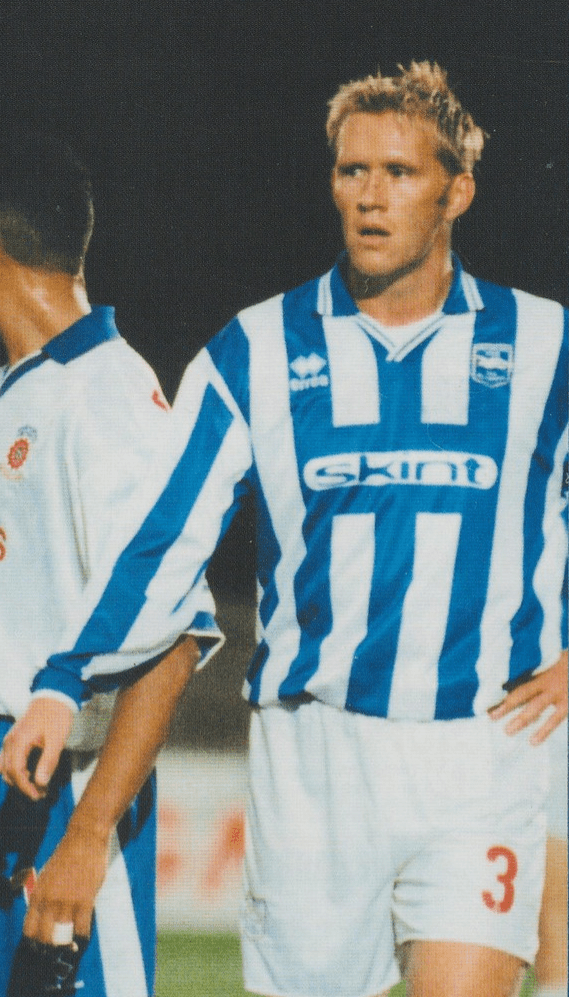
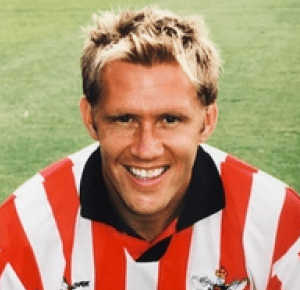
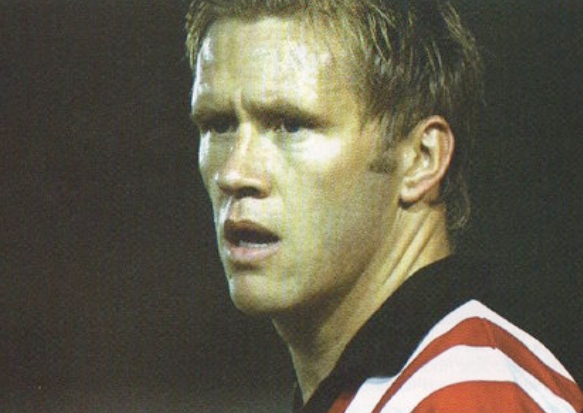
Champion medal surprise for man on the mic Aspinall

THE starry-eyed teenager who made half a dozen top level appearances for eventual league champions Everton had to wait a long time for his share of that distant glory.

But Warren Aspinall was nonetheless delighted when his contribution to the Toffees achievement in 1986-87 was finally recognised with a medal more than 30 years later.

That’s happened since I last featured Aspinall in this blog, which recalled his early days at hometown club Wigan Athletic and darker days after he had ended his playing days in the blue and white stripes of the Albion (three goals in 24 starts plus 13 as sub) in the 1999-2000 season.
Aspinall is now more often heard rather than seen by Brighton supporters who listen to match commentaries on Radio Sussex, and it was commentator Johnny Cantor, who the summariser sits alongside for the regional BBC radio station’s coverage of all Albion’s games, who instigated a presentation of the belated honour.

“It was JC who pushed it forward and he kept it to himself before surprising me with the news that Everton would be making a presentation,” Aspinall told the matchday programme. “I was shocked but absolutely over the moon.”

The number of games to qualify for a winners’ medal used to be 14, or a third of the season, but the EFL in 2021 decided retrospectively to fall in line with the Premier League which awards medals to players who’ve made a minimum of five appearances.

Aspinall had been unaware of the rule change but Cantor had words in the right places and when Albion played at Goodison Park on 3 January 2023, the former player was finally presented with his medal by Graeme Sharp, one of his fellow Everton forwards back in the day who subsequently became an Everton director.

It’s probably a good job the presentation was made before the game because Albion romped to a 4-1 win that day with goals from Karou Mitoma, full debut-making Evan Ferguson, Solly March and Pascal Gross.

“The medal means the world to me and my family and it now sits proudly on my mantelpiece along with my England under 20 caps,” said Aspinall.

He earned the first of those two caps in the same month that Everton paid £125,000 to sign the 18-year-old from Wigan Athletic, although he saw out the season on loan with the Latics.

He featured in Young England’s 2-0 win over the Republic of Ireland at Elland Road, Leeds, and the following month was in the side that suffered a 4-1 defeat to Scotland at Aberdeen’s Pittodrie ground. Tottenham’s David Howells and Neil Ruddock, then of Millwall, also played in both matches, as did Millwall goalkeeper Brian Horne.

Teenager Aspinall signs for Everton’s Howard Kendall watched by Wigan boss Bryan Hamilton

On his return to Goodison Park at the end of the 1985-86 season, Aspinall was on the bench for the last league game (Kendall rested several players because it was five days before the FA Cup Final, which Everton lost 3-1 to Liverpool) and he made his debut in the 3-1 home win over West Ham when going on for two-goal Gary Lineker, who was playing his last league game for Everton before joining Barcelona.

Everton finished as league runners up that season but they went one better the following season, when competition for forward places saw manager Howard Kendall able to pick Sharp and Adrian Heath as his preferred pair, with Paul Wilkinson and Ian Marshall as alternatives. It meant Aspinall’s playing contributions came in the form of nine league and cup appearances as a substitute (he was also a non-playing sub on four occasions). Although first team chances were limited, he bagged plenty of goals for the club’s reserve side, netting 21 in 23 games.

That was enough to convince former Celtic stalwart Billy McNeill, in charge of relegation-bound Aston Villa, to splash £300,000 to take him to Villa Park – where competition for a starting spot was again daunting, with Andy Gray, Gary Shaw, Simon Stainrod and Garry Thompson all striker options.

Aspinall made his Villa debut on 21 February 1987 in a 2-2 draw at home to Liverpool and by the season’s end, while his former Everton teammates were lifting the league trophy, he was part of a Villa side that was bottom of the pile.

McNeill was duly sacked and the picture changed the following season when Aspinall was joint top-scorer as Graham Taylor’s Villa bounced straight back to the top tier as runners up behind Millwall.

“Garry Thompson and I hit it off up front and we had such a good understanding that we kept Alan McInally out of the team for a long time,” he told Villa supporter Colin Abbott. “Garry was good to play alongside because he was like a battering ram and I fed off him.”

Aspinall made his 50th and final appearance for Villa on 7 May 1988 in a 0-0 draw away to Swindon (playing left back for Villa was Bernie Gallacher and in the opposition line-up was Colin Calderwood and Kieran O’Regan).

Already warned by Taylor that he needed to improve ill discipline that had resulted in too many cautions, Aspinall got himself sent off for stamping in a pre-season friendly against St Mirren and Taylor transfer-listed him.

Happy at Pompey

England World Cup winner Alan Ball, in charge at recently relegated Portsmouth, seized the moment and took him to Fratton Park for a fee of £315,000 in August 1988, where his teammates included Mark Chamberlain and Terry Connor. In six years with Pompey, Aspinall also played under John Gregory, Frank Burrows, caretaker Tony Barton and Jim Smith.

Briefer stays followed along the coast at Bournemouth (loan and permanent), Swansea City (loan) and two seasons at Carlisle United.

Aspinall at Colchester

Keen to return to the south, Micky Adams first signed him when he had taken over as manager at Brentford and he made 48 appearances (plus three as sub) for the Bees but Aspinall then went on loan and then permanently to Colchester United for nine months before Adams brought him on loan and then permanently to the Albion in the autumn of 1999. It was a part exchange for midfielder Andy Arnott.

In only his third game, Aspinall was a delighted scorer of the only goal on his old stomping ground of Brunton Park as Albion returned to Sussex with all the points. The News of the World said: “Former Carlisle favourite Warren Aspinall seized on Billy Barr’s poor back pass to chip keeper Andy Dibble.”

In the Argus, Andy Naylor wrote: “The colourful midfielder then dashed towards the Albion supporters huddled in the seats on a drizzly day in Cumbria before sliding full-length on the greasy turf.”

Aspinall continued his celebration with a finger-on-lip gesture and an ear cupped towards the home support. He told the matchday programme: “I heard the keeper shout for the ball and anticipated the defender’s pass. I think I showed a great turn of pace for a veteran.”

In fact, Aspinall was 32 when he joined the Seagulls and he added experience to a side that went on to finish its first season back in Brighton in 11th place in the fourth tier

At the start of the following season, when he went on as a sub for Gary Hart in Brighton’s home 2-1 win over Rochdale (Bobby Zamora scored both Albion goals), it was to be his last ever appearance.

Suffering from the niggle of a piece of floating bone in his right ankle, he followed physio advice to have it removed in what was expected to be a routine operation. But while in hospital, he caught the MSRA superbug which ate away tendons and ligaments in his ankle.

“They eventually said I would never play football again as a result. I was finished,” he told The News, Portsmouth, in a graphic account of the trauma. “Yet now I needed an operation to get rid of this infection, which involved me scheduled to stay on a hospital ward for 14 days, attached to an intravenous drip while antibiotics were fed into my body.

“After 13 days, my body broke out in a rash from head to toe. It had rejected the drug. So, I had the operation once more – and it happened again. After 13 days, my body rejected it.

“For 28 days I’d been on that hospital ward, so I was then offered the chance to return home if I underwent an operation to insert two tubes into my heart, one for the intravenous drip to enter and the other to take blood out.

“That sounded good to me – apart from my heart subsequently stopping during the procedure. I died. I’m told it was for a few seconds, but I died on that operating table,’ Aspinall told The News. “But they brought me back, and I was allowed to go home to Hedge End, with a district nurse checking on me every day, even Christmas Day.

“There were two six-inch tubes hanging out of my chest, with the nurse taking blood out of one and putting the drugs into the other.

“I lived. The antibiotics killed the superbug, but my career ended there and then. I was aged 33, with nothing planned, no coaching badges. I had to go into the real world.”

The story of what happened in his post-playing days – battles against gambling and alcohol addictions – have been well documented in various media interviews, including a detailed one with the Birmingham Mail in October 2012, when he spoke openly about a near-miss suicide attempt.

He has been Cantor’s co-commentator on Albion matches for Radio Sussex since 2015.

Crunching tackler ‘Tank’ Clark: a legend at two seaside clubs

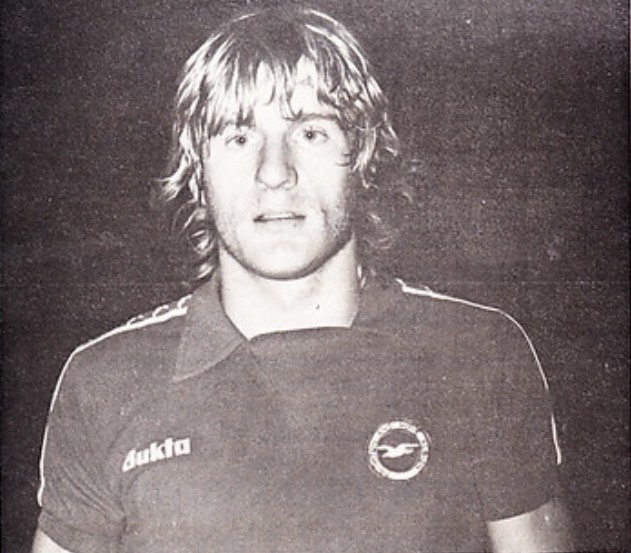
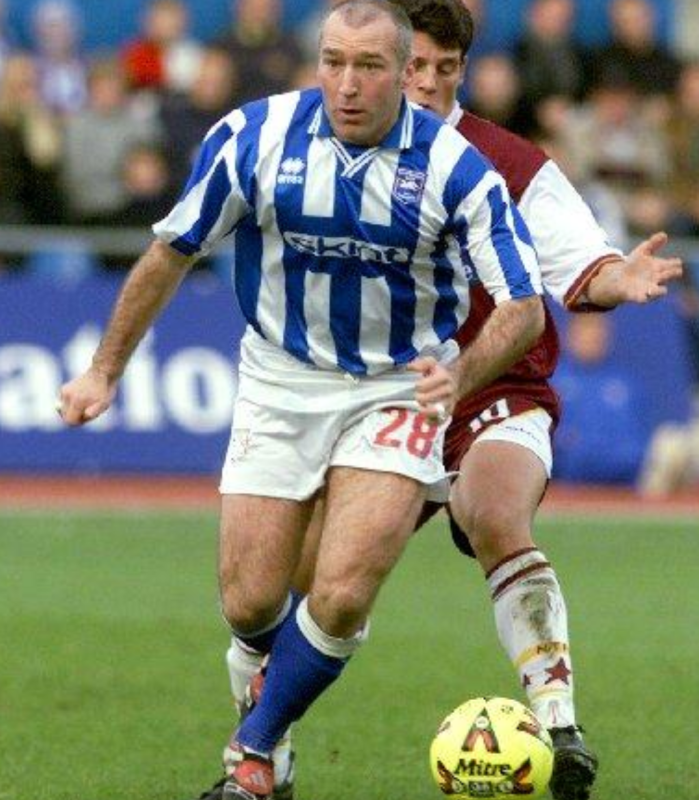
VIKING lookalike Paul Clark made a lasting impression on plenty of players with robust tackling which earned him ‘legend’ status among fans of Brighton and Southend United.

Described in one programme article as “the big bustling blond with the biting tackle”, Clark was given the nickname ‘Tank’ for his no-nonsense approach. A Southend fan lauded “his crunching tackles and never say die attitude”.

Clark himself reflected: “Wherever you go the supporters tend to like someone who is wholehearted and when it came to 50-50 challenges, or even sometimes 60-40, I didn’t shy away from too many, and the supporters just took to it.”

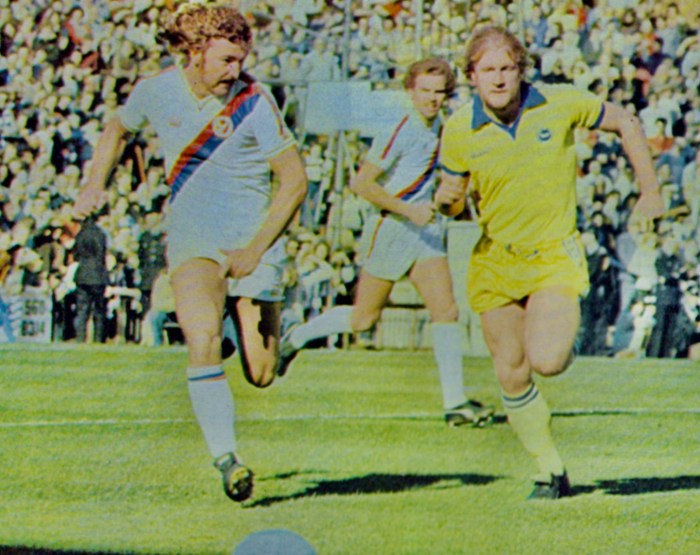
In Albion yellow against Palace

Giving further insight to his approach, he said: “You can go right up to the line – as long as you don’t step over it, then you’re OK.

“I used to pick up a booking during the first five or 10 minutes, then I knew I had to behave myself for the rest of the game. Despite the reputation I had, I was never sent off in over 500 games.”

A trademark strike at home to West Ham

Former teammate Mark Lawrenson said of him: “You would hate to have to play against him because quite often he would cut you in two. With him and ‘Nobby’ (Brian Horton) in the side, we definitely didn’t take any prisoners. One to rely on.”

A former England schoolboy international, it was said of the player in a matchday programme:

“Paul is the first to admit that skill is not his prime asset but there is no doubt as to the strength of his tackle. He is a real competitor and is also deceptively fast, being one of the best sprinters on the Goldstone staff.”

Born in south Benfleet, Essex, on 14 September 1958, Clark went to Wickford Junior School where he played for the school football team and the district primary schools’ side. When he moved on to Beauchamp Comprehensive, selection for his school team led to him playing for the Basildon Schools’ FA XI.

Clark as an England schoolboy

This in turn led to him being selected to play for England Schools at under 15 level, featuring against Scotland, Ireland, Wales, West Germany and France before going on a tour of Australia with the same age group. Contemporaries included future full time professionals Mark Higgins, Ray Deakin, Kevin Mabbutt and Kenny Sansom.

Clark left school at 16 before taking his O levels when Fourth Division Southend offered him an apprenticeship. He made his first team debut shortly before his 18th birthday in a 2-1 win over Watford.

Two months later, he won the first of six England Youth caps. He made his debut in the November 1976 mini ‘World Cup’ tournament in Monaco against Spain and West Germany alongside future full England internationals Chris Woods, Ricky Hill and Sammy Lee.

The following March, he played in England’s UEFA Youth tournament preliminary match against Wales when they won 1-0 at The Hawthorns. Sansom was also in that side. And he featured in all three group matches at the tournament that May (England beat Belgium 1-0, drew 0-0 with Iceland and 1-1 with Greece). Teammates included Russell Osman and Vince Hilaire.

Clark was only a third of the way into his second season at Southend when Alan Mullery sought to beef up his newly-promoted Brighton side in the autumn of 1977, and, in a part exchange deal involving Gerry Fell moving to Roots Hall, Clark arrived at the Goldstone. He made his debut for the Seagulls in a goalless draw at White Hart Lane on 19 November 1977 in front of a crowd of 48,613. And he came close to crowning it with a goal but for an outstanding save by Spurs ‘keeper Barry Daines.

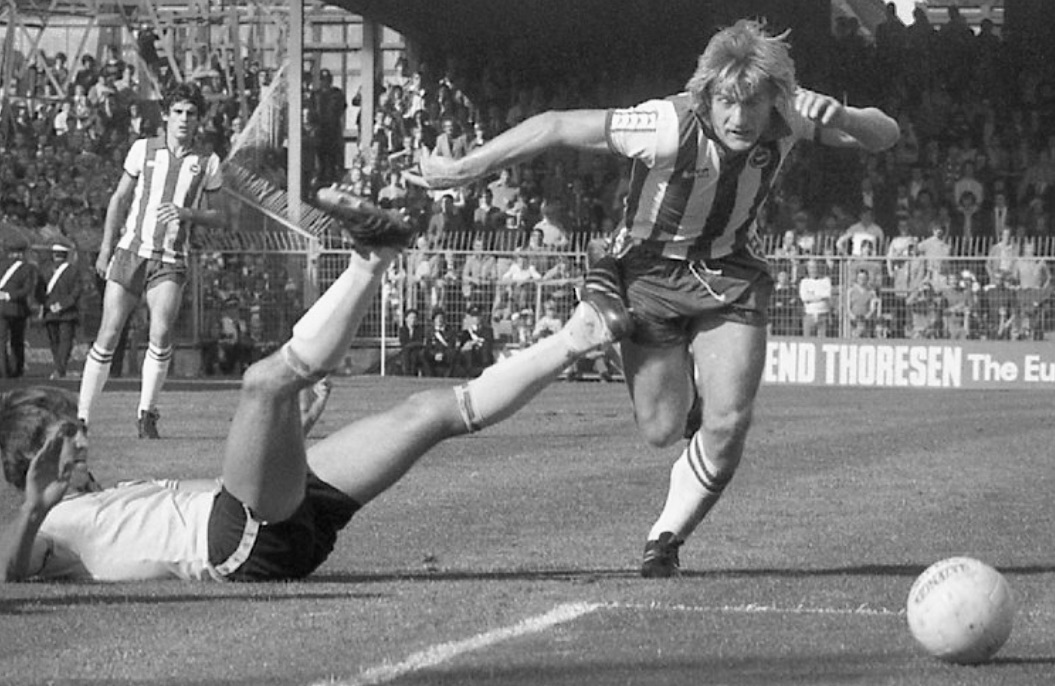
In full flight, as captured by photographer George Erringshaw

When Spurs visited the Goldstone later that season, Clark put in a man of the match performance and scored a memorable opener, following a solo run. A subsequent matchday programme article was suitably poetic about it.

“It showed all the qualities looked for in a player: determination, speed, skill and most of all the ability to finish….if any goal was singled out, Paul’s was certainly one to treasure.”

Albion went on to beat Spurs 3-1, although the game was remembered more because it was interrupted twice when the crowd spilled onto the pitch.

After only 12 minutes, referee Alan Turvey took the players off for 13 minutes while the pitch was cleared of Albion fans who’d sought safety on the pitch from fighting Spurs’ hooligan fans.

In the 74th minute, with Spurs 3-1 down and defender Don McAllister sent-off, their fans rushed the pitch to try to get the game abandoned. But police stopped the invasion getting out of hand and the game continued after another four-minute delay.

Clark’s goal on 16 minutes had been cancelled out six minutes later when Chris Jones seized on a bad goal kick by Eric Steele but defender Graham Winstanley made it 2-1 just before half-time.

Albion’s third goal was surrounded in controversy. Sub Eric Potts claimed the final touch but Spurs argued bitterly that Malcolm Poskett was offside.

Clark remembered the game vividly when interviewed many years later by Spencer Vignes for the matchday programme. The tenacious midfielder put in an early crunching tackle on Glenn Hoddle and after the game the watching ex-Spurs’ manager Bill Nicholson told him: “Well done. You won that game in the first five minutes when you nailed Hoddle.”

Said Clark: “I was 19 at the time so to get a pat on the back from him was much appreciated.”

It was one of three goals Clark scored in his 26 appearances that season (nine in 93 overall for Albion) but he wasn’t always guaranteed a starting berth and in five years at the club had a number of long spells stuck in the reserves.

Midfield enforcer or emergency defender were his primary roles but Clark was capable of unleashing unstoppable shots from distance and among those nine goals he scored were some memorable strikes.

For instance, as Albion closed in on promotion in the spring of 1979, at home to Charlton Athletic, Clark opened the scoring with a scorching 25-yard left foot volley in the 11th minute. Albion went on to win 2-0.

The following month, Clark demonstrated his versatility at St James’ Park on 3 May 1979 when Albion beat Newcastle 3-1 to win promotion to football’s elite level for the first time. Clark played in the back four alongside Andy Rollings because Mark Lawrenson was out injured with a broken arm.

Celebrating promotion with Peter O’Sullivan and Malcolm Poskett

“Not many people can say they played in a side that got Brighton up to the top flight,” said Clark. “It’s something I’m still immensely proud of.”

Once they were there, Clark missed the opening two matches (defeats at home to Arsenal and away to Aston Villa) and had an ignominious start to life at the higher level when he conceded a penalty within three minutes of going on as a sub for Rollings away to Manchester City on 25 August 1979.

Some observers thought Clark had played the ball rather than foul Ray Ranson but referee Pat Partridge thought otherwise and Michael Robinson stepped up to score his first goal for City from the resultant penalty. It put the home side 3-1 up: Teddy Maybank had equalised Paul Power’s opener but Mike Channon added a second before half-time.

Partridge subsequently evened up the penalty awards but Brian Horton blazed his spot kick wide of the post with Joe Corrigan not needing to make a save. Peter Ward did net a second for the Seagulls but they left Maine Road pointless.

Ahead of Albion’s fourth attempt to get league points on the board, Clark played his part in beating his future employer Cambridge United 2-0 in a second round League Cup match.

Three days later, he was on the scoresheet together with Ward and Horton as Albion celebrated their first win at the higher level, beating Bolton Wanderers 3-1 at the Goldstone.

It was Clark’s neat one-two with Ward that produced the opening goal and on 22 minutes, Maybank teed the ball up for Clark, who “belting in from the edge of the box, gave it everything and his shot kept low and sped very fast past (‘Jim’) McDonagh’s right hand,” said Evening Argus reporter John Vinicombe.

Gerry Ryan replaced Clark late in the game and after 12 starts, when he was subbed off three times, and four appearances off the bench, his season was over, and it wasn’t even Christmas.

A colour photo of a typical Clark tackle (on QPR’s Dave Clement) adorned the front cover of that season’s matchday programmes throughout but he didn’t start another game after a 4-0 League Cup defeat at Arsenal on 13 November.

Programme cover shot

He was sub for the following two games; the memorable 1-0 win at Nottingham Forest and a 1-1 draw at Middlesbrough, but Mullery had signed the experienced Peter Suddaby to play alongside Steve Foster, releasing Lawrenson to demonstrate his considerable repertoire of skills in midfield alongside skipper Horton and Peter O’Sullivan.

Young Giles Stille also began to press for a place and later in the season, Neil McNab was added to the midfield options, leaving Clark well down the pecking order in the reserves. Portsmouth wanted him but he rejected a move along the coast, although he had a brief loan spell at Reading, where he played a couple of games.

But Clark wasn’t finished yet in Albion’s colours and, remarkably, just over a year after his last first team appearance, with the Seagulls struggling in 20th spot in the division, he made a comeback in a 1-0 home win over Aston Villa on 20 December 1980.

Albion had succumbed 4-3 to Everton at Goodison Park in the previous match and Mullery told the Argus: “We badly needed some steel in the side and I think Clark can do that sort of job.”

Under the headline ‘The forgotten man returns’ Argus reporter Vinicombe said Mullery hadn’t changed his opinion that Clark was not a First Division class player, but nevertheless reckoned: “Paul’s attitude is right and I know he’ll go out and do a good job for me.”

For his part, Vinicombe opined: “The strength of Clark’s game is a daunting physical presence. His tackling is second to none in the club and Mullery believes he will respond to the challenge.”

Clark kept the shirt for another nine matches (plus one as a sub), deputising for Horton towards the end of his run, but his last first team game was in a 3-1 defeat at Norwich at the end of February.

Clark remained on the books throughout Mike Bailey’s first season in charge (1981-82) but, with Jimmy Case, Tony Grealish and McNab ahead of him, didn’t make a first team appearance and left on a free transfer at the end of it.

Back to Southend

He returned to Southend where he stayed for nine years and was player-manager on two occasions. Fans website shrimperzone.com moderator ‘Yorkshire Blue’ summed up his contribution to their cause thus: “In the top five all-time list for appearances, an inspiration in four promotions, one of the toughest tacklers of all-time and a man whose commitment for his home-town club could never be doubted.”

Clark was still only 27 when he had his first spell as manager, in caretaker charge after Dave Webb had quit following a bust-up with the club chairman, and he managed to steer United to promotion back to the third tier.

When Webb’s successor Dick Bate lasted only eight games of the new season, Clark was back at the helm, in turn becoming the youngest manager in the league.

His first hurdle ended in a League Cup giant killing over top flight Derby County (who included his old teammate John Gregory) when the Us had another former Albion teammate, Eric Steele, in goal.

A Roy McDonough penalty past England goalkeeper Peter Shilton at Roots Hall settled the two-legged tie (the second leg was goalless at the Baseball Ground) which the writer described as “arguably their biggest ever cup shock”.

In the league, player-manager Clark guided Southend to a safe 17th place but it went pear-shaped the following season. Clark only played 16 games, Southend were relegated, and Webb returning midway through the season as general manager.

Back-to-back promotions in 1989-90 and 1990-91 proved to be a more than satisfactory swansong to his Southend career, and in the first of those he found himself forming an effective defensive partnership with on-loan Guy Butters in the second half of the season.

In 1990-91, he missed only six games all season as the Shrimpers earned promotion to the second tier for the first time in their history, and he had a testimonial game against Arsenal.

But, after a total of 358 games for Southend, he left Roots Hall to join Gillingham on a free transfer.

Over three seasons, he played 90 league games, and was caretaker manager in 1992, before retiring at the end of the 1993-94 season. Gillingham’s top goalscorer with 18 that season was a young Nicky Forster and other Albion connections in that squad included Mike Trusson, Paul Watson, Neil Smillie, Andy Arnott and Richard Carpenter.

After Gillingham, Clark played non-league for Chelmsford City but left to become assistant manager to Tommy Taylor at Cambridge United. In 1996 he followed Taylor in a similar role to Leyton Orient.

Southend fans hadn’t heard the last of him, though – quite literally. He became a co-commentator on Southend games for BBC Radio Essex.

In the 2009-10 season, Clark was temporarily assistant manager to Joe Dunne at Colchester United.

Utility man Jamie Campbell a magnet for frustration

JAMIE CAMPBELL played in the top flight for Luton Town and later filled the left-back berth in the opening months of the season when Albion returned to Brighton after two years in exile at Gillingham.

However, by the time Albion won promotion from the fourth tier in May 2000, Campbell was on the outside looking in, Kerry Mayo having taken his place, and he was given a free transfer halfway through his two-year contract.

Campbell had been one of numerous new arrivals brought in by Micky Adams ahead of the 1999-2000 season having been given a free transfer by newly promoted Cambridge United where he had only missed one match in two years.

Although Albion famously beat Mansfield Town 6-0 in the season opener at the Withdean Stadium, subsequent form had some pondering whether it had been a flash in the pan.

Campbell, the only ever-present defender after eight games (three wins, two draws, three defeats), reassured supporters when he told the Argus: “At Cambridge we had some terrible hiccups at the start of the season. It was a new team, the same as Micky has put together here, and it does take time to gel.

“It’s early days yet. There are a lot of points to be played for and it’s a long old season. It’s far too early to start panicking. Let’s give it until Christmas, see where we are, and take it from there.”

In truth, there were few highlights for Campbell to enjoy in his time with the Seagulls. He put through his own net in only his fourth league outing, heading past the recalled Mark Walton at Darlington when filling in at centre back, although Gary Hart subsequently levelled it up.

He did score (left) in the right end to bag the only goal of the game in a Withdean win over Hartlepool on 6 November 1999, but the following month, when Albion were up against it with several players injured, ill or suspended, Campbell got himself sent off after only 25 minutes in a 2-0 defeat at Swansea City prompting Adams to drop him and relegate him to the reserves.

Campbell was shown the red card by Premiership referee Dermot Gallagher after twice sliding in recklessly on Jason Price in the space of just over a minute. He was Albion’s sixth player to be suspended that season.

“Campbell’s stupidity couldn’t have come at a worse time as a flu-ravaged squad had a hard enough task against the eventual Division Three champions without having to play for over an hour with 10 men,” recalled wearebrighton.com.

Campbell clears from Orient’s Martin Ling

Boss Adams, who had already fined Darren Freeman for a red card at Plymouth, told the Argus: “The boy will be disciplined. They’ve got to learn. In wet conditions like that, good defenders stay on their feet, it’s as simple as that.

“Obviously it’s a worry because with small squads in the third division you can’t afford too many sendings-off.”

Having lost his place, things then got worse for Campbell in February of the new century when he had to undergo a hernia operation, dashing any hopes he might have had of winning back a starting place. With Mayo and new arrival Nathan Jones vying for the left back spot, Campbell became surplus to requirements.

He moved on to Exeter City where he was almost ever-present in the 2000-01 season under Noel Blake and was named the Grecians’ player of the year.

Not long into his first season at St James’s Park, he was interviewed by the local paper and compared the situation at City to his experience with Brighton, because Blake, like his former Leeds teammate Adams, had assembled a new squad of players.

“You’ve got to quickly get to know everyone’s strengths and weaknesses so you can gel as a team,” he said. “He (Blake) has got standards and he wants people to believe in them.

“The boss runs things very professionally, he thrives on running the club like a First Division or even a Premiership club.

“And the good thing with the boss is that he admits he is still learning and his door is always free for us to knock on.”

On his return to the Withdean in the red and white stripes of Exeter three days before Christmas 2000 (above), Campbell’s penchant for own goals once again came to the fore when he deflected a Gary Hart effort that was going wide past the City ‘keeper to contribute to a 2-0 win for the Seagulls.

Not long into the 2001-02 season, Blake was replaced by former City player John Cornforth and, although Campbell played 20 games for the Grecians that season, he switched to Conference side Stevenage Borough in March 2002, where he linked up with former Albion players Simon Wormull and Andy Arnott.

The website boroguide.co.uk seems to be singularly underwhelmed by the Wayne Turner signing declaring: “It was perhaps indicative of the poor form that we found ourselves in that Campbell was often a beacon of mediocrity.

“In defence or midfield, the utility player often had little impact; frustration becoming a buzz word when describing JC’s performances.

“So, it was only natural therefore, that he ended up at Woking. Like many other former Boro’ players who didn’t live up to expectations, all roads lead to Kingfield.”

That move took place in February 2003, and he moved on again a year later, to Havant & Waterlooville where he stayed until July 2005, when he retired from playing.

Born in Birmingham on 21 October 1972, he was a trainee at Luton before signing professional in July 1991. He broke through under David Pleat in the 1991-92 season when Town were relegated from the top flight after 10 seasons at that level.

Young Hatter Campbell

 Campbell made four starts plus nine appearances off the bench as the Hatters lost their place amongst the elite. Pleat’s squad also included a young Kurt Nogan and combative midfielder Chris Kamara.

On other occasions Campbell was part of Town line-ups that included one-game Albion loanee goalkeeper Juergen Sommer and Arsenal loanee striker Paul Dickov. The excellent Hatters Heritage website said of him: “Jamie was regarded as a utility man at Kenilworth Road with his versatility meaning that he was used mainly as a substitute, which sadly ensured that he could never claim a permanent position in the Hatters side.” Somewhat ignominiously, the fans podcast We Are Luton Town named the defender in their worst-ever Hatters XI.

When he found first team opportunities were limited at Kenilworth Road, Campbell went on loan to Mansfield Town and Cambridge United and left Luton in July 1995 to sign for Barnet.

During two seasons at Underhill, Campbell featured in 67 league matches (and scored five goals) before moving back to Cambridge on a permanent basis in August 1997.

While playing for the Us, Campbell put the ball in the wrong net but ended up on the winning side in a memorable second round second leg League Cup match in 1998.

Roy McFarland’s basement league United side knocked out Premier League Sheffield Wednesday 2-1 on aggregate, having nicked a 1-0 win at Hillsborough in the first leg.

Campbell for Cambridge tries to block a cross by Albion’s Paul Armstrong

Fan Matt Ramsay recalled: “Jamie Campbell’s freak headed 20-yard own goal summarised the cruel nature the sport can possess as it handed the big guns the initiative.

“Yet just as supporters began to embrace the familiar underdog emotion of consoling each other with the knowledge that at least it was a valiant effort, the magic moment arrived.

“Just as football is cruel when it goes against you, the success brings delirium. As Trevor Benjamin thumped home a right wing freekick to put United back into the lead, and as the final whistle fifteen minutes later heralded a major cup upset, there was proof that there is reward for the eternal hope that all fans of all clubs require.”