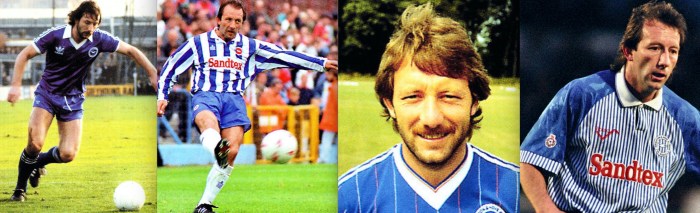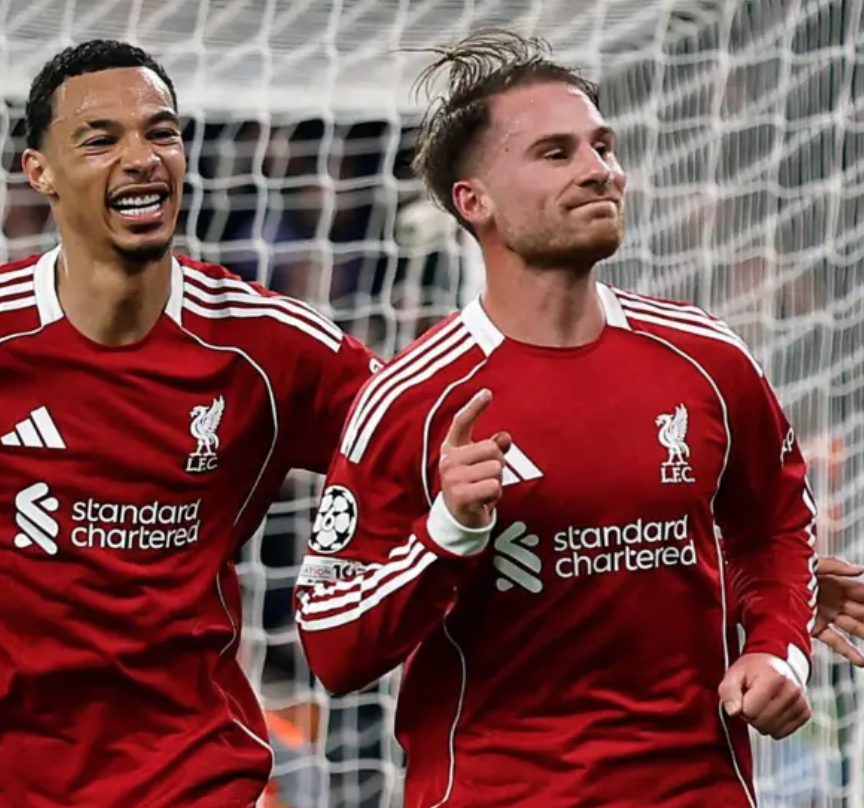
Alexis Mac Allister: the history-making World Cup winner

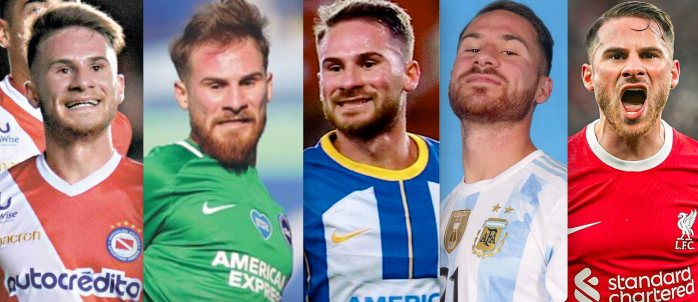
IF WINNING the World Cup is the pinnacle of any footballer’s career, there can be no question that Alexis Mac Allister has no equal as the greatest ever Brighton and Hove Albion player.

Several players have achieved the honour of representing their country on the back of their performances for Brighton, but never before December 2022 had the club boasted a World Cup winner, an international teammate of world-renowned Lionel Messi.

Argentinian Mac Allister has got the lot in his locker: equally adept as a holding or attacking midfielder, a great eye for pinpoint passes, deadly from the penalty spot, and with thunderbolt shots from distance to boot.

Indeed, one of the most memorable long-range strikes he scored for Brighton – against Leicester in Graham Potter’s last game in charge – would have been a goal of the season contender had it not been ruled out by the narrowest of VAR calls. It took the video assistant referee more than four minutes to chalk it off for offside which Potter conceded was “probably a millimetre or two the right decision”.

Thankfully, Mac Allister managed two that did count in that 5-2 win, converting a penalty for Albion’s fourth and then curling in an excellent 25-yard free-kick in injury time.

Potter’s input to making Mac Allister a more complete player was acknowledged in an interview with SunSport, not long after the coach departed forChelsea.

“He was very helpful — improving my versatility and physicality. I’m a much better player today because of it so I can thank him a lot,” said Mac Allister, who admitted how at first he found it difficult to transition from a more advanced player to a deeper-lying midfielder.

“The first year wasn’t easy for me. I found it very hard coming from Argentina with a different language and different way to play football. I physically wasn’t as strong as I am today,” he said.

In fact, he came close to jacking it all in at Brighton in December 2020, as he revealed in an in-depth interview with theplayerstribune.com, but was talked round in a FaceTime call with his mum in Buenos Aires.

“By that Christmas, with no fans in the stadiums, I had my bags packed. Literally, they were packed. I had two offers to leave — one from Russia and another from Spain, and my mind was made up.
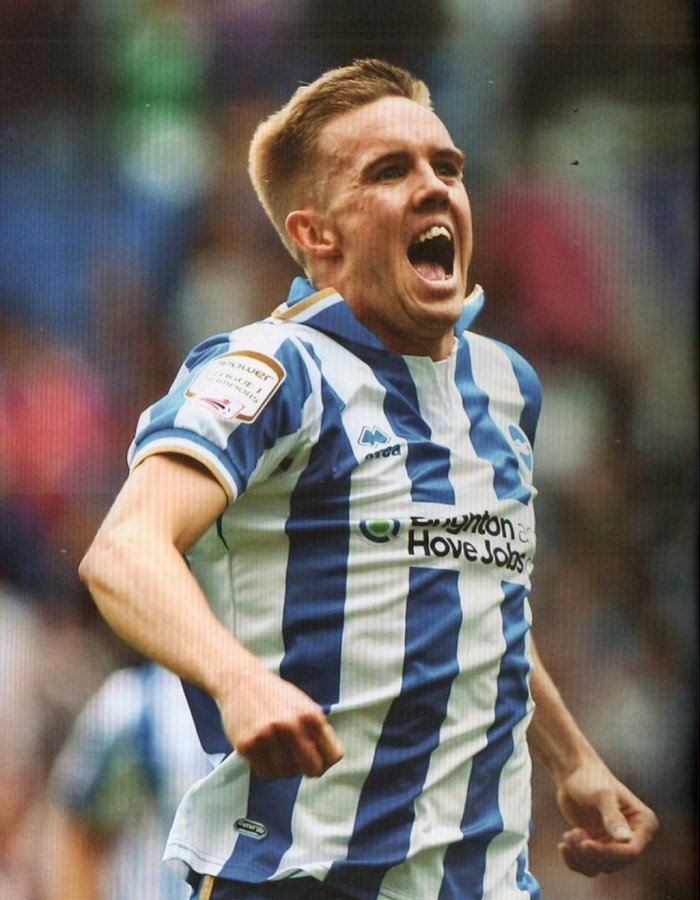
“At the time, I was barely playing for Brighton. It was embarrassing, because I had the no. 10 shirt for a Premier League club, which is the dream of so many kids in Argentina, but I was a nobody. My name was nothing. I thought that I was cursed,” he said.

He got on FaceTime with his mum and he admitted: “I was sobbing. I was at my flat in Brighton, and she was back home in Buenos Aires. I had lost my head. I said, ‘Mum, I can’t do it anymore. I’m coming home. I need to get out of here’.” 

He continued: “I wanted to go home so bad. But my mum made me see the light. ‘Ale, remember how much you always wanted this?’ she said. ‘You have to be brave. You can’t quit now’.” 

In the new year, Mac Allister started many more games and eventually cemented his place in the heart of Albion’s midfield.

No longer a nobody; Mac Allister now has a staggering 8.6 million followers of his Instagram account!

“I like to play as a no. 10, I like to play as a no. 6,” he said. “The most important thing for me is to help my teammates win football games and try to be as central as I can so I can be as close to the ball to get on it as much as possible.”

Potter himself spoke highly about the way Mac Allister handled the transition, saying in January 2021: “Sometimes when players make the move there can be an assumption that it will all happen for them straight away.

“He’s moved from South America and was adapting to a new country before COVID and then picked up a couple of injuries.

“But he’s a determined individual and he’s a really good guy to work with. He reads the game really well and has a good footballing brain.”

Born in the Argentine lowland city of Santa Rosa on Christmas Eve 1998, Mac Allister started his career with Club Social y Deportivo Parque before joining the youth team of Argentinos Juniors in Buenos Aires.

He made his senior team debut there in October 2016 and a year later he and his older brothers Kevin and Francis all played in the same side. Their father Carlos, a left back known as El Colorado — “the Redhead”—  had also played for Argentinos Juniors and Boca Juniors (and won three caps for Argentina).

Alexis signed for Brighton in January 2019 on a four-and-a-half-year contract and said at the time: “The main reason I signed was because the club came to Argentina looking for me and they seemed very convinced about me.

Mac Allister liked the direction Albion saw for him before signing

“They made a big effort, told me about their project and their ideas to keep growing in this league, and I liked their ideas. I liked what they said.”

He was loaned back to Argentinos Juniors until the end of the 2018-19 season and then moved on loan again to Boca Juniors, where brother Kevin was playing, for the first half of the 2019-20 season. This was a Boca side that had one of the players he used to admire from afar – former Man Utd and West Ham striker Carlos Tevez – up front.

Mac Allister told GQ magazine in September 2025: “When I was younger, there weren’t many Argentinians in the Premier League but I used to wake up very early in the mornings to watch players like Carlos Tevez and Maxi Rodriguez.

“I was a big fan of the Premier League, so I hope the next generations are doing the same with us, not just with me but with Argentinian players in general.”

Albion recalled Mac Allister in January 2020 a couple of months before the Covid pandemic began to bite. “My time at Boca helped me mature and I learned a lot of things,” he told the Albion website.

Mac Allister made his debut as a substitute at Molineux in the last fixture before matches were halted for three months. I was at that Wolves match and even in a few short minutes on the pitch there were glimpses of what the young Argentinian was going to add to Potter’s side.

But the break hit Mac Allister hard. “Everything shut down. No football. No friends. And the worst part was that I was stuck in a country where I didn’t speak the language, he told theplayerstribune.com.

“When I first came here, I thought ‘I’ve played for Boca Juniors, one of the best teams in South America, I am ready’,” Mac Allister said in an interview on the Albion website in February 2022. “We had the Covid situation and I didn’t train for two or three months with my teammates. When we returned, I realised I wasn’t at the level I needed to be. I had to work.”

The year which would end with Mac Allister as a World Cup winner began well too when he scored twice at Goodison Park in Albion’s first ever win at Everton on 2 January. The player himself saw it as pivotal moment.

Mac Allister reckoned everything clicked for him when he scored twice at Goodison Park

The game was only three minutes old when Mac Allister latched on to Neal Maupay’s knockdown to score in the third minute before Dan Burn put Albion 2-0 up on 21 minutes.

Anthony Gordon pulled one back but Mac Allister found the top-right corner with a superb strike to make it 3-1 on 71 minutes. Gordon struck again 14 minutes from the end, but Brighton held on to win.

“When I scored two against Everton in January 2022, it felt like everything clicked for me,” he said. “That day at Goodison, I became something different.”

Admitting he had been hoping to improve on the goalscoring front, Mac Allister told the club website: “When I played in Argentina I would score and assist a lot more. I have scored a few times for Brighton now, it’s nice to get the confidence from that.

“I had a few games where I was on the bench and that’s not what I want, so I knew I had to keep working because I knew I would get my chance and when I did, I wanted to be ready. When that chance came along, I thought I took it well.

“The message from the gaffer and my teammates was to keep my head down and work hard. It’s not just the 11 who start, the people on the bench are important too.”

Always deadly from the penalty spot

The next step change in his career came with the appointment of Roberto De Zerbi as Potter’s successor. “A few months before the World Cup, it changed everything for me,” he said.

“The main thing that he helped me improve was my scanning of the field — my “profiling” of the situation. Taking little mental pictures of the chess board every two seconds. We looked at Ødegaard as an example of this. For me, he’s one of the best in the world at scanning. His head never stops moving. De Zerbi gave me this gift, and it really elevated my game.”

Mac Allister told theplayerstribune.com: “Playing every week, with the manager’s trust, the idea of the World Cup started to seem not so distant.

“I will never forget, we were away at Wolverhampton, and I was in the hotel whenI received the call of my dreams. I was in the squad. I was actually going to Qatar.”

He called his parents and they cried together. He reflected: “Two years earlier, I couldn’t get off the bench at Brighton. Now I was going to the World Cup with Argentina, trying to make history.”

When he helped his country to lift the World Cup on 18 December 2022 (beating France 4-2 on penalties after the game finished 3-3), Mac Allister’s stock had already been rising. He was man of the match after scoring for his country for the first time in a 2-0 win over Poland that took Argentina through to the last 16. In the final, he delivered an inch-perfect cross for Angel di Maria to give Argentina a 2-0 lead in the first half and De Zerbi observed how well he played alongside maestro Messi.

“Messi and Mac Allister speak the same (football) language and Messi understands very well the quality of Alexis,” De Zerbi told The Athletic. “If you watch the game, Messi was looking for Alexis lots of times and they made a lot of passes to each other. Alexis was always giving back to Messi a clean pass.”

With Mac Allister playing further forward for his country than with the Albion, it had De Zerbi pondering. “I’d like to speak to him when he comes back,” the Italian told The Athletic. “I like him a lot in the other position (deeper).

“I spoke with his father the other day and he told me he prefers the Argentina position, but in that position we have (Adam) Lallana and Lallana is a teacher.

“If a team wants to become big, the quality needs to be further back. For me the midfielder can play on the defensive line, because he’s bringing more quality.”

But he added: “Alexis can play anywhere on the pitch. I don’t know if he’s better as a playmaker or 20 metres further forward.”

Established as a kingpin in Albion’s midfield alongside Moises Caicedo — almost certainly, Albion have never had a better pairing in that area of the team — it was inevitable that they would move on.

In May 2023, De Zerbi was phlegmatic about losing them both. “I think it’s right they can leave, can change teams and play in a level higher,” he said. “If you ask me about Caicedo and Mac Allister, I love them and they are two big, big players and can be in a big, big European team.

“They can play in every competition and are ready to compete for a big team and I hope for them they can play in the best team in the world.”

The manner of their departures differed, of course, and after Mac Allister had moved to Liverpool, De Zerbi admitted: “With me and with my staff he was super correct. Before we could read it in the newspapers, in the press, the possibility he could go to Liverpool, he went into my office to communicate it in front of me and to explain the reason.

“I understood logically and I appreciated a lot because he was clear and he was honest. Not all other players were the same. Of course, he was happy to go to Liverpool and we can understand it. But, in the same way, he was sad to leave his teammates and this club.”

Mac Allister revealed how he had a secret rendezvous with Jürgen Klopp ahead of the £35m deal being done. “He flew down and we met in secret somewhere halfway to Brighton,” he said. “I was a bit shocked that he did that for me.

“I had won a World Cup, but I was not a star at all. We had a coffee, and he explained to me that he really wanted me to come to Liverpool, because I reminded him a bit of Gündogan, who he developed at Dortmund into one of the best box-to-box midfielders in the world.”

After observing how well Mac Allister had settled in with the Reds, De Zerbi maintained: “He became a great, great player. I’m happy and I’m proud for him because I worked with him and he deserves to be an important player in a big team.”

The Argentinian’s first goal for the club, in a 4-3 Premier League win over Fulham at Anfield in December 2023, turned out to be Liverpool’s goal of the 2023-24 season.

It was a perfect half-volley that dipped and swerved into the top right corner of the net from around 30 yards.

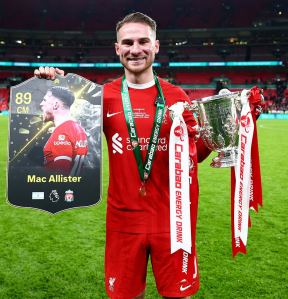
He collected his first domestic honour that season, too, when Liverpool beat Chelsea 1-0 to win the Carabao Cup (right).

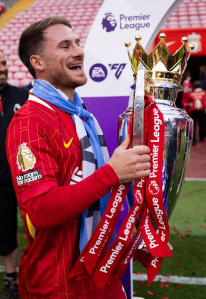
Under Klopp’s successor Arne Slot, Mac Allister made 35 appearances (30 starts + five as sub) when Liverpool won the Premier League title (left) in May 2025.

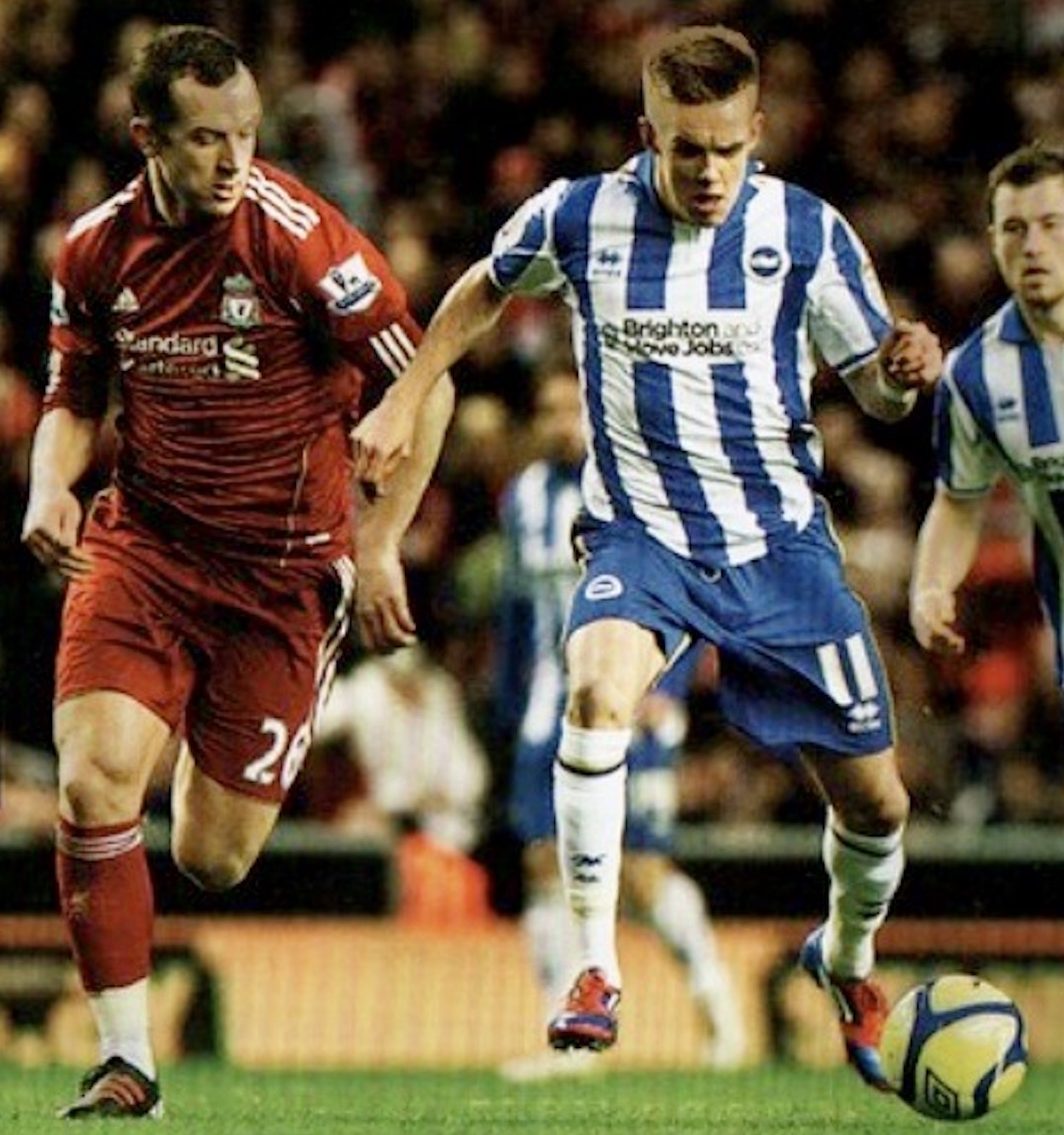
The Withdean visitors’ teenage winger went on to great things

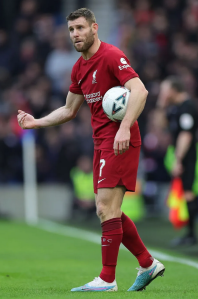
MY FIRST memory of watching James Milner play was at Withdean Stadium when he was on loan to Swindon Town from Leeds United.

Even then, as a seventeen-year-old, he had something about him – but I certainly didn’t imagine I would be watching him playing in the Premier League and Europe for Brighton 20 years later!

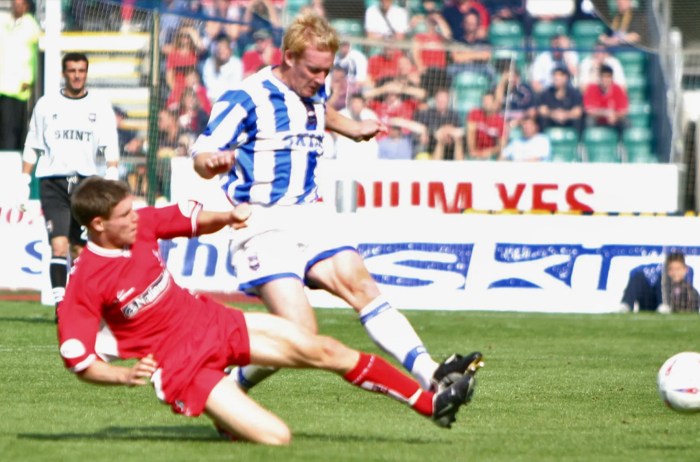
Young Milner tackles Brighton’s Kerry Mayo

That League One game on 6 September 2003 finished 2-2. Sam Parkin scored twice for Town and Albion’s goals came from Gary Hart and a penalty from on-loan Darius Henderson.

The Albion matchday programme subsequently recorded: “Kerry Mayo had a fine match, mainly subduing the impressive teenager James Milner.” (although, as the picture suggests, he wasn’t afraid to launch himself into a tackle).

Swindon’s manager Andy King had persuaded his old Everton teammate, Peter Reid (in charge of Leeds at the time) to loan Milner to the Robins for a month. In just six matches, the young winger scored twice.

“The boy is a terrific talent and everyone has been able to see the skills he has and I have no doubt he will go on to perform in the Premiership,” King told Sky Sports.

Milner already had two goals to his name for his parent club having scored twice in the Premier League in 2002-03 while still only 16.

On Boxing Day 2002, ten days short of his 17th birthday, he became the youngest player to score in the elite division, with a goal in a 2–1 win at Sunderland (the record had been set a couple of months earlier by Wayne Rooney for Everton and was subsequently taken by James Vaughan, also for the Toffees).

Milner had gone on as a 36th-minute sub for Alan Smith, a player he had admired when a boy growing up in Leeds. Terry Venables, Leeds manager at the time, said: “It’s not just a case of him simply coming through and helping out because every day he is getting better and better.”

Milner scored again three days later after going on as a 31st minute sub for Harry Kewell as Leeds beat Chelsea 2-0 at Elland Road.

“Picking up Mark Viduka’s pass in first-half injury time, Milner beat his man before thumping a right-foot shot low into the net with Blues keeper Ed de Goey powerless to stop him,” said the BBC report of the match.

“I am very pleased with him,” said Venables. “He is growing in this group and he has taken advantage of every day’s training to show what he can do.

“He has two good feet, he is courageous and everyone likes him a lot. He also is not only a nice, solid, good, well-mannered boy, he is a very talented player.

“It’s early days for the boy. At the moment he has not achieved anything and he is the first to admit that.

“But I think a lot of people are confident about his development. We have just got to take it easy.”

Wind on the clock more than two decades and Albion are now enjoying the benefit of Milner’s vast experience gained winning trophies galore for two of the country’s top clubs and playing for his country.

Born in Wortley, Leeds, on 4 January 1986, Milner broke through with Leeds United before joining Newcastle United at 18 and having loan and permanent spells at Aston Villa.

Milner went on to make more than 200 league and cup appearances for Manchester City and more than 300 for Liverpool as well as earning 61 full England caps and a record 46 at under 21 level.

Against Wolves on 22 January 2024, 38-year-old Milner overtook Ryan Giggs to go second outright on the Premier League’s all-time appearance list when he played in his 633rd top-flight match, 20 short of record holder Gareth Barry.

“I’ve had some luck,” Milner told TNT Sports. “I’ve worked hard and you have to enjoy it to put the work in every day. I’ve hopefully got a few more games in me.”

Milner’s free transfer move to Liverpool from Manchester City in the summer of 2015 proved an inspiration that brought him even more medals than he had won with the Sky Blues.

Over eight seasons, he made 332 appearances, scored 26 goals and lifted seven trophies along the way.  

“He’s a role model,” said manager Jürgen Klopp. “Nothing we have achieved in the last few years would have happened without James Milner, it’s as easy as that.

“Whether he was on the pitch or not, he’s set standards in a way not a lot of people can set standards, and it educated all of us.”

In a heartfelt tribute to the player, Klopp added: “From the first moment for me, he was a super-important player reference point.

“When you have a meeting and you look at Millie’s eyes and he’s not shaking his head, you know you’re on the right way. Nothing would have happened here without Millie because he kept it always going.

“From the player who was super-angry when he didn’t play, to the player when he did play, the way he pushed the whole dressing room before a game is absolutely second to none.”

For his part, Milner enjoyed a good relationship with Klopp, apart from once during a half-time flashpoint when the manager lost it, as Milner revealed to The High Performance Podcast.

“We had one moment where he was sharing his thoughts and I was sharing mine and I remember him smashing his hands on down the table and shouting, ‘Will you shut the f**k up!’ But Jurgen was brilliant, we had a great relationship and we were great off the pitch.”

It was Klopp’s predecessor, Brendan Rodgers, who persuaded Milner to make the journey along the M62, and he said at the time he signed him: “He had won the Premier League, he had won cups. His whole ambition was to win the Champions League and he felt that he would have a better opportunity to win it at Liverpool.”

Rodgers revealed that when Liverpool were trying to persuade him to sign, his wife Charlotte spent time chatting to Mrs Milner while he spent time with her husband!

“His actual football talent has probably gone under the radar because he’s played around some outstanding talents, but this is a guy who works tirelessly at his game,” said Rodgers.

“He’s in here at 7.45am making sure he’s prepared for his training, getting all of his food supplements and getting everything correct before training – he’s in two-and-a-half hours before he trains and then does his work, gives his maximum.

“He prepares himself like an elite player should. He’s also got big character and a big mentality.”

Rodgers was effusive in his praise of the new signing even before a ball had been kicked in anger after he scored the winner in a 2-1 pre-season victory over Brisbane Roar. Playing in the central role he preferred, he also provided a pass for Adam Lallana’s 27th-minute equaliser.

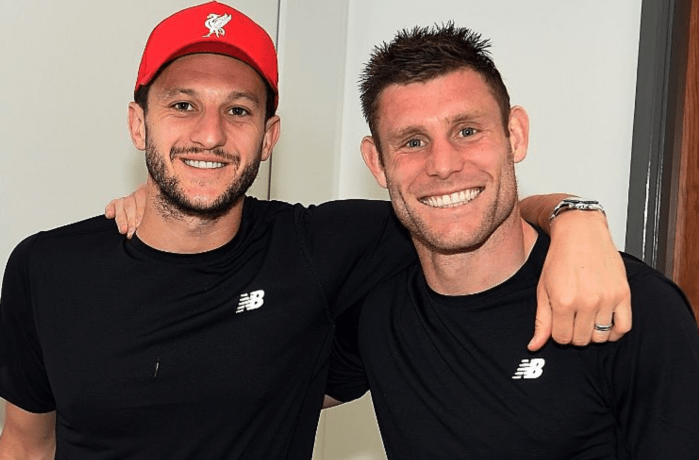
Former Liverpool teammates Adam Lallana and James Milner reunited at Brighton

“James Milner is a class act,” he told reporters. “We had to work very hard to get him in but I think we’ll see over the course of the season how important he is for us.

“He’s a wonderful personality and a top class footballer. When you see him play in his favourite position, you see all these qualities come out.”

Milner in action for Liverpool against Brighton during a lockdown match

Rodgers departed Anfield not long after Milner’s arrival but the player grew in stature under Klopp and, although it wasn’t his favourite position, he spent much of 2016-17, filling in at left-back.

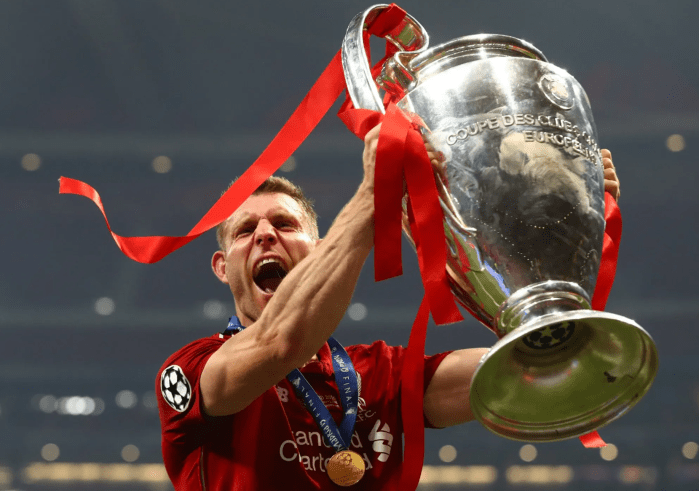
That season he made 40 appearances – 36 in the Premier League – as Liverpool qualified for the Champions League. They made it all the way to the final, only to lose to Real Madrid in Kyiv. But they made amends the following season and returned from Madrid with Liverpool’s sixth European Cup.

Milner went on as a second-half substitute in the Estadio Metropolitano in the 2-0 win over Tottenham Hotspur. “It will be nice going to Melwood seeing No.6 there,” he said. “Liverpool has a great history and when I signed for the club, I was desperate to add trophies as this club expects to win trophies and it has an amazing history – but we want to create our own history.”

Not only did they add the UEFA Super Cup and FIFA Club World Cup, Milner made 22 appearances as Liverpool clinched the Premier League title in 2019-20 with 99 points.

In 2021-22, Milner scored the first in Liverpool’s 11-10 penalty shoot-out win in Liverpool’s Carabao Cup defeat of Chelsea at Wembley, having gone on as an 80th minute sub, and he repeated the feat (as a 74th-minute sub) when the teams were also goalless at the end of the Emirates FA Cup final three months later. Liverpool won that 6-5 on penalties.

In his final season at Anfield, Milner featured 43 times and moved up to third spot on the Premier League’s all-time appearances list.

“I’m Leeds through and through and always have been and always will be – but I never probably thought that another club would get into me as much as Liverpool has,” said Milner.

The player he followed from Anfield to the Amex, Lallana, told the BBC exactly what Milner brings to a squad, especially in setting an example to younger players.

“He helps the management team in so many ways with the experience he’s built up,” said Lallana. “He knows what it takes to win. He knows what sacrifices need to be made.

“I’m not sure how he got the boring James Milner label, but he couldn’t be further away from that. He’s one of the loudest in the dressing room for sure. Full of life. Full of banter. But he’s definitely old school.”

Lallana added: “Those basics are always there and they’ll never change. I think that’s what’s made him who he is and given him his success. Those values that he’ll always live by. He taught me how to be a better professional and a better role model.”

It all began at Westbrook Lane Primary School in Horsforth and the secondary Horsforth School. He played local amateur football with Rawdon whose coach Graeme Coulson had first noticed Milner as a nine-year-old.

“I first came across him when I was refereeing a junior match involving Westbrook under nines at Horsforth,” Coulson told the Craven Herald and Pioneer. “He was so outstanding then that I asked some of the Horsforth parents who he was.

“I noted his name and it was one not to be forgotten. He was an outstanding talent scoring lots of goals but he was also very strong.”

Horsforth School spokeswoman Fran Morris said: “He was a first class student and he did really well at his GCSEs (he got eleven).

“He was very sporty at school and he won the PE prize which was handed out just before we broke up.

“He was the most wonderful young man and he was very popular, so we wish him all the best in his career. I am very sure he will do well and we are all proud of him at the school.”
Let alone his football ability, the young Milner also played cricket for Yorkshire Schools and excelled as an athlete: he was Leeds Schools’ cross-country champion for three successive years and district 100 metres champion for successive years.

Milner was a season ticket holder at Elland Road along with his parents Peter and Lesley before becoming a ball boy. He joined the Leeds United Academy after being spotted playing for Westbrook in Horsforth.

The sporty youngster was forced to decide between cricket and football, explaining in one interview: “I played for Yorkshire at the ages of 10 and 11 as a wicketkeeper-batsman. It was something I enjoyed but you get to a stage where you have to make a choice.

“I stopped playing cricket at 16 when I moved full time to the Leeds United Academy. They couldn’t take the risk of me getting injured, having my foot broken by a yorker or something like that.

“A couple of months later I made my Leeds debut. I still can’t take the risk for the same reason, but as soon as I retire from football, I’ll look forward to taking up cricket again.”

He completed his formal education at sports college Boston Spa School, which works in partnership with Leeds United, and, as soon as he left school, he was taken on as a trainee.

As he worked his way through United’s youth ranks, he also played for England at under-15 and under-17 levels.

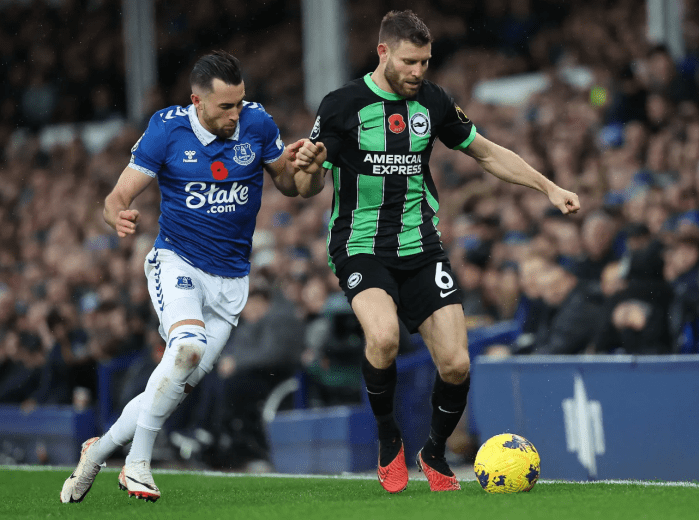
Milner in action for the Albion against Everton at Goodison Park

Craig Noone bounced back after Heighway heave-ho

PACY SCOUSE winger Craig Noone was a born entertainer who bounced back from early rejection by Liverpool to make it all the way to the Premier League.

Brighton in the Championship under Gus Poyet provided the former roofer with a platform to showcase his ability before Cardiff City gave him the opportunity to perform at the top level.

After he’d scored (below) and impressed in an away game at Manchester City, then newly-appointed Cardiff boss Ole Gunnar Solskjaer said: “Noone is a terrific little player.

“He causes defenders problems with his pace and his technique; he can go inside and outside. He’s got a good left foot, but he can cross it with his right.”

Born in Kirkby, Liverpool, on 17 November 1987, Noone was on Liverpool’s books between the ages of eight and 11.

“I was spotted playing for my Sunday team St Peter and Paul and I used to train at Melwood a couple of times a week – it was unbelievable,” he recalled. “We wore the cream and black training kit and I loved every minute. I was a big Steve McManaman fan, the way he ran at players, and would try to do the same.

“Unfortunately, when I got to 11, Steve Heighway called one night to say that I wasn’t good enough to stay on – I’ll never forget it.”

Noone would eventually get to play on the hallowed turf of Anfield, but not on behalf of the home side.

It was New Year’s Eve 2010 that he joined Brighton, making his debut four days later in a 2-1 win away to Exeter City, where he’d spent six weeks on loan the previous year.

Poyet had admired the winger’s attributes up against Inigo Calderon in one half and Marcos Painter in the second during the Seagulls’ 2-0 win at Plymouth three months earlier, Noone discovered from another Argyle player, Ashley Barnes, who’d scored against his old club that day.

“Barnesey later told me that the management thought I was a good player and had mentioned me a lot in the half-time team talk,” he said. “When Brighton made their interest official, I didn’t have to think twice. The manager, the team, the stadium…it ticked all the right boxes for me.”

The slightly built Noone swiftly endeared himself to the crowd with jinking runs at pace and it was perhaps inevitable that the fans would adapt for him the chant more widely associated with England and Manchester United star Wayne Rooney.

More a provider of chances for others than a goalscorer, ‘Nooney’ made 10 starts and 13 appearances off the bench as Poyet’s Seagulls romped to the League One championship title, getting his first goal in a home 2-0 win over Colchester United at the end of January, followed by one of Albion’s four in a convincing win over Hartlepool United on 12 February.

The highlight of the following season for Noone was Albion drawing Liverpool in cup games; not once, but twice. In the League Cup at the Amex, Noone put in a man-of-the-match performance as Albion narrowly lost 2-1 to the Reds.

Four years previously, Noone had been working on the roof of an extension at Steven Gerrard’s house, but in the post-match TV interview for Sky Sports he was stood alongside the Liverpool captain.

“It was his comeback match after injury and he gave me his shirt,” Noone told the Liverpool Echo. “To do the Sky interview alongside him afterwards was unbelievable for me. He said I deserved to be man of the match because I’d caused Liverpool a lot of problems.

“For him to say that made me really proud, especially when I think about where I’ve come from. It wasn’t long ago I was playing non-league football part-time and working as a roofer. That puts into perspective how far I’ve come and sometimes I have to pinch myself.”

Indeed, Noone’s resilience and ability to bounce back from adversity did have something of a Roy of the Rovers feel to it. After the disappointment of not progressing at Liverpool, Noone nonetheless did get to play representative games at Anfield: for Merseyside Schoolboys in the final of the National Cup against Bedfordshire.

“I scored to make it 1-0 in front of The Kop and it was an unbelievable feeling,” he said. “That was the only part of the ground open to spectators and I had all my friends and family watching. We went on to win the game 3-1.” He also played for Myerscough College in the National Colleges Cup final, again scoring in front of the Kop.

Non-league Skelmersdale United guided Noone from their youth team through to the first team. In early 2007, he had a trial at Royal Antwerp, a feeder club for Manchester United, but it wasn’t until November that year that he started to climb the football pyramid.

He was 20 when he stepped up two divisions to Blue Square North neighbours Burscough in exchange for experienced non-league striker Kevin Leadbetter. A regular for Burscough under Liam Watson, Noone followed the manager to Southport in June 2008.

He made his debut for Southport on the opening day of the 2008-09 season against Gainsborough, watched by the Plymouth chief scout Andy King, the former Everton striker. After the game, King approached him and told him to expect a call. Sure enough, the following Tuesday, the Devon club made contact and he was soon on his way for a £110,000 fee.

“Craig comes to us with a glowing reputation,” said Argyle boss Paul Sturrock. “It is now up to him to prove that it is merited. If he shows me he can make the step up to the Championship, the door is open for him.”

With Plymouth battling to stay in the division, Noone struggled to get games under his belt initially and was sent on loan to Exeter to gain some league-playing experience. But an intended three-month arrangement was cut to only six weeks by Sturrock, and he returned to Home Park and became a regular until his transfer to Brighton.

The least said the better about the FA Cup fifth round clash when the Seagulls were thumped 6-1 at Anfield. Noone only got on as a substitute, but the pre-match hype gave him the chance to tell his story to the Echo and he said: “I’m loving it at Brighton. I’m learning all the time and Gus is unbelievable to play for. His coaching is spot on and he’s made me a much better player.”

Indeed, Championship football didn’t faze Noone and, with the close season departure of Elliott Bennett to Norwich City, it presented him with the opportunity to start 21 games (coming off the bench in a further 16 matches) despite the addition of another wideman in Will Buckley.

He was also a popular character in the dressing room, having inherited a sense of humour from his dad, Steve, a part-time stand-up comedian. Skipper Gordon Greer said of the winger: “He’s a real top guy. He’s a great laugh and a really good personality to have about the place. He does some hilarious things and that really adds to the good atmosphere we have about the place.”

However, Noone’s performances didn’t go unnoticed by others and promotion-chasing Cardiff tested Albion’s resolve to keep the winger by offering £500,000 for him in January 2012. Albion rebuffed the approach and, in March, extended Noone’s contract until June 2015 with manager Poyet declaring: “He was a key player for us in the second half of last season and has already established himself as a top Championship player.”

A satisfied Noone told the club website: “I set my sights on a long-term contract so I’m very happy to get it sorted, because this club is going from strength to strength.

“We have a few wingers here but we all have our individual qualities and the way this team plays lets me express myself on the pitch. This contract shows that the club has confidence in me and I’m very happy here at Brighton.”

However, just a matter of days after playing for Brighton against Cardiff in a 0-0 draw at the Amex at the start of the new season, Noone was on his way to Wales when the Bluebirds doubled their previous offer to £1m, and Malky Mackay got his man.

“They matched my ambitions to get to the Premier League as quickly as possible,” said Noone, who appreciated their persistence in trying to sign him. “It’s a shame the move didn’t happen in January because I would have liked to be here and settled, but I enjoyed my time at Brighton and wouldn’t change that.

“But Cardiff are better equipped than Brighton to go up after going so close and not quite making it. Hopefully this time we will do it. I’m a Cardiff player and want to do the best I can.”

Noone played 25 times (plus six as a sub) and scored seven goals as Cardiff went up as Champions, while Albion slipped up in the play-offs, so making the switch certainly worked in his favour.

City went straight back down after one season in the Premier League, but Noone managed 15 starts plus eight appearances as a sub. He spoke to the matchday programme about how tough it had been to force his way into the side and said: “When you’re not playing it can be frustrating, but you have to take a step back and take a look at your situation. If I’d have been moaning and groaning, I don’t think I would have lasted long here.”

He was in Cardiff’s midfield when they lost 3-1 at Liverpool on 21 December 2013. The BBC report of the game noted: “Cardiff started the game promisingly and went close early on when a swift counter attack resulted in Mutch playing a ball though to Craig Noone, whose 22-yard shot was palmed over by goalkeeper Simon Mignolet.”

He was not involved in the return match in March when Liverpool thumped City 6-3, by which time Solskjaer had taken over the reins.

Apart from the individual goal against Manchester City that had Solskjaer purring, Noone also enjoyed a FA Cup third round match away to Newcastle United on 4 January 2014 when he scored from distance a minute after coming on as a late substitute, when City were 1-0 down.

Fellow substitute Fraizer Campbell scored a winner, turning the lead in City’s favour only seven minutes later. The victory proved historic, because it was the first time the Bluebirds had won at St James’ Park since 1963.

Noone’s humble journey back into the game meant he was always happy to contribute to community activities too and he was named Community Champion by Cardiff City FC Foundation for his inspiring involvement in its futsal programme.

His voluntary efforts, also recognised by the PFA, included taking part in classroom sessions before leading pupils in practical lessons.

He somewhat modestly said: “I’ve been in the classrooms with the young lads and girls as well. I’ve just been helping them out and giving them ideas of what it feels like to come into football late, the way I did.”

Cardiff’s website said of him: “Having risen from non-league football to the Premier League, Craig Noone has shown what a player can do for a club both on and off the pitch, and is remembered fondly by the Bluebirds faithful for his part in helping the club soar to historic new heights.”

In March 2015, Noone leapt at the chance to play at Anfield again, all in a good cause, when he was part of Jamie Carragher’s team against a Steven Gerrard side in an All Star Charity match.

Noone spent five years at Cardiff, scoring 19 goals in 170 appearances, but in the summer of 2017 manager Neil Warnock went public in suggesting the winger should look for another club. That move came in September 2017 when he joined fellow Championship side Bolton Wanderers on a two-year deal. He went on to score twice in 65 games for Bolton, where he once again found himself lining up alongside Buckley.

In 2019, Noone went Down Under to continue his career, linking up with A-League side Melbourne City FC, one of the sister clubs to Manchester City – the team Aaron Mooy was playing for before he returned to England.

“It’s a big life-change, but it’s something that I’m looking forward to,” he told a-league.com/au. “I like a challenge. The previous clubs I’ve been at it’s always been a challenge, whether it’s going for promotion or staying in the league.”

City football boss Michael Petrillo said of the new signing: “Craig is a creative, pacey wide player who, after playing at the highest level in the UK, will bring a lot in experience and threat to the team.

“Craig is a proven goalscorer and provider who is just as comfortable cutting inside and shooting from range as he is at linking up with his fullback and delivering dangerous crosses.”

After two years with Melbourne, Noone switched to Macarthur FC in South West Sydney for the 2021-22 season.

• Pictures from Albion’s matchday programme and online sources.

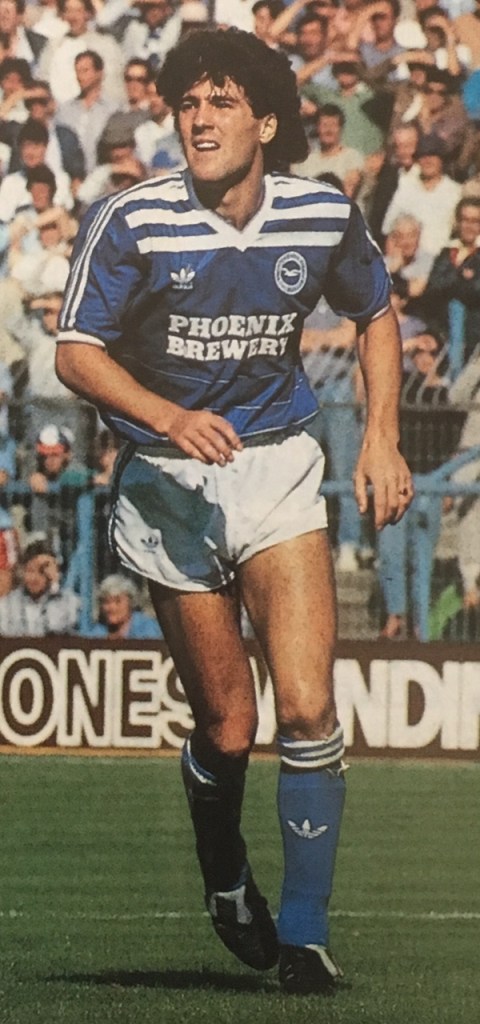
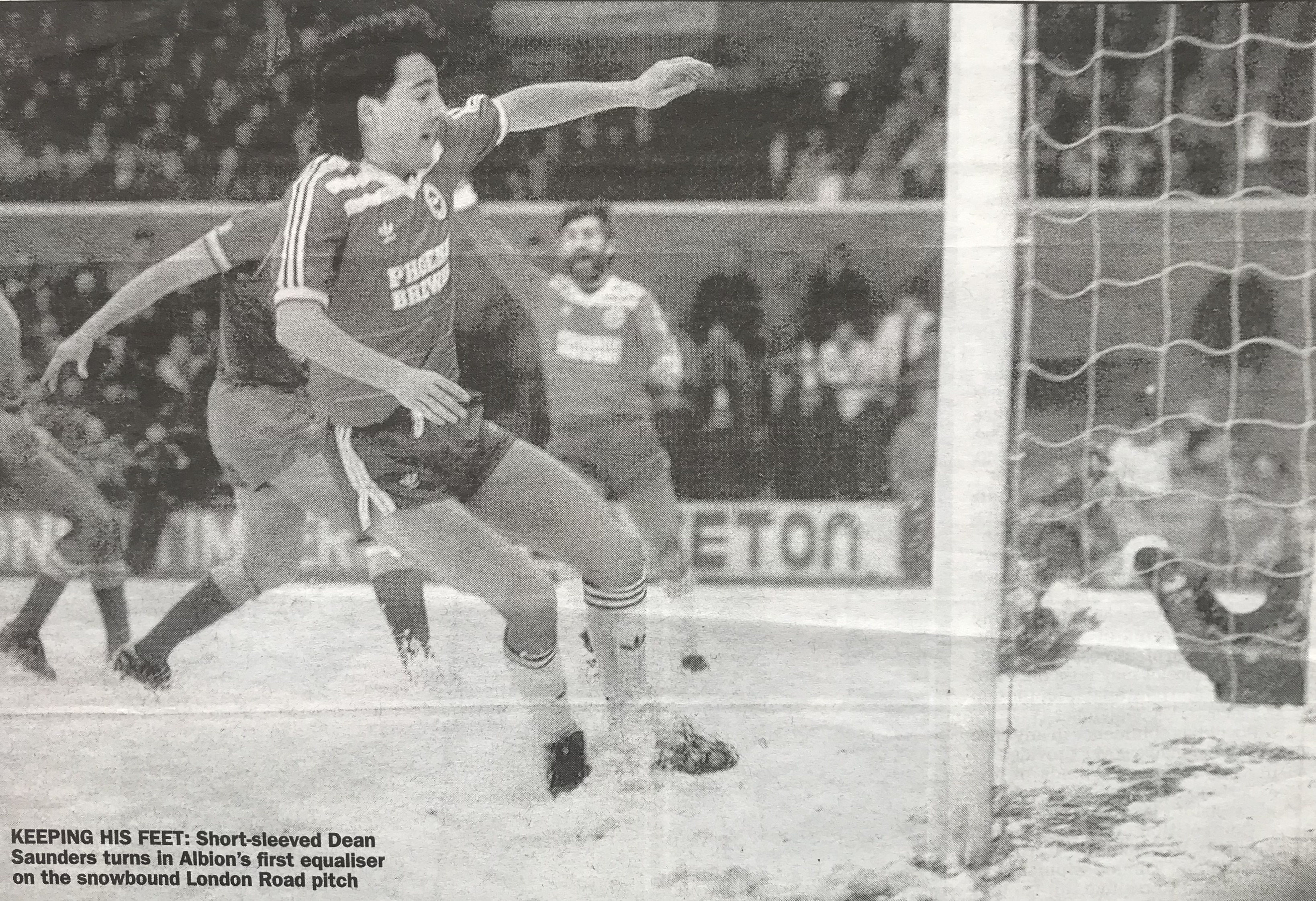
Dean Saunders raised cash for Brighton and Liverpool

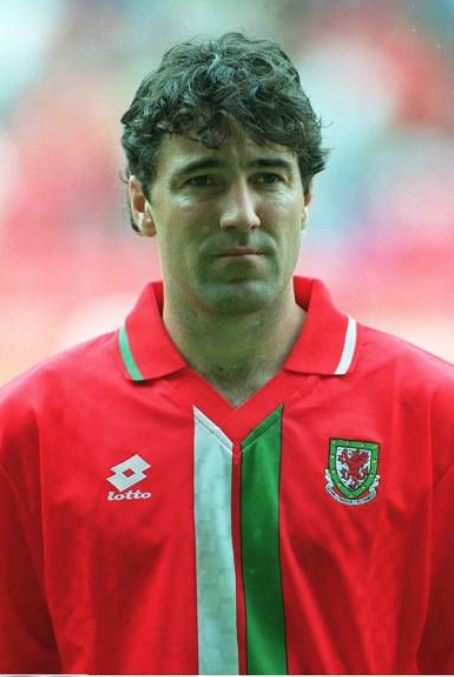
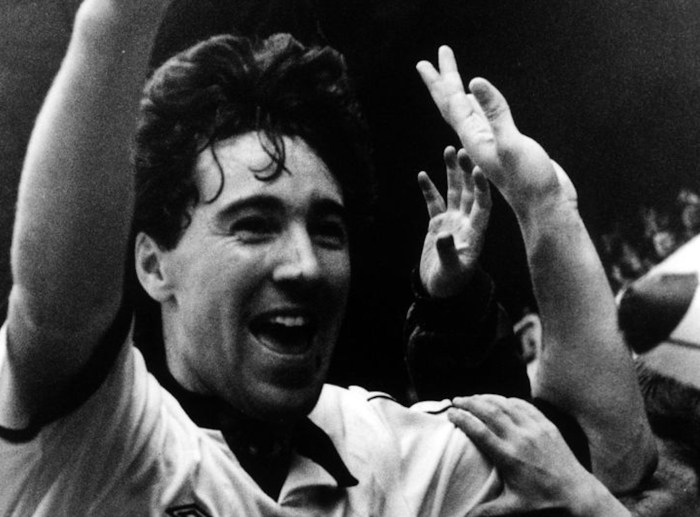
IT’S NOT often Brighton and Liverpool have had something in common but, when it came to striker Dean Saunders, they both sold him to raise money. And they weren’t alone.

In the Albion’s case, it happened in 1987 when manager Barry Lloyd was forced to cash in on the free transfer signing to raise £60,000 to go towards players’ wages.

For their part, five years later, Liverpool let the Welsh international depart Anfield for £2.3m because boss Graeme Souness wanted the money to buy a central defender.

When Saunders was remarkably transferred for £1m from the Maxwell-owned Oxford United to the Maxwell-owned Derby County, it prompted former Brighton and Liverpool defender Mark Lawrenson to quit as boss at the Manor Ground after he’d been promised there would be no transfers likely to weaken his squad.

Saunders’ long and much-travelled career began in Swansea, the place where he was born on 21 June 1964, the son of former Swansea and Liverpool wing-half Roy Saunders.

He attended GwrossydJunior School and was soon appearing in the school football team on Saturday mornings and playing minor football in the afternoons. He went on to Penlan Comprehensive in Swansea and his career began to blossom, playing in the school team at all levels under sports master Lee Jones, a former British gymanstics champion. Saunders played for the Swansea Schools representative sides at under 11, 13 and 15 levels.

“I can remember enjoying watching the Swansea players train when I was a lad,” he told Tony Norman in an Albion matchday programme article. “I was lucky because my dad was the assistant manager, so I could go to pre-season training and things like that.

“I used to kick a ball around on the sidelines and dream of playing for Swansea.” That dream turned to reality after he joined the Swans in 1980 as an apprentice (when John Toshack was the manager), turned professional in 1982, and made his debut in the 1983-84 season. He scored 12 times in 49 appearances but in his final year had a goalless four-game loan at Cardiff City.

Manager John Bond released him on a free transfer after a turbulent season in which the Swans only narrowly avoided relegation to the basement division and Chris Cattlin, who’d been impressed when he saw Saunders playing for Swansea Reserves at the Goldstone Ground, snapped him up for Brighton.

“I was amazed when the Welsh club let him go for financial reasons,” Cattlin wrote in his matchday programme notes for the opening game of the season. “He is young, quick and, if he works hard, he has a great chance.”

By the end of that season, Saunders had scored 19 goals in 48 league and cup games and was voted player of the season. His performances in the second tier for the Albion caught the eye of the Welsh national team manager, Mike England, and on 26 March 1986 Saunders made his full international debut for Wales as a substitute in a 1-0 win away to the Republic of Ireland. It was the first of 75 caps.

Saunders scored his first international goals when he netted twice in a 3-0 friendly win over Canada in Vancouver on 19 May 1986, after which England said: “He goes past defenders with his tremendous pace and his finishing against Canada was a revelation.

“The experience he gained at Brighton has done him the world of good. To finish top scorer in his first full season of Second Division football tells its own story.”

Saunders, who shared a house with Albion’s young Republic of Ireland international Kieran O’Regan, said being happy at home had helped him to settle down quickly.

“I liked Brighton from the day I arrived,” he said in a matchday programme article. “It reminds me of my home town of Swansea and I like living by the sea.”

A lover of all sports, Saunders revealed how he liked to play cricket in the summer, when he turned out for Haywards Heath, and he played snooker with O’Regan and Steve Penney.

That summer, Saunders told Shoot! magazine: “I had both cartilages out of my left knee at 18 and had both Swansea and Cardiff turn me down. I’ve had my share of the downs. From the moment I joined Brighton, my career has turned for the better.”

The young striker continued: “Swansea just gave me away – despite the fact that I was top scorer in a team coming apart. Cardiff City gave me a few games but always seemed to have reasons for not playing me consistently when I was on loan there.

“So, I had every incentive to make the break from Welsh football and I joined Brighton. Brighton can go places.

“I was disappointed that we didn’t make the First Division first time around. But all the lads are convinced that we will get there next season. I’ve been given a three-year contract so there are tremendous incentives to do better.”

It didn’t work out that way, though. After only a mid-table finish, Cattlin was sacked and there were rumblings of financial issues beginning to reverberate around the corridors of the Goldstone. Alan Mullery returned as manager but had limited funds to invest in the team, and, with echoes of the Pat Saward era back in the early ‘70s, the club turned to fans for financial help to bring in players.

After Mullery’s unseemly swift departure halfway through the season, former Worthing boss Lloyd took over and fans were completely mystified as to how he could leave out Saunders in favour of Richard Tiltman, who Lloyd had plucked from local football. Since then, it has been suggested his omission was more to do with money than football ability.

There was great consternation that Albion collected only £60,000 when Lloyd sold Saunders to Oxford in early March 1987, especially as the Seagulls were fast hurtling back to a level of football they’d manage to avoid for ten years.

That was no longer a concern for Saunders who recovered the goalscoring touch he’d shown during his first season at the Goldstone Ground, scoring 33 goals in 73 games for Oxford before being sold to Derby for £1m against Lawrenson’s wishes 19 months after arriving at the Manor Ground.

Meanwhile, the goals kept flowing for Saunders as he netted 57 in 131 games for Derby. The side finished fifth in the old First Division by the end of Saunders’ first season with the Rams, and he’d contributed 14 goals. The Derby Telegraph noted: “From the moment ‘Deano’ arrived, the players were inspired and the crowd enthused. The signing also suited the post-war tradition of 5ft 8in goalscoring heroes at the Baseball Ground – Raich Carter, Bill Curry, Kevin Hector and Bobby Davison.

“Derby fans were too wise to comment on height. What mattered was Saunders’ speed, eel-like turn and persistence. He scored six in his first five games, starting with two against Wimbledon when he captured supporters’ hearts with the immediacy of a Kevin Hector. A close-in header and long-range right-footer were beautiful appetisers.”

Despite Saunders scoring 24 goals for Derby in 1990-91, the side was relegated and Saunders and teammate Mark Wright were snapped up by Liverpool. Reds paid £2.9m to take Saunders to Anfield, boss Souness believing he’d be an ideal strike partner for their established Welsh international striker, Ian Rush.

Saunders made his Liverpool debut on 17 August 1991 in a 2-1 win over Oldham Athletic (Mark Walters and defender Wright also played their first league games for Liverpool); Ray Houghton and John Barnes scored Liverpool’s goals.

Saunders scored his first goal for the Reds 10 days’ later in a 1-0 win over QPR at Anfield but a Liverpool history website reckons he struggled to adapt to Liverpool’s passing game. “He was used to Derby’s counter-attacking style, scoring many of his goals by using his exceptional pace,” it said. “Saunders wasn’t very prolific in the league with about one goal every four games but flourished in the UEFA Cup with nine goals in five matches that included a quadruple against Kuusysi Lahti.”

Saunders scored twice in Liverpool’s successful FA Cup campaign, which culminated in them lifting the trophy at Wembley after beating Sunderland.

Although he scored twice in seven games at the start of his second season at Anfield, a cashflow issue meant Souness was forced to sell him to raise funds to dip into the transfer market.

Saunders explained: “Graeme called me in one day and told me he needed a centre-half [Torben Piechnik], and that he could raise the money by selling me to Aston Villa.

“I couldn’t believe he was prepared to let me go, but he said he didn’t think my partnership with Ian Rush had worked out, and Rushy wouldn’t be the one going anywhere. That was it.” 

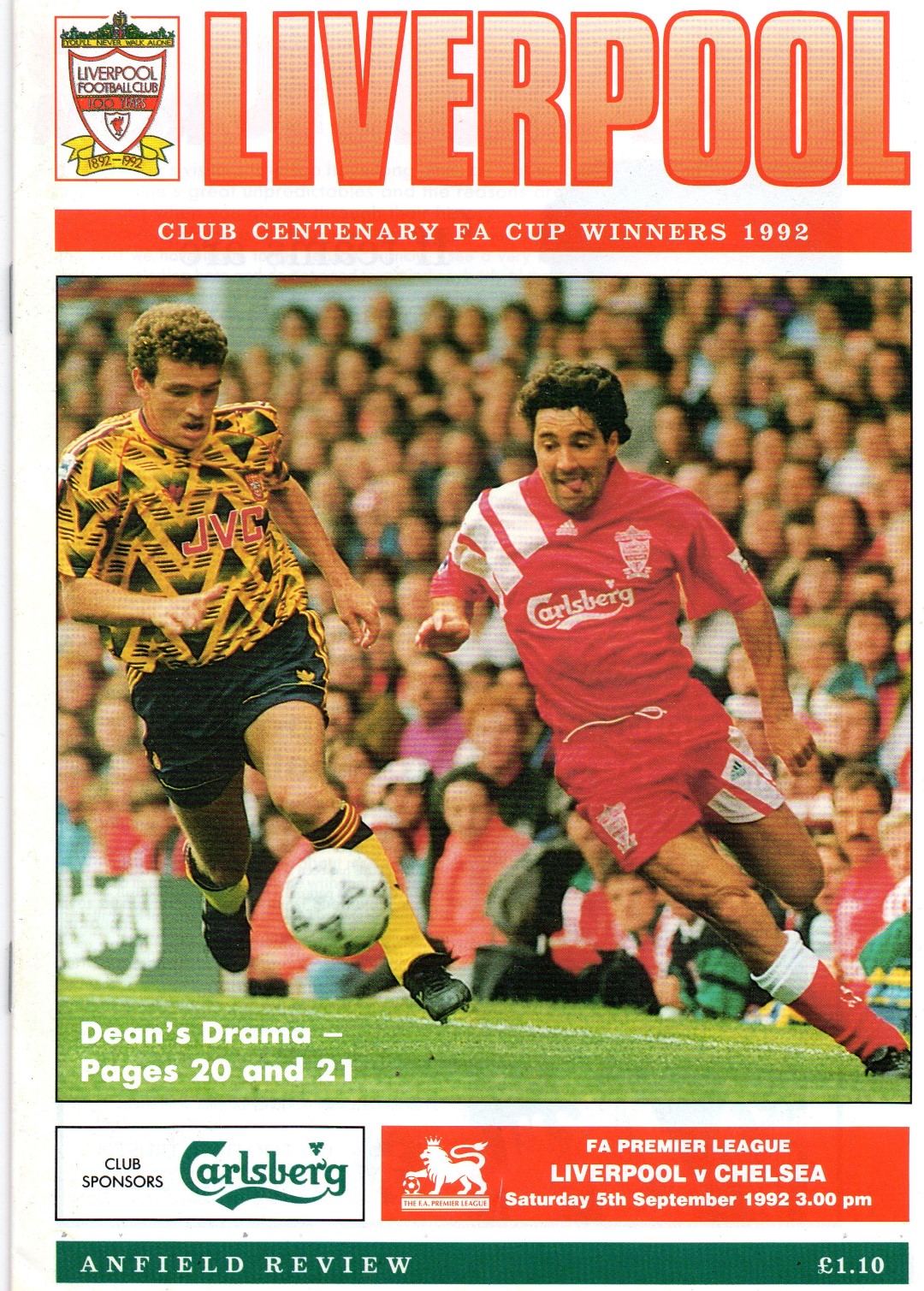
Saunders had scored 25 goals in 61 appearances for Liverpool, the last coming in a 2-1 home win over Chelsea (Jamie Redknapp scoring the other Liverpool goal) on 5 September 1992.

The Welshman had the last laugh, though, because only nine days after his departure from Liverpool he scored twice in Villa’s 4-2 victory over the Reds.

“Obviously I had a big incentive to do well today and I’m thrilled to have scored,” said Saunders. “Both my goals went through the goalkeeper’s legs.”

Signed by Ron Atkinson, Saunders spent three seasons at Villa, initially developing a formidable strike partnership with Dalian Atkinson, and then pairing up with Dwight Yorke. Saunders’ brace in the 1994 League Cup final helped beat Manchester United 3-1.

Villa history site lerwill-life.org.uk remembers him as “a spring-heeled attacker and very popular with the supporters” and adds: “Not big in size, he was very speedy and scored some spectacular goals including a 35-yard spectacular against Ipswich.”

His time at Villa Park came to an end when Brian Little took over as manager, and Saunders was reunited with his old Liverpool boss Souness in Turkey. A £2.35million fee took him to Galatasaray for the 1995-96 season and he netted 15 goals in 27 Turkish League matches.

Next stop for Saunders was back in the UK at Nottingham Forest, but the 1996-97 was an unhappy one as the manager who signed him, Frank Clark, was sacked in December after a bad run of defeats and Forest’s slide towards relegation continued under Stuart Pearce and Dave Bassett.

By the time Forest had bounced straight back up, Saunders had left the club, moving in December 1997 to second-tier Sheffield United for a year under Nigel Spackman and caretaker managers Russell Slade and Steve Thompson. United made the play-offs but lost out to Sunderland in the semi-finals. In December 1998, Saunders moved abroad again to link up with Souness a third time, at Benfica in Portugal.

The following summer, he returned to England and joined Bradford City, where his former Brighton teammate Chris Hutchings was assistant manager, then briefly manager. Saunders was a regular in his first season at Valley Parade, when the Bantams managed to narrowly avoid relegation from the Premier League, but he played only a handful of games in 2000-01, when they were relegated. Saunders retired as a player shortly before his 37th birthday and became a coach at Bradford before linking up with Souness again, this time as a coach.

He joined him at Blackburn Rovers and then Newcastle United, but when Newcastle sacked Souness early in 2006, Saunders lost his job as well.

In the following year he began taking the Certificate in Football Management course run by the University of Warwick; and this led to him being granted his UEFA Pro Licence coaching badge, a qualification that allowed him to be appointed as assistant to John Toshack with the Welsh national team. 

In October 2008, Saunders replaced Brian Little as manager of Wrexham, newly relegated to the Conference. He eventually managed to steer the north Wales outfit into the play-offs in the 2010-11 season, but they were knocked out by Luton Town and, in September 2011, Saunders was appointed manager of then Championship club Doncaster Rovers.

Unfortunately, he couldn’t save Rovers from relegation and they went back down to League One with only 36 points from their 46 League fixtures.

Having guided Rovers to second place in League One, Saunders was appointed manager of Wolverhampton Wanderers in January 2013, but he couldn’t prevent them being relegated from the Championship and he was sacked three days after relegation was confirmed courtesy of a 2-0 defeat at the hands of Gus Poyet’s Albion.

Saunders told the media after the game: “We have to get some players in who think like I’m thinking, who want to win, fresh minds, no damage done to them, no confidence issues, no ‘been here too long’ issues, no ‘I don’t know if the manager likes me’ issues. Once I get my own team on the pitch, imagine what the supporters will be like.”

Saunders, with only five wins from his 20 games in charge, didn’t get that chance and rather ruefully said of his opponents that day: “A few years ago they were bankrupt and without a stadium, but they’ve shown what is possible and, with the momentum, they have could well get into the Premier League.”

Just after Christmas 2014, Saunders was named as the interim manager of Crawley Town after the previous incumbent John Gregory stood down for health reasons.

Saunders then became manager of League One side Chesterfield on 13 May 2015 but his stay there lasted only five months.

In June 2016, Saunders was part of the BBC pundit team for their coverage of the Welsh national team’s games at Euro 2016 and made the headlines during the tournament when it was revealed that he had incurred parking charges of over £1,000 from Birmingham Airport’s short stay car park as he wasn’t expecting Wales to progress as far as they did. The charge was eventually waived by the airport who asked him to make a donation to charity instead.

His subsequent involvement in football has been as a pundit on BT Sport’s Saturday afternoon Score programme as well as on the radio with talkSPORT. He hit the headlines in 2019 when he was jailed for failing to comply with a roadside breath test but the initial punishment was quashed and changed to a suspended sentence. Via the League Managers’ Association, Saunders issued a statement in which he said: “I made a terrible error of judgment for which I have been rightly punished, and I wholeheartedly regret that it happened.”

Pictures from the Albion matchday programme and various online sources.

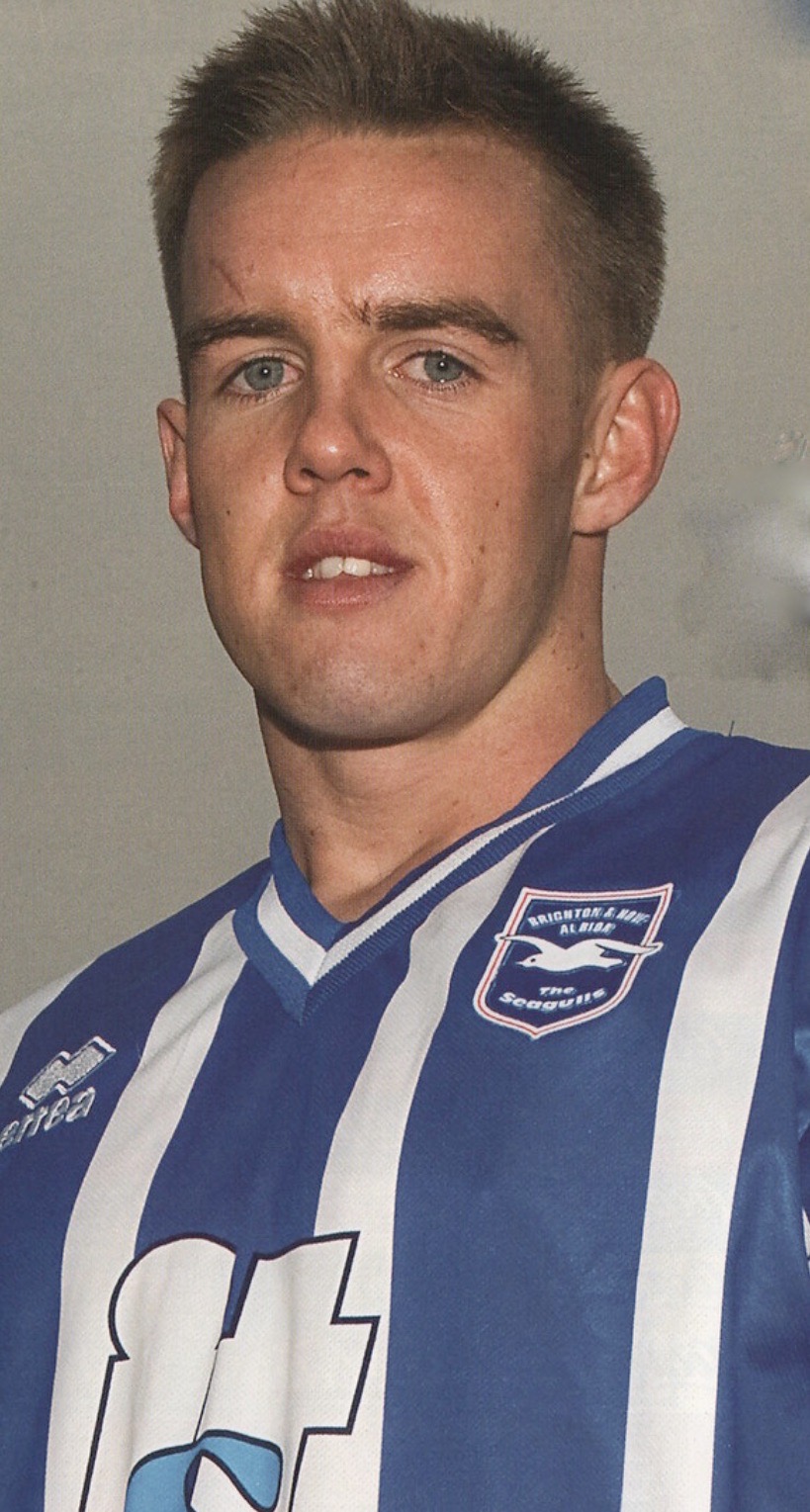
Injury-plagued Alan Navarro’s loyalties taken as Red

Nav v Suarez

A FORMER midfield partner of Steven Gerrard scored a memorable winner for the Seagulls at Elland Road, but it was a rare highlight in a promising career dogged by injuries.

Alan Navarro trained alongside Gerrard and played with him for Liverpool Reserves. While one went on to become a Liverpool legend and captain his country, the other had to forge a career mainly in the lower leagues.

Navarro talked to the Liverpool Echo about his former illustrious teammate when he prepared to return to Anfield with Brighton a decade after leaving the Merseyside giants.

“I came through as a full-back but then they decided to try me in midfield and I played with Steven a few times,” said Navarro. “It was a good thing but also a bad thing because you knew that you were going to be competing for a place with Steven.

“I trained with him every day for a few seasons….he was always head and shoulders above everyone else. His football, his brain, his pace, his strength, the way he tackles, everything about him was brilliant. He was the player you wanted to be.”

Navarro was talking in a preview to the FA Cup 5th round tie which saw Liverpool steamroller the Seagulls 6-1, courtesy of three own goals (two for Liam Bridcutt, one for Lewis Dunk).

Apart from the disastrous result, Navarro also picked up a booking on his return to Anfield. It was the second time the Liverpudlian had played against the side who nurtured him: he was also in the Albion side who lost 2-1 to the Reds in a League Cup game at the Amex in September 2011.

Nav stripesThe Scouser joined the Seagulls on a free transfer from MK Dons in the summer of 2009, and manager Russell Slade told the Argus: “Alan likes to get on the ball. He is the passer, the one that links you up and tries to make you play. He’s impressed us.”

After picking up an injury early on, he found it difficult to get back in the side until Gus Poyet arrived, and, with his ability to pick a pass for teammates to benefit from, slotted in well.

A cruciate ligament injury in his right knee, suffered in a League Cup game against Northampton Town at the beginning of the 2010-11 season, ruled him out for the season.

Having previously suffered a similar injury in his other knee eight years earlier, he knew what to expect, which he described to Andy Naylor in the Argus.

He later recalled how he feared it might have been the end of his career, but, after proving his fitness to Poyet, he went on to play 39 games for the Albion in the 2011-12 season – finally getting the chance to perform at a level he always felt he was capable of.

Navarro had previously had to contend with life in the bottom two tiers, but he enjoyed a new lease of life playing in the Championship, as he talked about in the Argus.

He played a total of 85 games for the Albion between 2009 and 2012 and only ever scored one goal. But what a memorable one!

Nav Leeds celeb

It came in the 90th minute of a Championship game at Elland Road on 11 February 2012, when his final touch after good work from Liam Bridcutt proved to be the winner as the Seagulls prevailed 2-1.

Craig Mackail-Smith (pictured above celebrating with Navarro and Craig Noone) had opened the scoring for the Seagulls but Luciano Becchio equalised and, just as it appeared the game would finish in a draw, up popped unlikely scorer Navarro.

Born in Liverpool on 31 May 1981, Navarro’s home was in Venmore Street, close to Anfield. “Funnily enough I was a Blue when I was younger,” he told the Albion matchday programme. “My family were Evertonians and a couple of cousins really drilled the club into me from an early age. But when I was 10 or 11, we moved to a house right next to Anfield and I fell in love with Liverpool.

“I loved watching John Barnes, Ronnie Whelan and then Robbie Fowler, even though he was not that much older than me. My mum still lives there, six doors away from The Kop.”

He joined the Reds in 1996, signed professional in 2000, and was a regular in the Reserves. He also had occasional travels with the first team, for example to Russia, Porto and Rome, as well as Chelsea, Newcastle and Sunderland for league games.

“It was strange going from fan to playing for the club, but an unbelievable experience,” he said. “From growing up on the club’s doorstep, I was in the youth team, then playing for the reserves and travelling with the first team to some big games.”

player_navarroIn the 1999-2000 season, Liverpool Reserves won the Premier Reserve League title with Navarro and Layton Maxwell pulling the strings in midfield.

Navarro only made it onto the first team substitutes’ bench twice but got his first taste of competitive action on loan at League One Crewe Alexandra.

He also went on loan to nearby Tranmere Rovers, whose manager, Dave Watson, told the Liverpool Echo: “Alan is a good quality player who has been in Liverpool’s reserves for a while now.

“I have seen him play several times and so have my assistant, Ray Mathias, and our chief scout, Dave Philpotts. (Anfield coach) Sammy Lee speaks very highly of the lad’s work at Liverpool and he’s certainly worth a look.”

After impressing on loan, Navarro made a permanent switch to Rovers in January 2002, signing a three-and-a-half-year contract. “It was difficult to leave because I love the club and a big part of my heart will always be there, but I needed to get my career up and running. I cherish my time there; I was taught the game by the best.”

Things didn’t go according to plan at Tranmere where he suffered a cruciate knee ligament injury and he went out on loan to Chester City and Macclesfield Town.

Navarro moved on from Tranmere in the summer of 2005, initially linking up with Conference National side Accrington Stanley for a month before Macclesfield boss Brian Horton secured his services on a permanent basis. Horton told the club website: “I’m delighted Alan has joined the team. I think he’s going to fit in extremely well.

“We had him here last season and couldn’t quite come to an agreement with Tranmere to sign him, so he went back there and we missed him badly.

“It was no coincidence that his departure came at the time when our form dipped so we’ve been keeping an eye on him for a long time and we’re delighted to have him.”

After his experience at Tranmere made him contemplate quitting the game altogether, it was Horton’s successor at Macclesfield, former Liverpool midfielder Paul Ince, who helped to reignite his passion for football.

“When he came to Macclesfield, he got me wanting to play football again,” he told the matchday programme. “He gave me the spark that helped me fall back in love with the game, and he took me from Macclesfield to MK Dons, where we had a lot of success.

“He remembered me from Liverpool, while his assistant Ray Mathias had me at Tranmere and knew me really well. It just clicked. I knew what Paul wanted from me and vice-versa.”

In August 2007, Navarro followed Ince to MK Dons, where he made 89 appearances over two seasons.

After his three years with the Seagulls, and following a season in which he played 33 matches, it was a little surprising that he was released in the summer of 2012, although supporter Alan Wares told thewashbag.com: “He will be remembered as a player who never gave less than 100 per cent every time he pulled on the shirt.

“It’s a shame to see such a quality player leave, but it shows how far Brighton have come as a club that Gus Poyet feels he can afford to release him.”

How ironic that his debut for new club Swindon should come in the League Cup against Brighton in August 2012 – Navarro scored twice and made the other in a 3-0 win!

However, that was pretty much as good as it got in his spell with the Robins. His Town career comprised only 15 starts plus five as a substitute, and a subsequent knee injury brought his career to an end.

Skilful Joao Teixeira scored six as Seagulls escaped the drop

THERE were few positive aspects to Sami Hyypia’s reign as Brighton manager but his Liverpool connections served the club sufficiently well enough to enable them to secure the loan signing of Joao Teixeira.

Here was a highly talented young player who often had supporters on the edge of their seats when he was on the ball.

It seems remarkable to think his six goals in 35 games (28 starts + seven as sub) for the Seagulls made him second top scorer behind Lewis Dunk’s seven in the 2014-15 season, when Albion narrowly avoided dropping out of the Championship.

Joao THis performances earned him the Young Player of the Year accolade even though his season was cut short by injury.

Having impressed as a substitute going on for Albion against Birmingham, Teixeira was on the scoresheet in his first full start, in a 2-0 win away to Leeds United. Hyypiä told Sky Sports: “Of course I am grateful to them for letting Joao come to us and get the games he needs, but it works both ways. They can benefit too because his time with us can hopefully be a stepping stone towards Liverpool’s first team.

“He is a young player and Liverpool have a very big squad. A player of his age needs to play games to improve. We have a quality player and I am very happy to have him with us.”

JT BHAFCThe Portuguese youngster scored again four days later, netting the winner as Albion came from behind to beat Bolton Wanderers 2-1 at the Amex.

Sadly, with the Seagulls floundering under the puzzling direction of the former Liverpool central defender, Teixeira didn’t get back on the scoresheet until after Chris Hughton arrived on New Year’s Eve 2014.

He twice scored braces (in a 3-2 home win over Ipswich on 21 January and a 4-3 home win over Birmingham on 21 February) but a leg break in a home game against Huddersfield Town on 14 April brought his season, and Albion career, to a premature end.

Born in Braga, Portugal, on 18 January 1993, he first caught the eye with his hometown club, before being snapped up by Sporting Lisbon where he continued to make progress through its youth teams.

Liverpool paid £830,000 in the January 2012 transfer window to take him to Anfield and he impressed playing for their under 21 side which led to him making a loan move to League One Brentford in August 2013. But what was originally due to be a six-month arrangement was cut short in October after only two substitute appearances because the Bees couldn’t guarantee him the game time Liverpool had been expecting him to get.

Back on Merseyside, he made it into the first team squad and on 12 February 2014 Brendan Rodgers sent him on as a substitute for Raheem Sterling in a 3-2 win at Fulham.

getty liv TeixCaptain Steven Gerrard told the Liverpool FC website: “I watched this kid a couple of years ago playing for Sporting Lisbon against Liverpool at Anfield in a youth game; I could see straight away he was the best player on the pitch.

“Credit to him, he has kept working hard. He has been invited to train with the first team. He is competing, he is trying to improve and learn. He listens – I’ve just been speaking to him in the dressing room and you can see he wants to learn and listen.

“He has got respect for the other players in the dressing room. This is the start for him now; I’ve just told him that he needs to push on, keep learning and building on what he has just achieved. He deserved his debut and he made a special tackle which helped us get over the line.”

As it turned out, his next senior action came at Brighton and he had to wait until October 2015 before his next chance at Liverpool. That came in a League Cup game in a 1-0 win over Bournemouth. He went on to make five cup appearances for Jurgen Klopp’s Reds in 2015-16, and scored his only goal for the club in a 3-0 FA Cup win over Exeter City. But he appeared only once in the Premier League.

Although Liverpool offered him a new contract, he chose to return to Portugal and join Porto. After making only eight appearances during the 2016-17 season, Teixeira joined hometown club Braga on a season-long loan, and this season is playing for Primeira Liga side Vitoria Guimaraes.

Gerry Ryan – ‘a special player and one of football’s nice people’

THERE WAS no shortage of tributes paid to Gerry Ryan when the former Albion winger died at the age of 68 on 15 October 2023.

Fellow Irish international Liam Brady, who appointed Ryan as his assistant when he took charge of the Seagulls in 1996, said: “Gerry was a wonderful team-mate. He was a very quick winger, very brave, and he took people on.

“We had some great games together and then we ended up on opposite sides, for Brighton and Arsenal, in the old First Division.”

Although Ryan and Brady’s time in charge happened during a turbulent time off the pitch, Brady pointed out: “We did a pretty good job in what were, of course, difficult circumstances, and I could see then just what Brighton meant to him – he was in love with the club so much.

“Off the pitch, Gerry was just a really nice guy. He was affable, unassuming and got on with everyone he came in contact with.”

That sentiment was echoed by teammate Gordon Smith who told the Albion website: “Gerry was always fired up to play.

“He was not always first choice, but he was still a very good player. He had this ability to be able to turn games around because he was quick and he could score goals.

“He was so reliable – he could fit into any position with his levels of fitness, ability and positional play.

“We were a very close group; we socialised a lot, we played golf, went to the races and Gerry was a key part of that – he was a really good laugh.”

Turlough O’Connor, another former team-mate, from his early days playing for Bohemians in Dublin, told the Irish Independent: “He was the most easygoing guy you’d ever meet, very laidback and always in a happy mood, and a very good footballer as well.

“He was comfortable both left and right, very good on the ball, and very quick, which helped. A very good crosser, he went by people, and was always a threat. He helped so many times laying on goals for me.”

Ryan was one of the most likeable Albion players for a huge number of fans, and I was one of them.

A versatile trier who was good enough to represent the Republic of Ireland on 18 occasions, the wholehearted Ryan might not make it into the all-time best Brighton XI but, if it was judged on affability, his name would be first on the team sheet.

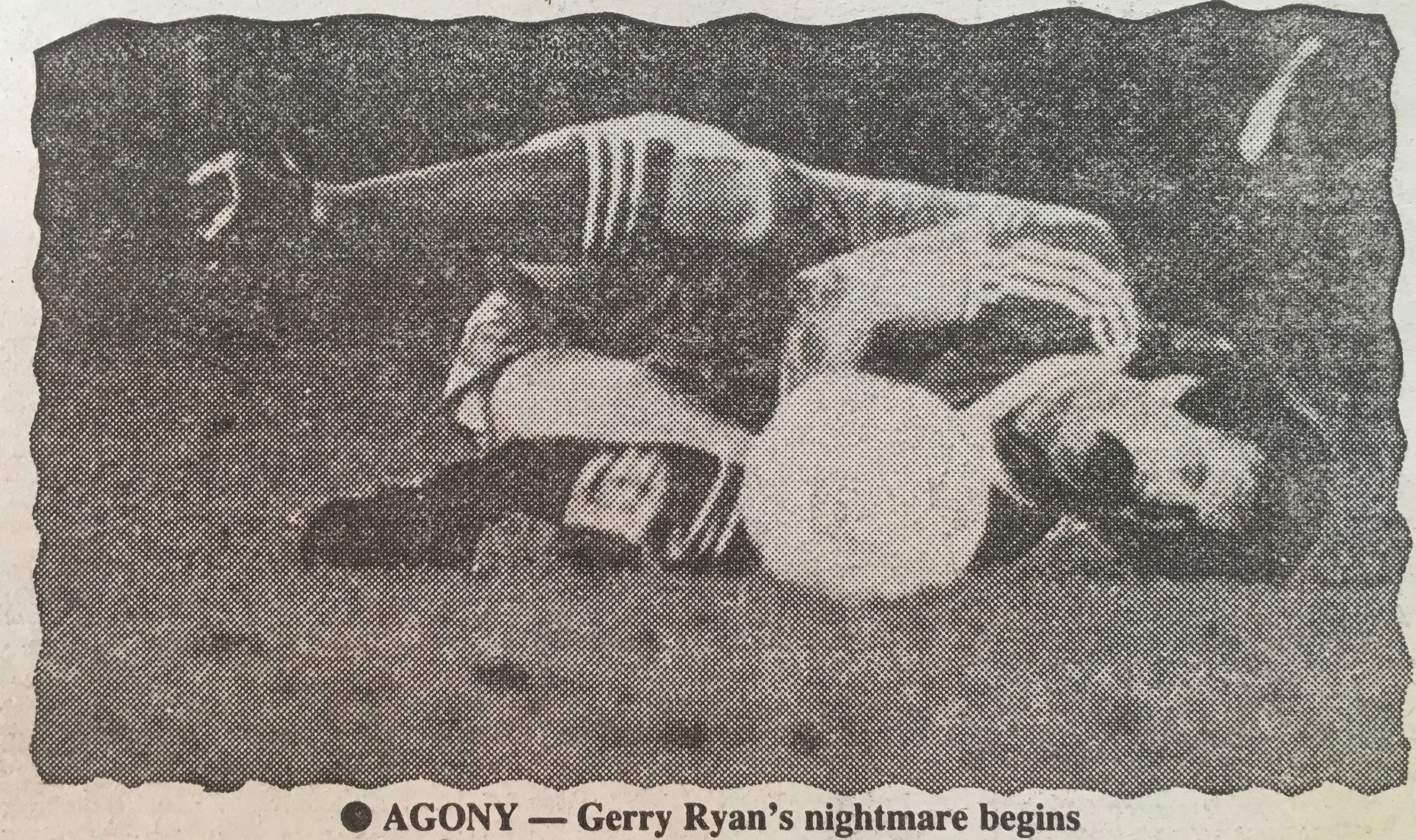
A cruel twist of fate saw his career ended in a tackle made by his Irish teammate (and former Albion boss) Chris Hughton’s brother, Henry. Typically, Ryan bore no grudges, as stressed by former Argus Albion reporter John Vinicombe in an article published in May 1986 when the genial Irishman finally accepted that his career was over.

Describing “the immense dignity and true manliness that Ryan displayed in refusing to condemn or indeed utter any harsh word against the player responsible,” he added: “Where others have sued and raged, slandered, cursed and threatened, Ryan said nothing.”

GR leg break

It was 2 April 1985 when his career was ended by that Hughton tackle in a 1-1 draw with Crystal Palace at Selhurst Park.

“Never in his life has he shirked a tackle and the one that ended his career so unfortunately at Crystal Palace was typical of many he faced in his career,” said Alan Mullery, the manager who signed him for the Seagulls.

“As a person, he is a lovely and typical Irish personality,” Mullery said in the programme for the player’s testimonial game against Spurs at the Goldstone on 8 August 1986. “I can honestly say that I have never met a player who dislikes him or has a bad word to say about him. I will remember Gerry Ryan as being a special player and one of football’s nice people.”

Mullery also referred to a Sunday lunch he and his family had with Ryan and his wife at the time he signed. “When Gerry ordered roast beef and chips I must have known then that I had a very special sort of player. At the time, I was a little dubious but afterwards I had no regrets.”

Mullery had been over in Dublin watching Albion’s Mark Lawrenson playing for the Republic of Ireland and Derby’s Ryan was playing in the same side. He had been having talks about moving to Stoke City but Mullers persuaded him to join Brighton instead, and, in a strange quirk of fate, he made his debut in a 2-2 draw away to Stoke.

After they’d become teammates, Lawrenson was among those players appreciative of Ryan’s “mercurial” qualities. He said in a matchday programme: “He wasn’t the most confident of players but he had loads of ability. For a wide player, he would come in and get goals for you.”

GR capsA week after joining the Seagulls, Ryan became an instant hit with Albion fans when he scored on his home debut in a 5-1 win over Preston. He notched a total of nine goals in 34 appearances in that first season and went on to score 39 in a total of 199 games.

Born in Dublin on 4 October 1955, Ryan was one of eight children. His early education was at the local convent in Walkinstown, a suburb to the south of Dublin where the family lived. At the age of eight he moved on to Drimnagh Castle School (it covered primary and secondary age groups).

At that stage, he was playing Gaelic football and hurling, at which he was capped at under-15 level by Dublin Schools. He didn’t play competitive football until he was 16 when he was introduced to a Dublin football club called Rangers AFC. He played alongside Kevin Moran, who later played for Manchester United, and Pat Byrne, who later played for Leicester City. Byrne and Ryan also played together for Bohemians, the oldest football club in Dublin.

Ryan joined the Dublin Corporation as a clerical officer on leaving school and played for Bohs as an amateur initially before becoming a part-timer on professional terms. By 18, Ryan was a first-team regular and, after collecting a League of Ireland Championship medal, was watched by Manchester United boss Tommy Docherty.

Docherty didn’t pounce then but, after Ryan had stayed four years with Bohemians, the ebullient Scot eventually returned to take him to England as his first signing for Derby County for a fee of £55,000.

The newly-appointed Docherty was determined to shake-up the club and while long-serving goalkeeper Colin Boulton was discarded along with striker Kevin Hector, Ryan, Scottish internationals Bruce Rioch and Don Masson, and Terry Curran and Steve Buckley were all introduced.

Ram Ryan

Ryan spoke about the way Docherty’s attitude towards him changed in an interview with Brian Owen of The Argus in 2016.

“One minute you were the blue-eyed boy, the next he wouldn’t even talk to you,” he said. Ryan made a hamstring injury worse by playing when Docherty insisted he was fit enough, and ended up sidelined for three months. “He didn’t like me then! That’s the way he was, he would turn on you, and he turned on me.”

Within a year, Docherty accepted Brighton’s £80,000 offer for Ryan and, as he was weighing up whether to choose the Seagulls or Stoke City, Ryan consulted the legendary Republic of Ireland and ex-Leeds midfielder Johnny Giles to ask his opinion.

“Gilesy said ‘Stoke have been in and out of the First Division forever but there is something going on down at Brighton. They get great crowds and it’s a beautiful place.’ I went to Brighton that weekend and absolutely loved it,” Ryan told Owen.

It was on 25 September 1978 winger Ryan arrived, prompting the departure of popular local lad Tony Towner after eight years at the Albion.

Five months before Ryan arrived at the Goldstone, he made his international debut, featuring for the first time in April 1978 in a 4-2 win over Turkey at Lansdowne Road. He only scored once for the Republic, but it was a cracking overhead kick in a 3-1 defeat against West Germany.

Ryan Eire

He was one of four regular Eire internationals playing for Albion at the time: Lawrenson, Tony Grealish and Michael Robinson the others.

His final appearance for his country came in a 0-0 draw against Mexico at Dalymount Park in 1984.

Ryan was part of some all-time history-making moments during his time with the Albion – scoring at St James’s Park in the 3-1 win over Newcastle on 5 May 1979 to clinch promotion to the top division for the first time, and burying the only goal of the game as unfancied Albion beat Brian Clough’s European champions Nottingham Forest, who’d previously not lost at home for two and a half years.

Ryan scoresMy personal favourite came on 29 December 1979 at the Goldstone when he ran virtually the entire length of a boggy, bobbly pitch to score past Joe Corrigan in the goal at the South Stand end to top off a 4-1 win over Manchester City. Ryan himself reckoned it was “the best goal I ever scored” as he recounted in a May 2020 BBC Sussex Sport interview with Johnny Cantor.

It was one of the most superb individual goals I saw scored and, when he was trying to recuperate from the horrific leg break which ultimately ended his career, I wrote to him in hospital to say what a special memory it held for me.

I was delighted to receive a grateful reply from him, and he has held a special place in my Albion memory bank ever since.

There were other stand-out occasions, two of which came against Liverpool:

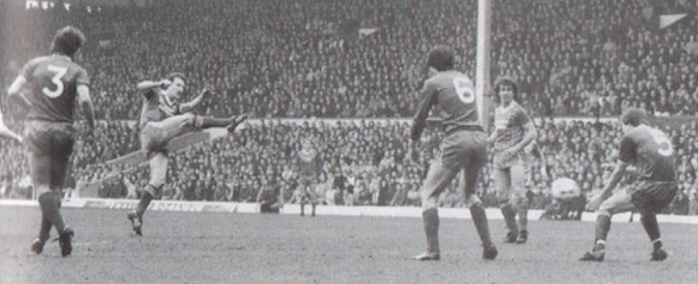
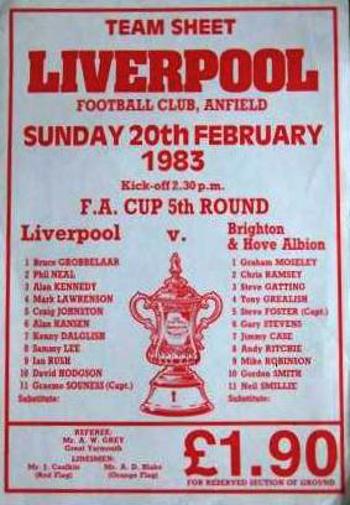
in February 1983 at Anfield when he opened the scoring in Albion’s memorable 2-1 FA Cup triumph en route to the final, and, in the following season, at the Goldstone when he and Terry Connor were on target in Second Division Albion’s 2-0 win over the Reds in the same competition, the first-ever live FA Cup match (other than finals) to be shown (previously any television coverage of FA Cup ties was only ever recorded highlights).

If the modern-day reader can’t quite put the feat in perspective, it is worth pointing out that Liverpool, managed by Joe Fagan, went on to win the League Cup, the League title and the European Cup that season.

Danny Wilson hadn’t long since joined the Albion and, in an interview with the Seagull matchday programme in 2003, he recalled: “That has to be my favourite memory from all my time at the Goldstone. Back then, Liverpool were just awesome, and to beat them like we did was virtually unheard of.”

Ryan’s involvement in the 1983 Cup run was hampered by a hamstring injury which meant he missed out on the semi-final. But, in the days of only one substitute, he was on the bench for the final and, when the injured Chris Ramsey couldn’t continue, Ryan went on at Wembley and did a typically thorough job at right-back.

GR prog snow

Following Albion’s relegation, as the big-name players departed the Goldstone, Ryan’s versatility and play-anywhere attitude came to the fore and, in his last two seasons with the club he was often selected as a centre-forward, although he was not a prolific goalscorer from that position.

After he was forced to quit playing, Ryan took what was then quite a familiar route for ex-players and became a pub licensee, running the Witch Inn at Lindfield, near Haywards Heath. Ryan and goalkeeper Graham Moseley, who he’d known from his days at Derby, were neighbours in Haywards Heath.

GR pots

However, when another of his former Republic of Ireland teammates, Liam Brady, was appointed Albion manager in 1994, it was an inspired choice for him to appoint Ryan as his assistant.

When that all-too-brief managerial spell came to a messy close, Ryan returned to his pub, and then moved back to the family home in Walkinstown. Ryan’s son Darragh played 11 games for the Albion in the late 1990s.

Sadly, in August 2007, Ryan suffered a stroke, and three years later he was diagnosed with kidney cancer. On his death, his family paid tribute to the care he was given by the staff of Our Lady’s Hospice, Harold’s Cross and to the staff of Lisheen Nursing Home, Dr Brenda Griffin, the Beacon Renal Unit, Tallaght, and Tallaght Hospital Renal Unit “for the excellent care given to Gerry over the past number of years”.

Pictures from a variety of sources but mainly from my scrapbook, the matchday programme and The Argus.

Liverpudlian Melia etched a never-to-be-forgotten place in Brighton’s history

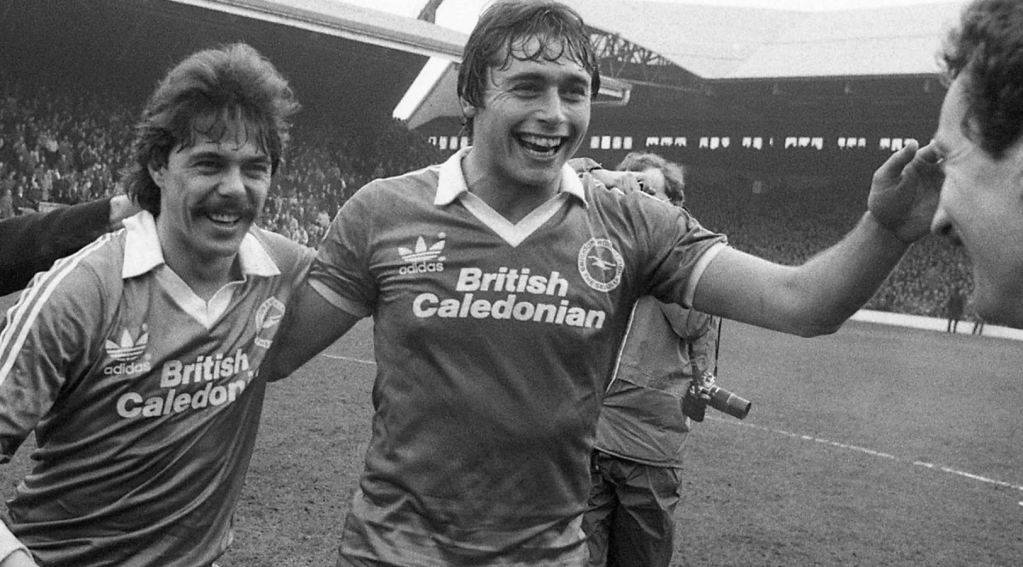
IT WAS the stuff of dreams when Liverpool born and bred Jimmy Melia saw his underdog Seagulls side beat the mighty Merseyside giants en route to Brighton’s one and only FA Cup Final appearance.

In fact, it wasn’t the first time Melia had taken a side to Anfield to play in the competition. On 2 January 1971, as player-manager of lowly Aldershot, he returned to the ground where he’d been an inside forward under Bill Shankly and gave them a scare in the third round, the Fourth Division side only losing 1-0.

Even Liverpool’s wideman, Steve Heighway, admitted: “I suppose we were lucky to win. It was a frosty day and the ball was playing quite a few tricks. I don’t think we were in any danger of losing. But Aldershot were playing well that day. They could have sneaked a draw.”

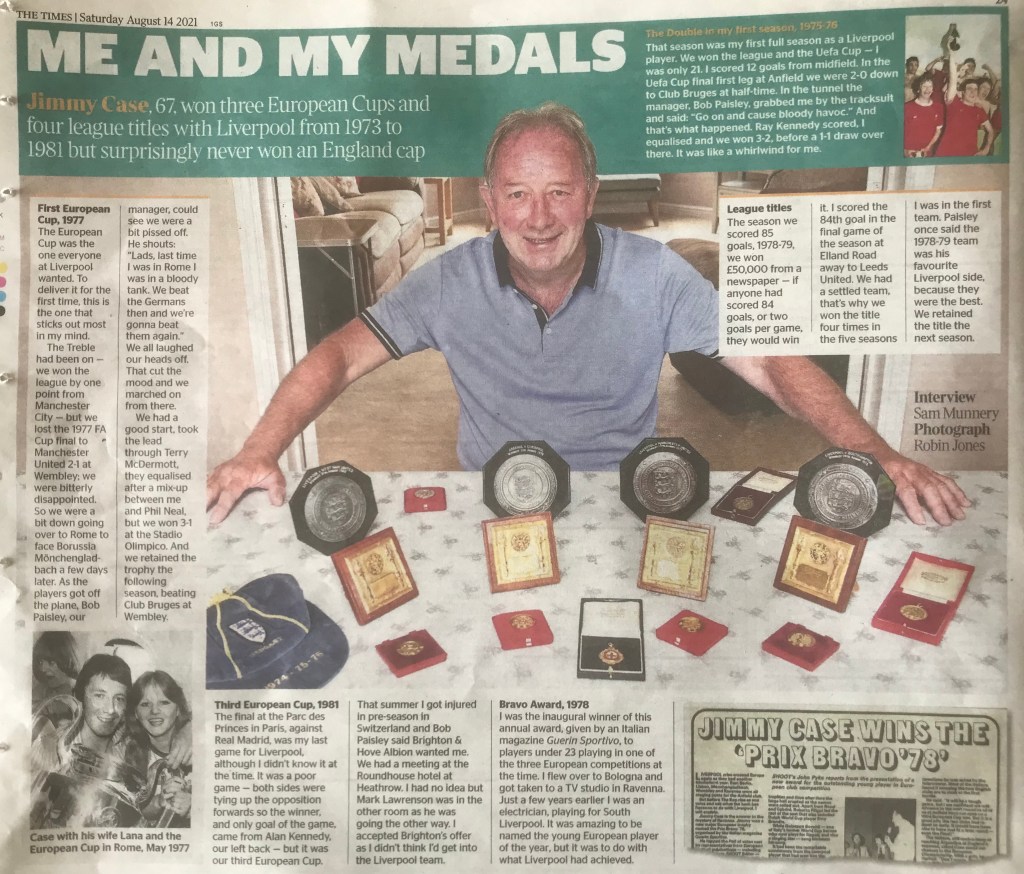
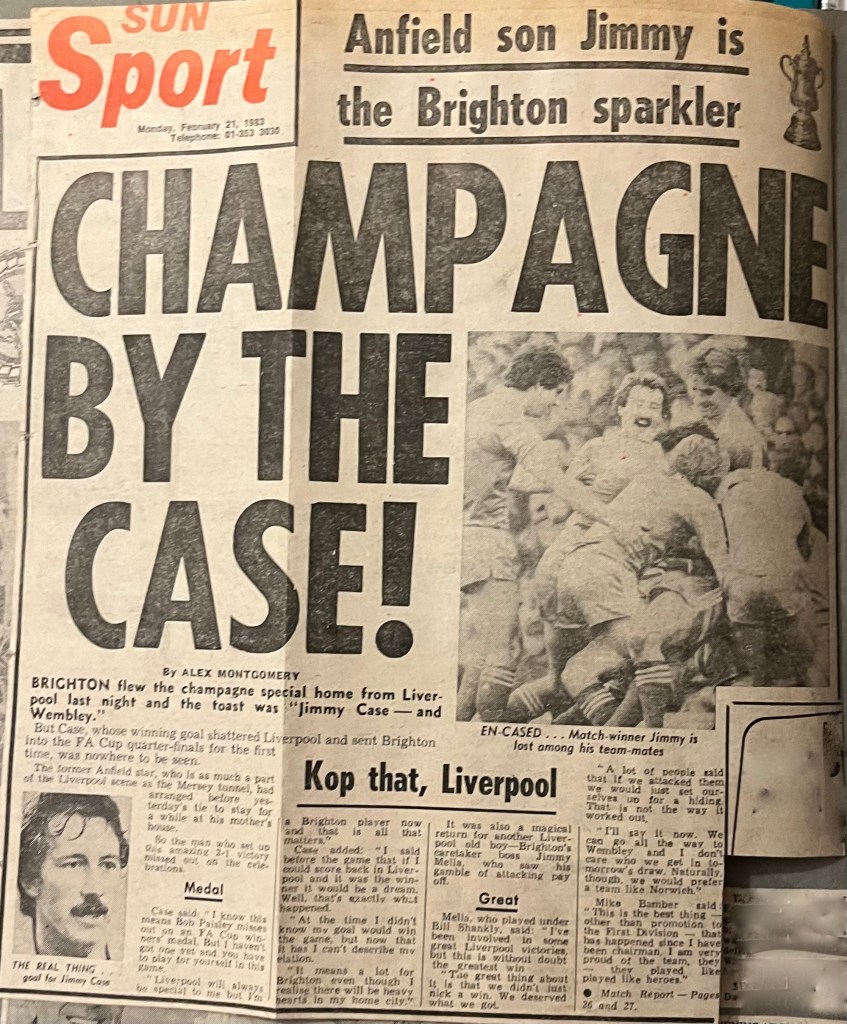
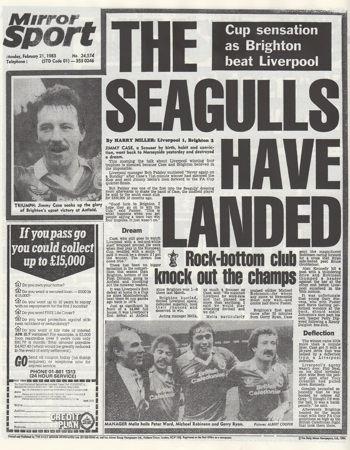
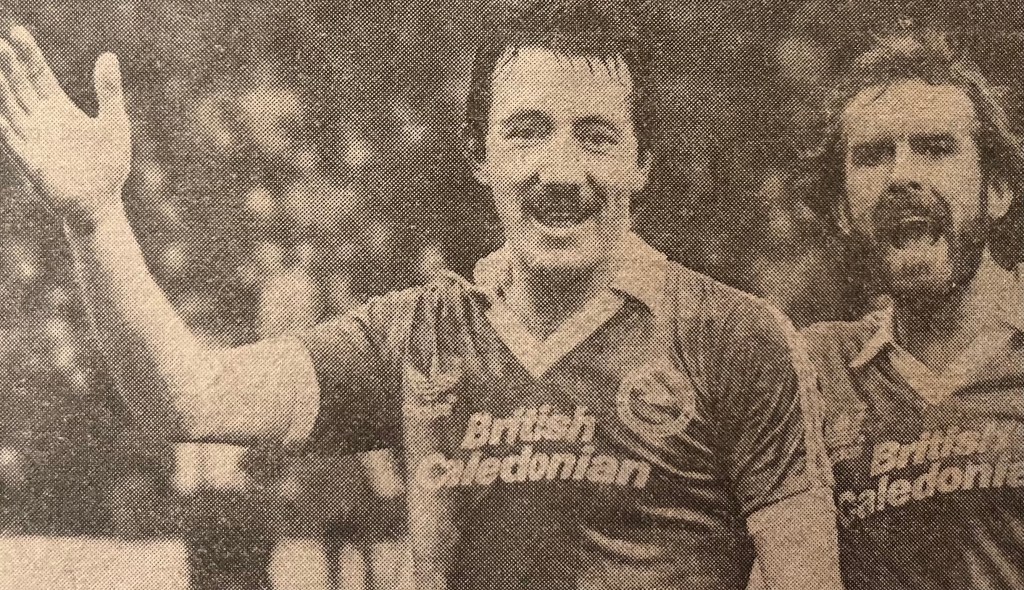
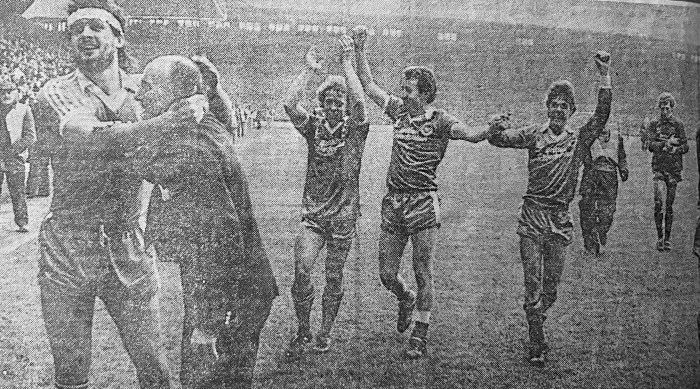
How satisfying, then, to return in 1983 and pilot Albion’s unlikely 2-1 win, with a winning goal courtesy of that other former Anfield favourite, Jimmy Case.

In the run-up to the game, Melia, raised in Liverpool’s Scotland Road, told the Daily Mail: “I’ve got 11 brothers and sisters in the Liverpool area and they’ll all want to be there.”

He clearly didn’t fear the game, pointing out that Brighton had been the last team to win at Anfield, and telling the Argus: “It is a great tie for us. When I was manager at Aldershot we lost 1-0 to them and I think we will do better this time. Remember, the Cup is full of all sorts of upsets. It wouldn’t be the Cup otherwise.”

After the famous victory, Melia told Alex Montgomery of The Sun: “I’ve been involved in some great Liverpool victories but this is without doubt the greatest win.

“The great thing about it is that we didn’t just nick a win. We deserved what we got. A lot of people said that if we attacked them we would just set ourselves up for a hiding. That is not the way it worked out.”

It emerged after the game that John Manning, an old footballing friend of Melia’s, had been key to plotting the victory. Former Crewe, Bolton and Tranmere striker Manning, Albion’s scout in the north at the time, gave the players a pre-match rundown on what to expect.

“Best team talk we’ve ever had,” defender Gary Stevens told the Daily Mail. “Liverpool played exactly the way he said they would and he was even right about which side (Phil) Neal would send his penalty (which went wide of goalkeeper Perry Digweed’s post).”

Born in Liverpool on 1 November 1937, Melia attended the city’s St Anthony’s School and didn’t play his first organised football match until the age of 11. He quickly demonstrated a talent for the game and after shining for the school side was picked to play for Liverpool Boys.

At 14, he was selected for England Schoolboys but a broken collarbone meant he was unable to play. A year later, though, after captaining Liverpool Boys, he got another chance with the national schoolboy side, making his debut against Eire in a team that included Bobby Charlton and Wilf McGuinness.

Liverpool offered him a place on the groundstaff as soon as he left school and, at the age of 17, he was taken on as a professional by former Brighton manager Don Welsh, who took over as Liverpool boss in 1951. Ahead of a Brighton v Portsmouth game in 1983, Melia mentioned his closeness to their manager at the time, Bobby Campbell.

“We virtually grew up together in the same street in Liverpool and we both signed for Liverpool as youngsters on the same day,” he wrote in his matchday programme notes. “We literally have a lifelong friendship.”

Melia scored on his Liverpool debut against Nottingham Forest in a 5-2 win when the famous Billy Liddell scored a hat-trick, and he was making a name for himself at a national level too. Melia scored twice for the England Youth side as they romped home 9-2 winners over Denmark at Home Park, Plymouth, on 1 October 1955. The following month he was on target again as England beat the Netherlands 3-1 at Carrow Road, Norwich.

Between the 1955-56 and 1963-64 seasons, Melia played 287 games for Liverpool, scoring 78 goals. It might have been more but for the fact he had to do National Service although the consolation was that he got to play in the British Army side with the likes of Duncan Edwards, Bobby Charlton, Dave Mackay, Peter Swan, Cliff Jones and Alan Hodgkinson.

One of his Liverpool goals came in a home game against Brighton on 10 October 1959. Phil Taylor’s Liverpool were 2-1 down to the Albion that Saturday afternoon and, in the 85th minute, Melia stepped up to take a penalty…and missed. Nevertheless, he atoned for the mistake by slotting home a last-gasp equaliser. A month later, Shankly took over as manager.

In a series of profiles of the leading Liverpool players of the era, journalist Ivan Ponting said: “Jimmy Melia was the principal midfield ideas man as Liverpool rose from the second tier in 1961-62 and he was capped twice in 1963 ahead of sparkling creatively in the opening half of the Reds’ first title campaign under Bill Shankly.”

In only the second game of Alf Ramsey’s reign as England manager, he selected Melia to play for the national side in a 2-1 defeat to Scotland at Wembley on 6 April 1963.

Then on 5 June 1963, in Basle, he was one of the goalscorers in the side that hammered Switzerland 8-1; Bobby Charlton scored a hat-trick but remarkably Jimmy Greaves didn’t get on the scoresheet.

Although he didn’t win another full cap, he was in a FA squad Ramsey took to Gibraltar in May 1965 when the Rock’s representative XI were soundly beaten 7-1 on 22 May and 6-0 the following day.

In the 1963-64 season, when Melia was sidelined by a minor ankle injury, Shankly reshuffled his line-up, moved centre-forward Ian St John into a more deep lying role and put Alf Arrowsmith up top. The change worked so well that Melia never did regain his regular place in the team.

“It was a stunning blow and a surprise to the balding Merseysider whose flair, industry and intelligence had been so productive, with his through-passing an exquisite speciality, even if some fans disliked what they saw as over-elaboration on the ball,” Ponting wrote for Back Pass magazine.

Melia was sold to Wolves for a then record fee of £48,000 in March 1964, but because he had played a certain number of games for Liverpool earlier in the season, was awarded a medal when the Reds were crowned champions.

It was the legendary Stan Cullis who had taken him to Molineux and, Melia told Charlie Bamforth for wolvesheroes.com, it was with the intention of him subsequently moving into a coaching role. But, when Cullis was sacked before the end of the year, his replacement, Andy Beattie, swiftly dispensed with Melia’s services, offloading him to Southampton in December 1964 for £30,000.

At The Dell, Melia (pictured below in Saints’ famous stripes) joined forces with the likes of Terry Paine and Martin Chivers and, in 1965, helped Ted Bates’ side to promotion to the top division.

Melia Saints

He was an ever present in the side during their first top division campaign, notable as a provider of crosses for Ron Davies and Chivers.

Eventually, the emerging Mike Channon took his place and, in 1968, after making 152 Saints appearances, on the strength of a recommendation from his old boss Cullis (by then manager of Birmingham), Aldershot paid £9,000 for him to become player-coach. The following April he became player-manager.

When he was sacked in January 1972, having made 134 league appearances for the Shots, he moved back to the north west as player-manager of lowly Crewe Alexandra but finally hung up his boots in May that year to concentrate on the manager’s job.

As a lowly league manager, Melia seldom came to the wider public’s attention, but when the opportunity arose, he was quick to seize it. Before another FA Cup third round match, this time against Huddersfield, he told Goal magazine any success he’d had as a manager could be put down to the influence of Shankly and his managers at Wolves and Southampton, Cullis and Bates.

“I was lucky,” said Jimmy. “You can’t help but learn from men such as these and I consider myself very fortunate to have served under them.”

In his first season as manager of Crewe Alexandra, his inexperienced team finished bottom and had to seek re-election to the league (in those days relegation was not automatic).

“I believe some of the youngsters we have here are destined for great futures. But perhaps you need a little more than just skill and enthusiasm to be successful,” he told Goal in July 1973.

Melia was clearly scarred by his treatment at Crewe. He told Ian Jarrett of The Sun: “We finished in the bottom four and were in danger of getting kicked out of the league so I spent days ringing around all my mates to get the votes to save us at the annual (league) meeting.

“I succeeded and went away feeling pretty happy until a phone call from the chairman warned me that I had only narrowly survived a vote of confidence.

“The following September I was made manager of the month but the club called an extraordinary meeting, got rid of the chairman, and soon after that I was out on my ear.

“The experience taught me a lesson.”

In 1975, Melia had three months as manager of Southport, before ending the same year coaching in the Middle East.

He then moved to the USA and linked up with a former Wolves teammate Laurie Calloway to become his assistant coach at NSL side Southern California Lazers. In 1979, Melia moved to Ohio to become coach of Cleveland Cobras.

A window back into the English game opened in April 1980 when Brighton boss Alan Mullery appointed him as the club’s chief scout.

Looking back now, it seems a tad ironic that Albion chairman Mike Bamber was all for sacking him and other members of Mullery’s backroom staff in the summer of 1981 to save money. Mullery refused – and subsequently left the club himself.

Melia retained his position under Mullery’s successor, Mike Bailey, who, despite taking the Albion to their highest ever finishing position (13th) in 1982, failed to win over fans with a style of football that saw them stay away in their thousands.

A concerned Bamber finally brought down the curtain on the Bailey era in December 1982, handing the first team managerial reins on a caretaker basis jointly to Melia and loyal backroom ‘boy’ George Aitken (himself a former manager who, like Melia, had been a player under Shankly during his time at Workington).

From the outset, it was Melia who put himself forward to handle interviews with the press, TV and radio, and, as the club progressed in the FA Cup, so the spotlight began to shine brighter on the Liverpudlian, especially with that tie at Anfield.

Inevitably, the question kept arising as to whether Melia would land the manager’s job on a permanent basis and, in one of many interviews, he somewhat tellingly said: “I’d love the job and, if we stay up, that will improve my chances. But I’m not going to attempt to survive by playing boring, safety-first football.”

In a comment that was something of an oxymoron, Melia told Paul Weaver of the News of the World: “I don’t want to say anything against my predecessor, Mike Bailey, but I wouldn’t have paid money to watch Brighton in the first half of the season.”

mullers + meia

Perhaps not surprising, then, that in a veterans’ charity match played at Selhurst Park just before the semi-final, Bailey refused a request to be photographed with Melia, albeit he was happy to pose alongside Mullery.

By then, Melia had indeed finally been given the manager’s role on a permanent basis (once Norwich had been defeated in the quarter final). On 16 March 1983, Bamber took him out to lunch at a Hove hotel to break the news.

In a front-page splash on the Argus, Melia said: “This is the happiest day of my life. It is a dream to be manager of a First Division club with also the possibility of taking them to Wembley.

“I am just pleased the chairman has given me the opportunity, and I hope to stay at the club for the next 20 years.” It would, of course, turn out to be closer to 20 weeks!

As excitement built in the run-up to the Cup Final, Bamber told Argus reporter Phil Mills: “Jimmy knows the game from A to Z but what I particularly like is that he’s always bubbling. He’s lively and looks on the positive side of things – even when we lose.

“The Jimmy Melia story is a fairy tale – three months ago he was our chief scout. Now he’s leading the Albion to Wembley for the FA Cup Final.

“You couldn’t get a better fairy tale than that.”

There’s no doubting Melia milked the moment, but who could blame him?

He told Ian Jarrett in The Sun: “I must make this situation count because I might never be involved in anything like it again.

“I have felt like the President of the United States in the past couple of weeks. Everyone has wanted to shake my hand and cars have beeped me in the street. It’s heaven to be in this position and I think everyone in the club should make the most of it.”

The Daily Mail even went as far as describing the opposing managers for the 1983 final as “Liberace meets Max Wall”, rather playing on the fact United’s Ron Atkinson had a penchant for bling and the follicly-challenged Melia bore something of a resemblance to the comedian and actor renowned for a silly walk. John  Roberts wrote: “Little Jim has given his usual 110 per cent in the discos, a chest-revealing Tom Jones shirt, black leather trousers, white dancing shoes and glamourous girlfriend offsetting a glistening dome that is just made for the Seagulls.”

The writer continued: “Brighton’s progress to Wembley for the first time in their history has made a relegation season tolerable and enabled the 46-year-old Melia to recapture a measure of the prestige he enjoyed as a player.

“As a nimble, intelligent inside forward he won Second and First Division championship medals with Liverpool and played for England. Some of his friends consider that he suffered to a degree for being a home-produced player rather than a fashionable big-money signing.”

Roberts even quoted comedian Jimmy Tarbuck, a boyhood friend of Melia’s, who said: “To use an old showbusiness saying, Jimmy’s been there and back.”

Who knows what might have happened had Albion actually won that Cup Final?

Melia will forever be associated with taking the club to what was then a globally-watched event and raising their profile to heights never previously achieved.

The cold, hard reality, though, was that Brighton’s brief stay among the elite of English football was over. Melia’s open, expansive style of play had been punished in the league, resulting in relegation and a loss of status that took 33 years to restore.

Melia had designs on boosting his coaching staff in the summer of 1983 with the introduction of the aforementioned Calloway, but Bamber had other ideas and, without consulting his manager, instead installed former Albion defender Chris Cattlin as first team coach.

From the outset, it was evident the two were not going to see eye to eye and it wasn’t long into the new season before it emerged publicly that Cattlin was actually picking the team.

Eventually Melia couldn’t continue with what was clearly an untenable position and resigned, but, in a rather tawdry denouement, appeared being carried shoulder-high on the north stand terrace at the next home game amid cries of ‘Bamber out, Melia in’.

At the time, there were rumblings of an Albion takeover from businessman Jeffrey Kruger and Bamber described Melia as “a disgrace” and claimed he had been operating as a mole for Kruger.

Nothing came of the takeover and the dust had not long settled on the end of Melia’s Albion association when he moved to Portugal and spent three years as boss of Belenenses, taking them to a top five finish.

Former Argus Albion reporter John Vinicombe reflected on Melia’s career in a wistful piece for the newspaper in 2001, and recalled: “Back in England Jimmy had a brief spell in charge at Stockport, then it was time to move on to Kuwait and Dubai, San Francisco, San Jose and Dallas.”

He subsequently settled in Dallas and became technical director for Liverpool’s academy in Texas.

Pictures from various sources including the Argus, The Sun, The News of the World, Shoot! and Goal magazines and the matchday programme.


Cherries legend Mark Morris and the memorable Storer moment

mark morris bw bourne

STUART Storer is rightly remembered as the scorer of the vital winner against Doncaster Rovers in the last ever match at the Goldstone Ground.

Few remember exactly how the ball fell kindly to him that rain-lashed afternoon on 26 April 1997, but close scrutiny of the much-played clip before games at the Amex (also available on YouTube) shows it was from a rebound off the bar following a header by centre back Mark Morris.

Although defending was his priority, Morris had chipped in with a fair few goals over the years – including getting the winner for the Albion on his debut in a 3-2 win at Hartlepool on 2 November 1996.

Morris was a seasoned pro who had captained Bournemouth and Wimbledon and been part of a promotion-winning side at Sheffield United.

He had answered the call to join Brighton when his old Bournemouth teammate Jimmy Case was manager, as he told The Argus in a 2001 interview. The Seagulls were struggling at the foot of the bottom division with the trapdoor to oblivion gradually creaking open.

Maybe if the Morris header had gone in rather than rattling the bar, a different name would have been etched into the annals of Albion history.

Of the vital last-ditch game at Hereford, Morris told The Argus: “As a player, we were playing for the future of a club steeped in tradition. It was one of the biggest games in my career and the result was paramount.

“I was about 35 then. It was getting to be close to the end of my career and I wanted to end on a decent result. Hopefully I played some part in keeping the club up.” Continue reading “Cherries legend Mark Morris and the memorable Storer moment”

Man City legend Joe Corrigan played the clown in Brighton

1 Joe punchingBRIGHTON fans often enter into a debate about the best goalkeeper ever to play for the club.

Although he was past his best when he joined the Seagulls, former England international Joe Corrigan would certainly be a contender.

Corrigan was, quite literally, at 6’4” a giant among goalkeepers and a colossus for Manchester City at the highest level before a second tier spell with Brighton towards the end of his playing career.

He subsequently became a top goalkeeping coach and amongst the ‘keepers he worked with was another former Seagulls favourite, Tomasz Kuszczak, when at West Brom.

After taking over from Harry Dowd, Corrigan was a near permanent fixture in goal for Manchester City between 1970 and 1983, winning a European Cup Winners’ Cup medal at the end of his debut season.

But for his career coinciding with Peter Shilton and Ray Clemence, he would surely have won more than the nine England caps he accumulated.

In total Corrigan made 592 appearances for City, a club record for a goalkeeper, and he was City’s Player of the Year three times.

In 1983, at the age of 34, Corrigan was sold to American club Seattle Sounders for £30,000, but he stayed in the US only a few months, and, in September that year, returned to England with Brighton.

Unfortunately for Joe it was at that turbulent time when, although Jimmy Melia was still the manager, chairman Mike Bamber had installed Chris Cattlin as first team coach behind Melia’s back.

Within a matter of weeks of the 1983-84 season starting, Melia was fired and Cattlin took over.

Corrigan was not impressed. In his 2008 autobiography (Big Joe, The Joe Corrigan Story) he declared Cattlin “the worst manager I’d ever played under” although he described his teammates as “a terrific bunch of lads” and he seemed to enjoy a decent social life on the south coast (pictured below for the matchday programme by Tony Norman, tucking into candy floss on the pier).

corrigan candyFor instance, at the annual players Christmas ‘do’ – if the account in Jimmy Case’s autobiography is anything to go by.

Corrigan became big pals with Case during his time at Brighton and the Scouse midfield favourite recounts in Hard Case (John Blake Publishing), a time the players went out on their Christmas ‘bash’ in Brighton wearing fancy dress.

Corrigan wore white tights and a tutu and at one point stood in the middle of the road directing traffic while his teammates crossed –  beckoning cars facing a red light to go and stopping cars that were on a green light. “I am still not sure how he survived that incident without having his collar felt,” said Case.

“Joe is a big, soft lad with a heart of gold but he has a painful way of showing it.”

One of his party pieces was to catch people off guard with a short jab in the ribs or arm. One playful punch landed on physio Mike Yaxley broke two of his ribs!

Case described Joe as “a star performer on the pitch and a bloody clown off it”.

Corrigan played 36 times for the Seagulls, including performing heroics in the famous 2-0 1984 FA Cup win over Liverpool, when goals by Terry Connor and Gerry Ryan meant the Seagulls dumped the mighty reds out of the cup two years in succession (following the 2-1 win at Anfield during the 1983 run to the cup final).

IMG_5197Sadly, as revealed in Big Joe, The Joe Corrigan Story, his time with Brighton ended on a sour note and when Cattlin opted for Perry Digweed as his first choice ‘keeper for the 1984-85 season, it all turned publicly ugly.

The club fined Corrigan for speaking out of turn to the press but Corrigan successfully got the fine overturned thanks to help from the PFA.

Under a heading ‘Truth’ Cattlin wrote in his matchday programme notes: “Our club made the papers this week for the wrong reasons, when a Football League tribunal upheld an appeal by Joe Corrigan against a club fine imposed upon him recently.

“Obviously I must accept the decision of the tribunal, just as I expect my players to accept a referee’s decision on the field. However, my dispute with Joe was not about his right to say anything to the press, but simply about what he said.

“At this club I don’t mind players speaking to the press in a responsible manner. I must though reiterate that I don’t want them slagging the staff, fellow players, fellow managers or the club.”

As it became clear he would never play for Brighton again, he went out on loan to Stoke City and Norwich but then back in Brighton Reserves sustained an injury to his neck that ended his career.

Corrigan retired from playing and initially helped to run a haulage business back in Manchester. But the lure of goalkeeping drew him into coaching at a number of clubs: City, Barnsley, Bradford, Tranmere and Stoke all on a part-time basis. Most notably, though, he spent 10 years at Liverpool, until the arrival of Rafa Benitez, then had spells at Celtic, Middlesbrough and West Brom.

The seeds for that part of his career were sown at Brighton, courtesy of John Jackson, the former Crystal Palace goalkeeper, who used to coach the Albion ‘keepers once a week.

Corrigan told the Manchester City matchday programme on 29 September 2018: “I got talking to him and it inspired me to look into doing something similar. So it was down to Brighton indirectly that I moved into the next phase of my career.”

When at 60 in 2009 he brought down the curtain on a 42-year career in the game, Tony Mowbray, manager of West Brom at the time, told the Birmingham Mail’s Chris Lepkowski: “Joe has been a pleasure to work with. His knowledge and experience have been a big help to me and I’ll be sorry to see him go.

“He’s a great character, a true gentleman and everyone at the club wishes him a long and happy retirement.”

Corrigan told the Mail: “Everyone says you know when the time is right to retire – and I feel this is mine.

“I’ve had just over four great years at this club and want to say a massive thank you to the Albion fans, who have always been very supportive of me and made me feel really welcome.

“The staff and players – particularly the keepers – have also been a pleasure to work with.

“Ironically, my final home game here will be against Liverpool, a club where I spent ten happy years, and we went to City two weeks ago, which obviously is always a special occasion for me.”

In the 2025 New Year’s honours list, Corrigan received an MBE for services to charitable fundraising.

2 Joe diving3 Joe shouting4 JC w GR SG EY

  • Pictures from my scrapbook show Corrigan punching clear of Chelsea’s David Webb, diving headlong to deny Chelsea’s Keith Weller, letting his teammates know his thoughts, and in an Albion squad line-up alongside Eric Young and behind Gerry Ryan and Steve Gatting.

J Cor sept 18

  • Joe pictured in the Man City matchday programme in September 2018.


Corrigan in 2025