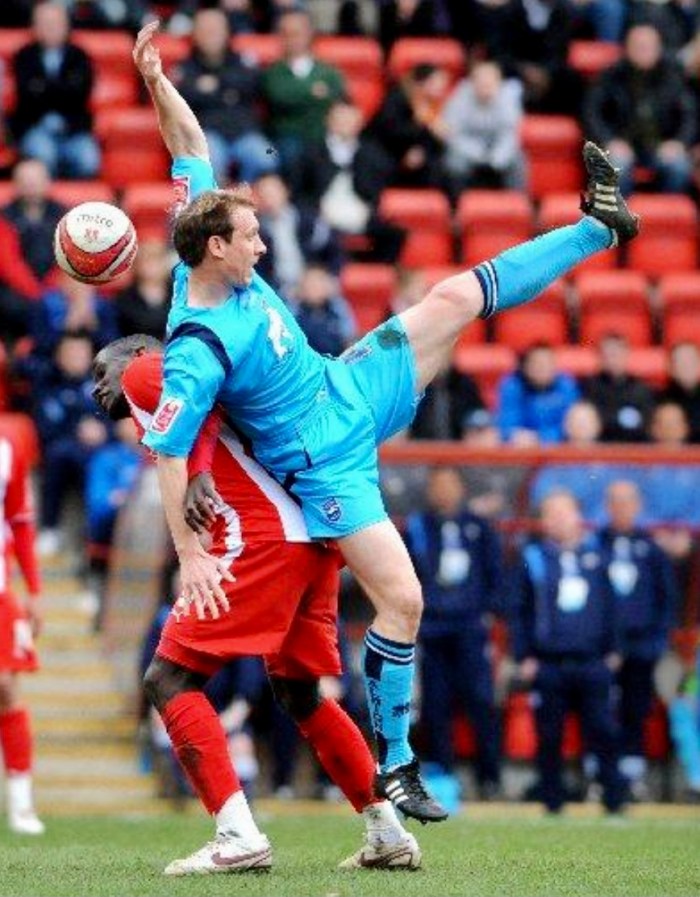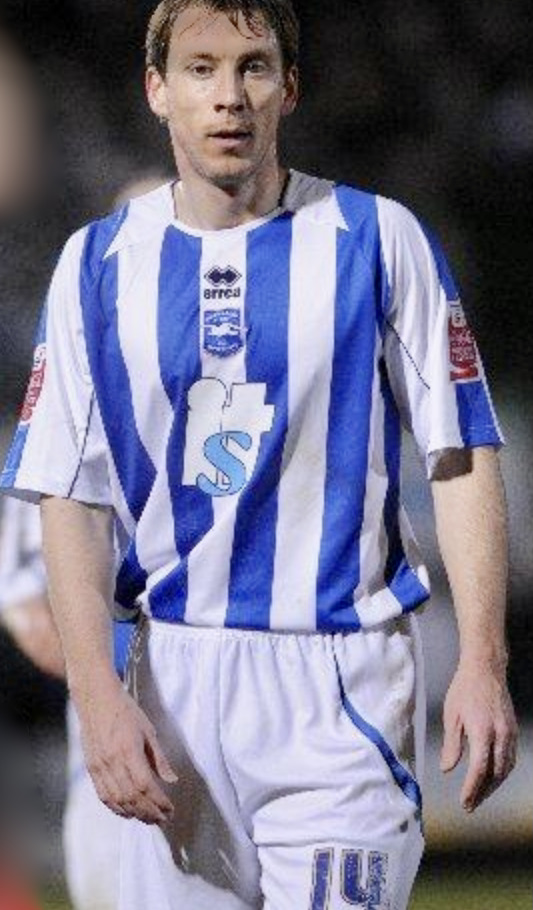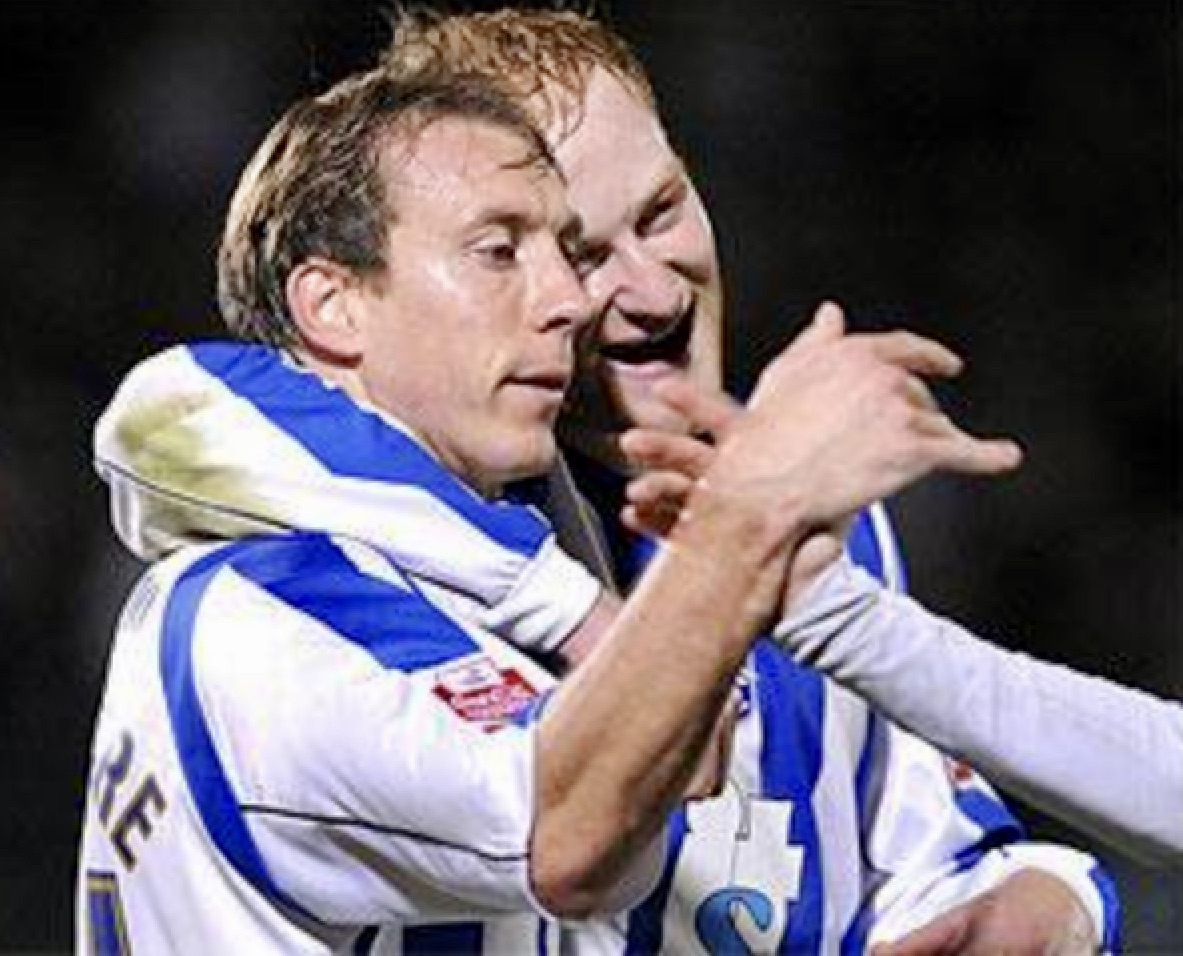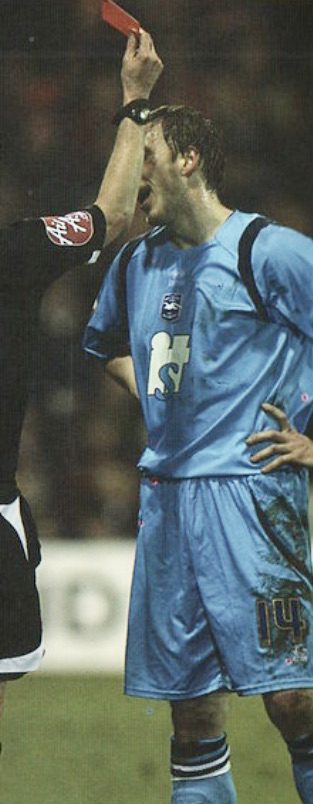
Not many of them, but Sidwell’s goals were memorable

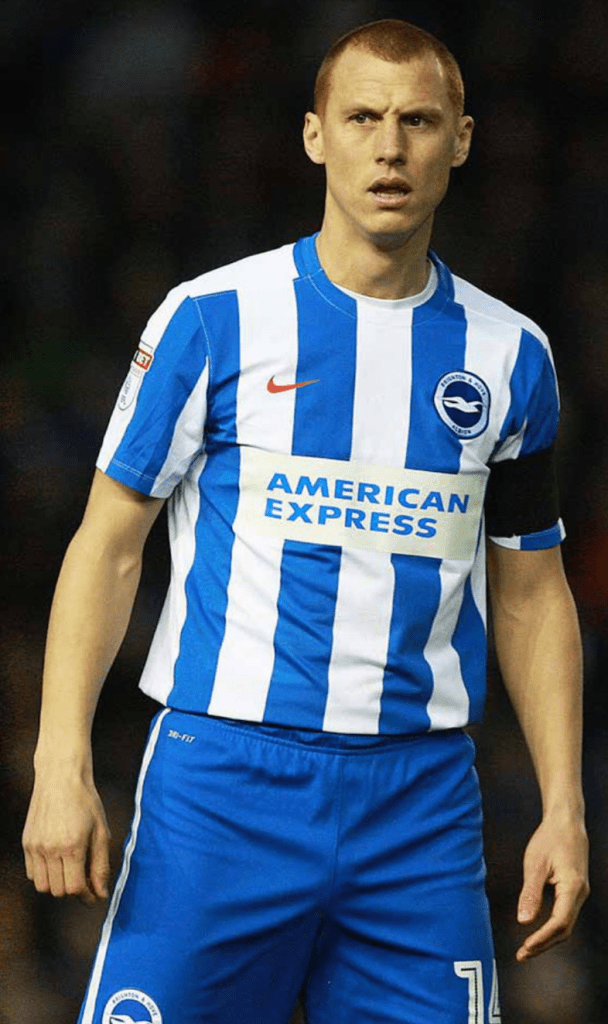
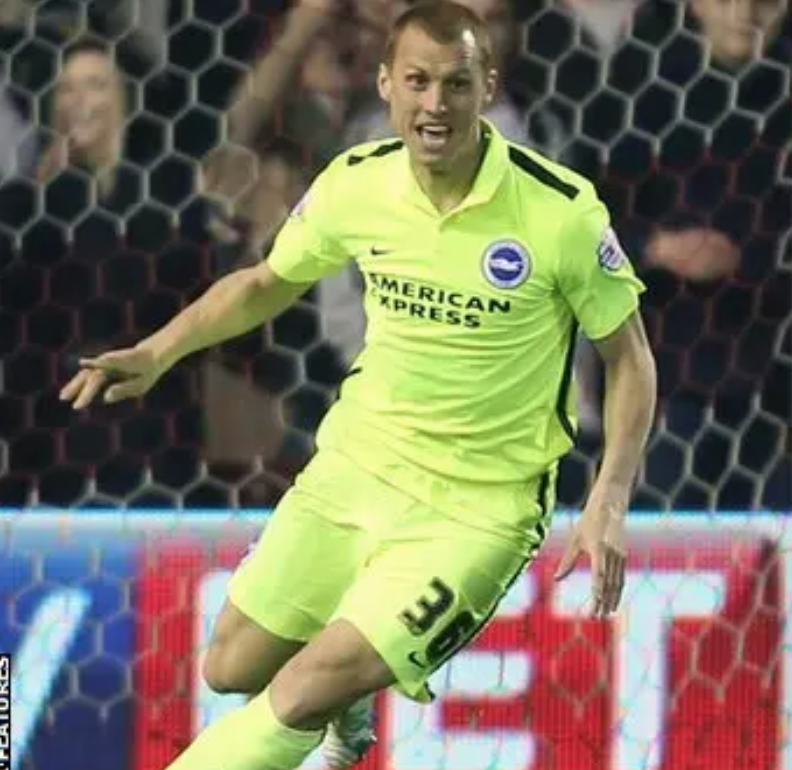
STEVE SIDWELL was not a recognised goalscorer but when he did find the back of the net it was often memorable and headline-making.

Such was his most talked about goal for Brighton – hit from the centre circle away to Bristol City in a Championship match on Bonfire Night in 2016. 

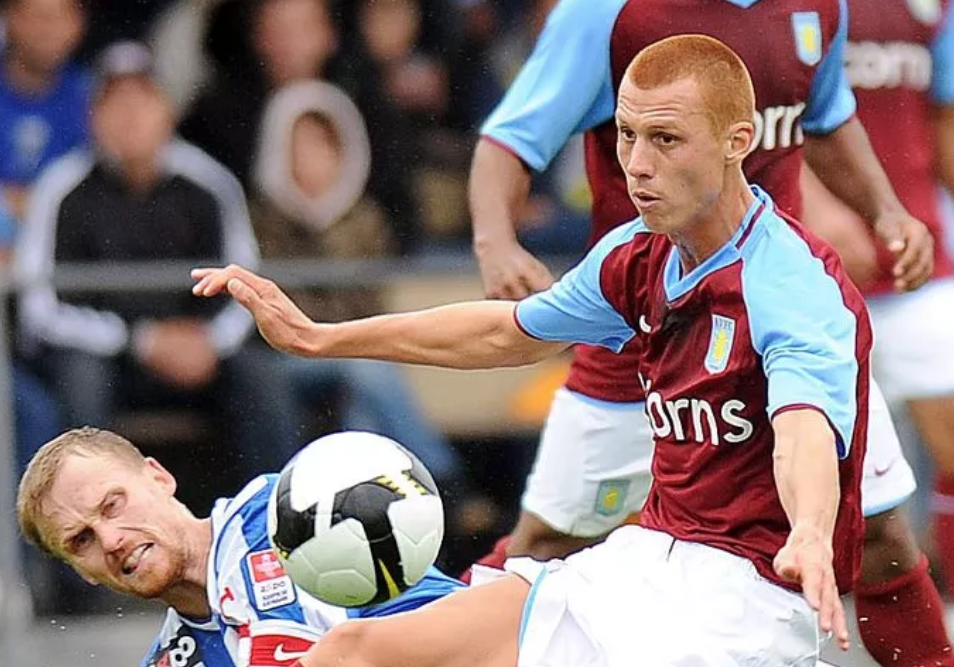
Eight years earlier, he stunned Goodison Park by rifling home from 25 yards after only 31 seconds of Aston Villa’s 7 December Premier League visit to Everton.

I was at Ashton Gate to see Sidwell’s amazing 50-yard lob over stranded Robins’ ‘keeper Richard O’Donnell (Jamie Murphy added a second in promotion-chasing Albion’s 2-0 win).

Manager Chris Hughton said: “It was a wonderful strike by Sidwell on his left foot when I would have expected it more from his right. It caught everyone by surprise, including their goalkeeper.”

I was also at the City Ground, Nottingham, seven months earlier when Sidwell went on as an 85th-minute sub and scored the winner (below) in the 91st minute to earn a 2-1 victory over Forest.

With his right foot this time, he drilled the ball in from 12 yards giving Albion a fourth win in five games which extended their unbeaten run to nine games.

“We felt that the game was becoming open and we felt we could bring players off the bench who could influence the game,” said Hughton. “One thing about Steve Sidwell is that he can break forward from midfield. I did not bring him on for that, but I am very glad he did it.”

Back to that game for Villa in 2008; moments after kick-off, Everton’s Mikel Arteta lost possession to Ashley Young. He fed James Milner who in turn found Sidwell. Finding himself with a sight at goal from 25 yards, he buried a stunning shot past Tim Howard. In an extraordinary end to the game, Young, who had scored Villa’s second, got a 94th-minute winner for the visitors after Joleon Lescott thought he’d salvaged a point in the 93rd minute, netting his second of the game. 

That opener at Goodison was a rare highlight for Sidwell in what overall was an unhappy two and a half years at Villa.

Sidwell had first caught Villa boss Martin O’Neill’s eye when he scored twice for Reading in a 2-0 home victory over Villa in February 2007.

O’Neill tried to land him before he opted to join Chelsea (the team he’d supported as a boy) and, by all accounts, predecessor David O’Leary had also tried to sign him.

So, it appeared to be a case of third time lucky when in July 2008 O’Neill took him for a reported £5million fee from being a Chelsea benchwarmer and gave him a three-year contract.

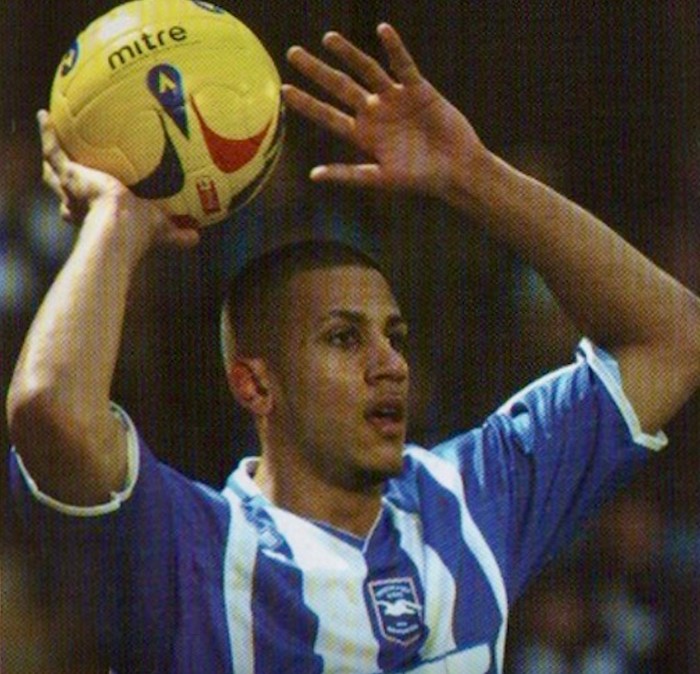
Sidwell during his first Albion spell

After success at Reading, where he had been reunited with Steve Coppell (who’d had him on loan at Brentford and Brighton as a young Arsenal player, as covered in my 2017 blog post), Sidwell had a disappointing season at Stamford Bridge, where he made just seven Premier League starts. 

Managerial change didn’t help his cause: he’d been signed by Jose Mourinho who left early in the season to be replaced by Avram Grant.

Sidwell later admitted: “I left for Aston Villa in search of regular football. In hindsight, I wished I’d stayed another six months because Luiz Felipe Scolari came in and you never know what might have happened then.”

At the time, Sidwell told Villa’s official website: “For me personally, it’s about getting back and playing. I have had a year of not playing as much as I would have liked so to get out on the pitch is the first aim.” 

Although he played in both legs of the InterToto Cup tie against Odense in July, knee and calf problems delayed his league debut until the end of October which he marked with a goal after going on as a late substitute in a 4-0 win at Wigan Athletic. That and the strike at Everton were two of four league and cup goals he scored for Villa that season when his 25 appearances (20 starts + five as sub) would ultimately amount to nearly half the total he made for the club: 37 starts + 27 as sub.

He didn’t add any more goals in the claret and blue and in the remainder of his time at Villa Park he was never really a regular, eg in 2009-10 only 14 of 33 appearances were as a starter and in 2010-11, three of six under Gérard Houllier.

Although he and O’Neill clashed on occasion, the Northern Irishman did say: “I’ve been very happy with him. It’s just that other players playing in positions all over the place have been playing brilliantly. Some people are playing out of their skin at this minute in our team. But I’ve been very pleased since he’s arrived at the football club.”

Sidwell’s former Reading teammate Nicky Shorey, who’d joined him at Villa Park, had high expectations of him ahead of his second season, telling the Birmingham Mail: “I don’t think Villa have seen the best of him yet. It’s been a strange season for Siddy. He’s been out injured for long periods and he’s picked up niggles here and there. I don’t think he’s ever had that before.

“For as long as I’ve known him, he’s never really been injured, so I think that’s something new for Siddy to try and learn from.”

Shorey said Sidwell had remained positive and upbeat around Bodymoor Heath and Villa Park and reckoned: “When he comes back for pre-season and hopefully has a good pre-season you’ll see the best of him and I think everyone will be impressed with how well he can do.

“When you know Siddy, that’s all he ever does – trains and plays with a smile. You haven’t got any worries with him on that count. He just keeps going and he’ll be fine. He’s just an all-round good midfielder and I’m sure he’ll show that before too long.”

Sidwell found himself competing for a midfield place with the likes of Milner (before his move to Manchester City), Gareth Barry, Stiliyan Petrov, Nigel Reo-Coker and Craig Gardner. He revealed later that he’d fallen out with O’Neill and at one point he went on the transfer list.

After O’Neill quit in protest at the sale of Milner to City, and ahead of Houllier’s appointment, Sidwell hoped to be given a new lease of life in claret and blue.

He overcame an Achilles’ problem and declared himself raring to go after playing 90 minutes in a 4-0 reserve team win over Blackpool at Bodymoor Heath.

“I feel I’ve shown glimpses,” he told the Birmingham Mail. “In the previous years, there have been good games and some poor games.

“If I get a run of games, I am sure I can perform to the best of my ability. Hopefully, now, whoever takes charge I will just get an opportunity and I will take it.

“It is going to be tough but it is down to individuals to perform in training, perform in reserve games and show the manager you are worthy of a start.

“Once you get that, you have to take it with both hands. Fitness wise, I’ve been training really well and looking sharp. It is just games that I need. I wasn’t unfit before the injury took place.”

When the Mail spoke to him ahead of a second city derby at the end of October 2010, Sidwell sought to exploit a two-month injury absence for Petrov saying: “It is all about opinions.

You don’t play under certain managers. Under certain managers you do get a chance.

“Once you get a chance it is about taking it and staying in the team.”

Sidwell started the game but was replaced by young Barry Bannan in the 58th minute of the dour goalless draw – and it turned out to be his last game for Villa (he was an unused sub away to Fulham the following week).

It was in a 2018 interview with Donald McRae of The Guardian that Sidwell revealed the extent of his disillusionment at Villa, telling the journalist: “When I was at Aston Villa I was on the most money in my career. But that was when I was at my unhappiest. I was living in Birmingham away from my wife and family.

“My middle son caught meningitis and was in hospital. The football never really took off and me and Martin O’Neill clashed. So, it was a combination of things.”

Released on a free transfer in January 2011, after being deemed surplus to requirements by Houllier, Sidwell joined Fulham – which is a story for another blog post.

After three years with the Cottagers, he followed ex-Fulham boss Mark Hughes to Stoke City and it was from there that he made his initial return to Brighton, on a half-season loan. 

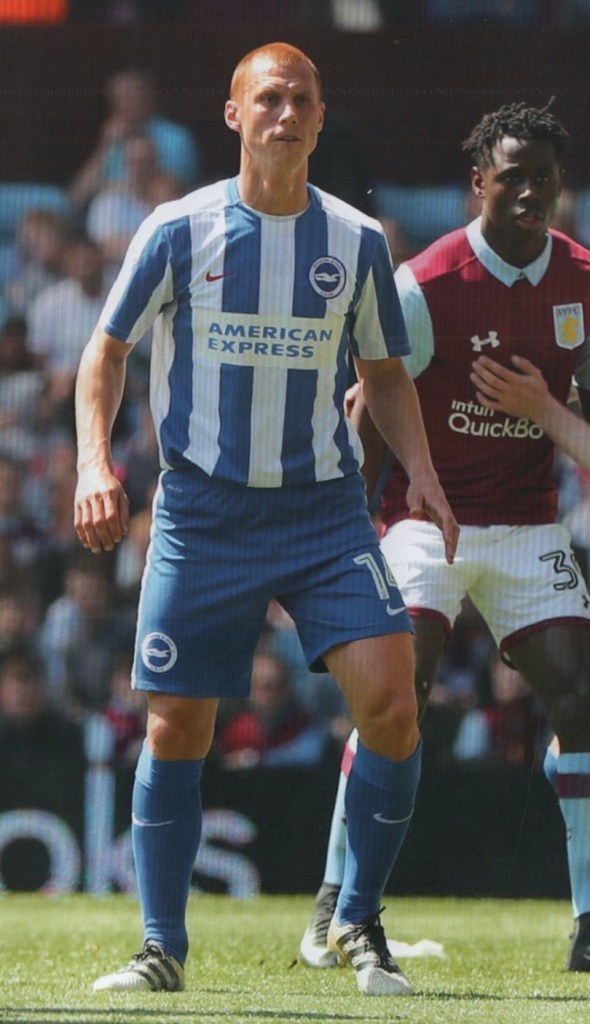
Sidwell in action for Albion against Villa

In clinching his signing in January 2016, Hughton told the Albion website: “Steve is an experienced player who has played virtually his entire career in the Premier League. He knows this club, as well as a few of the squad and will supplement our existing midfield options.

“Beram Kayal, Dale Stephens, Andrew Crofts and others have been excellent in midfield for us this season, but we also need to make sure we have good options in every position of the team, and options which will be enough for us through until the end of the season.

“Steve brings that, and in addition, he is another experienced head; he is a player who’s proven at the very top level of English football. Brighton fans will know Steve is also a great athlete and top professional.”

Although he only made six starts, Sidwell went on as a sub 13 times in that half-season. When Albion had to endure the end-of-season play-offs after missing out on automatic promotion by only drawing (1-1) the last game of the season at Middlesbrough, it was Sidwell who stepped in to fill the boots of Stephens, who was suspended after his controversial sending off by Mike Dean at the Riverside Stadium.

Unfortunately, Sidwell was one of four Albion players who had to go off injured in the 2-0 play-off first leg defeat at Sheffield Wednesday. He suffered ligament damage but was taped up and given medication to enable him to play in the home tie, although he later admitted: “I should never have played really.”

He reckoned the Amex atmosphere for that game was the best he’d ever been involved in. In spite of a valiant effort, it ended in a disappointing 1-1 draw although Sidwell said: “I ended up playing one of my better games in a Brighton shirt, which maybe cemented a contract for the following season.”

Released on a free transfer by Stoke, Sidwell signed on a permanent basis for the Seagulls and was a key component in the side that won promotion from the Championship in May 2017. He made 29 starts plus eight substitute appearances that campaign.

“The whole reason behind my return was to help the club into the Premier League,” he said.

Sidwell was on the bench as Albion began life amongst the elite but after that “a slipped disc, surgery, and then before you know it your career’s gone.”

Sidwell later admitted: “It was really hard. I came here to do a job, to get the football club into the Premier League, and then it was time to go and enjoy it. I thought I had two or three years left, but that was cut very short.”

Recognising he was blessed to have enjoyed a 20-year career, he nonetheless said: “To not really say goodbye to football, something I’d done since I left school, and also to Brighton, was really disappointing.”

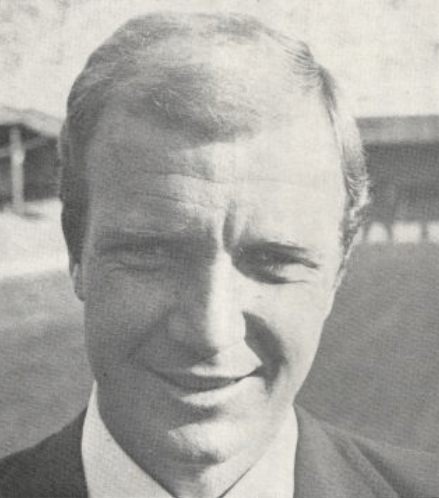
He stayed on at Albion as under-16s coach (right) for a while but increasingly his work as a pitchside pundit for live TV coverage of matches took up more of his time. He is also now a regular co-host of the popular That Peter Crouch Podcast.

Sidwell is also business development director of Box3 Projects, a company that constructs and designs office spaces to be rented out or sold.

Welbeck – “something really exceptional you don’t find in many players”

DANNY WELBECK was still at school when he made his senior football debut in the League Cup.

A first-year scholar at Man Utd, and just 17 in September 2008, Welbeck made his bow against Middlesbrough in front of a 53,000 crowd at Old Trafford. United won 3-1 with goals from Ronaldo, Giggs and Nani. And they went all the way that season, beating Tottenham on penalties in the final at Wembley.

Although Welbeck had been subbed off 10 minutes into the second half, it was the first of many medals he collected and in five years at Arsenal, after his £16m 2014 transfer deadline day move from Old Trafford, he twice collected FA Cup winners’ medals (even though he missed the 2015 final through injury when Aston Villa were humbled 4-0).

When Welbeck scored the decisive quarter-final goal for Arsenal that knocked United out of the 2015 competition, manager Arsene Wenger praised the player and said: “We all want to do well when we play against our former club, to show that you are a great player, but it’s not easy to deal with the mental situation of it. 

“He focused just on his game, didn’t do anything special. He just played football like we wanted him to play. He has shown mental strength because it’s not always easy to deal with that. You have a little bit of a psychological consideration.”

Wenger continued: “Overall, I think he had a great game. He just wants to win. He’s a team player, that’s what I like about Danny. He’s intelligent and he always wants to do well for the team. 

“He’s a great talent and he has shown again that he can produce such a complete performance, defensively and offensively as he did today – he has a great future.”

Welbeck played in the 2017 final when the Gunners edged it 2-1 against favourites Chelsea, and it was a highlight of his injury-plagued five years at Arsenal.

“It was a great performance,” he said. “Every single one of us on the pitch performed really well that day. It was a deserved win.”

Welbeck scoring one of his three against Galatasary

Another highlight was scoring the first senior hat-trick of his career in a 4-1 Champions League home win over Galatasary in October 2014.

Injuries to each of his knees and a serious broken right ankle severely limited Welbeck’s availability during his time with the Gunners and he admitted in a matchday programme interview: “When I look back, the injuries I suffered really hindered my progress.

“That really disappoints me to this day because I know that if I had managed to stay fit I would have done a lot more at the club, scored more goals and made more appearances.”
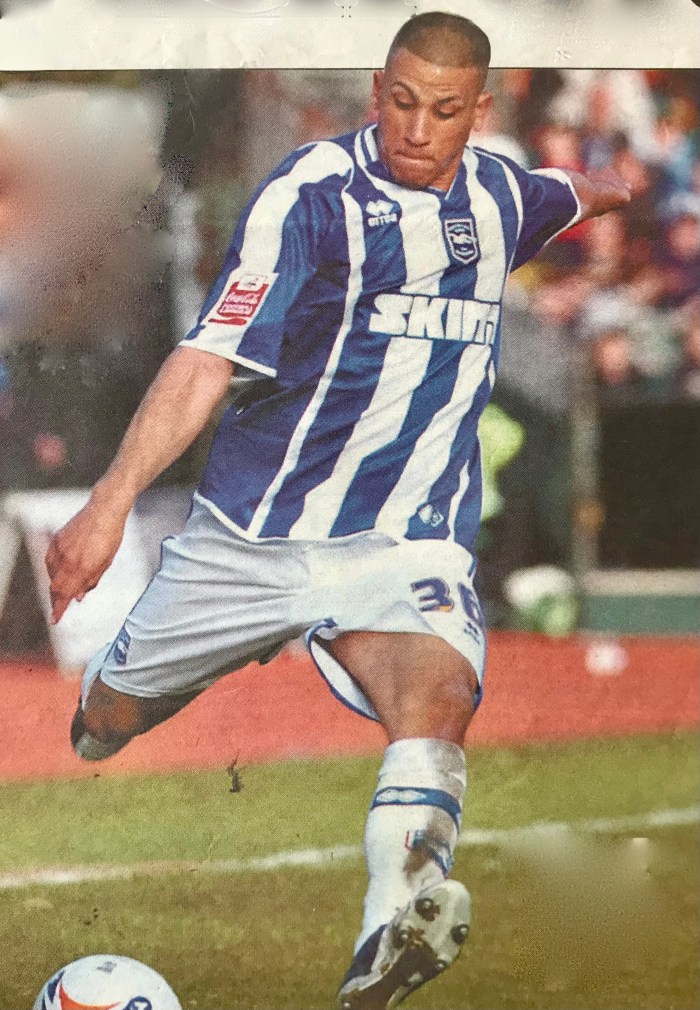
Even so, he pointed out: “I look back on my time at Arsenal as a great experience; a great club. There were lots of positives, despite the negatives with the injuries.

“The fans always treated me well, showed me love, and I will always respect and remember that.”

Welbeck opened up about the impact of his many injuries in a July 2020 interview with Adam Bate of Sky Sports. “You go through a load of emotions,” he said. “There are times when you are there sat in your hospital bed and you are crying. You are just overthinking things.”

He continued: “Once you have had the surgery and your head is straight, you know what has happened, it is behind you and you have got to look forward. You try to build from where you are that day. Every single day there are steps to overcome. You just have to come through them and you find that you are getting better and better and feeling in a better state of mind.”

He also explained how the time wasn’t entirely wasted. “There are football games on TV, you can watch different players who are playing in your position, you can watch your own clips to see what you can improve on,” he explained.

“There are little apps that can help you, people who you can talk to. I think there are so many extra percentages you can gain and if you can get that extra one per cent it is always going to be a help.”

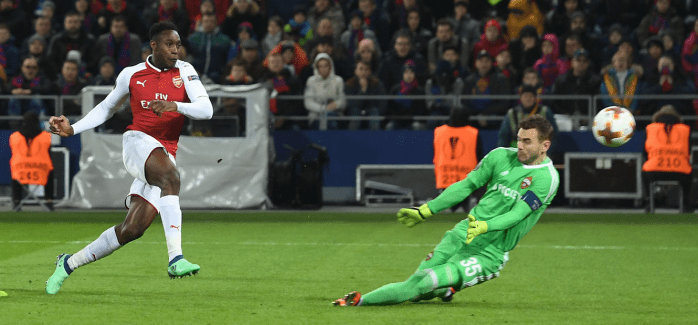
Welbeck buries one of his 32 goals for Arsenal

Wenger was certainly an admirer of what Welbeck was able to contribute. For example, speaking in February 2018 ahead of a shock 2-1 Europa League second leg home defeat against Graham Potter’s Ostersunds, Wenger said: “I want to keep him because I believe he has gone through a torrid time.

“He has come out well. I see signs in training now that are positive. If he can stay on the pitch and not be injured, I want him to stay here.”

And after the striker scored his fifth goal in five appearances to clinch a Europa League quarter final v CSKA Moscow, he said: “The qualities of Danny Welbeck… when your back’s against the wall, he looks like he has that extra special motivation in his body and in his head, that can give you something special.

“That’s something really exceptional and that you do not find in many players.”

Welbeck made 126 appearances for the Gunners (78 starts + 48 as sub) and scored 32 goals. As he had at United, he once again found himself at a club when there was an end of an era moment as Wenger left the Gunners after 22 years in 2018.

A badly-broken right ankle sustained in a Europa League match against Sporting Lisbon in November 2018 proved to be the end of his Arsenal career – he only made one Premier League start (out of seven appearances in total, plus seven off the bench) under Wenger’s successor Unai Emery.

Released at the end of that season, he joined Watford, who train next to Arsenal’s training ground in Hertfordshire, but injury struck early into his time with the Hornets, a hamstring problem putting him out for four months. After they’d got through four managers in the Covid-hit season, and been relegated from the Premier League, he left in October 2020 having scored three goals in 20 appearances (10 starts + 10 as a sub).

When Welbeck linked up with Brighton that autumn, few supporters would have imagined five years later he would still be making a huge contribution to the club.

There were a few murmurings at the beginning of the 2025-26 season but a brace in Albion’s comeback 3-1 win at Chelsea in September once again saw him grabbing headlines for all the right reasons. Two more followed at home to Newcastle and he once again scored against his first club at Old Trafford on 25 October. And long may it continue!

Speaking to The Athletic in February 2025, Welbeck said of his longevity: “I can probably thank my mum and dad for the genes. I work hard to keep myself in good condition and I am feeling fit and strong.”

Reporter Andy Naylor said: “He does not have a strict diet regime but watches what he eats, snacking on fruits or an occasional bar of chocolate between a normal three meals a day. His idea of a takeaway is a mixed grill with rice and salad.

“Another secret of Welbeck’s long-running success is a desire and determination to be the best he can be for as long as he can. He focuses on his football, turning down invites to take part in podcasts and punditry, preserving his energy for the training pitch and matchdays.”

After four seasons at Brighton in each of which he scored six or seven goals, in 2024-25 his 11 goals made him joint top scorer with Karou Mitoma from 26 starts + 10 as sub.

With five on the board before Halloween in 2025-26, the signs are looking positive for his best-ever haul.

Welbeck himself declared: “As long as I feel good, that’s how long I will go on for. If I feel good, feel like I can impact games, then I will just keep on going.”

Dislodged ‘keeper Ryan offered curious reprieve with Gunners

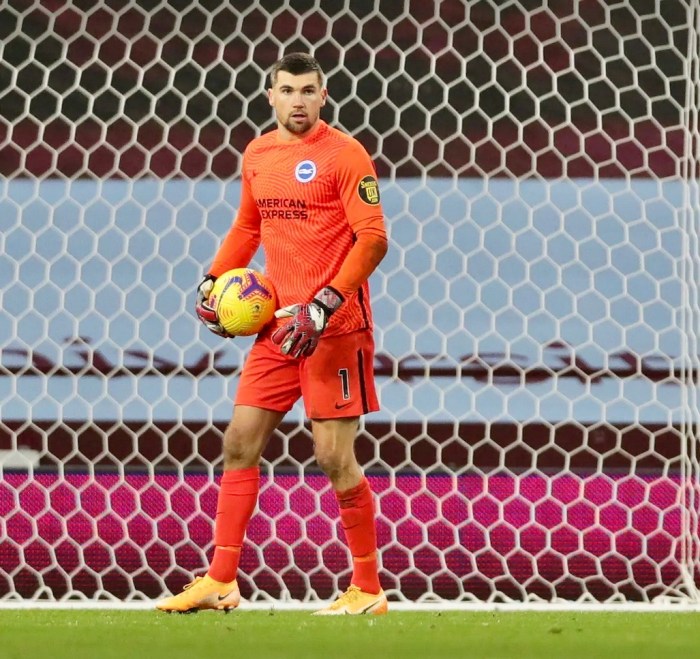
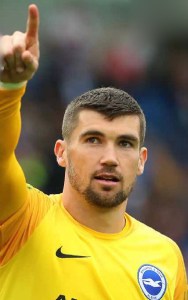
FEW FOOTBALL observers would have imagined an out of favour Brighton goalkeeper would get a move to Arsenal but that’s exactly what happened to Mat Ryan.

The Aussie no.1, Albion’s first choice goalkeeper for their first three seasons in the Premier League, surprisingly joined the Gunners having lost his Seagulls place to young Spaniard Robert Sanchez.

“We know Mat very well through his performances with Brighton in recent seasons and he brings additional quality to our squad,” Arsenal coach Mikel Arteta told the club’s website. “Mat has very good Premier League experience and has played over 100 times in the league, which is something that will benefit us greatly on and off the pitch.”

Technical director Edu added: “Mat is an experienced goalkeeper, a proven talent in the Premier League and has also played many internationals for Australia.

“Mat will further strengthen our squad with his experience and knowledge of playing at the highest level.”

The goalkeeper himself, a self-confessed boyhood Arsenal fan, relished the opportunity but found himself under fire from Brighton fans when he told Optus Sport: “I had in my mind a little bit of a plan that I wanted to play a couple of seasons at Brighton and try and do well and hopefully be bought by a bigger club and keep progressing in my career.

In action for the Gunners

“Perhaps it didn’t work out in the way of playing two, three seasons and then being bought for a fee as no.1 and going and playing.

“But one way or another I’ve obviously ended up in a massive step up from Brighton and to another level of football.”

For someone who had always previously endeared himself to the Albion faithful, memorably running the length of the pitch to join teammates in goal celebrations and after games handing out bits of his kit to supporters, it struck a discordant note.

When Ryan learned how his comments had angered some Brighton supporters, he took to Instagram to address them.

“I want to apologise to anyone who has felt I’ve been disrespectful towards the club. This was not and never will be my intention.

“I recognise how people could have interpreted that through those comments and, moving forward, I’ll be sure to pay extra attention as to how I refer to the club to not have the same outcome.

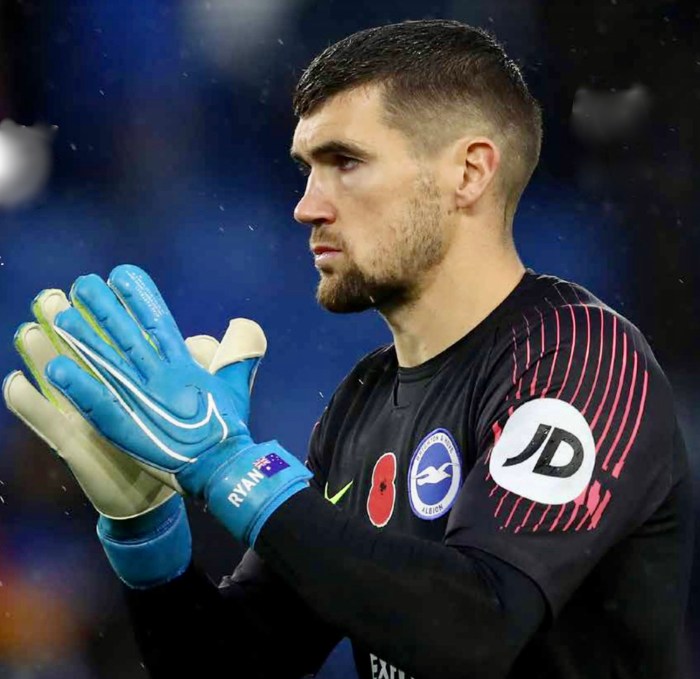
Albion’s no.1

“The club will always have a special place in my heart. I’ve got nothing but fond memories and wish all the best to you all for the remainder of the season and I’ll always continue to support the club because of our experiences together.”

Those experiences began ahead of Albion’s first season (2017-18) playing in the Premier League. Previous no.1 David Stockdale had chosen to move to Birmingham City, who were offering him a longer-term deal than Brighton, so the coast was clear for Ryan, already an established Australian international, to become Chris Hughton’s first choice goalkeeper.

Hughton himself admitted in an interview with the Argus that Ryan’s arrival had more to do with goalkeeping coach Ben Roberts. “He is the one who went to see him play, watched hours and hours of video.

“I didn’t see him live. Ben just thought he was a player at the right age, really enthusiastic. He’s different, not as big as some of the other keepers, but very athletic and really hungry to do well.

“I certainly watched a lot of him on video. We also, of course, have recommendations from our scouts but Ben is the one who looked at him and recommended him. You have to have faith in your staff.”

For his part, Ryan appreciated the work Roberts put in on the training ground. “Ben has a real knack of getting his goalkeepers in the best physical and mental shape in order to be best prepared for the opposition that we’re facing,” he told the matchday programme.

Signed from La Liga’s Valencia for a then club record transfer fee of £5 million, he played all 38 league games in his first season under Hughton, only missed four because of international commitments in 2018-19 and all league games in Graham Potter’s first season in charge.

In an early matchday programme interview, he spoke about how he had learned about life in the Premier League from fellow Aussie ‘keeper Mark Schwarzer (“a big hero of mine”) and, when on international duty, from former Aston Villa and Man Utd ‘keeper Mark Bosnich.

Ryan more often than not proved a reliable stopper for the Albion and he twice won Australia’s PFA Player of the Year award.

“At this level, you’ve got to be consistent,” he said. “Every day you’ve got to work hard on every aspect of your game and I’ve tried to do that.

“I try to contribute to the team as much as possible and it’s that constant challenge that you’ve got to try and live up to and, I guess, is what separates good players from great players – remaining consistent and sustaining those very high levels.”

And according to wearebrighton.com: “At his best throughout the 2017-18 and 2018-19 seasons, he was one of the most dependable number ones in the Premier League whose performances did more than most to keep Brighton in the top flight.”

He was sorry to see Hughton sacked – “Brought the club success it could only dream of and will always be someone I have the highest respect for” – but was happy to adapt to Potter’s more possession-based style in which the goalkeeper needed to be comfortable with the ball at his feet.

“It’s important we adapt to the new style so the system works as effectively as possible,” he said. “In the modern game you have to be able to adapt anyway, so each day I’m working hard and doing what’s being asked of me.”

The beginning of the end of his time at the Albion came when, out of the blue, young Sanchez was chosen to keep goal in a 2-1 defeat at Spurs after the Seagulls had managed only one win in the first six matches of the 2020-21 season.

Although restored to the starting line-up for the following five matches, following a 3-0 defeat at Leicester, Ryan was summoned by Potter and told Sanchez would be given an extended run in the side and that, assuming he wanted a no.1 berth, he would be better looking for a new club.

The conversation staggered Ryan and, ever a willing interviewee, told The World Game he was surprised and shocked but added: “Knowing where I stand now, from what was communicated to me, perhaps it might be better that we do go our separate ways.

“However, until that opportunity comes – and it’s a good project – then, as far as I’m concerned, I’m a Brighton player and I’m here to fight for my spot.”

Taking the opposite stance to the one Sanchez subsequently took when Jason Steele ousted him as no.1, Ryan vowed to continue to work hard.

“I still feel like I’ve got a lot to contribute and I’ll be trying to convince the manager I’m the best man for the job,” he said.

“I feel the experience I’ve picked up over the last three years in England shows I’ve got plenty to give to any club that wants to acquire my services.

“I think I’ve proved that through my performances.”

It was never particularly clear why Ryan eventually fell out of favour, although he ventured some ideas in an exclusive interview with Andy Naylor for The Athletic in March 2022.

He remembered at the start of the 2020-21 season noting there had been rumours around Albion being interested in signing Emiliano Martinez (who eventually went from Arsenal to Aston Villa) and when his (Ryan’s) agent tried to ask the club about it no one answered his call.

He was also heading into his fourth season of a five-year contract, but his agent wasn’t getting any response as to whether there would be a renewal.

“Thinking back, after all that has happened, maybe that was a sign,” Ryan told Naylor. “At the time, I wasn’t thinking anything of it, but when I think back now, maybe these were little signs.”

The loan move to Arsenal might have been brief – he had a won one, drew one, lost one record in three games – but his commitment to the cause was appreciated.

In a game against Fulham, a minute before the final whistle, Ryan went up for a corner and got his head on the ball to keep it live in the Fulham box before Eddie Nketiah equalised a few seconds later.

“I picked him because he totally deserves to play, he trains like a beast, he’s got the right attitude and he needed a game,” Arteta told Arsenal.com. “It was a great header.”

It led to him being chosen ahead of Bernd Leno for the 2 May trip to Newcastle which Arsenal won 2-0.

Although Arteta made all the right noises about signing him on a permanent basis, it turned out they wanted an English goalkeeper and they signed Aaron Ramsdale instead.

While awaiting news of where his next move would be, Ryan told Fox Sports Australia: “I’ve learnt so much in my experiences (at Arsenal) so far, all that’s being with a club like that, the resources, the personnel, the quality on the pitch, the enormity of the club on a global aspect… it was so cool to be a part of.

“It was a great experience and I was really proud of how I did and really content with how I did, and I showed that I have the capability to play at a level like that. I look forward to seeing what that little period now means for me moving forward.”
It was clear there would be no return to the Albion no.1 spot but warm words were issued when his summer departure to Real Sociedad was announced.

Potter declared: “He’s a great guy, top professional and as someone who wants to be playing regularly at senior level he goes to Real Sociedad with our very best wishes. 

“He’s been a pleasure to work with, he will be fondly remembered by everyone and always welcome back at the club.”

Unfortunately for Ryan, a knee cartilage injury suffered in pre-season put a hold on him mounting a challenge to Sociedad’s well-established Alex Remiro, and he had limited chances to shine back in Spain.

Nonetheless, his confidence remained high and he told Naylor in The Athletic article: “I’m a very good goalkeeper – a world-class goalkeeper. Since I left Brighton, I feel the level I’ve played at in the games I’ve played in has been quite high.

“Don’t get me wrong, every time the team list goes up and I see I’m not playing, it’s a blow – a kick in the guts – but I try using it as motivation to keep pushing on. I won’t stop until I see my name there more regularly.”

Born on 8 April 1992 in Plumpton, New South Wales, as a teenager Ryan played for semi-professional sides Marconi Stallions and Blacktown City before turning pro with Central Coast Mariners in 2010, where he was given his pro debut by Graham Arnold, later his head coach at international level.

In the course of his three years with the Mariners, he picked up various league accolades for his performances and earned his first international recognition when selected for Australia’s under 23s in 2011. He stepped up as a full international the following year making his debut in a 1-1 draw with North Korea and played all three matches in the 2014 World Cup in Brazil before winning the AFC Asian Cup with the Socceroos in 2015. He went on to play for his country at the 2018 and 2022 World Cup final tournaments and, at the time of writing, had 95 caps to his name.

Aussie international stopper

It was in 2013 that he moved to Europe and was signed by Belgian Pro League side Club Brugge, where he made more than 100 appearances over two years and was in the side that won the Belgian Cup in 2015 when Anderlecht were beaten 2-1 in Brussels. Ryan was the league’s goalkeeper of the year in 2014 and 2015.

An unhappy spell at Valencia followed where he managed only 21 appearances in two years, as the club got through five different managers. He spent the second half of the 2016-17 season back in Belgium, on loan to Genk, where he played 24 matches.

It would be fair to say Ryan has endured mixed fortunes since leaving Brighton. He managed only nine games for Sociedad before switching to FC Copenhagen but he only made six Danish Superliga starts and appeared in five cup matches while in Denmark.

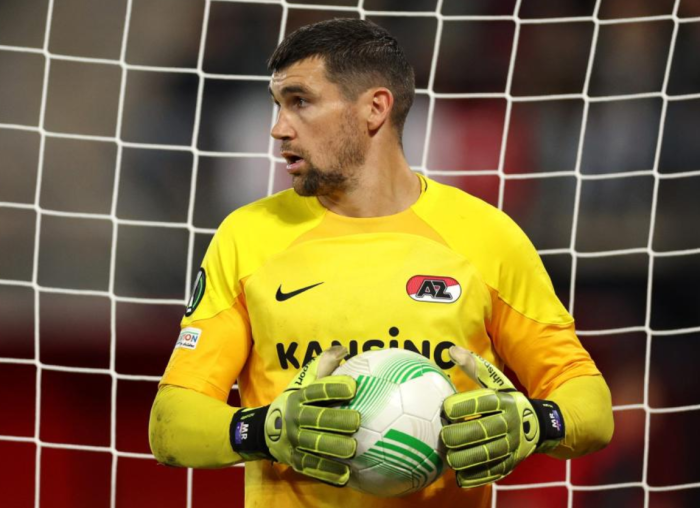
AZ Alkmaar in the Netherlands were able to offer him a return to being a regular no.1, though, and in 18 months he played 64 matches for the Eredivisie side, including 15 Europa Conference League games.

At the end of the 2023-24 season, he failed to agree a new deal with the club and the Dutch newspaper De Telegraaf reported that he ‘lost his game of poker’ with AZ’s sporting director Max Huberts, the club walking away from negotiations due to his wage demands.

As a free agent, Ryan joined Albion’s 2023-24 Europa League opponents AS Roma on a one-year contract as back-up to Serbian first choice ‘keeper, Belgian-born Serbian international Mile Svilar.

“If they get the Brighton version of Mathew Ryan, Roma will have a very safe pair of hands waiting in the wings,” reckoned Eliot Ben-Ner, writing for The Football Hub.

However, Ryan’s reign in Rome lasted only six months and in January 2025 he moved for a reported fee of £676,000 to French Ligue 1 side Lens on a six-month deal.

Steady Eddie had plenty of strings to his bow

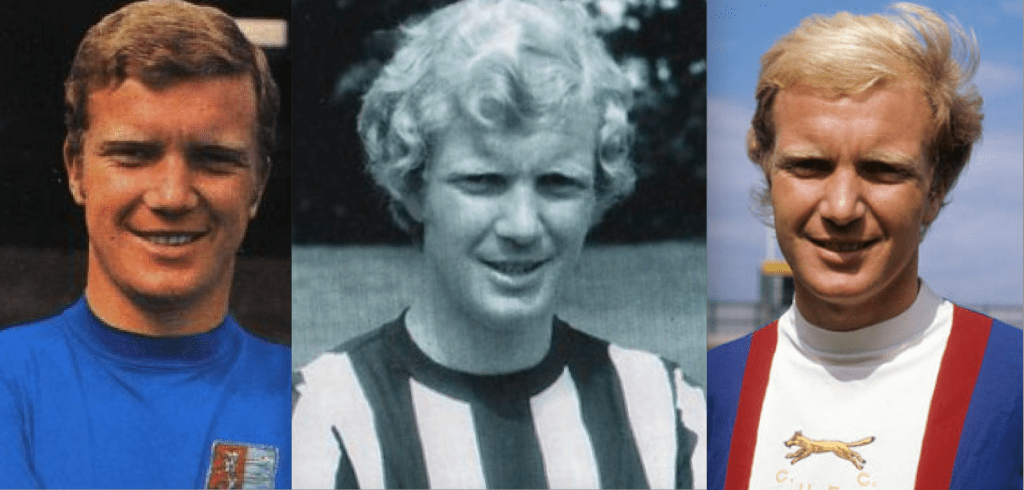
ONE TIME Albion captain and utility player Eddie Spearritt played in the top flight for Ipswich Town and Carlisle United.

He made five starts and five appearances off the bench for second tier champions Ipswich at the beginning of the 1968-69 season before joining third tier Brighton for £20,000 in January 1969.

Play anywhere Spearritt was then a permanent fixture in the Albion line-up for almost five years, making 225 appearances, before Brian Clough turfed him out at the end of the 1973-74 season.

But he found himself back amongst the elite when newly promoted Carlisle United snapped him up for their one and only season (1974-75) amongst the big boys.

Spearritt made 17 starts and six appearances as a sub for the Cumbrians but, in spite of a superb winning start when they briefly topped the division, United finished the season in bottom spot.

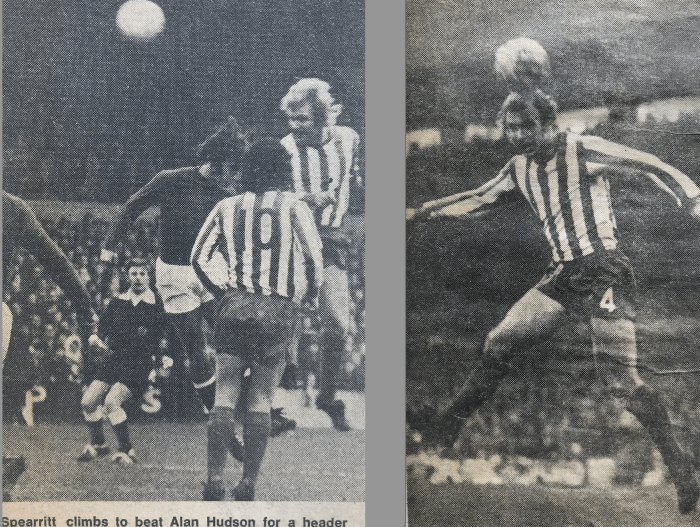
Spearritt shapes to challenge Aston Villa’s Ray Graydon

Equally comfortable playing in midfield, at full back or sweeper, Spearritt had on-off spells as Albion’s chosen penalty-taker as well as chipping in with goals from open play. He even turned his hand to goalkeeping when necessary.

Another key attribute to his game was an ability to send in long throw-ins which could sometimes be as effective as a free kick or corner. It was a skill which earned him a place in a Longest Throw competition staged by BBC’s sport show Grandstand in 1970-71, although he didn’t win it.

Born in Lowestoft on 31 January 1947, Spearritt went to Lowestoft Grammar School and on leaving school was picked up by Arsenal. But when the Gunners didn’t keep him on, he returned to East Anglia and joined Ipswich as an apprentice in August 1963.

He signed a professional contract with Town in February 1965 and, as Tim Hodge details on prideofanglia.com, he made his league debut in the 1965-66 season in a 1-0 win away to Preston in the old Division Two.

That was the season when substitutes were first introduced into the English game and the record books show that Spearritt was the first Ipswich sub to score a goal.

He went on for Irish international Danny Hegan in a match away to Derby County on 15 January 1966 and scored Ipswich’s second goal. The game finished 2-2; Gerry Baker having scored Town’s first.

Over the next three years, Spearritt made a total of 69 appearances (plus 10 as sub) for Bill McGarry’s side, scoring 14 goals along the way. Twenty of those games came in the 1967-68 season when Ipswich won the old Second Division.

A 1-0 home defeat to Spurs in October 1968 was his last for the Suffolk club and he parted company with Town shortly after McGarry left Portman Road to take over at Wolverhampton Wanderers.

A debut v Crewe (left) and slaloming through the Plymouth Argyle defence (right)

Spearritt was one of Freddie Goodwin’s first signings for Brighton – just a few weeks before my first ever Albion game. He made his debut in a 3-1 home win over Crewe Alexandra and kept the number 10 shirt to the end of the season, by which time he had scored five times, including both Albion’s goals in a 2-2 draw at home to Tranmere Rovers.

In the 1969-70 season, not only was he part of the Third Division Albion side who pushed his old manager McGarry’s First Division Wolves side all the way in a memorable third round League Cup tie, it was his header from Kit Napier’s free kick that put the Albion 2-1 ahead just before half-time.

Scottish international Hugh Curran scored twice in eight second half minutes to clinch the win for Wolves but a bumper Goldstone Ground crowd of 32,539 witnessed a terrific effort by their side.

A few weeks’ later, in a marathon FA Cup second round tie with Walsall that required three replays before the Saddlers finally prevailed 2-1, Spearritt took over in goal during the second replay when a concussed Geoff Sidebottom was stretchered off on 65 minutes. Albion hung on for a 1-1 draw.

Spearritt was a midfield regular in his first two seasons but Goodwin’s successor, Pat Saward, switched him to left back halfway through the 1970-71 season and that’s where he stayed throughout 1971-72 when Albion won promotion from the old Third Division as runners up behind Saward’s old club, Aston Villa.

It was in the first half of that season that Spearritt took a call from ex-Ipswich teammate Ray Crawford, the former England international centre forward, who had returned homesick from a short stint playing in South Africa.

He persuaded Saward to offer Crawford a trial and although he didn’t make the league side he scouted upcoming opponents, played for the reserves and subsequently ran the youth team.

Meanwhile, Spearritt was a key part of the promotion side and player-of-the-season Bert Murray generously declared the award could have gone to Eddie for his consistency that season. As it happened, Spearritt did get the award the following season, although somewhat more ignominiously considering Albion were relegated.

All smiles as Pat Saward’s side toast promotion in 1972

In the close season after promotion, Spearritt tied the knot with Penelope Biddulph, “an accomplished professional dancer,” the matchday programme told us, and they moved into a new home in Kingston-by-Sea.

Spearritt started out at left back in Division Two but after ten games was ousted by the arrival of George Ley from Portsmouth. He then switched back into midfield, but by the end of that relegation season was playing sweeper alongside Norman Gall (for nine games) and Steve Piper (for two).

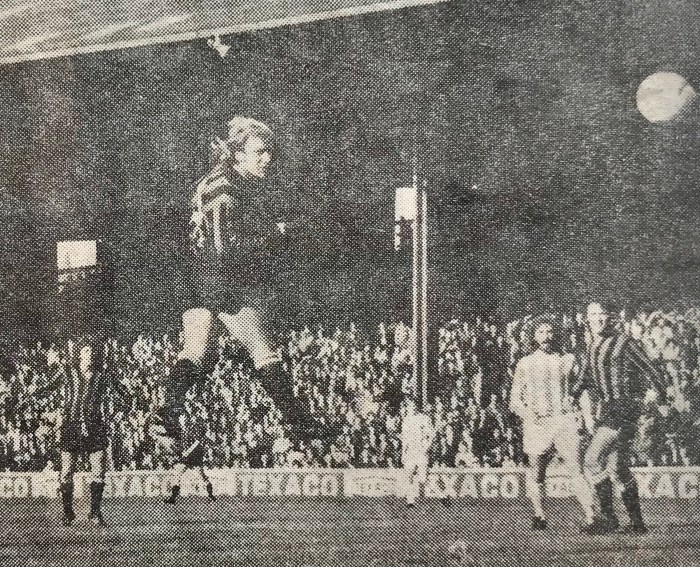
He scored (pictured above), along with Barry Bridges, in a 2-0 win at Huddersfield on 14 October but the team went on a disastrous run of 16 games without a win, although Spearritt did get on the scoresheet three times, including notching two penalties.

When Albion went to that footballing outpost Carlisle on 16 December, they had lost five in a row without managing a single goal. Carlisle were 5-0 up, goalkeeper Brian Powney was carried off with a broken nose, replaced between the sticks by Murray, then Albion won a penalty.

Spearritt took up the story in a subsequent matchday programme. “I used to be the club’s penalty taker but, after I had missed an important one at Mansfield in 1970, I lost the job. Penalty-taking is really all about confidence,” he said. “After I had missed that one at Mansfield, which cost us a point, the players lost confidence in me and the job went first to John Napier and was then taken over by Murray.

“Bert would have taken the penalty at Carlisle. He has already scored two this season. But he had gone in goal and it was decided it was too risky to fetch Bert out of goal to take the penalty.

“Nobody else seemed to want to take it so I just picked the ball up and put it on the spot. We were 5-0 down by then but I thought from a morale point of view that it was extremely important that I scored. You can understand my relief when I saw the ball hit the back of the net.

“Everybody was beginning to wonder when we would score again. I suppose with the run of bad luck we have been having it was almost inevitable that we should break our goal famine from the penalty spot.”

Towards the end of the dismal run, Albion drew First Division Chelsea at home in the third round of the FA Cup. The game was won 2-0 by Chelsea but it was an ugly, violent affair – The Argus labelled it ‘Goldstone day of shame’ – in which five players were booked and each side had a player sent off.

Spearritt, the first to be booked, found himself caught up in a huge controversy which resulted in Chelsea hard man Ron Harris being sent off by Leicester referee Peter Reeves; remarkably the only time in his career he was dismissed.

The Brighton man insisted he’d been hit by the defender and Saward said in diplomatic terms after the game: “Spearritt said he was struck on the mouth and that it was not an involuntary action but a blow. From what I saw, I couldn’t understand it.”

Esteemed football writer Norman Giller subsequently recorded it like this: “Harris got involved in a tussle with Spearritt, and, as he pushed him, Spearritt went down holding his face as if he had been punched. The referee directed Ron to an early bath. All the bones he had kicked, and here was Harris being sent off for a playground push.

“A Brighton-supporting vicar, with a pitchside view, wrote to the Football Association telling them what he had witnessed, and ‘Chopper’ was vindicated.”

Whatever the truth of the matter, Spearritt told Argus Albion reporter John Vinicombe that he’d been threatened by a Chelsea player after the incident. “He spoke to me several times and made it quite clear what he had in mind.”

Albion’s Ley was sent off for bringing down Tommy Baldwin and then getting involved in an altercation with Peter Osgood, who scored both Chelsea goals. Two minutes later David Webb went into the book for a ‘blatant foul’ on Spearritt.

Albion finally returned to winning ways the following month with a 2-0 win over Luton (on 10 February), and then beat Huddersfield, Carlisle and Swindon, prompting Saward to refer to “some outstanding individual performances” and adding: “I have been particularly pleased with the way Eddie Spearritt has been playing in recent weeks.

“He has maintained a high level of consistency this season and his work in defence and in midfield has been invaluable as the side has plugged away trying to turn the tide of results.”

Saward made Spearritt Albion’s captain at the start of the 1973-74 season back in Division Three and with the return of central defender Ian Goodwin and then the emergence of Piper in the sweeping role, he was soon back in midfield.

But when Saward was sacked in October and sensationally replaced by former Derby County League title winning management duo Brian Clough and Peter Taylor, Spearritt was one of the first to have his nose put out of joint by the new arrivals.

Journalist Spencer Vignes described what happened in Bloody Southerners (Biteback Publishing, 2018), his excellent book about that era.

Clough sought out long-serving centre back Norman Gall and, because he hailed from the same part of the country (ie the north east), told him he was making him the captain. Gall told Vignes: “Suddenly I’m captain, which I was really happy about. Eddie Spearritt didn’t like it though. He’d been captain up until then. In fact, he didn’t talk to me after that. That was the beginning of the end for Eddie.”

Spearritt was part of the side who capitulated 4-0, 8-2 and 4-1 in successive games against Walton & Hersham, Bristol Rovers and Tranmere Rovers, and he was dropped for six games, along with Ley (who never played for Albion again). Clough went into the transfer market and brought in midfielder Ronnie Welch and left back Harry Wilson from Burnley.

Although Spearritt was restored to the team in mid January, and had a run of seven games — including his 200th league game for Albion — when he was subbed off in a home win over Hereford United on 10 March 1974, it was to be his last appearance in an Albion shirt.

In five years he’d played 225 games (plus seven as sub) and scored 25 goals.

Come the end of the season, Spearritt was one of 12 players released by the club in what became known as the great Clough clear-out.

Perhaps surprisingly, though, his next step was UP two divisions to play in the First Division with then newly promoted Carlisle United.

One of his teammates there was defender Graham Winstanley, who later joined the Albion. The side was captained by Chris Balderstone, who was also a top cricketer. Journeyman striker Hugh McIlmoyle played up front while John Gorman, who later played for Spurs and became Glenn Hoddle’s managerial sidekick, was also in the team.

They memorably topped the division after three games…but predictably finished bottom of the pile by the end. In his two-year stay with the Cumbrians, Spearritt played 29 times, was sub twice and scored a single goal.

He moved back south in August 1976, signed by Gerry Summers at Gillingham, and made his debut in a League Cup first round second leg tie against Aldershot, then made his league debut against Reading.

In total, he made 22 appearances in his one season at the club — one of them at the Goldstone Ground on December 29 1976, when the Albion won 2-0 on a slippery, snow-covered pitch. Spearritt scored just the once for the Gills, from the penalty spot against Rotherham United at Priestfield.

He emigrated to Australia the following summer and settled in Brisbane where he played 56 games for the Brisbane Lions between 1977 and 1980 and was their head coach in 1979. He subsequently coached Rochedale Rovers in the Brisbane Intermediate League, steering them to promotion to the Premier League in 1983.

Outside of football, he became estates manager for L’Oréal and in later years was better known as the uncle of Hannah Spearritt, once of the pop group S Club 7, who became an actress in the ITV drama Primevil.

O’Cearuill treated cruel on strange football odyssey

O’Cearuill given a run of games at Brighton

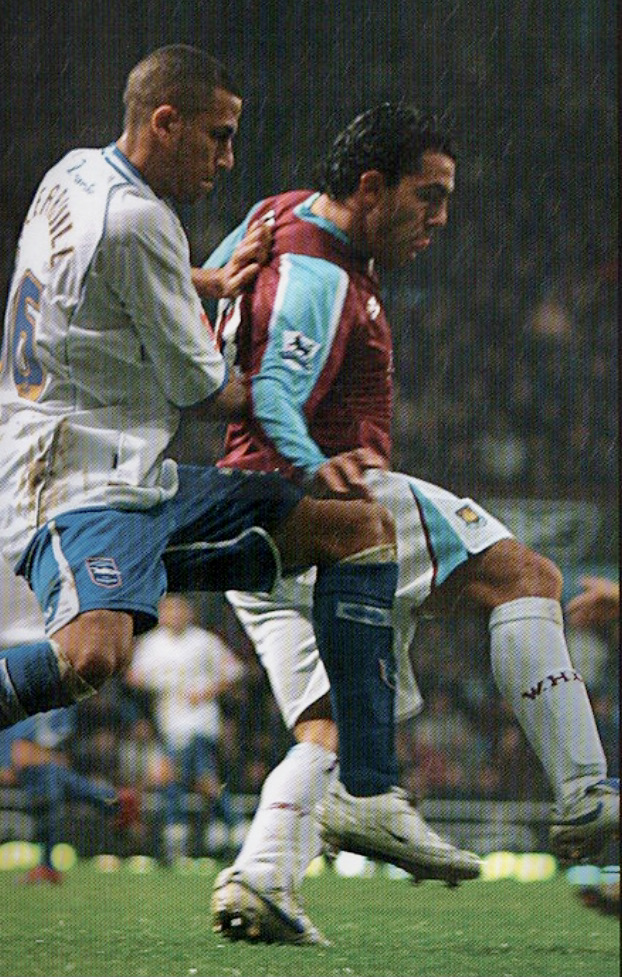
TEENAGE Arsenal defender Joe O’Cearuill certainly had a baptism of fire when he moved to the Albion on loan in early 2007.

The youngster was played out of position at right-back in a third round FA Cup tie away to West Ham.

The match at the old Boleyn Ground on 6 January 2007 pitched the Premier League Hammers under Alan Curbishley up against his old Seagulls teammate Dean Wilkins, who had taken over the reigns at League One Brighton just four months previously.

West Ham, FA Cup finalists the previous season, were just too good for the mainly young lower league side on the day and, with big-money Argentine striker Carlos Tevez up front, comfortably won the tie 3-0 (Mark Noble, Carlton Cole and Haydn Mullins the scorers).

Albion put up a reasonable fight in a goalless first half although O’Cearuill was fortunate not to concede a penalty when he put in a clumsy challenge on debutant Luis Boa Morte which referee Mark Halsey chose not to penalise.

The second half was only four minutes old when Noble scored his first ever West Ham goal, Cole added a second nine minutes later before being replaced by former Albion favourite Bobby Zamora, and Mullins struck in injury time to round off the win.

Wilkins had turned to the Arsenal youngster when Jack Hinshelwood’s dad Adam suffered a cruciate ligament injury in a Boxing Day match against Yeovil that ruled him out for nine months.

O’Cearuill’s stay on the south coast lasted three months during which he made seven starts and three sub appearances. His final Seagulls match came in a 1-1 home draw against Scunthorpe United.

The Argus reckoned his form was “patchy” and at one point he was dropped to the bench “after a below-par performance” in defeat at Brentford.

Only on a couple of occasions did he get the chance to play in his favoured centre back position; those positions were occupied most of the time by Joel Lynch and Guy Butters.

But after he’d gone on for the injured Lynch in the centre away to Gillingham, he helped the visitors to a 1-0 win and Wilkins said: “I thought he fitted in well. He went into the game at a difficult period. There were a lot of high balls to deal with, which he coped with well.”

That first half of 2007 was pretty much the highlight of his career because on an end of season tour of America he won two full caps for the Republic of Ireland.

Although born in Edmonton on 9 February 1987, he elected to represent the Republic of Ireland and having played for them at under-17, under-19 and under-21 level,

A senior cap for the Republic of Ireland

His first senior cap came when he was one of six substitutes made by manager Steve Staunton in a 1-1 draw against Ecuador at the Giants Stadium, New Jersey, on 23 May 2007.

He replaced Stephen O’Halloran in the 73rd minute and managed to pick up a yellow card in his short time on the pitch. Kevin Doyle headed the Irish equaliser a minute before half time.

O’Cearuill then started at right-back three days later in the Republic’s 1-1 draw with Bolivia in Boston. Shane Long scored his first goal for his country and in the second half former Albion goalkeeper Wayne Henderson took over in goal from Barnsley’s Nick Colgan. The side was captained by Kevin Kilbane.

Curiously, O’Cearuill had been let go by both Leyton Orient and Watford before he was given a chance by Arsenal. He played 27 youth team games for the Os in 2004-05 but was released in August 2005.

Watford picked him up and he played for their youth and reserve teams for a season, but again found himself released. Then, in the summer of 2006, after impressing Arsenal’s reserve team coach Neil Banfield in a trial game against Watford, he joined the Gunners.

He made his debut in a goalless pre-season friendly at Barnet on 15 July and a week later played in half of Dennis Bergkamp’s testimonial against Ajax of Amsterdam.

On a tour of Austria, he played another half as Arsenal beat Mattersburg 2-1 and got 30 minutes as a sub when the Gunners trounced Schwadorf 8-1.

The closest he came to competitive first team action was when he was on the bench for Arsenal’s Carling Cup match away to West Bromwich Albion on October 24, 2006, although he did not get on in the 2-0 win in which Jeremie Aliadiere scored both the goals.

Released by Arsenal, O’Cearuill’s career then drifted from one non-league club to another: Barnet, St Patrick’s Athletic (Dublin), Harlow Town, Borehamwood, Forest Green Rovers (pictured left), Bishop’s Stortford, Tooting & Mitcham United, Haringey Borough, Enfield and Heybridge Swifts.

When he sought to resurrect his career with Conference Premier side Dover Athletic in 2015, he was suitably phlegmatic in an interview with Kent Online.

“It’s certainly been a journey,” he said. “From getting everything on a plate at Arsenal and then for Ireland, to then be washing your own kit and boots.

“I took being a professional for granted and I wasn’t really ready for it – I was too young to take it all in.

“When Arsenal released me, I discovered there was a lot more to life than playing football and I lost the motivation to play at a decent level. I even gave the game up for a while.

“I was then happy to play wherever and go with the flow. I had a couple of great years playing with my mates at Haringey Borough. But that’s all in the past now. The days for playing for fun are behind me.

“I am ready for the next chapter in my life because I’ve got the hunger and desire back to play the game at a level I know I am capable of.”

Released by Dover at the end of the season, former Albion striker Nicky Forster, by then manager of Staines Town, took him on for the Isthmian League Premier Division team.

“We are delighted to have secured the services of Joe this season, he has a great attitude for success and will sit well alongside Darren Purse at the back,” he told the club website.

His last port of call was back at Haringey in the summer of 2016 and he retired from playing in October that year.

In his LinkedIn profile, O’Cearuill describes himself as a senior manager for The Elms Sport in Schools programme.

Pace and panache of marauding left-back Pervis Estupiñán

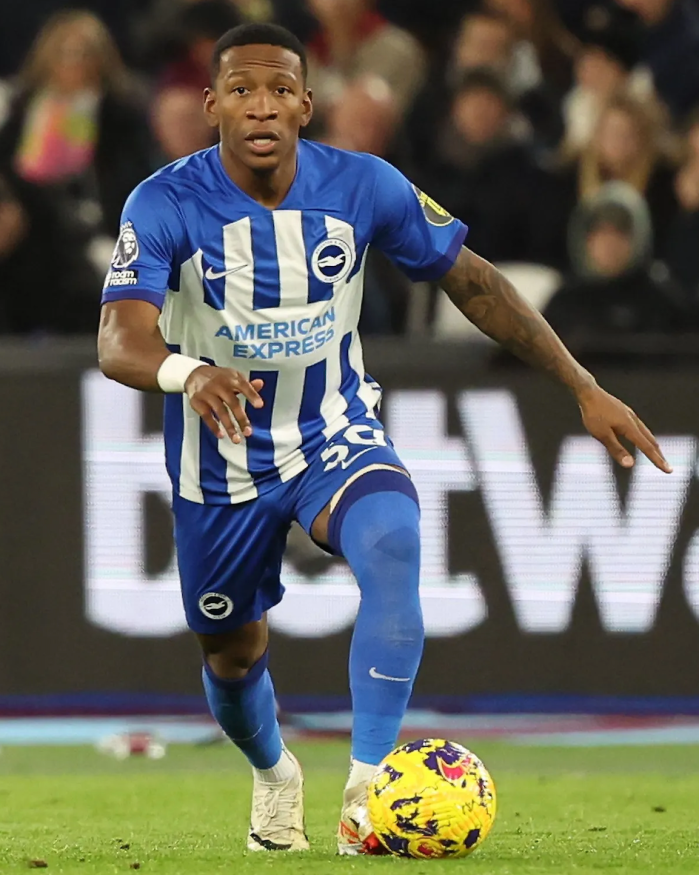
ECUADOR international Pervis Estupiñán stepped comfortably into the boots of Marc Cucurella when Albion signed him from Villarreal in the summer of 2022.

Rampaging runs down the left wing, pinpoint crosses and the occasional spectacular goal unleashed from distance all endeared the player to the Albion faithful.

A terrific goal he scored away to Crystal Palace in February 2023 was ruled out by VAR – and to compound the injustice, the referees body PGMOL subsequently admitted the strike had mistakenly been ruled out when John Brooks drew the offside line against the wrong Palace player.

“I was very sad about that disallowed goal because I don’t score a lot,” Estupiñán said later. “I remember it was a very equal game, but we played well.” The game finished 1-1.

One that did count, though, sealed Albion’s impressive 3-0 win away to Arsenal on 14 May 2023.

It was a fitting end to what was an impressive first season with the Seagulls during which he made 35 starts and six appearances off the bench.

His performances as the straightforward replacement for the previous season’s player of the year meant Albion could glow in the warmth of having trousered £62m for Cucurella and replaced him with a top quality defender for whom they paid £14.9m.

After he had scored his second goal for the Seagulls in a 4-1 win at Wolves at the beginning of the 2023-24 season, Brighton manager Roberto De Zerbi said he believed the defender had the potential to become one of the best left-backs in the world if he continued to improve his first touch and his passing.

“Pervis is one of the most crucial players for us because he started from left-back, but you can find him in a striker position,” he said. “He’s very smart, he’s one of our secrets I think.”

Praising Albion’s recruitment department for “yet again delivering another masterstroke” in signing Estupiñán, The Professional Football Scouts Association declared: “Full of determination, tenacity, energy and running power, his impact has been felt heavily on both ends of the pitch, as his all-round contribution has been a major asset for Roberto De Zerbi’s Seagulls.

“While his defensive work has been solid, with him feisty in his duels, aggressive in the press, good at tracking runners and positionally sound, it’s been his offensive impact that’s really caught the eye.”

The organisation talked about his “devastating and varied movement” and highlighted the way he dovetailed with Kaoru Mitoma in front of him. “The pair’s astute interchanges and ability to create space for each other by drawing or pinning adversaries has been a joy to watch,” it said.

“Be it making headway with wicked infield underlapping runs, blistering overlaps or making room for his colleagues by acting as a decoy, his movement has been a huge source of inspiration going forward for Brighton.”

Brighton certainly felt his loss with a muscle injury over the course of several months in the 2023-24 season, with The Athletic maintaining: “None of the replacements who tried to fill the void created by his absence possess the adventurous Estupiñán’s blend of athleticism, power and stamina.”

In a detailed analysis of his stats, the platform suggested in January 2024 that Estupiñán had a strong claim to be considered the best left back in the Premier League, comparing him favourably against Liverpool’s Andy Robertson, Man Utd’s Luke Shaw and Arsenal’s Oleksandr Zinchenko.

Although he scored two stunning goals (in a 4-2 home win over Spurs and a 4-2 win at Stoke City in the FA Cup) within a matter of nine days mid-season, too often on his return to the Albion side in the second half of the season, Estupiñán didn’t look anything like the player fans had enjoyed watching the previous campaign.

And then his season ended too early when he was subbed off in the first half of the 1-1 draw at Burnley in April with an ankle injury that subsequently required surgery, ruling him out of playing for his country in the Copa America summer competition.

De Zerbi reckoned Estupiñán would not be fit enough to start the new season and it remains to be seen when Albion fans might see him return to the starting line-up. In the meantime, another south American, Valentin Barco, has slotted into that position with aplomb.

Born in the coastal Ecuadorian city of Esmeraldas on 21 January 1998, Estupiñán’s footballing journey began aged 13 in the youth set up at Liga Deportiva Universitaria de Quito, in the country’s capital.

Given his professional debut shortly after his 17th birthday in 2015, he made 40 appearances in Ecuador’s top division and represented his country in the 2015 South American under-17 Championship and the FIFA under-17 World Cup. He was also given an early taste of international club competition in the Copa Sudamericana and the Copa Libertadores.

Not long after being selected in the best XI of the 2015 Ecuadorian Serie A season, Estupiñán joined the Pozzo-family-owned Watford, although he didn’t actually play a game for the Hornets in four years on their books. At the time, the Pozzos also owned Granada in Spain where Estupiñán spent the 2016-17 season on loan.

Subsequent season-long loans were also spent in Spain at Almeria, Mallorca and Osasuna, as detailed by Zach Lowy on breakingthelines.com.

It was said he would return to be part of Watford’s side for the 2020-21 season but their relegation from the Premier League led to him being sold instead.

In action for Villarreal

When Villarreal’s regular left-back Alberto Moreno was sidelined for six months after rupturing his ACL in pre-season, they signed Estupiñán for £15m to plug the gap. Lowy described him as “an athletic, technically sound left back who marauds up the flank with pace and panache and can deliver a deadly cross like few others”.

Lowy said Estupiñán excelled under Unai Emery as Villarreal finished seventh and won the Europa League for the first time in the club’s history (although Estupiñán was an unused substitute when they beat Manchester United on penalties in the final). He went on to make 74 appearances for them, including helping them to reach the semi-finals of the Champions League.

Having played at under 17 and under 20 levels for his country, Estupiñán made his first senior start for Ecuador in a 6-1 defeat to Argentina in 2019 but he went on the same year to play in that year’s Copa America when they reached the quarter finals and he played in all three Ecuador matches at the 2022 World Cup (together with fellow countrymen and Albion teammates Moises Caicedo and Jeremy Sarmiento).

Nicky Rust played more than 200 games then quit at 24

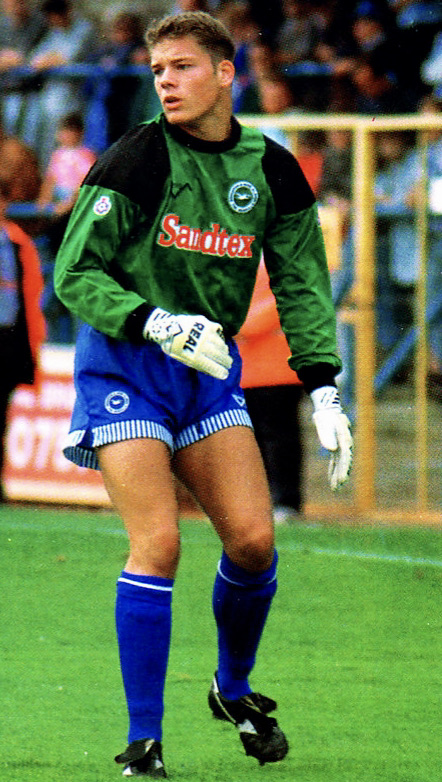
IT SEEMS extraordinary that a young goalkeeper who played more than 200 first-team games for Brighton quit the professional game at 24.

Nicky Rust had been one of the country’s elite young players when he graduated from the FA School of Excellence at Lilleshall. Then, at Arsenal, he was coached by the club’s legendary former ‘keeper Bob Wilson and trained alongside England international David Seaman.

But with little likelihood of 18-year-old Rust dislodging the established Seaman any time soon (and Alan Miller as back-up), Arsenal let him go in the spring of 1993. He ended up playing for five different managers in five years with the Albion.

Young Rust found himself picking the ball out of his net after only four minutes of his debut in Albion’s colours. That was on trial on 23 April 1993 away to Norwich City when Albion’s reserves, under Larry May, were looking for their first win in TWENTY attempts!

The Canaries included big money signing Efan Ekoku in their side and he opened the scoring before Rust had even had chance to break into a sweat.

However, a fairly strong Brighton side, including striker Andy Kennedy, returning to action after a back injury, Ian Chapman and Dean Wilkins, equalised with a Wilkins special: a 25-yard free kick that flew into the top corner past Mark Walton, a goalkeeper who would join Brighton five years later. Kennedy won it for the Albion with a cool finish past Walton in the last minute of the game.

Rust’s arrival was as a direct replacement for Mark Beeney, whose £350,000 move to Leeds three days previously had quite literally saved the club from going under (all the money went to pay an overdue tax bill with the Inland Revenue threatening to wind up the Albion).

By the time the summer came round, cash-strapped Albion also let go long-serving ‘keeper Perry Digweed, who’d been with the club for 12 years. So Rust, still only 18, suddenly found himself first choice at the start of the new season.

“I was thrown in the deep end and didn’t have time to think about nerves,” Rust told the Argus in a 2002 interview. “Barry Lloyd brought me in. Obviously, like any youngster, I had aspirations of making it in the Premiership.”

Arsenal boss George Graham was a former teammate of Lloyd’s going back to their days together at Chelsea and that friendship had already helped Albion obtain the services of defender Colin Pates on loan two years earlier (Pates also made a permanent move to the Albion that summer).

“Arsenal were and are a big club,” said Rust. “I had Bob Wilson as a goalkeeping coach and David Seaman was there offering me a lot of good, sound advice. He was a bit like myself in temperament, laid back, and we got on very well. But unfortunately for me it didn’t work out, and I was released. I was pleased Albion wanted me.”

Albion lost their opening two games, 2-0 at Bradford City in the league and 1-0 at Gillingham in the League Cup but two wins and a draw followed. While the side’s subsequent poor form ultimately led to the end of Lloyd’s reign, Rust kept his place when Liam Brady took over and was Albion’s regular no.1 for the next four years, much of which was played out against huge turbulence off the pitch.

“There was a lot of turmoil when I was there and saving our league status was a huge relief and was, in a strange way, one of my highlights,” he said. “The club’s problems were constantly there in the background and we were getting headlines for all the wrong reasons.”

On the pitch, Rust only missed two games in his first three years at the Albion. He equalled a club record for clean sheets with five on the bounce across February and March 1995.

The young goalkeeper had his own place in Portslade and also proved to be something of a landlord for other young players. He welcomed to his home temporarily during their loan spells former Arsenal teammates Mark Flatts and Paul Dickov and, longer term, striker Junior McDougald who had been at Lilleshall at the same time.

“Even though he was ex-Spurs and I was an ex-Gunner we got on really well,” he said. “We came from similar areas. I was from Cambridgeshire and he was from Huntingdonshire.”

Rust played his 100th league game for the Albion away to Bournemouth the day before he celebrated his 21st birthday on 25 September 1995. Teammate Steve Foster celebrated his 38th birthday on the day of the game, which Brighton lost 3-1. “Fozzie was a big influence in the dressing room,” Rust remembered. “He was highly respected and one of the loud characters. I certainly got my ear bent.”

Rust’s 210 games for Albion place him eighth in the list of longest-serving goalkeepers in the club’s entire history. But an injury and loss of form in the 1996-97 season led to him losing his place to local lad Mark Ormerod, who had started the season and was in goal for the final six matches when Albion only just survived dropping out of the league.

Rust had to play a waiting game as Ormerod continued as first choice at the start of the 1997-98 season. Unluckily for him, his chance of returning to the starting XI coincided with his partner having their first child. In November 1997, after only two wins in 15 matches, manager Steve Gritt was planning to rest Ormerod and reinstate Rust for an away game at Hull City.

But Rust’s pregnant partner went into labour and he dashed to be with her for the birth. Typically, Ormerod kept the first away clean sheet Albion had managed for TWENTY months and when he repeated the feat the following Saturday at Hartlepool, they were the first successive clean sheets since Rust’s run of five in March 1995!

Rust had to wait another fortnight, after Ormerod had been beaten twice in a defeat at home to Rotherham, before finally getting his chance to return to first-team duties.

Before long he demonstrated what he was capable of in a game close to home territory, at Peterborough United on 28 December 1997.

Albion were under severe pressure but held on for a 2-1 win and Gritt said: “We showed a great deal of fighting spirit and commitment to overcome their attacks and, on the day, had Nicky Rust in superb form to keep them out when they got through our last line of defence.”

The game was marred by young Darragh Ryan breaking a leg but Jeff Minton celebrated his 24th birthday by scoring Albion’s first goal and substitute Robbie Reinelt added Albion’s second – the first goal he’d scored since that all-important equaliser in the last game of the previous season at Hereford.

It came halfway through a run of 17 league games Rust played that season, the last of which (a 2-0 defeat at Exeter City) coincided with Gritt’s last game in charge.

New boss Brian Horton went with Ormerod and Rust had to watch on from the sidelines, although he did prove quite adept at offering his opinion on matches when drafted in as a summariser for South Coast Radio coverage of games.

The matchday programme noted he had been “doing an excellent job with his inside knowledge whilst, at the same time, earning the respect of his fellow players whose loved ones have been listening at home”.

While admitting he’d rather have been playing, Rust said he enjoyed the commentary banter. “His perception of the game and sense of humour have certainly come through on the air; they have received many favourable comments from listeners,” the programme noted.

However, disillusioned with life as an understudy, Rust chose to leave the Seagulls at the end of that season.

“I had got used to being No.1, but I wasn’t complacent and worked hard to get back in,” he told the Argus. “But it wasn’t the best of times for me.

“Brian Horton called me in one day and said: ‘You’re not in the team, how are you feeling?’ I said I thought I needed a new challenge. He told me not to rush into anything and I waited until the end of the season when I still felt the same way. It was very amicable.”

However, the grass definitely wasn’t greener on the other side. He spent pre-season with Orient but didn’t get taken on and moved to Barnet instead.

On his debut for Barnet, he picked the ball out the back of his net NINE times as the ‘keeper’s new club went down 9-1 at home to Peterborough, the cause not being helped by two Barnet players being sent off, one as early as the ninth minute.

After only two games for Barnet, Rust switched to Conference side Farnborough Town (where former Albion defender Wayne Stemp was playing at the time).

“The trouble was that the only contract Barnet could afford, because of limited finances, was just not enough,” Rust told the Argus. “It just wasn’t viable for me to sign it. I had a young family, my partner Clare, a childhood sweetheart by the way, and baby daughter Eloise to consider. Quite simply, the family came first. I wasn’t prepared to put them at risk by being selfish.” They later had a son, Harrison.

Rust chose to quit the full-time game and went on to run his own building business.

“A lot of goalkeepers go on forever but, in my case, I thought, at 24, that I ought to go out and get a proper job,” he said. “I don’t regret it for a moment.”

He went on to play non-league closer to home with Cambridge City and later helped out with once-a-week goalkeeper coaching.

Born in Ely, Cambridgeshire, on 25 September 1974, his father Alistair was a policeman in Great Shelford, just south of Cambridge, and his mother Corinne ran her own curtain making business. Rust was one of five children: there were three brothers (James, Philip and Thomas) and a sister (Francesca).

From Swavesey Primary School he moved on to Sawston Village College and the promising youngster was chosen for the Cambridgeshire and East Anglia representative sides.

He then gained a place at the FA School of Excellence at Lilleshall. Apart from McDougald, other contemporaries were Kevin Sharp and Jamie Forrester from Leeds United and Tottenham’s Sol Campbell, Danny Hill and Andy Turner.

Rust had trials at Tottenham and Luton Town, and Manchester United showed some interest, but he chose Arsenal as an associated schoolboy. It was the summer of 1991 when he joined them on a full-time basis as a YTS trainee.

The young ‘keeper played for England at under 15, under 16 and under 18 level and after joining the Albion was at one point put on standby for England under 21s.

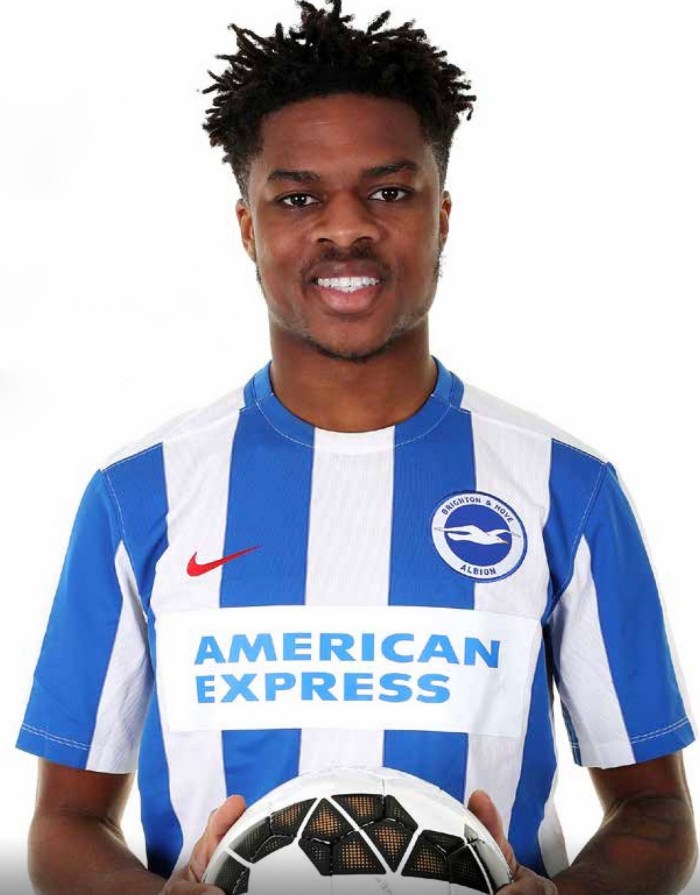
Chuba Akpom’s watching brief in Albion’s promotion

AFTER Chuba Akpom finally made his mark on England’s Championship, he earned a €14m move to Ajax where he initially struggled to make an impact.

But three goals in two wins after new manager John van’t Schip sent him on as a substitute made life look a lot better.

The forward got 28 goals in helping Middlesbrough to the Championship play-offs in 2022-23 but the move to Ajax began badly and he had few chances as the side struggled under former coach Maurice Steijn.

“It was a terrible first two months here if I am being honest,” Akpom told AFC Ajax. “The new manager has made me feel more at home than I have ever felt since arriving. We are footballers, we are human beings first.

“He spoke to me as a human being, not as a footballer. Ever since the new manager arrived, I feel much lighter, back to myself.”

The early season form sounded a lot like the unhappy spell when he was on loan to Brighton from Arsenal in 2017.

Akpom spent 16 years at Arsenal and one of his major inspirations was Tottenham Hotspur’s Chris Hughton, who took him on loan at Brighton. Hughton had been to the same inner city school, St Bonaventure’s in Newham, as the young striker from Canning Town and in an Andy Naylor exclusive for the Argus, Akpom revealed: “When I was in school there used to be pictures of the gaffer there.

“The kids used him like an inspiration and motivation. I did as well. Seeing someone come from the same area and the same school as me to become such a big and successful person.”

But the alma mater link did little to help the Arsenal loanee – in spite of high hopes when he signed in early 2017, Hughton gave him only one start and the rest of his involvement was as a substitute.

“He is a young talent who gained valuable experience with Hull in the Championship last season, will give us really good pace in the forward areas and complement the other strikers at the club,” said Hughton.

“We fought off competition from other clubs to sign Chuba and we would like to thank Arsenal for the opportunity of working with him for the rest of the season.”

Akpom was in effect a replacement for Dutch flop Elvis Manu, who left the building on loan to Huddersfield after a disappointing five months on the south coast.

It was to his disadvantage, though, that he joined the club at a time when Glenn Murray, Tomer Hemed and Sam Baldock were the preferred forward options, and, from the outset,he was aware of the challenge they posed.

“All three are experienced players; they know the Championship and they’ve shown what they can do with the goals they’ve scored, so it’s going to be good to learn from them,” he told the matchday programme.

“I’m going to be an addition to what we’ve already got here. We’ve all got something different to offer and I like to play at a fast intensity, try to get at defenders and get some shots off – basically be as much of a threat as I can. I’m also a team player, which is important.”

As it turned out, the young loanee’s only start was against Blackburn Rovers, on April Fool’s Day, and he was hooked on 58 minutes, with Hemed going on his place. Murray won it for the Seagulls with the only goal of the game nine minutes later netting past Jason Steele in the Rovers goal.

Akpom made nine appearances off the bench but he didn’t manage to get on the scoresheet. He made his debut as a 63rd minute sub for Hemed in the 3-1 defeat at Huddersfield on 2 February and replaced Jamie Murphy in the next match, when fellow substitute Hemed netted a last-gasp equaliser in a 3-3 draw at Brentford.  

“I know the Championship is a tough, tough league to play in,” he told the programme. “It’s really competitive and unpredictable, so you’ve got to get your head down and take each game as it comes.

“The team’s been flying high at the top of the league this season so you can see they’ve got the winning mentality in this league, and they’re playing the right kind of football, so I just want to be a positive addition to the team and help boost the bid for promotion.”

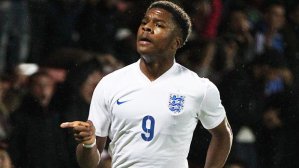
Akpom’s arrival at the Amex promised so much more, because he had already scored four goals at the stadium in previous matches: he scored a hat-trick for Arsenal’s under-21 side there and scored for England under 21 in a win over Switzerland in October 2015.

“I like playing here,” he told the programme. “The stadium’s nice, the pitch is great as well, so you can’t complain.

“It’s always good to score goals, no matter who it’s against, but hopefully I can now score a few goals here for Brighton.”

Even though his involvement in Albion’s promotion was peripheral, the club’s automatic elevation to the Premier League as runners up behind Newcastle meant he’d gone one better than the previous season when he’d been part of Hull City’s promotion via the play-offs.

That had been his fourth loan experience having previously gone on temporary moves to Brentford, Coventry City and Nottingham Forest.

Born in Canning Town on 9 October 1995, Akpom was playing football on local streets from the age of five but soon moved on to the Wanstead Flats, where he played for Rippleway United. An Arsenal scout spotted him at the tender age of six.

“I had a few training sessions for Arsenal and then signed for the club. I’ve been there ever since,” he told the programme. His best friend, who was developing alongside him, was Alex Iwobi, who also made it through to the Arsenal first team before moving on to Everton.

Akpom made his senior debut for the Gunners as a late substitute in a 3-1 win away to Sunderland in September 2013 (the match when Mezut Ozil made his debut).

The young striker went on to make a further nine first team appearances (mostly in the FA Cup and League Cup) but couldn’t claim a regular starting place under Arsene Wenger.

Akpom returned to Arsenal as Albion prepared for life in the Premier League and the following January made another loan move, linking up with Belgian First Division side Sint-Truiden on transfer deadline day in January 2018. He scored six goals in 16 games.

His association with Arsenal finally came to an end that summer when he signed a three-year contract with Greek Super League club PAOK Salonika.

Akpom told the BBC he consulted former Arsenal teammate Lucas Perez before moving to the club, based in Greece’s second largest city of Thessaloniki, and by the season’s end he had helped them win their first league title in 34 years.

“Perez said that I wouldn’t want to leave PAOK if I signed,” he said. “Thessaloniki is a beautiful city by the sea, the people are friendly, the climate is nice and, when I’m not training, I’m sometimes able to go to nearby beaches.

“I’m living in an apartment about 10 minutes from the ground and I drive along the coast to training.”

In May 2019, Akpom was the delighted but emotional scorer of the winning goal for PAOK in the Greek Cup as they beat AEK Athens.

After scoring 18 goals in two years for the Greek side, Akpom returned to the UK to sign for Neil Warnock at Middlesbrough, the effervescent Warnock declaring: “I’m delighted to finally have got him. He’s been my number one choice. I’ve wanted him for a long time.”

The deal gave Arsenal an unexpected £1m windfall because they had inserted a clause into the contract when the striker was sold to PAOK Salonika stipulating they would be entitled to 40 per cent of any fee if he was sold back to an English club.

Such an arrangement was frowned on by the football authorities and earned a fine and censure from FIFA, but Arsenal challenged that decision and got it overturned on an appeal to the Court of Arbitration for Sport.

Although Akpom scored on his Boro debut to secure a 1-1 draw at QPR and followed it up with a goal in his second game, a 2-1 home win over Barnsley, he went on to score just five in 40 appearances and in August 2021 returned to PAOK on loan.

The manager castigated the club’s recruitment team for having signed the player on the strength of watching videos, saying: “We really have to go into everything a bit more when we’re looking to sign players. I don’t think we’ll be signing another player on the recruitment (team’s) say after just watching a video, we need to watch players live.”

Warnock was typically forthright when asked why it didn’t work out for Akpom on Teesside, telling BBC Tees: “I think it’s a mixture of things. I think at the end of the day he didn’t show enough during the games to warrant him getting a place and you have to play games to get yourself fit.

“I never really thought he deserved a run of games because whenever I used him he didn’t perform and it’s one of those things.

“When I spoke to him we all agreed it’s best to go and I think he’s quite happy to go back there.”

Akpom had been expected to leave Boro in the summer of 2022 after returning from his loan in Greece, as Warnock’s successor Chris Wilder looked for other forward options.

But he impressed the boss in pre-season and started in their first game against West Brom, and again when coming off the bench in a defeat at QPR.

“It’s no secret that people would probably have thought I’d be gone by now, and maybe me too,” Akpom told BBC Tees. “It has been a rocky few months for me, which is no secret.

“I don’t know what the future holds. I just have the mentality of staying professional and enjoying it. Who knows what tomorrow brings?”

After Akpom scored both Boro goals in a 2-2 home draw with Sheffield United, Wilder said he was keen for Akpom to remain part of his squad.

“He’ll rightly get the plaudits. For him to come back into the group and show a great attitude… He’s just done an interview and said it’s one day at a time but for me it isn’t that unless he wants it to be, and I don’t think he does,” Wilder said.

“It’s his job to convince me that he wants to stay at this brilliant football club and he’s done enough. He has to keep going of course but we’ve all seen enough that he sees his medium to long-term future here. We’re delighted to have him here.”

In a quite extraordinary turnround in fortune for the player, he scored 28 goals in 38 games for Boro in the 2022-23 season, ending a 33-year wait for a striker who could score more than 20 goals in a season.

gazettelive.co.uk said of him: “He has gone from also-ran to one of the most feared strikers in the league.”

Comparing his goalscoring prowess to the likes of former Boro heroes like Brian Clough, John Hickton and John O’Rourke, the newspaper said: “Akpom has shown what any decent player can achieve if they stay fully focused.

“He already looked a different player before the arrival of Michael Carrick but has since climbed another few rungs up the ladder.”

Reporter Eric Paylor wrote: “The marvellous thing about Akpom’s goal sprint is that we didn’t see it coming. Two years ago he looked a very ordinary striker indeed.

“He managed to sneak into the side this season only as an afterthought, because Chris Wilder was short of strikers. So it’s to his eternal credit that Akpom has grabbed the nettle and shown what a massive threat he is in the box.”

When Carrick succeeded Wilder, he selected Akpom in a no.10 role rather than as an out and out centre forward, and it paid off.

Carrick told gazettelive.co.uk: “You go on your eye, your instincts, how well he takes the ball, how fluid he is moving with the ball in a bit of space. Technically coming through the ranks at Arsenal he’s had that foundation. I just wanted to free him up a little bit and play to his strengths. Thankfully he’s been able to do that. I think it suits him.

“It’s difficult for me to speak about the turnaround because I don’t know how he was playing before that before I came through the door.

“Certainly, from my first training session and the games leading up to me taking over, I saw encouraging signs from him. I said it from the start, we have tried to play to the strengths of our players and put them in positions that benefit them and the team. Chuba is definitely one of them. He’s found his role and he’s suited it; he’s doing great.”

Akpom himself said: “I wish I’d been playing in a deeper role throughout the whole of my career! I’m enjoying it.

“Playing in a nine previously helps me with my movement up top and with my back to goal, but I feel like coming to feet is when you can see the real me – getting on the half turn, playing one-twos, connecting the play and dribbling – this is what my game is all about.”

Over in Holland, Akpom struggled to get a starting place as Ajax found themselves at the wrong end of the Eredivisie.

After the departure of Steijn as Ajax coach, Akpom made a brief appearance as a sub when the Amsterdam side lost 2-0 to Albion in the first leg of their Europa League tie in October 2023 under caretaker boss Hedwiges Maduro.

But in Schip’s first Eredivisie game against Volendam, Akpom was sent on and scored in a 2-0 win.

He went one better against Heerenveen, joining the action off the bench again and this time scoring twice in a 4-1 win for Ajax.

In January 2025, Akpom secured a loan move to French side Lille, who secured a place in the last 16 of the Champions League after thumping Feyenoord 6-1.

David Livermore was no stranger to yellow and red cards

DAVID LIVERMORE was one of those signings Brighton fans had a good feeling about, only to be disappointed with the outcome.

Here was a player who had learned his craft over 10 years as a youngster at Arsenal and, at 28, had played most of his career at second tier level.

So, when Micky Adams got him on a free transfer from Hull City for League One Albion in the summer of 2008, the signs were encouraging.

“David is an experienced midfield player who has played most of his football in the Championship,” Adams said. “He’s a versatile player who can play in midfield, left wing and left back, and he’s another quality signing.”

Maybe it was that versatility that counted against him, but by the turn of the year he’d only made 13 starts and had picked up so many bookings that he had to serve a suspension.

Perhaps the writing was already on the wall. “Suspension and the midfielder more often than not went hand in hand – his passion, commitment and tough-tackling nature meant that the former Arsenal trainee picked up a huge 86 yellow cards and 3 reds in his Lions career,” Millwall fan Mark Litchfield wrote in a profile on newsatden.co.uk.

The player’s frustration was revealed in an Argus interview with Andy Naylor, who said: “Livermore is an ‘old school’ player, more comfortable with an era when crunching challenges were greeted matter-of-factly by opponents and with no more than a quiet word from officialdom, rather than the modern malaise of writhing opponents and card-happy refereeing.”

Livermore told the reporter: “It’s the way things are now, suspensions are part and parcel of the game. I am someone that likes a tackle and, unfortunately, I’ve got six bookings now.

“The game has changed a lot. The referee was threatening to send me off at the weekend and I only gave away two fouls in the whole game. I think the tackle is slowly being erased.”

After the suspension, Livermore struggled to regain a place in the squad and he wrecked the opportunity of a rare start in the Johnstone’s Paint Trophy when he was sent off for a bad foul in the semi-final at Luton Town. Albion clung on to a 1-1 draw but losing on penalties meant they were denied a trip to Wembley for the final against Scunthorpe.

That disappointment proved to be the final straw for the Adams reign, although being four places off the bottom of the table didn’t look pretty either.

Livermore went on as a sub in Adams’ successor Russell Slade’s first game in charge, a 2-1 defeat at Leyton Orient, and got a start in a home 5-0 win over the manager’s previous club, Yeovil.

He then started at left-back in a 3-0 defeat away to Walsall three days later, but was subbed off at half-time, and his replacement, loanee Gary Borrowdale, was Slade’s preference in that position for the rest of the season. Livermore was sent on loan, ironically to Luton.

But he had penned a two-year deal when signing the previous summer so he was back at Brighton for the 2009-10 season. He warmed the bench nine times in the first half of 2009-10 but only saw action once, going on as a sub for Andrew Whing in a 1-0 defeat at Orient in the JPT.

The arrival of Gus Poyet as manager didn’t help his cause either and eventually there was a mutual parting of the ways in February 2010. It felt very much like a case of what might have been, and the player himself gave a very honest assessment of his time with the Albion in an interview with the Argus.

“I am disappointed I have not fulfilled the expectations of supporters and probably myself,” he said. “I’ve played the majority of my career in the Championship. I started off at Arsenal and went to Millwall in League One, adapted to that and got promoted and had six or seven seasons in the Championship.

“I’m not saying I thought it would be easy coming to Brighton but I thought I would be able to do as well as at my other clubs.”

He said Albion was “a fantastic club” and he enjoyed the team spirit and friendliness of the squad, admitting: “It hasn’t worked out how I expected but I’ve enjoyed my time there.”

Livermore reckoned it was the money he was on at Brighton that put off other sides from taking him on loan. The ending of his contract gave him free agent status, which meant he was able to organise a short-term deal at Barnet.

It obviously hit the player hard to realise his playing days were coming to an end after Barnet released him at the end of the season.

He told the Cambridge Evening News: “I’d dropped through the leagues, from Championship to bottom of League Two in a couple of seasons.

“I knew I had to make a decision. I even qualified as a personal trainer – I don’t know what I was thinking.

“From a playing point of view, I fell out of love with the game. Part of me said just stop and get a job – deliver the post or something, just get a normal job, provide for your family and enjoy your life.”

He was rescued by the offer to manage non-league Histon, and he told the newspaper. “The Histon job came up and I took it and fell back in love with the game from a coaching point of view. I was very lucky that opportunity came up at the time.”

Born on 20 May 1980, in Edmonton, north London, Livermore grew up as a Spurs supporter and was taken on by them at the tender age of seven! But frustrated at just being asked to train, rather than play games, he switched to Arsenal and was on their books for a decade.

He was on a two-year YTS scheme before turning professional but had to move to Millwall, aged 19, to get a breakthrough in the game.

Livermore had been in the same Arsenal youth side as Ashley Cole, and played five games for the Gunners reserve team in the 1997-98 season, when Matthew Wicks and Matt Upson were regulars, scoring once in a 1-1 draw against Tottenham on 17 March 1998. In a pre-season friendly at Enfield on 18 July 1998, he went on an as substitute for 23 minutes but that was the extent of his first team involvement. He made 11 appearances plus two as a sub for the reserves in the 1998-99 season, before leaving the club.

He joined on loan initially making his Millwall debut on the opening day of the 1999-00 season at Cardiff City in a 1-1 draw that hit the headlines for fan clashes rather than the football. It took joint bosses Keith Stevens and Alan McLeary only four matches to convert the loan into a permanent transfer, and Livermore was signed for £30,000.

Football history books reveal Livermore as the scorer of the final football league goal of the 20th century: an injury-time winner against Brentford on December 28, 1999. It happened to be the first of his goals for Millwall and he made 34 appearances that season.

After the disappointment of losing a play-off semi-final to Wigan Athletic in 2000, Livermore was able to savour promotion from League Two as champions under Mark McGhee in 2001; he played 39 games and was part of an eye-catching partnership with Australian international Tim Cahill.

There was more play-off semi-final heartache the following season when Millwall were edged out of the League One end-of-season final two places by Birmingham City; another season in which Livermore only missed three games – through suspension.

2004 is to Millwall fans what 1983 is to Brighton supporters: it was the year that against all odds they made it to the FA Cup Final. Millwall’s achievement was arguably more remarkable in that they were in the division below opponents Man Utd. The Lions were beaten 3-0 at the Millennium Stadium in Cardiff and Livermore gave away a penalty (bringing down Ryan Giggs) which Ruud van Nistelrooy scored from.

“We didn’t play a Premier League side all the way through until the final so it just shows you what can happen,” Livermore recalled in an interview with the Argus. “I played every minute of every game. That was the highlight of my career.”

The one consolation from the Cup Final defeat was that Millwall got to play in Europe – the UEFA Cup – the following season because United were in the Champions League. It was Livermore’s penultimate season with the Lions and, with a year left on his contract, close season speculation had him linked with a £500,000 move to either Southampton or Sunderland.

Millwall director, Theo Paphitis, said: “Livers asked to go on the transfer list and that hasn’t changed. We’ve had enquiries from two clubs, but neither have matched our valuation. We would dearly love Dave to stay at Millwall, but his contract is up at the end of the season when he would be in a position to leave us for nothing.” It emerged Arsenal were entitled to 30 per cent of any profit the Lions made if the player was sold.

Millwall managed to persuade him to stay and to sign a new contract in January 2006, with director of football Colin Lee declaring: “I have said, from the moment I arrived, David is an absolutely vital player. I’m hopeful others we are in the process of trying to re-sign will see this as evidence we have now turned the corner and are moving forward again.”

While his loyalty was rewarded with the Player of the Year trophy come the end of the 2005-06 season, Millwall were relegated to League One and Livermore, wanting to stay in the Championship, was soon on his way.

In a most curious turn of events, Livermore joined Leeds United for a £400,000 fee, telling the Leeds website: “This is a huge club, this is where you want to be playing – at the right end of the division. I just want to be part of things here. Every player wants to play in the Premier League. That’s the aim.”

But before he could kick a ball in anger for United; in fact, just 10 days’ later, he was sold to Hull City. Leeds boss Kevin Blackwell explained that he had subsequently been able to sign Kevin Nicholls from Luton Town and (future Albion loan signing) Ian Westlake from Ipswich Town, and both would be ahead of Livermore in the pecking order.

Hull began the season under Phil Parkinson, who had signed former Reading teammate Nicky Forster for £250,000, but Phil Brown took over halfway through and they only just managed to avoid relegation. However, the midfielder must have had a wry smile on his face to discover the club propping up the division were none other than Leeds!

The following season saw a big turnround in Hull’s fortunes and they won promotion via the play-offs although Livermore was on the periphery and on transfer deadline day in January 2008 he moved to Boundary Park, Oldham, pairing up with Preston midfielder Jason Jarrett, another loanee who he would subsequently meet again at Brighton.

That introduction to management at Histon, when they were relegated from the Conference in his first season and were 16th in Conference North the following year, proved a steep learning curve for Livermore, as he told the Cambridge Evening News.

“In the first season I was player-manager I didn’t take a wage. My wife and family couldn’t quite understand why I was going through all of that for no money. Fortunately, I had some money set aside anyway, and going to Histon was the best decision I made.”

As well as having the lowest playing budget in the league, Livermore had to deal with off-field issues such as players not being paid and points deductions. “It was a baptism of fire,” he told the newspaper. “I learned a lot about dealing with contracts, managing individuals, trying to make things more professional, and getting players in to help the team.

“All you can do in any job is be honest. I didn’t have all the answers and I told the players that. I think honesty is key, and having that integrity.”

It was while he was at Histon that he began talking about his future coaching career with his friend and former Millwall teammate, Neil Harris, who was also coming to the end of his playing career (at Southend United). When Harris was injured, he went to watch a few Histon games and Livermore told cardiffcityfc.co.uk. “It was always good to have his eyes on the games and bounce ideas off each other.

I’ve known Neil since I was 19. We played together at Millwall for about six seasons and always stayed in touch after that despite our careers going in different directions.”

In 2012, Livermore had the opportunity to return to Millwall, as youth team coach, and Harris followed him back to take charge of the under 21s. “I’d assist him on his games with the 21s during that time and then when the opportunity came for him to take over as first team manager (in 2015), he asked me to join him, which was an easy decision for me to make,” said Livermore.

The pair took Millwall to the League One play-off final at Wembley in 2016, when they were beaten 3-1 by Barnsley, and the following season they returned after finishing sixth in the table and won their place back in the Championship courtesy of a 1-0 win over Bradford City. They also twice took Millwall to the quarter finals of the FA Cup.

Although Millwall won two of their first three matches of the 2019-20 season, a subsequent seven-game winless run saw the pair leave Millwall in October 2019. Club chairman John Berylson said: “Both Neil and David leave with their heads held high, forever friends of the club, and I wish them both every success in their future careers. They will always be welcome at The Den.”

The following month the pair were installed as successors to the Neil Warnock regime at Championship Cardiff and the Welsh side finished fifth in the league by the end of the first season but lost out to Fulham in the play-off semi-finals.

Unfortunately, the churn of managers in the Welsh capital didn’t spare Harris and Livermore and, in January 2021, after 14 months, their services were dispensed with after a six-game losing streak. Mick McCarthy and Terry Connor took over: they were only there for nine months.

After a year out of the game, Harris and Livermore were back in the managerial saddle in January 2022 at League One Gillingham, but they couldn’t prevent the Gills being relegated at the end of the season.

Bradley Johnson always liked a pop from long range

Bradley Johnson scores on his debut v Leicester (photo Simon Dack)

THE COCA-COLA Kid’s cousin was an instant hit when he joined seventh-from-bottom Brighton on loan from second-placed League One rivals Leeds United in October 2008.

Bradley Johnson, who’d heard about the Seagulls from his relative Colin Kazim-Richards, scored twice on his debut as the Seagulls turned round a 2-0 half-time deficit to beat Leicester City 3-2.

“I hadn’t played for two months and Micky (Adams) asked if I was fit and I admitted I wasn’t match fit, but he said he would throw me in anyway,” Johnson recounted.

“The two goals I scored gave me great confidence as a player, but the win helped everyone,” he said. “On the night, the fans were immense and the result gave us all a good boost.”

In an Argus interview in March 2021, Johnson recalled: “I was a young boy from Leeds coming into a struggling team against a team who were flying so it was a bit daunting for me.

“I didn’t know what to expect but, as debuts go, I don’t think it could have gone any better.

“Anyone who knows me knows I like a shot and I’ve always had that since a young age. Some don’t go where planned but thankfully on that night they did.”

Albion had failed to score in their three previous games, against Hereford, Peterborough and Hartlepool, and soon found themselves 2-0 down to City courtesy of two Matty Fryatt goals.

Adams hauled off a somewhat better known loanee – the ineffective Robbie Savage – at half-time, along with wideman Kevin McLeod, and the changes galvanised the Albion in the second half.

Right-back Andrew Whing reckoned the withdrawal of Savage might have helped Johnson to shine. “Maybe he’d felt a bit in Robbie’s shadow up until that point,” he told Spencer Vignes. “But he really stepped up in the second half and scored twice, one of them an unbelievable strike. We needed a spark and that was it.

“Bradley deserved a lot of credit that night. He’d come to us from Leeds and he just took responsibility, scored twice and got us back into it. He really made an impression.”

After Johnson’s pair of long range strikes past David Martin in the Leicester goal, City defender Jack Hobbs sealed a memorable comeback for the Seagulls when he diverted Joe Anyinsah’s cross past his own ‘keeper.

It was a tad ironic that Johnson should have scored against Leicester too because at the start of that year he came very close to signing for them but couldn’t agree terms and ended up at Leeds instead.

Five days after his impressive Albion debut, Johnson was on the scoresheet again as Adams’ side beat Millwall 4-1 at the Withdean Stadium (Glenn Murray, two, and Dean Cox, the other scorers).

Kazim-Richards, whose £250,000 transfer from Bury to Brighton had been paid for via fan Aaron Berry winning a competition organised by the soft drink giant, had already moved on to Fenerbahçe in Turkey via Sheffield United by the time Johnson arrived in Sussex.

But he said: “My cousin Colin had played there so I knew Brighton and I knew a few lads, and that it was a good place to be. But it was Micky that really sold the place to me and I just wanted to play. That is all I wanted to do; I didn’t look at the side’s league position. I just wanted to be a part of what Micky spoke about and help the club beat relegation.”

Unfortunately, the mini revival in the autumn of 2008 didn’t continue although Johnson was on the winning side again when, in his 10th and last game for the Albion, two Nicky Forster goals earned a 2-0 win at Swindon Town, spoiling Danny Wilson’s first game in charge of the Robins (Peter Brezovan was in goal for Town).

By then, Johnson, who’d lost his place at Leeds following an injury, had scored four times for the Albion (some records show he scored twice in a 4-2 home defeat to MK Dons, others that the second Brighton goal was netted by Stuart Fleetwood).

Somewhat gallingly, Johnson was next seen at Withdean less than three weeks into the new year – back in the fold with Leeds as they took all three points in a 2-0 win on 17 January 2009.

“When I was out on loan, Leeds were struggling and when I went back Gary McAllister got the sack. Simon Grayson came in and I didn’t know where my future lay, but Grayson told me I had a part to play and it was down to me to train hard and prove myself,” he said.

“He was true to his word, and I kept my head down, then I ended up coming back to Brighton and played against them for Leeds. It was a bit surreal to be in the away dressing room, but that is football.”

Johnson became a regular at Elland Road for the next two years and was part of the Leeds side who won promotion to the Championship in 2010, as well as earning headlines in memorable FA Cup ties against Premier League opposition.

In particular, in a third round replay against Arsenal at Elland Road in January 2011, Johnson scored a spectacular goal for the home side although they lost the tie 3-1.

Having spent five years on Arsenal’s books as a promising youngster, it was a bittersweet moment for Johnson who said afterwards: “It was a goal I’m not going to forget. I’m an Arsenal fan myself and so are all my family.”

On the transfer list at the time because he couldn’t agree a new deal with Leeds, he eventually got the chance he craved to play in the Premier League that summer when he moved to newly promoted Norwich City, where his teammates included Elliott Bennett and Andrew Crofts.

It was Canaries boss Paul Lambert who sold the club to him at the time but he also sang the praises of his successor, Chris Hughton.

Johnson joined the Canaries

“Hughton did come in with a different style of play,” he told pinkun.com. “He was very tactical. He was mindful that we were playing in the Premier League against good players whereas Paul Lambert wouldn’t care, if we were playing Manchester United, he’d say ‘if they score two, we’ll score three’.

“Different approaches, different ideas and different philosophies. People weren’t happy with the way he played but we finished 11th. I can only speak for myself, but I really enjoyed my time there and Chris is a great manager.”

He added: “Credit to him when he got the sack because he stuck by his morals and got Brighton promoted.”

After three seasons in the Premier League, the 2014–15 Championship season was one of Johnson’s most successful seasons with the Canaries: he became vice-captain to Russell Martin, appeared in 44 of the 46 league matches (including one appearance as a sub) and scored 15 goals.

He was voted fans’ Player of the Year and was part of the side that won the play-off final 2-0 against Middlesbrough to ensure City won back their Premier League place.

However, unable to get a place in Alex Neil’s side back among the elite, he switched to Derby County for £6m in September 2015.

That was the start of seven more seasons in the Championship: after 140 appearances over four years with the Rams, he moved on a free transfer to Blackburn Rovers, where he made 86 appearances over three seasons.

He eventually left Ewood Park at the end of the 2021-22 season and in the summer of 2022 joined MK Dons on a free transfer.

Johnson scored both goals as MK Dons turned round a disappointing start to the season by beating Port Vale 2-1 in their fourth match.

Johnson interviewed after scoring twice for MK Dons

Born in Hackney on 28 April 1987, Johnson was on Arsenal’s books from 1997 to 2002 but was released aged 15.

“Like any kid, being released from a club was horrible and I didn’t really feel like going back on a round of trials with other professional clubs, so instead I just played locally in Leyton.

He went to Ryman Premier side Waltham Forest but when he was 17 was invited for a trial at Cambridge United. He signed on a non-contract basis for eight months and was then offered a professional contract.

Johnson attracted suitors when playing for Northampton Town

But Northampton Town had been tracking him. “They made me a counter-offer which I accepted and that is where my career began,” he said.

That was in May 2005, and after he had been out on loan to gain experience at Gravesend & Northfleet and Stevenage Borough, he became a regular starter under Stuart Gray and his performances attracted scouts from clubs further up the league.

When that aforementioned move to Leicester fell through in January 2008, a few days later Leeds stepped in and paid a £250,000 fee for him.

He played in the same Leeds side as Casper Ankergren that lost the 2008 League One play-off final 1-0 to Doncaster, but picked up a back injury in pre season that led to him being sidelined. Although he returned to fitness, the side was doing well in his absence which meant he was unable to force his way back in. And then the chance to play competitive football was presented by the Albion.