Cucurella a Euros winner despite the boos backdrop 

MARC CUCURELLA has got used to going from hero to zero in the eyes of fickle football fans.

A revelation in his one and only season playing for Brighton, he scored a stunning goal in a 4-0 thrashing of Manchester United and was crowned both Players’ Player and Player of the Season.

But he pushed for a transfer only one year into a five-year contract and, although he didn’t get his hoped-for move to Manchester City, joined Chelsea for £62m.

While his first few months at Stamford Bridge were tough on and off the pitch, he finished the season as a regular in Mauricio Pochettino’s side and then went on to bigger and better things for his country.

He became a cult hero for his impressive performances at left-back during Spain’s winning run to claim the European Championship in July.

Euro winners: Cucurella with Nico Williams

Capping an excellent tournament by supplying the inch-perfect pass for Mikel Oyarzabal’s late winner, Cucurella was justified in having a dig at pundit Gary Neville who’d previously said the defender was “probably one of the reasons why Spain could not go all the way” in the tournament.

“We went all the way, Gary. Thanks for your support,” was Cucurella’s social media retort after the 2-1 win over England rounded off a tournament that he might not have been involved in if Valencia’s Jose Gaya and Barcelona’s Alejandro Balde hadn’t been injured.

The left-back with the “massive” hair also let his feet do the talking in response to German fans who booed his every touch of the ball in the semi-final and final because they reckoned he was guilty of a handball in the penalty area against the host nation but a penalty wasn’t given.

“I did not care too much, but at the same time, it felt a bit sad that some people came to that game just to boo a single player,” Cucurella told The Athletic. “Some people wasted tickets that could have gone to fans who would have really enjoyed the match.”

But, he pointed out, it wasn’t a new experience because Brighton fans, angered by the manner of his big money departure from the club after only one season, reacted similarly when he returned to the Amex playing for Chelsea.

“It was another night when the boos were really loud every time I touched the ball, so I got used to it,” he said. “The first time I went through this… I won’t say it’s an unbearable feeling but it’s unpleasant. Now I’m more used to it.”

Some players move on stylishly, others go about it in what is perceived to be the wrong way – thus incurring the opprobrium of supporters who remain loyal to the club.

A sizeable enough contingent of Albion fans were aggrieved by the manner of Cucurella’s departure from the club to vent spleen whenever he touched the ball as a Chelsea player back at the Amex.

It was a toss-up between Cucurella and Graham Potter as to who was the bigger pantomime villain when Chelsea were thumped 4-1 at Falmer in October 2022. “The Spaniard was booed and jeered relentlessly for over an hour on his first game at Brighton since his transfer,” The Athletic noted.

The online sports news outlet continued: “According to Whoscored, Cucurella’s defensive output included no tackles, no interceptions and just one clearance.”

They noted it was the fourth time in five starts that Cucurella had been taken off early, and said: “This change would have hurt the most. The taunts grew louder as he made his way off the pitch and the look on his face spoke volumes.”

Things might not have been going well for him at the time, but Potter was not unduly concerned and said: “He’s a resilient character, he’s a really good person. Sometimes when you move clubs it goes really well, and sometimes it can be a little bit of an up-and-down period. Marc’s a little bit up and down but he’s a top player and he will show his quality.”

Cucurella was an unused sub when Albion clinched the double over the Londoners that season with a 2-1 win at Stamford Bridge. But the next time he faced his old teammates, he demonstrated a level of commitment that in some quarters earned him the man of the match accolade.

When Potter’s successor Mauricio Pochettino selected him at right-back in the Carabao Cup against Brighton in September 2023, previously critical Chelsea supporters couldn’t believe what they saw as the home side edged the match 1-0. One said: “Pocketed Mitoma and Joao Pedro . What a shift for him.”

Agreeing he was ‘man of the match’, another said: “Cucurella was absolutely brilliant in that second half, playing that well at right-back was not something that I expected, fair play to him, maybe he should be given more opportunities.”

Arguably, he answered Brighton supporters’ criticism even more effectively – in a similar style to what he did in the Euros final v England – on 15 May 2024 at the Amex when his pinpoint cross in the 34th minute was comprehensively buried in the back of Albion’s net by Cole Palmer’s head.

But let’s remember a much happier time, when the Spaniard was the toast of the Albion faithful with a quite magnificent contribution to that 4-0 thumping of Manchester United.

Muhammad Butt on squawka.com positively purred about Cucurella’s performance declaring his man of the match accolade as “a richly deserved reward for a player who could truly ascend to any height in the world game”.

The writer’s colourful report observed:“What Cucurella did to poor Diogo Dalot all afternoon recalled The Avengers when Hulk whipped Loki around like a caveman trying to dry a wet sock on some rocks.

“Cucurella has the instantly iconic look of a comic book hero, a wiry frame with a face that is all prominent eyebrows and colossal curly hair giving him an instantly iconic silhouette.

“And he plays with the kind of ceaseless energy that one would attribute to those spandex-adorned heroes for whom stamina never seems to be an issue.”

Warming to his theme, Butt continued: “Cucurella grabbed the game by the scruff of the neck and was the dominant force on the pitch. Even when he played no part in the goals, the overall pressure that was weighing on United and keeping them pinned back in their own half was born of the Catalan’s drive and determination.
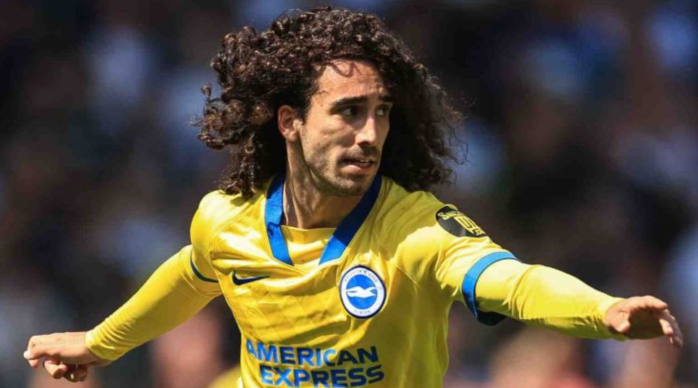
‘Such was Cucurella’s power against United that when he scored Brighton’s second goal, arriving late in the box like some left-sided Frank Lampard to lash the ball home violently at the near-post leaving David de Gea in the early stages of a Bee Gees tribute dance, it wasn’t even surprising. It made perfect sense, as though he had been doing it all season when, in fact, it was his first goal of the campaign.”

Sadly for Brighton fans, that showing seemed to be like an audition for a bigger and better stage and he had only two more matches in Albion’s colours.

Born in the Catalan village of Allela on 22 July 1998, he played futsal with his local club before linking up with the junior sides of Espanyol, where he was made captain. From there, at the age of 14, he joined Catalan giants Barcelona in 201

A rare appearance for Barcelona

“Barcelona were always my team,” he told the Albion matchday programme. “I liked the style of play and the big players the club always attracted.”

He went on: “For me to join such a special club, at such a special time in its history, was a proud moment for my family.”

He made his debut for the club’s B team at the age of 18 but also had the chance to train with the stars of the first team.

“While I was still in the academy, I would sometimes train with Messi or Neymar, which was really exciting,” he said. “I’d train with Busquets, Jordi Alba, sometimes Suarez, and it was scary the first time I stepped up.

“I was very nervous, training alongside players I’d only seen on TV or on the PlayStation, but these are the moments you remember for the rest of your life.”

He only made one brief substitute appearance for the Barcelona first team, going on for Lucas Digne in a 3-0 Copa del Rey win at Real Murcia in October 2017, and he said: “It was a very nice moment for me but it was a shame I never got to play for the team at Camp Nou.”

Cucurella got to play in La Liga on loan at Eibar (in 2018-19) and Getafe (in 2019-2020) before moving permanently to Getafe for the 2020-21 season.

When Albion signed him, fellow former Barca B graduate and ex-Albion midfielder Andrea Orlandi, now a TV pundit, told the Albion matchday programme: “Marc is a super-energetic player whose main assets are his energy, attitude and intensity.

“He was in the top three in every physical study in La Liga for the last three seasons and can’t play without giving it 100 per cent. He has the perfect attributes to be a success in the Premier League.”

Perhaps it should be no surprise that he shone for Spain at the 2024 Euros because he had been selected by his country at almost every age group level and won a silver medal as part of the under-23 side at the 2020 Olympic Games.

His first senior appearance was in a friendly against Lithuania in June 2021 when he captained the side to a 4-0 win. A second cap followed in a 3-3 draw with Brazil at the Bernabeu in Madrid in March 2024. The run through to the final took his caps tally to 10.

In an in-depth interview with Pol Ballus for The Athletic in July 2024, Cucurella opened up on the turbulence he had suffered after making the move to Chelsea. “Until the summer of 2022, my football career had been great: a constant progression, always upwards with no setbacks. Then I arrived at a club where the expectations were so, so high.

“Until then, I had played at clubs where every victory felt really special, where every point is celebrated. Then you go to Chelsea, where you win a game because that’s what you have to do. There is no time to chill or enjoy.”

Not only was managerial change disruptive, things didn’t go well for him off the field. “I spent the first two months living in a hotel with my family, then soon after we found a place to live we had thieves breaking into our home. After this, I spent two days hospitalised for a virus. I lost a lot of weight and had to start from scratch to get in shape again. It wasn’t easy to come back. The team couldn’t find their way on the pitch, either.”

Cucurella said fans had expectations of him because of the size of the fee Chelsea played Brighton but he pointed out: “People expect that, with certain price tags, you need to be a machine. Sometimes it’s difficult to understand that we are normal people who have our own problems off the pitch. We have worse and better phases in our lives.”

He worked with a psychologist to try to help him through his struggles, admitting: “Confidence is the most important thing. You miss it when you struggle, but it flows when you thrive. I’ve worked a lot on this, to stabilise those moments.”

Certain he could improve, he knuckled down in training and eventually seized his chance when it was given.

Towards the end of the 2023-24 season, Pochettino tinkered with Chelsea’s formation and successfully deployed Cucurella in a midfield role, drawing praise from observers such as Nick Purewal in The Standard, who said: “Cucurella’s ability in possession, to act as an auxiliary pivot and progress the ball has transformed Chelsea.”

The player himself had some fun on social media in the summer (right) when, with a nod to the chant Brighton fans conjured up during his time at the Amex, he filmed himself with a bottle of Estrella and sang the song… “he drinks Estrella, eats paella…” but his normally “massive” hair was neatly matted down!
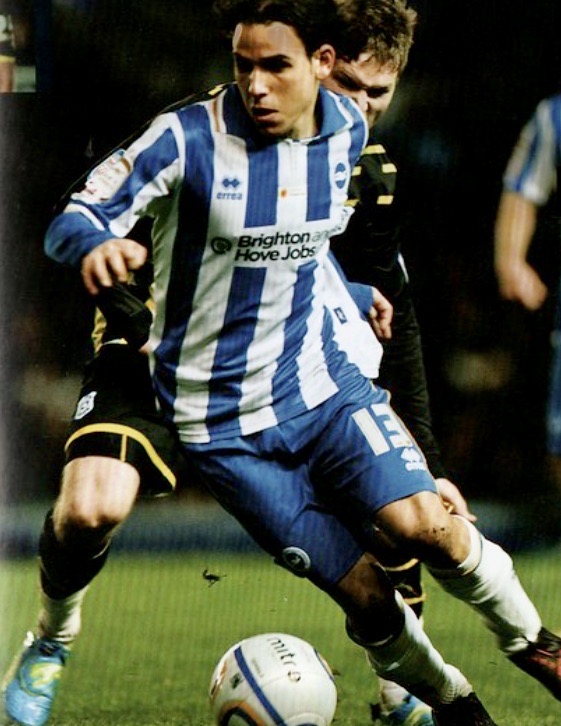
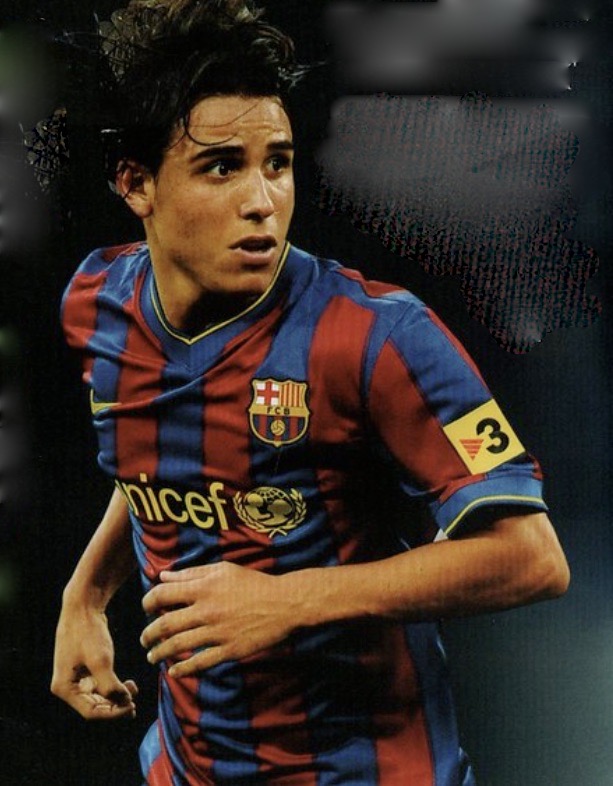
Teenage prodigy Assulin didn’t live up to early expectations

GAI ASSULIN played for his country aged just 16, was hailed as ‘the new Lionel Messi’ and appeared in Pep Guardiola’s Barcelona first team at 18.

Two years later he had two starts and five substitute appearances for Brighton in the Championship, on loan from Manchester City, but couldn’t agree terms for a permanent move.

He subsequently flitted from club to club, country to country, and in the autumn of 2021 was playing local five-a-side football in Cheshire.

Where did it all go wrong? Was it a case of too much too soon?

Assulin was only 12 when he uprooted from his Israel home to pursue the chance of a career with Barca. He spent seven years there, playing for the youth side before reaching the renowned B team in 2007 where he was coached by Guardiola.

“I learnt a lot from him,” he said. “He helped me develop as a player but then so did all the coaches I played for at the club. From the age of 12 to 17 you learn the philosophy of the first team; how to play, what to do, and that never changed.

“Whatever age group you are in, the system you play is the same as the senior side so, if you do get called into the first team, it is not a big, big difference to what you are used to.”

When Guardiola stepped up to first team coach, Assulin was among the youngsters he blooded involving the winger in the Copa del Rey game against Cultural Leonesa in October 2009 and then some pre-season friendlies, including against Tottenham at Wembley.

“Playing in those games was a good experience,” he told the Albion matchday programme. “As the manager likes his younger players, he gave me an opportunity but the competition for places was really, really tough so it was hard to break into the team.

“I also had a few problems with my knee which didn’t help either and my time with the club eventually came to an end.”

Ahead of Guardiola eventually making the same move, Assulin signed for Manchester City under Roberto Mancini in December 2010, explaining: “I wanted to continue my football education at another top club and Manchester City has many top, top players.”

He has since publicly castigated Mancini for not giving him the opportunity to break through at City, telling ITV in 2016: “He didn’t give anyone a chance, he didn’t care about any young players, especially me.

“I didn’t even do the pre-season, when it was a good time to give someone a chance and see if they do well (or) if they are not doing well. But I didn’t get a chance, which was frustrating. It was a shame as I always felt good when I trained with the first team, but sometimes he chose his own sons over other players and I don’t think it was fair.

“It is very important for me to tell people as a lot of City (fans) don’t know what happened with me at City. People always ask me why I didn’t get a chance, and it’s obvious that the manager was the problem.

“I loved playing there, I loved the city and I wish I had a chance there. (City execs) Brian Marwood and Garry Cook loved me and really wanted me to stay, but Mancini didn’t and that was the problem.”

When Assulin joined Brighton in February 2012, Gus Poyet admitted he hadn’t been planning to take him on because at the time he was only interested in getting City midfielder Abdul Razak on loan.

A window opened up when forward Will Hoskins went to Sheffield United on loan, and Poyet told the Argus: “We were not looking to bring in another player after Razak. This was something that came along that I thought was very interesting. When there is something unique and unexpected like this I think it’s a no brainer.

“Gai was one of the top young talents in the world four or five years ago and he was very unlucky with an injury.

“He is still very young. He has got an incredible amount of quality and he can really make a difference but for any young player he needs to be playing and right now at Man City that is very difficult.

“He is an offensive player without any doubt, not a midfielder. He can play up front, wide or behind the striker.”

Assulin made his Brighton debut on 22 February against Hull City, going on as a substitute for Razak in the 77th minute of a 0–0 draw. He made his first start against Cardiff City at the Amex on 7 March but was substituted after 59 minutes of a 2–2 draw.

Although Razak returned to City after falling out with Poyet, Assulin’s loan was extended to the end of the season. However, he only made one more start – in the 6-0 drubbing dished out by West Ham at the Boleyn Ground, again being subbed off when Kazenga LuaLua replaced him on 53 minutes.

His last action in an Albion shirt was as a 61st-minute substitute for Will Buckley in a 0-0 draw at Barnsley’s Oakwell ground. As an aside, Barnsley had future Albion back-up ‘keeper David Button in goal, and ex-Seagulls Jim McNulty in defence and Craig Davies up front.

Rather like the situation at City, there was plenty of competition for places at Brighton with Buckley, Craig Noone and LuaLua the wide choices and the incomparable Vicente playing just off the strikers.

Supporters commenting online recognised Assulin’s talent but felt he was too slight for the robust sort of treatment meted out by Championship defenders.

There was some speculation at the end of the season that a permanent move from City might materialise but terms couldn’t be agreed and Assulin moved instead to Racing Santander back in Spain.

He also had spells with Granada, Hercules and Mallorca and Israeli side Hapoel Tel Aviv. He returned to Barcelona to join third-tier side Sabadell in August 2016 but in January 2018 his contract was cancelled by mutual consent after an 18-month spell hampered by injury.

Next stop was Kazakhstan Premier League team Kairat but he played only once and mutually agreed to tear up the two-year contract he’d signed. He also went to Romanian outfit FC Politehnica Iași and, until the end of the 2020-21 season, he was playing for Crema in Italy’s Serie D.

Without a club, Assulin returned to his home in Cheshire with his partner and eight-year-old daughter, and, while searching for his next move, was doing the school run, coaching, playing five-a-side and helping with his partner’s children’s clothes shop, he told football reporter Will Unwin in a November 2021 interview.

“On an indoor pitch at an industrial estate in nearby Cheadle Hulme, it is not hard to spot the man with La Masia education among those from Moston and Moss Side,” Unwin observed.

“I grew up as a kid in Israel, in a small town and my dream was to play first-team football for a professional club,” Assulin told the reporter.

Born in Nahariya, Israel, on 9 April 1991, Assulin’s family supported Maccabi Haifa,  and young Gai went to watch them from an early age.

How did he end up at Barcelona? “My dad (Eli) took me to a club in Israel called Natanya and they had a manager who had contacts with Barcelona,” he explained. “I was invited to Andorra for a ten-day trial with other players from many different countries and I did really well. A scout from the club then invited me to Barcelona and I did really well at a trial there too. They then offered me a contract.”

Only 12 at the time, he said: “It was a big change obviously at that age, as you are not used to being in a different country and a different culture, but I did the right thing. I love football, it is my life and my family were with me when I needed them.

“My dad came over with me to live in Barcelona and then the rest of my family – my mum, one brother and two sisters – came over for a year before returning to Israel. They used to come and visit every couple of months. The experience has made me a more mature person.”

Unwin noted that Liverpool’s Thiago Alcântara once described Assulin as “the most talented player I’ve ever seen in La Masia”, the two players having progressed alongside each other.

“We grew up together at the club and played in the same team for seven years,” said Assulin. “I would see him every day, and we went to school together.”

In a 2018 interview with Unwin for Planet Football, Assulin said: “Training with Barcelona’s first team was the best experience I’ve had in my career.

“I learned so much. I’m proud to say I was training with such big players. I’ve learned from Messi, Henry, Zlatan. They’re all different types of players, so it was great to see how they operate and pick up little things from them.”

Likewise at Man City, especially from David Silva. “He’s such a good player and different from anything you will see,” said Assulin. “He’s just so intelligent on the pitch and a great guy too.

“I had a good relationship with almost everyone. I was talking more to the Spanish guys – Silva; Carlos Tevez was there at the time; Yaya Toure I knew from Barcelona; Kolo Toure was a really nice guy.

“I had a great relationship with everyone, but especially those guys. Every time I went to train with the first team, they helped me, and they liked me.”

That one full international appearance for Israel happened in a friendly match against Chile in 2008, his appearance as a 78th minute substitute coming 14 days before his 17th birthday. He subsequently made 22 appearances for Israel’s under 21 side over the next five years, but didn’t win another full cap.

Unwin observed: “The early pressure of being synonymous with Lionel Messi was not a tag Assulin particularly enjoyed as he looked to come out of the Argentinian’s shadow.”

The player himself explained: ‘They like to compare in football; it is something they do all the time and for me it is a big compliment, but Messi is the greatest footballer in history. ‘Sometimes it is not good if you take it in the wrong way, as the expectation is for you to go on to the pitch and do the same as Messi all the time. Whichever club I went to, they saw I was compared with Messi, so they thought I was going to be Messi and score 50 goals a year, so that comparison at the time was not as positive.

‘Right now, after being at so many clubs, I see it as something positive and I take it as something that hasn’t been said about so many players. Messi is the best in history, so it’s nice to be compared to him for something that I did right at the time.’

Teenage Teddy Maybank’s Chelsea promise dashed by injury at Brighton

TEDDY MAYBANK signed for the Seagulls for what at the time was a club record transfer in November 1977 and went on to score Brighton’s first ever top division goal.

But the new signing came in for some flak from the terraces and, over two years, never really delivered a significant return on the investment.

Maybank himself reckons the club forced him to play on with an injured knee when he shouldn’t have, which led to irreparable damage and ultimately a premature end to his career.

The former Chelsea centre-forward was signed to replace Ian Mellor, Peter Ward’s prolific strike partner in the 3rd Division, after Brighton had won promotion to the second tier.

“We let Ian Mellor go because we felt that he had reached a certain age and had probably peaked,” Alan Mullery told Matthew Horner, in his Peter Ward biography, He Shot, He Scored. “When Teddy Maybank became available, we thought that he was probably a better option.”

Born in Lambeth on 11 October 1956, Maybank lived the first 15 years of his life in Brixton and went to Christchurch Primary School, close to his home, where one of his playground footballing mates was Ray Lewington — now loyal deputy to Roy Hodgson — who, together with Maybank, went on to play for Chelsea and Fulham.

At the age of 11, Maybank moved to Stockwell Manor Secondary School and played various age group levels for South London Boys. One of the representative matches he played in took place at the Goldstone Ground on 25 September 1971, against Brighton Boys.

The Maybank family moved to Mitcham, close to the Chelsea training ground, and, when Teddy was 15, he joined them straight from school.

Maybank and Lewington progressed through Chelsea’s youth ranks at a time when the club’s focus was on bringing through home-grown talent. “It was a good time at Chelsea,” he said. “We had such a good youth side and I loved playing under Ken Shellito.”

That team, which won the South-East Counties Championship four years in a row, included Ray and Graham Wilkins, Lewington and John Sparrow.

Maybank’s first-team debut came in a 2-0 defeat at Tottenham Hotspur in April 1975 aged just 18, and he scored in only his second game, a 1-1 home draw against Sheffield United, but Chelsea were relegated from the top division that year.

The following campaign saw Maybank, still a teenager, become a first-team regular under Eddie McCreadie, grabbing five goals in 26 appearances between August and February.

After falling out of favour, he went out on loan to Fulham just before Christmas 1976 and then signed permanently for a £65,000 fee later that season.

Back in the ‘70s, Chelsea were a long way from the force they are now and Maybank admitted: “I wouldn’t say I ever played that well at Chelsea. I didn’t find it easy to score goals there.”

It was a different story at Craven Cottage. After scoring more than a goal every other game – 17 times in 31 games – Maybank was sold to Brighton for £238,000, which gave Fulham a swift and substantial profit that they used to pay off money owed on their recently-built Eric Miller Stand (now, the Riverside Stand).

                     Blond locks flying, Maybank comes up against QPR’s Dave Clement in a 1978  pre-season friendly. (Above right) This overhead kick against Sunderland at The Goldstone scraped the bar … otherwise would have been a Goal of the Season candidate!

Maybank made a good enough start for the Seagulls, scoring after just six minutes on his debut in a 2-2 home draw with Blackburn Rovers, played on a bitterly cold day in front of a crowd of 26,467. Tony Towner scored the Albion’s other goal and another debutant in that game was tough-tackling midfield player, Paul Clark.

Maybank was on the scoresheet again in the very next game as Albion recorded their first ever win, 1-0, at Blackpool.

It was in a game against Orient a week before Christmas that Maybank got a kick on his knee from defender Dennis Rofe (who later played for Leicester and Southampton) which caused an injury which he maintains wasn’t properly managed by the club.

He told fulhamfc.com in 2013: “They kept giving me injections, taking all the fluid out every Sunday after the game.

“I was barely training. I could run in a straight line but any time I put weight on my leg I would fall over. I wouldn’t feel any pain because of the injections, but I just fell over.”

The Brighton fans thought they had bought Bambi and were soon on his back, leading to a “pretty terrible time” that Maybank never really recovered from.

“The club should never ever have allowed me to play in that situation,” he said. “A surgeon saw me outside of the club, opened me up and said: ‘if you ever play football again, you’ll be the luckiest bloke in the world’.

“Brighton had told me, basically, that I couldn’t do any more damage. They wouldn’t do it now, but because I was the highest transfer fee they ever paid, they didn’t really take my welfare into consideration at all. In the end, it ruined my career.”

                      Shoot! article and (above right) Maybank goes full length to head the second of  his three goals against Cardiff on Boxing Day 1978.

In an article in Shoot! magazine at the time, Maybank talked about how he hadn’t had the best of starts with his new club. He said: “I wasn’t playing well. I knew that. My early form was a disappointment to the fans. They expected me to come in and start scoring regularly and doing incredible things.

“It’s always hard when you change clubs and you need a while to settle in. I have to adjust to my new team-mates but they’ve also had to change and adapt to playing with me.”

Mansfield were trounced 5-1 at the Goldstone on 21 January 1978 when Peter Ward shone with a hat-trick. Maybank also got one, but it was his last of the season. He made only six more appearances between January and the end of the season and new signing Malcolm Poskett seized his chance alongside Ward.

Albion narrowly missed out on promotion (by goal difference) and during the close season Maybank went under the knife for a cartilage operation.

Fit for the new season, Maybank was among the goals as Albion beat Millwall 4-1 at The Den on 2 September. He got a brace that day but in the same month was in trouble with the manager who’d had an anonymous tip-off that the star striker and Welsh international winger Peter Sayer had been seen in a nightclub on the eve of what turned out to be a 4-1 defeat by Leicester City.

Mullery made an example of the pair and they were both ‘persuaded’ to donate a fortnight’s wages to the local Guide Dogs for the Blind Association.

On the pitch, the goals dried up for Maybank until Boxing Day when he netted a hat-trick in a 5-0 win over Cardiff City. In an Albion matchday programme in 2015-16, Maybank admitted to Spencer Vignes: “The crowd started getting on my back, and I got in a pretty dark place.

“When I got that hat-trick, I went from villain to hero and yet it had got so bad that the day before Alan Mullery picked the squad I’d told him I never wanted to play for the club again.

“From the changing room before a game, I used to hear the crowd boo my name when the team was read out over the tannoy.”

In total, Maybank scored 10 times as Albion won promotion, and he was leading the line in the famous promotion-clinching 3-1 win at Newcastle on 5 May 1979.

In that season’s Rediffusion Player of the Year competition, Maybank finished third behind winner Mark Lawrenson and runner-up Brian Horton.

In much the same way Pascal Gross was feted for scoring Brighton’s first-ever goal in the Premiership, so Maybank scored the Albion’s very first goal in the top division.

After being hammered 4-0 by Arsenal in the opening fixture at the Goldstone, the Seagulls were away to Aston Villa in the second game.

                      Arms aloft, Maybank celebrates Albion’s first ever top division goal with skipper Brian Horton and Peter O’Sullivan. (Above right) Maybank battles with Arsenal’s David O’Leary watched by John Hollins and O’Sullivan.

Latching on to a John Gregory through pass and, with the very last kick of the first half, Maybank buried a shot past ‘keeper Jimmy Rimmer.

Albion lost the game 2-1 but the national newspapers were full of praise for the newcomers to the division.

Frank Clough in The Sun wrote: “Teddy Maybank and Peter Ward tore great holes in Villa’s jittery defence and were only stopped by inadequate finishing and fine goalkeeping by Rimmer.”

It was the first of three Maybank goals at the top level, but, according to Ward, the striker had a big falling out with Mullery. The manager brought in Ray Clarke as his first choice centre-forward and, in December 1979, Maybank was sold back to Fulham for £150,000.

He had scored a total of 16 goals in 64 appearances for the Seagulls, less than half the ratio he’d been scoring when bought.

After just 19 games for Fulham, Maybank joined Dutch side PSV Eindhoven for £230,000 in August 1980 (Fulham making another tidy profit on the player).

His debut for the Dutch giants came in front of a packed house at the Nou Camp, where Barcelona were staging a four-team tournament with Vasco da Gama and River Plate.

However, only a few games later his knee flared up again.

“They opened me up and saw what a state my knee was in,” Maybank explained in that 2013 interview with fulhamfc.co.uk. “I was told in no uncertain terms that if I didn’t retire I would be playing with the youth team or reserves. I think they thought they’d been taken for a ride.”

Maybank was left with no choice. At the age of 24, he retired from the game.

Pictures from my scrapbook sourced from Shoot! magazine and the matchday programme.

Barça boy Orlandi twice denied promotion with the Seagulls

andrea-orlandi-brightonARTICULATE Andrea Orlandi would probably rank as one of my favourite Albion players of recent times. It was just a shame he seemed bedevilled by injuries which curtailed his contribution.
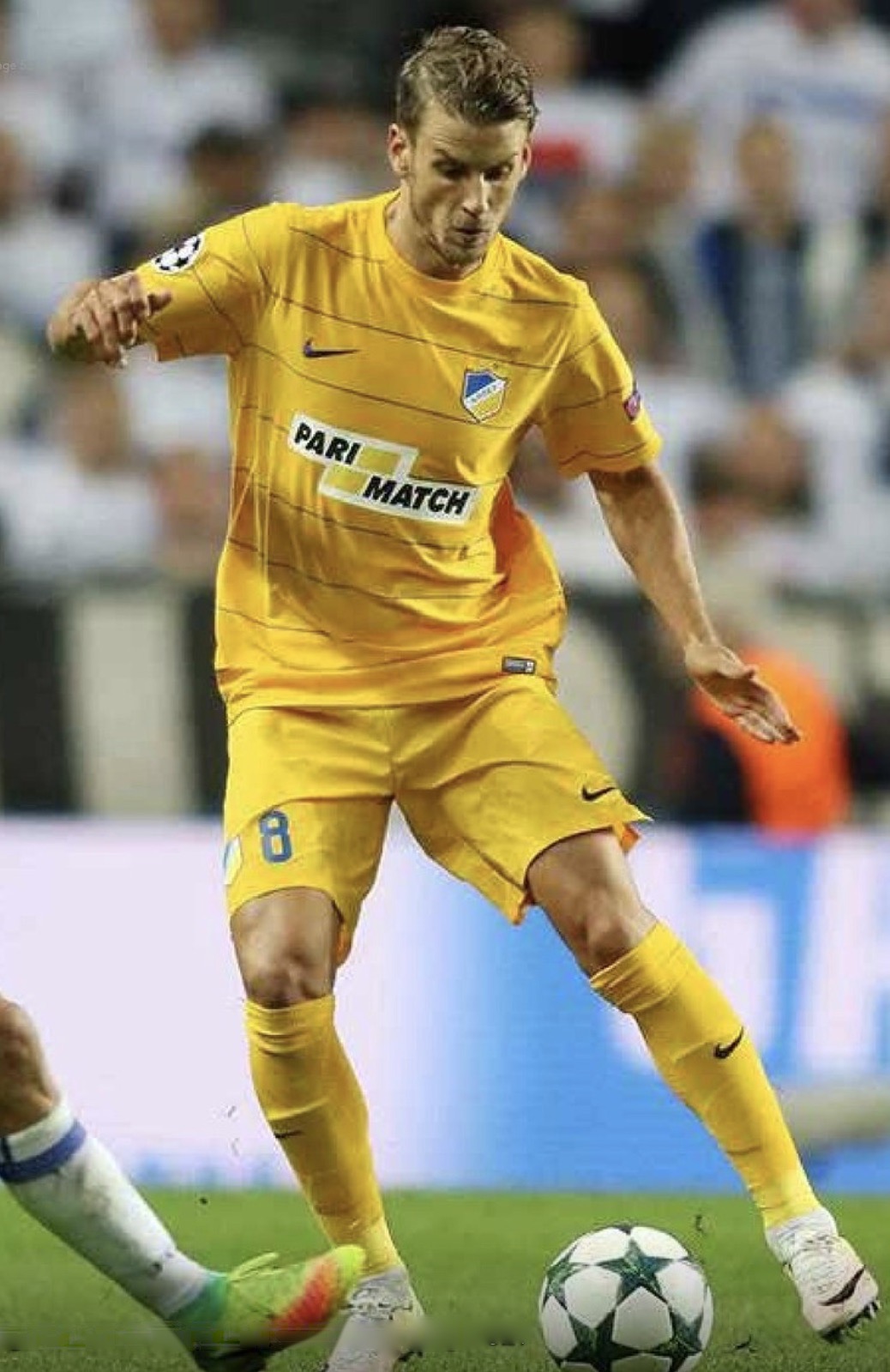
On his day, his technical ability definitely improved Brighton’s creativity going forward and I guess he’ll always be remembered for the goal he scored against Premier League Newcastle in the third round of the FA Cup on 5 January 2013 which he somehow guided in from what seemed an impossible angle.

On bbc.co.uk, the match report recorded: “A rejuvenated Wayne Bridge surged down the left flank, gathered Gordon Greer’s raking 50-yard pass and crossed for Orlandi, who flicked the ball up with his left foot and delightfully fired home with the outside of the same boot.”

Orlandi Newc goal

Orlandi was 28 when Gus Poyet signed him on a two-year contract on transfer deadline day in August 2012. “Andrea provides us with versatility and creativity across the midfield,” Poyet told the club’s official website.

“He can play as a typical winger, or more central in a number 10 role. He has played a lot of games in the Championship for Swansea, helping them win promotion, and he has played at the top level.”

It was crowd favourite Craig Noone’s departure to Cardiff that created the opening for Orlandi’s arrival, although they were very different players.

At Brighton, Orlandi had the chance to renew his great friendship with Seagulls legend Inigo Calderon, a former Alavés B side teammate, and there was quite a contingent of Spanish players at the club during that 2012-13 season.

As the Seagulls finished fourth and the Poyet era came to a close after the Palace play-off farce, Orlandi had played 30 games plus five as sub and added six league goals to that one in the FA Cup.

Under Poyet’s successor, Oscar Garcia, Orlandi picked up a knee injury in the opening game of the season, against Leeds, which required surgery.

“The doctor I went to see is regarded as one of the best in Europe so although it was disappointing that I had to undergo surgery, I was in the best hands,” he told the club website. “Although I was hoping rest would cure the problem, I was told I would risk further damage if I didn’t have surgery.”

As it turned out, he managed just 12 starts plus six as sub as the season culminated in yet more play-off heartache, this time at the hands of Derby County.

Orlandi played in both legs against the Rams and, although Garcia decided to quit, he recommended Orlandi be given a contract extension. As soon as Garcia had gone, though, head of football David Burke called him in to the club and told him he was being released.

Orlandi told the club website: “I’m sad. My youngest daughter was born here and I was hoping to stay here a lot longer but that is football.

“I really felt loved by everyone, especially the fans who were incredible to me whether I was on the pitch or off of it and that is something that nothing will ever take away from me.

“The city and all the people in it are wonderful and I wish everyone nothing but the best going forward and I hope the club can fulfil the dream of playing in the Premier League soon. I’m just sorry I couldn’t help to make that happen.

“It is a real shame that in my two years we got so close but we just couldn’t get over the finish line, but I will take away some magnificent memories with me.

“Once again I just want to pay tribute to the tremendous support I have felt during my time here.”

In a subsequent matchday programme article, Orlandi said: “Just running out at the Amex in front of a full house was an amazing experience – I loved every minute of my time at the club and loved playing for the fans.

“I will always hold Brighton close to my heart.”

Born in Barcelona on 3 August 1984 to Italian parents (a Juventus-supporting dad and an AC Milan-supporting mum), he played as a youth at Espanyol but at 17 moved to Alavés where he made 58 appearances for their B team between 2003 and 2005.

When loaned to Barcelona, he continued to be a B team player but he did play two first team games for the Catalan giants: as left back under Frank Rijkaard in a 3-1 defeat to Athletic Bilbao and a Copa Cataluyna win over Espanyol.

When Alavés released him in 2007, fellow Spaniard Roberto Martinez picked him up as a free agent and took him to Swansea City, where he stayed for five years.

Orlandi yellowManagerial changes at the Swans meant he wasn’t always first choice although on signing a contract extension in July 2011, chairman Huw Jenkins said: “He has grown into the squad over the past few years and his technical ability is well suited to the Premier League.”

He was part of Brendan Rogers’ squad promoted to the Premier League via a 4-2 play-off final win over Reading, appearing 24 times over the season, although he didn’t feature in the final at Wembley.

AO SwansIn one of his last Swansea games, on 28 April 2012, Orlandi scored after just 25 seconds of a Premier League game against already-relegated Wolves, but the game finished 4-4.

After his release from Brighton, he joined chaotic Championship side Blackpool, the day before the 2014-15 season started – with only a week to go, they had only eight registered professionals.

Under initially Jose Riga and then Lee Clark, Orlandi played 25 games plus five as sub, but the Tangerines finished rock bottom of the league, and the club was in disarray.

Orlandi revealed some of the strange goings-on in a weekly blog he wrote for Spanish website am14, including the time the goalkeeper Joe Lewis had to wear an autographed shirt intended for a presentation to a sponsor because there was no other top available.

In April 2015, Orlandi wrote: “When you first arrive in England in mid-April you imagine yourself spending your Sundays in the garden or having a drink on the terrace… you don’t imagine yourself stuck at home, listening to the wind and spending hours hiding from a hurricane.

“I have been living in England for almost eight years and the sun has always shone. This year is nothing like that, not in any sense. I will be patient and hopefully the nice weather will arrive before the end of the month. In terms of the football, the sun did not appear for Blackpool either.”

Orlandi also used the blog to talk about a defeat at Ipswich. “We started well, I scored a good goal thanks to a great assist from Cameron, and we lost. In part, this was thanks to my mistake which helped lead to their second goal.

“It was an error without explanation. ‘The pitch condition, the bounce of the ball, it came from a rebound’… excuses do not sit well with me. Unfortunately, sometimes we make inexplicable errors and that happened to me. I have to take responsibility, accept it and move on. The worst is that we equalised again and finally conceded 3-2 due to another silly play. It is the story of this season.

“When the league is finished, I will look at all the results and I shudder to think of the points that we have lost in, to put it mildly, a stupid fashion. Maybe we would not have avoided relegation but we would be in a different position, that is for sure.”

As the scorer of four goals, he was Blackpool’s second highest goalscorer for the season and, despite relegation, they hoped to keep him, but he invoked a release clause in his contract and became a free agent.

In August 2015, Orlandi signed for Cypriot First Division side Anorthosis Famagusta on a one-year deal but it didn’t sound like it was the greatest of experiences when Argus reporter Brian Owen caught up with him in February 2016, with Orlandi disappointed he hadn’t been able to find another English club in the Championship.

Orlandi switched clubs in Cyprus and joined APOEL but his one-year deal was terminated in January 2017 after he’d made 19 appearances.

He switched to Italy where he played 31 matches for Novara Calcio in Serie B and then joined his old pal Calde to spend half a season in the Indian Super League at Chennaiyin (under head coach John Gregory). On returning to Italy and signing for Serie C side Virtus Entella, during the medical a cardiologist discovered he’d got scarring in the left ventricle of his heart, and he was forced to retire without playing a game.

The popular Spaniard revealed in Richard Newman’s Football the Albion and Me podcast how he has gone on to become a scout for an agency as well as working as a TV pundit on La Liga and writing a column on that competition for the Evening Standard.Orlandi pundit

Pictures from various online sources and the Albion matchday programme