The Foxes hero who led Albion’s line in an hour of need

STEVE CLARIDGE became a Leicester City hero long before briefly coming to Brighton’s rescue.

He scored the winner in a play-off final at Wembley to take the Foxes up to the Premier League at the expense of Crystal Palace, who’d discarded him at an early age.

Both sides had been relegated from the top flight the year before and Claridge’s right-foot strike past Nigel Martyn in the 120th minute meant it was an immediate return for Martin O’Neill’s side.

“The high is not equal to anything,” Claridge told Leicestershire Live.
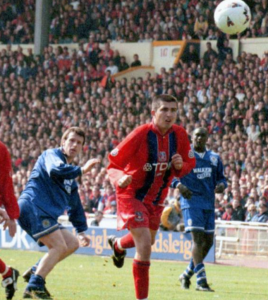
Scoring play-off winner v Palace

It came in 1996 and a year later he scored the only goal of the game (past Ben Roberts) in the 100th minute of a replay against Middlesbrough to win Leicester the League Cup, leading to him being named FourFourTwo’s ‘Cult Hero of 1997’.

Claridge had only completed a £1.2m move from Birmingham City two months before that play-off and he labelled it the most important goal of his life coming after a worrying period in which he wasn’t sure he’d ever be able to play again.

A mystery illness had ravaged his form and in only his fifth Leicester game he was taken off after 15 minutes. “Pins and needles from my knees down were so extreme, I could not even feel the ball,” he recalled.

It turned out a drug prescribed for a thyroid problem he’d had since the age of 12 was destroying his thyroid gland. “The main energy provider of my body was no longer functioning,” said Claridge.

However, once on the right medication, he made an almost unbelievable recovery, was restored to the side and helped to secure a play-off place.

After beating Stoke City in the semi-finals, they went a goal down to Palace in the final but pulled it back through a Garry Parker penalty before Claridge seized his chance in the dying moments of extra time.

Wembley winners for Leicester: Garry Parker and Steve Claridge

He collected a quick free kick from Parker and took aim, his shot from distance kissing the stanchion with goalkeeper Martyn motionless.

“The crowd is just really stunned in disbelief, I don’t know if that was because I’d hit it,” laughed Claridge. “It was so far out, and everybody was used to me scoring goals inside the six-yard box.”

He reflected: “To finish off after the lows I went through, the absolute lows where you’re thinking, ‘my career is over I can’t see a way out of this,’ to doing that and taking you to the ultimate high – winning that game of football. It’s unparalleled.”

Albion cover ‘boy’

Such experience was exactly what Championship strugglers Albion required when, on the back of three defeats, they faced the daunting prospect of promotion-seeking West Ham away on 13 November 2004.

Manager Mark McGhee, who’d previously signed Claridge when he was at Wolves and Millwall, was desperate to stem a tide which had seen eight goals conceded and no points on the board.

“He is one of the fittest players I’ve worked with and I had no doubt that after 18 months away from this level he would be able to perform,” said McGhee.

Claridge’s professional career looked to have run its course after he left Millwall in 2003 and became player-manager of Southern League side Weymouth.

But the disappointment of missing out on promotion had seen him and chairman Ian Ridley leave the club and Claridge, at the age of 38, was keen to give league football another go.

In what turned out to be a real backs-to-the-wall smash and grab raid, Albion earned the unlikeliest of 1-0 wins courtesy of a Guy Butters header from Richard Carpenter’s free kick.

Albion held firm despite a relentless wave of attacks by the home side and afterwards McGhee said: “We approached the game differently. Whereas before we thought we could win, today we did not, and played to make sure we didn’t get beaten.

“We kept the ball up front more which is important. Steve Claridge was key to that.”

Unfortunately, Brighton were not able to build on the win at the Boleyn Ground and there was only one more win (1-0 at home to Rotherham) during Claridge’s month with the club.

His fifth and final game for the Seagulls came away to his old club Millwall on 11 December 2004, when Albion lost 2-0.

In a programme feature about him that day, Claridge likened the circumstances of both clubs. “The club has no money and it is tough just to survive, but everyone is in it together,” he said. “At Millwall we had a great team spirit and togetherness, and that is very much the case here.”

McGhee’s tight budget prevented Claridge’s stay at Albion being extended and, after his deal was over, rather than it being one last hurrah, he went on to continue his league playing days at Brentford, Wycombe Wanderers, Gillingham, Bradford City and Walsall.

And, at the age of 40, and with him needing just one more game to fulfil the landmark of 1,000 professional games, his old club Bournemouth – where he’d started out as a professional in 1984 – gave him a match against Port Vale on 9 December 2006. No fairy tale, though, as they lost 4-0.

Born in Portsmouth on 10 April 1966, Claridge was brought up in Titchfield and began his football career at nearby Fareham Town in 1983. His initial foray into the pro game at Bournemouth only amounted to seven games before he moved to Weymouth for three years.

Crystal Palace offered him a route back to the full professional game in 1988 but he didn’t make their league side and after three months moved on to fourth tier Aldershot Town.

Two spells with Cambridge United followed between 1990 and 1994 for whom he scored 46 goals in 132 games. A falling out with manager John Beck saw him sold to Luton Town in 1992, but he was then bought back after Beck’s departure.

Birmingham City paid £350,000 to take Claridge to St Andrews and he became one of the club’s most prolific goalscorers, netting 35 in 88 games, and was top scorer with 25 goals when part of Barry Fry’s Blues side that won the Second Division title and the Auto Windscreens Shield (Football League Trophy) in the 1994-95 season.

After spending two years at Leicester, he went on a two-month loan to his hometown club, Portsmouth, but, in March 1998, McGhee signed him for the first time – and it didn’t go well.

The Scot, who had controversially left Leicester to take over at Wolves, took Claridge to Molineux for a £350,000 fee. But Wolves fans were not impressed, as Levelle revealed in this 2012 piece, and after just six games and no goals in the famous old gold shirt, he was sold to Portsmouth for £250,000 at the end of the season.

Even more galling for Wolves followers was that no sooner had Claridge made the switch to Portsmouth, he scored all three in a 3-1 win at Fratton Park!

David Miller in The Telegraph wrote: “The 34-year-old Steve Claridge, who had failed to score in five months when previously with Wolves, now gave sun-blessed Portsmouth a bank holiday funfair with a first- half hat-trick that was as easy as licking an ice-lolly.”

On the ball for Pompey

The goals and games came thick and fast for Claridge back on home turf – 34 in 104 – but his reign as player-manager at Fratton Park in 2000 was curtailed after just 25 games by the quirky chairman Milan Mandarić.

Remembering the player he’d seen only briefly a couple of years earlier, McGhee, by now in charge at Millwall, offered the striker a lifeline with the Lions, initially on loan and then as a permanent signing.

Going through the pain barrier at Millwall

Over two seasons in south east London, he became something of a fans’ favourite, scoring 26 in 85 matches, his efforts summed up by writer Mark Litchfield. “His style was unconventional, to say the least: shirt untucked, one sock down and no shin pads, any naïve defender probably thought they could eat him for breakfast. But hard work was a pre-requisite for Claridge – he wouldn’t give any opposition player a moment’s rest and would more often than not always get the better of them, too.”

Claridge had a less happy association with Millwall too when in July 2005 he was sacked after just 36 days as manager when the chairman who appointed him, Jeff Burnidge, was replaced by  Theo Paphitis, who wanted Colin Lee instead.

Even after achieving the 1,000-game landmark courtesy of Bournemouth, Claridge couldn’t resist the lure of another game, turning out for Worthing, Harrow Borough, Weymouth and Gosport Borough.

He was one of a group of five that formed Salisbury FC at the end of 2014, and as team manager was involved in gaining two promotions in the Southern League before leaving in October 2022.

Although he had officially hung up his boots in 2012 after helping Gosport to promotion to the Southern League Premier Division, in 2017 he played in a friendly defeat to Portsmouth in July and then put himself on against Paulton Rovers in the league a few weeks later.

His final ever game as a player came in a 3-2 victory over Fareham Town, when he was a remarkable 51, but he had to go off in the 71st-minute after picking up an injury. 
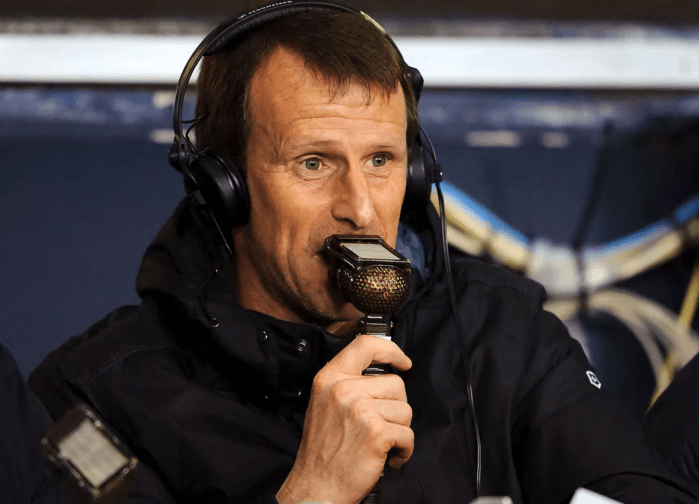
Pundit Claridge contributed his thoughts on radio and TV

Claridge also became a familiar face and voice working as a pundit for the BBC on TV at Football Focus and Final Score and on BBC Radio 5 Live. He also wrote scouting reports on promising players for The Guardian, numbering future Brighton signing Matt Sparrow among them.

“He is easy on the eye, links well with his forwards but also protects and helps his defenders by tackling from the wrong side and makes sure he tracks his runner whenever he threatens to get goal-side,” wrote Claridge of the then Scunthorpe United player in 2007.

Claridge later set up his own coaching scheme for youngsters in Salisbury and Warsash.

In 2023, he took over as manager of Gosport-based Wessex League Division One side Fleetlands FC for the 2023-24 season. In August 2024 they announced he was stepping down from the role “due to personal reasons”.  
On its website, a statement added: “The club would like to place on record our huge thanks to Steve for taking up the role in our hour of need and taking us to a fantastic 5th place finish last season.”
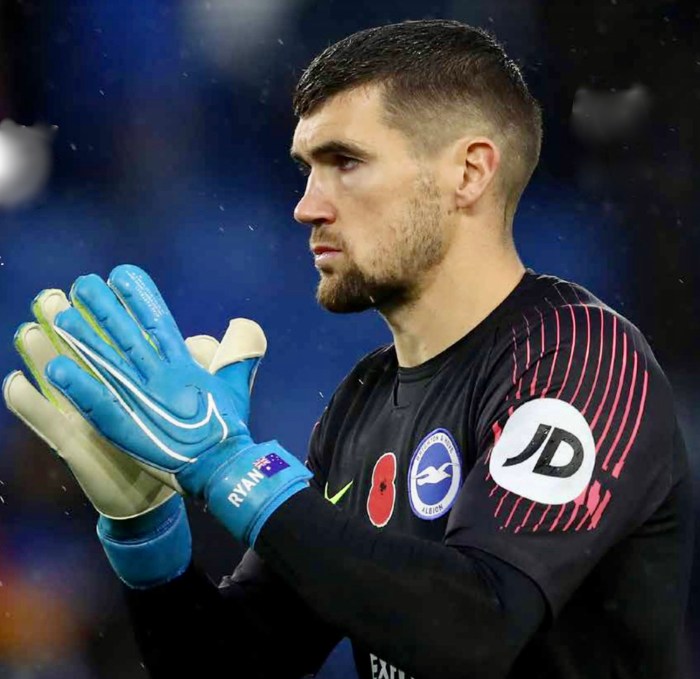
Dislodged ‘keeper Ryan offered curious reprieve with Gunners

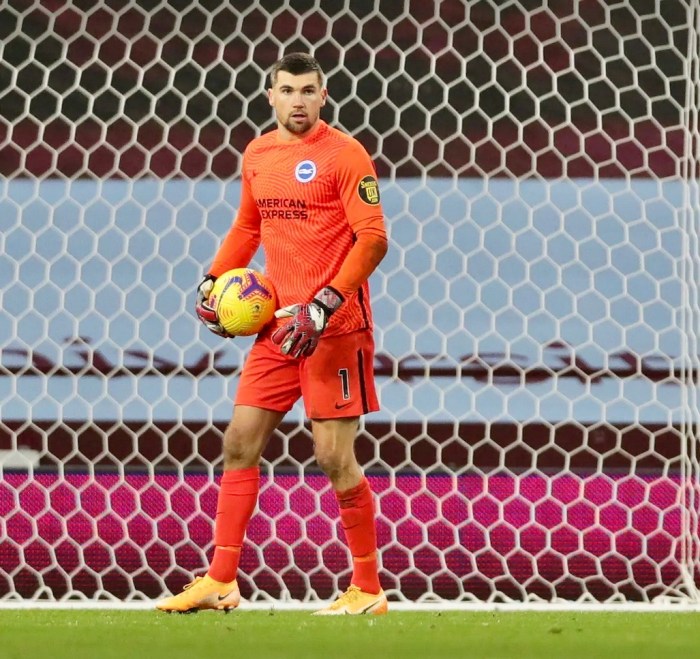
FEW FOOTBALL observers would have imagined an out of favour Brighton goalkeeper would get a move to Arsenal but that’s exactly what happened to Mat Ryan.

The Aussie no.1, Albion’s first choice goalkeeper for their first three seasons in the Premier League, surprisingly joined the Gunners having lost his Seagulls place to young Spaniard Robert Sanchez.

“We know Mat very well through his performances with Brighton in recent seasons and he brings additional quality to our squad,” Arsenal coach Mikel Arteta told the club’s website. “Mat has very good Premier League experience and has played over 100 times in the league, which is something that will benefit us greatly on and off the pitch.”

Technical director Edu added: “Mat is an experienced goalkeeper, a proven talent in the Premier League and has also played many internationals for Australia.

“Mat will further strengthen our squad with his experience and knowledge of playing at the highest level.”

The goalkeeper himself, a self-confessed boyhood Arsenal fan, relished the opportunity but found himself under fire from Brighton fans when he told Optus Sport: “I had in my mind a little bit of a plan that I wanted to play a couple of seasons at Brighton and try and do well and hopefully be bought by a bigger club and keep progressing in my career.

In action for the Gunners

“Perhaps it didn’t work out in the way of playing two, three seasons and then being bought for a fee as no.1 and going and playing.

“But one way or another I’ve obviously ended up in a massive step up from Brighton and to another level of football.”

For someone who had always previously endeared himself to the Albion faithful, memorably running the length of the pitch to join teammates in goal celebrations and after games handing out bits of his kit to supporters, it struck a discordant note.

When Ryan learned how his comments had angered some Brighton supporters, he took to Instagram to address them.

“I want to apologise to anyone who has felt I’ve been disrespectful towards the club. This was not and never will be my intention.

“I recognise how people could have interpreted that through those comments and, moving forward, I’ll be sure to pay extra attention as to how I refer to the club to not have the same outcome.

Albion’s no.1

“The club will always have a special place in my heart. I’ve got nothing but fond memories and wish all the best to you all for the remainder of the season and I’ll always continue to support the club because of our experiences together.”

Those experiences began ahead of Albion’s first season (2017-18) playing in the Premier League. Previous no.1 David Stockdale had chosen to move to Birmingham City, who were offering him a longer-term deal than Brighton, so the coast was clear for Ryan, already an established Australian international, to become Chris Hughton’s first choice goalkeeper.

Hughton himself admitted in an interview with the Argus that Ryan’s arrival had more to do with goalkeeping coach Ben Roberts. “He is the one who went to see him play, watched hours and hours of video.

“I didn’t see him live. Ben just thought he was a player at the right age, really enthusiastic. He’s different, not as big as some of the other keepers, but very athletic and really hungry to do well.

“I certainly watched a lot of him on video. We also, of course, have recommendations from our scouts but Ben is the one who looked at him and recommended him. You have to have faith in your staff.”

For his part, Ryan appreciated the work Roberts put in on the training ground. “Ben has a real knack of getting his goalkeepers in the best physical and mental shape in order to be best prepared for the opposition that we’re facing,” he told the matchday programme.

Signed from La Liga’s Valencia for a then club record transfer fee of £5 million, he played all 38 league games in his first season under Hughton, only missed four because of international commitments in 2018-19 and all league games in Graham Potter’s first season in charge.

In an early matchday programme interview, he spoke about how he had learned about life in the Premier League from fellow Aussie ‘keeper Mark Schwarzer (“a big hero of mine”) and, when on international duty, from former Aston Villa and Man Utd ‘keeper Mark Bosnich.

Ryan more often than not proved a reliable stopper for the Albion and he twice won Australia’s PFA Player of the Year award.

“At this level, you’ve got to be consistent,” he said. “Every day you’ve got to work hard on every aspect of your game and I’ve tried to do that.

“I try to contribute to the team as much as possible and it’s that constant challenge that you’ve got to try and live up to and, I guess, is what separates good players from great players – remaining consistent and sustaining those very high levels.”

And according to wearebrighton.com: “At his best throughout the 2017-18 and 2018-19 seasons, he was one of the most dependable number ones in the Premier League whose performances did more than most to keep Brighton in the top flight.”

He was sorry to see Hughton sacked – “Brought the club success it could only dream of and will always be someone I have the highest respect for” – but was happy to adapt to Potter’s more possession-based style in which the goalkeeper needed to be comfortable with the ball at his feet.

“It’s important we adapt to the new style so the system works as effectively as possible,” he said. “In the modern game you have to be able to adapt anyway, so each day I’m working hard and doing what’s being asked of me.”

The beginning of the end of his time at the Albion came when, out of the blue, young Sanchez was chosen to keep goal in a 2-1 defeat at Spurs after the Seagulls had managed only one win in the first six matches of the 2020-21 season.

Although restored to the starting line-up for the following five matches, following a 3-0 defeat at Leicester, Ryan was summoned by Potter and told Sanchez would be given an extended run in the side and that, assuming he wanted a no.1 berth, he would be better looking for a new club.

The conversation staggered Ryan and, ever a willing interviewee, told The World Game he was surprised and shocked but added: “Knowing where I stand now, from what was communicated to me, perhaps it might be better that we do go our separate ways.

“However, until that opportunity comes – and it’s a good project – then, as far as I’m concerned, I’m a Brighton player and I’m here to fight for my spot.”

Taking the opposite stance to the one Sanchez subsequently took when Jason Steele ousted him as no.1, Ryan vowed to continue to work hard.

“I still feel like I’ve got a lot to contribute and I’ll be trying to convince the manager I’m the best man for the job,” he said.

“I feel the experience I’ve picked up over the last three years in England shows I’ve got plenty to give to any club that wants to acquire my services.

“I think I’ve proved that through my performances.”

It was never particularly clear why Ryan eventually fell out of favour, although he ventured some ideas in an exclusive interview with Andy Naylor for The Athletic in March 2022.

He remembered at the start of the 2020-21 season noting there had been rumours around Albion being interested in signing Emiliano Martinez (who eventually went from Arsenal to Aston Villa) and when his (Ryan’s) agent tried to ask the club about it no one answered his call.

He was also heading into his fourth season of a five-year contract, but his agent wasn’t getting any response as to whether there would be a renewal.

“Thinking back, after all that has happened, maybe that was a sign,” Ryan told Naylor. “At the time, I wasn’t thinking anything of it, but when I think back now, maybe these were little signs.”

The loan move to Arsenal might have been brief – he had a won one, drew one, lost one record in three games – but his commitment to the cause was appreciated.

In a game against Fulham, a minute before the final whistle, Ryan went up for a corner and got his head on the ball to keep it live in the Fulham box before Eddie Nketiah equalised a few seconds later.

“I picked him because he totally deserves to play, he trains like a beast, he’s got the right attitude and he needed a game,” Arteta told Arsenal.com. “It was a great header.”

It led to him being chosen ahead of Bernd Leno for the 2 May trip to Newcastle which Arsenal won 2-0.

Although Arteta made all the right noises about signing him on a permanent basis, it turned out they wanted an English goalkeeper and they signed Aaron Ramsdale instead.

While awaiting news of where his next move would be, Ryan told Fox Sports Australia: “I’ve learnt so much in my experiences (at Arsenal) so far, all that’s being with a club like that, the resources, the personnel, the quality on the pitch, the enormity of the club on a global aspect… it was so cool to be a part of.

“It was a great experience and I was really proud of how I did and really content with how I did, and I showed that I have the capability to play at a level like that. I look forward to seeing what that little period now means for me moving forward.”

It was clear there would be no return to the Albion no.1 spot but warm words were issued when his summer departure to Real Sociedad was announced.

Potter declared: “He’s a great guy, top professional and as someone who wants to be playing regularly at senior level he goes to Real Sociedad with our very best wishes. 

“He’s been a pleasure to work with, he will be fondly remembered by everyone and always welcome back at the club.”

Unfortunately for Ryan, a knee cartilage injury suffered in pre-season put a hold on him mounting a challenge to Sociedad’s well-established Alex Remiro, and he had limited chances to shine back in Spain.

Nonetheless, his confidence remained high and he told Naylor in The Athletic article: “I’m a very good goalkeeper – a world-class goalkeeper. Since I left Brighton, I feel the level I’ve played at in the games I’ve played in has been quite high.

“Don’t get me wrong, every time the team list goes up and I see I’m not playing, it’s a blow – a kick in the guts – but I try using it as motivation to keep pushing on. I won’t stop until I see my name there more regularly.”

Born on 8 April 1992 in Plumpton, New South Wales, as a teenager Ryan played for semi-professional sides Marconi Stallions and Blacktown City before turning pro with Central Coast Mariners in 2010, where he was given his pro debut by Graham Arnold, later his head coach at international level.

In the course of his three years with the Mariners, he picked up various league accolades for his performances and earned his first international recognition when selected for Australia’s under 23s in 2011. He stepped up as a full international the following year making his debut in a 1-1 draw with North Korea and played all three matches in the 2014 World Cup in Brazil before winning the AFC Asian Cup with the Socceroos in 2015. He went on to play for his country at the 2018 and 2022 World Cup final tournaments and, at the time of writing, had 95 caps to his name.

Aussie international stopper

It was in 2013 that he moved to Europe and was signed by Belgian Pro League side Club Brugge, where he made more than 100 appearances over two years and was in the side that won the Belgian Cup in 2015 when Anderlecht were beaten 2-1 in Brussels. Ryan was the league’s goalkeeper of the year in 2014 and 2015.

An unhappy spell at Valencia followed where he managed only 21 appearances in two years, as the club got through five different managers. He spent the second half of the 2016-17 season back in Belgium, on loan to Genk, where he played 24 matches.

It would be fair to say Ryan has endured mixed fortunes since leaving Brighton. He managed only nine games for Sociedad before switching to FC Copenhagen but he only made six Danish Superliga starts and appeared in five cup matches while in Denmark.

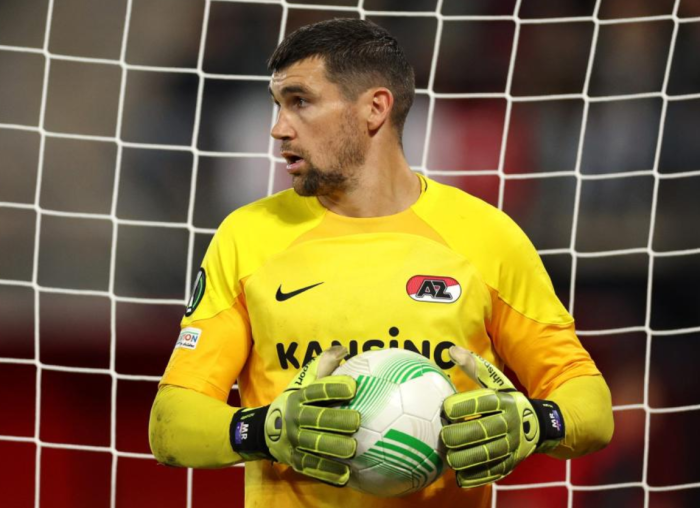
AZ Alkmaar in the Netherlands were able to offer him a return to being a regular no.1, though, and in 18 months he played 64 matches for the Eredivisie side, including 15 Europa Conference League games.

At the end of the 2023-24 season, he failed to agree a new deal with the club and the Dutch newspaper De Telegraaf reported that he ‘lost his game of poker’ with AZ’s sporting director Max Huberts, the club walking away from negotiations due to his wage demands.

As a free agent, Ryan joined Albion’s 2023-24 Europa League opponents AS Roma on a one-year contract as back-up to Serbian first choice ‘keeper, Belgian-born Serbian international Mile Svilar.

“If they get the Brighton version of Mathew Ryan, Roma will have a very safe pair of hands waiting in the wings,” reckoned Eliot Ben-Ner, writing for The Football Hub.

However, Ryan’s reign in Rome lasted only six months and in January 2025 he moved for a reported fee of £676,000 to French Ligue 1 side Lens on a six-month deal.

‘Keeper Kuipers the crowd-pleasing former Dutch marine

The ever-enthusiastic Michel Kuipers celebrates

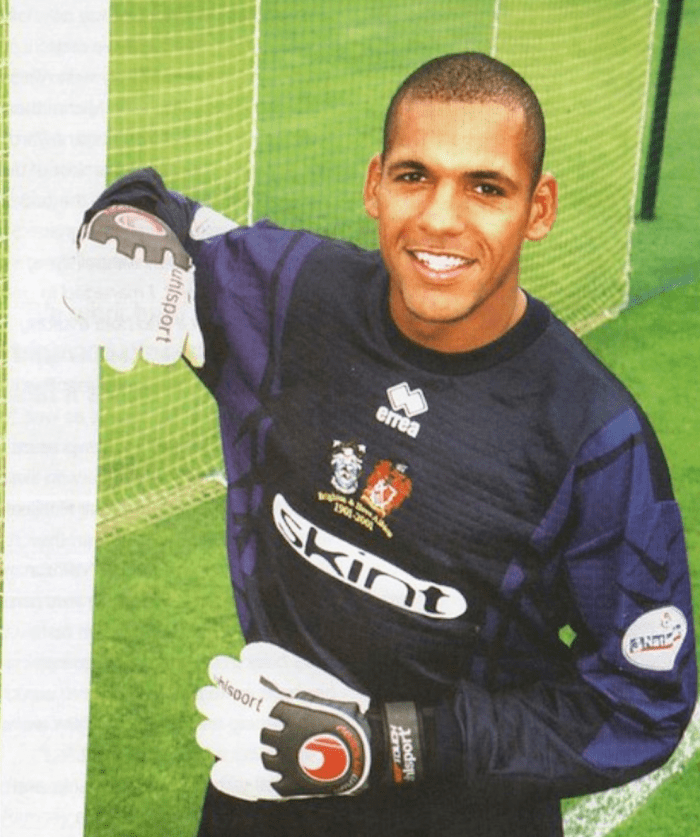
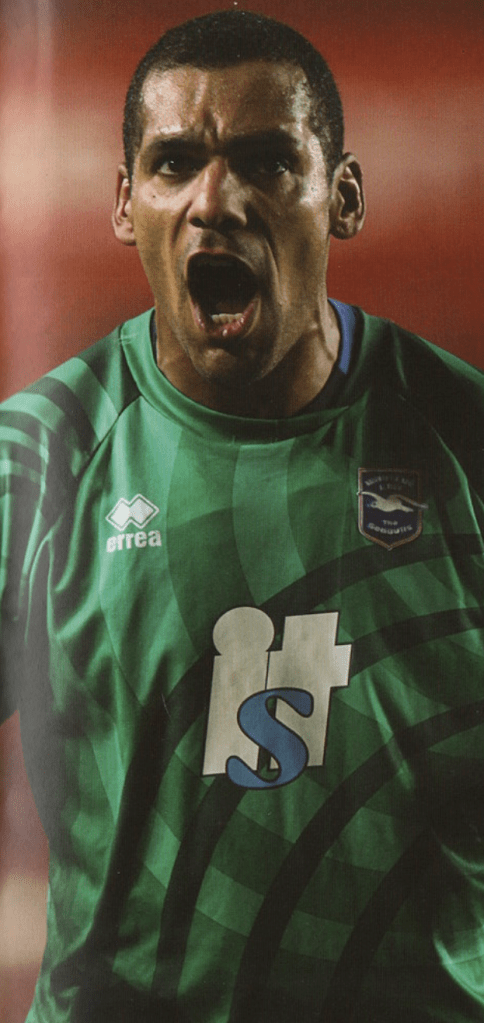
FORMER DUTCH MARINE Michel Kuipers earned back-to-back promotions with Brighton and Hove Albion and Crawley Town.

He was between the sticks for the Albion when they won promotion from the basement division in 2000-01 and the third tier in 2001-02.

And after 10 years with the Seagulls, during which he made a total of 287 appearances, he spent two years with Crawley where, over 49 matches, he won promotion from the Conference in 2011 and League Two in 2012.

Undeniably, it was Kuipers’ years with the Seagulls that defined his career after an inauspicious start when Micky Adams subbed him off at half-time on his debut away to Southend United. Replaced by Mark Cartwright in that match, he was left out of the next 11 matches before an injury to Cartwright enabled him to win back the shirt. He didn’t look back after that, though, and only missed three more matches as the Seagulls were crowned champions.

Early days between the sticks

Although there were to be plenty of ups and downs over the following years, when he wasn’t always first choice, Kuipers remained a crowd favourite for his agility as a shot stopper and his fanlike celebrations of goals and wins.

“I was a player but I also turned into a fan of the Albion,” he said in an interview with the matchday programme. “On the pitch I would celebrate each goal we scored like I was on the terraces with our supporters.

“After we had a good result in the game, I would celebrate with the players but always expressed my joy and gratefulness to the supporters.”

A sensational double-save in a televised game away to Wolves in November 2002 was a highlight for many and a one-handed reaction stop at Blackpool earned him a ‘save of the month’ award from sponsor Nationwide.

He didn’t always see eye to eye with Mark McGhee, who reckoned his kicking let him down, and the Scot said: “His desire to do well is unquestioned, but I had to make a decision and it was not always one he agreed with.”

McGhee was nonetheless full of admiration for the Dutchman and in a programme for Kuipers’ testimonial match v Reading in 2012, he recounted a specific role he played when Albion’s back-up goalie at the 2004 Second Division play-off final against Bristol City.

“I asked Michel to warm up, but in truth to get the supporters going. I remember him going down to the corner and waving with those huge arms – he absolutely galvanised the support.

“What was brilliant for me was that he did it despite his huge disappointment not to be playing himself – he did it for the team. The rest is history as the fans got behind the team. We got the penalty and went on to win the game.”

Later that evening, the trophy Albion won got bent when someone fell on it: with his bare hands, Kuipers straightened it!

Five years (from 19 to 24) in the Dutch Marines during which he’d parachuted from aeroplanes and learned to survive in harsh conditions, definitely left their mark. His training had taken him into jungles, deserts and the Arctic, but he said: “My love and passion for football was always there. In my spare hours I played for the Marines team.”

Born in Amsterdam on 26 June 1974, as a child Kuipers played football with his mates in front of some garages near the flats where he lived. He recalled they would be told off for hitting the ball against the garage doors, so he went in goal to try to save the ball from making loud bangs every time one of his friends scored.

“I was doing OK, so from that day onwards I played as a goalkeeper,” he said. He played for the local Blauw-wit under six team and went all the way through the age groups to the first team at 18.

A keen Ajax fan as a youngster, his idol was their goalkeeper Stanley Menzo – “one of the best goalkeepers of his generation” – and he also admired Menzo’s successor, Edwin Van Der Sar, who later played in England for Fulham and Manchester United.

Although Kuipers went straight from full-time education into the Marines, he also played part time for AFC Door Wilskracht Sterk (it means Strong Through Willpower) and Kuipers explained: “We won the Amsterdam regional league for the first time in 25 years and this brought me to the attention of Ian Holloway at Bristol Rovers.

“When I was offered a contract by him, I wasn’t sure I could leave the Army, but the officers knew I’d put 110 per cent into my job, so they were happy to release me.”

But in 18 months with Rovers, Kuipers only managed one first team appearance (against Bournemouth in March 1999). Indeed, it was while playing for Rovers Reserves against Brighton at Worthing that he caught the eye of Brighton boss Adams. He jumped at the chance when Albion offered him a trial and he played well enough in a Sussex Senior Cup semi-final against Langney Sports for Adams to persuade him to make a permanent move to the Seagulls with the intention of being back-up to Mark Walton.

When Walton suddenly upped sticks and joined Cardiff before the 2000-01 season had started, Kuipers found himself in the starting line-up for the opening game away to Southend.

Understandably, Kuipers was distraught at being taken off at half time but he knuckled down to try to win back the shirt and said: “If you’re mentally strong and you’ve got good self-confidence and belief then you just fight back and that’s the way I approached it in the following months.”

He credited the work he put in with goalkeeping coaches John Keeley and Mike Kelly, admitting: “They improved my technique and made me more professional.”

Even when Adams left for Leicester, Kuipers remained no.1 under Peter Taylor as the Seagulls soared to a second successive promotion.

Injury meant Kuipers missed the second half of the season when Steve Coppell’s side only just missed out on avoiding an immediate drop back to the third tier.

When Ben Roberts was preferred as first choice goalkeeper, Taylor, by then manager of Hull City, took Kuipers on loan in September 2003.

Albion rebuffed Hull’s attempt to sign him on a free transfer but shortly after his return to Sussex he was involved in a horror car smash on his way to training.

Remarkably, considering he was airlifted to hospital, he escaped serious injury although club physio Malcom Stuart reported: “Michel knows he was very lucky. There’s a degree of shock and he will need time for that to clear his system. Structurally there are no serious injuries, but he’s had several stitches and is very sore and uncomfortable muscularly.”

Manager McGhee added: “My God, we feared the worst. But in a sense it’s an absolute bonus, a miracle – they sent him home with a few cuts and bruises, a swollen face, a sore back and a sore neck, which in a week or two will be fine.”

Nevertheless, it was Roberts who kept his place as Albion won promotion via the aforementioned play-off final win in Cardiff. But in the first half of the 2004-05 Championship season, Kuipers was back in the saddle courtesy of injury to Roberts.

All was fine until a home game v Nottingham Forest on 22 January 2005 when Kuipers came off worse in a challenge with Kris Commons and the shoulder injury he sustained kept him out for the rest of the season. Former Arsenal ‘keeper Rami Shabaan and Southampton loanee Alan Blayney took over the gloves.

New competition arrived in the shape of Aston Villa loanee Wayne Henderson, who took over in goal at the start of the 2005-06 season and with the brief return of Blayney as well as Frenchman Florent Chaigneau as back-up, it seemed Kuipers’ Albion days might be over.

He was sent out on two loan spells at League Two Boston United – initially playing four times in December 2005, then 11 matches between February and April 2006.

With Brighton back in the third tier for the 2006-07 season, and another change of manager when McGhee gave way to Dean Wilkins, Kuipers found himself vying for the jersey with Henderson, who had been signed permanently. Local lad John Sullivan was beginning to emerge too. But there was no keeping a good man down and Kuipers was the ever-present first choice goalkeeper throughout the 2007-08 season.

At that time, he admitted he was still learning ways to improve thanks to goalkeeping coach Paul Crichton and told the matchday programme: “I am very pleased with the progress I have been making under Paul.

“My game has definitely improved and it is great to see the results of hard work on the training ground coming out in games.”

When Adams returned ahead of the 2008-09 season, Kuipers was still in pole position and he famously saved Michael Ball’s penalty when League One Albion beat Manchester City 5-3 on penalties in a second round League Cup tie at Withdean.

Although Sullivan had a run in the side, and Adams’ successor Russell Slade briefly turned to loanee Mikkel Andersen, Kuipers was once again in the box seat come the end of the season.

It wasn’t long after the arrival of Gus Poyet that Kuipers’ time at Brighton finally came to an end. A 2-1 home defeat to Norwich City in February 2010 was his last Albion start as Poyet turned instead to his ‘keeper of choice, Peter Brezovan.

The Dutchman continued his association with the Seagulls through involvement in the Albion in the Community programme and his long service was rewarded with a testimonial game at the Amex (a 1-1 draw v Reading when he played 15 minutes). He told BBC Radio Sussex: “Bar my family, this football club is the closest thing to my heart.

“I’ve been bleeding blue and white for the last 12 years so this is a very proud moment for me and my family.”

He added: “I love the Brighton supporters. They’ve been absolutely fantastic to me and a lot of the times when we had our backs against the wall, they were the 12th man.

“Especially as a goalkeeper, I really appreciate them backing the team. I think people appreciated me because I threw my body on the line for the club.”

Kuipers early days at Crawley saw him making headlines for all the wrong reasons – he was sent off twice in the first month, v Grimsby Town and v Forest Green Rovers – but he was in the Blue Square Bet Premier league side that had a terrific run in the FA Cup, only narrowly losing in the fifth round, 1-0 to Man Utd at Old Trafford in February 2011.

Kuipers’ loyalty was rewarded with a testimonial in 2012

On leaving Crawley in early 2013, he said: “When I joined, the club had finished mid-table in the Conference and I leave challenging for the play-offs in League One.

“The supporters have always backed me and I am really proud of the part I have played in raising the profile of Crawley Town with two successive promotions.

“It’s been a fantastic part of my career and I will always remember my time at the club.”

The final four months of his playing days were spent on the subs bench at Barnet, as back-up to first choice Graham Stack.

In 2020, Kuipers was behind the setting up of the PHX gym at Hollingbury.

Button rarely pressed into action with the Albion

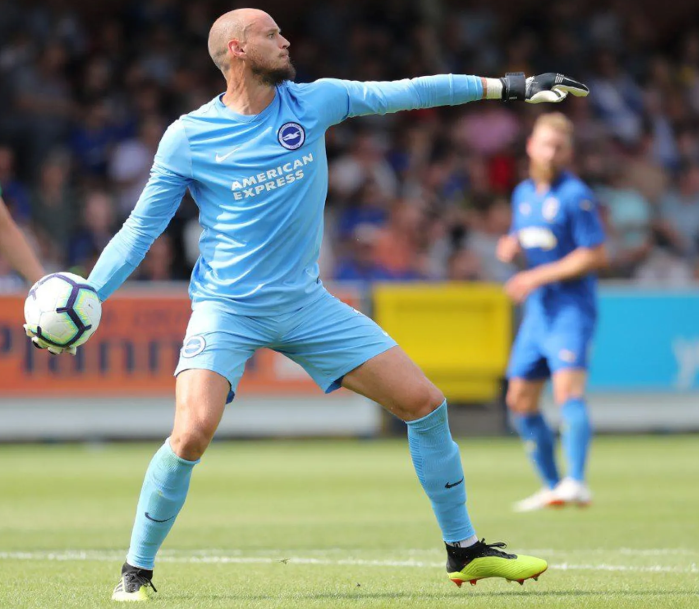
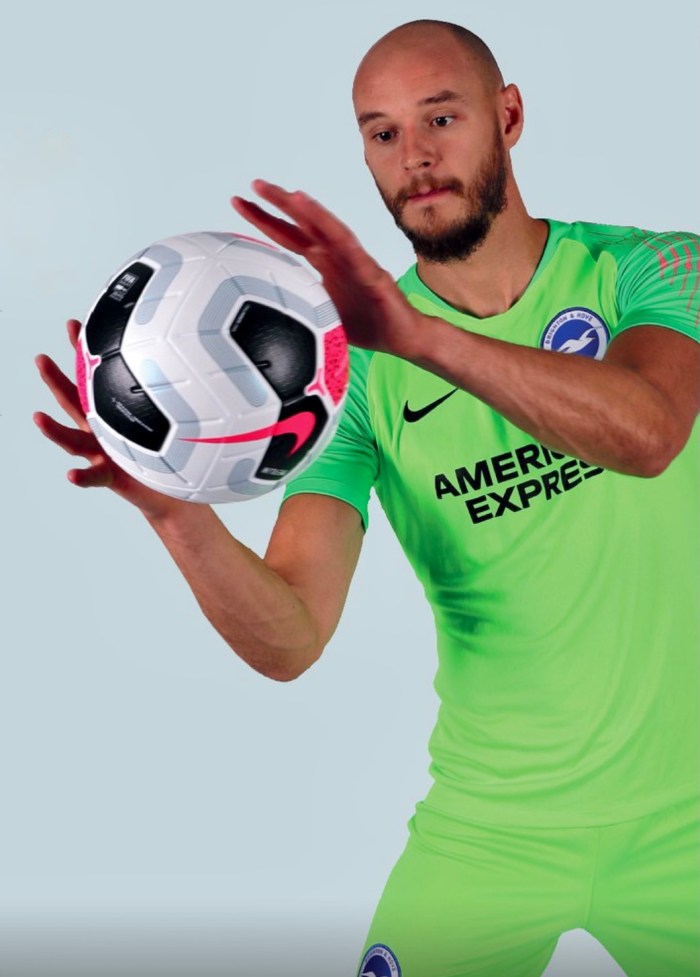
JOURNEYMAN goalkeeper David Button has travelled the length and breadth of the country in pursuit of playing time, his three years at Brentford being a rare settled spell in which he played 141 games.

Normally only a loanee or a back-up ‘keeper at a multitude of clubs, he had a season and a half as Fulham’s first choice but at Brighton between 2018 and 2020 he only made 10 first team starts.

Button was 29 when he signed for the Albion and he stepped into the boots vacated by Tim Krul, the previous back-up ‘keeper, who had moved on to Norwich City. With both upcoming goalkeepers Christian Walton and Robert Sanchez out on loan, boss Chris Hughton wanted a third senior ‘keeper.

Largely a watching brief

“He has a wealth of experience, having made over 300 appearances during his career so far, and I’m sure he will work well with Maty Ryan and Jason Steele,” said Hughton.

Button made his debut in a pre-season 2-1 friendly defeat against AFC Wimbledon, and realised from the outset that Ryan was going to be ahead of him.

“I’m not coming in blind to the situation, but I want to impress and be ready for the chance in the side – there has to be healthy competition wherever you are as a player and hopefully I can provide that for him,” he said. 

“There could be a chance for me and Jason in January if Maty goes away to the Asia Cup with Australia, so we’ll both be working hard to ensure we’re ready for that if the opportunity arises. 

“I know he’s very well thought of but at the same time you have to back yourself and work hard every day and do as well as you can.”

Indicating what might be expected of him, he said: “I’m confident with the ball at my feet – it’s a slightly different style to Fulham and we are allowed to go a bit more direct here and it’s something I feel I’m good at. 

“I think it’s a bit less risky – we play when we can and keep it when we can – the risk factor involved in playing it out of defence is less for me here though.”

Button certainly found a familiar face at training: goalkeeper coach Ben Roberts had previously worked with him at Charlton Athletic, and he said of him: “He has got a great reputation within the game and everyone he’s worked with speaks highly of him. I genuinely believe he’s one of the best at what he does.”

Button’s first competitive action for the Seagulls came in the fourth game of the season, a 1-0 home League Cup defeat to Southampton. He had to wait until December, when Ryan was away playing for Australia, to play in the Premier League.

In Premier League action v Everton

He kept a clean sheet in the first of them, a 1-0 home win over Everton, when he made a handful of saves, including turning a Richarlison effort onto a post.

“Although he’s a very experienced goalkeeper, it’s never easy when you’re coming in at this stage of the season and following Maty Ryan, who’s done so well for us,” Hughton said. “It wasn’t an easy decision because I’ve got two goalkeepers who are really pushing. But probably his experience managed to get him the nod (over Steele).

“It’s great for him to come into this first game and, not only be on a winning team, but also a clean sheet and that will do him the world of good.”

But that was as good as it got; Albion drew 2-2 at West Ham on New Year’s Day and lost to Liverpool (1-0) at the Amex and Man Utd (2-1) at Old Trafford. A 3-1 third round FA Cup win at Bournemouth saw then no.3 Jason Steele given a chance between the sticks.

On Ryan’s return, Button was back to the bench although he kept goal twice in Albion’s run to the semi-finals of the FA Cup: Button in the fourth round win over West Brom and in the fifth round win over Derby County. Hughton went with Ryan for the quarter final at Millwall and the semi v Man City.

When Graham Potter succeeded Hughton, Button spoke about the changes the goalkeepers then had to embrace. “We are now doing more work with our feet,” he told the matchday programme. “There is more onus on us to be better with the ball and to be comfortable with it.”

The opportunity to put it into practice was even less than previously for Button, though: he played just two League Cup matches in 2019-20 (Bristol Rovers and Aston Villa and one FA Cup tie (v Sheffield Wednesday).

At the start of the 2020-21 season, the ‘keeper swapped one Albion for another and signed for newly-promoted West Brom.

“I have ambitions of playing and helping the team as much as possible but I obviously understand that Sam (Johnstone) has got them promoted last season so he will start the season,” said Button.

“It’s up to me to push him and show the manager what I can do and take my chances when I get them. Hopefully there’ll be things I can bring to the squad certainly. I’m quite calm and comfortable with my feet too and commanding in my box so I’d say they’re my main strengths.”

However, Button played just one Premier League game in that first season plus three cup matches.

There was slightly more involvement in 2021-22 when the experienced stopper made 11 appearances in all competitions, including playing the final five Championship games and keeping consecutive clean sheets in the last three matches, against Coventry City, Reading and Barnsley.

When Button swapped West Brom for League One Reading in August 2023, one Baggies supporter wasn’t sorry to see the back of him. “’It is definitely the right move to offload David Button, he has been the worst goalkeeper I have ever seen at Albion,” said fan Matt Smith on footballleagueworld.co.uk.

“We’ve had some pretty decent goalies since I’ve been going, however Button was absolutely atrocious over a significant period of time too. How on earth did we spend £1m on him?

“How Steve Bruce gave him a two-year contract at the end of the 2021-22 season is beyond me. He’s so bad honestly. He can’t catch a bloody cold. He’s awful.”

Born in Stevenage on 27 February 1989, Button was with local club Stevenage Borough in their centre of excellence and acknowledged the input of the Coaching FX goalkeeping school in his early development.

“Keith Fenwick was my first coach: his first-class and very enjoyable sessions definitely helped to develop my love of being a keeper,” he said.

Button moved from youth academy to professional at Spurs

An England schoolboy and youth international, Button moved on to Tottenham’s youth academy in 2003, signed a scholarship deal two years later and then earned a four-year professional contract in December 2007. However, he only had eight minutes of first team action for Spurs – as a substitute for Carlo Cudicini in a League Cup match – and was loaned out 13 times.

Over his four years as a Spurs pro, he had two spells each at Crewe Alexandra and non-League Grays Athletic, plus stints at Rochdale, Bournemouth, Luton, Dagenham & Redbridge, Shrewsbury Town, Plymouth Argyle, Leyton Orient, Doncaster and Barnsley.

In the 2009-10 season, he notched up a total of 36 League Two appearances (10 for Crewe and 26 for Shrewsbury) and 30 in League One the following season, when with Peter Reid’s Plymouth, where he kept Romain Larrieu out of the team for much of the campaign.

When he eventually left Spurs permanently, he didn’t travel too far, joining Chris Powell’s Charlton in the Championship for £500,000. Powell preferred Ben Hamer in goal, though, and Button was restricted to a handful of appearances before moving on to Brentford.

In an interview with getwestlondon, Button said: “It was a little bit of a frustrating time for me at Charlton. I would like to think I would have been given a chance a bit sooner there. It was a difficult year but it helped build my character.”

When Brentford sold Simon Moore to Cardiff, manager Uwe Rösler took Button to Griffin Park declaring: “We decided David was the perfect choice for us. He is at the right age and he is very hungry to make the number one spot his own.

“As soon as Simon left, David was our first choice. David will face strong competition for the goalkeeper spot from Jack Bonham and Richard Lee, when Richard is fit again.

“We have been strong there (in the goalkeeping positions) over the past two seasons and are even stronger this year.

“Goalkeeper is a crucial position and David is a very good player.”

For once, fortune fell favourably for Button and he ended up first choice as the Bees won promotion from League One at the end of his first season and reached the play-off semi-finals at the end of his second season.

The Brentford fans website bcfctalk was full of praise for the stopper, saying: “He was very much our first point of attack as well as our last line of defence and his quick and accurate distribution played a massive part on our overall style of play and freedom of expression.”

The website added: “He sometimes failed to deal effectively with crosses and he could also use his physique better as he is an enormous man, but he was utterly reliable and often quite brilliant and he won us numerous points with some incredible saves.”

Ahead of the 2015-16 season, at a pre-season training camp in Portugal, Button spoke about all of the club’s ‘keepers being put through their paces by goalkeeping coach Simon Royce, a one-time Albion loanee ‘keeper, and how he wanted to maintain his run of form.

“I need to find that level of consistency now for me,” he said. “I feel like I had quite a few good games last season but there were a few where I wanted to do better. I am aiming to keep my standards high in every minute of every game this season.”
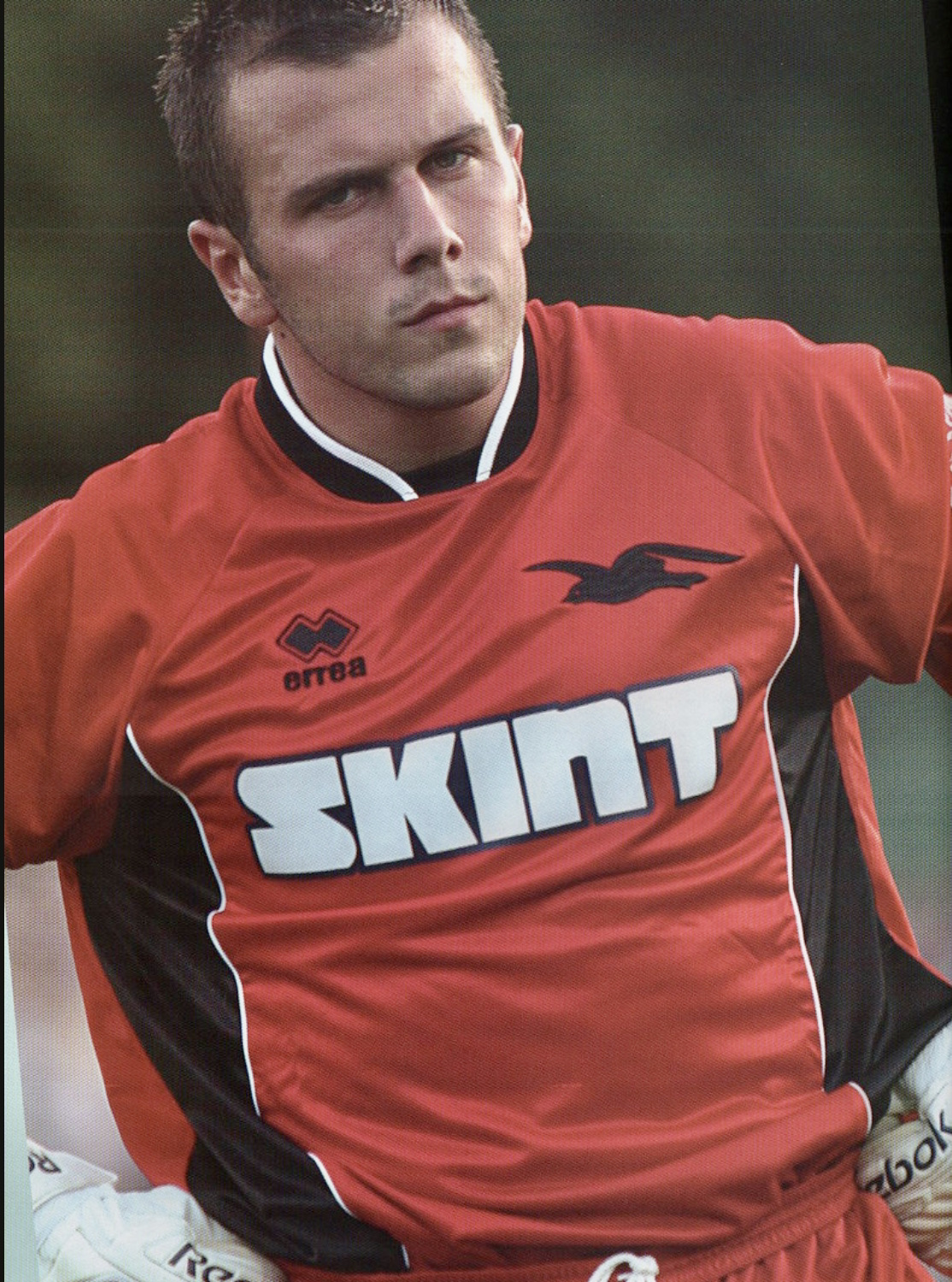
He remained first choice in 2015-16, making 47 appearances, but talks on a new contract broke down. He came in for a bit of a backlash on social media when he decided to move on to west London rivals Fulham instead but he told getwestlondon: “It’s football. Probably in their eyes it’d have been nicer for me to move on to a different club. It is what it is.

“Hopefully they remember the good times and what I did for the club. I’ve got a great respect for the fans and for the way they treated me while I was there.

Fulham custodian

“I had a great three years at Brentford but felt it was time for a change and the opportunity to come here arose and it was something that interested me.”

Button had the support of manager Slavisa Jokanovic at Fulham but gradually lost the backing of the supporters to the extent he was jeered at Craven Cottage.

Supporter Dan Smith did a detailed analysis of where he thought things went wrong on fulhamfocus.com. “Having narrowly missed out on promotion in the playoffs, Button signed off his Brentford career as a good keeper at this level and someone highly regarded by the Bees faithful,” wrote Smith. “His shot stopping one of the best in the league with a very strong ‘long’ kick.”

Button kept a clean sheet on the opening day of the 2016-17 season and Smith said: “He looked decisive, confident and capable. But something happened gradually as the season developed.”

He maintained the ‘keeper’s form slowly deteriorated and blamed the way he was being managed rather than the player himself. “He looks very uncomfortable with the ball at his feet and isn’t helped by the lack of movement from the deeper players making it very difficult for him to pick someone out,” wrote Smith. “Mistake after mistake giving the ball away clearly damaged his confidence because mistakes in possession led to poor keeping errors, letting in shots he should be saving and would have saved at Brentford.”

Interestingly, with echoes of what Roberto De Zerbi has said of Steele and Bart Verbruggen, Jokanovic did blame himself rather than Button, saying he trusted the ‘keeper and had full confidence in him.

“It’s my responsibility sometimes. I put my keepers in some sort of trouble. We play a bit different and I want to start playing from the keeper.

“It’s more simple to kick the ball to the strikers as it’d give him more opportunity to be comfortable in the goal.

“He has all my confidence. Sometimes, when he makes a mistake it’s partly my responsibility as well.”

Nevertheless, eventually Button lost his starting spot to Marcus Bettinelli.

Stockdale’s key role in Albion’s rise to the Premier League

DAVID STOCKDALE kept 20 clean sheets as Brighton were promoted from the Championship to the Premier League.

He was chosen by his peers in the PFA Championship team of the year and was runner up to Anthony Knockaert as player of the season.

What seemed like a mystery at the time, though, was that he then remained in the Championship by signing a three-year contract with Birmingham City (at the time managed by Harry Redknapp).

“I’m not ashamed to say I put my family first and football second for a change,” Stockdale explained, referring to his desire to sign a longer term deal than the Seagulls offered because he didn’t want the upheaval of a move that might have unsettled his daughter’s education at a time she was about to take exams.

Stockdale had joined the Seagulls from Fulham in the summer of 2014 and was first choice ‘keeper for three seasons, playing a total of 139 matches for the club.

Remembered for some notable performances between the sticks, Stockdale impressed off it too. In the wake of the Shoreham air crash, he showed great compassion for the victims.

Before the next game, away to Ipswich Town, he wore personalised gloves and a training top bearing the names of two of them, Albion groundsman Matt Grimstone, who was Worthing United’s goalkeeper, and his teammate Jacob Schilt.

He also spent time talking to Matt’s family, visiting with Albion ambassador Alan Mullery. “We are all guilty of complaining about the little things in life but there are far more important things to worry about and I wish more people realised that,” he told the matchday programme.

At the end of the season, Stockdale’s support was recognised by the award of the PFA Community Champion trophy. “A lot of tears were shed,” he told Albion reporter Andy Naylor, when he got the inside track on Stockdale’s story in an interview for The Athletic on 17 November 2019.

“I’d spoken to Matt a few times, with him being a goalkeeper. We used to shout across at each other. I’d joke, ‘You come and train with us and I’ll do that (groundskeeping)’.”

The way the club rallied round didn’t surprise the goalkeeper because he’d heard good things from Fulham teammate and all time Albion legend Bobby Zamora when he was mulling over the move.

“I knew it was a good club, a very progressive club, but when Bobby told me it was the best club, that was good enough for me,” he said.

There was a familiar face waiting for him at training too because the goalkeeping coach when he arrived was Antti Niemi, who had taken him under his wing in his early days at Fulham.

“I was only 21 at the time, at a big Premier League club, and he spoke to me a lot in those early days,” he said. “Although he’s the goalkeeping coach here now, it sometimes feels the same as it did back then.

“He’s the one putting on the sessions now, and I’ve enjoyed them like I did when I trained with him before,” he said.

Even so, Stockdale was even more impressed by Niemi’s successor, Ben Roberts. “There’s no better goalkeeping coach than him,” he said. “Ben and I had tried to work together at previous clubs and it hadn’t come off. So, when we finally did at Brighton, he said ‘this is what I want you to work on, stay with me and trust me and the process’.

“It wasn’t always easy, I was 30 at the time trying to adapt my style, sometimes it’s hard. But I trusted him and it worked. He’s shown with numerous keepers that he can help anyone improve. That’s why people hold him in such high regard.”

A personal highlight for Stockdale came in January 2017 at the Amex when he made a double save from a Fernando Forestieri penalty against Sheffield Wednesday that helped put Brighton top of the division.

Less memorable were two own goals in a 2-0 defeat at Norwich City when Alex Pritchard shots rebounded off the woodwork, hit him and went in.

And when Albion had a chance to clinch the Championship title at Villa Park, Stockdale fumbled a long-range Jack Grealish shot to concede a late equaliser which meant Newcastle finished top instead.

“I left with great memories, on a high, apart from the Villa game,” Stockdale told Naylor. “It was one of those when everyone knows it was a mistake. It just wasn’t meant to be, but as a player you feel the responsibility.

“We got what we wanted, got promoted, but I think it left a bit of a bad feeling.”

Born in Leeds on 20 September 1985, Stockdale stayed in Yorkshire in the early part of his career, initially in the youth sides of Huddersfield Town and York City.

It was York who took him on as a trainee, in 2000, and in the last game of the 2002-03 season, aged just 17, Terry Dolan gave him his first team debut as a half-time substitute for Michael Ingham, who was suffering a shoulder injury, although City lost 2-0 to Oxford United.

By then in the Conference, Stockdale made 19 consecutive appearances for the Minstermen between August and December 2004 before being dropped by caretaker manager Viv Busby.

It was during that run of games that Stockdale first gained international recognition, being selected for the England C (non-league) squad for a friendly v Italy (he went on as a sub for Nikki Bull).

After his club disappointment, he told the York Evening Press: “I was gutted when I was taken out of the team but I’ve just gone back to the training ground and worked as hard as I can.

“I have got my best years to come. I am only 19 and I hope I can get a contract for next year and stay at the club.”

When former Albion midfielder Billy McEwan took charge, he offered Stockdale his first professional contract, although the youngster prevaricated over signing it, much to the manager’s dismay.

McEwan told the York Evening Press: “If the players don’t want to sign, then it’s up to them. They can go because I want players who want to play for York City Football Club.

“But David Stockdale is the biggest disappointment to me and I have told him that. He’s a young apprentice getting his first professional contract and the last thing in his mind should be money. That should be of secondary importance and he should be grateful York City are offering him a contract.

“On the evidence of his last performance of the season, he has to do better if he wants to get into the team.

“At the moment, he has potential but so have a lot of players. Maybe he feels he can get an automatic number one spot but that’s up for grabs this summer.”

Shortly after signing the contract, Stockdale went on loan to Northern Premier League club Wakefield-Emley and the following March joined Worksop Town on a temporary basis.

Stockdale was released by York at the end of the 2005-06 season with some more harsh words from McEwan about his weight ringing in his ears. After signing for League Two Darlington, Stockdale told the York Evening Press being released had been the incentive he needed to save his career.

“I have done well in pre-season and got back into shape after letting myself go at York, which was well-documented,” he said. “I accept now that was the case and agree with the manager but I would have preferred not to have been criticised in public.

“It has probably given me a kick up the backside though to get me going again and I feel a better person now. I would have loved to have stayed at York because I was there for a long time and have a great affection for the club.

“I would like to thank everybody there for all the help they have given me. The fans were always great and I learnt everything there so it was a bit of a shock to go.”

Clearly benefiting from full-time goalkeeping coaching from former Darlington, Bristol Rovers and Middlesbrough no.1 Andy Collett, Stockdale became manager Dave Penney’s preferred first choice ‘keeper, ousting former Derby and Bolton stopper Andy Oakes.

Scouts from Birmingham and Newcastle were said to be monitoring his development but it was Fulham who stepped in and signed him in April 2008 for an undisclosed sum (thought to be £350,000 rising to a possible £600,000). He was loaned back to Darlo to finish the season when they lost out in the League Two play-off semi-finals.

Although he was at Fulham for six years, much of Stockdale’s time on their books was spent out on loan: in League Two with Rotherham United, League One at Leicester City, and in the Championship with Plymouth Argyle, Ipswich Town and Hull City.

Temporary Tractor Boy

Nevertheless, his parent club did give him a reasonable sprinkling of first team outings: he played a total of 52 games, 39 in the Premier League.

Indeed in 2011, when he was covering for the injured Mark Schwarzer, Fabio Capello, the England boss at the time, called him up for international duty, although he didn’t get to play.

His best run of games for Fulham in the Premier League came in the 2013-14 season when he made 21 appearances (he also played five cup games).

After he left Brighton, Stockdale was Birmingham’s first choice ‘keeper throughout the 2017-18 season (apart from two months out with an injured wrist). He played 39 games, having replaced the previous season’s no.1, Tomasz Kuszczak, who had also moved to City from Brighton.

Blues only narrowly avoided relegation from the Championship with Redknapp only lasting until mid-September as manager; Lee Carsley briefly in temporary charge, Steve Cotterill for five months and then Garry Monk.

Monk brought in Lee Camp as his first-choice ‘keeper and Stockdale was sent out on loan to three different League One clubs: Southend United (on an emergency seven-day arrangement), Wycombe Wanderers and Coventry City.

After making a single appearance for Birmingham under Monk’s successor Pep Clotet at the start of the 2019-20 season, Stockdale rejoined Wycombe in January 2020 on a half-season loan.

He then moved to Wycombe on a permanent contract in September 2020 but only played twice, with Ryan Allsop the preferred no.1. In February 2021, he linked up with League Two Stevenage on loan and played five matches before having to return to Wycombe when Allsop was injured.

He kept the shirt until the end of the season, when Wanderers were relegated to League One, and, with Allsop having been released, Stockdale stepped up and was ever-present throughout the 2021-22 season. His 18 clean sheets earned him the League One Golden Glove award, jointly with Michael Cooper of Plymouth.

Nevertheless, with his contract up, he then returned to Yorkshire, signing for Darren Moore’s Sheffield Wednesday, where he played 27 games in the 2022-23 season.

They say what goes around comes around, and at the start of the 2023-24 season Stockdale went back to York City, although he sustained an injury early on in the season that caused him to be sidelined from the National League team.

As well as his familiar playing role, Stockdale began to look towards a time when he hangs up the gloves by also being appointed York’s head of recruitment. However, he was let go from the role in April 2024.

Away from his direct involvement in club football, he began a postgraduate diploma in Global Football Sport Directorship with the PFA Business School.

Boo boys saw off international ‘keeper Wayne Henderson

DISGRUNTLED former Albion goalkeeper Wayne Henderson helped Grimsby Town keep their place in the Football League.

The Republic of Ireland international stopper, forced away from Brighton by a section of voluble supporters, was on loan to the Mariners in 2009 as they desperately tried to avoid the drop.

Although there were Grimsby grumbles on his debut, Henderson’s mission was a success, Town avoiding the drop by four points. But it was only a stay of execution because they finally fell out of the league for the first time in 100 years in 2010.

By then, Henderson was back at parent club Preston North End, who had bought him from the Seagulls for £150,000 on deadline day in January 2007.

He managed only 10 appearances for the Lancashire club – his last game coming in the final match of the 2009-10 season – and in March 2011, when only 27, he was forced to quit the game after two years plagued with spinal injuries.

Much had been expected of the young Irishman at Brighton after an initial loan spell from Aston Villa, where he had been coached by former Seagulls ‘keeper Eric Steele. He made his Albion debut away to Derby County, together with fellow countryman Paul McShane (on loan from Manchester United), in the opening game of the 2004-05 season.

Manager Mark McGhee said the youngster hadn’t put a foot wrong. “His kicking really took the pressure off us,” he said. “He was composed and took a couple of crosses towards the end which also helped relieve the pressure.”

McGhee had first hoped to sign Henderson in January 2005 to help solve a goalkeeping crisis created by a serious shoulder muscle injury to Michel Kuipers in a home match against Nottingham Forest.

Youngster Chris May, son of former Albion defender Larry May, had come off the bench to replace Kuipers in the match but McGhee didn’t see him as experienced enough in the battle to stay in the Championship. The previous season’s first choice ‘keeper, Ben Roberts, was a long-term absentee with a back injury, so McGhee had few options.

The Seagulls hoped a contractual hitch relating to Henderson’s previous loan spell at Notts County could be resolved in time to enable him to make his debut for the Albion at Elland Road. But it couldn’t and Brighton turned to Blackburn’s David Yelldell instead. That was the game where the loan goalkeeper famously wore a bright pink goalkeeper jersey and predictably suffered abuse from the Leeds crowd.

Although Clarke Carlisle put Leeds ahead just before half time, Yelldell had the last laugh when defender Guy Butters prodded home an equaliser in the 81st minute.

When McGhee didn’t see Yelldell as a long-term option, he turned to one-time Arsenal ‘keeper Rami Shabaan, who hadn’t played a competitive game for two years, but he let in 13 goals in six games. The manager brought in Southampton’s Alan Blayney, and he was between the posts for the last seven games of the season when Albion just managed to cling on to their tier two status.

McGhee finally managed to bring in Henderson ahead of the new season and, perhaps mindful of the goalkeeping headache he’d had the previous season, found he suddenly had an embarrassment of riches in that department.

Promising youngster Richard Martin appeared as a back-up on the bench, as did season-long French loanee Florent Chaigneau. In September, Southampton’s Blayney also returned for another loan spell and eventually took over the gloves when Henderson’s three-month loan from Villa came to an end.

Intriguingly, Henderson’s penultimate game on loan was a 1-1 draw with Ipswich at the Withdean when another Villa loanee, Stefan Postma was in goal for the visitors.

It had been Henderson’s understanding that a permanent move would follow soon after he’d featured in a 1-1 draw at home to Wolves on 1 November. But a two-month on-off saga began which, according to McGhee and chairman Dick Knight, was largely down to demands made by Henderson’s agent.

Albion agreed a fee with Villa of £20,000, plus £15,000 if he helped avoid relegation from the Championship. He didn’t.

The Argus sought the opinion of former Albion no. 1 Steele who felt Henderson had a chance to make a name for himself with the Seagulls.

“With Thomas Sorensen as the no. 1 and Stuart Taylor bought in from Arsenal, Wayne’s route in terms of playing first team football was always going to be limited,” Steele told the paper. “Our problem is that we only need one goalkeeper to play in one position and it’s just been a question of what level he would make his mark.

“He’s 22 now and he really had to be looking to move on and I wish him all the best. I’ve worked with him now for four and a half years and always thought he would make a good living from the game.

“I think that’s summed up by the fact that Brighton are going to pay a small fee and we’ll also get sell-ons. He’s the same height, he’s got the same build and he has got the same attributes as Shay Given (Newcastle and Republic of Ireland). And he just needs the chance to go and play.

“He’s been away at Wycombe and been away at Notts County, who would have signed him had they had the money. He’s done it in the Second Division and the First, now he’s got the chance to do it in the Championship.”

Even if supporters of the club he’d just joined had doubts about his merits, the Republic of Ireland selectors were confident enough to give him a first senior call up in February 2006, and he made his full international debut on 1 March 2006, as a second half substitute in a 3–0 win over Sweden.

After the Albion had forfeited their tier two status that season, and the omitted Kuipers had been transfer-listed after falling out with McGhee, Henderson opened his heart to the Argus.

“Michel is liked by the fans and hopefully one day I will get the respect of the fans I feel I deserve,” he told Andy Naylor. “Michel has that because he has been at the club for a long time. I have mixed feelings about him being on the transfer list because it’s good to have someone with his reputation at the club pushing me, but sadly he fell out with the manager.

“Hopefully, I can prove the fans who are criticising me wrong but if they are set in their ways there is nothing I can do about that. It’s a shame if that is the way they feel but I couldn’t care less. I am not going to worry about it.

“I know myself how well I have done, and I am an international player because of that.”

Although he started the new season as first choice ‘keeper, three defeats on the spin saw McGhee sacked and Kuipers back in the starting line-up.

New boss Dean Wilkins restored the Irishman to the team in October which was enough to convince Eire manager Steve Staunton, a former Aston Villa colleague, to put him into a Euro 2008 qualifier against the Czech Republic, when first choice Shay Given and back-up Paddy Kenny were unavailable.

“I knew Stan from Villa, yes, but I like to think I’m being picked on merit not just because he knows what I’m capable of,” said Henderson. “I’ve got a long way to go in all aspects but being at Brighton and playing first-team football means I’m developing under pressure and getting a chance to show Stan (Staunton) what I can do.”

The Irish drew 1-1 and, having been to Dublin to watch the match, Albion goalkeeping coach John Keeley believed Henderson could be Albion’s ‘keeper for 10 years.

“I’m so pleased for Wayne. It proves what a good goalkeeper he is,” said Keeley. “He has taken some stick but people should appreciate him.”

The coach praised his handling at Lansdowne Road, the way he had made himself available for back-passes from his full-backs, and his composure. Highlighting a fine one-handed save he made to deny Milan Baros, Keeley said: “The save that he made just before half-time was world class.”

He added:“I honestly believe that Wayne is a better ‘keeper than Paddy Kenny. His all-round game is more suited to international football.”

Henderson makes his Eire debut, replacing Shay Given

Keeley reckoned: “He’s 22 and we’ve got a world-class player. With Wayne being so young we’ve got a goalkeeper now for the next ten years. That’s the way I look at it.”

The following month, Henderson even made the headlines when he wasn’t playing! Injury ruled him out of Albion’s side to face Bradford City at Valley Parade on 4 November and he decided to watch from the seats behind the goal.

When Dean Bowditch scored an 89th-minute winner for the Seagulls, the exuberant ‘keeper jumped over the hoardings – and was promptly escorted out of the ground by a steward!

“It was over-zealous stewarding,” he said afterwards. “Alex Revell made the goal and he was celebrating right in front of where I was sitting in the front row of the stand.

“The natural thing was to go and celebrate within him but one of the Bradford stewards – who knew I was one of the non-playing squad members – took exception to my celebration.

“I think he was a Bradford supporter and perhaps he thought I was trying to rub his nose in it – but I wasn’t. I was just pumped up to see the lads score a last-minute winner.

“The next thing I was being grabbed by a steward and then I was marched out of the ground where the police took my name and address, but I think they saw the funny side of it.”

Henderson wasn’t laughing a few weeks later. He’d returned from injury but the side was on a losing streak in December. Away to Bournemouth on New Year’s Day, it looked like Albion might come away with a point but in stoppage time the ‘keeper lost his footing and gifted the Cherries a win, and a section of Brighton supporters booed him off the pitch.

After a 3-0 defeat to West Ham in the FA Cup third round, the Seagulls entertained Millwall at Withdean and a mix-up between Henderson and Joel Lynch led to the visitors winning by the only goal of the game.

Manager Dean Wilkins dropped him and it was the last time he played for the club. The barracking had got to him to the extent he had submitted a second transfer request of the season and, referring to the fans who’d got on his back, he told the Argus: “They love their football as much as anyone else but the way they reacted was pathetic really.”

After securing a deadline day move to Preston, he said: “It was disappointing the way it finished. I was devastated at being left out of the team. The mistake I made against Bournemouth could have happened to anybody and the Millwall game was a mistake by someone else that caught me out.”

Now free to air his feelings about the series of events, he said: “A lot of fans have certain opinions of players. For me the whole experience at Brighton was more like the X Factor.

“It just seemed to be a personality contest and I couldn’t enjoy my football.”

He continued: “I’ve never felt welcome at the club, except by the coaching staff and the players. The coaching staff have been magnificent, and I wish them all the best, because, if anyone is going to get anything out of the kids, it is Dean (Wilkins) and Dean (White), so I hope they are given a fair crack of the whip.

“Outside of them and the lads, a handful of fans have backed me lately and I really respect that but there were an awful lot of fans who didn’t and other people at the club who, for some reason, made it more difficult than it should have been.”

Within the tight confines of the small capacity Withdean Stadium, perhaps it was always going to be a tall order for Henderson to supplant crowd favourite Kuipers.

The ‘former Dutch marine – chef’ Kuipers, as he was serenaded by the singing section, had endeared himself to the Albion crowd after Micky Adams brought the previously unknown shot-stopper to the club in 2000. Subsequent managers brought in their own alternatives but Kuipers, always a reliable shot-stopper, had a habit of bouncing back.

If Henderson was perturbed by unfavourable crowd opinion at Brighton, it seems there was similar mood music when he made his debut for Grimsby.

Manager Mike Newell brought him in along with three other loan players (Joe Widdowson, Peter Sweeney and Barry Conlon) and, in 14 games he played through to the end of the season, five wins and three draws were enough to give them a finish four points above the relegation trapdoor (Chester City and Luton Town went out of the league).

The excellent Cod Almighty fans website observed some fans booed and jeered Henderson on his home debut because the gale force wind kept blowing his goal kicks into touch.

Pete Green, on the same website, later wrote: “These temporary Mariners have played an enormous part in preserving the club’s status in the Football League – even as repeated mistakes by experienced, longer-term Town players such as Phil Barnes and Tom Newey continued to jeopardise it. Henderson has already gone back to Preston, and we stand no chance of signing him permanently.”

While the other three loan players did sign permanently, Newell brought in another Irish international goalkeeper in Nick Colgan the following season.

Born in Dublin on 16 September 1983, Henderson followed in the goalkeeping footsteps of his father and brothers. Dad Paddy played for Shamrock Rovers; brothers Dave and Stephen played in the League of Ireland. Even his nephew, Stephen, was a goalkeeper – most notably for Portsmouth, Charlton and Nottingham Forest after also going through the youth ranks at Villa.

Wayne played for the same Cherry Orchard club in his home city that also spawned the likes of Mark Yeates, Dave Langan, Andy Reid and Stephen Quinn.

John Gregory was in charge at Villa Park when Henderson joined Aston Villa in July 2001. A year later, he was in goal when Villa won the FA Youth Cup (below), beating Everton – with Wayne Rooney playing up front – 4-2 on aggregate over two legs. Also in the Villa side that day was Liam Ridgewell, who later had a brief loan spell at Brighton, and Peter Whittingham, who went on to play more than 500 professional games and died in tragic circumstances aged just 35.

Joy for Henderson as Aston Villa win the 2002 FA Youth Cup

Although Henderson was chosen on Villa’s first team bench occasionally, he didn’t play any competitive fixtures for the first team. Those opportunities came via loans.

After a month at non-league Tamworth in the spring of 2004, he spent a month on loan at Second Division Wycombe Wanderers under Tony Adams towards the end of the 2003-04 season, when their last place finish meant they were relegated to the newly formed League Two.

The following season he joined Notts County, another of the clubs who’d been relegated with Wycombe, and had two loan spells, three months under Gary Mills and then a month under his successor, caretaker boss Ian Richardson.

Paul Simpson signed Henderson for Preston but when injuries forced him to retire at just 27, he told skysports.com: “I’ve decided to actually step out of football and give my body time to heal for once.

“It is exciting for me though because I’m looking to go into a completely different environment from playing but stay within football at the same time.

“I’ve been trying to get back fit for a few years now with injections and operations, but I’ve decided that rest is the way forward for it now.

“I’ve not signed anything yet, but there are a good few options for me to choose from, which I am really excited about.”

Henderson, who married 2010 Apprentice winner Liz Locke, now works as a licensed intermediary for agency YMU, who, among plenty of other elite footballers, represent Albion’s Evan Ferguson and Andrew Moran.

Day of reckoning beckoned for talent spotter Mervyn

THE YOUNGEST goalkeeper to appear in a FA Cup final spent 20 months picking out future players for Brighton.

It was one of several different post-playing roles Mervyn Day filled for various clubs.

Day, who at 19 won a winners’ medal with West Ham in 1975, was Albion’s head of scouting and recruitment between November 2012 and the end of the 2013-2014 season under head of football operations David Burke.

At the time, his appointment was another indicator of the gear change taking place at the club as it built on the move to the Amex Stadium and sought to gain promotion from the Championship.

Day said in a matchday programme interview: “This club has come such a long way in such a short space of time.

“When you think of the debacle of the Goldstone, the wilderness of Gillingham, then Withdean, you only have to get a player through the front door at this wonderful stadium to have a chance of signing them.

“Hopefully, within the next year or so, the new training ground will be up and running and, when you’ve got that as well, you’ve got the perfect opportunity not only to encourage kids to sign but top quality players as well.

“If we are fortunate enough to get ourselves into the Premier League at some point, we’ll be able to attract top, top players.”

It was a case of ‘the goalkeepers union’ that led to him joining the Albion. Day explained he’d been chatting to Andy Beasley, Albion’s goalkeeping coach at the time, who had been a colleague when Day was chief scout at Elland Road. Beasley wondered if he’d like to help coach Albion’s academy goalkeepers but Burke, who he also knew, stepped in and offered something more substantial: the job of scouting and talent identification manager.

He certainly brought a wealth of experience to the task. He had previously been assistant manager to former Albion midfielder Alan Curbishley at Charlton and West Ham; manager and assistant manager at Carlisle United, a scout for Fulham and the FA (when Steve McClaren was England manager) and chief scout at Leeds until Neil Warnock took charge.

In addition to that background, in the days before full-time goalkeeper coaches, Day had worked at Southampton under David Jones, Chris Kamara at Bradford City and John Aldridge at Tranmere Rovers. Then in 1997 Everton came along and he joined Howard Kendall’s backroom team alongside Adrian Heath and Viv Busby. “I was living in Leeds at that time, so distance wasn’t an issue, but it was an interesting trip across the M62 in the winter months,” Day recalled in an October 2021 interview with efcheritagesociety.com.

Brighton made Day redundant at the end of the 2013-14 season following a reshuffle of the recruitment department amid criticism of the quality of signings brought in.

That assessment might have been rather harsh because during his time at the club there was a change in manager (Oscar Garcia taking over from Gus Poyet) and, although the season ended in play-off disappointment, the likes of former Hammer Matthew Upson (who’d played under Day when he was at West Ham) had signed permanently on a free transfer (having been on loan from Stoke City for half the previous season).

The experienced Keith Andrews and Stephen Ward also joined on season-long loan deals and played prominent roles in Garcia’s play-off reaching side.

It was under Day’s watch that the promising young goalkeeper Christian Walton was signed after a tip-off from Warren Aspinall. Aspinall told the Argus in 2015: “I went to Plymouth to do a match report. I set off early and took in a youth team game off my own back. He was outstanding, commanding his box. I reported straight back to Gus (Poyet). He told Mervyn Day. He went to see him, Mervyn liked him.”

It wasn’t the first time Day had played a role in securing a goalkeeper for the Albion. As far back as 2003 he had an influence on Ben Roberts’ arrival at the Albion. Manager Steve Coppell revealed: “He is one of three goalkeepers at Charlton and at the moment nearly all the Premiership clubs are very protective about their goalkeepers.

“I have seen him play a number of times, although I certainly haven’t seen him play recently. I spoke with Mervyn Day (Charlton coach) and he says Ben is in good form. It’s a little bit of a chance and it will certainly be a testing start for him, but he is looking forward to the challenge.”

Day was also sniffing around another future Albion ‘keeper when he was chief scout for Bristol City (between 2017 and 2019).  According to Sky Sports commentator Martin Tyler, Mat Ryan was on their radar in the summer of 2017 when he swapped Belgium for England. In an interview with Socceroos.com, Tyler reveals he was asked by City’s ‘head of recruitment’ (thought to be Day) to glean the opinions of Gary and Phil Neville (manager and coach of Valencia at the time) on Ryan and whether he’d be suitable for the English game.

“I got a text saying, ‘Can you find out from the Nevilles whether they rate Mat Ryan’,” Tyler said. “It wasn’t my opinion they were looking for – quite rightly – it was Gary and Phil’s. I was able to do that and both Gary and Phil gave Mat the thumbs up.”

After leaving Brighton, Day moved straight into a similar role with West Brom, where he worked under technical director Terry Burton and first team manager Alan Irvine, but he was only there a year before linking up with the Robins. He has since been first team domestic scout for Glasgow Rangers, although based in his home town of Chelmsford.

Day was born in Chelmsford on 26 June 1955 and educated at Kings Road Primary School, the same school that England and West Ham World Cup hero Geoff Hurst attended. He moved on to the town’s King Edward VI Grammar School and represented Essex Schools at all levels. He joined the Hammers under Ron Greenwood on a youth contract in 1971.

“On my first day as an associate schoolboy I got taken by goalkeeping coach Ernie Gregory into the little gym behind the Upton Park dressing room and he had Martin Peters, an England World Cup winner, firing shots at me,” Day later recounted. “As a 15-year-old that was incredible.

“The bond got even closer when my father died when I was 17. I was an apprentice but Ron signed me as a full pro within a very short space of time to enable me to earn a little more money to help out at home. A short while later he gave me another increase. He was almost a surrogate father to me.”

In the early part of 1971, Day played in the same England Youth side as Alan Boorn, a Coventry City apprentice Pat Saward took from his old club to the Albion in August 1971.

The goalkeeper was just 18 when he made his West Ham United debut, on 27 August 1973, in a 3-3 home draw with Ipswich Town.

He went on to play 33 matches in his first season and only missed one game in the following three.

Tony Hanna, for West Ham Till I Die, wrote: “In only his eleventh game for the Hammers he received a standing ovation from the Liverpool Kop in a 0-1 defeat that could have been a cricket score but for his fine display and, in his next visit to Anfield, he saved a penalty in a 2-2 draw.”

Day recalled: “As a kid, I had no fear, I took to playing in the first team really, really well. At West Ham, the ‘keeper always had lots to do as we were an entertaining team. We had forward-thinking centre-backs in Bobby Moore and Tommy Taylor, and then after Bobby came Kevin Lock.”

Mervyn Day in action for West Ham against Brighton at the Goldstone Ground, Hove.

In 1974, Day progressed to England’s Under-23 side. He won four caps that year and a fifth in 1975 but it was a golden era for England goalkeepers at the time and he didn’t progress to the full international side, despite being touted for a call-up.

By the time Day won that last cap, he had been voted PFA Young Player of the Year and, at 19, had become the youngest goalkeeper to appear in a FA Cup Final, keeping a clean sheet as West Ham beat Fulham 2-0 at Wembley.

Hanna continued: “At times he was performing heroics in the West Ham goal and he was fast becoming a fans favourite. Tall and agile, he was a brilliant shot stopper and he was playing like a ‘keeper well beyond his years.”

However, by the 1977-78 season Day’s form had tapered off as the Hammers were relegated. “His confidence was so bad he was eventually dropped and he only played 23 games that season,” said Hanna. “There are several theories to what triggered the loss of form, but one thing that did not help the lad was the stick he was getting from the Hammers supporters.

“In hindsight Mervyn said that he was ill prepared for such a tough run of form. The early seasons had gone so well that he had only known the good times and when the bad ones came he struggled to come to terms with the pressure.”

In 1979, West Ham smashed the world record transfer fee for a goalkeeper to bring in Phil Parkes from QPR and Day was sold to Leyton Orient, where he replaced long-standing stopper John Jackson, who later became a goalkeeper coach and youth team coach at Brighton.

Day spent four years at Brisbane Road before moving to Aston Villa as back-up ‘keeper to Nigel Spink. After a falling-out with Villa boss Graham Turner, he switched to Leeds under Eddie Gray and then Billy Bremner. During Bremner’s reign, he had the humiliation of conceding six at Stoke City at the start of the 1985-86 season and, in spite of vowing it wouldn’t happen again, let in seven in the repeat fixture the following season. Amongst his Leeds teammates that day were Andy Ritchie and Ian Baird.

Nevertheless, he ended up playing more games (268) for Leeds than any of his other clubs. He rarely missed a game up to the end of 1989-90, the season when was he was named Player of the Year and collected a Second Division championship medal.

Howard Wilkinson offered him a post as goalkeeping coach for United’s first season back in the elite, having lined up a £1m move for John Lukic from Arsenal. Day had a couple of loans spells – at Luton Town and Sheffield United in 1992 – but was otherwise back-up for Lukic, alongside his coaching duties, until Wilkinson saved Brighton’s future by signing Mark Beeney from the Seagulls.

After eight years at Elland Road, Day moved to the Cumbrian outpost of Carlisle in 1993. When he moved into the manager’s chair at Brunton Park, he not only led them to promotion from the Second Division in 1997, but they also won the (Auto Windscreens Shield) Football League Trophy. United beat Colchester 4-3 on penalties at Wembley after a goalless draw; one of the scorers being the aforementioned Warren Aspinall, later of Brighton and Radio Sussex.

Day worked under Curbishley at Charlton for eight years between 1998 and 2006, helping the club stabilise in the Premier League.

And, in December 2006, he followed Curbishley as his No.2 to West Ham, where the duo spent almost two years.

It was in 2010 that he returned to Leeds as chief scout, working under technical director Gwyn Williams. United manager Simon Grayson said at the time: “We’re restructuring the scouting department under Gwyn and Mervyn will be both producing match reports and watching our opposition and working on the recruitment of players.

“Merv’s knowledge and experience will prove important to the football club as we look to progress and develop what we are doing.”

The Harry Hotspur youngster who went west

MULTIPLE loans away from parent club Tottenham Hotspur didn’t succeed in laying a path to a top level football career for striker Jonathan Obika.

One of the last such arrangements saw the young forward spend three months with the Seagulls in the 2013-14 season.

Nathan Jones, no.2 to Brighton head coach Oscar Garcia, had seen what Obika could do when the young striker had been under him as a coach on loan at Yeovil and Charlton Athletic.

Unfortunately, his impact with the Seagulls was underwhelming even though he scored on his first (and, ultimately, only) full start in a 3-1 win away to Port Vale in the fourth round of the FA Cup.

Obika salutes his one and only goal for Brighton

Albion’s other goals that day, from Rohan Ince and Solly March, were also their first for the club – generating the statistic that it was the first Albion game in 110 years in which three players had scored their first goal in the same league or cup match.

It had been an amazing goalscoring performance for Spurs reserves that prompted Albion to make a move for Obika as cover for first choice Leonardo Ulloa, especially with Craig Mackail-Smith and Will Hoskins sidelined by injury and Ashley Barnes on the brink of a move to Burnley.

The Argus reported that Obika had previously been a target but a move had been put on ice because he’d been injured. His return to fitness saw him net a double hat-trick in a friendly for Tottenham against Charlton’s under-21s, watched by Jones.

“The report coming back on him after the game was one word – lethal!” former Seagulls goalkeeper Ben Roberts, then on the coaching staff at Charlton, told the Argus.

“Like Nathan, I worked with Jon at Yeovil and then at Charlton and he’s a really good pro,” said Roberts. “He is guaranteed to score goals. He is a real predator around the box.

Obika in action for Yeovil

“I’ve been waiting for his career to really kick off. When he came to us at Charlton it took him a couple of weeks to get up to speed. But he was brilliant for us. The end of the season came too soon for us.

“He is a great signing for Brighton and he will suit the way they play.”

However, Garcia also brought in Spaniard David Rodriguez at the same time and Obika found himself down the pecking order, especially when Manchester United loanee Jesse Lingard was added to the forward options.

The Vale cup game aside, Obika made just seven appearances as a substitute but didn’t add to the lone goal and was eventually recalled by Spurs and sent out on loan to Charlton again until the end of the season.

Nevertheless, Garcia said: “He came in to give us forward cover and, while he may not have played as much as he would have liked, he has been a great professional and a pleasure to work with.”

Obika’s long association with Tottenham finally came to an end in September that year when he headed west to League One Swindon Town, where he played for three years, scoring 28 times in 108 games for the Robins.

In 2017, he switched to Town’s rivals Oxford United on a two-year deal before then trying his luck in Scotland, playing in the Scottish Premier League for St Mirren.

On the expiry of that contract, Obika moved to League One Morecambe and, in January 2022, found himself back in the news ahead of this year’s FA Cup third round when Morecambe travelled to North London to take on the club who nurtured his early career for 13 years.

Although Morecambe took a shock first half lead against Spurs through defender Antony O’Connor, it wasn’t a fairytale ending as the Premier League side eventually won the tie 3-1 with three goals in the last 16 minutes of the game.

Obika had to watch from the bench until the 58th minute when he replaced Jonah Ayunga – a Brighton reserve player between 2016 and 2018 – with Morecambe still clinging on to their slim lead.

Born in Enfield on 12 September 1990, of Nigerian parents, Obika grew up in Edmonton and it was while playing football for his primary school, St Paul’s & All Hallows, that he was scouted by Tottenham.

“I lived five minutes from the stadium, so I used to walk to training as a 10, 11-year-old,” he said. “That was my only focus back then.” He later attended Bishop Stopford School in Enfield and left with seven GCSEs.

Originally a left winger, Spurs’ under 18s coach Alex Inglethorpe was responsible for moving him to play as a central striker and in the 2007-08 season he was top scorer for the Spurs academy side.

Those goals caught the attention of first team boss Harry Redknapp and he signed his first professional contract at 18, while a second-year trainee in the academy, and earned a call-up to the first team squad.

Wearing the number 80, he made his debut off the bench in a UEFA Cup game in Holland against NEC Nijmegen on 28 November 2008. A few weeks later, he made his first senior start in front of the White Hart Lane faithful, playing against Shakhtar Donetsk in the same competition.

“I didn’t know I was starting at the beginning of the game, there were a few injuries so a lot of the youth team players trained that week and we were in the squad,” Obika remembered.

When announcing the team, Redknapp actually read out his name as John Utaka, his former player at Portsmouth, amid much hilarity. “That broke the ice,” said Obika. “I was less nervous after that. I was more relaxed and actually ended up having a good game. To play at the Lane, having grown up down the road, was a great feeling and I had all my family and friends there that night.”

Along with Inglethorpe, the coaches who most influenced his development at Spurs were John McDermott and, when he progressed to the reserves, Tim Sherwood, Les Ferdinand and former Albion full-back Chris Ramsey.

Obika and fellow Spurs youngster Andros Townsend were sent out on loan to Yeovil – it was the first of four loan spells there for Obika – as recalled by Jones in an interview with coachesvoice.com: “A host of other clubs wanted them, but I think Harry saw two young kids who wanted to play, and he saw something in us as a coaching team.

“Townsend clearly had huge drive and ambition, and Obika scored the goals that kept us in League One that season – so we will always be thankful to Harry for that.”

Obika recalled: “While I was at Yeovil, Nathan Jones was my coach and I built up a good relationship with him. He would stay behind with me while I did extra shooting: he didn’t need to, I could have done it with other teammates, but he wanted to be there and help me progress and I really appreciated that. He is a good man. He also took me to Charlton for a loan spell and, of course, to Brighton.”

Obika also had loan stints at Millwall, Crystal Palace, Peterborough and Swindon although in the 2012-13 season he did manage to get two more games for the Spurs first team, featuring in the League Cup and the FA Cup.

He went on as a 75th minute substitute for Clint Dempsey when André Villas-Boas’ Spurs side beat Carlisle United 3-0 in the League Cup in September 2012, and was a 59th-minute substitute for Gylfi Sigurdsson when Leeds dumped Spurs out of the FA Cup 2-1 in a fourth round tie at Elland Road in January 2013.

Casper Ankergren – the ‘Great Dane’ between the sticks

DANISH goalkeeper Casper Ankergren earned the League One player of the month award four times – twice with Leeds United and twice with Brighton.

When the Yorkshire club dumped him after he’d played 143 games for them, Gus Poyet, his former assistant manager at Elland Road, gave him the chance to revive his English football career. He spent seven years as a player at Brighton and between 2017 and 2021 assisted Ben Roberts with coaching Albion’s goalkeepers.

The Dane was only truly Albion no.1 for a season and a half, and fans were often divided about his capabilities. But his ability with the ball at his feet suited the way Poyet wanted the Albion to play, and as a coach chimes perfectly with the expectations placed on today’s Albion goalkeepers.

“He really is key to the way we pass it out from the back,” observed ‘Murraymint’ on North Stand Chat, noting his ball playing and vision for a pass as “excellent”.

Ankergren himself explained in a podcast on the club website in 2020: “I was always quite comfortable with the ball at my feet, probably because I played outfield as a kid.

“At Leeds I wasn’t supposed to play it to the centre backs but under Gus you had to play it short; he would go mental if you didn’t. That was his philosophy. I’ve always been a big fan of possession-based football.”

On the eve of the 2010-11 season, Poyet’s goalkeeping options were narrowed when first-choice Peter Brezovan was nursing a wrist injury and he wasn’t happy to start the campaign with either of the inexperienced understudies, Michael Poke or Mitch Walker.

Poyet told the club’s official website: “Goalkeeper is a key position in the team, and with Brezovan injured, we wanted to bring some experience to that position.

“Casper brings that experience and has played at this level and higher. I have worked with him at Leeds United, and know exactly what he is capable of, he also knows what it takes to get promoted from League One.”

Ankergren hadn’t even had time to get to know his new teammates when he made his Albion debut in a 2-1 win in the season-opener away to Swindon Town the day after signing.

Unfortunately, he didn’t cover himself in glory on his home debut when a mistimed punch helped Rochdale to get a last-gasp equaliser in a 2-2 draw at Withdean.

The ’keeper admitted he later hid himself away in his Jury’s Inn hotel feeling dreadful about the mistake. “I was devastated, but that’s football. As a keeper you can do well for 90 minutes but if you cock up in the 91st minute that’s all people remember you for,” he said in a matchday programme article. “It’s part of the game as a goalkeeper and you have to accept it.”

He certainly made up for it to the extent that he won the first of two nPower League One Player of the Month awards that season for his displays the following month, when he only conceded once in five matches as Albion secured 13 out of 15 points.

Ankergren won the award again in March 2011 when the Seagulls won eight matches out of eight – with six clean sheets for Ankergren – to consolidate their gallop towards the League One title.

In April 2011, Ankergren, speaking at the PFA awards in London, said: “He [Gus] was asking us to be perfect and although there’s no such thing in football, we were close, the way we did it, the way we played – he’s very, very pleased. He couldn’t ask for much more, I think.

“At the beginning of the season I had a chat with him and he said he thought a top six finish would be possible. But no, we finished first – an amazing season.”
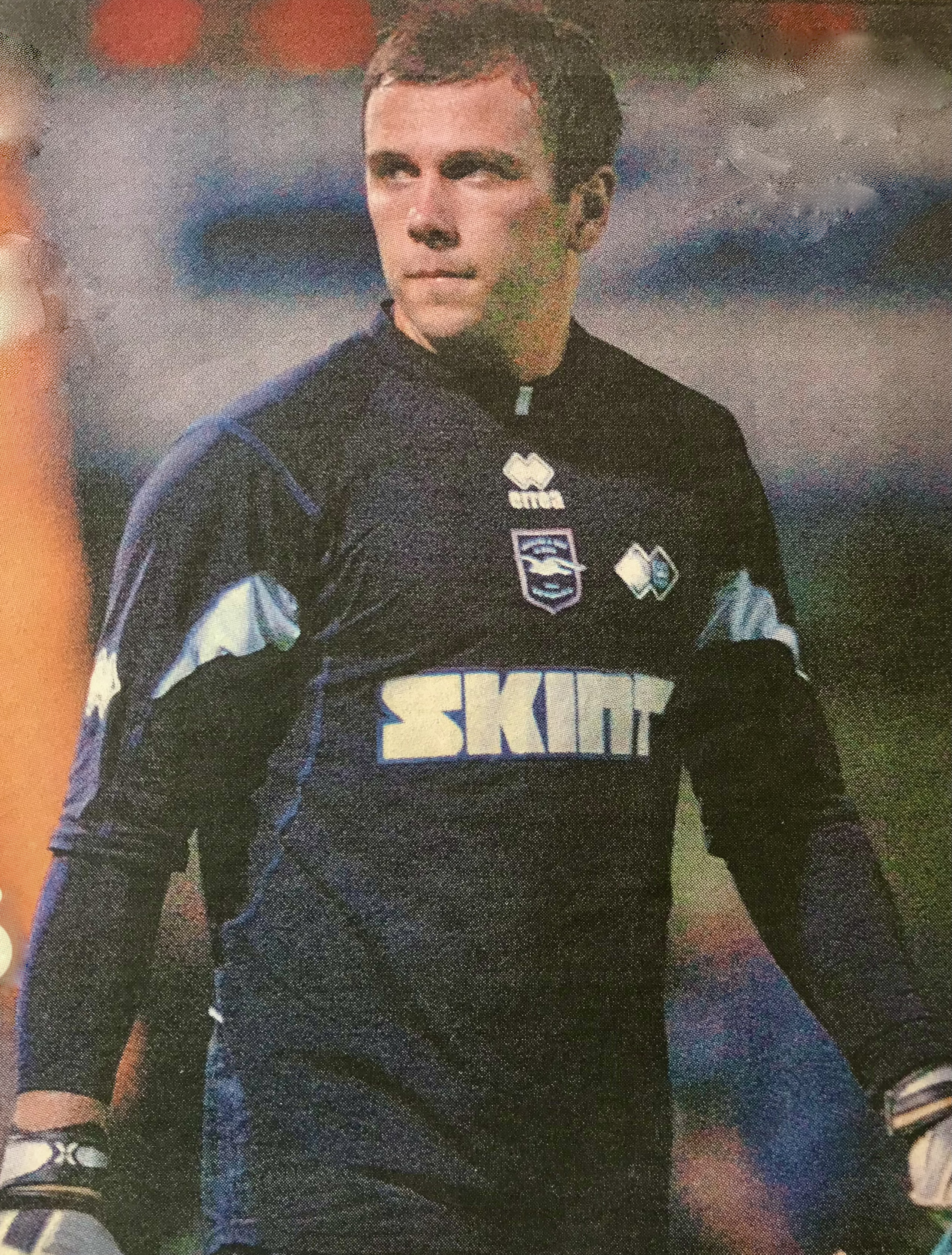
The promotion with Brighton was more personally satisfying for Ankergren because he was involved from the beginning to the end of the season.

“I played a lot of games for Leeds last season when we went up but I didn’t play the last eight or nine games and that was a big blow for me,” he said. “I’ve played every game in the league this season and obviously it’s great, that’s what you want to do as a footballer; you want to play every game and win and achieve something.”

He was in goal for the memorable first Amex league fixture against Doncaster and kept the shirt for the first 15 games of the 2011-12 Championship season. But after a seven-game winless run, Steve Harper came in on loan from Newcastle United.

When Harper returned to the North East, he got back in the side for seven more matches, but after four successive defeats in December, Poyet rang the changes for the New Year’s Day match at home to Southampton. Brezovan started in Albion’s surprise 3-0 win and stayed in goal through to the end of the season.

Fan Bradley Stratton later observed: “Brighton’s return to the Championship at the Amex highlighted the need for another change in goal. Ankergren and Brezovan, whilst competent in League One, were regularly found out at the higher level.

“They inspired little confidence in fans, and there was no doubt Poyet would use the summer window in 2012 to bring in a new man who could galvanise the Albion back line and restore confidence to a defence that had conceded six goals at both West Ham and Liverpool that year.”

After Tomasz Kuszczak arrived to become the senior goalkeeper, Ankergren’s first team action in 2012-13 was limited to four starts plus one as a sub.

Two of those were in the FA Cup against Premier League opposition. The third round FA Cup win over Newcastle United was his first appearance in the first team for 13 months and he said: “Although I have not been playing for the first team, I’ve always trained as hard as ever because you never know what’s round the corner and you want to push the other keepers hard, so I was ready. It’s still hard to be thrown straight back into action because you need to play regularly to get into the rhythm of things, but I was pretty happy with my performance against Newcastle.”

And there was nothing he could do to prevent Theo Walcott’s late deflected winner as Arsenal won the fourth round tie 3-2 at the Amex, when Leo Ulloa scored on his debut.

As if to emphasise his point about memorable howlers, one of his two league games that season was at Nottingham Forest, when he fumbled a last-minute equaliser at the City Ground, allowing Henri Lansbury’s long-range effort to earn the home side a point in a 2-2 draw.

Poyet was quick to sympathise with the goalkeeper and said: “To begin with I thought the shot must have taken a deflection but when I’ve seen it again I nearly killed myself!

“When you are a keeper you pay the price and Casper has done that today. He was having a very, very good game, making two or three good saves, coming for crosses and kicking very well. And in training he will save 1,000 shots like that, but we wanted him to save it today.

“Goalkeeper is a terrible position to play but we lose together and we win together – at least we got a point.”

In Oscar Garcia’s only season in charge, Ankergren played only two first team matches but he was kept on under Sami Hyypia and, with the arrival of David Stockdale and the emergence of youngster Christian Walton limiting his likely involvement even further, he made just the one appearance in the 2014-15 season, in Albion’s 4-2 League Cup win away to Swindon Town.

He confessed on the podcast that he struggled to get his head round the situation and contemplated quitting the game but was talked out of it by goalkeeping coach Andy Beasley.

With the arrival of Niki Maenpaa as back-up to Stockdale, Ankergren could have been forgiven for thinking his chances of ever playing first team football again had gone, but in a bizarre set of circumstances during a FA Cup tie at Lincoln City on 28 January 2017, Ankergren had to come off the bench in the 56th minute when Maenpaa went off injured.

The Finn had injured his shoulder in the melee that resulted after Glenn Murray had committed a foul in the penalty area and the first thing Ankergren had to do was to face the resultant penalty, which was scored.

Five minutes later he was picking the ball out of the back of the net again after inexperienced Chelsea loanee Fikayo Tomori had skewed a shot past the beleaguered ‘keeper. To rub salt in the wound, Albion lost 3-1, enabling City to reach the last 16 of the competition for the first time in their 115-year history. The consolation for Albion, of course, was that they were able to concentrate on the league, and they went on finally to win promotion to the elite level they’d left in 1983.

That promotion signalled the end of Ankergren’s playing days but the start of a career as a goalkeeping coach which he admitted in the podcast he’s enjoying immensely.

Born in the Danish coastal seaport of Køge on 9 November 1979, Ankergren played football with his mates from an early age on a pitch close to his home. He also played handball in the winter – it’s a big sport in Denmark – and it got to the point where he had to decide which one to pursue seriously because his parents said he couldn’t do both. He chose football because he enjoyed it a bit more, although he reckoned the hand-eye coordination involved in handball was an asset as he pursued his career as a goalkeeper.

When he started out playing organised football with Solrød FC, he switched from centre half to midfielder to striker and only went in goal when their keeper got injured.

He was only 12 when he was signed by his hometown’s local professional club, HB Køge. Before he became a full professional, he worked for a pizzeria delivering pizzas and at an after-school club. After leaving school, he continued his education at college for a further two years because he wanted to be a policeman if football didn’t work out.

But having broken into the Køge first team, he caught the attention of Brondby, who were probably the biggest club in Denmark at the time.

He joined them in May 2000 and started full-time the following January. “It was a big, big step for me,” he told the podcast. “I didn’t really enjoy it at first. It was a bigger step than I expected it to be.”

Their first-choice keeper, Morgens Krogh, had won Euro ‘92 with the national team so it was tough to compete with him. But the youngster made his debut when Krogh was injured and eventually took the no.1 spot. As well as winning one championship, he topped it by winning the league and cup double in 2005-06.

Ankergren also gained experience playing in the Europa League against teams like Locomotiv Moscow, Espanol and Palermo.

Shortly after he signed a new three-year contract with Brondby, unbeknown to him they signed Stephan Andersen from Charlton Athletic, and Ankergren wasn’t assured he’d still be first choice. “I’d had enough and wanted to try something different so while I was away with the national team (the B side) in Asia, I got a call from my agent saying Leeds were interested.”

Ankergren just missed out on a full international cap, although he was on the bench for games against Luxembourg and the Czech Repubic. He did win a handful of under 21 caps, and he said: “I’ve represented my country at various junior levels and remember making my under 16 debut against England. On the other side that days was Wes Brown and Michael Owen – you could tell both would have successful careers. Owen looked something special and he scored against me in a 4-1 defeat. I didn’t have my best game.”

Ankergren joined Leeds on loan initially, making his debut aged 27 in a 2-1 home win over Crystal Palace on 19 February 2007. Although it panned out to be one of the most turbulent times in the club’s history, Ankergren found life at Leeds more relaxed under Dennis Wise and Poyet than he had in Denmark.

His 14 games at the bottom of the Championship couldn’t halt the slide towards relegation which was confirmed emphatically with a points deduction when the club went into administration.

“I saved a couple of penalties early on, which won over the fans, including an important one against fellow strugglers Luton,” he said. He denied Dean Morgan from 12 yards with only four minutes left of a tense afternoon, and he told a supporter’s blog: “There were a few minutes, plus stoppage time to go against Luton so I had to stay focused as they were down there with us, so the win was vital.

“I had also saved a penalty away at Cardiff City but unfortunately we still lost the game.”

After signing on permanently, Ankergren was first choice as Leeds acclimatised to third tier football in 2007-08. He made 54 appearances in all competitions and, having conceded only one goal in five league games in September 2007, won his first League One Player of the Month award.

It wasn’t always plain sailing at Elland Road, though, and he was sad to see Poyet depart to become assistant manager to Juande Ramos at Spurs in November 2007, followed early in the new year by Wise, who became director of football at Newcastle.

“Gus was really, really respected up in Leeds. It was a big loss when he went to Tottenham – we really missed him, but I kept in touch after he left,” said Ankergren.

“I liked his style. If you do well, he’ll let you know – but if you don’t do well, he’ll also let you know. There’s none of this going behind your back; he’ll say it to your face, which is what I like.”

He also felt a sense of loss with Wise’s departure. “It was a massive disappointment for me personally,” he said. “Wisey is a good man, he had given me the chance to play in England and I will always be grateful to him.”

In March 2008, the goalkeeper faced an “improper conduct” charge brought by the FA for allegedly throwing a missile into the crowd at the County Ground, Swindon. He was fined £750 but not banned.

Gary McAllister was installed as manager and steered the club to the end of season play-offs against Doncaster Rovers and, despite some important saves by Ankergren, they lost. “I don’t know why but we never turned up at Wembley,” said Ankergren. “It was a strange feeling which let me flat, and it took a long time to get over that. We came so near, yet so far.”

Ankergren admitted to sheridan-dictates.com that he did not particularly enjoy the 2008-09 season. “It appeared that McAllister didn’t know his best team. I was in the side one week then the next he would pick Dave Lucas. Goalkeepers need games to stay sharp and focused and the thought of being dropped played on me and I did not perform to the standards I expected from myself.

“McAllister had been an outstanding midfielder but he was a League One manager with a League One squad. I think he expected too much from a group who didn’t have the ability that he had been blessed with as a player.

“The atmosphere was not great around the club and I thought that McAllister made some very strange decisions.

“Although I did not have any real issues with the manager, I have to be honest and say that I was not too disappointed when he was sacked and Simon Grayson was brought in.”
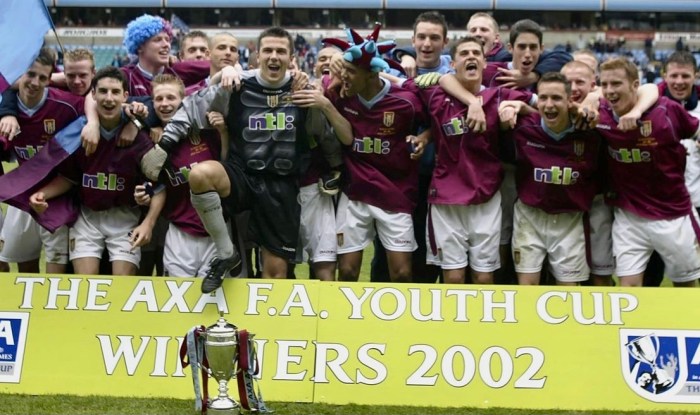
Grayson’s reign started on Boxing Day 2008 and he put Ankergren back into his team to play Leicester City. Leeds had fallen into mid-table but turned things around to earn a place in the play offs against Millwall who won the two-legged semi-final.

“Looking back, could we handle the favourites tag?” Ankergren asked. “It was another horrible feeling, but we were all determined to come back for pre-season training and go one better.”

However, although Lucas had left the club, Ankergren faced new competition in Shane Higgs and Grayson went with him at the start of the 2009-10 season.

But when Higgs was injured at MK Dons on 26 September 2009, Ankergren appeared as a substitute and eventually won his place back, even though United brought in Frank Fielding and David Martin as loan goalkeepers, and he had the feeling Grayson didn’t really rate him.

Ankergren re-established himself with a string of impressive performances and clean sheets and was the last line of defence in a memorable 1-0 FA Cup third round win for Leeds at Old Trafford in January 2010, including pulling off a terrific save to deny Danny Welbeck.

He was also in goal against Spurs in the next round when it took a replay at Elland Road before the north London club finally won through.

However, the beginning of the end of his time at Elland Road came when he made a mistake in a 2-0 home defeat against Millwall on 22 March 2010, and he didn’t return to the side for the remaining nine games as they went on to win promotion to the Championship as runners up behind Norwich City.

“I remember sitting with Paul Dickov in the dressing room having a beer and reflecting on what we had achieved,” Ankergren told sheridan-dictates.com. “We went over to the Centenary Pavilion for the end of season dinner and on to a nightclub, It was a great night but deep down I knew that I had played my last game for the club as my contract was up.”
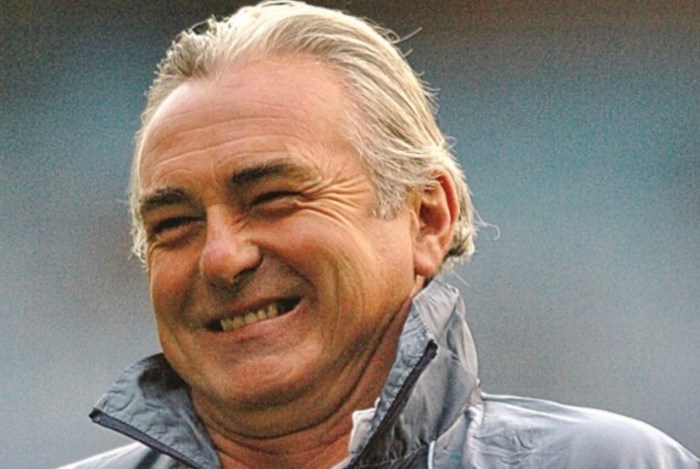
Ironically, his replacement at Leeds was fellow Dane, Kasper Schmeichel, son of Ankergren’s goalkeeping idol, Peter, who also played for Brondby before going on to achieve fame at Manchester United.

Ankergren’s 11-year association with the Seagulls came to an end in September 2021 when he returned to his home country as head goalkeeping coach at Brondby.

Pictures from various online sources, matchday programmes and the Argus

Krul luck as Ryan kept Dutch penalty ‘master’ at bay

AN international goalkeeper whose prowess at saving penalties took his country through to the World Cup semi-finals barely got a look-in between the sticks for Brighton.

Experienced Dutchman Tim Krul, who played 184 games for Newcastle United over 12 years, kept goal for the Seagulls on only five occasions during the 2017-18 season.

The form of Mat Ryan, himself an Australian international, meant Krul’s involvement was restricted to cup matches and a watching brief from the substitute’s bench.

Krul initially signed on a season-long loan deal on deadline day in August 2017 but the move was made permanent the day after he made his Albion first team debut in a 1-0 League Cup defeat at Bournemouth.

Manager Chris Hughton said: “I know Tim from my time at Newcastle and he is an excellent professional that has a vast amount of experience at both club and international level.

“He’s played an extensive amount of games in the Premier League, as well as playing in the Europa League and his experience will also help benefit the other keepers in the squad.”

Having experienced some in and out spells during his time on Tyneside, Krul understood the situation when interviewed by The Argus in November 2017.

“I’m working hard every day to push Mat Ryan. He’s done great so far and we’re picking up points, that’s what it’s all about.

“If the gaffer needs us or Mat got injured, I need to be ready and literally it can happen any second.”

Krul admitted: “It’s a different position for myself, because I’m used to playing week in, week out.”

The move to Albion had been the chance to reignite his career after a long spell on the sidelines having suffered a cruciate knee ligament injury on international duty in 2015.

Krul is powerless to stop Romelu Lukaku’s winning goal for Manchester United in Brighton’s FA Cup fifth round tie at Old Trafford

Before he made the move, he consulted Steve Harper, who’d been on loan at Brighton during the Gus Poyet era. Harper told the matchday programme: “I told him it woud be a great move for him and it will also be a great signing for the club. He was outstanding in the season Newcastle finished fifth in the Premier League and he’s an international ‘keeper for the Netherlands who has played at the World Cup.”

After he’d played in Albion’s FA Cup fifth round defeat to Manchester United at Old Trafford, Krul told The Argus: “Obviously when I came, I was hoping to get a bit more (game time) maybe, but at the time I walked through the door Maty’s performances went up a level, so that is testament to him.

“The level we are training at with Ben Roberts every day is really high. He has been showing that in the games. I’ve been around long enough to see when a goalkeeper is playing well you take that. I’m 29, I’m back fit, I’m feeling better than I’ve ever done so I’m ready to play. I just have to be patient again.

“I had to be patient at the start of my career and you have to do that again now. But my chance will come. There’s a lot of years left.”

Krul finally got regular playing time again when he moved to Norwich City

Unfortunately, that didn’t happen with the Albion but Krul certainly resurrected his career with Norwich City and, after signing an initial two-and-a-half-year deal in the summer of 2018, earned a further three-and-a-half-year contract in December 2020.

He then contracted Covid-19, announcing it on Twitter, where he has a huge following of more than 349,000. “I feel under the weather and fatigued,” he wrote. “It’s an important reminder to stay safe, this virus is not a hoax.”

Thankfully, by the end of January, he had recovered and returned to the side to clock up 100 appearances for the Canaries.

Born in The Hague, Holland, on 3 April 1988, from a young age Krul played for his hometown club RAS and was with ADO Den Haag between the ages of 12 and 17. Graeme Souness was still boss when Krul joined Newcastle in the summer of 2005. Shay Given and Steve Harper were the established ‘keepers in those days.

Shortly after making his debut in a UEFA Cup match in November 2006, he suffered injuries which ruled him out of action for six months. After returning to playing in the spring of 2007, he earned a new four-year deal with Newcastle.

An eventful loan spell in Scotland followed as Krul sought to gain league experience at Falkirk. He conceded 11 goals in two games early on (four to Celtic, seven to Rangers), he was sent off in a game on 2 January 2008, and then dislocated a shoulder in a cup match against Aberdeen, bringing the loan to a premature end.

When Given left St James’ Park for Manchester City, Krul was no.2 behind Harper in Newcastle’s 2009-10 season in the Championship. He deputised if Harper was injured and was given starts in cup matches. By the season’s end, when the Toon had won promotion back to the Premier League, Krul was awarded a new four-year deal and made his debut at that level when replacing the injured Harper in a 1-0 win away at Everton in September 2010.

He ended that campaign having played 25 first team matches, and the following season, established himself as the no.1, with Rob Elliot as his deputy. Out-in-the-cold Harper was allowed to spend a month on loan with the Albion.

Under Alan Pardew, Krul was the preferred first choice ‘keeper, and he signed a five-year contract with the Magpies in 2012. Several different injuries in 2012-13 restricted him to 30 appearances.

Another six-week injury lay-off over Christmas 2014 interrupted a period when there was yet another managerial change on Tyneside and the 2015-16 season under Steve McLaren was only a couple of months old before Krul was ruled out for the remainder of the season when he ruptured an anterior cruciate ligament in his right knee playing in the Netherlands’ 2-1 European Qualifiers win in Kazakhstan.

McLaren was sacked in March 2016 and his replacement Rafa Benitez couldn’t prevent them from being relegated. Krul signed a one-year contract extension in the summer of 2016 but, with Elliot and Karl Darlow ahead of him, he was sent on loan to Ajax as Newcastle successfully bounced back to the elite, pipping Albion to the Championship title.

Meanwhile, things didn’t work out as planned for Krul. He only got a handful of games for the Ajax reserve side and he spent the second half of the season at AZ Alkmaar instead.

Krul has played for his country at every age level and made his full international debut in a friendly against Brazil in 2011. Maarten Stekelenburg and Jasper Cillessen have normally been ahead of him but he has won 11 caps, including three in 2020 after a five-year absence from the side. However, it was what happened at the 2014 World Cup in Brazil that most fans will remember.

Head coach Louis van Gaal took off Cillessen in the final seconds of extra time with the Dutch still drawing 0-0 with Costa Rica and sent Krul on because of his reputation for saving penalties. Sure enough, he made two saves in the subsequent shoot-out and Holland went through to the semi-finals (where they went out 4-2 on penalties to Argentina).

The story behind the decision emerged in an article by Michael Bailey for The Athletic on 5 March 2020. The Dutch goalkeeping coach at the tournament, Frans Hoek, explained how Krul had responded best of the three ‘keepers to special training he put them through.

“When we came together with the national team, the three goalkeepers were more or less at the same level in stopping penalties. And that level was low,” Hoek told The Athletic. “We decided to do things in a different way and when you do that you have to believe in it, practice it and then show it. Basically, Tim responded best to that.

“He had some advantages. He’s very big, he has an enormous reach. He is impressive when you’re standing the other side of him and maybe because he’s from Den Haag area, he can be a little bit provocative. Michel Vorm is too nice a guy, so is Cillessen. But Tim can get away with it. It’s just something he has.”

A look back through the archives reveals Krul was displaying his prowess saving penalties as far back as his youth playing days. In an FA Youth Cup match for Newcastle against Brighton, he made saves from Tommy Fraser and Scott Chamberlain as Toon edged it 3-2 on penalties.

Albion goalkeeper coach Roberts was full of praise when asked about the big Dutch ‘keeper. “He has an aura about him and the self-belief to think he will save everything,” said Roberts. “I’m delighted for him as lots wrote him off when he had his bad knee injury. He’s since shown how much his hard work and dedication has paid off.”

After putting pen to paper on his new Norwich contract, Krul told the club website: “Proud is the big word. I’m excited to commit my future to Norwich and have had an amazing two and a half years already at this club, so I’m excited to add another three and a half years to that.

“The plan the club has got for the next few years is exciting and there’s some young, exciting talent coming through the ranks as well. From top to bottom, it’s a club I want to be at; one that’s run really well from Michael and Delia to the kitman. It’s an exciting time for the club, for sure.

“As a player, you want to be loved and I’ve got a great relationship with the fans. The club giving me this three-and-a-half-year contract shows the belief they’ve still got in me.”

Manager Daniel Farke added: “It’s fantastic news for us to have a player of Tim’s quality and personality. He’s by far the best goalkeeper in this league and was impressive in the Premier League.

“He’s still in a really good age for a goalkeeper and can play many more years. It’s good news he was willing to sign a long-term contract because there is lots of interest in a player of his quality and experience.”

Krul was a key part of Norwich’s Championship-winning sides of 2018-19 (when he was ever-present) and 2020-21. But in August 2023 he returned to the Premier League when he was signed by newly-promoted Luton Town.

Town boss Rob Edwards said: “Tim’s a leader and a top goalkeeper who is still very and ambitious and very hungry. He wants to play.

“It’s great to have someone of his level in the group with that ambition and to be that driven, and it’s going to add great competition to the goalkeeper department, which is what we’ve wanted.”

Pictures from online sources and matchday programmes.