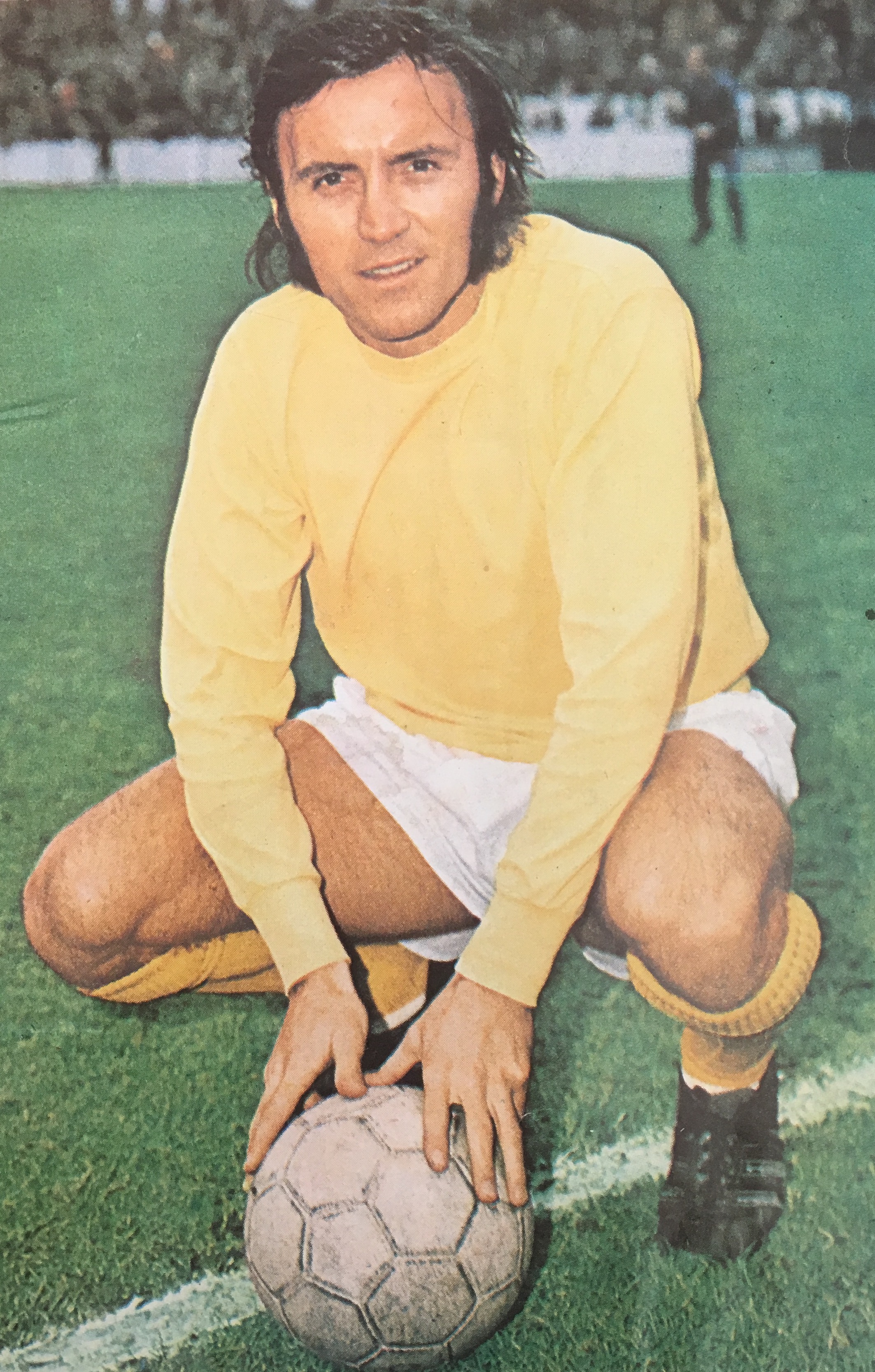
Fans took Alan Duffy to their hearts after debut goal

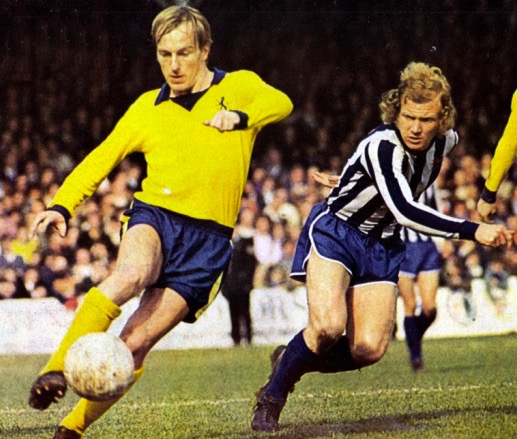
TWENTY-year-old Alan Duffy couldn’t have wished for a better start to his Brighton career than scoring a belter on his debut.

A £10,000 signing from Newcastle United, he was quickly off the mark on 17 January 1970 in a 2-1 Third Division win over Bradford City.

He appeared to be “the Third Division answer to George Best by beating two Bradford players and smashing a ferocious shot in off the crossbar” according to Seagulls TV, which recounted he was a “stocky striker with a robust style”.

Fan Mo Gosfield, posting on North Stand Chat in January 2011, described the goal as “one of my top 10 Albion moments, because it took your breath away”.

Mo added: “He had all the makings of a cult figure at Brighton. The swagger, the shock of hair, the slight beer belly. I loved him, but he never quite lived up to that sensational start.”

The fans in the old North Stand adapted the Hare Krishna chant to incorporate his name and, after that promising debut, the young striker kept his place in the starting line-up through to the end of the season.

He repaid manager Freddie Goodwin’s faith in him with five more goals. Particularly memorable were Duffy’s two goals in Albion’s 2-1 win over Reading on Good Friday when a huge crowd of 32,036 packed into the Goldstone.
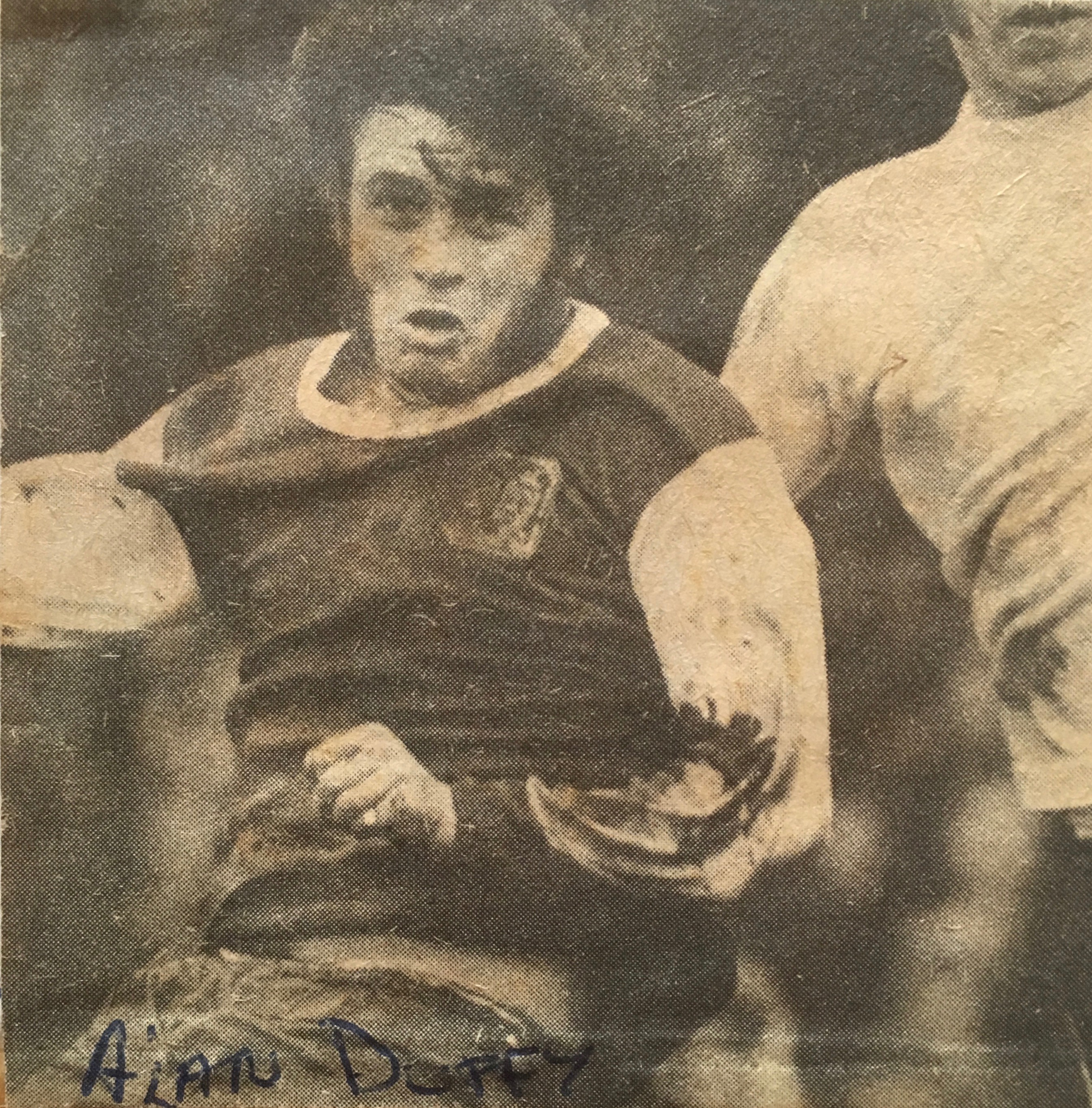
2 AD action BW.jpg

Brighton were top of the league going into the game and looking a good bet for promotion.

Former goalkeeper Brian Powney discussed that game – and Duffy – when he was interviewed by Brian Owen for an article in the Argus on 20 February 2017.

There were question marks over both Duffy’s goals – a suspicion of handball for one, the other possibly offside – but, while both stood, a seemingly good goal from the youngster was ruled out later on.

Looking back on the game was a painful reminder for Powney, who dislocated a finger which physio Mike Yaxley had to put back while out on the pitch, it being the era long before substitute goalkeepers were available.

Unfortunately, too, Albion blew their promotion chances by losing four of the last five games after that Easter win over the Royals.

The only other points collected came in the penultimate game, a 2-1 home win over Rotherham, when Duffy again scored twice – one a penalty.

Asked about Duffy in that 2017 interview, Powney said: “Alan was hit and miss, a bit madcap.

“He had a lot of talent and, had he applied himself, he would have had a longer career. He was a good player but not such a good pro.”

Like many a player before and since, a change of manager in that World Cup summer of 1970 didn’t help Duffy’s progress at Brighton although, according to Seagulls TV: “Weight issues and injury woes, starting with a thigh problem on the opening day, marred his 1970-71 campaign.”

Duffy began in the no.8 shirt for the opening two games of that season under Goodwin’s replacement,Pat Saward, but a thigh injury picked up away to Bristol Rovers proved more problematic than first thought and he missed a large part of the first half of the season.

Duffy was out of the side from mid-October to February and, on his return to the starting line-up, was involved in one of the most curious incidents I ever saw at the Goldstone.

On 27 February 1971, against Preston North End, Albion won a controversial penalty at the south stand end of the pitch after Duffy somewhat unconvincingly tumbled in the area.

Centre forward Kit Napier took the spot-kick;  ‘keeper Alan Kelly saved it, but referee Tom Reynolds ordered a retake because of encroachment. As Napier steadied himself for the retake, Duffy stepped forward, pushed his teammate out of the way, took the penalty himself – and missed!

In the Argus, reporter John Vinicombe wrote: “Napier watched aghast as the ball thudded against the bar. Duffy hung his head, as well he might.” The game finished in a disappointing 0-0 draw.

“The manager went mad at him afterwards,” Powney recalled, and Saward promptly dropped Duffy to the bench for the next two matches.

In the meantime, the manager brought in the experienced Bert Murray and Willie Irvine on loan to add some nous and quality. Although Duffy did get back in the side for six games, the rest of the time he was on the bench.

One time when he entered the fray from the bench against Aston Villa, a BBC radio commentator described him as “a square little man – an oddity” but he was soon singing his praises for a through ball that set up Napier to score.

His only goals of the season came in the same match – against Bradford City, in a 3-2 win at Valley Parade on Easter Monday. Duffy struck twice in the second half as Albion came back from being 2-1 down at half-time.

By the season’s end, he had made just 15 starts, and was subbed off on five occasions. There were seven appearances off the bench, plus three occasions when he was a non-playing sub.

In 1971-72, he made just one start – in a league cup match – and was only ever a substitute in the league, coming on 12 times and not being used on 10 other occasions.

A Brighton & Hove Gazette special publication noted that shortly after coming on as a substitute in a second round FA Cup game at home to Walsall in December 1971, he was booked for fighting with the Saddlers’ goalkeeper, Bob Wesson.

A subsequent post-match incident with the goalkeeper led to Duffy being suspended for six weeks. His final appearance saw him come on for Murray in a 4-2 win away to Oldham Athletic in mid-January 1972.

Saward clearly didn’t see Duffy as a long-term part of his plans and when he plunged into the transfer market on deadline day in March, the Geordie was used as a makeweight in the deal which brought Tranmere Rovers striker Ken Beamish to the Goldstone for a fee of £25,000. On the same day, Wolves’ Irish international Bertie Lutton returned to the Albion following a loan spell earlier in the season.

In two years at Prenton Park, Duffy made 33 appearances and scored just twice, before heading back to the north east in 1973 to join Darlington.

In the 1973-74 season, he played 24 games for Darlington without getting on the scoresheet and the following season drifted into non-league football, playing for Consett.

It was quite some fall from that glorious day on 21 September 1968 when he had made his Newcastle first team debut against Manchester United at Old Trafford in a 3-1 defeat.

Born on 20 December 1949 in Stanley, Co Durham, Duffy joined Newcastle in 1966 and on 7 April 1968 won an England Youth international cap when he featured in a 0-0 draw away to Bulgaria.

The game took place in Nimes, France, and was part of the UEFA Youth tournament. Amongst his teammates were Burnley’s Dave Thomas and Steve Kindon and fellow Magpie Alan Foggon.

After that debut at Old Trafford, Duffy didn’t play for the first team again until 9 August 1969, coming on as a sub in a 1-0 defeat v West Ham.

His next chance came on 20 September 1969 when he came on as a sub in a 1-1 draw with Southampton.

A week later, he got a start in another 1-1 draw, this time against Wolverhampton Wanderers. But Toon1892.com recounted: “In his time at Newcastle he was always considered to be Pop Robson’s deputy rather than a first team choice.”

When the Toon decided to let him join Brighton, Duffy had to admit he’d never previously ventured that far south before. At least there was a familiar face waiting for him when he arrived: at the time, Albion had a young Newcastle goalkeeper, Martin Burleigh, on loan.

The matchday programme revealed how manager Goodwin and club secretary Alan Leather had quite a journey travelling to the North East to clinch the deal for Duffy because bad weather caused them to alter their train and plane arrangements.

Leather then had to dash from Newcastle to the Football League headquarters at St Annes on the Lancashire coast to register the paperwork ahead of the 48-hour deadline for new signings so that Duffy would be eligible to play in Albion’s away game at Barrow. He managed it…..but then the match was postponed!

Pictures from my scrapbook either originated in the matchday programme or were published in the Evening Argus. Also featured, a special publication produced by the Brighton & Hove Gazette.
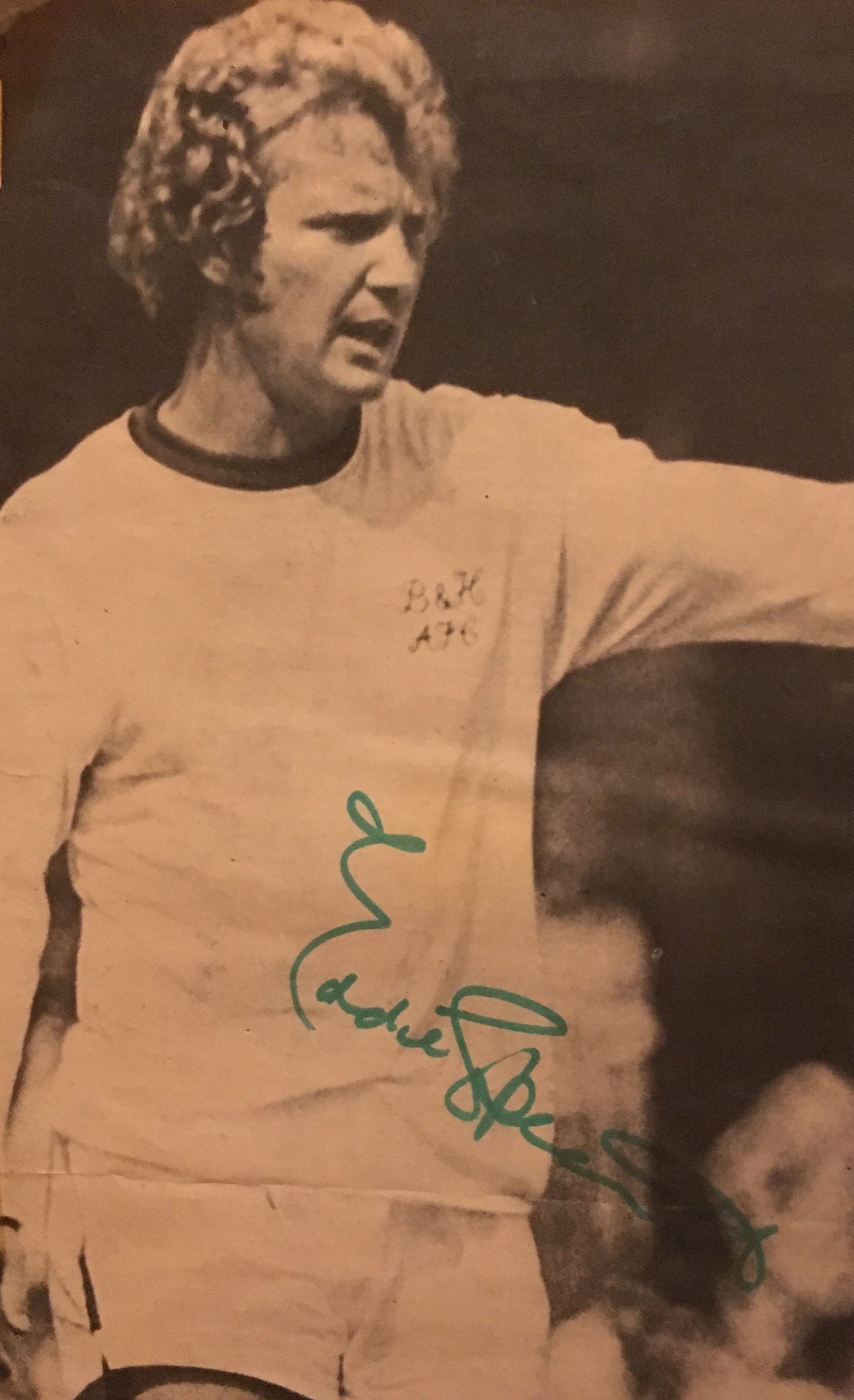
Steady Eddie Spearritt ‘Mr Versatility’ and a long throw specialist

2-signed-eddie-spearrittIN THE days before managers had a bench of substitutes, players who could slot into virtually any position were a major asset. One of my favourites was Eddie Spearritt.

A wholehearted, tough character, Spearritt was equally comfortable playing in midfield, at full back or sweeper, would occasionally get on the scoresheet, and even turned his hand to goalkeeping when necessary.

Long before anyone had heard of Rory Delap, Spearritt was a top exponent of the long throw which could sometimes be as effective as a free kick or corner. It was a skill which earned him a place in a Longest Throw competition staged by BBC’s sport show Grandstand in 1970-71, although he didn’t win it.

Born in Lowestoft on 31 January 1947, Spearritt started out at Arsenal but on failing to make the grade there, switched to Ipswich Town as an apprentice in August 1963.


On prideofanglia.com, Tim Hodge details Eddie’s Ipswich career. He made his league debut in the 1965-66 season in a 1-0 win away to Preston in the old Division Two.

Over the next two years, he made a total of 69 appearances (plus 10 as sub) for Bill McGarry’s side, scoring 14 goals along the way (Spearritt is pictured in Ipswich squad photos above, including the side who were Second Division winners).

A 1-0 home defeat to Spurs in October 1968 was his last for the Suffolk club and three months later, surplus to new manager Bobby Robson’s requirements, was one of Freddie Goodwin’s first signings, for £20,000, just a few weeks before my first ever Albion game.ES debut Crewe

He made his debut in a 3-1 home win over Crewe Alexandra (above with the superb backdrop of a packed EastTerrace at the Goldstone Ground) and kept the number 10 shirt to the end of the season, by which time he had scored five times, including both Albion’s goals in the 2-2 draw at home to Tranmere Rovers.

1-spearritt-v-wolves-69-copyIn the 1969-70 season, not only was he part of the Third Division Albion side who pushed his old manager McGarry’s First Division Wolverhampton Wanderers side all the way in a memorable third round League Cup tie, it was his header from Kit Napier’s free kick that put the Albion 2-1 ahead just before half-time (aftermath pictured above).

Scottish international Hugh Curran scored twice in eight second half minutes to clinch the win for Wolves but a bumper Goldstone Ground crowd of 32,539 witnessed a terrific effort by their side.

ES Shoot action

A few weeks’ later, in a marathon FA Cup second round tie with Walsall that required three replays before the Saddlers finally prevailed 2-1, Spearritt took over in goal during the second replay when a concussed Geoff Sidebottom was stretchered off on 65 minutes. Albion hung on for a 1-1 draw.


Spearritt was a midfield regular in his first two seasons but Goodwin’s successor, Pat Saward, switched him to left back halfway through the 1970-71 season and that’s where he stayed throughout the 1971-72 promotion campaign. Player-of-the-season Bert Murray generously declared the award could have gone to Eddie for his consistency that season.

In the close season after promotion, Spearritt tied the knot with Penelope Biddulph, “an accomplished professional dancer,” the matchday programme told us, and they moved into a new home in Kingston-by-Sea.

Spearritt started out at left back in Division Two but after ten games was ousted by the arrival of George Ley from Portsmouth. He then switched back into midfield, but by the end of that relegation season was playing sweeper alongside Norman Gall (for nine games) and Steve Piper (for two).

He scored, along with Barry Bridges, in a 2-0 win at Huddersfield on 14 October but the team went on a disastrous run of 16 games without a win, although Spearritt did get on the scoresheet three times, including notching two penalties.

When Albion went to that footballing outpost Carlisle on 16 December, they had lost five in a row without managing a single goal. Carlisle were 5-0 up, goalkeeper Brian Powney was carried off with a broken nose, replaced between the sticks by Bert Murray, then Albion won a penalty.

Spearritt took up the story in a subsequent matchday programme.

“I used to be the club’s penalty taker but, after I had missed an important one at Mansfield in 1970, I lost the job. Penalty-taking is really all about confidence,” he said. “After I had missed that one at Mansfield, which cost us a point, the players lost confidence in me and the job went first to John Napier and was then taken over by Bert Murray.

“Bert would have taken the penalty at Carlisle. He has already scored two this season. But he had gone in goal and it was decided it was too risky to fetch Bert out of goal to take the penalty.

“Nobody else seemed to want to take it so I just picked the ball up and put it on the spot. We were 5-0 down by then but I thought from a morale point of view that it was extremely important that I scored. You can understand my relief when I saw the ball hit the back of the net.

“Everybody was beginning to wonder when we would score again. I suppose with the run of bad luck we have been having it was almost inevitable that we should break our goal famine from the penalty spot.”

Albion finally returned to winning ways with a 2-0 win over Luton on 10 February, and then beat Huddersfield, Carlisle and Swindon, prompting Saward to refer to “some outstanding individual performances” and adding: “I have been particularly pleased with the way Eddie Spearritt has been playing in recent weeks.

“He has maintained a high level of consistency this season and his work in defence and in midfield has been invaluable as the side has plugged away trying to turn the tide of results.”

Spearritt was Saward’s captain at the start of the 1973-74 season back in Division Three and with the return of central defender Ian Goodwin and then the emergence of Steve Piper in the sweeping role, he was soon back in midfield.

When Saward was sensationally replaced by Brian Clough and Peter Taylor in October, Spearritt was part of the side who capitulated 4-0, 8-2 and 4-1 in successive games against Walton & Hersham, Bristol Rovers and Tranmere Rovers. He was dropped for six games, along with Ley (who never played for Albion again) as Clough went into the transfer market and brought in midfielder Ronnie Welch and left back Harry Wilson from Burnley.

Spearritt was restored to the team in mid January and had a run of seven games — including his 200th league game for Albion — but when he was subbed off in a home win over Hereford United on 10 March 1974, it was to be his last appearance in an Albion shirt.

In five years he’d played 225 games (plus seven as sub) and scored 25 goals.

In common with lots of players from the Saward era, Spearritt was a victim of the great Clough clear-out. Perhaps surprisingly, though, his next step was UP two divisions to play in the First Division with then newly-promoted Carlisle United.

One of his teammates there was defender Graham Winstanley, who later joined the Albion. The side was captained by Chris Balderstone, who was also a top cricketer. Journeyman striker Hugh McIlmoyle played up front while John Gorman, who later played for Spurs and became Glenn Hoddle’s managerial sidekick, was also in the team.

They memorably topped the division after three games….but predictably finished bottom of the pile by the end. In his two-year stay with the Cumbrians, Spearritt played 29 times, was sub twice and scored a single goal.

He moved back south in August 1976, signed by Gerry Summers at Gillingham, and made his debut against Reading, going on to make 22 appearances in his one season at the club, scoring once, from the spot, against Rotherham United at Priestfield.

One of those games was against the Albion on December 29 1976, when the home side won 2-0 on a slippery, snow-covered pitch.

Eddie emigrated to Australia the following summer and settled in Brisbane where he played for and managed the Brisbane Lions before retiring. He subsequently became estates manager for L’Oréal.

3-spearritt-graydon4-spear-pen-v-black5-gill-eddie-v-mellor-dec-76

  • Pictures from my scrapbook show him celebrating after scoring in the League Cup against Wolves; an autographed Goal action shot in the white with blue cuffs kit when I was an autograph hunter around the players’ tunnel before a game, Eddie was always happy to oblige; a Shoot colour shot of him in action against winger Ray Graydon in the famous 1972 televised win over Aston Villa; from a matchday programme, Eddie’s successful penalty kick in a 2-1- home defeat to Blackpool in December 1972 nestles in the back of the net, with ‘keeper John Burridge beaten, and, from the Argus, challenging Ian Mellor playing for Gillingham against the Albion in December 1976.

Goalscorer Gilliver was heading for trouble in the days of heavier footballs

MOST football fans of a certain age will be familiar with the story of former West Brom and England centre forward Jeff Astle’s death in 2002 from early on-set dementia caused by heading footballs during his career.

The same condition has befallen Allan Gilliver, who played up front for Brighton and Lincoln City.

In September 2015, the Bradford Telegraph and Argus carried a report in which they said: “In 2013 Allan discovered he had dementia and that the likely cause is heading the ball – something he did throughout his football career.”

‘I scored a lot of goals heading the ball, we had heading practice every day,’ Allan told the newspaper. ‘It hurt like hell; footballs were much heavier back then and retained moisture.’

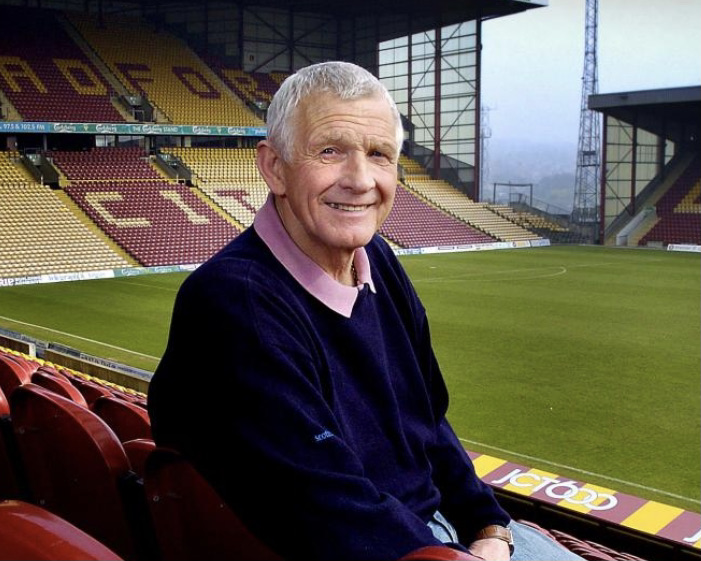
The story was being told in the run-up to a charity event to raise funds and awareness of dementia and Gilly was something of a legend in Bradford having worked behind the scenes at Bradford City for many years after his playing career had ended.

He had originally moved to City from Lincoln in 1972, where he teamed up with former Brighton captain and centre half John Napier (pictured below in a Bradford team photo).

Gilliver arrived at the Goldstone in the summer of 1969 on a free transfer from his hometown club, Rotherham United. He’d been born in the village of Swallownest (in the borough of Rotherham) on 3 August 1944. He was a keen all-round sportsman and when he was 14 was invited for net practice with the Yorkshire county side.

But he opted to pursue a career in football and joined Huddersfield Town in 1961. He scored on his debut in a 4-1 win at home to Swansea and he went on to score 22 goals in 45 appearances for Town. But in June 1966 a £12,000 fee saw him switch to Blackburn Rovers where he netted nine goals in 34 matches.Gilli Rovers

Two years later, Tommy Docherty signed him for Rotherham to partner Jim Storrie up front and he scored four goals in 29 matches for the Millers. His signing for Brighton proved to be a shrewd bit of business by manager Freddie Goodwin because Gilliver ended the 1969-70 season top scorer with 16 league and cup goals.

He made an encouraging start by netting on his debut in the pre-season 6-0 win over a Gibraltar XI. It wasn’t long before he was off the mark in the league too, scoring the only goal in a 1-0 win at Plymouth on 16 August.

Gilliver also scored in two of the Albion’s memorable League Cup ties in the autumn of 1969, netting in the 2-0 defeat of Birmingham, who were then in the division above Brighton, and also in the closely-fought epic against First Division Wolves when Albion narrowly lost 3-2.

Later that same season he scored a hat-trick in a 4-0 home win over Halifax. Even when Goodwin departed for Birmingham during the summer of 1970, Gilliver retained his place under new manager Pat Saward, and scored eight times.

But, presumably in the knowledge he’d got the loan signings of Bert Murray and Willie Irvine lined up, Saward surprisingly sold Gilliver and former captain Nobby Lawton to Lincoln in February 1971. The pair’s appearance in a 2-1 defeat away to Shrewsbury that month turned out to be their farewell.

As a youngster, I used to watch games from behind the manager’s dugout beneath the West Stand at the Goldstone.

I remember vividly how during one game, as the players trooped off down the tunnel for the half-time break, someone in the crowd behind me, clearly not impressed by the striker’s performance, shouted: “Gilly, why don’t you come off?” The forward looked into the crowd for the source of the comment and retorted: “And why don’t you p*ss off!”

The forward’s spell with Lincoln was ultimately a brief one but his switch to Valley Parade for a £4,000 fee began a lifetime association with the Bantams.

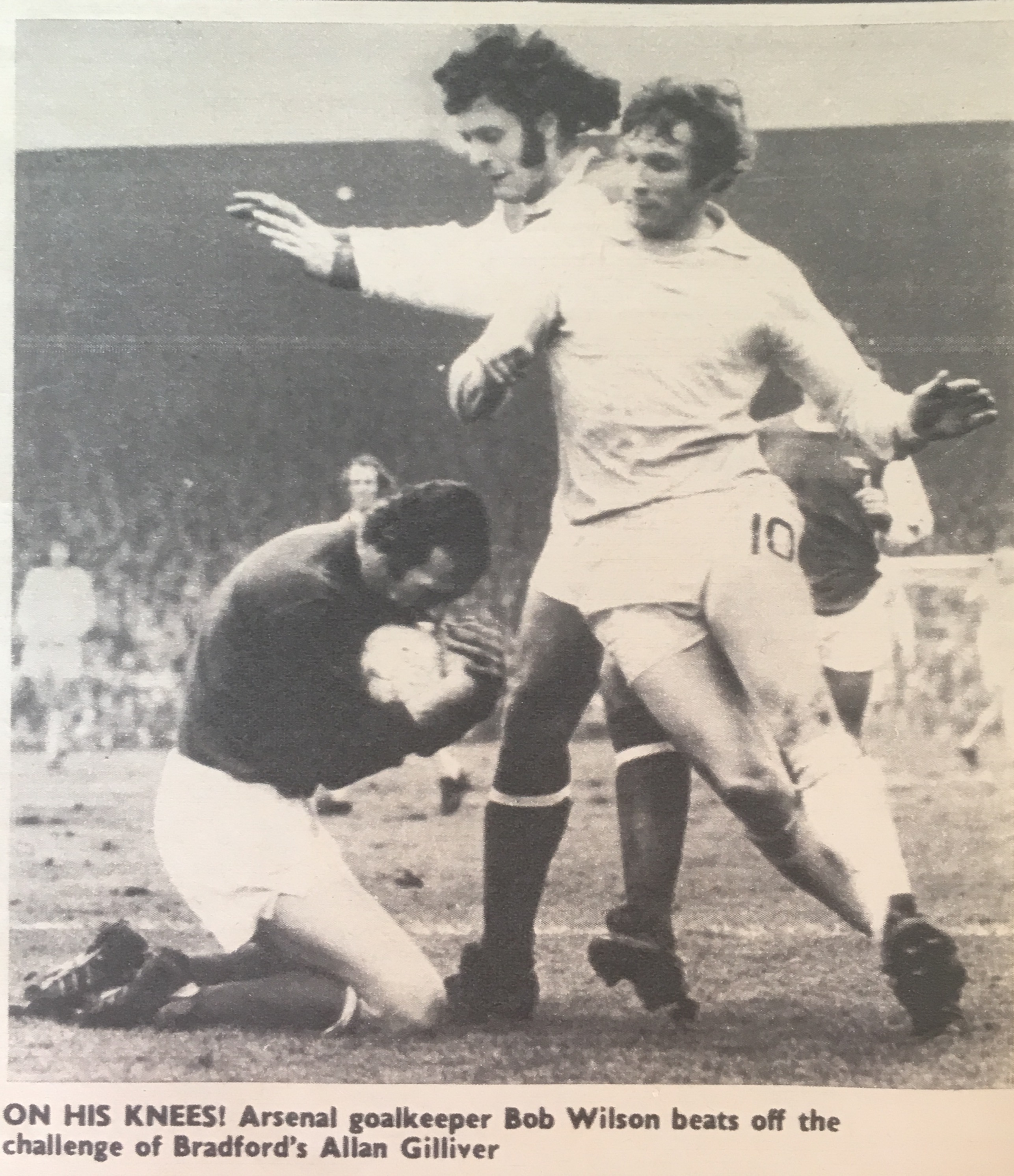
In researching this piece, I came across a picture of Gilliver in action for Bradford against Arsenal at Highbury in 1973.

He moved on to Stockport County in 1974 and had a brief spell with the Baltimore Comets in America, playing alongside the aforementioned Napier, before returning to England.

Back at Bradford in 1978-79, he played twice before his playing days came to an end but he stayed with the club and his subsequent roles included groundsman, safety officer, bar supervisor, stadium manager and commercial manager. He retired in 2007.

In May 2023, Gilliver’s wife Chris opened up to the Telegraph & Argus about the sad impact of the former footballer’s condition, which had necessitated putting him in a care home.  

“The grandchildren miss grandad as he was,” she said. “He doesn’t recognise them. He smiles but he would smile at anyone.

“He has got no incentive. He would just sit in one place all day unless someone does something with him.”

She told reporter Rowan Newman: “They are not suffering in many ways because they don’t know, but we are – the families who love and care for them.

“Every day you lose a little bit more. He could speak last week, he can’t speak now. He could use a knife and fork, he can’t cut his food up any more. He has lost so much.”

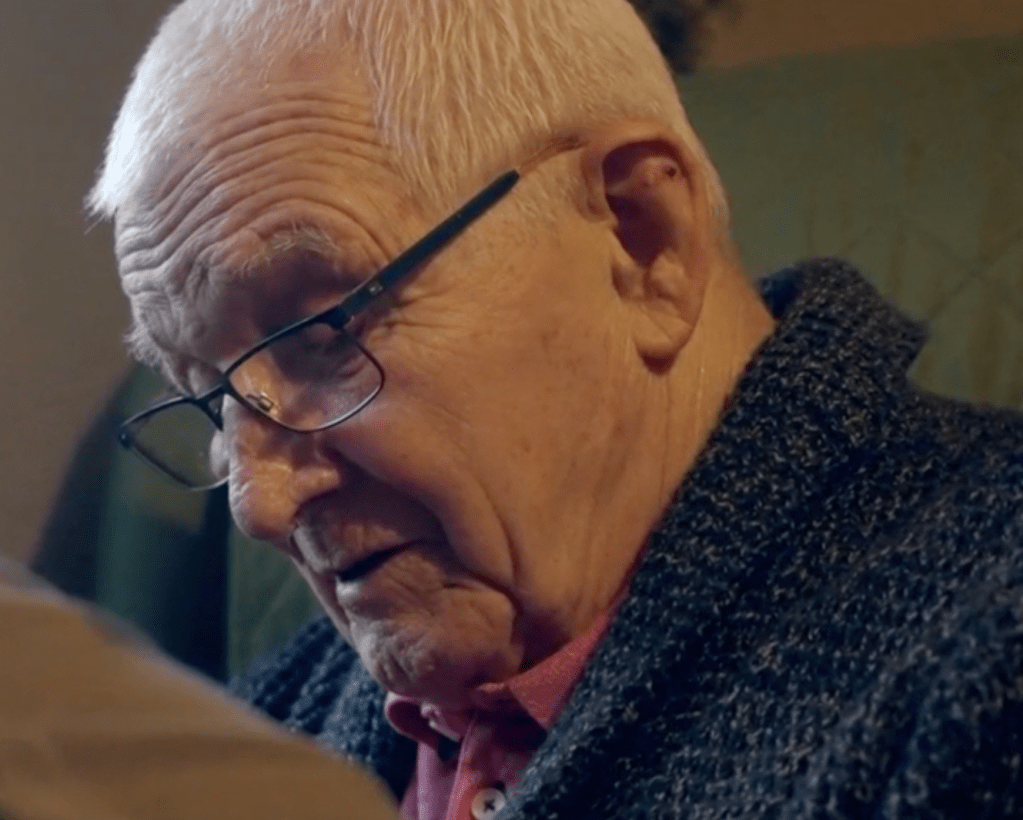
Gilliver appeaed  briefly in a news bulletin on BBC One News on 25 March 2025 about professional footballers and dementia. It said he now lives in a care home.

napier-gilliver-73-74-bradfordag-v-arsenal

  • Pictures from my scrapbook show Gilliver in aerial action for the Albion; alongside John Napier in a Bradford team photo (and below with Baltimore Comets); in Goal magazine playing for Bradford City, challenging goalkeeper Bob Wilson in a 1973 FA Cup tie against Arsenal, a portrait in the stripes of City, and various shots that first appeared in Albion matchday programmes.
Allan Gilliver living with dementia in a care home, as featured on BBC One news in March 2025

Cross the colossus majestic in promotion-winning season

1-cross-clincherGRAHAM Cross won promotion from the third tier in successive seasons – one with Brighton & Hove Albion, the next with Preston North End.

They came after a record-breaking 15-year spell with his hometown club Leicester City.

Cross was a tower of strength and ever-present in Alan Mullery’s 1976-77 promotion-winning team. He was so consistent that his fellow professionals named him and fellow Seagulls Brian Horton and Peter Ward in the division’s PFA team of the year.

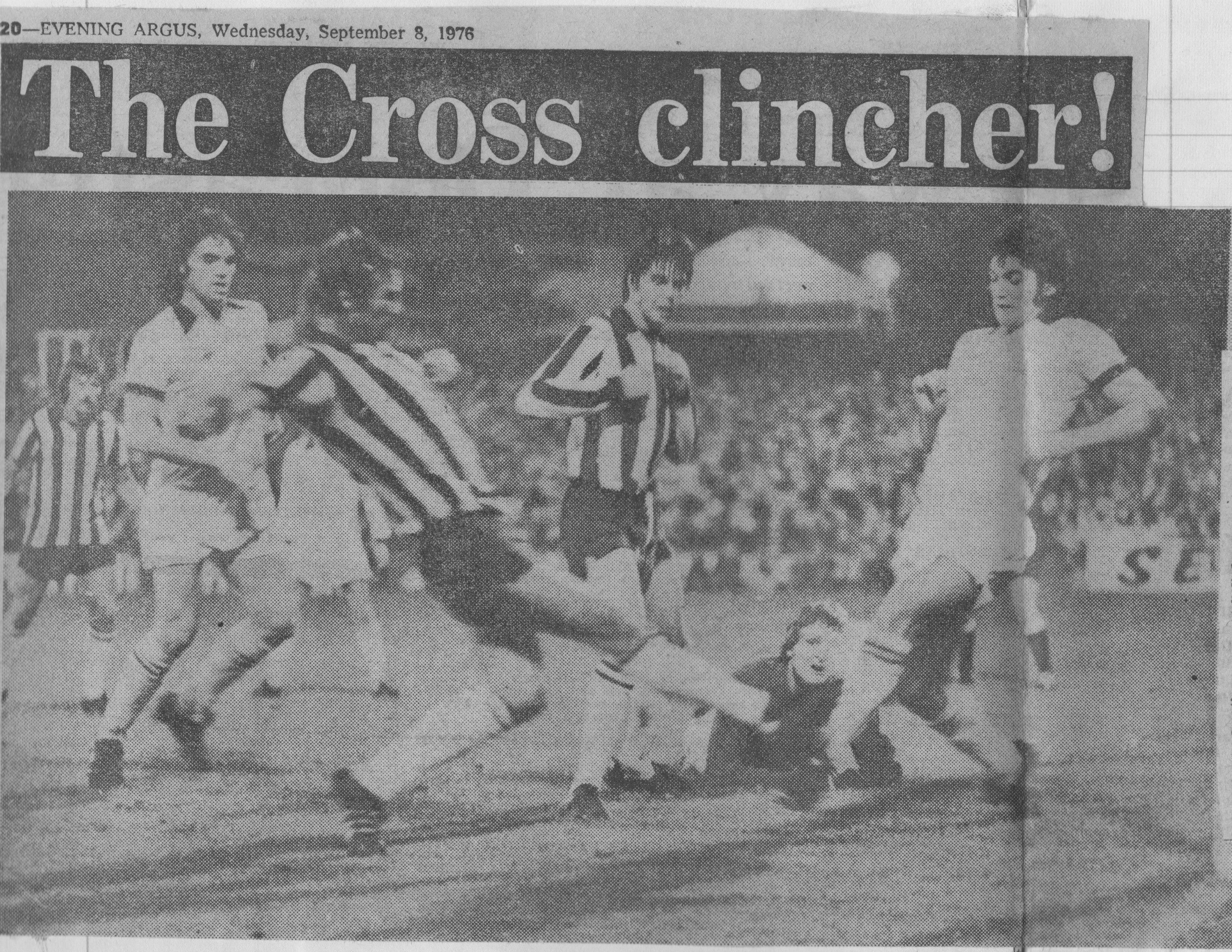
One standout performance I recall was in a cracking League Cup replay at the Goldstone against Division 1 side Ipswich Town on 7 September 1976 (see picture above).

Despite the Albion being down to 10 men, having had Phil Beal carried off injured after sub Ian Mellor had already come on, Cross scored the winning goal two minutes from time to give Albion their first competitive victory against a first division team for 43 years!

“Graham had an absolutely tremendous 1976-77 season for us and I can’t speak too highly of him,” Mullery told Shoot! “When I first started planning for the new term I reckoned on having him in the side for our step up into the Second Division.”

G Cross BW HSHowever, when he realised he could land the highly promising 20-year-old Mark Lawrenson from Preston for £112,000, those plans changed.

Lawrenson had played brilliantly against the Albion during the promotion season and was eager to take the step up so he headed south together with full back Gary Williams and Cross and left back Harry Wilson went in the opposite direction.

“I wish him well at Preston and can assure their supporters they are getting one of the most honest lads in the game in Graham,” said Mullery.

Cross certainly played his part as Preston earned promotion from the third tier – one of his teammates was centre forward Michael Robinson, who joined Albion in 1980 – but in the following season the magic touch eluded him when he played 19 times for Lincoln City but didn’t manage to stop them being relegated to the Fourth Division.

3-gc-leicesterCross had been part of the furniture at Leicester and the meashamfox blog recalls how he scored on his debut on 29 April 1961 against Birmingham City in a 3-2 win at Filbert Street.

He was a real ‘Mr Versatility’ who played in eight different positions, although mostly  in midfield – the history books describe him as an inside forward or wing half – and at centre back.

During all the hullabaloo surrounding Leicester’s remarkable Premiership title win in 2016, there were flashbacks to the last time a Leicester side went that close to clinching the league title – in 1962-63 – with Cross a member of that side.

In an interview with the Leicester Mercury, his former Scottish international teammate Frank McLintock spoke about a so-called signature move called ‘the switch’ Leicester employed whereby Cross dropped back and McLintock bombed past him.

“It was a load of rubbish, really,” McLintock told the paper. “It was just that I was really fit and Graham, who was a great player, would be a bit puffed out when he got back. We just swapped positions for a bit.

“The opposition would get confused with who was picking up who. Even Bill Shankly copied it later on at Liverpool.”

Unlike the 2016 vintage, the 1963 side blew their title chances by losing their last four league games. However, they did reach the FA Cup Final that year. Cross was in the side that lost 3-1 to Manchester United. He was also in the Leicester side that lost the 1969 final 1-0 to Manchester City.

His performances in 1963 were good enough to earn him a call up to the England under 23 team, making his debut in a 0-0 draw with Yugoslavia at Old Trafford. In the return fixture two months later, he scored a penalty to supplement an Alan Hinton hat-trick as England won 4-2.

He was a permanent fixture in the side for 10 matches (including a 4-1 win over West Germany, when future Albion colleague Peter Grummitt was in goal). But in November 1964, Leeds’ Norman Hunter took over the no.6 shirt.

Cross was recalled for one more game, in April 1966, when the under 23s beat Turkey 2-0 at Ewood Park. Two of the side that day – Martin Peters and Roger Hunt – would go on to be part of the England World Cup winning team three months later, but Cross never progressed to the senior England team.

Nevertheless he did pick up a  League Cup winner’s medal when Leicester beat Stoke City in 1964 but was a loser the following year when they were beaten narrowly by a Chelsea side containing Barry Bridges and Bert Murray.

Three years before joining Brighton, Cross received a long service clock to mark 500 first class appearances.

Throughout this period, he was also one of that rare breed who played county cricket too.

A right-arm medium-fast bowler, he played 83 first class matches for Leicestershire between 1962 and 1976 and took 92 wickets at an average of 29.95. His top batting performance was a knock of 78.

I am indebted once more to the meashamfox blog to learn that it was Cross’ dual sporting prowess that eventually brought his Leicester career to an end.

In the summer of 1975, he was part of the Leicestershire side captained by Ray Illingworth that won the county championship and the Benson and Hedges Cup, making him the only man to have played in cup finals at Wembley and Lord’s.

But the Leicester board took a dim view of him carrying on playing cricket instead of reporting back for pre-season training and he was suspended.

He was sent out on loan to Chesterfield and played 12 times for them in the 1975-76 season, before being released.

He arrived at the Goldstone on May 25 1976 at the same time as full back (and future manager) Chris Cattlin.

Manager Peter Taylor had impeccable contacts in the Midlands and in Cattlin, from Coventry, and Cross, from Leicester, he acquired two experienced campaigners who had played at the top level in the game for many years.

Taylor’s intention was that Cross would have the sort of impact at Brighton that the ageing Dave Mackay had on Derby when Taylor and Brian Clough signed him from Spurs.G Cross LEic

Taylor had tried to sign Cross before, in the pair’s early days at Derby. Leicester even accepted an £80,000 bid but Cross prevaricated over the move and they turned their attentions elsewhere. He admitted his regret at missing out on the £4,000 cut of the deal but told Goal magazine: “I’m happy in Leicester and I’m pleased that I decided to stay.”

That decision would ultimately lead him to become the all-time appearance record holder for Leicester, having played 599 games; a feat still not surpassed.

Clough and Taylor were renowned for building their sides on solid defences and, having already captured Grummitt, Graham Winstanley, Andy Rollings and Wilson, Taylor added Ken Tiler, Dennis Burnett, Cattlin and Cross.

Taylor, of course, didn’t hang around to see how Cattlin and Cross would contribute. With only four weeks to go to the start of the season, he decided to quit and renew his partnership with Clough, this time at Nottingham Forest.

One of the first images fans saw of his replacement, Alan Mullery, showed him embracing Cross and Cattlin at the pre-season press photocall.

Cross mostly played alongside Rollings, with Burnett and Winstanley filling in when Rollings was sidelined.

Interestingly, Cross never actually moved to Brighton during his spell with the Seagulls: the deal he agreed allowed him to continue to train with Leicester because he and his wife had business interests in the Leicester area.

The meashamfox blog declared “Graham Cross was Leicester City’s finest ever player” although the author was also sad to report how in February 1993 “he had been jailed for using post office funds to pay off his gambling debts”.

The blog concluded: “Despite this blip in his life, for me ‘The Tank’ Graham Cross is a true Leicester legend.”

Pictures from my scrapbook show:

  • A cracking Argus picture and headline record the winner Graham Cross scored against Ipswich in the League Cup.
  • A full page colour photo in Goal magazine when at Leicester.
  • Celebrating his inclusion in the PFA division 3 team of the year with Brian Horton and Peter Ward at the annual awards dinner.
  • Another Goal article, from 1973, marking a clock presentation to Cross in recognition of 500 senior appearances for Leicester.
  • Cross in the Preston team line-up alongside Michael Robinson, who would eventually join the Seagulls via Manchester City.
Cross aged 77 was interviewed and photographed by The Times ahead of Leicester’s 2021 FA Cup Final win over Chelsea

Chelsea starlet Barry Bridges a Brighton record signing

5-bridges-in-stripesENGLAND international Barry Bridges was once Brighton & Hove Albion’s record signing for the princely sum of £28,000.
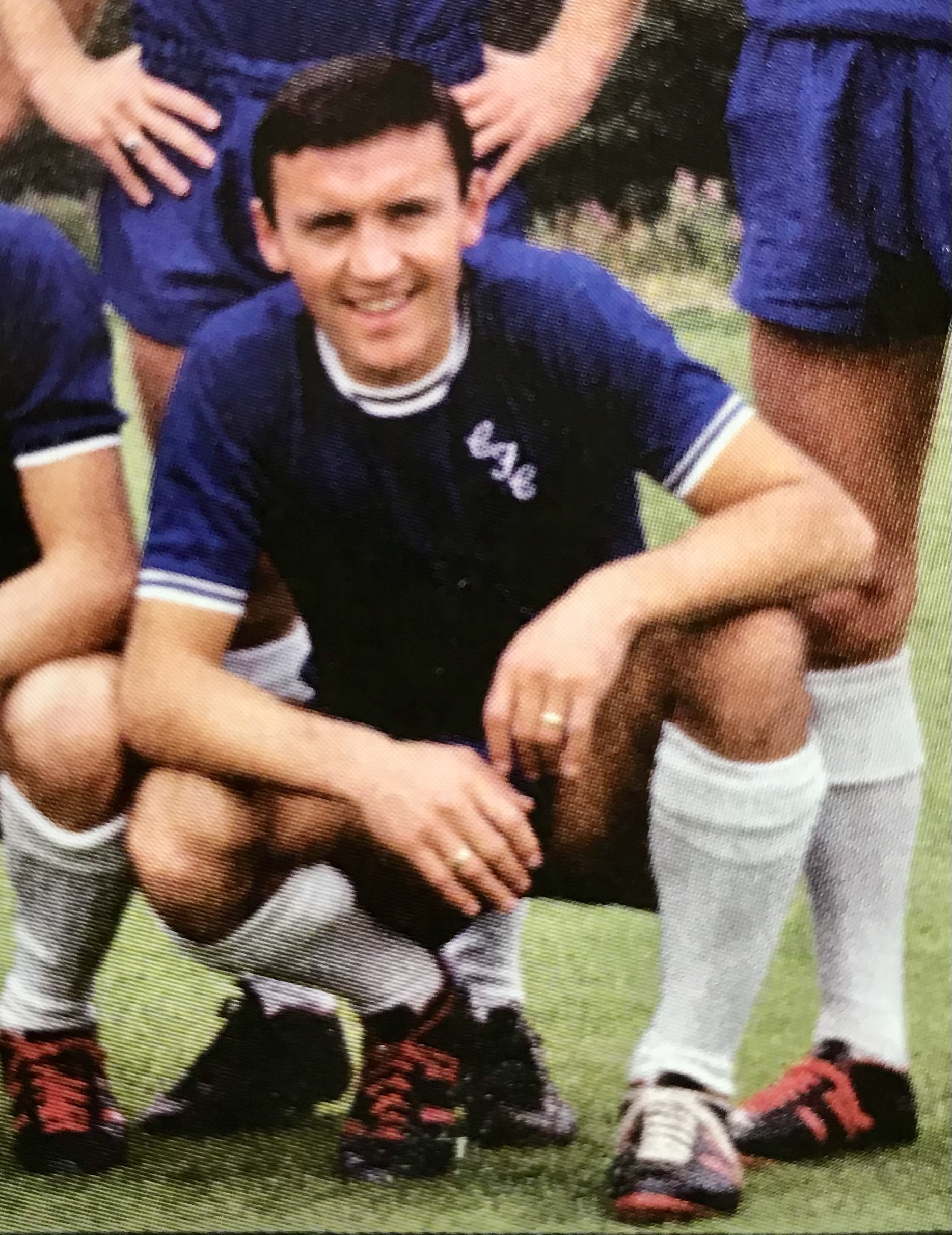
Much of his career ran in parallel with Bert Murray. Both young stars at Chelsea in the early to mid-60s, they were transferred to Birmingham City in 1966 and joined the Albion in the early 1970s.

Norfolk-born Bridges had come to the attention of Chelsea while playing for local side Norwich & Norfolk Boys and had a dream debut in 1959 at just 17, scoring in a local derby against West Ham. It was in the 1961-62 season that he established himself in the Chelsea first team, Jimmy Greaves having been transferred to AC Milan.

In what turned out to be  superb 1964-65 season for him and the club, he scored 27 goals in 42 appearances for Chelsea and collected a League Cup winners’ medal when they beat Leicester City 3-2 over two legs.

It was in May 1966 when Tommy Docherty started breaking up his squad and Bridges left Chelsea for Birmingham having scored 93 goals in 205 league appearances for the London club.

Bridges went one better than Murray and earned full England international honours. Four caps in fact. He was just a few days short of his 24th birthday when he made his debut in a 2-2 draw with Scotland at Wembley in April 1965.

bb-england-w-sir-a

Bridges pictured with Sir Alf Ramsey, Jack Charlton and Nobby Stiles while on England international duty.

He kept the no.9 shirt in the next two games, played in May, a 1-0 win over Hungary at Wembley and was the scorer of England’s goal in a 1-1 draw away to Yugoslavia. His fourth and final game was in a 3-2 friendly defeat against Austria in October 1965. Injury prevented him staking a claim for a place in the 1966 World Cup squad.

In 1971, Bridges went on an end-of-season tour to Australia with an English FA squad that also included Peter Grummitt (then of Sheffield Wednesday) and Dennis Mortimer (of Coventry at the time). The squad went to Dublin first to celebrate the 50th anniversary of the FA of Ireland, drawing 1-1 with the Republic, before heading Down Under where they won all nine of the matches they played in various locations across a month.

BridgesChels

Birmingham paid a then club record fee of £55,000 to acquire Bridges and in two seasons in the West Midlands he scored 46 goals in 104 outings.

Interviewed by bcfc.com in 2014, Bridges said: “What persuaded me to join Birmingham more than anything was the chairman, Clifford Coombs. He was a great guy and wanted to put the club back on its feet. He told me that I was going to be his first signing and he really wanted me to join.”

In his first season he helped Blues to a League Cup semi-final – ironically against Queens Park Rangers – the club he would move to next.

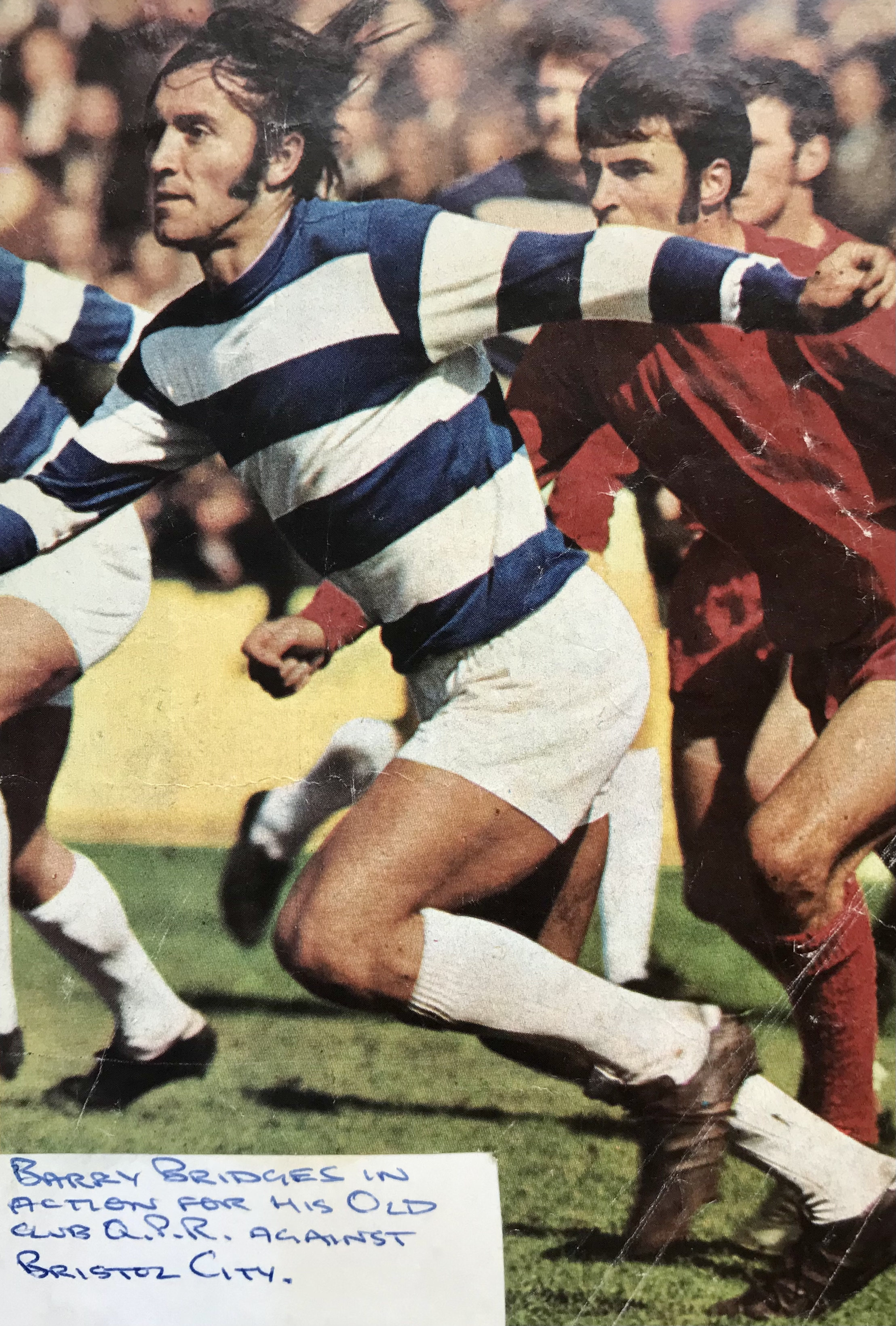
In August 1968, a £50,000 deal saw him move to Loftus Road, where he was part of a strong forward line playing alongside Frank Clarke and the flamboyant Rodney Marsh with his old Chelsea teammate Terry Venables pulling the strings in midfield.

Unfortunately the campaign ended in relegation from the old First Division but in 1969-70 he linked up well alongside Marsh and Clarke and scored 24 goals in all competitions.

Bridges QPR

QPR decided to cash in on him and sold him to Millwall in 1970 and in 1972 he was part of a Millwall side who only narrowly missed promotion to the top division. The Lions were already celebrating promotion on the pitch at The Den when news came through that in fact promotion rivals Birmingham had beaten Sheffield Wednesday to go up, contrary to a rumour that had been circulating in the ground that they’d been losing.

“The four supporters who had been chairing me on their shoulders dropped me. Everyone was stunned, and we had to troop off the pitch all bitterly disappointed and choked,” said Bridges. “I desperately wanted to play First Division football again and so did the rest of the lads. We were all sick.”

When Pat Saward signed him for Brighton in September 1972, it was evident from the start that this was a player who had played at the highest level.

Unfortunately, although Bridges could easily cope at that level, others either didn’t step up or the new players didn’t gel – arguably Saward made too many changes – but, whatever the reason, Brighton couldn’t stop losing and were left floundering at the foot of the table.

Bridges made his debut in a 1-1 draw away to Aston Villa but it was another four matches before he got his first goal, ironically against his old club Millwall, in a 3-1 defeat at home.

Bridges seldom had the same partner up front, early on playing with Willie Irvine, on other occasions with Ken Beamish and later with Lammie Robertson after Saward brought him in from Halifax in exchange for Irvine.

My abiding impression of him was that he appeared to be too good for the rest of the team. His speed of thought was often way ahead of the rest so he would put passes into areas where he would expect a teammate to be, only to be disappointed that they hadn’t read it, so he was made to look wasteful.

One of the few moments of pleasure for Bridges in what was otherwise a season of doom and gloom was the prospect of a FA Cup third round tie against Chelsea at the Goldstone in January 1973. Bridges was in great demand for pre-match interviews in view of his past association with the London club.

“It’s a tremendous draw for the club and a dream draw for Bert Murray and myself who both started our careers at Chelsea,” Bridges told Goal magazine. “Personally it will be nice to see most of the Chelsea lads again. I grew up with Peter Bonetti, Ron Harris and Ossie (Peter Osgood).”

Bridges hoped a good performance in the Cup would help to reinvigorate the lacklustre league form and said: “It’s a crying shame that we’re struggling because the facilities here are second to none. Obviously we need to start getting results now before it’s too late. A win against Chelsea could be just the boost we need to get out of trouble in the league.”

As it turned out, not only did the game end in defeat (2-0) for the Albion but it drew national headlines for all the wrong reasons – ‘day of shame’ for example – as Harris and Brighton left back George Ley were sent off, five were booked and the mood on the pitch led to fighting on the terraces with 25 people arrested.

However, Albion’s fortunes did eventually improve – although it was without Bridges, who in the final few games of the season was restricted to appearances off the bench.

Back in the third division, Bridges was restored to the starting line-up and scored in the opening game in a 1-1 draw at Rochdale.

He was part of the team Brian Clough and Peter Taylor inherited in October and, after they secured their first win courtesy of Pat Hilton’s goal in a 1-0 win away to Walsall, Bridges told the press: “I did more running about in this game than I had in the previous 10 matches.

“I’m 32 now, but with this chap geeing me up I reckon I can go on playing for several more years. We were a bit on edge before the game and the first thing he told us was to relax. Afterwards he told us he was pleased with the effort we showed and we can work from here and go places.

“Though I was sorry to see Pat Saward go – he was a great coach – I think Brian’s got what it takes to make us a good side. He’s just what the club have been waiting for.”

But three games later, as one of the team humiliated in a 4-0 home FA Cup defeat to Walton & Hersham at the end of November, Bridges was unceremoniously dropped and didn’t play again for the first team until February.

Although he then had a run in the team, scoring six times in a 17-game spell, he was among twelve players Clough and Taylor offloaded at the end of the season.

That brought down the curtain on his league career but he continued playing – initially in South Africa with Johannesburg side Highlands Park and then in Ireland – where when player-manager of St Patrick’s Athletic he also gave game time to another former Brighton striker, Neil Martin. He also managed Sligo Rovers before returning to his native Norfolk to manage non league sides Kings Lynn and Dereham Town.

In 2013, the QPR programme caught up with him to discover he was living in Norwich close to where he was brought up, and still getting along to watch matches.

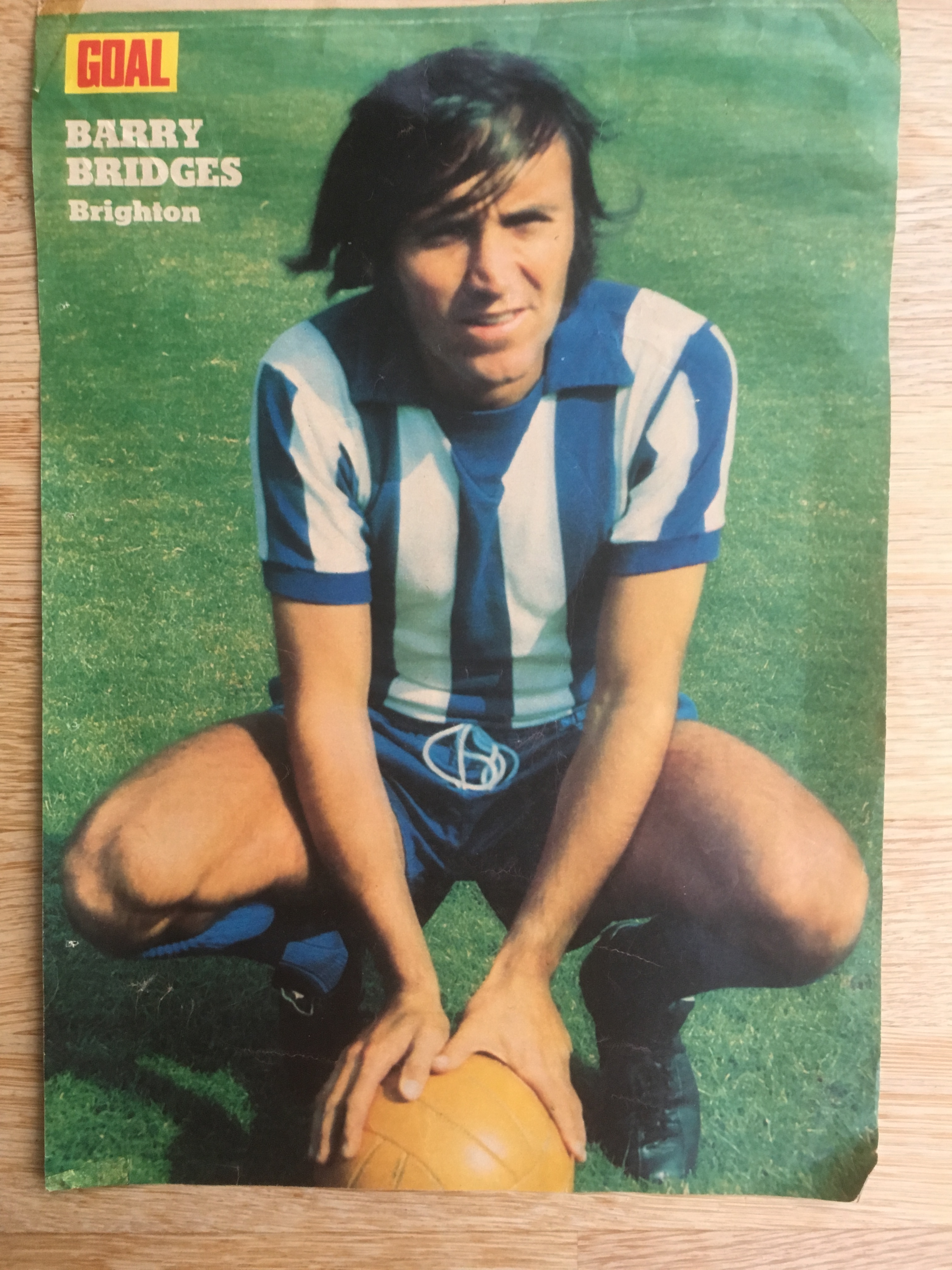
1-england-bridges2-chelsea-bridges4-bridges-in-hoopsB Bridges Btn GOALBarry Bridges (Lions)Barry Bridges (Millwall yellow)

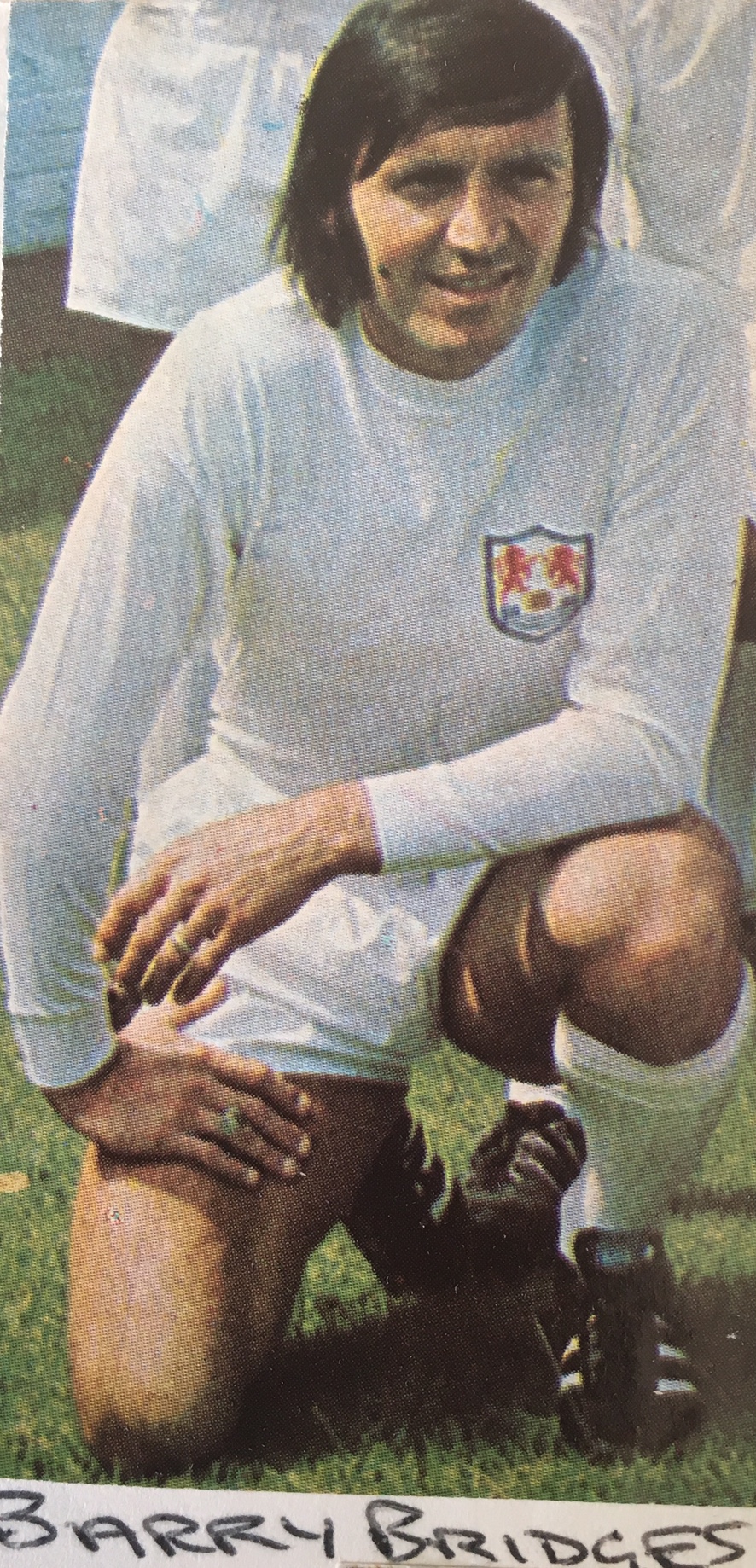
  • Pictures from my scrapbook show Barry in his England and Chelsea days, in Millwall’s white and change yellow shirts, in QPR’s familiar hoops, and in the Albion stripes.

Bertie Lutton’s memorable Easter goal at Bournemouth

STANDING amongst the writhing crush of Albion fans squeezed in behind the goal at Dean Court on the afternoon of Easter Saturday 1972, I struggled to get a clear view of the frenzied action on the pitch.

Brighton equalised, that much was evident from the eruption and movement of the swaying masses, but who applied the finishing touch was anybody’s guess as far as I was concerned.

I later discovered it was none other than Bertie Lutton, the £5,000 Northern Irish international winger signed only three weeks previously from Wolverhampton Wanderers.

Lutton had got himself into the penalty area and with a centre forward-like instinct headed Peter O’Sullivan’s cross past Fred Davies in the Bournemouth goal to cancel out the lead Ted MacDougall** had given the promotion-chasing Cherries.

It was Lutton’s second Albion goal in two days. On Good Friday at the Goldstone, he was on the scoresheet with Bert Murray and Ken Beamish as a bumper crowd of 27,513 (remember this was the third tier of English football) saw Albion beat Torquay United 3-1.

It’s difficult for modern day fans to contemplate but literally 24 hours later, the Albion had travelled nearly 100 miles west to take on Third Division promotion rivals Bournemouth and 22,540 fans crammed into the stadium.

In what was a classic game of two halves, the Cherries dominated the opening 45 minutes and took the lead through MacDougall, a prolific scorer of that period who went on to play for Manchester United, West Ham, Norwich City and Scotland.

Albion threw everything at them after the break and Lutton’s equaliser was fully deserved on the balance of play in the second half.

The goal was enough to keep him in the side for the following three games. After that he reverted to the bench to the end of the season, but was on the pitch, having replaced Kit Napier, when the whistle blew at the end of the 1-1 Goldstone draw with Rochdale that earned Albion promotion as runners up behind Aston Villa…..with Bournemouth three points behind in third place (there were no play-offs in those days).

Raising a glass of promotion-winning champagne in the dressing room with his Brighton teammates after that game must have felt good, but that Dean Court moment was probably as good as it got for the blond-haired Ulsterman in his time on the south coast.

Born in Banbridge, County Down, on 13 July 1950, Bertie’s brief footballing career began with his hometown club, Banbridge Town, and it’s reported just £50 exchanged hands to take him to then English elite side Wolves in 1967.Lutton WWFC

At a time when Wolves were blessed with some outstanding players like Derek Dougan, Hugh Curran, Dave Wagstaffe, Jim McCalliog and Mike Bailey, Bertie managed just 25 matches for Wolves between 1967 and 1971.

Brighton manager Pat Saward, nicknamed The Loan Ranger because of the number of players who he brought in on loan, first acquired Bertie’s services on a temporary basis between September and November in 1971.

He made his debut in a 2-0 defeat at Aston Villa and scored twice in seven games before returning to his parent club.

Then, on 9 March 1972, with the clock ticking down to what in those days was the 5pm transfer deadline, Saward completed a double transfer swoop, securing Lutton’s permanent signing for £5,000 together with Beamish from Tranmere for £25,000 (plus the surplus-to-requirements Alan Duffy).

A delighted Saward declared to Argus reporter John Vinicombe: “Bertie can do a job for us anywhere. This can’t be bad for us. At 21 and with two caps for Ireland he has a future and played very well for us while on loan.

“He can play right or left, up the middle, or midfield and Beamish can fit into a number of positions.”

Maybe it was the versatility Saward referred to that worked against Lutton. When Brighton began the 1972-73 season in the second tier, Lutton was still on the bench. He came on in three games, then got four successive starts before going back to the bench.

Albion were finding life tough at the higher level and although Saward switched things around and brought in new faces, the results went from bad to worse.

bertieluttonLutton started three games in December which all ended in defeat and the 3-0 Boxing Day reverse at Oxford United turned out to be his last appearance for the Albion.

It fell in the middle of a spell of 12 successive defeats during which only five goals were scored – and two of those were penalties, another an own goal!

Saward couldn’t put his finger on the reason for the slump and declared himself dismayed by the attitude of certain players: Lutton was one of three put on the transfer list.

Astonishingly he stepped up a division and went on loan to West Ham. He did well enough to secure a full-time switch to Upton Park and almost a year to the day of his arrival at the Goldstone, he was gone and the shrewd Saward turned a £10,000 profit on the enigmatic Irishman.

Those two caps Saward referred to had come while on Wolves’ books in April 1970 against Scotland and England in the old end-of-season Home International tournament. After his move to West Ham, he gained four more. Indeed, in the history books, he became the first Hammer ever to represent Northern Ireland. He came on as sub in three games in May 1973 and his final appearance was in November that year as a starter in a 1-1 draw away to Portugal.

His only goal for West Ham came in a 1-1 draw away to Derby County on 21 April 1973, where one of his teammates was the aforementioned MacDougall. Sadly Lutton’s West Ham career lasted just 12 games. He was forced to quit English football in 1974 at the age of just 23.

He emigrated to Australia and played semi-professional football in the Australian Soccer League for a number of years and settled in Melbourne.

The ‘where are they now’ website reveals he most recently worked as a supervisor for a logistics company.

  • The website wolvesheroes.com tracked down Lutton in March 2010 and reported a fascinating tale about what happened to a 1970 Mexico World Cup England shirt Bobby Moore had given his old West Ham teammate.

** MacDouGoal! the striker’s autobiography.

Pictures from my scrapbook show Bertie Lutton

  • celebrating a goal for the Albion
  • appearing for Wolves
  • heading the equaliser in the Easter Saturday draw at Bournemouth

3-lutton-stripes

luttoningoal

Lutton alongside George Best during Northern Ireland training
Lutton pictured in 2010 on wolvesheroes.com