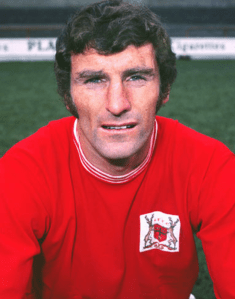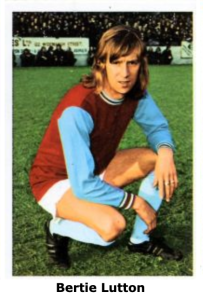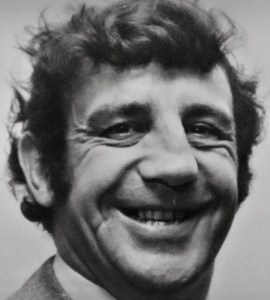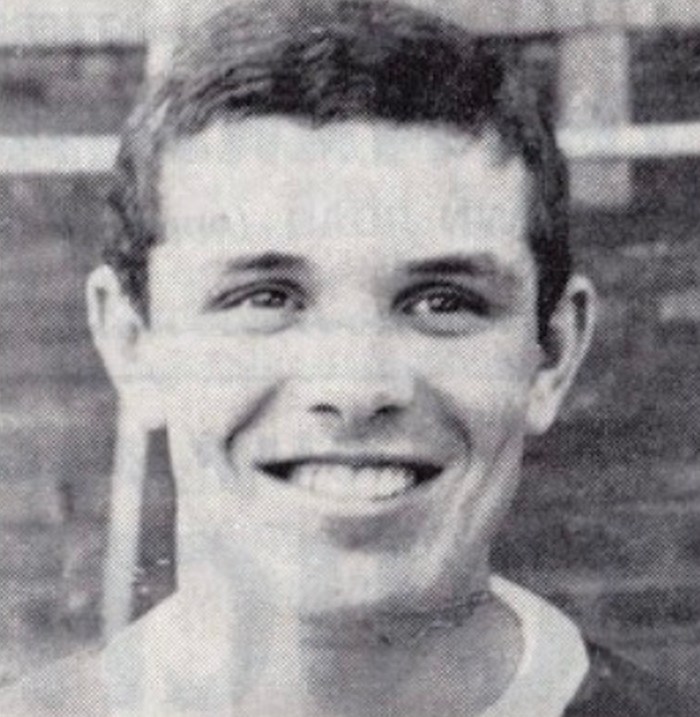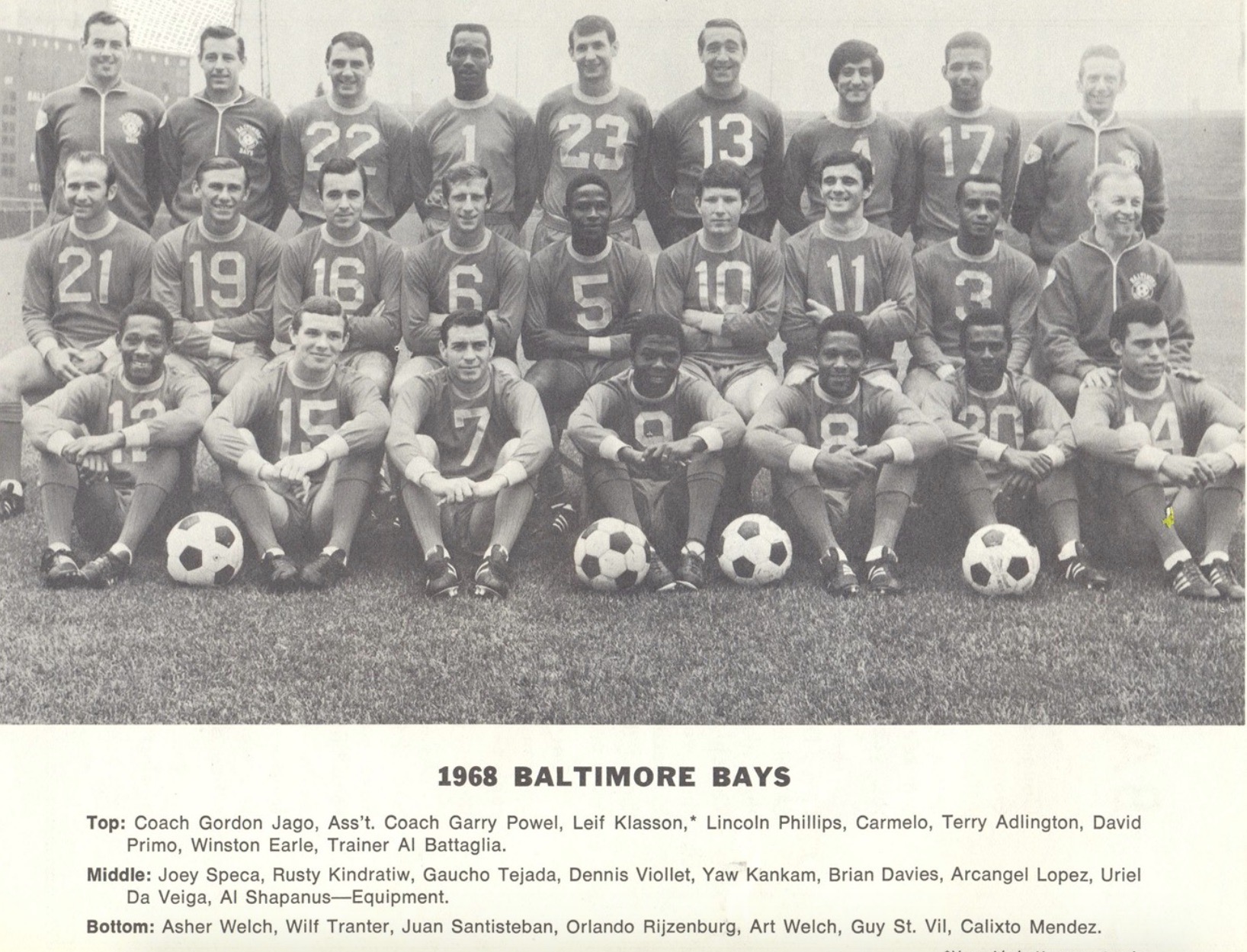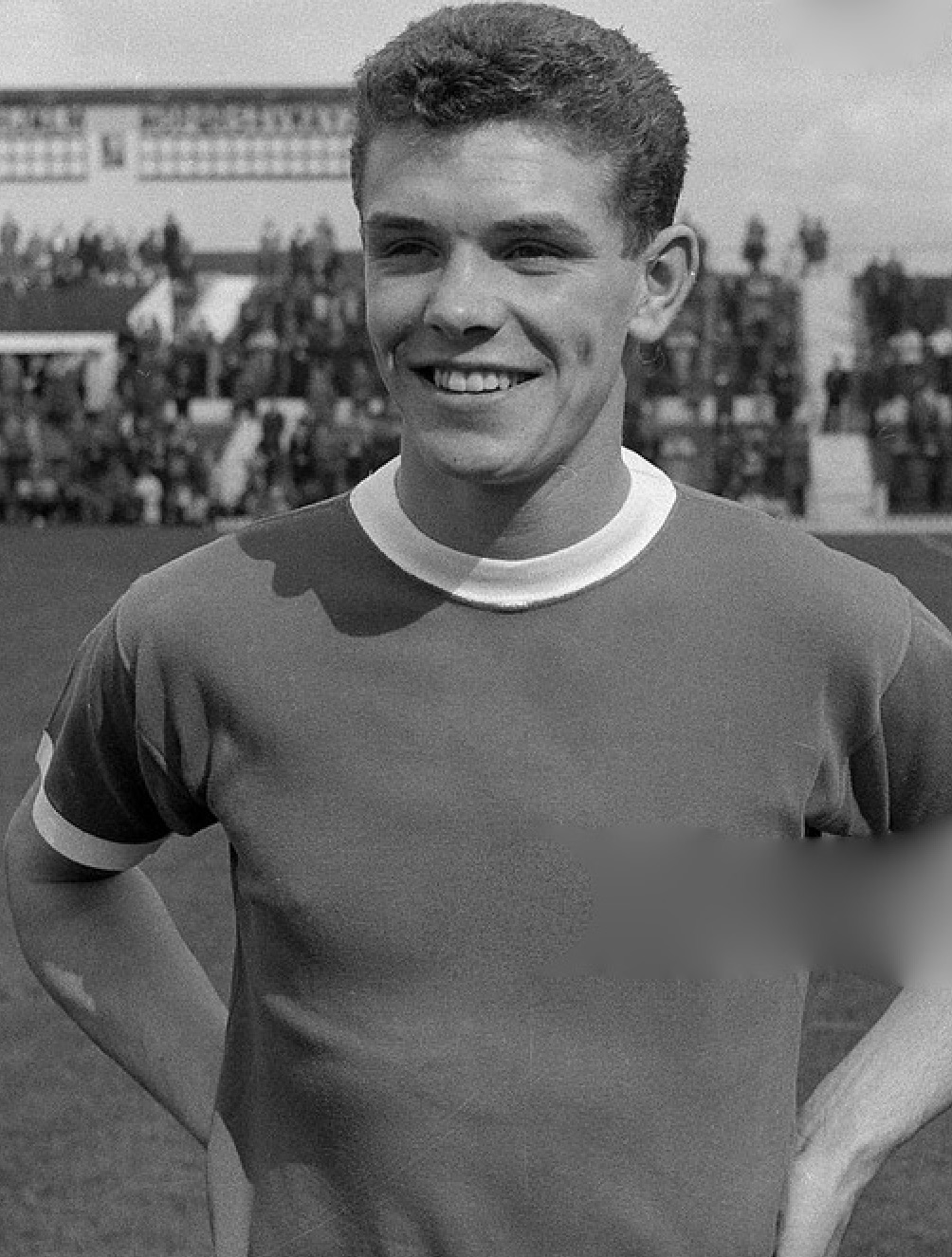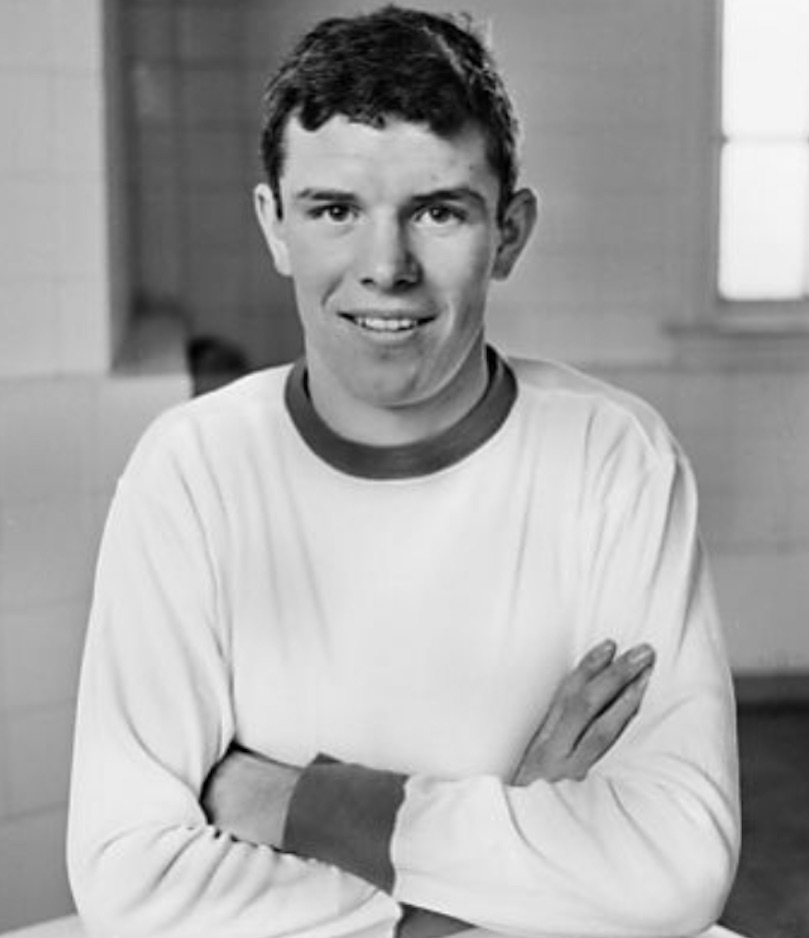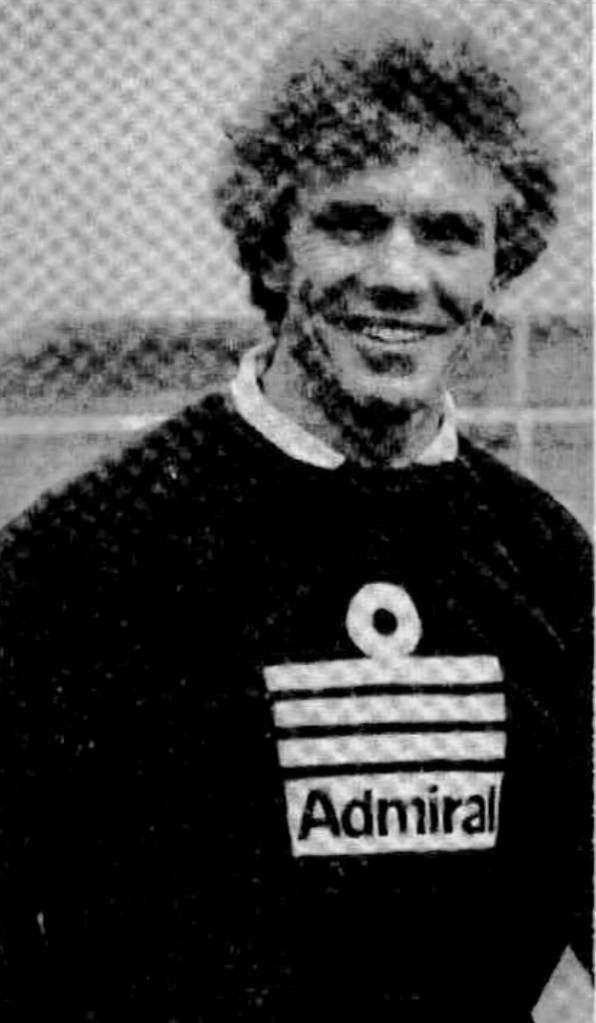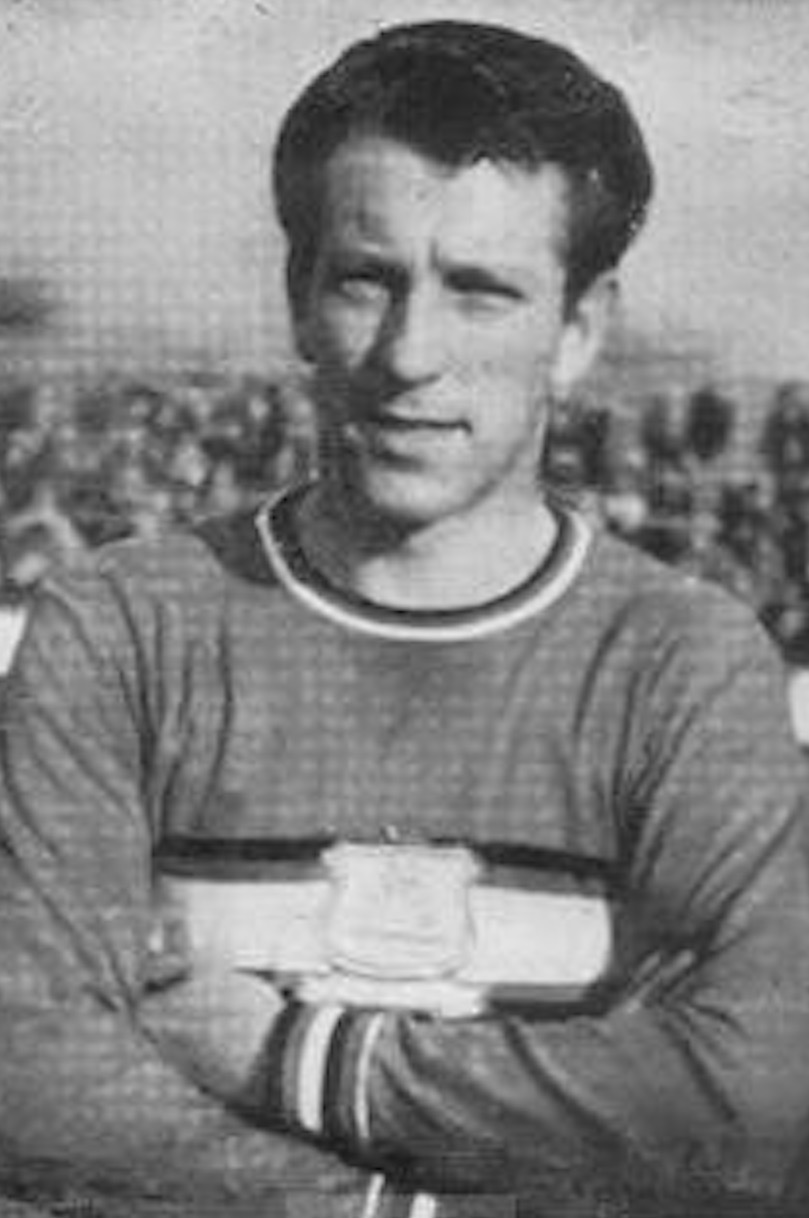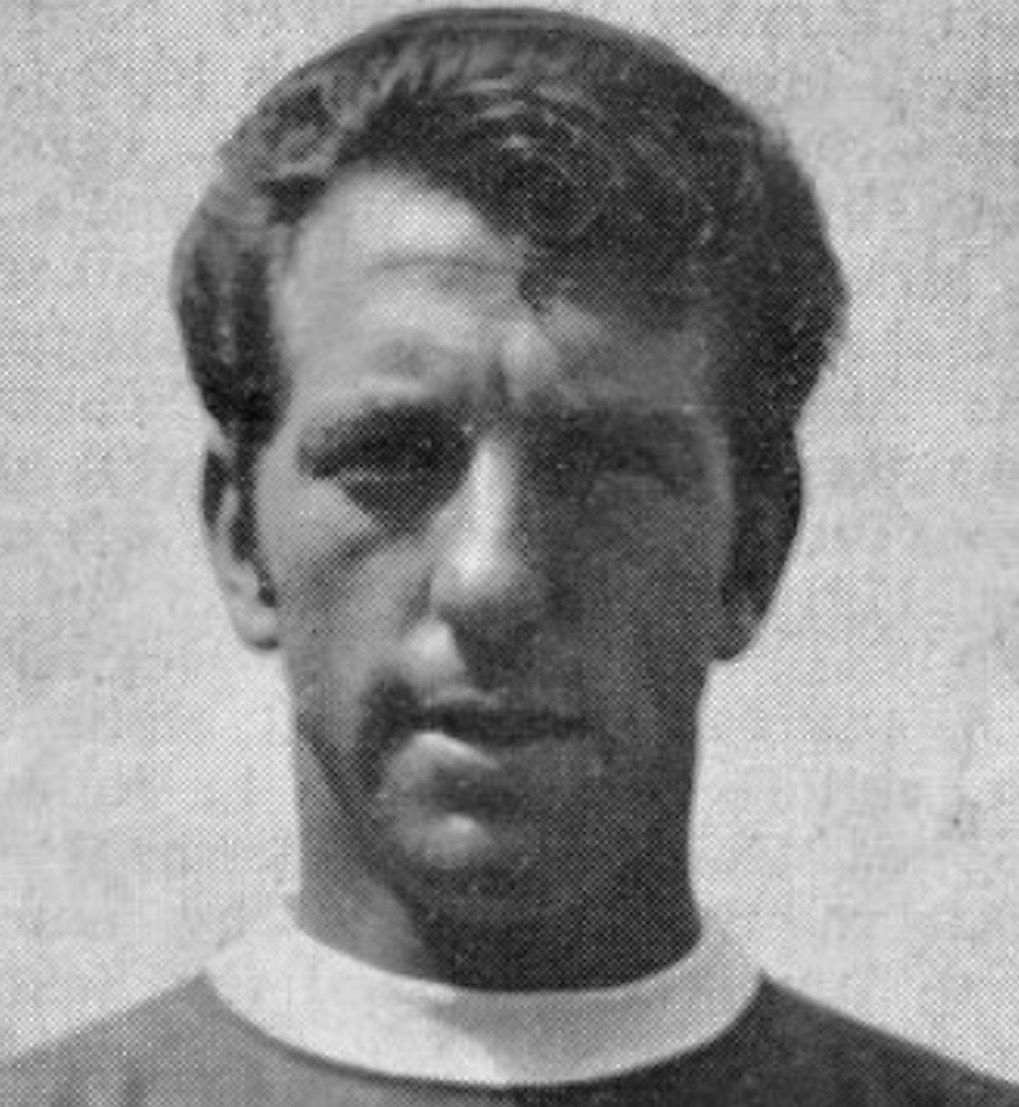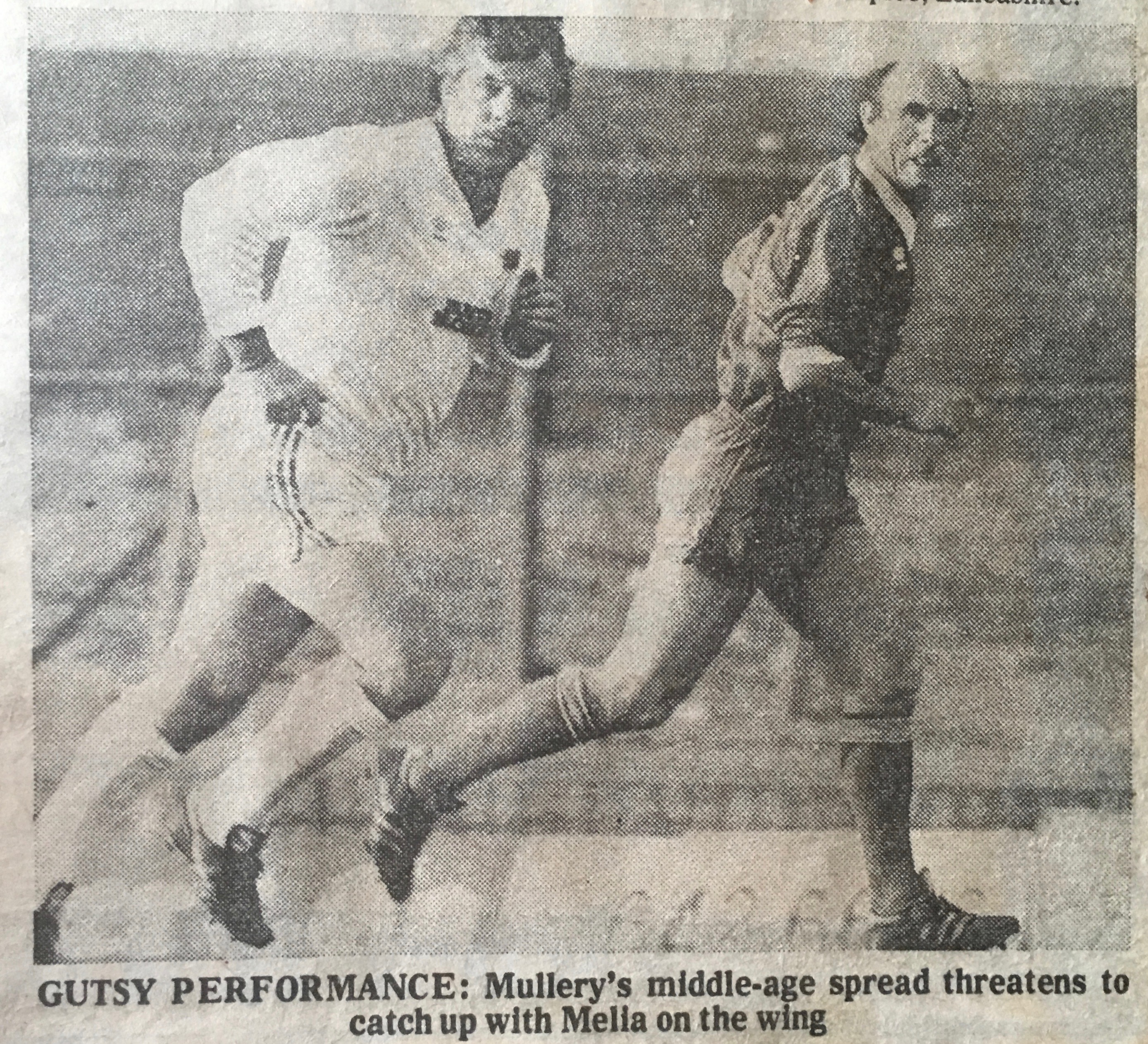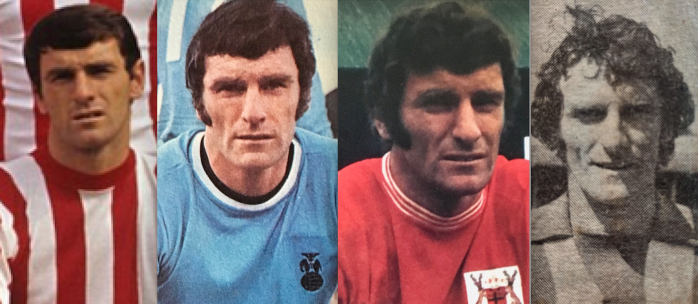
BERTIE LUTTON has a place in the West Ham history books even though he only made 13 appearances.
He was the first Hammer ever to play for Northern Ireland, winning four caps in 1973 (more on these later).
Lutton, frozen out at second tier Brighton less than a year after signing from Wolverhampton Wanderers, stepped back up a level to join Ron Greenwood’s side.
Although he had played at the elite level for Wolves, having been unable to hold down a regular first team spot at Molineux, he joined Pat Saward’s promotion-chasing Brighton in the 1971-72 season.
Lutton played his part in helping Albion go up from the old Third Division as runners up behind Aston Villa in the spring of 1972, as described in my 2016 blog post about his contribution.
But, when Brighton struggled to cope with the higher grade football, Saward questioned the commitment and attitude of certain players and Lutton was put on the transfer list.
It was certainly something of a surprise when, unable to get a start in a second tier side, he went on loan to First Division West Ham.
Lutton did well enough to secure a full-time switch to Upton Park. Almost a year to the day of his arrival at the Goldstone, he was London-bound and the shrewd Saward turned a £10,000 profit on the player.
The enigmatic Irishman made his Hammers First Division debut in a 1-0 away win against Norwich City on 10 February 1973, alongside the likes of Bobby Moore, Billy Bonds and Trevor Brooking, in front of a crowd of 32,597.
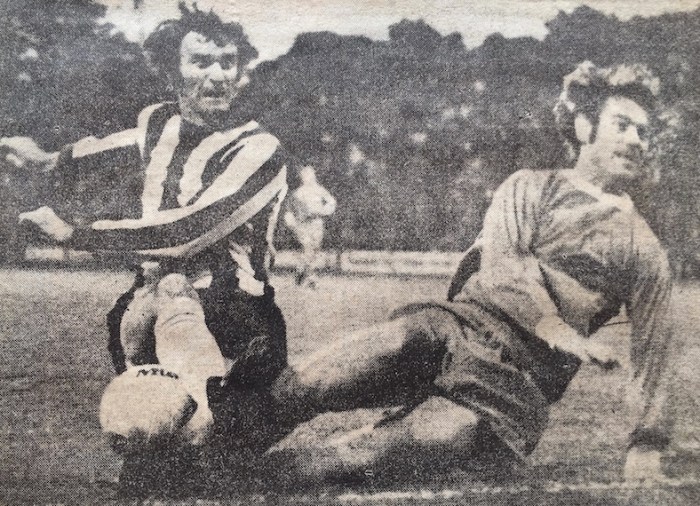
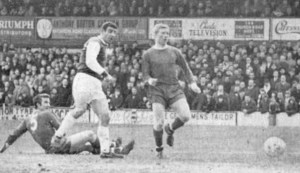
Bryan ‘Pop’ Robson scored the only goal of the game and finished the season as the club and League top goalscorer with 28 goals from 46 games. Lutton didn’t reappear until April when he went on as a sub in a 1-1 draw at home to Leeds and a 4-3 Good Friday win over Southampton at the Boleyn Ground (when George Herrington captured the action picture below of him).
Reviving his scoring feat for Brighton at Bournemouth a year previously, given a start on Easter Saturday, Lutton scored his only goal for the Hammers in a 1-1 draw away to Derby County. He then played in the last two games of the season, a 0-0 draw at Birmingham City, and a 2-1 defeat at home to Arsenal. West Ham finished the season in sixth place, though, which was the highest league position they’d achieved under Greenwood.
Lutton’s crucial equaliser for Brighton at Bournemouth on Easter Saturday 1972
Those league appearances earned Lutton a recall to the Northern Ireland squad and manager Terry Neill sent him on as a second half sub for Bryan Hamilton in a World Cup qualifier against Cyprus on 8 May 1973.
The game was played in front of a paltry 6,090 at Fulham’s Craven Cottage because of the troubles in Northern Ireland at the time. The Irish were already 3-0 up at half time and that’s how it finished: Sammy Morgan (later to play for Brighton) scored one and Man Utd’s Trevor Anderson hit two.
Eight days later, Lutton went on for goalscorer Anderson in Glasgow as the Irish succumbed to a 2-1 defeat to Scotland in the Home International tournament.
Three days after that, he saw action again when he once again replaced Ipswich Town’s Hamilton, who’d scored the only goal of the game as the Irish beat Wales 1-0 at Everton’s Goodison Park. Only 4,946 watched that one.
Back with West Ham at the start of the 1973-74 season and Lutton was in the starting line-up for home defeats to Newcastle United (2-1) and QPR (3-2) and was a sub in a 3-1 defeat away to Manchester United.
He started a 1-0 home defeat to Burnley, but was subbed off, as the Hammers’ torrid first half of the season continued. Previously imperious captain Bobby Moore was dropped and the side were bottom of the table at Christmas.
Lutton only re-appeared in the starting line-up in January when, in a FA Cup third round replay away to Third Division Hereford United, West Ham embarrassingly lost 2-1.
He retained his place three days later when, although the Hammers were missing Moore, Brooking, Kevin Lock, John McDowell and Robson, they made amends by beating Man Utd 2-1 at Upton Park. Billy Bonds and Pat Holland scored for the home side, Sammy McIlroy for United.
A week later, Lutton played his last Hammers match when appearing as a sub in a 1-1 draw at Newcastle United.
It came two months after he had made his last appearance for his country. That was in another World Cup qualifier, on 14 November 1973, when the Irish earned a 1-1 draw against Portugal in Lisbon. He played in midfield alongside Tommy Jackson and captain Dave Clements behind George Best, Anderson and Morgan up front.
Lutton had made his Northern Ireland debut three years earlier when his Wolves teammate Derek Dougan led the line in a 1-0 Home International defeat against Scotland in Belfast.
N Ireland training with George Best
Three days later, on 21 April 1970, he played the first half against England at Wembley when Best scored but the hosts won 3-1 (Lutton was replaced by sub John Cowan for the second half).
That was the game in which Bobby Charlton won his 100th England cap (and was made captain for the occasion) and his Man Utd teammate Brian Kidd made his debut. Ralph Coates also won his first England cap. Charlton, Martin Peters and Geoff Hurst scored the English goals.
Born in Banbridge, County Down, on 13 July 1950, Lutton’s brief footballing career began with his hometown club, Banbridge Town, and it’s reported just £50 exchanged hands to take him to Wolves in 1967.
At a time when Wolves were blessed with some outstanding players like Dougan, Hugh Curran, Dave Wagstaffe, Jim McCalliog and Mike Bailey, the young Irishman managed just 25 matches for Wolves between 1967 and 1971.
Although he may have only had a brief spell in the limelight, he seems to have had a penchant for earning a place in footballing history.
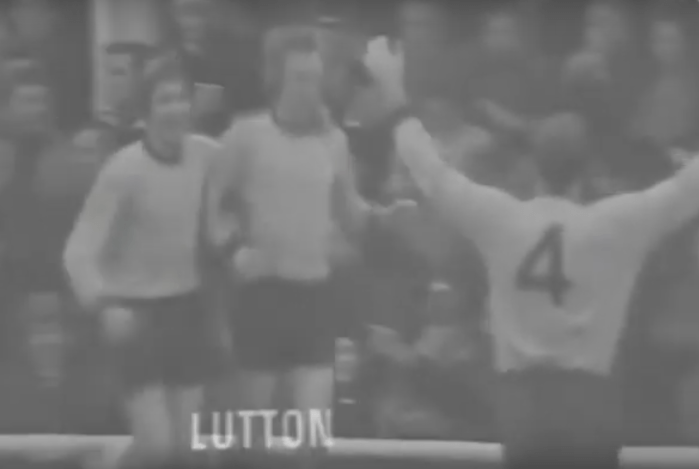
His one and only First Division goal for Wolves was also the club’s 2000th goal in that league to be scored at Molineux.
Goal v Arsenal in frront of the Match of the Day cameras
Arsenal were the visitors on 15 November 1969 and Lutton seized on a fortunate deflection off the aforementioned Terry Neill to net in the 47th minute past the Gunners’ back-up ‘keeper Geoff Barnett. The home side won 2-0 with Scottish international Curran scoring the second just two minutes after Lutton’s opener.
Not listed in the matchday programme line-up, Lutton played instead of the injured Mike O’Grady in the no.8 shirt (players didn’t wear a squad number shirt in those days).
The game was featured on Match of the Day with the legendary Kenneth Wolstenholme commentating and the rather grainy black and white coverage of the game can still be found on the internet wolvescompletehistory.co.uk/arsenal-h-1969-70/.
Lutton only made one start and one sub appearance in the 1970-71 season but was a regular in the Wolves reserve side in which the emerging John Richards was banging in the goals.
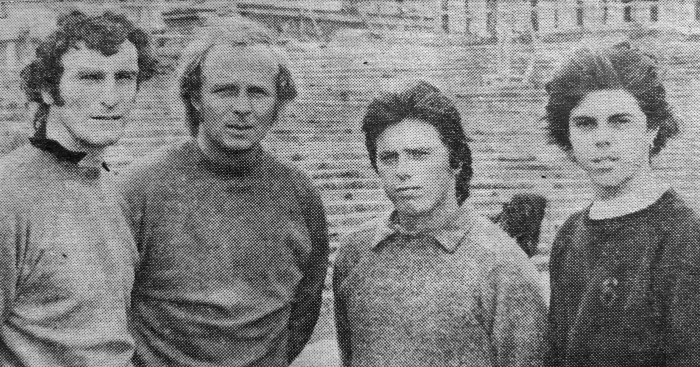
The pair were room-mates as teenagers with Wolves and were reunited after 37 years by the wolvesheroes.com website.
They hadn’t seen each other since 12 May 1973 at Goodison Park when Lutton was an unused sub for Northern Ireland in a Home International against England and Richards was playing up front for the English alongside two-goal Martin Chivers. (England won the game 2-1).
Lutton has popped up on the Wolves history site on several occasions over the years, often when he has returned from his home in Australia to the Black Country to see his son, Lee, who still lives in the area.
Two years later Saward, quite the specialist at using the loan market, acquired Bertie’s services on a temporary basis between September and November, 1971.
He made his debut in a 2-0 defeat at Aston Villa and scored twice in seven games (in a 2-2 draw at Torquay United and a 3-1 home win over Bristol Rovers) before returning to his parent club.
Celebrating a goal at the Goldstone for Brighton
Then, on 9 March 1972, with the clock ticking down to what in those days was the 5pm transfer deadline, Saward completed a double transfer swoop, securing Lutton’s permanent signing for £5,000 together with Ken Beamish from Tranmere for £25,000 (plus the surplus-to-requirements Alan Duffy).
A delighted Saward declared to Argus reporter John Vinicombe: “Bertie can do a job for us anywhere. This can’t be bad for us. At 21 and with two caps for Ireland he has a future and played very well for us while on loan.
“He can play right or left, up the middle, or midfield and Beamish can fit into a number of positions.”
It’s likely that versatility counted against him and, in the days of only one substitute, he was more often than not a sub, being able to go on in a variety of positions.
He was on the bench when Brighton began the 1972-73 season in the second tier and went on in three games. He then got four successive starts before going back to the bench.
Albion were finding life tough at the higher level and although Saward switched things around and brought in new faces, results went from bad to worse.
Lutton started three games in December which all ended in defeat and the 3-0 Boxing Day reverse at Oxford United turned out to be his last appearance for the Albion.
It fell in the middle of a spell of 12 successive defeats during which only five goals were scored. Saward couldn’t put his finger on the reason for the slump but Lutton found himself one of three put on the transfer list.
The West Ham move must have seemed ideal but sadly it was all over after just 13 games. Injury forced him to quit the professional game and he had a brief spell playing non-league for Horsham before emigrating to Australia.
There he played semi-professional football in the Australian Soccer League for a number of years before settling in Melbourne where he worked for the paint giant Dulux.
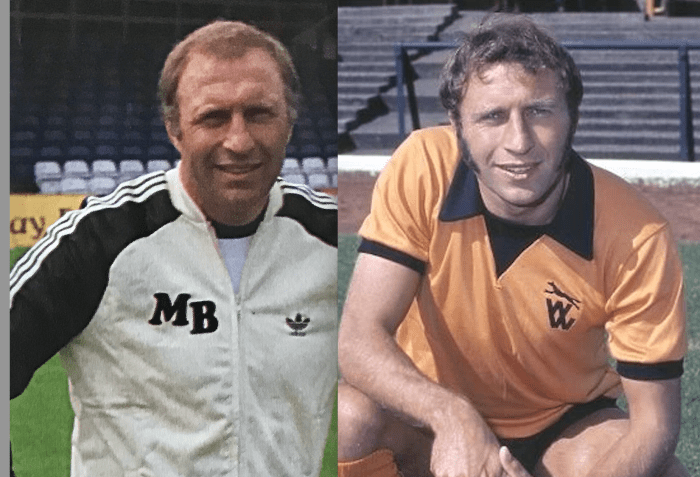
FOR 40 YEARS, Mike Bailey was the manager who had led Brighton & Hove Albion to their highest-ever finish in football.
A promotion winner and League Cup-winning captain of Wolverhampton Wanderers, he took the Seagulls to even greater heights than his predecessor, Alan Mullery.
But the fickle nature of football following has remembered Bailey a lot less romantically than the former Spurs, Fulham and England midfielder.
The pragmatic way Brighton played under Bailey turned fans off in their thousands and, because gates dipped significantly, he paid the price.
Finishing 13th in the top tier in 1982 playing a safety-first style of football counted for nothing, even though it represented a marked improvement on relegation near-misses in the previous two seasons under Mullery, delivering along the way away wins against Tottenham Hotspur, Liverpool and then-high-flying Southampton as well as a first-ever victory over Arsenal.
Bailey’s achievement with the Albion was only overtaken in 2022 with a ninth place finish under Graham Potter; since surpassed again with a heady sixth and European qualification under Roberto De Zerbi.
Fascinatingly, though, Bailey had his eyes on Europe as far back as the autumn of 1981 and laid his cards on the table in a forthright article in Shoot! magazine.
Bailey’s ambition laid bare
“I am an ambitious man,” he said. “I am not content with ensuring that Brighton survive another season at this level. I want people to be surprised when we lose and to omit us from their predictions of which clubs will have a bad season.
“I am an enthusiast about this game. I loved playing, loved the atmosphere of a dressing room, the team spirit, the sense of achievement.
“As a manager I have come to realise there are so many other factors involved. Once they’re on that pitch the players are out of my reach; I am left to gain satisfaction from seeing the things we have worked on together during the week become a reality during a match.
“I like everything to be neat – passing, ball-control, appearance, style. Only when we have become consistent in these areas will Brighton lose, once and for all, the tag of the gutsy little Third Division outfit from the South Coast that did so well to reach the First Division.”
Clearly revelling in finding a manager happy to speak his mind, the magazine declared: “As a player with Charlton, Wolves and England, Bailey gave his all, never hid when things went wrong, accepted responsibility and somehow managed to squeeze that little bit extra from the players around him when his own game was out of tune.
“As a manager he is adopting the same principles of honesty, hard work and high standards of professionalism.
“So, when Bailey sets his jaw and says he wants people to expect Brighton to win trophies, he means that everyone connected with Albion must forget all about feeling delighted with simply being in the First Division.”
Warming to his theme, Bailey told Shoot!: “This club has come a long way in a short time. But now is the time to make another big step…or risk sliding backwards. Too many clubs have done just that – wasted time basking in recent achievements and crashed back to harsh reality.
“I do not intend for us to spend this season simply consolidating. That has been done in the last few seasons.”
Mike Bailey had high hopes for the Albion
If that sounds a bit like Roberto De Zerbi, unfortunately many long-time watchers of the Albion like me would more likely compare the style under Bailey to the pragmatism of the Chris Hughton era: almost a complete opposite to De Zerbi’s free-flowing attacking play.
It was ultimately his downfall because the court of public opinion – namely paying spectators who had rejoiced in a goals galore diet during Albion’s rise from Third to First under Mullery – found the new man’s approach too boring to watch and stopped filing through the turnstiles.
Back in 2013, the superb The Goldstone Wrap blog noted: “Only Liverpool attracted over 20,000 to the Goldstone before Christmas. The return fixture against the Reds in March 1982 was the high noon of Bailey’s spell as Brighton manager.
“A backs-to-the-wall display led to a famous 1-0 win at Anfield against the European Cup holders, with Andy Ritchie getting the decisive goal and Ian Rush’s goalbound shot getting stuck in the mud!”
At that stage, Albion were eighth but a fans forum at the Brighton Centre – and quite possibly a directive from the boardroom – seemed to get to him.
Supporters wanted the team to play a more open, attacking game. The result? Albion recorded ten defeats in the last 14 matches.
At odds with what he had heard, he very pointedly said in his programme notes: “It is my job to select the team and to try to win matches.
“People are quite entitled to their opinion, but I am paid to get results for Brighton and that is my first priority.
“Building a successful team is a long-term business and I have recently spoken to many top people in the professional game who admire what we are doing here at Brighton and just how far we have come in a short space of time.
“We know we still have a long way to go, but we are all working towards a successful future.”
Dropping down to finish 13th of 22 clubs, Albion never regained a spot in the top half of the division and The Goldstone Wrap observed: “If Bailey had stuck to his guns, and not listened to the fans, would the club have enjoyed a UEFA Cup place at the end of 1981-82?”
Bailey certainly wasn’t afraid to share his opinions and, as well as in the Shoot! article, he often vented his feelings quite overtly in his matchday programme notes; hitting out at referees, the football authorities and the media, as well as trying to explain his decisions to supporters, urging them to get behind the team rather than criticise.
It certainly didn’t help that the mercurial Mark Lawrenson was sold at the start of his regime as well as former captain Brian Horton and right-back-cum-midfielder John Gregory, but Bailey addressed the doubters head on.
“I believe it was necessary because while I agree that a player of Lawrenson’s ability, for example, is an exceptional talent, it is not enough to have a handful of assets.
“We must have a strong First Division squad, one where very good players can come in when injuries deplete the side.
Forthright views were a feature of Bailey’s programme notes
“We brought in Tony Grealish from Luton, Don Shanks from QPR, Jimmy Case from Liverpool and Steve Gatting and Sammy Nelson from Arsenal. Now the squad is better balanced. It allows for a permutation of positions and gives adequate cover in most areas.”
One signing Bailey had tried to make that he had to wait a few months to make was one he would come to regret big time. Long-serving Peter O’Sullivan had left the club at the same time as Lawrenson, Horton and Gregory so there was a vacancy to fill on the left side of midfield.
Bailey had his eyes on Manchester United’s Mickey Thomas but the Welsh wideman joined Everton instead. When, after only three months, the player fell out with Goodison boss Howard Kendall, Bailey was finally able to land his man for £350,000 on a four-year contract.
Talented though Thomas undoubtedly was, what the manager didn’t bargain for was the player’s unhappy 20-year-old wife, Debbie.
She was unable to settle in Sussex – the word was that she gave it only five days, living in a property at Telscombe Cliffs – and went back to Colwyn Bay with their baby son.
Thomas meanwhile stayed at the Courtlands Hotel in Hove and the club bent over backwards to give him extra time off so he could travel to and from north Wales. But he began to return late or go missing from training.
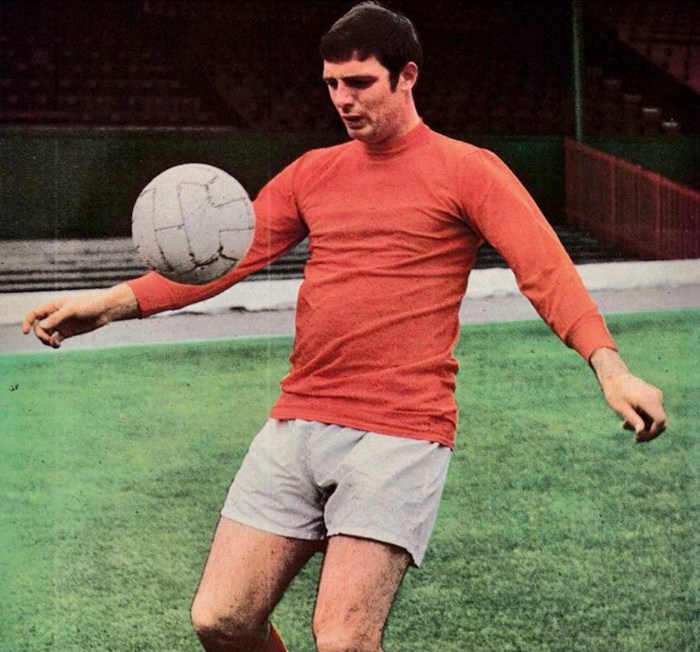
After the third occasion he went missing, Bailey was incandescent with rage and declared: ”Thomas has s*** on us….the sooner the boy leaves, the better.”
At one point in March, it was hoped a swap deal could be worked out that would have brought England winger Peter Barnes to the Goldstone from Leeds, but they weren’t interested and so the saga dragged out to the end of the season.
After yet another absence and fine of a fortnight’s wages, Bailey once again went on the front foot and told Argus Albion reporter John Vinicombe: “He came in and trained which allowed him to play for Wales.
“He is just using us, and yet I might have played him against Wolves (third to last game of the season). Thomas is his own worst enemy and I stand by what I’ve said before – the sooner he goes the better.”
Thomas was ‘shop windowed’ in the final two games and during the close season was sold to Stoke City for £200,000.
In his own assessment of his first season, Bailey said: “Many good things have come out of our season. Our early results were encouraging and we quickly became an organised and efficient side. The lads got into their rhythm quickly and it was a nice ‘plus’ to get into a high league position so early on.”
He had special words of praise for Gary Stevens and said: “Although the youngest member of our first team squad, Gary is a perfect example to his fellow professionals. Whatever we ask of him he will always do his best, he is completely dedicated and sets a fine example to his fellow players.”
The biggest bugbear for the people running the club was that the average home gate for 1981-82 was 18,241, fully 6,500 fewer than had supported the side during their first season at the top level.
“The Goldstone regulars grew restless at a series of frustrating home draws, and finally turned on their own players,” wrote Vinicombe in his end of season summary for the Argus.
He also said: “It is Bailey’s chief regret that he changed his playing policy in response to public, and possibly private, pressure with the result that Albion finished the latter part of the season in most disappointing fashion.
“Accusations that Albion were the principal bores of the First Division at home were heaped on Bailey’s head, and, while he is a man not given to altering his mind for no good reason, certain instructions were issued to placate the rising tide of criticisms.”
If Bailey wasn’t exactly Mr Popular with the fans, at the beginning of the following season, off-field matters brought disruption to the playing side.
Steve Foster thought he deserved more money having been to the World Cup with England and he, Michael Robinson and Neil McNab questioned the club’s ambition after chairman Bamber refused to sanction the acquisition of Charlie George, the former Arsenal, Derby and Southampton maverick, who had been on trial pre-season.
Robinson went so far as to accuse the club of “settling for mediocrity” and couldn’t believe Bailey was working without a contract.
Bamber voiced his disgust at Robinson, claiming it was really all about money, and tried to sell him to Sunderland, with Stan Cummins coming in the opposite direction, but it fell through. Efforts were also made to send McNab out on loan which didn’t happen immediately although it did eventually.
All three were left out of the side temporarily although Albion managed to beat Arsenal and Sunderland at home without them. In what was an erratic start to the season, Albion couldn’t buy a win away from home and suffered two 5-0 defeats (against Luton and West Brom) and a 4-0 spanking at Nottingham Forest – all in September.
Other than 20,000 gates for a West Ham league game and a Spurs Milk Cup match, the crowd numbers had slumped to around 10,000. Former favourite Peter Ward was brought back to the club on loan from Nottingham Forest and scored the only goal of the game as Manchester United were beaten at the Goldstone.
But four straight defeats followed and led to the axe for Bailey, with Bamber declaring: “He’s a smashing bloke, I’m sorry to see him go, but it had to be done.”
Perhaps the writing was on the wall when, in his final programme contribution, he blamed the run of poor results simply on bad luck and admitted: “I feel we are somehow in a rut.”
It didn’t help the narrative of his reign that his successor, Jimmy Melia, surfed on a wave of euphoria when taking Albion to their one and only FA Cup Final – even though he also oversaw the side’s fall from the elite.
“It seems that my team has been relegated from the First Division while Melia’s team has reached the Cup Final,” an irked Bailey said in an interview he gave to the News of the World’s Reg Drury in the run-up to the final.
Hurt by some of the media coverage he’d seen since his departure, Bailey resented accusations that his style had been dull and boring football, pointing out: “Nobody said that midway through last season when we were sixth and there was talk of Europe.
“We were organised and disciplined and getting results. John Collins, a great coach, was on the same wavelength as me. We wanted to lay the foundations of lasting success, just like Bill Shankly and Bob Paisley did at Liverpool.
“The only problem was that winning 1-0 and 2-0 didn’t satisfy everybody. I tried to change things too soon – that was a mistake.
“When I left (in December 1982), we were 18th with more than a point a game. I’ve never known a team go down when fifth from bottom.”
Bailey later expanded on the circumstances, lifting the lid on his less than cordial relationship with Bamber, when speaking on a Wolves’ fans forum in 2010. “We had a good side at Brighton and did really well,” he said. “The difficulty I had was with the chairman. He was not satisfied with anything.
“I made Brighton a difficult team to beat. I knew the standard of the players we had and knew how to win matches. We used to work on clean sheets.
“With the previous manager, they hadn’t won away from home very often but we went to Anfield and won. But the chairman kept saying: ‘Why can’t we score a few more goals?’ He didn’t understand it.”
Foster, the player Bailey made Albion captain, was also critical of the ‘boring’ jibe and in Spencer Vignes’ A Few Good Men said: “We sacked Mike Bailey because we weren’t playing attractive football, allegedly. Things were changing. Brighton had never been so high.
“We were doing well, but we weren’t seen as a flamboyant side. I was never happy with the press because they were creating this boring talk. Some of the stuff they used to write really annoyed me.”
Striker Andy Ritchie was also supportive of the management. He told journalist Nick Szczepanik: “Mike got everyone playing together. Everybody liked Mike and John Collins, who was brilliant. When a group of players like the management, it takes you a long way. When you are having things explained to you and training is good and it’s a bit of fun, you get a lot more out of it.”
Born on 27 February 1942 in Wisbech, Cambridgeshire, he went to the same school in Gorleston, Norfolk, as the former Arsenal centre back Peter Simpson. His career began with non-league Gorleston before Charlton Athletic snapped him up in 1958 and he spent eight years at The Valley.
During his time there, he was capped twice by England as manager Alf Ramsey explored options for his 1966 World Cup squad. Just a week after making his fifth appearance for England under 23s, Bailey, aged 22, was called up to make his full debut in a friendly against the USA on 27 May 1964.
He had broken into the under 23s only three months earlier, making his debut in a 3-2 win over Scotland at St James’ Park, Newcastle, on 5 February 1964.He retained his place against France, Hungary, Israel and Turkey, games in which his teammates included Graham Cross, Mullery and Martin Chivers.
England ran out 10-0 winners in New York with Roger Hunt scoring four, Fred Pickering three, Terry Paine two, and Bobby Charlton the other.
Eight of that England side made it to the 1966 World Cup squad two years later but a broken leg put paid to Bailey’s chances of joining them.
“I was worried that may have been it,” Bailey recalled in his autobiography, The Valley Wanderer: The Mike Bailey Story (published in November 2015). “In the end, I was out for six months. My leg got stronger and I never had problems with it again, so it was a blessing in disguise in that respect.
“Charlton had these (steep) terraces. I’d go up to them every day, I was getting fitter and fitter.”
In fact, Ramsey did give him one more chance to impress. Six months after the win in New York, he was in the England team who beat Wales 2-1 at Wembley in the Home Championship. Frank Wignall, who would later spend a season with Bailey at Wolves, scored both England’s goals.
“But it was too late to get in the 1966 World Cup side,” said Bailey. “Alf Ramsey had got his team in place.”
During his time with the England under 23s, Bailey had become friends with Wolves’ Ernie Hunt (the striker who later played for Coventry City) and Hunt persuaded him to move to the Black Country club for a £40,000 fee.
Thus began an association which saw him play a total of 436 games for Wolves over 11 seasons.
In his first season, 1966-67, he captained the side to promotion from the second tier and he was also named as Midlands Footballer of the Year.
Wolves finished fourth in the top division in 1970-71 and European adventures followed, including winning the Texaco Cup of 1971 – the club’s first silverware in 11 years – and reaching the UEFA Cup final against Tottenham a year later, although injury meant Bailey was only involved from the 55th minute of the second leg and Spurs won 3-2 on aggregate.
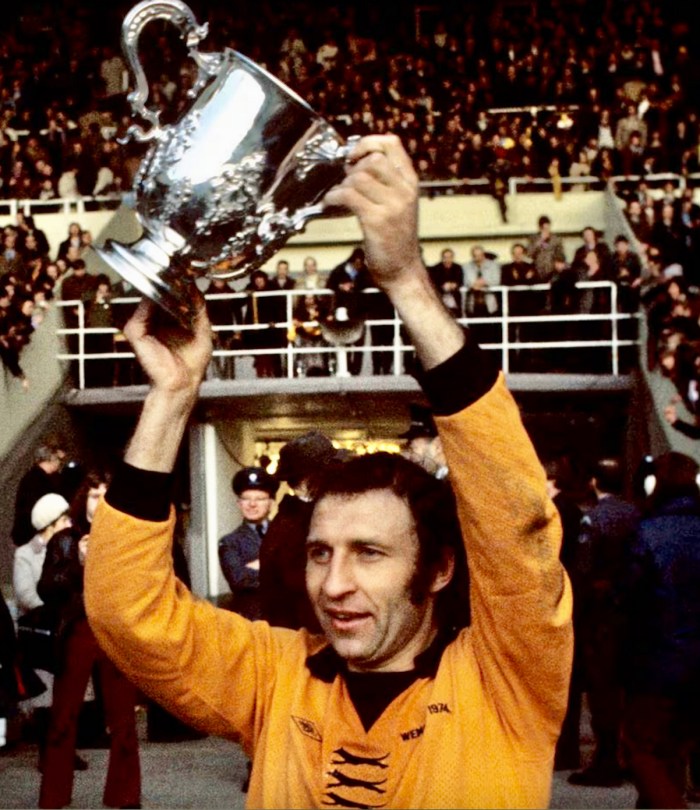
Two years later, Bailey, by then 32, lifted the League Cup after Bill McGarry’s side beat Ron Saunders’ Manchester City 2-1 at Wembley with goals by Kenny Hibbitt and John Richards. It was Bailey’s pass to Alan Sunderland that began the winning move, Richards sweeping in Sunderland’s deflected cross.
Bailey lifts the League Cup after Wolves beat Manchester City at Wembley
This was a side with solid defenders like John McAlle, Frank Munro and Derek Parkin, combined with exciting players such as Irish maverick centre forward Derek Dougan and winger Dave Wagstaffe.
Richards had become Dougan’s regular partner up front after Peter Knowles quit football to turn to religion. Discussing Bailey with wolvesheroes.com, Richards said: “He really was a leader you responded to and wanted to play for. If you let your standards slip, he wasn’t slow to let you know. I have very fond memories of playing alongside him.”
“He gave me – just as he did with all the young players coming into the team – so much help and guidance in training and matches on and off the pitch,” said Richards.
“There were so many little tips and pieces of advice and I remember how he first taught me how to come off defenders. He would say ‘when I get the ball John, just push the defender away, come towards me, lay the ball off and then go again’.
“There was so much advice that he would give to us all, and it had a massive influence.”
Midfielder Hibbitt, another Wolves legend who made 544 appearances for the club, said: “He was the greatest captain I ever played with.”
Steve Daley added: “Mike is my idol, he was an absolute inspiration to me when I was playing.”
Winger Terry Wharton added: “He was a great player…a bit of a Jekyll and Hyde character as well. On the pitch he was a great captain, a winner, he was tenacious and he was loud.
“He got people moving and he got people going and you just knew he was a captain. And then off the pitch? He could have been a vicar.”
When coach Sammy Chung stepped up to take over as manager, Bailey found himself on the outside looking in and chose to end his playing days in America, with the Minnesota Kicks, who were managed by the former Brighton boss Freddie Goodwin.
He returned to England and spent the 1978-79 season as player-manager of Fourth Division Hereford United and in March 1980 replaced Andy Nelson as boss at Charlton Athletic. He had just got the Addicks promoted from the Third Division when he replaced Mullery at Brighton.
In a curious symmetry, Bailey’s management career in England (courtesy of managerstats.co.uk) saw him manage each of those three clubs for just 65 games. At Hereford, his record was W 32, D 11, L 22; at Charlton W 21, D 17, L 27; at Brighton, W 20 D 17, L 28.
In 1984, he moved to Greece to manage OFI Crete, he briefly took charge of non-league Leatherhead and he later worked as reserve team coach at Portsmouth. Later still, he did some scouting work for Wolves (during the Dave Jones era) and he was inducted into the Wolves Hall of Fame in 2010.
In November 2020, Bailey’s family made public the news that he had been diagnosed with dementia hoping that it would help to highlight the ongoing issues around the number of ex-footballers suffering from it.
Perhaps the last words should go to Bailey himself, harking back to that 1981 article when his words were so prescient bearing in mind what would follow his time in charge.
“We don’t have a training ground. We train in a local park. The club have tried to remedy this and I’m sure they will. But such things hold you back in terms of generating the feeling of the big time,” he said.
“I must compliment the people who are responsible for getting the club where it is. They built a team, won promotion twice and the fans flocked in. Now is the time to concentrate on developing the Goldstone Ground. When we build our ground, we will have the supporters eager to fill it.”
Pictures from various sources: Goal and Shoot! magazines; the Evening Argus, the News of the World, and the Albion matchday programme.
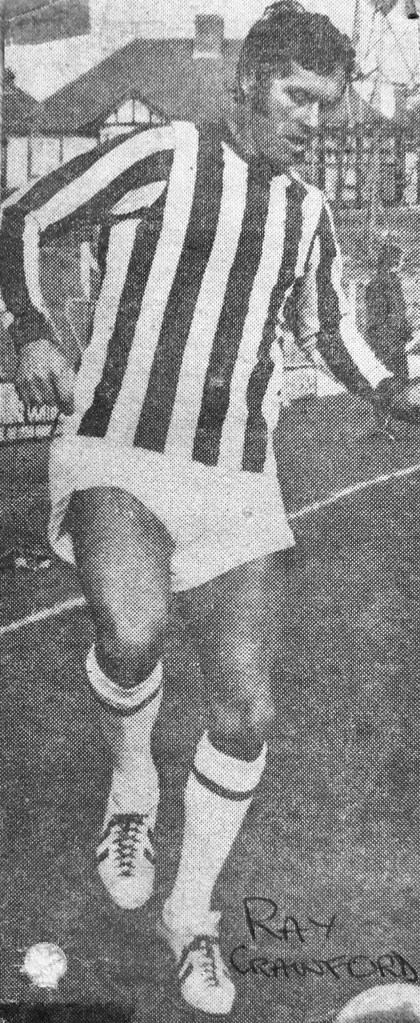
RAY CRAWFORD, one of the foremost goalscorers of the 1960s, came close to a swansong with the Albion and ended up coaching the club’s youngsters.
Crawford had been a key player in Alf Ramsey’s First Division title-winning Ipswich Town side having begun at hometown club Portsmouth and later netted 41 goals in 61 appearances for Wolverhampton Wanderers.
He joined Brighton in the autumn of 1971 after he had read they were struggling to score goals. Earlier the same year, he’d hit the headlines at the age of 35 when he scored twice for Fourth Division Colchester United as they sensationally beat Don Revie’s First Division Leeds United 3-2 in the FA Cup.
After a subsequent short stint playing in South Africa, homesickness brought him and his family back to the UK and the search began for a way to continue his celebrated career in the game.
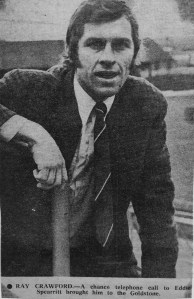
He got in touch with his former Ipswich teammate, Eddie Spearritt, a key member of Albion’s squad, and the utility player persuaded manager Pat Saward to offer Crawford a trial.
“I did well enough in my trial week for Pat to ask me to stay for another month and to see how things went,” Crawford recalled in his eminently readable autobiography Curse of the Jungle Boy (PB Publishing, 2007).
Crawford found the net for the reserves, but a contractual issue with his last club, Durban City (who wanted a fee the Albion weren’t prepared to pay) prevented him joining as a player.
Meanwhile, the previous goalscoring slump that had first drawn him to the club was remedied by a decent run of goals from Peter O’Sullivan to supplement a revival in the form of strikers Kit Napier and Willie Irvine.
It meant Crawford, at 36, hung up his boots (although he still managed a cameo 15 minutes for the reserves in October 1973) to concentrate on coaching.
In the days before large teams of scouts and analysis tools, he would also run an eye over Albion’s future first team opponents to highlight their strengths and weaknesses.
“His dossiers on opposing styles and individual players have proved of great value in the team talks,” reported John Vinicombe in an Evening Argus supplement celebrating Albion’s promotion from the Third Division.
“When I returned to England after a spell with Durban City my only thoughts were of playing,” Crawford recalled. “Before I went to South Africa, I had a good season with Colchester United scoring 32 goals, and, of course, there were the two goals that I scored against the great Leeds United, knocking them out of the FA Cup, which still made me believe that my career was in playing.
Crawford scores v Leeds in the FA Cup
“But when my month’s loan from Durban City expired, and Pat Saward asked me if I would like to join the staff, I jumped at the chance.”
It didn’t stop Saward continuing to search for someone to supplement the strikeforce as the Albion went neck and neck with Aston Villa and Bournemouth for promotion.
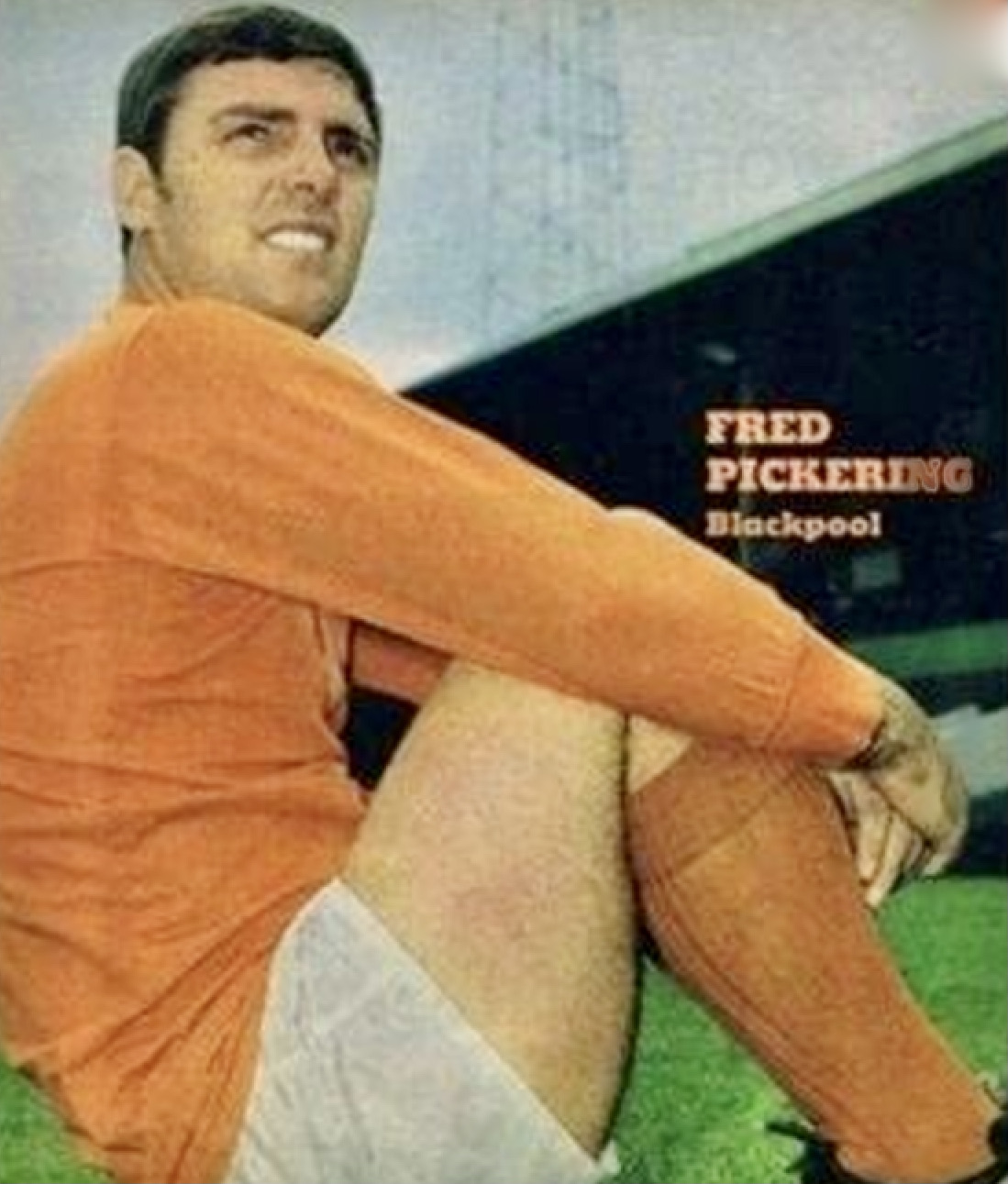
Saward even brought in on trial another former England striker, the ex- Everton, Birmingham and Blackpool striker Fred Pickering from Blackburn Rovers. Like Crawford, he scored for the reserves but he wasn’t deemed fit enough for the first team.
Eventually, in March 1972, Saward found the missing piece of his jigsaw in Ken Beamish, a record transfer deadline day signing from Tranmere Rovers.
Beamish chipped in with some vital late goals to help Albion edge out the Cherries to secure Albion’s promotion as runners up to Villa.
The new man’s contribution earned Crawford’s approval in Brighton & Hove Albion Supporters’ Club’s official souvenir handbook, produced to celebrate the promotion.
Crawford as coach
He said: “I don’t like to single out players because football is a team game, but I must on this occasion. Ken Beamish added the final bite up front, and those vital goals that he scored helped us into Division II. What a player this boy is – he never gives up!”
It emerged in Crawford’s autobiography that he also had a friend in Albion chairman Mike Bamber, having got to know him when the Colchester team stayed at Bamber’s Ringmer hotel before a FA Cup tie.
Ever one for rubbing shoulders with stars, Bamber had subsequently invited Crawford back to Sussex to open a local fete in exchange for a weekend stay at the hotel with his family.
“Since that time, I had regarded Mike as a friend and a man I could trust,” said Crawford.
The former striker’s work with the club’s youngsters was evidently appreciated; for instance by Steve Barrett (below left) who said in 2011: “Ray was my coach when I was an apprentice and a young pro. Always had a great enthusiasm for the game and, even in training at the age of about 40, had a good touch and great eye for goal.
“Was great fun on our annual youth trips to tournaments to Holland or Germany. Was very modest in general but loved to remind everyone of his two goals for Colchester against the then mighty Leeds in the FA Cup. A really nice man.”
When Saward was sacked in the autumn of 1973, Crawford assisted caretaker manager Glen Wilson for the home fixture against Southport, which Albion won 4-0.
As for his relationship with Bamber, it counted for nothing as soon as the chairman astonished the football world by appointing Brian Clough and Peter Taylor to succeed Saward.
Crawford was angered by Clough’s “abrasive and stubborn” shenanigans, for instance being bought a pint in a Lewes hotel bar and then left waiting with Wilson as the former Derby duo disappeared for two hours.
“I wasn’t prepared to be treated like that and I soon found out that the way he spoke to people was as I’d expected,” Crawford recalled. “One day he left the players sitting in the dressing room for two hours before training. I don’t know why. It left a sort of threatening pressure on the players that I didn’t agree with.”
It probably didn’t help matters that Crawford’s outspoken wife Eileen also took issue with Clough when he tried to stop the players’ wives having a smoke while socialising before a match. “I don’t smoke, but if I did, it wouldn’t be anything to do with you!” she told him.
Crawford had heard that his first club, Portsmouth, were looking to revive a youth set-up that had been abandoned under a previous manager, so he applied to take on the role of setting it up and running it and headed back to Fratton Park in December 1973.
Born just a mile away from Portsmouth’s famous home ground, the eldest of four children, on 13 July 1936, Crawford initially looked unlikely to follow the sporting prowess of his dad, who had been a professional boxer, because of asthma.
Nevertheless, his enthusiasm for football was sparked by a display of skill from Pompey player Bert Barlow when he did a coaching session at his school, and he joined a local football club called Sultan Boys.
Then he was taken to see Portsmouth play at Fratton Park and he set his heart on stepping out onto that turf himself.
At 14 he started to fill out in height and weight. “I changed quickly from a skinny, shy, asthmatic youth into a strong, young athlete, representing Hilsea Modern School and Portsmouth Schools in cross country running and in the 440 yards,” he said.
He also excelled at cricket and was offered the chance to have a trial with Hampshire County Cricket Club. But his heart was set on football.
Eventually a break came courtesy of a friend who was already in Portsmouth’s youth team. Crawford was invited to twice-weekly training and, after impressing, was taken on as a junior.
In the meantime, he worked by day for the Portsmouth Trading Company making concrete and breeze blocks, which involved spending around eight hours every day lifting 500 heavy blocks onto pallets to dry. It certainly got him fit.
The football club eventually offered him a contract after two years of training with them, but then (as was the case with all young men at the time) he had to do two years’ National Service in the army.
That’s where the title of his book comes in because he was posted to Malaya where word of his footballing ability had already spread. He was invited to play for Selangor Rangers, the biggest club in Kuala Lumpur, and the army also gave him permission to play for the Malayan Federation on a tour of Cambodia and Vietnam.
“Whilst I took part in many more football matches in Malaya than military exercises, I did go out into the jungle on a few occasions with the battalion,” he recalled.
Back at Portsmouth in the autumn of 1956, Crawford resumed his football career, initially in Pompey’s reserve team. After scoring 33 goals in 39 reserve team games, he finally got a first team call-up, making his debut in a 0-0 draw against Burnley at Fratton Park on 24 August 1957.
In the following game, he scored two in two minutes as Spurs were beaten 5-1 at home, but the following month he suffered a broken ankle that sidelined him for two months.
The beginning of the end of his fledgling Pompey playing career came in December that year when he lost it with the club chairman, Jack Sparshatt, who puzzlingly decided to enter the dressing room at half-time during a game, voicing his disapproval at the performance. Crawford told him to f*** off!
Perhaps not surprisingly he was left out of the side for a month.
He did get selected again in the new year, playing up front with Irishman Derek Dougan, but, that summer, Eddie Lever, the manager who’d given him his debut, was sacked and it wasn’t long before his replacement, Freddie Cox, sold Crawford to Ipswich.
Although he hadn’t wanted to move, future England boss Ramsey was persuasive and Crawford admitted: “I had no idea at the time that this would eventually turn out as one of the best decisions I ever made in life.”
The Hampshire lad adapted well to Suffolk and by the end of his first season at Town had scored 25 goals in 30 league games. Not a bad return but even better was to come and with Crawford and strike partner Ted Phillips rattling in the goals, Ipswich won back-to-back titles, winning the second tier championship in 1960-61 and the elite title in 1961-62.
Crawford scored 40 and Phillips 30 as Ipswich won promotion in 1961 and, at the higher level the following season, Crawford bagged another 37 goals.
Such prolific scoring inevitably brought him to the attention of the international selectors and, at the age of 25, he won two England caps. The mystery was why he didn’t win more.
Crawford made his England debut in a Home International against Northern Ireland at Wembley on 22 November 1961. He was credited with setting up England’s goal, scored by Bobby Charlton in the 20th minute, and the game ended in a disappointing 1-1 draw.
The 30,000 crowd for the Wednesday afternoon match was a record low for Wembley at that time. The prolific Ipswich striker only won one more cap, and then only because of a fractured cheekbone injury to first choice Alan Peacock of Middlesbrough.
Nonetheless, Crawford seized his chance and got on the scoresheet after only seven minutes against Austria in a friendly at Wembley on 4 April 1962.
He turned and buried a shot to give England an early lead which Ron Flowers increased with a penalty before half-time. Roger Hunt scored a third for England in the second half. Hans Buzek pulled one back for the visitors in the 76th minute.
As well as Hunt, future World Cup winners Ray Wilson and Bobby Charlton were also in the England line-up, together with 1966 squad members Jimmy Armfield and John Connelly. The team was captained by Fulham’s Johnny Haynes. Jimmy Melia was part of the squad but didn’t play.
Jimmy Magill, who later joined Brighton from Arsenal, was in the Irish side whose equaliser was scored by Burnley’s Jimmy McIlroy. Spurs’ Danny Blanchflower won his 50th cap for his country that day.
Having scored 33 goals in the First Division, Crawford was gutted not to be selected in the England squad for the 1962 World Cup in Chile and future England boss Ramsey was mystified too. “I just don’t understand it and I will go as far as saying it is downright unfair,” he said.
Crawford reckoned it was because England coach Harold Shepherdson, who also held a similar role at Middlesbrough, always advanced the claims of Boro’s aforementioned Peacock, who was chosen ahead of him despite scoring fewer goals, and in the Second Division.
Although Crawford was selected three times for the Football League representative side, he didn’t win any more full international caps.
Probably more surprising was that his old club boss Ramsey, who had seen him at close quarters for Town, didn’t turn to him after he’d taken charge of England in October 1962. But Ramsey had an embarrassment of riches at his disposal, not least in the shape of Jimmy Greaves and Bobby Smith along with Liverpool’s Hunt and later Geoff Hurst.
Crawford’s first meeting with Jackie Milburn, who took over from Ramsey as Ipswich boss, simply involved the former Newcastle and England centre-forward saying: “Nice to meet you Ray, you won’t be here long.”
Sure enough, he wasn’t. Despite his past successes, Ipswich cashed in and sold him to Wolves for £55,000 in September 1963.
His debut was somewhat ignominious as Wolves succumbed 6-0 at Liverpool (their ‘keeper Malcolm Finlayson was forced off injured) but Crawford scored twice in his second game as Wanderers won 2-1 at Blackpool (for whom Alan Ball scored).
Crawford went on to finish that first season with 26 League goals to his name in 34 games and was named Player of the Year, although Wolves finished in a disappointing 16th place.
Crawford, who is remembered fondly on the website wolvesheroes.com, had been joined at Molineux by Liverpool’s Melia (“a fine passer of the ball”) but when Stan Cullis, the manager who signed them both, was sacked, neither of them saw eye to eye with his successor, Andy Beattie.
Melia was sold to Southampton and the rift with the new boss saw Crawford switch to Black Country rivals West Brom in February 1965 for a £35,000 fee. He later reflected it was a case of jumping out of the frying pan into the fire because he didn’t enjoy a good relationship with Baggies boss Jimmy Hagan.
The striker played only 16 matches for Albion, scoring eight goals, before asking for a transfer in March 1966 and being granted his wish. “I did my best but never had a decent run of games in the first team,” he said. “It never quite worked out but I enjoyed most of my time there and the fans could not have been better.”
It was former club Ipswich, battling at the wrong end of the Second Division, who rescued him and, even though it meant dropping down a division, he was happy to return to Portman Road under Bill McGarry.
Crawford struck up a useful striking partnership with prolific American-born Gerry Baker. By the end of the season, he’d scored eight goals in 13 appearances and Town managed to avoid relegation.
He was part of the Ipswich side that won the Second Division championship the following season, netting 25 goals in 48 appearances, and by then was approaching his 32nd birthday.
The goals continued to flow with Ipswich back amongst the elite, Crawford scoring 21 in 42 games in the 1967-68 season. But more managerial upheaval was around the corner, when McGarry left to become manager of Wolves.
“When McGarry left for Wolves, I had lost my master and mentor, leaving a psychological gap for me that wasn’t going to be filled by anyone else however qualified or good they were as a manager,” said Crawford.
Even before Bobby Robson succeeded McGarry, Crawford started to weigh up his options and he decided he fancied a move to South Africa, where his old Ipswich teammate Roy Bailey had settled.
Although Town chairman John Cobbold initially agreed to give him a free transfer, the Board later changed their mind and decided they wanted some compensation for his services. Instead of going to South Africa, he ended up moving to Charlton Athletic for £12,000.
The move to The Valley turned sour after he refused to join a training camp organised by manager Eddie Firmani because his family were ill and he needed to be at home to look after them. He was sacked after playing just 22 games for the Valiants, during which time he scored seven goals.
Southern League Kettering provided a short-term means of getting back into playing but it was Fourth Division Colchester United who took him on and he repaid their faith by scoring 31 goals in 55 matches under Dick Graham, the most memorable being that pair against Leeds.
Crawford eventually got his move to South Africa in August 1971, joining Durban City, but his family couldn’t settle and they returned to the UK three months’ later.
During his time as youth coach at Portsmouth, he was responsible for signing Steve Foster and, in his autobiography, recalls how a tip-off from Harry Bourne, a local schoolteacher set him on the path of the future Albion and England centre-back.
Foster had been released by Southampton and Crawford went to the family home in Gladys Avenue, Portsmouth, to invite him to train with Pompey. Foster’s mother was at a works disco at Allders and Crawford went to find her there and had to shout above the sound of the music that Portsmouth were interested in signing her son.
The youngster, 18 at the time, got in touch the next day and, before long, was switched from a centre-forward to a centre-back, after Crawford’s former Ipswich teammate Reg Tyrrell told him: “That no.9, he’s no centre-forward, but he’d be a good number 5.”
After he left Portsmouth in 1978, Crawford took over as manager at Hampshire league side Fareham Town and later managed Winchester City before finally retiring from the game in 1984 to become a merchandising rep.
ALEX DAWSON was even younger than Evan Ferguson when he scored a FA Cup semi-final hat-trick.
The bull-like centre forward who broke through at Manchester United in the wake of the Munich air crash wrote his name in football record books on 26 March 1958.
Dawson was just 18 years and 33 days old when he netted three goals in United’s 5-3 win over Fulham in front of 38,000 fans at Highbury, north London. No-one that young has ever repeated the feat.
Eleven years later, Dawson scored twice for Brighton in a Third Division match against Walsall. It was my first ever Albion game. He followed up the two he got in that game with six more in four other games I saw that 1968-69 season. They were enough to sow the seeds of a lifetime supporting the Albion and the burly Dawson, wearing number 9, became an instant hero to an impressionable 10-year-old.
Dawson scored twice v Walsall in 1969
Dawson is no longer with us but the memory of his goalscoring exploits live on amongst those fans of a certain vintage who had the pleasure of seeing him in action.
A man who played alongside him at Wembley in 1958 – Freddie Goodwin – made Dawson his first signing for Brighton, for £9,000, not long after he had taken over as manager in the winter of 1968.
By then, he was plying his trade with Bury. He had left United in 1961 after scoring a remarkable 54 goals in 93 games, including one on his debut aged just 17 (in a 2-0 win over Burnley).
After losing 2-0 to Bolton Wanderers in 1958, another losing Wembley appearance followed six years later. He scored a goal for Preston North End but the Lancastrian side lost 3-2 to West Ham United.
United pair Freddie Goodwin and Alex Dawson were reunited at Brighton
Nevertheless, Dawson was prolific for Preston scoring 132 goals in 237 league and cup games over six years. The purple patch I saw him have for Brighton saw him find the net no fewer than 17 times in just 23 games, including three braces and four in an away game at Hartlepool. That was only one behind top scorer Kit Napier whose 18 came in 49 matches.
Alex Dawson in snow action at the Goldstone Ground
In a curtain-raiser to the 1969-70 season, Dawson scored four times as Albion trounced a Gibraltar XI 6-0 at the Goldstone. But the signing of Allan Gilliver and, in the New Year, young Alan Duffy, began to reduce his playing time. He got 12 more goals in 28 appearances (plus three as sub) but, when Goodwin left the club, successor Pat Saward edged him out.
Even in a loan spell at Brentford he scored seven in 11 games. Greville Waterman, on bfctalk.wordpress.com in July 2014, recalled: “He was a gnarled veteran of thirty with a prominent broken nose and a face that surely only a mother could love, but he had an inspirational loan spell at Griffin Park in 1970.”
Still smiling and scoring goals at Corby
Released by the Albion at the end of the 1970-71 season, Dawson’s final footballing action was with non-league Corby Town, where he didn’t disappoint either.
In his first season at Occupation Road, he finished top scorer with 25 goals in 60 appearances and by the time he retired from playing on 4 May 1974, his tally for the Steelmen was 44 in 123 appearances.
When the curtain came down on his career, Dawson had scored 212 goals in 394 matches – more than one every two games. A true goalscorer.
It was in the wake of the decimating effect of the Munich air disaster that Dawson found himself thrust into the limelight at a tender age.
The crash claimed the lives of eight of United’s first choice team – Dawson’s pals. Youngsters and fringe players had to be drafted into the side to fulfil the remaining fixtures that season. One was Dawson, another was Goodwin.
Thirteen days after the accident, Dawson took his place beside survivors Bill Foulkes and Harry Gregg and scored one of United’s goals as they beat Sheffield Wednesday 3-0 in the fifth round of the Cup.
He scored again as United drew 2-2 with West Brom in the sixth round, before winning through 1-0 in a replay to go up against Fulham in the semi-final.
Dawson told manutd.com: “In our first game with Fulham (played at Villa Park), Bobby Charlton scored twice in a 2-2 draw, and I was put on the right wing. I was a centre-forward really and, when we played the replay at Highbury four days later, I was back in my normal position.
“Jimmy (Murphy) said before the game: ‘I fancy you this afternoon, big man. I fancy you to put about three in.’ I just said: ‘You know me Jim, I’ll do my best,’ but I couldn’t believe it when it happened.
“The first was a diving header, I think the second was a left-footer and the third was with my right foot.
“It was a long time ago, of course, and it’s still a club record for the youngest scorer of a hat-trick in United’s history. Records are there to be broken and I’m surprised that it’s gone on for over half a century.
“I’m a proud man to still hold this record. Even when it goes, nobody can ever take the achievement away from me.”
While Dawson was my first Albion hero, when he died in a Kettering care home at the age of 80 on 17 July 2020 the esteem in which he was held by others also came to the fore in the tributes paid by each of the clubs he played for.
Born in Aberdeen on 21 February 1940, Dawson went to the same school as United legend Denis Law, but his parents moved down to Hull and Dawson joined United straight from Hull Schoolboys.
Dawson and future Preston and Brighton teammate Nobby Lawton were both on the scoresheet as United beat West Ham 3-2 in the first leg of the 1957 FA Youth Cup Final and Dawson scored twice in the 5-0 second leg win. West Ham’s side included John Lyall, who later went on to manage them.
On redcafe.net, Julian Denny recalled how Dawson once scored three hat-tricks in a row for a United reserve team that was regularly watched by crowds of over 10,000.
After that goalscoring first team debut against Burnley in April 1957, he also scored in each of the final two matches that season (a 3-2 win at Cardiff and a 1-1 draw at home to West Brom) to help United win the title and secure their passage into Europe’s premier club competition.
Obviously, circumstances dictated Dawson’s rapid rise but, with the benefit of hindsight, some say his United career may have panned out differently if he hadn’t been thrust into first team action at such a young age.
He was just short of his 18th birthday when the accident happened. In an interview with Chris Roberts in the Daily Record (initially published 6 Feb 2008 then updated 1 July 2012), he recalled: “I used to go on those trips and had a passport and visa all ready but the boss just told me I wasn’t going this time.
“I had already been on two or three trips just to break me in. I know now how lucky I was to be left in Manchester. The omens were on my side.”
Dawson went on to describe the disbelief and the feelings they had at losing eight of the team, including Duncan Edwards several days later.
“We were all so close and Duncan was also a good friend to me before the accident,” said Dawson. “Duncan was such a good player, there is no doubt about that. He was a wonderful fellow as well as a real gentleman.
“I will never, ever forget him because he died on my birthday, 21 February, and before that he was the one who really helped me settle in.”
Dawson gradually became an increasingly bigger part of the first-team picture at United, making 11 appearances in 1958-59 and scoring four times. The following season he scored 15 in 23 games then went five better in 1960-61, scoring 20 in 34 games.
He was at the top of his game during the last week of 1960 when he scored in a 2-1 away win at Chelsea on Christmas Eve, netted a hat-trick as Chelsea were thumped 6-0 at Old Trafford on Boxing Day, and then scored another treble as United trounced neighbours City 5-1 on New Year’s Eve.
A fortnight later he had the chance to show another less well-known string to his footballing bow…. as a goalkeeper!
It was recalled by theguardian.com in 2013. When Tottenham were on their way to the first ever double and had an air of near-invincibility about them, they arrived at Old Trafford having lost only once all season, and had scored in every single game.
Long before the days of a bench full of substitutes, when ‘keeper Harry Gregg sustained a shoulder injury, Dawson had to take over in goal.
Dawson excelled when called upon, at one point performing, according to the Guardian’s match report, “a save from Allen that Gregg himself could not have improved upon”.
The article said: “Tottenham’s attempts to get back into the game came to nought and Dawson achieved what no genuine goalkeeper had all season: keep out Tottenham’s champions-elect. In the end, there were only two games all season in which Spurs failed to score, and this was one of them.”
Scoring for Preston North End
Tottenham’s north London neighbours, Arsenal, finished a disappointing 25 points behind Spurs in 11th place, but United manager Matt Busby had been keeping tabs on the Gunners’ prolific centre forward David Herd (Arsenal’s top scorer for four seasons), and in July 1961 took him to Old Trafford for £35,000. It signalled the end of Dawson’s time with United.
When the new season kicked off, Dawson had a new apprentice looking after the cleaning of his boots….a young Irishman called George Best. In his 1994 book, The Best of Times (written with Les Scott),
Best said: “Alex Dawson was a brawny centre forward whose backside was so huge he appeared taller when he sat down. To me, Alex looked like Goliath, although he was only 5’10”. What made him such an imposing figure was his girth.
“He weighed 13st 12lbs, a stone heavier than centre half Bill Foulkes who was well over 6ft tall. What’s more, there wasn’t an ounce of fat on Alex – it was all muscle.”
Best’s responsibilities for Dawson’s boots didn’t last long, however, because in October that year, Busby sold the centre forward to Preston for £18,000.
In 1967, Dawson took the short journey to Bury FC where his goalscoring exploits continued with 21 goals in 50 appearances, before he joined Goodwin’s regime at Brighton.
What a career to look back on: Alex Dawson recalling his goalscoring exploits
PROLIFIC goalscoring centre-forward Fred Pickering, who at his peak scored hat-tricks on his Everton and England debuts, ended his career after an unsuccessful two-month trial with Brighton.
Pickering was a transfer record signing for Everton (the previous season’s league champions) when he joined them from Blackburn Rovers for £85,000 in March 1964.
On his debut for Harry Catterick’s side, he scored three past Nottingham Forest’s Peter Grummitt in a 6-1 thrashing.
Eight years later, a player who’d played for his country and, but for injury, might have been involved in the 1966 World Cup, scored once for Brighton’s reserve side: in a 3-0 home win over Colchester United on 8 March 1972.
Brighton won promotion from the old Third Division two months later thanks in no small part to 19 goals scored by Kit Napier and 17 from Willie Irvine (Pickering’s former Birmingham City teammate Bert Murray netted 13 and Peter O’Sullivan hit 12).
Throughout the season, manager Pat Saward had been hankering for something a bit extra in the forward line. While he appreciated the skill of Napier and Irvine, he said “none had the devil in him. We wanted more thrust.”
Pickering was the second seasoned striker Saward had run the rule over, wondering whether their experience of goal plundering at the highest level several years before might be revived in third tier Albion’s quest for promotion.
Earlier in the season, he tried recruiting an ageing Ray Crawford but contract issues with the player’s last club, Durban City, meant the former Portsmouth, Ipswich, Wolves and Colchester centre-forward ended up joining the staff as a scout and coach instead.
In February 1972, 31-year-old Pickering, by then not even getting a game in Blackburn’s Third Division side, was given a chance by Saward to show he still had the goalscoring ability he had demonstrated so effectively earlier in his career.
Photographs of a rather heavy-looking Pickering training appeared in the Evening Argus and the former England striker was interviewed on Radio Brighton (as it was then) about his illustrious career. Although he played for the reserves, he wasn’t deemed fit enough to make it into the first team.
Saward eventually got the thrusting forward he sought on March transfer deadline day when he signed Tranmere Rovers’ Ken Beamish, who, at 24, was younger and fitter, and quickly endeared himself to Albion fans by scoring a handful of late goals which helped clinch promotion.
But what of Pickering? Born in Blackburn on 19 January 1941, he played junior football in his hometown before joining Rovers as an amateur aged 15.
As a schoolboy, he’d been an inside forward (a no.8 or no.10 in today’s parlance) but he was a full-back when he signed as a professional for Rovers on his 17th birthday.
Indeed, he was at left-back in the Rovers side that won the FA Youth Cup in 1959, beating West Ham United 2-1 on aggregate over two legs.
Alongside him for Rovers were future Spurs and Wales centre-half Mike England and Keith Newton, who also later moved to Everton and played for England at the 1970 World Cup. West Ham included Bobby Moore and Geoff Hurst in their line-up.
With the likes of Dave Whelan and Bill Eckersley ahead of Pickering in the Blackburn pecking order, his chances of a first team breakthrough were limited.
But after a successful outing for the reserves up front, and with wantaway Irish striker Derek Dougan dropped, Pickering was given a chance as a centre forward – and he never looked back.
He scored twice in a 4-1 win over Manchester City and went on to strike up successful partnerships with Ian Lawther, initially, and then Andy McEvoy.
“It was a big turning point for me to be playing centre forward,” Pickering told the Lancashire Telegraph. “Especially when you consider in 1961, Dally Duncan (Blackburn manager, and later Brighton guesthouse owner) told me that Plymouth wanted me and that I was free to leave. I didn’t want to go because Blackburn was my club.
“I only left in the end because the club wouldn’t give me a rise of a couple of quid. It was absurd.”
By then Pickering had scored 74 goalsin158 appearances – some strike rate – which meant he always held a special place in the hearts of the Ewood Park faithful, as reporter Andy Cryer described in a 2011 article for the Lancashire Telegraph.
“Had fate been kinder to him he could easily have been a national darling too,” wrote Cryer.
“When hat-trick hero Geoff Hurst was firing England to World Cup final glory in 1966, an injured Pickering was left reflecting on what might have been after an incredible journey took him from Rovers reserves to international stardom.”
Pickering, nicknamed Boomer for his powerful right foot, had scored five goals in three England appearances and looked set for inclusion in England’s 1966 World Cup squad having been named in Sir Alf Ramsey’s provisional selection.
But he suffered a knee injury in an FA Cup quarter final replay against Manchester City which not only caused him to miss Everton’s FA Cup final win that Spring, but also meant he had to withdraw from the England squad. Cryer reckons it also led to the subsequent demise of his career.
Pickering told the reporter: “I played three games for England and I scored in every game I played, I scored five goals and I was playing well. I was named in the World Cup squads. I was going and from that day it was the following weekend when the knee started to go.
“I watched all the Brazil games at Goodison. England struggled in their first game against Uruguay and that is when Jimmy Greaves got injured.
“Obviously that is how Hurst got in, he wasn’t even really in the set up before. There was every chance if I had been fit it that might have been me who had got in. I wouldn’t say I would have done what Geoff Hurst did but you never know what might have happened.”
Pickering had made his England debut two months after moving to Everton, in a 10-0 demolition of the USA on 27 May 1964. It was the same match that saw future Albion manager Mike Bailey play his first full international for his country. Roger Hunt went one better than Pickering by scoring four, Terry Paine got two and Bobby Charlton the other. Eight of that England side made it to the 1966 World Cup squad two years later – alas Pickering didn’t.
The same scoring rate he had enjoyed at Blackburn continued at Everton and in his first full season he scored 37 goals in all competitions – the most by an Everton player since Tommy Lawton scored 38 in 1938-39.
In three years with the club, he scored 70 times in 115 matches but his exclusion from the 1966 FA Cup final squad soured his relationship with manager Catterick, as covered in detail by the efcstatto.com website. Injuries disrupted his involvement at the start of the following season, and a cartilage operation put him out of action for nearly six months.
Although he made his comeback in March 1967, his Everton days were numbered and, in August 1967, moneybags Birmingham City bought him for £50,000 to form a hugely effective forward line with Barry Bridges and Geoff Vowden.
Pickering and Bridges played in all 50 of Birmingham’s matches in the 1967-68 season; the aforementioned Bert Murray 47. Bridges was top scorer with 28 goals and Pickering netted 15.
The Second Division Blues made an eye-catching run to the semi-finals of the FA Cup, but they lost 2-0 to West Brom (who went on to beat Everton 1-0 in the final).
The following season, Pickering scored 17 times in 40 appearances (Phil Summerill also scored 17, and Jimmy Greenhoff 15) but City finished a disappointing seventh.
That signalled the end of the striker’s time in the Midlands and he returned to his native north west with Blackpool, who paid £45,000 for his services.
It was money well spent as Pickering top-scored with 18 goals as the Tangerines won promotion back to the elite, finishing runners up to Huddersfield Town. His most memorable performance was on 13 April 1970 when he scored a hat-trick away to local rivals Preston North End in front of a Deepdale crowd of 34,000. It earned Blackpool promotion while simultaneously relegating North End to the third tier.
But the 1970-71 season didn’t go well for Blackpool or Pickering. The club got through three managers and only won four matches all season, which eventually saw them finish bottom of the pile and relegated along with fellow Lancastrians Burnley. Pickering found himself fined and excluded for breaches of club discipline (mainly involving missing training) and before the season was over he was sold back to his first club, Blackburn.
That was a blow to Preston, who had just loaned Willie Irvine to Brighton and were keen to install Pickering as his replacement. But it was to Rovers, for £9,000, that he went, but he couldn’t prevent the Ewood Park outfit being relegated to the third tier.
He scored just twice in 11 League games in his second spell at Blackburn before that two-month trial at Brighton.
After he retired from football, he became a forklift truck driver. Warm tributes were paid when Pickering died aged 78 on 9 February 2019. Well-known football obituarist Ivan Ponting said of him: “At his rampaging best, Fred was an irresistible performer.
“Though neither outstanding in the air, nor overly-physical for a man of his power, not even particularly fast, he could disrupt the tightest of defences with his determined running and a savage right-foot shot that earned him the nickname of ‘Boomer’.
“Boasting nimble footwork for one so burly – he could nutmeg an opponent as comprehensively as many a winger – he was especially dangerous when cutting in from the flank, a manoeuvre that yielded some of his most spectacular goals.”
In March 2022, a road in the Mill Hill district of Blackburn, where he lived all his life, was named after him and his family spoke of their pride as they unveiled the street sign in his honour.
A HIGHLY RESPECTED coach who guided a succession of young hopefuls from Manchester United’s youth ranks through to their first team once aimed to re-ignite his playing career at Brighton.
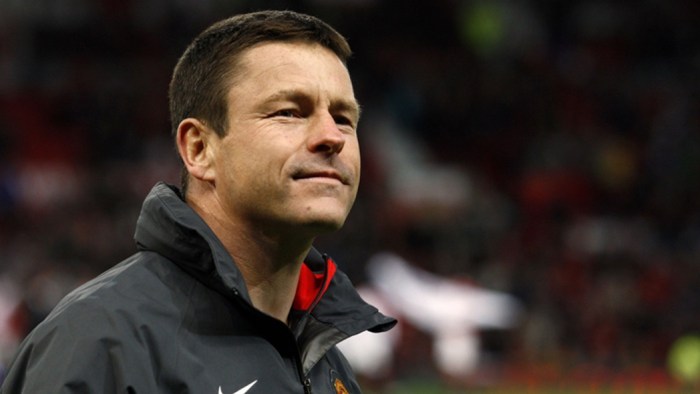
Paul McGuinness, son of former United player and manager Wilf, was in charge of the United side (that included Paul Pogba, Jesse Lingard and Michael Keane) who won the FA Youth Cup in 2011, and Danny Welbeck and Tom Cleverley also emerged under his guidance.
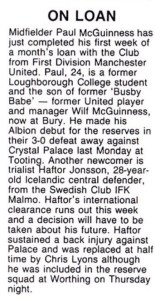
Wind the clock back to the autumn of 1990, though, and McGuinness, the 24-year-old captain of United’s reserve side in 1989-90, arrived on loan on the south coast.
Albion boss Barry Lloyd would go on to take Albion to Wembley for a play-off final against Neil Warnock’s Notts County the following May.
But in October and November Lloyd was still casting around to see who might supplement Albion’s efforts to get among the division’s pacesetters, and McGuinness had lost his starting berth in United’s Central League side.
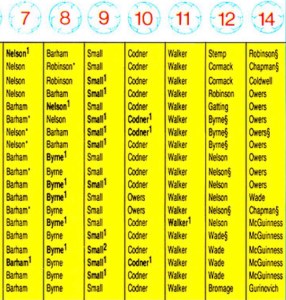
McGuinness made his debut for the reserves in a 3-0 defeat away to Crystal Palace. He also played right-back in a 2-1 defeat against QPR Reserves at the Goldstone, in a side in which Soviet international Igor Gurinovich (playing up front with new arrival Bryan Wade) scored Albion’s goal.
In those days of two subs, McGuinness was selected on the bench for five first team games in succession. But he was never put on and, after a 2-1 defeat away to West Ham, he went back to United.
Born in Manchester on 2 March 1966, McGuinness aspired to follow in his dad’s footsteps, but he found him a hard taskmaster and an ultimate competitor, something he reckoned dated back to an upbringing by Sir Matt Busby’s right-hand man Jimmy Murphy.
“The standards were relentless,” McGuinness told manutd.com. “In a primary school match, I scored 10 goals and my main memory of the day is getting an absolute b******ing for leaving mud in the bath afterwards and not sticking to the right standards. To this day, I rinse the bath and shower down afterwards, every single time!
He continued: “I scored a hat-trick in a cup final and when I came off, he told me off for remonstrating with the referee during the game.”
McGuinness declared: “I didn’t want to be a manager because, over time, dad’s experiences really put me off it, but every school holidays I’d be with him at whatever club he was with at the time.
“At York, Hull and Bury, I’d go and join in with the apprentices while he worked. I’d be 12 playing with 16-year-olds, 14 playing with the reserves, 16 training with the first team.
“Just having him as my dad gave me a massive head start when it came to coaching. He’d take me to games and tell me to pick out the best players and explain why, and he’d always study what was happening in the game, and tell me what was going to happen next, and he was always right.
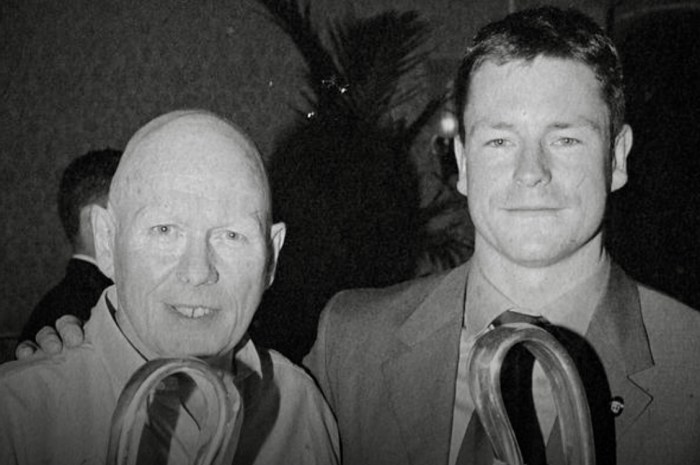
Wilf McGuinness and son Paul
“He’d tell me who was going to get booked, or if a team was over-committing and leaving themselves prone to conceding, and he was always right. That really helped me learn the game at a young age.”
Not to mention the unbelievable experience of getting to play alongside some of United’s biggest household names from their golden era.
“When I was a teenager, there used to be charity games with United, City, Piccadilly Radio and all sorts,” McGuinness recalled. “The ex-players were all in their 40s, and dad would tell me to come along and bring my boots.
“I’d almost always get some playing time, and I ended up playing with Bobby Charlton, George Best, Nobby Stiles, Paddy Crerand, David Sadler, Alex Stepney, but also the City legends too, like Colin Bell, Mike Summerbee, Franny Lee, Tony Book, Glyn Pardoe. It was just incredible.
“This was sometimes just on school fields or non-league grounds, and Bobby was just awesome in every single game. He scored three or four every time.”
Eventually the young McGuinness got the chance to fulfil his dream when he got taken on by United. He was a youth team player between 1982 and 1984 and then spent two years as a professional at Old Trafford, playing alongside Paul McGrath, Kevin Moran, Mark Hughes, Clayton Blackmore, Frank Stapleton and Alan Brazil.
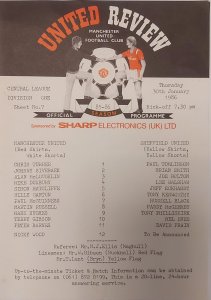
On the teamsheet with some big names
He recounted the circumstances when paying tribute to Eric Harrison, the acclaimed founder of United’s ‘Class of ‘92’, who died in February 2019. “Eric was fundamental in my career as both a player and then for many years as a coach,” McGuinness told traininggroundguru. “I can still vividly remember the moment I convinced him I should get a first pro contract with Manchester United.
“We were playing 6 v 6 on a full-length pitch at The Cliff with no goalkeepers. You could only score if you were inside the six-yard box, which made it a real test of character.
“A player on the opposition team broke free from deep and I chased him all the way back and slide tackled him before he was about to shoot.
“Eric stopped the game. ‘Now that is what we want.’ That got me a two-year contract at the age of 17.”
Perhaps somewhat unusually at that time, McGuinness was also determined to get an education as well as pursue his professional football dream, and he took a degree in PE and Sports Science at Loughborough University.
Having studied under the tutelage of Mike ‘Doc’ Holliday, McGuinness showed his gratitude in subsequent years by taking United academy teams to play matches against the university’s football side.
When that first United contract came to an end in 1986, McGuinness tried his luck with Crewe Alexandra and he played in 13 matches for Dario Gradi’s side in the 1986-87 season.
His studies completed, McGuinness admitted his return to United happened almost by chance.
“This was the time of the ‘Fergie Fledglings’ and I popped into the training ground one day to say hello,” he told traininggroundguru. “ ‘You could have played for the reserves last night,’ Eric said, and I ended up playing the next few games for them. It went from there and Sir Alex Ferguson gave me another contract for a couple of years.”
It was during the second year of that deal that he joined the Albion on loan and the following year he switched to Bury, although he didn’t play any league games for them. Eventually he moved on to Chester City and played in seven matches for Harry McNally’s side.
“Eric got me back in at United after that, first as the club’s welfare officer and then as Centre of Excellence Director,” McGuiness recounted. “He was a constant mentor and you couldn’t help but learn from him.”
He also worked with Nobby Stiles and took over as head of the centre of excellence from the World Cup winner in 1994.
McGuinness has clearly spent a long time absorbing advice and in that manutd.com interview recounted another anecdote about his father.
“When I was a kid, dad would have me shoot from the halfway line, time after time. Eventually, in a university game, I scored from the kick-off with one of those shots and he was there. I was so made up with that.
“He was forever trying to get you to try something different and that stuck with me in my coaching. I had Ollie Norwood trying that from the kick-off, or I’d tell Fraizer Campbell or Marcus Rashford to dribble towards goal straight from the kick-off. Just try something different.
“For me, it was about the spirit of football, something which I talk about a lot to this day, and that’s something that my dad has always embodied.”
It was obviously quite an emotional moment when United finally parted company with McGuinness in February 2016. He told the Manchester Evening News: “It has been an honour and a privilege to follow in my father Wilf’s footsteps and to serve Manchester United in a variety of roles for a total of 28 years.
“To have seen 86 Academy players develop to make their debut for the first team and 23 to become full internationals has been thoroughly rewarding.
“I have especially enjoyed working behind the scenes with devoted colleagues, nurturing and coaching young players to reach their potential.
“I will be forever grateful to Sir Alex Ferguson for making my dreams come true and inviting me to represent Manchester United as a player and for the last 23 years as a proud member of staff.”
McGuinness has frequently shared his knowledge and coaching experience at seminars and online in interviews and podcasts. For example, he told fourfourtwo.com: “One of the first things we look at in young players is how they move with and without the ball.
“You can never be certain, but it gives us a good idea whether they will go on to become athletic. I have seen many talented youngsters who are technically very good but are finished by 12 or 13 because athletically they are not quite good enough.”
Not the case with Rashford, though. “Marcus was a great mover, he was very quick and had a great flow about him,” said the coach.
United built several cage pitches to recreate school playground learning, where older and younger players would compete in small spaces. “They would play 8v8 or 7v7 to increase their speed of thought and improve their skills,” said McGuinness. “At 12, Rashford was playing cage football with Paul Pogba, Jesse Lingard and Ravel Morrison, who were 16.
“He learned from them, but he could also express himself more. With his own age group he might only play a single one one-two, but with Pogba, he could play two or three.”
Scott McTominay is among the current crop of United players to have acknowledged McGuinness’ influence on his career. “We were always brought up to have an elite mentality,” he told manutd.com. “That’s one of the most important things for Paul McGuinness and Warren Joyce – how strong you are in games when it might not be going so well. You have to keep all the right habits off the pitch as well, which I’ve completely bought into from Paul and Warren.
“That was probably one of the best things I’ve done: listening and learning from everything they’ve said and trying to put it into the first team.”
He had overall responsibility for players from the under nines through to the under 18s, with a brief to ensure players were ready for the transition to the under 23s and the first-team squad. But in September 2022, it was reported he had stepped down from the role to help care for his father who, like several players of that generation, had dementia.
More than 19,000 followers on Twitter can see on McGuinness’ timeline an appreciation of the finer arts of football and memories of his dad Wilf’s playing and coaching career.
WILF TRANTER, who died in July 2021, was one of a number of former Manchester United players to pitch up at Brighton in the 1960s.
He arrived at the Goldstone Ground on 5 May 1966, signed by Archie Macaulay, and made his debut the following day, taking over Derek Leck’s no.4 shirt in a 3-1 defeat at Shrewsbury Town.
A back injury kept him out of action at the start of the 1966-67 season and he had to wait until the end of October to return to the first team, in a home 1-1 League Cup draw against Northampton Town. He must have been thankful to have been a non-playing sub for the replay at Northampton as the Cobblers smashed Albion 8-0 to progress to the fifth round.
Restored to the side for the 5 November 2-0 home win over Oldham Athletic, Tranter settled into a regular slot and, according to the matchday programme, had a run of “rattling good games”.
“Strongly-built Tranter has played his part in our recent recovery and climb up the league table,” it declared. He only missed three games over the following four months, through to the beginning of March.
He then dropped right out of the picture, with Albion flirting dangerously close to the drop, before returning in a much-changed line-up for the last game of the season (a 1-1 draw away to Doncaster) after safety had been secured two games previously, courtesy of a 1-1 home draw against Middlesbrough.
Tranter and fellow defenderNorman Gall
With big money signing John Napier preferred alongside Norman Gall in the centre, and young Stewart Henderson looking to take over the right-back shirt from the ageing Jimmy Magill, there was stiff competition for places in defence.
However, at the start of the 1967-68 season, Tranter made the right-back spot his own and even managed to get on the scoresheet with a goal in Albion’s 3-1 win at Mansfield on 21 October 1967.
The Albion programme said Tranter raced through and caught Town by surprise before hammering home and Evening Argus Albion reporter John Vinicombe described the goal as “a truly splendid effort”. It was Tranter’s only goal for the club. One of the other scorers that day, John Templeman, notched his first for the Albion. Charlie Livesey had opened the scoring.
A familiar face arrived at the Goldstone that autumn when former United midfielder Nobby Lawton joined for a £10,000 fee from Preston North End. Tranter missed only a handful of matches as Albion hovered in mid-table but his time at the club drew to a close with 55 league and cup appearances to his name, plus two as a sub.
His final start for Brighton came in an ignominious 4-0 defeat at Watford on 23 March 1968. He did appear as a substitute for Dave Turner in a 1-1 home draw with Barrow on 27 April but, at the season’s end, he was one of seven players transfer listed.
Maybe if he’d stuck around, his Albion career would have been longer because by the end of that year another of his former United colleagues, Freddie Goodwin, took over as manager, and among his first signings was former Busby Babe Alex Dawson.
But, by then, Tranter was playing for Baltimore Bays in the North American Soccer League (NASL), featuring in 12 matches during a six-month spell alongside former Manchester United inside forward Dennis Viollet. The side was coached by Gordon Jago, later QPR and Millwall manager.
Tranter in action for Baltimore Bays
On his return to the UK in January 1969, Tranter signed for Fulham where he played 23 matches in three years. Among his teammates at Craven Cottage were Barry Lloyd, who later managed Brighton, together with goalkeeper Ian Seymour and midfielder Stan Brown, who both had loan spells with the Albion.
Tranter returned to the UK at Fulham
Tranter was born in Pendlebury on 5 March 1945 and went to St Gregory’s Grammar School, Ardwick Green, Manchester, from 1956 until 1961.
He progressed from his school team to become captain of Manchester Boys and also played for Lancashire Boys before signing apprentice forms with United in September 1961.
Although he was taken on as a professional in April 1962, he had to be content with reserve team football for the majority of his time at Old Trafford. In United’s reserve side, Tranter played alongside Bobby Smith (who also later played for Brighton) and Nobby Stiles in midfield, when George Best was on the left wing.
On 7 March 1964, Tranter got to make his one and only first team appearance for United in a 2-0 win away to West Ham.
A crowd of 27,027 at the Boleyn Ground saw him take Bill Foulkes’ place in the side. While United’s goals were scored by David Herd and David Sadler, by all accounts Tranter did well to quell the threat of Hammers’ striker Johnny Byrne.
Manager Matt Busby rested Denis Law, Best and Bobby Charlton for the game – because United were facing the Hammers in the FA Cup semi-final the following Saturday. The weakened Reds might have won the league game but the back-to-full-strength side lost the Cup semi-final 3-1 in front of 65,000 at Hillsborough.
In the final at Wembley, the Hammers won the cup 3-2, beating Preston North End, captained by the aforementioned midfielder, Lawton. Hammers conceded two goals, one scored by the also-referrred-to Dawson.
After his previous post-Albion stint in the States, Tranter returned four years later and played 14 NASL matches for St Louis Stars. Amongst his teammates in Missouri was John Sewell, the former Charlton, Crystal Palace and Orient defender, who later managed the Stars.
Back in the UK, Tranter dropped into non-league football with Dover Town but in the late ‘70s linked up with fellow former United reserve Smith as assistant manager at Swindon Town.
His time in the County Ground dugout proved eventful in more ways than one.
Towards the end of the 1978-79 season, when Town and Gillingham were both chasing promotion, a fiery encounter at Priestfield in March (when a fan got on the pitch and knocked out the referee!) was followed by an even more explosive encounter between the two clubs in May.
The whole story is told from different angles but Town midfielder Ray McHale, who would later join Brighton, was at the centre of some ugly tackling by the Gills. In the tunnel after the game Tranter was alleged to have made some “unsavoury” remarks which led to someone punching him in the face. He had to go to hospital for treatment.
Two Gillingham players – future Albion coach Dean White and Ken Price – were accused of inflicting Tranter’s injuries but they were subsequently found not guilty at Swindon Crown Court.
The following season, Swindon memorably beat Arsenal in the League Cup after forcing a draw at Highbury, although Tranter was lucky to be at the game. On the eve of the match, he escaped serious injury when his car spun out of control in heavy rain and skidded through a gap in a roadside hedge before landing safely in a field.
After leaving Swindon, Tranter had spells managing non-league sides, notably following in the footsteps of his old United teammate Foulkes by taking the reins at Southern Midland Division side Witney Town.
He then had a season in charge at Banbury United and took over at Hungerford Town between 1992 and 1993. At Hungerford, he is fondly remembered for overseeing the refurbishment of the old changing rooms, leaving a 20-year legacy at the club.
According to the Pitching In title, Tranter eventually left the game to focus on business interests in property and care homes.
His wife Carol died aged 70 in 2016 and Tranter died in his sleep aged 76 on 2 July 2021.
• Pictures from matchday programmes and online sources.
CONTACTS made as a youngster at Arsenal stood versatile Mike Everitt in good stead for the rest of his career.
He went on to play under his former Gunners teammate Dave Bowen at Northampton Town as part of one of football’s most remarkable stories and earned a place in the Cobblers’ ‘team of the century’.
Later, he joined a small enclave of former Arsenal players at Brighton. Everitt swapped Devon for Sussex in March 1968 when he moved from Plymouth Argyle for a £2,500 fee.
The man who signed him, Archie Macaulay, was a former Arsenal man himself who’d already brought three other ex-Gunners to Hove in goalkeeper Tony Burns, Irish international full-back Jimmy Magill and winger Brian Tawse.
Everitt started the new season as first choice left-back in Macaulay’s side and an uninterrupted 14-game run in the team as autumn turned to winter straddled Macaulay’s departure and the arrival of new boss Freddie Goodwin.
Everitt slotted home a penalty as Albion drew 1-1 away to Bristol Rovers on 18 January 1969 but the 3-1 home win over Crewe Alexandra the following Saturday was his last outing of the season.
Everitt, Howard Wilkinson and Dave Turner from this Albion line-up all went on to become coaches
He picked up an injury and, with Goodwin having signed his former Leeds teammate Barrie Wright from New York Generals, local lad John Templeman able to fill either full-back slot, not to mention the addition of Eddie Spearritt from Ipswich Town, Everitt couldn’t win back his place in the starting line-up.
Competition for a starting place only intensified in the summer of 1969 when Goodwin’s former Leeds teammate, Willie Bell, arrived from Leicester and was installed as the regular choice at left-back, while Stewart Henderson cemented the right-back slot to the extent he was named Player of the Season.
While Everitt deputised for Bell on a couple of occasions and filled Bobby Smith’s midfield spot for four matches, his only other involvement was as sub on a handful of occasions. He was a non-playing sub in the final game of the season (a 2-1 home defeat to Mansfield Town) and then left the club during the close season.
Born in Clacton on 16 January 1941, Everitt represented Essex Schoolboys and London Schoolboys before being taken on as an apprentice by Arsenal in 1956. He turned professional in February 1958 and, thanks to the excellent records of thearsenalhistory.com, we know that he first played in the first team in the Harry Bamford Memorial match at Eastville against a Bristol XI on 8 May 1959.
He then went on Arsenal’s end-of-season tour to Italy and Switzerland. He was an unused sub for friendlies against Juventus and Fiorentina but came on as a substitute in a 4-1 win over Lugano of Switzerland on 24 May 1959.
Everitt (circled back row) lines up for Arsenal – with (left to right trio in centre of front row), David Herd, Tommy Docherty and Jimmy Bloomfield
It wasn’t until Easter 1960 that he made his competitive first team breakthrough, but when he did it was a baptism of fire in George Swindin’s side.
He made his first team debut in front of 37,873 fans packed into Highbury on Good Friday (15 April 1960) as the Gunners beat a Johnny Haynes-led Fulham side 2-0.
Modern day players might not be able to comprehend it but Everitt also played the following day when Arsenal travelled to Birmingham City, and lost 3-0. Two days later, away to Fulham this time, Everitt was again in the starting line-up as Arsenal lost 3-0.
He kept his place for the following Saturday’s match – at home to Manchester United – and in front of 41,057 he was part of the side that beat United 5-2. Future Albion teammate Alex Dawson led the line for a United team that included Bobby Charlton and Johnny Giles.
That was the penultimate game of the season and Everitt retained his place for the final game, which ended in a 1-0 defeat to West Brom at The Hawthorns.
The 1960-61 season got off to a good start for him too as he played in the opening four matches and, into the bargain, scored Arsenal’s only goal as they beat Preston North End at home on 23 August. Unfortunately for him, a tigerish Scot called Tommy Docherty edged him out of the first team picture and in February 1961 he moved to Fourth Division Northampton Town (for a fee of £4,000) who were managed by the aforementioned Bowen.
His stay with the Cobblers spanned one of the most remarkable stories in football history as they were promoted season on season from the Fourth to the First….and then relegated all the way back down again (although Everitt had left for pastures new before they reached the basement again).
What he was part of, though, was achieving three promotions in five years. Glenn Billingham recalled that heady era in a 2017 article for thesefootballtimes.co.
In 1961-62, Everitt was a regular at wing-half and scored five goals in 41 appearances. He switched to left-back the following season and played 30 matches as Town went up as champions.
A season of consolidation in 1963-64 saw Town finish 11th in Division Two, when Everitt played 45 matches. He played in 43 games in the 1964-65 season which culminated in the historic promotion to the top-flight courtesy of finishing in runners up spot, a point behind champions Newcastle United.
Necessary investment in improving the squad was slow to materialise and Bowen initially had to rely on the same squad of players who’d got them up. Everitt was one of only five Town players who had previously played at that level.
A 5-2 defeat away to Everton in the opening fixture was perhaps a portent of what was to follow for the rest of the season. They didn’t record a win until their 14th game, at home to West Ham (when they won 2-1), but the underdogs performed heroics in their first two home matches. It must have been quite an occasion when in only the second game of the season Everitt lined up in the Northampton side to face Arsenal.
The game finished 1-1, although Everitt had to be replaced at half-time. However, he also played in the return fixture at Highbury which also finished in a 1-1 draw.
Town also drew 1-1 at home to Manchester United, stifling the attacking threat of Best, Law and Charlton, although United exacted revenge at Old Trafford where they dished out a 6-2 thrashing. Charlton got a hat-trick, Law scored a couple and John Connelly was also on the scoresheet.
Everitt made 34 appearances (plus one as sub) that season and scored two goals, one in a rare win, in the penultimate game, when the Cobblers beat Sunderland 2-1 (the Wearsiders scorer was Neil Martin, who later played for the Albion). Graham Carr (father of comedian Alan Carr) played 30 times for the Cobblers that season.
Back in the second tier, Everitt featured in 17 games but as Town plummeted straight through the division, he moved on to Plymouth Argyle in March 1967, where his former Arsenal teammate Jimmy Bloomfield had moved to from West Ham. Everitt was still only 26 when he made his debut in a 1-0 home defeat to Wolverhampton Wanderers. After 31 games for Argyle, he made the move to Brighton.
Everitt had already gained his preliminary coaching badge when still a player and after leaving Brighton in 1970 he initially moved to Plymouth City as player-manager. Within months, he seized the opportunity to move up a level when he landed the player-manager role at then Southern League Wimbledon.
In a January 2010 interview in The Guardian, it was revealed the two candidates he beat to land the position were David Pleat, who went on to manage Luton, Leicester and Spurs, and his former Albion teammate Howard Wilkinson, who won the league title with Leeds United.
Pleat recalled: “The director, Stanley Reed, went for Mike and Howard ended up at Boston United while I was eventually appointed by Nuneaton Borough in the Southern League.”
A few eyebrows were raised in 1973 when Everitt was appointed manager of newly-relegated Brentford just seven days before the start of the 1973-74 season, taking over from Frank Blunstone, who’d left to become youth team manager at Manchester United.
Greville Waterman, on a Bees fan blog, said Everitt polarised opinion, declaring: “He was undoubtedly a cheap option and received little support from the directors (now where have we heard that before) and did his best with a wafer thin squad.”
A classic example saw defender Stewart Houston sold to Manchester United for a club record £55,000 in December 1973, but the money wasn’t immediately reinvested in the squad.
Nevertheless, Waterman pointed out: “His approach did not go down well with some of his players and he brought in a number of tough bruisers. Under his management, Brentford declined rapidly, fell to the bottom of the Football League and barely escaped the need to apply for re-election.”
Legendary Brentford defender Alan Nelmes was particularly disparaging about Everitt. “He didn’t have the technical expertise that Frank had and you felt as if the club wasn’t going anywhere with him. Frank was very advanced in his thinking, ahead of his time, really, and it was a step backwards to have Mike.”
Everitt finally got some backing from the boardroom on transfer deadline day. Experienced forward Dave Simmons was brought in from Cambridge United and former Everton and Southampton defender Jimmy Gabriel from Bournemouth and a 10-match unbeaten run from mid-February to early April did enough to assure the Bees avoided bottom spot even though their finishing position of 19th was their lowest position for nearly 50 years. Crowds were hovering around only 5,000 too.
It didn’t get much better the following season and in spite of getting a vote of confidence in November 1974 from new chairman Dan Tana, Everitt only lasted a few more weeks in the hotseat.
Ironically, after a poor start to the campaign, he’d begun to turn results round and lifted the side to a mid-table position on the back of four wins and a draw in a seven-game spell between late November to mid-January, but he was sacked on 16 January and replaced with John Docherty, who’d only packed up playing for the Bees the previous summer.
Everitt’s next role came as a coach (pictured above) under his old Arsenal pal Bloomfield at Leicester City, and former winger Len Glover came up with an amusing reminiscence on lcfc.com.
Glover recalled when he was 17 playing against Everitt for Charlton Athletic against Northampton.
“He had massive thighs, and had his sleeves rolled up. In the first five minutes he had kicked me when the ball was nowhere near, and now he was our coach!
“He was just the same when he was our coach. When he started, he gathered us round at the training ground. His opening gambit was, ‘You don’t know me, and I don’t know you, but we will soon change that!’
“Then he noticed Frank Worthington who was not with the group but was with the apprentices who were crossing the ball for him to volley like they did every morning. He went, ‘Oi, get over here!’ Frank went, ‘Yeah, in a minute’. Instead of saying, ‘Over here, now!’ Everitt just went, ‘Well, hurry up then’.
“Before Everitt left we went to Leeds and we got stuffed 3-0. After the game Birch (Alan Birchenall) was doing his hair with his hair dryer. Win or lose he would always do his hair. Mike Everitt came in and said, ‘It’s a pity you’re not as good with the ball as you are with that hair dryer!’ Birch replied, ‘If I was as good with the ball as I am with the hair dryer, I wouldn’t be playing for Leicester!’”
After leaving Leicester, Everitt managed Kuwaiti side Al-Shabab when another former Arsenal teammate, George Armstrong, was manager of the Kuwaiti national side (Armstrong’s daughter, Jill, posted a picture of them in Kuwait on Twitter in 2019).
Jill Armstrong posted this picture on Twitter of her with dad George and Everitt in Kuwait
After Kuwait, Everitt managed Cairo-based Egyptian teams Al Mokawloon and Al Ahly, the club Percy Tau joined in the summer of 2021.
According to Wikipedia, Everitt had particular success at Al Mokawloon, winning the 1982-83 Egyptian Premier League title and two African Cup Winners Cups.
• Pictures from matchday programmes and online sources.
IT WAS the stuff of dreams when Liverpool born and bred Jimmy Melia saw his underdog Seagulls side beat the mighty Merseyside giants en route to Brighton’s one and only FA Cup Final appearance.
In fact, it wasn’t the first time Melia had taken a side to Anfield to play in the competition. On 2 January 1971, as player-manager of lowly Aldershot, he returned to the ground where he’d been an inside forward under Bill Shankly and gave them a scare in the third round, the Fourth Division side only losing 1-0.
Even Liverpool’s wideman, Steve Heighway, admitted: “I suppose we were lucky to win. It was a frosty day and the ball was playing quite a few tricks. I don’t think we were in any danger of losing. But Aldershot were playing well that day. They could have sneaked a draw.”
How satisfying, then, to return in 1983 and pilot Albion’s unlikely 2-1 win, with a winning goal courtesy of that other former Anfield favourite, Jimmy Case.
In the run-up to the game, Melia, raised in Liverpool’s Scotland Road, told the Daily Mail: “I’ve got 11 brothers and sisters in the Liverpool area and they’ll all want to be there.”
He clearly didn’t fear the game, pointing out that Brighton had been the last team to win at Anfield, and telling the Argus: “It is a great tie for us. When I was manager at Aldershot we lost 1-0 to them and I think we will do better this time. Remember, the Cup is full of all sorts of upsets. It wouldn’t be the Cup otherwise.”
After the famous victory, Melia told Alex Montgomery of The Sun: “I’ve been involved in some great Liverpool victories but this is without doubt the greatest win.
“The great thing about it is that we didn’t just nick a win. We deserved what we got. A lot of people said that if we attacked them we would just set ourselves up for a hiding. That is not the way it worked out.”
It emerged after the game that John Manning, an old footballing friend of Melia’s, had been key to plotting the victory. Former Crewe, Bolton and Tranmere striker Manning, Albion’s scout in the north at the time, gave the players a pre-match rundown on what to expect.
“Best team talk we’ve ever had,” defender Gary Stevens told the Daily Mail. “Liverpool played exactly the way he said they would and he was even right about which side (Phil) Neal would send his penalty (which went wide of goalkeeper Perry Digweed’s post).”
Born in Liverpool on 1 November 1937, Melia attended the city’s St Anthony’s School and didn’t play his first organised football match until the age of 11. He quickly demonstrated a talent for the game and after shining for the school side was picked to play for Liverpool Boys.
At 14, he was selected for England Schoolboys but a broken collarbone meant he was unable to play. A year later, though, after captaining Liverpool Boys, he got another chance with the national schoolboy side, making his debut against Eire in a team that included Bobby Charlton and Wilf McGuinness.
Liverpool offered him a place on the groundstaff as soon as he left school and, at the age of 17, he was taken on as a professional by former Brighton manager Don Welsh, who took over as Liverpool boss in 1951. Ahead of a Brighton v Portsmouth game in 1983, Melia mentioned his closeness to their manager at the time, Bobby Campbell.
“We virtually grew up together in the same street in Liverpool and we both signed for Liverpool as youngsters on the same day,” he wrote in his matchday programme notes. “We literally have a lifelong friendship.”
Melia scored on his Liverpool debut against Nottingham Forest in a 5-2 win when the famous Billy Liddell scored a hat-trick, and he was making a name for himself at a national level too. Melia scored twice for the England Youth side as they romped home 9-2 winners over Denmark at Home Park, Plymouth, on 1 October 1955. The following month he was on target again as England beat the Netherlands 3-1 at Carrow Road, Norwich.
Between the 1955-56 and 1963-64 seasons, Melia played 287 games for Liverpool, scoring 78 goals. It might have been more but for the fact he had to do National Service although the consolation was that he got to play in the British Army side with the likes of Duncan Edwards, Bobby Charlton, Dave Mackay, Peter Swan, Cliff Jones and Alan Hodgkinson.
One of his Liverpool goals came in a home game against Brighton on 10 October 1959. Phil Taylor’s Liverpool were 2-1 down to the Albion that Saturday afternoon and, in the 85th minute, Melia stepped up to take a penalty…and missed. Nevertheless, he atoned for the mistake by slotting home a last-gasp equaliser. A month later, Shankly took over as manager.
In a series of profiles of the leading Liverpool players of the era, journalist Ivan Ponting said: “Jimmy Melia was the principal midfield ideas man as Liverpool rose from the second tier in 1961-62 and he was capped twice in 1963 ahead of sparkling creatively in the opening half of the Reds’ first title campaign under Bill Shankly.”
In only the second game of Alf Ramsey’s reign as England manager, he selected Melia to play for the national side in a 2-1 defeat to Scotland at Wembley on 6 April 1963.
Then on 5 June 1963, in Basle, he was one of the goalscorers in the side that hammered Switzerland 8-1; Bobby Charlton scored a hat-trick but remarkably Jimmy Greaves didn’t get on the scoresheet.
Although he didn’t win another full cap, he was in a FA squad Ramsey took to Gibraltar in May 1965 when the Rock’s representative XI were soundly beaten 7-1 on 22 May and 6-0 the following day.
In the 1963-64 season, when Melia was sidelined by a minor ankle injury, Shankly reshuffled his line-up, moved centre-forward Ian St John into a more deep lying role and put Alf Arrowsmith up top. The change worked so well that Melia never did regain his regular place in the team.
“It was a stunning blow and a surprise to the balding Merseysider whose flair, industry and intelligence had been so productive, with his through-passing an exquisite speciality, even if some fans disliked what they saw as over-elaboration on the ball,” Ponting wrote for Back Pass magazine.
Melia was sold to Wolves for a then record fee of £48,000 in March 1964, but because he had played a certain number of games for Liverpool earlier in the season, was awarded a medal when the Reds were crowned champions.
It was the legendary Stan Cullis who had taken him to Molineux and, Melia told Charlie Bamforth for wolvesheroes.com, it was with the intention of him subsequently moving into a coaching role. But, when Cullis was sacked before the end of the year, his replacement, Andy Beattie, swiftly dispensed with Melia’s services, offloading him to Southampton in December 1964 for £30,000.
At The Dell, Melia (pictured below in Saints’ famous stripes) joined forces with the likes of Terry Paine and Martin Chivers and, in 1965, helped Ted Bates’ side to promotion to the top division.
He was an ever present in the side during their first top division campaign, notable as a provider of crosses for Ron Davies and Chivers.
Eventually, the emerging Mike Channon took his place and, in 1968, after making 152 Saints appearances, on the strength of a recommendation from his old boss Cullis (by then manager of Birmingham), Aldershot paid £9,000 for him to become player-coach. The following April he became player-manager.
When he was sacked in January 1972, having made 134 league appearances for the Shots, he moved back to the north west as player-manager of lowly Crewe Alexandra but finally hung up his boots in May that year to concentrate on the manager’s job.
As a lowly league manager, Melia seldom came to the wider public’s attention, but when the opportunity arose, he was quick to seize it. Before another FA Cup third round match, this time against Huddersfield, he told Goal magazine any success he’d had as a manager could be put down to the influence of Shankly and his managers at Wolves and Southampton, Cullis and Bates.
“I was lucky,” said Jimmy. “You can’t help but learn from men such as these and I consider myself very fortunate to have served under them.”
In his first season as manager of Crewe Alexandra, his inexperienced team finished bottom and had to seek re-election to the league (in those days relegation was not automatic).
“I believe some of the youngsters we have here are destined for great futures. But perhaps you need a little more than just skill and enthusiasm to be successful,” he told Goal in July 1973.
Melia was clearly scarred by his treatment at Crewe. He told Ian Jarrett of The Sun: “We finished in the bottom four and were in danger of getting kicked out of the league so I spent days ringing around all my mates to get the votes to save us at the annual (league) meeting.
“I succeeded and went away feeling pretty happy until a phone call from the chairman warned me that I had only narrowly survived a vote of confidence.
“The following September I was made manager of the month but the club called an extraordinary meeting, got rid of the chairman, and soon after that I was out on my ear.
“The experience taught me a lesson.”
In 1975, Melia had three months as manager of Southport, before ending the same year coaching in the Middle East.
He then moved to the USA and linked up with a former Wolves teammate Laurie Calloway to become his assistant coach at NSL side Southern California Lazers. In 1979, Melia moved to Ohio to become coach of Cleveland Cobras.
A window back into the English game opened in April 1980 when Brighton boss Alan Mullery appointed him as the club’s chief scout.
Looking back now, it seems a tad ironic that Albion chairman Mike Bamber was all for sacking him and other members of Mullery’s backroom staff in the summer of 1981 to save money. Mullery refused – and subsequently left the club himself.
Melia retained his position under Mullery’s successor, Mike Bailey, who, despite taking the Albion to their highest ever finishing position (13th) in 1982, failed to win over fans with a style of football that saw them stay away in their thousands.
A concerned Bamber finally brought down the curtain on the Bailey era in December 1982, handing the first team managerial reins on a caretaker basis jointly to Melia and loyal backroom ‘boy’ George Aitken (himself a former manager who, like Melia, had been a player under Shankly during his time at Workington).
From the outset, it was Melia who put himself forward to handle interviews with the press, TV and radio, and, as the club progressed in the FA Cup, so the spotlight began to shine brighter on the Liverpudlian, especially with that tie at Anfield.
Inevitably, the question kept arising as to whether Melia would land the manager’s job on a permanent basis and, in one of many interviews, he somewhat tellingly said: “I’d love the job and, if we stay up, that will improve my chances. But I’m not going to attempt to survive by playing boring, safety-first football.”
In a comment that was something of an oxymoron, Melia told Paul Weaver of the News of the World: “I don’t want to say anything against my predecessor, Mike Bailey, but I wouldn’t have paid money to watch Brighton in the first half of the season.”
Perhaps not surprising, then, that in a veterans’ charity match played at Selhurst Park just before the semi-final, Bailey refused a request to be photographed with Melia, albeit he was happy to pose alongside Mullery.
By then, Melia had indeed finally been given the manager’s role on a permanent basis (once Norwich had been defeated in the quarter final). On 16 March 1983, Bamber took him out to lunch at a Hove hotel to break the news.
In a front-page splash on the Argus, Melia said: “This is the happiest day of my life. It is a dream to be manager of a First Division club with also the possibility of taking them to Wembley.
“I am just pleased the chairman has given me the opportunity, and I hope to stay at the club for the next 20 years.” It would, of course, turn out to be closer to 20 weeks!
As excitement built in the run-up to the Cup Final, Bamber told Argus reporter Phil Mills: “Jimmy knows the game from A to Z but what I particularly like is that he’s always bubbling. He’s lively and looks on the positive side of things – even when we lose.
“The Jimmy Melia story is a fairy tale – three months ago he was our chief scout. Now he’s leading the Albion to Wembley for the FA Cup Final.
“You couldn’t get a better fairy tale than that.”
There’s no doubting Melia milked the moment, but who could blame him?
He told Ian Jarrett in The Sun: “I must make this situation count because I might never be involved in anything like it again.
“I have felt like the President of the United States in the past couple of weeks. Everyone has wanted to shake my hand and cars have beeped me in the street. It’s heaven to be in this position and I think everyone in the club should make the most of it.”
The Daily Mail even went as far as describing the opposing managers for the 1983 final as “Liberace meets Max Wall”, rather playing on the fact United’s Ron Atkinson had a penchant for bling and the follicly-challenged Melia bore something of a resemblance to the comedian and actor renowned for a silly walk. John Roberts wrote: “Little Jim has given his usual 110 per cent in the discos, a chest-revealing Tom Jones shirt, black leather trousers, white dancing shoes and glamourous girlfriend offsetting a glistening dome that is just made for the Seagulls.”
The writer continued: “Brighton’s progress to Wembley for the first time in their history has made a relegation season tolerable and enabled the 46-year-old Melia to recapture a measure of the prestige he enjoyed as a player.
“As a nimble, intelligent inside forward he won Second and First Division championship medals with Liverpool and played for England. Some of his friends consider that he suffered to a degree for being a home-produced player rather than a fashionable big-money signing.”
Roberts even quoted comedian Jimmy Tarbuck, a boyhood friend of Melia’s, who said: “To use an old showbusiness saying, Jimmy’s been there and back.”
Who knows what might have happened had Albion actually won that Cup Final?
Melia will forever be associated with taking the club to what was then a globally-watched event and raising their profile to heights never previously achieved.
The cold, hard reality, though, was that Brighton’s brief stay among the elite of English football was over. Melia’s open, expansive style of play had been punished in the league, resulting in relegation and a loss of status that took 33 years to restore.
Melia had designs on boosting his coaching staff in the summer of 1983 with the introduction of the aforementioned Calloway, but Bamber had other ideas and, without consulting his manager, instead installed former Albion defender Chris Cattlin as first team coach.
From the outset, it was evident the two were not going to see eye to eye and it wasn’t long into the new season before it emerged publicly that Cattlin was actually picking the team.
Eventually Melia couldn’t continue with what was clearly an untenable position and resigned, but, in a rather tawdry denouement, appeared being carried shoulder-high on the north stand terrace at the next home game amid cries of ‘Bamber out, Melia in’.
At the time, there were rumblings of an Albion takeover from businessman Jeffrey Kruger and Bamber described Melia as “a disgrace” and claimed he had been operating as a mole for Kruger.
Nothing came of the takeover and the dust had not long settled on the end of Melia’s Albion association when he moved to Portugal and spent three years as boss of Belenenses, taking them to a top five finish.
Former Argus Albion reporter John Vinicombe reflected on Melia’s career in a wistful piece for the newspaper in 2001, and recalled: “Back in England Jimmy had a brief spell in charge at Stockport, then it was time to move on to Kuwait and Dubai, San Francisco, San Jose and Dallas.”
He subsequently settled in Dallas and became technical director for Liverpool’s academy in Texas.
Pictures from various sources including the Argus, The Sun, The News of the World, Shoot! and Goal magazines and the matchday programme.
A CARTILAGE operation when he was just 17 changed Gary Williams’ career, but, after success at Brighton, it eventually brought his playing days to a premature end at Crystal Palace.
Originally a winger, the operation, when he was an emerging player at Preston North End, took the edge of his pace and led to him converting into an overlapping left back.
Thankfully, as Brighton fans would witness, his ability to score important goals never left him.
Born in Litherland, Liverpool, on 8 March 1954, Gary Peter Williams had unsuccesful trials with Liverpool and Coventry City before starting his career with non-league Marine. He caught the eye of a scout who’d gone to watch a different player and ended up signing for Preston in April 1972.
Williams made his Preston debut in the final game of the 1971-72 season as Preston drew 2-2 at home to Swindon.
He then played in the opening match of the following season, against Aston Villa, but had to wait until the end of March at Brighton for his next appearance.
After his cartilage op, and just when he thought he was set to be released aged 18, Preston’s reserve team left-back got injured, Williams filled in, did a good job, and it was the platform he needed to launch his career.
“Because I used to be a winger, I knew which way to shepherd them to make it difficult to cut inside,” he told the journalist and author Spencer Vignes in his 2005 book, A Few Good Men.
It was the legendary Bobby Charlton, briefly trying out management at North End, who gave Williams his big break into first team football, selecting him at left back for the final eight games of the 1974-75 season.
Young Gary Williams with former England World Cup winner, Nobby Stiles, at Preston, and scoring the winner at Sunderland.
Former Everton boss Harry Catterick took over from Charlton and made Williams the first choice left back in 1975-76. The following season his outstanding performances earned him the Player of the Season award and on 22 March 1977, he made his 100th league appearance in a 1-0 defeat at Selhurst Park.
By then, Williams was catching the eye of clubs higher up the league and his final game for Preston was the season-ending fixture at Shrewsbury on 14 May, which North End won 2-1.
In July 1977, Preston accepted a £45,000 fee from Brighton to sign Williams shortly after his teammate Mark Lawrenson joined for £100,000. Albion’s Graham Cross and Harry Wilson moved in the opposite direction to fill the positions they’d vacated.
Williams told Vignes how he’d always enjoyed playing against Brighton because of the size of the crowds they got.
“To run out in Division 3 at the Goldstone in front of a full house was amazing. You knew you were in for a hard time but the atmosphere was just infectious,” he said.
Manager Alan Mullery had called him and asked him to get himself down to Brighton and the club booked a room in the Metropole Hotel, the sea view helping to make up his mind about the move.
“I wanted to better myself and get into the First Division but football is such an up and down game that it’s not too wise to look too far ahead,” Williams told Football Weekly News magazine in 1980.
The start to his Albion career was somewhat inauspicious. Although he came on as a substitute in the opening game, a league cup tie away to Cambridge United which finished 0-0, injury then prevented him making his league debut for two months.
It finally came in a 2-0 win away to Sunderland on 1 October 1977 and he then missed only one game through to the end of the season, appearing a total of 34 times as the Seagulls finished fourth, missing promotion on goal difference to Tottenham.
The following season saw Williams play every game, scoring twice, as Brighton were runners-up to Palace gaining promotion to Division One for the first time.
In Albion’s first season amongst the elite, Williams was again ever present – indeed, he remarkably played 146 consecutive games during his time at the club.
The Everton-supporting full-back got the chance to play against his boyhood side in December 1979 and three months later he scored the first of two cracking, memorable Brighton goals in the top division as the Seagulls finished in 16th position.
On 29 March 1980, at the Goldstone, he lashed a shot from 30 yards that flew past England goalkeeper Peter Shilton to earn Albion the double over European Cup holders Nottingham Forest.
Williams beats Nottingham Forest full back Viv Anderson at the Goldstone and, together with Gary Stevens, tries to thwart Liverpool’s Kenny Dalglish.
Williams admits he was about to pass it until skipper Brian Horton urged him to ‘hit the ****ing thing!’
“When you hit the ball that sweetly, you don’t even really feel a thing,” he recounted to Vignes, in that 2005 interview. “By the time I looked up, it was heading for the top corner.”
Although Forest boss Brian Clough declared it a fluke in a post-match interview, because the game took place in front of the TV cameras, it was selected as one of the goals of the season.
Thirteen months after that goal, Williams struck another beauty, this time to silence the Sunderland faithful at Roker Park.
It clinched Albion a 2-1 win and was part of a late flurry of good results which saw the Seagulls escape the clutches of relegation.
Describing it to Vignes, he said: “It was our last attack of the game. Gordon Smith knocks a good ball into the penalty area and I’ve just taken a gamble and gone up from the halfway line. I say so myself but it was a really good volley.
“It fell to me around 10 yards out and you hear the net ripple because the crowd went silent.”
While it contributed to Albion staying up, that summer saw the departure of Mullery, Lawrenson and Horton and the arrival of Mike Bailey into the manager’s chair. It was to signal the end of Williams’ Brighton career.
Bailey favoured a far more defensive approach to his predecessor and brought in the experienced Northern Ireland international Sammy Nelson, who had been displaced at Arsenal by the arrival of Kenny Sansom.
Williams only learned about the signing through The Argus and, when he confronted the manager about it, was told Nelson was only going to be a squad player.
“I’m thinking ‘bollocks’ but he didn’t play him straightaway,” Williams recounted. “He couldn’t drop me because I wasn’t doing anything wrong.”
Ironically, however, he lost his place after bombing forward and scoring in a 4-1 win over Manchester City. Astonishingly, Bailey was annoyed that he had been too adventurous!
With Nelson keen to carry on playing and earn a place in Northern Ireland’s 1982 World Cup squad, it meant Williams was left to languish in the reserves.
By the end of the season, though, Mullery, by now manager of Crystal Palace, came to Willams’ rescue and gave him a chance to resume first team football.
In a swap deal that saw winger Neil Smillie arrive at the Goldstone, Williams moved to Selhurst.
But after only 10 games he was forced to have an operation on his troublesome knee. Expert advice steered him towards a painful decision but he took it and retired from the game aged just 29.
Williams told the Argus: “The trouble with my knee is really wear and tear. I had a cartilage out at 17, and I was told after the operation last October a lot of harm might be caused if I went on playing.”
In A Few Good Men, Vignes gained a great insight into a northern lad who fell in love with the Albion and remains a fan to this day.
“I was very lucky in that I played right at the beginning of the era of overlapping full-backs,” Williams told him. “It was beginning to creep in when I first came onto the scene, and I had an advantage as I’d started my career as a left-winger. I knew all about coming forward.”