Midfielder Alan Curbishley helped Seagulls to promotion

Screenshot

ALAN Curbishley completed a hat-trick of promotions with new clubs when he was part of Brighton’s successful third tier side in 1988.

He’d previously been promoted after switching from West Ham to Birmingham City and also when moving from Aston Villa to Charlton Athletic.

Curbishley was what you might call West Ham through and through.

Born at Forest Gate on 8 November 1957, within a mile of West Ham station, he was one of five children (elder brother Bill famously promoted and managed The Who and Led Zeppelin and was producer of the films Tommy and Quadrophenia).

Curbishley first played in Brighton at under 11 level, in a Newham Boys side against Brighton Boys at Longhill School, in May 1967. He was later capped for England Boys aged 15 and after joining the Hammers straight from school played for England Youth.

Curbishley won nine England Youth caps under Ken Burton, scoring on his debut in a 1-1 draw against Poland in Las Palmas on 21 January 1975 when England went on to win the Atlantic Cup. Among his teammates were future England captain Bryan Robson, Peter Barnes and Keith Bertschin.

He vied for a starting berth with Mark Nightingale (Palace, Bournemouth, Norwich, Peterborough), making six starts and three appearances off the bench. His last appearance was in a 1-0 win over Wales in Cardiff on 11 February 1976, playing alongside Glenn Hoddle and Gary Owen.

Almost a year earlier, on 29 March 1975, he had made his first team Hammers debut at the tender age of 17, lining up in midfield alongside Trevor Brooking and Graham Paddon in a 1-0 home defeat against Chelsea. Mervyn Day was in goal for West Ham and guarding the opposition net was John Phillips.

At the time, Curbishley was the youngest to play in the senior team although that record was subsequently eclipsed by Paul Allen.

A contemporary of Geoff Pike, Paul Brush and Alvin Martin, they were all in the West Ham youth team defeated 5-1 on aggregate by Ipswich in the 1975 FA Youth Cup Final.

In a midfield dominated by Brooking, Paddon and Pat Holland, and later Alan Devonshire and Pike, Curbishley found first team chances limited, although in 1977-78 he made 36 appearances.

After 85 matches for the Hammers, in 1979 he moved to Birmingham for £275,000. Manager Jim Smith used the proceeds of the £1m transfer of Trevor Francis to Nottingham Forest to buy Curbishley, Frank Worthington, Colin Todd and Archie Gemmill. Curbishley was still only 21 when he made his debut for the Blues on 18 August 1979 in a 4-3 defeat at home to Fulham and he went on to be ever present for Birmingham in that 1979-80 season.

Curbishley earned his one and only England Under 21 cap in a 5-0 thrashing of Switzerland at Portman Road when Justin Fashanu was among the scorers. He had hopes of going to the 1982 World Cup with England, having broken into the England B squad but fractured a kneecap sliding into a tackle with Albion’s Brian Horton. “I missed the rest of the season and the start of the next, and the World Cup squad which I might have broken into otherwise,” he said. “It was the worst disappointment I’ve ever faced.”

He was on the front cover of the matchday programme for a game I went to watch at St Andrew’s on 27 March 1982 when he played for Ron Saunders’ Blues in a 1-0 win over Brighton. But financial issues meant the side was broken up and, the following year, after a total of 155 games, he committed what today seems to be viewed as a cardinal sin by signing for Villa for £100,000, ironically making his debut against Birmingham in a 1-0 win on 4 April 1983.

“I had high hopes of success there with them just having won the European Cup,” he told Dave Beckett in an Albion matchday programme article. “It was soon obvious though that Tony Barton was under pressure from the moment he took over and all the players thought it was just a matter of time before he was sacked.

“He got a raw deal. That season we finished ninth in the league, got to the semis of the League Cup and were knocked out of the UEFA Cup in the last minute on the away goals rule. Villa have never been near that form since, but Tony Barton’s face didn’t fit and he was soon on his way along with all the men he signed.”

After only 36 appearances, scoring once, Curbishley returned to London, dropping back down to the 2nd division, to begin what would be a long association with Charlton Athletic, punctuated only by his spell at Brighton.

Amazingly, although homeless at the time and playing at Selhurst Park, Charlton won promotion back to the 1st Division. Unfortunately Curbishley sustained an achilles tendon injury and only played 10 games in the 1986-87 season.

“I knew I had an achilles injury but the operation was delayed until a week before the start of the new season and consequently I wasn’t fit again until December,” he said. “The manager bought two new midfield players, which I understood, but when I was fit again I couldn’t get back into the side.

“It became apparent that I wouldn’t get much of a chance unless something drastic happened so I’m pleased to have a fresh start.”

After 13 seasons playing in the top two divisions, he left Charlton having scored six times in 63 games and dropped down to the Third to join the Albion for £32,500.

He made his debut in a goalless draw at Chesterfield on 22 August 1987 in front of a crowd of just 2,286.

After the departure of Jimmy Case in 1985, the centre of Albion’s midfield had been crying out for someone who could put their foot on the ball and pass it, and Curbishley stepped neatly into that role, scoring six goals – mostly penalties – in 34 appearances as Brighton won promotion.

“Alan was a very level-headed guy, an excellent passer and really disciplined,” Albion boss Barry Lloyd told Spencer Vignes in a matchday programme article.

In total, over three years on the south coast, Curbishley played 127 games (plus five as sub)  – making his 400th league appearance during the 1988-89 season – and scored 15 goals.

curbs penThe Albion matchday programme featured Curbishley when the Seagulls hosted the Hammers for a Barclays League Division 2 game on 16 September 1989. Describing his time with the East London club, he said: “It was a brilliant set up although I was definitely a bit headstrong in my early days.

“I didn’t really grow up until I moved to St Andrew’s and that’s where I had my best playing days.”

Lou Macari’s side in 1989 included Curbishley’s old pal Alvin Martin and future Albion manager Liam Brady but the Seagulls ran out 3-0 winners (goals from Kevin Bremner, Robert Codner and Garry Nelson).

In 1990, Curbishley began his coaching career, returning to Charlton initially as player-coach under Lennie Lawrence. When Lawrence left in 1991, Charlton made the somewhat unusual decision to appoint joint managers: Curbishley and Steve Gritt (who would later be at the helm when Albion narrowly escaped dropping out of the league).

Curbishley’s first signings for Charlton were former Albion teammates Nelson and Steve Gatting and he later plundered young winger John Robinson from the Seagulls. After four years, Curbishley took sole charge at The Valley and led Charlton to some of the most successful times in their history.

Considering their resources, Curbishley turned Charlton into a steady top flight club and model of stability, consistently securing a mid-table finish.

Sean Cole in The Bleacher Report described him as “one of the most promising managerial talents of the new millennium” and in 2006, in the wake of Sven-Goran Eriksson’s departure as England manager, Curbs had ‘tea and biscuits’ with then chief executive Brian Barwick – but Steve McLaren got the job instead.

In December 2006, Curbishley landed what surely would have been considered his dream job – manager of West Ham.

It was quite a reunion of old pals when Brighton visited Upton Park for one of his first games in charge, in the third round of the FA Cup in January 2007. Albion boss Dean Wilkins and coach Ian Chapman had both been teammates while physiotherapist Malcolm Stuart was still wielding the magic spray.

In front of 32,874, Hammers ran out fairly comfortable 3-0 winners with Mark Noble scoring his first senior West Ham goal and Carlos Tevez a real handful up front. These were the respective line-ups:

West Ham: Carroll, Dailly, Ferdinand (Spector 45), Gabbidon, McCartney, Benayoun, Mullins, Noble, Boa Morte (Newton 73), Cole (Bobby Zamora 68), Tevez.
Subs not used: Green, Sheringham. Goals: Noble 49, Cole 58, Mullins 90.

Brighton: Wayne Henderson, Joe O’Cearuill, Joel Lynch, Guy Butters, Kerry Mayo, Tommy Fraser (Gary Hart 51), Adam El-Abd, Dean Hammond, Alexandre Frutos (Sam Rents 67), Alex Revell (Joe Gatting 84), Jake Robinson. Subs not used: Michel Kuipers, Richard Carpenter.

Fans’ website westhamtillidie recalled: “Perhaps Curbs’ greatest legacy at the club was the £7m signing of his former Charlton protégé Scott Parker, who went on to win the Hammer of the Year prize three times and pick up a Football Writers’ Player of the Year Award during his time at the club.”

Sadly, though it was to all end in tears and Curbishley quit in protest at the then Icelandic owners’ failure to consult him over the sale of defenders Anton Ferdinand and George McCartney.

In what must have been a tough heart-v-head decision, he resorted to a legal resolution of the situation and eventually won a case for constructive dismissal, eventually receiving £2.2m in compensation. But it was the last manager’s job he had.

“It took me a year to sort out my problem at West Ham,” he told The Independent. “And then, after that, I was perhaps a little too picky. I was told by other senior managers ‘don’t be out too long’ but I was waiting for a job that I thought was the job for me.”

Job vacancies came and went, Curbishley’s name was generally on all the shortlists, but he never again made it through to the manager’s chair. There was a brief moment at Fulham when he was technical director assisting Rene Meulensteen but when Meulensteen was swiftly axed, new manager Felix Magath brought in his own people.

He rejoined the Fulham coaching staff in March 2015 and took charge of training in November 2015 when Kit Symons was relieved of his managerial duties but Stuart Gray took charge of the team before Slavisa Jokanovic was appointed.

In 2016, Curbishley brought out a book, Game Changers: Inside English Football: From the Boardroom to the Bootroom (published by HarperSport) and was a regular pundit on the Football on 5 programme covering Football League games.

Further reading

https://www.westhamtillidie.com/posts/2014/11/07/preview-aston-villa

http://bleacherreport.com/articles/1415997-the-curious-case-of-alan-curbishley-footballs-forgotten-man

https://www.whufc.com/club/history/managers/alan-curbishley#C1vPoA9yPR1kYluJ.99

  • Pictures show westhamtillidie’s image of Curbishley in West Ham colours; the midfielder on the front of a Birmingham matchday programme 1982; in Villa’s colours from a Match Weekly annual, an Argus shot of Curbs scoring a penalty for Brighton against Man City, and other images from the Albion match programme.

All-time Albion hero Peter Ward scored inside a minute of debut

ward v bpool

ARMS aloft in familiar salute to yet another goal, the smiling footballer in a black and white picture on a Florida football club’s website dates back 40 years!

All around the world, it seems, Peter Ward’s goalscoring exploits for Brighton & Hove Albion are still the stuff of legend.

Four decades may have come and gone but the memories of this mercurial talent have never dimmed.

FC Tampa Rangers say of their youth coach: “During the 1976–77 season at Brighton, he scored 36 goals, beating the club record and winning him the golden boot.

“He is still revered by Brighton fans who sing a song dreaming of a team in which every player is Peter Ward: ‘We all live in a Wardy Wonderland’.”

If the word legend gets bandied about a little too frequently, where Peter Ward is concerned it is perfectly apt.

1-ward-scoresFew Brighton players have managed to approach the esteem in which this extraordinary talent is held by supporters who saw him score the goals which took the Seagulls from perennial third tier also-rans to a place among the elite.

It takes genuine talent, bravery and skill to score goals at all three levels but Ward delivered. In 220 games for the Albion (plus seven as sub) he scored 95 goals.

In his splendid 2007 book, A Few Good Men (The Breedon Books Publishing Company Limited), Spencer Vignes refers back to 1980 and says of Ward: “No centre forward since has managed to steal his crown. Some have come close – Garry Nelson and Bobby Zamora spring to mind – but Wardy remains special, the golden boy of what proved to be a golden time for the club.”

I was sorry to have missed Ward’s latest return to Brighton when in 2016 he joined some of the Goldstone heroes of the past at the Theatre Royal.

Impishly donning a curly wig on top of his now bald pate to make his grand entrance, Ward showed he’d still got something of the showman about him.

There was never a shortage of superlatives to describe his skills on the pitch. While his dad Colin was a compositor on the Tamworth Herald, his son’s talents with a football filled dozens of column inches in a variety of football publications.

PW green BWAlan Mullery, the manager who benefited most from his audacious skill and compared him to the great Jimmy Greaves, said: “He was just the skinny little kid who could do fantastic things with a football.”

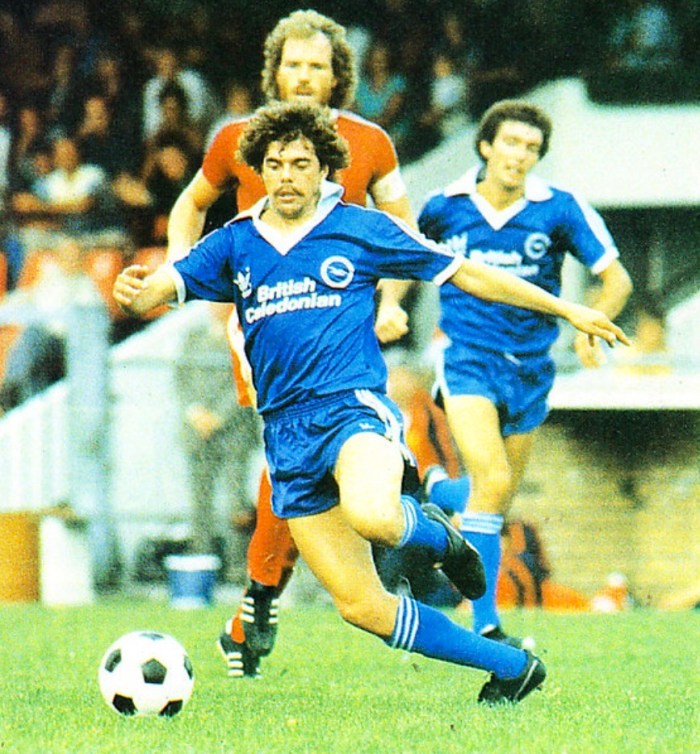
Mullery told Shoot: “Peter has the ability to kill a ball no matter how it comes at him. His pace over short bursts is incredible and he shoots powerfully and accurately with either foot.”

He continued: “Above all else, Peter’s strength on the ball, for a player of his stature, is remarkable. He fools defenders who believe they can easily knock him flying.”

Two of Ward’s former teammates told Vignes what made him so special. “He had this long stride that just seemed to take him away from people,” said Peter O’Sullivan. “One step and he’d be gone. Once he got goal-side of a player, that was it really – bang! Nobody ever seemed to be able to catch him, even in training.”

Brian Horton joined the club around the same time as Ward and said of his younger teammate: “He was this thin, scrawny little player that needed to learn the game, but his finishing was unbelievable, absolutely unbelievable.”

Nottingham Forest fans will have less happy memories of a player the managerial duo of Clough and Taylor took to the City Ground as they strived to replace Garry Birtles and Trevor Francis with any pairing from Ward, Ian Wallace and Justin Fashanu.

It just didn’t work out for Wardy at Forest although he tells Vignes in A Few Good Men: “I had a great time at Forest. I got on well with the lads and had a laugh.”

While he always got on well with Taylor, his relationship with the erratic Clough was a lot stormier which meant he was in and out of the side.

When Lichfield-born Ward left school he was only 4’8” and because he was told he was too small to make a career playing football he got a job as an apprentice fitter at Rolls Royce and played local football in the Derby area.

The detail of those early years can be discovered in Matthew Horner’s excellent biography of Ward (He Shot, He Scored, Sea View Media).

Scout Jim Phelps recommended Ward to the then non-league Burton Albion manager Ken Gutteridge having worked with the freescoring player at a Sunday afternoon side, Borrowash United.

After joining the newly-promoted Brewers initially in the Reserves, the 1974-75 season was only a month old when he made his first team bow alongside former England internationals Frank Wignall and Ian Storey-Moore – and promptly scored a hat-trick in a 4-1 win over Tamworth, his hometown team.

By the middle of November that season, with 10 goals to his name, Ward’s scoring exploits had attracted the attention of league clubs and Brighton boss Peter Taylor, with plenty of contacts in the area, put in a bid.

The Burton chairman, Jim Bradbury, went public on the approach – which Gutteridge found completely unacceptable. He promptly resigned… and before long was appointed to Taylor’s backroom staff!

In the meantime, Burton resisted Brighton’s money and it later emerged that Gutteridge had told Taylor he would only take up the post on condition that Ward would eventually be brought to the Goldstone.

Taylor stuck to his word and eventually signed Ward for £4,000 in the close season of 1975.

The rest, as they say, is history and in researching for this piece it was difficult to sift through the multitude of material from my scrapbooks, programmes, books and other places to condense it all into something manageable.

Because of his popularity, most of the story is familiar to fans of a certain generation anyway and anyone who has not yet read Horner’s book should get themselves a copy because it is rich with material from Ward himself and others who played alongside him or observed him.

Scoring within 50 seconds of his Albion debut away to Hereford United in front of the Match of the Day cameras couldn’t have been a better start and the partnership he struck up with beanpole Ian Mellor was key to promotion from the old Division 3.

For what at times seemed like a fantasy coming to life, it’s intriguing to learn that Ward’s watching of the Bond film The Spy Who Loved Me on the eve of two games was followed the next day by him scoring hat-tricks.

In the 1977-78 season, he saw it before making his England under 21 debut at the Goldstone against Norway in a 6-0 win, and, later the same season, he saw it again before an away game at Mansfield and scored three once again!

It seemed a natural progression that Ward would make it to the full England team and he did eventually – winning one cap for a six-minute substitute appearance against Australia in May 1980.

In fact he made the full England squad three years earlier for a game against Luxembourg but wasn’t involved in the match itself and, by his own admission, reckons he blotted his copybook with manager Ron Greenwood by being ill in the room he shared with Trevor Brooking after going out drinking with Brian Greenhoff.

ward coverIn the way that all good things must come to an end, the beginning of the end of the fairytale came as Albion struggled to come to terms with their first season at the top level.

Ward was certainly not as prolific as he had been lower down the football pyramid although, as reported in my previous blog post, the arrival of Ray Clarke helped him rediscover his form to finish that season as top goalscorer with 17.

However, a return to his Midlands home territory looked increasingly likely. He nearly went to Derby in November 1979 but a swap deal with Gerry Daly fell through, and Forest also wanted him but Clough walked away from the deal.

Eleven months later, though, Clough and Taylor were back in for him when Birtles was sold to Man Utd, paying the Albion £450,000 for his services. Andy Ritchie, being displaced by Birtles’ move to United, promptly replaced Ward at the Albion.

Ward made just 33 appearances for Forest, scoring seven goals, and in 1981-82 went on loan to Seattle Sounders.

In the autumn of 1982, Brighton brought him back to the Goldstone on loan and it was in the fourth game of a 16-game spell that he scored (above) what he considered his favourite goal, the winner against his boyhood idols Manchester United at the Goldstone on 6 November 1982.

Ward was part of the Albion line-up that won that memorable FA Cup fifth round tie at Anfield en route to the 1983 FA Cup Final but it was to prove his penultimate game as the eccentric Clough quashed Ward’s desire to stay with the Seagulls and that potential trip to Wembley.

At that time, Clough’s Forest hadn’t been to a FA Cup Final and he told Ward: “Son, I’ve never been to a Cup Final and neither will you.”

That spelled the end of Ward’s time at the City Ground and by the end of 1983 he was sold to Vancouver Whitecaps for £20,000; the beginning of what became a 13-year career playing mainly indoor football in America, where he still lives.

Pictures from various sources: the matchday programme, Evening Argus and Shoot! / Goal.

Cross the colossus majestic in promotion-winning season

1-cross-clincherGRAHAM Cross won promotion from the third tier in successive seasons – one with Brighton & Hove Albion, the next with Preston North End.

They came after a record-breaking 15-year spell with his hometown club Leicester City.

Cross was a tower of strength and ever-present in Alan Mullery’s 1976-77 promotion-winning team. He was so consistent that his fellow professionals named him and fellow Seagulls Brian Horton and Peter Ward in the division’s PFA team of the year.

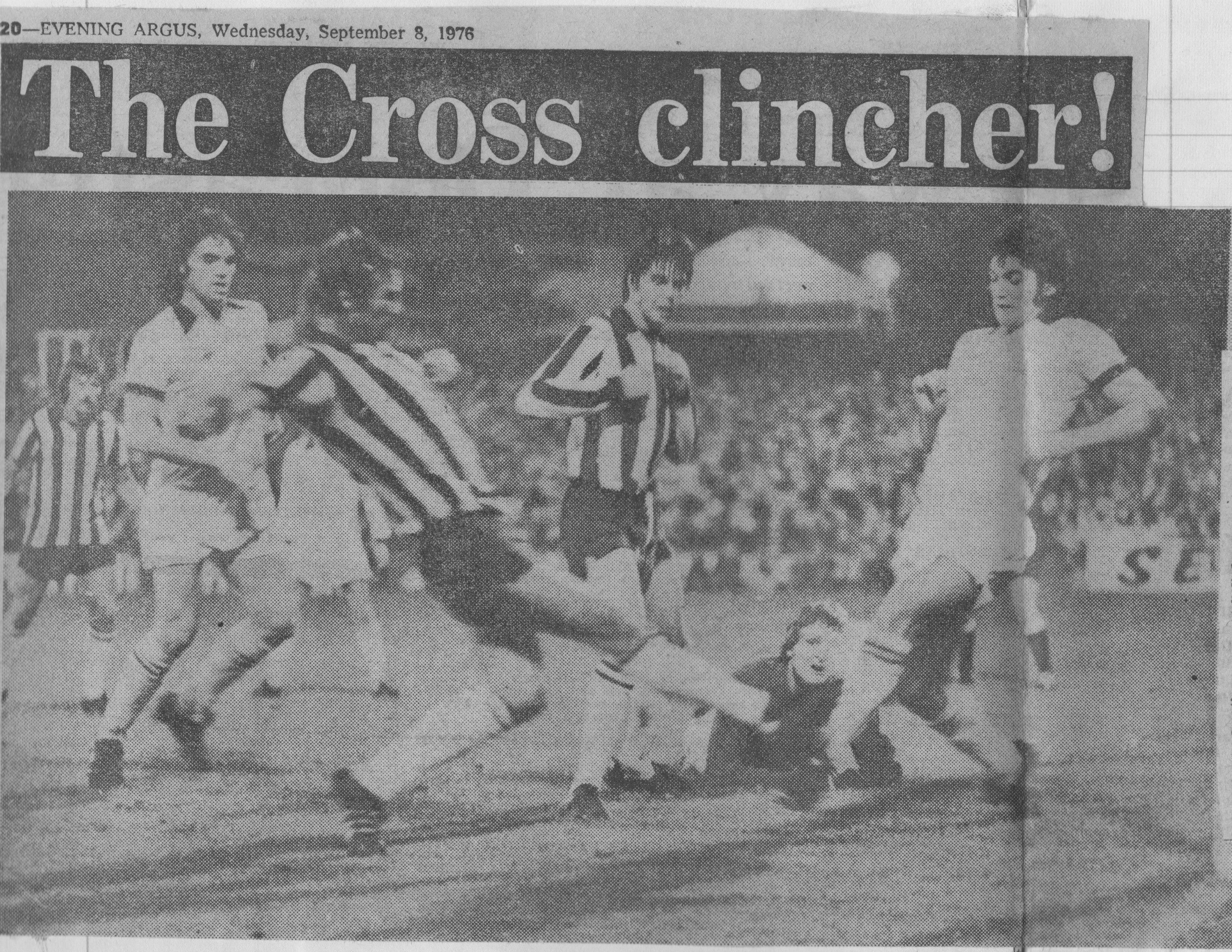
One standout performance I recall was in a cracking League Cup replay at the Goldstone against Division 1 side Ipswich Town on 7 September 1976 (see picture above).

Despite the Albion being down to 10 men, having had Phil Beal carried off injured after sub Ian Mellor had already come on, Cross scored the winning goal two minutes from time to give Albion their first competitive victory against a first division team for 43 years!

“Graham had an absolutely tremendous 1976-77 season for us and I can’t speak too highly of him,” Mullery told Shoot! “When I first started planning for the new term I reckoned on having him in the side for our step up into the Second Division.”

G Cross BW HSHowever, when he realised he could land the highly promising 20-year-old Mark Lawrenson from Preston for £112,000, those plans changed.

Lawrenson had played brilliantly against the Albion during the promotion season and was eager to take the step up so he headed south together with full back Gary Williams and Cross and left back Harry Wilson went in the opposite direction.

“I wish him well at Preston and can assure their supporters they are getting one of the most honest lads in the game in Graham,” said Mullery.

Cross certainly played his part as Preston earned promotion from the third tier – one of his teammates was centre forward Michael Robinson, who joined Albion in 1980 – but in the following season the magic touch eluded him when he played 19 times for Lincoln City but didn’t manage to stop them being relegated to the Fourth Division.

3-gc-leicesterCross had been part of the furniture at Leicester and the meashamfox blog recalls how he scored on his debut on 29 April 1961 against Birmingham City in a 3-2 win at Filbert Street.

He was a real ‘Mr Versatility’ who played in eight different positions, although mostly  in midfield – the history books describe him as an inside forward or wing half – and at centre back.

During all the hullabaloo surrounding Leicester’s remarkable Premiership title win in 2016, there were flashbacks to the last time a Leicester side went that close to clinching the league title – in 1962-63 – with Cross a member of that side.

In an interview with the Leicester Mercury, his former Scottish international teammate Frank McLintock spoke about a so-called signature move called ‘the switch’ Leicester employed whereby Cross dropped back and McLintock bombed past him.

“It was a load of rubbish, really,” McLintock told the paper. “It was just that I was really fit and Graham, who was a great player, would be a bit puffed out when he got back. We just swapped positions for a bit.

“The opposition would get confused with who was picking up who. Even Bill Shankly copied it later on at Liverpool.”

Unlike the 2016 vintage, the 1963 side blew their title chances by losing their last four league games. However, they did reach the FA Cup Final that year. Cross was in the side that lost 3-1 to Manchester United. He was also in the Leicester side that lost the 1969 final 1-0 to Manchester City.

His performances in 1963 were good enough to earn him a call up to the England under 23 team, making his debut in a 0-0 draw with Yugoslavia at Old Trafford. In the return fixture two months later, he scored a penalty to supplement an Alan Hinton hat-trick as England won 4-2.

He was a permanent fixture in the side for 10 matches (including a 4-1 win over West Germany, when future Albion colleague Peter Grummitt was in goal). But in November 1964, Leeds’ Norman Hunter took over the no.6 shirt.

Cross was recalled for one more game, in April 1966, when the under 23s beat Turkey 2-0 at Ewood Park. Two of the side that day – Martin Peters and Roger Hunt – would go on to be part of the England World Cup winning team three months later, but Cross never progressed to the senior England team.

Nevertheless he did pick up a  League Cup winner’s medal when Leicester beat Stoke City in 1964 but was a loser the following year when they were beaten narrowly by a Chelsea side containing Barry Bridges and Bert Murray.

Three years before joining Brighton, Cross received a long service clock to mark 500 first class appearances.

Throughout this period, he was also one of that rare breed who played county cricket too.

A right-arm medium-fast bowler, he played 83 first class matches for Leicestershire between 1962 and 1976 and took 92 wickets at an average of 29.95. His top batting performance was a knock of 78.

I am indebted once more to the meashamfox blog to learn that it was Cross’ dual sporting prowess that eventually brought his Leicester career to an end.

In the summer of 1975, he was part of the Leicestershire side captained by Ray Illingworth that won the county championship and the Benson and Hedges Cup, making him the only man to have played in cup finals at Wembley and Lord’s.

But the Leicester board took a dim view of him carrying on playing cricket instead of reporting back for pre-season training and he was suspended.

He was sent out on loan to Chesterfield and played 12 times for them in the 1975-76 season, before being released.

He arrived at the Goldstone on May 25 1976 at the same time as full back (and future manager) Chris Cattlin.

Manager Peter Taylor had impeccable contacts in the Midlands and in Cattlin, from Coventry, and Cross, from Leicester, he acquired two experienced campaigners who had played at the top level in the game for many years.

Taylor’s intention was that Cross would have the sort of impact at Brighton that the ageing Dave Mackay had on Derby when Taylor and Brian Clough signed him from Spurs.G Cross LEic

Taylor had tried to sign Cross before, in the pair’s early days at Derby. Leicester even accepted an £80,000 bid but Cross prevaricated over the move and they turned their attentions elsewhere. He admitted his regret at missing out on the £4,000 cut of the deal but told Goal magazine: “I’m happy in Leicester and I’m pleased that I decided to stay.”

That decision would ultimately lead him to become the all-time appearance record holder for Leicester, having played 599 games; a feat still not surpassed.

Clough and Taylor were renowned for building their sides on solid defences and, having already captured Grummitt, Graham Winstanley, Andy Rollings and Wilson, Taylor added Ken Tiler, Dennis Burnett, Cattlin and Cross.

Taylor, of course, didn’t hang around to see how Cattlin and Cross would contribute. With only four weeks to go to the start of the season, he decided to quit and renew his partnership with Clough, this time at Nottingham Forest.

One of the first images fans saw of his replacement, Alan Mullery, showed him embracing Cross and Cattlin at the pre-season press photocall.

Cross mostly played alongside Rollings, with Burnett and Winstanley filling in when Rollings was sidelined.

Interestingly, Cross never actually moved to Brighton during his spell with the Seagulls: the deal he agreed allowed him to continue to train with Leicester because he and his wife had business interests in the Leicester area.

The meashamfox blog declared “Graham Cross was Leicester City’s finest ever player” although the author was also sad to report how in February 1993 “he had been jailed for using post office funds to pay off his gambling debts”.

The blog concluded: “Despite this blip in his life, for me ‘The Tank’ Graham Cross is a true Leicester legend.”

Pictures from my scrapbook show:

  • A cracking Argus picture and headline record the winner Graham Cross scored against Ipswich in the League Cup.
  • A full page colour photo in Goal magazine when at Leicester.
  • Celebrating his inclusion in the PFA division 3 team of the year with Brian Horton and Peter Ward at the annual awards dinner.
  • Another Goal article, from 1973, marking a clock presentation to Cross in recognition of 500 senior appearances for Leicester.
  • Cross in the Preston team line-up alongside Michael Robinson, who would eventually join the Seagulls via Manchester City.
Cross aged 77 was interviewed and photographed by The Times ahead of Leicester’s 2021 FA Cup Final win over Chelsea

Ian Mellor – the postman who delivered for Peter Ward

Mellor BHATHE SONGS still sung today that immortalise Peter Ward sadly fail to recognise the man who laid on so many of the nimble striker’s goals.

But fans of a certain vintage will never forget the contribution of former postman Ian ‘Spider’ Mellor.

Nicknamed because of his long-legged build, the beanpole midfielder-turned-striker, scored 31 goals in 122 appearances for Albion between 1974 and 1978.

Born in Wythenshawe on 19 February 1950, Mellor grew up supporting Manchester City and dreamt of playing for them. He went to Sale Moor Secondary School in the city and, aged 15, he was offered a trial at Maine Road but he didn’t get taken on. Undeterred, two years later he got a second chance after bombarding the club with cuttings of his exploits playing Sunday league football in the area.

He lapped up the experience of being coached by Malcolm Allison. It was towards the end of the Bell, Summerbee, Lee era and Mellor managed 40 appearances for City. In March 1973, however, while Allison was ill, chairman Peter Swales sold him to Norwich City for £60,000.

“Malcolm said he left Maine Road because I’d been sold without his permission when he was ill in hospital,” Mellor told the Manchester Evening News.

“I didn’t really stop to think what I was letting myself in for,” he said. “I should have stayed at City and then, to make it even worse, soon after I’d left, Denis Law rejoined the club. I could have been playing in the same team as my idol.”

After Mellor scored the only goal of the game in Albion’s 1-0 win over Allison’s Crystal Palace at the start of the 1974-75 season, Allison said: “I remember Spider when I was at Manchester City.

“I didn’t want to see him leave for Norwich. Directors force you to do that sort of thing, then they sack you. Spider was a late developer, but his timing is so good now.”

Norwich were struggling at the wrong end of the old First Division when Mellor moved to Norfolk and although he agreed to the deal, he reflected years later that he regretted it.

Perhaps, therefore, it was no surprise when Brian Clough arrived at Carrow Road in the spring of 1974 with the promise of making him Brighton’s record signing for a fee of £40,000, he jumped at the chance to play for the league title-winning manager.

Mellor was part of a triple signing from Norwich as Clough persuaded him and centre backs Andy Rollings and Steve Govier to drop down a division to play for Brighton.

Ironically, he never played competitively under Clough because of ol’ Big Ed’s move to Leeds that summer but under Peter Taylor he played mainly in a left-sided midfield role.

It was Taylor’s successor, Alan Mullery, who changed him from a wide midfield player to a centre forward, a position from which he contributed so many ‘assists’ for Ward. Those in the know certainly recognised his contribution.

In Matthew Horner’s excellent biography of Ward, He shot, he scored, Mullery is quoted as saying: “Ian Mellor had the ability: he was a big tall lad and he had super pace and a great left foot. I thought that they would form a terrific partnership.

“In my opinion, Mellor was wasted in midfield. He could hold on to the ball and he’d learnt his skills from Malcolm Allison and Joe Mercer at Manchester City, who were both great coaches. He shouldn’t really have been playing at the level we were at – he was too good – but he was and that was great for us.

“Spider would get the ball to him and Peter would go on these mazy runs and, nine times out of 10, would knock the ball into the back of the net.

“The partnership is history now but they were absolutely fantastic together.”

Former Albion colleague, now BBC pundit, Mark Lawrenson said of him: “Playing Ian Mellor alongside Ward was the masterstroke really – Mellor was an out-and-out footballer and a perfect partner for Wardy.”

Club skipper at the time, Brian Horton, added: “In the first year Ward and Spider were unbelievable. We didn’t have a big target man but the movement with those two was fantastic. They got about 50 goals between them and I chipped in with about a dozen more.”

Ironically one of the stand-out games of his Albion career, on 3rd May 1977, came against Albion’s play-off opponents, Sheffield Wednesday, in front of 30,756 fans at the Goldstone.

Argus reporter John Vinicombe named him his Albion man-of-the-match as Wednesday were beaten 3-2 to earn promotion.

Not long into the following season, Mullery splashed £238,000 on centre forward Teddy Maybank from Fulham and he went straight into the team alongside Ward, which unsurprisingly didn’t go down well with Mellor.

“I knew I was better than him, but they had to justify his price and that’s why I got dropped,” Mellor maintained in a an Albion matchday programme interview with Spencer Vignes. Mellor requested a transfer in spite of chairman Mike Bamber urging him to stay.

“In hindsight, of course, I should have stayed,” said Mellor. “I was still good enough. I was 29, with two good seasons left in me.”

Instead, in February 1978, he moved back to his native north west from Brighton to play for Chester for two years but then had three years at Sheffield Wednesday where he managed 11 goals in 70 games and, like his spell alongside Ward, provided a perfect foil for Terry Curran to bang in the goals.

He ended his career at Bradford City and later worked as a commercial executive for the PFA. He also worked for football boot supplier Puma and was a representative for football kit supplier Pelada.

Younger readers will be more familiar with the former Liverpool striker Neil Mellor, who now works in the media, who was one of Ian’s sons.

Ian Mellor died aged 74 in Cheadle on 1 May 2024 after a long battle with amyloidosis.

  • Pictures from my scrapbook and Albion matchday programmes show headlines Mellor made and the player in action.

scrapbok mellor

A little less hirsuit than in his playing days…