Last eight in the FA Cup becoming familiar territory

REACHING the FA Cup quarter-finals for the fourth time in seven years is music to the ears of Brighton fans of a certain vintage.

Time was when an exit far earlier in the competition was the more likely expectation and falling victim to non-league giant killers (remember Walton & Hersham, Leatherhead, Kingstonian, Canvey Island, Sudbury Town) was nothing short of humiliating.

But as each season in the exalted company of the Premier League has gone by, the last eight stage of the FA Cup has been well within reach.

As one who goes back a good many years, it was a delightful surprise to reach the quarters twice in the mid-1980s (going all the way to the final in 1983, of course, if you hadn’t heard!).
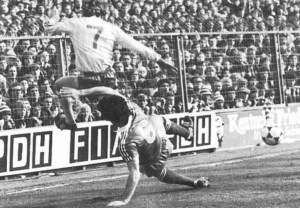
Gary Stevens tackles Mark Barham

It still pains me to say that I was one of the many locked out of the 28,800 Goldstone Crowd on 12 March 1983 when Albion played in their first ever FA Cup quarter-final.

Norwich City, under former West Ham FA Cup winner Ken Brown, were the opposition with future England goalkeeper Chris Woods in goal and Mark Barham, who joined Albion towards the end of his career, on the wing.

Jimmy Melia’s Seagulls had already beaten the Canaries 3-0 a few months earlier but the cup match proved a much tighter affair described as “bruising” by several football reporters who noted the physios were called on seven times to treat injuries – Albion’s Norwich-born Mike Yaxley twice attending to Steve Foster.

Andy Ritchie in what turned out to be his last home game for the Albion

Nonetheless, it was “marvellous entertainment for all its imperfections” reckoned the Sunday Telegraph’s Lionel Masters, who said: “Brighton full-back Chris Ramsey did more than most to inject a steely resolve. He conducted a feud with (Dave) Bennett, whom he flattened more times than a target a fairground rifle range.”

Alan Hoby of the Sunday Express wrote: “It was a tough, turbulent, physical affair with an orgy of high balls,” while the only goal of the game, from Albion’s Jimmy Case was “one of the few moments of quality in a frantic game,” according to Brian Scovell of the Daily Mail.

The less well-known quarter-final appearance of that decade came on 8 March 1986 when a Goldstone Ground crowd of 25,069 (at a time when the average often dipped below 10,000) saw Chris Cattlin’s Second Division Albion entertain First Division south coast rivals Southampton.
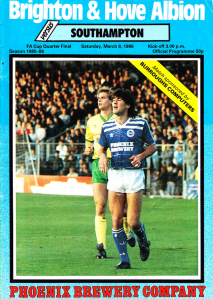
Albion were pleased finally to have got a home game in the competition having had to overcome away ties at Newcastle, Hull and Peterborough (who were eventually beaten 1-0 in a home replay five days before the Saints match).

Saints were managed by Chris Nicholl, Cattlin’s fellow former Burnley youth team colleague, and in the opposition line-up was Case, the talisman of Albion’s run to the final three years previously when he rifled in the winner at Anfield in the fifth round, scored that only goal v Norwich and buried a long-range rocket in the semi against Sheffield Wednesday at Highbury.

England’s Peter Shilton was in goal for Southampton and, most curiously, after a five-week absence from first team action, misfiring Mick Ferguson was selected by Cattlin to lead Albion’s attack. Not one of the 1983 Albion side started for the Seagulls.

Sadly, Brighton, in the upper reaches of the second tier at the time, didn’t do themselves justice. Saints won it 2-0 with first half goals from Steve Moran and Glenn Cockerill – and it turned out to be Ferguson’s last game for the Seagulls. Three weeks later he moved to Colchester United.

Fast forward to 2018 and another strange striker selection by a Brighton manager – this time Chris Hughton leaving top scorer Glenn Murray on the subs bench – proved costly in a quarter-final against Manchester United at Old Trafford.

New £14m signing Jurgen Locadia missed four good chances among 12 second-half Brighton efforts on goal to United’s one and Pascal Gross went close on three occasions. But BBC Sport’s Mike Whalley suggested: “He (Hughton) might have been left wondering if resting Murray caused Brighton to miss their chance of a first FA Cup semi-final since 1983.”

United topped and tailed the tie with Romelu Lukaku opening the scoring early on and Nemanja Matic sealing victory late on when he nodded in Ashley Young’s free-kick.

A year later, it looked like Albion wouldn’t be going beyond the last eight once again when Championship side Millwall led the Seagulls 2-0 at The New Den with only two minutes to go. Cue Locadia, on as a sub, to make amends for the previous season’s misses by making space for himself in the box and firing home an unstoppable shot to pull a goal back for the visitors.

Then, with 95 minutes on the clock, Solly March from way outside the box floated in a free-kick that Lions’ ‘keeper David Martin inexplicably let slip through his grasp to bring the Albion level.

Goalkeeper Mat Ryan a penalty shoot-out hero at Millwall in 2019

The momentum was in Brighton’s favour in extra time but it took a penalty shoot-out to decide the tie and when Murray missed Millwall might have thought it had turned back their way. But after three successes each, Mat Ryan kept out Mahlon Romeo’s effort, and Lions centre back Jake Cooper needed to bury his spot kick to keep the tie alive for the home side. He blazed his shot over the bar and Albion were through.

There was to be no such drama in 2023 when 18-year-old Evan Ferguson did a whole lot better than his 1986 namesake and stole the headlines by scoring twice against League Two Grimsby, who were playing in their first FA Cup quarter-final for 84 years.

The Mariners had knocked out five teams from divisions above them to reach that stage but they were well and truly put to the sword by Roberto De Zerbi’s impressive Seagulls who ran out 5-0 winners at the Amex.

As well as Ferguson’s brace, Deniz Undav, March and Karou Mitoma were also on the scoresheet and it could have been more; Mitoma missing a sitter and Adam Webster’s effort hitting the bar.

Perhaps by way of highlighting how quickly fortunes can change for young players, it’s interesting to recall that of Ferguson BBC pundit Danny Murphy said at the time: “This kid is a superstar. Honestly.

“He’s got great feet, technical ability. He’s calm, powerful and plays the role really well. You don’t see him out wide, he stays central and is always a target.

“I can’t see a weakness in his game at the moment. For 18 years old, the maturity he shows in his game is phenomenal.”

Murray, having moved into the punditry game himself by then, added: “It was the manner in which he scored those goals, he was so composed. As a young lad just coming into the first team, you can snatch at those chances but he just relaxes in that moment – and that is something that you can’t teach.

“He’s got a good stature and I think there’s big things in the future for him.”

Two goals that etched Sammy Morgan’s place in Albion history

HAVING A cheekbone broken in four places during a pre-season friendly summed up the bad luck of never-say-die Northern Irish international striker Sammy Morgan.

His cause wasn’t helped when the manager who signed him six months earlier quit. And, to top it off, while he was recovering from that horrific injury, an Albion footballing legend in the shape of Peter Ward burst onto the scene.

When a £30,000 fee brought him to Brighton from Aston Villa just before Christmas 1975, it looked like the side had found the perfect strike partner for Fred Binney as they pushed for promotion from the third tier.

Unfortunately, the man with the swashbuckling, fearless approach went eight games without registering a goal. However, in his ninth game he made amends in memorable fashion.

Morgan scored both goals in a 2-0 win over Crystal Palace in front of an all-ticket Goldstone Ground crowd of 33,300 – with another 4,000 locked out.

It was 24 February 1976 and the Daily Mail’s Brian Scovell reported the goals thus: “In the 12th minute, Ernie Machin struck an early ball into the middle from the right and Ian Mellor headed on intelligently behind the defence for Morgan to steer the ball into the corner of the net.

“The second goal, in the 55th minute, came when Tony Towner took the ball off Jeffries and set off on a 40-yard run which ended with his shot rebounding off goalkeeper Paul Hammond. Morgan tapped in the rebound.”

Gritty, angular and awkward, Morgan scored five more before the end of the season, including another brace at home to Swindon.

However, Albion narrowly missed out on promotion and Peter Taylor, the manager who bought Morgan, quit the club in the close season. The new season under Alan Mullery hadn’t even begun when, in a pre-season friendly against Luton Town, Morgan fractured his cheekbone in four places.

“I know I’m probably more prone to injuries than other players because of my style of play, but there’s no way I can change it, even if I wanted to,” Morgan told Shoot! magazine. “I made up my mind as soon as I got back in the team that I’d have a real go and that’s what I’ve done. People say I’m a brave player but I don’t really know if that’s true. I just like to give 100 per cent and that way no-one can ever come back at you.”

In the season before he joined Brighton, a groin injury had restricted him to just three top-flight appearances for Villa and, when he was fit to return, Villa had signed Andy Gray, whose form kept him out of the side.

Initially reluctant to move on, he admitted in that Shoot! interview: “I was sad at the time because I had a lot of happy times at Villa but now I think they may have done me a favour. Brighton are a very good ambitious club and I’ve just bought a house in Peacehaven. Really, I couldn’t be happier.”

Born in Belfast on 3 December 1946, Morgan’s family moved to England to settle in Great Yarmouth and, with an eye to a teaching career, he combined studies with playing part-time football for non-league Gorleston Town.

“Deep down I knew I could make the grade, but the opportunity just wasn’t there,” he told Goal magazine in a 1974 interview. “The local league club was Norwich City and in those days they didn’t seem that keen on local talent.”

Morgan enrolled at teacher training college in Nottingham and just when he thought a professional football career might elude him, Port Vale made an approach.

“I jumped at the chance,” he said. “They let me stay at Nottingham to complete my studies and I would travel up to train and play with them. Deep down I thought that the Third Division was as high as I could get, unless, of course, Vale were promoted.”

In his three years with Vale, where his teammates included Albion legend Brian Horton, he scored 24 goals in 113 appearances, and he caught the eye of the Northern Ireland international selectors. He scored on his debut in a European Championship qualifier with Spain on 16 February 1972 when he took over at centre-forward from the legendary Derek Dougan.

Amongst his illustrious teammates that day were Pat Jennings in goal and the mercurial George Best. Future Brighton left-back, Sammy Nelson (then with Arsenal) was also in the side. The game was played at Boothferry Park, Hull, because of the ‘troubles’ in Northern Ireland at that time and it finished 1-1.

Morgan won 18 caps in total over the next six years, scoring twice more, in 3-0 home wins over Cyprus on 8 May 1973 and Norway on 29 October 1975.

The Goal article noted Morgan “earned a reputation of being a hard, no-nonsense striker who could unsettle defences and goalkeepers with his aggression”.

Aston Villa boss Vic Crowe liked what he saw and reckoned he’d be an ideal replacement for that tough Scottish centre-forward Andy Lochhead, who was coming to the end of his career.

Morgan was by now 27 but, in the summer of 1973, Villa paid a £20,000 fee for his services.

“The offer came right out of the blue and I had no second thoughts about the move at all,” he said. “Being part of such a famous club naturally brings pressures, but I wouldn’t have it any other way.

There was a famous incident in a televised game between Arsenal and Aston Villa when the normally calm, cool and collected Arsenal goalkeeper Bob Wilson went ballistic because of the way Morgan tried to stop him clearing his lines.

Swindon goal celeb“The bigger the atmosphere, the more I like it. For instance, my best two games this season were against Arsenal, and in the replay there was a crowd of 47,000.”

At Brighton, new manager Mullery quickly decided he preferred Ward to Binney and, with Morgan sidelined by that pre-season injury, opted to put former midfielder Ian Mellor up front to partner him.

Wardy MorgBetween them, they literally couldn’t stop scoring goals, and the success of their striking partnership restricted Morgan to only two starts in 1976-77. He was on the sub’s bench throughout that first promotion season under Alan Mullery, and he scored just once in 16 appearances as the no.12.

He subsequently moved on to Cambridge United before a spell in Holland, where he played for Sparta Rotterdam and FC Groningen.

When his playing days were over, he became a teacher back in Gorleston. He also became involved in the Norwich youth team in 1990, signing full time as the youth development officer in 1998 and becoming the club’s first football academy director (he holds a UEFA Class A coaching licence). He resigned in 2004 and moved to Ipswich as education officer.

In 2014, Morgan was diagnosed with stomach cancer and underwent chemo to tackle it. Through that association, in September 2017 he gave his backing to Norfolk and Suffolk Youth Football League’s choice of the oesophago-gastric cancer department at the Norfolk and Norwich University Hospital (NNUH) as its charity of the year.

Even when he could have had his feet up, he was helping to coach youngsters at independent Langley School in Norwich.

  • Pictures from various sources: Goal, Shoot! and the Evening Argus.

Eire captain Tony Grealish swapped one Albion for another

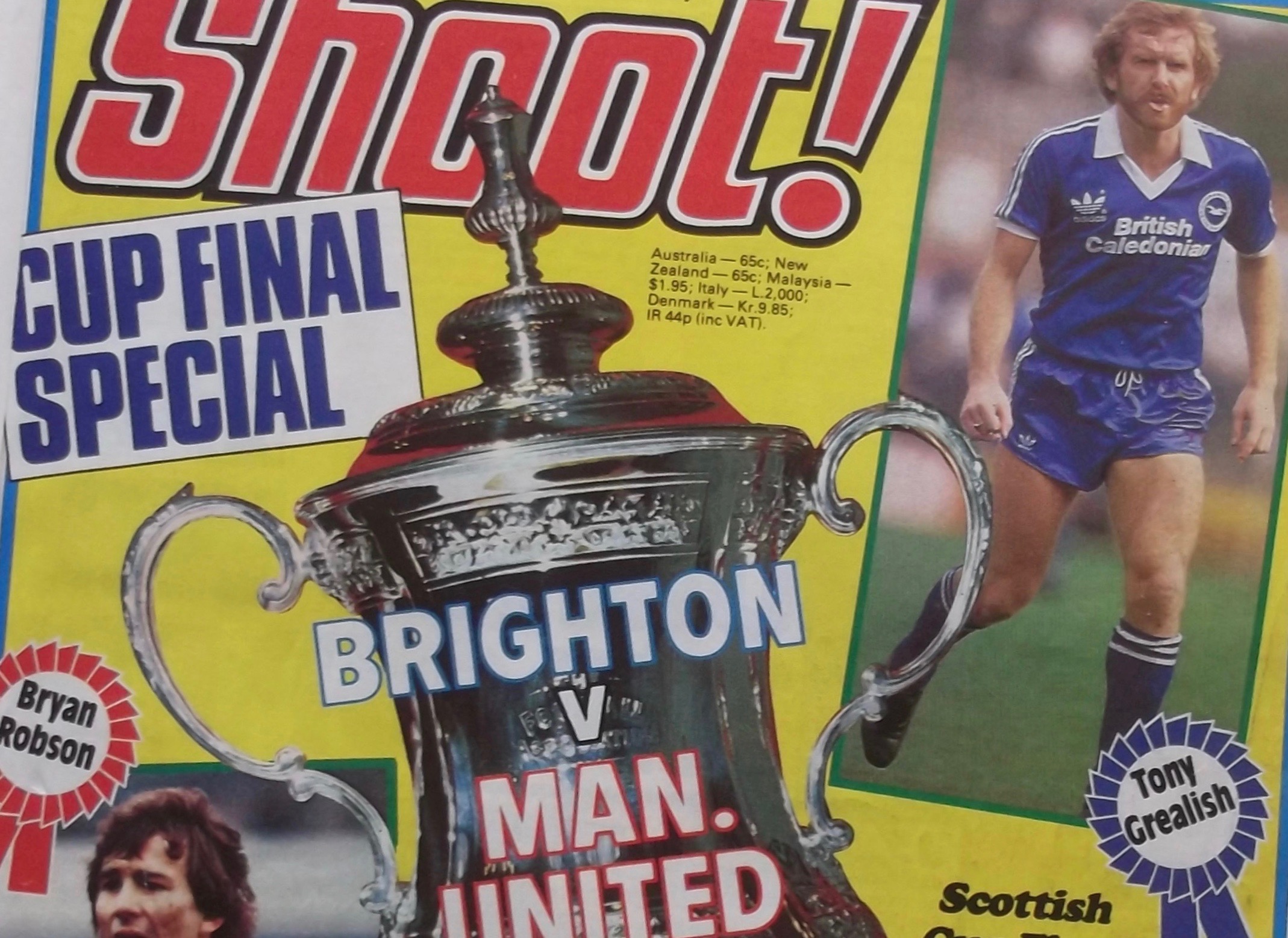
1 main pic TG cover boyTHE PLAYER who led out Brighton at Wembley for the 1983 FA Cup Final against Manchester United was an experienced Republic of Ireland international who went on to play for West Bromwich Albion.
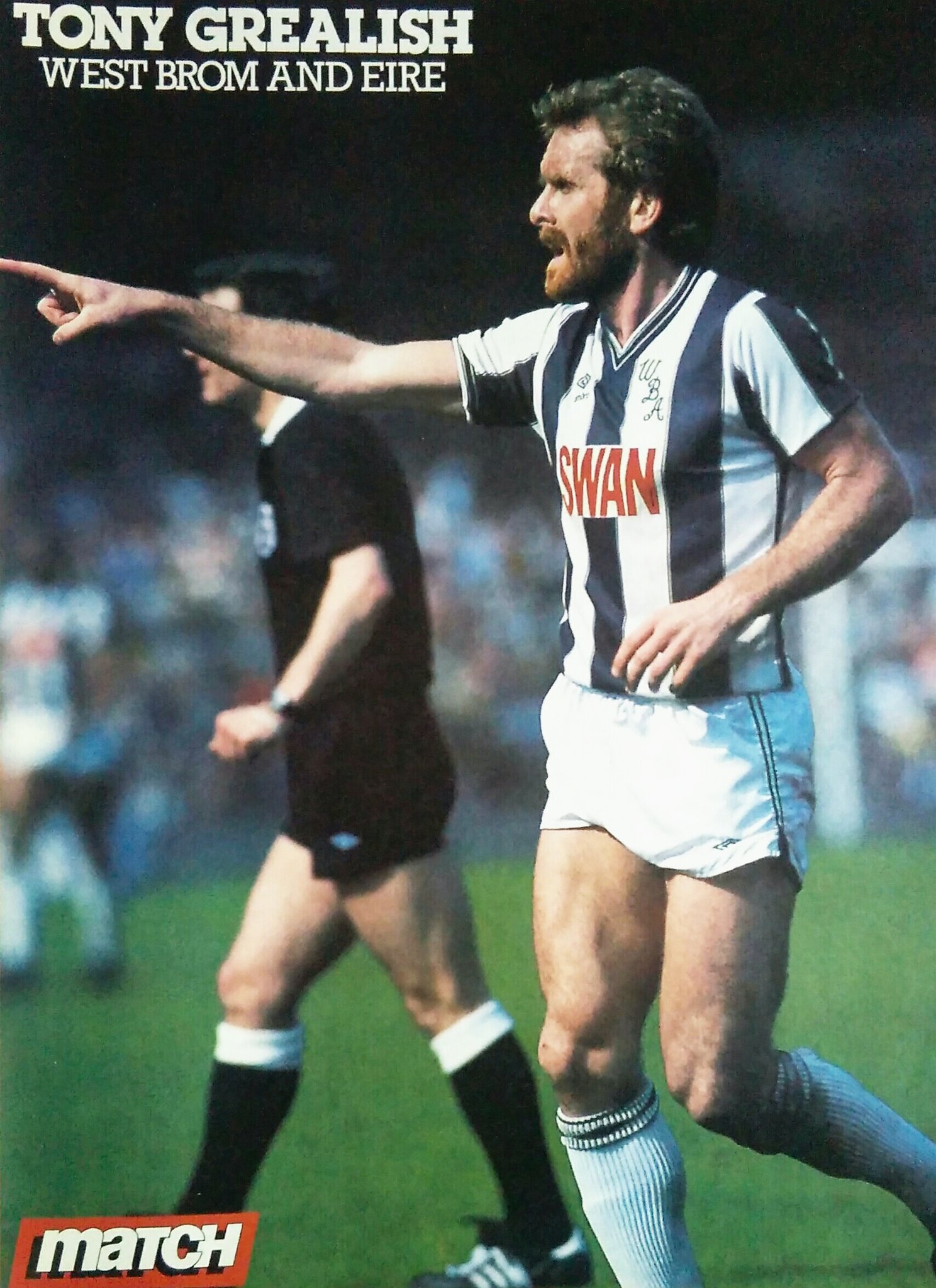
Tony ‘Paddy’ Grealish, sadly no longer with us having died of cancer aged only 56 in 2013, was given his international debut against Norway in 1976 by the legendary Johnny Giles, who knew a thing or two about midfield play.

In fact it was Giles, in his second spell as WBA manager, who took Grealish to The Hawthorns in 1984 as the break-up of the Brighton cup final squad continued.

After his untimely death, Giles told the Irish Times: “I obviously knew him at that stage from the Ireland set-up and knew what to expect.

“He wasn’t the classiest of players but he was one of the most hard working and you knew exactly what you were going to get.

“He was a great lad; a social animal who liked a drink after a game but gave you absolutely everything during it.”

Born in Paddington, London, on 21 September 1956, Grealish qualified to play for the Republic through his father, Packie, who was born in Athenry, Galway, and his mother Nora’s parents, both from Limerick.

He began his career across the other side of London, at Orient, and played 171 games for the Os, one of the last being the memorable 3-3 draw against Brighton in 1979 which featured on The Big Match. One of his teammates that day was Henry Hughton, brother of subsequent Brighton manager, Chris.

The previous year Grealish had been part of the Orient side that made it through to the FA Cup semi final against Arsenal, played at Stamford Bridge, but they were beaten 3-0 (the Gunners lost 1-0 to Ipswich in the final).

In 1979, David Pleat paid £150,000 to take him for Luton Town for whom he played 78 games in two seasons.

The managerial upheaval at the Goldstone Ground in the summer of 1981 saw the arrival of Mike Bailey in place of Alan Mullery, and one of his first moves was to bring in Grealish as part of a swap for Brian Horton, the ageing, inspirational captain who led Brighton from the old Third Division to the First.

Grealish was definitely what you’d call a players’ player, someone who did the hard work in the engine room of the team to enable players with more flair to shine.

He talked about just that scenario in an interview with the Daily Mail after Brighton had beaten Sheffield Wednesday at Highbury in that 1983 cup semi-final.

Referring to an incident when he’d charged down a free kick, he told Brian Scovell: “That’s my job. I’m the bloke with the ugly mug so they get me to do it.”

It was Grealish who rolled the ball to Jimmy Case to smash home that memorable opening goal and he relished his teammate’s strike, saying: “It wasn’t just the power, it was the way the ball swerved away from the ‘keeper that did it.”

After the disappointment of missing out in 1978, reaching the cup final was extra special for Grealish and he found himself thrust centre stage as a result of usual captain Steve Foster’s suspension from the first match.

Even all this time later, people remember how Grealish wore the trademark Foster headband as he led Brighton out. “It was a small protest over Steve’s exclusion from the final,” he told the media after the game.

In the News of the World, Fred Burcombe began his report: “Tony Grealish, Brighton’s stand-in skipper, yesterday entered the Wembley arena with a gesture of defiance and left for home in a blaze of confidence.”

In fact, Grealish was involved in both Brighton’s goals in the 2-2 draw. James Mossop reported in the Sunday Express: “Brighton stayed on the attack after a corner. Tony Grealish collected the ball and his teammates began to fan out, all eager for a pass. He chose Neil Smillie on the right. Smillie gave young Gary Howlett the chance to centre – and as the ball curved in Smith met it ideally, sending his header over the ‘keeper’s outstretched forearm and into the net.”

And with the clock ticking down, United by now 2-1 up, it was Grealish who drilled the ball hard into the penalty box where Gary Stevens controlled it and fired the ball past Gary Bailey to net the equaliser.

Grealish lived in Peacehaven during his time with the Seagulls and clearly enjoyed the social life with his teammates.

“The atmosphere at Brighton is particularly good,” he told Tony Norman in a club programme feature. “There’s always plenty going on. I enjoy our Wednesday golf games. There’s often as many as 10 of the players there. That’s always a laugh.”

Following relegation to the second tier, the Seagulls squad was broken up bit by bit; Gary Stevens and Michael Robinson going first. Grealish lasted a little longer and played two thirds of the 1983-84 season before being sold to West Brom in March.

It didn’t stop him being selected alongside teammate Case in the PFA representative side that season (the centre half selection was Mick McCarthy and the forwards included Kevin Keegan and Mark Hateley).

In total, Grealish played 116 games plus five as a sub for Brighton, and his last game for the Seagulls saw him score in a 1-1 home draw with Manchester City, who he would subsequently join in 1986-87. He played 65 games for West Brom, and 11 times for City, who also had former Seagull Neil McNab in their line-up.

In August 1987, Grealish moved to Rotherham United and played 110 games for the Millers before moving to Walsall (36 appearances).

During his time at Rotherham, in 1988-89, he once again found himself in the PFA representative selection, this time for Division Four. Grealish then did the rounds of various non-league clubs in the Midlands: Bromsgove Rovers, Moor Green, Halesowen Harriers, Sutton Coldfield and Evesham United.

He returned to Bromsgrove Rovers as player-manager before calling it a day, and then worked in the scrap metal business. His career record showed he played a total of 589 league games, plus 45 for the Republic of Ireland; 17 of them as captain.

Little surprise, then, that when he died in 2013, the Football Association of Ireland paid a warm tribute. FAI president Paddy McCaul said: “He will be remembered as a great servant of Irish football who was part of the international set-up under John Giles and Eoin Hand that came so close to qualifying for major tournaments and helped change Ireland’s fortunes at that level of the game.”

FAI chief executive John Delaney added: “Tony Grealish was one of my footballing heroes when I was a child and I always remembered him as a great competitor who always gave his all for Ireland.”

It was during Alan Kelly’s brief reign in charge, in 1980, that Grealish was first made Eire skipper – against Switzerland – and he was a central figure in successor Eoin Hand’s team.

“He was a great character,” said Hand. “I don’t think I ever selected a team during my time in charge that didn’t have him in it.

“I think it’s fair to say he raised his game when he was playing international football. I’d say he was a great club player but the commitment he gave for Ireland; he just couldn’t have given that on a twice weekly basis playing club football. He gave absolutely everything.

“He contributed so much (including eight international goals), had an infectious enthusiasm for it all. If ever there was someone who showed how proud he could be to represent his country then Tony was it. He was very much part of it all; a great ambassador; very generous.”

Hand added: “He was a great example to others in the way he dealt with people; other players, supporters, kids….a really wonderful guy. I was very lucky to have him around when I was manager.”

3.TG shoot cover2 Football Past on Twitter

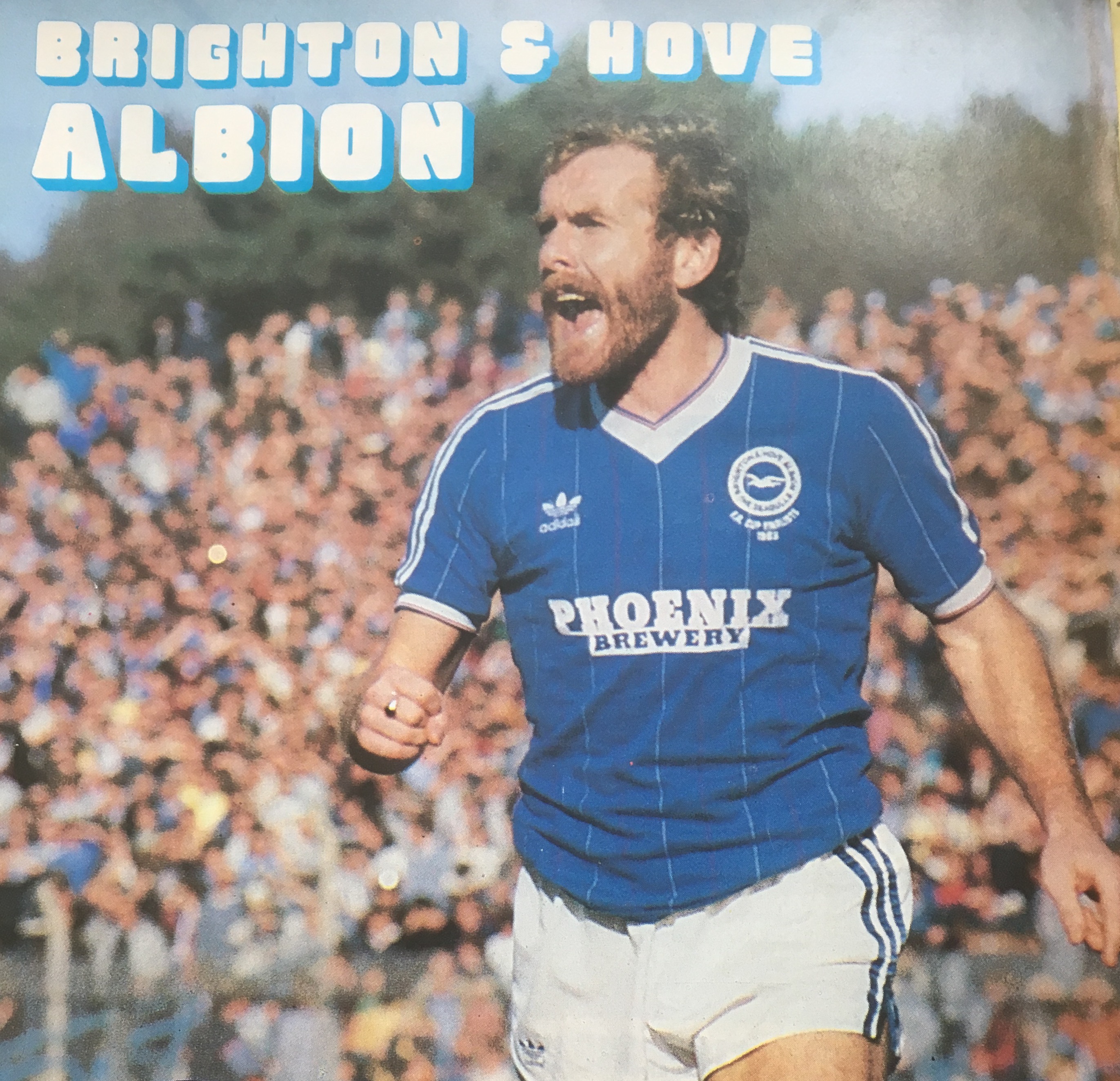
  • Pictures from my scrapbook show Grealish on an Albion matchday programme cover, a Match magazine pic of him in WBA colours via Football Past on Twitter, on the front of the 1983 FA Cup Final preview edition of Shoot!, and, below, a montage of various headlines and images.

Did Chris Ramsey’s injury alter outcome of 1983 FA Cup Final?

2-near-post-guardBRIGHTON & HOVE Albion’s May 1983 FA Cup Final clash with Manchester United was historic for the club and for their 21-year-old right back it was even more eventful.
Who would have known that former Bristol City apprentice Chris Ramsey’s ignominious departure from the field in a firemen’s lift on Glen Wilson’s shoulder would more or less be the end of an all-too-brief playing spell in the top echelons of the English game?

Might the match – and Ramsey’s career – have panned out differently if it hadn’t been for that diabolical tackle by Norman Whiteside?

Trouble had been brewing in the weeks leading up to the final and the national media, looking for every possible angle to pick at, had singled out Ramsey for criticism. Did that stoke the fire?

Let’s rewind a little and explore what happened.

Born in Birmingham on 28 April 1962 , Ramsey, whose father came to the UK from St Lucia, was one of two boys and five girls. Rejected by Charlton Athletic as a schoolboy, he became an apprentice at Ashton Gate but was then released and, after a successful trial, Brighton took him on.

The 1980-81 season was Albion’s second in the top division and, as it drew towards its close, it was looking increasingly likely they were heading for relegation.

Manager Alan Mullery was openly criticising his players for their efforts and his big ally off the field, vice-chairman Harry Bloom (current chairman Tony Bloom’s granddad) had died of a heart attack on the team coach on an away trip to Stoke.

Something had to change and, at the tender age of 19, Ramsey was called up from the reserves and plunged in at the deep end.

In three of the last four games, he took over the no.2 shirt after Mullery switched John Gregory from right back into midfield. Ramsey’s debut came in a crucial Easter Saturday clash away to rivals Crystal Palace when, released from the shackles of defending, Gregory scored twice in a 3-0 win. Ramsey also played in the wins over Sunderland away and Leeds at home.

The Seagulls stayed up by the skin of their teeth and Evening Argus reporter John Vinicombe said in his end of season analysis that Ramsey had been “a revelation” in those three games.

Within a matter of weeks, Mullery quit as manager in the furore over chairman Mike Bamber selling Mark Lawrenson to Liverpool (after Mullery had already agreed a deal to sell him to Manchester United).

Gregory was sold to QPR for £300,000 but, far from that move opening up an opportunity for Ramsey, Mullery’s replacement Mike Bailey brought in on a free transfer from Loftus Road the experienced Don Shanks, who was immediately installed as the first choice right back.

Indeed Bailey froze out Ramsey for the following 19 months! At one point he was transfer listed but it was Bailey who departed the Goldstone first – his sacking working to the advantage of the young defender.

When George Aitken and Jimmy Melia took over in December 1982, Ramsey was instantly promoted from the reserves and seized his opportunity.

In a profile in an Albion matchday programme in February 1983, Ramsey told Tony Norman: “Like any other young apprentice, my dream was to play in the First Division. I must admit that even after coming to Brighton, I had times when I wondered if I’d make it. But now I’ve got my chance and I’m keen to make the most of it.”

In one of the most comprehensive profiles on Ramsey, former Brighton teammate, Andy Ritchie, told Adam Ellis of The Football League Paper: “He was quite a shy lad back then but he had everything you want in a full back. Aggression, pace, agility – and he could tackle like a demon.”

These were the attributes that Melia appreciated too. In a Daily Mail preview of the Norwich quarter final, Melia told reporter Brian Scovell: “The other players love playing with him. He’s a great competitor, tackles well and uses the ball with a bit of style.

“I’m pleased he’s taken his chance. He deserves to play at Wembley if we manage to get there.”ramsey + mel

As it turned out, Ramsey’s place was in jeopardy because of two sendings off in the league in April which led to him being banned for the semi-final against Sheffield Wednesday at Highbury.

After being sent off in a 2-1 home win over Spurs, Terry McNeill reported in the News of the World: “Ramsey was lucky to stay on earlier after bringing down Mark Falco in a probable scoring position. When he took the striker again from behind, there was no escape.”

The 20-year-old Ramsey was fairly phlegmatic about the situation and told Alex Montgomery of The Sun: “Whatever I did, I did for the club. You can’t think about Cup games when you are struggling for points at the bottom of the First Division.”

His second dismissal, along with Coventry’s Steve Jacobs (who later played for the Albion under Chris Cattlin) after a scuffle in a 1-0 win at the Goldstone, was lambasted by one of the pre-eminent football writers of the day, Frank McGhee of the Daily Mirror.

“Can Brighton afford to field at Wembley a man who by then won’t have been able to play for 19 days?” he intoned. “And can they trust Ramsey not to sully soccer’s great state occasion by a moment of blind madness?”

Nevertheless, after Wednesday were beaten, Melia was happy to restore his first-choice right back to the starting line-up but one wonders now whether Ramsey had a sense of foreboding about how the big occasion would unfold.

Reflecting on those dismissals in the build-up to the final, he told The Sun’s Montgomery: “I just hope people aren’t looking for me. I’ll certainly be careful. I honestly don’t think I deserve the reputation which I’ve been saddled with in the last few weeks.

“The dismissals were just coincidences – nothing more than that. I know I am an aggressive type of player but that is my game. I always want to give 100 per cent for the club. The last thing I want is trouble at Wembley.”

After Albion had taken a shock lead through Gordon Smith’s header, United piled on the pressure and Ramsey headed a goalbound Gordon McQueen effort off the line.

But then came a pivotal moment early in the second half. Tim Carder and Roger Harris record it thus in their excellent Seagulls! The Story of Brighton & Hove Albion FC: “Whiteside went in high on Ramsey’s shin as the Albion full back cleared, and then trod on his ankle. The referee had a strong word with the United forward but did not signal a foul.”

The tackle had rendered Ramsey lame and while he tried in vain to carry on, two minutes later he wasn’t able to challenge for a ball to the far post which Frank Stapleton duly dispatched to equalise.

Those of us watching in the stadium, together with millions glued to TV screens around the world, saw Ramsey carried from the Wembley turf and, in those days of only one substitute, wondered how Albion would cope with a makeshift defender in the shape of Gerry Ryan.

After United took the lead through Ray Wilkins, Ramsey’s friend – and fellow England under-20 teammate – Gary Stevens’ equalised to send the game into extra time and ultimately a replay. Stevens was adamant about the impact Whiteside’s challenge had on the game.

In Match of My Life, edited by Paul Camillin, he said: “It was a bad tackle and perhaps cost us the game. In those days we only had one substitute and Gerry Ryan came on and did a great job at right back, even though he was a midfield player, but we did miss Chris because he had been having a great game.”

Whiteside was unapologetic about the challenge but Ramsey fumed to The Sun’s Montgomery: “It could have broken my leg. If I’d done it, I’d have been off. I just can’t understand how Whiteside got away with it.”

The injury deprived Ramsey of the chance to play in the replay five days later and, after that sad exit, his playing career never reached similar heights again.

Indeed he actually only played 37 games for the Albion, most of those coming in that 1982-83 season. He played only a handful of games in the following season and in August 1984 went on loan to Swindon Town before joining them permanently four months later.

There, he played alongside the likes of Sky Sports reporter Chris Kamara and one-time Albion assistant manager Colin Calderwood and clocked up over 120 appearances, including being part of Lou Macari’s Fourth Division champions in 1986 and Third Division play-off winners in 1987.

In August 1987, he joined Southend United but played just 13 games for them before persistent back injuries forced his early retirement at the age of just 26.

Some business ventures he embarked on didn’t work out and former Albion right back rival Shanks set him up with a trial for a team in Malta, Naxxar Lions, where he made a playing comeback.

Eventually the ongoing injury problems made him look to other ways of making a living. He coached in the United States but also started studying like crazy.

Amongst lots of qualifications, he got a Master’s degree at the University of North London in Health, Physical Education and Recreation (a qualification which enabled him to become a primary school teacher) and simultaneously obtained his UEFA coaching badges.

That Football League Paper piece records: “With an MSc, ten diplomas and myriad other qualifications, Ramsey is so highly educated that he actually sets the test for pro licence candidates.”

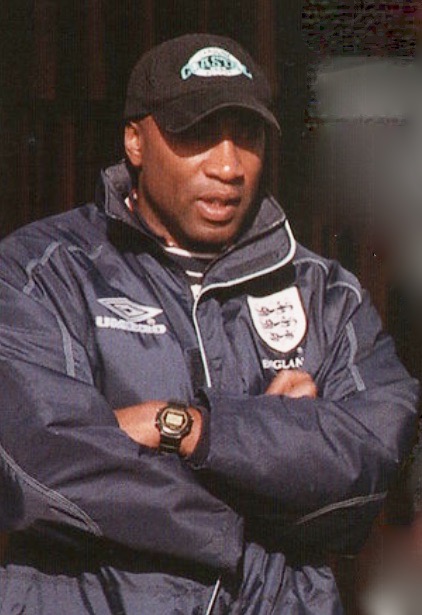
ramsey EngA stint in charge of youth development at Leyton Orient and coaching Newham Ladies was followed by an FA appointment as coach to the England under-20 side in the 1999 FIFA World Youth Championship when among the players under his direction were Ashley Cole, Peter Crouch, Matthew Etherington and John Piercy, who later played for the Albion. At the FA he learned from the likes of Les Reed and one-time Albion winger Howard Wilkinson.

He had a short and unsuccessful three-month spell as assistant to Ricky Hill at Luton Town, and he said: “Ricky Hill was a massive inspiration to me.”

Just when it appeared new offers had dried up, Ramsey got the chance to manage Charleston Battery in the USA, where he stayed for three years.

Winning the USL A-League (second division) with Battery in 2003 brought him to the attention of Spurs, and, as head of player development, many of the young players he coached in tandem with Les Ferdinand and Tim Sherwood were Harry Kane, Ryan Mason, Danny Rose, Nabil Bentaleb, Andros Townsend, Steven Caulker and Jake Livermore.

“He was massive for all of us,” French midfielder Bentaleb told The Football League Paper. “He believed in us, he encouraged us. He told the manager we were ready when everyone else believed we were not. He was not shy or scared of anybody and he knew exactly what he wanted.”

chris ramsey (spurs)In the Evening Standard in 2012, Spurs and England centre back, Ledley King, said: “He is one of the best coaches in the country. The youngsters love the way he works and they have really bought into his methods.”

Ramsey left Spurs in 2014 to take up a coaching role at QPR, and when Harry Redknapp left the floundering Hoops in February 2015, Ramsey stepped up to become a fully-fledged Premier League manager.

He was not able to halt Rangers’ relegation from the elite, though, and lasted only until November in charge of the side as they struggled to come to terms with life back in the Championship.

However, in January 2016, he was appointed technical director at QPR to oversee the club’s academy coaching and player development.

The club’s director of football, Ferdinand, told The Guardian: “While we were disappointed things didn’t work out with Chris at first team level, we were determined to retain his services. As such, we actually put a clause in his contract which allowed us to retain Chris’s services in a player-development role should things not work out for him as head coach.”

Ramsey finally left QPR in January 2024. By then 61, the head of coaching and technical director told the club website: “I have had a fantastic nine years at QPR and the club will always have a special place in my heart.”

The club’s chairman Lee Hoos said: “Chris has been a great servant to the club. I cannot thank him enough for his incredible hard work, dedication and guidance.

“However, as we thoroughly rationalise everything we do, and following very amicable discussions with Chris, it is felt this move is in the best interests of all parties. He will always remain a friend of the club.”

  • Shootthedefence.com did a face-to-face interview with Ramsey on 23 September 2016 which is well worth a listen as he talks in detail about his whole career.
  • In pictures from my scrapbook, Ramsey graces the cover of an Albion matchday programme; (top) he defends the near post during the 1983 FA Cup Final with Gordon McQueen in attendance; he is photographed by Tony Norman outside the Goldstone and criticised in the Daily Mirror by Frank McGhee.