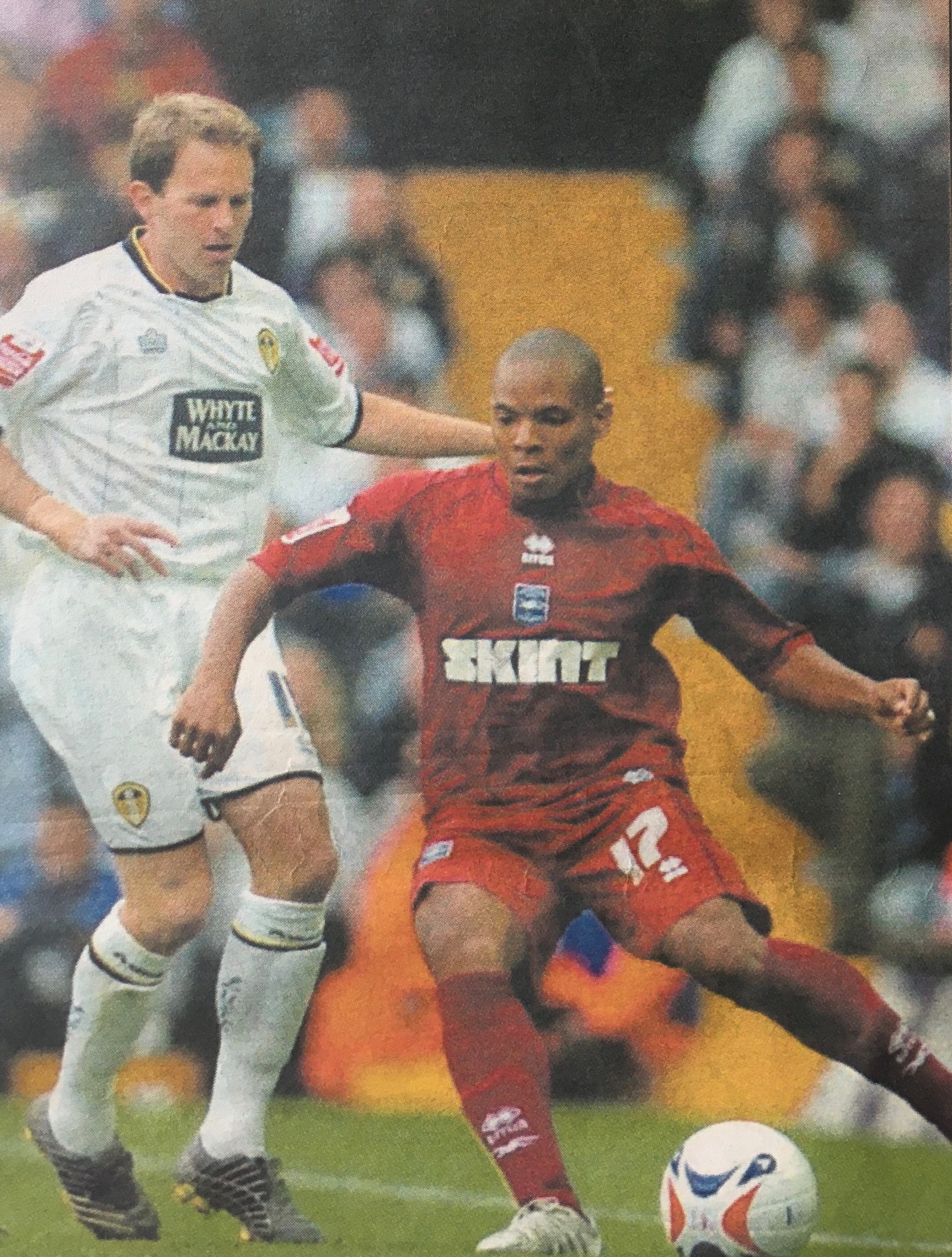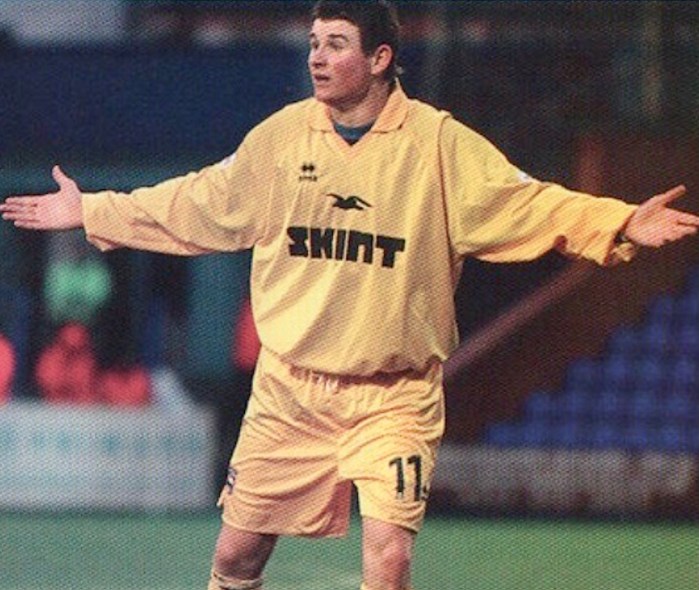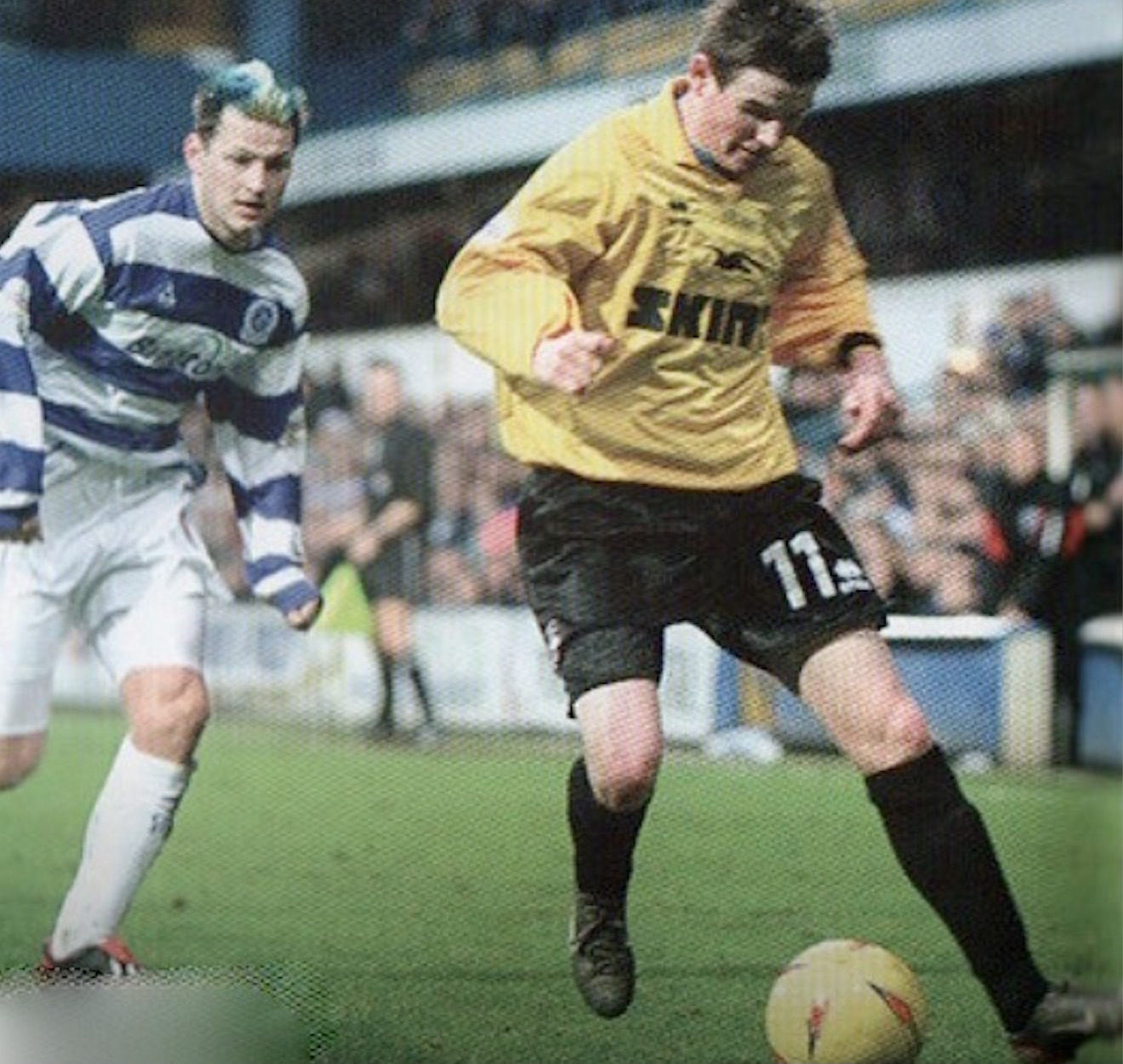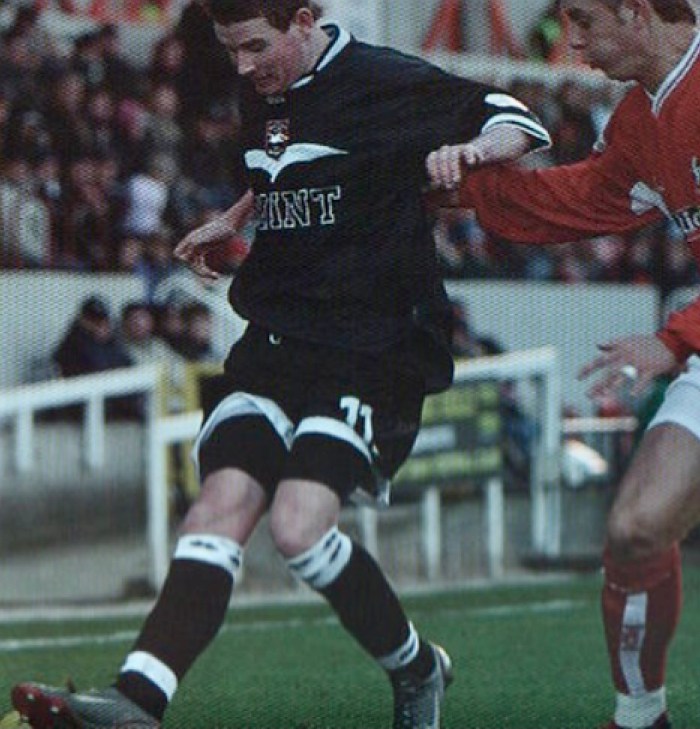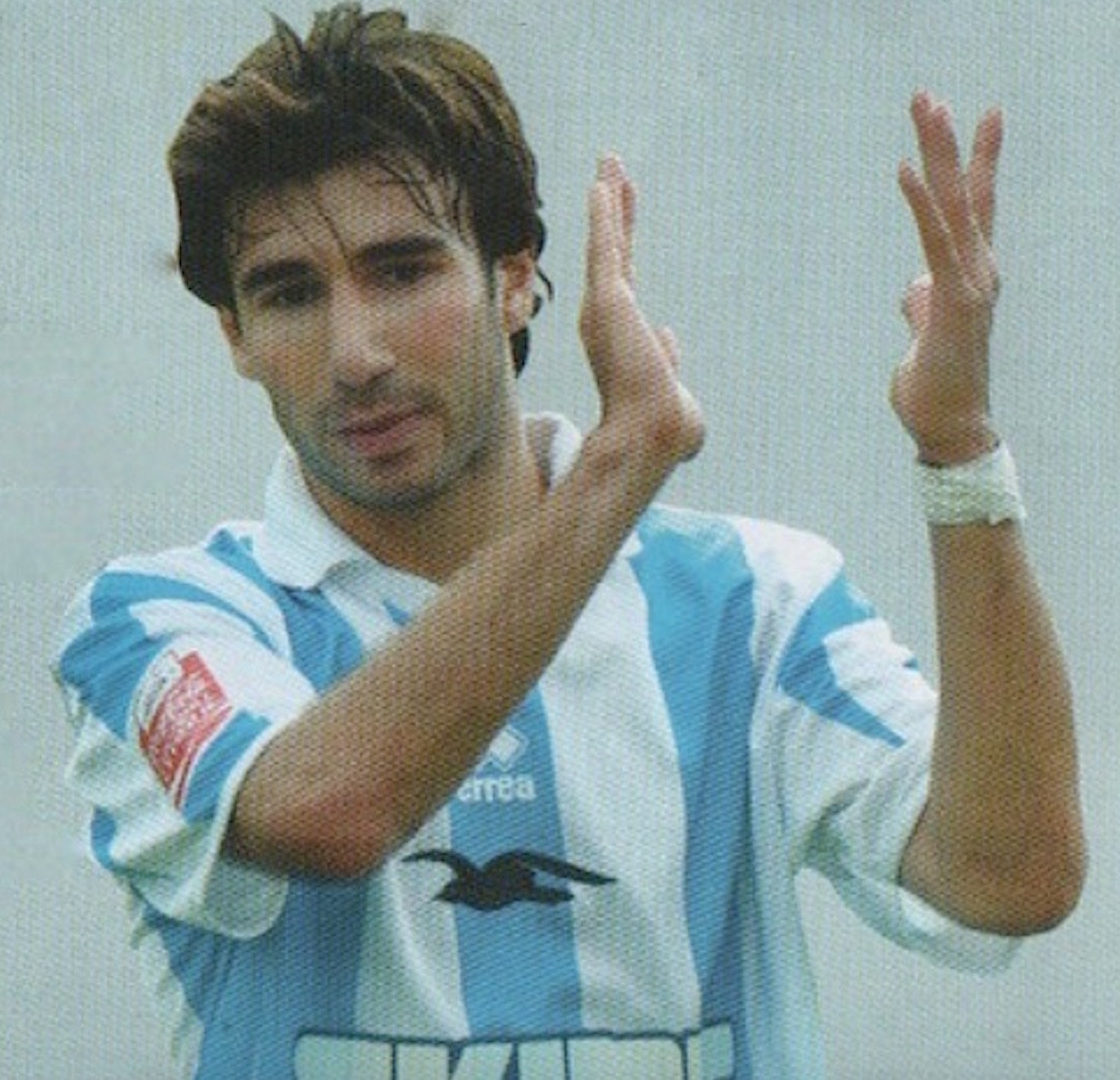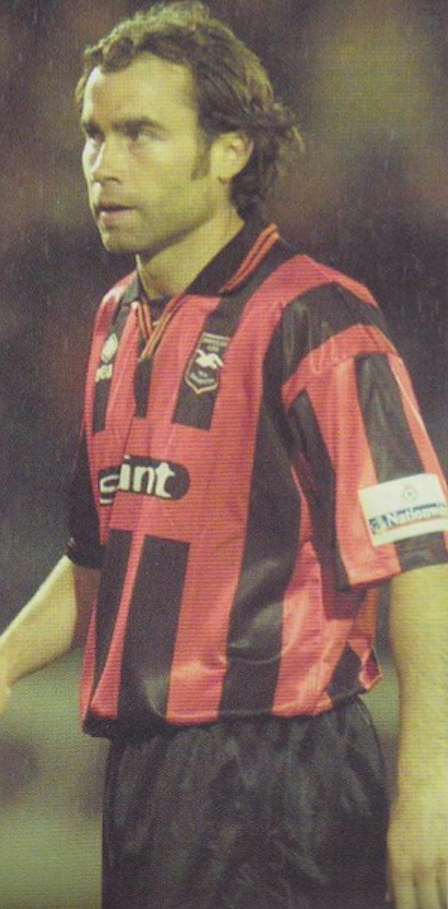
Melton took Micky at his word – and saw red 

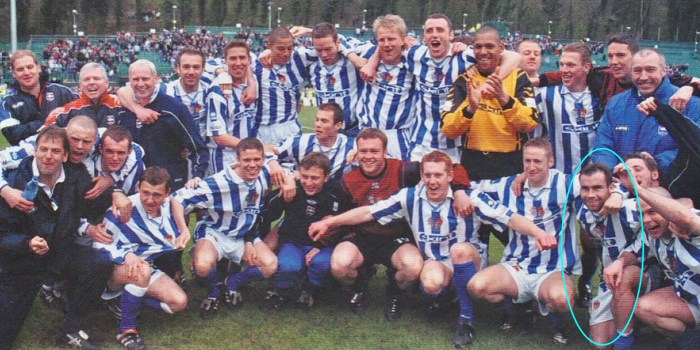
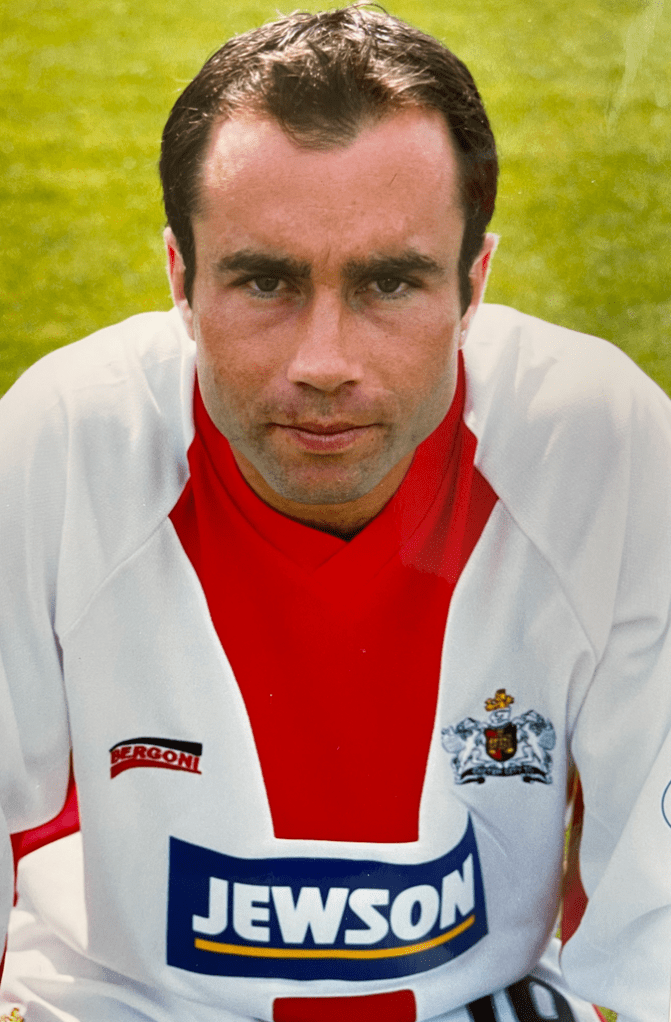
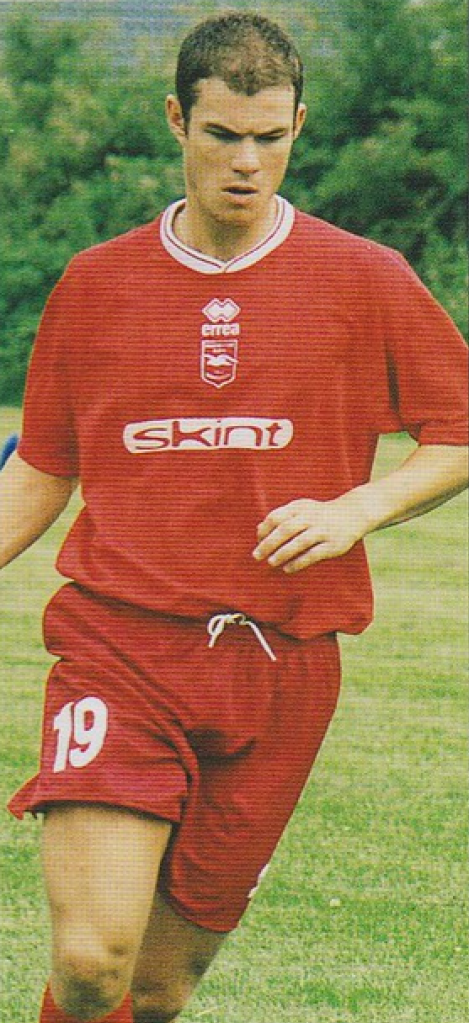
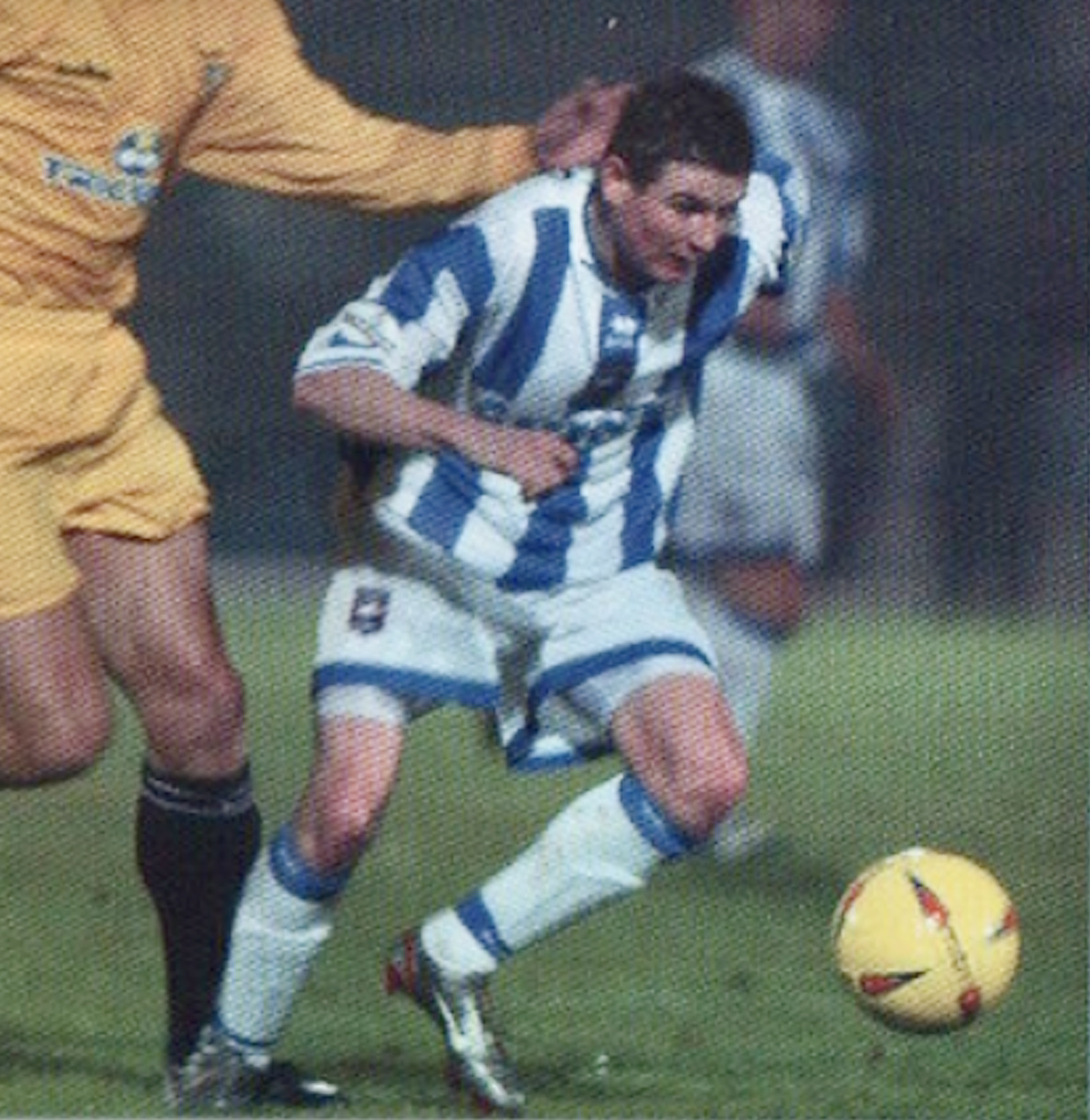
MIDFIELDER Steve Melton took manager Micky Adams at his word in a notorious pre-season friendly – and ended up being sent off after putting in a waist-high tackle on an opponent.

Adams subbed off a riled Richard Carpenter against Longford Town in July 2001 with instructions to former Nottingham Forest trainee Melton “to give the lad who was booting our players up in the air a taste of his own medicine. Make sure he knows you are around.”

Melton duly put in a flying lunge on Longford midfielder Alan Reynolds that saw him receive an automatic red card and the fall-out from the challenge sparked an almighty punch-up which ended up with Albion’s Charlie Oatway and opponent Alan Murphy also being sent off after an altercation.

That particular battle then led to an even bigger scrap involving coaches and even the Longford chairman who took a punch in the face from one of his own players!

The so-called pre-season “friendly” – later dubbed the Battle of Longford – was abandoned with only 44 minutes on the clock by inexperienced ref Dermot Tone, who had only stepped in to officiate because senior Irish referees were at a seminar.

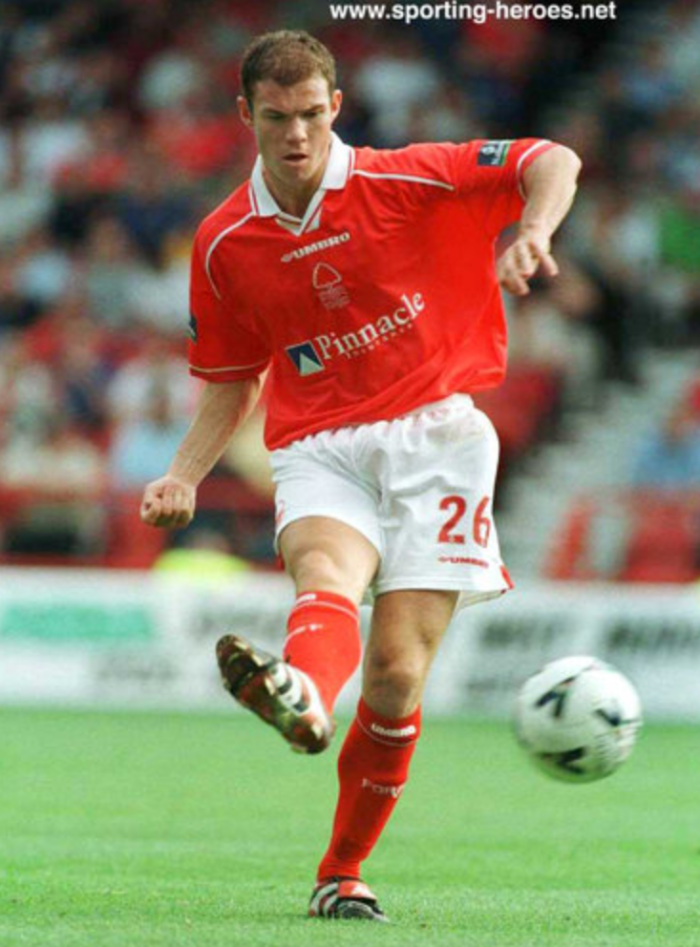
For Melton, it was all a far cry from making your Premier League debut two years earlier in front of 25,353 fans at the City Ground, Nottingham, in Ron Atkinson’s last-ever game as a manager. Melton was pitched in for already-relegated Forest for an East Midlands derby against Leicester and they went down in style (Blackburn and Charlton also went down), scraping a 1-0 win against the Foxes.

Born in Lincoln on 3 October 1978, Melton first linked up with Forest when he was just 11, playing at the centre of excellence. He signed full time at 16, a matter of days after finishing his GCSEs. He progressed through the youth team and reserves and it was during that time that he first worked with Adams, who’d been assistant manager to Dave Bassett before Atkinson’s arrival. 

Before he got close to the Forest first team, 18-year-old Melton and another trainee had experienced competitive football in Finland where Bassett had sent them to play for Sami Hyypiä’s old club MyPa on a three-month loan.

“He sent us out there to toughen us up. It also got us used to playing in a proper men’s league so that we learnt to value the prize of the three points and the standing within the first team,” he explained in a matchday programme interview.

That experience followed by his Forest first team debut didn’t have the outcome he wanted and after only three games under Atkinson’s successor, David Platt, he picked up an injury and couldn’t force his way back into the first team picture.

In February 2000, he switched 50 miles west to third tier Stoke City and admitted: “It seemed a good move as I didn’t have to travel too far. 

“It was a chance for me to play for a decent-sized club that were going strong in the cup and in the league. It was either that or play reserve team games for the rest of the year at Forest and wait for a break that I didn’t think was going to come.”

As it turned out, it was mainly a watching role, making only seven appearances as a substitute. He was a non-playing bench warmer alongside Chris Iwelumo (who did get on) when City won the Football League (Auto Windscreens Shield) Trophy at Wembley, beating Bristol City 2-1.

Stoke’s new Icelandic consortium hinted that they wanted to keep him on but in the absence of a contract offer, rather than risk uncertainty, he took up Adams’ offer to join fourth-tier Albion. 

A complimentary caption in the club match day programme

On a trial in the Emerald Isle the year before the Longford incident, Melton did enough across the week of the tour to earn a one-year contract. He had a long wait before getting a start but after 11 introductions as a substitute he finally made his full debut in February 2001, stepping in for Carpenter at Torquay after the regular midfield starter pulled out with an injured ankle. 

After playing his part in Albion’s first win (1-0 courtesy of Bobby Zamora) at Torquay for 36 years, Melton told The Argus: “I’m enjoying it here. I’ve settled in with the lads and I share a house with some of them.” 

On playing for Adams, he said: “I think Micky is going to be a really good manager. I enjoy working with him. A lot of the lads do. 

“Hopefully he will take Brighton up. He’s had a taste of managing at a higher level at Forest and I think he has the potential to do it again.” 

Melton’s outlook brightened the following month and he got starts in nine of the season’s remaining 15 matches as Adams led the Seagulls to promotion as champions. 

At home to his future employer Hull City, Melton made his home debut and scored his first goal for the club in a 3-0 win (Paul Watson and substitute Phil Stant also scored).

Reflecting on his involvement, he said: “It’s difficult to break in when the team keep winning every week, and they go unbeaten for 12 or 13 games, maybe drop a point but then go off on another run.

“It’s frustrating because you’re not playing, but you can’t really have too much of a case when the team is sat at the top of the league.”

Come the end of the season, he had done enough to be offered a two-year extension to his contract. As it turned out, the 2001-02 season followed much the same pattern as his first in terms of more appearances off the bench than starts.

He was on the scoresheet twice in the LDV Vans Trophy, scoring an extra time golden goal in a 2-1 home win over Wycombe Wanderers but was then inadvertently the fall guy in a 2-1 quarter-final defeat at Cambridge United.

Having given Albion a 36th-minute lead, latching on to Dirk Lehmann’s lay-off to fire a low right-footer past Lionel Perez from just outside the penalty area, he lost possession to Dave Kitson, who ran away to equalise, and then, four minutes into extra time, a shot by Armand One that was going wide took a wicked deflection off Melton’s shoulder to send United through to the next round.

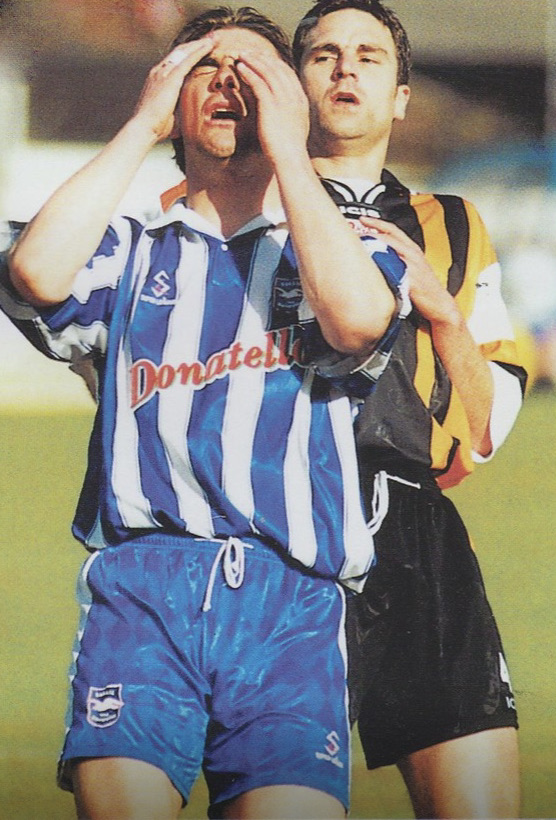
A happier outing came when he made a rare start and scored as promotion-chasing Albion beat table-toppers Reading at the Withdean in February 2002. Peter Taylor’s Seagulls triumphed 3-1 on a rain-lashed night under the lights (Zamora and Junior Lewis also scored).

Goalscorers Melton and Zamora after a memorable win over Reading

“It was pleasing to start,” Melton told The Argus. “You have got to be patient and I have waited a good few months. 
“I have been on the outside for the last few weeks. Hopefully I can stay on the inside now. 

“Playing against the League leaders is a different matter completely from the LDV appearances that I made earlier in the season. 

“You can only do as well as you can when you are chosen to play and hopefully I did that. Once you have been given the shirt you have to try and keep it.” 

Melton’s goal was only the second league goal of his career and his first for 11 months. 

Taylor reckoned it was the best home performance since he took over from Adams the previous autumn and Albion won eight (and drew five) of the following 14 games to go on and clinch the third-tier title with the also-promoted Royals six points behind.

Melton scored Albion’s first goal of the 2002-03 season when he started in the 3-1 win at Burnley under his third Brighton manager, Martin Hinshelwood (Zamora and Paul Brooker also scored; Hinshelwood’s 18-year-old nephew Adam made his debut). 

Unfortunately, Melton tweaked a hamstring in the process and had to be subbed off. He only made nine more appearances (six starts plus three off the bench) as Hinshelwood’s short reign in charge ended with 10 league defeats in a row.

Incoming boss Steve Coppell brought in the likes of free agent Simon Rodger and Arsenal loanee Steve Sidwell and Melton found himself surplus to requirements.

It was in October 2002 that he moved to Hull on loan shortly after Peter Taylor had replaced Jan Molby as manager with the club about to move out of Boothferry Park and into the Kingston Communications Stadium.

Tiger Melton

Melton made 19 starts plus six appearances off the bench as the Tigers finished 13th in the old Third Division.

According to the website oncloudseven.com: “Despite his promise and Taylor’s persistence, Melton’s career at City was not a success and he showed only brief flashes of good form. Melton is, however, forever enshrined in the City record books because in December 2002 he scored the first ever goal at the KC Stadium against Sunderland, for the honour of lifting the Raich Carter Trophy.”

He found himself only on the fringes the following season and he had moved on to Boston United under Steve Evans by the time Taylor steered Hull to promotion as divisional runners up.

A recurring back injury restricted his playing time at Boston and during 2005-06 he was sent out on loan to Conference National side Tamworth. On his release from Boston in the summer of 2006, he switched to Southern League Premier King’s Lynn FC for two seasons.

Melton at Boston

In September 2008, he rejoined Boston with manager Tommy Taylor telling the club’s website: “Steve has great quality on the ball and that’s what we have been missing in the midfield area. 

Hopefully he will add another dimension to our team.”

But he was released at the end of the season and joined Lincoln United of the Northern Premier League Division One East, alongside his former Boston and King’s Lynn teammate Matt O’Halloran. After spells with Lincoln Moorlands Railway, Grantham Town and Worksop Town, he wound up his playing days back at Lincoln United.

In the meantime, his first job outside of football was in sales for mobile comms company Vodacom. He spent nearly seven years with the now defunct energy advice and installation company the Mark Group and since 2019 has worked for building services certification business The National Association of Professional Inspectors and Testers, where he is now commercial and compliance director.

Season-opening hat-trick a dream come true for Freeman

THE NEW season opening game 26 years ago saw Darren Freeman score a hat-trick as the back-in-Brighton Seagulls hammered Mansfield Town 6-0.

For Freeman, who’d previously played under Micky Adams at Fulham and Brentford, it really couldn’t have been a better debut for his hometown club as the 1999-2000 season got under way at the Withdean Stadium.

Freeman hit the headlines again when he scored the first league goal of the millennium, crashing home a volley after only two minutes in a noon kick-off 4-2 Withdean win over Exeter City on 3 January 2000. It also earned him a magnum of champagne from league sponsor Nationwide.

Headline-maker

“It was a dream come true to play for my hometown club,” Freeman later admitted. After he’d scored that hat-trick at Withdean, he managed to pick out his dad’s face in the 5,582 crowd and fondly recalled his ‘That’s my boy!’ look of pride.

If the start of the season was spectacular, trouble was lurking round the corner with Freeman ending up suspended for seven matches – all in the first half of the season. He incurred a three-game ban after being dismissed for a stamping incident at Cheltenham and worse was to follow after he spat in Plymouth defender Jon Beswetherick’s face.

Beswetherick said: “He caught me in the face with his fist just inside the 18-yard box. I ran after him to have a word in his ear and on the way back up the pitch he just spat in my face.

“He had to go. Footballers all say that is the lowest thing you can do. It was probably in the heat of the moment, but I am sure he regrets it now.”

Not only did he receive a four-game suspension, manager Adams fined him a week’s wages and said: “He let himself down, the club down, his family down and everybody connected with Brighton. He knows that and he is full of remorse. He has been left in no doubt at all that it’s not good enough.”

Freeman was top scorer with 13 goals by the end of the season but a new goalscoring hero had begun to emerge in the shape of raw teenager Bobby Zamora!

That’s not to say Freeman’s days in the stripes were over, but his second season was dogged by injuries. Two hernia operations ruled him out from the start of September to the middle of December, then, after he had worked his way back into the starting line-up, in February 2001 he put in a transfer request after being left out of the side for a home game against Blackpool, sparking an angry reaction from Adams.

“I picked a side against Blackpool which I thought would win us the game and he wasn’t in it,” he said. “He is entitled not to agree, but there is a wrong way and a right way of knocking on my door and he chose the wrong way.

“I’ve never had one player ask to leave a club where I have been a manager. This is somebody as well who I had the utmost time and respect for, having taken him to two of my previous clubs.”

Freeman had a change of heart the following month after Adams restored him to the bench.

“I want to be a part of things,” he explained. “Obviously I’ve had a bad season with injuries and a lot of it was frustration.

“When me and Micky had a chat and I asked for a transfer we both said a few things. We didn’t have a massive fall-out. We are both adults and we have got to get on with it.”

The Argus revealed Freeman’s mentor, and former Albion forward and Northern Ireland international Gerry Armstrong played a part in the decision.

“I speak to Gerry a couple of times a week,” Freeman said. “A man of his experience can only give you good advice. I’ve had a number of conversations with him. It was my own choice to come off the transfer list, but Gerry has talked some great sense into me.”

Albion finished the season as division champions but by then Freeman was having a third hernia operation having made just six starts plus 12 appearances off the bench.

“I admit that as much as I was pleased for the lads, I felt gutted I wasn’t really part of it,” Freeman admitted. He went to Lilleshall and worked through the summer in an effort to regain fitness and earn a new contract.

But it was an uphill battle and although he struggled through pre-season and played in Albion’s opening friendly at his old club Worthing, he told the Argus: “I could hardly walk after the game. I was up all night in absolute agony.”

He was sent to see Harley Street specialist Jerry Gilmore who delivered devastating news: “There is no way you can carry on playing professional football. You are in a right mess, but hopefully we can do something to give you a better quality of life.”

A fourth hernia operation followed but not being able to resume his career hit him hard.

“The club have played an absolutely massive part in helping me through and all of my family and friends, because it has really been a rough time,” he told the Argus.

“It has been great working with him (Adams). He gave me the opportunity to experience promotions, the freedom to express my way of playing and the opportunity to fulfil my ambition.”

In a matchday programme interview several years later, Freeman told Spencer Vignes: “On reflection, I was lucky. Some people play their entire career and don’t win anything, and yet every club I played for got promoted.”

Born in Brighton on 22 August 1973, Freeman went to Varndean School, started playing football with Hollingbury Hawks and then joined Whitehawk as a teenager before playing at Isthmian League level for Worthing and Horsham.

“I came through the non-league system and was given the opportunity to fulfil my dreams,” he told Vignes. “I wasn’t the greatest player but what I can say is I gave everything for every club I played for.”

Freeman turned professional with Gillingham under Tony Pulis in August 1994, where he played alongside future Fulham and Albion teammates Richard Carpenter and Paul Watson. He recalled how it was while he was playing for the Gills against Fulham that Adams’ no.2 Alan Cork got in his ear and told him not to sign a new contract at Priestfield because Fulham wanted to sign him.

Sure enough, as Freeman admitted to Vignes: “Once I knew Fulham were interested, then I was interested. They were, and are, a massive club and it was nice that a team like that wanted me.”

Impressed by Adams’ man-management skills, he said: “He made me feel wanted and that I was a big part of his plans for the 1996-97 season. He sold Fulham to me, saying we were going to do well. And we did, because we won promotion.”

In full flow for Fulham

Fulham fans website HammyEnd.com recalled: “The £15,000 Micky Adams paid to Gillingham for the services of shaggy-haired Darren Freeman proved to be a bargain.

“The popular forward quickly became a firm favourite with the Fulham faithful on account of his ability to terrorise defenders, either out wide or through the middle as a conventional centre forward.

“Injuries robbed Freeman of the chance to make good on his undoubted talented, but he still scored nine goals as the Whites went up from Division Three in 1997.”

In an interview with fulhamfc.com, Freeman said: “Micky brought in a great bunch of lads and the togetherness was fantastic. The team morale was really, really good.

“He was quite a young manager, I think he’d actually played that season, but he’d got a great bunch of lads together and we really kicked on.

“When you consider that it was Micky’s first full season as a manager, it’s incredible what he achieved. He went about his business and did his job fantastically.”

He added: “Micky had a lot of faith in me and I feel very privileged to have achieved my goals and my ambitions from when I was a kid, and to be a part of Fulham was the icing on the cake.

“We were paid to do a job but, when I look back at it, it was a dream come true and I don’t think you realise until later on in life how important it was. Fulham, to me, the fans and the whole club, it was just a special time for me.”

As with many others at Craven Cottage, Freeman’s fortunes changed when Kevin Keegan and Ray Wilkins were installed as managers by Mohamed Al Fayed and he joined something of an exodus across London to Brentford.

Coincidentally, Freeman scored on his league debut for Brentford in a 3-0 win over Mansfield (the Stags must have loved him!) and his teammates in that 1998-99 season included Watson, Lloyd Uwusu, Warren Aspinall and Charlie Oatway. Owusu ended the season as top scorer with 25 goals (Freeman scored nine) as the Bees won the Third Division championship.

After his playing days were brought to a premature end, Freeman spent five years as manager of his first club, Whitehawk, leading them to three promotions (from the Sussex County League to the Conference South) and in 2012 to winning the Sussex Senior Cup.

He briefly managed Peacehaven and Telscombe before occupying the manager’s chair at Lewes for nearly three years.

He subsequently became a football agent, initially spending 18 months with Sports Total, one of Europe’s leading football agencies, before joining forces with his former Brentford team at Dirk Hebel Sports Consulting (Hebel named one of his sons Darren after his teammate!).

Freeman told Vignes he relishes the opportunity to pass on his knowledge of the game to current players. “They say nothing compares to playing, but I find it very rewarding. It’s the next best thing to being out there, definitely.”

When the ball hits the goal it’s not Shearer or Cole it’s Zamora!

EVERY NOW AND AGAIN as a football supporter a truly special player stands out well above the rest you’ve watched. Bobby Zamora was most definitely in that category.

As the new year dawns on what will be my 55th year supporting Brighton & Hove Albion, it is perhaps fitting to spend a little time remembering just how good Zamora was for the Seagulls before his outstanding ability to score goals was taken to higher levels: Tottenham Hotspur, West Ham, Fulham and ultimately, and, quite deservedly, England.

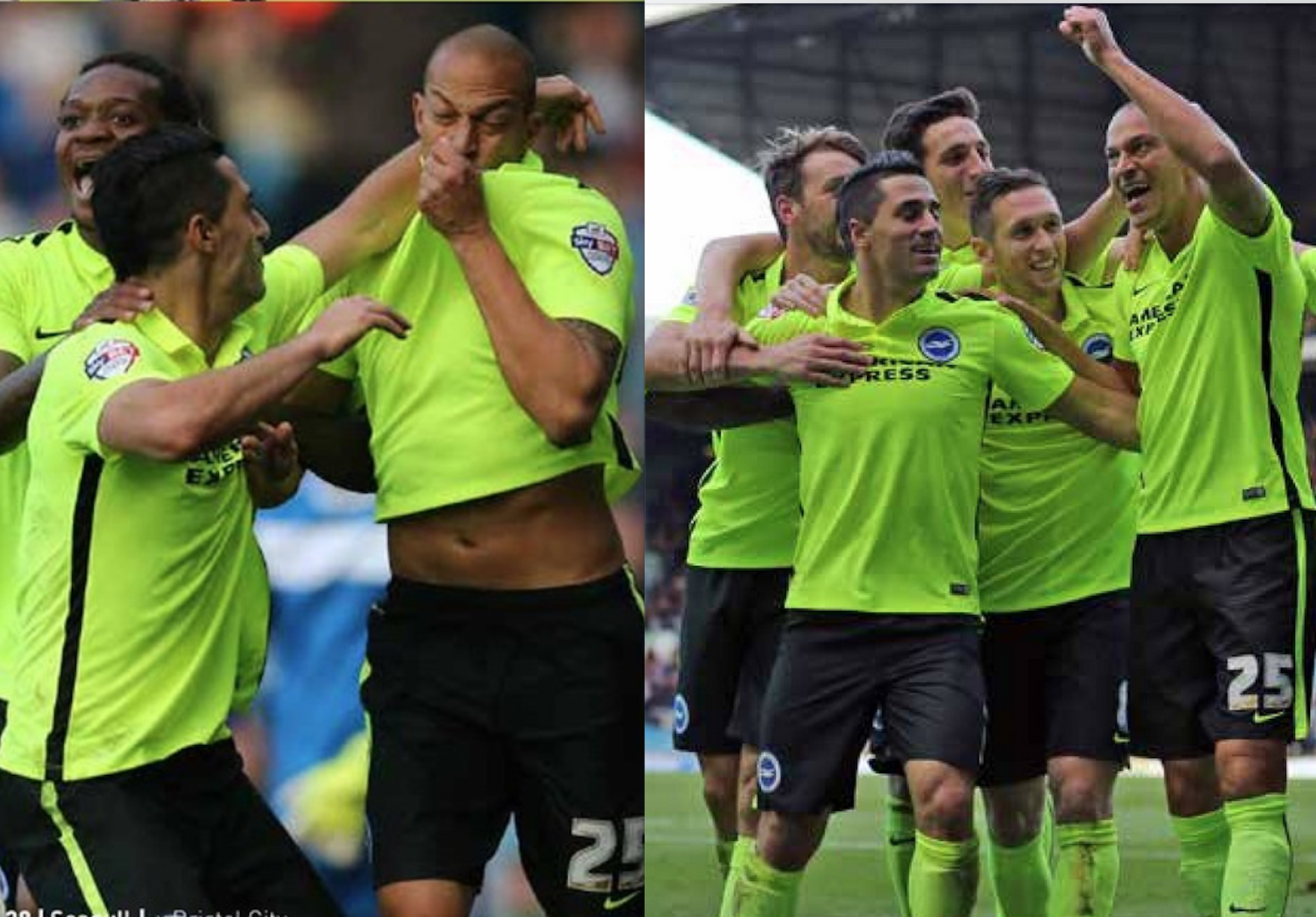
That he came back to the Albion from QPR as his career began to ebb was nothing short of a bonus­ – and, while I’m not a big gambler, I was delighted to get a modest return from the bookies when my punt on him being the last goalscorer came good after he had gone on as a sub at Elland Road on 15 October 2015 and chipped the winner (below) to register his first goal since rejoining!

“That goal was definitely the highlight of my season,” Zamora told interviewer Adam Virgo in a Seagulls World interview. “It was my first goal since coming back and to score the winner so late in the game was unbelievable. It was a special moment for me, and it settled the nerves knowing that we’d got the three points.”

Just four days later, Zamora repeated the feat going on as a 76th-minute substitute for Tomer Hemed at home to Bristol City and beating goalkeeper Frank Fielding with a low shot from 15 yards out. Albion won 2-1; Sam Baldock having levelled things up against his former club after Derrick Williams opened the scoring for City.

Unfortunately, Zamora managed just five more in that second spell. He made 10 starts plus 16 as a sub in Chris Hughton’s side but he was struggling with a hip injury.

It eventually caught up with him and prevented him from contributing further to Albion’s aim of promotion back to the elite; his last game being as a sub in a 0-0 draw at home to Sheffield Wednesday on 8 March 2016. “If I was fit, I would have scored some goals and we’d have been promoted automatically,” he told the UndrThe Cosh podcast (pictured above).

Thankfully another returning striker in the shape of Glenn Murray completed that task the following season and went on to cement his own place in Albion’s history: his 111 goals in 287 appearances putting him second in the list of Brighton’s all-time top goalscorers.

Golden goalscorers: Zamora + Murray

Each of the different eras I’ve watched the Albion has thrown up truly memorable players who have generated their own air of excitement and anticipation because of the goals they scored.

The first one for me was Alex Dawson, who netted seven in the first five games I watched in 1969. Then along came Willie Irvine whose goalscoring in third tier Albion’s promotion-winning season of 1972 earned him an unexpected recall to the Northern Ireland side – and an appearance (that I went to watch) in a 1-0 win against England at Wembley.

Next, of course, was the truly outstanding Peter Ward, who jinked his way past defenders with apparent ease and scored goals for fun, his 36 goals in 1976-77 smashing a decades-old record. Like Zamora, he came back to the scene of past glories (albeit only on loan) and scored a magnificent winner against the team he supported as a boy, Manchester United.

Garry Nelson, with 32 goals, and Kevin Bremner were a superb front pair in another third tier promotion-winning line-up in 1988 while, in 1990-91, Mike Small and John Byrne combined brilliantly to take the Seagulls within a hair’s breadth of a return to the big time.

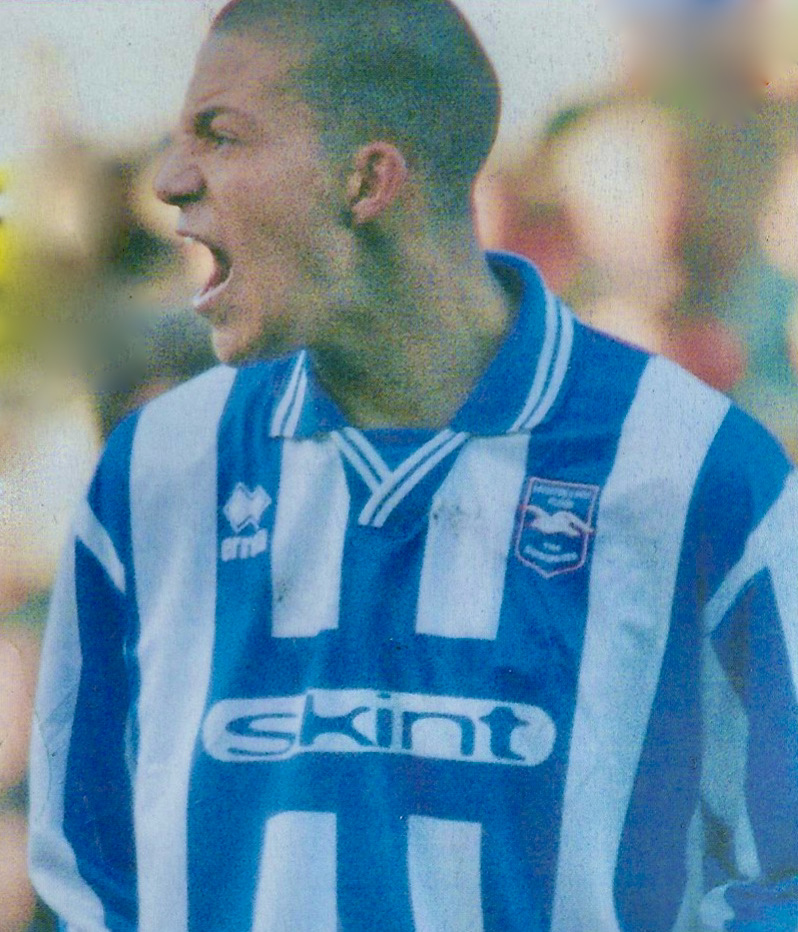
The arrival of a beanpole of a kid with an eye for goal in Zamora completely transformed Albion’s fortunes under Micky Adams and he was the talisman in back-to-back promotions following years in the doldrums.

Zamora’s Albion story is pretty well known but let’s remind ourselves of how it all began.

Depending on whose account you believe more, it was either Dick Knight or Adams who had the foresight to bring Zamora to the Withdean.

Adams said: “The first time I saw him he came onto the training ground; he looked like a kid. But he was tall and gangly with a useful left foot; there was potential there.”

In fact, Zamora might never have arrived in Sussex if Albion had been successful in securing a permanent deal for on-loan Lorenzo Pinamonte. When Brentford outbid Brighton for the services of the Bristol City loanee, Albion turned their attention to Zamora (left), a Bristol Rovers player who was only getting sub appearances under Ian Holloway but had scored eight goals in six games on loan at nearby non-league Bath City.

“He was six foot one and we knew he had a very good first touch and could hold the ball up well, the type of player we wanted,” Knight recounted in his autobiography Mad Man: From The Gutter to the Stars (Vision Sports Publishing, 2013).

Zamora duly arrived on loan and scored six in six matches (including a hat-trick in a 7-1 away win at Chester). He scored an equaliser and was named Man of the Match on his debut v Plymouth and by the end of February was Player of the Month.

Hat-trick ball at Chester

While Knight and Adams wanted him to stay, he insisted on returning to Rovers where he thought he might force his way into Holloway’s starting line-up. But it was back only to the bench as Nathan Ellington, Jason Roberts and Jamie Cureton were ahead of him in the pecking order.

As preparations began for the new season, Albion offered £60,000 for Zamora but Rovers chairman Geoff Dunford wanted £250,000. An incredulous Knight said he wouldn’t go higher than £100,000 and couldn’t believe they could demand such a figure for someone who hadn’t actually started a first team game.

Zamora had Rovers’ youth team coach Phil Bater to thank for forcing through the move. He accompanied the shy youngster into a meeting with Holloway, who tried to say he’d get some games if he stayed. Bater reckoned the youngster was being strung along and argued Zamora’s cause saying he stood more chance of playing if Rovers let him join the Albion.

After some brinkmanship from each club’s respective chairmen, with Knight threatening to walk away from the deal, it finally went through two days before the start of the season, although Albion’s chairman reluctantly agreed to a 30 per cent sell-on clause for the player.

Zamora instantly became one of the top earners on £2,000 a week with a goal bonus built in.

“It was an absolute coup that we had finally secured this player,” said Knight. “I could only see good things in him, could only see that he would be a huge asset to us.

“Football is all a matter of opinions. There is little science to it. For me, Zamora was the best signing I ever made.”

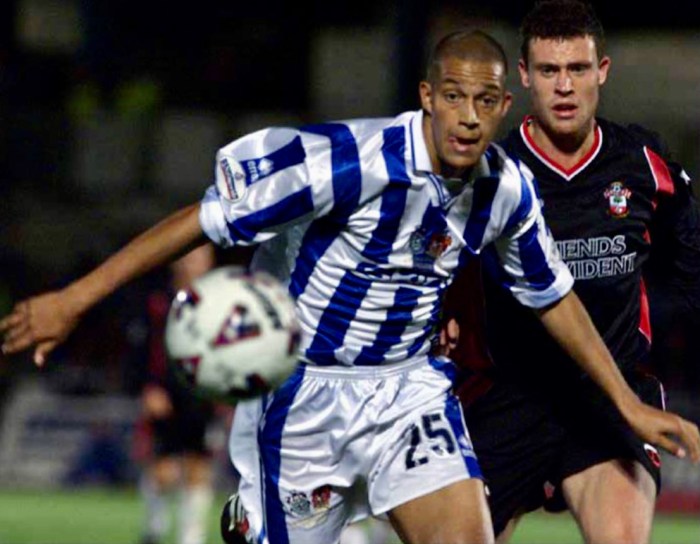
Zamora has eyes on the ball closely watched by a young Wayne Bridge for Southampton

Not only did Zamora manage to score 31 goals as Albion won promotion from the basement division, he went one better when they went straight to the top of the third tier the following season, netting 32 times in 46 matches.

A significant number of those goals came courtesy of Zamora’s excellent understanding with left-footed right-back Paul Watson, of whom he said: “He created a lot of goals for me with those quick free kicks. He didn’t put a foot wrong too often and was very underrated. He never got the credit his hard work deserved.”

Expanding on it in another interview, he said: “Whenever Watto got the ball I knew precisely where I needed to run to and he knew where to deliver it. It was such a great connection: Watto has an absolutely wonderful left foot and it made my job as a striker so much easier when you get deliveries like that.”

Declaring that even in the Premiership he hadn’t come across anybody with a better left foot, he added: “I was very lucky to have played in the same team as him; he created numerous goals for me; not only with his deliveries but with his intelligent play as well.”

Watson had arrived at the club with Charlie Oatway and was part of a cluster of players who had served under Adams at Brentford and Fulham. When Adams and assistant Bob Booker steered Albion to promotion as fourth tier champions, Zamora was player of the season and he and Danny Cullip were named in the PFA divisional XI.

Not long into the following season, the lure of taking over as manager at a Premier League club saw Adams quit Brighton, initially to become Dave Bassett’s no.2 at Leicester City, but with the promise of succeeding him.

“While I thought I had a shot at another promotion, it wasn’t a certainty,” Adams explained. “I knew I had put together a team of winners, and I knew I had a goalscorer in Bobby Zamora, but football’s fickle finger of fate could have disrupted that at any time.”

His successor, Peter Taylor, knew how fortunate he was to inherit an experienced squad, and said: “Of course the greatest asset we had was Bobby Zamora. Having him meant that we could play a front two at home and away from home we could play him on his own and he would still get us a goal out of nothing. He was an incredible player and miles too good for that level.”

And Zamora wasn’t only a star on the pitch, as Knight spoke about in his autobiography. “When he was at his zenith at Brighton, the requests we got for him to visit schools, hospitals and go to prize-givings far outweighed all the other players together, but he was always amenable. He was never starry, never refused. I couldn’t speak more highly of Bobby Zamora as a person.”

Knight recounted in his book how, after a 1-0 win at Peterborough, when Zamora missed a penalty but also scored the only goal of the game, Albion’s promotion to the second tier was confirmed and in his own inimitable way Posh boss Barry Fry said to Brighton’s star striker: “You’re a fucking great player and you’ll play for England one day, I’m fucking sure of it.”

Zamora was still only 21 when Tottenham signed him from relegated Brighton in July 2003. He left the south coast having scored a total of 83 goals in 136 appearances but in his last season in the stripes he netted just 14 as the Seagulls battled unsuccessfully to retain their tier two status.

Unfortunately, he missed eleven matches with a dislocated shoulder and, had former Premier League striker Paul Kitson been fit to play alongside him (he managed only seven starts plus three off the bench), the season may well have had a different outcome.

Everton’s Bill Kenwright had offered £3m for Zamora during the season but their manager Walter Smith seemed less convinced and, with Kevin Campbell and Wayne Rooney likely to be ahead of him, Zamora stayed in Sussex.

But chairman Dick Knight promised not to stand in his way if an opportunity was presented at the end of the season and that came from Tottenham. Manager Glenn Hoddle and assistant Chris Hughton had been to see Zamora in action at the Withdean on a number of occasions.

Spurs chairman Daniel Levy played hardball over the deal. Eventually, Knight settled on a £1.5m fee but, because of the original sell-on clause, £450,000 was due to Bristol Rovers.

Hoddle told The Guardian: “He has got good pace and great movement on and off the ball. No disrespect to Brighton, they have got a good team down there, but we have got players here who can make the most of his movement.”

The player’s agent Phil Smith told the newspaper: “The fee for Bobby is £1.5m which is a decent price in today’s market for a Second Division striker.

“It has been a long time coming for Bobby but he is delighted to be going into the Premiership. It has always been an ambition.”

Disappointed Albion manager Steve Coppell observed: “It is a big move for Bobby and nobody really expected we could hang onto him for much longer. But it has blown a big hole in any plans I had. I don’t have a better option than playing with Bobby Zamora up front.”

When he arrived at Spurs, one of the senior pros who took him under his wing was none other than Gus Poyet.

“As a young guy coming into the team, he was one of the senior pros who would always talk to me and encourage me,” Zamora told the matchday programme. “He didn’t have to do that, but he went out of his way to do so and you could see he had coaching qualities. He would often point things out on the pitch that you’d pick up on, and when he spoke, you’d listen.

“He wasn’t starting every game either, so in training I did more things with him than maybe the rest. I really got on well with him.”

As it turned out, Zamora made only 18 appearances for Spurs (11 as a substitute) and only scored once – ironically a single goal that knocked West Ham out of the Carling Cup in October 2003.

In January 2004, Spurs chose to use him as a makeweight in taking Jermain Defoe from the Boleyn Ground to White Hart Lane.

Phlegmatic Zamora didn’t look on it as a failure but embraced the “learning curve” of training alongside the likes of Poyet, Robbie Keane, Darren Anderton and Jamie Redknapp.

“I came away a better player and with more experience,” he said. “Glenn Hoddle had signed me and then he got sacked not long afterwards. David Pleat took charge and we didn’t really see eye-to-eye, but the lads and the club were brilliant and I learned so much from my time there.

“I took a chance by stepping back down to the Championship with West Ham – but it was the opportunity of playing regular football again that was the pull for me.”

‘Radio’ Poyet talked himself out of Brighton and Athens jobs

GUS POYET’S penchant for speaking out cost him his job at Brighton and AEK Athens.

“There is a reason they nicknamed Poyet ‘Radio’: always on, always talking, especially when it comes to football,” wrote Sid Lowe, in The Guardian.

While the exact reasons for his departure from the Albion in 2013 were never made public, there was speculation that it revolved around him talking openly about his desire to move on moments after the Seagulls had lost a Championship play-off match against arch rivals Crystal Palace.

“I’ve not been in this situation before but I don’t like it,” Poyet said after the game. “It’s changed my view completely about everything I was prepared for, so we’ll see now. I have always said that all the time we keep improving I am going to be at this club and the day we hit the roof, I’m not. Is there something more?

“Right now I don’t know, so I need to make sure I know there is, because if not I am not going to stay forever.”

Poyet was suspended by the club three days later, along with the assistant manager Mauricio Taricco and first-team coach Charlie Oatway, with them only saying they were launching an internal inquiry.

Andy Naylor in the Argus of 17 May 2013 reckoned the suspensions related to “numerous alleged breaches of contracts” pointing out: “Poyet refused to deal with the retained list, announced by the club earlier in the day.

“He told the squad at a meeting at The Amex on Tuesday he would not be involving himself with players’ contracts, because they were not his decisions and he might not be the manager next season.

“Players leaving and staying at the end of their contracts were dealt with instead by chairman Tony Bloom and head of football David Burke.”

At the time, Poyet’s name was being mentioned as a potential successor to David Moyes at Everton, and Martin Jol’s position at Fulham was not thought to be secure.

In the Argus, Naylor wrote: “During his post-match press conference he demanded assurances from Bloom he would have enough money to continue improving the team after their promotion near-miss.

“Those remarks are not, however, thought to be instrumental in the action taken by the club. Poyet’s relationship with Bloom and other senior figures has deteriorated in recent weeks.

“The Uruguayan almost joined Reading in March and his decision to stay only papered over the cracks.”

Naylor observed that Poyet’s previously “wide-ranging powers” had been reined in since the appointment the previous year of chief executive Paul Barber, who was on the board at Spurs when Poyet lost his job as assistant to Juande Ramos.

“It became an open secret within the Amex that Poyet would leave at the end of the season, irrespective of how Albion fared in the play-offs,” he said.

The following month Poyet claimed he was sacked while live on air doing punditry for the BBC although the club maintained he knew full well that he wouldn’t be returning to the job he had been doing for three and a half years.

Announcing his sacking on the club website, a statement read: “This followed his suspension, an investigation, and a subsequent formal disciplinary process. In line with the club’s own procedures, and UK employment law.”

Wind on the clock three years to April 2016 and, after only five months in charge of AEK Athens, Poyet was labelled “immoral” by the Greek club’s owner, Dimitris Melissanidis for telling the Greek media he would be leaving the club at the end of the season. Sounds familiar?

A Reuters report of 20 April 2016 maintained: “Speaking to the media on Tuesday, a day ahead of AEK’s Greek Cup semi-final second leg match against Atromitos, Poyet further angered the club by revealing details of a private meeting he had held with Melissanidis.

“What he did was unacceptable, it was not the appropriate time to unsettle the team just hours before the semi-final,” Melissanidis told reporters.

“AEK has never leaked any information from any of our meetings with him and for him to talk to the press about the contents of our meeting is immoral.”

Local media reported Poyet had been fired and would not be in the dugout for the match against Atromitos.

“AEK was informed of Gus Poyet’s decision that he will not stay with the club after the summer on Tuesday evening,” the club said.

“The important thing for AEK at the moment is the crucial semi-final with Atromitos, all of the other issues will be seen to after the match.”

After losing his job at Sunderland seven months previously, Poyet took over from Traianos Dellas in Athens in October 2015 on a deal until the end of the season, with the option to renew for another two years. Taricco and Oatway joined with him.

All smiles as Poyet arrives at AEK as manager

At the time of his appointment Poyet said: “I know that I have come to a huge club and I’ve been astonished by the reception that I have received.

“Our goal is to play to win every game, starting with the derby against Panathinaikos on Sunday (it finished 0-0), and maintain contact with the top positions.”

The ‘Yellows’ picked up a string of impressive results under Poyet but speculation about his future was never far away. In December 2015 he was linked to the managerial vacancy at Swansea City (following the departure of Garry Monk), prompting AEK to make a public declaration.

“We have not been approached by Swansea, there is no need for us to be approached and no propositions have been made from Swansea,” said a club spokesman. “Mr Poyet is happy at the club and will be our manager at least until the end of the season.”

AEK ended the regular season in second behind champions Olympiakos, although points were deducted for crowd trouble and they eventually finished third.

On his personal website, Poyet records that he led AEK Athens to the semi-finals of the Greek Cup and they won the three biggest derbies in the country against Panathinaikos, PAOK and Olympiakos over a month and a half. After he left, they went on to win the Greek Cup.

A month after his departure from Athens, Poyet was installed as head coach at Spanish La Liga side Real Betis, from Seville, on a two-year contract.

He subsequently managed in China, France and Chile but returned to Greece in February 2022 as the head coach of the country’s national team.

At one point it looked like he might return to Greece before then. It seemed all had been forgiven when, in September 2019, word had it that Poyet was lined up to return to AEK as the successor to the departed Miguel Cardoso.

However, agonasport.com said: “All of the signs seemed to be pointing towards Poyet returning to AEK as manager, but reports have now revealed that negotiations have reached a dead end. AEK are not willing to match the Uruguayan’s financial demands.”

Andy Arnott’s United dream dashed by injury

A PLAYER who was on the brink of signing for Man Utd for £100,000 ended up playing for the Albion in exile.

But for an untimely hernia injury, Andy Arnott would have been an Alex Ferguson signing at Old Trafford.

As it turned out, the moment passed and the opportunity didn’t arise again. He later made 28 appearances for the Seagulls during the 1998-99 season when home games were played at Gillingham’s Priestfield Stadium.

It was a ground Arnott was familiar with. Born in nearby Chatham on 18 October 1973, he joined Gillingham as a trainee and had only served one year of his apprenticeship when he was taken on as a professional.

Manager Damien Richardson gave him his debut for the Fourth Division club only four games into the 1991-92 season when he was just 17.

It couldn’t have gone better because he scored the Gills’ opening goal in a 2-0 home win over Scarborough.

This was a Gillingham side that included summer signing Paul Clark, who had been part of Alan Mullery’s successful Brighton side in the late 1970s, and Mike Trusson, who’d won promotion from the Third Division with the Seagulls under Barry Lloyd. A young Richard Carpenter was also breaking through.

Arnott scored three goals in 23 appearances by the season’s end although one goal and two appearances against Aldershot were later expunged from the records because the Shots were expelled from the league.

Nonetheless, the youngster’s emergence hadn’t gone unnoticed higher up the football pyramid and the offer of the chance to join United came along, ostensibly so that he could feature in their youth team’s involvement in the end-of-season Blue Star youth tournament in Zurich.

This was the era of the famous ‘Class of 92’ and Arnott found himself playing alongside David Beckham, Paul Scholes and Nicky Butt.

“After impressing during his spell with United, Ferguson made a £100,000 offer to Gillingham which was turned down by the then manager Damien Richardson,” Albion’s matchday programme noted.

In action for Gillingham against Albion’s Nicky Bissett

The player then suffered a hernia injury that put him out of the game for a year, putting paid to any further interest from United.

“I was gutted at the time, but it was a case of just getting on with returning to fitness and playing football,” Arnott said.

Back at Gillingham, he played 50 matches and scored 12 goals but then, in January 1996, got a £15,000 move to Leyton Orient. He spent a season and a half with the Os under manager Pat Holland and played in every position to help out the team, including goalkeeper in one emergency.

Arnott played under Micky Adams at Fulham

In the summer of 1997, after Fulham’s promotion from Division Three under Micky Adams, Arnott moved to Craven Cottage for an undisclosed fee (thought to be £25,000).

Within a few months, Mohammed Al Fayed took over the club and sacked Adams.

“All of a sudden Fulham went from being an ordinary Second Division outfit to a multi-million pound club,” he said. “I felt sorry for Micky as he had done a fantastic job, but he did foresee what was coming and sorted out long term contracts for most of the players.”

The new management duo of Ray Wilkins and Kevin Keegan brought in their own players and Arnott found himself confined to the reserves with the likes of Mark Walton, winger Paul Brooker, and forward Darren Freeman.

He scored twice for Fulham Reserves in a 3-0 win over Albion’s reserve side on 21 October 1998, and that persuaded Brian Horton to take him on.

“A few clubs had shown an interest around that time, but Brighton were the first that I spoke to and I liked what I was hearing so I signed straight away,” he said.

Horton signed him by the end of the same month for £10,000, plus another appearance-related £10,000, and said in the matchday programme he was “absolutely tremendous” on his debut. It came in a 1-0 win in pouring rain at Barnet when Charlton loanee defender Emeka Ifejagwa scored the only goal of the game on his debut. “He (Arnott) and Jeff Minton forged a good partnership and I am looking for that to flourish,” said Horton.

In his player-by-player commentary of performances, programme columnist Paul Camillin said: “Brilliant debut. He showed a good array of passing skills and he might have the bite we’ve been lacking.”

It was the wrong kind of bite he displayed in only his fourth game, though, when he was shown a red card in the 55th minute of Albion’s 2-0 win at Horton’s old club Hull City.

Defender Ross Johnson also went for an early bath for a second bookable offence but Albion’s nine men hung on for 35 minutes to complete their fourth successive away League win: the best such run for 62 years!

There’s little doubt Arnott’s arrival coincided with an upturn in the side’s form and in the matchday programme he took time to praise Albion’s loyal followers. “It is a fantastic advantage to have the number of away supporters we do,” he said. “It makes you want to play that little bit more to give them something back. They are absolutely magnificent.”

Arnott and Jamie Moralee

In the absence of Gary Hobson and Ian Culverhouse, Arnott was given the captain’s armband although that discipline was a bit questionable at times. He saw red for a second time, after Jeff Wood had taken over from Horton, for a second bookable offence at home to his old club Orient – Os captain Dean Smith (manager of relegation-threatened Leicester) also went for a second yellow – although Wood and Orient boss Tommy Taylor both slammed referee Rob Styles for his officiating.

Man of the Match

Wood declared: “Too many officials want to stamp their authority on the game early and flash cards like they are going out of fashion.”

Although Arnott saw out the season in the starting line-up, when his old boss Adams took over from Wood, by the time the new season got under way back in Brighton, Adams had signed Paul Rogers and Charlie Oatway as his preferred midfield pair.

By the end of September, Arnott had been snapped up by Second Division Colchester United; initially on loan and then permanently when their new boss Steve Whitton completed a direct swap that saw Warren Aspinall join the Seagulls.

However, Arnott made only four starts plus eight appearances off the bench in that first season and his time with United was blighted by a long-standing groin injury.

“The whole thing has been an absolute nightmare. I have been struggling with the injury for 14 months and despite loads of rest, two operations and four cortisone injections, the problem is as bad as ever,” he told Colchester’s Daily Gazette in January 2001.

“I was really struggling just before Christmas and I visited the specialist who told me I’m pretty near to exhausting my options.

“When it’s at its worst the injury is unbearable, especially when I turn or attempt to hit a long ball.

“I’m still only 27 with what should be many years left in the game.”

Unfortunately, though, he was forced to call time on his professional playing career and dropped into non-league initially with then-Conference side Stevenage, then Dover Athletic, where he was captain, Welling United and Ashford Town.

After his playing days were over, he settled in Rochester and became a project manager for Dryspace Structures while retaining his football links as a coach for Ebbsfleet United’s under 16 team.

Ooh la la: Seb Carole was a history-maker

DIMINUITIVE winger Sébastien Carole has a double entry in the history of Brighton and Hove Albion.

Not only was he the first Frenchman to play for the club, he was also the first to play under three completely separate contracts for Brighton’s first team.

As well as three different spells with the Seagulls (2005-06, 2009 and 2010), he spent two years at Leeds United where his son is now in their under 18 side.

Ironically Carole scored his first goal for Albion against Leeds, but his first Brighton manager, Mark McGhee, thought the player’s ability should have yielded far more goals.

“He’s got to get more goals,” McGhee told the Argus in November 2005. “He’s a great finisher, a great ball striker and he can manipulate the ball.

“He is going to get himself in scoring positions, because he makes space for himself when he comes inside, and in training he scores.”

That goal against Leeds came in a memorable 3-3 draw at Elland Road on 10 September 2005 but Carole’s only other goal that season came in a rare victory, 2-1, over Hull City on 16 December (Charlie Oatway got the other).

An eleven-game winless run from January to the end of March, in which only four points were picked up, pretty much sealed Albion’s fate and the promise of Carole on one wing and fellow Frenchman Alexandre Frutos on the other didn’t live up to expectations. Albion lost their Championship status with only seven wins across the whole campaign.

To cap it off, a disappointed McGhee saw Carole exercise a clause in his contract that meant he could leave Brighton on a free transfer if they were relegated.

“We gave Seb the opportunity to come here and be part of the team,” McGhee told the Argus. “Regardless of that clause, the decent thing for him to do would have been to stay, at least at the start of the season.”

Seagulls chairman Dick Knight explained the clause had to be inserted into Carole’s contract to ensure he’d join from Monaco in the first place.

“If that clause hadn’t gone in then Seb’s wages over the two years would have been higher and the signing-on fee would have been more, so it was a no-brainer,” he said. “We fought hard to keep him, but the agent has persuaded Seb to go.”

The winger chose to move to Leeds, beginning the first of several occasions he’d link up with manager Kevin Blackwell. But Blackwell was sacked after only three months and his eventual replacement, Dennis Wise, told the Frenchman he wouldn’t be part of his plans.

“I had a think about it, had a chat with my wife and I said that I would stay and fight for my place,” said Carole. “I had signed for three years and I wanted to prove I could be a good player for Leeds.

“That summer, Leeds were relegated, and I could have gone back to France and joined Le Havre but I chose to stay and fight for my place. Then, by a twist of fate, the left winger got injured, I got on, played well and after that Dennis Wise told me he didn’t want me to go.”

Wise’s assistant at Leeds was of course Gus Poyet – and the winger’s relationship with the Uruguayan would later be of use back on the south coast.

Unfortunately, when Wise left Leeds for Newcastle, replacement Gary McAllister wanted to bring in his own players so once again Carole found himself sidelined, and there was a mutual agreement to cancel his contract.

He was without a club for a few months although his old boss Blackwell, by now at Sheffield United, invited him to train with them and he played a few games for their reserve side, and he spent a short while training with Bradford City.

However, in December 2008 and January 2009 he linked up with League Two Darlington, where he played seven matches. “It was not far from where I was living and I needed some games for fitness,” he said. “I signed a monthly contract and left a week before I came back to Brighton on trial.”

Micky Adams, back at Brighton for what turned out to be an unsuccessful second spell, tried all sorts of permutations to try to turn round a string of disappointing results and the invitation extended to the Frenchman was one of the last avenues he explored before the Albion parted company with him.

He scored twice and created two more in a practice match against the youth team as Adams ran the rule over him at a trial. “He’s not somebody I’ve worked with before, but everyone at the club speaks highly of him so we will take a look,” said the manager.

The early signs for Carole under Adams were good: he went on as a 56th-minute substitute for Chris Birchall at home to Hartlepool on 2 February, putting in a cross for Nicky Forster to convert.

Sections of the Withdean faithful voiced their disapproval of Adams’ choice of change, but the manager was typically forthright in his response, telling the Argus: “We can all sit in the stands sometimes and play football manager.

“I decided Seb Carole would give us an impetus. That was no reflection on what Chris Birchall had done. I can’t be worried about what the fans are thinking. I’ve got to do what I think is best and stand there and be as brave as I can be.

“Seb travels well with the ball, delivered a couple of great crosses and put one on a plate for Fozzie.”

It wasn’t long before Adams was on his way and although Carole liked what he heard from incoming boss Russell Slade, the new man preferred Dean Cox as his wide option.

Carole told Brian Owen of the Argus: “I love the way he talks. He’s got so much passion and he has tried to do something different.

“He wants us to play a bit of football at times when it’s possible because obviously the pitch doesn’t allow you to play that much. We can see something has happened since he came here.”

However, Carole’s part in ‘the great escape’ was somewhat peripheral, making only five starts plus seven appearances off the bench.

He later said: “Micky Adams signed me and I think I did well under him, then he left and Russell Slade came and I wasn’t really in his plans.

“I wasn’t really involved in the team. I was on the bench most of the time and I didn’t understand why, because I thought I could bring something to the club.

“I was a little bit upset about the whole situation. I didn’t get the chance to do well in that second spell.”

Released by the Albion in June 2009, Carole was attracted by the prospect of playing under the legendary John Barnes at Tranmere Rovers and signed a short-term deal at the start of the 2009-10 season.

However, once again managerial upheaval would be Carole’s downfall. Rovers won only three of their first 14 matches and Barnes was shown the Prenton Park door.

“I was disappointed when he was sacked,” Carole told the Argus. “When I went there we had a long chat about how he wanted to play and I signed because of him, because I knew what he was like as a player and would play the way I like.

“I think it was a little bit unfair and a little bit early for him to be sacked, because he didn’t get the finance to make the signings he wanted.

“I definitely think if he had stayed then I would have stayed longer. When they put the physio (Les Parry) in charge, I just felt it wasn’t that good for me.”

The third coming of Carole at the Albion, on a week-to-week deal, was as a direct result of his having played under Poyet at Leeds, the winger telling the Argus: “He knew what to tell me in a certain way to get the best out of me. That is what he was good at when he was at Leeds.

“He was only the assistant manager to Dennis Wise but, more than anyone else, he was talking to the players in the right way and players were listening to him.

“He brings you confidence and you trust him and he will bring a togetherness to Brighton, which is important to get the team back on track.

“He is exactly the same as when he was at Leeds. He is really relaxed and wants to play a certain system. Obviously, that will take time. I think what he is trying to put in place here will bring the club back to where it deserves to be.”

Poyet was equally positive about taking on the Frenchman. “I know Seb better than anyone,” he said. “Seb’s a winger, not just right or left. People say he’s right-footed but he did a terrific job for us at Leeds on the left.

“We’ve been playing without a natural left-sided winger. People look at Dean Cox out there but I see him a bit more inside. I don’t think we have another player like Seb.

“People will compare him to Elliott (Bennett) but he’s a different type of player. Elliott is more direct, more about speed, more going past people with his speed. Seb is about checking in and out and dummies, taking players out of position with his skills. We don’t have that player. That’s why he is coming in.”

It was six weeks before he got his first start and he fancied his chances of getting a longer deal, especially when a hamstring injury forced Kazenga LuaLua to return to Newcastle.

“With Kaz injured for the rest of the season, I think I have got a massive chance now,” he said. “It’s up to me and how I perform.

“I was pleased to be back in the starting eleven. You always get frustrated when you are not playing but I trust Gus and I know exactly what he wants.

“I kept my head down and kept working hard and knew I would get another chance.”

His best run in the side saw him feature in four games on the trot: a 2-0 win at Oldham, a 3-0 home win over Tranmere, a 2-2 draw at home to Southampton and a 2-0 defeat at Hartlepool.

Carole certainly felt pumped up for the game against Rovers, reckoning he had a point to prove to Parry. “He didn’t play me at all. I want revenge and to show him,” he told the Argus before the match. “If I could score and just kill them I’d be happy.”

Carole didn’t score but he did put in an inviting cross that Andrew Crofts seized on to score a second goal for the Albion on the half hour. Glenn Murray had opened the scoring in the seventh minute and debutant Ashley Barnes went on as a sub to score the third.

Dropped after the Hartlepool defeat in favour of on-loan Lee Hendrie, Carole was a non-playing substitute for four matches and, although he played in the season’s finale, a 1-0 win at home to Yeovil, that was his last game in an Albion shirt.

Born in Cergy-Pontoise, a suburb of Paris, on 8 September 1982, Carole’s first memories of football were as a five-year-old having a kickabout with his dad, Jean-Claude, who had played for Paris Saint Germain’s academy but whose career didn’t take off because of an accident.

Carole went to La Fiaule school in Vaureal from the age of three to 10 where he played football every Wednesday. Apart from football, he also had an aptitude for maths. He went on to La Bussie and joined Monaco at the age of 14. He progressed through the ranks before eventually playing 11 times for the first team, including once in the Champions League.

Carole was 21 when he first came to the UK in January 2004, joining Alan Pardew’s West Ham on loan at the same time that Bobby Zamora joined the Hammers from Tottenham Hotspur.

But the young Frenchman only made one substitute appearance, going on in the 87th minute for Jobi McAnuff as the Hammers beat Crewe Alexandra 4-2 at the Boleyn Ground on 17 March.

The following season he was sent on loan to French Ligue 2 side Châteauroux where he scored once in 11 matches.

It was truly the long and the short of it when in August 2005 Albion announced the joint signing of 5’7” Carole and 6’5” Florent Chaigneau, a French goalkeeper on loan from Stade Rennes. Describing them as “exciting additions to the squad”, Albion chairman Knight said: “The fact that we have been able to attract these young players who have already represented France at various levels, is a measure of the progress we are making at this club. We will give them the stage to make their names in England.”

Carole made his debut in the third game of the season, rather ironically once again Crewe Alexandra were the opponents, in a 2-2 home draw, and Chaigneau played his first match 10 days later as Albion bowed out of the League Cup 3-2 away to Shrewsbury Town. While Carole established himself in the side, Chaigneau only made two more appearances.

Although Carole played for France through the age groups up to 19, in 2010 he played three games for Martinique, the Caribbean island side, in the Didgicel Cup.

After failing to get the hoped-for longer contract at Brighton, Carole spent the 2010-11 season with French Ligue 1 team OGC Nice. He subsequently returned to the UK and spent six months at League One strugglers Bury, managed by his old boss Blackwell, but was released having made just five substitute appearances. He then proceeded to drift around various non-league sides in Yorkshire.

He later set up his own football school, which he ran for a year, and has since been an agent (C & S Football Management). His son Keenan is currently playing for the Leeds under 18 team.

McGhee provided Albion platform for playmaker Mark Yeates

TRICKY playmaker Mark Yeates spent five years as a Tottenham Hotspur player but it was with Brighton that he played his first competitive football.

Yeates looked like a useful loan signing when he joined new manager Mark McGhee’s Albion squad in November 2003. He drew plenty of admirers and featured in 10 games over two months.

It wasn’t long before McGhee was talking about the possibility of signing him on a permanent basis, but Spurs had other ideas. He eventually had to leave north London to pursue his career but he ultimately made nearly 500 professional appearances.

Eighteen-year-old Yeates arrived on the south coast shortly after Zesh Rehman had also signed on loan (from Fulham), Albion having lost midfield duo Charlie Oatway and Simon Rodger to injuries.

The diminutive Irishman made his debut in McGhee’s first match in charge: a 4-1 defeat to Sheffield United at Withdean.

The matchday programme’s assessment was thus: “The second half was better. Mark Yeates moved into the centre of midfield and so had an opportunity to show what he can do. He could beat players, look up, and try a perceptive through ball. Wide on the left in the first half, he’d been exposed and given the ball away too often.”

On the day England won the Rugby World Cup, Yeates was one of six Albion players booked as the Seagulls beat Notts County 2-1 at Meadow Lane; an eventful game which saw Adam El-Abd make his league debut, Leon Knight score twice and John Piercy sent off for two bookable offences.

After only his third game, Yeates was off on international duty, playing for the Republic of Ireland under 19s away to France.

It was in early December that McGhee spoke about wanting to take Yeates on a permanent basis, telling the club’s website: “I’ve said already that I knew before he came here what a good player he is and I imagined he would do well in this team, and he has done that.”

McGhee told the Argus: “He has a kind of Gaelic confidence. Robbie Keane had it and Mark is similar in that respect.

“His character is perfect really for the way he plays. It goes with the ability and flair.”

Yeates hailed from the same Tallaght district of Dublin as Keane – a player McGhee knew well having given him his English football debut at 17 when manager of Wolves.

After extending his stay at the Albion to a second month, Yeates told the Argus: “Before I came here I had never really played in the centre of midfield. I usually play up front off a big man.

Yeates takes control watched by Adam Hinshelwood

“The gaffer tried me up front in the first half at QPR (in the LDV Vans Trophy) but we didn’t get the ball into mine and Leon’s feet, and with two little men you are not going to get much joy.

“At Tottenham we play with wingbacks and two holding midfielders and I am allowed a free role.

“I have to be a bit more disciplined here. Sometimes I can go running about a bit, it’s just up to the lads to call me back in to help out.”

Yeates appreciated the opportunity Albion had given him to taste senior football, telling the newspaper: “It’s great for me just to be getting first team football, plus the reason I am staying here is because they are a good bunch down here.”

He observed: “It’s a lot more fast and furious because everyone is playing for their living. You have to give a bit more and get more out of yourself which you probably wouldn’t get in a reserve game.

“In reserve football, players are going through the motions. It’s just a matter of playing a game.”

After he’d played his final game on loan, a 0-0 home draw with Oldham Athletic, the matchday programme observed: “Yeates showed some neat touches and was Albion’s most creative outlet once again.”

When Albion struggled to beat Barnsley 1-0 in the FA Cup, the matchday programme noted: “The passing abilities of Mark Yeates, and his desire to get into the penalty area, were sorely missed.”

Back at Spurs, Yeates had to wait until the very last game of the season to make his Premier League debut. He’d previously been an unused substitute when Glenn Hoddle’s Tottenham were thrashed 5-1 by Middlesbrough at the end of the 2002-03 season.

But in May 2004, David Pleat selected him to start in a side also featuring Ledley King, Jamie Redknapp, Christian Ziege, Jermain Defoe and Robbie Keane.

The fixture at Molineux ended in a 2-0 win for the visitors and Yeates helped Spurs take the lead against the run of play, laying on a cross for Keane to score against his former club. Defoe netted a second to seal the win.

Born in Tallaght on 11 January 1985, Yeates was the eldest son of former Shelbourne, Shamrock Rovers, Athlone Town and Kilkenny City striker Stephen Yeates, who died aged just 38 following a tragic accident, just as Mark was making his way through the youth ranks at Spurs.

The young Yeates first played competitive football with Greenhills Boys, a club who his grandfather and father had been involved with, and then moved on to Cherry Orchard, a Dublin side renowned for producing a number of players who went on to have successful professional careers.

In an extended interview with Lennon Branagan for superhotspur.com, Yeates recalled how Tottenham scout Terry Arber did a two-day coaching course at Cherry Orchard, after which he, Willo Flood (later to play for Manchester City and Dundee United) and Stephen Quinn (who went on to play for Sheffield United) were invited to London for a trial with Spurs.

Yeates was only 15 but he was taken on and had to up sticks from home and move into digs in London.

“As a skilful dribbler who was regularly a source of assists and goals in the youth set-up, Yeates quickly demonstrated to the coaching staff at Tottenham that he possessed the raw materials required to graduate to the next level,” wrote Paul Dollery in an October 2021 article for the42.ie.

Sadly, his progress through the youth ranks was interrupted by the shock news of his father’s death in an accident. Yeates told Dollery how it could have all gone the wrong way, but he thankfully remained focused.

“It was really tough, but you’d ask yourself what else you could do if you didn’t keep going – go home to your estate in Tallaght, drink cans every weekend and get roped into whatever else? 

“I could have done that, or I could look at the three-year contract that was on the table at Tottenham and get my head down to go after that.

“It was hard, but a bit of willpower and the desire to be a footballer – which I had since I started kicking a ball – got me through it.”

In his interview with Branagan, Yeates said: “I started to train with the first team at a decent age and really being involved quite a bit as well as being a regular with the reserves group with Colin Calderwood and Chris Hughton at the time.

“I’ve just got so many unbelievable things to say when I look back now and I can only say so many good things about Spurs because it sort of built me and gave me so much.”

It was in January 2005 when Yeates next appeared for the Spurs first team, Martin Jol sending him on as a sub in the third round FA Cup tie against Brighton at White Hart Lane when Tottenham edged it 2-1.

The following week he once again replaced Pedro Mendes as a sub when a star-studded Chelsea side won 2-0 on their way to winning their first Premier League title under Jose Mourinho. He also got on in the next game, as Spurs crashed 3-0 at Crystal Palace,

While he could have continued to bide his time at Spurs, he preferred to go out on loan again to get some games under his belt. He played four times for League One Swindon Town and then had a season-long loan at Colchester United, helping them to promotion from League One in 2005-06 in a squad which included Greg Halford and Chris Iwelumo.

Further loan spells followed at Hull City and Leicester City but, in the summer of 2007, he joined Colchester on a permanent deal.

Yeates scored 21 goals in 81 games for United drawing him to the attention of future England manager Gareth Southgate who took him to Middlesbrough (who had just been relegated from the Premier League) for a £500,000 fee.

On signing a three-year deal, Yeates said: “This is massive for me. There was interest from other clubs but there was only one thing on my mind once my agent told me Middlesbrough had been in touch.

“This club belongs in the Premier League, the fans deserve to be there and I can’t wait to play in front of them. It’s a Premiership club in my mind – all you have to do is look around the facilities, the training ground, the stadium, everything is spot on.”

Yeates reckoned his versatility would suit Boro. “I can play on the right or the left,” he said. “I played a full season’s Championship football on the right for Colchester, while I played most of last season on the left. But then, in probably eight of the last 10 games, I played behind the front two.

“For a winger, I think my goals record is quite good,” he added. “I got 14 last season and nine by Christmas the season before I got injured.

“I like to get on the ball and take on defenders. The number one job of being a wide man is creating chances and I certainly like to do that, but scoring goals isn’t a bad habit to have either. I promise the fans I’ll give 110 per cent. I’m hungry to prove that I deserve to be here.”

Fine words but it didn’t pan out well for him because Southgate was sacked in October 2009 and his successor Gordon Strachan shunned the Irishman. By January 2010, Yeates was on the move again, this time to Sheffield United.

Blades boss Kevin Blackwell told the club’s website: “He’s a player we have looked at before, I’ve had my eye on him for a year or two but we couldn’t agree terms with Colchester. I’m delighted to finally get my man, although I was surprised that Boro would let him go.”

Yeates was reunited with Stephen Quinn and another former Albion loanee, Darius Henderson, was up front for the Blades. Yeates reckoned he had his best ever spell playing under Blackwell’s successor, Gary Speed.

“He was just an unbelievable man and, going back to when I was at Tottenham as a young lad, he was the prime example of the player you should aspire to be like,” he said. “He had faith in me.”

Unfortunately, when Speed left to manage Wales, former Albion boss Micky Adams took charge and the pair didn’t see eye to eye, as he explained to watfordlegends.com.

“I was at Sheffield United and it was the season when we went from the Championship to League One. Micky Adams was the manager and we weren’t getting on. In the summer Micky was sacked and Danny Wilson came in as manager.

“I trained for the full pre-season with the club, but I was aware that there were a couple of clubs keeping an eye on my situation throughout the summer. It was Blackpool and Watford who put in offers for me, and I spoke with both clubs, but when I met Dychey (Sean Dyche) I decided to sign for Watford.

“I still had a house in Loughton so overall it was a good opportunity to get back down south, and everything that Sean said to me on the phone really appealed to me.”

Yeates was at Watford for two seasons, initially under Dyche and then Gianfranco Zola, but his contract wasn’t renewed in the summer of 2013 and he decided to link up once again with his former Colchester and Hull boss, Phil Parkinson, at League One Bradford City.

He was one of the goalscorers for Bradford when they completed a massive upset by beating Premier League table toppers Chelsea 4-2 at Stamford Bridge in the fourth round of the 2015 FA Cup.

However, released that summer, he switched across the Pennines to join Oldham Athletic and six months later was on the move again, this time to Blackpool.

“Since leaving Hull it’s been a bit up and down,” he told Branagan. “I was on a short term deal at Oldham which went alright before then deciding to go to Blackpool because of a longer contract which was put in front of me which I don’t regret, as I’ve been living around the St Annes area now for five years and my children have grown up here and are at school and it’s a great area to raise a family in.”

His final league club as a player was Notts County, who he joined on a short-term deal in January 2017, and he appeared in 11 games plus three as a substitute as new manager Kevin Nolan’s side turned what at one point looked like relegation from the league into a 16th place finish (although two years later County lost the league status they’d held for 157 years).

After playing non-league for Eastleigh, in 2019 Yeates moved closer to home and signed for AFC Fylde. In September 2021, he became an academy coach at Fleetwood Town, although he continued to keep his hand in as a player at Bamber Bridge.

Reflecting on the player’s career, Dollery wrote: “With a ball at his feet, Yeates was one of the most technically accomplished Irish players of his generation, cut from the same cloth as the likes of (Wes) Hoolahan and Andy Reid.

“That such a claim isn’t backed up by international achievements can perhaps be partly explained by his own admission that he didn’t marry his talent with a devotion to other aspects of the game that were beginning to play a more prominent role in the life of a professional footballer.

“If fitness coaches scheduled a gym session, Yeates felt his time would be better spent by staying on the training pitch to perfect his free kicks. A predilection for crisps, fizzy drinks and nights out didn’t aid his cause either.”

Yeates recognised he could have done things differently and said: “The reality was that I didn’t live like a saint.

“Everyone who knows me would know that that’s just not my personality. I’ve always been a fella who likes a bit of craic; just a normal Irish lad from an estate who happened to love playing football.”

• Pictures from the Albion matchday programme and various online sources.

Benno’s quick route to the top after ‘fantastic’ Albion chapter

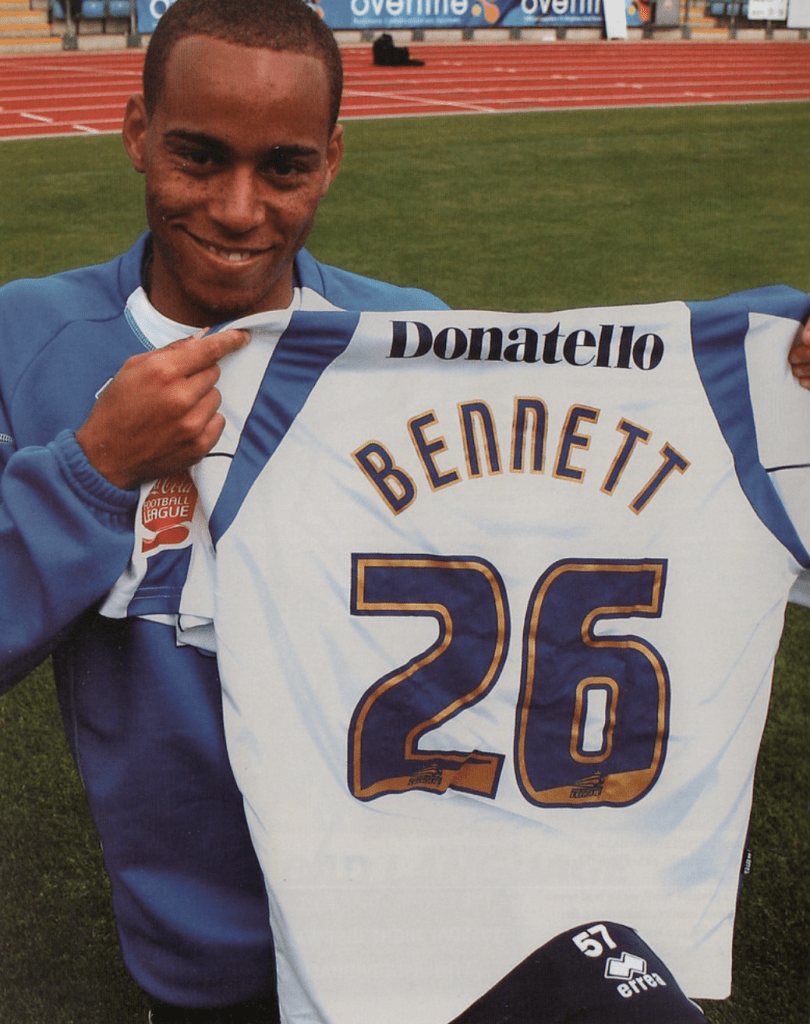
SEVENTEEN GOALS in 100 appearances don’t tell the whole story of Elliott Bennett’s two seasons as a Brighton player.

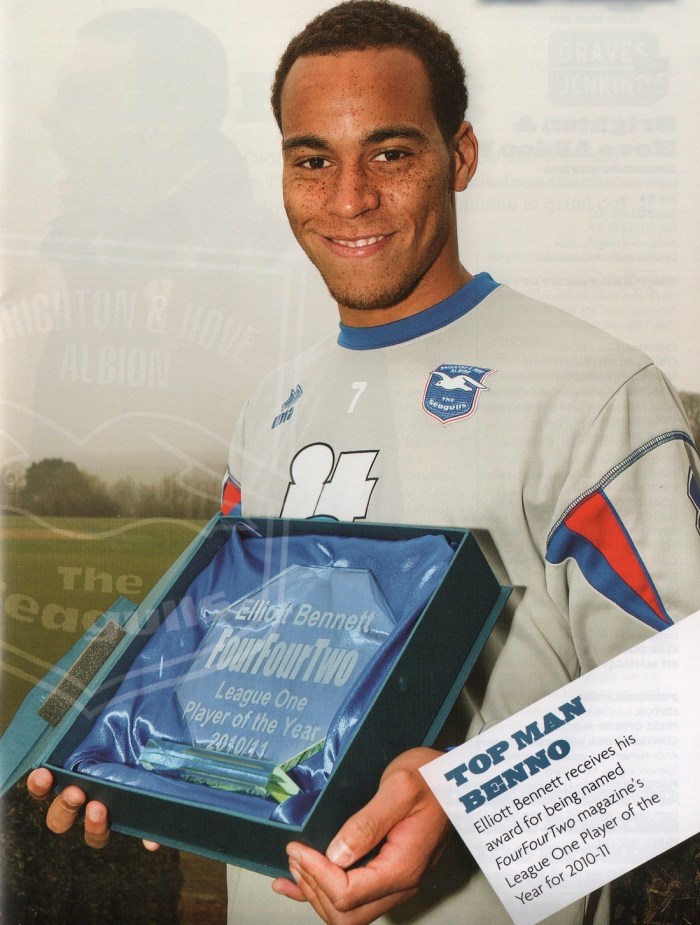
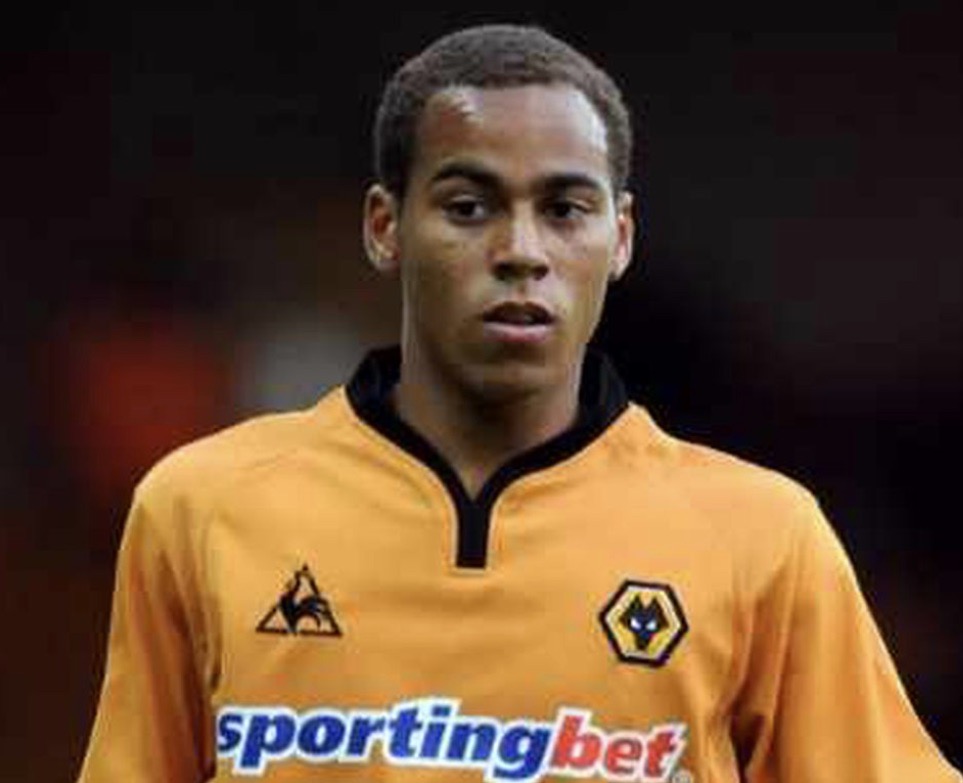
Russell Slade signed him in August 2009 from Wolverhampton Wanderers for £200,000, but it was under the guidance of Gus Poyet that he flourished and was a stand-out performer when Albion won promotion from League One in 2011.

Not only was he chosen by his fellow professionals in the PFA League One team of the year (along with teammates Gordon Greer and Inigo Calderon), he was Four Four Two magazine’s League One Player of the Year.

Always diplomatic in interviews about personal achievements, typically he said: “If you win awards, it’s nice personally but you have to remember you can’t win them without your teammates. If I’m setting up goals, then it means our strikers are on their game as well as they’re getting on the end of my crosses.”

In a matchday programme feature, he added: “These individual awards really are not possible unless you have a good team around you, so this award is really on behalf of the whole squad and coaching staff.”

Bennett acknowledged the impact Poyet made on improving him as a player. “Gus has given me different roles to play throughout the season. I’m a lot more aware as a player as a result and I’m better with the ball now. There’s still lots for me to work on, but the gaffer has really brought my game on. I definitely owe him a lot.”

In another matchday programme article, he once again paid tribute to Poyet, his assistant Mauricio Taricco and coach Charlie Oatway. “I feel like I’m improving all the time and I owe so much to the coaching staff: the gaffer and Tano, while Charlie has got my head right. I used to beat myself up if I gave the ball away but Charlie has stamped that out of me. Technically, all three have helped me and I’ve also been playing in the middle a bit more, which has added another string to my bow.”

Bennett continued: “While I’m known for being a winger, my link-up play has also improved this season, which has really pleased me. I’m now more involved and it’s important that I keep on learning. The gaffer will always pull me to one side if he sees something that can help improve me – which he does with everyone – and then it’s a case of trying to replicate that on a match day.

“When you’ve got a gaffer who’s played the game at the highest level, you can only learn from him – and if you didn’t listen you’d be pretty stupid.

“I’ll play anywhere for the good of the team – I’ve even played right-back this season, but I must admit that I do prefer playing in a more advanced role where I can create things for the team. Whether that’s right wing, the left wing or even behind the strikers I don’t mind. I just love being involved.”

Bennett’s impact wasn’t confined to games, either. He and Liam Bridcutt used to visit Westdean Primary School, near Withdean, where they listened to youngsters reading. His wife, Kelly, worked for the club too.

Aware they had a hit property on their books, Albion awarded Bennett a new three-and-a-half-year deal in November 2010, when Poyet told the club website: “Elliott has been a good pro and has earned this new contract.

“He has shown he is capable of playing in a number of positions, he enjoys playing our style of football and I think he will continue to get better as a player.”

For his part, Bennett said: “Gus is a big factor for me. I will always be grateful to Russell Slade for signing me, but the current gaffer has brought his own style of play.

“I have really taken to the club ever since I arrived from Wolves last summer. I feel I have grown up as a person and developed as a player.”

Unfortunately for Brighton, Bennett’s superb contribution drew plenty of admirers and, when Norwich City offered £1.9million to give him the chance of Premier League football, the lure was too great to resist for player and club.

While his promoted teammates looked forward to Championship football in the brand new Amex Stadium, Bennett joined Paul Lambert’s Canaries to test his talent at the highest level.

Bennett told HITC Sport’s Alfie Potts Harmer: “Brighton was a fantastic part of my life and a fantastic chapter of my career, I loved every minute of it.

“When we won the title there, League One was full of teams who are now flying, you look at Southampton, Bournemouth and Huddersfield, it was a strong League One that year, and we played some fantastic stuff.

“The stadium coincided with promotion and I’d just signed a new contract. I think I would have stayed there for many years had it not been a Premier League move, but I don’t regret moving to Norwich. When an opportunity like that comes you have to take it as a player. You don’t know if it will come again.”

Lambert was delighted to land the youngster having previously had a bid to sign him in January that year rejected. “He is a young and exciting player with plenty of pace,” Lambert told the Norwich website. “He can play in a wide position or in behind the forwards, he’s a quick lad and he’s got a winning mentality.

“He played his full part in what Brighton achieved last season and that desire to succeed will stand him in good stead here.”

Bennett declared: “It’s an unbelievable opportunity for me to fight for a place in a team which will be playing in the Premier League.

“I like the mentality at Norwich City that has seen them get back-to-back promotions and I’m grateful to Paul Lambert for giving me the chance to be part of what’s happening at the club.

“I didn’t make it through at Wolves, which was my home-town club, and Brighton gave me the opportunity and I’m grateful for that.

“Now I’m just really excited about the chance to try to help Norwich in the Premier League.”

Bennett certainly seized the opportunity and in his first season was delighted to score the winning goal in Norwich’s 2-1 win over Spurs at White Hart Lane. He’d played 57 games in the Premier League when his career suffered a major hiatus. In the first home game of the 2013-14 season, against Everton, he sustained a cruciate injury which ruled him out of all but the last game of that campaign, as City were relegated.

Frustrated by the lack of starts at Norwich as they began life back in the Championship, Bennett was happy to return to the Seagulls on loan as Sami Hyypia tried various permutations to get some wins on the board.

Bennett received a warm reception from the Seagulls supporters as he stepped out at the Amex for a home game against Wigan Athletic on 4 November and helped the side to their first win in eight matches.

Unfortunately, the upturn in fortunes was all too brief and, although Bennett’s loan was extended by a second month, six winless games saw Hyypia exit the hotseat. “I had nothing but respect for him,” Bennett later told The Athletic. “He gave me an opportunity, after a big injury, to get out and play some football. He didn’t have to bring me back. I was thankful for that. Unfortunately, it didn’t work out.”

Bennett’s final appearance came in the memorable 2-0 win over Fulham under caretaker manager Nathan Jones.

He returned to Norwich just as Alex Neil was taking over from Neil Adams as manager and was part of the squad who won promotion back to the Premier League via a play-off win over Middlesbrough.

But back in the elite, first team opportunities were limited and during the first part of the 2015-16 season Bennett went out on loan again, this time to Bristol City, where Steve Cotterill was the manager.

Bennett made 14 appearances for the Robins but soon after his deal expired in January 2016, a £250,000 fee saw him move permanently to Blackburn Rovers, where, from the start of the 2019-20 season, he became club captain, and he continued to be a well-respected part of Tony Mowbray’s set-up.

Bennett has certainly endeared himself to the Rovers supporters and has even been hailed as a modern-day ‘Mr Blackburn’ by website roverschat.com, who lauded his contribution to the club.

“Elliott Bennett’s evergreen positivity, fan interactions, and trademark fist pump were key in improving the culture at Rovers, as the dark, grey clouds over Ewood Park that had called it home since 2011 ever so slowly began to dissipate.

“His leadership has been a key contribution, as even when he is not playing for Rovers, he still is managing to inspire others to become the best version of themselves.”

One of those times spent out of the side came when Bennett tested positive for Covid-19 in May 2020 although the player said he didn’t feel unwell, and typically was thinking of others when interviewed about it.

“There seems to have been a lot of hysteria about footballers returning to training, but it’s not a big deal at all,” he said. “It’s the people who are seriously ill in hospital that we need to worry about, not footballers who are fit and healthy, and who aren’t showing any signs of being unwell.”

The popular Bennett is an active participant on social media and has 76,000 followers on Twitter.

In the summer of 2021, he moved to League One Shrewsbury Town, just 15 miles from Telford where he was born on 18 December 1988,

Bennett first showed his talent playing for local Telford team Hadley Juniors. Wolves scouts Les Green and Tony Lacey spotted him and invited him to train with the club’s under sevens and under eights. Remarkable as it sounds, he was offered a contract at the age of nine! “From then I just worked my way up through the age groups,” he told wolves.co.uk in a January 2019 article.

“The coaching was fantastic, the level of care we got was outstanding and we had the chance to travel the world. We got to go to Holland, we went to Japan, and it was a fantastic experience for me. Going to Japan and winning the under-12 World Cup was probably one of my favourite memories I have from the playing side of the academy.”

At Thomas Telford School, Bennett captained the school team as they won the county cup five years in a row. He was also a talented 200m runner who represented Shropshire at sprinting.

After leaving school to go on a scholarship at Wolves, he signed professional in 2007.

“The biggest moment for me was being given my professional contract,” he said. “I always dreamt of one day being able to pull on that gold and black shirt and play at Molineux, and thankfully I did.”

He got a taste of first team action in pre-season matches, scoring after only five minutes in a 3-2 win at Hereford United, and in 2007-2008 he made two appearances for the first team in the League Cup.

Mick McCarthy gave him his first competitive start in a 2-1 win over Bradford City on 15 August 2007 but he was replaced by Stephen Ward at half-time, and on 28 August was in the Wolves side humbled 3-1 after extra time by lowly Morecambe.

Although he was involved with the first team squad for some league matches, he didn’t get any game time, but gained experience going out on loan, initially playing 11 games at League One Crewe Alexandra, and later featuring in 19 League Two games for Bury.

He spent the whole of 2008-09 on loan with Bury, scoring three goals in 52 matches.

It must have been quite a wrench for Bennett to contemplate moving away from the club he’d been associated with for 14 years, but it was a former Brighton striker, the then Wolves assistant manager Terry Connor, who persuaded him to spread his wings and move to the Albion, as he revealed in a Football the Albion and Me interview.

He explained that he’d still got two years left on his contract at Wolves and being very much “a home person” he’d not considered leaving home in Telford, 20 minutes away from Wolverhampton.

“I remember Terry pulling me into his office and saying ‘Look, I went to Brighton in a similar position to yourself, you’ve got to go out and forge your own career. Become a man, become a person, don’t be Elliott Bennett from the academy at Wolves. You’re Elliott Bennett the professional footballer, create your own path.’

“And from that conversation I thought ‘You have to take the shackles off and go and try something different’ and you can’t really get a much better place to live than Brighton, as I later found out. It turned out to be the best decision I have made since I started playing.”

The week before he signed, he went to watch Albion away at Huddersfield…..and saw his new employer thrashed 7-1. Luckily, he’d made up his mind to join before the game!

“I was a guest of Tony Bloom,” he said. “I had a good chat with him before the game and he told me the vision. He told me where he wanted to take the club. I was blown away to be honest. I couldn’t wait to get started.”

Pictures from Albion matchday programmes and various online sources.

Why Roman’s roubles spelled bad news for Alexis Nicolas

A PROMISING young midfielder edging towards first team football at Chelsea had his dreams extinguished when Roman Abramovich arrived with lorry loads of cash.

Manager Claudio Ranieri had let Alexis Nicolas know that he was heading in the right direction after he’d broken through to the fringes of the first team.

But when Abramovich took over at Stamford Bridge, big name signings started to arrive and Nicolas was left way down the pecking order behind the likes of Juan Sebastián Verón, Claude Makélélé, Geremi and Scott Parker.

New boss Jose Mourinho informed the youngster he should look elsewhere to make progress, and Brighton, newly promoted to the Championship, offered a refuge for the talented London-born Cypriot under-21 international.

Albion’s midfield options were depleted at the beginning of the 2004-05 season with Simon Rodger a long-term absentee, stalwart Richard Carpenter recovering from close-season knee surgery, and Charlie Oatway also sidelined through injury.

It meant Nicolas had a chance to show what he was made of and he played 15 games on loan from the start of the season through to October.

Enthusiastic Albion boss Mark McGhee said: “He has brought energy and he has got quality. He is a certain type of player, similar in many ways to Charlie Oatway.

“He is not a box-to-box goalscoring midfielder but what he does brilliantly is that he is always in the area around the ball where you need him.

“He breaks things up quickly and, when we win possession, we go more quickly from defence into attack with Alexis in there than we did previously.”

Nicolas clearly relished the opportunity he’d been given and, as the prospects of a permanent move grew stronger, he told the Argus: “It’s flattering that Brighton want to keep me. I like it here. I am happy with the club and the manager and I don’t see why it can’t be permanent.

“If everything can come together, and I think it will be a good move, then I don’t see why it won’t go ahead.”

He added: “There is a lot of stuff to be sorted out with a lot of different people.

“All I can say is I am happy here and I like the club. They are good people and the fans are great. Anyone with an offer to come here has got to be chuffed with that, because it is a great set-up.”

McGhee made no secret of his admiration for the 21-year-old, saying: “He’s been a fixture in the team and that says it all. He is improving week in and week out and I think he has got a good future.

“He has a terrific little engine and attitude. He quietly goes about his job and he has been really important for us so far this season.

“The boy himself is modest and unassuming. He loves Chelsea, he loved being there and I am sure he will be very disappointed to leave, but he wants to be a footballer more than he wants to be a Chelsea player. That is the important thing for us.”

McGhee explained the difference Nicolas made to the side. “He has that knack of being in the right place at the right time; he seems to cover such a big area. For a physically small lad, he is everywhere.

“He anticipates where the next ball is going and gets there early, puts people under pressure, wins the ball back and activates us going forward. He wins it and, before you know it, we’re going forward.”

When he signed permanently, Nicolas said: “It feels great. You are always sad to leave a club and I have been at Chelsea for a while, but I am excited and glad that I have signed for Brighton.

“The role I play is similar to Claude Makélélé’s and I used to speak to Claude regularly. He used to give me a lot of good advice. I’ve learned from all of the players at Chelsea, but now it’s time for me to open another chapter in my life and learn some other stuff.”

Nicolas said breaking into the Chelsea first team had whetted his appetite to return to that level and he told the Albion matchday programme: “Having played in the Premiership, I would like to achieve it here at Brighton and I don’t see why one day Brighton can’t be a club in the Premiership.”

Unfortunately, he joined an injury and suspension hit squad that couldn’t compete with better-resourced clubs in the second tier because of crowd-restricted home gates at the Withdean Stadium.

While Nicolas impressed in his first season, playing in a further 19 games, McGhee was forced to sell star players Danny Cullip and Darren Currie to bolster the club’s perilous finances, and the side only just managed to avoid the drop.

The following season, with Dean Hammond and Carpenter the mainstays in central midfield, Nicolas too often watched on from the bench and missed several weeks because of ankle and knee injuries.

Asked about his watching brief from the sidelines, he said in a matchday programme article: “It’s been very frustrating for me this season and I’m upset about it. I’d like to think that a lot of the fans would like to see me out there. The manager can only pick eleven players and he’s the boss – what he says goes and I respect that.”

His frustration was barely disguised in an interview with the Argus on 23 Feb 2006, after a reserve match he was due to play in was called off.

“It seems impossible for me to get 90 minutes at the moment,” he said. “I was out for six weeks injured and have only managed 60 minutes football against Millwall in a reserve match since because of postponements.

“Before that I was mostly on the bench. I have hardly played this season.

“Even though I am not fully match fit, I have been training hard and have enough about me to be able to cope. I am not thinking of myself when I say this. I have put personal goals to one side.

“After all, I pulled out of international squads with Cyprus earlier in the season even if it meant I could just be on the bench for Brighton. I feel I have a lot to offer.”

The midfielder added: “What matters is Albion. I love the club, the lads and the fans and want to do my best for them.”

Unfortunately, after playing only 12 matches in 2005-06, he wasn’t kept on after the Seagulls were relegated on 30 April 2006, and he never played league football again.

Born in Westminster on 13 February 1983, Nicolas went to Trent CE Primary School in Cockfosters, where he first showed a talent with a football. He also enjoyed long distance running and tennis.

He played football for a decent Sunday League side in Colliers Wood alongside two other future professionals, Steve Sidwell and Leon Britton, and eventually became part of Arsenal’s youth set-up. But he ended up as an apprentice at Aston Villa, and got taken on as a professional. He was in the same under-19s squad as future Albion goalkeeper Wayne Henderson and defender Liam Ridgewell.

But in December 2001, he joined Chelsea on a free transfer, and with 24 starts plus one as a sub, he missed only one of the reserves side’s 26 matches in the 2002-03 season.

He was handed the no.27 shirt for the 2003-04 season and made his Chelsea first team debut in their 1-0 FA Cup win away to Scarborough on 24 January 2004.

John Terry scored the only goal of the game and Nicolas played in midfield alongside Frank Lampard and Emmanuel Pettit in a side also featuring Joe Cole and Wayne Bridge.

Guardian football reporter, Paul Wilson, noted: “Alexis Nicolas made an encouraging debut, but time and again Cole, in particular, would attempt something complicated when a simpler option was available.”

Nicolas made his Premiership debut a week later in a 1–0 win over Charlton Athletic. His only other appearance was as a 90th minute substitute for Lampard as the Blues rounded off the season with a 1-0 home win over Leeds United.

Nicolas spoke about those early years at Chelsea in an interview with Simon Yaffe of planetfootball.com.

“Ranieri called me into his office at the end of 2002-2003 and told me the club didn’t have a lot of money to invest and that he didn’t have too many midfielders at his disposal, so I would be in his plans for the following season,” Nicolas said.

Even as the oligarch’s takeover was going through in the summer of 2003, the youngster was part of Ranieri’s team which beat Newcastle United 5-4 on penalties in the final of the FA Premier League Asia Cup in front of a crowd of 41,500 in Kuala Lumpur’s national Bukit Jalil stadium. It was the first piece of silverware of the Abramovich era.

“It maybe wasn’t the most glamorous of trophies, but it was still the first of many under the new owner,” Nicolas said.

It wasn’t long before a flurry of big-name signings soon changed the picture for Nicolas; the arrival of five midfielders in particular being somewhat ominous.

“I had planned to go out on loan because I had fallen so far down the pecking order,” Nicolas added. “But some of the midfielders, like Makélélé and Petit, were picking up injuries, so I stuck around.

“Looking back, it was easy to think, ‘He’s signed, so that is why I am not playing,’ but it was really a turning point in Chelsea’s history, and it was nice to have been part of it.

“I was pleased for the club when Abramovich took over but also a little bit disappointed for myself.”

After relegated Brighton released him, Nicolas tried to continue his league career and had a trial with Bradford City, but after an unremarkable game for their reserves side, manager Colin Todd told the Bradford Telegraph & Argus: “At the moment I can’t guarantee him anything. His fitness levels aren’t the best but if he wants to continue to train with us and try to improve on that then it’s up to him.”

In fact, he decided to join St Albans City on 26 September 2006 and made his Nationwide Conference debut in a 2-1 defeat at Weymouth four days later.

On 12 November, the St Albans City website noted: “A knee injury restricted Alexis to just six appearances for St Albans City but, with a number of League One and League Two sides showing an interest, the player has decided to move on.”

Nicolas said he was grateful to manager Colin Lippiatt for giving him the opportunity and added: “I was not in the best of states when I joined the club but everyone has been a great help and when fully fit I hope to join one of the League One or League Two sides who are showing an interest in me.”

But it was a career in property investment that opened up for him instead and in 2012 he set up his own business in partnership with Ryan Springer.

He wasn’t completely done with football, though, and, also in 2012, Nicolas had a spell as player-manager of Hadley FC, a Spartan South Midlands League Premier Division side, and in 2014-15 he was part of the club’s management team under former Spurs and Chelsea player Micky Hazard.

Pictures as featured in the Albion matchday programme and from various online sources.

Promotion-winning full-back Paul Watson delivered for Zamora

DEPENDABLE full-back Paul Watson will best be remembered by Brighton fans for a sweet left foot that invariably created goalscoring chances for Bobby Zamora

.Previously, Watson made 57 appearances in a season-and-a-half with Fulham, and was a mainstay in their famous 1996-97 side that earned promotion from Division Three under Micky Adams.

.Born in Hastings on 4 January 1975, Watson began his playing career with Gillingham, where he spent five years before following Adams to Fulham in July 1996.

He teamed up with Adams once more, at Brentford, where he played for 20 months before signing for the Albion in a joint deal with Bees teammate Charlie Oatway.

Watson was a key member of the side that won back-to-back championships, helping the Seagulls from the fourth to the second tier.

The left-footed right back was particularly accurate from dead ball situations and his pinpoint passing proved ideal for Zamora to thrive on.

In Paul Camillin’s Match of My Life book (knowthescorebooks.com, 2009), Zamora said: “Whenever Watto got the ball I knew precisely where I needed to run to and he knew where to deliver it to.

“It was just such a great connection: Watto has an absolutely wonderful left foot and it made my job as a striker so much easier when you get deliveries like that.”

At the time of the interview, Zamora had moved on to Premiership Fulham and had played several seasons at the highest level. He said: “I don’t think I have come across anybody with a better left foot than Watto’s.

“I was very lucky to have played in the same team as him: he created numerous goals for me; not only with his deliveries but with his intelligent play as well.”

When the Seagulls finished top of the third tier under Adams’ successor Peter Taylor, Watson was one of four former Fulham players in the side: Danny Cullip, Simon Morgan and Paul Brooker the others.

img_4424

The disastrous run of 12 defeats under Martin Hinshelwood, after such a promising start in the second tier, took the players by surprise, as Watson revealed in an extended interview with Jon Culley for the Wolverhampton Wanderers matchday programme on 11 November 2002.

“Obviously we were aware it was a step up but we thought we would at least do okay,” he said. “Nobody was suggesting we would win promotion for a third season in a row, but, with a couple of new signings and the quality that was already in the side, we didn’t think we would struggle as we have.

“Everything started off all right. We had a good win at Burnley and then a 0-0 draw against Coventry and the way we were playing seemed to be working but after that nothing would go right.

“Every bit of luck, even the referees’ decisions, seemed to go against us and we could not get a point for love nor money.”

Watson conceded that the squad Peter Taylor had led to the Second Division title before his resignation faced a steeper learning curve than anticipated.

“You have to appreciate that 80 per cent of the squad had never played in the First Division before and it is a big jump in terms of the technical quality of some of the people you are up against,” he said.

Watson admitted the loss of Taylor had come as a big blow, and said: “Peter Taylor had been the England coach, even if it was only for one game, and to attract a manager of that quality to a club such as ourselves was very exciting.  Lots of players were gutted when he left.”

The arrival of Steve Coppell as manager gave the team renewed hope, although at the time Watson also spoke about the return to fitness and form of Zamora.

“Bobby was out for a while at the beginning of the season and you are always going to miss a player of his quality,” he said. “Now that he is beginning to get his fitness back, hopefully he will be able to make a difference to our fortunes.

“Nobody here is talking about relegation despite the start we have made. The arrival of players like Dean Blackwell and Simon Rodger have given a bit more know-how to the squad. We think we have what it takes to stay up.”

Obviously, it didn’t quite turn out that way, although they came mighty close to avoiding the drop. Watson stayed with the club the following season when Mark McGhee came in and steered the Seagulls to play-off victory in Cardiff against Bristol City, but his regular right-back slot was taken over by Adam Virgo.

After six years with the Seagulls, Watson left in July 2005, once again following ex-boss Adams, this time to Coventry City.

“I’ve got a lot of respect for him,” Watson told fulhamfc.com. “He’s made my career, basically! I’ll always have good things to say about him. Wherever he’s been he’s always been able to get the best out of his players, and he got the best out of me as well.”

However, Watson only played three games in a six-month spell with the Sky Blues, before going non-league with Woking, playing 15 games and, in the 2006-07 season, appearing in 44 games for Rushden & Diamonds.

He then had a season with Crawley and finally finished playing with Bognor. After hanging up his boots, Watson undertook a physiotherapy degree and was subsequently taken on by the Albion.

“It kind of started when I was at Brighton,” Watson told fulhamfc.com. “I had a couple of injuries towards the end of my time there and the physio at the time, Malcolm Stuart, helped me along and pointed me in the right direction.

Watto phys

“I did a couple of courses while I was still playing which helped me get onto my degree when I retired.”

Watson spent just short of nine years with the Albion’s physio team, initially with the development squad and then with the first team, during which time he earned a first class honours degree in physiotherapy at Brunel University, graduating in 2012.

Since June 2017 he has been head physio at Sheffield United and is currently studying for a Master’s degree in Sports Physiotherapy with Bath University.