Injury-plagued ‘keeper Ben Roberts part of ‘Boro Cup folklore before Brighton promotion

2 pen shoot-outBEN ROBERTS might only have played a handful of games for Middlesbrough in seven years on their books but one of them will never be forgotten.

He was between the sticks for ‘Boro when Chelsea’s Roberto di Matteo scored one of the quickest ever FA Cup Final goals.

Thankfully, Brighton fans prefer to remember him as the ‘keeper who helped the Seagulls to promotion from the third tier via the play-offs in 2004.

“That season at Brighton remains one of my best experiences in football,” Roberts told beatsandrhymesfc.com’s Christian Brookes, in a 2011 interview.

“Apart from enjoying living in the city, I remained relatively injury-free and played the most games of my career. So for a full season’s work to come down to one day in the Millennium Stadium with a full house in attendance was a very special memory.”

No-one knew at the time, of course, but it was also Roberts’ last game in goal for the Albion because a back injury forced him to retire from the game prematurely in 2005, aged just 29.

In an extended interview with Dominic Shaw for gazettelive.co.uk in December 2017, Roberts looked back on his time at ‘Boro and a playing career that was beset with injury.

Born in Bishop Auckland on 22 June 1975, the young Roberts was spotted playing for South Durham Boys by Dennis Cooper, father of ‘Boro legend Colin Cooper, and the club took up his recommendation. Roberts would set off by bus from his home in Crook at 6am each day to get to training on time in Middlesbrough, nearly 30 miles away.

At one point, it looked like he wouldn’t get the chance to continue his career because he was deemed too short, but he fed his face throughout the summer, shot up the required inches, and was rewarded with a two-year scholarship.

In fact, he was still a YTS scholar when he got his first involvement with the first team, being named on the bench for two of Boro’s first three games in the inaugural season of the Premier League (1992-93).

However, it was another two seasons before he actually got into first-team action, making his debut in an Anglo-Italian Cup game against Ancona, with Bryan Robson by then in the managerial hotseat.

In the 1994-95 season, Roberts got league experience under his belt during loan spells with Hartlepool and Wycombe Wanderers and the following season he went on loan to Bradford City before returning to Middlesbrough to help out a goalkeeping crisis.

Injury to Gary Walsh presented Roberts with his chance, and, aged 21, he made his ‘Boro league debut on 18 January 1997 in a 4-2 win at home to Sheffield Wednesday.

Although Mark Schwarzer arrived at the club, he was also hit by injury – and was cup-tied in the FA Cup – leaving Roberts, 21 at the time, as the stand-in No.1.

On 1 April that year, he also earned his one and only international cap, coming on as a sub for Chris Day as England under 21s drew 0-0 with Switzerland at Swindon’s County Ground. Also in the team for that friendly were Rio Ferdinand, Jamie Carragher, Darren Huckerby and Lee Bowyer.

Two of Roberts’ 17 appearances for ‘Boro that season were in cup finals: in the replay of the League Cup Final against Leicester City, and then the FA Cup Final against Chelsea at Wembley.

Roberts started the following season as first choice because Schwarzer was still out injured, but his final appearance of the season – at home to Birmingham in the September – was his final appearance for the club.

Several treatments for a back injury were unsuccessful and at one stage, still only 24, he feared he’d be forced to retire, until he underwent surgery in London. As well as operating on problematic discs, the surgeon found a blood clot in his back.

In between back operations, Roberts went out on loan again and in 1999 played 14 games for Division Two side Millwall, including another Wembley appearance, this time against Wigan in the Auto Windscreens Shields Trophy. The Latics won 1-0 with the winning goal scored by future Albion captain, Paul Rogers.

The following season, Roberts had another loan spell, this time at Lennie Lawrence’s Luton Town and in the summer of 2000 he finally left ‘Boro and joined Charlton Athletic. However, he played only once for the Addicks, coming on as a sub in the final game of the 2002-03 season after regular no.1 Dean Kiely had been sent off.

Roberts greenPrior to that, Roberts had been out on loan again, initially at Reading and then returning to Luton. His first association with Brighton also came in that season, as Steve Coppell’s Seagulls were battling hard to avoid relegation from the second tier.

He played three times and I remember one of those games was one I went to away at Bradford City (a 1-0 win) on 15 February 2003, when he pulled off some terrific stops on a rock-hard pitch. The most memorable came early in the game and Roberts rated it as his best as a Brighton player.

“It was only after five minutes and Ashley Ward had a clear header inside the six yard box, but I got to it. I shouldn’t have, but I did,” he recalled in a matchday programme interview. “It (the game) shouldn’t have been played because the goalmouth was like a skating rink and that kind of set the tone.”

Unluckily for Roberts, he then picked up a dose of ‘flu and veteran Dave Beasant took over and kept the shirt until the end of the season.

However, Coppell saw enough to persuade him to sign Roberts permanently and, as referred to earlier, the 2003-04 season was to be the one time when he finally made his mark, culminating in the 1-0 win over Bristol City at the Millennium Stadium in Cardiff.

When his back injury problems returned and ruled him out of the whole of the 2004-05 season, he quit the game and went travelling to South America, Asia and India before returning to the UK and going to Roehampton University to take a sports science and coaching degree.

Not only did he achieve first class honours, his dissertation on biomechanics (which applies the laws of mechanics and physics to human performance) earned him a ‘Pursuit of Excellence’ award from Adidas.

Although he intended to stay in the world of academia, his old Brighton teammate, Nathan Jones, persuaded him to join the coaching staff at Yeovil Town.

“I was at a stage where I missed the banter, the day-to-day interaction and being outside,” he said. “I went down and loved it and that turned into my career. ”

While at Yeovil, he worked with Alex McCarthy, who later played for Southampton in the Premier League, and the much-travelled Stephen Henderson, who has played for Charlton, Nottingham Forest and Crystal Palace.

Roberts himself had the briefest of returns to league action when in October 2010 he appeared as a substitute in a 3-3 draw against Swindon, replacing the injured Henderson at half-time and conceding two late goals.

At the end of that year, he followed Jones to Charlton Athletic and in four and a half years at The Valley worked with Rob Elliot (later with Newcastle), Ben Hamer (Leicester), David Button (who became Mat Ryan’s deputy at Brighton) and Nick Pope (Burnley).

When, in the summer of 2015, the goalkeeping coach role at Brighton was vacated by Antti Niemi, who returned to Finland for family reasons, Roberts jumped at the chance to link up once more with coach Jones, then part of Chris Hughton’s management team.

Skysports.com quoted Roberts at the time, saying: “I’m ecstatic to be back at Brighton. I’ve made no secret that my happiest years as a professional footballer were spent down here, as I had a special affinity with the fans at Withdean.”

While that role continues it would be remiss not to mention THAT ‘Boro v Brighton Championship clash at the Riverside in May 2016. He told gazettelive.co.uk: “Obviously you want to win and it was so, so tight. My best mate and best man, Adam Reed, is a physio at ‘Boro and seeing him in the tunnel afterwards so happy with his kids, that levelled out the disappointment a little bit for me.

“It was still so hard to take, though. Adam said he felt a bit awkward as well and didn’t want to celebrate too much, but we were on holiday together a couple of weeks later and I was philosophical about it.”

Roberts continued as Albion’s senior goalkeeping coach after Hughton was succeeded by Graham Potter and, somewhat controversially, followed Potter to Chelsea when the manager took almost all of his backroom team to Stamford Bridge in September 2022. He retained the goalkeeper coach role at Chelsea after Potter was sacked.

Brighton pictures from Bennett Dean / Pitch Publishing’s We Are Brighton / Play Off Special;  from online, celebrating ‘Boro promotion with Bryan Robson and Nigel Pearson; flying the flag for Reading, and the Albion matchday programme.

Midfielder Alan Curbishley helped Seagulls to promotion

Screenshot

ALAN Curbishley completed a hat-trick of promotions with new clubs when he was part of Brighton’s successful third tier side in 1988.

He’d previously been promoted after switching from West Ham to Birmingham City and also when moving from Aston Villa to Charlton Athletic.

Curbishley was what you might call West Ham through and through.

Born at Forest Gate on 8 November 1957, within a mile of West Ham station, he was one of five children (elder brother Bill famously promoted and managed The Who and Led Zeppelin and was producer of the films Tommy and Quadrophenia).

Curbishley first played in Brighton at under 11 level, in a Newham Boys side against Brighton Boys at Longhill School, in May 1967. He was later capped for England Boys aged 15 and after joining the Hammers straight from school played for England Youth.

Curbishley won nine England Youth caps under Ken Burton, scoring on his debut in a 1-1 draw against Poland in Las Palmas on 21 January 1975 when England went on to win the Atlantic Cup. Among his teammates were future England captain Bryan Robson, Peter Barnes and Keith Bertschin.

He vied for a starting berth with Mark Nightingale (Palace, Bournemouth, Norwich, Peterborough), making six starts and three appearances off the bench. His last appearance was in a 1-0 win over Wales in Cardiff on 11 February 1976, playing alongside Glenn Hoddle and Gary Owen.

Almost a year earlier, on 29 March 1975, he had made his first team Hammers debut at the tender age of 17, lining up in midfield alongside Trevor Brooking and Graham Paddon in a 1-0 home defeat against Chelsea. Mervyn Day was in goal for West Ham and guarding the opposition net was John Phillips.

At the time, Curbishley was the youngest to play in the senior team although that record was subsequently eclipsed by Paul Allen.

A contemporary of Geoff Pike, Paul Brush and Alvin Martin, they were all in the West Ham youth team defeated 5-1 on aggregate by Ipswich in the 1975 FA Youth Cup Final.

In a midfield dominated by Brooking, Paddon and Pat Holland, and later Alan Devonshire and Pike, Curbishley found first team chances limited, although in 1977-78 he made 36 appearances.

After 85 matches for the Hammers, in 1979 he moved to Birmingham for £275,000. Manager Jim Smith used the proceeds of the £1m transfer of Trevor Francis to Nottingham Forest to buy Curbishley, Frank Worthington, Colin Todd and Archie Gemmill. Curbishley was still only 21 when he made his debut for the Blues on 18 August 1979 in a 4-3 defeat at home to Fulham and he went on to be ever present for Birmingham in that 1979-80 season.

Curbishley earned his one and only England Under 21 cap in a 5-0 thrashing of Switzerland at Portman Road when Justin Fashanu was among the scorers. He had hopes of going to the 1982 World Cup with England, having broken into the England B squad but fractured a kneecap sliding into a tackle with Albion’s Brian Horton. “I missed the rest of the season and the start of the next, and the World Cup squad which I might have broken into otherwise,” he said. “It was the worst disappointment I’ve ever faced.”

He was on the front cover of the matchday programme for a game I went to watch at St Andrew’s on 27 March 1982 when he played for Ron Saunders’ Blues in a 1-0 win over Brighton. But financial issues meant the side was broken up and, the following year, after a total of 155 games, he committed what today seems to be viewed as a cardinal sin by signing for Villa for £100,000, ironically making his debut against Birmingham in a 1-0 win on 4 April 1983.

“I had high hopes of success there with them just having won the European Cup,” he told Dave Beckett in an Albion matchday programme article. “It was soon obvious though that Tony Barton was under pressure from the moment he took over and all the players thought it was just a matter of time before he was sacked.

“He got a raw deal. That season we finished ninth in the league, got to the semis of the League Cup and were knocked out of the UEFA Cup in the last minute on the away goals rule. Villa have never been near that form since, but Tony Barton’s face didn’t fit and he was soon on his way along with all the men he signed.”

After only 36 appearances, scoring once, Curbishley returned to London, dropping back down to the 2nd division, to begin what would be a long association with Charlton Athletic, punctuated only by his spell at Brighton.

Amazingly, although homeless at the time and playing at Selhurst Park, Charlton won promotion back to the 1st Division. Unfortunately Curbishley sustained an achilles tendon injury and only played 10 games in the 1986-87 season.

“I knew I had an achilles injury but the operation was delayed until a week before the start of the new season and consequently I wasn’t fit again until December,” he said. “The manager bought two new midfield players, which I understood, but when I was fit again I couldn’t get back into the side.

“It became apparent that I wouldn’t get much of a chance unless something drastic happened so I’m pleased to have a fresh start.”

After 13 seasons playing in the top two divisions, he left Charlton having scored six times in 63 games and dropped down to the Third to join the Albion for £32,500.

He made his debut in a goalless draw at Chesterfield on 22 August 1987 in front of a crowd of just 2,286.

After the departure of Jimmy Case in 1985, the centre of Albion’s midfield had been crying out for someone who could put their foot on the ball and pass it, and Curbishley stepped neatly into that role, scoring six goals – mostly penalties – in 34 appearances as Brighton won promotion.

“Alan was a very level-headed guy, an excellent passer and really disciplined,” Albion boss Barry Lloyd told Spencer Vignes in a matchday programme article.

In total, over three years on the south coast, Curbishley played 127 games (plus five as sub)  – making his 400th league appearance during the 1988-89 season – and scored 15 goals.

curbs penThe Albion matchday programme featured Curbishley when the Seagulls hosted the Hammers for a Barclays League Division 2 game on 16 September 1989. Describing his time with the East London club, he said: “It was a brilliant set up although I was definitely a bit headstrong in my early days.

“I didn’t really grow up until I moved to St Andrew’s and that’s where I had my best playing days.”

Lou Macari’s side in 1989 included Curbishley’s old pal Alvin Martin and future Albion manager Liam Brady but the Seagulls ran out 3-0 winners (goals from Kevin Bremner, Robert Codner and Garry Nelson).

In 1990, Curbishley began his coaching career, returning to Charlton initially as player-coach under Lennie Lawrence. When Lawrence left in 1991, Charlton made the somewhat unusual decision to appoint joint managers: Curbishley and Steve Gritt (who would later be at the helm when Albion narrowly escaped dropping out of the league).

Curbishley’s first signings for Charlton were former Albion teammates Nelson and Steve Gatting and he later plundered young winger John Robinson from the Seagulls. After four years, Curbishley took sole charge at The Valley and led Charlton to some of the most successful times in their history.

Considering their resources, Curbishley turned Charlton into a steady top flight club and model of stability, consistently securing a mid-table finish.

Sean Cole in The Bleacher Report described him as “one of the most promising managerial talents of the new millennium” and in 2006, in the wake of Sven-Goran Eriksson’s departure as England manager, Curbs had ‘tea and biscuits’ with then chief executive Brian Barwick – but Steve McLaren got the job instead.

In December 2006, Curbishley landed what surely would have been considered his dream job – manager of West Ham.

It was quite a reunion of old pals when Brighton visited Upton Park for one of his first games in charge, in the third round of the FA Cup in January 2007. Albion boss Dean Wilkins and coach Ian Chapman had both been teammates while physiotherapist Malcolm Stuart was still wielding the magic spray.

In front of 32,874, Hammers ran out fairly comfortable 3-0 winners with Mark Noble scoring his first senior West Ham goal and Carlos Tevez a real handful up front. These were the respective line-ups:

West Ham: Carroll, Dailly, Ferdinand (Spector 45), Gabbidon, McCartney, Benayoun, Mullins, Noble, Boa Morte (Newton 73), Cole (Bobby Zamora 68), Tevez.
Subs not used: Green, Sheringham. Goals: Noble 49, Cole 58, Mullins 90.

Brighton: Wayne Henderson, Joe O’Cearuill, Joel Lynch, Guy Butters, Kerry Mayo, Tommy Fraser (Gary Hart 51), Adam El-Abd, Dean Hammond, Alexandre Frutos (Sam Rents 67), Alex Revell (Joe Gatting 84), Jake Robinson. Subs not used: Michel Kuipers, Richard Carpenter.

Fans’ website westhamtillidie recalled: “Perhaps Curbs’ greatest legacy at the club was the £7m signing of his former Charlton protégé Scott Parker, who went on to win the Hammer of the Year prize three times and pick up a Football Writers’ Player of the Year Award during his time at the club.”

Sadly, though it was to all end in tears and Curbishley quit in protest at the then Icelandic owners’ failure to consult him over the sale of defenders Anton Ferdinand and George McCartney.

In what must have been a tough heart-v-head decision, he resorted to a legal resolution of the situation and eventually won a case for constructive dismissal, eventually receiving £2.2m in compensation. But it was the last manager’s job he had.

“It took me a year to sort out my problem at West Ham,” he told The Independent. “And then, after that, I was perhaps a little too picky. I was told by other senior managers ‘don’t be out too long’ but I was waiting for a job that I thought was the job for me.”

Job vacancies came and went, Curbishley’s name was generally on all the shortlists, but he never again made it through to the manager’s chair. There was a brief moment at Fulham when he was technical director assisting Rene Meulensteen but when Meulensteen was swiftly axed, new manager Felix Magath brought in his own people.

He rejoined the Fulham coaching staff in March 2015 and took charge of training in November 2015 when Kit Symons was relieved of his managerial duties but Stuart Gray took charge of the team before Slavisa Jokanovic was appointed.

In 2016, Curbishley brought out a book, Game Changers: Inside English Football: From the Boardroom to the Bootroom (published by HarperSport) and was a regular pundit on the Football on 5 programme covering Football League games.

Further reading

https://www.westhamtillidie.com/posts/2014/11/07/preview-aston-villa

http://bleacherreport.com/articles/1415997-the-curious-case-of-alan-curbishley-footballs-forgotten-man

https://www.whufc.com/club/history/managers/alan-curbishley#C1vPoA9yPR1kYluJ.99

  • Pictures show westhamtillidie’s image of Curbishley in West Ham colours; the midfielder on the front of a Birmingham matchday programme 1982; in Villa’s colours from a Match Weekly annual, an Argus shot of Curbs scoring a penalty for Brighton against Man City, and other images from the Albion match programme.

Flying winger Tony ‘Tiger’ Towner immortalised in children’s TV programme

2-towner-takes-on-argusIF ART is the sincerest form of flattery, Tony Towner can count himself amongst the privileged few to be forever remembered on film.

That it was done by two of Rotherham United’s most ardent celebrity fans is neither here nor there – it’s not everyone who can say their prowess has been portrayed in an episode of Chucklevision.

Towner and fellow Millers hero Ronnie Moore were at the centre of a classic knockabout episode of the children’s TV series in which Rotherham supporters Paul and Barry Chuckle constantly get involved in slapstick scrapes.

In Football Heroes, made in 1996, the Chuckle Brothers meet Towner and Moore (actors playing them rather than the footballers themselves!) on their way to a game and accidentally end up with their invitation cards to play in a veterans match, leading to them ending up on the pitch.

Towner earned plaudits for his Rotherham performances in this Shoot magazine feature – pipping one Danny Wilson!

It was Towner and Moore’s starring performances in the Rotherham side that won promotion from the old Division 3 as champions in 1980-81 that earned them cult status.

Over three seasons, Towner appeared over 100 times for the Millers and even all these years later is still remembered with affection.

Take, for example, comments made on the Millers Mad website a couple of years ago. Ivor Hardy said: “Tony (Tiger) Towner was one of the best and most talented footballers ever to play for us.

“He was instrumental in us winning the league in 80/81, along with doing the double over our near neighbours Sheffield United in the same season.

“We were lucky to get the services of Towner and Seasman from Millwall, and only did so because the Lions were in financial turmoil that season and had to get some money in fast. He will always be a legend with the older fans, along with team mates Seasman, Moore, Fern, Breckin, Mountford etc.

“Tiger gave us some great memories.”

Meanwhile, kevthemaltbymiller said: “Great player for us, very tricky winger with lightning pace. Happy memories.” And sawmiller added: “Tiger was a super player – good winger who created a real buzz in the crowd when he got the ball and ran at players.”

Towner himself considered his time at Rotherham to have been his best playing days. In an Albion matchday programme article, he told Roy Chuter: “They were probably my best years, my most consistent, anyway. I was 26, 27 years old – at my peak. I had three tremendous years.”

Initially playing under Sunderland’s 1973 FA Cup Final hero Ian Porterfield, he also enjoyed working with the former Liverpool legend Emlyn Hughes, when he took over as manager.

Brighton fans also have good memories of the local boy made good. Sussex youngsters making the grade with the Albion have been pretty few and far between over the years, but Towner and defender/midfielder Steve Piper were two who did it in the 1970s.

In Albion’s 1972-73 season in the second tier, Piper had already been blooded in the first team in the November. Towner signed professional on 29 December 1972 and, with Albion having been knocked out of the FA Cup by Chelsea in the third round, manager Pat Saward arranged a friendly against Stoke City on fourth round day, 3 February 1973 (Stoke had been beaten 3-2 by Man City) and gave Towner his first team debut in a 2-0 defeat at the Goldstone.

The following Saturday he made his league debut aged just 17 at home to Luton Town. Albion went into the game having suffered 14 defeats on the trot (12 in the league plus the games against Chelsea and Stoke) and, rooted to the bottom of the table, relegation was inevitable.

Saward gave the side a shake-up, dropping three established players – goalkeeper Brian Powney in favour of loan signing Tommy Hughes from Aston Villa, right back Graham Howell (to the bench), and experienced striker Barry Bridges.

Piper made only his sixth first team appearance and he was joined by winger Towner and forward Pat Hilton. It was Towner’s brilliant display on the wing that really caught the eye as Albion finally mustered a win, beating the Hatters 2-0.

Towner kept the shirt until the end of the season and it was the launchpad for a 15-year professional career in which he made over 400 appearances. After that Luton debut, he scored his first goal in a 2-1 home win against Huddersfield on 10 March.

“I was an Albion fan as a kid, in Bevendean, and I joined them straight from school at 15, as an apprentice,” he said. “I already had the ‘Tiger’ nickname when I got into the team in 1973 – I think it was one of Alan Duffy‘s. I must have tackled him a bit too hard in training, or something. Tiger was a great nickname, and I loved it.”

One of the few survivors of the great Brian Clough cull of the playing staff in 1974, Towner was a speedy, skilful winger who could put in terrific crosses for his teammates. The fact he was a local lad endeared him greatly to the crowd.

In five years, he had plenty of challengers for his place. In the early days, Gerry Fell competed for the wide berth and later Eric Potts, but Towner still managed 171 games (+ 12 as sub) for the Albion and scored 25 goals.

“Gerry was the opposite of me, though still a winger – he had loads of pace, though not too much skill,” Towner recalled. “He’d knock the ball ahead of him and run past the defender to get it, a bit like Stuart Storer. I’d try to trick my way past.”

In John Vinicombe’s end of season assessment of Peter Taylor’s first season in sole charge (1974-75), he said: “It is with no disrespect to Taylor that I suggest that the three most consistent players were those he inherited – O’Sullivan, Towner and Piper.

“Towards the end, Towner tailed off a little but he struck up an intuitive partnership with Fred Binney.”

In fact Towner was third highest in the squad for appearances that season, playing 47 games in total plus four as sub and with 10 goals was second highest goalscorer behind Binney.

It was the arrival of Gerry Ryan from Derby in September 1978, which finally prompted his departure. George Petchey, who later joined Chris Cattlin’s backroom team at the Goldstone, took him to Millwall for £65,000.

Unfortunately, while Brighton won promotion to Division 1 in 1979, Millwall went the opposite way out of Division 2, and Towner found himself back in the third tier.

After 68 appearances for the Lions, in 1980 he was sold to Rotherham along with teammate John Seasman for a combined fee of £165,000.

Towner scored once for Rotherham’s near neighbours Sheffield United in a 10-game loan spell in 1983 and although he had missed out on Brighton’s eventual elevation to the top tier, he managed it with Wolves in 1983-84 having been signed by the Black Country side for £80,000.

He then joined Charlton Athletic but in the 1985-86 season was loaned to Rochdale where he once again linked up with his former Rotherham teammates, Moore and Seasman. He made five appearances for Rochdale and MikeMCSG on clarkechroniclersfootballers.blogspot.co.uk recalls: “He came on as sub in a home game and made an instantly good impression by beating the full back with his first touch.

“He went on to play a blinder in the draw at Halifax on Boxing Day. Unfortunately Tony didn’t want to uproot to the North and couldn’t be persuaded to make his stay permanent. When Cambridge came in with an offer he signed for them instead although he only made eight appearances for them in total.”

Towner’s final Albion appearance had been in a 4-1 defeat away to Leicester in September 1978 but his final appearance at the Goldstone came in a memorable FA Cup 3rd round tie on 4 January 1992.

Albion beat then Southern League Crawley 5-0 and Towner earned a rousing reception from the 18,031 packed into the Goldstone when, at the age of 36, he came on as a substitute for the visitors.

Crawley were one of several non-league clubs he played for: he also turned out for Gravesend, Fisher Athletic, Lewes, Newhaven and Saltdean.

Interestingly, Towner reflected: “I could definitely have played for a few more years at league level, and perhaps I should’ve done. I’d got a bit disillusioned with it though.”

After his playing days ended, Towner ran his own Brighton-based removals business and watched the Albion as a fan. In October 2015, Brian Owen interviewed him for an Argus piece ahead of a game against Cardiff when former Albion winger Craig Noone was in opposition.

Towner reckoned Albion made a mistake letting him go but added: “It’s good to see Brighton making good use of wingers.

“That’s the way I was brought up, using the wide men.

“It’s all right having midfield men or attack-minded full-backs. But what gets the crowd on its feet is a winger going past the full-back and crossing.

“You can have all the formations you like but, if you see a winger getting past his full-back, it excites people.”

Tony Towner certainly came into that category.

1-sawar-towner
3-towner-crosses-argus-prog
4-argus-shot-towner-on-wing

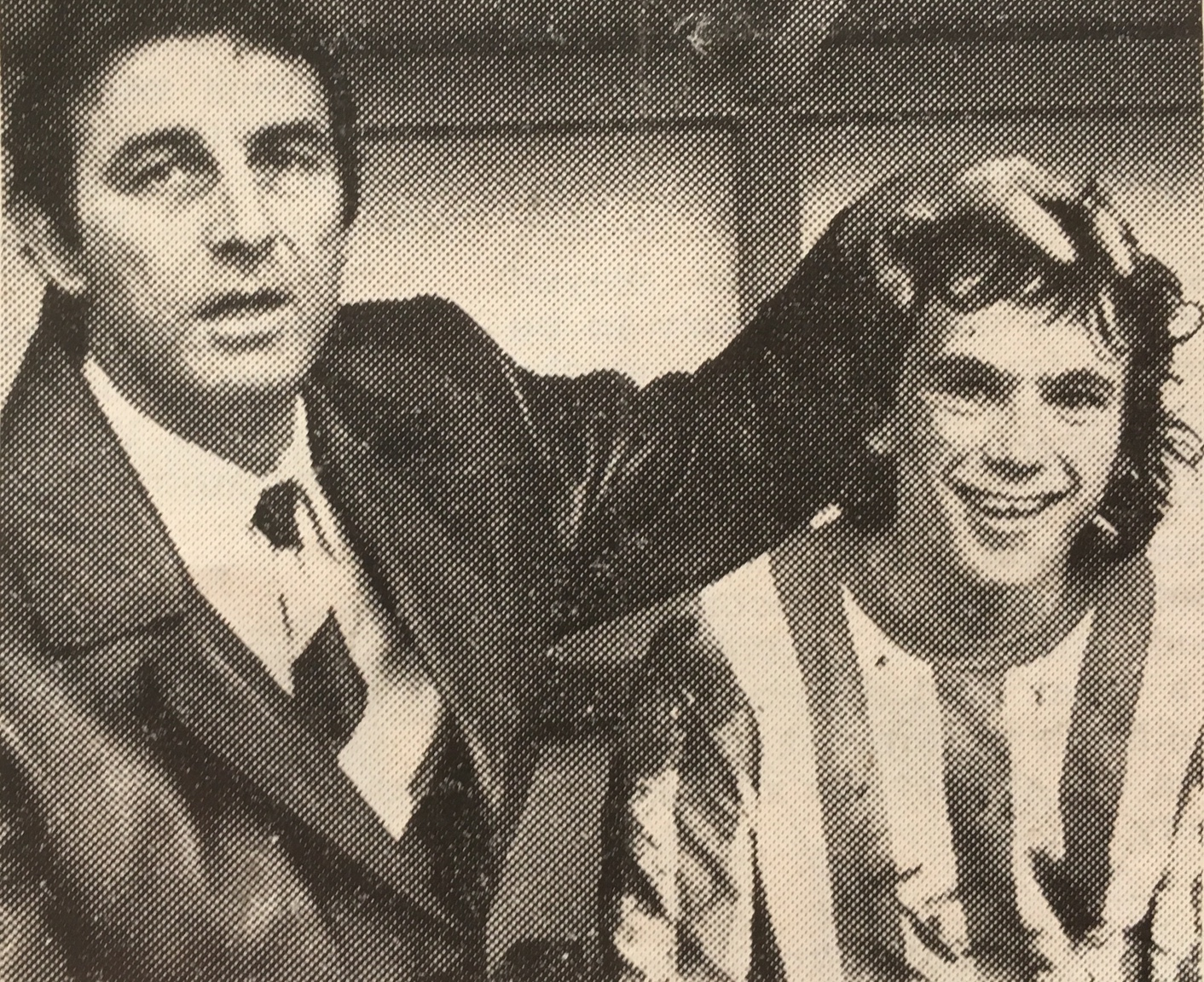
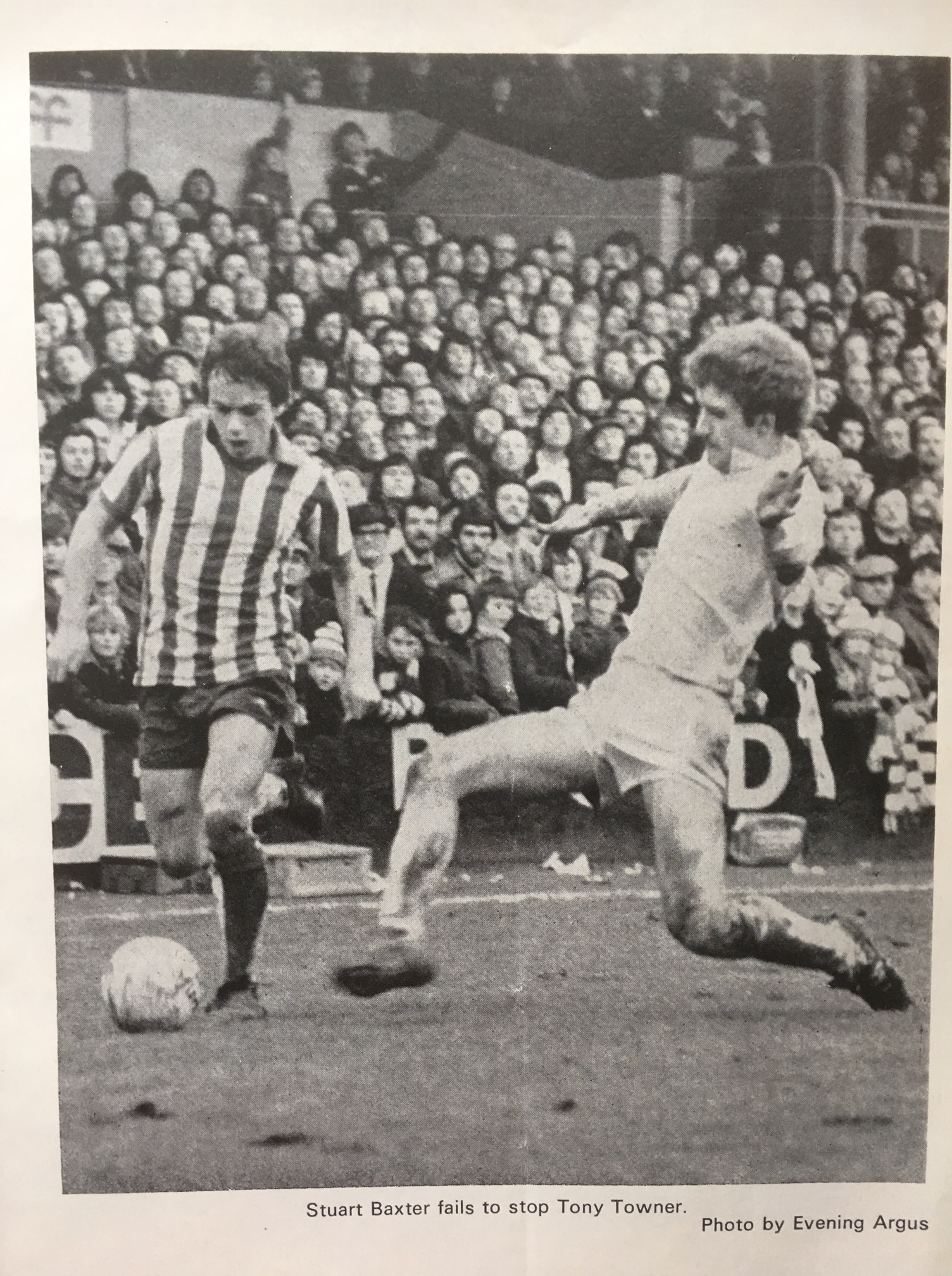
Pictures mainly shot by Evening Argus photographers and then reproduced in the Albion matchday programmes show a happy Towner congratulated by manager Pat Saward after his league debut, in familiar pose taking on a full back, getting in a trademark cross, in full flight on the wing, and finally on a Wolves album sticker.

Did Chris Ramsey’s injury alter outcome of 1983 FA Cup Final?

2-near-post-guardBRIGHTON & HOVE Albion’s May 1983 FA Cup Final clash with Manchester United was historic for the club and for their 21-year-old right back it was even more eventful.
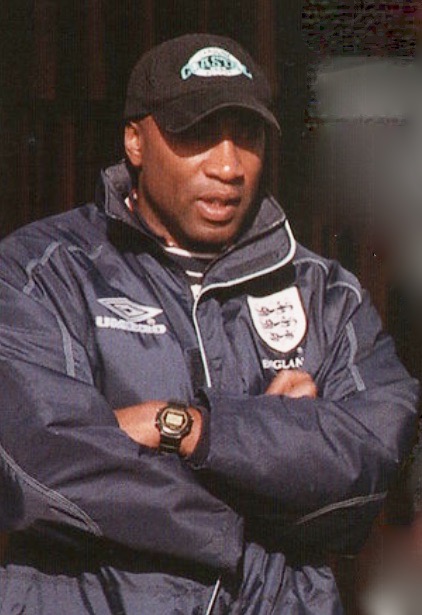
Who would have known that former Bristol City apprentice Chris Ramsey’s ignominious departure from the field in a firemen’s lift on Glen Wilson’s shoulder would more or less be the end of an all-too-brief playing spell in the top echelons of the English game?

Might the match – and Ramsey’s career – have panned out differently if it hadn’t been for that diabolical tackle by Norman Whiteside?

Trouble had been brewing in the weeks leading up to the final and the national media, looking for every possible angle to pick at, had singled out Ramsey for criticism. Did that stoke the fire?

Let’s rewind a little and explore what happened.

Born in Birmingham on 28 April 1962 , Ramsey, whose father came to the UK from St Lucia, was one of two boys and five girls. Rejected by Charlton Athletic as a schoolboy, he became an apprentice at Ashton Gate but was then released and, after a successful trial, Brighton took him on.

The 1980-81 season was Albion’s second in the top division and, as it drew towards its close, it was looking increasingly likely they were heading for relegation.

Manager Alan Mullery was openly criticising his players for their efforts and his big ally off the field, vice-chairman Harry Bloom (current chairman Tony Bloom’s granddad) had died of a heart attack on the team coach on an away trip to Stoke.

Something had to change and, at the tender age of 19, Ramsey was called up from the reserves and plunged in at the deep end.

In three of the last four games, he took over the no.2 shirt after Mullery switched John Gregory from right back into midfield. Ramsey’s debut came in a crucial Easter Saturday clash away to rivals Crystal Palace when, released from the shackles of defending, Gregory scored twice in a 3-0 win. Ramsey also played in the wins over Sunderland away and Leeds at home.

The Seagulls stayed up by the skin of their teeth and Evening Argus reporter John Vinicombe said in his end of season analysis that Ramsey had been “a revelation” in those three games.

Within a matter of weeks, Mullery quit as manager in the furore over chairman Mike Bamber selling Mark Lawrenson to Liverpool (after Mullery had already agreed a deal to sell him to Manchester United).

Gregory was sold to QPR for £300,000 but, far from that move opening up an opportunity for Ramsey, Mullery’s replacement Mike Bailey brought in on a free transfer from Loftus Road the experienced Don Shanks, who was immediately installed as the first choice right back.

Indeed Bailey froze out Ramsey for the following 19 months! At one point he was transfer listed but it was Bailey who departed the Goldstone first – his sacking working to the advantage of the young defender.

When George Aitken and Jimmy Melia took over in December 1982, Ramsey was instantly promoted from the reserves and seized his opportunity.

In a profile in an Albion matchday programme in February 1983, Ramsey told Tony Norman: “Like any other young apprentice, my dream was to play in the First Division. I must admit that even after coming to Brighton, I had times when I wondered if I’d make it. But now I’ve got my chance and I’m keen to make the most of it.”

In one of the most comprehensive profiles on Ramsey, former Brighton teammate, Andy Ritchie, told Adam Ellis of The Football League Paper: “He was quite a shy lad back then but he had everything you want in a full back. Aggression, pace, agility – and he could tackle like a demon.”

These were the attributes that Melia appreciated too. In a Daily Mail preview of the Norwich quarter final, Melia told reporter Brian Scovell: “The other players love playing with him. He’s a great competitor, tackles well and uses the ball with a bit of style.

“I’m pleased he’s taken his chance. He deserves to play at Wembley if we manage to get there.”ramsey + mel

As it turned out, Ramsey’s place was in jeopardy because of two sendings off in the league in April which led to him being banned for the semi-final against Sheffield Wednesday at Highbury.

After being sent off in a 2-1 home win over Spurs, Terry McNeill reported in the News of the World: “Ramsey was lucky to stay on earlier after bringing down Mark Falco in a probable scoring position. When he took the striker again from behind, there was no escape.”

The 20-year-old Ramsey was fairly phlegmatic about the situation and told Alex Montgomery of The Sun: “Whatever I did, I did for the club. You can’t think about Cup games when you are struggling for points at the bottom of the First Division.”

His second dismissal, along with Coventry’s Steve Jacobs (who later played for the Albion under Chris Cattlin) after a scuffle in a 1-0 win at the Goldstone, was lambasted by one of the pre-eminent football writers of the day, Frank McGhee of the Daily Mirror.

“Can Brighton afford to field at Wembley a man who by then won’t have been able to play for 19 days?” he intoned. “And can they trust Ramsey not to sully soccer’s great state occasion by a moment of blind madness?”

Nevertheless, after Wednesday were beaten, Melia was happy to restore his first-choice right back to the starting line-up but one wonders now whether Ramsey had a sense of foreboding about how the big occasion would unfold.

Reflecting on those dismissals in the build-up to the final, he told The Sun’s Montgomery: “I just hope people aren’t looking for me. I’ll certainly be careful. I honestly don’t think I deserve the reputation which I’ve been saddled with in the last few weeks.

“The dismissals were just coincidences – nothing more than that. I know I am an aggressive type of player but that is my game. I always want to give 100 per cent for the club. The last thing I want is trouble at Wembley.”

After Albion had taken a shock lead through Gordon Smith’s header, United piled on the pressure and Ramsey headed a goalbound Gordon McQueen effort off the line.

But then came a pivotal moment early in the second half. Tim Carder and Roger Harris record it thus in their excellent Seagulls! The Story of Brighton & Hove Albion FC: “Whiteside went in high on Ramsey’s shin as the Albion full back cleared, and then trod on his ankle. The referee had a strong word with the United forward but did not signal a foul.”

The tackle had rendered Ramsey lame and while he tried in vain to carry on, two minutes later he wasn’t able to challenge for a ball to the far post which Frank Stapleton duly dispatched to equalise.

Those of us watching in the stadium, together with millions glued to TV screens around the world, saw Ramsey carried from the Wembley turf and, in those days of only one substitute, wondered how Albion would cope with a makeshift defender in the shape of Gerry Ryan.

After United took the lead through Ray Wilkins, Ramsey’s friend – and fellow England under-20 teammate – Gary Stevens’ equalised to send the game into extra time and ultimately a replay. Stevens was adamant about the impact Whiteside’s challenge had on the game.

In Match of My Life, edited by Paul Camillin, he said: “It was a bad tackle and perhaps cost us the game. In those days we only had one substitute and Gerry Ryan came on and did a great job at right back, even though he was a midfield player, but we did miss Chris because he had been having a great game.”

Whiteside was unapologetic about the challenge but Ramsey fumed to The Sun’s Montgomery: “It could have broken my leg. If I’d done it, I’d have been off. I just can’t understand how Whiteside got away with it.”

The injury deprived Ramsey of the chance to play in the replay five days later and, after that sad exit, his playing career never reached similar heights again.

Indeed he actually only played 37 games for the Albion, most of those coming in that 1982-83 season. He played only a handful of games in the following season and in August 1984 went on loan to Swindon Town before joining them permanently four months later.

There, he played alongside the likes of Sky Sports reporter Chris Kamara and one-time Albion assistant manager Colin Calderwood and clocked up over 120 appearances, including being part of Lou Macari’s Fourth Division champions in 1986 and Third Division play-off winners in 1987.

In August 1987, he joined Southend United but played just 13 games for them before persistent back injuries forced his early retirement at the age of just 26.

Some business ventures he embarked on didn’t work out and former Albion right back rival Shanks set him up with a trial for a team in Malta, Naxxar Lions, where he made a playing comeback.

Eventually the ongoing injury problems made him look to other ways of making a living. He coached in the United States but also started studying like crazy.

Amongst lots of qualifications, he got a Master’s degree at the University of North London in Health, Physical Education and Recreation (a qualification which enabled him to become a primary school teacher) and simultaneously obtained his UEFA coaching badges.

That Football League Paper piece records: “With an MSc, ten diplomas and myriad other qualifications, Ramsey is so highly educated that he actually sets the test for pro licence candidates.”

ramsey EngA stint in charge of youth development at Leyton Orient and coaching Newham Ladies was followed by an FA appointment as coach to the England under-20 side in the 1999 FIFA World Youth Championship when among the players under his direction were Ashley Cole, Peter Crouch, Matthew Etherington and John Piercy, who later played for the Albion. At the FA he learned from the likes of Les Reed and one-time Albion winger Howard Wilkinson.

He had a short and unsuccessful three-month spell as assistant to Ricky Hill at Luton Town, and he said: “Ricky Hill was a massive inspiration to me.”

Just when it appeared new offers had dried up, Ramsey got the chance to manage Charleston Battery in the USA, where he stayed for three years.

Winning the USL A-League (second division) with Battery in 2003 brought him to the attention of Spurs, and, as head of player development, many of the young players he coached in tandem with Les Ferdinand and Tim Sherwood were Harry Kane, Ryan Mason, Danny Rose, Nabil Bentaleb, Andros Townsend, Steven Caulker and Jake Livermore.

“He was massive for all of us,” French midfielder Bentaleb told The Football League Paper. “He believed in us, he encouraged us. He told the manager we were ready when everyone else believed we were not. He was not shy or scared of anybody and he knew exactly what he wanted.”

chris ramsey (spurs)In the Evening Standard in 2012, Spurs and England centre back, Ledley King, said: “He is one of the best coaches in the country. The youngsters love the way he works and they have really bought into his methods.”

Ramsey left Spurs in 2014 to take up a coaching role at QPR, and when Harry Redknapp left the floundering Hoops in February 2015, Ramsey stepped up to become a fully-fledged Premier League manager.

He was not able to halt Rangers’ relegation from the elite, though, and lasted only until November in charge of the side as they struggled to come to terms with life back in the Championship.

However, in January 2016, he was appointed technical director at QPR to oversee the club’s academy coaching and player development.

The club’s director of football, Ferdinand, told The Guardian: “While we were disappointed things didn’t work out with Chris at first team level, we were determined to retain his services. As such, we actually put a clause in his contract which allowed us to retain Chris’s services in a player-development role should things not work out for him as head coach.”

Ramsey finally left QPR in January 2024. By then 61, the head of coaching and technical director told the club website: “I have had a fantastic nine years at QPR and the club will always have a special place in my heart.”

The club’s chairman Lee Hoos said: “Chris has been a great servant to the club. I cannot thank him enough for his incredible hard work, dedication and guidance.

“However, as we thoroughly rationalise everything we do, and following very amicable discussions with Chris, it is felt this move is in the best interests of all parties. He will always remain a friend of the club.”

  • Shootthedefence.com did a face-to-face interview with Ramsey on 23 September 2016 which is well worth a listen as he talks in detail about his whole career.
  • In pictures from my scrapbook, Ramsey graces the cover of an Albion matchday programme; (top) he defends the near post during the 1983 FA Cup Final with Gordon McQueen in attendance; he is photographed by Tony Norman outside the Goldstone and criticised in the Daily Mirror by Frank McGhee.