Boss feistily defended crowd-heckled Bobby Smith

B Smith white actionTOUGH-TACKLING midfielder Bobby Smith made more than 200 appearances for Manchester United’s reserve side.

He played alongside emerging talents such as George Best and Nobby Stiles but wasn’t able to follow them in making the step up to the first team.

Like many before and since, he had to look elsewhere to establish a career in the game, and 85 of his 307 senior career appearances came in the colours of Brighton & Hove Albion, the fourth of seven clubs he served as a player.
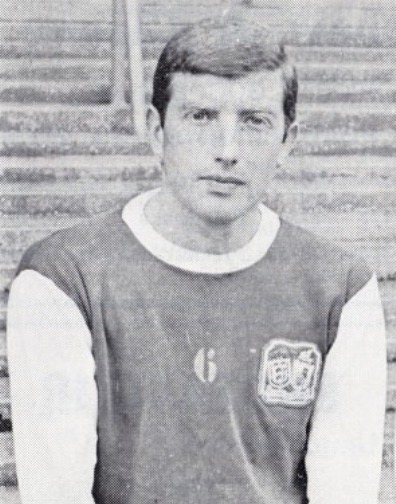
Smith stayed in the game as a manager and coach for 26 years after hanging up his boots, his most notable achievement coming in December 1979 as boss of Third Division Swindon Town when they overcame the mighty Arsenal in a thrilling League Cup quarter final.

Born in Prestbury, Cheshire, on 14 March 1944, Smith won six England Schoolboys (under 15s) caps, playing right-half with future World Cup winner Martin Peters playing on the left.

He went on to win two England Youth caps: on 9 March 1961, he was in an England side (which also included John Jackson in goal and future Luton and Spurs boss David Pleat) that lost 1-0 to the Netherlands in Utrecht and three days later was again on the losing side, this time 2-0, to West Germany in Flensburg, when teammates included John Milkins, Portsmouth’s ‘keeper for many years, and striker John O’Rourke, who played for various clubs. Smith turned professional with United the following month.

MUFC REs v WBA

I’ve discovered an old programme (above) for a Man Utd reserve fixture against West Brom during that era. It shows Smith alongside Wilf Tranter (who also later played for Brighton, and was Smith’s assistant manager at Swindon), Nobby Stiles in midfield, and George Best on the left wing.

In 1964, when a first team call-up continued to elude Smith, he lowered his sights and went to play for a former United colleague at Scunthorpe United. That colleague was Freddie Goodwin who would later be his manager at Brighton as well.

At Scunthorpe, Smith finally saw league action and played 87 games in two seasons before being transferred for £8,000 to Grimsby Town. In two years with the Mariners, he played 56 games before joining the Albion in June 1968.

My distant memory of Smith was of a tough-tackling midfielder who was in the shadow of the likes of Nobby Lawton and Dave Turner when it came to his popularity with supporters. And manager Goodwin hit back strongly when a section of fans voiced their disapproval of the player.

Smith scored the only goal of the game after only 50 seconds away to Stockport County on 23 January 1970, but in the previous home game (a 2-1 win over Bradford City) there had been a few shouts from the terraces in Smith’s direction.

In his weekly article for the Brighton and Hove Herald, Goodwin said: “I was most disappointed to hear certain sections of the crowd getting at Bobby Smith.

“He has done nothing to warrant this behaviour. He is a 90-minute aggressive player and his value to the team lies in his ability to win the ball from the opposition.

“He is well aware of his limitations as a player, but there is no-one who can accuse him of ever giving less than 100 per cent.

“This sort of behaviour by a small minority of spectators does nothing to help the team or the individual players.

“Any player who takes the field as a representative of Brighton and Hove Albion does so because he has been selected for the team by me.

“It is my responsibility that a player represents the Albion. So, to barrack any player is most unfair to him.”

Smith in action against the backdrop of the packed East Terrace at the Goldstone. Albion won 4-0

His 85 games for the Albion came across three seasons: 33 in 1968-69 and 26 in each of the following two seasons. Goodwin’s successor, Pat Saward, released him at the end of the 1970-71 season, and, in June 1971, he went on a free transfer to Chester City.

After only four months in the North West, he switched to the North East, joining Hartlepool United, initially on loan. Over two years, in which Len Ashurst’s side only just avoided the old re-election places, Smith played in 76 matches before moving on to Bury in August 1973. He signed as a player-coach but didn’t feature in the league side, instead taking over as manager – aged only 29 – from Allan Brown in December 1973.

It was the start of a coaching and managerial career that would span more than a quarter of a century.

He took Bury to promotion from the fourth tier by the end of that 1973-74 season, and remained in charge for just under four years, He was at the helm for a total of 215 games; the record books showing he achieved a 41.9 per cent win rate.

A six-month stint followed at Port Vale, between November 1977 and May 1978, but, of his 33 games in charge, he only presided over six wins (there were 14 draws and 13 defeats).

Swindon paid £10,000 compensation to lure him to the County Ground, where, as mentioned, his assistant manager was the aforementioned Tranter.

The official Swindon website remembered: “Despite being a relatively young manager, he guided Swindon to a promotion challenge in his first season in charge – missing out by three points, after losing the last two games of the season.”

Part of the secret had been Smith’s signing of strikers Andy Rowland and Alan Mayes.

Swindon w BS WTSmith (far right) as manager of Swindon, with Tranter (far left), Chris Kamara (circled back row) and skipper Ray McHale (centre front row).

His major achievement came the following year, when Town beat Arsenal 4-3 in a replay to reach the League Cup semi-final.

When one considers the size of League Cup game crowds now, it seems extraordinary to discover around 7,000 Swindon fans (in a gate of 38,024) had made the trip to Highbury for the initial tie, which finished 1-1.

The Gunners had famously lost to lowly Swindon in the 1969 League Cup Final at Wembley, so the humble Wiltshire club smelled history repeating itself.

In the replay, with 21,795 packed into the County Ground, Steve Walford and John Hollins scored own goals and future Brighton manager Liam Brady scored twice for Arsenal. One of the key players for Swindon was future Sky Sports reporter Chris Kamara.

Striker Rowland, who scored an extra time winner, relived the momentous occasion in an interview with SwindonWebTV.

Smith on Focus

Unsurprisingly, the giant killing attracted plenty of media attention and Smith was interviewed live on Football Focus by presenter Bob Wilson.

Smith pointed out that his side had been well grounded and, after the initial draw against Arsenal, had thumped his old club Bury 8-0, equalling Swindon’s biggest winning margin in a league game. Amongst the scorers were Rowland and Billy Tucker – two of four ex-Bury players in Swindon’s starting line-up. Another was Brian Williams – Bury’s youngest ever player – and one of the other goalscorers, Ray McHale, (later to play for Brighton in the top division) went on to have a loan spell at Gigg Lane later in his career.

The Robins beat top-flight opponents Wolverhampton Wanderers 2-1 at home in the first leg of the semi-final but went down 3-1 at Molineux in controversial circumstances, Wolves scoring the decisive goal five minutes from the end.

“We were so unfortunate because Wolves should have been down to 10 men,” Kamara told the Swindon Advertiser. “Alan Mayes got hit by the goalkeeper (Paul Bradshaw). He came out of his goal, didn’t get anywhere near the ball and he clattered Alan and broke his two front teeth and his nose but didn’t get sent off.

“I know everyone looks at situations and says ‘You were unlucky’ but that was a turning point in the game, and we ended up losing.”

It later emerged that the tie could have had a dramatic impact on Kamara’s playing career. In a 2010 interview with FourFourTwo magazine, he explained how he was once on Manchester United’s radar during Ron Atkinson’s reign.

“I was at Swindon and my manager Bobby Smith said, ‘Big Ron’s coming to watch you.’ We were playing in the 1980 semi-final of the League Cup against Wolves, but I had the ’flu and didn’t play so well. I’m not saying that’s the reason he didn’t sign me, but Ron went back to his old club, West Brom, and signed Remi Moses instead.”

With the benefit of hindsight, the cup run took its toll on the Swindon side. Before the semi, they were just five points from a promotion place, with four games in hand. But only five of their last 18 games were won, and they lost nine away games on the trot, resulting in a disappointing 10th place finish.

Smith had spent large –  by Swindon’s standards –  including £250,000 on two players, David Peach and Glenn Cockerill, both of whom never fitted in at the club.

When Swindon lost their first five matches of the 1980-81 season, Smith was relieved of his duties.

He later took charge at Newport County and Swansea City, as well as coaching at the Swans, Blackpool, Cardiff City, and Sheffield Wednesday, together with a spell as assistant manager of Hereford United.

He was assistant manager to Frank Burrows at the Vetch Field but when the chairman at the time announced his intention to sell up, and no funds were being made available for new players, Burrows left of his own accord and Smith became caretaker manager.

Contributor Colin_swansea, on the fans website scfc2.co.uk, observed: “After Tosh left we had caretakers Doug Livermore for 30 days, Les Chappell for 23 days prior to Tosh returning, and after Tosh had left for a second time on the 5th March 1984 Les returned as caretaker until the end of the season.

“Our manager’s position was even more farcical after Frankie Burrows left with his assistant Bobby Smith taking over until a bust up during the Xmas period when Doug Sharp wouldn’t sanction the buying of rubber studded boots to combat the winter conditions.

Smith interviewed after his Swindon side held Spurs to a 0-0 draw in the FA Cup

“Smith left on 22 December 1995, Jimmy Rimmer was caretaker to 7 February 1996, Kevin Cullis became manager for a week, a two-game spell of two defeats, Rimmer returned for eight days as caretaker, before Jan Molby’s appointment on 22 February 1996. Molby’s replacement as manager on 9 October 1997 was Micky Adams who lasted 13 days and three league defeats with his assistant Alan Cork taking over until the end of the season.

“Cork didn’t fit the profile for the club’s new owners, Silver Shield, and he was offloaded at the end of the season. Ironically his successor, John Hollins, didn’t sign one player the following season when the club reached the play offs.

“Never a dull moment being manager of the Swans during the 80s and 90s!”
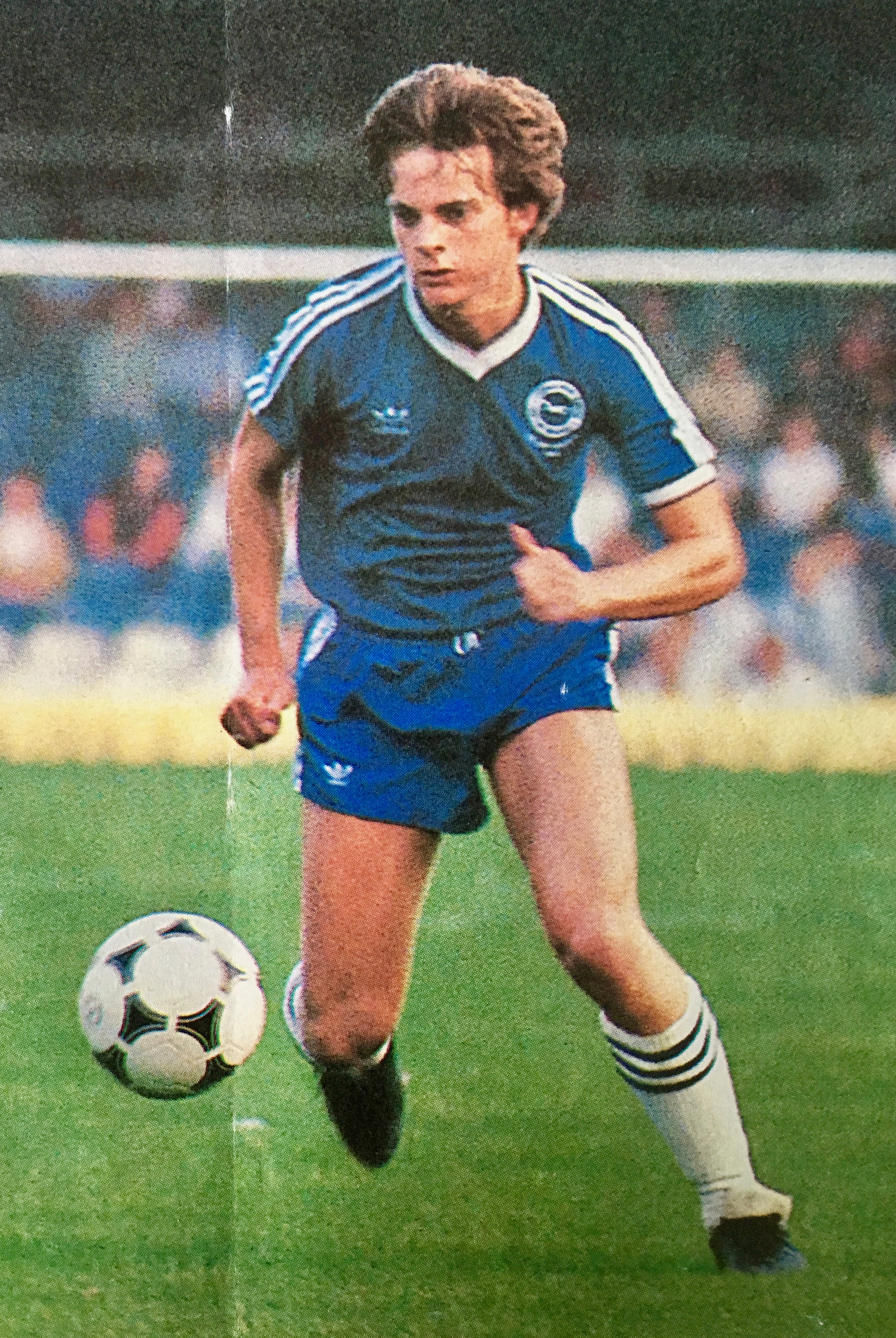
Cup Final was highlight for Irish rookie Gary Howlett

HowlettGARY HOWLETT is probably the least well remembered player of Brighton’s 1983 FA Cup Final side.
There were plenty of other characters, goalscorers and headline makers to detract from the contribution of a quiet lad from Dublin who almost sneaked into the side under the radar.

That Wembley appearance was only his 11th senior appearance in the Albion first team. Can you imagine?

And as the history books now tell us, he actually only made 26 more appearances for the Seagulls before being transferred to Bournemouth.

Born in Dublin on 2 April 1963, Howlett’s football career began at the famous Dublin-based Home Farm club, which produced dozens of footballers who went on to make names for themselves in England and Ireland; players like Paddy Mulligan, Mick Martin and Ronnie Whelan.

Howlett followed suit and had Manchester United and Coventry City keen to sign him. He chose Coventry because manager Gordon Milne made him feel more welcome. Unfortunately, just when he thought he had the chance of a first team breakthrough, Milne was sacked and his replacement Dave Sexton let him go as part of a cost-cutting measure that saw a dozen players leave the club.

In May 1982, he was back home in Dublin watching the FA Cup Final between Spurs and QPR on TV. Not in his wildest dreams did he imagine just a year later he would be playing in what was then a showpiece occasion watched by a worldwide audience.

Coventry’s youth team manager, John Sillett, had tipped off Mike Bailey about Howlett’s availability and the Albion took him on. Howlett was soon involved in first team training and believed he was on the verge of making the team away at Coventry, of all places, in early December 1982. But Bailey was sacked and it wasn’t until the beginning of March that Howlett finally made the step up.

He was a non-playing substitute for successive away games against Swansea City and West Ham and then, on 22 March 1983, newly-appointed manager Jimmy Melia gave him his first start, at home to Liverpool. And what a debut! The youngster scored as the Seagulls held the league leaders to a 2-2 draw.

With fellow Irishman Gerry Ryan sidelined by injury, Howlett kept his place in the team for a couple more games, sat out two, and then returned to the starting line-up.

Because Ryan was not 100 per cent fit, it was Howlett who got the nod for the FA Cup semi final match against Sheffield Wednesday. He then retained his place for the remaining six league games before being picked for the Cup Final itself.

That momentous match on 23 May 1983 was only 13 minutes old when the young Dubliner made a telling contribution to the game.

It was his chipped diagonal pass over Manchester United centre back Kevin Moran that found Gordon Smith, who arched a header past Gary Bailey to put the Seagulls in dreamland.

Howlett told the press after the match: “I saw Gordon at the back of the goal and just dipped it over Moran.

“I was dying to do something good out there and when the goal came I couldn’t believe it.”

Howlett told the Argus he wasn’t overawed by the occasion but had felt nervous when the national anthem was played.

“Until then all the lads were laughing and joking. It was a great atmosphere beforehand – very relaxed,” he said.

With Albion snatching a replay, Howlett, aged just 20, got to play on the hallowed turf a second time five days later, thus getting the sort of opportunity that eludes the vast majority of players throughout their entire careers.

He was subbed off on 74 minutes (Ryan replacing him) but the game was dead and buried by then anyway.

For Gary Stevens, that Cup Final was the stepping stone to a glittering career. Unfortunately for Howlett, it was the pinnacle and his career never subsequently reached such heights.

Interestingly, in a matchday programme interview with Spencer Vignes in 2004, Howlett reflected that he should have worked harder to ensure he built on that early success.

“Gary Stevens was only a year older than me. After the cup final, he knuckled down and said ‘I want more of this’. I just thought it was going to happen naturally. I didn’t realise I was going to have to work at it.

“That’s the difference between the likes of me and the real pros, people like Roy Keane. Nothing will get in their way.”

Only five years after those two appearances at Wembley, Howlett was turning out in front of 2,500 crowds at York City’s Bootham Crescent.

There had been one brief bright spot, though, and that came when he represented his country.

On 3 June 1984, he earned a full international cap as a 55th minute substitute in a 1-0 win against China.

That Republic of Ireland team also included Brighton teammates Tony Grealish and Ryan. Mick McCarthy was in central defence and the side was captained by Frank Stapleton.

In the season leading up to that, Howlett managed just 17 appearances, plus two as sub, and in the first part of the 1984-85 season he appeared just six times.

In December 1984, Melia’s replacement, Chris Cattlin, sold Howlett for £15,000 to the then Division 3 Bournemouth, where Harry Redknapp was the manager.

Among his teammates at Dean Court were future multi-club manager Tony Pulis and the much-travelled striker Steve Claridge.

Howlett spent four years with the Cherries, making 60 appearances, although he said he was never the same player after damaging his knee ligaments. In his final year, he was sent out on loan to Aldershot and Chester City. At Aldershot, former Seagull Michael Ring was among his temporary teammates.

Howlett at Aldershot

In January 1988, he made a permanent move to York City, and in three years playing in Division Four with the Minstermen, Howlett played a total of 119 games and contributed 13 goals.

He left them in 1991 and went back to Ireland to play for Shelbourne. He also played for Crusaders and was on the coaching staff of Bohemian FC.

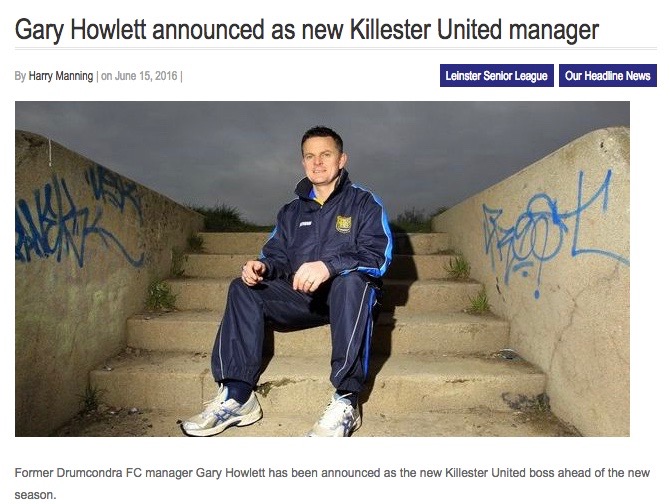
Howlett spent nine seasons as manager of Drumcondra in the Leinster Senior League, before switching to their rivals Killester United in 2016.

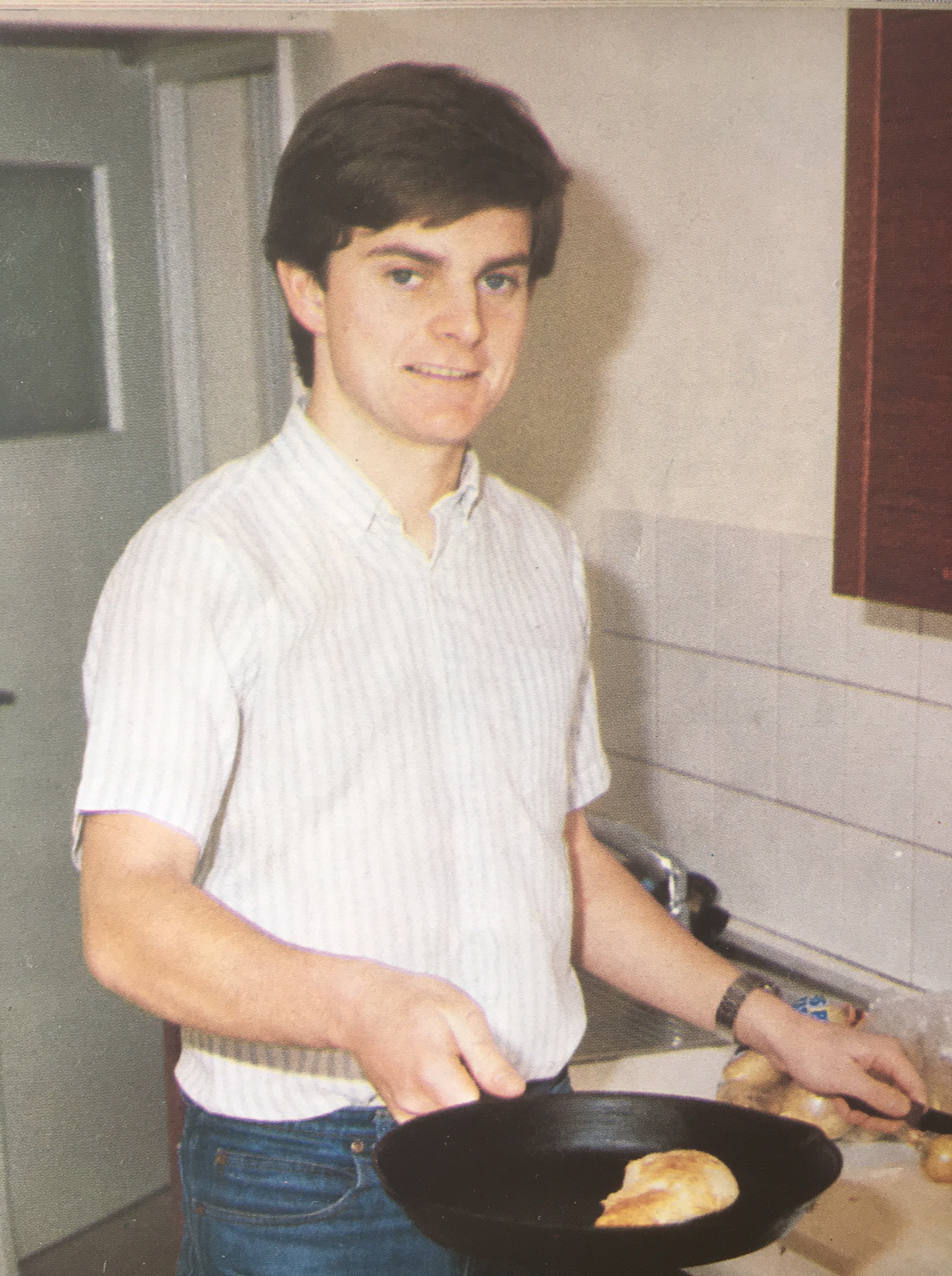
1 howlett2 howlett prog cover3 Howlett cooks by Tony Norman4 howlett now

  • Pictures show Gary Howlett’s entry in the Cup Final programme, on a matchday programme cover, Tony Norman’s shot of him cooking at home and a screen grab of him following a recent managerial appointment. Also, a montage of other headlines and action pictures.

Welsh international Peter Sayer added artistry to Brighton’s rise to the elite

NIMBLE-footed Peter Sayer was certainly a player for the big occasion: a Cardiff City legend and briefly a Welsh national team star.

At Brighton & Hove Albion, he was part of the team that memorably won promotion to the top division for the first time in its history.

He signed for the Seagulls for £100,000 just nine months after playing for his country in what was the only Wales victory over England at Wembley (on 31 May 1977).

Sayer was part of a Welsh team captained by Terry Yorath (father of TV presenter Gabby Logan) but with far fewer household names than their illustrious opponents.

Wales were managed by Mike Smith, the former Hove Grammar School teacher, while Don Revie’s England were captained by Kevin Keegan, playing up front alongside Stuart Pearson and Mick Channon.

The BBC highlights of the match show the diminutive Sayer getting on the end of a Leighton James cross but steering his header wide before James scored the only goal of the game from the penalty spot after he’d been upended by Peter Shilton.

Neil Moxley, for dailymail.co.uk in September 2011 discovered what had happened to that Welsh team since, which included jobs ranging from Wales boss to toilet roll business managers. Sayer, he reported, had become steward at a golf club in Preston, where he moved to after Brighton, and then run a pub in the area.

In Back Pass magazine in August 2013, Sayer was quoted as saying: It was an excellent time at Brighton. There were some very good players at the club and I was playing well.

“I especially remember when we won promotion to the old First Division at Newcastle in 1978-79.

sayer bwhs“We had our own train which we used to travel on to away games. It was great for team morale.”

He added: “I ended up in the reserves even though I was playing well. I got asked to go to Newcastle but failed the medical.

“The club then had an opportunity to sell me to Preston and they perhaps felt they needed to offload some players. Maybe I should have dug my heels in and fought.”

Sayer wasn’t a prolific goalscorer but he did get on the scoresheet in a memorable 3-3 draw at Orient that I went to in April 1979, when Martin Chivers scored his only goal for the Albion and another former Spurs star, Ralph Coates, was among the scorers for the Os.Jackson concedes Sayer

The game was covered by ITV’s The Big Match and broadcast to the nation the day after the game. Sayer scored after ‘keeper John Jackson, who later became a goalkeeping coach at Brighton, parried a Paul Clark thunderbolt and the Welshman cracked in the rebound.

There’s a very detailed look back at Sayer’s career on pneformerplayers.co.uk by Ian Rigby. His report says: “Occasionally he quietly attends Deepdale to watch North End, but on his return to Cardiff City, as a guest, he is treated as a former star player, which he was.”

A televised third round FA Cup tie between Cardiff and Spurs in January 1977 thrust Sayer into the limelight when his winning goal was seen by millions and can still be seen on YouTube today.

Rigby recounts: “He controlled the ball with his head and, with four defenders converging upon him, he smashed the ball past Pat Jennings. A sponsored car was just one of the perks that came Peter’s way after that goal.”

Born in Cardiff on 2 May 1955, Sayer grew up in the city and went to Trelai Primary School then Cantonian Comprehensive School. He played for his school at all levels and at each successive age group for the Cardiff Schools representative side. That led to him winning Welsh international caps at schoolboy level and later at youth, under-21 and full levels too.

He was awarded a professional contract with Cardiff in July 1973 by then manager Jimmy Scoular but he had to wait until February 1974, by which time Scoular had been replaced by former Leicester and Man Utd boss Frank O’Farrell, to make his league debut as a substitute against Blackpool.

By 1975, just as he was beginning to establish himself, he suffered a broken leg and dislocated ankle in a game at Southampton. Eighteen months later, though, he had recovered sufficiently well to earn his first international honour, playing for Wales Under-21s against England, at Molineux.

Sayer ultimately earned seven full international caps including that Home International win against England and two World Cup qualifying games, one being the controversial game against Scotland at Anfield when a diabolical refereeing decision robbed the Welsh.

Nicknamed ‘Leo’ because he sported the same-style perm as the 70s Shoreham-born pop singer who shared the same surname, Sayer was a regular in the Albion’s 1978-79 promotion-winning side.

He initially retained his place as Brighton strove to come to terms with the top division but when Alan Mullery decided to switch the mercurial Mark Lawrenson from defence to midfield, it was at Sayer’s expense.

In August 1980, Preston manager Nobby Stiles, the England World Cup winner, paid £85,000 to take Sayer to Deepdale, but his career there was beset by injuries and he was released at the end of the 1983-84 season and signed for Chester City for one season.

He subsequently played non-league for Morecambe, Northwich Victoria, Chorley and Southport.

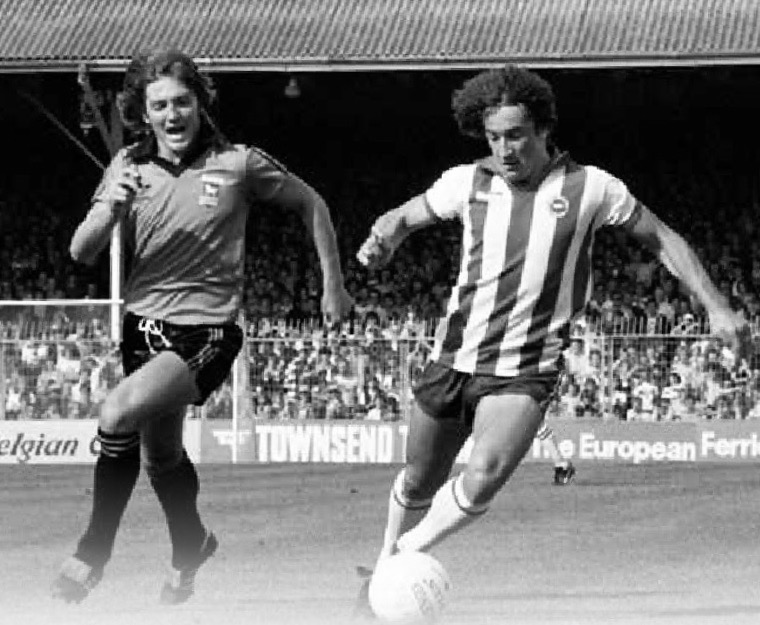
Pictures from my scrapbook show the Albion matchday programme photograph of Sayer scoring in that game against Orient and, from the BBC coverage of England v Wales at Wembley in 1977, the winger looking exasperated after his header has gone wide. Sayer was quite a dab hand at snooker, too.

Ian Mellor – the postman who delivered for Peter Ward

Mellor BHATHE SONGS still sung today that immortalise Peter Ward sadly fail to recognise the man who laid on so many of the nimble striker’s goals.

But fans of a certain vintage will never forget the contribution of former postman Ian ‘Spider’ Mellor.

Nicknamed because of his long-legged build, the beanpole midfielder-turned-striker, scored 31 goals in 122 appearances for Albion between 1974 and 1978.

Born in Wythenshawe on 19 February 1950, Mellor grew up supporting Manchester City and dreamt of playing for them. He went to Sale Moor Secondary School in the city and, aged 15, he was offered a trial at Maine Road but he didn’t get taken on. Undeterred, two years later he got a second chance after bombarding the club with cuttings of his exploits playing Sunday league football in the area.

He lapped up the experience of being coached by Malcolm Allison. It was towards the end of the Bell, Summerbee, Lee era and Mellor managed 40 appearances for City. In March 1973, however, while Allison was ill, chairman Peter Swales sold him to Norwich City for £60,000.

“Malcolm said he left Maine Road because I’d been sold without his permission when he was ill in hospital,” Mellor told the Manchester Evening News.

“I didn’t really stop to think what I was letting myself in for,” he said. “I should have stayed at City and then, to make it even worse, soon after I’d left, Denis Law rejoined the club. I could have been playing in the same team as my idol.”

After Mellor scored the only goal of the game in Albion’s 1-0 win over Allison’s Crystal Palace at the start of the 1974-75 season, Allison said: “I remember Spider when I was at Manchester City.

“I didn’t want to see him leave for Norwich. Directors force you to do that sort of thing, then they sack you. Spider was a late developer, but his timing is so good now.”

Norwich were struggling at the wrong end of the old First Division when Mellor moved to Norfolk and although he agreed to the deal, he reflected years later that he regretted it.

Perhaps, therefore, it was no surprise when Brian Clough arrived at Carrow Road in the spring of 1974 with the promise of making him Brighton’s record signing for a fee of £40,000, he jumped at the chance to play for the league title-winning manager.

Mellor was part of a triple signing from Norwich as Clough persuaded him and centre backs Andy Rollings and Steve Govier to drop down a division to play for Brighton.

Ironically, he never played competitively under Clough because of ol’ Big Ed’s move to Leeds that summer but under Peter Taylor he played mainly in a left-sided midfield role.

It was Taylor’s successor, Alan Mullery, who changed him from a wide midfield player to a centre forward, a position from which he contributed so many ‘assists’ for Ward. Those in the know certainly recognised his contribution.

In Matthew Horner’s excellent biography of Ward, He shot, he scored, Mullery is quoted as saying: “Ian Mellor had the ability: he was a big tall lad and he had super pace and a great left foot. I thought that they would form a terrific partnership.

“In my opinion, Mellor was wasted in midfield. He could hold on to the ball and he’d learnt his skills from Malcolm Allison and Joe Mercer at Manchester City, who were both great coaches. He shouldn’t really have been playing at the level we were at – he was too good – but he was and that was great for us.

“Spider would get the ball to him and Peter would go on these mazy runs and, nine times out of 10, would knock the ball into the back of the net.

“The partnership is history now but they were absolutely fantastic together.”

Former Albion colleague, now BBC pundit, Mark Lawrenson said of him: “Playing Ian Mellor alongside Ward was the masterstroke really – Mellor was an out-and-out footballer and a perfect partner for Wardy.”

Club skipper at the time, Brian Horton, added: “In the first year Ward and Spider were unbelievable. We didn’t have a big target man but the movement with those two was fantastic. They got about 50 goals between them and I chipped in with about a dozen more.”

Ironically one of the stand-out games of his Albion career, on 3rd May 1977, came against Albion’s play-off opponents, Sheffield Wednesday, in front of 30,756 fans at the Goldstone.

Argus reporter John Vinicombe named him his Albion man-of-the-match as Wednesday were beaten 3-2 to earn promotion.

Not long into the following season, Mullery splashed £238,000 on centre forward Teddy Maybank from Fulham and he went straight into the team alongside Ward, which unsurprisingly didn’t go down well with Mellor.

“I knew I was better than him, but they had to justify his price and that’s why I got dropped,” Mellor maintained in a an Albion matchday programme interview with Spencer Vignes. Mellor requested a transfer in spite of chairman Mike Bamber urging him to stay.

“In hindsight, of course, I should have stayed,” said Mellor. “I was still good enough. I was 29, with two good seasons left in me.”

Instead, in February 1978, he moved back to his native north west from Brighton to play for Chester for two years but then had three years at Sheffield Wednesday where he managed 11 goals in 70 games and, like his spell alongside Ward, provided a perfect foil for Terry Curran to bang in the goals.

He ended his career at Bradford City and later worked as a commercial executive for the PFA. He also worked for football boot supplier Puma and was a representative for football kit supplier Pelada.

Younger readers will be more familiar with the former Liverpool striker Neil Mellor, who now works in the media, who was one of Ian’s sons.

Ian Mellor died aged 74 in Cheadle on 1 May 2024 after a long battle with amyloidosis.

  • Pictures from my scrapbook and Albion matchday programmes show headlines Mellor made and the player in action.

scrapbok mellor

A little less hirsuit than in his playing days…