Jamie Moralee’s pitfalls a valuable lesson for future prosperity

IT WOULD BE an understatement to say striker Jamie Moralee had mixed fortunes during his time with Brighton.

A one-time £450,000 signing, the former Crystal Palace player joined the lowly Seagulls on a free transfer when they were playing home games in exile at Gillingham in 1998-99.

His lack of goals earned a certain amount of derision from the handful of Albion followers who supported the club in those dark days.

And on one infamous occasion, in March 1999, he managed to get himself sent off within a minute of going on as a late substitute, without touching the ball.

Moralee sees red at Scunthorpe

To make matters worse, the punch he threw didn’t even catch the opponent, John Eyre, who promptly added to Albion’s woes by completing his hat-trick in a 3-1 home win for Scunthorpe United.

The Argus put Moralee’s “moment of madness” down to frustration at so regularly being on the subs bench (16 times – and only sent on in eight of them).

“He did not actually connect, but the intent was obvious and the resulting red card inevitable,” the newspaper reported.
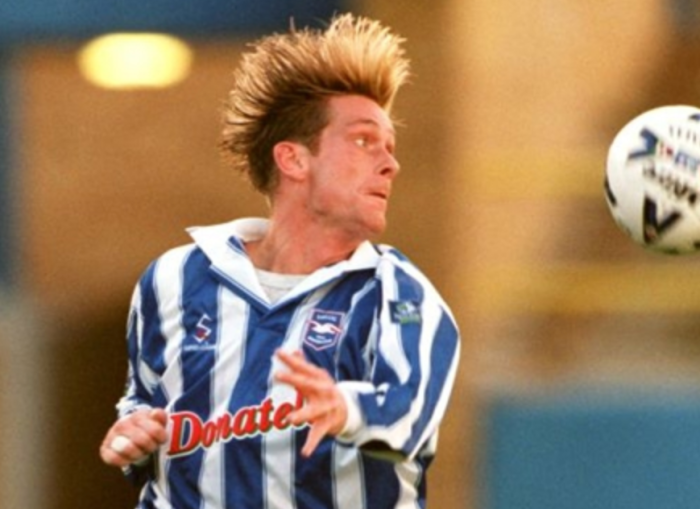
Signed at the start of the season on a month-to-month contract, Moralee had a run of 14 starts under Brian Horton but after scoring just the one goal (in a 3-1 defeat against Mansfield), he was dropped to the bench.

Just before Horton quit to move to Port Vale, he gave Moralee a contract until the end of the season and in January, after Jeff Wood briefly took charge, the player hoped his impact as a sub when laying on a winning goal for Paul Armstrong against Scarborough would help change supporters’ views of his contribution.

“It was nice to be a bit of a hero for a change,” he told The Argus. “I was a bit unlucky with a goal which was disallowed at Chester in the game before and I just want to get on with Brighton and do my best.

“I’ll take the credit because I’ve not had much this season. Hopefully the corner has turned for me.”

Moralee said he had been asked to play several different roles and reckoned much of the criticism aimed his way was unjustified.

Moralee gets stuck in

“I feel I have done all right,” he maintained. “I don’t think the supporters really appreciate me and they let me know that when I came on, but I will just keep doing my job.

“The players give me all the support I need and I am confident enough to go out and do the business. I certainly won’t hide.”

Having missed several matches after the red mist descended at Scunthorpe, a third manager arrived in the shape of Micky Adams, and Moralee started the last seven matches of the season under the new boss, scoring once.

Moralee slides in

But it wasn’t enough to earn a new deal and Moralee was one of eight players released at the end of the season. Having played under three managers in one season for the Albion, there was swift change in the dugout at his next port of call too.

He began the next season up a division with Colchester United, whose manager Mick Wadsworth said: “I remember him as a very outstanding young player with Millwall. We watched him several times during last season.

“He is very sharp in and around the penalty box and his hold-up play is exceptional – a quality we were sadly lacking in the season just gone.

“Jamie was an outstanding prospect as a young player with Millwall and was sold on to Watford for £450,000 around five years ago before his career became blighted by injuries.

“Last season was his first full season for some time as he battled to shrug off a string of injuries and has probably used Brighton to get back to full fitness and match sharpness.”

The season was only three games old when Wadsworth resigned and was replaced by Steve Whitton who saw his United side beat Reading 3-2 in his first match (Warren Aspinall scored twice and Nicky Forster scored one for the visitors). Moralee, making his league debut for Colchester, was subbed off on 76 minutes.

After that, Colchester went on an 11-game winless run and other than a positive spell in January, had a forgettable season and finished third from bottom. Moralee made 21 starts plus eight as a sub.

Born in Wandsworth, London, on 2 December 1971, Moralee joined Palace as a YTS trainee, working his way through the levels alongside Gareth Southgate. He was a regular in the Palace reserves playing up front with Stan Collymore.

But after just two first team starts and four sub appearances under Steve Coppell, he was traded as a makeweight in exchange for Millwall’s Chris Armstrong.

Happy days in the Lions’ Den

When unveiled to Lions fans in a matchday programme article, Moralee boldly declared: “Having broken though into first team football with Palace last season and learned from strikers like Mark Bright and Garry Thompson, I feel I’m ready to come to a club like Millwall and score twenty goals a season.”

Amongst the goals for Millwall

Of the player he swapped places with, he even went as far as to say: “Chris was quick and by all accounts did very well here in the opening games this season, but I’ll score more goals than him.”

Continuing in a similar vein, he added: “I’m most effective in the box, I like the ball into my feet and, at the risk of sounding over confident, if I get the chances I’ll score goals for you.”

True to his word, Moralee did get amongst the goals for Mick McCarthy’s side and 20 goals in 63 appearances (plus 13 as a sub) over two seasons earned him a £450,000 move to Watford.

Moralee made a big money move from Millwall to Watford

But the Glenn Roeder signing had a tough time with the Hornets, only seeing his fortunes change after Graham Taylor returned to the club as manager. He explained the circumstances in a full-page piece in the Wolves v Watford matchday programme of 30 March 1996.

“Glenn bought me to play up front with a big target man, which I was used to at Millwall. But the partners I had were all smaller than me and I was now the big target man, a role that did not suit me and one that I do not enjoy.

“I had always been used to scoring, something that wasn’t happening, and this resulted in a loss of confidence.

“The intentions were there, but I needed a big target man to feed me the ball. It just did not work out.”

When Taylor took over from Roeder, Moralee got back the starting place he’d lost and learned how to play as a lone striker. “It is a lot of work but I believe I have developed into a better all-round player,” he said. “It is nice to have a manager with a little faith in me.”

After Watford were relegated to Division Two, in the summer of 1996 he moved on a free transfer to Crewe Alexandra where he didn’t register any goals and made just 13 starts and six sub appearances.
He ended the 1997-98 season with Royal Antwerp in Belgium and spent pre-season with Fulham before Horton took him on at the Albion, initially on a monthly contract basis, at the start of the 1998-99 season.

After his season at Layer Road, he linked up with former Crystal Palace colleague Peter Nicholas at Welsh Premier League side Barry Town. He spent three seasons with Barry, winning the Welsh Premier-Welsh Cup double each season. He was also involved in three Champions League campaigns with the club and netted 59 goals in 96 appearances.

Financial problems at Barry led to Moralee moving on and he had spells with Forest Green Rovers, Newport County and Chelmsford City before ending his playing career in 2006.

After retiring from playing, Moralee set up his own football agency, New Era, in conjunction with former Albion teammate Peter Smith, with Rio Ferdinand as its highest profile client.

In an interview for a webinar, Moralee said the agency aims to teach up and coming talented footballers how to avoid the pitfalls that affected his own playing career.

Describing his own “very up and down career with a couple of highs and many, many lows”, he explained to The Player, The Coach, The Person webinar: “When I got a few quid, I was spending it on all the wrong things. Buying cars and watches and going out too much; drinking too much. I wasn’t investing it.”

Hard work, application and a ruthlessness to succeed in life are aspects he’s now passing on having realised they were attributes that would have made a difference to his own career as a player.

“I needed to stay in football in some capacity,” he said. “I didn’t want to be a coach or manager.I knew that young players, if they got to the edge of the pitfalls I fell down, I could help them.”

He is particularly pleased to have helped players who had rejection in their early days who went on to have successful careers, such as Welsh internationals Chris Gunter, Neil Taylor and Ashley Williams.

Moralee spoke openly about his 20-year friendship with Rio Ferdinand in a 2018 film for the ‘Best Man Project’ of The Campaign Against Living Miserably (Calm): an initiative to celebrate the power of friendships which supports men in looking out for their mates.

Opening up on the power of friendships in football

Coppell’s Palace signing Humphrey knew all about ups and downs

FULL-BACK John Humphrey signed for Crystal Palace in lieu of rent his previous club, newly-relegated Charlton Athletic, owed for playing home matches at Selhurst Park!

Humphrey was 29 and with more than 350 senior appearances behind him when Steve Coppell added him to an experienced defence to play alongside Eric Young and Andy Thorn in the old First Division.

It was a level Humphrey was well used to having started out there with Wolves (where he played in the same side as Tony Towner) and at Charlton in a defence that included  Colin Pates.

All that came before Humphrey came to Albion’s rescue in the dark days of the 1996-97 season, as I recounted in my 2020 blog post about him.

This time I’m highlighting his time at Selhurst Park, which he spoke about at length in a January 2023 interview with cpfc.co.uk.

“I saw myself as one of the senior players,” Humphrey remembered. “We had the likes of Richard Shaw coming through and Gareth [Southgate] coming through and we signed people like Chris Coleman and Chris Armstrong. Alongside that we had some experience with Eric Young and [Andy] Thorny, so I hoped I fitted in to part of the jigsaw.

“[The challenge] for me was getting used to the style of play, because at that time I know Stevie was not so much direct but he wanted to get the ball forward as early as possible because of the threat of [Ian] Wright and [Mark] Bright. So, it took me a while to get used to that.

“I do remember after a few games Stevie dropped me for a game to say: ‘This is what I want you to do.’ Then he put me back in… I was part of his restructuring and in that first year it worked out very well.”

So much so that at the end of his first year at the club Palace reached third – their highest league finish in history – and won the Zenith Data Systems trophy (otherwise known as the Full Members’ Cup) at Wembley, beating Everton 4-1.

Humphrey was still playing in the Premier League at the age of 34 and clocked up 203 appearances for the Eagles before briefly returning to Charlton for the 1995-96 season, moving on to Gillingham and then helping out his old Charlton teammate Steve Gritt in Brighton’s hour of need.

Revered at Charlton, chicagoaddick.com wrote of him: “In the five seasons he patrolled our right side of defence he missed only one league game and faced the best wingers and strikers playing in the country at that time: Barnes, Waddle, Le Tissier, Lineker, Rush, Aldridge, Beardsley, Fashanu.

“Maybe it was because we stood in the decrepit Arthur Wait Stand but Humphrey was fantastic to watch up close. Graceful, but strong in the tackle. He was a quick-thinker and a quick mover. He would glide down the right wing and put in some peaches of a cross.”

Humphrey won three consecutive player of the year awards (1988, 1989, 1990) – an honour no other Charlton player has received.

Humphrey in action for the Albion at Gillingham

By the time he arrived at Brighton, he was 36 and had played close on 650 professional matches.

“Steve wanted me because I was experienced, could get the players organised and was able to talk them through matches,” Humphrey told the Argus in a January 2002 interview. “He knew I was steady, reliable and dependable, that nine games out of ten I’d play pretty well and that I would give 100 per cent.

“It was a lot of pressure but I’d been through a few promotions (three) and relegations (six) with Wolves, Charlton and Crystal Palace.” He continued: “The stressful situations I had gone through with those other clubs had given me experience of how to try and keep a season alive.

“I could do a job for Brighton and I felt I did that and the team turned out to be good enough to hang on. It was one of the biggest achievements of my career.”

He added: “It might have been going out of the frying pan of Gillingham into the fire at Albion but I’m glad I made the jump.”

Humphrey looked back fondly on those difficult times and told the newspaper: “They have great fans and the Goldstone was always packed for the home games.

“You couldn’t help but be lifted by the crowd. The team couldn’t win away, but managed to win at home. So, one win every two games was decent and led to that eventful day at Hereford.”

When he left the Albion as part of a cost-saving measure the following season, he turned semi-pro and played initially for Chesham in the Ryman League premier division, then Carshalton, Dulwich Hamlet and Walton and Hersham.

“Having come from the professional ranks to semi-pro it was difficult to adjust to the different standards like some of the attitudes of players to training for instance,” Humphrey said. “Also, I found the training itself wasn’t that enjoyable.

“I remember at Walton and Hersham turning up for a session, but we weren’t allowed on the pitch and had to do a road run. That was frustrating and I begun to think that maybe there were other things in life than just playing football.”

Former teammate Pates was his conduit to a new career as a teacher at Whitgift School in Croydon, where ex-Palace and Chelsea midfielder Steve Kember also joined them.

“I knew Colin from Charlton when we roomed together,” he explained. “I was aware he was at the school and he said he needed help for after-school sessions and asked me to come along.

“So I did and the football took off at the school and I got involved in other sports like rugby and basketball and got a full-time job there.”

He also retained his links with Charlton, coaching their under-15 team, and told the Argus in that 2002 piece: “I deal with privileged kids at Whitgift who may go on to be doctors, lawyers or solicitors while at Charlton the kids usually aren’t so privileged.

“To a lot of them, football is a way of making something of themselves. It gives me a great buzz when one of the Charlton youngsters makes positive progress.”

Humphrey later moved on to become head of football at Highgate School in north London.

Illness put paid to John Piercy’s promising career

A FIVE-YEAR professional football career bookended by 3-1 results against Crewe Alexandra almost certainly wouldn’t have been the path John Piercy would have chosen for himself.

One saw him make a promising debut for Tottenham Hotspur on 13 October 1999, subbed off to a terrific ovation from a 25,000 crowd at White Hart Lane on 74 minutes as they progressed in a League Cup game against the lower league opposition.

The other was a League One defeat for Brighton & Hove Albion at humble Withdean Stadium on 6 November 2004, subbed off ignominiously only 12 minutes into the second half with many in the crowd of 6,163 unaware that the hereditary bowel disease afflicting him was putting paid to his hopes of a football career.

Born in Forest Gate, east London, on 18 September 1979, Spurs first spotted Piercy as a stand-out 12-year-old, talented enough to represent England Schoolboys.

He became a trainee with Spurs at the age of 16 and signed as a professional in July 1998.

It was George Graham who gave him his first team debut for Spurs in that game against Crewe, starting him up front alongside Chris Armstrong in a side that featured future Brighton player and assistant manager Mauricio Taricco in defence.

The Spurs goals were scored by Oyvind Leonhardsen, David Ginola and Tim Sherwood, but spursodyssey.com was full of praise for the young Piercy.

“One young man who will remember this night more than most is 20-year-old debutant John Piercy, who won the home fans’ hearts with two terrific efforts on goal, and an eye-catching performance all round,” it said. They even went as far as to suggest he might be ‘the new Ginola’.

The performance was good enough to earn him a place on the bench for the following Saturday’s Premier League game away to Derby County and he was called into action in the second half to replace Armstrong as Spurs won 1-0.

He made two more league appearances that season and an excellent Spurs archive website said of him: “The solidly built East Londoner had the ability to lead the line and to make chances for his team-mates, by going wide and taking people on.

“Some work was needed on his first touch and his pace, but he was strong, direct and knew where the goal was.  Preferred to play wide on the left of midfield, but was deployed at full back in the reserves to good effect.”

Chris Hughton was the Spurs reserve team manager at the time and said of Piercy: “John is able to adapt well to different roles which is why we’ve played him at full-back in pre-season when we’ve been stretched in those areas.  But I’d say his best position is definitely right or left of midfield.”

On 4 April 1999, he started for England under 20s against the USA in the World Youth Championships in Nigeria, but was subbed off in a game England lost 1-0. His teammates that day included future full international Ashley Cole, and the side was managed by former Albion full-back Chris Ramsey.

john piercyFrustrated by the lack of first team opportunities at Spurs, Piercy, by then based in Eastbourne, opted to join Brighton in September 2002 during Martin Hinshelwood’s brief reign as manager.


Hinshelwood told the BBC: “He’s a player who can play in a variety of positions. That will give us plenty of options.”

A first team breakthrough at Brighton was slow to happen, however, with Hinshelwood’s successor, Steve Coppell, opting for experience in the ultimately unsuccessful battle to avoid relegation from the second tier. Piercy top-scored for the reserves that season, netting 13 goals from midfield.

However, shortly after Mark McGhee’s appointment, he did get some game time and in December 2003 also registered his first league goal in a 1-0 win at home to Wrexham.

Later the same month, he went one better playing up front in place of the suspended Leon Knight and scored twice in a resounding 4-0 home win over Wycombe Wanderers.

More often than not, though, he was brought on as a substitute rather than starting games. He made just eight league starts and in six of them was subbed off.

His other appearances (16) were all from the bench and that was the role he found himself in at the 2004 play-off final at the Millennium Stadium in Cardiff, although his contribution was certainly effective.

Piercy replaced Nathan Jones in the 77th minute. “He (McGhee) made a change with just over 10 minutes left and we went on to win the game, so no one is going to complain, are they?” Jones told walesonline.co.uk.

Reports also recorded how Brighton threatened Steve Phillips’ goal moments after Piercy replaced Jones, Iwelumo glancing the substitute’s cross wide of the far post.

Sadly for Piercy, while he showed promise on the football pitch, he began to suffer the horribly debilitating effects of colitis, as he described in an interview with the Argus.

He praised the support he got from McGhee and reserve team boss Dean White but it reached a point where it was evident the illness was simply sapping too much energy from him to continue a full-time professional football career.

That defeat at home to Crewe proved to be his last game for the Albion and he announced his retirement aged 25 shortly afterwards.

“He knows his capabilties and I know his capabilities,” said McGhee in a matchday programme article. “He’s a player that could easily cope with the standard of the Championship but this illness has just affected him in a way that he just can’t get fit enough to do himself justice.”

Chairman Dick Knight added: “It is a great shame that such a skilful player, with such tremendous natural ability, has seen his career curtailed in such a cruel way. All at the club are devastated for him to be hanging up his boots at the relatively young age of 25.”

Piercy subsequently regained sufficient fitness to play a season with non-league Eastbourne Borough and then took up a coaching role with the club.

Nowadays he is a sports coach at Ocklynge Junior School in Eastbourne where he teaches youngsters football and PE, and is also a coach at CACL Sports in the town.

Piercy Ocklynge Sch