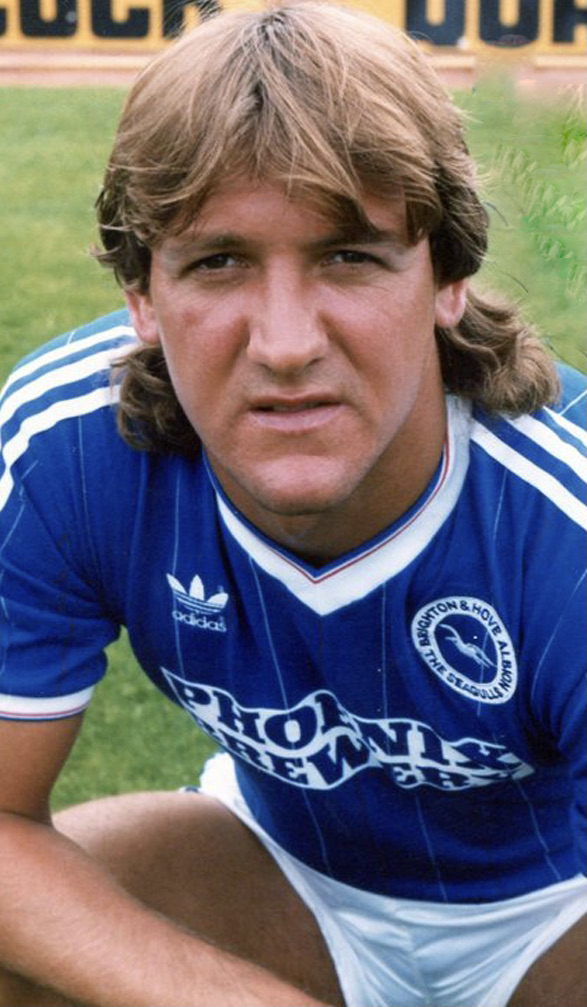
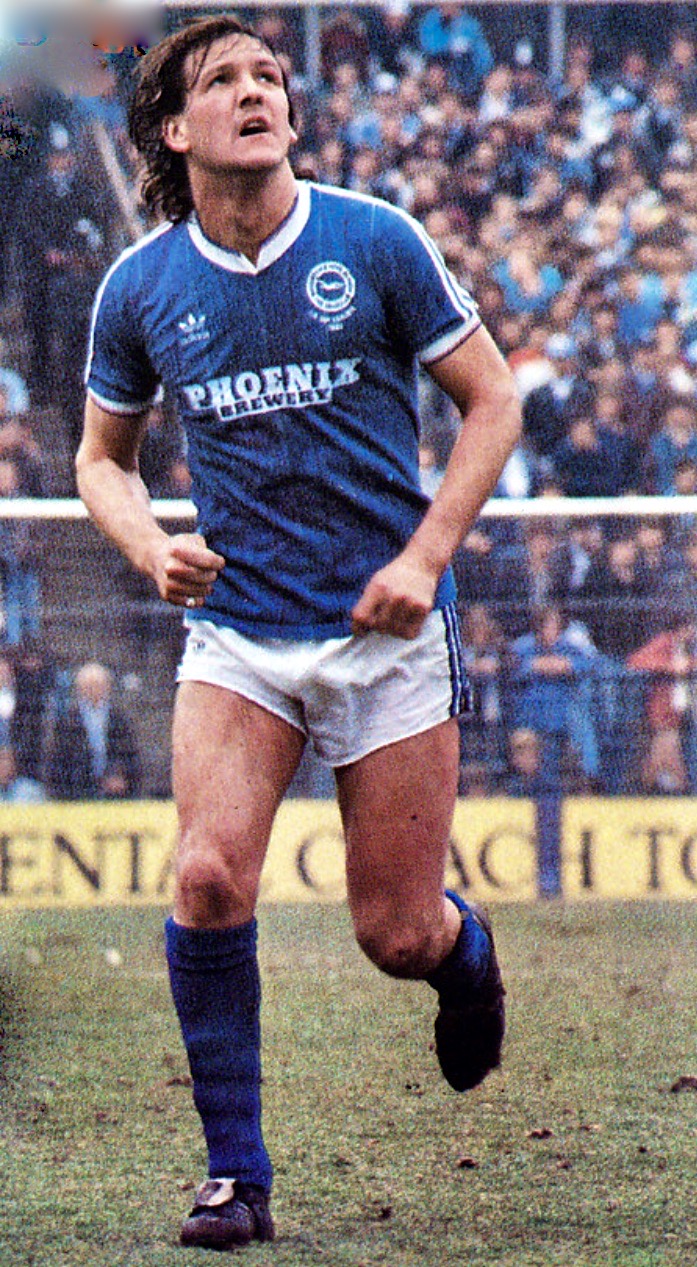
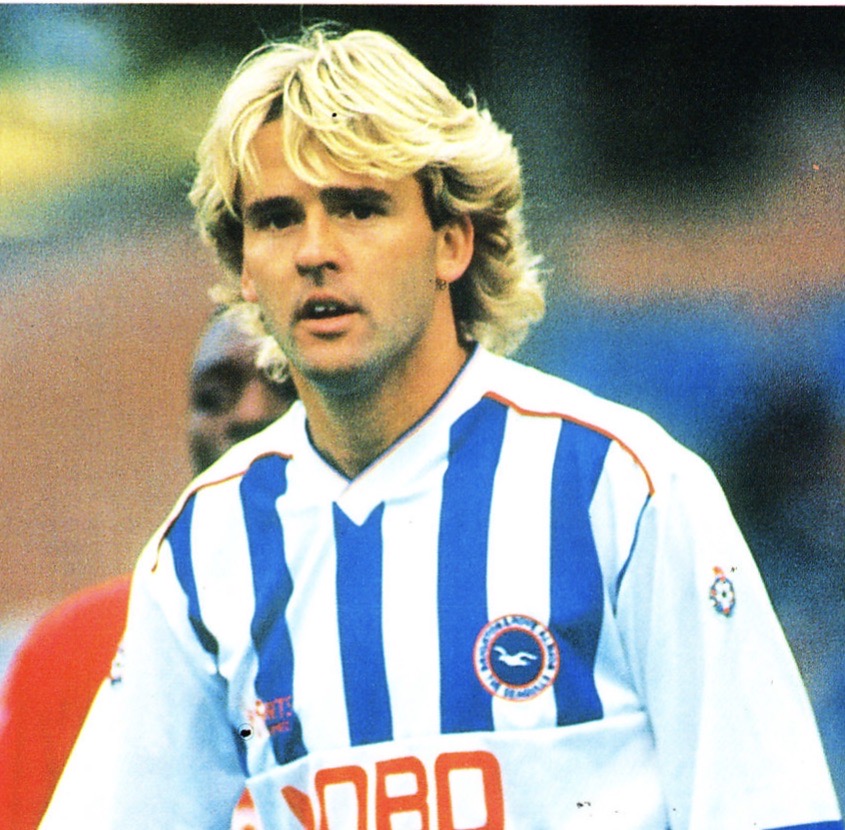
Gerry Ryan – ‘a special player and one of football’s nice people’

THERE WAS no shortage of tributes paid to Gerry Ryan when the former Albion winger died at the age of 68 on 15 October 2023.

Fellow Irish international Liam Brady, who appointed Ryan as his assistant when he took charge of the Seagulls in 1996, said: “Gerry was a wonderful team-mate. He was a very quick winger, very brave, and he took people on.

“We had some great games together and then we ended up on opposite sides, for Brighton and Arsenal, in the old First Division.”

Although Ryan and Brady’s time in charge happened during a turbulent time off the pitch, Brady pointed out: “We did a pretty good job in what were, of course, difficult circumstances, and I could see then just what Brighton meant to him – he was in love with the club so much.

“Off the pitch, Gerry was just a really nice guy. He was affable, unassuming and got on with everyone he came in contact with.”

That sentiment was echoed by teammate Gordon Smith who told the Albion website: “Gerry was always fired up to play.

“He was not always first choice, but he was still a very good player. He had this ability to be able to turn games around because he was quick and he could score goals.

“He was so reliable – he could fit into any position with his levels of fitness, ability and positional play.

“We were a very close group; we socialised a lot, we played golf, went to the races and Gerry was a key part of that – he was a really good laugh.”

Turlough O’Connor, another former team-mate, from his early days playing for Bohemians in Dublin, told the Irish Independent: “He was the most easygoing guy you’d ever meet, very laidback and always in a happy mood, and a very good footballer as well.

“He was comfortable both left and right, very good on the ball, and very quick, which helped. A very good crosser, he went by people, and was always a threat. He helped so many times laying on goals for me.”

Ryan was one of the most likeable Albion players for a huge number of fans, and I was one of them.

A versatile trier who was good enough to represent the Republic of Ireland on 18 occasions, the wholehearted Ryan might not make it into the all-time best Brighton XI but, if it was judged on affability, his name would be first on the team sheet.

A cruel twist of fate saw his career ended in a tackle made by his Irish teammate (and former Albion boss) Chris Hughton’s brother, Henry. Typically, Ryan bore no grudges, as stressed by former Argus Albion reporter John Vinicombe in an article published in May 1986 when the genial Irishman finally accepted that his career was over.

Describing “the immense dignity and true manliness that Ryan displayed in refusing to condemn or indeed utter any harsh word against the player responsible,” he added: “Where others have sued and raged, slandered, cursed and threatened, Ryan said nothing.”

GR leg break

It was 2 April 1985 when his career was ended by that Hughton tackle in a 1-1 draw with Crystal Palace at Selhurst Park.

“Never in his life has he shirked a tackle and the one that ended his career so unfortunately at Crystal Palace was typical of many he faced in his career,” said Alan Mullery, the manager who signed him for the Seagulls.

“As a person, he is a lovely and typical Irish personality,” Mullery said in the programme for the player’s testimonial game against Spurs at the Goldstone on 8 August 1986. “I can honestly say that I have never met a player who dislikes him or has a bad word to say about him. I will remember Gerry Ryan as being a special player and one of football’s nice people.”

Mullery also referred to a Sunday lunch he and his family had with Ryan and his wife at the time he signed. “When Gerry ordered roast beef and chips I must have known then that I had a very special sort of player. At the time, I was a little dubious but afterwards I had no regrets.”

Mullery had been over in Dublin watching Albion’s Mark Lawrenson playing for the Republic of Ireland and Derby’s Ryan was playing in the same side. He had been having talks about moving to Stoke City but Mullers persuaded him to join Brighton instead, and, in a strange quirk of fate, he made his debut in a 2-2 draw away to Stoke.

After they’d become teammates, Lawrenson was among those players appreciative of Ryan’s “mercurial” qualities. He said in a matchday programme: “He wasn’t the most confident of players but he had loads of ability. For a wide player, he would come in and get goals for you.”

GR capsA week after joining the Seagulls, Ryan became an instant hit with Albion fans when he scored on his home debut in a 5-1 win over Preston. He notched a total of nine goals in 34 appearances in that first season and went on to score 39 in a total of 199 games.

Born in Dublin on 4 October 1955, Ryan was one of eight children. His early education was at the local convent in Walkinstown, a suburb to the south of Dublin where the family lived. At the age of eight he moved on to Drimnagh Castle School (it covered primary and secondary age groups).

At that stage, he was playing Gaelic football and hurling, at which he was capped at under-15 level by Dublin Schools. He didn’t play competitive football until he was 16 when he was introduced to a Dublin football club called Rangers AFC. He played alongside Kevin Moran, who later played for Manchester United, and Pat Byrne, who later played for Leicester City. Byrne and Ryan also played together for Bohemians, the oldest football club in Dublin.

Ryan joined the Dublin Corporation as a clerical officer on leaving school and played for Bohs as an amateur initially before becoming a part-timer on professional terms. By 18, Ryan was a first-team regular and, after collecting a League of Ireland Championship medal, was watched by Manchester United boss Tommy Docherty.

Docherty didn’t pounce then but, after Ryan had stayed four years with Bohemians, the ebullient Scot eventually returned to take him to England as his first signing for Derby County for a fee of £55,000.

The newly-appointed Docherty was determined to shake-up the club and while long-serving goalkeeper Colin Boulton was discarded along with striker Kevin Hector, Ryan, Scottish internationals Bruce Rioch and Don Masson, and Terry Curran and Steve Buckley were all introduced.

Ram Ryan

Ryan spoke about the way Docherty’s attitude towards him changed in an interview with Brian Owen of The Argus in 2016.

“One minute you were the blue-eyed boy, the next he wouldn’t even talk to you,” he said. Ryan made a hamstring injury worse by playing when Docherty insisted he was fit enough, and ended up sidelined for three months. “He didn’t like me then! That’s the way he was, he would turn on you, and he turned on me.”

Within a year, Docherty accepted Brighton’s £80,000 offer for Ryan and, as he was weighing up whether to choose the Seagulls or Stoke City, Ryan consulted the legendary Republic of Ireland and ex-Leeds midfielder Johnny Giles to ask his opinion.

“Gilesy said ‘Stoke have been in and out of the First Division forever but there is something going on down at Brighton. They get great crowds and it’s a beautiful place.’ I went to Brighton that weekend and absolutely loved it,” Ryan told Owen.

It was on 25 September 1978 winger Ryan arrived, prompting the departure of popular local lad Tony Towner after eight years at the Albion.

Five months before Ryan arrived at the Goldstone, he made his international debut, featuring for the first time in April 1978 in a 4-2 win over Turkey at Lansdowne Road. He only scored once for the Republic, but it was a cracking overhead kick in a 3-1 defeat against West Germany.

Ryan Eire

He was one of four regular Eire internationals playing for Albion at the time: Lawrenson, Tony Grealish and Michael Robinson the others.

His final appearance for his country came in a 0-0 draw against Mexico at Dalymount Park in 1984.

Ryan was part of some all-time history-making moments during his time with the Albion – scoring at St James’s Park in the 3-1 win over Newcastle on 5 May 1979 to clinch promotion to the top division for the first time, and burying the only goal of the game as unfancied Albion beat Brian Clough’s European champions Nottingham Forest, who’d previously not lost at home for two and a half years.

Ryan scoresMy personal favourite came on 29 December 1979 at the Goldstone when he ran virtually the entire length of a boggy, bobbly pitch to score past Joe Corrigan in the goal at the South Stand end to top off a 4-1 win over Manchester City. Ryan himself reckoned it was “the best goal I ever scored” as he recounted in a May 2020 BBC Sussex Sport interview with Johnny Cantor.

It was one of the most superb individual goals I saw scored and, when he was trying to recuperate from the horrific leg break which ultimately ended his career, I wrote to him in hospital to say what a special memory it held for me.

I was delighted to receive a grateful reply from him, and he has held a special place in my Albion memory bank ever since.

There were other stand-out occasions, two of which came against Liverpool:

in February 1983 at Anfield when he opened the scoring in Albion’s memorable 2-1 FA Cup triumph en route to the final, and, in the following season, at the Goldstone when he and Terry Connor were on target in Second Division Albion’s 2-0 win over the Reds in the same competition, the first-ever live FA Cup match (other than finals) to be shown (previously any television coverage of FA Cup ties was only ever recorded highlights).

If the modern-day reader can’t quite put the feat in perspective, it is worth pointing out that Liverpool, managed by Joe Fagan, went on to win the League Cup, the League title and the European Cup that season.

Danny Wilson hadn’t long since joined the Albion and, in an interview with the Seagull matchday programme in 2003, he recalled: “That has to be my favourite memory from all my time at the Goldstone. Back then, Liverpool were just awesome, and to beat them like we did was virtually unheard of.”

Ryan’s involvement in the 1983 Cup run was hampered by a hamstring injury which meant he missed out on the semi-final. But, in the days of only one substitute, he was on the bench for the final and, when the injured Chris Ramsey couldn’t continue, Ryan went on at Wembley and did a typically thorough job at right-back.

GR prog snow

Following Albion’s relegation, as the big-name players departed the Goldstone, Ryan’s versatility and play-anywhere attitude came to the fore and, in his last two seasons with the club he was often selected as a centre-forward, although he was not a prolific goalscorer from that position.

After he was forced to quit playing, Ryan took what was then quite a familiar route for ex-players and became a pub licensee, running the Witch Inn at Lindfield, near Haywards Heath. Ryan and goalkeeper Graham Moseley, who he’d known from his days at Derby, were neighbours in Haywards Heath.

GR pots

However, when another of his former Republic of Ireland teammates, Liam Brady, was appointed Albion manager in 1994, it was an inspired choice for him to appoint Ryan as his assistant.

When that all-too-brief managerial spell came to a messy close, Ryan returned to his pub, and then moved back to the family home in Walkinstown. Ryan’s son Darragh played 11 games for the Albion in the late 1990s.

Sadly, in August 2007, Ryan suffered a stroke, and three years later he was diagnosed with kidney cancer. On his death, his family paid tribute to the care he was given by the staff of Our Lady’s Hospice, Harold’s Cross and to the staff of Lisheen Nursing Home, Dr Brenda Griffin, the Beacon Renal Unit, Tallaght, and Tallaght Hospital Renal Unit “for the excellent care given to Gerry over the past number of years”.

Pictures from a variety of sources but mainly from my scrapbook, the matchday programme and The Argus.

Goal machine Frank Stapleton ended his playing days in a Brighton shirt

stapleton stretch

FRANK STAPLETON hit the heights as a goalscorer for Arsenal and Manchester United but his prize-winning playing days came to an end in a Brighton & Hove Albion shirt.

Stapleton was the scorer of the first top flight goal at the Goldstone Ground – unfortunately, it was the opener in Arsenal’s 4-0 win in 1979! He was also one of the Manchester United scorers in the 1983 FA Cup Final against Brighton, having moved to Old Trafford two years earlier (above, however, he just fails to connect for Arsenal against Brighton with Steve Foster and Gary Williams looking on).

His two appearances for Brighton came in 1995 when his old pal Liam Brady brought him in to try to improve the front line of an ailing side.

Born in Dublin on 10 July 1956, the promising young Stapleton was rejected by United as a teenager but the Gunners reaped the benefit of that decision by snapping him up at the tender age of 15 on chief scout Gordon Clark’s recommendation.

Arsenal’s confidence in the prospects for the promising young Irish duo were reflected in a Goal magazine article of 7 October 1972 in which boss Bertie Mee talked about them as future first team players. At the time, they were still part of the club’s junior ranks, aged just 15 and 16.

goal cutting

Mee said: “Brady is almost established as a regular in the reserve side. He needs building up but has the potential to become a first-team player. Stapleton has made quite an impact in his first season and, providing he maintains a steady improvement, he could also follow the path of Brady.”

It was only Brady’s second season and Clark, the Arsenal chief scout who unearthed him, said, at first, he thought he would be better suited to becoming a jockey because he was so small and frail!

He quickly changed his mind when he saw his ability with a football. “He was like a little midget but he had so much confidence. He’s really shot up now and although he’s still not very tall, he’s strong enough to hold his own,” said Clark.

Stapleton, at 15, joined Arsenal in the summer of 1972 and quickly developed a reputation as a goalscorer, netting 11 goals in seven games.

“Frank is tall and very good in the air,” said Clark. “He seems to get up and hang for the ball. He is also very good on the floor and reads the game intelligently for a youngster.”

As expected, Stapleton progressed to the first team and made his debut in 1975 against Stoke City. He initially formed an impressive partnership with England striker Malcolm Macdonald and in three successive seasons was Arsenal’s leading goalscorer.

Such prowess brought him to the attention of the Republic of Ireland international selectors and player-manager Johnny Giles gave him his full debut aged just 20 in 1976 against Turkey in Ankara.

It was the first of a total of 71 caps for his country, during which time he became their captain and scorer of 20 goals. He led Eire when they famously beat England 1-0 at the Euro 1988 finals in Germany. Although he was part of the 1990 World Cup squad – alongside former Albion boss, Chris Hughton –  he was by then behind Niall Quinn, John Aldridge and Tony Cascarino in the pecking order.

Stapleton was part of Arsenal’s three successive FA Cup final teams (1978, 1979, 1980), scoring against United in Arsenal’s 3-2 win in 1979.

When the Gunners sold Brady to Juventus in 1980, Stapleton started to question the club’s ambition and, the following year, on expiry of his contract, decided he would move on himself.

He had scored 108 goals in 300 appearances for Arsenal – some strike rate! – and it wasn’t a popular move to join a major rival in the same division, but he wasn’t the first or last player to have done so.

In the Sixties, United had taken David Herd from the marble halls of Highbury to lead their line and, of course, in more recent times, United signed Alexis Sanchez.

stapleton utd

When Robin van Persie made the same transfer switch from Arsenal to Manchester United in 2012, the Daily Mail took Stapleton back 30 years to talk about the circumstances of his own move.

Stapleton was Ron Atkinson’s first major signing for United and in his first season was partnered up front with Garry Birtles. Stapleton was the leading scorer for United in that first season, with 13 goals in 41 league games.

Subsequently, his main strike partner was the Northern Ireland international, Norman Whiteside.

img_4637

Stapleton scored United’s first goal, a 55th minute equaliser, in the 2-2 Cup Final draw against Brighton: one of 19 he notched during the 1982-83 season in which he played in 59 of United’s 60 games.

By the end of the following season, Stapleton’s regular strike partner was Mark Hughes and he scored in the 1985 FA Cup semi-final against Liverpool to set up yet another Wembley appearance, this time collecting his third winners’ medal when Whiteside’s winner beat Everton.

Despite a good start to the following season, with Stapleton once again amongst the goals, poor league form eventually cost Atkinson his job and his successor, Alex Ferguson, began rebuilding the side.

After six years at United, Stapleton, by then 30, was amongst those to be let go, and he was sold to Ajax of Amsterdam, lured by the fact they were managed by Johan Cruyff. But the move failed to live up to expectations, as detailed by the42.ie, and he ended up having a spell on loan at Anderlecht.

It was the first of a series of moves which didn’t really work out for him, although in the 1988-89 season he found himself playing in France alongside fellow Irish international – and future Brighton striker – John Byrne for Le Havre.

stapleton 4 derby

Derby County offered him a platform back in the UK game and he featured 10 times for them in 1987-88 and, after his stint in France came to an end, he spent two seasons with Blackburn Rovers.

He played once for lowly Aldershot and five times for Huddersfield Town before landing a player-manager’s post with Bradford City. In three years at Valley Parade, he made 68 appearances before the axe fell, and he answered Brady’s call for help at the Goldstone Ground.

The brilliant The Goldstone Wrap detailed his brief involvement in a March 2015 post, explaining how he featured as a substitute in a 0-0 draw at home to Bournemouth and started in a 3-0 defeat away to Cardiff City.

It was a final swansong for his playing career, as he looked to get back into coaching or management. He had two stints working under his former United teammate Ray Wilkins: at QPR and, in 2014, with the Jordan national side.

Stapleton spent eight months in 1996 as the first head coach of American Major Soccer League side New England Revolution, of Massachusetts.

His last appointment in the English game was briefly as a specialist striker coach at Bolton Wanderers, appointed during Sam Allardyce’s reign, in 2003-04.

Nowadays, Stapleton is more likely to be found talking about his illustrious career, his availability for bookings listed by football-speakers.com.

Goalscorer Craig Maskell among Town’s top 100 crowd favourites

Screenshot

CRAIG MASKELL had a decent near 1 in 3 goalscoring record for Brighton & Hove Albion but he’s possibly best remembered for a shot that didn’t go in.

When Maskell’s curling effort in the relegation decider at Hereford United on 3 May 1997 struck the post rather than going in, fortunately Robbie Reinelt was on hand to slot home the rebound to earn Albion the draw that ensured they stayed in the league.

Born Craig Dell Maskell on 10 April 1968 in Aldershot, perhaps it was his destiny to play for Southampton! (for younger readers, The Dell used to be Southampton’s home ground).

Indeed, Maskell started his professional career at Southampton, signing pro forms just after his 18th birthday. But he appeared in only six league games for the Saints before joining Huddersfield Town in May 1988 for a £20,000 fee.

His new teammates included former Seagulls Chris Hutchings and Kieran O’Regan and the goals really flowed for him in the 1988-89 season when he scored 28 times in 46 games.

Arguably his most memorable match came in the 1989-90 season when he scored four in a 5-1 win at Cardiff City, thus becoming only the third player in Huddersfield’s history to score four in an away match.

By the end of that season, he’d scored an impressive 43 goals in 87 games for Town and, at the time of Huddersfield’s centennial in 2006, Maskell’s prolific goalscoring for them led to his inclusion in The Fans’ Favourites, a book listing their top 100 Town players.

That prolific scoring record earned him a £250,000 move to Third Division Reading. He scored in a season-opening 3-1 win at Exeter City and had 10 goals by the season’s end as the Royals completed a mid-table finish under player-manager Mark McGhee, who later became Brighton boss.

With John Madejski settling in as the new owner, and McGhee finding his feet in the managerial chair, the 1991-92 season saw Reading finish 12th. Maskell ended up top scorer with 16 goals in 35 appearances (plus five as sub), three of them coming in a 4-2 win away to Darlington.

In the summer of 1992, player-manager Glenn Hoddle paid £250,000 to take Maskell to second tier Swindon Town (where he had previously spent a month on loan in 1987).

It was to prove a memorable season for the Robins as they won promotion to the top tier for the first time in their history, via a 4-3 play-off victory over Leicester City. Maskell was leading scorer with 23 goals in a side captained by central defender Colin Calderwood, later Chris Hughton’s assistant manager at Brighton.

Maskell made his Robins debut on the opening day of the 1992-93 season, in a 1-0 win over Sunderland, and scored his first goal in a 2-2 draw at Wolves in late August. He went on to net eight times in the opening ten games of the season before suffering a mini goal drought between December and April.

Nevertheless, Maskell bagged two in a 6-4 win at Birmingham before scoring in both legs of the play-off semi-final against Tranmere Rovers. He then scored Town’s second at Wembley, thumping a left-footed drive off the post and into the net.

Although he started the first two matches amongst the elite, he then struggled to get game time in the Premier League, often warming the bench as Jan Age Fjortoft,  Andy Mutch and Keith Scott started ahead of him.

He scored twice in a 3-3 draw at Sheffield Wednesday on 29 December 1993, but he left the club in February 1994, returning to former club Southampton for a £250,000 fee.

However, Saints already had a fair bit of striking talent in their ranks and once again he found his opportunities limited, this time by the likes of Matt Le Tissier, Neil Shipperley and Gordon Watson. As a result, he only managed 17 Premier League starts.

He had a five-game loan spell at Bristol City but then joined Brighton on 1 March 1996, making his debut the following day against Brentford. He didn’t have to wait long for his first Albion goal, scoring against Oxford United on 12 March and then hit two four days later at home to Hull City.

The off-field shenanigans at Brighton were a big distraction at the time but on the pitch Maskell managed to score a total of 20 goals in 69 games, crucially netting 14 of them in 37 games during that make-or-break 1996-97 season.

After 17 games the following season, he was one of five senior players whose contracts were terminated early, in December 1997, as the cash-strapped Seagulls in exile at Gillingham were forced to make drastic cuts to survive. Maskell had a brief spell playing for Happy Valley in Hong Kong before linking up with Leyton Orient for 18 months.

It is recorded in a number of places that Maskell decided to quit the professional game while walking off the turf at Wembley having played as a substitute in the Orient team beaten by Scunthorpe United in the Nationwide League third division play-off final.

“I turned to one of my team-mates and said: ‘That’s enough’,” Maskell said. “I’d spent too much time away from my family and too little time on the pitch at Orient.”

He had scored just twice in 23 games for the O’s, however, he continued playing at non-league level for several years, turning out for Hampton & Richmond Borough, Aylesbury United and Staines Town, as well as being coach and assistant manager to Steve Cordery.

In an article in The Times on 16 November 2000, just prior to a FA Cup first round tie between Hampton & Richmond Borough and Barnet, Maskell talked about what he had learned from the various managers he’d played under.

“I look to Glenn Hoddle for his ability to create flair in attack and Lawrie McMenemy because he was so good at man-management.

“Most of my ideas on defensive organisation I learnt from Dave Merrington, who was youth-team coach at Southampton. He was fantastic. You just have to look at the players he found for the club, not just myself but Matt Le Tissier, Alan Shearer, the Wallaces and another dozen or so less well-known players who had good careers.”

Mike Bailey took the Seagulls to their highest-ever finish

ONE OF the all-time greats of Wolverhampton Wanderers led Brighton & Hove Albion to their highest-ever finish in football.

Midfield general Mike Bailey played for Wolves for 11 seasons between 1965 and 1976, leading the team to promotion from the Second Division in 1966-67, helping them to top-flight positions of fourth and fifth in 1971 and 1973, getting to the final of the UEFA Cup in 1972, and lifting the League Cup at Wembley in 1974.

MB WWFCLgeCupMike Bailey holds aloft the League Cup after Wolves beat Manchester City 2-1 at Wembley.

It was perhaps a hard act to follow Alan Mullery as manager of Brighton, particularly as the former Spurs and Fulham captain had led the club from Third Division obscurity to the pinnacle of English football within three years.

But Bailey had just got Charlton Athletic promoted from the Third Division and in the 1981-82 season led Albion to a 13th place finish, a record which was only threatened in 2017-18 by Chris Hughton’s side, who eventually ended up 15th.

Unfortunately, although Bailey’s team was relatively successful, the style of play he adopted to achieve that position was a turn-off to the fans who deserted the Albion in their hundreds and thousands.

Eventually, chairman Mike Bamber felt he had to address the slump in support by sacking Bailey in December 1982. “He’s a smashing bloke, I’m sorry to see him go, but it had to be done,” said Bamber. There are plenty – in particular Bailey! – who feel he acted a little too hastily.

Bailey shared his feelings in an interview he gave to the News of the World’s Reg Drury in the run-up to the 1983 FA Cup Final.

Mike Bailey talks to the News of the World; his often frank programme notes; his assistant, John Collins, a former Luton Town player.

“It seems that my team has been relegated from the First Division while Jimmy Melia’s team has reached the Cup Final,” he began.

Wanting to put the record straight having been hurt by some of the media coverage he’d seen since his departure, he explained: “I found the previous manager Alan Mullery had left me with a good squad, but, naturally I built on it and imposed my own style of play.”

Bailey resented accusations that his style had been dull and boring football, pointing out: “Nobody said that midway through last season when we were sixth and there was talk of Europe.

“We were organised and disciplined and getting results. John Collins, a great coach, was on the same wavelength as me. We wanted to lay the foundations of lasting success, just like Bill Shankly and Bob Paisley did at Liverpool.

“The only problem was that winning 1-0 and 2-0 didn’t satisfy everybody. I tried to change things too soon – that was a mistake.

“When I left, we were 18th with more than a point a game. I’ve never known a team go down when fifth from bottom.”

It was clear from the outset of Bailey’s reign that he didn’t suffer fools gladly and there were numerous clashes with players, notably Steve Foster, Michael Robinson and Neil McNab, the displaced Gordon Smith and Mickey Thomas, a Bailey signing who repeatedly went missing because his wife didn’t like it in the south.

Bailey would vent his feelings quite overtly in his matchday programme notes; he was not afraid to hit out at referees, the football authorities and the media, as well as trying to explain his decisions to supporters, urging them to get behind the team rather than criticise.

Happier times as Mike Bailey becomes Albion manager and signs Tony Grealish to replace outgoing stalwart midfielder and skipper, Brian Horton.

Attempting to shine a light on the comings and goings associated with his arrival, he explained: “The moves we have been making are designed to provide Brighton with a better football team and one that can consolidate its position in the First Division, rather than struggle, such as in the last two seasons.”

By Christmas, the team were comfortably in the top half of the table and in an interview with the Argus, Bailey said: “I must admit that as a player and captain of Wolves I was a bit of a bastard, slagging others off, and that sort of thing. But being a manager, one sees everything in a different light. I am still trying to learn as a manager, especially now that I am with a First Division club.”

Three months later, shortly after he had appeared at a fans forum at the Brighton Centre, he very pointedly said: “It is my job to select the team and to try to win matches.

“People are quite entitled to their opinion, but I am paid to get results for Brighton and that is my first priority.

“Building a successful team is a long-term business and I have recently spoken to many top people in the professional game who admire what we are doing here at Brighton and just how far we have come in a short space of time.

“We know we still have a long way to go, but we are all working towards a successful future.”

As he assessed his first season, he said: “Many good things have come out of our season. Our early results were encouraging and we quickly became an organised and efficient side. The lads got into their rhythm quickly and it was a nice ‘plus’ to get into a high league position so early on.”

He had special words of praise for Gary Stevens and said: “Although the youngest member of our first team squad, Gary is a perfect example to his fellow professionals. Whatever we ask of him he will always do his best, he is completely dedicated and sets a fine example to his fellow players.”

Meanwhile, in his own end of season summary, Argus Albion reporter John Vinicombe maintained: “It is Bailey’s chief regret that he changed his playing policy in response to public, and possibly private, pressure with the result that Albion finished the latter part of the season in most disappointing fashion.

“Accusations that Albion were the principal bores of the First Division at home were heaped on Bailey’s head, and, while he is a man not given to altering his mind for no good reason, certain instructions were issued to placate the rising tide of criticisms.”

Vinicombe recorded that the average home gate for 1981-82 was 18,241, fully 6,500 fewer than had supported the side during their first season amongst the elite.

“The Goldstone regulars, who are not typical of First Division crowds (but neither is the ground) grew restless at a series of frustrating home draws, and finally turned on their own players,” he said.

At the beginning of the following season, off-field matters brought disruption to the playing side. Arsenal’s former FA Cup winner Charlie George had trained with the Seagulls during pre-season and senior players Foster, Robinson and McNab publicly voiced their disappointment that the money wasn’t found to bring such a player on board permanently.

McNab in particular accused the club of lacking ambition and efforts were made to send him out on loan. Similarly, Robinson was lined up for a swap deal with Sunderland’s Stan Cummins, but it fell through.

Meanwhile, Albion couldn’t buy a win away from home and suffered two 5-0 defeats (against Luton and West Brom) and a 4-0 spanking at Nottingham Forest – all in September. Then, four defeats on the spin in November, going into December, finally cost Bailey his job. Perhaps the writing was on the wall when, in his final programme contribution, he blamed the run of poor results on bad luck and admitted: “I feel we are somehow in a rut.”

It would be fair to say Bailey the player enjoyed more success than Bailey the manager. So, where did it all begin?

Born on 27 February 1942 in Wisbech, Cambridgeshire, he went to the same school in Gorleston, Norfolk, as the former Arsenal centre back Peter Simpson. His career began with non-league Gorleston before Charlton Athletic snapped him up in 1958 and he spent eight years at The Valley.

M Bailey charltonDuring his time there, he was capped twice by England as manager Alf Ramsey explored options for his 1966 World Cup squad. Just a week after making his fifth appearance for England under 23s, Bailey, aged 22, was called up to make his full debut in a friendly against the USA on 27 May 1964.

He had broken into the under 23s only three months earlier, making his debut in a 3-2 win over Scotland at St James’ Park, Newcastle, on 5 February 1964.He retained his place against France, Hungary, Israel and Turkey, games in which his teammates included Graham Cross, Mullery and Martin Chivers.

England ran out 10-0 winners in New York with Roger Hunt scoring four, Fred Pickering three, Terry Paine two, and Bobby Charlton the other.

Eight of that England side made it to the 1966 World Cup squad two years later but a broken leg put paid to Bailey’s chances of joining them, even though he got one more chance to impress Ramsey.

Six months after the win in New York, he was in the England team who beat Wales 2-1 at Wembley in the Home Championship. Frank Wignall, who would later spend a season with Bailey at Wolves, scored both England’s goals. Many years later, Wignall was playing for Burton Albion when a certain Peter Ward began to shine!

In 1965, Bailey broke his leg in a FA Cup tie against Middlesbrough and that was at a time when such injuries could be career-threatening.

“I was worried that may have been it,” Bailey recalled in his autobiography, The Valley Wanderer: The Mike Bailey Story (published in November 2015). “In the end, I was out for six months. My leg got stronger and I never had problems with it again, so it was a blessing in disguise in that respect.

“Charlton had these (steep) terraces. I’d go up to them every day, I was getting fitter and fitter. But it was too late to get in the 1966 World Cup side – Alf Ramsey had got his team in place.”

 Bailey missed out on the 1966 England World Cup squad but he won Football League representative honours and enjoyed success as captain of Wolves.

During his time with the England under 23s, Bailey had become friends with Wolves’ Ernie Hunt (the striker who later played for Coventry City) and Hunt persuaded him to move to the Black Country club.

Thus began an association which saw him play a total of 436 games for Wolves over 11 seasons, leading a side with solid defenders like John McAlle, Francis Munro and Derek Parkin, combined with exciting players like forwards Derek Dougan and John Richards, plus winger Dave Wagstaffe.

However, when coach Sammy Chung stepped up to take over as manager, he selected Kenny Hibbitt ahead of Bailey so the former skipper chose to end his playing days in America, with the Minnesota Kicks, who were managed by the former Brighton boss Freddie Goodwin.

Nevertheless, Bailey’s contribution to the team famous for their old gold kit saw him inducted into the Wolves Hall of Fame in 2010.

On his return to the UK, Bailey became manager of Hereford United, then he returned to The Valley as manager of Charlton and, immediately after getting them promoted to the third tier, took over at Brighton in the summer of 1981.

A somewhat extraordinary stat I discovered about Bailey’s management career in England through managerstats.co.uk was that he managed each of those three clubs for just 65 games. At Hereford, his record was W 32, D 11, L 22; at Charlton W 21, D 17, L 27; at Brighton, W 20 D 17, L 28.

In 1984, he moved to Greece to manage OFI Crete, and he later worked as reserve team coach at Portsmouth. Later still, he did some scouting work for Wolves.

Pictures from various sources: Goal and Shoot! magazines; the Evening Argus, the News of the World, and the Albion matchday programme.

Fluctuating fortunes for Guy Butters after beginning alongside Spurs stars

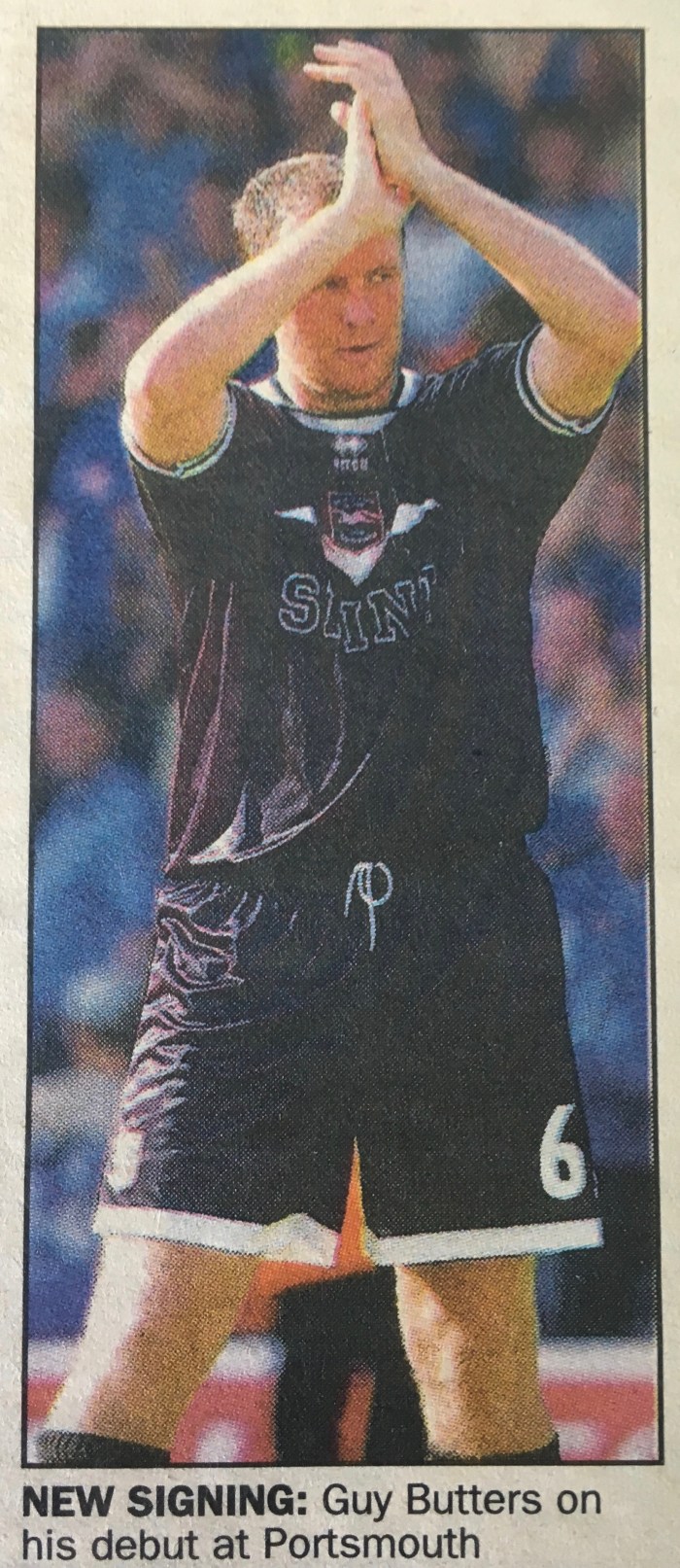
GUY BUTTERS saw plenty of highs and lows in a 20-year playing career that started with great promise at Tottenham Hotspur and included six years at Brighton, where he still works.

Butts coaches for Albion in the Community, he’s scouted players, hosted hospitality lounges and still turns out to play in charity matches, not to mention sharing a constant flow of corny jokes with his 3,700+ followers on Twitter!

Promotion via the play-offs at Cardiff in 2004 and being chosen as player of the season would be up there in terms of highs with Brighton.

My personal favourite came on 13 November 2004, when Butters scored the only goal of the game as Albion committed daylight robbery in front of 29,514 packed into West Ham’s Boleyn Ground.

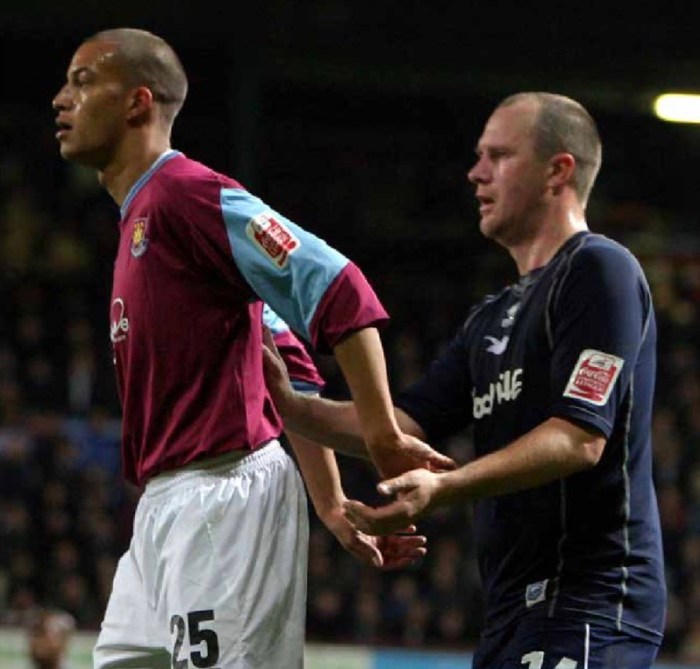
BZ GBBrighton were up against it going into the game and had taken veteran Steve Claridge on for a month to help them out of a striker crisis. Hammers threw everything at the Albion that afternoon but somehow the Seagulls kept the ball out and, on 68 minutes, Butts, up for a Richard Carpenter free kick, got his head on the end of it to send the ball into the back of the net in front of the Seagull faithful.

Even after versatile Adam Virgo and Hammers’ Haydn Mullins were sent off for a scrap on 74 minutes, and West Ham bought on substitute Bobby Zamora, the scoreline remained 1-0 to the Albion.

A couple of months later, it was obviously a special day for Butters when, on 8 January 2005, he was given the captain’s armband to lead the Albion in their third round FA Cup tie against Spurs at White Hart Lane.

  • A programme portrait and skipper for the day in the FA Cup at White Hart Lane.

The matchday programme recalled how Butters “was very much the discovery of the 1988-89 season when manager Terry Venables lifted the tough tackling former Spurs trainee from our reserves to the first team to play alongside Gary Mabbutt and Chris Fairclough in a back three.

“Guy was also in there alongside such names as Paul Gascoigne, Chris Hughton, Chris Waddle, Paul Walsh, Terry Fenwick, Paul Stewart, (former Brighton Cup Final hero) Gary Stevens and Paul Allen. And he kept his regular place the following season when Gary Lineker was added to the squad.”

Born on 30 October 1969 in Hillingdon, he made his debut shortly after his 19th birthday in a League Cup game against Blackburn, and suffered the agony of scoring an own goal. But on his full league debut as a sub against Wimbledon on 12 November 1988, he made amends with a goal in the right end.

“We won that one 3-2 but it’s probably better remembered by Spurs fans as the game in which Gary Stevens was injured following a tackle by Vinnie Jones,” Butters told the Spurs programme.

“I’ve got great memories of my time at Tottenham but, looking back, I recall spending much of my time trying to avoid Gazza who was always up to something! But it was the players around me that I will never forget – I was in there with men who had appeared in World Cups, and that’s my abiding memory.”

The year after his Spurs debut, Butters also earned international honours. In June 1989, he was involved in three England under 21 tournament matches in Espoirs de Toulon matches.

He started in the 3-2 defeat to Bulgaria on 5 June, and was replaced by substitute Neil Ruddock. Two days later, he came on as a sub for Dean Yates in England’s 6-1 thrashing of Senegal in Sainte Mazime. Two days after that, he came on as a sub for Ruddock, as the under 21s drew 0-0 with the Republic of Ireland in Six-Fours-les-Plages.

Of that side, Carlton Palmer, David Batty and David Hirst went on to gain full England caps, but those three games were Butters’ only representative appearances.

After limited game time at Spurs in the 1989-90 season, Butters went out on loan to Fourth Division Southend United, scoring three times in 16 games.

Steve Sedgley, Fenwick and Gudni Bergsson were all ahead of him as potential partners for Mabbutt so, on 28 September 1990, he was transferred to Portsmouth for a fee of £375,000, having made a total of 35 league appearances for Tottenham.

At Pompey, he played at the back alongside Kit Symons and colleagues included Mark Chamberlain on the wing and Warren Aspinall up front, together with his ex-Spurs teammate Paul Walsh, now better known as a Sky Sports pundit.

But there were mixed fortunes for Butters at Pompey, which he spoke about in a November 2016 interview for the Portsmouth website. He was there six years and enjoyed some good times when Jim Smith was manager.

guy butters YouTube

He had a brief spell on loan with Oxford United in 1994 and he eventually realised his time at Fratton Park was up when a regime change saw the arrival of Terry Venables, who was the Spurs boss when he was sold to Portsmouth.

Tony Pulis signed him for Gillingham for £225,000 on 18 October 1996 and, in six years at Priestfield, one game in particular stands out for the unfortunate pivotal moment Butters played in it.

It was 30 May 1999, the Football League Second Division play-off final to determine the third and final team to gain promotion and Gillingham were up against Manchester City, remarkably, at that time, struggling to get out of the third tier of English football.

Goals from Carl Asaba and Bob Taylor on 81 and 87 minutes looked to have given Pulis’ side victory. But Kevin Horlock had pulled one back for Joe Royle’s City and, as normal time expired, former Albion loanee Paul Dickov equalised for City in the fifth minute of added on time to level the scores at 2-2.

With no further scoring in extra time, it went to penalties. City scored three of their first four; Gills had scored only one of their three. So, the pressure was on Butters, the fourth penalty taker, to bury it to keep the Gills in it.

When Butters stepped up and hit it low to ‘keeper Nicky Weaver’s left…. it was within the 20-year-old’s reach, and he pushed it away. Cue wild celebrations as City won the shoot-out 3-1.

“Missing that penalty was one of the worst moments of my life but you have to move on and I am not afraid to have another go,” Butters told interviewer Alex Crook in an article for the 2004 Division Two play-off final match programme. “At the time, I just wanted the ground to swallow me up but nobody blamed me because it was just one of those things.”

Consolation for Butters came the following year when Gillingham returned to Wembley and on that occasion won 3-2 in extra-time against Wigan Athletic. As with Pompey, Butters had six years in total with the Kent club and played 159 league games before being released in the summer of 2002.

IMG_6010The 2002-03 season was already under way by the time Butters joined Albion on a free transfer and, in the September, he was doing his own personal pre-season workout programme in a bid to get fit.
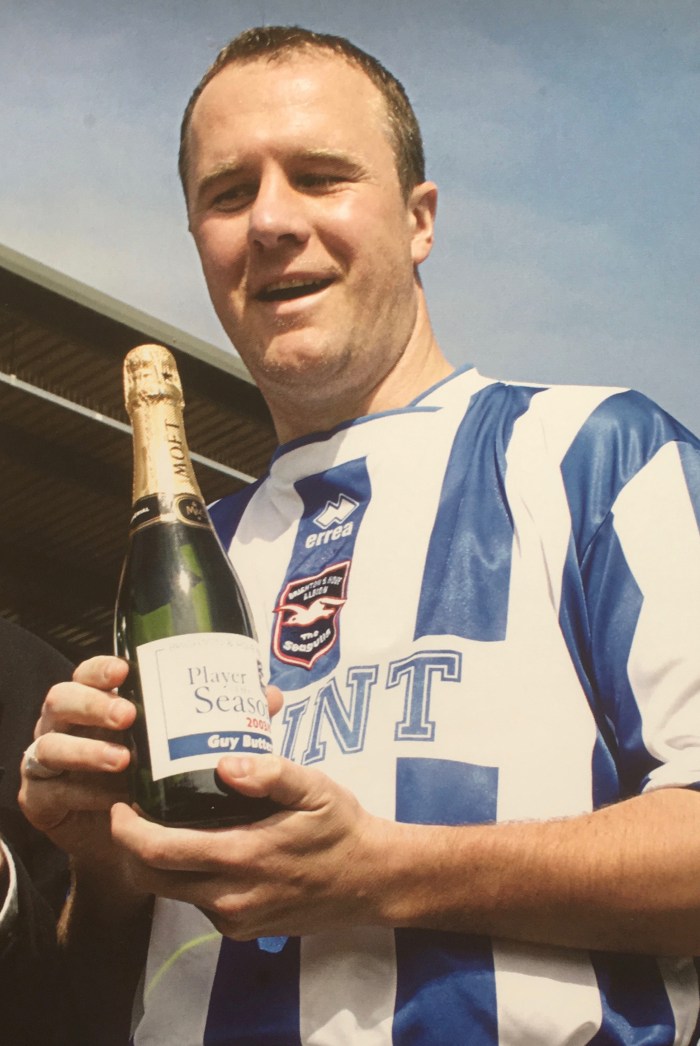
“When I first came here I had to do a lot of extra work with Dean White,” Butters told Brian Owen, of the Argus. “It was a case of trying to cram a lot of stuff into a little space of time. I wasn’t really getting too much time to recover after it.”

The managerial change from Martin Hinshelwood to Steve Coppell didn’t do Butters any favours either. Virgo and Butters were the centre back pairing for Coppell’s first match – a 4-2 home defeat to Bristol City – and both were then discarded into the wilderness.  Virgo went on loan to Exeter and, after Coppell brought in Dean Blackwell to play alongside Danny Cullip, Butters was sent out on loan to Barnet.

But when injury meant Blackwell’s career was over, the door opened again for Butters and he seized the opportunity to such an extent that as Albion won promotion back to the second tier via the play-offs, he was voted player of the season.

GB potseas by Bennett Dean• 2004 Player of the Season pictured by Bennett Dean.

In fact, it was the arrival of Mark McGhee to succeed Coppell that was very much a turning point in Butters’ career because he had previously been considering hanging up his boots.

In Match of My Life (www.knowthescorebooks.com), he said: “Mark was a real breath of fresh air as manager. Straight away he helped me with a special diet and fitness programme aimed at improving my general match fitness, but, more importantly, helping me work towards prolonging my professional football career.

“He was the first manager to do that and under his guidance I began to thrive and really enjoy my football again.”

As the Argus previewed the 2004-05 season with a special publication, they declared: “Buoyed by a great run of form in last season’s run-in and looking in good shape in training, Butters is ready for another stab at the second tier of English football.”

And Butters said: “This year I did a bit in the summer when I was on holiday and the gaffer put us through our paces so I’m sure that when the season starts I’ll be pretty match fit.

“It’s a big step up but, if we can get a few results away from home, not too many of those big teams are going to fancy coming to Withdean.”

  • The Argus spots a lighter refreshing moment!
  • Butters and Cullip were opponents when the Seagulls won at Sheffield United, another moment captured by the Argus.

Three years later, at the age of 37, Butters was still with the Seagulls and looking forward to what would ultimately turn out to be his last in the stripes.

“I thoroughly enjoyed it last year,” Butters told Andy Naylor. “It is probably one of the most enjoyable seasons I’ve had.

IMG_6014“I missed out on pre-season last year through injury. The gaffer was amazed I played as many games as I did.

“I cannot see why, with a decent pre-season under my belt and, as long as I look after myself, that I cannot do the same again.

“I just want to go on playing as long as I can and along the way enhance my CV with coaching badges.”

Manager Dean Wilkins finally released Butters at the end of the 2007-08 season, during which he had been sent off for the first time in his career.

He’d played a total of 187 games for the Seagulls and carried on playing with Havant & Waterlooville briefly plus a seven-game spell on loan at Lewes before trying his hand at management with Winchester City and Eastleigh.

Guy + Nick

  • I got the chance to meet Guy when he kindly presented an award at an event I was involved in organising: what a great bloke!

Injury-plagued ‘keeper Ben Roberts part of ‘Boro Cup folklore before Brighton promotion

2 pen shoot-outBEN ROBERTS might only have played a handful of games for Middlesbrough in seven years on their books but one of them will never be forgotten.

He was between the sticks for ‘Boro when Chelsea’s Roberto di Matteo scored one of the quickest ever FA Cup Final goals.

Thankfully, Brighton fans prefer to remember him as the ‘keeper who helped the Seagulls to promotion from the third tier via the play-offs in 2004.

“That season at Brighton remains one of my best experiences in football,” Roberts told beatsandrhymesfc.com’s Christian Brookes, in a 2011 interview.

“Apart from enjoying living in the city, I remained relatively injury-free and played the most games of my career. So for a full season’s work to come down to one day in the Millennium Stadium with a full house in attendance was a very special memory.”

No-one knew at the time, of course, but it was also Roberts’ last game in goal for the Albion because a back injury forced him to retire from the game prematurely in 2005, aged just 29.

In an extended interview with Dominic Shaw for gazettelive.co.uk in December 2017, Roberts looked back on his time at ‘Boro and a playing career that was beset with injury.

Born in Bishop Auckland on 22 June 1975, the young Roberts was spotted playing for South Durham Boys by Dennis Cooper, father of ‘Boro legend Colin Cooper, and the club took up his recommendation. Roberts would set off by bus from his home in Crook at 6am each day to get to training on time in Middlesbrough, nearly 30 miles away.

At one point, it looked like he wouldn’t get the chance to continue his career because he was deemed too short, but he fed his face throughout the summer, shot up the required inches, and was rewarded with a two-year scholarship.

In fact, he was still a YTS scholar when he got his first involvement with the first team, being named on the bench for two of Boro’s first three games in the inaugural season of the Premier League (1992-93).

However, it was another two seasons before he actually got into first-team action, making his debut in an Anglo-Italian Cup game against Ancona, with Bryan Robson by then in the managerial hotseat.

In the 1994-95 season, Roberts got league experience under his belt during loan spells with Hartlepool and Wycombe Wanderers and the following season he went on loan to Bradford City before returning to Middlesbrough to help out a goalkeeping crisis.

Injury to Gary Walsh presented Roberts with his chance, and, aged 21, he made his ‘Boro league debut on 18 January 1997 in a 4-2 win at home to Sheffield Wednesday.

Although Mark Schwarzer arrived at the club, he was also hit by injury – and was cup-tied in the FA Cup – leaving Roberts, 21 at the time, as the stand-in No.1.

On 1 April that year, he also earned his one and only international cap, coming on as a sub for Chris Day as England under 21s drew 0-0 with Switzerland at Swindon’s County Ground. Also in the team for that friendly were Rio Ferdinand, Jamie Carragher, Darren Huckerby and Lee Bowyer.

Two of Roberts’ 17 appearances for ‘Boro that season were in cup finals: in the replay of the League Cup Final against Leicester City, and then the FA Cup Final against Chelsea at Wembley.

Roberts started the following season as first choice because Schwarzer was still out injured, but his final appearance of the season – at home to Birmingham in the September – was his final appearance for the club.

Several treatments for a back injury were unsuccessful and at one stage, still only 24, he feared he’d be forced to retire, until he underwent surgery in London. As well as operating on problematic discs, the surgeon found a blood clot in his back.

In between back operations, Roberts went out on loan again and in 1999 played 14 games for Division Two side Millwall, including another Wembley appearance, this time against Wigan in the Auto Windscreens Shields Trophy. The Latics won 1-0 with the winning goal scored by future Albion captain, Paul Rogers.

The following season, Roberts had another loan spell, this time at Lennie Lawrence’s Luton Town and in the summer of 2000 he finally left ‘Boro and joined Charlton Athletic. However, he played only once for the Addicks, coming on as a sub in the final game of the 2002-03 season after regular no.1 Dean Kiely had been sent off.

Roberts greenPrior to that, Roberts had been out on loan again, initially at Reading and then returning to Luton. His first association with Brighton also came in that season, as Steve Coppell’s Seagulls were battling hard to avoid relegation from the second tier.

He played three times and I remember one of those games was one I went to away at Bradford City (a 1-0 win) on 15 February 2003, when he pulled off some terrific stops on a rock-hard pitch. The most memorable came early in the game and Roberts rated it as his best as a Brighton player.

“It was only after five minutes and Ashley Ward had a clear header inside the six yard box, but I got to it. I shouldn’t have, but I did,” he recalled in a matchday programme interview. “It (the game) shouldn’t have been played because the goalmouth was like a skating rink and that kind of set the tone.”

Unluckily for Roberts, he then picked up a dose of ‘flu and veteran Dave Beasant took over and kept the shirt until the end of the season.

However, Coppell saw enough to persuade him to sign Roberts permanently and, as referred to earlier, the 2003-04 season was to be the one time when he finally made his mark, culminating in the 1-0 win over Bristol City at the Millennium Stadium in Cardiff.

When his back injury problems returned and ruled him out of the whole of the 2004-05 season, he quit the game and went travelling to South America, Asia and India before returning to the UK and going to Roehampton University to take a sports science and coaching degree.

Not only did he achieve first class honours, his dissertation on biomechanics (which applies the laws of mechanics and physics to human performance) earned him a ‘Pursuit of Excellence’ award from Adidas.

Although he intended to stay in the world of academia, his old Brighton teammate, Nathan Jones, persuaded him to join the coaching staff at Yeovil Town.

“I was at a stage where I missed the banter, the day-to-day interaction and being outside,” he said. “I went down and loved it and that turned into my career. ”

While at Yeovil, he worked with Alex McCarthy, who later played for Southampton in the Premier League, and the much-travelled Stephen Henderson, who has played for Charlton, Nottingham Forest and Crystal Palace.

Roberts himself had the briefest of returns to league action when in October 2010 he appeared as a substitute in a 3-3 draw against Swindon, replacing the injured Henderson at half-time and conceding two late goals.

At the end of that year, he followed Jones to Charlton Athletic and in four and a half years at The Valley worked with Rob Elliot (later with Newcastle), Ben Hamer (Leicester), David Button (who became Mat Ryan’s deputy at Brighton) and Nick Pope (Burnley).

When, in the summer of 2015, the goalkeeping coach role at Brighton was vacated by Antti Niemi, who returned to Finland for family reasons, Roberts jumped at the chance to link up once more with coach Jones, then part of Chris Hughton’s management team.

Skysports.com quoted Roberts at the time, saying: “I’m ecstatic to be back at Brighton. I’ve made no secret that my happiest years as a professional footballer were spent down here, as I had a special affinity with the fans at Withdean.”

While that role continues it would be remiss not to mention THAT ‘Boro v Brighton Championship clash at the Riverside in May 2016. He told gazettelive.co.uk: “Obviously you want to win and it was so, so tight. My best mate and best man, Adam Reed, is a physio at ‘Boro and seeing him in the tunnel afterwards so happy with his kids, that levelled out the disappointment a little bit for me.

“It was still so hard to take, though. Adam said he felt a bit awkward as well and didn’t want to celebrate too much, but we were on holiday together a couple of weeks later and I was philosophical about it.”

Roberts continued as Albion’s senior goalkeeping coach after Hughton was succeeded by Graham Potter and, somewhat controversially, followed Potter to Chelsea when the manager took almost all of his backroom team to Stamford Bridge in September 2022. He retained the goalkeeper coach role at Chelsea after Potter was sacked.

Brighton pictures from Bennett Dean / Pitch Publishing’s We Are Brighton / Play Off Special;  from online, celebrating ‘Boro promotion with Bryan Robson and Nigel Pearson; flying the flag for Reading, and the Albion matchday programme.

Winger Neil Smillie was a Wembley winner eventually

NS v MU Wemb

AN UNSUNG hero of Brighton’s 1983 FA Cup Final side, winger Neil Smillie, had the distinction of being the first ever apprentice the legendary Malcolm Allison signed for Crystal Palace.

Big Mal had enjoyed league and FA Cup success at Manchester City as Joe Mercer’s sidekick but he swept into Palace in the early 70s as a boss in his own right, courting publicity with his flamboyant fedora hat and giant cigar.

Smillie admitted: “I was going to West Ham but Allison persuaded me to take a look at Palace.

“The place was so alive and vibrant under him that I went there instead.”

Born in Barnsley on 19 July 1958, Neil followed in the footsteps of his dad, Ron, a former professional who played for Barnsley and Lincoln.

After joining Palace in 1974, Smillie turned professional a year later and was on Palace’s books for seven years, although he had three loan spells away from Selhurst.

In 1977, he went briefly to Brentford, who he ultimately would have a long association with later in his career.

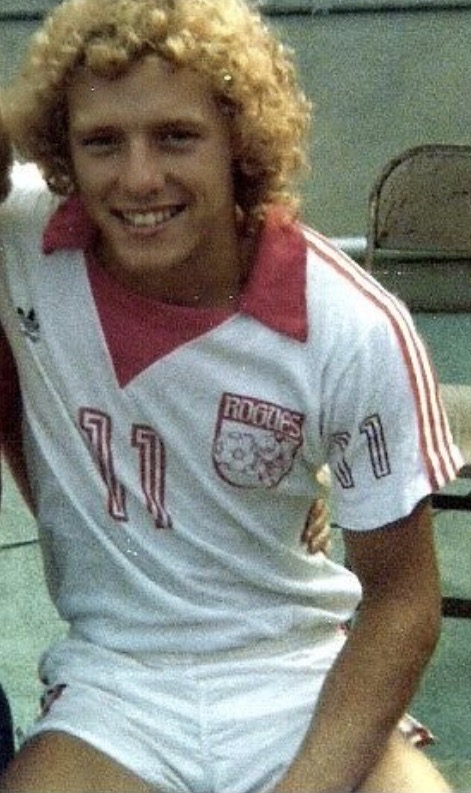
Smillie MemphisThe following two years, he went to play in America for Memphis Rogues (pictured left) where his teammates were players from the English game winding down their careers: the likes of former Albion players Tony Burns and Phil Beal, ex-Chelsea, Leicester and Palace striker Alan Birchenall and former Chelsea winger Charlie Cooke; the side being managed by former Chelsea defender Eddie McCreadie.

At the end of the 1981-82 season, Smillie was denied a pay rise by Palace so he decided to quit and wrote letters to clubs in the top two divisions in England asking for a job!

Brighton had managed to offload the troublesome Mickey Thomas to Stoke City so had a need for a left winger. They were the first to come up with an offer, and with full back Gary Williams surplus to requirements since the arrival of experienced defender Sammy Nelson, Brighton offered him in exchange for Smillie.

The bubble-haired winger gratefully accepted the switch to the Seagulls. While he made the starting line-up for the opening game of the new season, a heavy (5-0) defeat away at West Brom in the next game then saw him dropped and sidelined for months.

It was only once ultra-cautious manager Mike Bailey had left that Smillie got back in contention, and only then – in January 1983 – through someone else’s misfortune.

He said: “I was out in the cold and only got my break when Giles Stille was injured during the Cup game against Newcastle United.”

Smillie seized his opportunity and remained in the side for the rest of the season, culminating in the two Wembley FA Cup Final matches against Manchester United.

Back in the second tier following Brighton’s relegation, Smillie played 28 games plus once as a sub but following new manager Chris Cattlin’s signing of Northern Irish winger Steve Penney, there was competition in the wide areas.

Throughout the 1984-85 campaign, Smillie was more often than not a substitute rather than a starter. He did manage a seven-game run of appearances in the late autumn and began the final three games of the season, but the last game, a 1-0 home win over Sheffield United, proved to be his farewell.

Smillie revealed in a 2003 interview with Spencer Vignes that he’d discovered Manchester City had been keen to take him on loan but Cattlin hadn’t sanctioned it, even though he wasn’t selecting him.

“Chris had turned them down, saying I was a good player and he needed me. Yet he wasn’t even playing me! I just couldn’t believe he’d done it,” he said. Although he and his family were settled in Sussex, he realised he had to move.

Several eyebrows were raised when Cattlin managed to secure a £100,000 fee from Watford for Smillie’s services in the summer of 1985. The winger joined Graham Taylor’s beaten FA Cup finalists but he failed to establish himself in the side and made just 16 first team appearances in a season with the Hornets.

In the summer of 1986, he moved on to Reading for two years and, in 1988, after his disappointment with Brighton, Smillie was finally a winner at Wembley, scoring and setting up two goals as Reading beat Luton 4-1 in the Simod Cup Final.

The Hatters were led by former Albion captain Steve Foster and another of Smillie’s former teammates, Danny Wilson, was in their midfield. Mick Harford scored the opening goal for Luton, but Smillie’s pass allowed Michael Gilkes to bundle home an equaliser.

Smillie then won a spot kick converted by Stuart Beavon, and, in the second half, Mick Tait swept home another Smillie assist. Smillie then rounded off a great afternoon by scoring himself. It was hailed as one of the best days in Reading’s history, witnessed by over 45,000 loyal Royals fans.

Nevertheless, Smillie didn’t hang around and instead joined Brentford, where his former Palace teammate Phil Holder was assisting the manager at the time, Steve Perryman.NS Bees

Nick Bruzon interviewed Smillie in depth for a Where are they now? feature on the Brentford FC website in July 2010.

“Representing Brentford over three different decades, initially on loan in 1977 and then for five years from 1988 to 1993, Neil Smillie combined raw pace with ceaseless energy to make him one of the most popular players to patrol the New Road touchline,” said Bruzon. “Whilst with Brentford he experienced promotion, relegation and play off heartbreak, scoring 18 goals in 185 games.”

Smillie said: “I’ve got to say, the five years I spent at Brentford (and I was 30 when I signed) I thoroughly enjoyed.

“I’d reached a point in my career where I felt comfortable in terms of what I could give on the pitch. I’d always been a hard worker and I got the feeling that the supporters appreciated someone who worked hard.”

In the 1992-93 season, he played alongside Chris Hughton, who, like Smillie, was winding down his playing career.

“I loved taking people on and I loved getting crosses in for people to score so that just seemed to fit in nicely at the time with the team that we had,” he said. “I played my part as well as others who played theirs in getting the ball to me. We all did our bit and for me it was a great part of my career.”

On leaving Brentford, Smillie became a player-coach at Gillingham when his old Palace teammate Mike Flanagan was the manager. When Flanagan was sacked, Smillie took over the managerial reigns on a caretaker basis while the club tried to stabilise during financial troubles.

Smillie told Bruzon: “We were in a fairly precarious position and ended up in a decent position. So there was some enjoyment to it but the situation at a club without any money and struggling was difficult.”

Some names familiar to Brighton fans were at Gillingham at the time. Smillie played up front with Nicky Forster. Paul Watson was in defence and Richard Carpenter in midfield.

His three-month reign came to an end when Gillingham appointed Tony Pulis as the new manager and former Palace manager Alan Smith took Smillie to Wycombe Wanderers to look after their youth team.

When Smith left, Smillie was caretaker manager until former Albion full back John Gregory got the managerial post. Smillie then became Gregory’s successor in the hot seat for a year.

When the inevitable sack came, Smillie stepped outside of day to day running of football to become sports marketing manager for Nike in the UK. His role was to identify emerging talent for Nike to associate themselves with, and, as a result he stayed in touch with the game.

Among the players he signed to Nike were Theo Walcott, Darren Bent, Gabby Agbonlahor, James Milner, Tom Huddlestone, Danny Welbeck and Johnny Evans.

Pictures show (top) Smillie in action on the cover of the Albion programme; walking his dog; in Match magazine, on the cover of Shoot! being tackled by Liverpool’s Sammy Lee; a Simod Cup winner with Reading.

Twelve goals in 26 games for Scottish striker Alan Young

GARY LINEKER’S former strike partner at Leicester City had a good goals to appearances ratio for Brighton & Hove Albion.

Sadly, Scotsman Alan Young only managed 26 appearances in his one season (1983-84) with the Albion, although his 12 goals meant he finished second top goalscorer behind Terry Connor.

His brief Brighton career got off to a great start with a memorable debut goal, an overhead kick to net against Chelsea at the Goldstone. Young twice scored braces for the Seagulls but his season was injury-hit and, with manager Chris Cattlin bringing in his old pal Frank Worthington for the 1984-85 season, Young was sold to Notts County.

In more recent times, Young courted controversy as a radio pundit sharing his opinions about Leicester, and in 2014 BBC Radio Leicester dropped him from his role supporting commentator Ian Stringer.

alanyoung6 2

Back in September 2013, Young was berated online for his criticism of winger Anthony Knockaert. Foxello, on ja606.co.uk, wrote: “If there’s one thing that annoys me more than just about anything else at this football club, it is that grumpy, nasty egotist Alan Young and his never-ending agenda against certain members of the football club.”

The correspondent bemoaned: “Knocky is now the butt of every joke, and the object of every jibe Young throws out…. It’s almost as if he doesn’t want us to have skilful players who occasionally misplace a pass due to their advanced vision, and just have hoofers and cloggers like in his day.”

So let’s take a look back at ‘his day’. Born in Kirkcaldy on 26 October 1955, Young was football-daft and showed sufficient promise to earn Scottish schoolboy international honours.

His boyhood favourite team was Raith Rovers, whose star player at the time was Ian Porterfield, who famously scored the winning goal when Second Division Sunderland beat Leeds in the 1973 FA Cup Final.

Surprisingly overlooked by Scottish professional clubs, Young also experienced early disappointment in England when Nottingham Forest rejected him. “Nottingham Forert didn’t want me and I left there thinking I was no good,” he told Shoot! magazine.

Nonetheless, when he was playing as an unattached player for Scotland Schoolboys against England at Old Trafford, Oldham Athletic scout Colin McDonald, a former Burnley and England international goalkeeper, noted his promise and persuaded the young forward to head south of the border to begin his professional career.

In five years at Boundary Park he scored 30 goals in 122 games, and, to a large extent, learned his trade from old pro Andy Lochhead, a prolific goalscorer in his day for Burnley, Leicester and Aston Villa.

In the 1978-79 season, Young netted a hat-trick against Leicester which caught the eye of fellow Scot and former Rangers boss, Jock Wallace, who had taken over at Filbert Street and was building a team with his fellow countrymen at its core.

When Young joined Leicester, and played alongside his boyhood pal Martin Henderson, it began a love affair with Leicester that endures to this day.

In three years at Leicester, Young scored 26 times in 104 games, eventually forming a partnership with the emerging Lineker. TV’s favourite football frontman was generous enough to pen the foreword to Young’s 2013 autobiography, Youn9y (written in conjunction with Simon Kimber and published by the historypress.co.uk) and said of him: “He was an old-fashioned, aggressive centre forward. He possessed, though, a delicate touch and finesse that belied his big target man status – the perfect partner for a nippy little goalhanger trying to make a name for himself.”

Screenshot
Leicester strike partner for Gary Lineker

Young scored on his full debut for City in a league cup game v Rotherham and followed it up with two on his league debut at home to Watford.

The only time Young was sent off while playing for Leicester was, ironically, at the Goldstone Ground in 1981, at Easter, which was the second of four games at the end of the season that Albion won to stay in the top division.

Young was dismissed for two bookable offences, the first for clattering into goalkeeper Graham Moseley and the other a clash with Steve Foster, although, in his autobiography, he says Foster play-acted a knee injury, which the referee bought. Foster even teased him about it when he joined the Seagulls two years later. In that Easter 1981 fixture, Young’s teammate Kevin McDonald was also sent off, Brighton won 2-1 – and Leicester ended up being relegated together with Norwich and bottom-placed Crystal Palace.

Back in the old Second Division, Young did his cartilage in a game on QPR’s plastic pitch which he says was the beginning of the end of his career, because his knee was never the same afterwards (years later he had a knee replacement).

He also had the disappointment of losing to Spurs in the 1982 FA Cup semi final, although he maintains if a certain Chris Hughton had been sent off for two fouls on Lineker, it might all have been a different story.

Before the next season kicked off, Jock Wallace, the manager he idolised, decided to move back to Scotland to manage Motherwell and his successor at Filbert Street, Gordon Milne, swiftly chose to pair the emerging Alan Smith up front with Lineker, signalling the exit for Young.

Managerial upheaval was to become a familiar cause of Young’s departures in the years that followed, too. But I am getting ahead of myself.

Ian Porterfield, his footballing hero from yesteryear, had taken over as manager at Fourth Division Sheffield United and, although he didn’t really want to drop down the leagues, the Blades were a big club so Young moved to Bramall Lane.

A year later, though, after Brighton’s relegation from the elite in 1983, striker Michael Robinson was sold to Liverpool so there was a centre forward vacancy – and manager Jimmy Melia chose Young to fill it.

The fee was either £140,000 or £150,000 depending on which account you believe, but Young was happy because he pocketed a £20,000 signing on fee (four times what he had received only a year earlier when moving to Sheffield).

His first involvement with the squad was on a close-season tour of the Balearic Islands (with associated eye-opening tales recalled by thegoldstonewrap.com) but he also picked up an injury that was to dog his season on the south coast.

While Young had a lot of time for Melia, when Cattlin took over it was a different story and, in his book, there are plenty of colourful expletives used to describe exactly what he thought! He also castigates physio Mike Yaxley – “the most useless physio I have ever worked with” – although he says the team spirit was very good…seemingly fuelled by long post-training ‘sessions’ in Woody’s wine bar.

A youngHe said: “The football was very enjoyable there and never more so than when Jimmy Case and I were playing together; I loved playing with Jimmy.”

For a short time in that 1983-84 season, Albion had three Youngs in their squad, none of whom were related. Along with Young the forward, there were centre backs Eric Young and on-loan Willie Young.

When Cattlin decided to bring in his old Huddersfield teammate Worthington the following season, Young was on his way, this time to Notts County. The manager who signed him was the former Liverpool and Nottingham Forest defender Larry Lloyd, but his tenure in the managerial chair was very short so, once again, Young found himself playing for a manager who hadn’t chosen him.

In two years at Meadow Lane, Young scored 12 in 43 games for County. He moved on to Rochdale where the Leeds legend Eddie Gray was in charge, but injury took its toll and he only scored twice in 28 games in the 1986-87 season before retiring at 31. He had scored a career total of 89 goals in 349 appearances.

While there were a few non-league appearances, he eventually landed a job back at Notts County in the early days of community football schemes. He made a success of the job, obtained his coaching qualifications and eventually they combined the community scheme with the centre of excellence.

Brighton fans will be interested to know that among the young lads who emerged during Young’s time there were Will Hoskins and Leon Best. The star player, though, was Jermaine Pennant.

Young has fond memories of Neil Warnock’s time as County manager, because of his interest in the work being done at grassroots level. However, the mood changed when Sam Allardyce took over.

Allardyce initially cut Young’s salary and then showed him the door. “I can’t and I never will forgive Sam Allardyce,” he said.

Away from football, Young has had a tempestuous love life – read the book to gather the detail – and has three sons and a daughter. While he also had spells working for Chesterfield and Leeds, he dropped out of the game and then had a very dark period dominated by heavy drinking in isolation, including a time living alone in a caravan on the banks of Loch Lomond.

Eventually a return to England and his break into radio punditry brought him back from the brink.

In 2013, his autobiography Youn9y was published, the sleeve notes describing the story of “a talented, brave striker who played at the highest level of the domestic game but also experienced human misery at its lowest once his playing career was over”.

The notes add: “Youngy doesn’t just recount the good times of his playing career; he also offers valuable insight and moments of perception and understanding of some of the darkest days of his life.”

After four years as match summariser, in 2014 BBC Radio Leicester dispensed with his services and replaced him with another former Fox, Gerry Taggart.

However, Young still gives his opinions about Leicester on the community radio station Hermitage FM.

Pictures show a shot of Alan on Brighton seafront from an Albion matchday programme; the front cover of his autobiography; other matchday programme action shots, and in the Hermitage FM radio studio from Twitter.

Eire striker John Byrne’s three spells at the Albion

FOOTBALL things came in threes for striker John Byrne. He had three different spells playing up front for the Albion and he featured for three different clubs under manager Denis Smith.

Add to that, on three occasions, he was signed by clubs who he’d played well against. And, for QPR fans, he was also the third no.10 who got the crowd off their feet at Loftus Road, following in the footsteps of Rodney Marsh and Stan Bowles.

Ironically, it was former Albion boss Alan Mullery who took Byrne to Rangers, in 1984, during his six turbulent months as manager. Mullery took over from his former Spurs teammate Terry Venables, who’d left to manage Barcelona.

While Mullers’ reign at Loftus Road was brief, the skilful forward he brought in stayed four years and won plenty of admirers amongst the Hoops supporters.

Alongside former Albion striker Michael Robinson, he was part of the QPR team that lost to Oxford (a club he would play for later in his career) in the 1986 League Cup Final (QPR’s sub that day was Liam Rosenior’s dad, Leroy).

Wembley wasn’t to be a happy hunting ground for Byrne, though. That 1986 defeat was the first of three occasions he made it onto the iconic turf, each time ending up on the losing side.

Byrne’s career had begun with basement side York City at 16 after Mike Walker, a taxi driver pal of York’s boss, the former Manchester United manager Wilf McGuinness, spotted him playing local football in Manchester (he was born on 1 February 1961 and raised in Wythenshawe).

Charlie Wright, the former Bolton and Charlton goalkeeper took over as manager and gave Byrne his first pro contract but it was his successor, Denis Smith, the ex Stoke City stopper, who arrived in 1982, together with his coach, former striker Viv Busby, who set Byrne on the road to success.

He scored an impressive 55 goals in 175 appearances for York between 1979 and 1984 and his signing by Mullery for QPR came after he did well in a two-legged Milk Cup tie against the Hoops.

In an odd symmetry, his later move from QPR to Le Havre came after the sides had met in a friendly, and the pattern continued when his eventual move to Brighton came after they too had played Le Havre pre-season.

But back to London where, in his four years at Loftus Road, he scored 30 times in 126 appearances.

QPR fans recall fondly a game when Byrne scored twice in a 6-0 thrashing of Chelsea and, some years later, in an interview with QPRnet, he explained how the drubbing riled the Chelsea, and later Brighton, defender Doug Rougvie to the extent that Byrne and fellow striker Gary Bannister finished the game playing out wide to avoid getting a kicking!

He also scored a winner against Manchester United, the team he’d followed as a boy, and in an interview with Sussex Life in 2010, he said: “I felt a bit like a traitor!”

It was in the year following his move to QPR that he made his international debut for the Republic of Ireland – he qualified to play for them because his dad, Jim, was from County Carlow.

He was an international teammate of Chris Hughton and Mark Lawrenson and between 1985 and 1993 collected a total of 23 caps, scoring four goals, two of which came in a 3-1 win over Turkey.

JB Eire

Although part of Eire’s Euro 88 and 1990 World Cup squads, he didn’t play a game.

Byrne had three spells with Brighton but undoubtedly the most memorable was in the season that ended in heartbreak in the Wembley play-off final against Neil Warnock’s Notts County.

Manager Barry Lloyd had brought him back to the UK from Le Havre for £125,000, shortly after he had been to the World Cup in Italy with the Republic, and successfully partnered him up front with the prolific Mike Small.

Byrne admitted in a 2010 matchday programme interview how he thought he was joining Sunderland that summer but his agent Paul Stretford’s demands put off the Wearsiders and the striker ended up writing to all the English First and Second Division clubs looking for an alternative club.

Surprisingly, he didn’t get many replies, but Brighton did. “Barry Lloyd got in touch and the rest is history,” said Byrne.

It turned out Lloyd had long been an admirer. He wrote in the matchday programme: “I first tried to sign him two years ago, before he went to Le Havre. He was at QPR then and I was vying with Sunderland for his signature when he finally decided to broaden his footballing experience by moving to France.”

Lloyd revealed how he had consulted with Republic of Ireland boss Jack Charlton to check Byrne had lost none of his old skills and ambition. “He is an intelligent player who moves well across the line and I am sure he is looking on his move to us as an ideal opportunity to regain his place in the Republic’s squad for the European Championships in two years’ time,” said Lloyd.

Albion have had some decent striking partnerships over the years but not since Ward and Mellor in the Seventies had a pair captured the imagination in quite the same way as Byrne and Small. Between them they spearheaded Albion’s push for promotion to the elite.

J ByrneThe climax to the season was a classic case of ‘if onlys’ where ‘Budgie’ was concerned: if only he hadn’t been injured in that final game against Ipswich, he would have been fit to play from the start in the final.
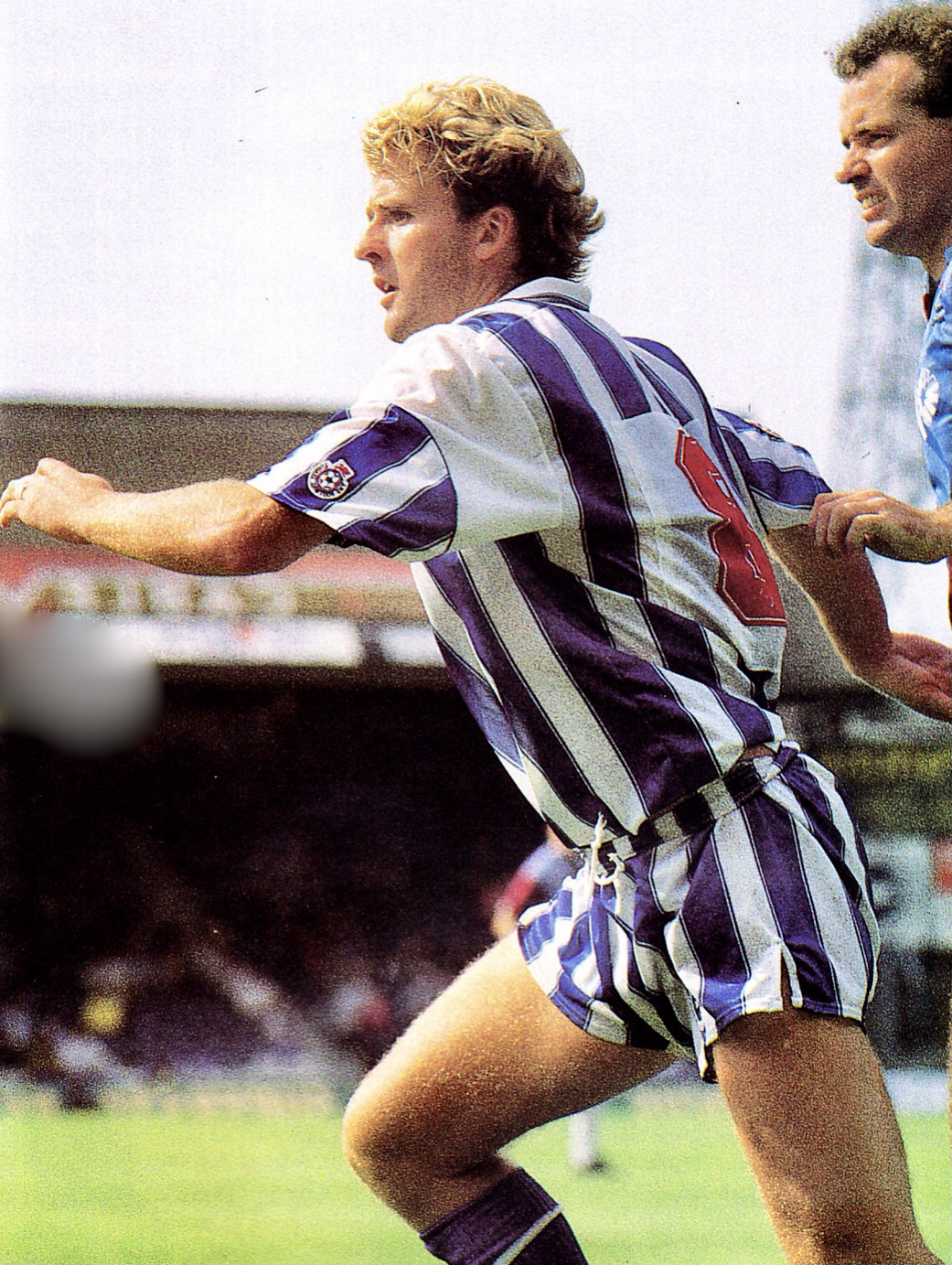
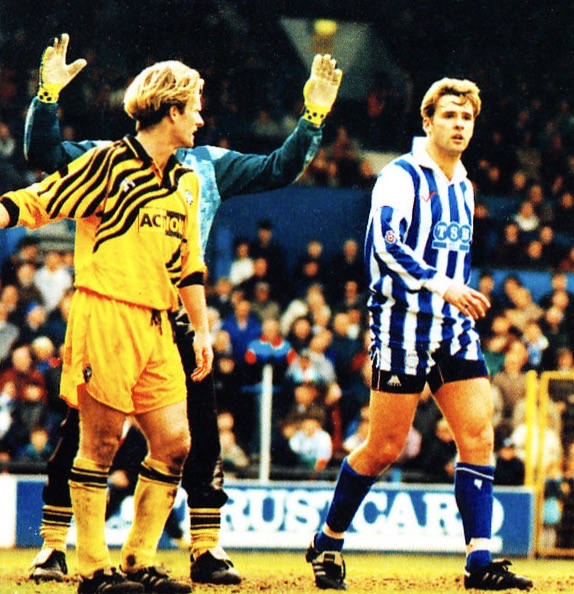
There again, if he hadn’t been fouled on the edge of the box, Albion wouldn’t have won the free kick from which Dean Wilkins scored to earn Albion the play-off spot!

With his right leg heavily strapped, Byrne appeared as a substitute in the final. When the Albion story came to an unhappy ending, and the expected financial boost of playing in the top division didn’t materialise, Lloyd had to cash in his prize assets: Small went to West Ham for £400,000 and Byrne was sold to Sunderland for twice what Brighton had paid for him.

Reflecting on Byrne’s impact, Lloyd told Albion’s matchday programme: “He was outstanding for us, he really was. His workrate was excellent.

“He could pass a ball, cross a ball and he knew where the back of the net was. We didn’t have a lot of money to spend but we got something special with him which very nearly got us into what is now the Premier League.”

Byrne famously scored in every round of the FA Cup as Sunderland marched to the final in 1992, and, almost as famously, missed a great chance from six yards as the Wearsiders lost to Liverpool.

After a season at Sunderland, Byrne moved to Millwall, where things didn’t work out for him, and in 1993 he returned to Brighton on loan for a brief seven-game spell in which he scored twice.

He then had two seasons at Oxford, when he scored 18 times in 55 appearances, before returning once more to the Albion to play 39 games in the 1995-96 season. He scored six times, but, it would be fair to say, he was a shadow of the player who graced that 1990-91 season.

Byrne didn’t let the grass grow under his feet when he packed up playing – he learned how to take care of other people’s by becoming a podiatrist.

Followers of the Albion also got to hear his dulcet Mancunian tones on the radio as a summariser on the local radio station’s coverage of Brighton games.Byrne close action

Byrne pictured in 2010