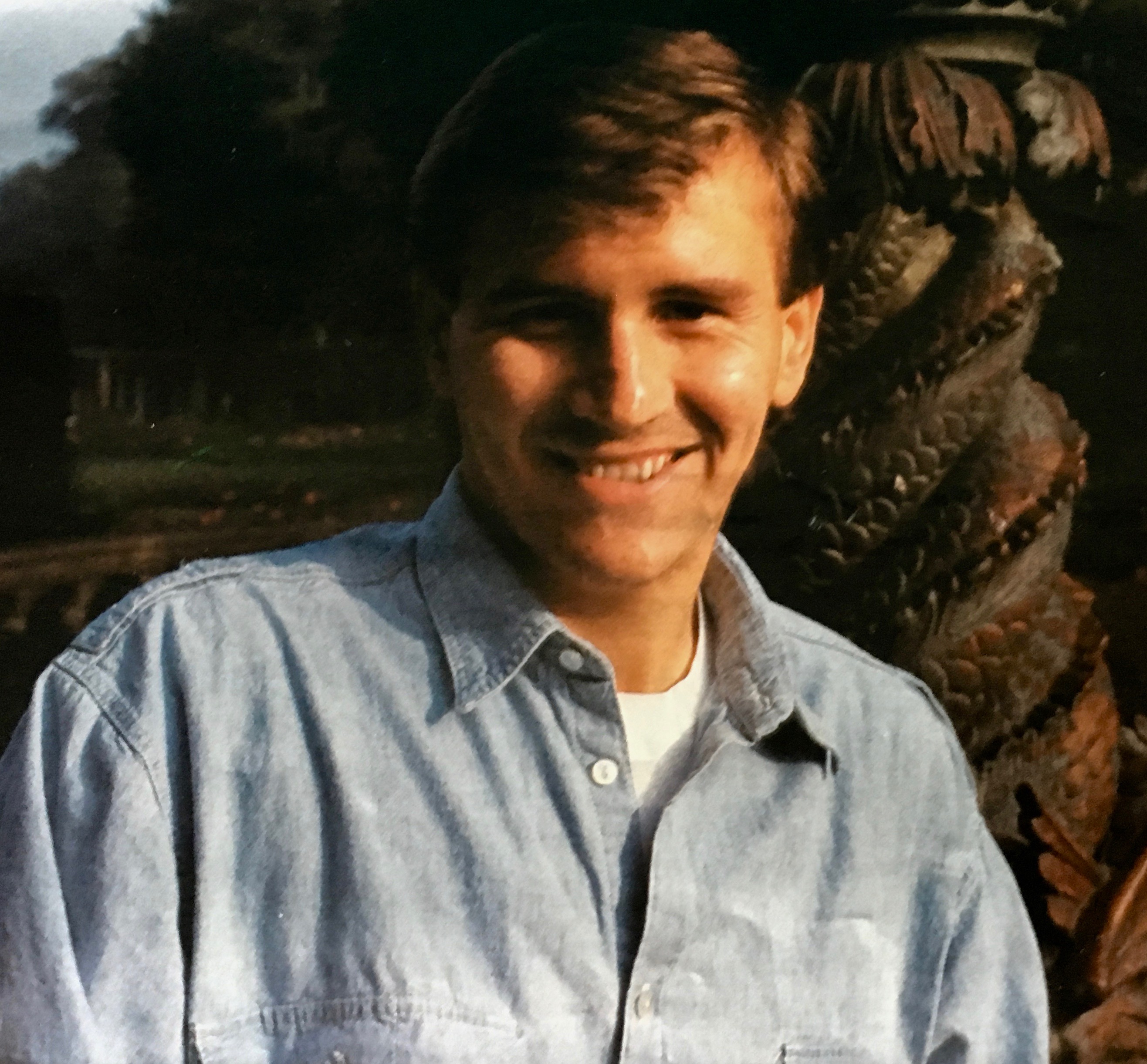
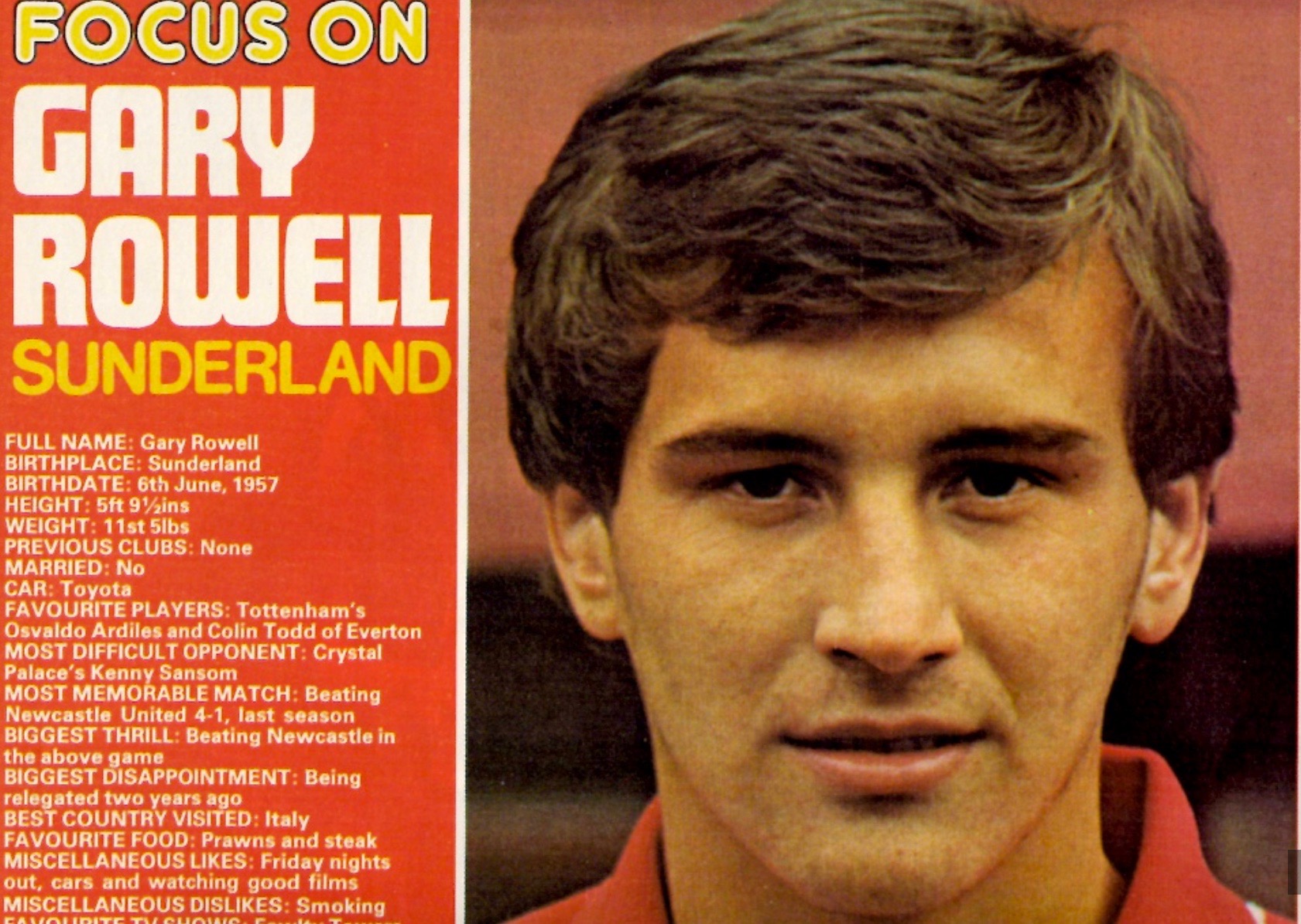
Ball-playing defender Colin Pates a captain at just 22

ENGLAND World Cup winning hat-trick hero Geoff Hurst gave Colin Pates his Chelsea debut as an 18-year-old – and what an extraordinary footballing baptism it was.

Replacing the injured Micky Droy for a visit across London in a second tier match against Orient, young Pates was involved in a madcap 10-goal match that saw Chelsea win 7-3.

“It was an amazing feeling to go out there but it was chaos, “ he told chelseafancast.com in a 2021 podcast.

And in another interview, he recalled: “It certainly wasn’t a good advertisement for defenders but as long as you come away with the win the fans are happy. It’s one of those days where you’re so fired up it just goes so quickly.

“You come off the pitch at the end and have no recollection of what happened really. I was up against some good, experienced pros and it was quite daunting, but I really enjoyed it.”

That game at Brisbane Road marked the start of a Chelsea first team career that spanned 346 matches, 137 of them as captain, in a turbulent period for the club.

Pates’ future Brighton teammates Gary Chivers and Clive Walker were also in that side at Orient and Walker scored two of Chelsea’s hatful (Lee Frost (3), Micky Fillery and Ian Britton the others).
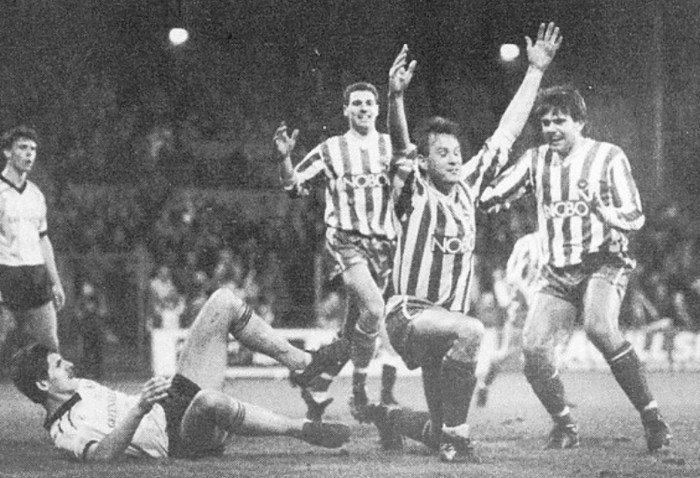
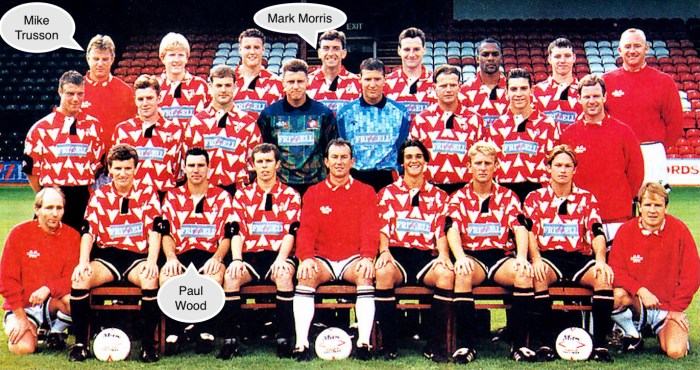
Pates and Robert Codner celebrate reaching the Wembley final

Fast forward 12 years and Pates was reunited with Chivers and Walker when he joined Brighton on loan from Arsenal in February 1991 to help out after young Irish centre-back Paul McCarthy was sidelined by injury.

Manager Barry Lloyd pulled off something of a coup to persuade his old Chelsea teammate, George Graham, then manager of Arsenal, to loan Pates to the Seagulls for three months.

The Argus Albion reporter John Vinicombe described it as a “masterstroke” and doubted that Albion would have made it to the divisional play-off final at Wembley without him.

Match magazine pic of Pates at Wembley

Lloyd’s faithful no. 2, Martin Hinshelwood, said Pates got better and better over the three months, pointing out: “He has steadied us a little bit. He talks to players, he is a great trainer and he has brought a lot to our back four.”

The player himself told Luke Nicoli of the Albion website in a 2021 interview: “Although I was dropping down a division, it didn’t matter to me – I was just happy to be playing football.

“I immediately struck up a partnership at the back with Gary, and it was like the good old days at Chelsea again.

“I spent three months at the club and I loved every minute; I loved the area, the Goldstone, the club, the fans and, of course, we went all the way to Wembley that season in the play-offs – where the turnout from our fans in the final was incredible.

“We lost (3-1) to Notts County, which was one of those games where it just wasn’t meant to be.”

It has since emerged that Lloyd’s insistence on changing a successful formula by playing Romanian international Stefan Iovan as a sweeper in that match upset the players.

But Pates said: “I know we changed formation that day, and maybe that contributed to our defeat, but I didn’t look at it like that – it was just one of those games where it wasn’t meant to be.”

“We came with a fantastic late run in the league, but it proved to be a game too far for us,” he recalled in a matchday programme article. “We made a slow start to the game and that defeat still hurts, knowing what it meant to everyone connected with the club.”

In another interview, Pates said: “The result in the play-off final didn’t go our way but it was a fantastic experience for the team to play at Wembley, the side was so close to the Premiership, or First Division as it was called then.

“I’d been lucky to have played there before but to others it was the pinnacle of their careers.”

Indeed, the last time Pates had played there was five years previously when he made history by becoming the first-ever Chelsea player to lift a trophy – the Full Members Cup – at the iconic stadium (when Ron Harris lifted the FA Cup in 1970 it was at Old Trafford, where the replay had taken place after a 2-2 draw at Wembley). That was arguably the pinnacle of his career.

The Full Members Cup was a short-lived competition between North and South clubs from the top two divisions of the league, with the regional winners meeting in a national final. It was introduced after English clubs were banned from competing in Europe following the Heysel disaster. In truth, it struggled to be taken seriously and it was a surprise it lasted as long as seven seasons.

The most remarkable element of Chelsea’s win was that the game took place the day after they’d played a league game at Southampton – when Pates scored the only goal of the game with a deflected free kick past Peter Shilton in Southampton’s goal.

Chelsea beat Manchester City 5-4 but extraordinarily were cruising at 5-1 before City scored three in the last six minutes (one an 89th minute own goal by Doug Rougvie!).

“When the referee blew his whistle, was I relieved!” said Pates. “It’s great to play at Wembley with thousands of fans screaming their heads off, and once you’re on the pitch you don’t care what cup it is, you just want to win it.”

Born on 10 August 1961 in Wimbledon, Pates went to school only five miles from Stamford Bridge and was a Chelsea fan as a boy. He signed for the club aged 10, starting training with them in 1971, the year they won the European Cup Winners’ Cup having won the FA Cup the previous year. Pates worked his way through the different age levels and as an apprentice cleaned the boots of hardman defender Ron Harris.

He made that first team debut on 10 November 1979, by which time he had already played five times for England Youth that autumn. A further six appearances followed in 1980, alongside the likes of Micky Adams, Gary Mabbutt, Paul Walsh and Terry Gibson. Mark Barham, Steve Mackenzie and Terry Connor featured in the early 1980 games.   

Pates in action for Chelsea against Albion’s Terry Connor, a former England Youth teammate

Simultaneously, Droy’s lack of fitness meant young Pates got an extended run in the side. However, because he was comfortable on the ball and could play in a number of positions, manager Hurst often used him as something of a utility player.

For example, in 1980-81, his 15 appearances were spread across all back four positions. But when John Neal took over for the 1981-82 season, Pates was ever present in the centre alongside Droy.

While the side’s league fortunes didn’t improve under the new man (they finished 12th), they had the consolation of reaching the quarter finals of the FA Cup after beating reigning European champions Liverpool 2-0 in the fifth round (Pates had the job of man-marking Graeme Souness).

Remarkably, Chelsea only narrowly avoided relegation to the old Third Division in 1983, and, as a result, manager Neal had a clear-out of the ‘old guard’ and Pates’ performances and attitude earned him the captain’s armband just before his 22nd birthday.

“I think he wanted someone who had come through the ranks and knew the club,” Pates said. “I was fortunate enough to be one of the few players – along with the likes of John Bumstead – who he kept on from before.”

Pates has nothing but praise for Neal and his assistant Ian McNeill (who played more than 100 games for Brighton between 1959 and 1962) and their eye for good players, like Pat Nevin, Joe McLaughlin, Nigel Spackman, David Speedie and Kerry Dixon, who were brought in to rebuild the club.

“I loved John Neal, he was a man of few words but when he said something you listened because it was going to be something poignant or important,” said Pates. “He was a good man-manager and would always take care of you if you had problems and be there for a chat. You wanted to play for him.”

Combined with the new arrivals, Pates and his pal Bumstead were part of a core of local lads Neal relied on (it included Dale Jasper, Chivers and Fillery): they all came from the same estate in Mitcham.

In his first season wearing the armband, “Pates stepped into the role with ease and led the team to the Second Division title” wrote Kelvin Barker.

“Colin’s classy displays in the top division catapulted him into the limelight, his impressive captaincy of a club on the up particularly catching the eye.

“A string of niggly injuries after Christmas led to him missing a handful of matches and his importance to the defence was highlighted when, in his absence, Chelsea slipped to consecutive defeats at Coventry and Ipswich.

“Pates made a total of 48 appearances during the 1984-85 campaign and scored once, the goal coming in a stunning 4-3 win at Goodison Park against the season’s champions, Everton.”

It had been a proud moment when Pates led Chelsea out at Highbury for the 1984-85 season-opener against Arsenal. The game finished 1-1, Paul Mariner opening the scoring for the Gunners on 35 minutes, Dixon equalising for the visitors four minutes later.

Chelsea made a decent fist of their return to the big time, finishing sixth. They also reached the semi-finals of the League Cup only to be knocked out over two legs by a Clive Walker-inspired Sunderland.

Chelsea did make it to Wembley the following year but it would be fair to say winning

that Full Members Cup final ultimately damaged their progress in the league. Chelsea were riding high in the top flight at the time and being spoken of as title contenders but immediately after that trophy win they were beaten 4-0 at home by West Ham on Easter Saturday and 6-0 by QPR at Loftus Road on Easter Monday.

Pates’ future Brighton teammate John Byrne scored twice for the Rs playing alongside Michael Robinson and Gary Bannister, who got a hat-trick. Substitute Leroy Rosenior (father of Liam) scored the other.

Byrne later remembered: “There were some big name players in the Chelsea line-up, including centre-back Doug Rougvie who seemed like he wanted to kill somebody when the score was 5-0! He was certainly looking for blood!

“We had the Milk Cup Final coming up and I remember saying to Banna with about 15 minutes to go ‘I ain’t going anywhere near Rougvie’. And Gary replied: ‘Neither am I!’ So we both ended up playing on the wings with no one in the middle!”

Pates and Doug Rougvie both played for Chelsea and Brighton

There was talk that Pates might force his way into the England squad for the Mexico World Cup that summer but Terry Butcher, Alvin Martin and Terry Fenwick were ahead of him.

Competition at club level emerged at the start of the following season when centre-half Steve Wicks was recruited and Pates was moved to left-back. However, injuries to Wicks meant Pates was soon back in the middle.

In his sporting-heroes.net piece, Barker continued: “As Chelsea’s farcical season went from bad to worse, he found himself being played in midfield again. With the Blues looking down the barrel of a drop into Division Two, Colin was returned to the centre of defence and relegation was averted.”

An injury-disrupted 1987-88 season also saw Pates have the captaincy taken off him and given to fellow defender Joe McLaughlin. Pates actually missed the start of the season having had a cartilage operation and when he returned in October the team were on something of a downward spiral. Injured again at the end of March, by the time he was fit to return, Chelsea were heading close to the relegation trapdoor.

At the time, as part of a restructuring plan to reduce the top division’s number of teams from 22 to 20, the team finishing fourth bottom of Division One had to play-off against the third, fourth and fifth-placed teams in Division Two. The top two in Division Two were promoted automatically and the bottom three in Division One went down.

Chelsea ended up fourth from bottom and had to play Middlesbrough (who’d finished third in Division Two) over two legs.

Boro won the first leg at Ayresome Park 2-0 but Chelsea only won their home leg 1-0, so they were relegated. However, history has since remembered the match more for the riotous behaviour of Chelsea supporters.

gazettelive.co.uk recalled: “There was trouble before, during and after the high-stakes game. Chelsea fans invaded the pitch on the whistle and stormed the away end sparking hand to hand fighting with barely a steward in sight.

“And it was only the intervention of mounted police that eventually cleared the pitch. The trouble didn’t stop there with more attacks outside the ground as Boro fans returned to their cars, coaches and the tube.”

Boro striker Bernie Slaven remembered: “We were locked in the dressing room celebrating promotion for maybe an hour while the police dealt with the trouble and cleared the pitch then we went out and celebrated again with the Boro fans who had been kept back in the stadium.

“The trouble and the ugly atmosphere was a real shame because it took all the headlines away from what we had achieved.”

John Hollins resigned as manager and was replaced by Bobby Campbell. One of his first moves was to sign the powerful central defender Graham Roberts who he made captain.

Pates was given a testimonial as part of the pre-season friendly fixtures (a 0-0 draw with Spurs) but the season was only three months old when he suddenly found himself unwanted at the Bridge.

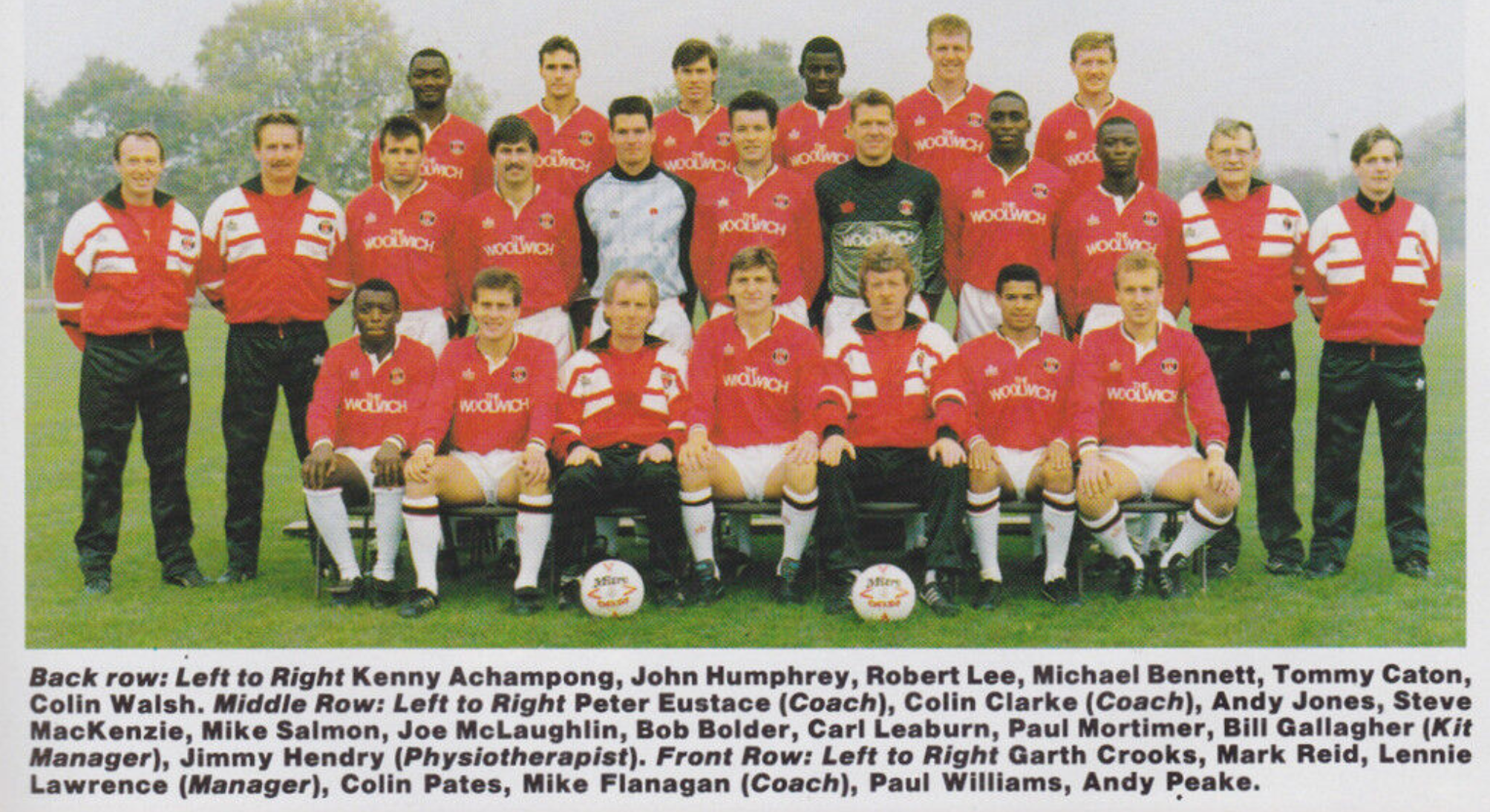
As Pates returned to the dressing room at the end of a 2-2 Littlewoods Cup home draw with Scunthorpe United, Campbell informed him Charlton Athletic manager Lennie Lawrence was upstairs waiting to sign him, the club having already agreed terms over the transfer (a £400,000 fee).

“It came right out of the blue,” said Pates. “At first, I was taken aback. I have been at Stamford Bridge since I was a schoolkid. Chelsea has become a way of life.”
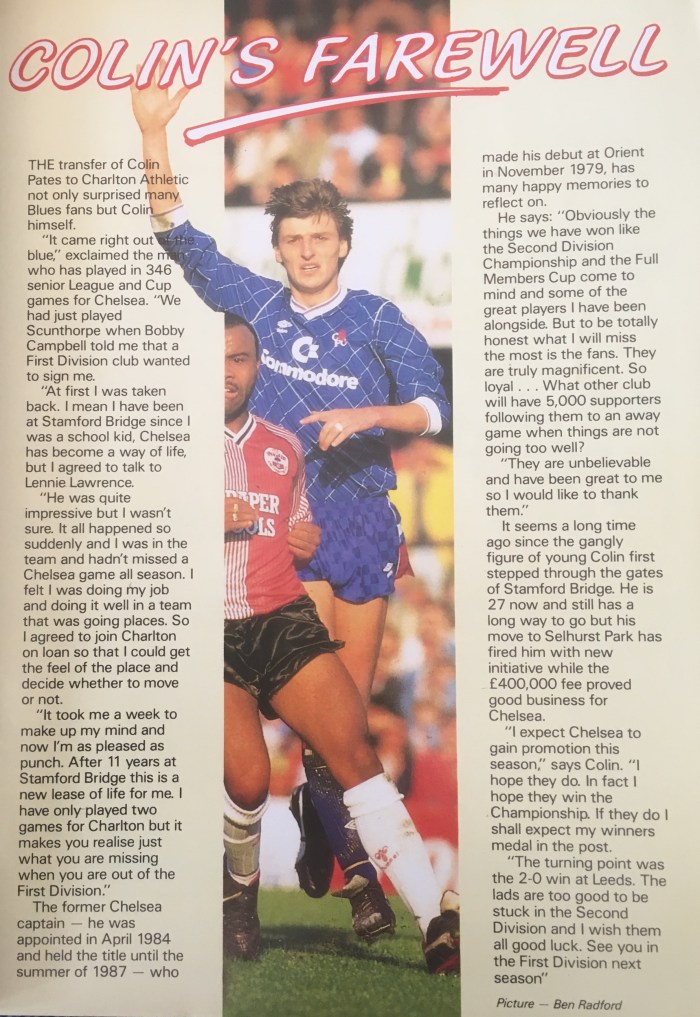
When the Albion visited Chelsea for a Division 2 league game on 29 October 1988, the matchday programme carried an article headlined ‘Colin’s farewell’, detailing the circumstances.

“The transfer of Colin Pates to Charlton Athletic not only surprised many Blues fans but Colin himself,” it began.

And reflecting on what happened many years later, Pates told Luke Nicoli: “I was allowed to leave and did so with a heavy heart as I wanted to stay.”
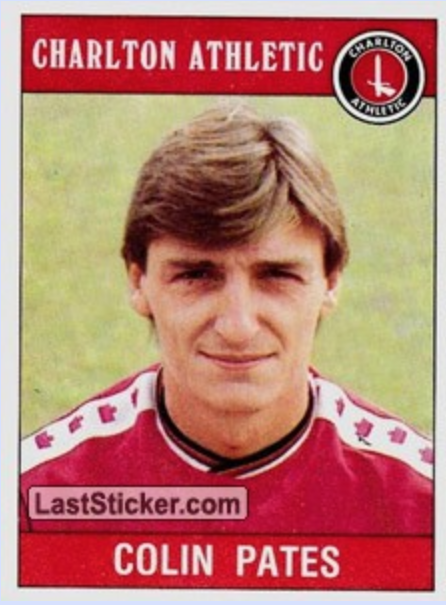
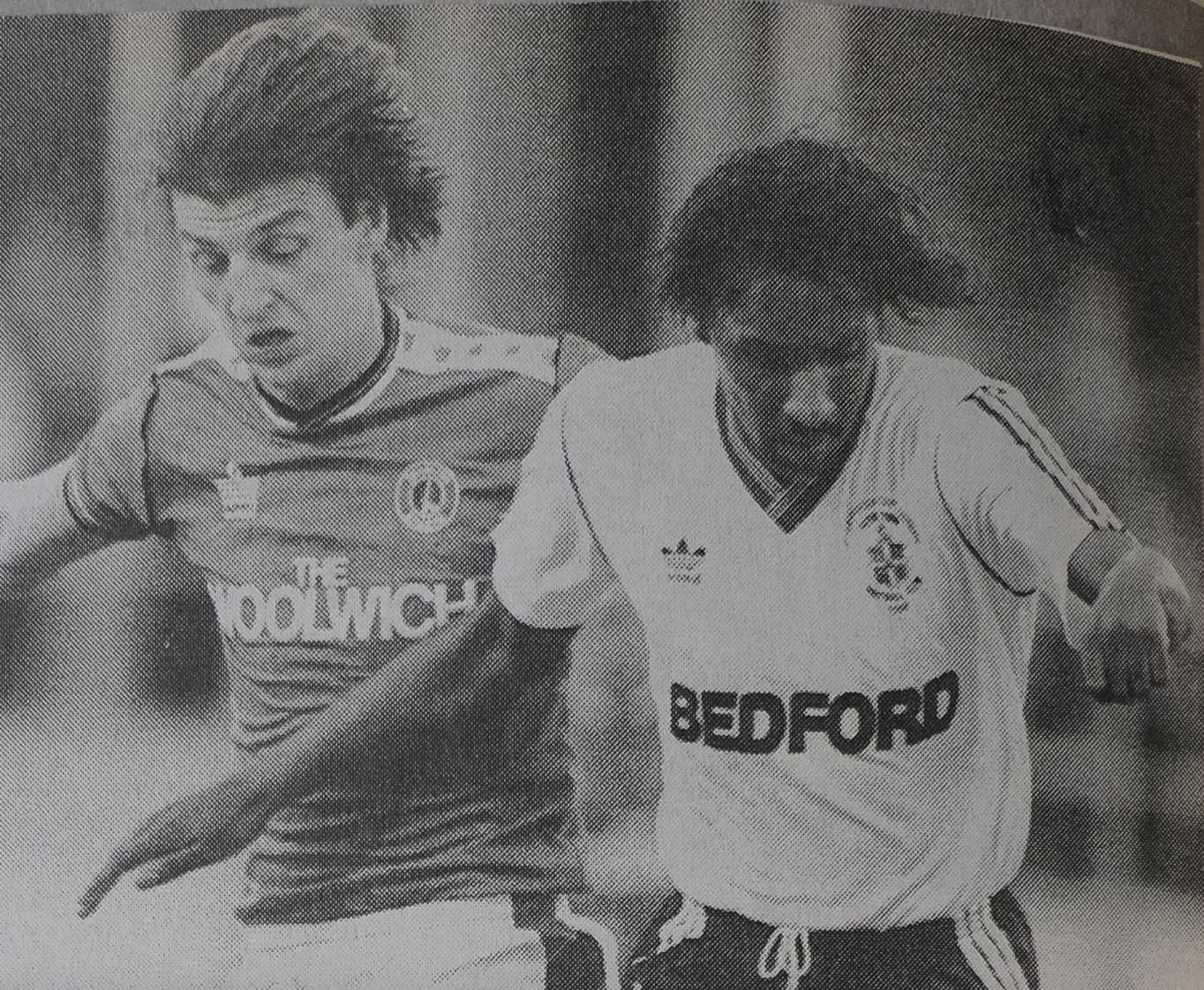
Nevertheless, the move at least presented the defender with the chance to return to playing in the top division, and he admitted: “After 11 years at Stamford Bridge, this is a new lease of life for me.”

Charlton, who had to play home matches at Crystal Palace’s Selhurst Park at the time, finished 14th by the end of that 1988-89 season, but Pates had left for Arsenal by the time the Addicks were relegated in 19th place at the end of the following season.

Despite those moves across London, and to the south coast, Chelsea hadn’t seen the last of Pates, though. He subsequently became head of football at the independent Whitgift School in South Croydon, where he coached most sports and was the first football coach in what had previously been a rugby-dominated school and pupils Victor Moses and Callum Hudson-Odoi both went on to play for the Blues.

Pates was also seen back at the Bridge on matchdays working in the hospitality lounges.

A lifetime in football for Mike Trusson the enforcer

MIKE TRUSSON has spent a lifetime in football since Plymouth Argyle spotted his raw teenage talent, took him on as an apprentice and gave him his professional debut at 17.

After playing more than 400 matches over 15 years, he became prominent in football marketing, coaching and scouting, often in association with his good friend Tony Pulis, who he played alongside at Gillingham after leaving the Albion.

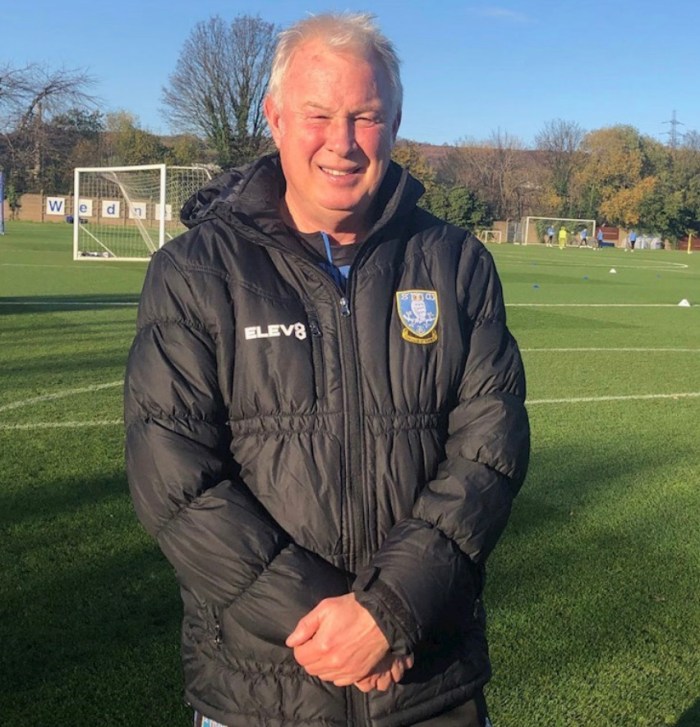
As recently as late 2020 he was assistant manager to Pulis for an ill-fated brief spell at Sheffield Wednesday.

Much fonder memories of his time in the steel city were forged when he was twice Player of the Year at Sheffield United.

In an exclusive interview with the In Parallel Lines blog, Trusson told Nick Turrell about his time with the Seagulls, his first coaching job at AFC Bournemouth and the formative years of his career.

A goalscoring home debut for Mike Trusson

A MOVE TO SUSSEX in the summer of 1987 ticked all the right boxes for Mike Trusson.

An experienced midfielder with more than 300 games under his belt already, he welcomed the opportunity to be part of the rebuilding job Barry Lloyd was undertaking at the Goldstone following the club’s relegation back to the third tier. He was one of seven new signings.

The move also brought him a whole lot closer to his family in Somerset than south Yorkshire, where he’d lived and played for seven years.

And it gave him the chance to earn more money.

The only problem was he had a dodgy left knee – it was an injury that prevented him making his first team debut for the Seagulls for four months, and it troubled him throughout his first season.

Frequent leaping to head the ball had resulted in a torn patella knee tendon that had needed surgery during the latter days of the player’s time at Rotherham United, where for two years his manager had been the legendary former Leeds and England defender Norman Hunter.

Prior to the injury, Blackburn Rovers had bid £200,000 to sign him, but nothing came of it and a contractual dispute with the Millers (who were not keen to give him what he said he was entitled to because of the injury) led to him being given a free transfer (Hunter subsequently signed former Albion midfielder Tony Grealish).

Trusson fancied a move south to be nearer his folks and had written to several clubs, Albion included, who he thought might be interested in his services (these were the days before agents).

Although Millwall and Gillingham had shown an interest, it was a call from Martin Hinshelwood, Lloyd’s no.2, that saw Trusson head to Sussex for an interview where he met the management pair, chairman Dudley Sizen and director Greg Stanley.

Trusson looks back on the encounter with amusement because not only did they agree to take him on but they offered him more money than he was asking for because they said he’d need it in view of the North-South disparity in property prices.

“Brighton was a big club. Only four years earlier they’d been in the Cup Final and some of those players from that time were still at the club,” he said. “From my point of view, it was a big career move. It ticked all the boxes.”

Initially Trusson shared a club house in East Preston with fellow new signings Kevin Bremner, Garry Nelson and Doug Rougvie before moving his wife and daughter down and settling in Angmering, close to the training ground (Albion trained at Worthing Rugby Club’s ground at the time).

Before he could think about playing, though, he had to get fit. Scar tissue after the operation on his knee had left him in a lot of pain, and although he passed his medical, the pain persisted.

New physio Mark Leather told him straight that he wouldn’t be able to train, let alone play, with the leg in the condition it was. It had shrunk in size due to muscle wastage so his first two months at the Albion were spent building it back up and regaining match fitness in the reserves.

In the meantime, former full-back Chris Hutchings was keeping the no.8 shirt warm until he finally got a move to Huddersfield that autumn.

Trusson recalled: “I was aware there was a rebuilding process going on. It was a very different group to ones I’d experienced at other clubs. A lot of the lads travelled down from London so there was not much socialising.”

There was certainly lots of competition for places during his time at the club. Sometimes Dale Jasper would get the nod over him and he could see Lloyd preferred the ball-playing types like Alan Curbishley and Dean Wilkins, and later Robert Codner and Adrian Owers.

“I thought if I was going to play, I had to change,” Trusson reflected. “I became more of a midfield enforcer and left it to the better players to play.”

As such, he was surprised yet delighted to score on his home debut, albeit, more than 30 years on, he doesn’t remember much about it.

For the record, it was on 12 December 1987, in front of a rather paltry 6,995 Goldstone Ground crowd, that Trusson scored the only goal of the game against Chester City as Albion extended an unbeaten run to 15 matches. (Chester’s side included former Albion Cup Final midfielder Gary Howlett, who was on loan from Bournemouth).

In that injury-affected first season, he played 18 games plus seven as sub. He had been on the subs bench for three games as the season drew to an exciting climax, but he was not involved in the deciding game when Bristol Rovers were beaten 2-1 at the Goldstone.

Teaming up with Garry Nelson against Arsenal in the FA Cup

When the 1988-89 season got under way, Trusson was on the bench for the first two league games and he got a start in a 1-0 defeat away to Southend in the League Cup. After the side suffered eight defeats on the trot, Trusson was back in the starting line-up for the home game v Leeds on 1 October and Albion chalked up their first win of the season (1-0).

Unsurprisingly, Trusson kept his place for the next clutch of games, although Curbishley returned and kept the shirt for an extended run.

It wasn’t until the new year that he won back a starting place but then he had his best run of games, keeping the shirt through to the middle of April.

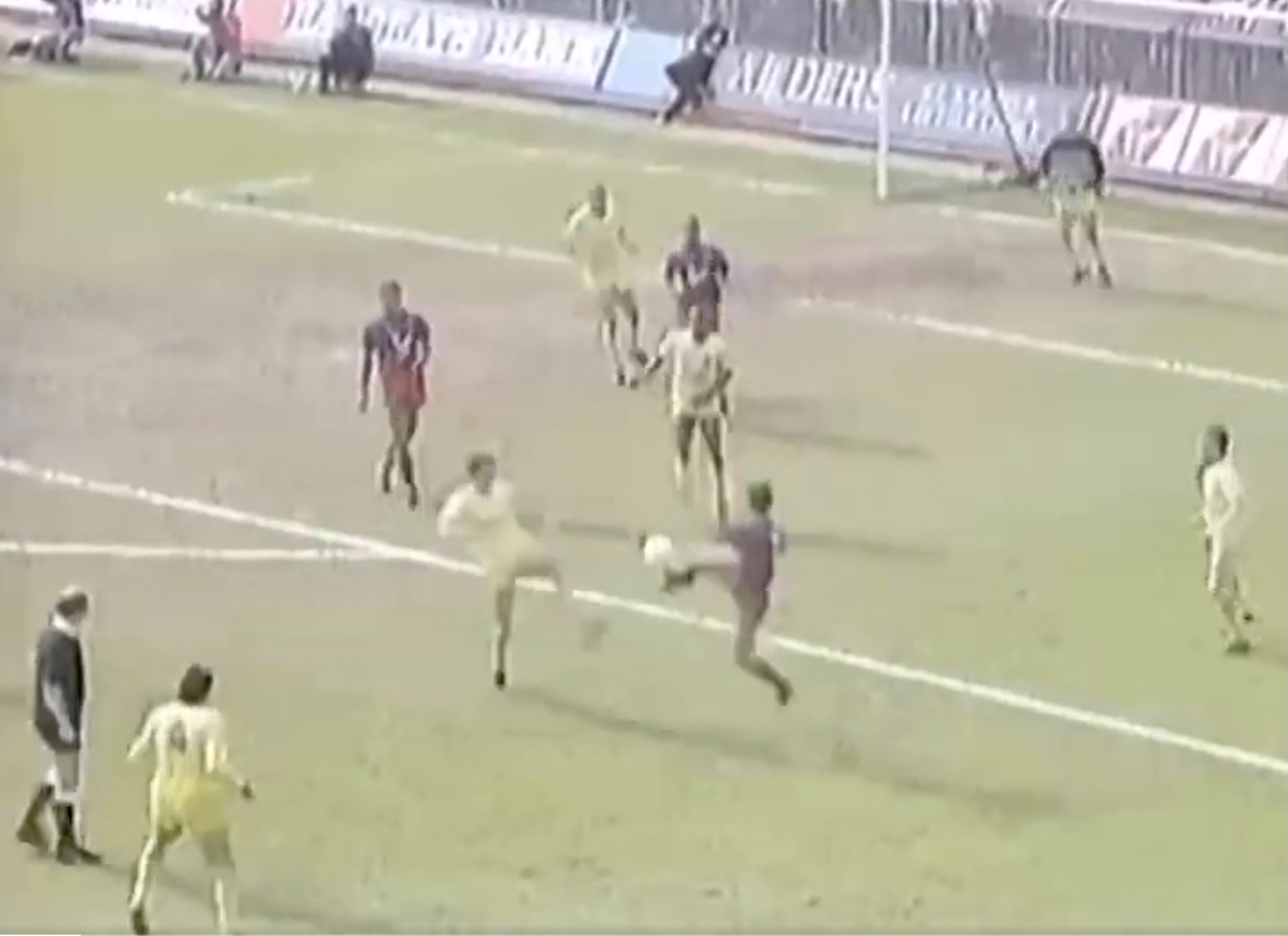
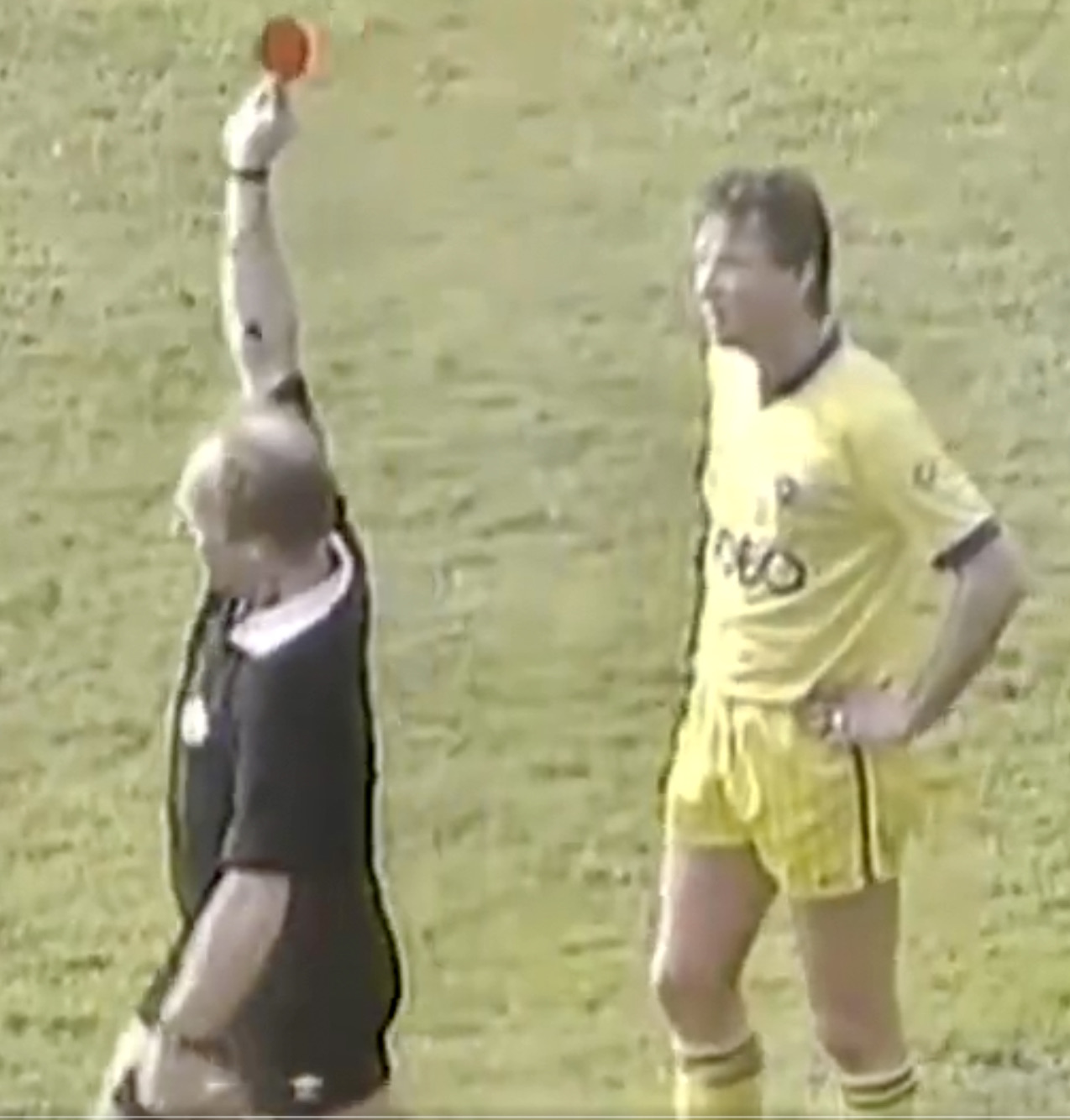
The previous month he was sent off (above) in the extraordinary match at Selhurst Park which saw referee Kelvin Morton award five penalties in the space of 27 minutes, as well as wielding five yellow cards and Trusson’s red. Four of the penalties went to Palace – they missed three – but they went on to win 2-1 against the ten men. Manager Lloyd said: “I don’t think I’ve ever been involved in such a crazy game – we could have lost 6-1 but were unfortunate not to gain a point.”

Looking back, Trusson reckoned: “I was always conscious I wasn’t Barry’s type of player.” With a gentle but respectful sense of understatement, he said: “He was not the most communicative person I have met in my life!”

In essence, perhaps not surprisingly, Trusson would seek an explanation as to why he wasn’t playing when he thought he deserved to, but it wasn’t always forthcoming. He recalled that defender Gary Chivers, who he was reunited with at Bournemouth and who he stays in touch with, used to call Lloyd ‘Harold’ after the silent movie star!

Nevertheless, he said: “Tactically Barry was a good manager. When he did talk, he talked a lot of sense.”

It was during his time at Brighton that Trusson started running end-of-season soccer schools for youngsters. He was honest enough to admit they gave him an opportunity to earn a bit of extra money to put towards a holiday rather than laying the foundations for his future career as a coach.

That was still a little way off when, at 29, he left the Albion in September 1989 having played 37 games. By then, Curbishley, Codner and Wilkins were firmly ensconced as the preferred midfield trio, and he wanted to get some regular football. Cardiff wanted him but his family were settled in West Sussex so he opted for Gillingham, which was driveable, although he stayed in a clubhouse the night before matches.

It was at Priestfield where he began to establish a close friendship with Tony Pulis, who was winding down his playing career and was similarly commuting to north Kent (from Bournemouth).

“We had always kicked each other to bits when we played against each other but often ended up having a drink and a chat afterwards, and got on,” said Trusson. “We were also keen golfers, and both talkers; we had our views (even if we didn’t always agree) and the friendship developed.”

This is a good point to go back to the beginning because it was his early appreciation of the art of coaching that would ultimately become the foundation for what followed later.

Born in Northolt on 26 May 1959, Trusson had trials with Chelsea as a schoolboy but a bout of ‘flu put the kibosh on any progress. It also wasn’t helped by the family relocating to Somerset, not a renowned hotbed for nurturing football talent.

The young Trusson went to Wadham Comprehensive School in Crewkerne and his hopes for another crack at professional football were given a huge boost when a Plymouth Argyle vice-president, who was involved with the local youth football side he played for, organised for him to have a trial at Home Park.

Argyle liked what they saw and offered him an apprenticeship, and the excellent greensonscreen.co.uk website details his career in the West Country.

It was Trusson’s good fortune that former England goalkeeper Tony Waiters – a coach ahead of his time – was Argyle boss and he gave him a first team debut aged just 17 in October 1976.

Waiters was a great believer in giving youngsters their chance to shine at an early age; he’d already worked for the FA as a regional coach, for Liverpool’s youth development programme, and been manager of the England Youth team, before being appointed Argyle manager. He later went on to manage the Canadian national team at the 1986 World Cup.

Waiters and his assistant Keith Blunt, who later took charge of the Spurs youth team in the 1980s (and was technical director at the English National Football School at Lilleshall between 1991 and 1998) together with Bobby Howe, the former West Ham and Bournemouth defender, completely opened Trusson’s eyes to what could be achieved through good coaching.

“They were in the vanguard of English coaching in the mid to late ‘70s,” he said. “I joined Plymouth as a kid having never been coached. Growing up in Somerset, we just used to play games.

“From when I was 15 to 17, they taught me so much, talking me through so many aspects of the game, and coaching me to understand why I was doing certain things on the pitch, giving advice about things like timing and angled runs.”

In an Albion matchday programme interview, Trusson told reporter Dave Beckett: “They kept us in a youth hostel and looked after us really well, even providing us with carefully planned individual weight and fitness programmes.

“Certainly you couldn’t fault them on their ideas. Out of the 20 apprentices I knew brought on by the scheme, 17 made the grade as pros. That’s an astonishingly high return by anybody’s standards.”

Although Argyle were relegated in his first season, Trusson kept his place under Waiters’ successors in the hotseat: Mike Kelly, Lennie Lawrence and Malcolm Allison. Bobby Saxton was in charge by the time he left Plymouth in the summer of 1980 to join then Third Division Sheffield United.

He was signed by Harry Haslam but, halfway through a season which it was hoped would see Blades among the promotion contenders, things went horribly wrong when Haslam moved ‘upstairs’ and former World Cup winner Martin Peters took over the running of the team. United were relegated to the fourth tier for the first time in their history.

Peters and Haslam quit the club and former Sunderland FA Cup Final matchwinner Ian Porterfield, who had just won the Division Three title with Rotherham, took charge.

Player of the Year at Sheffield United

Blades bounced straight back as champions, losing only four games all season, and Trusson was their Player of the Year. He earned the accolade the following season as well, when they finished 11th in Division Three.

The side’s prolific goalscorer at that time, Keith Edwards, a former teammate who now works as a co-commentator covering Blades matches for Radio Sheffield recently told the city’s daily paper The Star: “He was such a likeable character in the dressing room.

“I had a great understanding with him. He was a great team man, good for the dressing room and could play in a lot of positions. Every now and then he got himself up front with me and he worked his heart out.

“He looked after you as a player, he could be a tough lad. We played Altrincham one week and he got sent off for whacking someone that had done me a previous week. He was handy.

“And he was such a good character to have in the team.”

After three years at Bramall Lane, and 126 appearances, (not to mention scoring 31 goals), he was then swapped for Paul Stanicliffe and, instead of involvement in a promotion bid, found himself in a relegation fight at Rotherham United.

Trusson enjoyed his time with the Millers under George Kerr and over four years he played 124 games and chipped in with 19 goals. It was a regime change, and the aforementioned injury, that saw life at Millmoor turn sour.

A brief spell playing for Sing Tao in Hong Kong followed the end of his time with Gillingham and on his return to the UK his pal Pulis, who had taken over as Bournemouth manager from Harry Redknapp, invited him to become youth team coach at Dean Court.

Linking up with former Gillingham teammate Tony Pulis at Bournemouth

“I loved it and, when David Kemp moved on, I got the opportunity to coach the first team,” he said.

“We were very young and we were struggling to avoid relegation,” he recalled. “We kept them up and it was great experience. We both learned so much and we spent a lot of time together.”

When Pulis was sacked, Trusson was staggered to be offered the job as his replacement but turned it down out of loyalty to his friend.

The pair have since worked together at various clubs. For example, he was a senior scout at Stoke City and head of recruitment at West Brom.

“I’ve worked for him as a scout at pretty much every club he’s been at,” said Trusson, who cites trust, respect and judgement as the attributes Pulis saw in him.

Trusson was also once marketing manager for football-themed restaurant Football, Football in London – he managed to woo Sean Bean, the actor who is a well-known Blades fanatic, to the opening – and he had a marketing job for the PFA.

He runs his own online soccer coaching scheme and was working as a European scout for Celtic when, in an unexpected return to football’s frontline in November 2020, he was appointed assistant manager of Sheffield Wednesday.

Assistant manager at Wednesday

Pulis replaced Garry Monk at Hillsborough and turned to Trusson as his no.2. In that interview with The Star, Edwards said: “He’s a great lad. I was slightly surprised to see him get the job at Wednesday, but it was completely understandable.

“He’s a clever bloke, knows his football and has stayed in the game all this time, which is to his credit. His experience of scouting, coaching and having played in several different positions makes him a massive asset to any football club, I’d say.”

Edwards recalled how his former teammate had an eye for coaching from a young age. “He was always keen to get into that, he always wanted to lend a hand to the coaches,” he said.

“Some players would get off as quickly as they could to their families or whatever they were doing with their time. He wasn’t like that, he bought into the club thing. Some players were always around the place and he was like that, very understanding and willing to help out.

“I had massive fall-outs with the odd person, you know how it is, but I never saw Truss like that. He was always so calm and understanding of other people’s opinion. That’s how and why he’s stayed in the game throughout all this time. That either comes naturally to you or it doesn’t.

“I remember he always had a way of talking to people, whether that’s players or fans or board members or coaches. That’s stuck with him today.”

Wearside hero Gary Rowell blighted by injury after leaving Sunderland

gary rowell tony normanBRIGHTON fans never got to witness the best of prolific goalscorer Gary Rowell who, to this day, Sunderland fans eulogise in the same way Albion fans still sing about Peter Ward.

He died aged 68 on 13 December 2025, exactly 50 years to the day of his first appearance for the Black Cats following a long battle with leukaemia.

Rowell has a place in Sunderland’s best all time XI selection, in 2005 he topped a Football Focus poll as Sunderland’s all-time cult hero and, in 2020, was inducted into the SAFC Hall of Fame, which he described as ‘the best night of my life’.

There is a website that details every one of the 103 goals the Seaham-born footballer scored for the Wearsiders in 297 games after making his debut as a 71st minute substitute for Mel Holden in a 1-0 Sunderland win over Oxford United at Roker Park.

Unfortunately, the free-scoring striker-turned-midfielder was struck by a knee injury which hampered the latter part of his career, including his spells with Norwich City and the Seagulls.

Having left Sunderland on a free transfer after 12 years at the club, Rowell tore ligaments in his right knee on a pre-season tour of Scandinavia with Norwich before he even managed to kick a ball in anger.

In a year at Carrow Road, he made only six appearances – four as a substitute – and scored just the once, coming off the bench to net against Aston Villa. Typical of this spell between August 1984 and July 1985, he was substituted after only 16 minutes of his reserve team debut.

The following season, a £35,000 fee took him back to the North East to play for Middlesbrough, but, at the time, they were in the middle of a financial crisis and lost their second-tier status. Rowell top-scored with 10 goals in 27 appearances – two of them against the Albion at the Goldstone in January 1986 – but Boro were relegated in second-to-last spot (Brighton finished in 11th place that season).

Brighton were not exactly flush with cash themselves in the summer of 1986 when Alan Mullery, the manager who’d previously led them from third tier to the elite, returned to the club to replace Chris Cattlin.

Mullery found a very different set-up to the one he’d left acrimoniously in the summer of 1981. With little money available to be spent on new arrivals, hard-up Albion, not for the first time, had turned to the supporters in an effort to raise transfer funds.

Money from a scheme called the Lifeline fund went towards buying goalkeeper John Keeley for £1,500 from non-league Chelmsford, Darren Hughes for £30,000 from Shrewsbury Town, and Rowell from Middlesbrough on a free transfer (the Lifeline funds being used to help with his relocation to the South Coast).

Mullery explained the Rowell signing thus in his programme notes: “I see his role with us as coming forward from midfield and adding to our power in the box.

“We know he can get goals and he is a versatile player. When we further improve the squad, we may use him a little differently.”

Rowell , who discovered Mullery had tried to sign him back in 1979 (but Sunderland hadn’t informed him), joined just after the start of the season, in time to be given a place on the bench for the away 1-1 draw with his former club Sunderland. He went on for Kieran O’Regan with 18 minutes left.

He kept the bench warm for two more matches before getting his first start in place of Northern Irish centre-forward Gerry Armstrong in a 2-2 draw away to Plymouth Argyle on 13 September.

Unfortunately, it wasn’t long before Mullery was reporting his absence from the side because of an ankle injury sustained in training.

Nevertheless, interviewed by Tony Norman in the matchday programme, Rowell, who was 29 and married with two small children, said: “I’m delighted with the move. I’ve found it to be a very friendly club and people have gone out of their way to make us feel at home. Now I want to repay the club by playing well for the team.”

The longest run of games he got in an Albion shirt came in November and December 1986 when he took over from winger Steve Penney for six matches (two wins, two draws, two defeats).

rowell BW HS

A broken toe and a troublesome hamstring made him feel injury-jinxed but, during his run back in the side, he had what Mullery described as “his best game since joining us” in a 3-0 win over Shrewsbury Town on 21 December. Six days later, the toe went again, and he didn’t play for the rest of the season.

Mullery was then controversially dismissed the following month and Rowell had to wait until the start of the following season for successor Barry Lloyd to select him.

He featured in three pre-season friendlies, all of which ended in defeats and wore the no.4 shirt in the opening two fixtures of the 1987-88 season, but those were his only first-team starts that campaign. His midfield berth was taken over by the experienced Alan Curbishley.

By October, the matchday programme reported Rowell and fellow midfielder Dale Jasper had been placed on the transfer list following long discussions with Lloyd. Curiously, it added: “However, both players are keen to stay with the club, regardless of any offers made, and will be battling hard for first team places.”

Rowell subsequently appeared seven times as a substitute for the first team, but he was largely confined to the Reserves for whom he made 20 appearances and scored once. In February 1988, he moved to Dundee on trial, but, when not taken on, moved the following month to Carlisle United.

After just seven games for the Cumbrians, he finished his professional career at Burnley, where he scored once in 19 appearances.

Born in Sunderland on 6 June 1957, Rowell grew up in the mining village of Seaham, became an apprentice at Sunderland in 1972 and two years later turned professional.

In 1976, when Sunderland were struggling in the First Division, manager Jimmy Adamson gambled on the introduction of the 19-year-old Rowell: it paid off in spades as he scored 44 goals in two and a half seasons.

During that prolific spell, Rowell was in the squad for two end of season England Under 21 Championship preliminary matches; he went on for Laurie Cunningham in a 1-0 win over Finland in Helsinki on 26 May 1977 but wasn’t involved in a 2-1 win over Norway in Bergen six days later. This was an England side including future full internationals Peter Barnes and Peter Reid.

He was also a non-playing member of Dave Sexton’s squad that assembled at the Goldstone Ground three months later, but he had to watch as an over-age Peter Ward (22), playing on home turf, of course, scored a hat-trick in a 6-0 win over Norway. The aforementioned Curbishley was also a non-playing onlooker in that squad.

footballinprint.comUndoubtedly, the stand-out moment of Rowell’s Sunderland career came when he scored a hat-trick in a 4-1 win over arch rivals Newcastle United at St James’ Park, which he referred to in a profile article (see above).

In a vote for Sunderland’s best players of the 1970s, Rowell was described as “a lovely footballer. Though not blessed with blistering pace, he would ghost into goal-scoring positions and his finishing was deadly.” Rowell was an expert penalty taker, scoring 25 of 26 he took for Sunderland.

Some observers reckon but for injury he would surely have gone on to gain full England international honours. However, his career was severely disrupted by a serious knee injury sustained in a March 1979 game against Leyton Orient.

After a lengthy recovery, he resumed scoring goals regularly but there were doubts over his being able to maintain fitness for the duration of a whole season.

As part of a big team rebuilding exercise carried out by manager Len Ashurst in 1984, Rowell was allowed to move to Norwich.

After his playing days ended, Rowell became a financial consultant in Burnley and those loyal Sunderland supporters still got to hear their hero because, for a number of years, he was a commentator on Sunderland games for Metro Radio.

  • Pictures mainly from matchday programmes. Sunderland profile article: footballinprint.com.