
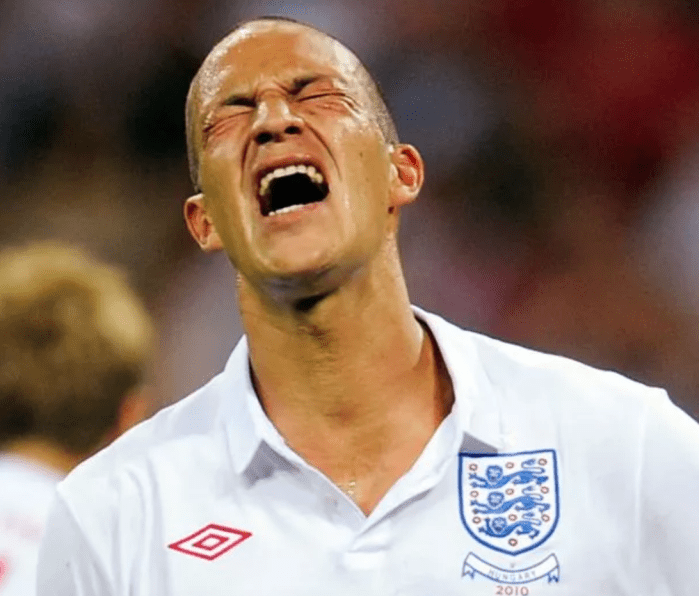
TEN DAYS after Barry Fry’s prediction about Bobby Zamora playing for England, he made his debut for the country’s under 21 side.
It was 16 April 2002 and the Brighton striker went on as a sub for Leeds’ Alan Smith in a 1-0 friendly defeat v Portugal at Stoke’s Britannia Stadium. Paul Konchesky, a fellow graduate of the East London boys’ team Senrab, was left-back that day.
While plenty of observers expected Zamora eventually to step up to the full England side, he had to wait until he was 30 to make his first (and only) start at that level, and not before being wooed to switch allegiance and play for Trinidad and Tobago.
That happened in 2005, when the Caribbean country’s Dutch coach, Leo Beenhakker, wanted him to play in a World Cup qualifier against Guatemala. Zamora told the News of the World: “Trinidad is my dad’s country and to play in the finals would be a dream but West Ham are more important.

“I am only thinking about the club at the moment and do not want to be distracted from that. The club mean everything to me and if I can help us have a good season that is all that matters.”
After an injury-hit 2007-08 season, though, West Ham sold him to Fulham in the summer of 2008. The following year it was reported Zamora and his old Senrab teammate Jloyd Samuel had both obtained Trinidad & Tobago passports in time to play in a 2010 World Cup qualifier.
Injury prevented Zamora from getting involved but Samuel did play twice for the Soca Warriors even though he had won seven England under 21 caps. (Samuel tragically died in a road accident aged 37 in 2018).
Zamora top-scored with 19 goals in Fulham’s memorable 2009-10 season under Roy Hodgson. The south London side finished 12th in the Premier League and made it through to the final of the Europa League (the first season of the revamped competition previously known as the UEFA Cup).
Zamora had been a fitness doubt before the game against Athletico Madrid in the People’s Park Stadium in Hamburg and he had to give way to Clint Dempsey 10 minutes into the second half.
The game went into extra time with the score 1-1 after 90 minutes and agonisingly Fulham succumbed to an extra time winner scored by Diego Forlan. Sergio Aguero, later of Man City fame, beat defender Aaron Hughes and crossed for Forlan to flick the ball home four minutes from the end.
Nevertheless, Zamora’s goalscoring form had caught the attention of England manager Fabio Capello and his deputy Franco Baldini who were keen to call him up for the 2010 World Cup.
Sadly, those hopes were dashed by an achilles injury, and Zamora conceded: “I told Fabio that I was struggling and I knew that, had I gone, I wouldn’t have done myself or England justice.”
The player told The Independent: “It’s been an up and down season because it’s been so good on the pitch and I’ve scored some important goals. To now pick up this injury has kicked me in the teeth.
“It’s come during the last couple of weeks and when there was the possibility of going to the World Cup with England. That’s football, it’s a cruel game.”
He added: “The World Cup’s a massive tournament. It’s not about myself, it’s about England.
“Capello wished me all the best, hoped that I get fit and would be available next season.”
True to his word, Zamora was one of five uncapped players included in Capello’s squad immediately after the disappointment in South Africa.
One of the first people to contact him was former West Ham teammate, Teddy Sheringham, who he said he learnt so much from. “I got a long text message from Teddy. He said I might be nervous beforehand but that I deserved this opportunity, and he said once I’d taken part in my first training session, I would realise that I deserved to be there. He was spot on; after that I did not look out of place and I embraced being part of the squad.”
The call up came in something of a crazy week for Zamora because only days earlier his wife gave birth to twin girls, Gisele and Siena.
“The twins were born last Monday, they came out (of hospital) on Friday, then I had a match on Saturday, was back home for one day and then I was away with England, so I have not seen them as much as I wanted to, but I am sure I will find some time when I get back home,” he said.
“The twins are a massive part of my life now, and with getting the call-up to play for your country is a massive honour. I am lost for words. I am extremely proud to be called up to play for my country.”
Capello sent him on as a second half substitute for Frank Lampard to play up front alongside Wayne Rooney in England’s 2-1 friendly win over Hungary at Wembley on 11 August 2010.
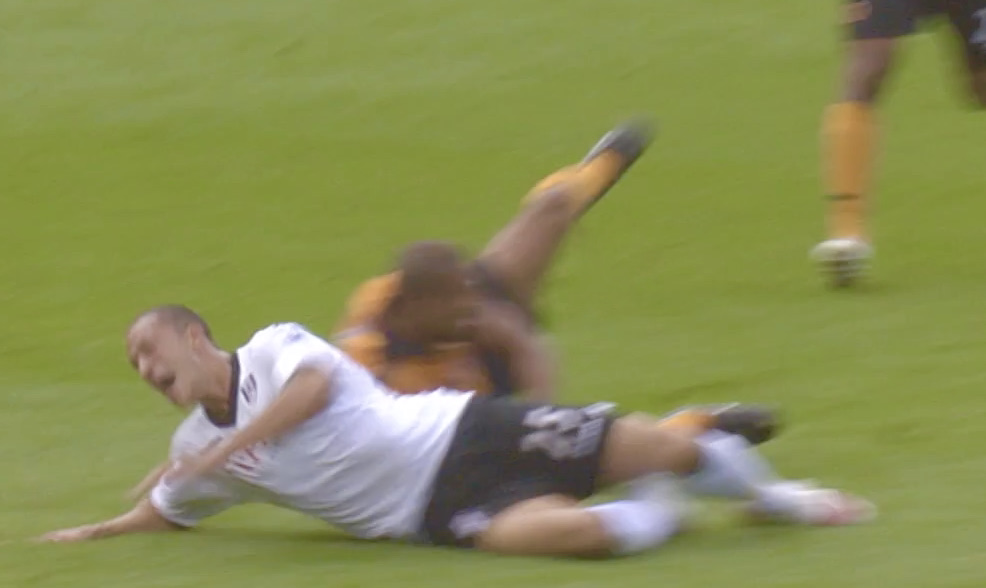
Having made that breakthrough, the day after he signed a new four-year contract with Fulham he agonisingly suffered another setback when he broke a leg (above) and sustained ankle ligament damage during a 2-1 win over Wolves. He was sidelined for five months.
Capello didn’t consign him to history, though, and called him up again in May 2011 (his teammate David Stockdale was in the same squad) to face Switzerland in a Euro 2012 qualifier. But neither were involved in the disappointing 2-2 Wembley draw.
His first start for England finally came six months later in a 1-0 home win over Sweden, the first time in 43 years that England had beaten the Scandinavian country. Zamora’s close friend (and another former Senrab graduate) John Terry was England captain and joining the striker in making first starts were right-back Kyle Walker and Everton’s Jack Rodwell.
Richard Williams in The Guardian clearly felt sorry for the debutant centre forward, though, writing: “Poor Bobby Zamora. Offered the opportunity to score England’s 2,000th goal on Tuesday night, a perennially unfortunate footballer was forced instead to stand and watch as Stewart Downing’s cross glanced off the side of Gareth Barry’s head and then off Daniel Majstorovic’s forehead before evading Andreas Isaksson’s dive as it looped inside the post for the most anticlimactic of own goals.”
Reporting on the narrow victory over the Swedes, Williams added: “Whichever side the ball went, Zamora made sure he was available. A double exchange of passes with Walcott in the 17th minute put Zamora in on goal, but after Isaksson blocked his first effort the follow-up was poked past the post from five yards.
“Any centre forward will ultimately be judged by the goals he scores rather than his total of assists, and Zamora spurned a wonderful chance in the 65th minute when Downing scampered down the left once more before pulling the ball back at precisely the right pace and angle for the striker to meet it with a first‑time connection. Jonas Olsson, however, flew in to deflect the shot for a corner.”
Zamora was subbed off in the 70th minute to be replaced by Darren Bent and the Guardian sports writer concluded: “England – and Zamora in particular – really should have inflicted greater punishment on such humdrum opposition.”
Bent had also replaced Zamora in his first start for England under 21s. That came in February 2003 in a 1-0 defeat to Italy in Carrara.
A month before his move to Spurs, he also started England’s 3-2 friendly win over Serbia and Montenegro at Hull’s Kingston Communications Stadium, on that occasion being replaced by Darren Ambrose. (His future Fulham and Albion teammate Steve Sidwell was in midfield that day).
Eight days later, in a UEFA under 21 championship preliminary match, he went on as a sub for Shola Ameobi as England beat Slovakia at the Stadium of Light, Sunderland.

After that under 21s debut against Portugal, he was selected in the squad for the UEFA under 21 championship finals in Switzerland. On 20 May 2002, David Platt sent him on as a sub for Gareth Barry in a 2-1 defeat to Italy in Basle.
Two days later, in the third group match, again a sub, he replaced Jermain Defoe as England lost 3-1 to Portugal and were eliminated from the competition.
On two other occasions Zamora was an unused sub but he didn’t add to his six caps. And, after
Capello quit the England job in February 2012, Zamora didn’t play for the full England side again.
• Ahead of Albion’s new year clash with West Ham, find out why Zamora’s move to the Boleyn Ground was so ideal in the next instalment.

 In parallel lines