Promotion-winner Sam Baldock part of Albion’s history

BRIGHTON’S football history will record Sam Baldock as part of the squad who earned the club promotion back to the top division after a 34-year absence.

Baldock and Oliver Norwood famously crowd surfed on a train from Falmer to Brighton, held aloft by jubilant supporters celebrating after the April 2017 win at home to Wigan Athletic.

It was one of the many joyous scenes that will live long in the memory banks of Brighton fans following that momentous occasion.

In the cold light of day, though, it’s probably fair to say Baldock divided opinion about his contribution to the cause. Manager Chris Hughton described him as “a great professional and a good character in the dressing room” but, whether because of injuries or lack of opportunity, the diminutive striker never quite made it at the top level his brother George would go on to reach with Sheffield United.

Baldock was certainly a hard-working player but perhaps he didn’t deliver goals consistently enough to warrant the ‘super’ status attributed to him by some of Albion’s more vocal supporters. Injuries seemed to take their toll on a player whose most successful spells have generally been at third tier level.
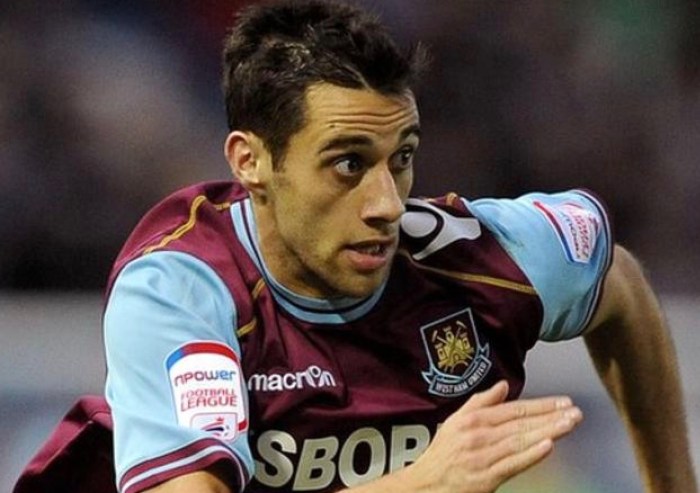
SB WHUWest Ham United, under Sam Allardyce, gave Baldock a platform to take his lower-league goalscoring prowess to a higher level when they began the 2011-12 season in the Championship. But, after a bright start, he disappointed and eventually only stayed for one year of a four-year deal.

Although he was popular with fans, he clearly didn’t float Allardyce’s boat. West Ham fans are astute observers of the game and one of the best summaries I’ve read about Baldock’s contribution was in a piece on westhamworld.co.uk.

“Baldock is a short, pacey, centre forward. He has an eye for goal, which is great but, he doesn’t have the strength or power like other players we have like (Carlton) Cole or (Ricardo) Vaz Te,” the author of the article wrote.

“In a world where it appears the 4-4-2 system is dying very quickly, especially at the top level, it causes problems for Baldock, who seems to be a player who likes to feed off the other striker who can hold the ball up and thread a pass through for him to run onto.

“He is your ideal little man in the big man and little man 4-4-2 but, with the formation not being used very often and, especially under Allardyce, we don’t see it much at all.”

Born in Buckingham on 15 March 1989, Baldock went to the town’s The Royal Latin School (where his mum was the deputy head) and, at 16, joined Wimbledon’s youth system at the time they relocated to Milton Keynes. He signed on as a trainee in 2004 (pictured below signing a contract with MK Dons owner Pete Winkelman)  and after impressing in FA Youth Cup games earned call-ups to the first team squad.

IMG_5904Former Albion captain, Danny Wilson, gave Baldock his first-team debut at 16 as a late substitute against Colchester United in a 2-1 Football League Trophy defeat on 20 December 2005.

He didn’t feature again until the 2006-07 season, by which time Martin Allen had taken over as manager. One of only two Football League Trophy games he was involved in included a 4-1 defeat against Brighton.

It was when Paul Ince became manager that Baldock got a few more chances at first-team level and he got to appear at Wembley as a substitute in March 2008 when MK Dons beat Grimsby Town to win the Football League Trophy (otherwise known as the Johnstone’s Paint ‘Pot’).

However, it was when Roberto di Matteo took over from Ince in the 2008-09 season that Baldock finally became a Dons regular, netting 13 goals in 44 appearances and catching the eye of the international selectors.

In September 2009, he was selected for the England under 20 squad which took part in the World Youth Championship in Egypt – a squad which interestingly also included goalkeeper Jason Steele, later a back-up ‘keeper at Brighton, and future full England internationals Danny Rose and Kieran Trippier.

Baldock played in the opening 1-0 defeat against Uruguay, went on as a substitute in the following game, a 4-0 defeat to Ghana, and again in the final game, a 1-1 draw with Uzbekistan. England finished bottom of their group and were eliminated.

Baldock didn’t get selected again but, having scored a total of 43 goals in 124 appearances for MK Dons, he became Allardyce’s seventh summer signing for West Ham in August 2011.

SB WHU coloursHe couldn’t have asked for a better start when he scored five times in his first six games for the Hammers. Unfortunately, as has been the case throughout his career, he picked up an injury that sidelined him, and, in his absence, Nicky Maynard and the aforementioned Vaz Te became first choices in the forward line.

The Hammers decided to cut their losses after just one year of his deal and he was sold to Bristol City for £1.1m. His 10 goals in 34 games were insufficient to keep the Robins in the Championship but back at League One level, the goals flowed once more.

Baldock was the Robins captain under Steve Cotterill and scored 26 in 54 games in the 2013-14 season (neatly compiled on YouTube), earning him the League One Golden Boot. That prompted Brighton to snap him up on 27 August 2014, signing for an undisclosed fee (thought to be £2m) on a four-year deal until June 2018.

Signed as part of the regime under head of football David Burke, Baldock, 25, joined the squad assembled under new manager Sami Hyypia, who told the club website: “Sam was one of our key summer attacking targets and I’m delighted we have now completed the transfer.

“He’s a predator, instinctive in front of goal and his career goal record is excellent. He’s played and scored goals at this level, and we are confident he can be a major threat for us going forward.”

As it turned out, Baldock scored only four goals in each of his first two seasons but contributed 12 in the Seagulls’ promotion-winning campaign of 2016-17.

It was enough to earn him a new deal, and he told the club website: “As soon as the club made noises that they wanted to extend my contract it was always in my head that this is where I want to be.

“Last season was probably the pinnacle of my career, and I hope now we can establish ourselves in the Premier League and continue to improve together.”

Hyypia’s successor, Hughton, added: “We are delighted that Sam has agreed a new deal with us. He has been a key member of the squad since he arrived at the club and this new contract is recognition of his contribution over the last couple of seasons.”

However, Hughton ultimately gave him very few chances in the Premier League and, after playing only five games in the 2017-18 season, he was sold to Championship side Reading.
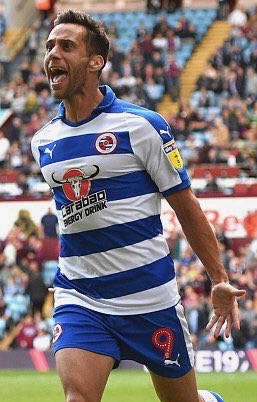
Baldock-ReadingRoyals boss Paul Clement told the Reading website: “I’m very happy that Sam has joined us here at Reading, having pursued his signature throughout the summer.

“I always felt he was the right striker for us to bring to this club in terms of his age, his experience and his quality.”

Although he penned a three-year deal with the Royals, his initial season at the Madejski was blighted by injury and, having scored just five in 23 games, and seemingly not in new manager Jose Gomes’ plans, there were reports during the recent close season that he would be invited to look for a move elsewhere.

On 17 August 2021, Baldock signed a short-term deal with Derby County to cover the injury absence of former Brighton striker Colin Kazim-Richards. When that contract came to an end in February 2022, Baldock joined League One Oxford United until the end of the season, and in May 2022 was given a two-year contract by manager Karl Robinson, another of his former managers at MK Dons.

“I walked through the door back in February and it felt like the right place straight away,” the boyhood U’s fan told oufc.co.uk. “The badge has always had a special place in mine and my family’s hearts ever since it was the first club we watched live at the Manor.

“Having previously worked under the gaffer I knew I wanted to play for him again – he got the best out of me earlier in my career and I hope that can happen again.”

  • Pictures from various online sources.

Did Chris Ramsey’s injury alter outcome of 1983 FA Cup Final?

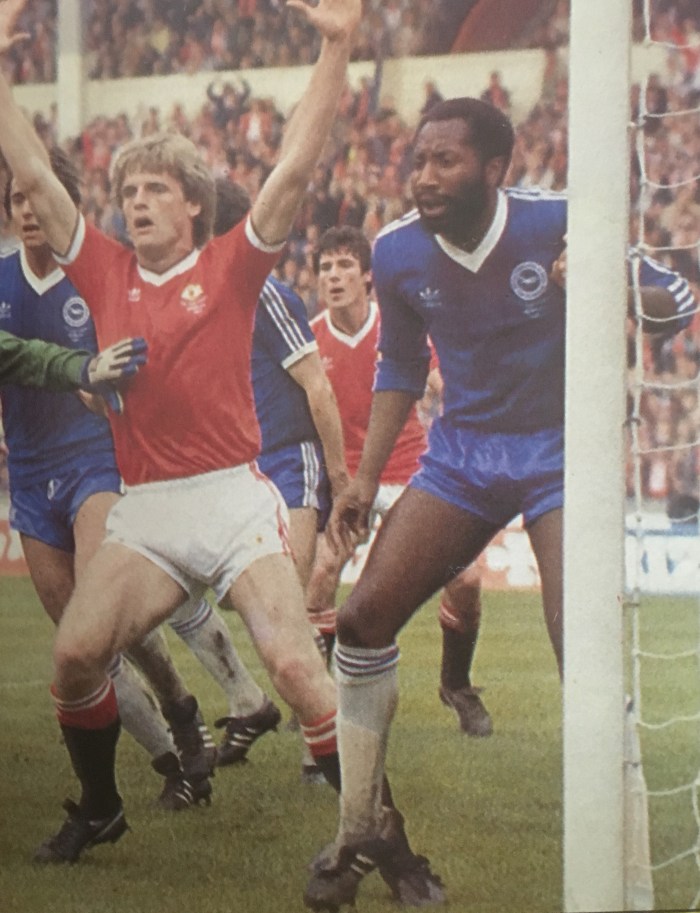
2-near-post-guardBRIGHTON & HOVE Albion’s May 1983 FA Cup Final clash with Manchester United was historic for the club and for their 21-year-old right back it was even more eventful.

Who would have known that former Bristol City apprentice Chris Ramsey’s ignominious departure from the field in a firemen’s lift on Glen Wilson’s shoulder would more or less be the end of an all-too-brief playing spell in the top echelons of the English game?

Might the match – and Ramsey’s career – have panned out differently if it hadn’t been for that diabolical tackle by Norman Whiteside?

Trouble had been brewing in the weeks leading up to the final and the national media, looking for every possible angle to pick at, had singled out Ramsey for criticism. Did that stoke the fire?

Let’s rewind a little and explore what happened.

Born in Birmingham on 28 April 1962 , Ramsey, whose father came to the UK from St Lucia, was one of two boys and five girls. Rejected by Charlton Athletic as a schoolboy, he became an apprentice at Ashton Gate but was then released and, after a successful trial, Brighton took him on.

The 1980-81 season was Albion’s second in the top division and, as it drew towards its close, it was looking increasingly likely they were heading for relegation.

Manager Alan Mullery was openly criticising his players for their efforts and his big ally off the field, vice-chairman Harry Bloom (current chairman Tony Bloom’s granddad) had died of a heart attack on the team coach on an away trip to Stoke.

Something had to change and, at the tender age of 19, Ramsey was called up from the reserves and plunged in at the deep end.

In three of the last four games, he took over the no.2 shirt after Mullery switched John Gregory from right back into midfield. Ramsey’s debut came in a crucial Easter Saturday clash away to rivals Crystal Palace when, released from the shackles of defending, Gregory scored twice in a 3-0 win. Ramsey also played in the wins over Sunderland away and Leeds at home.

The Seagulls stayed up by the skin of their teeth and Evening Argus reporter John Vinicombe said in his end of season analysis that Ramsey had been “a revelation” in those three games.

Within a matter of weeks, Mullery quit as manager in the furore over chairman Mike Bamber selling Mark Lawrenson to Liverpool (after Mullery had already agreed a deal to sell him to Manchester United).

Gregory was sold to QPR for £300,000 but, far from that move opening up an opportunity for Ramsey, Mullery’s replacement Mike Bailey brought in on a free transfer from Loftus Road the experienced Don Shanks, who was immediately installed as the first choice right back.

Indeed Bailey froze out Ramsey for the following 19 months! At one point he was transfer listed but it was Bailey who departed the Goldstone first – his sacking working to the advantage of the young defender.

When George Aitken and Jimmy Melia took over in December 1982, Ramsey was instantly promoted from the reserves and seized his opportunity.

In a profile in an Albion matchday programme in February 1983, Ramsey told Tony Norman: “Like any other young apprentice, my dream was to play in the First Division. I must admit that even after coming to Brighton, I had times when I wondered if I’d make it. But now I’ve got my chance and I’m keen to make the most of it.”

In one of the most comprehensive profiles on Ramsey, former Brighton teammate, Andy Ritchie, told Adam Ellis of The Football League Paper: “He was quite a shy lad back then but he had everything you want in a full back. Aggression, pace, agility – and he could tackle like a demon.”

These were the attributes that Melia appreciated too. In a Daily Mail preview of the Norwich quarter final, Melia told reporter Brian Scovell: “The other players love playing with him. He’s a great competitor, tackles well and uses the ball with a bit of style.

“I’m pleased he’s taken his chance. He deserves to play at Wembley if we manage to get there.”ramsey + mel

As it turned out, Ramsey’s place was in jeopardy because of two sendings off in the league in April which led to him being banned for the semi-final against Sheffield Wednesday at Highbury.

After being sent off in a 2-1 home win over Spurs, Terry McNeill reported in the News of the World: “Ramsey was lucky to stay on earlier after bringing down Mark Falco in a probable scoring position. When he took the striker again from behind, there was no escape.”

The 20-year-old Ramsey was fairly phlegmatic about the situation and told Alex Montgomery of The Sun: “Whatever I did, I did for the club. You can’t think about Cup games when you are struggling for points at the bottom of the First Division.”

His second dismissal, along with Coventry’s Steve Jacobs (who later played for the Albion under Chris Cattlin) after a scuffle in a 1-0 win at the Goldstone, was lambasted by one of the pre-eminent football writers of the day, Frank McGhee of the Daily Mirror.

“Can Brighton afford to field at Wembley a man who by then won’t have been able to play for 19 days?” he intoned. “And can they trust Ramsey not to sully soccer’s great state occasion by a moment of blind madness?”

Nevertheless, after Wednesday were beaten, Melia was happy to restore his first-choice right back to the starting line-up but one wonders now whether Ramsey had a sense of foreboding about how the big occasion would unfold.

Reflecting on those dismissals in the build-up to the final, he told The Sun’s Montgomery: “I just hope people aren’t looking for me. I’ll certainly be careful. I honestly don’t think I deserve the reputation which I’ve been saddled with in the last few weeks.

“The dismissals were just coincidences – nothing more than that. I know I am an aggressive type of player but that is my game. I always want to give 100 per cent for the club. The last thing I want is trouble at Wembley.”

After Albion had taken a shock lead through Gordon Smith’s header, United piled on the pressure and Ramsey headed a goalbound Gordon McQueen effort off the line.

But then came a pivotal moment early in the second half. Tim Carder and Roger Harris record it thus in their excellent Seagulls! The Story of Brighton & Hove Albion FC: “Whiteside went in high on Ramsey’s shin as the Albion full back cleared, and then trod on his ankle. The referee had a strong word with the United forward but did not signal a foul.”

The tackle had rendered Ramsey lame and while he tried in vain to carry on, two minutes later he wasn’t able to challenge for a ball to the far post which Frank Stapleton duly dispatched to equalise.

Those of us watching in the stadium, together with millions glued to TV screens around the world, saw Ramsey carried from the Wembley turf and, in those days of only one substitute, wondered how Albion would cope with a makeshift defender in the shape of Gerry Ryan.

After United took the lead through Ray Wilkins, Ramsey’s friend – and fellow England under-20 teammate – Gary Stevens’ equalised to send the game into extra time and ultimately a replay. Stevens was adamant about the impact Whiteside’s challenge had on the game.

In Match of My Life, edited by Paul Camillin, he said: “It was a bad tackle and perhaps cost us the game. In those days we only had one substitute and Gerry Ryan came on and did a great job at right back, even though he was a midfield player, but we did miss Chris because he had been having a great game.”

Whiteside was unapologetic about the challenge but Ramsey fumed to The Sun’s Montgomery: “It could have broken my leg. If I’d done it, I’d have been off. I just can’t understand how Whiteside got away with it.”

The injury deprived Ramsey of the chance to play in the replay five days later and, after that sad exit, his playing career never reached similar heights again.

Indeed he actually only played 37 games for the Albion, most of those coming in that 1982-83 season. He played only a handful of games in the following season and in August 1984 went on loan to Swindon Town before joining them permanently four months later.

There, he played alongside the likes of Sky Sports reporter Chris Kamara and one-time Albion assistant manager Colin Calderwood and clocked up over 120 appearances, including being part of Lou Macari’s Fourth Division champions in 1986 and Third Division play-off winners in 1987.

In August 1987, he joined Southend United but played just 13 games for them before persistent back injuries forced his early retirement at the age of just 26.

Some business ventures he embarked on didn’t work out and former Albion right back rival Shanks set him up with a trial for a team in Malta, Naxxar Lions, where he made a playing comeback.

Eventually the ongoing injury problems made him look to other ways of making a living. He coached in the United States but also started studying like crazy.

Amongst lots of qualifications, he got a Master’s degree at the University of North London in Health, Physical Education and Recreation (a qualification which enabled him to become a primary school teacher) and simultaneously obtained his UEFA coaching badges.

That Football League Paper piece records: “With an MSc, ten diplomas and myriad other qualifications, Ramsey is so highly educated that he actually sets the test for pro licence candidates.”

ramsey EngA stint in charge of youth development at Leyton Orient and coaching Newham Ladies was followed by an FA appointment as coach to the England under-20 side in the 1999 FIFA World Youth Championship when among the players under his direction were Ashley Cole, Peter Crouch, Matthew Etherington and John Piercy, who later played for the Albion. At the FA he learned from the likes of Les Reed and one-time Albion winger Howard Wilkinson.

He had a short and unsuccessful three-month spell as assistant to Ricky Hill at Luton Town, and he said: “Ricky Hill was a massive inspiration to me.”

Just when it appeared new offers had dried up, Ramsey got the chance to manage Charleston Battery in the USA, where he stayed for three years.

Winning the USL A-League (second division) with Battery in 2003 brought him to the attention of Spurs, and, as head of player development, many of the young players he coached in tandem with Les Ferdinand and Tim Sherwood were Harry Kane, Ryan Mason, Danny Rose, Nabil Bentaleb, Andros Townsend, Steven Caulker and Jake Livermore.

“He was massive for all of us,” French midfielder Bentaleb told The Football League Paper. “He believed in us, he encouraged us. He told the manager we were ready when everyone else believed we were not. He was not shy or scared of anybody and he knew exactly what he wanted.”

chris ramsey (spurs)In the Evening Standard in 2012, Spurs and England centre back, Ledley King, said: “He is one of the best coaches in the country. The youngsters love the way he works and they have really bought into his methods.”

Ramsey left Spurs in 2014 to take up a coaching role at QPR, and when Harry Redknapp left the floundering Hoops in February 2015, Ramsey stepped up to become a fully-fledged Premier League manager.

He was not able to halt Rangers’ relegation from the elite, though, and lasted only until November in charge of the side as they struggled to come to terms with life back in the Championship.

However, in January 2016, he was appointed technical director at QPR to oversee the club’s academy coaching and player development.

The club’s director of football, Ferdinand, told The Guardian: “While we were disappointed things didn’t work out with Chris at first team level, we were determined to retain his services. As such, we actually put a clause in his contract which allowed us to retain Chris’s services in a player-development role should things not work out for him as head coach.”

Ramsey finally left QPR in January 2024. By then 61, the head of coaching and technical director told the club website: “I have had a fantastic nine years at QPR and the club will always have a special place in my heart.”

The club’s chairman Lee Hoos said: “Chris has been a great servant to the club. I cannot thank him enough for his incredible hard work, dedication and guidance.

“However, as we thoroughly rationalise everything we do, and following very amicable discussions with Chris, it is felt this move is in the best interests of all parties. He will always remain a friend of the club.”

  • Shootthedefence.com did a face-to-face interview with Ramsey on 23 September 2016 which is well worth a listen as he talks in detail about his whole career.
  • In pictures from my scrapbook, Ramsey graces the cover of an Albion matchday programme; (top) he defends the near post during the 1983 FA Cup Final with Gordon McQueen in attendance; he is photographed by Tony Norman outside the Goldstone and criticised in the Daily Mirror by Frank McGhee.