Zamora’s wait for England while dad’s Trinidad came knocking

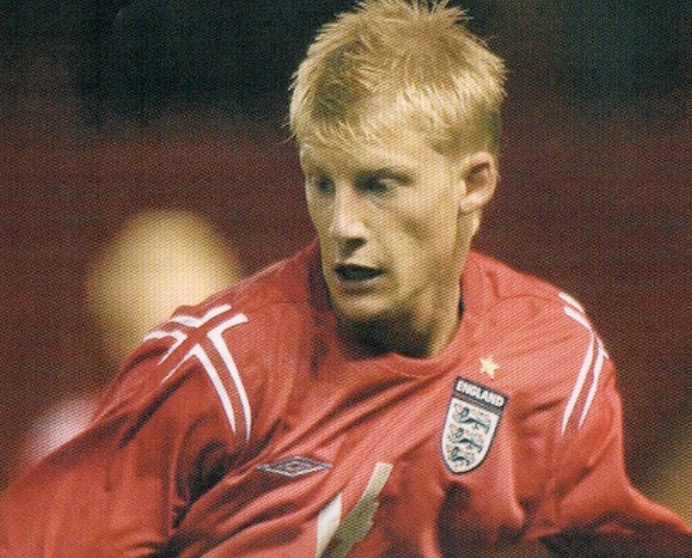
TEN DAYS after Barry Fry’s prediction about Bobby Zamora playing for England, he made his debut for the country’s under 21 side.

It was 16 April 2002 and the Brighton striker went on as a sub for Leeds’ Alan Smith in a 1-0 friendly defeat v Portugal at Stoke’s Britannia Stadium. Paul Konchesky, a fellow graduate of the East London boys’ team Senrab, was left-back that day.

While plenty of observers expected Zamora eventually to step up to the full England side, he had to wait until he was 30 to make his first (and only) start at that level, and not before being wooed to switch allegiance and play for Trinidad and Tobago.

That happened in 2005, when the Caribbean country’s Dutch coach, Leo Beenhakker, wanted him to play in a World Cup qualifier against Guatemala. Zamora told the News of the World: “Trinidad is my dad’s country and to play in the finals would be a dream but West Ham are more important.

“I am only thinking about the club at the moment and do not want to be distracted from that. The club mean everything to me and if I can help us have a good season that is all that matters.”

After an injury-hit 2007-08 season, though, West Ham sold him to Fulham in the summer of 2008. The following year it was reported Zamora and his old Senrab teammate Jloyd Samuel had both obtained Trinidad & Tobago passports in time to play in a 2010 World Cup qualifier.

Injury prevented Zamora from getting involved but Samuel did play twice for the Soca Warriors even though he had won seven England under 21 caps. (Samuel tragically died in a road accident aged 37 in 2018).

Zamora top-scored with 19 goals in Fulham’s memorable 2009-10 season under Roy Hodgson. The south London side finished 12th in the Premier League and made it through to the final of the Europa League (the first season of the revamped competition previously known as the UEFA Cup).

Zamora had been a fitness doubt before the game against Athletico Madrid in the People’s Park Stadium in Hamburg and he had to give way to Clint Dempsey 10 minutes into the second half.

The game went into extra time with the score 1-1 after 90 minutes and agonisingly Fulham succumbed to an extra time winner scored by Diego Forlan. Sergio Aguero, later of Man City fame, beat defender Aaron Hughes and crossed for Forlan to flick the ball home four minutes from the end.

Nevertheless, Zamora’s goalscoring form had caught the attention of England manager Fabio Capello and his deputy Franco Baldini who were keen to call him up for the 2010 World Cup.

Sadly, those hopes were dashed by an achilles injury, and Zamora conceded: “I told Fabio that I was struggling and I knew that, had I gone, I wouldn’t have done myself or England justice.”

The player told The Independent: “It’s been an up and down season because it’s been so good on the pitch and I’ve scored some important goals. To now pick up this injury has kicked me in the teeth.

“It’s come during the last couple of weeks and when there was the possibility of going to the World Cup with England. That’s football, it’s a cruel game.”

He added: “The World Cup’s a massive tournament. It’s not about myself, it’s about England.

“Capello wished me all the best, hoped that I get fit and would be available next season.”

True to his word, Zamora was one of five uncapped players included in Capello’s squad immediately after the disappointment in South Africa.

One of the first people to contact him was former West Ham teammate, Teddy Sheringham, who he said he learnt so much from. “I got a long text message from Teddy. He said I might be nervous beforehand but that I deserved this opportunity, and he said once I’d taken part in my first training session, I would realise that I deserved to be there. He was spot on; after that I did not look out of place and I embraced being part of the squad.”

The call up came in something of a crazy week for Zamora because only days earlier his wife gave birth to twin girls, Gisele and Siena.

“The twins were born last Monday, they came out (of hospital) on Friday, then I had a match on Saturday, was back home for one day and then I was away with England, so I have not seen them as much as I wanted to, but I am sure I will find some time when I get back home,” he said.

“The twins are a massive part of my life now, and with getting the call-up to play for your country is a massive honour. I am lost for words. I am extremely proud to be called up to play for my country.”

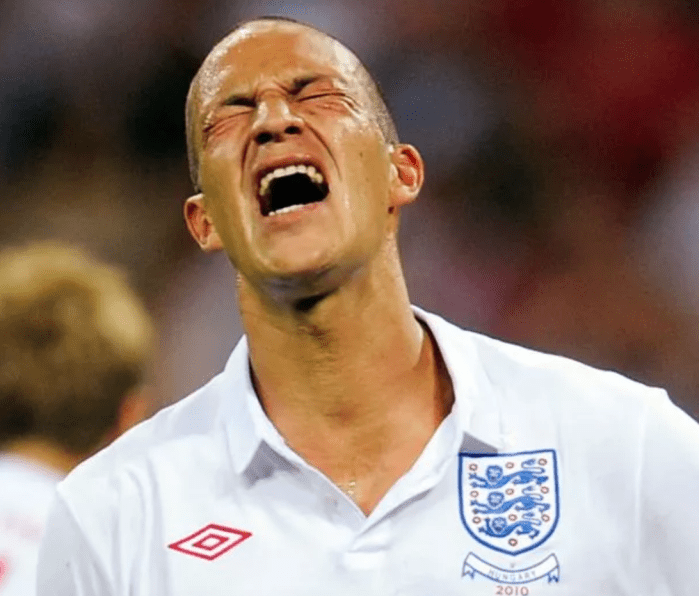
Capello sent him on as a second half substitute for Frank Lampard to play up front alongside Wayne Rooney in England’s 2-1 friendly win over Hungary at Wembley on 11 August 2010.

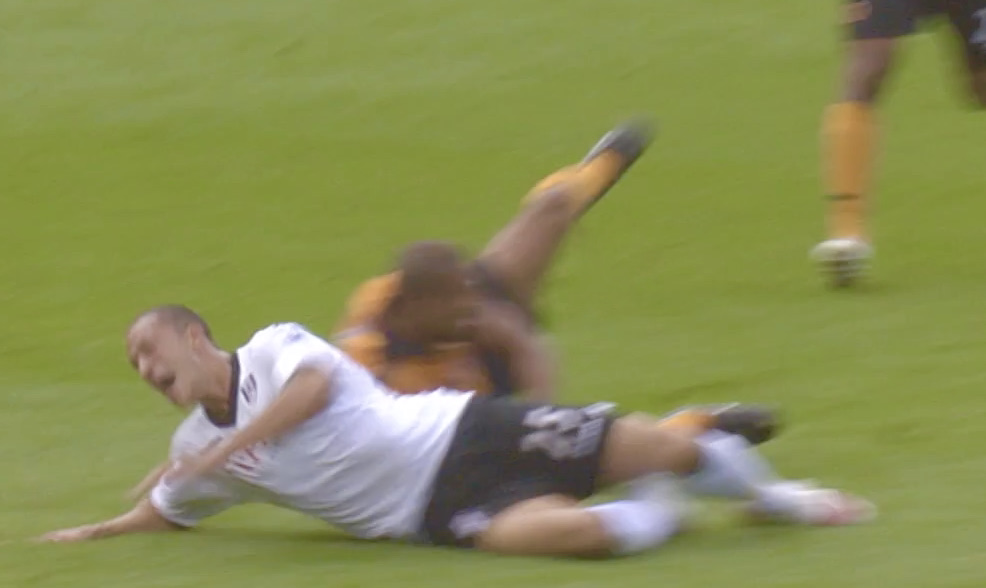
Having made that breakthrough, the day after he signed a new four-year contract with Fulham he agonisingly suffered another setback when he broke a leg (above) and sustained ankle ligament damage during a 2-1 win over Wolves. He was sidelined for five months.

Capello didn’t consign him to history, though, and called him up again in May 2011 (his teammate David Stockdale was in the same squad) to face Switzerland in a Euro 2012 qualifier. But neither were involved in the disappointing 2-2 Wembley draw.

His first start for England finally came six months later in a 1-0 home win over Sweden, the first time in 43 years that England had beaten the Scandinavian country. Zamora’s close friend (and another former Senrab graduate) John Terry was England captain and joining the striker in making first starts were right-back Kyle Walker and Everton’s Jack Rodwell.

Richard Williams in The Guardian clearly felt sorry for the debutant centre forward, though, writing: “Poor Bobby Zamora. Offered the opportunity to score England’s 2,000th goal on Tuesday night, a perennially unfortunate footballer was forced instead to stand and watch as Stewart Downing’s cross glanced off the side of Gareth Barry’s head and then off Daniel Majstorovic’s forehead before evading Andreas Isaksson’s dive as it looped inside the post for the most anticlimactic of own goals.”

Reporting on the narrow victory over the Swedes, Williams added: “Whichever side the ball went, Zamora made sure he was available. A double exchange of passes with Walcott in the 17th minute put Zamora in on goal, but after Isaksson blocked his first effort the follow-up was poked past the post from five yards.

“Any centre forward will ultimately be judged by the goals he scores rather than his total of assists, and Zamora spurned a wonderful chance in the 65th minute when Downing scampered down the left once more before pulling the ball back at precisely the right pace and angle for the striker to meet it with a first‑time connection. Jonas Olsson, however, flew in to deflect the shot for a corner.”

Zamora was subbed off in the 70th minute to be replaced by Darren Bent and the Guardian sports writer concluded: “England – and Zamora in particular – really should have inflicted greater punishment on such humdrum opposition.”

Bent had also replaced Zamora in his first start for England under 21s. That came in February 2003 in a 1-0 defeat to Italy in Carrara.

A month before his move to Spurs, he also started England’s 3-2 friendly win over Serbia and Montenegro at Hull’s Kingston Communications Stadium, on that occasion being replaced by Darren Ambrose. (His future Fulham and Albion teammate Steve Sidwell was in midfield that day).

Eight days later, in a UEFA under 21 championship preliminary match, he went on as a sub for Shola Ameobi as England beat Slovakia at the Stadium of Light, Sunderland.

Zamora showed England quality at an early age

After that under 21s debut against Portugal, he was selected in the squad for the UEFA under 21 championship finals in Switzerland. On 20 May 2002, David Platt sent him on as a sub for Gareth Barry in a 2-1 defeat to Italy in Basle.

Two days later, in the third group match, again a sub, he replaced Jermain Defoe as England lost 3-1 to Portugal and were eliminated from the competition.

On two other occasions Zamora was an unused sub but he didn’t add to his six caps. And, after

Capello quit the England job in February 2012, Zamora didn’t play for the full England side again.

• Ahead of Albion’s new year clash with West Ham, find out why Zamora’s move to the Boleyn Ground was so ideal in the next instalment.

Tony Rougier couldn’t have wished for a better Albion start

A GOAL by Tony Rougier three minutes into his debut as a substitute gave Brighton a glimmer of hope in their battle to avoid relegation.

His strike against Mark McGhee’s mid-table Millwall side at Withdean Stadium on 22 February 2003 was the only goal of the game and lifted Albion out of the bottom three of the Championship.

When Bobby Zamora dummied Kerry Mayo’s pass to allow Arsenal loanee Graham Barrett to turn and move the ball goalwards, Rougier nipped in to complete a neat finish past Tony Warner in the Millwall goal.

Manager Steve Coppell had sent on the Reading loanee as a 61st minute substitute for winger Paul Brooker although he admitted to Stuart Barnes of The Guardian: “I honestly didn’t know if Tony would make a difference, but I felt he would pep up everybody else because we were starting to lose our grip.

“Getting out of the bottom three will give the players a lot of self-esteem. For a long time this season they have questioned whether they belonged at this level.”

Trinidad and Tobago international Rougier joined the Seagulls having been sidelined by Alan Pardew at Reading who paid £325,000 when signing him from Brian Horton’s Port Vale.

Horton gave the Argus an insight of what Albion fans might expect when he said in an interview: “Tony has a great build and he is a threat with his pace and strength.

“We had to sell him because we needed the money and he was one of our major earners.”

He had been Vale’s leading goalscorer with eight goals in 38 games when they were relegated from the First Division in 2000 before moving to Reading that August.

Rougier made a total of 84 appearances for Reading, scoring six goals, and in his first season helped them to the Division Two play-off final where they lost 3-2 to Walsall (and Rougier scored an own goal after going on as a substitute). But a year later, he made 20 starts and 13 appearances off the bench as Reading were promoted in second place – behind the Albion!

He had scored twice in 12 outings for Pardew’s high-flying Royals in 2002-03, including in a 1-0 win against Albion at Withdean. But competition for places was fierce, with the likes of Nicky Forster, Darius Henderson, John Salako and Nathan Tyson.

Coppell told the Argus: “I speak with Alan fairly regularly but this came totally out of the blue when I phoned him up.

“Tony is a big, strong lad and he gives us options. He can play as a wide man or down the middle and the move suits Reading, the player and me.”

Getting to grips with Jason Brown of Gillingham

Coppell needed forward cover because Gary Hart was about to start a four-match suspension, Zamora was banned for the next away game at Gillingham, Paul Kitson was still injured and Barrett was struggling for form and goals.

The following matchday programme observed Rougier had not been signed for his goalscoring prowess, but rather for his “power, direct running, and causing havoc that others can exploit”.

But the goal was very welcome in a season that might well not have ended in relegation if Coppell had started the season in charge rather than joining after so many games had already been lost under Martin Hinshelwood.

Rougier made his first start in a 3-0 defeat away to Gillingham playing up front with Barrett when Zamora and Hart were suspended.

He featured in home wins over Rotherham United (2-0) and Nottingham Forest (1-0) as well as an away defeat at Stoke City (0-1), but he missed the 2-1 defeat at Sheffield United after twisting his right ankle against Forest.

He bowed out in style in his final appearance, making one goal and scoring a second in a memorable 2-2 draw away to Ipswich Town.

I took my then 14-year-old son Rhys to the clash at Portman Road and the lively midfielder-cum-striker in the no.34 shirt, who had been taken to the hearts of the Albion faithful, was suitably serenaded with the chant ‘Ra-ra-ra Rougier’ to the tune of the popular vaudeville and music hall song Tarara Boom-de-ay.

His first significant involvement saw him go up for a header from Hart’s cross and Town goalkeeper Andy Marshall diverted the ball into his own net to gift Albion an equaliser.

Future Albion loanee striker Darren Bent missed a penalty that would have put Ipswich back in front, and then, with 10 minutes to go, Albion fans were buoyant with expectation when Rougier slammed the ball into the roof of the net after Ipswich had failed to clear their lines.

Unfortunately for Brighton, a 30-yard thunderbolt from Martin Reuser flew past Dave Beasant to put the home side level and Albion had to be content with a point, which ultimately wasn’t enough to avoid making an immediate return to the division they’d left the previous season.

While the player was keen to extend his stay, Pardew wanted him back to help with Reading’s promotion run-in, although thankfully he wasn’t involved in Brighton’s shock 2-1 win at the Madejski Stadium on 4 April (and Steve Sidwell, who had been on loan at the Albion earlier that season was an unused sub). Goals from Brooker and sub Kitson took the spoils for the Albion, Cureton netting for the home side.

The Royals finished fourth in the league before losing 3-1 on aggregate to Wolves in the play-off semi-finals, and Rougier was released on a free transfer having scored three times in 13 starts and nine appearances off the bench.

Rougier told the Argus he would be interested in returning to the Albion, but nothing came of it and he joined Brentford instead. Manager Wally Downes believed the player had “real quality” although Brentford fans seemed to have divided opinions on what he brought to the side.

‘Snappy’ on The Griffin Park Grapevine reckoned: “The guy is a huge asset, especially in the last 10 minutes of a game when he can hold the ball up and dance his way around players like they were statues and relieve the pressure on the defence.”

‘West Ealing Bee’ agreed: “He is an asset to the club and a very important part of the team.” But ‘Boston Bee’ had a totally different take on the player:Even when he actually tried (15min/match) he looked like he wasn’t trying. His lack of interest in the game going on around him drove me crazy.”

Rougier made 34 appearances for the Bees, scoring five goals but when Martin Allen took over as manager in March 2004, Rougier was one of five players he allowed to leave Griffin Park as part of a squad overhaul that ultimately helped them to a last-day escape from relegation.

Meanwhile, Rougier linked up with another ex-Albion captain, Danny Wilson, at Bristol City on a free transfer. Indeed, Rougier appeared for the Robins when they lost 1-0 to McGhee’s Albion in the divisional play-off final in Cardiff on 30 May.

But when Wilson lost his job that summer, Rougier followed him out of the exit and he returned to Trinidad, where he won the last of 67 international caps for Trinidad and Tobago.

Rougier stepped into coaching

He has since turned to coaching, becoming a UEFA A licensed coach, and attained a degree in sports development. On his LinkedIn profile, he describes himself as the founder, president and technical director of FC South End, and, in 2014, among his past coaching experiences was a spell working with his nation’s under 20 squad.

Four years later, he had moved to the United States to coach the New England Revolution academy team.

Born on 17 July 1971 in Sobo, a village in south west Trinidad, his footballing career was initially confined to his home country.

Tom Lunn, writing for Reading fan website thetilehurstend.sbnation.com in 2019, profiled Rougier describing how the player began his senior footballing career in his home country with La Brea Angels. His Wikipedia page says he also played for Trintoc, United Petrotrin, and Trinity Pros.

An Albion matchday programme article said Rougier then moved to New York where he spent a year working in the baggage department at John F Kennedy airport before heading to the UK.

After overcoming work permit issues, he was taken on by Raith Rovers where, over the course of two years, he became something of a cult hero. In 2018, he returned to Fife to be inducted into the club’s Hall of Fame.

“This is where it all started,” he said in an interview with the club’s TV channel. “It never felt the same whichever club I went to afterwards. The Fife people gave me respect and it’s something I’ll never forget.”

Rougier welcomed back in Fife

During the interview, Rougier remembered fondly an occasion when he man-marked Paul Gascoigne, playing central midfield against Rangers.

His stand-out moment was a UEFA Cup second round tie in Munich’s Olympic Stadium on 30 October 1985 when Raith only narrowly lost 2-1 to Bayern Munich who boasted the likes of Oliver Kahn in goal and Jurgen Klinsmann up front.

His performances for Raith earned him a £250,000 move to Hibernian. He scored four times in 45 matches for Alex McLeish’s Edinburgh outfit but in January 1999 joined Port Vale, signed by Horton’s predecessor John Rudge for £175,000.

By then, he had established himself in the Trinidad and Tobago national side, a teammate of Dwight Yorke, and often being chosen as captain.

In his own words, he describes himself as: “A highly experienced football coach and former professional player with a career in the game spanning more than 25 years, I has successfully made the transition into coaching, management and club operations through a consistent focus on long term player and team development.

“A former national team captain with Trinidad & Tobago and a promotion winner in both England and Scotland, I have been able to effectively apply my on-field experience to guide team success and coaching strategy at professional, grassroots and school level.

“I am a positive, dynamic and passionate professional who is committed to my continued progression as a coach. I am always open to opportunities in which I can develop while positively impacting a football club or organisation, and would relish the opportunity to work with elite players within an ambitious environment.”

Why Saint Dan riled the Albion

DAN HARDING was promoted twice with Southampton and once with the Seagulls and later cut short his career because of family tragedy.

Personally, I’m not sure he really need to be cast as ‘public enemy no.1’ because of the way he left Brighton.

With the benefit of hindsight, it was really no surprise that he chose to turn his back on playing at Withdean in favour of Elland Road, Leeds.

OK, the stringing-out of the contract negotiations, and public slanging match that accompanied them, didn’t help matters.

But football careers are short and the Amex was a long way off becoming a reality when Harding decided to opt for pastures new.

“I really enjoyed my time at Brighton but you can’t compare the size of the two clubs or the facilities,” he told the Leeds matchday programme at the time. “It has been like going from one world to another.”

Ironically, it seems his success on the pitch with Brighton, which led to him gaining international recognition, might well have been the unsettling influence.

Former Albion boss Peter Taylor selected him for England under-21s as the 2004-05 season got underway. He made his England debut as a substitute for Micah Richards in a 3-1 win over Ukraine at the Riverside Stadium, Middlesbrough, on 17 August 2004. Future full internationals James Milner and Darren Bent were in the same squad.

He started the 8 October 2004 match against Wales at Ewood Park, Blackburn: a 2-0 win courtesy of goals from Milner and Bent. He also started the game four days later when the under 21s drew 0-0 away to Azerbaijan in Baku. His last cap came the following month in a 1-0 defeat away to Spain when he was replaced by Ben Watson. Future Albion loanee Liam Ridgewell was also a substitute in that game.

It was this platform that sowed the seeds of discord, according to former chairman Dick Knight’s take on the circumstances surrounding Harding’s acrimonious departure from the Albion.

In his autobiography Mad Man: From the Gutter to the Stars, Knight reckoned it was while on international duty that Harding was “egged on by his agent about his value after talking to players with bigger clubs, on bigger wages”.

Knight went on: “Early on, I offered him a sizeable contract renewal but he sat on it. He kept saying he wanted to stay, but I don’t think he had any intention of doing so.

“Because he was under 24, we were entitled to compensation. Shaun Harvey, the Leeds chief executive – who became CEO of the Football League in July 2013 – tested me with a couple of paltry sums before finally offering £250,000, which I rejected.”

DH Leeds action 2Via the Football League tribunal system, Knight managed to get the figure up to £850,000, part achievement-based, and with a 20 per cent sell-on clause.

All in all, not a bad return for a player who came through the Albion’s youth and reserve ranks after being spotted at 15 playing for Hove Park Colts.

Born in Gloucester on 23 December 1983, the young Harding loved kicking a football from the moment he could walk and enjoyed watching his dad, Kevan, turn out for the Army team.

The family was posted to Brighton, and Harding was taken to the Goldstone Ground by his mum, Linda. One of his earliest memories was on 23 September 1992 seeing a 17-year-old David Beckham make his Manchester United debut as a substitute for Andrei Kanchelskis in a League Cup tie that finished 1-1.

Harding joined the Albion initially on schoolboy terms for a year and was then taken on as a YTS trainee, progressing through the juniors and reserves before eventually making his first team debut on 17 August 2002, during Martin Hinshelwood’s brief reign, as a substitute for Shaun Wilkinson in a 2-0 home defeat to Norwich City.

After Hinshelwood was replaced by Steve Coppell, and Harding sustained a back injury, the youngster played no further part in the first team picture that season, but he was awarded a new contract in April 2003.

In the first part of the 2003-04 season, Harding was a regular on the bench, but, on 21 February 2004, Coppell’s successor, Mark McGhee, gave him his full debut in place of the suspended Kerry Mayo in a 3-0 win over Bournemouth.

Dan Harding

Harding kept his place through to the end of the season, making a total of 23 appearances, including being part of the side that lifted the divisional play-off trophy at the Millennium Stadium, Cardiff, as the Seagulls beat Bristol City 1-0.

“In hindsight, it was a very lucky time for me. I broke into a team that was winning games and was promoted,” he told the Daily Echo. “Looking back now, I don’t think I appreciated at the time what a big achievement it was.”

Sent off in only the second game of the following season for two bookable offences, it wasn’t long before his contract discussions were aired publicly, with McGhee telling the Argus in October: “It’s starting to really frustrate me.

“Dan keeps telling us and saying publicly he wants to sign but we cannot tie his agent down to have a meeting with us. He has to be honest with us.”

Harding in turn denied he was being difficult, telling the Argus that talks were ongoing.

The off-field issues certainly seemed to be troubling Harding and McGhee publicly blamed the defender for a 2-0 defeat at Millwall in December. He was also outmuscled by Stoke City’s Ade Akinbiyi in a game at Withdean, leading to a late winner for the visitors. Across the season, McGhee dropped him on four occasions because of such inconsistency.

When he won his place back in February, he told the Argus: “I had to prove not only to the gaffer but to the other players and the fans that I want that position back.

“That’s where I prefer to play. I like to call that my position. I don’t mind playing on the left hand side of midfield or centre midfield, but I do love playing at left-back.

“Hopefully I can reproduce the same sort of form and keep my confidence up. Everyone wants to be playing, so when you are left out it’s a bit of a kick in the teeth. It’s not nice, but you have to pick yourself up and try to get back into the team.”

DH leeds action 1However, the Brighton contract offer was declined and on 7 June that summer, Harding put pen to paper on a deal with Leeds, whose fans were no doubt delighted to read that he used to follow their fortunes when he was a youngster.

“When I lived in Germany, they showed quite a lot of Leeds games on telly and, in a strange way, I kind of ended up supporting them because it was the only football I really got to see out there,” he said.

His dad later took him to a Leeds FA Cup match v Wolves, and he added: “I have to admit I have been a closet Leeds fan. Obviously, I didn’t shout about it when I was playing for Brighton and it’s kind of strange now that this move has happened.”

If Harding doubted the size of the task at Elland Road, he’d only have had to read the comments of manager Kevin Blackwell, often Neil Warnock’s no.2, who was the Leeds manager at the time.

In an article about Harding in the club programme, Blackwell said: “It has been a big transition for him. No disrespect to Brighton, but coming from the scaffolding at Withdean to Elland Road was a big step-up for Dan. He was nervous in the first couple of games, but he has started to settle down.”

He talked about how he needed to cement his place at United, and added: “If he does succeed here, all the doors will be open to him. I have no doubt that once he develops certain aspects of his game and his self-confidence, he will go a long way because he is a real athlete with a great left foot.”

Brighton fans vented their displeasure at how things had turned out every time Harding touched the ball when Leeds entertained the Seagulls on 12 September 2005; a game which finished 3-3. The fact two of Albion’s goals came from crosses on Harding’s flank prompted Blackwell to drop him for the following match.

After only seven games, Harding picked up an injury and, over the course of the season, played just 21 matches for United. In August 2006, the Yorkshire club used the full-back as a makeweight in a deal which took future Albion loanee Ian Westlake from Ipswich to Leeds.

He was a regular at Portman Road for a couple of seasons but, in his third season, manager Jim Magilton deemed him surplus to requirements and sent him out on loan to Southend United. I recall going to a match at Roots Hall and seeing him have an outstanding game against Brighton.

Later the same season, with Ipswich bobbing along in mid-table, Harding seized the chance to join Steve Coppell’s promotion-chasing Reading, and he played in their play-offs defeat to Burnley.

When Roy Keane took over at Ipswich in 2009, Harding was sold to Southampton; manager Alan Pardew’s first signing for the Saints. Harding’s former Albion youth coach, Dean Wilkins, was part of Pardew’s coaching team.

Harding reflected in an interview with the Southern Daily Echo that what followed were the happiest three years of his career, in which he played 121 games and chipped in with five goals.

In 2010-11, he was named in the PFA League One team of the year along with teammates Kelvin Davies, Jose Fonte, Adam Lallana and Alex Oxlade-Chamberlain.

In the harsh and fickle world of football, Brighton fans relished Brighton’s 3-0 win over Southampton at the Amex on 2 January 2012 when Albion winger Will Buckley gave Harding such a torrid time that, to compound his humiliation, the former Brighton player was subbed off by boss Nigel Adkins with five minutes of the first half still to play.

Although part of the Saints side that won promotion back to the Premier League that May, Harding didn’t get the chance to play at the top level because Adkins moved him on to Nottingham Forest.

Harding talked in detail to the Echo’s Paul McNamara about life at Forest, which he found an unstable place, especially when Sean O’Driscoll, the manager who signed him, was sacked.

Although he played some games under that legendary left-back Stuart Pearce, when he took over, Harding eventually went on loan to Millwall, but wasn’t able to help them stave off relegation from the Championship.

He reveals in his interview with McNamara how disillusioned he became with the amount of dishonesty in football and, coupled with his pregnant wife losing two of the triplets she was expecting, he put family before football and, at the age of only 31, dropped down four divisions to play non-league with Eastleigh.

He talked about the tough decisions he’d had to make in an interview before a FA Cup tie Eastleigh played against Bolton Wanderers.

In 2016, Harding joined Whitehawk as a player, then became part of the coaching set-up, and was briefly caretaker manager before the appointment of Steve King.

The multi-million pound striker who scored on his Albion debut

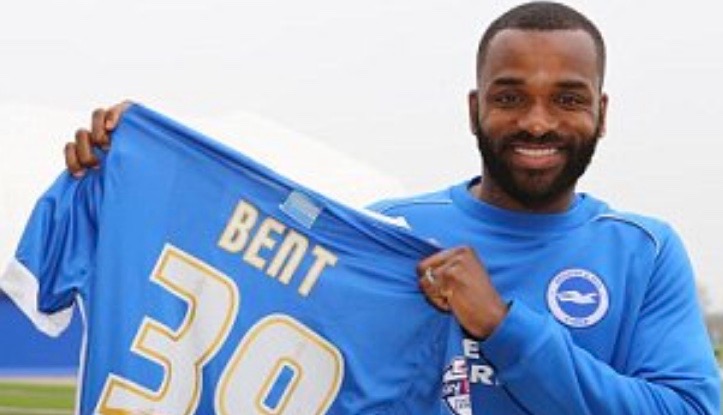
STRIKER Darren Bent spent the last month of 2014 with Championship-struggling Brighton as the hapless Sami Hyypia tried to bring a halt to a dismal run of form.

Unable to command a regular starting spot at Aston Villa, Bent made an encouraging enough start, scoring on his debut against Fulham.

But the game ended in a 2-1 defeat and his only other goal came at Molineux two days before the axe fell on Hyypia’s time in the hotseat as Albion drew 1-1 with Wolves.

Bent told BBC Radio Sussex he’d reached “boiling point” in his frustration at the lack of starts under Paul Lambert at Villa. Previous boss Gerard Houllier had smashed Villa’s transfer fee record to take Bent from Sunderland for an initial £18m in January 2011, but, after Lambert became manager in 2012, he made just 13 Premier League appearances.

albion D BentAt the time he headed to the Amex, Bent had scored 184 goals in 464 career appearances, not to mention scoring four while winning 13 caps for England.

“I hope he will score plenty of goals for us during his time with us,” Hyypia had told the club website. “His record speaks for itself. He is a top-class striker with more than 100 Premier League goals with Charlton, Spurs, Sunderland and Aston Villa.

“Three years ago, he was a regular in the England squad under Fabio Capello; there is no doubting his ability to score goals.

“He also wants to play regular games and that is evident in his willingness to step down from the Premier League to the Championship.”

Bent told the matchday programme: “It doesn’t bother me that I’ve had to drop down a division to play football. Anyone who knows me knows that all I care about is football.

“It has never been about money or anything like that. It has always been about playing football. I’m always at my happiest when I’m playing.”

At least Bent found some familiar faces in the Albion dressing room in fellow Villa loanees Joe Bennett and Gary Gardner and former Fulham teammates David Stockdale and Aaron Hughes.

“Brighton felt like the perfect place to come and play football, especially for someone like Sami Hyypia, who I’ve played against many times over the years,” Bent added. “As a manager, I think he is the right man. He is the kind of guy I want to play for.”

Bent goalBent returned to Villa after playing in five games and although new boss Chris Hughton indicated a willingness to bring him back, the striker was soon on his way to Derby County for the remainder of the season.

He scored 12 in 17 games for Steve McLaren’s Rams and subsequently joined them on a permanent basis in the summer of 2015. After two seasons in the Championship with Derby, scoring 14 in 67 matches, a hamstring injury sidelined him for the start of the 2017-18 season and in January 2018 he went on loan to Championship strugglers Burton Albion.

Having been without a club since released by Derby in the summer of 2018, he announced his retirement at 35 in July 2019.

Since then, he has joined the football pundit circuit, although not everyone is convinced he’s making that good a job of it!

pundit D BentNevertheless, Talksport and Sky Sports are happy to give him a platform and, in an interview with Metro, he suggested what might be the most difficult aspect of it. “I played with some of these guys and regard them as friends so, when they have had a bad game, will I be able to dig them out? It’s finding the line between being objective and respectfully constructive.”

Only in January 2020, Bent could be found arguing the case for Lewis Dunk to be recalled by England. The former striker is also active on Twitter with @DarrenBent attracting just short of 492,000 followers.

Born in Tooting, south London, on 6 February 1984, Bent was probably destined to be a footballer because his dad Mervyn had been on the books of Wimbledon and Brentford as a youngster.

The family moved to Cambridgeshire when the young Bent was only 10 and his early football career was nurtured at Godmanchester Rovers.

Ipswich Town picked him up as a 14-year-old and nurtured him through their youth ranks until he eventually made it to the first team in November 2001.

In four seasons with Ipswich, he scored 56 goals in 141 appearances before then Premier League Charlton Athletic paid a fee of £2.5m to take him to The Valley.

After two successful seasons in which he bagged 37 goals in 79 games for the Valiants, he made another big money move, this time to North London to join Spurs.

It was in June 2007 they paid a club record £16.5m and he scored 25 in 79 games for them before a similar fee saw him move to Sunderland, then in the Premier League, in the summer of 2009.

After 18 months in the North East, Bent put in for a transfer and Aston Villa paid £24m to sign him on a four-and-a-half year contract. He marked his debut with the only goal of the game in a win over Manchester City.

In his second season with Villa, Bent took on the captaincy for a while but managerial changes meant his face didn’t always fit and he spent the whole of the 2013-14 season on loan to Fulham, where he scored six in 30 matches.

Winger Neil Smillie was a Wembley winner eventually

NS v MU Wemb

AN UNSUNG hero of Brighton’s 1983 FA Cup Final side, winger Neil Smillie, had the distinction of being the first ever apprentice the legendary Malcolm Allison signed for Crystal Palace.

Big Mal had enjoyed league and FA Cup success at Manchester City as Joe Mercer’s sidekick but he swept into Palace in the early 70s as a boss in his own right, courting publicity with his flamboyant fedora hat and giant cigar.

Smillie admitted: “I was going to West Ham but Allison persuaded me to take a look at Palace.

“The place was so alive and vibrant under him that I went there instead.”

Born in Barnsley on 19 July 1958, Neil followed in the footsteps of his dad, Ron, a former professional who played for Barnsley and Lincoln.

After joining Palace in 1974, Smillie turned professional a year later and was on Palace’s books for seven years, although he had three loan spells away from Selhurst.

In 1977, he went briefly to Brentford, who he ultimately would have a long association with later in his career.

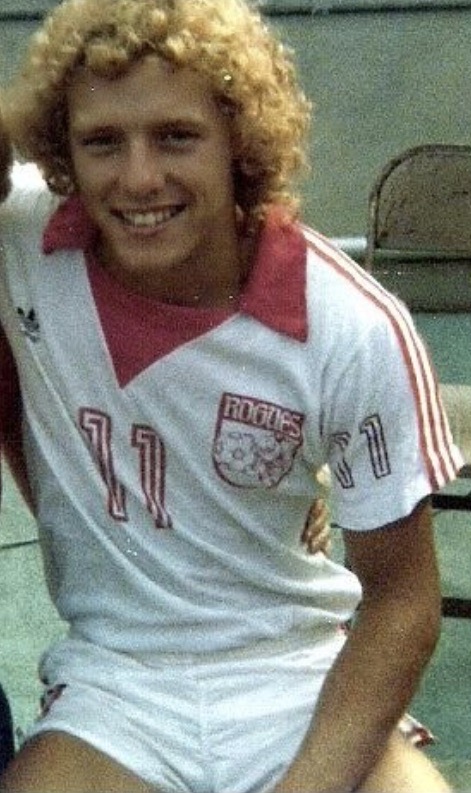
Smillie MemphisThe following two years, he went to play in America for Memphis Rogues (pictured left) where his teammates were players from the English game winding down their careers: the likes of former Albion players Tony Burns and Phil Beal, ex-Chelsea, Leicester and Palace striker Alan Birchenall and former Chelsea winger Charlie Cooke; the side being managed by former Chelsea defender Eddie McCreadie.

At the end of the 1981-82 season, Smillie was denied a pay rise by Palace so he decided to quit and wrote letters to clubs in the top two divisions in England asking for a job!

Brighton had managed to offload the troublesome Mickey Thomas to Stoke City so had a need for a left winger. They were the first to come up with an offer, and with full back Gary Williams surplus to requirements since the arrival of experienced defender Sammy Nelson, Brighton offered him in exchange for Smillie.

The bubble-haired winger gratefully accepted the switch to the Seagulls. While he made the starting line-up for the opening game of the new season, a heavy (5-0) defeat away at West Brom in the next game then saw him dropped and sidelined for months.

It was only once ultra-cautious manager Mike Bailey had left that Smillie got back in contention, and only then – in January 1983 – through someone else’s misfortune.

He said: “I was out in the cold and only got my break when Giles Stille was injured during the Cup game against Newcastle United.”

Smillie seized his opportunity and remained in the side for the rest of the season, culminating in the two Wembley FA Cup Final matches against Manchester United.

Back in the second tier following Brighton’s relegation, Smillie played 28 games plus once as a sub but following new manager Chris Cattlin’s signing of Northern Irish winger Steve Penney, there was competition in the wide areas.

Throughout the 1984-85 campaign, Smillie was more often than not a substitute rather than a starter. He did manage a seven-game run of appearances in the late autumn and began the final three games of the season, but the last game, a 1-0 home win over Sheffield United, proved to be his farewell.

Smillie revealed in a 2003 interview with Spencer Vignes that he’d discovered Manchester City had been keen to take him on loan but Cattlin hadn’t sanctioned it, even though he wasn’t selecting him.

“Chris had turned them down, saying I was a good player and he needed me. Yet he wasn’t even playing me! I just couldn’t believe he’d done it,” he said. Although he and his family were settled in Sussex, he realised he had to move.

Several eyebrows were raised when Cattlin managed to secure a £100,000 fee from Watford for Smillie’s services in the summer of 1985. The winger joined Graham Taylor’s beaten FA Cup finalists but he failed to establish himself in the side and made just 16 first team appearances in a season with the Hornets.

In the summer of 1986, he moved on to Reading for two years and, in 1988, after his disappointment with Brighton, Smillie was finally a winner at Wembley, scoring and setting up two goals as Reading beat Luton 4-1 in the Simod Cup Final.

The Hatters were led by former Albion captain Steve Foster and another of Smillie’s former teammates, Danny Wilson, was in their midfield. Mick Harford scored the opening goal for Luton, but Smillie’s pass allowed Michael Gilkes to bundle home an equaliser.

Smillie then won a spot kick converted by Stuart Beavon, and, in the second half, Mick Tait swept home another Smillie assist. Smillie then rounded off a great afternoon by scoring himself. It was hailed as one of the best days in Reading’s history, witnessed by over 45,000 loyal Royals fans.

Nevertheless, Smillie didn’t hang around and instead joined Brentford, where his former Palace teammate Phil Holder was assisting the manager at the time, Steve Perryman.NS Bees

Nick Bruzon interviewed Smillie in depth for a Where are they now? feature on the Brentford FC website in July 2010.

“Representing Brentford over three different decades, initially on loan in 1977 and then for five years from 1988 to 1993, Neil Smillie combined raw pace with ceaseless energy to make him one of the most popular players to patrol the New Road touchline,” said Bruzon. “Whilst with Brentford he experienced promotion, relegation and play off heartbreak, scoring 18 goals in 185 games.”

Smillie said: “I’ve got to say, the five years I spent at Brentford (and I was 30 when I signed) I thoroughly enjoyed.

“I’d reached a point in my career where I felt comfortable in terms of what I could give on the pitch. I’d always been a hard worker and I got the feeling that the supporters appreciated someone who worked hard.”

In the 1992-93 season, he played alongside Chris Hughton, who, like Smillie, was winding down his playing career.

“I loved taking people on and I loved getting crosses in for people to score so that just seemed to fit in nicely at the time with the team that we had,” he said. “I played my part as well as others who played theirs in getting the ball to me. We all did our bit and for me it was a great part of my career.”

On leaving Brentford, Smillie became a player-coach at Gillingham when his old Palace teammate Mike Flanagan was the manager. When Flanagan was sacked, Smillie took over the managerial reigns on a caretaker basis while the club tried to stabilise during financial troubles.

Smillie told Bruzon: “We were in a fairly precarious position and ended up in a decent position. So there was some enjoyment to it but the situation at a club without any money and struggling was difficult.”

Some names familiar to Brighton fans were at Gillingham at the time. Smillie played up front with Nicky Forster. Paul Watson was in defence and Richard Carpenter in midfield.

His three-month reign came to an end when Gillingham appointed Tony Pulis as the new manager and former Palace manager Alan Smith took Smillie to Wycombe Wanderers to look after their youth team.

When Smith left, Smillie was caretaker manager until former Albion full back John Gregory got the managerial post. Smillie then became Gregory’s successor in the hot seat for a year.

When the inevitable sack came, Smillie stepped outside of day to day running of football to become sports marketing manager for Nike in the UK. His role was to identify emerging talent for Nike to associate themselves with, and, as a result he stayed in touch with the game.

Among the players he signed to Nike were Theo Walcott, Darren Bent, Gabby Agbonlahor, James Milner, Tom Huddlestone, Danny Welbeck and Johnny Evans.

Pictures show (top) Smillie in action on the cover of the Albion programme; walking his dog; in Match magazine, on the cover of Shoot! being tackled by Liverpool’s Sammy Lee; a Simod Cup winner with Reading.