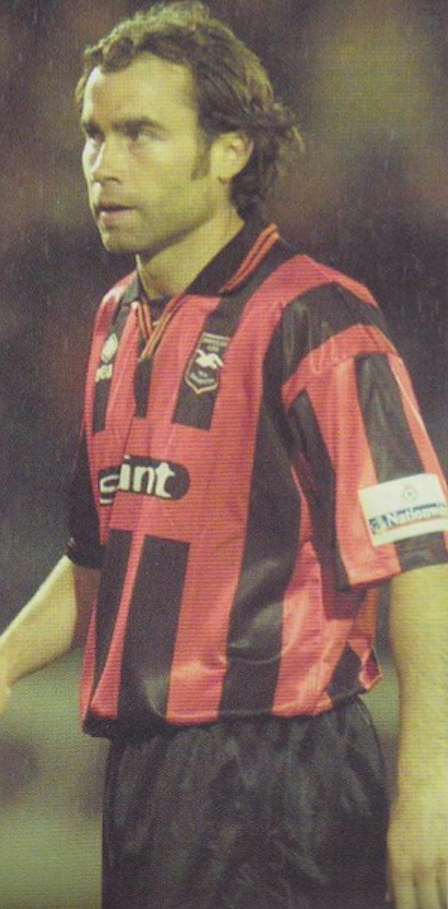
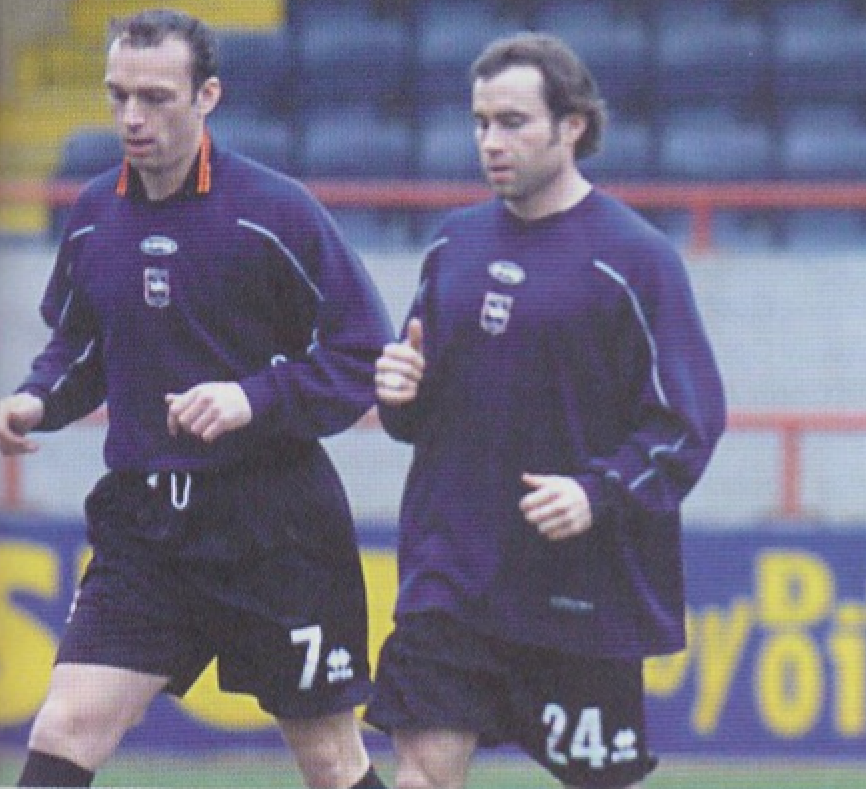
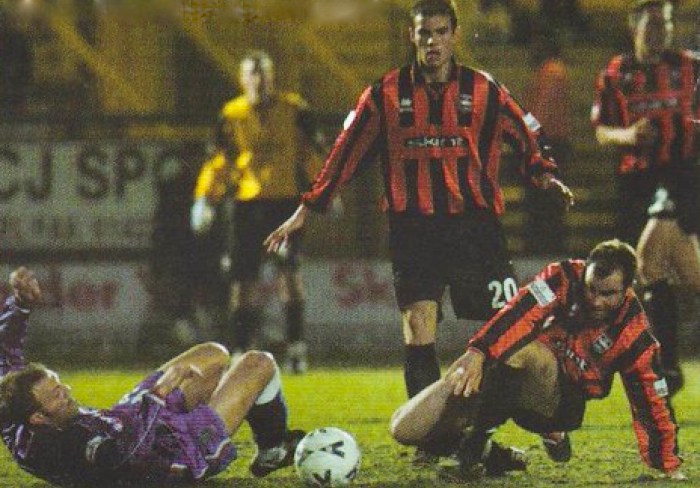
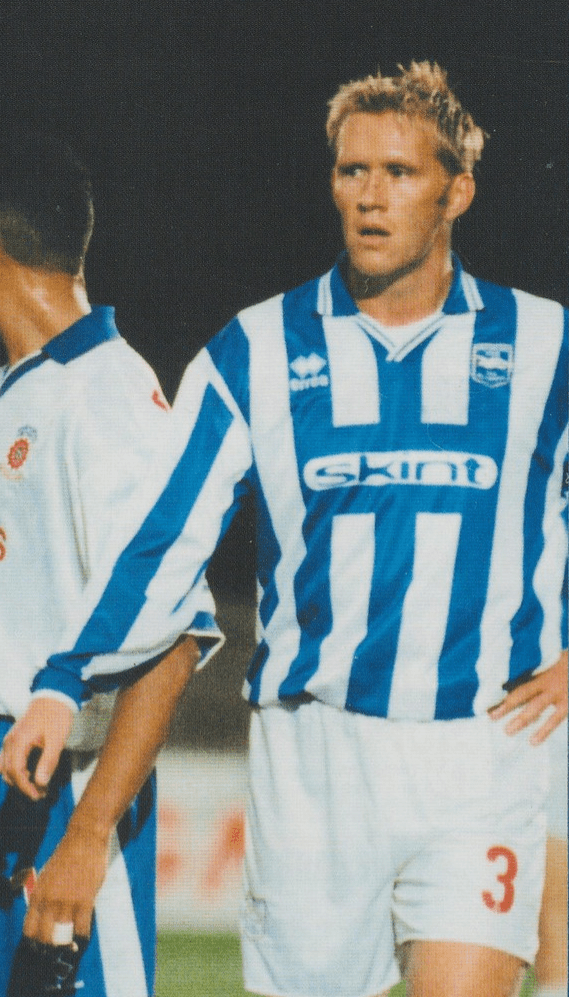
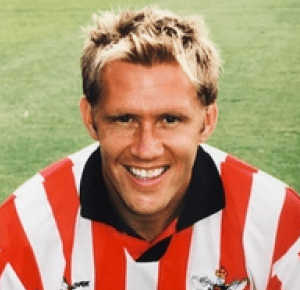
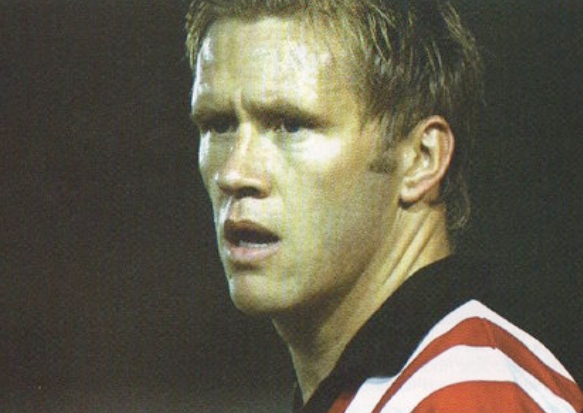
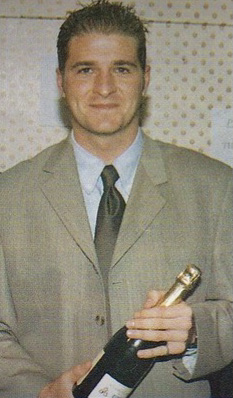
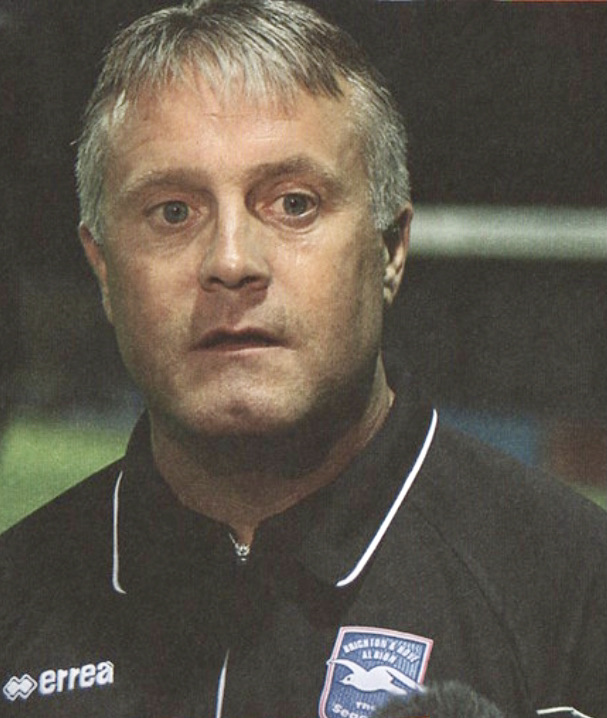
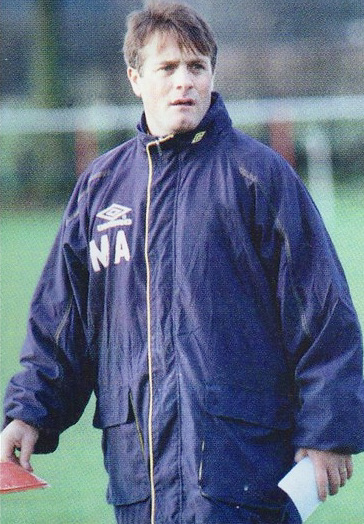
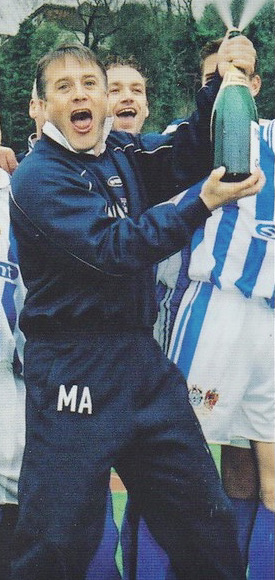
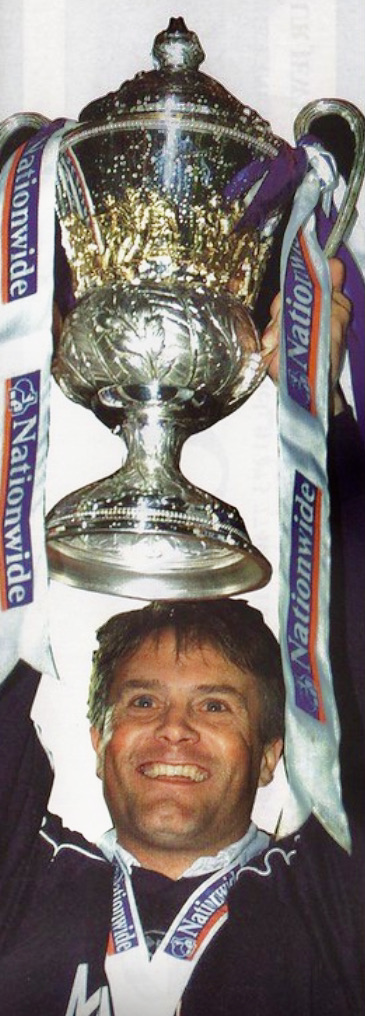
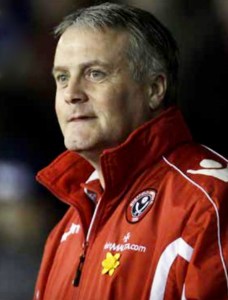
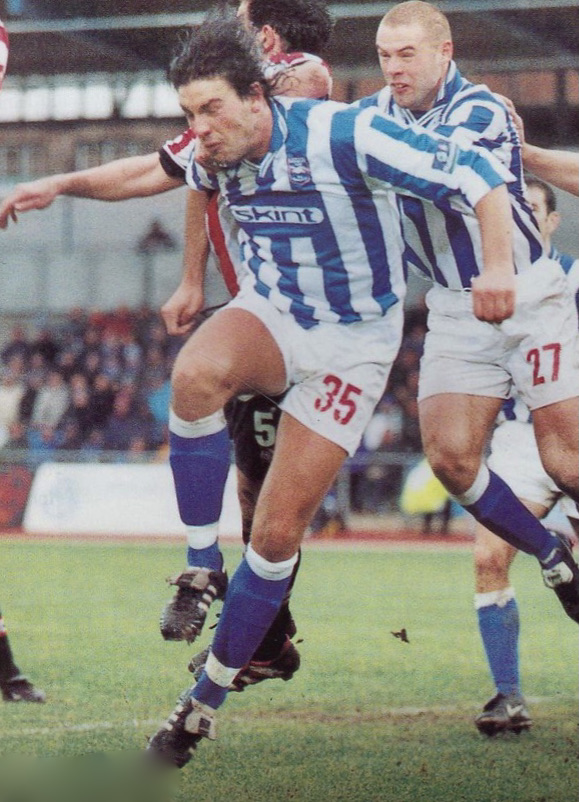
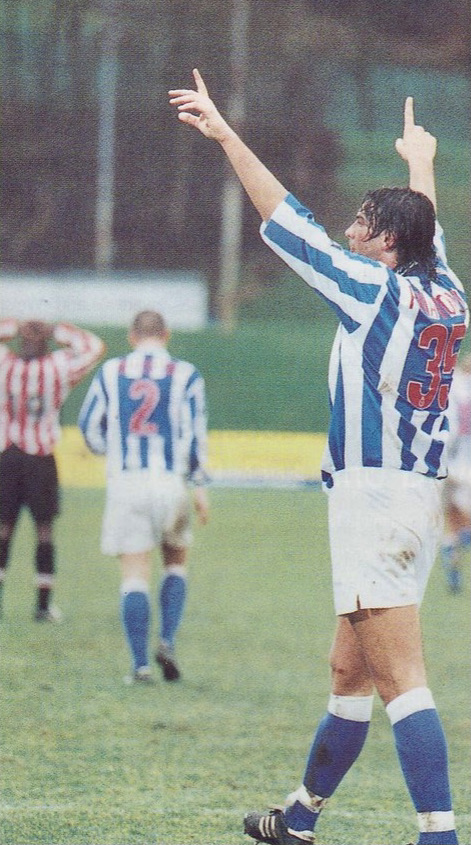
Andy Crosby enjoyed the taste of success with Brighton

ROCK-solid centre-half Andy Crosby won a Division 3 Championship medal with the Albion in 2001 before experiencing two frustrating near-miss seasons as captain of Oxford United.

Brighton’s achievement provided him with his first-ever promotion, but it didn’t turn out to be his last: he climbed out of the same division with Scunthorpe United and then, against all the odds, reached the Championship with the Iron – twice.

Micky Adams, who was a player at Leeds when Crosby was in their youth ranks, had been unsuccessful in trying to sign the defender when he was in charge of Brentford.

But as Adams set about building his first squad at the Albion, he managed to secure Crosby’s services for a £10,000 fee in the summer of 1999.

“I didn’t need any convincing at all to sign,” said Crosby. “It was good timing for me and it worked out fantastically well,” he told Richard Walker. “Sometimes it’s hard to see where you’re going when you’re just keeping your head down and working hard at a struggling club so the Albion did wonders for my career.”

In a matchday programme interview with Spencer Vignes, he added: “I couldn’t wait to sign. Even at that level, I still thought of them as a big club.

“My only reservations were that I’d never lived down south and that we’d just bought a house. We also had a one-year-old daughter. But in the end the pros outweighed the cons.”

The family moved into a house at Stone Cross, near Eastbourne, and Crosby made his debut (albeit with a broken toe!) in the 6-0 Withdean win over Mansfield (as featured in my recent blog post about Darren Freeman).

He developed an effective central defensive partnership with Danny Cullip, and he said: “Although we were very different characters away from the 90 minutes, something really clicked between us and everyone knows how vital it is to have a good centre-half pairing, just as much as a good front two working for each other.

“Our paths have crossed since, and the talk’s always of great memories from Brighton days.”

Hired as a stopper rather than a scorer, Crosby helpfully weighed in with five goals as Albion found their feet back in Sussex.

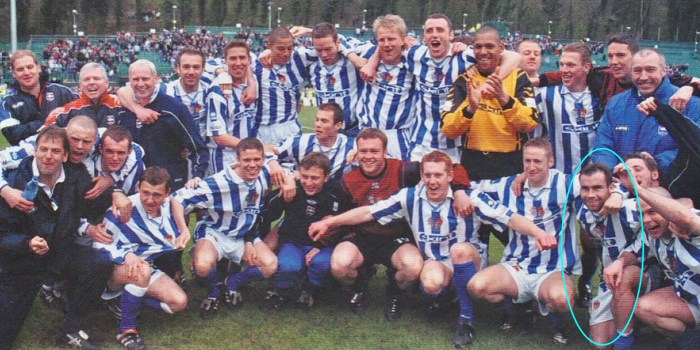
Then in the following season, Crosby was at the heart of the defence when Albion won the league. “That win down at Plymouth and the home game against Chesterfield where we sealed the Championship will stay with me forever,” he said. “It was just an amazing ride.”

Crosby continued: “We had this great spirit, a team desperate to do really well.

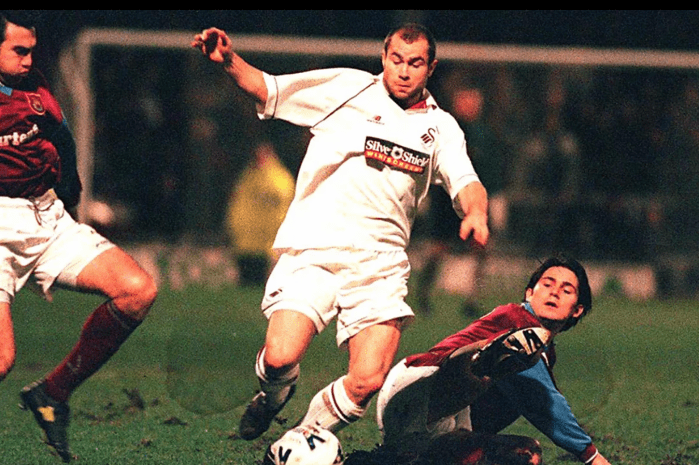
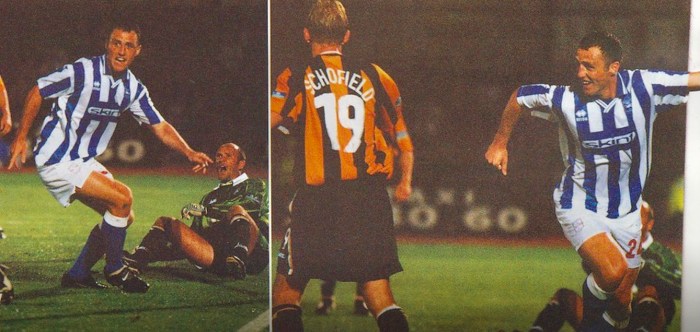
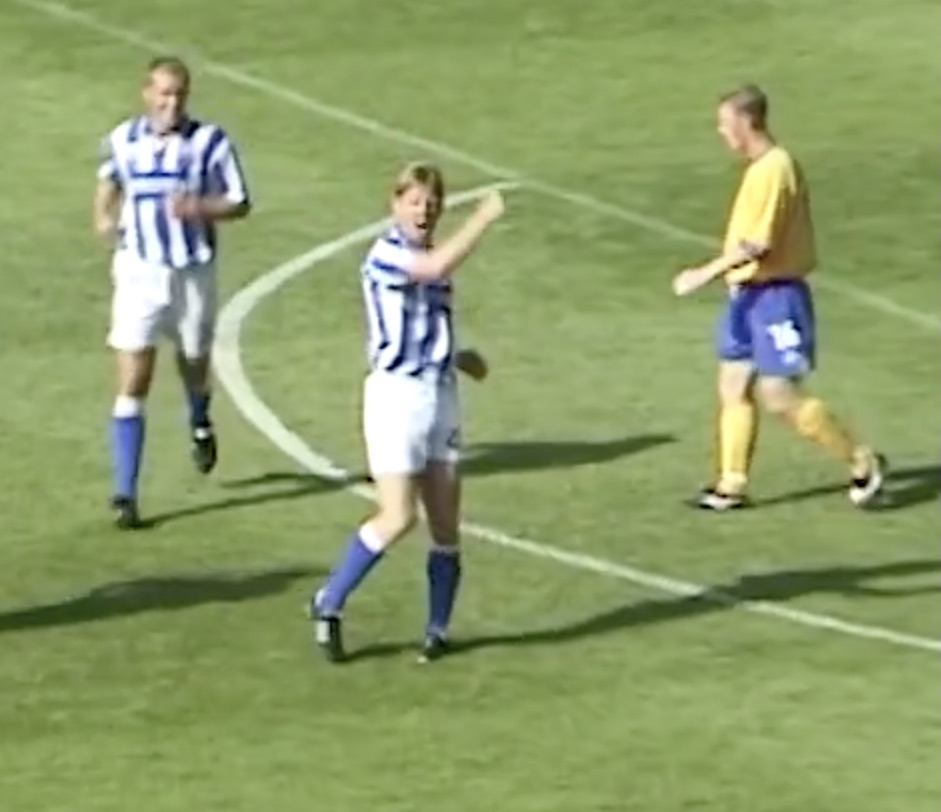
Pouncing to score and celebrate against future employer Hull City

“I’ve got nothing but good memories of the place. It was the first time I’d ever been involved in a promotion campaign as a player. For the first time in my life, I was seeing on a day-to-day basis what it takes to be successful.

“We played some great football and the fans were fantastic. I’ve said it before but if you can’t play for them you can’t play for anyone.”

He added: “Withdean was a funny place but somehow we were able to use it to our advantage. Other clubs didn’t like playing there.”

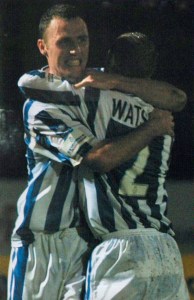
Getting to grips with Paul Watson

Once elevated to the higher level, Crosby lost his starting place to Simon Morgan and Adams’ successor Peter Taylor continued with Cullip and Morgan as his preferred centre-back pairing.

By then 28, Crosby didn’t fancy a watching brief and in December 2001 he moved on a free transfer to Oxford, the first United signing made by Ian Atkins. He said: “I didn’t want to go, and Peter said he wanted me to stay, but I wanted to play. Going to Oxford meant first team football.”

Although Crosby’s first half season with Oxford saw them struggle near the foot of the division, the 2002-03 campaign ended with them only a point off the play-off places and the central defender scored winning goals in four of the 53 matches he played.

It got better for him on a personal level the next season when his fellow pros named him in the 2003-04 PFA team of the year, but United missed out on the play-offs by three points.

Another string to Crosby’s bow at Oxford was being an accomplished penalty taker. He never missed a spot kick in normal play and, in 2003-04, one of the five he buried was at Scunthorpe’s Glanford Park.

In the summer of 2004, he declined a new contract believed to have been on worse terms than the previous one and chose to move back to the north to join Scunny.

Nonetheless, the Oxford Mail said of him: “The 31-year-old centre back has been a model of consistency in his time at the Kassam Stadium.

“Ideally suited to the Third Division with his uncompromising, no-nonsense style, the hard-tackling defender, who is also good in the air, was also greatly respected by his teammates for his cool professionalism.”

He may have started out in the basement division with Scunthorpe, but what followed was the stuff of dreams. Crosby himself later admitted: “When I joined, if someone had told me I’d be playing for Scunthorpe in the Championship, I would have called them a doctor.

“But it reaffirms your belief in football a little bit, especially when you’re involved first-hand, to see a club of Scunthorpe’s size still being able to pull off what was nothing short of a minor miracle.”

In an interview with the Scunny website, Crosby pointed out: “I was 31 when I arrived at Scunthorpe and I had to use my knowledge and experience in whatever capacity I could, and set standards on and off the pitch. It was something I enjoyed doing and I think it’s something that’s either in you or it’s not.

“My whole time at Scunthorpe was great and I never thought when I signed that we’d get to the Championship twice. It was fantastic and the highlight of my career without a shadow of a doubt.

“I was captain of a promotion-winning team from League One to the Championship, playing at some massive stadiums.”

Although knee injury issues limited him to nine appearances in the 2008-09 season, he was restored to the side for the play-offs and led Scunny to a 3-2 League One play-off final win over Millwall at Wembley in May 2009 (Matt Sparrow scored twice for Scunny).

“It was a great way to end playing,” he admitted. “I have some fantastic memories and look back at my time at the club with nothing but fondness.”

By then he had already been working as assistant manager to Nigel Adkins, the former Iron physio and after playing a total of 715 games for six league clubs he was also Adkins’ assistant manager at Southampton, Reading, Sheffield United, Hull City and Tranmere Rovers.

Crosby, who took over from Adkins as manager of League Two Tranmere in February 2025, said “I’ve got a fantastic relationship with Nigel. He’s been fantastic for me, changed me as a person and polished off a few of the rough edges. I’ve got nothing but great words to say about him.”

Into the manager’s chair

In an interview with tribalfootball.com, he said: “My coaching journey has been full of learning experiences, and I’m a much better coach now than when I started. I was fortunate to work with some fantastic players.

“My best experience was at Southampton, where we achieved back-to-back promotions from League One to the Premier League, working with incredible players like Lallana, Lambert, and Schneiderlin. Even the difficult moments teach you a lot, though. Results didn’t always go our way, but even then, those experiences helped me grow as a coach.”

Crosby also saw the development of the likes of Alex Oxlade-Chamberlain, James Ward-Prowse and Luke Shaw during nearly two and a half years at Southampton. While at Bramall Lane, he also worked with future England internationals Aaron Ramsdale and Dominic Calvert-Lewin.

Even at Hull, he had the fortune to work with Fikayo Tomori, on loan from Chelsea, and Jarrod Bowen.

Born in Rotherham on 3 March 1973, miner’s son Crosby was raised in the village of Maltby. He supported the Millers as a youngster but was rejected by them as a player when he was 11. At 14, though, he was taken on at Leeds.

When he didn’t progress beyond the youth team at Elland Road, former Leeds captain and manager Billy Bremner took him on at Doncaster Rovers and gave him his league debut aged 18.

He played 60 times for Donny over a couple of seasons (and spent a month on loan at Conference side Halifax) before moving to the north east and spending five years at Darlington, notching up a total of 211 appearances.

He was captain of the losing side in the 1996 Third Division play-off final at Wembley when Jim Platt’s Darlo lost by a single goal to Neil Warnock’s Plymouth Argyle.

Off-field financial issues marred his time at Chester City in the 1998-99 season, so his move to Brighton was a welcome change.

Reflecting on that time with the Seagulls, he said: “In any walk of life, if you get a really good group together, recruit well and get good characters in who complement each other well, then you should succeed. A lot of that was down to Micky.

“It was the fittest I’ve ever been – that was down to him – but that work and organisation brought its reward which is something I’ve taken with me into my own coaching career.”

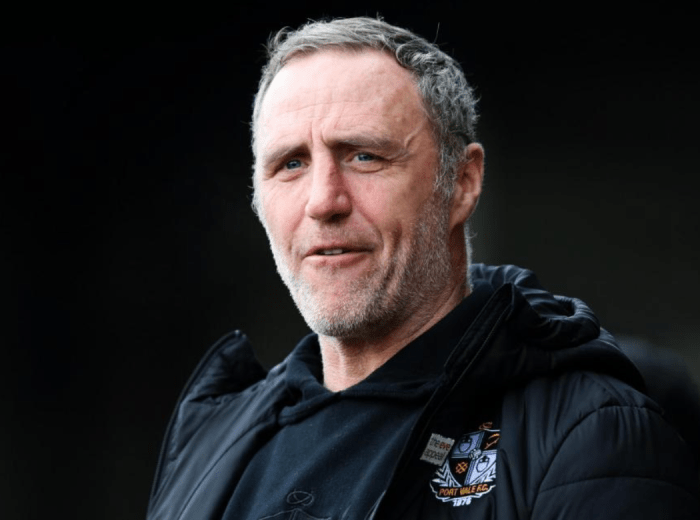
Before his current (August 2025) position at Prenton Park, he also coached the Northern Ireland under 21 international side and spent three years coaching and managing at Port Vale.

Utility man Jamie Campbell a magnet for frustration

JAMIE CAMPBELL played in the top flight for Luton Town and later filled the left-back berth in the opening months of the season when Albion returned to Brighton after two years in exile at Gillingham.

However, by the time Albion won promotion from the fourth tier in May 2000, Campbell was on the outside looking in, Kerry Mayo having taken his place, and he was given a free transfer halfway through his two-year contract.

Campbell had been one of numerous new arrivals brought in by Micky Adams ahead of the 1999-2000 season having been given a free transfer by newly promoted Cambridge United where he had only missed one match in two years.

Although Albion famously beat Mansfield Town 6-0 in the season opener at the Withdean Stadium, subsequent form had some pondering whether it had been a flash in the pan.

Campbell, the only ever-present defender after eight games (three wins, two draws, three defeats), reassured supporters when he told the Argus: “At Cambridge we had some terrible hiccups at the start of the season. It was a new team, the same as Micky has put together here, and it does take time to gel.

“It’s early days yet. There are a lot of points to be played for and it’s a long old season. It’s far too early to start panicking. Let’s give it until Christmas, see where we are, and take it from there.”

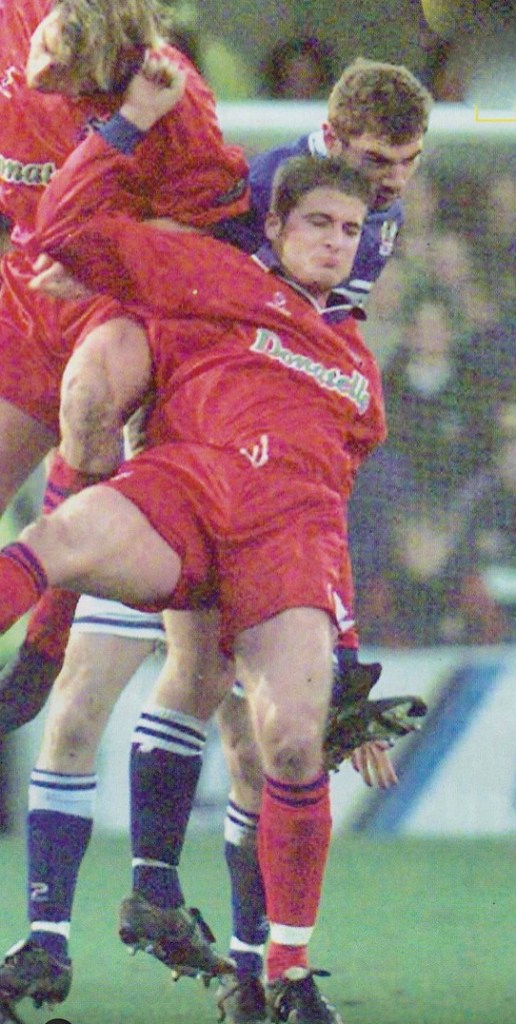
In truth, there were few highlights for Campbell to enjoy in his time with the Seagulls. He put through his own net in only his fourth league outing, heading past the recalled Mark Walton at Darlington when filling in at centre back, although Gary Hart subsequently levelled it up.

He did score (left) in the right end to bag the only goal of the game in a Withdean win over Hartlepool on 6 November 1999, but the following month, when Albion were up against it with several players injured, ill or suspended, Campbell got himself sent off after only 25 minutes in a 2-0 defeat at Swansea City prompting Adams to drop him and relegate him to the reserves.

Campbell was shown the red card by Premiership referee Dermot Gallagher after twice sliding in recklessly on Jason Price in the space of just over a minute. He was Albion’s sixth player to be suspended that season.

“Campbell’s stupidity couldn’t have come at a worse time as a flu-ravaged squad had a hard enough task against the eventual Division Three champions without having to play for over an hour with 10 men,” recalled wearebrighton.com.

Campbell clears from Orient’s Martin Ling

Boss Adams, who had already fined Darren Freeman for a red card at Plymouth, told the Argus: “The boy will be disciplined. They’ve got to learn. In wet conditions like that, good defenders stay on their feet, it’s as simple as that.

“Obviously it’s a worry because with small squads in the third division you can’t afford too many sendings-off.”

Having lost his place, things then got worse for Campbell in February of the new century when he had to undergo a hernia operation, dashing any hopes he might have had of winning back a starting place. With Mayo and new arrival Nathan Jones vying for the left back spot, Campbell became surplus to requirements.

He moved on to Exeter City where he was almost ever-present in the 2000-01 season under Noel Blake and was named the Grecians’ player of the year.

Not long into his first season at St James’s Park, he was interviewed by the local paper and compared the situation at City to his experience with Brighton, because Blake, like his former Leeds teammate Adams, had assembled a new squad of players.

“You’ve got to quickly get to know everyone’s strengths and weaknesses so you can gel as a team,” he said. “He (Blake) has got standards and he wants people to believe in them.

“The boss runs things very professionally, he thrives on running the club like a First Division or even a Premiership club.

“And the good thing with the boss is that he admits he is still learning and his door is always free for us to knock on.”

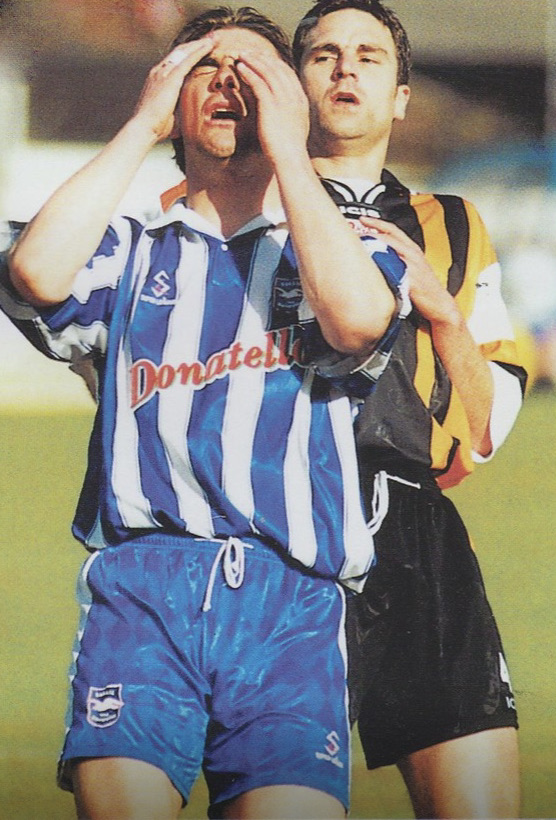
On his return to the Withdean in the red and white stripes of Exeter three days before Christmas 2000 (above), Campbell’s penchant for own goals once again came to the fore when he deflected a Gary Hart effort that was going wide past the City ‘keeper to contribute to a 2-0 win for the Seagulls.

Not long into the 2001-02 season, Blake was replaced by former City player John Cornforth and, although Campbell played 20 games for the Grecians that season, he switched to Conference side Stevenage Borough in March 2002, where he linked up with former Albion players Simon Wormull and Andy Arnott.

The website boroguide.co.uk seems to be singularly underwhelmed by the Wayne Turner signing declaring: “It was perhaps indicative of the poor form that we found ourselves in that Campbell was often a beacon of mediocrity.

“In defence or midfield, the utility player often had little impact; frustration becoming a buzz word when describing JC’s performances.

“So, it was only natural therefore, that he ended up at Woking. Like many other former Boro’ players who didn’t live up to expectations, all roads lead to Kingfield.”

That move took place in February 2003, and he moved on again a year later, to Havant & Waterlooville where he stayed until July 2005, when he retired from playing.

Born in Birmingham on 21 October 1972, he was a trainee at Luton before signing professional in July 1991. He broke through under David Pleat in the 1991-92 season when Town were relegated from the top flight after 10 seasons at that level.

Young Hatter Campbell

 Campbell made four starts plus nine appearances off the bench as the Hatters lost their place amongst the elite. Pleat’s squad also included a young Kurt Nogan and combative midfielder Chris Kamara.

On other occasions Campbell was part of Town line-ups that included one-game Albion loanee goalkeeper Juergen Sommer and Arsenal loanee striker Paul Dickov. The excellent Hatters Heritage website said of him: “Jamie was regarded as a utility man at Kenilworth Road with his versatility meaning that he was used mainly as a substitute, which sadly ensured that he could never claim a permanent position in the Hatters side.” Somewhat ignominiously, the fans podcast We Are Luton Town named the defender in their worst-ever Hatters XI.

When he found first team opportunities were limited at Kenilworth Road, Campbell went on loan to Mansfield Town and Cambridge United and left Luton in July 1995 to sign for Barnet.

During two seasons at Underhill, Campbell featured in 67 league matches (and scored five goals) before moving back to Cambridge on a permanent basis in August 1997.

While playing for the Us, Campbell put the ball in the wrong net but ended up on the winning side in a memorable second round second leg League Cup match in 1998.

Roy McFarland’s basement league United side knocked out Premier League Sheffield Wednesday 2-1 on aggregate, having nicked a 1-0 win at Hillsborough in the first leg.

Campbell for Cambridge tries to block a cross by Albion’s Paul Armstrong

Fan Matt Ramsay recalled: “Jamie Campbell’s freak headed 20-yard own goal summarised the cruel nature the sport can possess as it handed the big guns the initiative.

“Yet just as supporters began to embrace the familiar underdog emotion of consoling each other with the knowledge that at least it was a valiant effort, the magic moment arrived.

“Just as football is cruel when it goes against you, the success brings delirium. As Trevor Benjamin thumped home a right wing freekick to put United back into the lead, and as the final whistle fifteen minutes later heralded a major cup upset, there was proof that there is reward for the eternal hope that all fans of all clubs require.”

Andy Arnott’s United dream dashed by injury

A PLAYER who was on the brink of signing for Man Utd for £100,000 ended up playing for the Albion in exile.

But for an untimely hernia injury, Andy Arnott would have been an Alex Ferguson signing at Old Trafford.

As it turned out, the moment passed and the opportunity didn’t arise again. He later made 28 appearances for the Seagulls during the 1998-99 season when home games were played at Gillingham’s Priestfield Stadium.

It was a ground Arnott was familiar with. Born in nearby Chatham on 18 October 1973, he joined Gillingham as a trainee and had only served one year of his apprenticeship when he was taken on as a professional.

Manager Damien Richardson gave him his debut for the Fourth Division club only four games into the 1991-92 season when he was just 17.

It couldn’t have gone better because he scored the Gills’ opening goal in a 2-0 home win over Scarborough.

This was a Gillingham side that included summer signing Paul Clark, who had been part of Alan Mullery’s successful Brighton side in the late 1970s, and Mike Trusson, who’d won promotion from the Third Division with the Seagulls under Barry Lloyd. A young Richard Carpenter was also breaking through.

Arnott scored three goals in 23 appearances by the season’s end although one goal and two appearances against Aldershot were later expunged from the records because the Shots were expelled from the league.

Nonetheless, the youngster’s emergence hadn’t gone unnoticed higher up the football pyramid and the offer of the chance to join United came along, ostensibly so that he could feature in their youth team’s involvement in the end-of-season Blue Star youth tournament in Zurich.

This was the era of the famous ‘Class of 92’ and Arnott found himself playing alongside David Beckham, Paul Scholes and Nicky Butt.

“After impressing during his spell with United, Ferguson made a £100,000 offer to Gillingham which was turned down by the then manager Damien Richardson,” Albion’s matchday programme noted.

In action for Gillingham against Albion’s Nicky Bissett

The player then suffered a hernia injury that put him out of the game for a year, putting paid to any further interest from United.

“I was gutted at the time, but it was a case of just getting on with returning to fitness and playing football,” Arnott said.

Back at Gillingham, he played 50 matches and scored 12 goals but then, in January 1996, got a £15,000 move to Leyton Orient. He spent a season and a half with the Os under manager Pat Holland and played in every position to help out the team, including goalkeeper in one emergency.

Arnott played under Micky Adams at Fulham

In the summer of 1997, after Fulham’s promotion from Division Three under Micky Adams, Arnott moved to Craven Cottage for an undisclosed fee (thought to be £25,000).

Within a few months, Mohammed Al Fayed took over the club and sacked Adams.

“All of a sudden Fulham went from being an ordinary Second Division outfit to a multi-million pound club,” he said. “I felt sorry for Micky as he had done a fantastic job, but he did foresee what was coming and sorted out long term contracts for most of the players.”

The new management duo of Ray Wilkins and Kevin Keegan brought in their own players and Arnott found himself confined to the reserves with the likes of Mark Walton, winger Paul Brooker, and forward Darren Freeman.

He scored twice for Fulham Reserves in a 3-0 win over Albion’s reserve side on 21 October 1998, and that persuaded Brian Horton to take him on.

“A few clubs had shown an interest around that time, but Brighton were the first that I spoke to and I liked what I was hearing so I signed straight away,” he said.

Horton signed him by the end of the same month for £10,000, plus another appearance-related £10,000, and said in the matchday programme he was “absolutely tremendous” on his debut. It came in a 1-0 win in pouring rain at Barnet when Charlton loanee defender Emeka Ifejagwa scored the only goal of the game on his debut. “He (Arnott) and Jeff Minton forged a good partnership and I am looking for that to flourish,” said Horton.

In his player-by-player commentary of performances, programme columnist Paul Camillin said: “Brilliant debut. He showed a good array of passing skills and he might have the bite we’ve been lacking.”

It was the wrong kind of bite he displayed in only his fourth game, though, when he was shown a red card in the 55th minute of Albion’s 2-0 win at Horton’s old club Hull City.

Defender Ross Johnson also went for an early bath for a second bookable offence but Albion’s nine men hung on for 35 minutes to complete their fourth successive away League win: the best such run for 62 years!

There’s little doubt Arnott’s arrival coincided with an upturn in the side’s form and in the matchday programme he took time to praise Albion’s loyal followers. “It is a fantastic advantage to have the number of away supporters we do,” he said. “It makes you want to play that little bit more to give them something back. They are absolutely magnificent.”

Arnott and Jamie Moralee

In the absence of Gary Hobson and Ian Culverhouse, Arnott was given the captain’s armband although that discipline was a bit questionable at times. He saw red for a second time, after Jeff Wood had taken over from Horton, for a second bookable offence at home to his old club Orient – Os captain Dean Smith (manager of relegation-threatened Leicester) also went for a second yellow – although Wood and Orient boss Tommy Taylor both slammed referee Rob Styles for his officiating.

Man of the Match

Wood declared: “Too many officials want to stamp their authority on the game early and flash cards like they are going out of fashion.”

Although Arnott saw out the season in the starting line-up, when his old boss Adams took over from Wood, by the time the new season got under way back in Brighton, Adams had signed Paul Rogers and Charlie Oatway as his preferred midfield pair.

By the end of September, Arnott had been snapped up by Second Division Colchester United; initially on loan and then permanently when their new boss Steve Whitton completed a direct swap that saw Warren Aspinall join the Seagulls.

However, Arnott made only four starts plus eight appearances off the bench in that first season and his time with United was blighted by a long-standing groin injury.

“The whole thing has been an absolute nightmare. I have been struggling with the injury for 14 months and despite loads of rest, two operations and four cortisone injections, the problem is as bad as ever,” he told Colchester’s Daily Gazette in January 2001.

“I was really struggling just before Christmas and I visited the specialist who told me I’m pretty near to exhausting my options.

“When it’s at its worst the injury is unbearable, especially when I turn or attempt to hit a long ball.

“I’m still only 27 with what should be many years left in the game.”

Unfortunately, though, he was forced to call time on his professional playing career and dropped into non-league initially with then-Conference side Stevenage, then Dover Athletic, where he was captain, Welling United and Ashford Town.

After his playing days were over, he settled in Rochester and became a project manager for Dryspace Structures while retaining his football links as a coach for Ebbsfleet United’s under 16 team.

Confrontation was seldom far away in Micky Adams’ career

THE FIRST player ever to be sent off in a Premier League game managed Brighton twice.

Fiery Micky Adams saw red playing for Southampton when he decked England international midfielder Ray Wilkins.

“People asked me why I did it. I said I didn’t like him, but I didn’t really know him,” Adams recalls in his autobiography, My Life in Football (Biteback Publishing, 2017).

It was only the second game of the 1992-93 season and Adams was dismissed as Saints lost 3-1 at Queens Park Rangers.

Adams blamed the fact boss Ian Branfoot had played him in midfield that day, where he was never comfortable.

“He (Wilkins) was probably running rings around me. I turned around and thumped him. I was fined two weeks’ wages and hit with a three-match ban.”

It wasn’t the only time he would have cause not to like Wilkins either. The former Chelsea, Manchester United and England midfielder replaced Adams as boss of Fulham when Mohammed Al-Fayed took over.

His previously harmonious relationship with Ray’s younger brother, Dean, turned frosty too. When Adams first took charge at the Albion, he considered youth team boss Dean “one of my best mates”. But the two fell out when Seagulls chairman Dick Knight decided to bring Adams back to the club in 2008 to replace Wilkins, who’d taken over from Mark McGhee as manager.

“He thought I had stitched him up,” said Adams. “I told him that I wanted him to stay. We talked it through and, at the end of the meeting, we seemed to have agreed on the way forward.

“I thought I’d reassured him enough for him to believe he should stay on. But he declined the invitation. He obviously wasn’t happy and attacked me verbally. I did have to remind him about the hypocrisy of a member of the Wilkins family having a dig at me, particularly when his older brother had taken my first job at Fulham.

“We don’t speak now which is a regret because he was a good mate and one of the few people I felt I could talk to and confide in.”

With the benefit of hindsight, Adams also regretted returning to manage the Seagulls a second time considering his stock among Brighton supporters had been high having led them to promotion from the fourth tier in 2001. The side that won promotion to the second tier in 2002 was also regarded as Adams’ team, even though he had left for Leicester City by the time the Albion went up under Peter Taylor.

Adams first took charge of the Seagulls when home games were still being played at Gillingham’s Priestfield Stadium.  Jeff Wood’s short reign was brought to an end after he’d failed to galvanise the side following Brian Horton’s decision to quit to return to the north. Horton took over at Port Vale, where Adams himself would subsequently become manager for two separate stints.

Back in 1999, though, Adams had been at Nottingham Forest before accepting Knight’s offer to take charge of the Albion. He’d originally gone to Nottingham to work as no.2 to Dave Bassett but Ron Atkinson had been brought in to replace Bassett and Adams was switched to reserve team manager.

The Albion job gave him the opportunity to return to front line management, a role he had enjoyed at Fulham and Brentford before regime changes had brought about his departure from both clubs.

On taking the Albion reins, Adams said: “For too long now this club has, for one reason and another, had major problems. The one thing that has remained positive is the faith the supporters have shown in their club.

“The club has to turn around eventually and I want to be the man that helps to turn it around.”

The man who appointed him, Knight, said: “Micky is a formidable character with a proven track record. He knows what it takes to get a club promoted from this division. But, more than that, Micky shares our vision of the future and wants to be part of it. That is why I have offered him a four-year contract and he has agreed to that commitment.”

Not long after taking over the Albion hotseat, he was happy to say goodbye to the stadium he’d previously known as home when a Gillingham player in the ‘80s and it was a revamped squad he assembled for the Albion’s return to Brighton, albeit within the confines of the restricted capacity Withdean Stadium.

Darren Freeman and Aidan Newhouse, two players who’d played for Adams at Fulham, scored five of the six goals that buried Mansfield Town in the new season opener at the ‘Theatre of Trees’.

Considering he was only too happy to be photographed supporting the campaign to build the new stadium at Falmer, it’s disappointing to read in his autobiography what he really thought about it.

“My mates and I nicknamed it ‘Falmer – my arse’ although I never said this to Dick’s face,” he said. “There was always so much talk and we never felt like it was going to get done.”

The turning point in his first full season in charge was the arrival of Bobby Zamora on loan from Bristol Rovers. “The first time I saw him he came onto the training ground; he looked like a kid. But he was tall and gangly with a useful left foot; there was potential there.”

Interestingly, considering Adams makes a point of saying he usually ignored directors who tried to get involved on the playing side, he took up Knight’s suggestion that the side should switch to a 4-4-2 formation – and the Albion promptly won 7-1 at Chester with Zamora scoring a hat-trick!

After a so-so first season back in Brighton, not long into the next season Adams was forced to replace his no.2, Alan Cork, with Bob Booker because Cork was offered the manager’s job at Cardiff City, at the time owned by his former Wimbledon chairman, Sam Hammam. Adams reckoned Booker’s appointment was one of the best decisions he ever made.

Surrounded by players who had served him well at Fulham and Brentford, together with the additions of Zamora, Michel Kuipers and Paul Rogers, Adams and Booker steered Albion to promotion as champions. Zamora was player of the season and he and Danny Cullip were named in the PFA divisional XI.

Not long into the new season, the lure of taking over as manager at a Premier League club saw Adams quit Brighton, initially to become Bassett’s no.2 at Leicester City, but with the promise of succeeding him.

“While I thought I had a shot at another promotion, it wasn’t a certainty,” Adams explained. “I knew I had put together a team of winners, and I knew I had a goalscorer in Bobby Zamora, but football’s fickle finger of fate could have disrupted that at any time.”

He admitted in the autobiography: “Had I been in charge at the age of 55, rather than 40, then I perhaps would have taken a different decision.”

While Albion enjoyed promotion under Taylor, what followed at Leicester for Adams was a lot more than he’d bargained for and, to his dismay, he is still associated with the ugly shenanigans surrounding the club’s mid-season trip to La Manga, to which he devotes a whole chapter of his book, aiming to set the record straight.

On the pitch, he experienced relegation and promotion with the Foxes and he doesn’t hold back from lashing out about ‘moaner’ Martin Keown, “one of the worst signings of my career”. Eventually, he’d had enough, and walked away from the club with 18 months left on his contract.

After a break in the Dordogne area of France, staying with at his sister-in-law and her husband’s vineyard, he looked for a way back into the game. He was interviewed for the job of managing MK Dons but was put off by a Brighton-style new-ground-in-the-future scenario. Then Peter Reid, a former Southampton teammate, was sacked by Coventry City. He put his name forward and took charge of a Championship side full of experienced players like Steve Staunton and Tim Sherwood.

The side’s fortunes were further boosted by the arrival of Dennis Wise, but, in an all-too-familiar scenario Adams had encountered elsewhere, the chairman who appointed him (Mike McGinnity) was replaced by Geoffrey Robinson. It wasn’t long before it was obvious the relationship was only going to end one way. As Adams tells it, Robinson was influenced by lifelong Sky Blues fan Richard Keys, the TV presenter, and it was pretty much on his say-so that Adams became an ex-City manager after two years in the job.

With an ex-wife and three children to support as well as his partner Claire, Adams couldn’t afford to be out of work for long and fortunately his next opportunity came courtesy of Geraint Williams, boss of newly promoted Colchester United, who took him on as his no.2.

However, it only got to the turn of the year before he was out of work once again, although, from what he describes, he wasn’t enjoying his time with the U’s anyway because Williams kept him at arm’s length when it came to tactics and team selection.

He was amongst the ranks of the unemployed once again when Albion chairman Knight gave him a call, but, with the benefit of hindsight, he said: “Going back turned out to be one of the biggest mistakes of my life.”

Adams blamed the backdrop of “the power struggle” between Knight and Tony Bloom on the lack of success during his second stint in the hotseat, and he reckons it was Bloom who “demanded my head on a platter”. The fateful meeting with Knight, when a parting of the ways was agreed, famously took place in the Little Chef on the A23 near Hickstead.

Looking back, Adams conceded he bowed to pressure from Knight to make certain signings – namely Jim McNulty, Jason Jarrett and Craig Davies in January 2009 – who didn’t work out. He reflected: “I shouldn’t have taken the job in the first place. I’d let my heart rule my head but, in fairness, I didn’t have any other offers coming through and it seemed like a good idea at the time.

“I wouldn’t ever say he (Knight) let me down, but he had his idea about players. I did listen to him, and maybe that’s where I went wrong.”

He added: “Going back to a club where success had been achieved before felt good, yet, the second time around, the same spark wasn’t there no matter how hard I tried.”

Born in Sheffield on 8 November 1961, Micky was the second son of four children. It might be argued his penchant for lashing out could have stemmed from seeing his father hitting his mother, which he chose to spoke about at his father’s funeral. Adams is obviously not sure if he did the right thing but he felt the record should be straight.

The Adams family were always Blades rather than Wednesdayites and, at 15, young Micky was in the youth set-up at Bramall Lane having made progress with Sunday league side Hackenthorpe Throstles.

While he thought he had done well under youth coach John Short during (former Brighton player) Jimmy Sirrel’s reign as first team manager, Sirrel’s successor, Harry Haslam, replaced Short and, not long afterwards, Adams was released.

However, Short moved to Gillingham and invited the young left winger to join the Gills. Adams linked up with a group of promising youngsters that included Steve Bruce.

In September 1979, he had a call-up to John Cartwright’s England Youth side, going on as a sub in a 1-1 draw with West Germany, and starting on the left wing away to Poland (0-1), Hungary (0-2) and Czechoslovakia (1-2) alongside the likes of Colin Pates, Paul Allen, Gary Mabbutt, Paul Walsh and Terry Gibson.

Adams honed his craft under the tutelage of a tough Northern Irishman Bill ‘Buster’ Collins and began to catch the attention of first team manager Gerry Summers and his assistant Alan Hodgkinson, who had played 675 games in goal for Sheffield United.

He made his debut aged just 17 against Rotherham United but didn’t properly break through until Summers and Hodgkinson were replaced by Keith Peacock (remember him, he was the first ever substitute in English football, in 1965, when he went on for Charlton Athletic against John Napier’s Bolton Wanderers) and Paul Taylor.

“Keith saw me as a full-back and that was probably the turning point of my career,” Adams recalled.

Once Adams and Bruce became regulars for the Gills, scouts from bigger clubs began to circle and at one point it looked like Spurs were about to sign Adams. That was until he came up against the aforementioned Peter Taylor, who was playing on the wing for Orient at the time (having previously played for Crystal Palace, Spurs and England).

“He nutmegged me three times in front of the main stand and, to cut a long story short, that was the end of that. Gillingham never heard from Spurs again,” Adams remembered.

Even so, Adams did get a move to play in the top division when Bobby Gould signed him for Coventry City. Managerial upheaval didn’t help his cause at Highfield Road and when John Sillett preferred Greg Downs at left-back, Adams dropped down a division to sign for Billy Bremner’s Leeds United (pictured below right with the legendary Scot).

“He had such a big influence on my career and life that I wouldn’t have swapped it for the world,” said Adams. But life at Elland Road changed with the arrival of Howard Wilkinson, and Adams found himself carpeted by the new boss after admitting punching physio Alan Sutton for making what an injured Adams considered an unreasonable demand to perform an exercise routine even though he was in plaster at the time.

Nevertheless, Adams admits he learned a great deal in terms of coaching from Wilkinson, especially when an improvement in results came about through repetitive fine-tuning on the training pitch.

“It is the one aspect of coaching that is extremely effective, if delivered properly,” said Adams. “I learnt this from Howard and took this lesson with me throughout my coaching and managerial career.”

However, Adams didn’t fit into Wilkinson’s plans for Leeds and he was transferred to Southampton, managed by former Aston Villa, Saints and Northern Ireland international Chris Nicholl. Adams joined Saints in the same week as Neil ‘Razor’ Ruddock and the pair were quickly summoned by Nicholl to explain the large size of the hotel bills they racked up.

Adams moved his family from Wakefield to Warsash and he went on to enjoy what he reflected on as “the best few years of my playing career”. He was at the club when a young Alan Shearer marked his debut by scoring a hat-trick and the “biggest fish in the pond at the Dell” was Jimmy Case.

Adams described the appointment of Branfoot in place of the sacked Nicholl as a watershed moment in his own career. “Overall he was decent to me and I found his methods good,” he said. And he pointed out: “I was getting older, I’d started my coaching badges and I already had one eye on my future.”

Adams recalled an incident during a two-week residential course at Lilleshall, after he had just completed his coaching badge, when he dislocated his shoulder trying to kick Neil Smillie.

“I was left-back and he was right-wing, and he took the piss out of me for 15 minutes. The fuse came out and I decided to boot him up in the air,” Adams recounted. “The only problem was that I missed. I fell over and managed to dislocate my shoulder hitting the ground. It was the worst pain I’ve ever had.”

If life was sweet at Southampton under Branfoot, that all changed when he was replaced by Alan Ball and the returning Lawrie McMenemy. Adams and other older players were left out of the side. Simon Charlton and Francis Benali were preferred at left-back. Eventually Adams went on a month’s loan to Stoke City, at the time managed by former Saints striker Joe Jordan, assisted by Asa Hartford.

On his return to Southampton, and by then 33, Adams was given a free transfer.

Former boss Branfoot came to his rescue, inviting him to move to League Two Fulham as a player-coach in charge of the reserve team. Branfoot also signed Alan Cork and he and Adams began a longstanding friendship that manifested itself in becoming a management pair at various clubs.

On the pitch, Branfoot struggled to galvanise Fulham and, with the team second from bottom of the league, he was sacked – and Adams replaced him. He kept Fulham up by improving fitness levels and introducing more of a passing game.

But he knew big changes were needed if they were going to improve and he gave free transfers to 17 players, despite clashing with Jimmy Hill, who had different ideas.

An admirer of what Tony Pulis was doing at Gillingham, Adams signed three of their players: Paul Watson, Richard Carpenter and Darren Freeman. He also got in goalkeeper Mark Walton and centre back Danny Cullip. Simon Morgan was one of the few who wasn’t let go, and Paul Brooker emerged as a skilful winger. All would later play under him at Brighton.

Promotion was secured and Adams was named divisional Manager of the Year but after all the celebrations had died down Mohamed Al-Fayed bought the club and things changed dramatically.

“The club was in a state of flux as it tried desperately to come to terms with its new status as a billionaire’s plaything,” Adams acerbically observed. “From having nothing, we had everything.”

Before too long, in spite of being given a new five-year contract, Adams was out of the Craven Cottage door, replaced by Wilkins and Kevin Keegan.

But he wasn’t out of work for long because Branfoot’s former deputy, Len Walker, introduced him to the chairman of Swansea City, who were on the brink of relieving Jan Molby of his duties as manager.

Various promises were made regarding funds that would be made available to him but when they were not forthcoming he realised something was not right and he quit, leaving Cork, the deputy he’d taken with him, to take over.

By his own admission, if he hadn’t been sitting on the £140,000 pay-off he’d received from Fulham, he probably would have stayed. As it was, he was out of work once again…..until he had a ‘phone call from David Webb, the former Chelsea and Southampton defender who was the owner of Brentford, but in the process of trying to sell the club.

His brief was to keep the side in the league and to make it attractive to potential purchasers. It was at Griffin Park that he first met up with the aforementioned Bob Booker, who was managing the under 18s at the time. “He is one of the most loyal and trustworthy friends I have ever known,” said Adams. “He would do anything for you.”

However, although he signed the likes of Cullip and Watson from Fulham, he wasn’t able to stop the Bees from being relegated. During the close season, former Palace chairman Ron Noades bought the club and announced he was also taking over as manager.

Once again, Adams was out of a job but his next step saw him appointed as no.2 to Dave Bassett at Nottingham Forest.

Which brings us almost full circle in the Adams career story, but not quite.

After the debacle of his second stint in charge of Brighton, he was twice manager at Port Vale, each spell straddling what turned out to be a disastrous period in charge of his family’s favourite club, Sheffield United.

It was Adams who gave a league debut to Harry Maguire during his time at Bramall Lane, but the side were relegated from the Championship on his watch, and he was sacked.

Adams took charge of 249 games as Vale boss but quit after a run of six defeats saying he’d fallen out of love with the game.

It didn’t prevent him having another go at it, though. He went to bottom of the league Tranmere Rovers and admitted in his book: “It was arrogance to think I could turn round a club that had been relegated twice in two seasons.”

In short, he couldn’t and he ended up leaving two games before the end of what was their third successive relegation.

“It was a really poor end to a career that had started so promisingly at Fulham,” he said.

The strange tale of Lorenzo Pinamonte, a gentleman of Verona

IF CASH-STRAPPED Brighton hadn’t been outbid by Brentford for a little-known Italian striker in the opening months of the 21st century, a teenage forward who went on to earn a place in the club’s history might never have appeared in an Albion shirt.

‘If only’, ‘but’ and ‘maybe’ preface many a football fan’s dashed hopes but in the case of Lorenzo Pinamonte, it seems the Gods were smiling on the Seagulls.

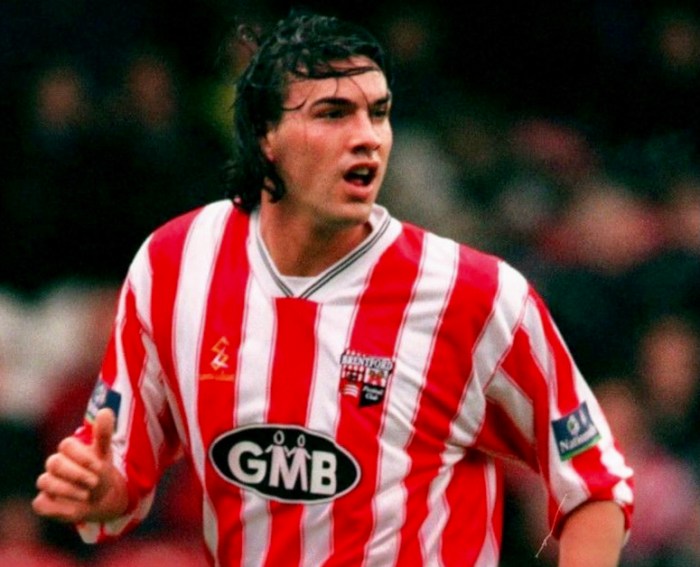
The imposing Italian scored only three goals in 26 appearances for the Bees after their £75,000 gazumped Albion’s bid to take him permanently from Bristol City.

Thankfully Brighton’s fortunes were vastly improved by the chap they signed instead: a raw reserve at City’s neighbours Rovers called Bobby Zamora!

Let’s go back to the last month of the 20th century. After a spectacular start to life back in Brighton following the two-year exile playing home games at Gillingham – including an opening day 6-0 crushing of Mansfield Town – mid-table Albion were struggling to find the back of the net with any consistency.

Twice-red-carded striker Darren Freeman missed multiple games through suspension, former soldier David Cameron struggled to cut it at leading the line, and former England Youth international Aidan Newhouse didn’t live up to Micky Adams’ expectations either.

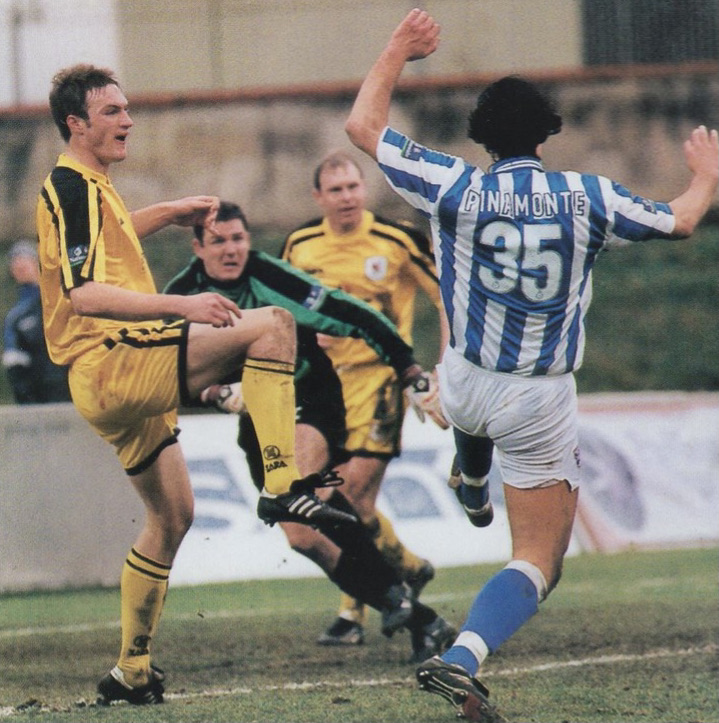
That’s when Adams turned to the first Italian to represent the Albion, 22-year-old 6’3” Pinamonte, who was struggling to get a game under Tony Pulis, then boss of the relegated Robins (they’d dropped down to the third tier the season before).

He made his debut for ‘flu-hit Albion away to Swansea City on a rainy night at the Vetch Field, only meeting his teammates for the first time when being picked up en route to Wales for the game.

“Pinamonte led the line as a lone striker,” recalled wearebrighton.com. “A thankless task was made even harder when the Albion were reduced to 10 men following a red card for Jamie Campbell with only 25 minutes played.”

While makeshift Albion lost 2-0 to the Swans, their run of defeats was halted courtesy of a 1-1 Boxing Day draw at home to Barnet and a last game of the century 3-1 win at Rotherham. The 3 January match at home to Exeter City not only famously saw Freeman score the first football league goal of the 21st century, it also featured a brace from the lanky loan signing as Albion won 4-2.

It seems Adams had seen enough to want to make Pinamonte’s move permanent, but matters became complicated when Pulis decided to quit the Robins and take over at Portsmouth.

Because the departing manager’s successor may have had a different view of the striker, he signed on loan for a second month, rather than permanently, Adams telling the Argus: “We are pleased to keep Lorenzo for another month. The situation at Bristol won’t be resolved for a few weeks, so a permanent deal is up in the air.”

The same article declared that Pinamonte wanted to join Albion permanently but the bid put in by chairman Dick Knight was below the asking price, and Brentford, a division above Albion at the time, had also made an offer.

Pinamonte unsurprisingly felt in limbo and confessed to being distracted when he played in a 1-0 defeat against Leyton Orient.

“In your mind you wonder what is happening, whether you are going to stay or go, so there was a little bit of confusion.

“That probably affected me. I was thinking about it, and perhaps not concentrating,” he said. “I think I have done well so far, but not in that game.”

Cover boy Lorenzo

The turn round in form took the Seagulls to within five points of a play-off place but Pinamonte’s head was turned by the chance to play at a higher level and Brentford eventually got their man.

Offered a lucrative three-and-a-half-year contract at Griffin Park, Pinamonte admitted to the Argus: “I am a little bit upset to be leaving and I would love to come back in the future. I wanted to stay but for my future it is better to leave. Money talks and I will be playing in a higher division.”

A disappointed Adams admitted he would have to look elsewhere for a big, hold-up striker. “We thought Dave Cameron would come in and be that big centre forward and Aidan Newhouse also. Unfortunately Dave prefers the ball into his body and feet so he can jink and turn.

“Big Lorenzo came in and gave us that other option. Gary Hart and Darren Freeman gambled off him. Now that he has gone, to get the best out of them and the other forwards at the club, we may need to bring another big man in.”

Adams later told Greville Waterman, one of the voices of authority on all things Brentford: “We were going through an indifferent spell and struggling for a big centre forward. David Cameron wasn’t up to it and we had been outbid by Brentford for Lorenzo Pinamonte, so I called Ian Holloway at Bristol Rovers who told me: ‘I have got a young lad who’s been on loan at Bath City. He’s only 19 and as raw as anything, but he has scored a few goals for them.’

“I was not totally convinced but we were desperate and the clincher was when Ian told me he was only earning £140 per week, so I said ‘send him down,’ and the rest is history!”

For his part, Pinamonte reflected some years later that his time at Brighton probably just came too early in his life. “Maybe if I had gone when I was 25 or 26 it would have been different for me,” he told Brian Owen of the Argus in 2016. “I enjoyed England but it probably came too early for me. I was there alone and I was very young.”

Pinamonte’s time at Brentford certainly divided opinion. ‘Smilely’ on griffinpark.org described him as “Lorenzo Pinthetailonthedonkey” but ‘Saffrey’ on the same platform said: “I think he’s been unlucky with (Ron) Noades as he was never really given a chance, as Uncle Ron brought in that donkey Steve ‘Murray’ Jones, when he should have given Pinamonte, who had recently joined the club, a decent run out.”

The Bees lured Pinamonte from Albion’s grasp – thankfully

‘Chalfont Bees’ reckoned: “All I’ve seen of Lorenzo is him getting booked or worse. He just doesn’t seem to be good enough at the moment and I can’t see him improving. I say cut our losses and get rid of him so as to give other strikers a chance.”

And ‘Holysmith’ opined: “Although Pinamonte hasn’t done much, he has a good strike rate for the amount of time he has played for Brentford. The problem is he doesn’t move about much.”

In the 2000-01 season, Pinamonte went out on a mid-season loan to Leyton Orient and at the season’s end he was released by Steve Coppell.

As he explained in that 2016 interview with Brian Owen, he then returned to Italy and spent eight years playing in the Italian third division until retiring as a pro at the age of 31.

Born on 9 May 1978, a gentleman of Verona (Caprino Veronese to be precise), the young Pinamonte was with southern Italy side Foggia before trying his luck in England. He joined Bristol City on a free transfer in the 1997-98 season.

In City’s disastrous 1998-99 season, when they were relegated from Division One (now the Championship) in bottom place, Pinamonte celebrated his 21st birthday by scoring the only goal of the game on his debut as Norwich City were beaten at Ashton Gate in the last fixture of the campaign.

With their fate already sealed and with an eye to the following season, Swedish manager Benny Lennartsson, who had won only five of the 30 games he’d taken charge of, chose to blood a few youngsters and handed Pinamonte his debut up front alongside £1.2m signing Ade Akinbiyi.

Five minutes before half time, the City faithful finally had a moment to cheer, as Bristol Evening Post reporter Richard Latham recorded. “Akinbiyi, made captain for the day against the club who launched his career, headed down a Micky Bell corner and Pinamonte stuck out a long right leg to find the top corner of the net from close range.”

Lennartsson was relieved of his duties at the end of the season and two months later he was replaced by former Gillingham boss Pulis, who sent the young Italian striker on a fruitless loan at Carlisle United (he didn’t play a game) before answering Brighton’s call for reinforcements.

Off the field, Albion’s matchday programme informed us how Pinamonte was staying at the Courtlands Hotel in Hove during his temporary stay where the manager was Italian Jo Guiseppe-Messina, and he had also enjoyed the hospitality of Angelo Cavalli, the owner of Topolino Duo restaurant in Hove.

Apart from scrapbook memories of his time with the Albion, Pinamonte continued his friendship with Cavalli; the restaurateur had been to visit him at the hotel at Lake Garda that he ran after his professional playing days were over.

Teenage prodigy Newhouse quit game to teach maths

AIDAN NEWHOUSE scored twice on his Albion debut but only started two games for the Seagulls!

The former Fulham striker netted two of Brighton’s six goals in the 1999-2000 season opening match at the Withdean Stadium.

He replaced hat-trick man Darren Freeman with the Albion 4-0 up on 7 August 1999 and promptly added two more goals to complete a 6-0 rout of Mansfield Town (pictures below).

Newhouse, wearing the no.25 later worn iconically by Bobby Zamora, was given a start in a 2-0 league cup defeat away to Torquay United. Although he regularly went on as a substitute, often for Freeman, he only began one other game: a 1-0 home league win over Cheltenham Town.

Newhouse had limited opportunities in Albion colours

Newhouse had previously played under manager Micky Adams at Fulham in 1997, and, unluckily for him, Freeman and Gary Hart were the first choice forward choices in those opening months.

Competition for places intensified in the autumn with the arrival of Warren Aspinall and Lorenzo Pinamonte. Newhouse was swiftly on his way to Conference club Sutton United.

When they were relegated at the end of the season, he switched to Northwich Victoria in 2001, but only played one match before quitting and becoming a schoolteacher.

Born in the Wirral town of Wallasey on 23 May 1972, Newhouse showed so much early promise that he made his debut for Chester City before his 16th birthday.

He was just 15 years and 350 days old when he was sent on as a substitute by manager Harry McNally on the final day of the 1987–88 season as Chester won away at Bury 1–0 in the Third Division.

The talented teenager was in David Burnside’s 1988-89 England side for the UEFA Under-18 Championship preliminary matches against Greece (home and away), France and Czechoslovakia, scoring in the 3-0 win away to Greece on 8 March 1989. He played up front with Andrew Cole, later of Manchester United and Newcastle United fame.

The following season he went on as a sub for Cole in a 0-0 draw with Denmark at Wembley; a game which was played at Wembley before the England-Brazil full international. Three weeks later he scored England’s third when he started in a 3-0 win over Poland, another game played before a full international (England v Denmark).

In July the same year, he started all three of England’s matches (a draw and two defeats) when they finished fourth in the UEFA Under-18 Championship in Hungary.

Chester cashed in on their young prodigy, selling him to then First Division Wimbledon for £100,000 in February 1990.

First team opportunities for Wimbledon were few and far between for Newhouse and he is in the same exalted company as former Albion loanee Gary Bull in being one of only four players to have scored on their single Premier League appearance.

Wimbledon scorer

Ironically, it came in a match in 1992-93 against Aston Villa best remembered for Dalian Atkinson’s individual goal that won the BBC’s Goal of the Season award. “It was deflected past the goalkeeper,” Newhouse told premierleague.com. “It was a bit of a low-life goal compared to Dalian Atkinson’s.”

It was Bobby Gould who gave him his Wimbledon debut but a stomach injury halted his progress under Gould’s successor Ray Harford, as well as the form of John Fashanu and Terry Gibson.

In a 1990-91 season matchday programme article, Newhouse said: “I was really looking forward to this season. Bobby Gould had given me a taste of first team action and I felt I was ready to really stake a claim for a place.

“Then I picked up the injury and it took me months even to get back into full training let alone playing well.”

Although he was a Wimbledon player for seven years, he went out on loan on four occasions: to Tranmere Rovers, Port Vale, Portsmouth and Torquay United. He eventually left permanently for Fulham in 1997.

He scored four goals in only 12 league and cup matches for Fulham: three in a two-legged League Cup match against Wycombe Wanderers and one in the league in a 2-0 win away to Bristol City on 2 September 1997 (Richard Carpenter scored the other). But, only a few weeks’ later, Adams was controversially replaced by Ray Wilkins and Kevin Keegan under the new Mohammed Al-Fayed regime.

Scoring for Fulham

Before long, Newhouse was on his way too. A £30,000 fee took him to Swansea City although, by the time he had arrived, Adams’ short tenure as boss was already over, his role filled by his former no.2 Alan Cork.

It’s probably an understatement to say things didn’t work out for Newhouse in South Wales. Indeed, in a FourFourTwo magazine poll inviting supporters to name their club’s worst player, Newhouse earned the tag from Swansea fans.

He failed to score in 17 appearances across two seasons and Steven Carroll, of the SOS Fanzine, cited a particular game in February 1999, when Carlisle visited the Vetch Field, to back up the claim.

“Due to injuries and suspensions, Newhouse was awarded a rare start. Early on, he was put through on goal and fouled by the ‘keeper inside the box – but while the referee looked set to award a penalty, with said goalkeeper on the floor and both Newhouse/the ball free, our hapless striker shot from close range and missed an open goal. No penalty.

“In the second half, Stuart Roberts received the ball on the edge on the box and was about to shoot, only for Newhouse to kick him in the back of the leg. He never played again after that.”

After retiring from the game in 2001, Newhouse became a maths teacher and he told premierleague.com: “Not all of us are Stevie G and the likes of Neymar,” he said. “I played 13 years, made about £250 a week on average.

“It shows you that, you know, we can do all sorts of things and eventually, to do a job that you enjoy, you will need some education. You will need that to give you an option and a choice.

“Teaching…it’s one of those things. It’s like football, there’s a camaraderie between you and the class.

“Once the guys realise they’re part of a team, there are some similarities. You can have a laugh with the lads and they realise you are there to try and help them succeed.”