
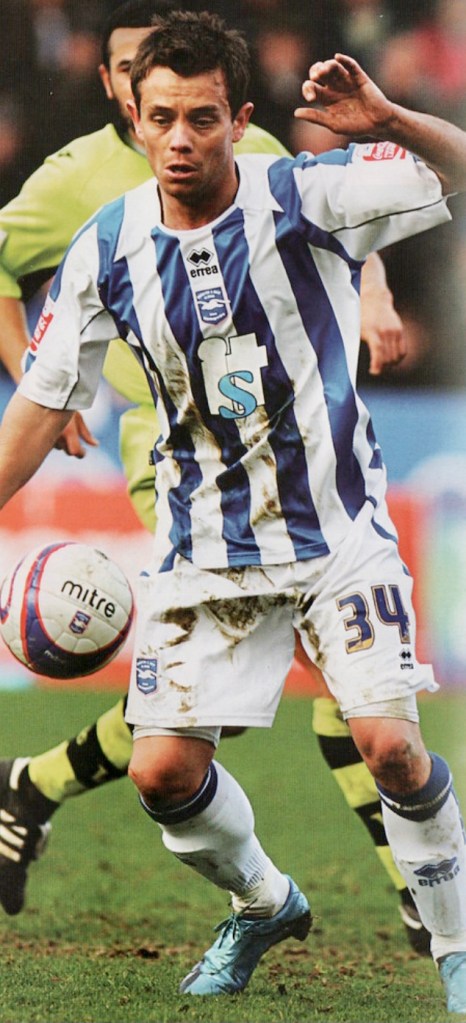
SKY SPORTS pundit Lee Hendrie has reached heights and plumbed depths in a life that saw him stop off at third-tier Brighton in 2010 after 17 years with Aston Villa.
Hendrie was something of a forgotten man of football when Gus Poyet snapped him up for the Seagulls on loan from Derby County in March 2010.
Hendrie featured in eight Albion games in the last six weeks of the season: four wins, two draws and two defeats.
Turning out in League One was quite a fall for a player Glenn Hoddle selected for England, but he told the matchday programme: “The main thing is to play football. If you’re not playing then you tend to get forgotten but hopefully I can get some game time between now and the end of the season.”

And he later said to football.co.uk: “I went to Brighton to get my face back out there. Gus Poyet was brilliant. He got the lads together in a circle and said, ‘******* hell, we’ve got Lee Hendrie here’. Let me tell you, after feeling so unwanted I suddenly felt 10 feet tall.”
Hendrie made his debut as a 75th minute substitute for Sebastien Carole in a 3-0 home win over Tranmere Rovers, and he told the matchday programme: “We could have had more than three goals and I should have scored.”
But Hendrie was bubbling after his involvement and said: “Listening to the gaffer in the changing room, you can see why the lads are playing with a lot of confidence and have improved so much.
“I’ve played under a few managers, but not many, can I say, are like Gus, who is so enthusiastic and tells the players to go and enjoy themselves. There is nothing a player wants more than a gaffer telling you to enjoy your game.”
Of Albion’s midfield triumvirate of Gary Dicker, Alan Navarro and Andrew Crofts, it tended to be Dicker who was edged out by Hendrie’s arrival.

However it was in Crofts’ place that the loanee got his first start, in a 2-0 Easter Monday defeat at Hartlepool in which former Albion loanee ‘keeper Scott Flinders prevented the visitors from leaving with a point. Hendrie was subbed off on 58 minutes when Kazenga LuaLua took over.
Hendrie went on as a sub for Dicker in the following home game against Carlisle United and it was his cross that set up what looked like a late equaliser by Tommy Elphick, only for Gary Madine to nick all three points with a second for United two minutes from the end.
Hendrie started in place of Dicker away to Gillingham but gave way to the Irishman in the 79th minute and the game ended 1-1. Hendrie started once again in the 1-0 win away to Southend, but Dicker replaced him on 65 minutes.
Hendrie’s third successive start in place of Dicker came at home to Bristol Rovers, when Albion won 2-1, but once again he didn’t last the 90 minutes as Dicker took over on 74 minutes.
In the penultimate game of the season, away to MK Dons, the game finished goalless although Alex Rae and Diego Arismendi were red carded for brawling. Hendrie started and Dicker replaced him on 58 minutes.
The on-loan midfielder’s only full 90-minute appearance came in the last game of the season when Yeovil were beaten 1-0 at the Withdean Stadium; Elliott Bennett scoring the only goal of the game a minute before half-time.
The chances of a permanent deal for Hendrie looked unlikely with Poyet admitting: “We were very pleased with him and he was pleased to be here. We will wait to see if, when we start putting the squad together, there is a possibility of it happening. It’s not an easy one, because of the wages.”
Born in Solihull on 18 May 1977, football was in Hendrie’s blood: Scottish dad Paul had played for Villa’s arch rivals Birmingham City and he was playing professionally for Portland Timbers at the time his son was born. He later played for Bristol Rovers, Halifax Town and Stockport County.
For someone who became Villa through and through, Hendrie admitted to the Birmingham Mail that he had actually been at city rivals Birmingham’s school of excellence before ‘Big’ Ron Atkinson snapped him up as a teenager.
As well as his dad having played for them, his nan was a City season ticket holder and his uncle also supported them. “Villa didn’t come and scout me at the time and Blues were the first club that did. It was an opportunity for me to get myself into the pro ranks and see what it was all about. Dad said it would be good to go and have a feel for it, which I did.”

But ever since he’d scored two goals in a schools’ cup final victory for his school, Washwood Heath, against Hodge Heath at Villa Park, he had dreamed of playing for Villa.
The dream came closer when Hendrie signed on the dotted line as a 14-year-old at Villa’s Bodymoor Heath training ground, although he remembers his dad tempering his excitement.
“When we came out after I’d signed, I’d got given a load of training clobber and I thought this was it, I’d made it,” he said. “My dad said: ‘Take a step back, you, you ain’t got anywhere yet, this is the start of a long road. Just because you’ve got all the kit it doesn’t mean you’re a professional footballer and an Aston Villa player – relax yourself’.”
Hendrie and his best mate Darren Byfield, who had been strike partners in Erdington Star and Erdington & Saltley district team as kids, developed a reputation as a dynamic duo on and off the pitch, and soon became Atkinson’s ‘teacher’s pets’.
Atkinson converted Hendrie from a centre forward to left winger (even predicting he’s one day play for England in that position) and the duo continued to do well for the Villa youth team.
As it turned out, it was Atkinson’s successor, Brian Little, who ended up giving Hendrie his first team debut – although it was memorable for all the wrong reasons!
It came two days before Christmas in 1995 when he went on as a 33rd minute substitute for Mark Draper away to Queens Park Rangers. He collected a yellow card for kicking the ball away and was red carded in stoppage time; a second booking for an innocuous foul on Rufus Brevett. Into the bargain, Villa lost 1-0.
A devastated Hendrie revealed it was the opposition player-manager, Ray Wilkins, rather than Little, who put a comforting arm round him. “Someone who I’ve seen play football, a legend of the game, to come and console me and say: ‘This is football, welcome to football, these are the ups and downs you’re going to have in your career’.

“He said there’s lot of people who are talking highly of you, you’ve got a big future in the game, kid. As he got up, he tapped my shoulder and said: ‘Keep that up’.”
Few subsequent chances were given to him under Little but, when John Gregory took over, he became more established.
He would go on to make a total of 308 appearances for Villa (243 league and cup starts), scoring 32 goals, with his best performances coming in Gregory’s tenure. He wasn’t quite the same player under Graham Taylor or David O’Leary.
It was on November 18 1998 that he won his one and only England cap, sent on by Glenn Hoddle as a 77th minute substitute for Villa team-mate Paul Merson in a 2-0 win over the Czech Republic at Wembley. Two other Villa teammates, Dion Dublin and Gareth Southgate, were also part of Hoddle’s squad.

Unfortunately for Hendrie, Hoddle was sacked two months later and no subsequent England bosses called on him. “It’s a regret that I didn’t go on and make more of my England career,” he said. “It’s great that I’ve got a cap and it’s something you can’t take away from me, but I hate being classed as a one-cap wonder.”
Hendrie’s days at Villa came to an end in August 2006, his last involvement being from the bench in Martin O’Neill’s first match in charge, a 1-1 Premier League draw at Arsenal on the opening day of the 2006-07 campaign.
While Hendrie, by then 30, was excited about playing for O’Neill, the new boss had other plans and told him he was not part of them.
Initially he joined Stoke City under Tony Pulis on a season-long loan but Bryan Robson at Sheffield United outbid the Potters for his services on a permanent basis, and he signed a three-year deal at Bramall Lane at the start of the 2007-08 season.

Unfortunately, when Robson swiftly parted company with the Blades, Hendrie didn’t see eye to eye with his successor, Kevin Blackwell, who accused the player of being a money-grabber.
“Sheffield United was just the worst thing I could have done,” he told the Claret & Blue podcast.
“Kevin Blackwell was one of the worst managers I have ever, ever been under. He put the nail in the coffin for (my career).”
Blackwell sent him on loan to Leicester City, where he played nine games, and he later went to Blackpool too. United moved him on to Derby County but when he struggled for games there, he joined Brighton.
If the spell at Brighton was a temporary relief from his mounting problems, he revealed in a Guardian interview with Donald McRae that 2010 turned out to be one of the worst years of his life, and he attempted suicide on several occasions.

A property empire he had built up amassed insurmountable debts which even saw his mother’s home repossessed. He lost his own house as well, and it sent him into depression. Divorce and bankruptcy made the situation even worse.
“The football was almost over and my head was gone. I’d been trying to sell property, but the housing market crashed,” he said. “I got to the stage where I just wanted to end it all. I’d hit rock bottom.”
The ups and downs of Hendrie’s colourful life have featured in various media interviews.
The rise and fall tale was charted by the sporting.blog and Hendrie’s spoken about his troubles on Sky Sports, where he later became a pundit.

He was in tears on Harry’s Heroes: Euro Having A Laugh discussing his depression struggles with Vinnie Jones. The BBC radio programme You and Yours highlighted his plight in a March 2013 episode.
On the footballing front, a brief spell at Bradford City was followed by a host of short stopovers at Bandung (2011), Daventry Town (2011), Kidderminster Harriers (2011-12), Chasetown (2012), Redditch United (2012) and Tamworth (2012-13) before he retired as a professional.
He then played for Corby Town (2013), Highgate United (2013), Basford United (2013 – 2015), Montpellier (2016-17), Redditch United (2016), Nuneaton Griff (2019) and Highgate United (2019) on a non-professional basis.
As he tried to find a new purpose in life, alongside his media work, Hendrie set up FootieBugs, a football academy for kids aged from three to 12.

 FOR ALMOST the whole of Championship seasons 2004-05 and 2005-06, Albion manager
  Gary Hart came close to nicking it for the Albion with a volley that struck a post but the points were shared, which was no good for either side.
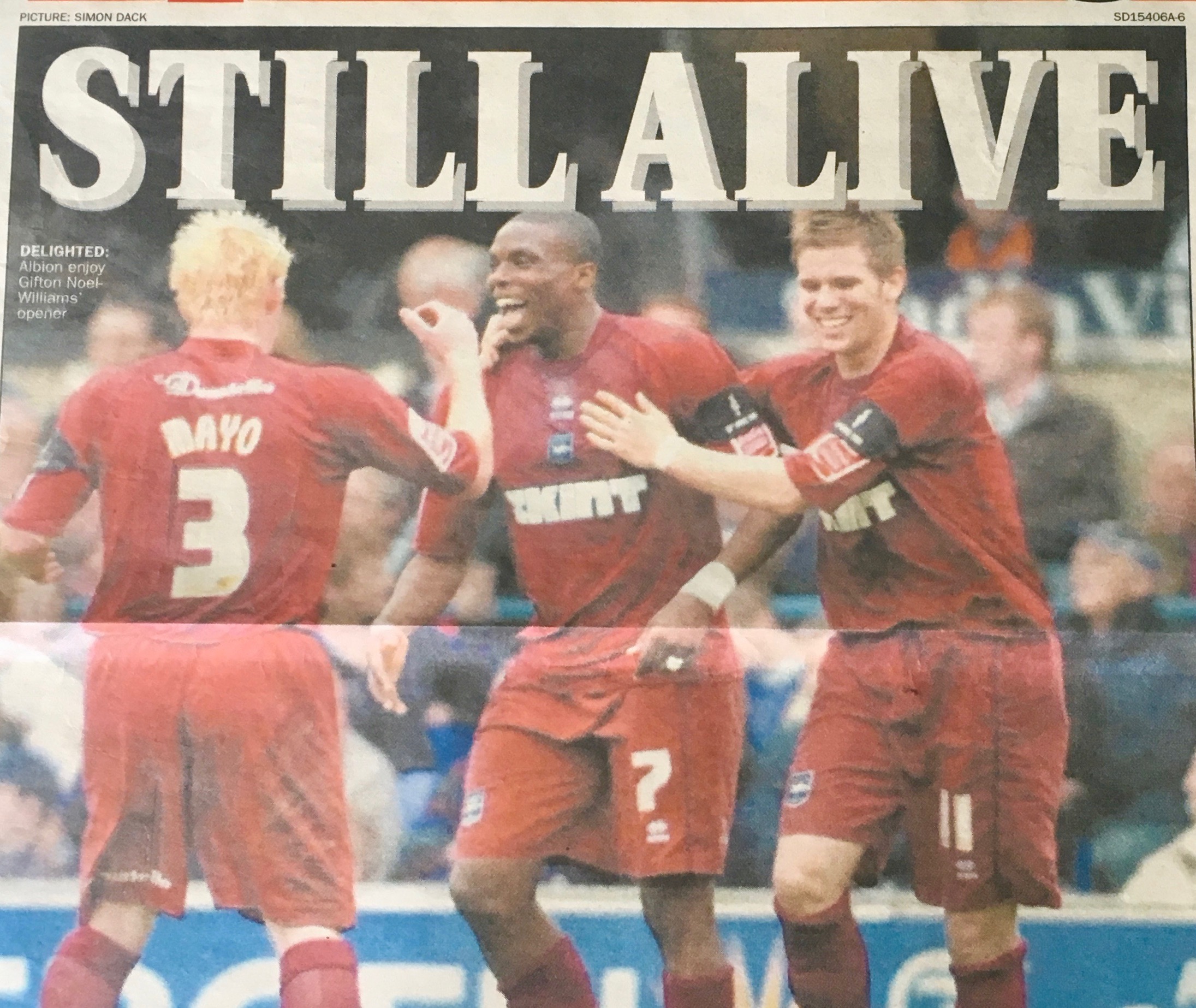 If that delight was not enough, teenage defender
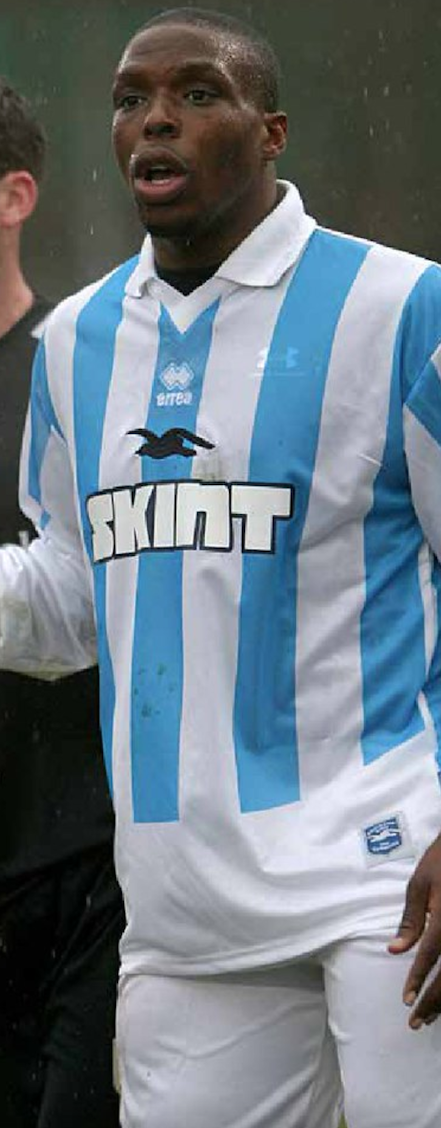
 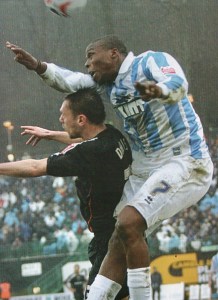 Certainly a fascinating character, Noel-Williams was still only 26 when he pitched up at the Albion, and was already a father of six children.
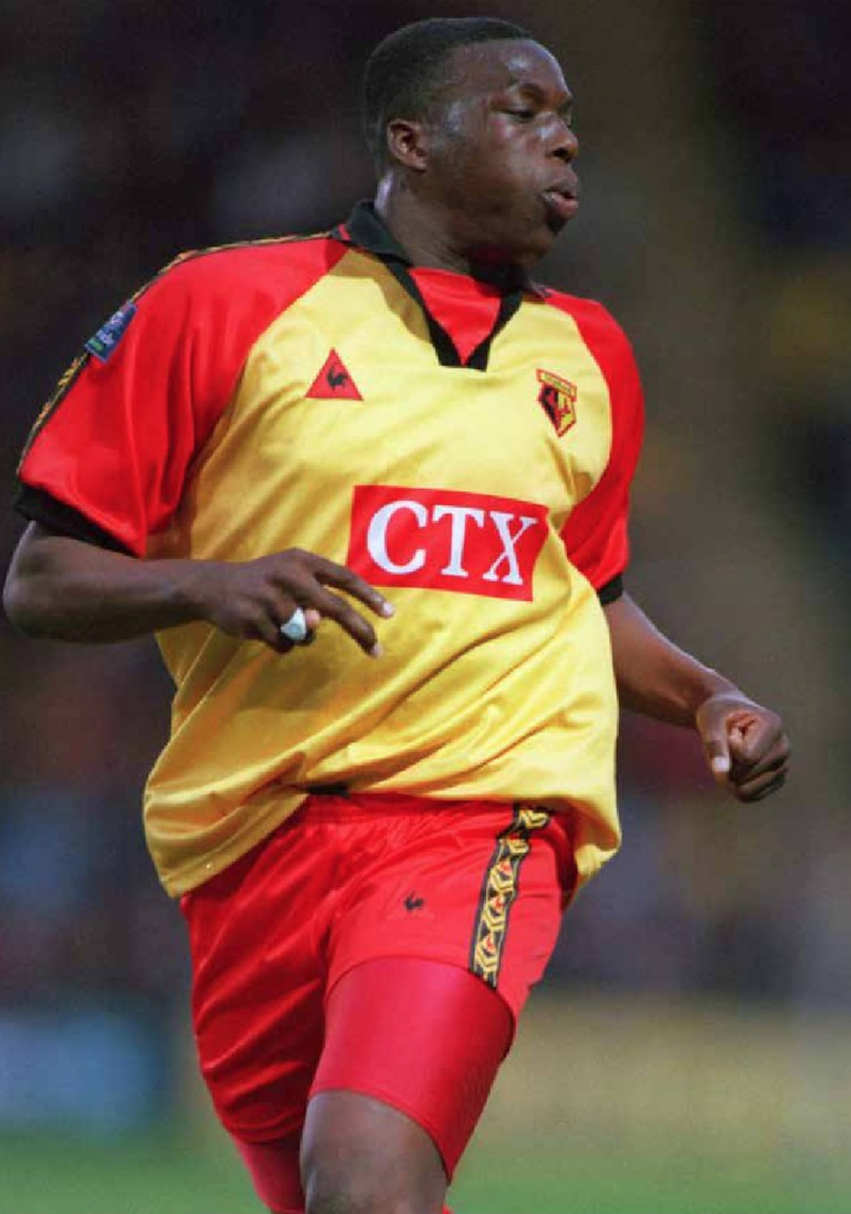 He was told he would have to give up the game, but Watford’s pop icon chairman was living in America at the time and saw an article about a drug that could save his career. He contacted Graham Taylor and they paid for him to get the necessary treatment.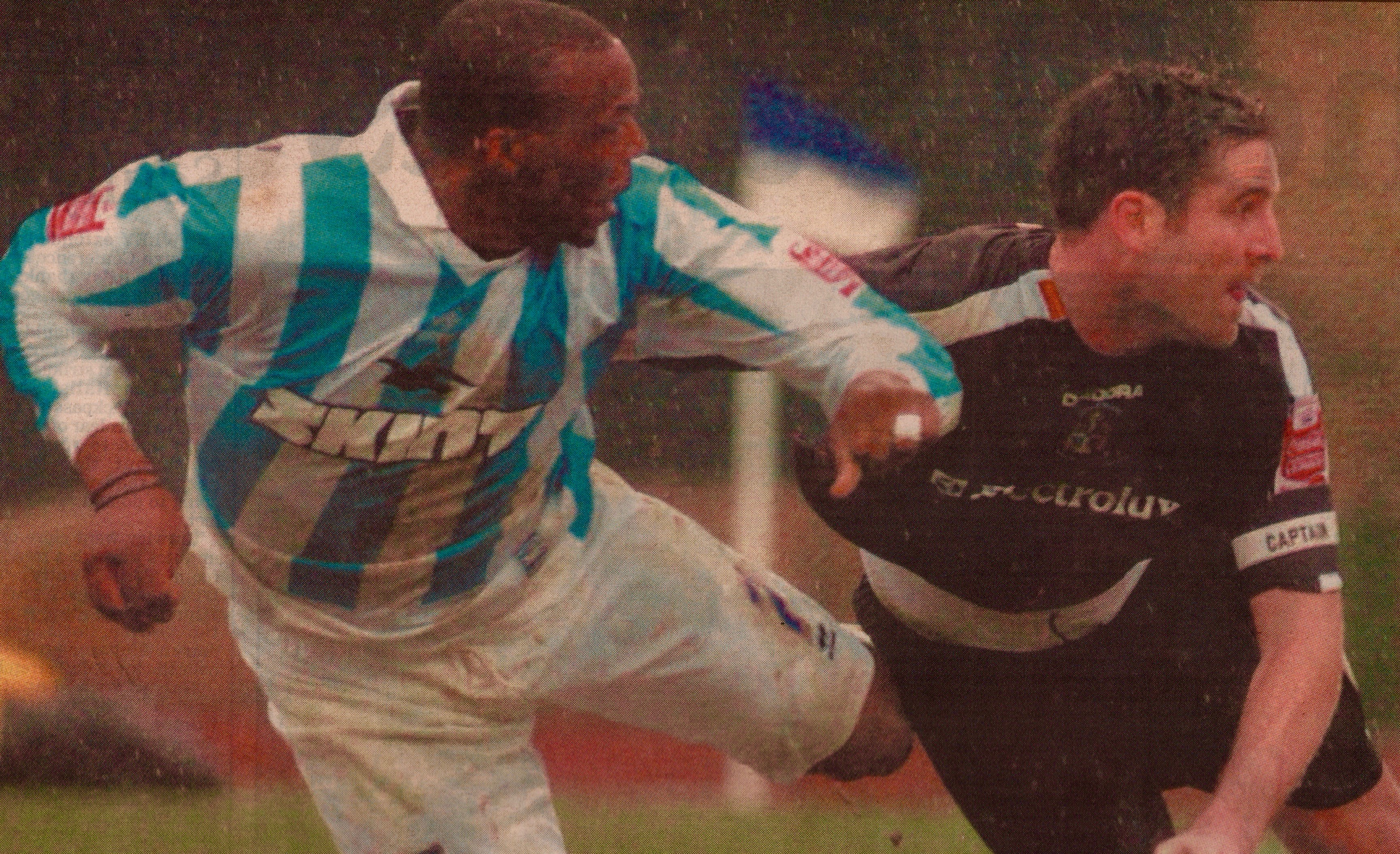
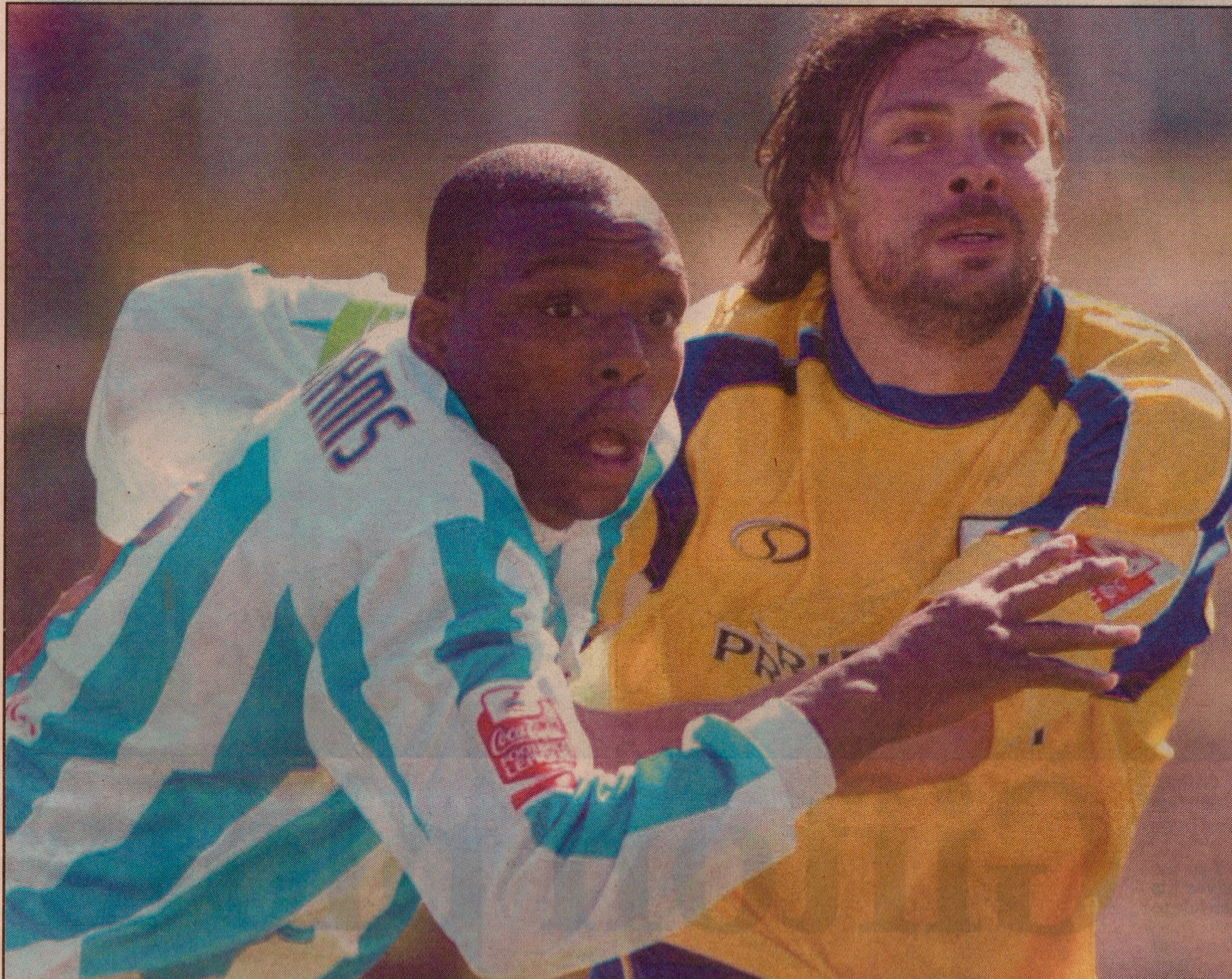

 In parallel lines