

‘I’VE STARTED so I’ll Finnish’ could have summed up Antti Niemi’s season coaching Brighton’s goalkeepers.
Even though the fellow countryman who appointed the former Southampton and Fulham ‘keeper left in ignominy less than halfway through the 2014-15 season, Niemi stuck it out to the end before returning to his native Finland.
Niemi joined Albion in the summer of 2014 as part of the new backroom team put together by former Liverpool and Finland international Sami Hyypia.
“This wasn’t planned and, when Sami called me, I was working in Finland for a few years with two different clubs on a part-time basis,” he told the matchday programme. “It was a surprise.”
Seeing it as a “great opportunity” he added: “I thought about it for a couple of days, but it was not a difficult decision to make in the end. I’m obviously already familiar with the south coast.
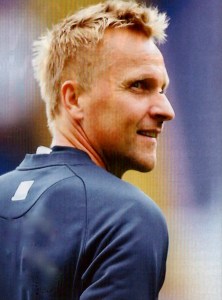
“If you look at the surroundings at the training ground and the stadium, it’s a fantastic place to work each day. I seriously love the job.”
At Brighton, Niemi was responsible for the form of newly-arrived David Stockdale, emerging youngster Christian Walton and back-up ‘keeper Casper Ankergren.
Stockdale admitted it was the presence of Niemi — a former team-mate at Craven Cottage — as goalkeeping coach that was a big reason in his making the move to Sussex (as well as a chat with Bobby Zamora).
“Antti looked after me at Fulham when I first went in as a young keeper,” he said. “I know what he is about, what his training is like and what kind of person he is.”
Niemi was also the reason fellow countryman and Finland international Niki Mäenpää joined the Seagulls, although their paths ultimately didn’t cross on the training ground in Sussex because Niemi decided to return home for family reasons.
Mäenpää had been coached by Niemi back in Finland and he was first linked with the Albion when Hyypia was appointed. Although a move from Dutch second division club VVV-Venlo didn’t go through then, it eventually happened in the summer of 2015.
“Seeing as his contract is ending, he is looking forward to a new adventure and Antti has explained to him about Brighton and everything,” the player’s agent, Richinel Bryson, told The Argus.
Born on 31 May 1972 in Oulu, the northern Finnish city where there is no darkness during summer nights, Niemi remembered going to school when the temperature was –42°C one winter.
He completed compulsory military service in his homeland, explaining in a 2003 interview with The Guardian that he found life tough for much of his 11 months at a sports military school.
“I didn’t realise this at the time but, if I wasn’t in football, I would probably be in the army,” he told reporter Joe Brodkin. “I’m very patriotic. It was fun and it’s something I would have considered, although I’m too old now.
“In some ways it’s similar to what we have in the dressing room: being together and having fun, giving stick and taking stick. In the army it was a similar situation. We had something like 20 footballers in there and it was fun. Not at the time but looking back.”
Niemi began his football journey with local side Oulun Luistinseura before moving on to Rauman Pallo and then to the country’s biggest club, HJK Helsinki, where he eventually became first choice ‘keeper and made 101 appearances over four years.
He then swapped from Finland’s capital to Denmark’s fortuitously because the Finland FA president at the time had played in Denmark as a goalkeeper and FC Copenhagen asked him for a name.
“He mentioned me and everything happened in two days,” Niemi recalled in an interview with fulhamfc.com. “I was inconsistent in my first six months in Denmark but did well in my first full season.
“I learned that Rangers had sent a scout to watch someone on the pitch when we played in a league cup semi-final; it was one of those games where I just saved everything and we won. That 90 minutes made them choose to sign me, so it was all about luck really.”
That was luck he would come to rue, subsequently, though, because he had actually agreed to sign for Gordon Strachan at then Premier League Coventry City. Rangers stepped in at the last minute to clinch his signature in 1997 but it was a period of his career that would prove to be frustrating.
Andy Goram was first choice ‘keeper and Theo Snelders was also ahead of him.
He did win the Scottish League Cup (beating St Johnstone 2-1 in 1998) but he only played in one Old Firm game and that ended in a 5-1 defeat, so he didn’t have happy memories of his time at Ibrox where Walter Smith’s successor, Dick Advocaat, was unconvinced of the Finn’s ability under pressure and suggested he needed to move on to prove himself.

He switched from Glasgow to Edinburgh to join Hearts for £350,000 in December 1999, manager Jim Jefferies telling The Herald: “Niemi is a fine keeper and is very highly regarded by everyone.”
Niemi reflected: “They were the third best team in the country behind Celtic and Rangers, but I said to myself that sometimes you have to take a step backwards to go forward.
“That was maybe the best decision that I ever made; it felt a bit of a downgrade at the time, but I wasn’t playing and I knew it would be good for me in the long run.”
In two-and-a-half years at Hearts, he became first choice and made a name for himself as a penalty stopper.
The keeper said of himself in a 2021 interview with the Edinburgh Evening News: “The biggest strength I had in my game was quick hands and quick reactions.”
Looking back on his 106 appearances for the Jam Tarts, he revealed: “Hearts have always been THE club for me.”
In an interview with CoffeeFriend.co.uk, he said: “Don’t get me wrong. I was very lucky to play in the English Premier League with Southampton and Fulham but there was something romantic about the place.
“I went there from Rangers where I was second or third keeper and suddenly got the chance to be No.1 and be a big part of the team.
“We finished third, had some European football, memorable derbies. I hope it doesn’t sound cocky but I really can’t remember too many games I let the team down.
“I loved my time there and it’s definitely one of those places I miss now and then.”
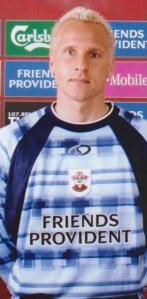
It was Strachan who persuaded Niemi, by then 30, to try his luck in the Premier League at Southampton.
“My decision to move was purely on a football basis,” he said. “I hardly get any more money than I did in Scotland. I was there for five years and for two and half years I was playing regularly. Sometimes I felt I was playing against the same teams and the same players the whole time.”
Saints paid a fee of £2m to secure his services and he made his debut against Charlton Athletic, where he had spent a month on loan before his move to Hearts.
Strachan quickly installed Niemi as his preferred ‘keeper over Paul Jones and at the end of his first season with the Saints he appeared in the FA Cup final against Arsenal at the Millennium Stadium, Cardiff – a game which I watched with my friend Andrew Setten, sitting in front of Geoff Hurst in the best seats in the house!
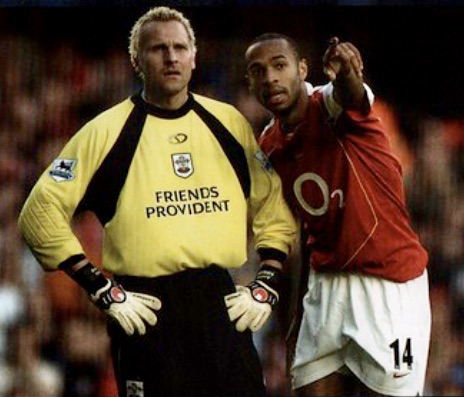
With Arsenal retaining a 1-0 first half lead, Niemi unfortunately tore a calf muscle midway through the second half and, when replaced by Jones, became the first goalkeeper to be substituted in a FA Cup final.
In spite of losing to that solitary goal, Niemi didn’t want to miss the lap of appreciation and took a ride on a team-mate’s shoulders as they trooped around the stadium.
A series of injuries and a couple of operations limited him to 28 Premier League games in each of the next two seasons but in the opinion of goalkeeping coach David Coles (who once played on loan for Brighton), he was among the world’s top five ’keepers and he was the Saints player of the year in 2003-04.
“The Premiership has been every bit as good as I expected and even more,” Niemi said in that Guardian interview. “Everywhere you go it’s a full stadium and the pitches are perfect. It’s a fantastic league.
“I was making some good saves in Scottish football but the spotlight in the Premiership is so much bigger. There are so many cameras and every single game and situation is highlighted, so it’s easier to shine.”
Niemi’s reputation was certainly enhanced after he kept 17 clean sheets in his first two top flight seasons under Strachan at St Mary’s.
But he was also part of the Southampton side that was relegated in 2005, bringing to an end 27 years in English football’s top tier.
“The longer the season went on, the worse the results got and the more it started to affect the dressing room,” he told hampshirelive. “But overall, I can only look into the mirror and blame myself.
“My first two seasons at Saints were great, but during the third one, I just couldn’t get up to that standard any more. It was average at best.”
Niemi saw influential team-mates leave without being properly replaced and he said: “I remember looking around myself at the beginning of the campaign and thinking ‘things here aren’t as well as they should be’. The team had weakened and the contrast was huge.”
After the relegation, Niemi said: “I felt ashamed, simple as. It just felt embarrassing as hell.”
He stayed half a season after Saints playing in the Championship but returned to the Premier League in January 2006 when he moved to Fulham under Chris Coleman.
“Living in London was a big attraction.,” he told fulhamfc.com. “My wife was delighted to get a chance to move to West London and, as I’d played against them many times, I knew that it was a nice club too.”
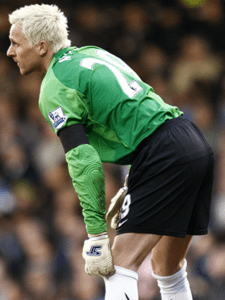
A hamstring injury limited him to nine appearances in those first few months at Craven Cottage but he established himself as first choice the following season and went on to make 63 appearances before a wrist injury led to him calling it a day at the start of the 2008-09 season.
However, at the age of 37, he was persuaded to come out of retirement and followed his former Saints coach Coles to south coast rivals Portsmouth as back-up to first choice David James.
He left Pompey in March 2010 having earned around £450,000 over the course of eight months without having made an appearance, the Daily Mirror reported.
The newspaper said the Finn earned £14,000 a week during his time at Fratton Park and played just twice for the reserves and spent one Premier League match on the subs’ bench.
Having won 67 caps playing in goal for Finland, Niemi became his country’s goalkeeping coach from 2010 as well as working with the Finnish FA in developing the quality of goalkeeper coaching in the country. Alongside those responsibilities, he slotted in club goalkeeper coaching in various locations – including back at his old club HJK Helsinki, at another Finnish side, FC Honka, and the season at Brighton.
Joaquin Gómez, a coach he first met during that season with the Albion, subsequently called on his services at Finnish side HIFK in 2021.
Gómez, originally an academy coach with the Seagulls, stayed on as part of the first team management set-up having worked under Hyypia’s successor, Oscar Garcia., but then left to become head of tactical analysis at Derby County before teaming up with Nathan Jones at Luton Town, and then Stoke City.
In May 2019, on Niemi’s recommendation, he also started coaching Finland’s under 21 team. After leaving Stoke, he was assistant manager at Spanish Second Division side FC Cartagena, assistant coach at Finland’s SJK Seinäjoki and spent a season at Al-Qadsiah in Saudi Arabia.
On persuading Niemi to join him at HIFK, Gómez said: “He’s an outstanding goalkeeping coach and will now also assist me in other areas.
“Antti is the best Finnish goalkeeper of all time, and he has done great work in coaching after his retirement from playing. At HIFK he’ll have a more versatile role than previously, as he’ll be working more with outfield players as well.”
In the summer of 2024, Gómez persuaded Niemi to join him at Greek Super League club Volos and the Finn spoke to Tribalfootball.com about those days spent in Lancing.
“I have seen a lot of passionate people in my lifetime in football but this guy is something else; he has dedicated his life to football.
“He moved from Spain (to England) without knowing any English, he just wanted to work in English football. He was working as a waiter, he was cleaning the toilets at Brighton, he was coaching kids and eventually somebody saw that this guy is really passionate and he can coach so he got in the first team.”
Niemi continued: “He called me in the summer, he said I had a few days to decide. He is very temperamental; he is very passionate and I am the boring, steady guy who always tells him to calm down! You need that sort of personality; you don’t need a similar sort of personality as you need to balance each other out
“He offered me the job to be the assistant manager which is different as I have always been a goalkeeping coach and I still am with the Finnish national team but I took it as a challenge, as an adventure. It is going to be a learning curve for me and I am really enjoying it so far.”
Unfortunately, Gómez was sacked after only five league matches and his next appointment, in January 2025, was as the new coach of Indonesian Liga 1 club Borneo Samarinda.


 The following season, Meade scored a hat-trick in the 3-1 win over Watford, which began Don Howe’s tenure as Arsenal manager, and he also earned a special place in Gunners’ fans hearts when scoring twice (pictured celebrating above with Charlie Nicholas, who also got two) in Arsenal’s 4-2 victory over arch-rivals Spurs on Boxing Day 1983.

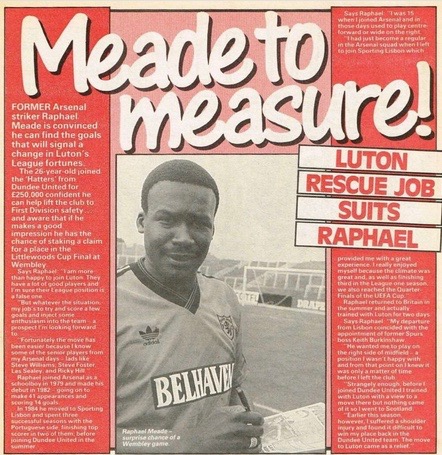 But after only four games for the Hatters he was on his way again, this time to Odense BK in Denmark.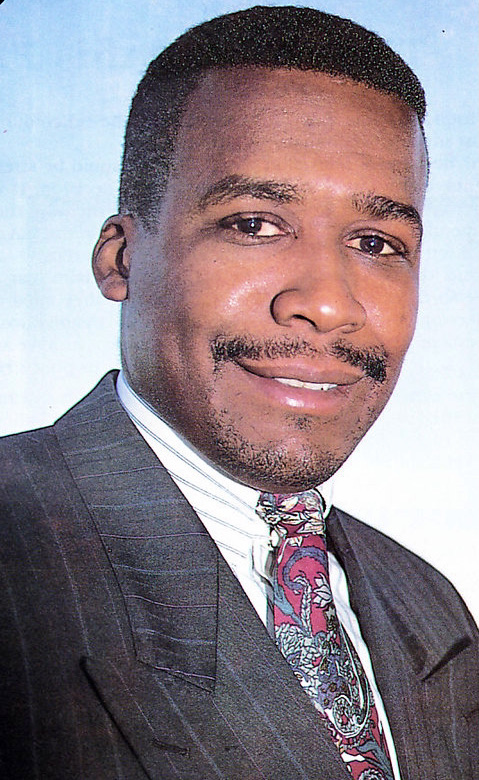




 It was not unusual to see Dublin selected as man of the match and several programmes featured pictures of the obligatory post-match presentation by the sponsor to the nattily-dressed defender. Dublin admitted in another profile piece that clothes and shopping were hobbies.


 In parallel lines