Managerial change had habit of foxing Jason Jarrett’s progress

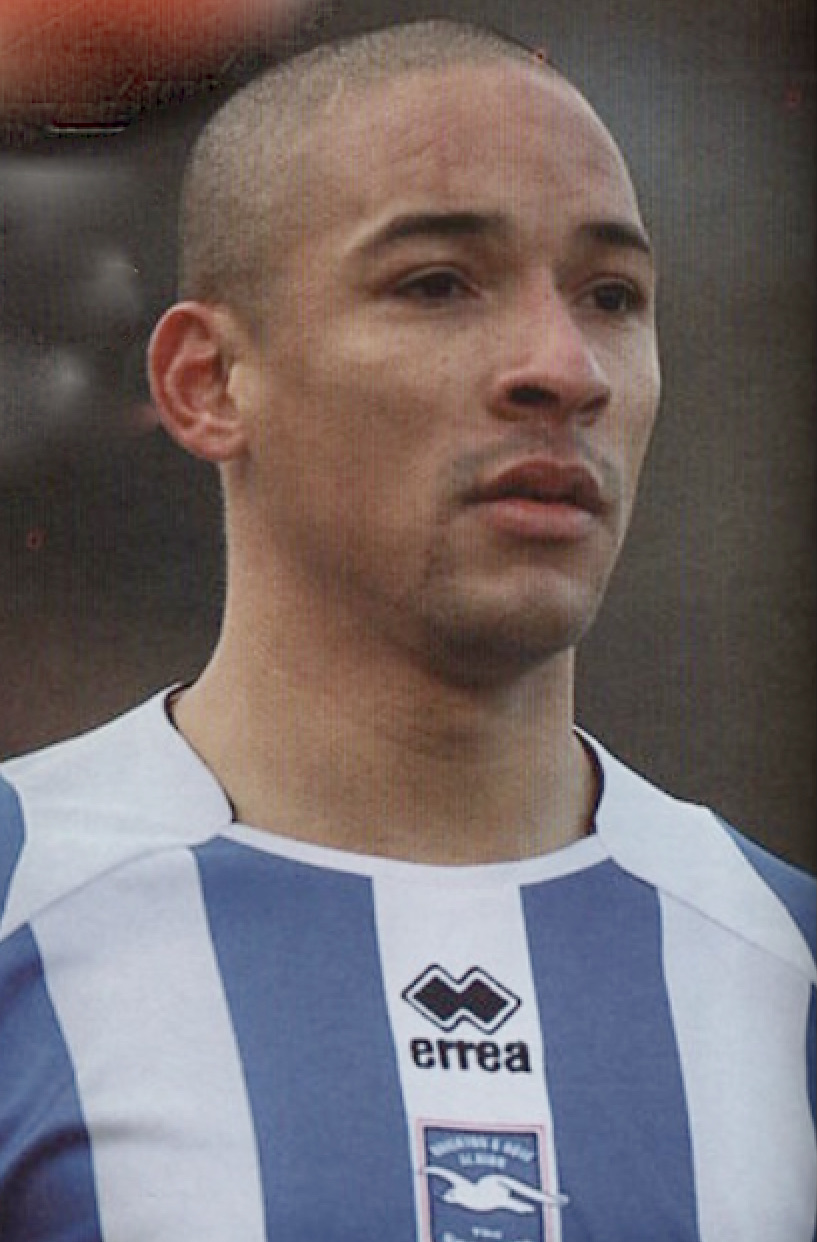
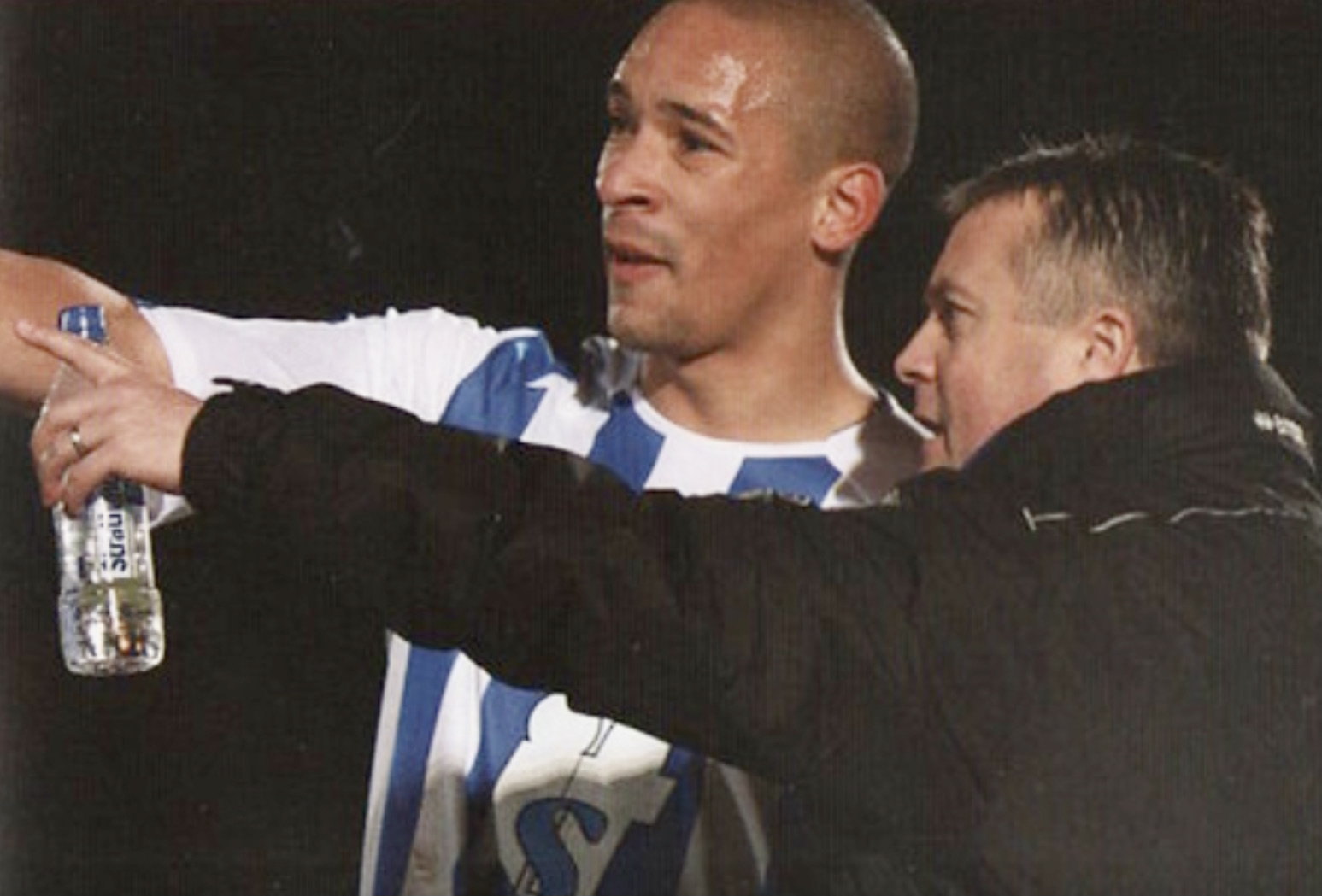
JASON JARRETT was one of multiple additions to Micky Adams’ struggling League One Brighton side in January 2009, advised to head to the Withdean by former Preston playing colleague Joe Anyinsah.

Anyinsah, who had been on loan at the Albion and declined the opportunity to stay in favour of moving to Carlisle United, nonetheless recommended the Seagulls to Jarrett.

The alliteratively named midfielder was 29 when he arrived on a free transfer hoping to reignite his career after a frustrating two-and-a-half years at Deepdale during which time he made just nine appearances.

“I was told by Alan Irvine I had a future at Preston North End, but there is only so long that you can sit on the bench,” he said. “I wanted to leave so that I can play some games and I have heard good things about Brighton so in the end it was a straightforward decision.”

He pointed out: “This is a chance to resurrect my career and I’m grateful to Micky Adams for bringing me down here.”

Jarrett was one of six new arrivals that month: Jim McNulty, Craig Davies, Calvin Andrew, Seb Carole and Chris Birchall were the others.

“We needed a bit more physical strength in midfield, which is why Jason is there,” Adams explained.

His debut for the Seagulls saw him in opposition to a club he’d very nearly signed for – Leicester City – after playing 13 games for them on loan in 2007.

And, in an even more bizarre twist, he ended up wearing the Foxes’ second kit of all yellow in the game on 27 January 2009 because the match referee deemed Albion’s would have clashed.

“Rob Kelly took me to Leicester and I was close to signing for them but it fell through when he was sacked,” Jarrett told the Argus ahead of the game.

“They are a big club and obviously the best team in the League. Everyone can see that, so it is going to be very difficult. They are a club that should definitely be in the Championship at the very least.”

Nevertheless, the Albion caused something of an upset by holding the high-flyers to a goalless draw, and the new man came close to netting the Albion a win.

Brighton were the 13th club of Jarrett’s career, most of which had been spent at Championship level. Anyone of a superstitious nature would say luck was not on his side.

Although he made 12 starts + two as a sub for the Albion, it was only a matter of weeks after he signed that Adams parted company with the Seagulls.

New boss Russell Slade stuck with Jarrett initially but then brought in his own man in Gary Dicker from Stockport County.

Having been given a contract only until the end of the season, Jarrett was not kept on, and it wasn’t long before he was reunited with Adams, this time at Port Vale.

Born in Bury on 14 September 1979, Jarrett started his career as a 16-year-old apprentice with Blackpool, and made his first team debut in November 1998. He moved on to Wrexham for the 1999-2000 season but only made one appearance for the Welsh side. Next up was hometown club Bury in the Second Division where he got a foothold in the team and featured in 69 matches. However, when they went into administration in 2002, they were forced to sell Jarrett to Wigan Athletic for £75,000.

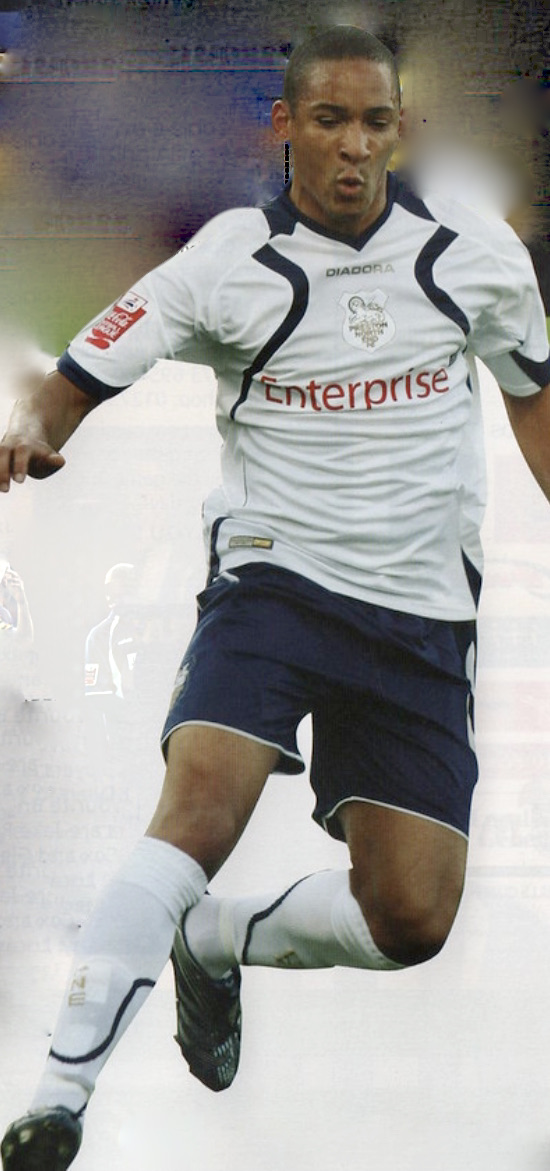
Jarrett was a key part of the Latics midfield as they rose from the fourth tier through to the Championship, making 107 appearances under Paul Jewell.

A broken leg suffered in pre-season ahead of the 2004-05 season sidelined him and after he’d recovered he spent a month on loan at Stoke City under Tony Pulis.

Jarrett moved on before getting the chance to play in the Premier League for Wigan, instead joining Norwich City in the summer of 2005. He had previously played for Canaries boss Nigel Worthington at his first club, Blackpool, but, in common with a few other signings, his chances at Carrow Road were few and far between. He went on loan to Plymouth Argyle in the first part of the season, returning in January 2006, and two months later joined Preston on a temporary basis before making the switch to Deepdale permanent in May that year.

Once again, though, he found a manager in Paul Simpson reluctant to give him a regular starting berth so he went on loans to Hull City (where he played alongside Nicky Forster and David Livermore), Leicester (as mentioned above), QPR (for three months) and Oldham (where Craig Davies was a teammate).

He was picked out in the Albion matchday programme as Oldham’s star man ahead of their visit to the Withdean in February 2008, described as “a mobile, pacy central operator who can get forward but is also prepared to do the grimy tracking back and box-to-box work that are a good midfielder’s staple diet”.

He later returned to Oldham after his short term contract with Port Vale had expired. He’d been without a club in the latter half of the 2009-10 season but, in the summer of 2010, Oldham boss Paul Dickov took him on after a successful trial period. He told the club website: “We have a very young team and Jason’s experience helps us.”

However, he only made eight appearances and in January 2011 he dropped out of the league, initially playing for Conference North FC Halifax Town, then Airbus UK in Wales, before, in May 2013, signing for Conference side Chester. When they were relegated from the Conference in April 2014, Jarrett moved to Salford City.

After his playing days were over, Jarrett set up his own business: ProBall Sport. On his LinkedIn profile, he describes its aims thus: “At ProBall Sport we provide fun, educational sport activities for primary and secondary schools plus nutrition and well-being workshops.

“The power of school sports changed my life,” Jarrett writes. “I know first-hand how much of a positive impact it can have on young children, whether that be in pushing them on towards becoming a professional sports person or keeping them fit, active and healthy.

“I believe that first class sports coaching from a young age had a profound effect on my life and achievements so I developed Proball Sport to directly support and inspire today’s pupils to give them the chance to experience something similar, hopefully, even more special.”
Even fearsome John McGrath couldn’t stop the rot

IN ALBION’S bleak midwinter of 1972-73, manager Pat Saward was desperate to try to reverse a worrying run of defeats.

The handful of additions he’d made to the squad promoted from the old Third Division in May 1972 had not made the sort of improvements in quality he had hoped for.

An injury to Norman Gall’s central defensive partner Ian Goodwin didn’t help matters and Saward chopped and changed the line-up from week to week to try to find the right formula.

Previously frozen out former captain John Napier was restored for a handful of games (before being sold to Bradford City for £10,000). The loan ranger’ (as Saward was dubbed for the number of temporary signings he brought in) then tried Luton Town’s John Moore in Goodwin’s absence.

Youngster Steve Piper was given his debut at home to high-flying Burnley, but Albion lost that 1-0. Then Saward tried left-back George Ley in the middle away to Preston, but that didn’t work either. North End ran out comfortable 4-0 winners with Albion’s rookie ‘keeper Alan Dovey between the sticks after regular no.1 Brian Powney went down with ‘flu.

As December loomed, and with Goodwin still a couple of weeks away from full fitness after a cartilage operation, Saward turned to John McGrath, a no-nonsense, rugged centre-half who had played close on 200 games for Southampton over five years.

“With his rolled-up sleeves, shorts hitched high to emphasise implausibly bulging thigh-muscles, an old-fashioned haircut and a body dripping with baby oil, ‘Big Jake’ cut an imposing figure,” to quote the immensely readable saintsplayers.co.uk.

In Ivan Ponting’s obituary in the Independent following McGrath’s death at 60 on Christmas Day 1998, he reckoned his “lurid public persona was something between Desperate Dan and Attila the Hun”.

Although McGrath had begun the 1972-73 season in the Saints side, the emerging Paul Bennett had taken his place, so a temporary switch to the Albion offered a return to first team football.

Albion had conceded eight goals in three straight defeats and hadn’t registered a goal of their own, so, even though the imposing centre-half was approaching the end of a playing career that had begun with Bury in 1955, it was hoped his know-how defending against some of the best strikers in the country might add steel in the heart of the defence, and stem the flow of goals.

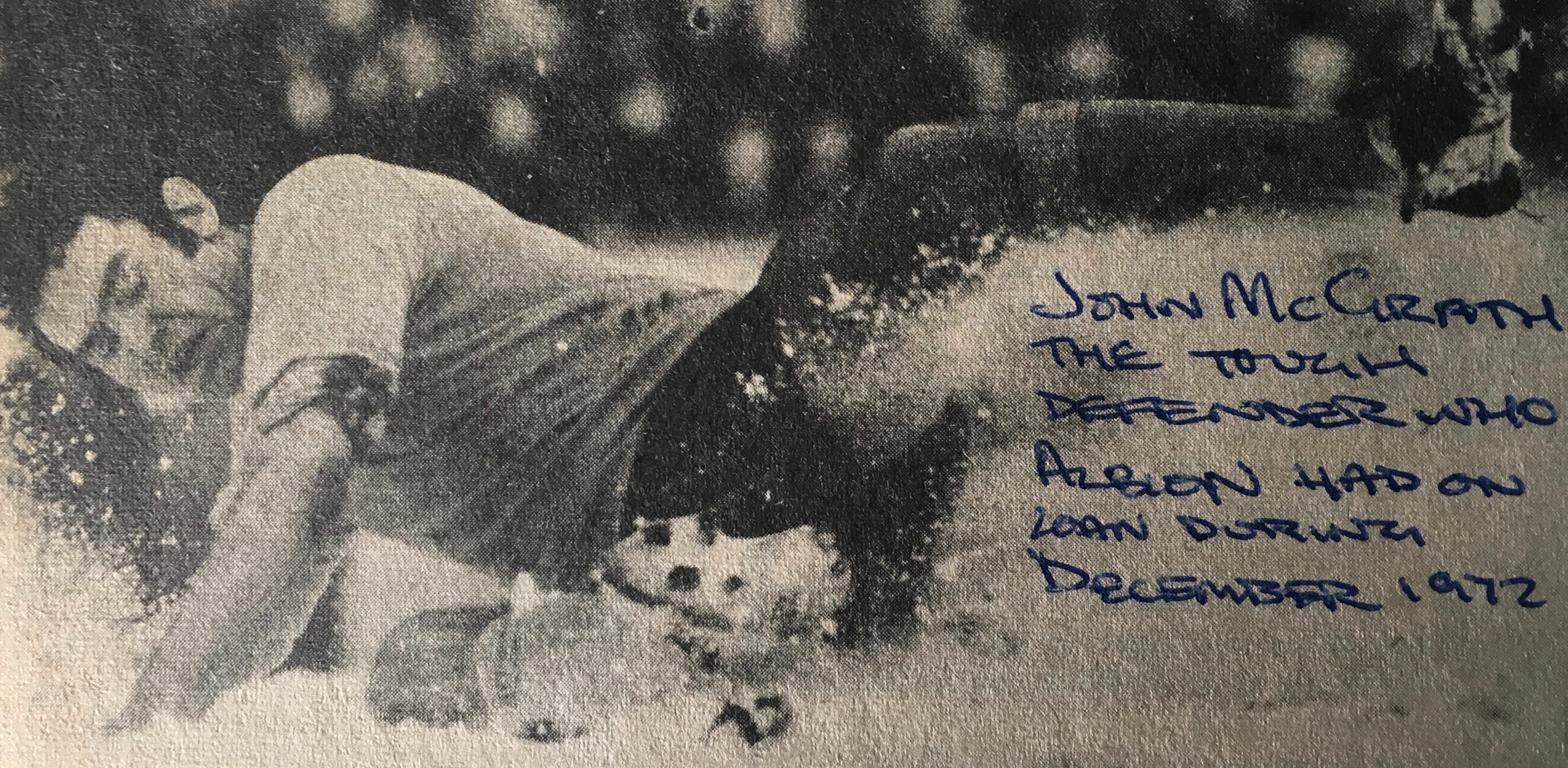
In short, it didn’t work. McGrath played in three matches and all three ended in defeats, with another eight goals conceded.

In his first match (above left), Middlesbrough won 2-0 at the Goldstone. At least the deficit was slimmer in his second game: a 1-0 loss away to George Petchey’s Orient in which Lewes-born midfielder Stan Brown played the last of nine games on loan from Fulham.

McGrath’s third match saw Albion succumb to a thrashing at Carlisle United. By then, Brighton had lost five in a row and still hadn’t managed to score a single goal. Stalwart Norman Gall was dropped to substitute to allow the returning Goodwin to line up alongside McGrath, and Bert Murray led the side out resplendent in the second strip of red and black striped shirts and black shorts.

Carlisle hadn’t read the script, though, and promptly went 5-0 up. To compound Albion’s agony, with 20 minutes still to play, goalkeeper Powney was carried off concussed and with a broken nose.

In those days before substitute goalkeepers, Murray (who’d swapped to right-back that day with Graham Howell moving into his midfield berth) took over the gloves. Miraculously, Albion won a penalty and because usual spot kick taker Murray was between the sticks, utility man Eddie Spearritt took responsibility having relinquished the job after a crucial miss in a game in 1970.

Thankfully, he buried it, finally to make a much-awaited addition to that season’s ‘goals for’ column.

No more was seen of McGrath, however. Gall was restored to the no.5 shirt and was variously partnered by Goodwin, Piper and, towards the end of the season, Spearritt.

After another heavy defeat, 4-0 at Sunderland, which had seen another rare appearance by Dovey in goal, he was transfer-listed along with Gall and Bertie Lutton, as Saward pointed the finger. Lutton got a surprise move to West Ham but Gall stayed put and Dovey was released at the end of the season without playing another game.

The run of defeats eventually extended to a total of 13 and was only alleviated after a big shake-up for the home game versus Luton Town on 10 February.

Powney, who’d conceded five at Fulham in the previous game, was replaced by Aston Villa goalkeeper Tommy Hughes on loan; out went experienced striker Barry Bridges in favour of rookie Pat Hilton and exciting teenage winger Tony Towner made his debut. Albion won 2-0 with both goals from Ken Beamish, and the monkey was finally off their backs.

Although the following two games (away to Bristol City and Hull) were lost, results did pick up, but it was all too little too late and Albion exited the division only 12 months after their promotion.

Born in Manchester on 23 August 1938, McGrath sought unsuccessfully to get into the game as an amateur with Bolton Wanderers but at 17 he joined Bury who were in the old Division Two at the time.

Although they were subsequently relegated, McGrath was part of the 1961 side that went on to win the Third Division Championship. By the time they lifted the trophy, though, he had moved on to Newcastle United for a fee of £24,000, with Bob Stokoe (later renowned for steering Second Division Sunderland to a famous FA Cup win over Leeds United in 1973) a makeweight in the transfer.

It was a busy time for the young defender. On 15 March 1961, he made his one and only England Under-23 appearance against West Germany at White Hart Lane, Tottenham, playing alongside future World Cup winners George Cohen at right-back and the imperious Bobby Moore.

Also in the young England side for that 4-1 win was Terry Paine, who would later become a teammate at Southampton.

Newcastle had hoped the defender would prevent their relegation from the top flight, but it didn’t happen as they went down having conceded 109 goals; their worst ever goals against tally.

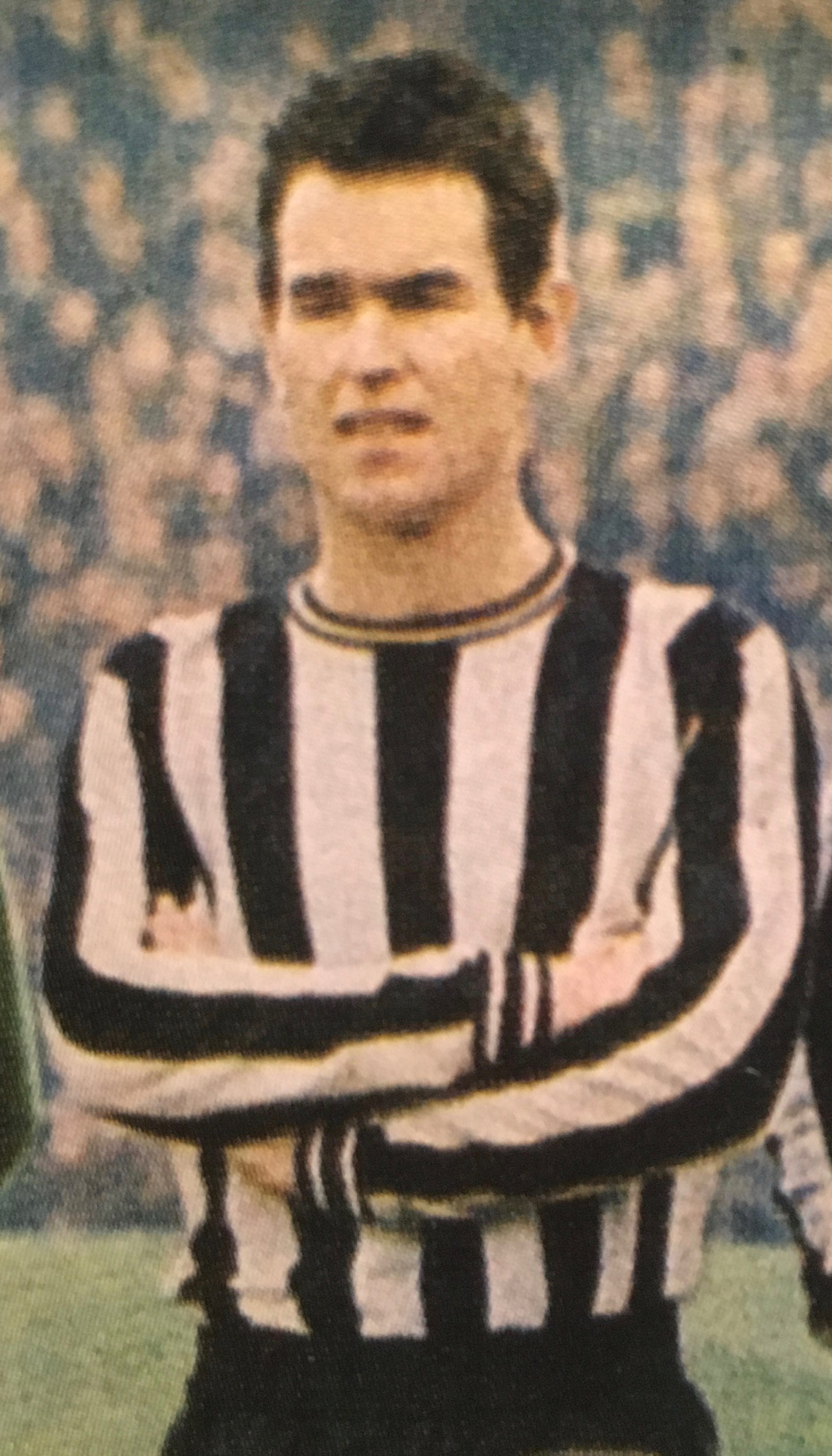
Joe Harvey eventually succeeded Charlie Mitten as manager as Newcastle adapted to life back in the Second Division, and McGrath (below left and, in team picture, back row, far left) played 16 matches in a side in which full-back George Dalton (below, back row, far right) had started to emerge.

Future Brighton captain Dave Turner was one of the successful FA Youth Cup-winning side Harvey inherited, but his first team outings were rare and he was sold to the Albion in December 1963.

Meanwhile, McGrath really established himself, featuring in 41 games in 1963-64 (Dalton played in 40) as Newcastle finished in a respectable eighth place.

The 1964-65 season saw McGrath ever-present as Toon were promoted back to the First Division, pipping Northampton Town to the Second Division championship title by one point. McGrath – “a monster of a centre-half, who was as tough as he was effective” was “the cornerstone” of the promotion side, according to newcastleunited-mad.co.uk.

McGrath retained his place in Toon’s first season back amongst the elite but the arrival of John McNamee and the emergence of Bobby Moncur started to restrict his involvement.

That pairing became Harvey’s first choice, and young Graham Winstanley was in reserve too, so, after playing only 11 games in the first half of the 1967-68 season, McGrath, by then 29, was sold to Southampton for £30,000. He’d played 181 games for United.

In Ted Bates’ Saints side, McGrath was a rock at the back alongside Jimmy Gabriel, although, as saintsplayers.co.uk records, he wasn’t too popular with opposing managers: Liverpool’s Bill Shankly accusing Southampton of playing “alehouse football”.

He went on to make 194 appearances (plus one as a sub) for Saints, before becoming youth coach at the club, part of the first team coaching staff when Southampton won the FA Cup in 1976, and then reserve team manager.

Not content with a backroom role, McGrath took the plunge into management and made his mark with two clubs in particular: managing Port Vale on 203 occasions and Preston North End in 205 matches.

According to Rob Fielding he became a cult hero at Vale Park with his unorthodox ways, once putting FIFTEEN players on the transfer list…which resulted in a six-match unbeaten run!

Winger Mark Chamberlain, who went on to play for Stoke and England, and later Brighton, was one of the young players McGrath introduced.

Long-serving Vale defender Phil Sproson, who was originally signed by former Albion midfielder Bobby Smith, rose to prominence under McGrath and said: “I’ll always be grateful because he taught me how to play centre-half.”

Fielding reckoned McGrath’s finest hour was steering Vale to promotion from the old Fourth Division in 1982-1983, even though by then he had sold Chamberlain to Stoke.

Against a backdrop of player unrest and what were perceived to be ill-judged moves in the transfer market, McGrath was sacked in December 1983 and replaced by his assistant, John Rudge.

He wasn’t out of work for long, though, and took the reins at basement side Chester City where he was in charge for just under a year. Most notably in that time, he gave future Arsenal and England defender Lee Dixon his first taste of regular football.

While success eluded him at Chester, his arrival at Preston in 1986 proved fruitful, North End striker Gary Brazil recalling: “It needed a catalyst and it needed a change and very fortunately for the club and for the players, John McGrath came walking through the door who was like a Tasmanian devil. He came in and the world changed really, really quickly for the better.”

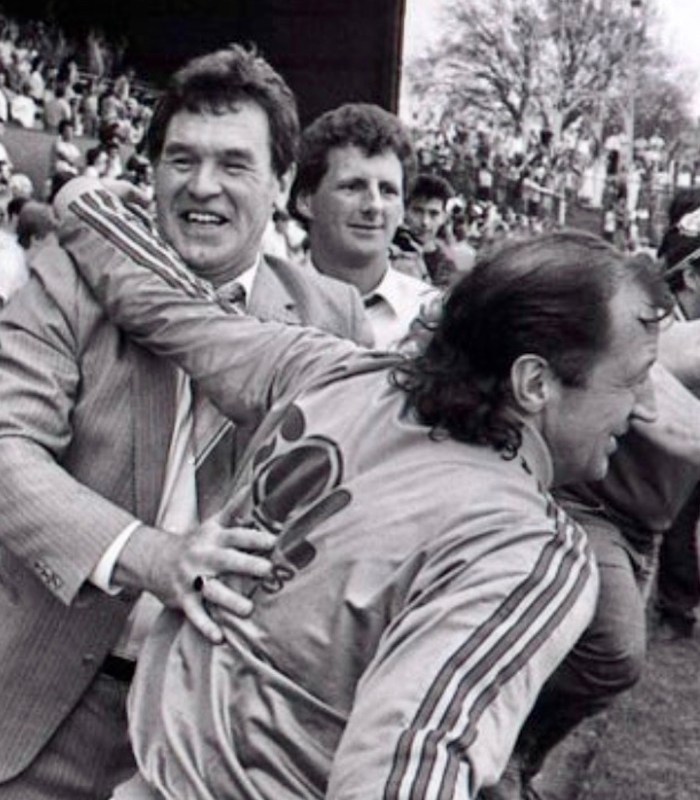
McGrath led Preston to promotion from the bottom tier in 1987 with a squad built around Sam Allardyce and veteran Frank Worthington.

Manager McGrath and Frank Worthington celebrate promotion

“Frank Worthington was a delight to have around and set a real high standard for a lot of us in terms of how we train,” said Brazil. “He just stunned me how he was always first out training.”

The turnround McGrath oversaw, with Deepdale crowds rising from below 3,000 to more than 16,000, rejuvenated the club and the city.

Brazil reminisced: “It was the best year of my football life that year that we got promoted. It wasn’t just an experience playing but an experience of a group of players and how well they could bond and John was integral to that. He was a very, very clever man.”

Indeed McGrath was viewed as having saved North End from the ignominy of losing their league status, the club having had to apply for re-election the season before he arrived at Deepdale.

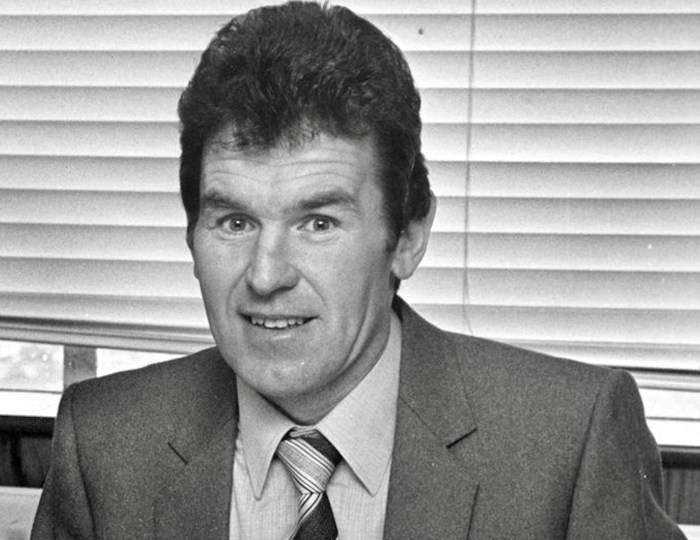
Edward Skingsley’s book, Back From The Brink, features a black and white photograph of McGrath on its cover and tells the story of North End’s transformation under his direction.

Describing his appointment as “a masterstroke” he reckoned the club owed him a massive debt for masterminding their resurgence and subsequent stability.

“Without him, it is debatable whether Preston North End would even exist today, never mind play in the latest fantastic incarnation of Deepdale,” said Skingsley. “Thank goodness he caught Preston North End before it died.”

McGrath left Preston in February 1990 and had one last stab at management, this time with Halifax Town. He succeeded Saints’ FA Cup winner Jim McCalliog and was in charge at The Shay for 14 months but left in December 1992. Five months later they lost their league status, finishing bottom of pile.

The silver-tongued McGrath was subsequently a popular choice on the after-dinner speaking circuit and a pundit on local radio in Lancashire but died suddenly on Christmas Day 1998.

Goalscoring Busby Babe Alex Dawson my first Brighton hero

ALEX DAWSON remains the youngest player to have scored a hat-trick in a FA Cup semi-final.

He was just 18 years and 33 days on 26 March 1958 when his perfect treble (header, right foot and left foot shots) for a makeshift post-Munich Manchester United helped to secure a 5-3 win over Fulham in a replay in front of 38,000 fans at Highbury.

Eleven years later he scored twice for Brighton & Hove Albion in what for many might have been a meaningless Third Division match against Walsall.

But for me, it was the beginning of a lifelong journey supporting the Albion. It was the very first Brighton game I saw and the burly Dawson, wearing number 9, became an instant hero to an impressionable 10-year-old.

Little did I know then of the famous background of the man who played a big part in Brighton’s 3-0 win over the Saddlers that afternoon.

What I’ve learned since makes him even more of a hero, and it’s evident that fans of other sides he played for remembered him with great fondness when learning of his death at the age of 80 on 17 July 2020.

Returning to that 1958 match, it was just six weeks after the Munich air disaster that claimed the lives of eight of United’s first choice team – Dawson’s pals – so youngsters and fringe players had to be drafted into the side to fulfil the remaining fixtures that season.

Thirteen days after the accident, Dawson took his place beside survivors Bill Foulkes and Harry Gregg and scored one of United’s goals as they beat Sheffield Wednesday 3-0 in the fifth round of the Cup. He scored again as United drew 2-2 with West Brom in the sixth round, before winning through 1-0 in a replay to go up against Fulham in the semi-final.

Dawson told manutd.com: “In our first game with Fulham (played at Villa Park), Bobby Charlton scored twice in a 2-2 draw, and I was put on the right wing. I was a centre-forward really and, when we played the replay at Highbury four days later, I was back in my normal position.

“Jimmy (Murphy) said before the game: ‘I fancy you this afternoon, big man. I fancy you to put about three in.’ I just said: ‘You know me Jim, I’ll do my best,’ but I couldn’t believe it when it happened.

“The first was a diving header, I think the second was a left-footer and the third was with my right foot.

“It was a long time ago, of course, and it’s still a club record for the youngest scorer of a hat-trick in United’s history. Records are there to be broken and I’m surprised that it’s gone on for over half a century.

“I’m a proud man to still hold this record. Even when it goes, nobody can ever take the achievement away from me.”

Also in the United side that day was Freddie Goodwin….and he was the manager of that Brighton side I watched for the first time v Walsall in February 1969.

Born in Aberdeen on 21 February 1940, Dawson went to the same school as United legend Denis Law, but his parents moved down to Hull where he went to Westbourne Street School. Dawson joined United straight from Hull Schoolboys.

Dawson and future Preston and Brighton teammate Nobby Lawton were both on the scoresheet as United beat West Ham 3-2 in the first leg of the 1957 FA Youth Cup Final and Dawson scored twice in the 5-0 second leg win. West Ham’s side included John Lyall, who later went on to manage them.

On redcafe.net, Julian Denny recalled how Dawson once scored three hat-tricks in a row for a United reserve team that was regularly watched by crowds of over 10,000.

He scored on his United first team debut against Burnley in April 1957, aged just 17, and in each of the final two matches that season (a 3-2 win at Cardiff and a 1-1 draw at home to West Brom) to help win the title and secure United’s passage into Europe’s premier club competition.

They were the first of 54 goals in 93 United appearances, but was it all too much too soon? Some say Dawson’s career with United may have panned out differently if he hadn’t been thrust into first team action at such a young age.

Was he mentally scarred by the loss of those teammates, in the knowledge he could well have been with them on that fateful journey?

Let’s not forget he was just short of his 18th birthday when the accident happened. In an interview with Chris Roberts in the Daily Record (initially published 6 Feb 2008 then updated 1 July 2012), he recalled: “I used to go on those trips and had a passport and visa all ready but the boss just told me I wasn’t going this time. I had already been on two or three trips just to break me in. I know now how lucky I was to be left in Manchester. The omens were on my side.”

Dawson went on to describe the disbelief and the feelings they had at losing eight of the team, including Duncan Edwards several days later.

A Daws MU BW“We were all so close and Duncan was also a good friend to me before the accident,” said Dawson. “Duncan was such a good player, there is no doubt about that. He was a wonderful fellow as well as a real gentleman.

“I will never, ever forget him because he died on my birthday, 21 February, and before that he was the one who really helped me settle in.”

Dawson gradually became an increasingly bigger part of the first-team picture at United, making 11 appearances in 1958-59 and scoring four times. The following season he scored 15 in 23 games then went five better in 1960-61, scoring 20 in 34 games.

He was at the top of his game during the last week of 1960 when he scored in a 2-1 away win at Chelsea on Christmas Eve, netted a hat-trick as Chelsea were thumped 6-0 at Old Trafford on Boxing Day, and then scored another treble as United trounced neighbours City 5-1 on New Year’s Eve.

A fortnight later he had the chance to show another less well-known string to his footballing bow…. as a goalkeeper!

It was recalled by theguardian.com in 2013. When Tottenham were on their way to the first ever double, and had an air of near-invincibility about them, they arrived at Old Trafford having lost only once all season, and had scored in every single game.

Long before the days of a bench full of substitutes, when ‘keeper Harry Gregg sustained a shoulder injury, Dawson had to take over in goal.

Dawson excelled when called upon, at one point performing, according to the Guardian’s match report, “a save from Allen that Gregg himself could not have improved upon”.

The article said: “Tottenham’s attempts to get back into the game came to nought and Dawson achieved what no genuine goalkeeper had all season: keep out Tottenham’s champions-elect. In the end, there were only two games all season in which Spurs failed to score, and this was one of them.”

Tottenham’s north London neighbours, Arsenal, finished a disappointing 25 points behind Spurs in 11th place, but United manager Matt Busby had been keeping tabs on the Gunners’ prolific centre forward David Herd (Arsenal’s top scorer for four seasons), and in July 1961 took him to Old Trafford for £35,000. It signalled the end of Dawson’s time with United.

When the new season kicked off, Dawson had a new apprentice looking after the cleaning of his boots….a young Irishman called George Best. In his 1994 book, The Best of Times (written with Les Scott), Best said: “Alex Dawson was a brawny centre forward whose backside was so huge he appeared taller when he sat down. To me, Alex looked like Goliath, although he was only 5’10”. What made him such an imposing figure was his girth.

“He weighed 13st 12lbs, a stone heavier than centre half Bill Foulkes who was well over 6ft tall. What’s more, there wasn’t an ounce of fat on Alex – it was all muscle.”

Best’s responsibilities for Dawson’s boots didn’t last long, however, because in October that year, Busby sold the centre forward to Preston for £18,000.

During a prolific time at Preston, Dawson scored 114 goals in 197 appearances, and became known as The Black Prince of Deepdale. In the 1964 FA Cup Final at Wembley, Dawson scored in the 40th minute but Preston lost 3-2 to a Bobby Moore-led West Ham United.

The Preston captain that day was his former Man Utd teammate Lawton, who he subsequently joined at Brighton.

Lawton, now no longer with us, mentioned “that great striker Alex Dawson” in an interview he gave to the Lancashire Evening Post, published in May 2004.

“I’d known Alex since we were both on the groundstaff at Old Trafford,” Lawton recalled. “He was a bull of a centre-forward and was a Deepdale hero.

“He’s a lovely man and I was best man at his wedding. He hasn’t changed at all, and we are still great friends.

“Alex and the rest of the team would have graced any Premiership side today.”

Clearly Preston fans felt the same way. ‘Albertan’ on pne.net in 2012 said: “Alex Dawson was a super player … He was the complete centre forward – powerful, mobile and lethal with either foot or his head. He was also brave, committed and characterful.”

While ‘sliper’ on the same forum added: “In his prime Dawson was a powerhouse and great to watch. I can safely say I’ve never seen a better header of a ball at Deepdale.”

‘Curlypete’ recalled: “You could literally see goalkeepers tremble when Dawson was running at them, it was either the ball, ‘keeper or more likely both who ended up in the net.”

In 1967, Dawson took the short journey to Bury FC where his goalscoring exploits continued with 21 goals in 50 appearances. I was intrigued to see in a team photo of the Bury squad before the 1968-69 season, a young Lammie Robertson sitting at Dawson’s feet.

In December 1968, the aforementioned Freddie Goodwin had just taken over as Brighton manager and he paid Bury £9,000 to make his old United teammate his first signing at the Goldstone. An early programme profile revealed the surprising news that Dawson also had a sideline as a men’s hairdresser.

He certainly added a cutting edge to Albion’s attack, finding the net no fewer than 17 times in just 23 games, including three braces and four in an away game at Hartlepool. Dawson was no mean cricketer, either. An all-rounder who used to play for the Newton Heath club, as well as a collection of half-centuries to his credit, he once took eight wickets for 35 runs as a lively fast-medium bowler.

The following season, Goodwin added Allan Gilliver to the strikeforce and he outshone Dawson in the scoring stakes, although the Scot still scored 12 in 36 games.

As is so often the case, it was a change of manager that marked the end of his time with the Albion. With Goodwin departed for Birmingham, replacement Pat Saward didn’t give the old-timer much of a look-in and he went out on loan to Brentford where he showed he could still find the back of the net with familiar regularity.

Greville Waterman, on bfctalk.wordpress.com in July 2014, recalled: “He was a gnarled veteran of thirty with a prominent broken nose and a face that surely only a mother could love, but he had an inspirational loan spell at Griffin Park in 1970 scoring seven times in eleven games including the winner in that amazing late, late show FA Cup victory against Gillingham.

“Typical of the times at Griffin Park, he departed after his loan spell as apparently the club was unable to agree terms with him. A classic example of both parties suffering given that Dawson never played another Football League game and Brentford lacked a focal point in their attack until the arrival of John O’Mara later that same season.”

Released by the Albion at the end of the 1970-71 season, Dawson’s final footballing action was with non-league Corby Town.

Nevertheless, he could look back on a fantastic career as a goalscorer, with a strike rate the envy of many a modern day forward.

Pictures: Top: Alex Dawson portraits – in the 1969-70 and 1970-71 kits.

  • A montage showing Dawson:
    • scoring the first of his goals in the 1958 FA Cup semi final
    • in a Bury line-up (from the Bury Times) with future Albion forward Lammie Robertson also encircled.
    • powering a header for the Albion.
    • in a portrait from pnefc.net.

Welsh international Peter Sayer added artistry to Brighton’s rise to the elite

NIMBLE-footed Peter Sayer was certainly a player for the big occasion: a Cardiff City legend and briefly a Welsh national team star.

At Brighton & Hove Albion, he was part of the team that memorably won promotion to the top division for the first time in its history.

He signed for the Seagulls for £100,000 just nine months after playing for his country in what was the only Wales victory over England at Wembley (on 31 May 1977).

Sayer was part of a Welsh team captained by Terry Yorath (father of TV presenter Gabby Logan) but with far fewer household names than their illustrious opponents.

Wales were managed by Mike Smith, the former Hove Grammar School teacher, while Don Revie’s England were captained by Kevin Keegan, playing up front alongside Stuart Pearson and Mick Channon.

The BBC highlights of the match show the diminutive Sayer getting on the end of a Leighton James cross but steering his header wide before James scored the only goal of the game from the penalty spot after he’d been upended by Peter Shilton.

Neil Moxley, for dailymail.co.uk in September 2011 discovered what had happened to that Welsh team since, which included jobs ranging from Wales boss to toilet roll business managers. Sayer, he reported, had become steward at a golf club in Preston, where he moved to after Brighton, and then run a pub in the area.

In Back Pass magazine in August 2013, Sayer was quoted as saying: It was an excellent time at Brighton. There were some very good players at the club and I was playing well.

“I especially remember when we won promotion to the old First Division at Newcastle in 1978-79.

sayer bwhs“We had our own train which we used to travel on to away games. It was great for team morale.”

He added: “I ended up in the reserves even though I was playing well. I got asked to go to Newcastle but failed the medical.

“The club then had an opportunity to sell me to Preston and they perhaps felt they needed to offload some players. Maybe I should have dug my heels in and fought.”

Sayer wasn’t a prolific goalscorer but he did get on the scoresheet in a memorable 3-3 draw at Orient that I went to in April 1979, when Martin Chivers scored his only goal for the Albion and another former Spurs star, Ralph Coates, was among the scorers for the Os.Jackson concedes Sayer

The game was covered by ITV’s The Big Match and broadcast to the nation the day after the game. Sayer scored after ‘keeper John Jackson, who later became a goalkeeping coach at Brighton, parried a Paul Clark thunderbolt and the Welshman cracked in the rebound.

There’s a very detailed look back at Sayer’s career on pneformerplayers.co.uk by Ian Rigby. His report says: “Occasionally he quietly attends Deepdale to watch North End, but on his return to Cardiff City, as a guest, he is treated as a former star player, which he was.”

A televised third round FA Cup tie between Cardiff and Spurs in January 1977 thrust Sayer into the limelight when his winning goal was seen by millions and can still be seen on YouTube today.

Rigby recounts: “He controlled the ball with his head and, with four defenders converging upon him, he smashed the ball past Pat Jennings. A sponsored car was just one of the perks that came Peter’s way after that goal.”

Born in Cardiff on 2 May 1955, Sayer grew up in the city and went to Trelai Primary School then Cantonian Comprehensive School. He played for his school at all levels and at each successive age group for the Cardiff Schools representative side. That led to him winning Welsh international caps at schoolboy level and later at youth, under-21 and full levels too.

He was awarded a professional contract with Cardiff in July 1973 by then manager Jimmy Scoular but he had to wait until February 1974, by which time Scoular had been replaced by former Leicester and Man Utd boss Frank O’Farrell, to make his league debut as a substitute against Blackpool.

By 1975, just as he was beginning to establish himself, he suffered a broken leg and dislocated ankle in a game at Southampton. Eighteen months later, though, he had recovered sufficiently well to earn his first international honour, playing for Wales Under-21s against England, at Molineux.

Sayer ultimately earned seven full international caps including that Home International win against England and two World Cup qualifying games, one being the controversial game against Scotland at Anfield when a diabolical refereeing decision robbed the Welsh.

Nicknamed ‘Leo’ because he sported the same-style perm as the 70s Shoreham-born pop singer who shared the same surname, Sayer was a regular in the Albion’s 1978-79 promotion-winning side.

He initially retained his place as Brighton strove to come to terms with the top division but when Alan Mullery decided to switch the mercurial Mark Lawrenson from defence to midfield, it was at Sayer’s expense.

In August 1980, Preston manager Nobby Stiles, the England World Cup winner, paid £85,000 to take Sayer to Deepdale, but his career there was beset by injuries and he was released at the end of the 1983-84 season and signed for Chester City for one season.

He subsequently played non-league for Morecambe, Northwich Victoria, Chorley and Southport.

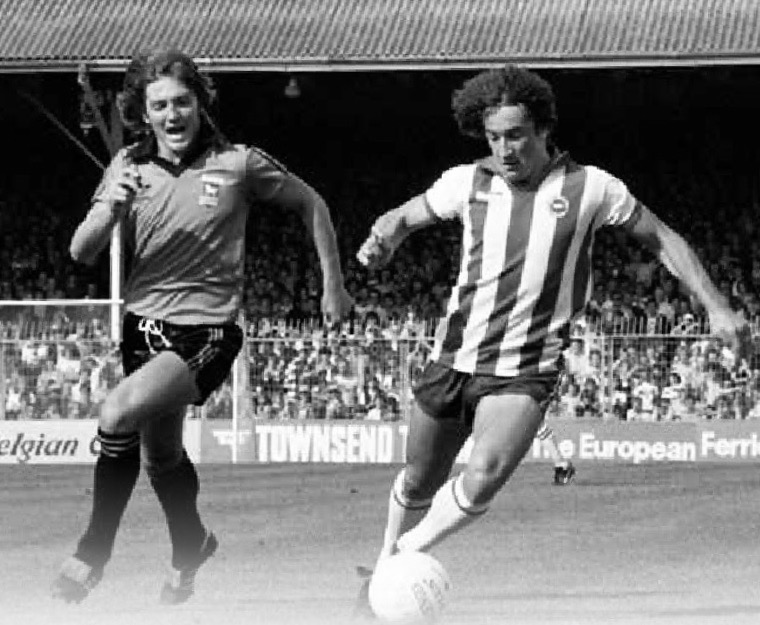
Pictures from my scrapbook show the Albion matchday programme photograph of Sayer scoring in that game against Orient and, from the BBC coverage of England v Wales at Wembley in 1977, the winger looking exasperated after his header has gone wide. Sayer was quite a dab hand at snooker, too.