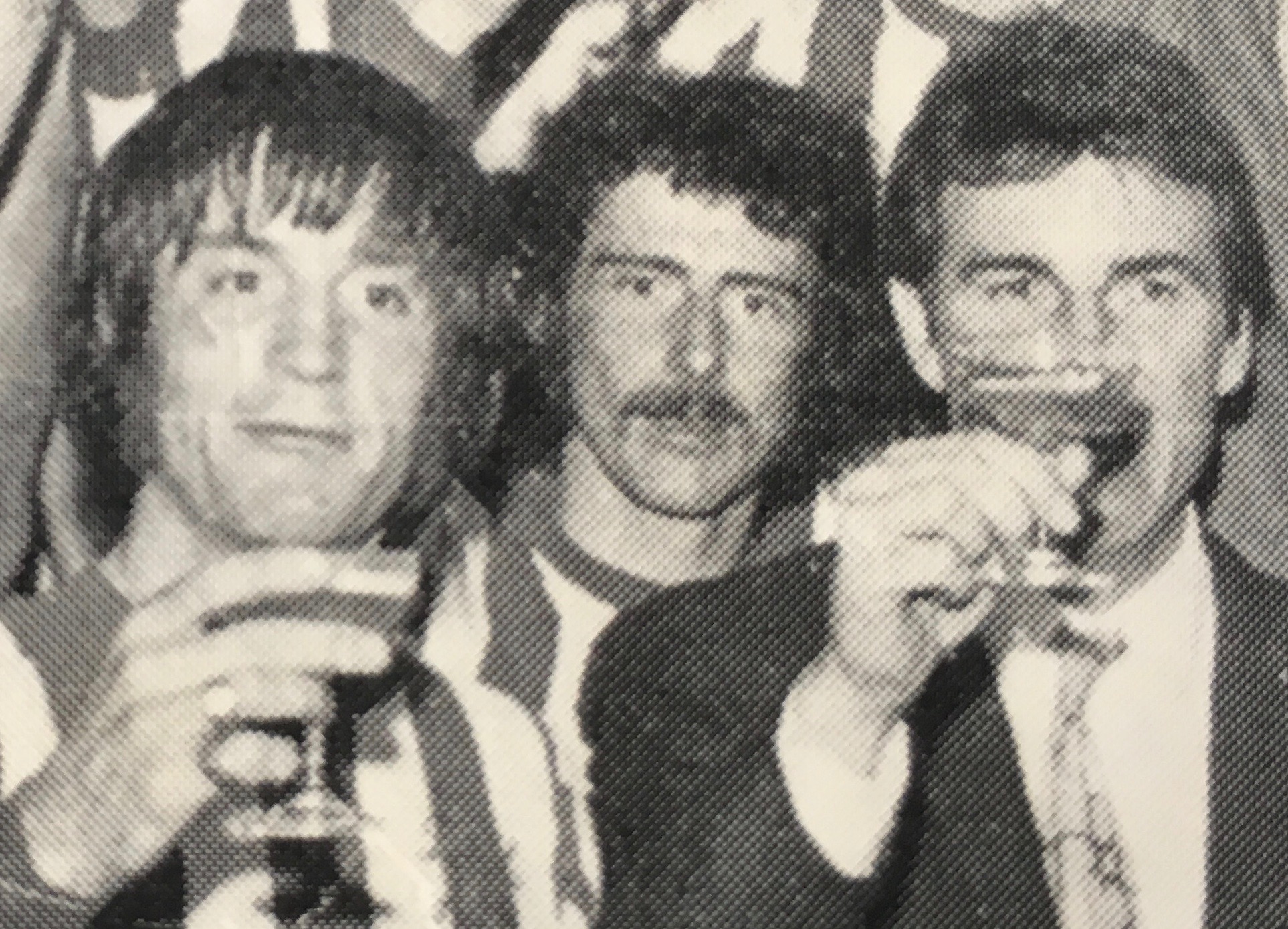
Brothers in arms but not actually related: Kit was just a pal

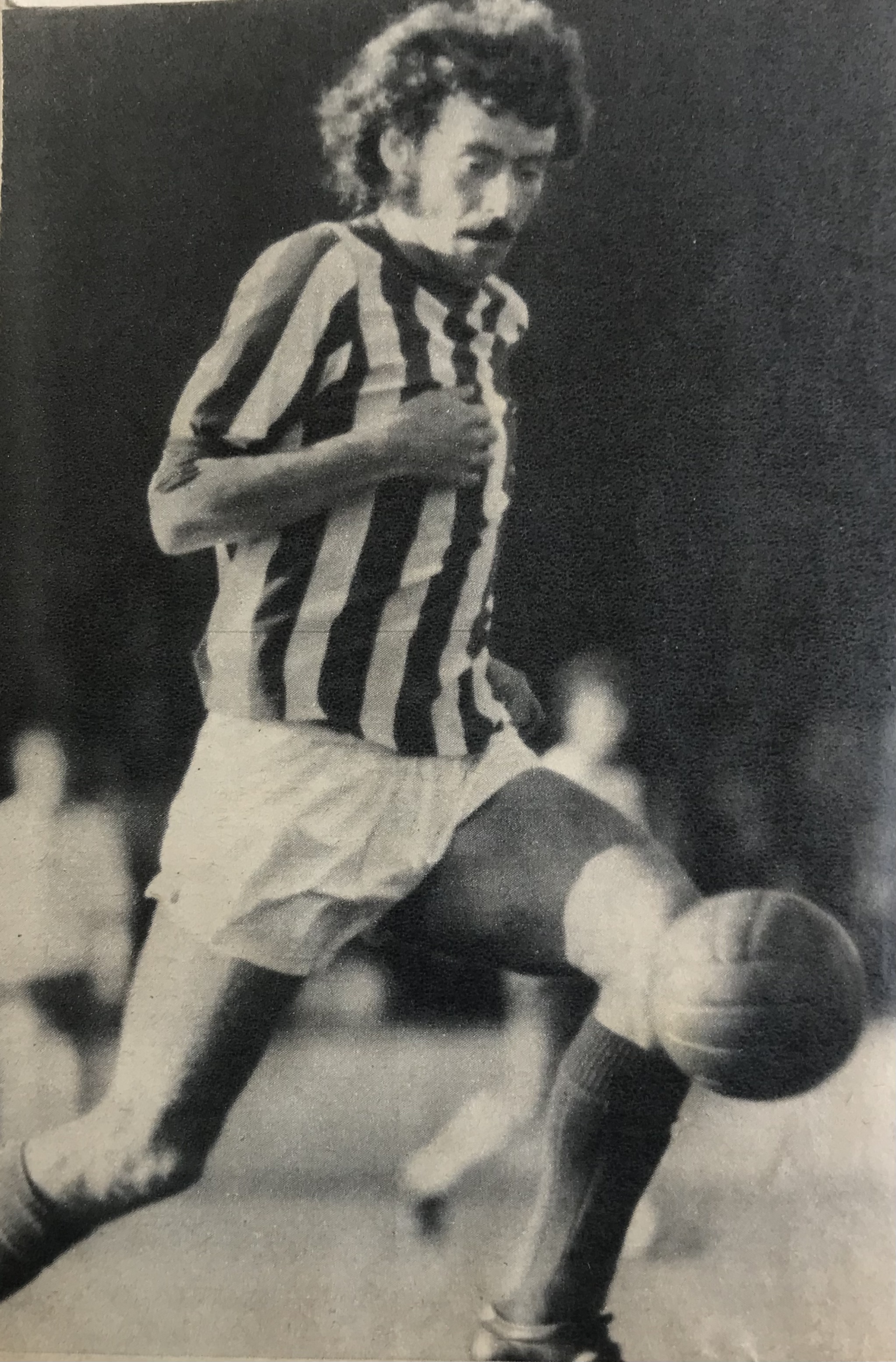
John Napier competes with Aston Villa’s Andy Lochhead

JOHN NAPIER is still coaching youngsters in America as he approaches his 76th birthday. NICK TURRELL’s In Parallel Lines blog caught up with him for a trip down memory lane.  Here, in the fourth of five articles, he recalls his Albion teammates and some memorable opponents.

AS A YOUNG lad starting out watching Brighton in the late ‘60s, I assumed two players sharing the same not-particularly-common surname must have been brothers.

But defender John Napier and striker Kit Napier spoke with different accents.

“I think back then most people thought we were brothers, but we had to explain he was from Scotland and I was from Northern Ireland,” he said.

“But I was a great friend of Kit’s. Our families spent a lot of time together. I even went up one summer with Kit to Dunblane in Scotland where he was from, and we had a great time.
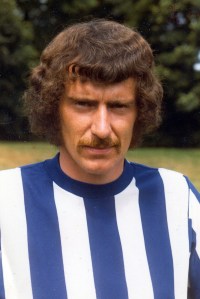
No relation – Kit Napier

“Kit was a really good player. He knew how to finish in the box, a real goal shark. He was quick over short distances and scored some great goals over his time at Brighton.

“You would not see him for a while and then, like all good goalscorers, he would jump in with a half chance, and you would think ‘Where did he come from’?”

Napier was sorry to hear of Kit’s death in 2019. “His son did keep in touch with me from South Africa and kept me up to date with what was happening,” he said.

“I know he will always be remembered fondly in Brighton.”

The towering centre-half spoke warmly about the team spirit he experienced during his time with the Albion.

In that 1971-72 promotion squad, Napier was one of three Northern Irish internationals, and I wondered whether their nationality gave them a special bond.

“We were all good friends and spent family times together,” he said. “The great thing about Brighton back then was how all the players jelled together.

“There were no cliques in the group. We all liked being together, it did not matter which part of the country we were from. When we went out, it was always as a group with families.

Willie Irvine was another known for his goalscoring ability, much like Kit Napier; sharp around the box and tried to get on the end of every cross in the box.

Napier with fellow Irishman Willie Irvine

“I remember Willie scoring a great goal for us against Aston Villa in our promotion year.”
Bertie Lutton

And Bertie Lutton? “Bertie was also a good player. He had some flair about his movement with the ball. I remember his long flowing head locks back then also.

“Both were well received by the Goldstone crowds. We had several Irish players through the years.”

Sadly, having been based in America for a good many years, Napier has not managed to stay in touch with his former teammates, although, via this article, he issued an open invitation to any of them to get in touch with him.

George Ley

“I did talk to George Ley, who lived in Dallas, a couple of times, and Kit Napier’s family in South Africa,” he said.

“I did see Peter O’Sullivan when Brighton were over in America on a tour in the 80s, but nothing else. I wish I had.

“I knew that Dave Turner was coaching in Canada, Stewart Henderson was at Southampton coaching for a long-time.

“But I was also at Bradford many years before I came to America in 1979, so I completely lost touch.

“The years have gone by so fast.”

In my previous article, I referred to Pat Saward’s praise for Napier’s handling of marksman Ted MacDougall, so I wondered who were the toughest opponents he faced.

“That’s a good question: back then the old Third Division was a tough league, it didn’t matter who you played against,” he said. “You were in for a physical battle in every game. It was never easy.”

The big man continued: “I did not really pay attention to who I was marking. I always went out with the mindset to get my job done for the club.

Penalty box ‘wrestling’ isn’t anything new; at least the ref saw the funny side!

“We would talk about individuals sometimes, and what their strengths were, but very rarely worried too much about players.

“MacDougall was at Bournemouth at the time: he was a handful. Andy Lochhead at Aston Villa was another. I am sure there were many more, but I did not lose sleep thinking about how I was going to stop players.
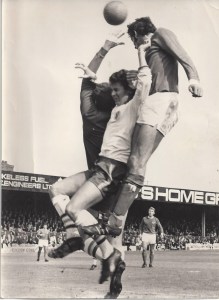
“There were good days and bad days, which we all had. But if we were on the winning side, it was always a good day!”

Napier added: “I met up with Ted MacDougall a few years ago when we were both in a US coaching class in Los Angeles.

“He was based in Atlanta at the time. We talked about old times and battles we had through the years. It is amazing how many former UK players are living over here in the States, working in various coaching positions.”
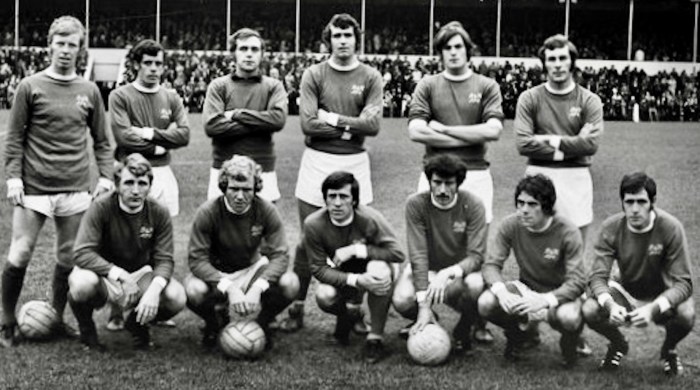
A little-seen away strip for the Albion in the 1970-71 season

• In the final part of this series of articles, the blog looks at how Napier got into coaching, the influences he sought, and what he’s doing now.
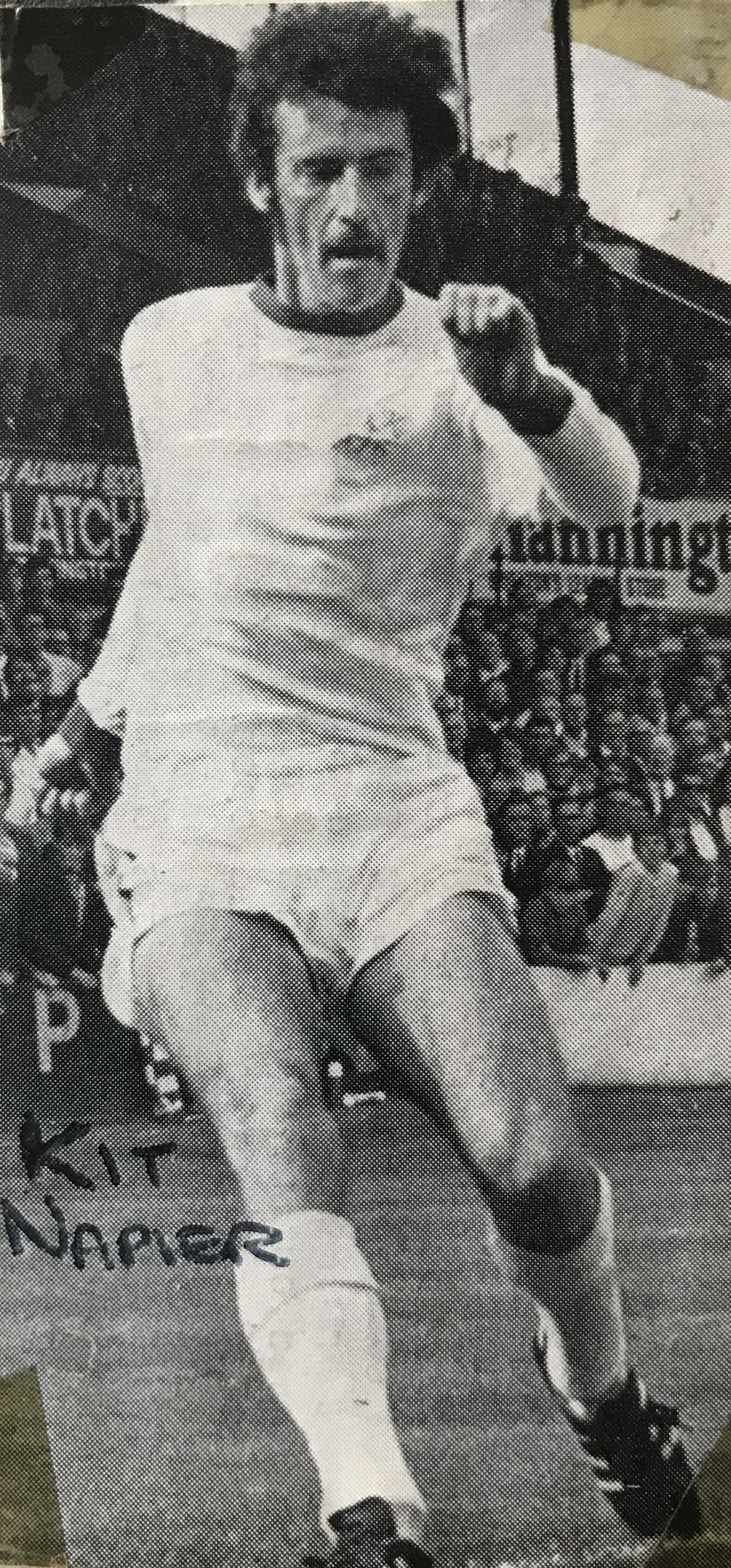
Kit Napier top scorer for Brighton in five of six seasons

FORMER Newcastle United centre forward Kit Napier, who moved from the Magpies to Brighton in 1966, was playing up front alongside Alex Dawson when I first started watching the Albion (in 1969).

Kit Napier at full stretch to score against Bournemouth in front of a packed Goldstone Ground on Boxing Day 1971

Born in Dunblane on 26 September 1943, Kit’s promise as a schoolboy prompted his headmaster to put his name around as a future footballing talent and he left Scotland to join Blackpool (then playing in the top tier) as a junior before turning professional in 1960. But he only played twice for the Tangerines before moving on to Second Division Preston North End in 1963-64. Things didn’t work out there either, though, and he dropped down a further division to Workington, where it all started to click.

Workington were newly-promoted to the Third Division and Napier was on the scoresheet during what has been described as the club’s proudest night, a 5-1 win in a Football League Cup 3rd round replay against First Division Blackburn Rovers on 22 October 1964.

In a team managed by Ken Furphy, who later enjoyed success as manager of Watford, one of Napier’s teammates was Keith Burkinshaw, who several years later would become manager of Tottenham Hotspur.

The Workington archive also recalls the fifth round tie, on 25 November 1964, when Workington hosted Chelsea at Borough Park.  At the time, Chelsea were riding high in the top flight of English football and were unbeaten on their travels when they arrived in west Cumbria.  Reds were fourth in the old Third Division at the time.

“In front of a record League Cup attendance (17,996), Reds gave Tommy Docherty’s Chelsea the fright of their lives by holding them to a 2-2 draw having been 0-2 down early in the game,” the archive records.  “Dave Carr and Kit Napier scored for the Reds and we had a ‘goal’ disallowed late in the game for an offside offence.

“We eventually lost the replay, 0-2, but the crowd at Stamford Bridge was 10,000 fewer than the gathering at Borough Park.”

Napier scored 25 goals in 58 games for the Cumbrian side which attracted the attention of the Geordie giants at St James’ Park. He was still only 22 when they paid £18,000 for him.

KN NUFCHe made his Newcastle debut on 6 November 1965 in a 2-0 home win over Blackpool. But it probably didn’t help his cause that Newcastle lost six of his seven other games, and drew the other!

His last game was in the Tyne-Wear derby game on 3 January 1966 when Sunderland triumphed 2-0.

Toon1892.com, a veritable mine of Newcastle history, says of Napier: “He was seen as a forward who had great potential. Unfortunately, he struggled to come to terms with the First Division and despite having all the ‘tricks’ he could not put the ball into the net.

An autographed Evening Argus photograph of Kit Napier from the 1970-71 season

“Being given only eight games to prove himself, one wonders whether he was given a real chance or not, but the arrival of (Welsh international) Wyn Davies settled any argument and Kit was off to Brighton.”

That move came early in the 1966-67 season when Brighton – bottom of the league table at the time – paid £9,000 to bring him south. He made an instant impression, scoring twice on his debut in a 5-2 win over Peterborough.

It was the perfect start to what was to be the most successful period of his career.

Over Easter in 1971, Napier scored in all three of Albion’s matches – a 1-0 home win over Aston Villa on Good Friday, a 2-0 home win over Reading the following day, and a 3-2 away win at Bradford City on Easter Monday.

The matchday programme for the following home game declared: “This gift of marksmanship blends very nicely with his ball control and general skill in possession. Not to mention the times when he lets fly at goal from outside the penalty area.

“We’ve seen some thrilling thunderbolts from him, including several during 1967-68 season when he broke Albion’s post-war individual scoring record with 30 goals, 24 of them in the league.”

He was top goalscorer in five of his six seasons with the club and, by the time he left, he’d netted 99 goals in just short of 300 appearances, including 19 in the 1971-72 promotion-winning side. Against Shrewsbury at the Goldstone, on 30 October 1971, he netted his 100th career league goal (see below). At that time, his Albion tally was 75.

IMG_4445

The superb The Goldstone Wrap blog did an extended piece on him in which they said: “Kit Napier is rightly considered an Albion legend. He was a ball-playing attacker, skilful with both feet, and with tremendous talent for goalscoring. At the Goldstone, Napier’s class and quick-witted play endeared him to the crowds.”

Aside from the goals, three things about him stand out in my memory:

• Kit had an amazing talent for scoring direct from corners: quite some skill. The first came in a 2-0 home win over Bury on 27 December 1969.

• In a game against Preston, on 27 February 1971, when Napier was shaping to take a penalty in front of the South Stand, Alan Duffy, promptly stepped forward, pushed his teammate out of the way and took the penalty himself – and missed!

• The following season, in a home game against Wrexham, Napier had been having a bit of an off day and the crowd were getting on his back. Eventually manager Pat Saward subbed him off and, as he trudged towards the tunnel, rather than the polite applause that tends to accompany today’s substitutions there were lots of ironic cheers to greet his withdrawal. Napier responded by waving a two-fingered salute to all corners of the ground! I’m pretty sure nothing came of it although, of course, in this day and age he’d no doubt have been hauled before the powers that be.

irvine napier saward

Kit Napier celebrates promotion with Willie Irvine, left, and manager Saward.

With Albion promoted, Saward knew he needed to strengthen the side and he clearly didn’t think Napier was up to playing at the higher level and put him on the transfer list.

Although he made a handful of starts in the 1972-73 Second Division campaign, by the end of August he’d been sold to Blackburn Rovers (who were in the Third Division at the time) for £15,000 as Albion sought to recoup some of the £29,000 record fee they spent bringing former England international Barry Bridges to the club from Millwall.

Napier had two seasons at Ewood Park and brought down the curtain on his English league career with a further 10 goals in 54 appearances. When he returned to the Goldstone with Rovers, he was made captain for the day. “I still get goosebumps and feel emotional at how the whole crowd gave me a standing ovation,” Kit remembered many years later.

He moved to South Africa to play for Durban United and, after packing up playing, had a very successful career as a Ford car salesman in the city (he was national sales manager of the year seven years in a row) alongside his former Albion teammate Brian Tawse. An Albion matchday programme reported how they both also turned out for a local Sunday league side in Durban.

Napier’s later years were blighted by emphysema and he died in Durban on 31 March 2019 at the age of 75.

6F15B25C-FBBC-4A75-8119-94BA0BDC7DBC_1_201_a