‘One of the most influential and progressive coaches of his generation’

ALTHOUGH I wasn’t even born when Dave Sexton was winning promotion with Brighton, I remember him well as a respected coach and manager.

The record books and plenty of articles have revealed Sexton scored 28 goals in 53 appearances for Brighton before injury curtailed his playing career.

As a manager, he took both Manchester United and Queens Park Rangers to runners-up spot in the equivalent of today’s Premier League and won the FA Cup and European Cup Winners’ Cup with Chelsea.

On top of those achievements, he was the manager of England’s under 21 international side when they won the European Championship in 1982 and 1984, and worked with the full international squad under Ron Greenwood, Bobby Robson, Terry Venables, Glenn Hoddle, Kevin Keegan and Sven-Göran Eriksson.

Sexton coached under several England managers

On his death aged 82 on 25 November 2012, Albion chief executive Paul Barber said: “I know Dave was an extremely popular player during his days at the Goldstone Ground and, as a friend and colleague during my time working at the FA, I can tell you that he was held in equally high esteem.

“He was a football man through and through. I enjoyed listening to many of Dave’s football stories and tales during our numerous hotel stays with the England teams and what always came through was his great love and passion for the game.

“Dave was a true gentleman and a thoroughly nice man.”

Former West Ham and England international, Sir Trevor Brooking, who worked as the FA’s director of football development, said: “Anyone who was ever coached by Dave would be able to tell you what a good man he was, but not only that, what a great coach in particular he was.

“In the last 30-40 years Dave’s name was up there with any of the top coaches we have produced in England – the likes of Terry Venables, Don Howe and Ron Greenwood. His coaching was revered.”

Keith Weller, a £100,000 signing by Sexton for Chelsea in 1970, said: “I had heard all about Dave’s coaching ability before I joined Chelsea and now I know that everything said about his knowledge of the game is true. He has certainly made a tremendous difference to me.”

And the late Peter Bonetti, a goalkeeper under Sexton at Chelsea, said: “He was fantastic, I’ve got nothing but praise for him.”

One-time England captain Gerry Francis, who played for Sexton at QPR and Coventry City, said: “Dave was quite a quiet man. You wouldn’t want to rub him up the wrong way given his boxing family ties, but you wanted to play for him.

“Dave was very much ahead of his time as a manager. He went to Europe on so many occasions to watch the Dutch and the Germans at the time, who were into rotation, and he brought that into our team at QPR, where a full-back would push on and someone would fill in.

“He was always very forward-thinking – a very adaptable manager.”

Guardian writer Gavin McOwan described Sexton as “the antithesis of the outspoken, larger-than-life football manager. A modest and cerebral man, he was one of the most influential and progressive coaches of his generation and brought tremendous success to the two London clubs he managed.”

Born in Islington on 6 April 1930, the son of middleweight boxing champion Archie Sexton, his secondary school days were spent at St Ignatius College in Enfield and he had a trial with West Ham at 15. But, like his dad, he was a boxer of some distinction himself, earning a regional champion title while on National Service.

Sexton played 77 games for West Ham

However, it was football to which he was drawn and, after starting out in non-league with Newmarket Town and Chelmsford City, he joined Luton Town in 1952 and a year later he returned to West Ham, where he stayed for three seasons.

In 77 league and FA Cup games for the Hammers, he scored 29 goals, including hat-tricks against Rotherham and Plymouth.

It was during his time at West Ham that he began his interest in coaching alongside a remarkable group of players who all went on to become successful coaches and managers.

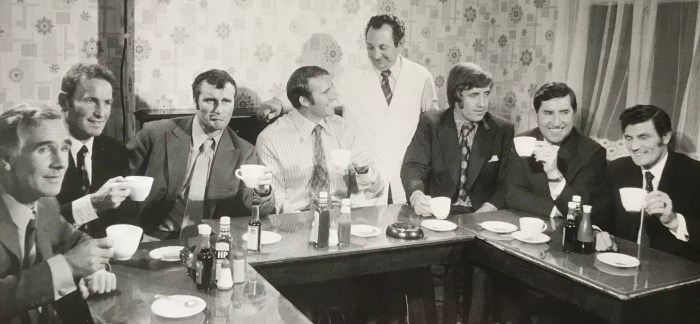
He, Malcolm Allison, Noel Cantwell, John Bond, Frank O’Farrell, Jimmy Andrews and Malcolm Musgrove used to spend hours discussing tactics in Cassettari’s Cafe near the Boleyn ground. A picture of a 1971 reunion of their get-togethers featured on the back page of the Winter 2024 edition of Back Pass, the superb retro football magazine.
One of the game’s most respected managers, Alec Stock, signed Sexton for Orient but he had only been there for 15 months (scoring four goals in 24 league appearances) before moving to Brighton (after Stock had left the Os to take over at Roma).

Albion manager Billy Lane bought him for £2,000 in October 1957, taking over Denis Foreman’s inside-left position. Sexton repaid Lane’s faith by scoring 20 goals in 26 league and cup appearances in 1957-58 as Brighton won the old Third Division (South) title. But a knee injury sustained at Port Vale four games from the end of the season meant he missed the promotion run-in. Adrian Thorne took over and famously scored five in the Goldstone game against Watford that clinched promotion.

Nevertheless, as he told Andy Heryet in a matchday programme article: “The Championship medal was the only one that I won in my playing career, so it was definitely the high point.
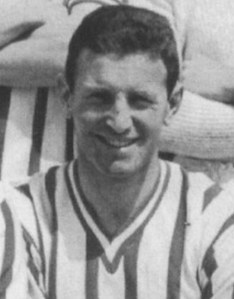
Sexton in Albion’s stripes

“All the players got on well, but a lot of what we achieved stemmed from the manager’s approach. It was a real eye-opener for me. We were a free-scoring, very attacking side and I just seemed to fit in right away and got quite a few goals. It was a joy to play with the guys that were there and I thoroughly enjoyed those two years.”

Because of the ongoing problems with his knee, he left Brighton and dropped two divisions to play for Crystal Palace, but he was only able to play a dozen games before his knee finally gave out.

“I suffered with my knee throughout my playing career,” said Sexton. “In only my second league game for Luton I went into a tackle and tore the ligaments in my right knee.

Knee trouble curtailed his Palace playing days

“I also had to have a cartilage removed. The same knee went again when I was at Palace. We were playing away at Northampton, and I went up with the goalkeeper for a cross and landed awkwardly, my leg buckling underneath me, and that sort of finished it off.”

In anticipation of having to retire from playing, he had begun taking coaching courses at Lilleshall during the summer months. Fellow students there included Tommy Docherty and Bertie Mee, both of whom gave him coaching roles after he’d been forced to quit playing.

Docherty stepped forward first having just taken over as Chelsea manager in 1961, appointing Sexton an assistant coach in February 1962. “I didn’t have anything else in mind – I couldn’t play football any more – so I jumped at the chance,” said Sexton. “It was a wonderful bit of luck for me as it meant that my first job was coaching some brilliant players like Terry Venables.”

The Blues won promotion back to the top flight in Sexton’s first full season and he stayed at Stamford Bridge until January 1965, when he was presented with his first chance to be a manager in his own right by his former club Orient.

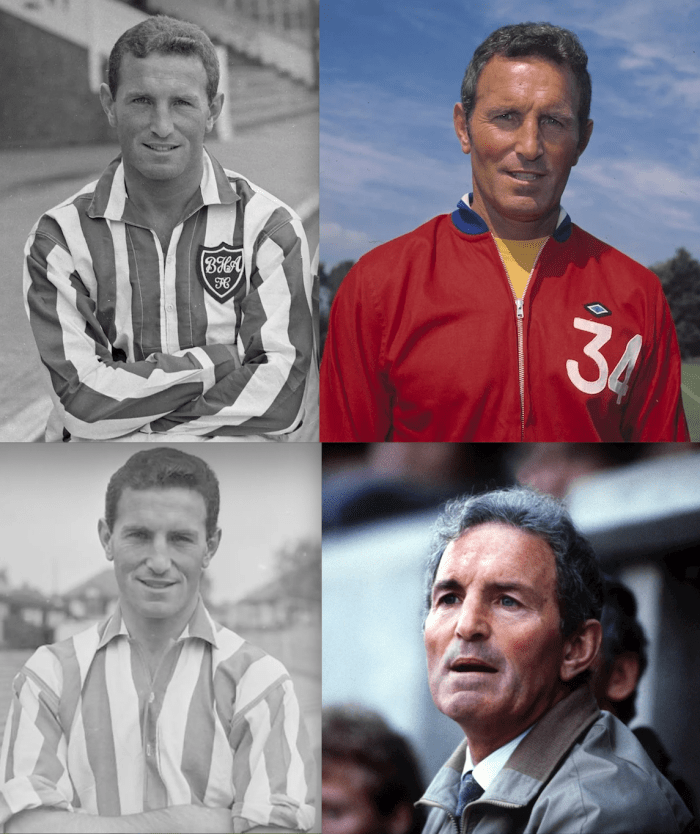
Frustrated by being unable to shift them from bottom spot of the old Second Division, Sexton quit after 11 months at Brisbane Road and moved on to Fulham to coach under Vic Buckingham, who later gave Johan Cruyff his debut at Ajax and also managed Barcelona.

Perhaps surprisingly, Sexton declared in 1993 that the thing he was most proud of in his career was the six months he spent at Fulham in 1965. “Fulham were bottom of the First Division. Vic Buckingham was the manager. He had George Cohen, Johnny Haynes . . . Bobby Robson was the captain. Allan Clarke came. Good players, but they were bottom of the table, with 13 games to go.

“I did exactly the same things I’d been doing at Orient. And we won nine of those games, drew two and lost two – and stayed up. It proved to me that you can recover any situation, if the spirit is there.”

When Arsenal physiotherapist Mee succeeded Billy Wright as Gunners manager in 1966, he turned to Sexton to join him as first-team coach. In his one full season there, Arsenal finished seventh in the league and top scorer was George Graham, a player the Gunners had brought in from Chelsea as part of a swap deal with Tommy Baldwin.
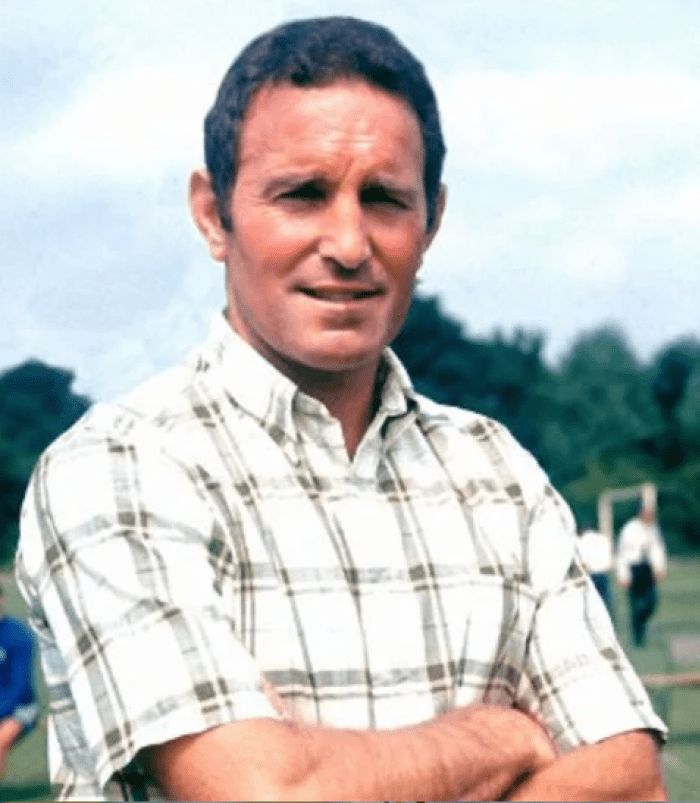
When the ebullient Docherty parted company with Chelsea in October 1967, Sexton returned to Stamford Bridge in the manager’s chair and enjoyed a seven-year stay which included those two cup wins.

In a detailed appreciation of him on chelseafc.com, they remembered: “Uniquely, for the time, Sexton brought science and philosophy to football: he read French poetry, watched foreign football endlessly and introduced film footage to coaching sessions.”

In those days Chelsea’s side had a blend of maverick talent in the likes of centre forward Peter Osgood and, later, skilful midfielder Alan Hudson. No-nonsense, tough tackling Ron “Chopper” Harris and Scottish full-back Eddie McCreadie were in defence.

As Guardian writer McOwan said: “Sexton was embraced by players and supporters for advocating a mixture of neat passing and attacking flair backed up with steely ball-winners.”

I was taken as a young lad to watch the 1970 FA Cup Final at Wembley when Sexton’s Chelsea drew 2-2 with Leeds United on a dreadful pitch where the Horse of the Year Show had taken place only a few days earlier.

Chelsea had finished third in the league – two points behind Leeds – and while I was disappointed not to see the trophy raised at Wembley (no penalty deciders in those days), the Londoners went on to lift it after an ill-tempered replay at Old Trafford watched by 28 million people on television.

Sexton added to the Stamford Bridge trophy cabinet the following season when Chelsea won the European Cup Winners’ Cup final against Real Madrid, again after a replay.

But when they reached the League Cup final the following season, they lost to Stoke City and it was said Sexton began to lose patience with the playboy lifestyle of people like Osgood and Hudson, who he eventually sold.

The financial drain of stadium redevelopment, and the fact that the replacements for the stars he sold failed to shine, eventually brought about his departure from the club in October 1974 after a bad start to the 1974-75 season.

Sexton wasn’t out of work for long after parting company with Chelsea

He was not out of work for long, though, because 13 days after he left Chelsea he succeeded Gordon Jago at Loftus Road and took charge of a QPR side that had some exciting talent of its own in the shape of Gerry Francis and Stan Bowles.

Although the aforementioned Venables had just left QPR to work under Sexton’s old Hammers teammate Allison at Crystal Palace, Sexton brought in 29-year-old Don Masson from Notts County and he quickly impressed with his range of passing, and would go on to be selected for Scotland. Arsenal’s former Double-winning captain Frank McLintock was already in defence and Sexton added two of his former Chelsea players in John Hollins and David Webb.

Sexton said of them: “The easiest team I ever had to manage because they were already mature . . . very responsible, very receptive, full of good characters and good skills. They were coming to the end of their careers, but they were still keen.”

Sexton was a student of Rinus Michels and so-called Dutch ‘total football’ – a fluid, technical system in which all outfield players could switch positions quickly to maximise space on the field.

Loft For Words columnist ‘Roller’ said: “Dave Sexton was decades ahead of his time as a coach. At every possible opportunity he would go and watch matches in Europe returning with new ideas to put into practice with his ever willing players at QPR giving rise to a team that would have graced the Dutch league that he so admired.

“He managed to infuse the skill and technique that is a hallmark of the Dutch game into the work ethic and determination that typified the best English teams of those times.

“QPR’s passing and movement was unparalleled in the English league and wouldn’t been seen again until foreign coaches started to permeate into English football.”

His second season at QPR (1975-76) was the most successful in that club’s history and they were only pipped to the league title by Liverpool (by one point) on the last day of the season (Man Utd were third).

Agonisingly Rangers were a point ahead of the Merseysiders after the Hoops completed their 42-game programme but had to wait 10 days for Liverpool to play their remaining fixture against Wolves who were in the lead with 15 minutes left but then conceded three, enabling Liverpool to clinch the title.

Married to Thea, the couple had four children – Ann, David, Michael and Chris ­– and throughout his time working in London the family home remained in Hove, to where he’d moved in 1958. They only upped sticks and moved to the north when Sexton landed the Man Utd job in October 1977.

He once again found himself replacing Docherty, who had been sacked after his affair with the wife of the club’s physiotherapist had been made public.
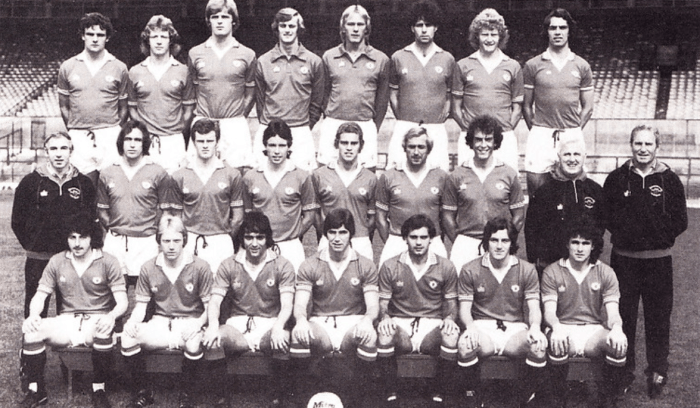
Sexton (far right) and the Manchester United squad

It was said by comparison to the outspoken Docherty, Sexton’s measured, quiet approach didn’t fit well with such a high profile club which then, as now, was constantly under the media spotlight.

The press dubbed him ‘Whispering Dave’ and although some signings, like Ray Wilkins, Gordon McQueen and Joe Jordan, were successful, he was ridiculed for buying striker Garry Birtles for £1.25m from Nottingham Forest: it took Birtles 11 months to score his first league goal for United.
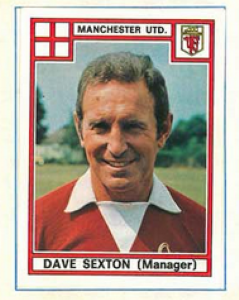
Sexton took charge of 201 games across four years (with a 40 per cent win ratio) and he steered United to runners-up spot in the equivalent of the Premier League, two points behind champions Liverpool, in the 1979-80 season. United were also runners-up in the 1979 FA Cup final, losing 3-2 to a Liam Brady-inspired Arsenal.

As he said in a subsequent interview: “I really enjoyed my time at United. You are treated like a god up there and the support is fantastic. I had mixed success but it’s something that I wouldn’t have missed for the world.

“It’s tough at the top however and while other clubs would have been quite happy in finishing runners-up, it wasn’t enough for Man Utd. That’s the name of the game and I bear no grudges over it at all.”

As it happens, Sexton’s successor Ron Atkinson only managed to take United to third in the league (although they won the FA Cup twice) and it was another seven seasons before they were runners-up again under Alex Ferguson’s stewardship.

But back in 1981, United’s loss was Coventry’s gain and their delight at his appointment was conveyed in an excellent detailed profile by Rob Mason in 2019.

The new Coventry boss saw City beat United 2-1 in his first game in charge

“By the time the name of Dave Sexton was being put on the door of the manager’s office at Highfield Road the gaffer was in his fifties and a highly regarded figure within the game,” wrote Mason. “That sprang from the style of pass and move football he liked to play. His was a cultured approach to the game and Coventry supporters could look forward to seeing some attractive football.”

One of the happy quirks of football saw his old employer take on his new one on the opening day of the 1981-82 season – and the Sky Blues won 2-1! They won by a single goal at Old Trafford that season too, but overall away form was disappointing and in spite of a strong finish (seven wins, four draws and one defeat) they finished 14th – a modest two-place improvement on the previous season.

On a limited budget, Sexton struggled to get a largely young squad to make too much progress but he did recruit former England captain Gerry Francis, who’d been his captain during heady days at QPR, and he was a good influence on the youngsters.

Sexton’s second season in charge began well but ended nearly disastrously with a run of defeats leaving them flirting with relegation, together with Brighton. One of his last league games as City manager was in the visitors’ dugout at the Goldstone. Albion beat the Sky Blues 1-0 courtesy of a Terry Connor goal on St George’s Day 1983 – but it was Sexton’s side who escaped the drop by a point. Albion didn’t.

Coventry’s narrow escape from relegation cost Sexton his job (although he remained living in Kenilworth, Warwickshire) and it proved to be his last as a club manager, although he was involved as a coach when Ron Atkinson’s Aston Villa finished runners up in the first season (1992-93) of the Premier League – behind Ferguson’s United, who won their first title since 1967.

Villa beat United at home and nicked a point at Old Trafford and ahead of the drawn game Richard Williams of The Independent dropped in on a Villa training session to interview Sexton.

Sexton was happy to be working with the youth team, the young pros and the first team. “Mostly I’ve been concerned with movement, up front and in midfield. Instead of the traditional long ball up to the front men, approaching the goal in not such straight lines,” he explained.

The quiet Sexton had a valid retort to the reporter’s surprise that he should be working in the same set-up as the flamboyant Atkinson. “It’s like most stereotypes,” he said. “They’re never quite as they seem to be. Ron’s got a flamboyant image, but actually he’s an idealist, from a football point of view.

“He’s got a vision, which might not come across from the stereotype he’s got. I suppose it’s the same with me. I’m meant to be serious, which I am, but I like a bit of fun, too. And, obviously, the thing we’ve got in common is a love of football.”
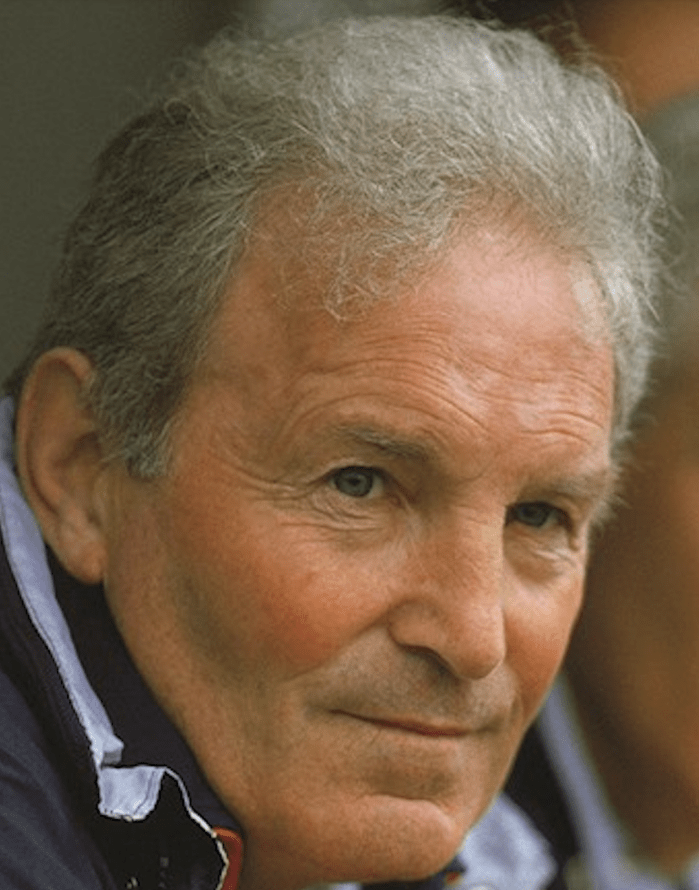
Relieved to be more in the background than having to be the front man, Sexton told Williams: “The reason I’m in the game in the first place is that I love football and working with footballers, trying to improve them individually and as a team.

“So, to shed the responsibility of speaking to the press and the directors and talking about contracts, it’s a weight off your shoulders. Now I’m having all the fun without any of the hassle.”

Atkinson had invited his United predecessor to join him at Villa after he had retired from his job as the FA’s technical director of the School of Excellence at Lilleshall, and coach of the England under 21 team.

It had been 10 years since Bobby Robson had appointed him as assistant manager to the England team (Sexton had coached Robson at Fulham). He had previously been involved coaching England under 21s alongside his club commitments since 1977 leading the side to back-to-back European titles in 1982 and 1984. The 1982 side, who beat West Germany 5-4 on aggregate over two legs, included Justin Fashanu and Sammy Lee, and in a quarter final v Poland he had selected Albion’s Andy Ritchie, somewhat ironically considering he had sold him to the Seagulls when manager at United.

In April 1983, Albion’s Gary Stevens played for Sexton’s under 21s in a European Championship qualifier at Newcastle’s St James’ Park, which was won 1-0. The following year, Stevens, by then with Spurs, was in the side that met Spain in the final, featuring in the first of the two legs, a 1-0 away win in Seville. Somewhat confusingly, his Everton namesake featured in the second leg, a 2-0 win at Bramall Lane. England won 3-0 on aggregate. Winger Mark Chamberlain, later an Albion player, also played in the first leg.

After the Robson era, Sexton worked with successive England managers: Venables, Hoddle and Keegan. When Eriksson became England manager in 2001, he invited Sexton to run a team of scouts who would compile a database and video library of opposition players – a strategy Sexton had pioneered three decades previously.

Viewed as one of English football’s great thinkers, Sexton had a book, Tackle Soccer, published in 1977 but away from football he had a love of art and poetry and completed an Open University degree in philosophy, literature, art and architecture. He was awarded an OBE for services to football in 2005.

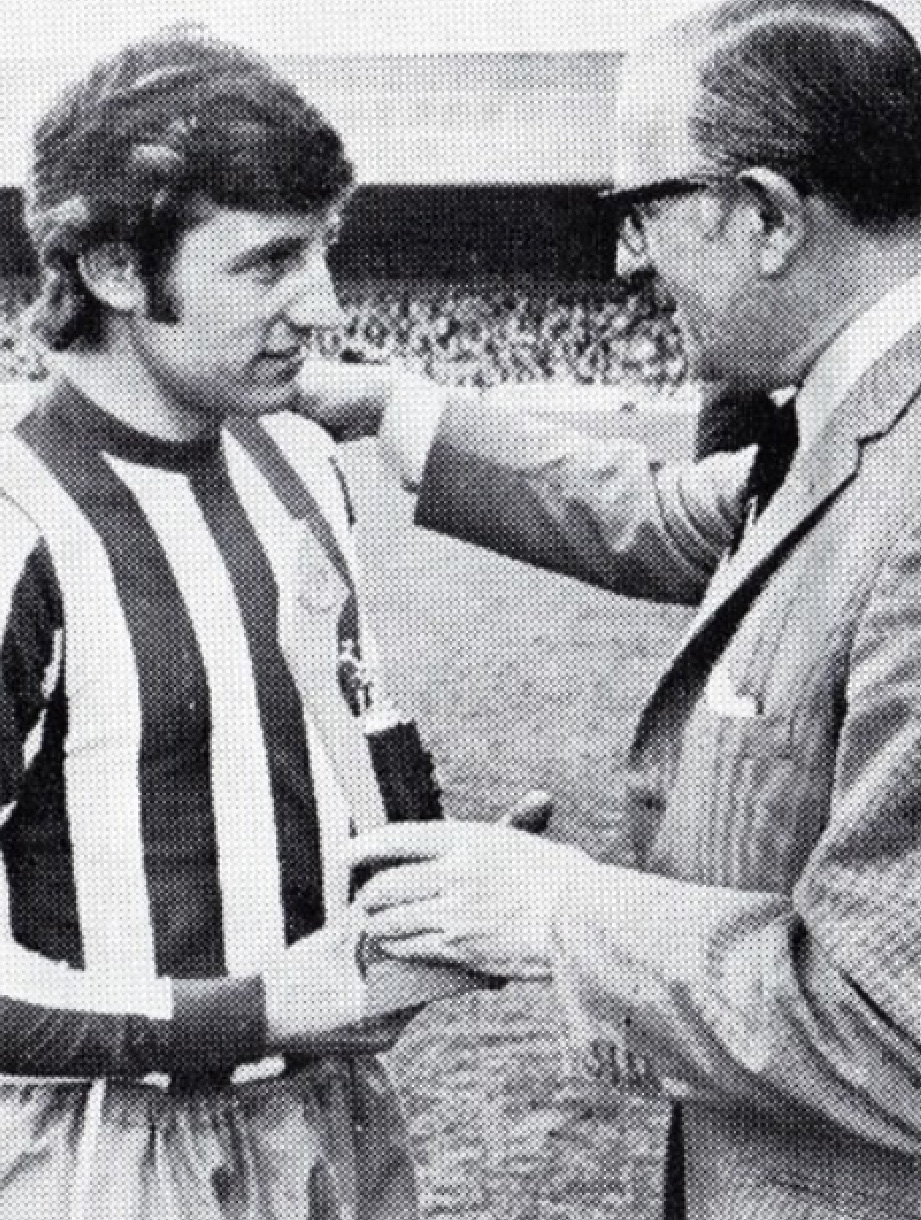
Sexton was always a welcome guest at Brighton and here receives a reminder of past glories from Dick Knight

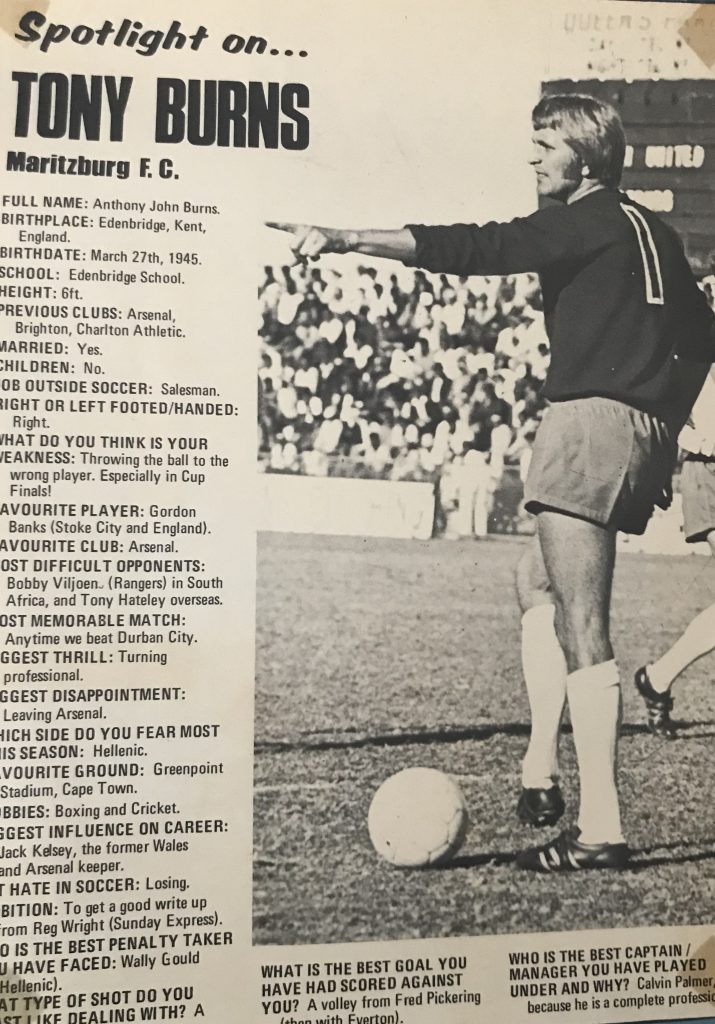
Tony Burns handled the art of goalkeeping for decades

A GOALKEEPER with film star looks signed for Brighton from Arsenal just after England lifted the World Cup.

Tony Burns had kept goal for the Gunners in 31 top-flight matches and Albion boss Archie Macaulay, who had played for Arsenal himself, went back to his old club to sign a no.1 to challenge the emerging local lad, Brian Powney.

It wasn’t difficult for Burns to settle at the Goldstone because the dressing room included Northern Irish full-back Jimmy Magill and winger Brian Tawse, familiar faces from his time in north London who’d also made the switch to Brighton.

It also wasn’t long before female fans who admired his smouldering good looks were sending in letters to the office inquiring about his eligibility!

Burns relived his career in detail in 2020 when interviewed by 17-year-old would-be journalist Jed Vine, who watches games at the Amex with his mother, and games at the Emirates with his dad.

Born in Edenbridge, Kent, on 27 March 1944, Burns first showed his goalkeeping prowess during his schooldays in the town before he joined Southern League club Tonbridge (now Tonbridge Angels) who he returned to twice more and later managed three times.

He made his Southern League debut against Yiewsley (later to become Hillingdon Borough) in February 1963 and only his third game for Tonbridge was as an 18-year-old against Arsenal at Highbury.

With long term custodian Jack Kelsey retiring, Arsenal were looking around for likely successors and, liking what they saw of Burns, offered him a contract.

“In his early days at Highbury, he showed immense potential and, after benefitting from Kelsey`s coaching, made encouraging strides,” a 2020 Pitching In piece for the Southern League recalled.

Manager Billy Wright gave him his senior Arsenal debut in a friendly against Enschede in Holland in August 1963, with Magill in defence, and he got his first taste of South Africa on a five-game tour the following May when he was in goal for Arsenal’s 5-1 win over a Western Province XI and their 6-0 win over an Eastern Province XI.

But his big breakthrough came when he made his league debut in a 3-2 home win over Burnley in October 1964 (three days earlier he’d played in goal in a 7-0 friendly win over non-league Corinthian Casuals).

“I felt on top of the world. I had always wanted to play for the Gunners and here I was keeping goal for them, and on the winning side at that,” he told the Albion matchday programme. “There’s only one first match and I’ll never forget this one.”

Once he got the shirt, he had a run of 26 games (32 including friendlies) from October 1964 through to the end of March 1965.

He generally played in front of a defence featuring the likes of Don Howe, Frank McLintock and Ian Ure with John Radford and Joe Baker up front.

During the first half of the 1965-66 season, Burns appeared in seven league games and three friendlies, but his final Gunners first team appearance came on 27 December 1965 in a 4-0 defeat away to Sheffield Wednesday.

Jim Furnell was Wright’s preferred first choice, and, as the season wore on, the emerging Bob Wilson was getting the nod ahead of him as stand-in (although it wasn’t until 1968 that Wilson finally ousted Furnell).

Disappointed to leave, Burns nonetheless went in search of regular football by joining Third Division Brighton for £2,000 in July 1966.

He made his first appearance for the Albion on 17 September 1966, when he took over from the injured Powney, but Brighton went down 2-0 to Grimsby Town.

Powney returned the following week and Burns had to wait until January for his next games – two FA Cup ties against Aldershot.

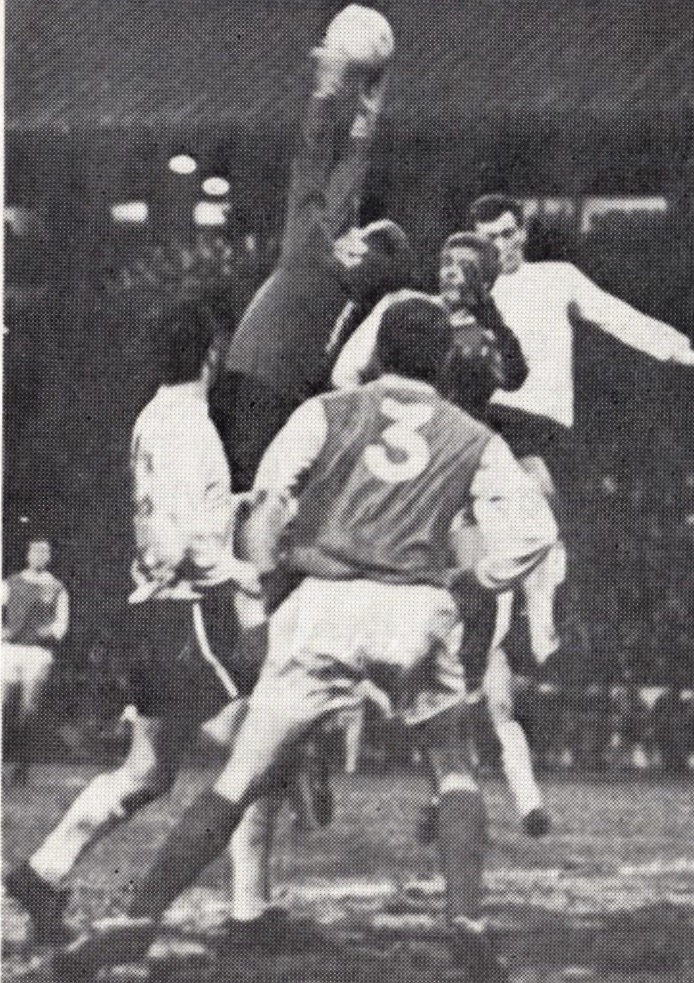
Burns in action versus Chelsea

He kept his place for the big fourth round FA Cup game against First Division Chelsea at the Goldstone which finished 1-1 when his former Arsenal teammate Tawse controversially had what he thought was a cracking late winner ruled out for a foul by Kit Napier.

Unfortunately, Burns conceded four in the replay at Stamford Bridge as the superior Chelsea side made the most of home advantage to ease their way through comfortably, 4-0. That was the season they went all the way to the final only to lose 2-1 to Tottenham Hotspur, whose ranks included Alan Mullery and Joe Kinnear.

By the end of the season, Burns had played 18 matches against Powney’s 37. But Burns had the upper hand in 1967-68 featuring in 29 games compared to Powney’s 21.

He also started the 1968-69 season as first choice but his 54th and final game for the Albion was in the 2-1 home defeat to Northampton in the second round of the FA Cup on 20 December 1968.

New manager Freddie Goodwin brought in former Wolves and Aston Villa ‘keeper Geoff Sidebottom to challenge Powney and let Burns leave on a free transfer in March 1969.

He joined Charlton Athletic, where he made 10 appearances in their unsuccessful tilt at promotion, but declined what he saw as a derisory contract offer. He returned to Tonbridge briefly and in January 1971 headed off to play in South Africa, initially for Durban United, and later, Maritzburg.

In his interview with Jed, he recalls playing in an English All Stars team managed by Malcolm Allison who invited him to return to England with Crystal Palace when his contract was up.

Burns made the move in October 1973 after previous Palace no.1 (and later Albion youth coach) John Jackson had moved to Orient.

He shared goalkeeping duties with Paul Hammond, playing a total of 90 matches between the sticks for Palace over the next four years under Allison and his successor Terry Venables.

In 1977, Burns played half a dozen games on loan for Brentford before heading off to the States like a lot of ageing players did at that time.

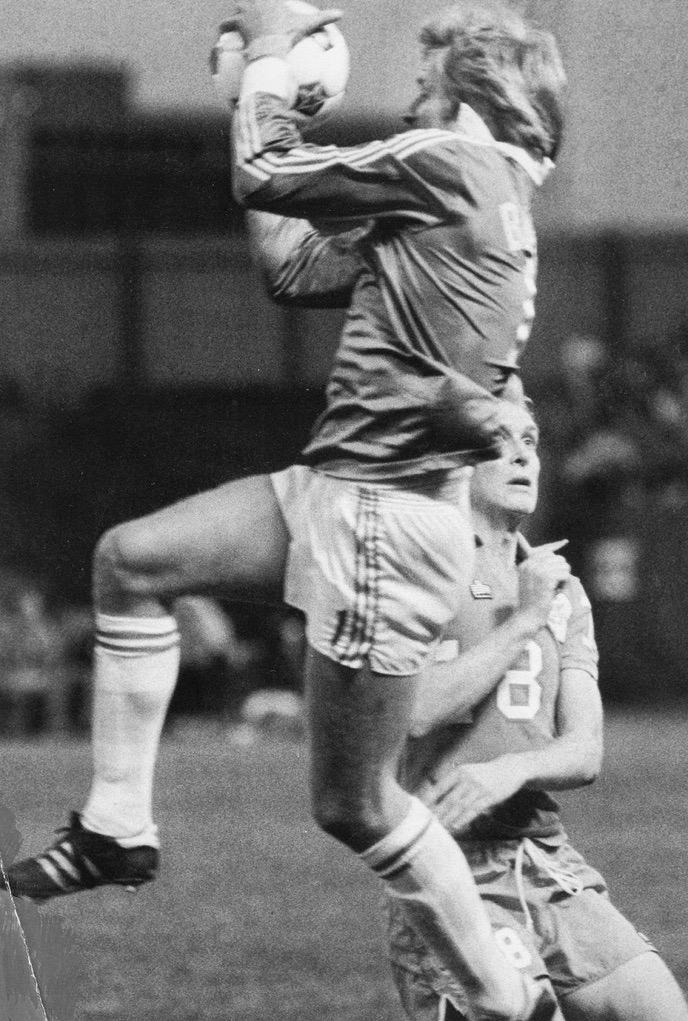
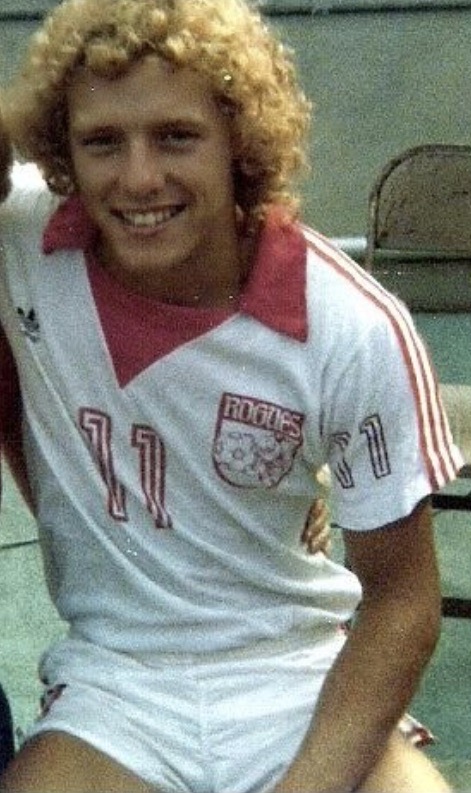
The ‘keeper played a dozen games for Memphis Rogues in the North American Football League. They were coached by former Chelsea defender and manager Eddie McCreadie although Burns had gone there to team up with former boss Allison who was sacked without a ball being kicked because he hadn’t signed enough players!

Burns played for Memphis Rogues in the USA

Among Burns’ teammates were a young Neil Smillie, who’d been struggling for games at Palace, Phil Beal, who had left Brighton the year before, John Faulkner, the one-time Leeds and Luton defender, and the flamboyant Alan Birchenall, beloved by Leicester City supporters of many generations.

Back in the UK in 1978, Burns joined Plymouth Argyle as cover for Martin Hodge, and ended his league playing days in this country appearing in 11 games in the first half of the 1978-79 season.

However, he left Home Park to rejoin Tonbridge Angels for a third time and he also played for Hastings United and Dartford.

After his playing days were over, Burns had three spells in charge of Tonbridge, from August 1980 to December 1982, August 1989 to May 1990, and in a caretaker role from November 2001 to May 2002 (by which time he was goalkeeping coach at Millwall, who he joined in 1992 under Mick McCarthy.

Burns served as goalkeeper coach under several Millwall managers.
Picture: Brian Tonks.

He also spent seven years as manager of Gravesend and Northfleet (who became Ebbsfleet United) between 1982 and 1989.

But it was at Millwall where he finally found a permanent home, working under no fewer than 18 different managers, including Steve Gritt and Mark McGhee.

He was even at the helm himself for a while, working as co-caretaker manager with former Lions boss Alan McLeary after Dave Tuttle’s departure in April 2006, when Millwall’s relegation had already been confirmed.

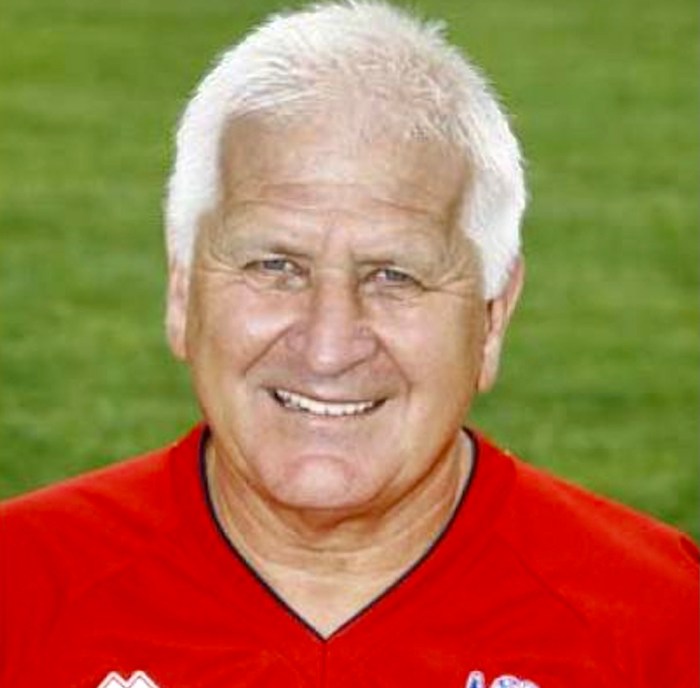
The appointment of Nigel Spackman the following month led to Burns’ departure in July 2006, when he took up a similar role at his old club Palace, working under former Albion boss Peter Taylor coaching Julian Speroni and Scott Flinders.

Goalkeeping coach at Palace under Peter Taylor

He left Selhurst in November 2007 when Taylor lost his job, and Speroni told yourlocalguardian.co.uk: “It was sad to lose Tony Burns because we worked well with him. During last season when I wasn’t playing regular football, Tony was the one who kept me going which was very important.”

Burns moved with Taylor to Conference side Stevenage Borough but later returned to Millwall under Kenny Jackett before stepping down in 2012, when he was succeeded by Kevin Pressman.

Still, he wasn’t finished with the game, though, and at the age of 70, in the summer of 2014, he teamed up with Taylor yet again to become goalkeeping coach at Gillingham. He joined them on a part-time non-contract basis as a replacement for Carl Muggleton.

Boylers’ service appreciated both sides of the Atlantic

MIDFIELD enforcer John Boyle was born on Christmas Day 1946 and went on to play more than 250 games for Chelsea.

Towards the end of his career, he spent two months on loan at Brighton trying to bolster the Albion’s ailing midfield in the dying days of Pat Saward’s spell as manager.

Indeed, Boyle was in that unenviable position of being at the club when the manager who brought him in was turfed out, and the man who replaced him (in this case none other than Brian Clough) swiftly dispensed with his services and sent him back to Chelsea.

By then, Boyle’s time at Chelsea was at an end and, after his 10-game Goldstone spell was also over, he went the shorter distance across London to play for Orient, before ending his playing days in America with Tampa Bay Rowdies.

Born in Motherwell, Boyle went to the same Our Lady’s High Secondary school that spawned Celtic greats Billy McNeill and Bobby Murdoch and, just around the time he turned 15, his stepbrother, who lived in Battersea, organised through a contact they had with then boss Tommy Docherty for him to go down to London for a trial.

He did enough to impress and 10 days later Chelsea sent him a letter inviting him to join their youth team, together with the train ticket from Motherwell to London.

“When I got off the train, Tommy Doc was waiting for me to take me to my digs,” Boyle told chelseafc.com in a recent interview. “I stayed in the digs that Bobby Tambling and Barry Bridges had stayed in before.”

Boyle – known to all as ‘Boylers’ – made his debut in the 1965 League Cup semi-final against Aston Villa and, at 18, it couldn’t have been much more memorable.

“I played on Monday in a Scottish youth trial and Wednesday I was playing against Aston Villa in the semi-final of the League Cup,” Boyle recounted. “After 20 odd minutes, I tackled this guy and he got injured and carried off. The crowd then booed me, he limped back on and then the crowd booed me more!

“It went to 2-0, to 2-2 and then with about 10 minutes to go I got the ball 30 yards out, rolled it forward and went crack and it went into the top corner of the net. I remember Terry Venables ran up to me and said ‘John, I am so pleased for you,’ and that was my first game. To score the winning goal in your first game was Roy of the Rovers stuff.”

He went on to become Chelsea’s youngest ever cup finalist when he was in the team that won the trophy. In those days, it was played over two legs, and, after beating Leicester City 3-2 in the home game, they drew the away leg 0-0. His teammates in the second leg were Bert Murray and the aforementioned Bridges, who he would go on to play alongside at Brighton in 1973.

The Goldstone Ground was familiar territory to him. On 18 February 1967, he was famously sent off for the visitors in a FA Cup 4th round tie when Albion held their more illustrious opponents to a 1-1 draw in front of a packed house. Chelsea went on to win the replay 4-0 and that year went all the way to the final where Boyle was part of the side who lost 2-1 to Spurs. In another fiery FA Cup tie between Brighton and Chelsea, in January 1972, Boyle was Chelsea’s substitute as they won 2-0 in a game which ended 10 a side, George Ley and Ron Harris being sent off.

john boyle chels blueWhen Docherty moved on from Stamford Bridge, and Dave Sexton took over as manager, Boyle’s involvement in the side was more sporadic, as he told fan Ian Morris on his Rowdies blog.

“Dave appreciated my energy and willingness, but I don’t think he really fancied me as a player. Basically, I became an odd-job man, filling in here and there, and in football it doesn’t help to get that reputation,” he said.

Although he wasn’t in the squad that beat Leeds in the 1970 FA Cup Final, he was back in the side when Chelsea beat Real Madrid over two legs in May 1971 to win the European Cup Winners’ Cup.

After Brighton’s disastrous 1972-73 season in the second tier – the general consensus is that they’d not properly been prepared for promotion and didn’t invest sufficiently in the team to have a fighting chance of staying up – the side continued to be in the doldrums as they adjusted to life back in the old Third Division.

Manager Saward was struggling to come up with the right formula and, having transferred former captain Brian Bromley to Reading, sought to boost his midfield with the experienced Boyle, who was surplus to requirements at Stamford Bridge.

With the paperwork signed on 20 September, Boyle was handed the no.8 shirt and made his debut alongside Ronnie Howell in a 0-0 draw away to Grimsby Town.

He made his home debut the following Saturday, but the Albion went down 1-0. Three days later, this time partnering Eddie Spearritt in the middle, Boyle helped Albion to a 1-0 win at Oldham Athletic.

After a 3-1 defeat away to Blackburn Rovers, at home to Halifax Town Boyle had a new midfield partner in John Templeman. But again they lost by a single goal.

With Howell back alongside him for the home game v Shrewsbury Town, Albion prevailed 2-0 in what turned out to be Saward’s last game in charge. Perhaps by way of another interesting historical note, Boyle was subbed off to be replaced by Dave Busby, who became the first black player to play for the Albion.

Caretaker boss Glen Wilson retained Boyle in midfield for the midweek 4-0 hammering of Southport and he was also in the line-up for Clough’s first game in charge, a 0-0 home draw against York City on 3 November. But the 2-2 draw away to Huddersfield Town on 10 November was his last game for the Albion.

As someone who’d gained something of a reputation as enjoying the social side of things at Chelsea, particularly with the likes of Peter Osgood, Charlie Cooke and Alan Birchenall, it maybe doesn’t come as too big a surprise to learn that Clough advised him “always buy two halves instead of a pint, or people will think you’re a drinker”.

Boyle was still only 28 when he tried his hand in Florida in February 1975, being appointed Tampa Bay Rowdies captain, and leading them to victory in the Super Bowl against Portland Timbers in August that year.

His former Chelsea teammate Derek Smethurst scored 18 goals in that inaugural season, playing up front alongside ex-West Ham striker Clyde Best, while former Crystal Palace ‘keeper Paul Hammond was in goal.

A newspaper article about Boyle’s contribution resides on tampapix.com, a hugely entertaining site featuring loads of players of yesteryear who turned out for the Rowdies.

It somewhat flamboyantly says: “‘Captain Rowdie’ John Boyle was a barrel-chested midfielder with legs as white as snow and hair as thin as a wheat crop during a summer drought.  He became the role model for the club, as much because of his leadership as well as the fact that he knocked opponents ‘grass-over-tea kettle’ when they came his way.”

He retired from playing in November the same year but, two years later, he stepped in as Rowdies coach when Eddie Firmani quit. However, he had also gone into the pub business in the UK and ultimately the need to be behind the bar at Simon the Tanner in Bermondsey, with his wife Madeline, meant he had to turn his back on the sunshine state and return to London.

Unable to resist the lure of the States once more, Boyle played five matches for indoor league side Phoenix Inferno in the 1980-81 season.

In that wide-ranging interview Boyle gave to chelseafc.com earlier this year, he said: “I wouldn’t change a thing in my life, I am just grateful for what I have done. I have been blessed and one of the great things about it is 50 years later you can still talk about it! I was a lucky young man to have played when I did and meet the people I did.”


Teenage Teddy Maybank’s Chelsea promise dashed by injury at Brighton

TEDDY MAYBANK signed for the Seagulls for what at the time was a club record transfer in November 1977 and went on to score Brighton’s first ever top division goal.

But the new signing came in for some flak from the terraces and, over two years, never really delivered a significant return on the investment.

Maybank himself reckons the club forced him to play on with an injured knee when he shouldn’t have, which led to irreparable damage and ultimately a premature end to his career.

The former Chelsea centre-forward was signed to replace Ian Mellor, Peter Ward’s prolific strike partner in the 3rd Division, after Brighton had won promotion to the second tier.

“We let Ian Mellor go because we felt that he had reached a certain age and had probably peaked,” Alan Mullery told Matthew Horner, in his Peter Ward biography, He Shot, He Scored. “When Teddy Maybank became available, we thought that he was probably a better option.”

Born in Lambeth on 11 October 1956, Maybank lived the first 15 years of his life in Brixton and went to Christchurch Primary School, close to his home, where one of his playground footballing mates was Ray Lewington — now loyal deputy to Roy Hodgson — who, together with Maybank, went on to play for Chelsea and Fulham.

At the age of 11, Maybank moved to Stockwell Manor Secondary School and played various age group levels for South London Boys. One of the representative matches he played in took place at the Goldstone Ground on 25 September 1971, against Brighton Boys.

The Maybank family moved to Mitcham, close to the Chelsea training ground, and, when Teddy was 15, he joined them straight from school.

Maybank and Lewington progressed through Chelsea’s youth ranks at a time when the club’s focus was on bringing through home-grown talent. “It was a good time at Chelsea,” he said. “We had such a good youth side and I loved playing under Ken Shellito.”

That team, which won the South-East Counties Championship four years in a row, included Ray and Graham Wilkins, Lewington and John Sparrow.

Maybank’s first-team debut came in a 2-0 defeat at Tottenham Hotspur in April 1975 aged just 18, and he scored in only his second game, a 1-1 home draw against Sheffield United, but Chelsea were relegated from the top division that year.

The following campaign saw Maybank, still a teenager, become a first-team regular under Eddie McCreadie, grabbing five goals in 26 appearances between August and February.

After falling out of favour, he went out on loan to Fulham just before Christmas 1976 and then signed permanently for a £65,000 fee later that season.

Back in the ‘70s, Chelsea were a long way from the force they are now and Maybank admitted: “I wouldn’t say I ever played that well at Chelsea. I didn’t find it easy to score goals there.”

It was a different story at Craven Cottage. After scoring more than a goal every other game – 17 times in 31 games – Maybank was sold to Brighton for £238,000, which gave Fulham a swift and substantial profit that they used to pay off money owed on their recently-built Eric Miller Stand (now, the Riverside Stand).

                     Blond locks flying, Maybank comes up against QPR’s Dave Clement in a 1978  pre-season friendly. (Above right) This overhead kick against Sunderland at The Goldstone scraped the bar … otherwise would have been a Goal of the Season candidate!

Maybank made a good enough start for the Seagulls, scoring after just six minutes on his debut in a 2-2 home draw with Blackburn Rovers, played on a bitterly cold day in front of a crowd of 26,467. Tony Towner scored the Albion’s other goal and another debutant in that game was tough-tackling midfield player, Paul Clark.

Maybank was on the scoresheet again in the very next game as Albion recorded their first ever win, 1-0, at Blackpool.

It was in a game against Orient a week before Christmas that Maybank got a kick on his knee from defender Dennis Rofe (who later played for Leicester and Southampton) which caused an injury which he maintains wasn’t properly managed by the club.

He told fulhamfc.com in 2013: “They kept giving me injections, taking all the fluid out every Sunday after the game.

“I was barely training. I could run in a straight line but any time I put weight on my leg I would fall over. I wouldn’t feel any pain because of the injections, but I just fell over.”

The Brighton fans thought they had bought Bambi and were soon on his back, leading to a “pretty terrible time” that Maybank never really recovered from.

“The club should never ever have allowed me to play in that situation,” he said. “A surgeon saw me outside of the club, opened me up and said: ‘if you ever play football again, you’ll be the luckiest bloke in the world’.

“Brighton had told me, basically, that I couldn’t do any more damage. They wouldn’t do it now, but because I was the highest transfer fee they ever paid, they didn’t really take my welfare into consideration at all. In the end, it ruined my career.”

                      Shoot! article and (above right) Maybank goes full length to head the second of  his three goals against Cardiff on Boxing Day 1978.

In an article in Shoot! magazine at the time, Maybank talked about how he hadn’t had the best of starts with his new club. He said: “I wasn’t playing well. I knew that. My early form was a disappointment to the fans. They expected me to come in and start scoring regularly and doing incredible things.

“It’s always hard when you change clubs and you need a while to settle in. I have to adjust to my new team-mates but they’ve also had to change and adapt to playing with me.”

Mansfield were trounced 5-1 at the Goldstone on 21 January 1978 when Peter Ward shone with a hat-trick. Maybank also got one, but it was his last of the season. He made only six more appearances between January and the end of the season and new signing Malcolm Poskett seized his chance alongside Ward.

Albion narrowly missed out on promotion (by goal difference) and during the close season Maybank went under the knife for a cartilage operation.

Fit for the new season, Maybank was among the goals as Albion beat Millwall 4-1 at The Den on 2 September. He got a brace that day but in the same month was in trouble with the manager who’d had an anonymous tip-off that the star striker and Welsh international winger Peter Sayer had been seen in a nightclub on the eve of what turned out to be a 4-1 defeat by Leicester City.

Mullery made an example of the pair and they were both ‘persuaded’ to donate a fortnight’s wages to the local Guide Dogs for the Blind Association.

On the pitch, the goals dried up for Maybank until Boxing Day when he netted a hat-trick in a 5-0 win over Cardiff City. In an Albion matchday programme in 2015-16, Maybank admitted to Spencer Vignes: “The crowd started getting on my back, and I got in a pretty dark place.

“When I got that hat-trick, I went from villain to hero and yet it had got so bad that the day before Alan Mullery picked the squad I’d told him I never wanted to play for the club again.

“From the changing room before a game, I used to hear the crowd boo my name when the team was read out over the tannoy.”

In total, Maybank scored 10 times as Albion won promotion, and he was leading the line in the famous promotion-clinching 3-1 win at Newcastle on 5 May 1979.

In that season’s Rediffusion Player of the Year competition, Maybank finished third behind winner Mark Lawrenson and runner-up Brian Horton.

In much the same way Pascal Gross was feted for scoring Brighton’s first-ever goal in the Premiership, so Maybank scored the Albion’s very first goal in the top division.

After being hammered 4-0 by Arsenal in the opening fixture at the Goldstone, the Seagulls were away to Aston Villa in the second game.

                      Arms aloft, Maybank celebrates Albion’s first ever top division goal with skipper Brian Horton and Peter O’Sullivan. (Above right) Maybank battles with Arsenal’s David O’Leary watched by John Hollins and O’Sullivan.

Latching on to a John Gregory through pass and, with the very last kick of the first half, Maybank buried a shot past ‘keeper Jimmy Rimmer.

Albion lost the game 2-1 but the national newspapers were full of praise for the newcomers to the division.

Frank Clough in The Sun wrote: “Teddy Maybank and Peter Ward tore great holes in Villa’s jittery defence and were only stopped by inadequate finishing and fine goalkeeping by Rimmer.”

It was the first of three Maybank goals at the top level, but, according to Ward, the striker had a big falling out with Mullery. The manager brought in Ray Clarke as his first choice centre-forward and, in December 1979, Maybank was sold back to Fulham for £150,000.

He had scored a total of 16 goals in 64 appearances for the Seagulls, less than half the ratio he’d been scoring when bought.

After just 19 games for Fulham, Maybank joined Dutch side PSV Eindhoven for £230,000 in August 1980 (Fulham making another tidy profit on the player).

His debut for the Dutch giants came in front of a packed house at the Nou Camp, where Barcelona were staging a four-team tournament with Vasco da Gama and River Plate.

However, only a few games later his knee flared up again.

“They opened me up and saw what a state my knee was in,” Maybank explained in that 2013 interview with fulhamfc.co.uk. “I was told in no uncertain terms that if I didn’t retire I would be playing with the youth team or reserves. I think they thought they’d been taken for a ride.”

Maybank was left with no choice. At the age of 24, he retired from the game.

Pictures from my scrapbook sourced from Shoot! magazine and the matchday programme.

Winger Neil Smillie was a Wembley winner eventually

NS v MU Wemb

AN UNSUNG hero of Brighton’s 1983 FA Cup Final side, winger Neil Smillie, had the distinction of being the first ever apprentice the legendary Malcolm Allison signed for Crystal Palace.

Big Mal had enjoyed league and FA Cup success at Manchester City as Joe Mercer’s sidekick but he swept into Palace in the early 70s as a boss in his own right, courting publicity with his flamboyant fedora hat and giant cigar.

Smillie admitted: “I was going to West Ham but Allison persuaded me to take a look at Palace.

“The place was so alive and vibrant under him that I went there instead.”

Born in Barnsley on 19 July 1958, Neil followed in the footsteps of his dad, Ron, a former professional who played for Barnsley and Lincoln.

After joining Palace in 1974, Smillie turned professional a year later and was on Palace’s books for seven years, although he had three loan spells away from Selhurst.

In 1977, he went briefly to Brentford, who he ultimately would have a long association with later in his career.

Smillie MemphisThe following two years, he went to play in America for Memphis Rogues (pictured left) where his teammates were players from the English game winding down their careers: the likes of former Albion players Tony Burns and Phil Beal, ex-Chelsea, Leicester and Palace striker Alan Birchenall and former Chelsea winger Charlie Cooke; the side being managed by former Chelsea defender Eddie McCreadie.

At the end of the 1981-82 season, Smillie was denied a pay rise by Palace so he decided to quit and wrote letters to clubs in the top two divisions in England asking for a job!

Brighton had managed to offload the troublesome Mickey Thomas to Stoke City so had a need for a left winger. They were the first to come up with an offer, and with full back Gary Williams surplus to requirements since the arrival of experienced defender Sammy Nelson, Brighton offered him in exchange for Smillie.

The bubble-haired winger gratefully accepted the switch to the Seagulls. While he made the starting line-up for the opening game of the new season, a heavy (5-0) defeat away at West Brom in the next game then saw him dropped and sidelined for months.

It was only once ultra-cautious manager Mike Bailey had left that Smillie got back in contention, and only then – in January 1983 – through someone else’s misfortune.

He said: “I was out in the cold and only got my break when Giles Stille was injured during the Cup game against Newcastle United.”

Smillie seized his opportunity and remained in the side for the rest of the season, culminating in the two Wembley FA Cup Final matches against Manchester United.

Back in the second tier following Brighton’s relegation, Smillie played 28 games plus once as a sub but following new manager Chris Cattlin’s signing of Northern Irish winger Steve Penney, there was competition in the wide areas.

Throughout the 1984-85 campaign, Smillie was more often than not a substitute rather than a starter. He did manage a seven-game run of appearances in the late autumn and began the final three games of the season, but the last game, a 1-0 home win over Sheffield United, proved to be his farewell.

Smillie revealed in a 2003 interview with Spencer Vignes that he’d discovered Manchester City had been keen to take him on loan but Cattlin hadn’t sanctioned it, even though he wasn’t selecting him.

“Chris had turned them down, saying I was a good player and he needed me. Yet he wasn’t even playing me! I just couldn’t believe he’d done it,” he said. Although he and his family were settled in Sussex, he realised he had to move.

Several eyebrows were raised when Cattlin managed to secure a £100,000 fee from Watford for Smillie’s services in the summer of 1985. The winger joined Graham Taylor’s beaten FA Cup finalists but he failed to establish himself in the side and made just 16 first team appearances in a season with the Hornets.

In the summer of 1986, he moved on to Reading for two years and, in 1988, after his disappointment with Brighton, Smillie was finally a winner at Wembley, scoring and setting up two goals as Reading beat Luton 4-1 in the Simod Cup Final.

The Hatters were led by former Albion captain Steve Foster and another of Smillie’s former teammates, Danny Wilson, was in their midfield. Mick Harford scored the opening goal for Luton, but Smillie’s pass allowed Michael Gilkes to bundle home an equaliser.

Smillie then won a spot kick converted by Stuart Beavon, and, in the second half, Mick Tait swept home another Smillie assist. Smillie then rounded off a great afternoon by scoring himself. It was hailed as one of the best days in Reading’s history, witnessed by over 45,000 loyal Royals fans.

Nevertheless, Smillie didn’t hang around and instead joined Brentford, where his former Palace teammate Phil Holder was assisting the manager at the time, Steve Perryman.NS Bees

Nick Bruzon interviewed Smillie in depth for a Where are they now? feature on the Brentford FC website in July 2010.

“Representing Brentford over three different decades, initially on loan in 1977 and then for five years from 1988 to 1993, Neil Smillie combined raw pace with ceaseless energy to make him one of the most popular players to patrol the New Road touchline,” said Bruzon. “Whilst with Brentford he experienced promotion, relegation and play off heartbreak, scoring 18 goals in 185 games.”

Smillie said: “I’ve got to say, the five years I spent at Brentford (and I was 30 when I signed) I thoroughly enjoyed.

“I’d reached a point in my career where I felt comfortable in terms of what I could give on the pitch. I’d always been a hard worker and I got the feeling that the supporters appreciated someone who worked hard.”

In the 1992-93 season, he played alongside Chris Hughton, who, like Smillie, was winding down his playing career.

“I loved taking people on and I loved getting crosses in for people to score so that just seemed to fit in nicely at the time with the team that we had,” he said. “I played my part as well as others who played theirs in getting the ball to me. We all did our bit and for me it was a great part of my career.”

On leaving Brentford, Smillie became a player-coach at Gillingham when his old Palace teammate Mike Flanagan was the manager. When Flanagan was sacked, Smillie took over the managerial reigns on a caretaker basis while the club tried to stabilise during financial troubles.

Smillie told Bruzon: “We were in a fairly precarious position and ended up in a decent position. So there was some enjoyment to it but the situation at a club without any money and struggling was difficult.”

Some names familiar to Brighton fans were at Gillingham at the time. Smillie played up front with Nicky Forster. Paul Watson was in defence and Richard Carpenter in midfield.

His three-month reign came to an end when Gillingham appointed Tony Pulis as the new manager and former Palace manager Alan Smith took Smillie to Wycombe Wanderers to look after their youth team.

When Smith left, Smillie was caretaker manager until former Albion full back John Gregory got the managerial post. Smillie then became Gregory’s successor in the hot seat for a year.

When the inevitable sack came, Smillie stepped outside of day to day running of football to become sports marketing manager for Nike in the UK. His role was to identify emerging talent for Nike to associate themselves with, and, as a result he stayed in touch with the game.

Among the players he signed to Nike were Theo Walcott, Darren Bent, Gabby Agbonlahor, James Milner, Tom Huddlestone, Danny Welbeck and Johnny Evans.

Pictures show (top) Smillie in action on the cover of the Albion programme; walking his dog; in Match magazine, on the cover of Shoot! being tackled by Liverpool’s Sammy Lee; a Simod Cup winner with Reading.

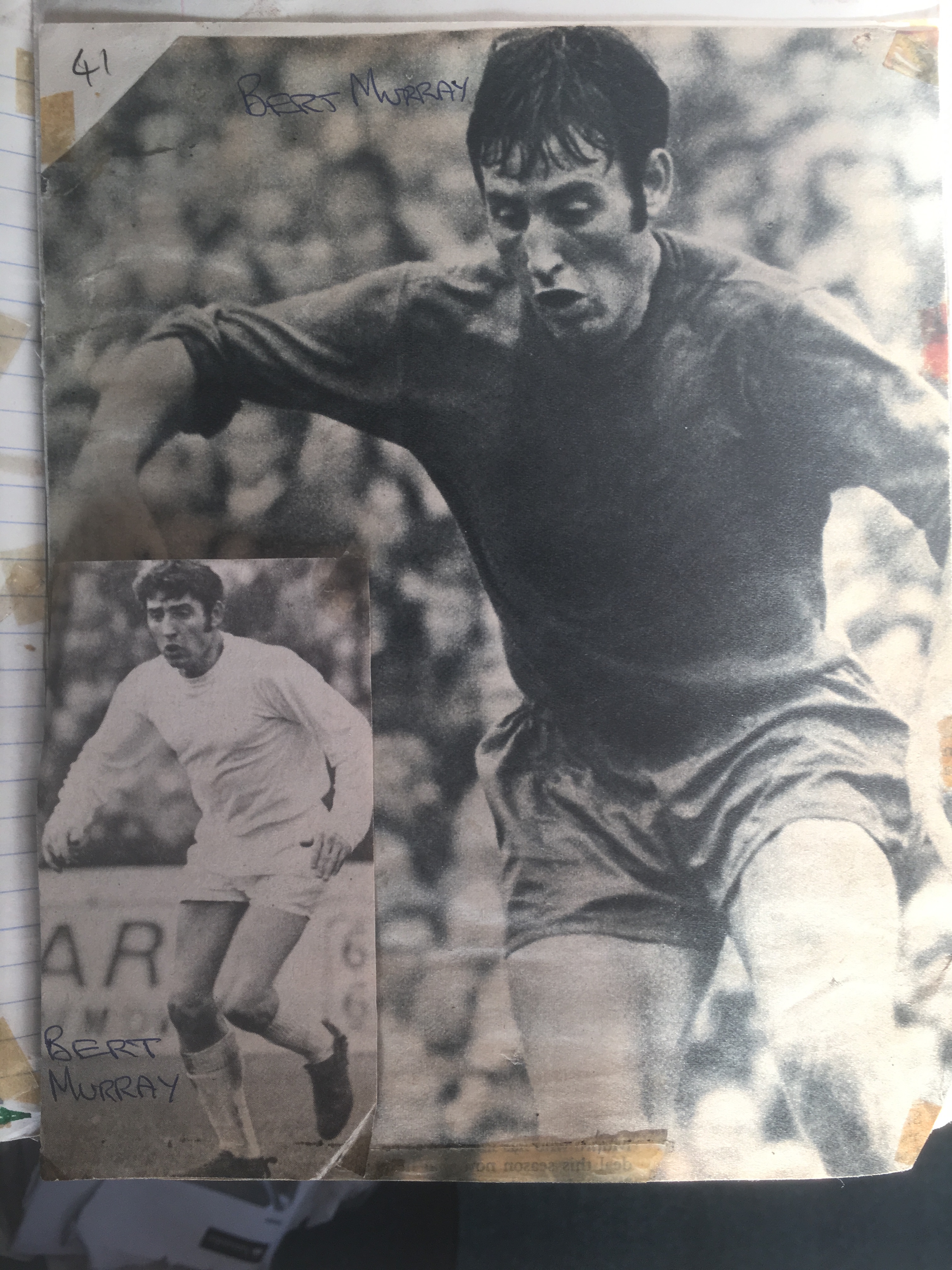
Cup winner Bert Murray: Brighton’s People’s Player

5-bert-v-villaON HOLIDAY in Jersey in 2016 my eyes were drawn to a picture on a display in St Helier’s Fort Regent entertainment complex.
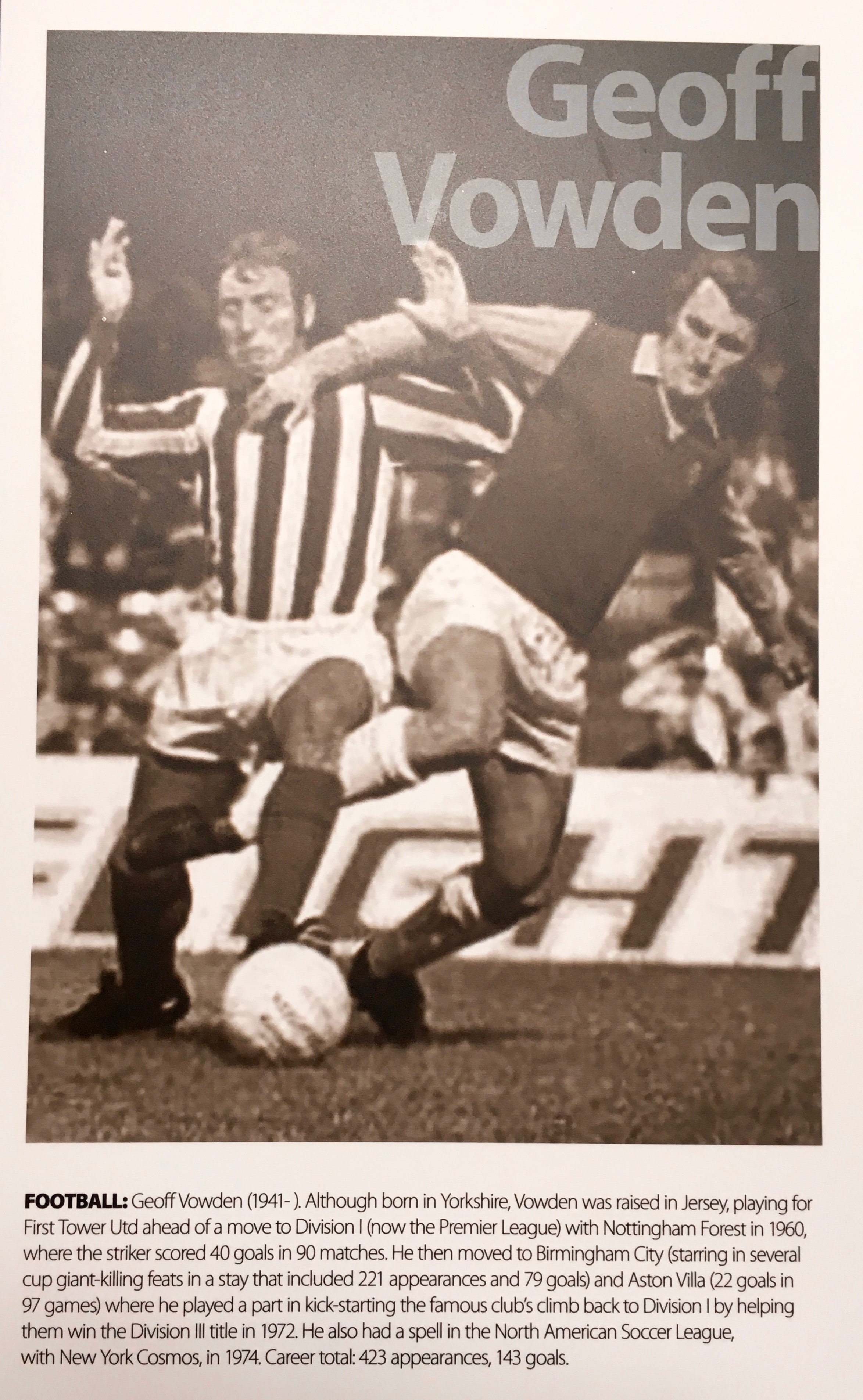
“That’s Bert Murray,” I declared to my bemused wife, and, let’s face it, who would have thought Brighton & Hove Albion’s combative former Chelsea and Birmingham City winger would still be on a public display 45 years after the picture was taken?

The display featured sports stars from Jersey who had gone on to make a name for themselves – and, ironically, the picture in which Bert appeared (below) was about Geoff Vowden (born in Barnsley but raised in Jersey), then with Aston Villa, but a player who had been a teammate during Murray’s five years at St Andrew’s.

1-jersey-posterVersatile Murray – mainly a winger but equally adept at right back – wrote himself into the Albion’s history books when he was bought from Birmingham with funds raised by fans.

But let’s go back to the beginning. Born in Hoxton, London, on 22 September 1942 Murray started his football career with Chelsea in 1958 and scored in the first leg of their 1960 FA Youth Cup Final win against Preston as part of a team which spawned many future star players, such as Peter Bonetti, Terry Venables and Bobby Tambling.

Bert made his Chelsea first team debut in 1961 and in 1963 was part of the squad that won promotion from Division 2. His form for Chelsea attracted the England selectors and in the 1964-65 season he played in six of England under 23s’ seven games, scoring on his debut.

That was on 25 November 1964 in a 5-0 romp over Romania at Coventry’s old Highfield Road ground when Alan Ball, Mick Jones, Alan Hinton and Martin Chivers also scored.

Sadly for Bert, that was the only win he experienced as an England player: in the remaining games there were four 0-0 draws and a 1-0 defeat to West Germany. Other big name players who were part of the same team included Nobby Stiles, Norman Hunter and George Armstrong

Murray’s final international was in front of 70,000 fans in Austria on 2 June 1965 when his Chelsea colleague Bonetti had taken over in goal from Gordon West and Ball, who, like Stiles would become part of the following year’s England World Cup winning team, was sent off.

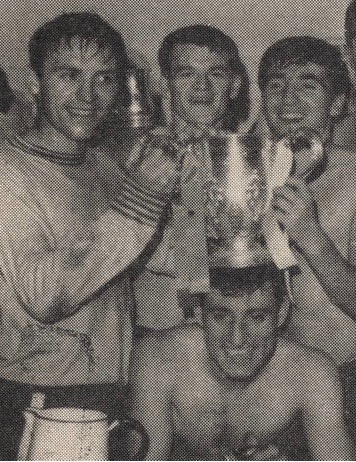
2-1965-lge-cup-winnersAt least at club level in 1965 Murray won some silverware (above image discovered on The Shed End Chelsea fans website), playing alongside Bonetti, Venables, Eddie McCreadie, Barry Bridges and John Boyle as Tommy Docherty’s Chelsea won the League Cup in April via a narrow 3-2 aggregate win over Leicester.
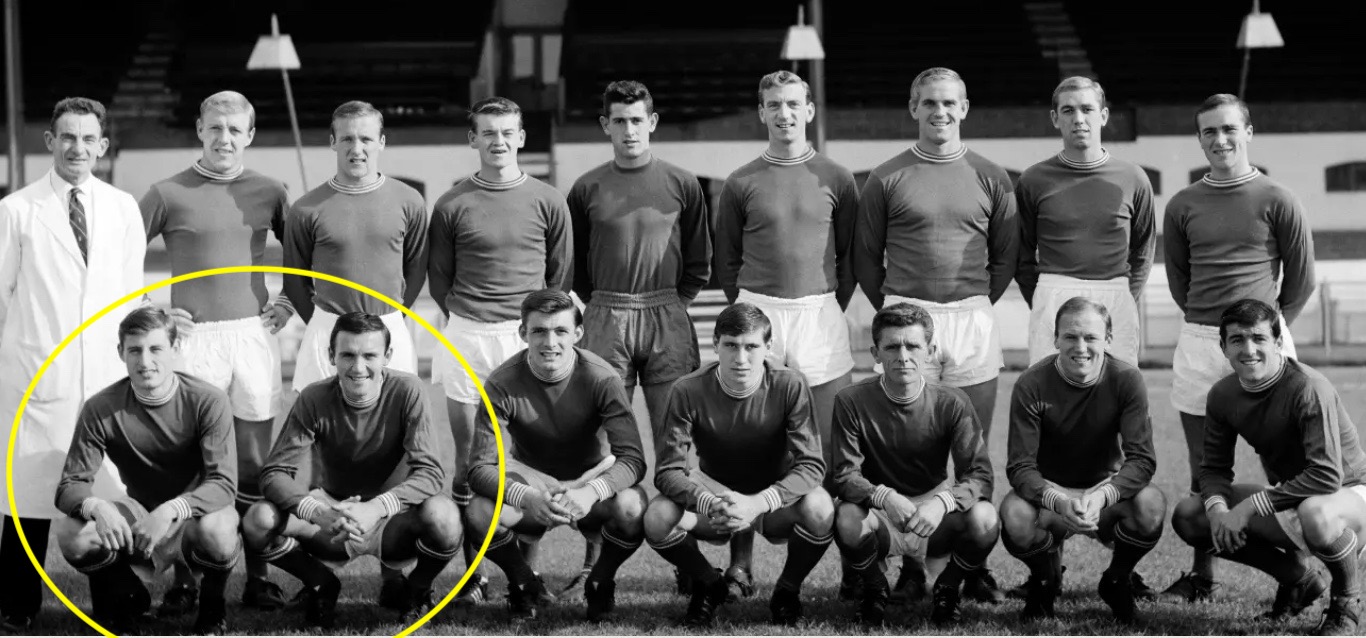
Murray + Bridges ChelseaMurray and Bridges alongside each other in a 1963-64 Chelsea team picture.
In the same season, Chelsea were top of Division One for nearly the whole season, and were looking good for the domestic treble but lost 2-0 to Liverpool in the FA Cup semi-final.

The young team started to show signs of strain and slipped to third in the league. Murray and Bridges were amongst a group of eight players who defied a curfew when the team were staying in Blackpool prior to a game against Burnley and the manager sent them home. The team Docherty put out capitulated 6-2.

According to ‘Bluebeard’ on theshedend.com the following nearly-but-not-quite season – fifth in the league, beaten FA Cup semi-finalists again and Fairs Cup semi-finalists – led to Docherty breaking up the team and selling Murray, Venables, Bridges and George Graham.

So, in 1966, having scored 44 goals in 183 games, Murray was transferred to Birmingham for £25,000 and Bridges went too, as Birmingham’s new wealthy owner, Clifford Coombs, splashed the cash for manager Stan Cullis.

3-brumbertThe pair were part of the side which in successive seasons got to the semi-final of the League Cup (in 1967) and FA Cup (in 1968) only to lose on both occasions. Because these things are important in the Midlands, joysandsorrows.co.uk remembers Murray as part of the 1968 Blues side who beat rivals Villa home and away. In five years, he played 132 games scoring 22 goals.

murray brum

It was the Blues former Brighton manager Freddie Goodwin who loaned him to his old club in early 1971. The loan became a permanent move thanks to £10,000 raised through innovative manager Pat Saward’s famous Buy-a-Player scheme which saw fans respond to the club’s lack of cash to bring in new players by coming up with sponsored walks and suchlike to raise the necessary money to enable Saward to bring in new faces. Thus Murray was swiftly dubbed the People’s Player.

4-bertwillie1971Saward brought in Willie Irvine on loan from Preston at the same time and the pair combined well on 10 March 1971 (pictured above by the Evening Argus before the game) as high-flying Fulham were beaten 3-2. In Irvine’s 2005 book with Dave Thomas, Together Again, he recalls how the pair hit it off and began a friendship that endures.

Murray was an influential right winger who made and scored goals and he became a reliable penalty taker too, notably keeping a cool head from 12 yards in the 12-game unbeaten run in 1972 which culminated in promotion as runners up behind Aston Villa.

In the famous game televised by BBC’s Match of the Day at home to Villa in April 1972, Saward moved Murray to right back to replace previously ever-present Stewart Henderson. It wasn’t completely alien to him, though, because he’d slotted into that role on occasion at Birmingham.

The photographers were busy during that tightly-fought 2-1 win against Villa and several different shots of Bert’s tussle with Villa’s talented winger Willie Anderson appeared in the newspapers and magazines following the game (see pic at top of article).

While others might have been grabbing the bulk of the goals and the headlines, Murray’s consistent performances earned him the player of the season award (below, receiving the award from chairman Tom Whiting).

murray poy

The newly-promoted side struggled badly and Saward chopped and changed the line-up, bringing in a host of new faces – including Bert’s old Chelsea colleague Bridges – as he tried in vain to find the right formula to keep the Albion up. But Murray was one of the few who kept his place at the higher level, mainly back in midfield. He took over the captaincy from Ian Goodwin and contributed nine goals in 39 appearances.

Although eventually the side clicked in the final third of the season, the damage had been done early on and the recovery wasn’t enough to avoid an immediate return to Division 3.

Murray wrote in the matchday programme: “The last two months have been amazing and although I say it myself I beleive that we have played some really good football recently. I also believe we deserve a better fate.”

He added: “We must hope we have learned our lessons well for next season.” Murray appeared in the front row of the 1973-74 team line-up but his time on the south coast was drawing to a close – along with manager Saward. Murray was involved in only two games as a substitute in October and after a total of 102 games and 25 goals he moved on to Peterborough United, initially on loan and then signing permanently.

It was Noel Cantwell, the man Saward had served as assistant manager at Coventry City, who signed Murray for Posh. “He needed a right midfielder,” Murray said in a 2012 interview with the Argus. “I went up there and had four wonderful years. I still see some of the lads now.”

Saward, with his own days at the Goldstone numbered and, without naming any names, wrote some cryptic programme notes for the 13 October home game against Halifax. “In deciding that a player can leave a club, the manager must consider the player’s contribution to the club and decide whether he fits into his plans for the future,” he wrote.

“When a manager decides it is time for the player and club to part he is not necessarily governed solely by the ability of the player but he has to look at his squad as a whole and assess whether there are younger players with longer futures waiting their chance to come through.

“A governing factor must be that the strongest possible team should be fielded at all times and the manager must decide when other players should take over from established favourites.”

In the programme for the 24 October game with Southport – by which time Saward himself had been sacked – there was a brief paragraph under the headline ‘Bert Murray Leaves’.

At 31, Bert still had plenty of football left in him and he went on to make 123 appearances for Posh, scoring another 10 goals, before retiring and going into the pub trade, in Market Deeping, nine miles north of Peterborough.

Many have been the occasions Albion fans following the team at London Road have taken a detour to pop in to see Bert and chat over old times over a pint.

In 2013, when he had his 70th birthday, The Society of Independent Brewers did an article about his 20 years running Everards pub The Bull in Market Deeping with his wife Eileen. They had also spent 17 years at two other pubs in the town, The Winning Post and The White Horse.

“Everards have been good and seem happy with what we are doing here. So if they are happy, Eileen and I plan to keep on going for a few more years yet as we really enjoy running the pub,” he said.

In September 2013, Bert returned to Stamford Bridge for a 50th anniversary reunion with the Chelsea ‘class of ‘63’ – chatting over old times over dinner with Terry Venables, John Hollins, Peter Bonetti, Barry Bridges, Ken Shellito and Bobby Tambling.

Pictures from my scrapbook , the internet and the Albion matchday programme.

Below, the Goal magazine feature ‘The Girl Behind The Man’