
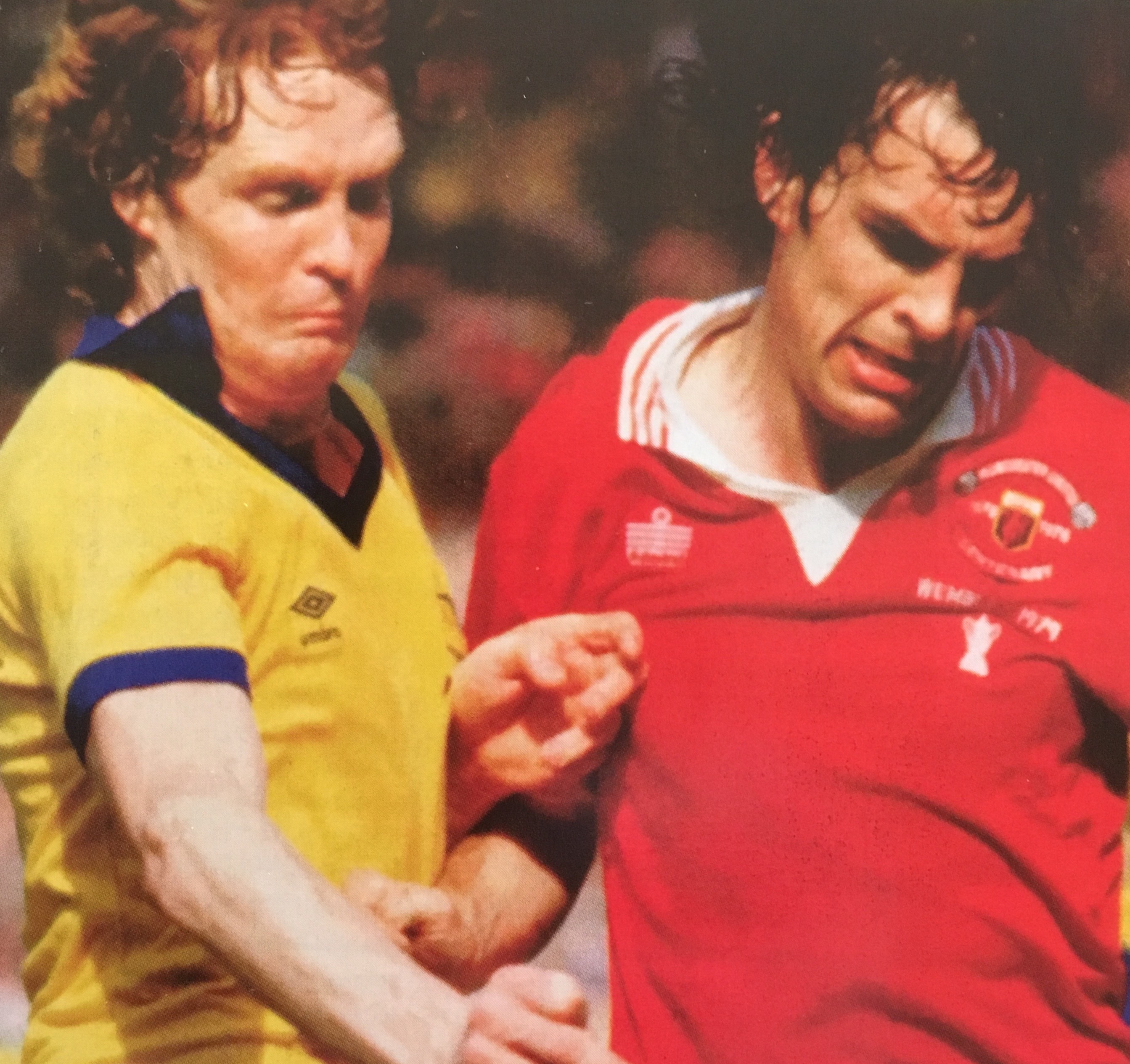
 A TOWERING Scottish defender who played in three consecutive FA Cup finals for Arsenal was a temporary centre-back stand-in for Brighton in 1984.
Willie Young had moved on from the marble halls of Highbury by the time Albion boss Chris Cattlin borrowed him to plug a gap.
Young was nearing the end of a 14-year career and had switched to Norwich City but was made available to help the Seagulls out of a hole.
Another former Gunner, Steve Gatting, was suspended for three matches in March 1984 and former club captain Steve Foster had just been sold to Aston Villa to raise some much-needed funds.
So Cattlin brought in flame-haired Scot Young to play alongside inexperienced namesake Eric Young. His first game, at home to Manchester City on 10 March, finished in a 1-1 draw.
A week later, Albion triumphed 3-0 away to Derby County and won by a similar margin at home to Leeds United on 24 March.
So far, so good, but in what turned out to be Young’s final game, the wheels came off big time and Albion succumbed 5-1 away to Portsmouth, despite taking the lead.
The line-up saw Eric Young unable to play through suspension and Willie partnered by the returning Gatting. They were no match for Pompey’s prolific centre forward Mark Hateley.
Young found himself in the book with 15 minutes of the first half still to play following a foul on Hateley. Evening Argus Albion reporter John Vinicombe said: “Young was lucky not to be sent off when he bowled Hateley over from behind. Hateley was in a goalscoring position, and, at the time, Albion were still in front.”
The club’s official report added: “On 65 minutes, Hateley outpaced Young and moved smoothly in to net his 22nd goal of the season for Portsmouth.”
Vinicombe gave a brutal assessment: “Out of the shambles may come some good. If Cattlin had been undecided about taking Willie Young on contract, this performance may well have made up his mind.
“Hitherto, Young had not let the side down in his previous three loan appearances, but Mark Hateley, ten years his junior, gave him a terrible runaround.”
So, an ignominious end to his short spell and he was subsequently sacked by Norwich for misconduct.
After a short spell with lowly Darlington, Young called time on his playing career later that year and ran a pub and restaurant, Bramcote Manor, in Nottingham, before it was demolished to be replaced by a religious meeting place.
He subsequently took over the running of the Belvoir kennels and cattery in Bottesford, Leicestershire, while also being a part-time pundit for Scottish television.
Born in the Midlothian village of Heriot on 25 November 1951, Young went to school at Ross High in Tranent and was more noted for rugby than football – he was a talented hooker who had a trial for the South of Scotland Schools’ team.
However, he was playing football for amateur side Sefton Athletic when Hearts offered him a trial – but as a Hibernian supporter he turned them down! Falkirk then gave him a trial but a change of management meant it wasn’t followed up and eventually Aberdeen stepped in to sign him in 1969.
After making 187 appearances for the Dons in five years, initially under Eddie Turnbull and then Jimmy Bonthrone, Tottenham Hotspur boss Terry Neill signed the defender after he’d impressed in a UEFA Cup tie between Aberdeen and Spurs. He played 64 times for the Lilywhites in two seasons.
Neill’s successor Keith Burkinshaw dispensed with his services and he joined Neill at Arsenal when the Northern Irishman switched to manage the side he used to play for. According to The Scotsman, Neill described Young as “a big awkward bastard who liked a drink”.
Before the move, he’d been sent off in a Spurs v Arsenal clash following what was described as a kung fu style kick on Frank Stapleton.
 Young (pictured above launching into a tackle on Albion’s Gerry Ryan) became something of a Gunners cult hero for making the controversial switch from the north London rivals and fans inevitably enjoyed the chant: “We’ve got the biggest Willie in the land.” In four years, he made a total of 236 appearances, chipping in with 19 goals as well.
His three FA Cup Final appearances came in 1978, 1979 and 1980, only collecting a winners’ medal in 1979 when the Gunners beat Manchester United 3-2.
The consensus view was that Young did well in that game, suppressing the threat of fellow Scot Joe Jordan, who led the line for United. In 1980, Young famously committed a professional foul on Paul Allen as he looked like he would score as the youngest player in a FA Cup Final.
Young said in that piece in The Scotsman: “I was the last man and only got booked. After that the rules were changed and the ‘professional foul’, as it started to be called, became a red card offence. Paul was going to score so I had to take him down. Afterwards he said: ‘Don’t worry, big man, I’d have done the same.’ But everyone else was appalled. He was only 17, the youngest to play in an FA Cup final, and I’d ruined the fairytale. Big, bad Willie had done it again.”
Hammers won the game 1-0 with a rare Trevor Brooking header.
 After Young lost his first team place at Arsenal to Chris Whyte, he moved on to Nottingham Forest (pictured above), where he spent a couple of seasons, playing 59 games.
He then joined Norwich in 1983 but, dogged by injuries, he failed to command a regular place in their side.
Young won five Scotland under 23 caps but his involvement in some over-exuberant revelry in Copenhagen in 1975 brought about a life ban from the international set-up, which he spoke about in the 2015 interview with The Scotsman.
Post-playing, Youngr settled in the Nottingham area with his wife Lynda, and ran a pub for many years. His death at the age of 73 was announced on 31 October 2025.

 In parallel lines