Crunching tackler ‘Tank’ Clark: a legend at two seaside clubs

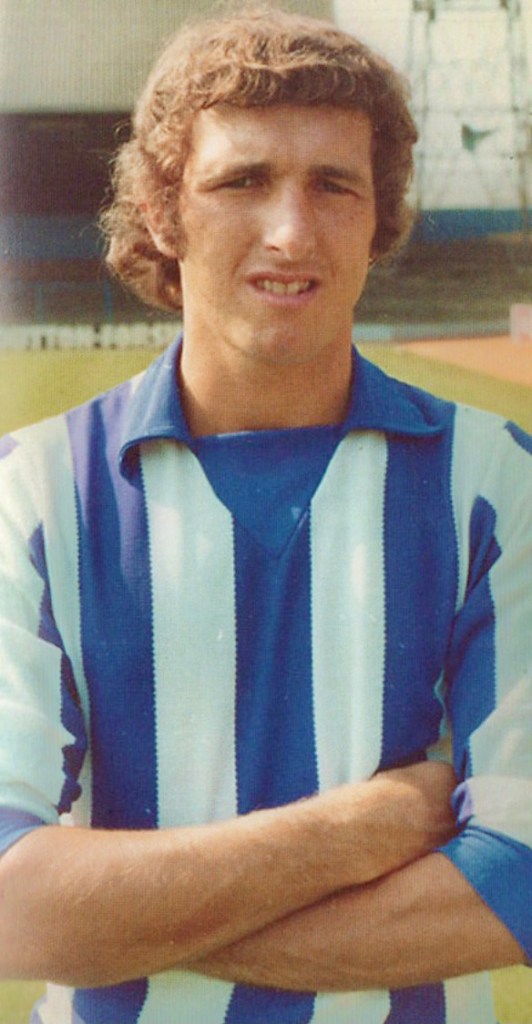
VIKING lookalike Paul Clark made a lasting impression on plenty of players with robust tackling which earned him ‘legend’ status among fans of Brighton and Southend United.

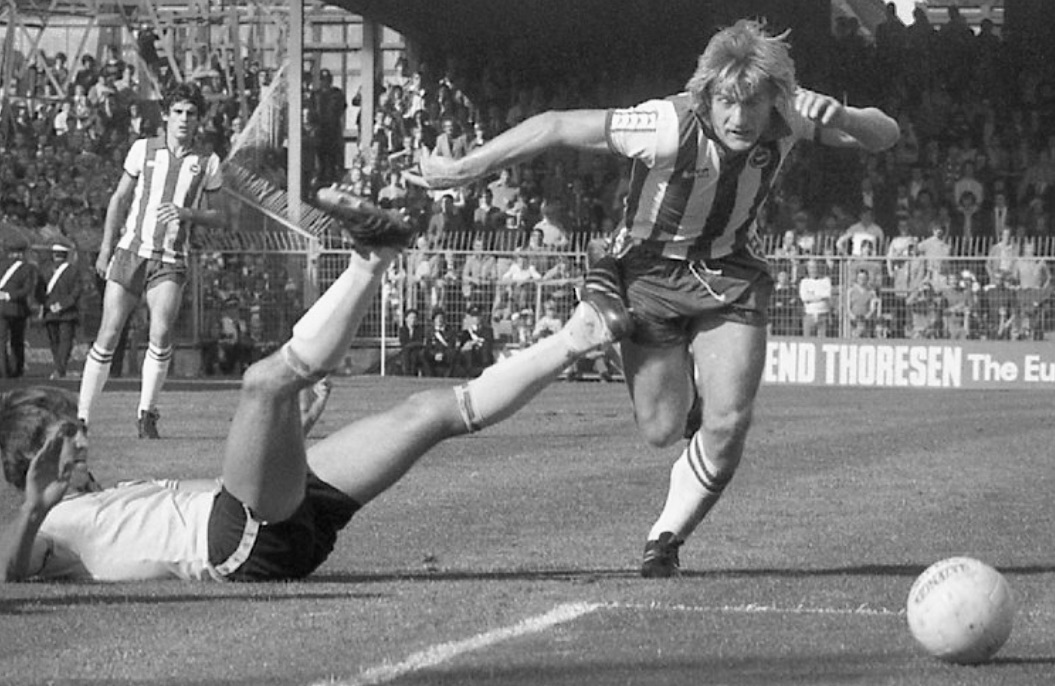
Described in one programme article as “the big bustling blond with the biting tackle”, Clark was given the nickname ‘Tank’ for his no-nonsense approach. A Southend fan lauded “his crunching tackles and never say die attitude”.

Clark himself reflected: “Wherever you go the supporters tend to like someone who is wholehearted and when it came to 50-50 challenges, or even sometimes 60-40, I didn’t shy away from too many, and the supporters just took to it.”
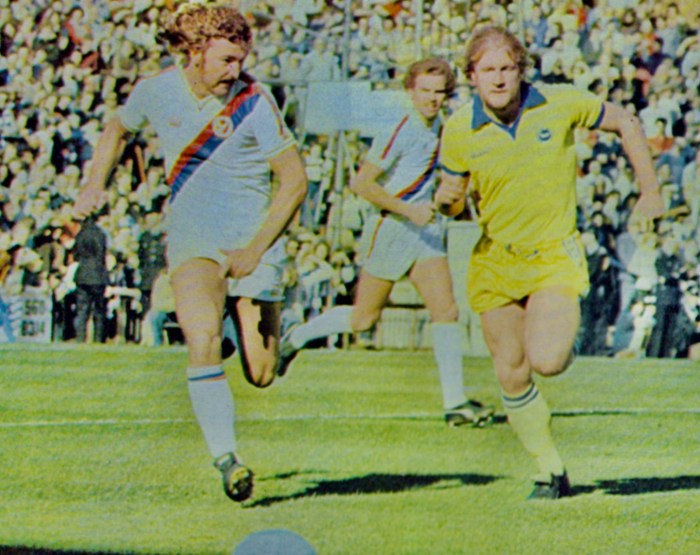
In Albion yellow against Palace

Giving further insight to his approach, he said: “You can go right up to the line – as long as you don’t step over it, then you’re OK.

“I used to pick up a booking during the first five or 10 minutes, then I knew I had to behave myself for the rest of the game. Despite the reputation I had, I was never sent off in over 500 games.”

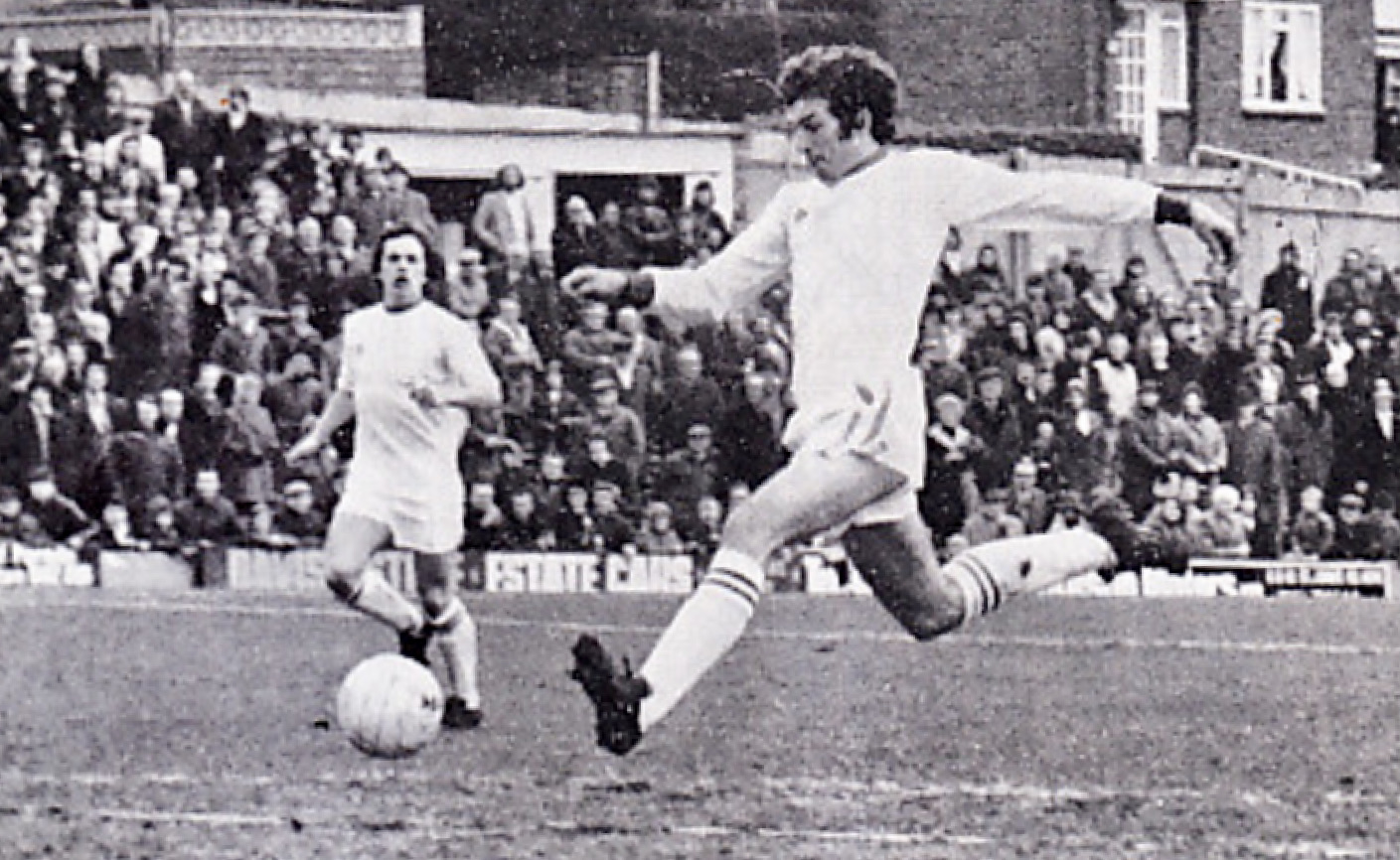
A trademark strike at home to West Ham

Former teammate Mark Lawrenson said of him: “You would hate to have to play against him because quite often he would cut you in two. With him and ‘Nobby’ (Brian Horton) in the side, we definitely didn’t take any prisoners. One to rely on.”

A former England schoolboy international, it was said of the player in a matchday programme:

“Paul is the first to admit that skill is not his prime asset but there is no doubt as to the strength of his tackle. He is a real competitor and is also deceptively fast, being one of the best sprinters on the Goldstone staff.”

Born in south Benfleet, Essex, on 14 September 1958, Clark went to Wickford Junior School where he played for the school football team and the district primary schools’ side. When he moved on to Beauchamp Comprehensive, selection for his school team led to him playing for the Basildon Schools’ FA XI.

Clark as an England schoolboy

This in turn led to him being selected to play for England Schools at under 15 level, featuring against Scotland, Ireland, Wales, West Germany and France before going on a tour of Australia with the same age group. Contemporaries included future full time professionals Mark Higgins, Ray Deakin, Kevin Mabbutt and Kenny Sansom.

Clark left school at 16 before taking his O levels when Fourth Division Southend offered him an apprenticeship. He made his first team debut shortly before his 18th birthday in a 2-1 win over Watford.

Two months later, he won the first of six England Youth caps. He made his debut in the November 1976 mini ‘World Cup’ tournament in Monaco against Spain and West Germany alongside future full England internationals Chris Woods, Ricky Hill and Sammy Lee.

The following March, he played in England’s UEFA Youth tournament preliminary match against Wales when they won 1-0 at The Hawthorns. Sansom was also in that side. And he featured in all three group matches at the tournament that May (England beat Belgium 1-0, drew 0-0 with Iceland and 1-1 with Greece). Teammates included Russell Osman and Vince Hilaire.
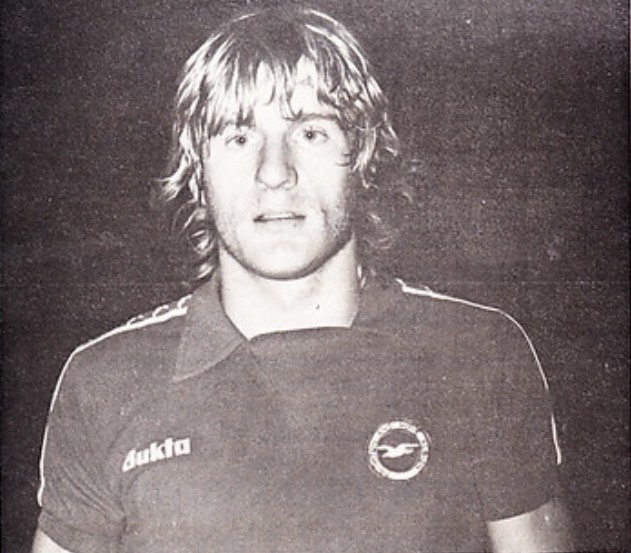
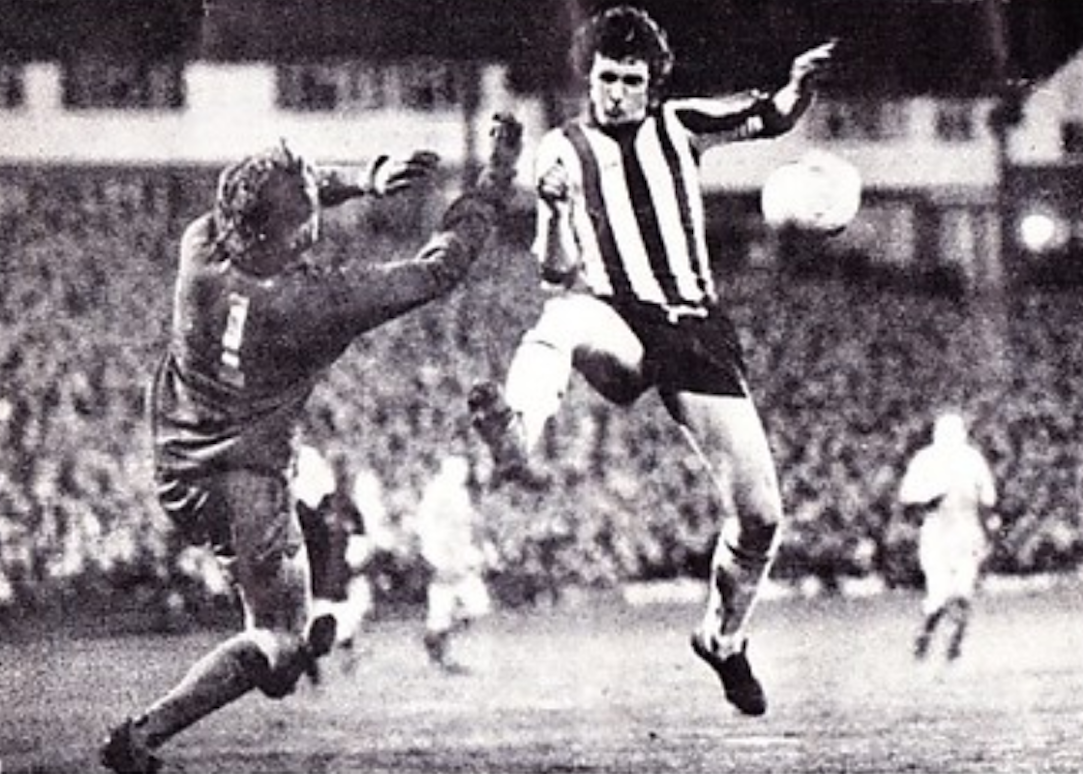
Clark was only a third of the way into his second season at Southend when Alan Mullery sought to beef up his newly-promoted Brighton side in the autumn of 1977, and, in a part exchange deal involving Gerry Fell moving to Roots Hall, Clark arrived at the Goldstone. He made his debut for the Seagulls in a goalless draw at White Hart Lane on 19 November 1977 in front of a crowd of 48,613. And he came close to crowning it with a goal but for an outstanding save by Spurs ‘keeper Barry Daines.

In full flight, as captured by photographer George Erringshaw

When Spurs visited the Goldstone later that season, Clark put in a man of the match performance and scored a memorable opener, following a solo run. A subsequent matchday programme article was suitably poetic about it.

“It showed all the qualities looked for in a player: determination, speed, skill and most of all the ability to finish….if any goal was singled out, Paul’s was certainly one to treasure.”

Albion went on to beat Spurs 3-1, although the game was remembered more because it was interrupted twice when the crowd spilled onto the pitch.

After only 12 minutes, referee Alan Turvey took the players off for 13 minutes while the pitch was cleared of Albion fans who’d sought safety on the pitch from fighting Spurs’ hooligan fans.

In the 74th minute, with Spurs 3-1 down and defender Don McAllister sent-off, their fans rushed the pitch to try to get the game abandoned. But police stopped the invasion getting out of hand and the game continued after another four-minute delay.

Clark’s goal on 16 minutes had been cancelled out six minutes later when Chris Jones seized on a bad goal kick by Eric Steele but defender Graham Winstanley made it 2-1 just before half-time.

Albion’s third goal was surrounded in controversy. Sub Eric Potts claimed the final touch but Spurs argued bitterly that Malcolm Poskett was offside.

Clark remembered the game vividly when interviewed many years later by Spencer Vignes for the matchday programme. The tenacious midfielder put in an early crunching tackle on Glenn Hoddle and after the game the watching ex-Spurs’ manager Bill Nicholson told him: “Well done. You won that game in the first five minutes when you nailed Hoddle.”

Said Clark: “I was 19 at the time so to get a pat on the back from him was much appreciated.”

It was one of three goals Clark scored in his 26 appearances that season (nine in 93 overall for Albion) but he wasn’t always guaranteed a starting berth and in five years at the club had a number of long spells stuck in the reserves.

Midfield enforcer or emergency defender were his primary roles but Clark was capable of unleashing unstoppable shots from distance and among those nine goals he scored were some memorable strikes.

For instance, as Albion closed in on promotion in the spring of 1979, at home to Charlton Athletic, Clark opened the scoring with a scorching 25-yard left foot volley in the 11th minute. Albion went on to win 2-0.

The following month, Clark demonstrated his versatility at St James’ Park on 3 May 1979 when Albion beat Newcastle 3-1 to win promotion to football’s elite level for the first time. Clark played in the back four alongside Andy Rollings because Mark Lawrenson was out injured with a broken arm.

Celebrating promotion with Peter O’Sullivan and Malcolm Poskett

“Not many people can say they played in a side that got Brighton up to the top flight,” said Clark. “It’s something I’m still immensely proud of.”

Once they were there, Clark missed the opening two matches (defeats at home to Arsenal and away to Aston Villa) and had an ignominious start to life at the higher level when he conceded a penalty within three minutes of going on as a sub for Rollings away to Manchester City on 25 August 1979.

Some observers thought Clark had played the ball rather than foul Ray Ranson but referee Pat Partridge thought otherwise and Michael Robinson stepped up to score his first goal for City from the resultant penalty. It put the home side 3-1 up: Teddy Maybank had equalised Paul Power’s opener but Mike Channon added a second before half-time.

Partridge subsequently evened up the penalty awards but Brian Horton blazed his spot kick wide of the post with Joe Corrigan not needing to make a save. Peter Ward did net a second for the Seagulls but they left Maine Road pointless.

Ahead of Albion’s fourth attempt to get league points on the board, Clark played his part in beating his future employer Cambridge United 2-0 in a second round League Cup match.

Three days later, he was on the scoresheet together with Ward and Horton as Albion celebrated their first win at the higher level, beating Bolton Wanderers 3-1 at the Goldstone.

It was Clark’s neat one-two with Ward that produced the opening goal and on 22 minutes, Maybank teed the ball up for Clark, who “belting in from the edge of the box, gave it everything and his shot kept low and sped very fast past (‘Jim’) McDonagh’s right hand,” said Evening Argus reporter John Vinicombe.

Gerry Ryan replaced Clark late in the game and after 12 starts, when he was subbed off three times, and four appearances off the bench, his season was over, and it wasn’t even Christmas.

A colour photo of a typical Clark tackle (on QPR’s Dave Clement) adorned the front cover of that season’s matchday programmes throughout but he didn’t start another game after a 4-0 League Cup defeat at Arsenal on 13 November.
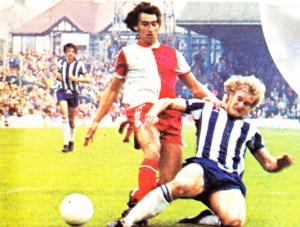
Programme cover shot

He was sub for the following two games; the memorable 1-0 win at Nottingham Forest and a 1-1 draw at Middlesbrough, but Mullery had signed the experienced Peter Suddaby to play alongside Steve Foster, releasing Lawrenson to demonstrate his considerable repertoire of skills in midfield alongside skipper Horton and Peter O’Sullivan.

Young Giles Stille also began to press for a place and later in the season, Neil McNab was added to the midfield options, leaving Clark well down the pecking order in the reserves. Portsmouth wanted him but he rejected a move along the coast, although he had a brief loan spell at Reading, where he played a couple of games.

But Clark wasn’t finished yet in Albion’s colours and, remarkably, just over a year after his last first team appearance, with the Seagulls struggling in 20th spot in the division, he made a comeback in a 1-0 home win over Aston Villa on 20 December 1980.

Albion had succumbed 4-3 to Everton at Goodison Park in the previous match and Mullery told the Argus: “We badly needed some steel in the side and I think Clark can do that sort of job.”

Under the headline ‘The forgotten man returns’ Argus reporter Vinicombe said Mullery hadn’t changed his opinion that Clark was not a First Division class player, but nevertheless reckoned: “Paul’s attitude is right and I know he’ll go out and do a good job for me.”

For his part, Vinicombe opined: “The strength of Clark’s game is a daunting physical presence. His tackling is second to none in the club and Mullery believes he will respond to the challenge.”

Clark kept the shirt for another nine matches (plus one as a sub), deputising for Horton towards the end of his run, but his last first team game was in a 3-1 defeat at Norwich at the end of February.

Clark remained on the books throughout Mike Bailey’s first season in charge (1981-82) but, with Jimmy Case, Tony Grealish and McNab ahead of him, didn’t make a first team appearance and left on a free transfer at the end of it.

Back to Southend

He returned to Southend where he stayed for nine years and was player-manager on two occasions. Fans website shrimperzone.com moderator ‘Yorkshire Blue’ summed up his contribution to their cause thus: “In the top five all-time list for appearances, an inspiration in four promotions, one of the toughest tacklers of all-time and a man whose commitment for his home-town club could never be doubted.”

Clark was still only 27 when he had his first spell as manager, in caretaker charge after Dave Webb had quit following a bust-up with the club chairman, and he managed to steer United to promotion back to the third tier.

When Webb’s successor Dick Bate lasted only eight games of the new season, Clark was back at the helm, in turn becoming the youngest manager in the league.

His first hurdle ended in a League Cup giant killing over top flight Derby County (who included his old teammate John Gregory) when the Us had another former Albion teammate, Eric Steele, in goal.

A Roy McDonough penalty past England goalkeeper Peter Shilton at Roots Hall settled the two-legged tie (the second leg was goalless at the Baseball Ground) which the writer described as “arguably their biggest ever cup shock”.

In the league, player-manager Clark guided Southend to a safe 17th place but it went pear-shaped the following season. Clark only played 16 games, Southend were relegated, and Webb returning midway through the season as general manager.

Back-to-back promotions in 1989-90 and 1990-91 proved to be a more than satisfactory swansong to his Southend career, and in the first of those he found himself forming an effective defensive partnership with on-loan Guy Butters in the second half of the season.

In 1990-91, he missed only six games all season as the Shrimpers earned promotion to the second tier for the first time in their history, and he had a testimonial game against Arsenal.

But, after a total of 358 games for Southend, he left Roots Hall to join Gillingham on a free transfer.

Over three seasons, he played 90 league games, and was caretaker manager in 1992, before retiring at the end of the 1993-94 season. Gillingham’s top goalscorer with 18 that season was a young Nicky Forster and other Albion connections in that squad included Mike Trusson, Paul Watson, Neil Smillie, Andy Arnott and Richard Carpenter.

After Gillingham, Clark played non-league for Chelmsford City but left to become assistant manager to Tommy Taylor at Cambridge United. In 1996 he followed Taylor in a similar role to Leyton Orient.

Southend fans hadn’t heard the last of him, though – quite literally. He became a co-commentator on Southend games for BBC Radio Essex.

In the 2009-10 season, Clark was temporarily assistant manager to Joe Dunne at Colchester United.

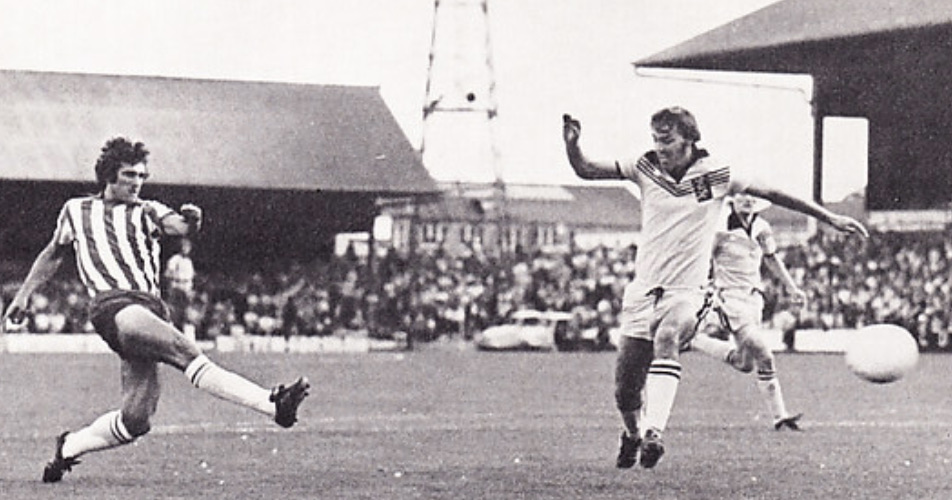
Bank clerk Fell on his speedy feet at the Albion

In full flight for the Albion

NOT TOO many professional footballers start out as bank clerks, but Gerry Fell broke that mould when he signed for Brighton.

Six-foot winger Fell had worked at the Newark branch of NatWest for five years, combining bank clerk duties with playing semi-professional football for Lincolnshire-based Stamford in the United Counties League.

In the latter part of 1973, Stamford played Long Eaton United in a FA Trophy second round qualifying match and Long Eaton’s manager, Brian Daykin, having liked what he saw, signed Fell for the Derbyshire side the following summer.

Within weeks, Daykin left Long Eaton to become no.2 to Peter Taylor at the Albion – and one of his first moves was to persuade Taylor to sign Fell. Taylor watched the player a couple of times and endorsed his assistant’s opinion.

Fell was 23 when he packed up his NatWest job to move to Sussex and turn professional.

“I loved Brighton from the moment I arrived, absolutely loved it, especially considering where I came from,” he said. “It was a totally different ball game to Newark and I loved the idea of living by the sea. It was so cosmopolitan and a massive eye-opener for me.”

In a matchday programme article, Fell told Spencer Vignes: “I was always very fit and a good trainer, so I didn’t find the training difficult at all. But obviously the step up in terms of actually playing took a bit of getting used to.

“I thought it was great because, as you can imagine, it was a stars-in-my-eyes job for me. I got into the first team within three months of arriving, so it was fantastic. I’ve never regretted any of it.”

Pointing out that he wasn’t the only member of that squad who was late to the game and from non-league (Peter Ward and Brian Horton were too), he said: “You had a few of us who’d experienced the outside world and perhaps appreciated what it meant to be a professional footballer that little bit more because of it.”

Born in Newark on 1 March 1951, Fell’s first football memory was as the mascot for Newark Central, a local team that his grandfather ran. He was educated at Magnus Grammar School in Newark where he earned a reputation for athletic achievements, gaining honours in high jump and 800 metre running.

Fell certainly hit the ground running at the Albion as a pacy goalscoring winger, netting five goals in 20 appearances in the season he arrived plus eight in 28 the following season (1975-76).

His initial first team involvement was as a non-playing sub for a 2-0 home win over Southend United on 7 December 1974 (Tommy Mason and Jim Walker the scorers), but once he’d made his debut at the end of the following month in a 2-0 win over Colchester United, he kept the shirt previously worn by Ian Mellor through to the end of the season (bar one game when Mellor replaced him).

In 1975-76, when Taylor’s much-changed side only narrowly missed out on promotion, Fell twice hit braces in 6-0 wins at the Goldstone, the first pair against Chester in September (Fred Binney 2, Peter O’Sullivan and Mellor also scorers), the other when Colchester United were dispatched by the same scoreline in January 1976 (Binney another two, Andy Rollings and Mellor also scoring).

He revelled in switching from playing in front of 200-300 people to turning out at the Goldstone where crowds could often be more than 20,000 – even for Third Division games.

“To play in front of that amount of people on that ground, well, it was a dream come true,” Fell told Vignes. “The Goldstone was a bit of a fortress at that time and the players in the team were so confident.”

Apart from that first half-season, Fell generally competed with Brighton-born Tony Towner for the no.7 shirt and Taylor’s successor Alan Mullery went with Fell for the final run-in to promotion from the third tier in the spring of 1977. He started 11 games and scored the only goal of the game as top-of-the-table Albion secured a vital 1-0 win over Port Vale in their penultimate home game.

“It wasn’t easy being on the sidelines looking on, but Gerry was a breath of fresh air,” Towner said in a matchday programme interview. “He was the opposite of me; though still a winger, he had loads of pace, though not too much skill!

“He’d knock the ball ahead of him and run past the defender to get it. I’d try to trick my way past.”

Ironically, although Brighton secured promotion by beating Sheffield Wednesday 3-2 in the last home game, the man of the match was the visitors’ Eric Potts – and his next game at the Goldstone was in Albion’s colours… as a replacement for Fell and Towner!

Having liked what he saw in that exciting encounter under the lights in front of a bumper crowd of 30,756, Mullery promptly signed Potts for £14,000 in the close season.

The diminutive winger had previously played for Wednesday at the level of today’s equivalent of the Championship and he was installed in the no.7 shirt for the first 21 games of the season.

Fell played and scored in his first start of the season (a 2-0 home win over Hull City) in September and the following game, his last start in an Albion shirt, was in a 2-2 League Cup second round replay draw at Oldham Athletic.

But Fell wasn’t done with the Seagulls just yet. He proved to be a matchwinner after going on as a 57th minute substitute for the injured Steve Piper in the last league game of September, a 3-2 night game win over Luton Town in front of a Goldstone crowd of 25,132.

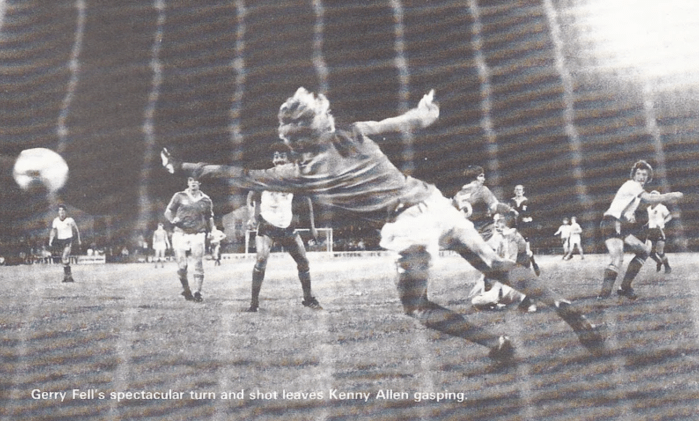
The game was finely poised at 1-1 (Ward and Ron Futcher on target) when on 84 minutes Fell, unmarked at the far post, headed in a second Albion goal when Mellor flicked on a corner by Potts. Three minutes later, Fell was once again played in by Mellor and a turn-and-volley into the top corner from the edge of the box put Albion 3-1 up. There was still time for Jimmy Husband to pull one back for the Hatters, but Albion held on to take all the points.

Those goals didn’t earn him a starting place, though. On six further occasions Fell was sub (three playing, three not getting on) before Mullery traded him as a makeweight in the signing of 19-year-old powerhouse midfielder Paul Clark from Southend United.

In the three years between his first involvement with the first team as a non-playing sub at home to those future employers and his last, going on for Potts in a 1-0 defeat away to Notts County on 5 November 1977, only three other players were involved in both fixtures: Graham Winstanley, O’Sullivan and Mellor. Fell departed with the impressive record of 20 goals in 72 starts plus 19 sub appearances.

In his first season in Essex, he helped Dave Smith’s Shrimpers to promotion from Division Four when they were runners up behind Watford. Third-placed Swansea City and Brentford in fourth also went up.

The next season, while his old Albion teammates were celebrating promotion to the elite for the first time in the club’s history, Fell’s Southend finished mid-table in the third tier, although they did have the excitement of a memorable FA Cup third round encounter with mighty Liverpool: he was part of the Southend team that memorably held the European champions to a 0-0 draw in the FA Cup in January 1979 when 31,033 crowded into Roots Hall.

“It was snowy and frosty and we could’ve beaten them on the night,” United manager Smith later told the local Echo newspaper.

“Derrick (Parker) missed a sitter at the end but I remember turning to one of my coaches and saying I was glad he missed. They thought I was mad but it meant we got to go to Anfield and I’d never managed a team there before.”

How did Southend manage such a result against a full-strength Liverpool side captained by Emlyn Hughes with Ray Clemence in goal, Jimmy Case and Graeme Souness in midfield and Kenny Dalglish up front?

In the lead-up to the game, Smith said: “We couldn’t find anywhere to train so we went to the bottom of the pier. We ended up in a pub there drinking hot port and this was only a few days before the game. Maybe that’s the answer to playing so well.”

Liverpool made up for it in the replay a week later when they won 3-0 (goals from Case, Dalglish and Ray Kennedy) and Fell was subbed off on 75 minutes.

The last season of the decade would end in the disappointment of relegation, and Fell’s departure from the club, but they once again had excitement in a cup competition against higher level opposition, winning 2-1 away at Bolton Wanderers (and drawing 0-0 at home in the second leg) in the second round of the League Cup and then twice forcing draws against West Ham in the third round, before losing 5-1 in a second replay.

When it came to the FA Cup though, United were on the wrong end of a giant killing as Isthmian League Harlow Town beat them 1-0 in the second round.

Not long after joining Southend in 1977, Fell had helped them beat Torquay United 2-1 in the first round of the FA Cup and it was to Plainmoor that he headed in July 1980 on a free transfer.

That cup match was remembered in Torquay’s Into The Eighties pre-season magazine which said: “The pace and power of Gerry Fell left a painful memory with us when he helped Southend knock us out of the FA Cup here at Plainmoor three years ago. He had cost the Shrimpers £20,000 then but now he arrives on the south coast on a free transfer and has already impressed in pre-season training. Gerry certainly knows how to score.”

United supporter and programme statistician John Lovis added: “A complete forward who’s got the lot.”

Alongside big-name new arrival Bruce Rioch as a player-coach, Fell had a terrific first season scoring 17 league and cup goals, seven of them from the penalty spot.

Delighted manager Mike Green said in his matchday programme notes: “We certainly look forward to free kicks now because in Gerry Fell and Bruce Rioch we possess two of the hardest and most accurate dead ball kickers in the game.”

Although he was in the side as the 1981-82 season began under ex-Manchester United boss Frank O’Farrell’s third stint as Gulls manager, he lost his starting berth and later that season had a loan spell at York City, where a young John Byrne was finding his feet in a struggling side.

He briefly joined a mini-exodus of ex-Football League pros in Hong Kong at Happy Valley – future Brighton coach and manager Jeff Wood also played for them – but he returned to Brighton and played non-league football with Sussex County League Whitehawk, finishing the 1983-84 season as leading goalscorer with 35 goals, captaining them to the league championship and also representing the Sussex county side.

He finally hung up his boots in 1986 and was a partner for an independent financial adviser before setting up his own financial services company. He remained in Brighton until 2004 before heading back north and settling in Broom Hills, a Lincolnshire rural farming community to the north west of the city of Lincoln.

Fell died from cancer at the age of 74 in May 2025.

John Ruggiero scored on his Brighton league debut

JOHN RUGGIERO was one of four signings Alan Mullery made for newly promoted Albion in the summer of 1977.

That one of the quartet was Mark Lawrenson from Preston North End for £115,000 rather eclipsed Ruggiero’s arrival from recently relegated Stoke City for £30,000.

Nonetheless, Ruggiero made an immediate impact, scoring on his league debut as a substitute for Peter O’Sullivan to earn the Seagulls a 1-1 draw at Southampton.

Ruggiero had begun the season in the starting line-up in Albion’s home and away goalless draws against Ron Atkinson’s Cambridge United in the League Cup before relinquishing a starting berth for the opening Division Two fixture at The Dell.

His 77th minute equaliser, after Alan Ball had put the home side ahead just before half time, was added to a fortnight later and, for a brief moment, he was joint top scorer with Steve Piper – on two goals.

The pair were both on the scoresheet to help the Seagulls to a 2-1 win at Mansfield Town on 3 September; the home side’s first defeat at Field Mill in 38 matches.

Shoot! magazine previewed Ruggiero’s eager anticipation at returning to the Victoria Ground for a league game on 15 October but he was only a sub that day and, although he went on for fellow summer signing Eric Potts, Albion lost 1-0.

A young Garth Crooks taking on Chris Cattlin the day Ruggiero returned to Stoke

After only seven league and cup starts (and three appearances off the bench), Ruggiero then had to wait six months for another sub appearance.

He went on as a second half substitute for injured Paul Clark in a 1-0 win at Blackburn, combining with Potts who went on to score the only goal of a game described by Argus writer John Vinicombe as “the most exhilarating match I have seen for years”.

Ruggiero didn’t make another start until the very last game of the season; but what a match to play in. A crowd of 33,431 packed in to the Goldstone to see the Seagulls take on Blackpool, with another possible promotion finely poised.

Albion dutifully won the game 2-1 (sending Blackpool down) with goals from Brian Horton and Peter Ward but their hopes of going up were cruelly dashed when Southampton and Spurs, who each only needed a draw to go up, lo and behold ground out a 0-0 draw playing each other.

As the Argus reported: “When news came of the goalless draw at The Dell there were cries of ‘fix’ and Albion had to suffer the bitter disappointment of missing promotion by the difference of nine goals.”

Before his recall for that clash, Ruggiero had continued to find the back of the net for the reserves – indeed he was the side’s top scorer for two seasons.

The Albion matchday programme reported his scoring exploits in some detail. For instance, in a 4-1 win away to Portsmouth. “John Ruggiero was the star of our win at Fratton Park with two fine goals and might have scored a hat-trick,” it said.

And in a 5-2 Goldstone win over Charlton Athletic, Ruggiero opened the scoring with a header from a Gary Williams cross, Steve Gritt pulled one back for the Addicks and Ruggiero volleyed in a fourth goal from the edge of the box.

Ruggiero, who lived in Shoreham with his wife Mary, discovered competition for a first team spot intensified after his summer signing: Clark from Southend adding steel to the midfield and Fulham’s Teddy Maybank taking over from Ian Mellor as Ward’s striking partner. O’Sullivan, meanwhile, comfortably stepped up to the higher level and kept his place.

When Albion were on course for promotion to the elite the following season, Ruggiero’s first team involvement was almost non-existent (a non-playing sub on one occasion).

He was sent out on loan to Portsmouth, then in the old Division 3, where he was a teammate of Steve Foster. Ruggiero scored once in six appearances, netting in a home 2-2 draw with Cambridge United on 27 December 1977.

He was released before Albion took their place amongst the elite and moved on to Chester City, signed by player-manager Alan Oakes, the former Manchester City stalwart.

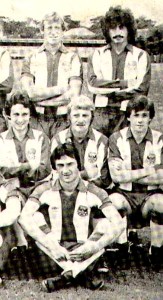
Ruggiero joined just as ex-Albion teammate Mellor was moving on from Sealand Road, but, in a Chester team photo (above right), Ruggiero is standing alongside Jim Walker, who’d played at the Albion under Peter Taylor, and in the front row is a young Ian Rush.

Ruggiero scored within three minutes of his first league game for Chester, setting them on their way to a 3-2 win over Chesterfield. But he only made 15 appearances for them before dropping into the non-league scene.

The legendary England World Cup winner Gordon Banks, formerly of Stoke, signed Ruggiero for Telford United in the 1979-80 season when he was briefly manager of the Alliance Premier League side.

Born in Blurton on 26 November 1954 to Italian parents, the young Ruggiero went to Bentilee Junior School then Willfield High School. His prowess on the football field saw him represent Stoke Boys and the county Staffordshire Boys side and he was one of 24 young players who had a trial at Middlesbrough for the England Schoolboys side but missed the final cut.

He had the chance to join Stoke City at 15 but stayed on at school and passed five O levels: English Language, English Literature, Technical Drawing, History and Art.

“I had a lot of interest from many clubs: Blackpool, Leicester City, Derby County, Blackburn Rovers, Bolton Wanderers, Coventry City, West Brom and I even had a letter from Arsenal inviting me to go training with them,” Ruggiero told Nicholas Lloyd-Pugh for the svenskafans.com website in an April 2011 interview.

“I nearly signed for Coventry but the very last club to ask me was Stoke City and, once this happened, I knew where I would go. I joined as an apprentice when I was 16 in 1970.”  

Ruggiero explained how he started in the A youth team, progressed to the reserve side and finally made his first team debut under Tony Waddington on 5 February 1977, in a home 2-0 defeat against league leaders Manchester City.

He had made his league debut the previous season during a short loan period with Workington Town, playing three games in Division Four, which gives him the relatively rare distinction of having played in all four divisions of English football.

Even as a reserve team regular at Stoke he got to play at big stadiums like Old Trafford, Anfield, Elland Road, Hillsborough and Goodison Park. “It was great for the young players but you always hoped to make the first team at some point,” he said.

“It was a real dream for me to have players like Gordon Banks, Geoff Hurst, Alan Hudson, Peter Shilton and many more being part of your life.

“Tony Waddington loved his team and he always went for experience, so the younger players found it really hard to make the first team. However, a few younger players did well such as Alan Dodd, Sean Haslegrave, Stewart Jump, Ian Moores and Garth Crooks.”

He continued: “Players like Terry Conroy and John Mahoney were really friendly and always had a word of advice for you. I really liked Alan Dodd; he was a much underrated player and would have played for England at a bigger club.”

Ruggiero also spoke warmly of Alan A’Court, Stoke’s first team coach who had played for Liverpool, who took him on a football holiday to Zambia in 1973 where he played for Ndola United. A’Court was Zambia’s national coach at the time.

Two years later, Ruggiero earned a ‘Player of the Tournament’ accolade while playing for Stoke in a youth tournament in Holland.

Waddington’s successor as manager, former player George Eastham, also played a part in Ruggiero’s development by arranging for him to play in South Africa for eight months in 1975 where he was a league and cup winner with Cape Town City.

“I knew that George liked me as a player so I felt that this could be good for me when he took over the team,” Ruggiero told Lloyd-Pugh. “He had already played me in a friendly match against Stockport which was a showcase for the return of George Best from America.

“Whilst Best, Hudson and Greenhoff were doing their party tricks, I was quietly having a good game and it was clear that I was ready for another chance.”

That came in a home game against Liverpool, Ruggiero playing in midfield. “The next 90 minutes was my best of all time,” he said. “We drew the game 0–0. I would like to think I was the man of the match and George spoke very highly of me to the press after the game. The Liverpool team included Kevin Keegan, Ray Kennedy, Ray Clemence and many other big names.”

Stoke had turned to youngsters like Ruggiero because big name players had been sold off to pay for a replacement Butler Street stand roof at the Victoria Ground.

And while the youngster kept his place after that impressive display v Liverpool, they only won one of their remaining nine games and were relegated. It was little consolation that he scored twice away to Coventry because they lost 5-2.

“After the Liverpool game I was on a high, I really thought I’d made the big time and would be a first team player at Stoke for years to come,” he said. “I played nearly all the games left that season and was pretty consistent in all of the games.

“I was just enjoying my time and never really thought about relegation.”

But the 1-0 last day defeat at Aston Villa would prove to be his last game for Stoke because Brighton, who had gained promotion from the third tier, were bolstering their squad to compete at the higher level.

Ruggiero signed for the Seagulls along with Lawrenson and Williams, who moved from Preston (swapping places with Graham Cross and Harry Wilson), and Sheffield Wednesday winger Potts.

While Lawrenson was on the path to greatness, and Williams established himself in Albion’s left-back spot, Potts found his involvement was mainly from the bench and Ruggiero’s early promise faded.

After his short football career was over, Ruggiero joined the police, serving in the Cheshire force, rising to the rank of detective sergeant and mainly working in the Crewe area.

When the Goldstone Wrap blog checked on him in 2014, they unearthed a Facebook message in which he said: “Loved my short time in Brighton. Would have liked to have played a few more games but still love the place and the team were buzzing at that time.”

And in 2020, a former police colleague, Steve Beddows, informed the Where Are They Now website that Ruggiero had retired and was continuing to live in the Stoke area.

“He remains a very fit man with a keen eye for precise action posed wildlife photography and undertakes huge amounts of charitable work,” said Beddows. “A great sense of humour but very dogged, smart and highly professional. He does masses for charity with Stoke City Old Boys Association still and had the nickname ‘Italian Stallion’ because of his good looks.

“I never heard a bad word about him from anyone and he can still run marathons and plays lots of golf.”

Flying winger Tony ‘Tiger’ Towner immortalised in children’s TV programme

2-towner-takes-on-argusIF ART is the sincerest form of flattery, Tony Towner can count himself amongst the privileged few to be forever remembered on film.

That it was done by two of Rotherham United’s most ardent celebrity fans is neither here nor there – it’s not everyone who can say their prowess has been portrayed in an episode of Chucklevision.

Towner and fellow Millers hero Ronnie Moore were at the centre of a classic knockabout episode of the children’s TV series in which Rotherham supporters Paul and Barry Chuckle constantly get involved in slapstick scrapes.

In Football Heroes, made in 1996, the Chuckle Brothers meet Towner and Moore (actors playing them rather than the footballers themselves!) on their way to a game and accidentally end up with their invitation cards to play in a veterans match, leading to them ending up on the pitch.

Towner earned plaudits for his Rotherham performances in this Shoot magazine feature – pipping one Danny Wilson!

It was Towner and Moore’s starring performances in the Rotherham side that won promotion from the old Division 3 as champions in 1980-81 that earned them cult status.

Over three seasons, Towner appeared over 100 times for the Millers and even all these years later is still remembered with affection.

Take, for example, comments made on the Millers Mad website a couple of years ago. Ivor Hardy said: “Tony (Tiger) Towner was one of the best and most talented footballers ever to play for us.

“He was instrumental in us winning the league in 80/81, along with doing the double over our near neighbours Sheffield United in the same season.

“We were lucky to get the services of Towner and Seasman from Millwall, and only did so because the Lions were in financial turmoil that season and had to get some money in fast. He will always be a legend with the older fans, along with team mates Seasman, Moore, Fern, Breckin, Mountford etc.

“Tiger gave us some great memories.”

Meanwhile, kevthemaltbymiller said: “Great player for us, very tricky winger with lightning pace. Happy memories.” And sawmiller added: “Tiger was a super player – good winger who created a real buzz in the crowd when he got the ball and ran at players.”

Towner himself considered his time at Rotherham to have been his best playing days. In an Albion matchday programme article, he told Roy Chuter: “They were probably my best years, my most consistent, anyway. I was 26, 27 years old – at my peak. I had three tremendous years.”

Initially playing under Sunderland’s 1973 FA Cup Final hero Ian Porterfield, he also enjoyed working with the former Liverpool legend Emlyn Hughes, when he took over as manager.

Brighton fans also have good memories of the local boy made good. Sussex youngsters making the grade with the Albion have been pretty few and far between over the years, but Towner and defender/midfielder Steve Piper were two who did it in the 1970s.

In Albion’s 1972-73 season in the second tier, Piper had already been blooded in the first team in the November. Towner signed professional on 29 December 1972 and, with Albion having been knocked out of the FA Cup by Chelsea in the third round, manager Pat Saward arranged a friendly against Stoke City on fourth round day, 3 February 1973 (Stoke had been beaten 3-2 by Man City) and gave Towner his first team debut in a 2-0 defeat at the Goldstone.

The following Saturday he made his league debut aged just 17 at home to Luton Town. Albion went into the game having suffered 14 defeats on the trot (12 in the league plus the games against Chelsea and Stoke) and, rooted to the bottom of the table, relegation was inevitable.

Saward gave the side a shake-up, dropping three established players – goalkeeper Brian Powney in favour of loan signing Tommy Hughes from Aston Villa, right back Graham Howell (to the bench), and experienced striker Barry Bridges.

Piper made only his sixth first team appearance and he was joined by winger Towner and forward Pat Hilton. It was Towner’s brilliant display on the wing that really caught the eye as Albion finally mustered a win, beating the Hatters 2-0.

Towner kept the shirt until the end of the season and it was the launchpad for a 15-year professional career in which he made over 400 appearances. After that Luton debut, he scored his first goal in a 2-1 home win against Huddersfield on 10 March.

“I was an Albion fan as a kid, in Bevendean, and I joined them straight from school at 15, as an apprentice,” he said. “I already had the ‘Tiger’ nickname when I got into the team in 1973 – I think it was one of Alan Duffy‘s. I must have tackled him a bit too hard in training, or something. Tiger was a great nickname, and I loved it.”

One of the few survivors of the great Brian Clough cull of the playing staff in 1974, Towner was a speedy, skilful winger who could put in terrific crosses for his teammates. The fact he was a local lad endeared him greatly to the crowd.

In five years, he had plenty of challengers for his place. In the early days, Gerry Fell competed for the wide berth and later Eric Potts, but Towner still managed 171 games (+ 12 as sub) for the Albion and scored 25 goals.

“Gerry was the opposite of me, though still a winger – he had loads of pace, though not too much skill,” Towner recalled. “He’d knock the ball ahead of him and run past the defender to get it, a bit like Stuart Storer. I’d try to trick my way past.”

In John Vinicombe’s end of season assessment of Peter Taylor’s first season in sole charge (1974-75), he said: “It is with no disrespect to Taylor that I suggest that the three most consistent players were those he inherited – O’Sullivan, Towner and Piper.

“Towards the end, Towner tailed off a little but he struck up an intuitive partnership with Fred Binney.”

In fact Towner was third highest in the squad for appearances that season, playing 47 games in total plus four as sub and with 10 goals was second highest goalscorer behind Binney.

It was the arrival of Gerry Ryan from Derby in September 1978, which finally prompted his departure. George Petchey, who later joined Chris Cattlin’s backroom team at the Goldstone, took him to Millwall for £65,000.

Unfortunately, while Brighton won promotion to Division 1 in 1979, Millwall went the opposite way out of Division 2, and Towner found himself back in the third tier.

After 68 appearances for the Lions, in 1980 he was sold to Rotherham along with teammate John Seasman for a combined fee of £165,000.

Towner scored once for Rotherham’s near neighbours Sheffield United in a 10-game loan spell in 1983 and although he had missed out on Brighton’s eventual elevation to the top tier, he managed it with Wolves in 1983-84 having been signed by the Black Country side for £80,000.

He then joined Charlton Athletic but in the 1985-86 season was loaned to Rochdale where he once again linked up with his former Rotherham teammates, Moore and Seasman. He made five appearances for Rochdale and MikeMCSG on clarkechroniclersfootballers.blogspot.co.uk recalls: “He came on as sub in a home game and made an instantly good impression by beating the full back with his first touch.

“He went on to play a blinder in the draw at Halifax on Boxing Day. Unfortunately Tony didn’t want to uproot to the North and couldn’t be persuaded to make his stay permanent. When Cambridge came in with an offer he signed for them instead although he only made eight appearances for them in total.”

Towner’s final Albion appearance had been in a 4-1 defeat away to Leicester in September 1978 but his final appearance at the Goldstone came in a memorable FA Cup 3rd round tie on 4 January 1992.

Albion beat then Southern League Crawley 5-0 and Towner earned a rousing reception from the 18,031 packed into the Goldstone when, at the age of 36, he came on as a substitute for the visitors.

Crawley were one of several non-league clubs he played for: he also turned out for Gravesend, Fisher Athletic, Lewes, Newhaven and Saltdean.

Interestingly, Towner reflected: “I could definitely have played for a few more years at league level, and perhaps I should’ve done. I’d got a bit disillusioned with it though.”

After his playing days ended, Towner ran his own Brighton-based removals business and watched the Albion as a fan. In October 2015, Brian Owen interviewed him for an Argus piece ahead of a game against Cardiff when former Albion winger Craig Noone was in opposition.

Towner reckoned Albion made a mistake letting him go but added: “It’s good to see Brighton making good use of wingers.

“That’s the way I was brought up, using the wide men.

“It’s all right having midfield men or attack-minded full-backs. But what gets the crowd on its feet is a winger going past the full-back and crossing.

“You can have all the formations you like but, if you see a winger getting past his full-back, it excites people.”

Tony Towner certainly came into that category.

1-sawar-towner
3-towner-crosses-argus-prog
4-argus-shot-towner-on-wing

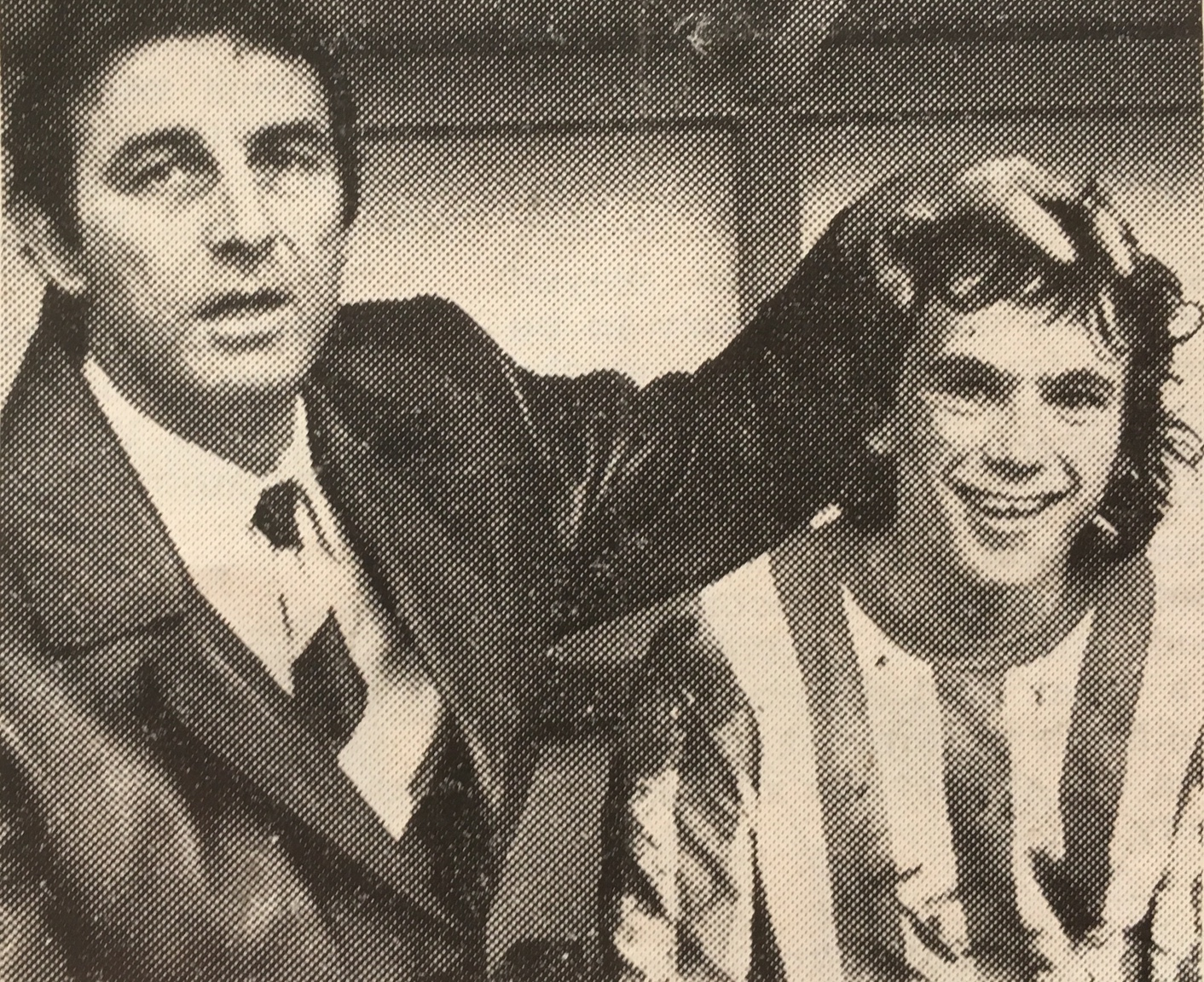
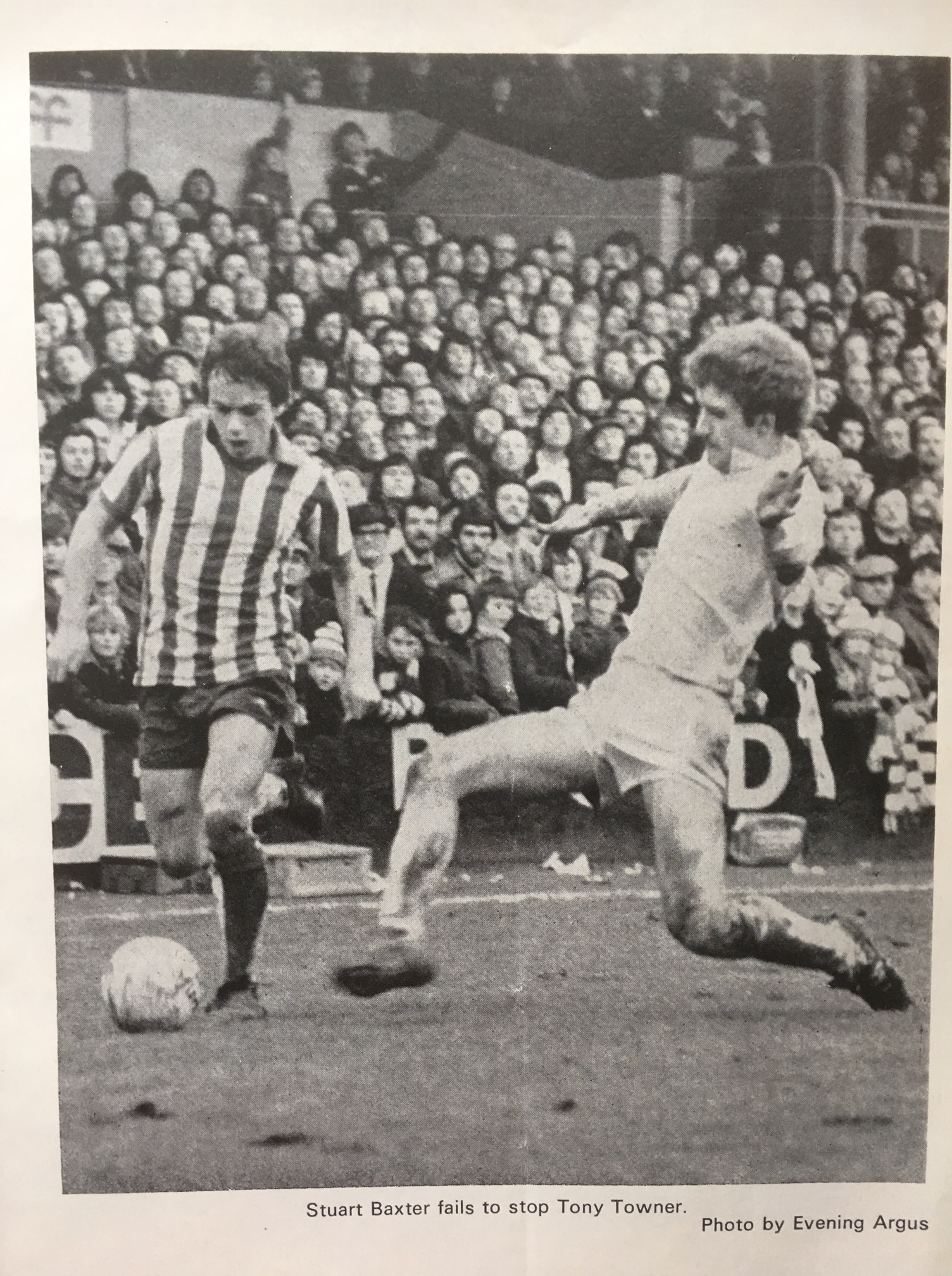
Pictures mainly shot by Evening Argus photographers and then reproduced in the Albion matchday programmes show a happy Towner congratulated by manager Pat Saward after his league debut, in familiar pose taking on a full back, getting in a trademark cross, in full flight on the wing, and finally on a Wolves album sticker.