Champion medal surprise for man on the mic Aspinall

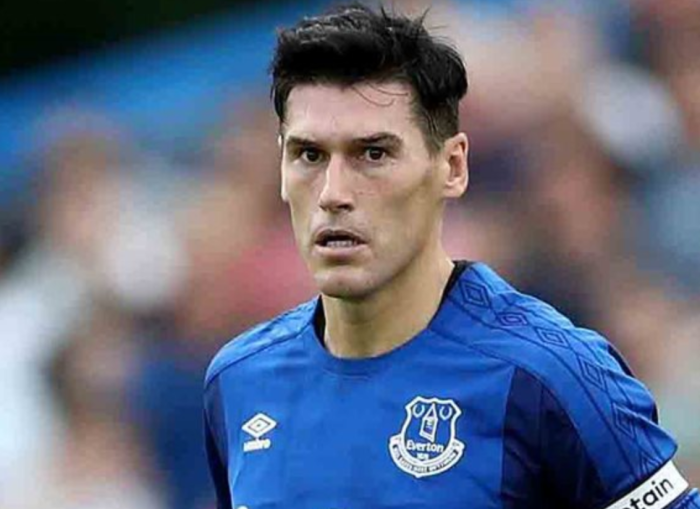
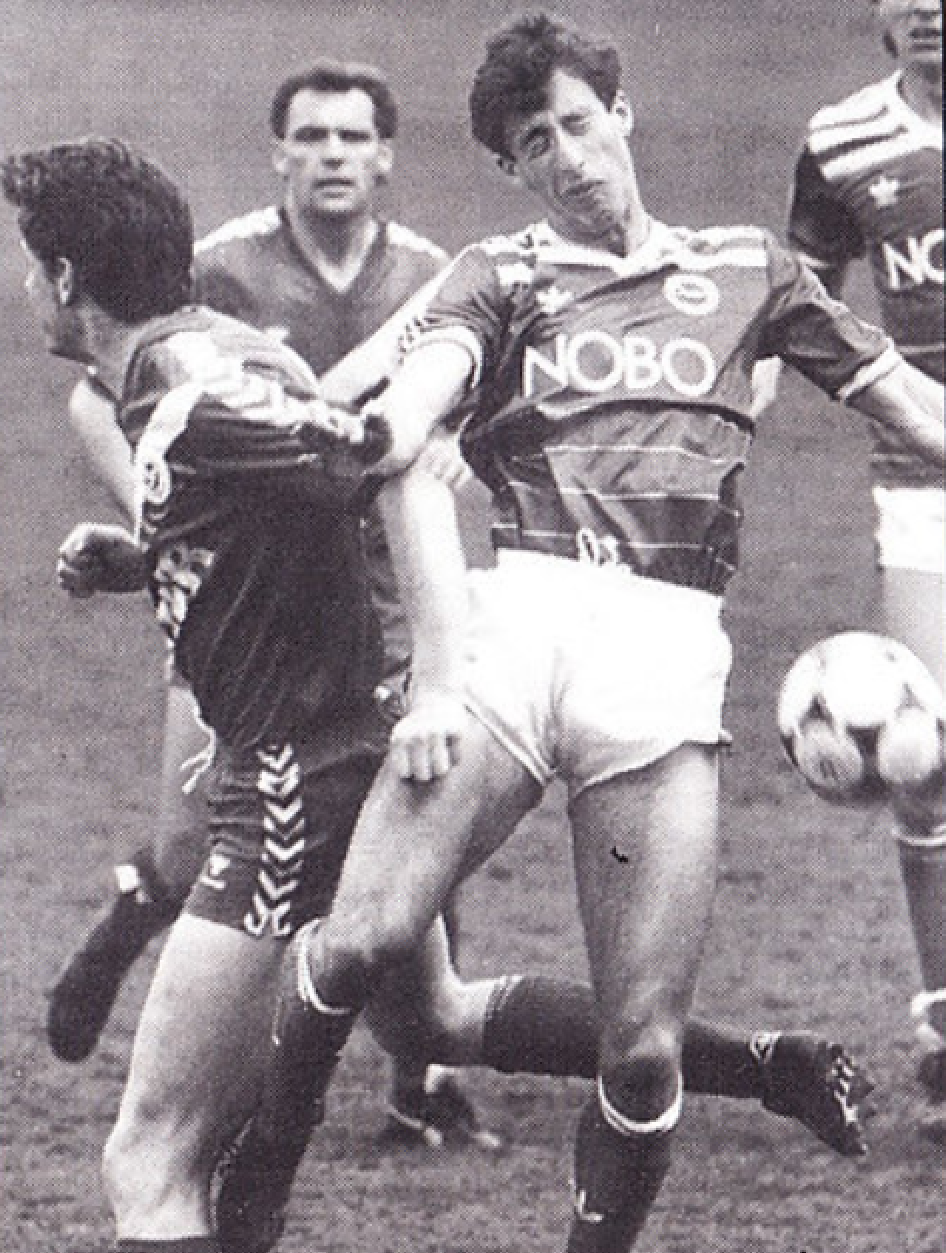
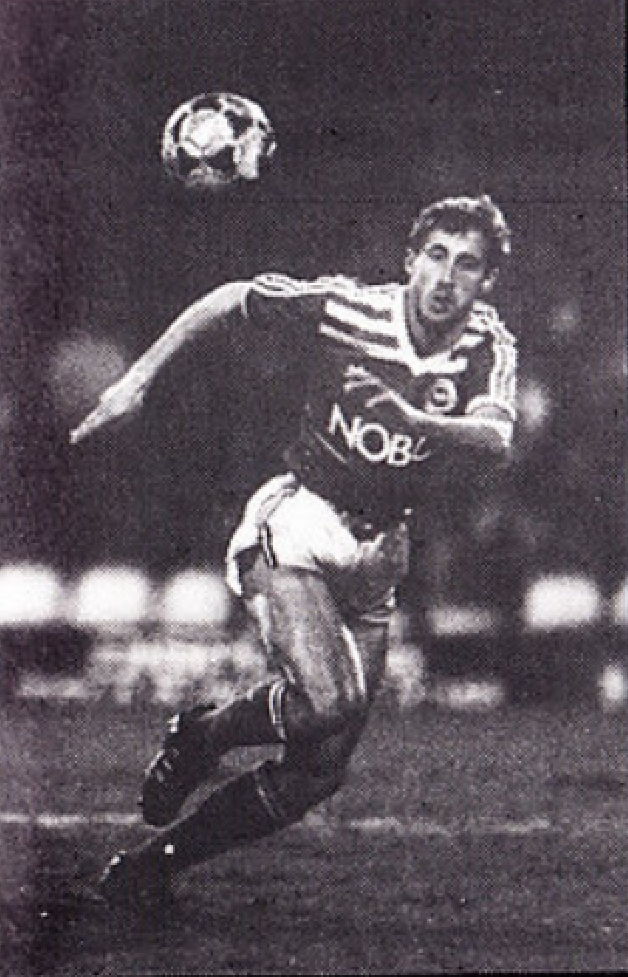
THE starry-eyed teenager who made half a dozen top level appearances for eventual league champions Everton had to wait a long time for his share of that distant glory.

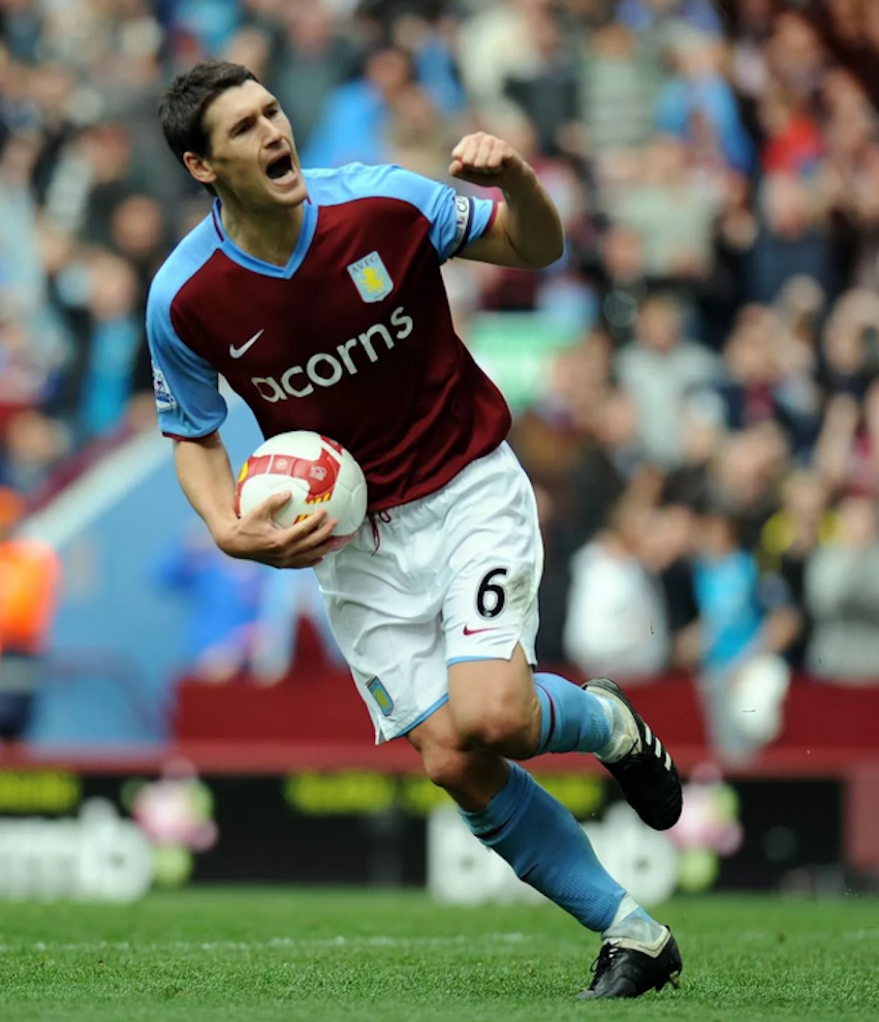
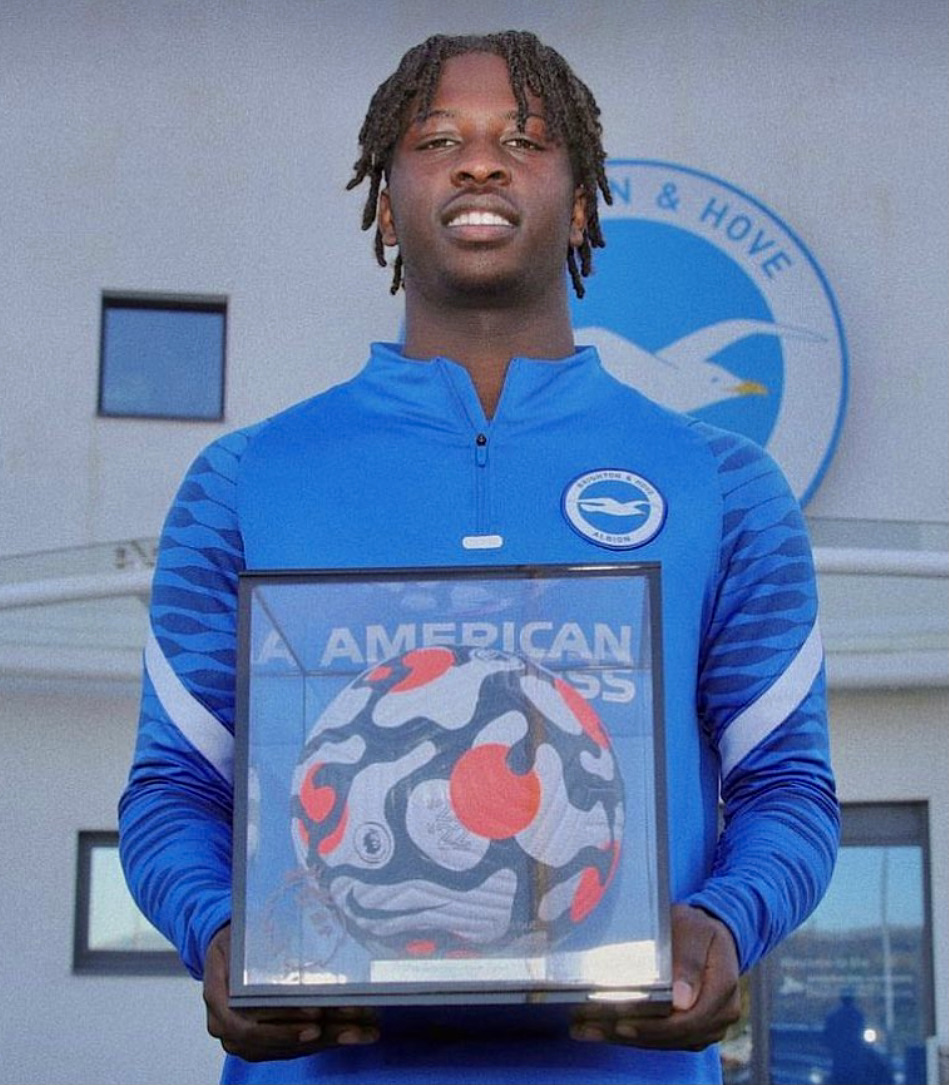
But Warren Aspinall was nonetheless delighted when his contribution to the Toffees achievement in 1986-87 was finally recognised with a medal more than 30 years later.

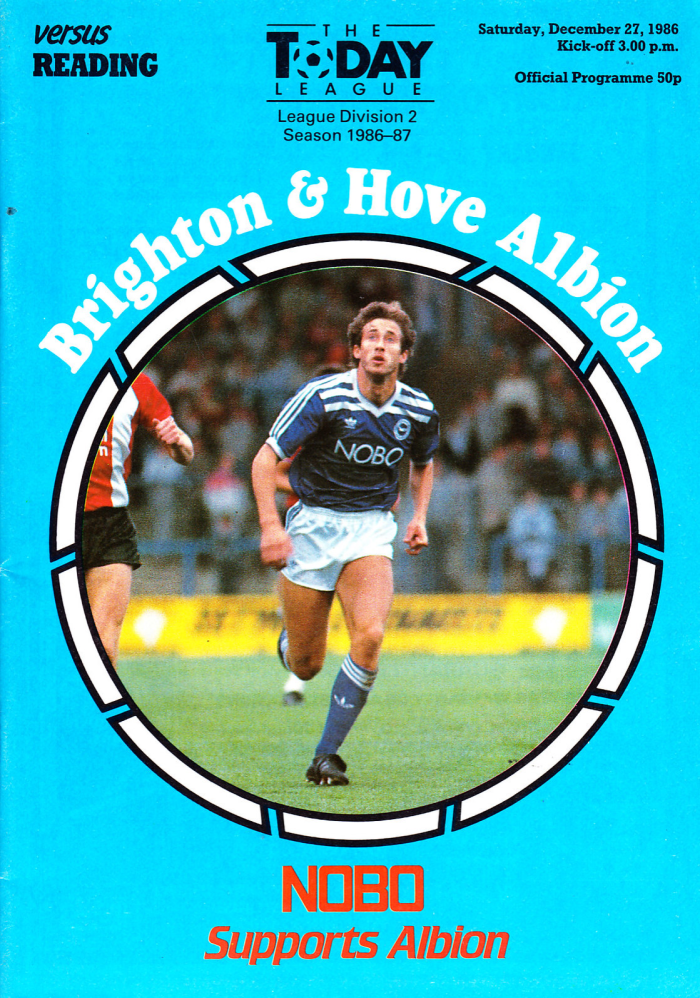
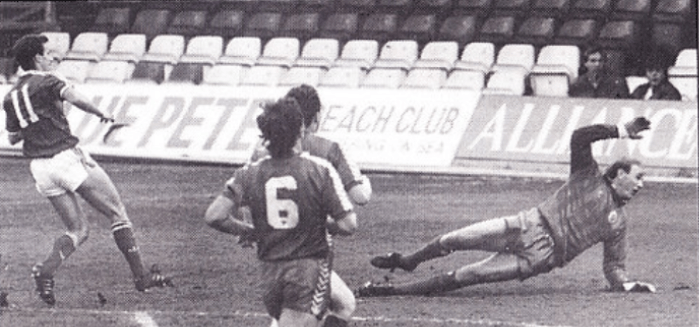
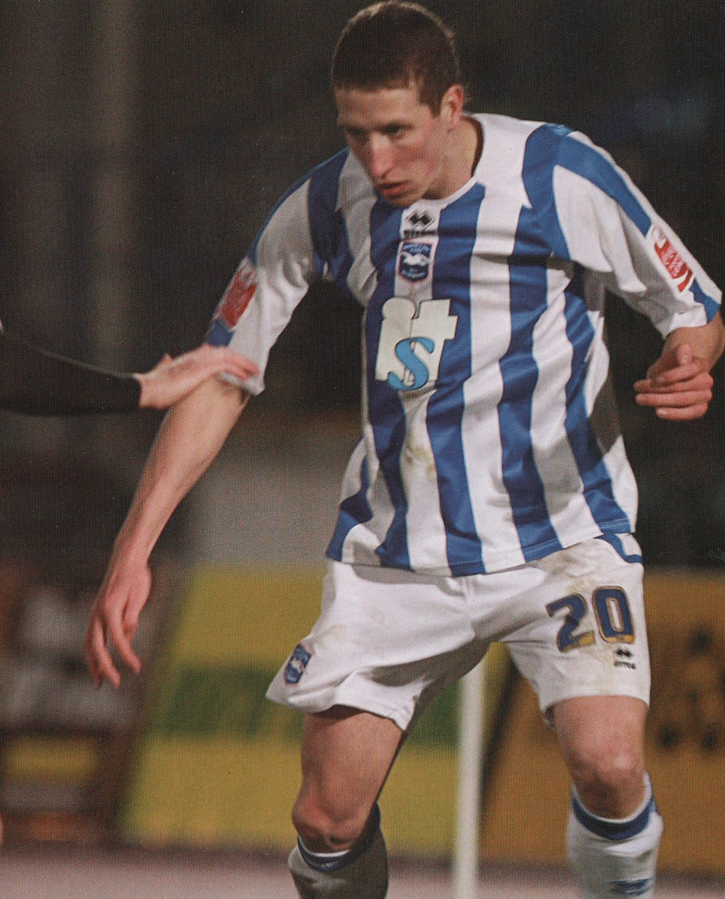
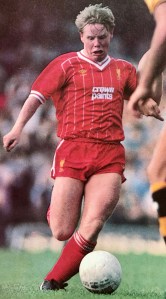
That’s happened since I last featured Aspinall in this blog, which recalled his early days at hometown club Wigan Athletic and darker days after he had ended his playing days in the blue and white stripes of the Albion (three goals in 24 starts plus 13 as sub) in the 1999-2000 season.

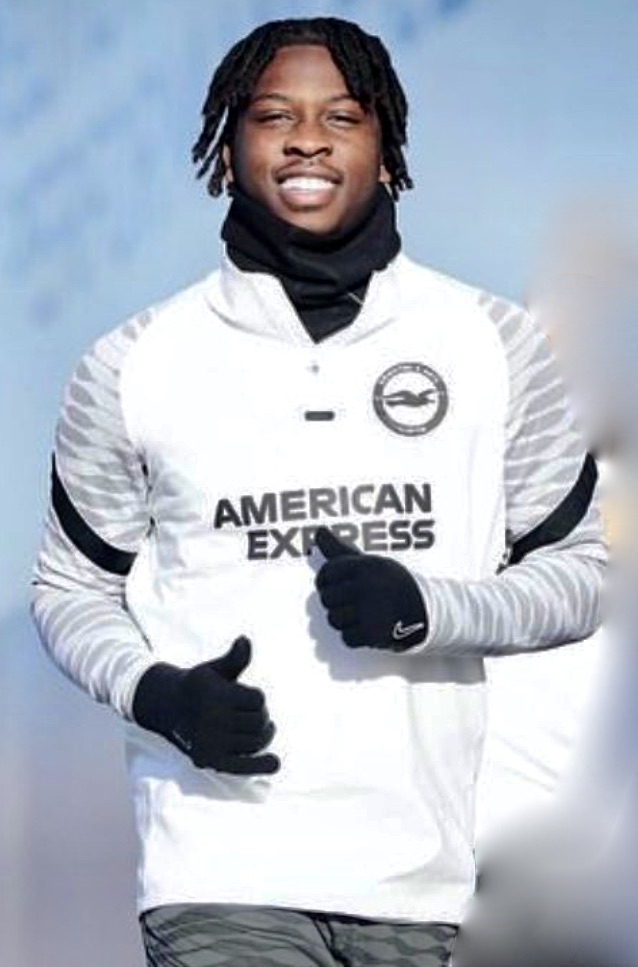
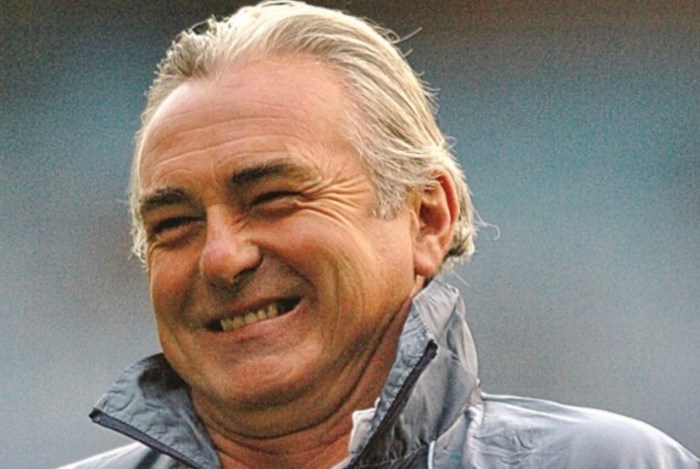
Aspinall is now more often heard rather than seen by Brighton supporters who listen to match commentaries on Radio Sussex, and it was commentator Johnny Cantor, who the summariser sits alongside for the regional BBC radio station’s coverage of all Albion’s games, who instigated a presentation of the belated honour.

“It was JC who pushed it forward and he kept it to himself before surprising me with the news that Everton would be making a presentation,” Aspinall told the matchday programme. “I was shocked but absolutely over the moon.”

The number of games to qualify for a winners’ medal used to be 14, or a third of the season, but the EFL in 2021 decided retrospectively to fall in line with the Premier League which awards medals to players who’ve made a minimum of five appearances.

Aspinall had been unaware of the rule change but Cantor had words in the right places and when Albion played at Goodison Park on 3 January 2023, the former player was finally presented with his medal by Graeme Sharp, one of his fellow Everton forwards back in the day who subsequently became an Everton director.

It’s probably a good job the presentation was made before the game because Albion romped to a 4-1 win that day with goals from Karou Mitoma, full debut-making Evan Ferguson, Solly March and Pascal Gross.

“The medal means the world to me and my family and it now sits proudly on my mantelpiece along with my England under 20 caps,” said Aspinall.

He earned the first of those two caps in the same month that Everton paid £125,000 to sign the 18-year-old from Wigan Athletic, although he saw out the season on loan with the Latics.

He featured in Young England’s 2-0 win over the Republic of Ireland at Elland Road, Leeds, and the following month was in the side that suffered a 4-1 defeat to Scotland at Aberdeen’s Pittodrie ground. Tottenham’s David Howells and Neil Ruddock, then of Millwall, also played in both matches, as did Millwall goalkeeper Brian Horne.

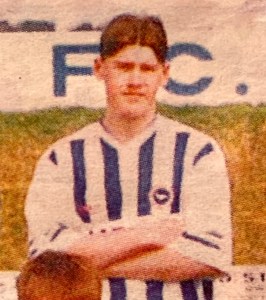
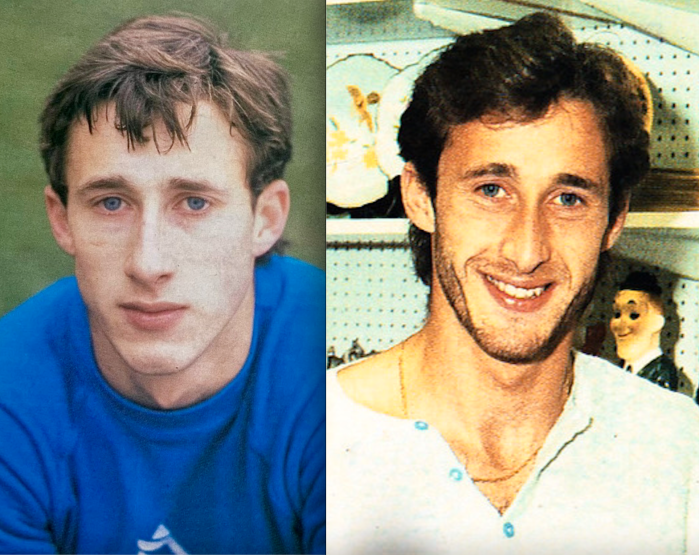
Teenager Aspinall signs for Everton’s Howard Kendall watched by Wigan boss Bryan Hamilton

On his return to Goodison Park at the end of the 1985-86 season, Aspinall was on the bench for the last league game (Kendall rested several players because it was five days before the FA Cup Final, which Everton lost 3-1 to Liverpool) and he made his debut in the 3-1 home win over West Ham when going on for two-goal Gary Lineker, who was playing his last league game for Everton before joining Barcelona.

Everton finished as league runners up that season but they went one better the following season, when competition for forward places saw manager Howard Kendall able to pick Sharp and Adrian Heath as his preferred pair, with Paul Wilkinson and Ian Marshall as alternatives. It meant Aspinall’s playing contributions came in the form of nine league and cup appearances as a substitute (he was also a non-playing sub on four occasions). Although first team chances were limited, he bagged plenty of goals for the club’s reserve side, netting 21 in 23 games.

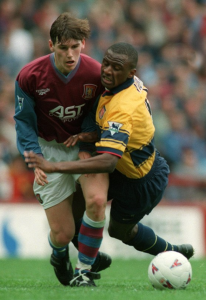
That was enough to convince former Celtic stalwart Billy McNeill, in charge of relegation-bound Aston Villa, to splash £300,000 to take him to Villa Park – where competition for a starting spot was again daunting, with Andy Gray, Gary Shaw, Simon Stainrod and Garry Thompson all striker options.

Aspinall made his Villa debut on 21 February 1987 in a 2-2 draw at home to Liverpool and by the season’s end, while his former Everton teammates were lifting the league trophy, he was part of a Villa side that was bottom of the pile.

McNeill was duly sacked and the picture changed the following season when Aspinall was joint top-scorer as Graham Taylor’s Villa bounced straight back to the top tier as runners up behind Millwall.

“Garry Thompson and I hit it off up front and we had such a good understanding that we kept Alan McInally out of the team for a long time,” he told Villa supporter Colin Abbott. “Garry was good to play alongside because he was like a battering ram and I fed off him.”

Aspinall made his 50th and final appearance for Villa on 7 May 1988 in a 0-0 draw away to Swindon (playing left back for Villa was Bernie Gallacher and in the opposition line-up was Colin Calderwood and Kieran O’Regan).

Already warned by Taylor that he needed to improve ill discipline that had resulted in too many cautions, Aspinall got himself sent off for stamping in a pre-season friendly against St Mirren and Taylor transfer-listed him.

Happy at Pompey

England World Cup winner Alan Ball, in charge at recently relegated Portsmouth, seized the moment and took him to Fratton Park for a fee of £315,000 in August 1988, where his teammates included Mark Chamberlain and Terry Connor. In six years with Pompey, Aspinall also played under John Gregory, Frank Burrows, caretaker Tony Barton and Jim Smith.

Briefer stays followed along the coast at Bournemouth (loan and permanent), Swansea City (loan) and two seasons at Carlisle United.

Aspinall at Colchester

Keen to return to the south, Micky Adams first signed him when he had taken over as manager at Brentford and he made 48 appearances (plus three as sub) for the Bees but Aspinall then went on loan and then permanently to Colchester United for nine months before Adams brought him on loan and then permanently to the Albion in the autumn of 1999. It was a part exchange for midfielder Andy Arnott.

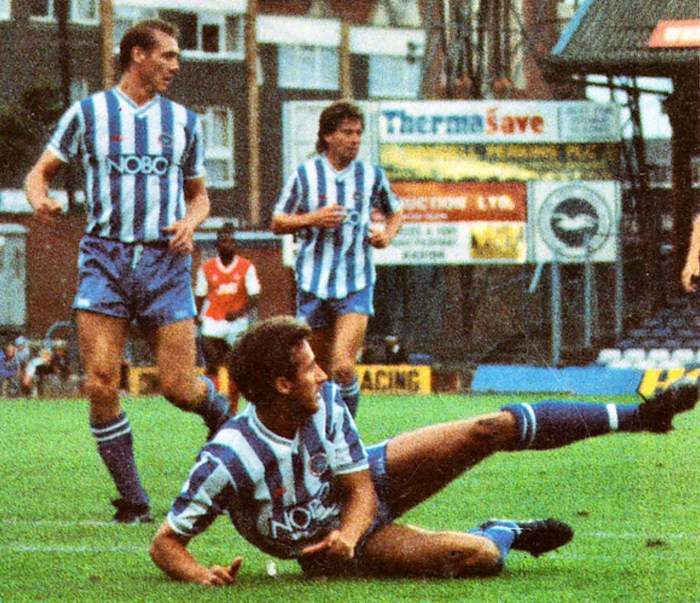
In only his third game, Aspinall was a delighted scorer of the only goal on his old stomping ground of Brunton Park as Albion returned to Sussex with all the points. The News of the World said: “Former Carlisle favourite Warren Aspinall seized on Billy Barr’s poor back pass to chip keeper Andy Dibble.”

In the Argus, Andy Naylor wrote: “The colourful midfielder then dashed towards the Albion supporters huddled in the seats on a drizzly day in Cumbria before sliding full-length on the greasy turf.”

Aspinall continued his celebration with a finger-on-lip gesture and an ear cupped towards the home support. He told the matchday programme: “I heard the keeper shout for the ball and anticipated the defender’s pass. I think I showed a great turn of pace for a veteran.”

In fact, Aspinall was 32 when he joined the Seagulls and he added experience to a side that went on to finish its first season back in Brighton in 11th place in the fourth tier

At the start of the following season, when he went on as a sub for Gary Hart in Brighton’s home 2-1 win over Rochdale (Bobby Zamora scored both Albion goals), it was to be his last ever appearance.

Suffering from the niggle of a piece of floating bone in his right ankle, he followed physio advice to have it removed in what was expected to be a routine operation. But while in hospital, he caught the MSRA superbug which ate away tendons and ligaments in his ankle.

“They eventually said I would never play football again as a result. I was finished,” he told The News, Portsmouth, in a graphic account of the trauma. “Yet now I needed an operation to get rid of this infection, which involved me scheduled to stay on a hospital ward for 14 days, attached to an intravenous drip while antibiotics were fed into my body.

“After 13 days, my body broke out in a rash from head to toe. It had rejected the drug. So, I had the operation once more – and it happened again. After 13 days, my body rejected it.

“For 28 days I’d been on that hospital ward, so I was then offered the chance to return home if I underwent an operation to insert two tubes into my heart, one for the intravenous drip to enter and the other to take blood out.

“That sounded good to me – apart from my heart subsequently stopping during the procedure. I died. I’m told it was for a few seconds, but I died on that operating table,’ Aspinall told The News. “But they brought me back, and I was allowed to go home to Hedge End, with a district nurse checking on me every day, even Christmas Day.

“There were two six-inch tubes hanging out of my chest, with the nurse taking blood out of one and putting the drugs into the other.

“I lived. The antibiotics killed the superbug, but my career ended there and then. I was aged 33, with nothing planned, no coaching badges. I had to go into the real world.”

The story of what happened in his post-playing days – battles against gambling and alcohol addictions – have been well documented in various media interviews, including a detailed one with the Birmingham Mail in October 2012, when he spoke openly about a near-miss suicide attempt.

He has been Cantor’s co-commentator on Albion matches for Radio Sussex since 2015.

Goalkeeper Simon Steele swapped gloves for collars

STEELE is a familiar name in an Albion goalkeeper’s shirt. In the current set-up, there’s Jason. Back in the 1970s there was Eric. And very briefly, in the early 1980s, there was Simon.

After three years as an Everton youth player, Simon Steele joined the Albion a few weeks after they’d lost to Manchester United in the 1983 FA Cup Final.

When the Albion went on a pre-season tour in Majorca, the new arrival suddenly found himself keeping goal for the Seagulls in a match against the mighty Real Madrid.

“It may well only have been the City of Palma Tournament, a four-team pre-season competition, but Steele will never forget that evening on August 18, 1983,” The Argus reported in a 2004 article.

By then 40 and with 14 years behind him as a detective with Sussex Police, Steele recalled: “I had joined Brighton just after the FA Cup final. I had done a bit of pre-season training and then we went out to Majorca for this tournament.

Graham Moseley wasn’t on the tour, I can’t remember why, so it was between me and Perry Digweed.

“I was really surprised to be selected for the game. I think Perry thought we would get a good hiding and threw an injury.”

 A crowd of more than 20,000 watched the game and Steele told the newspaper: “They had a good side with plenty of internationals. We had quite a bit of support so the atmosphere was really good, especially considering it was a pre-season game with not a lot resting on it. There were a lot of Brits out there who came to support us and we were playing for personal pride.

“I just remember them scoring in injury time. Santillana turned on a sixpence and put the ball in the bottom corner from eight or ten yards out.

“Other than that we held them at bay. Although I had quite a bit to do, I dealt with it comfortably. I never felt under any great pressure and it was gutting when the goal went in.”

Indeed, The Argus said the match report of the time raved about Steele’s performance, in particular picking out “one breathtaking stop” from Camacho, who had played for Spain at the 1982 World Cup.

Steele retained his place when Albion beat Hungarian side Vasas Diosgyori 3-2 in the tournament’s third place play-off, with goals from Steve Gatting, Tony Grealish and a Terry Connor penalty.

However, although Steele reckoned he had done enough to earn a place when the action proper began, he was to be disappointed.

“I did play well and it catapulted me on to the fringes of the first team,” he told The Argus. “I really thought I would start the season, then I got a call the day before the season started and Jimmy Melia said he would start with Moseley in the first game at Oldham.

“It was a bolt out of the blue because I thought I had played well in pre-season.”

Thankfully, he didn’t have long to wait for his chance, though. Two days later, with Moseley injured and Digweed suspended, the youngster made his League debut in a 3-2 defeat against Leeds at Elland Road.

Simon Steele keeping goal for the Albion at Elland Road

Grealish gave the Seagulls the lead before, as the matchday programme highlighted, Steele came out well to make saves at the feet of Andy Ritchie and John Sheridan.

He also “saved brilliantly” from George McCluskey but was beaten by an equaliser from Andy Watson and a Frank Gray penalty.

Connor levelled the match, rising high to head home against his old club, but, agonisingly, a last-minute 25-yard right-footed shot from Sheridan left Steele helpless and gave Leeds the win.

Melia turned to the more experienced Digweed for the next match, at home to Chelsea, and within a matter of days, former England international Joe Corrigan arrived to dominate the goalkeeper pecking order – and Steele’s brief Albion career was over.

He went on loan to fourth tier Blackpool and Melia explained in his matchday programme notes: “With the surfeit of goalkeepers at present at the Goldstone, his opportunities are limited and I felt that he could get some valuable experience in the league with Blackpool which will stand him in good stead.

“He is only nineteen and I think he has a great future; we feel that a loan spell will sharpen up his game, but it certainly doesn’t mean he has left the Goldstone permanently.”

Steele played three games for the Tangerines and the following spring went on loan to third tier strugglers Scunthorpe United, where he featured five times.

The Iron, managed by ex-Leeds and England striker Allan Clarke, actually wanted to keep him but Steele said he was not happy with the terms being offered and reckoned he would be better off getting a job and playing part-time football instead.

Born in Southport on 29 February 1964, Steele went to Ainsdale High School in the seaside town between 1975 and 1979. He joined Everton at the same time as Shaun Teale (according to the website efcstatto.com), who later won the League Cup with Aston Villa.

Despite his best efforts in goal for Everton’s youth side in the 1982 FA Youth Cup, they lost 2-0 to Villa in the third round. The Liverpool Echo report of the game noted: “Paul Kerr picked up a free kick rebound and seemed certain to score until Steele denied him with a spectacular save. But the Midlanders went ahead after 41 minutes when winger Obi beat Steele with a powerful swerving shot from 25 yards.”

It added: “After Mark Walters had struck the face of the Everton bar, Kerr chipped the advancing Simon Steele with devastating accuracy to notch Villa’s second in the 83rd minute.”

After turning his back on the chance to play lower league football with Scunthorpe, Steele turned out for a variety of Sussex non-league sides – Worthing, Bognor, Pagham, Peacehaven, Whitehawk and Withdean – and became a detective constable with Sussex Police in October 1990.

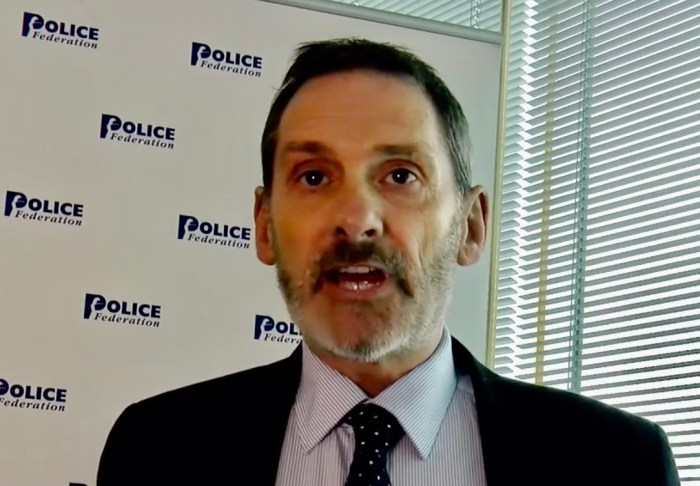
He was in the news in 2019 when, in his role as secretary of the Sussex Police Federation, he spoke out about the lack of investment in detectives in the county.

Speaking up on behalf of police colleagues

He said victims of crime weren’t getting the service they should have done because of a lack of sufficient detectives in the force.

“It used to be easy to fill the detective roles,” he said. “Now officers don’t want to go into the department for whatever reason, down to the workloads that they’re carrying, the pressures, the hours that they’re working, and a lot of them are pretty close to breaking point.”

Big-time beckoned for Bratislava-born Brezovan

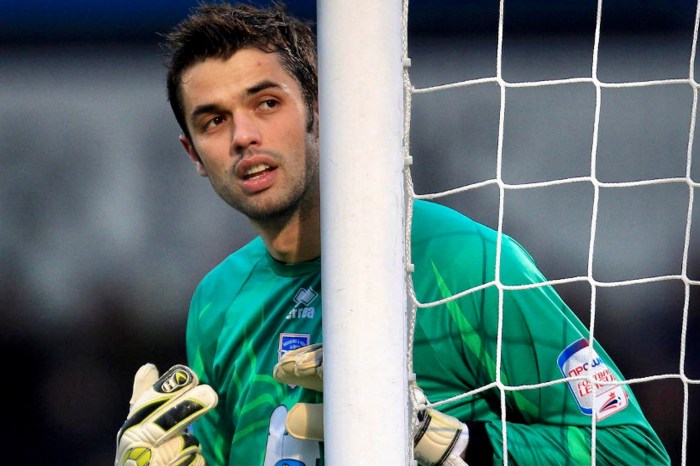
LANKY Slovakian stopper Peter Brezovan, who saved penalties on his Albion and Swindon Town debuts, once came close to a dream move to Everton.

The Merseyside outfit had him on a five-day trial with a view to signing him on a permanent basis from Swindon.

“It was very rewarding just to train alongside Tim Howard and face all these international players,” he said. “It was an experience I’ll never forget.”

Former Man Utd ‘keeper Howard was Everton’s no.1 in 2007 and, having released Richard Wright that summer, manager David Moyes had only new signing Stefan Wessels and the little-used Iain Turner as back-up ‘keepers. Everton’s goalkeeper coach was the former England international Chris Woods.

While Everton didn’t follow up their interest in Brezovan with an offer (three years later they did sign a Slovakian goalkeeper, Jan Mucha), it sounded like Swindon rather over-egged their expectations of a big payday.

Robins stopper

The Wiltshire Gazette and Herald reckoned a £300,000 eve of deadline day offer from Wolverhampton Wanderers had been rejected, saying: “Town will be asking for a substantial amount more.”

The newspaper added: “If the price is right, Town are ready to cash in on their number two keeper.” And manager at the time, Paul Sturrock reportedly told the Mirror: “If I was offered something like £2m, Brez would be an Everton player.”

The Toffees had originally taken an interest in Brezovan and invited him for a trial when he made an eye-catching start in English football in 2006. Not only did he save two penalties in his first game for Swindon, he conceded only five goals as Town won six of their opening seven matches and won the PFA Player of the Month award for September. Unluckily, a badly broken arm put him out of the game for nine months but Everton revived their invitation when Brezovan was fit again.

It probably didn’t help the ‘keeper’s progress at Swindon that successive managers came and went during his time at the club. It was Dennis Wise who signed him on a year’s loan from Czech side 1.FC Brno shortly after he’d taken over as Swindon manager, assisted by his former Chelsea teammate Gus Poyet, but by October the pair (along with goalkeeper coach Andy Beasley, who later spent a year at Brighton) left Wiltshire to take over at Leeds United.

County Ground caretaker managers David Tuttle and Ady Williams were followed by Sturrock for a year; David Byrne twice held the fort temporarily and Maurice Malpas was in charge for 11 months in 2008. When he left in November that year, Danny Wilson arrived the following month.

Born on 9 December 1979 in Bratislava, Brezovan’s first football memories were playing at right-back. In a matchday programme article, he explained: “In the first game of the season our ‘keeper got injured, so the biggest kid had to go in goal – and I’ve been there ever since. I’ve always been tall so looked upon to go in goal but, unlike a lot of kids, I enjoyed it.”

Brezovan spent his youth career at the city’s MŠK Iskra Petržalka and also played for Devin in the city before spending two years in the Czech Republic with FC Slovan Břeclav and HFK Olomouc. He then spent four years at FC Brno in South Moravia, although it was while he was on loan back in Bratislava, playing for FK Inter Bratislava, that he was spotted by Swindon and subsequently made the move to England.

In spite of his spectacular start for the Robins, when he couldn’t speak a word of English, it would be fair to say Swindon have mixed memories of his time at the County Ground, chronicled in detail on swindon-town-fc.co.uk. After former Albion captain Wilson released him at the end of the 2008-09 season, he was without a club for six months.

He had an unsuccessful trial at Crewe Alexandra in October 2009 but Poyet, not long after succeeding Russell Slade as Albion boss, signed him for a month at the beginning of December to cover a mini goalkeeper crisis he inherited.

Regular no.1 Michel Kuipers was injured and Slade’s misfit summer signing Graeme Smith had conceded 11 goals in three defeats and one win.

Handed his debut on a drizzly, grey December afternoon at Exeter (I know, because I was there, getting wet on the uncovered terrace behind the goal!), Brezovan went from zero to hero, according to writer Richie Morris, after upending  former Albion loanee Stuart Fleetwood in the penalty area and then impressively saving Marcus Stewart’s spot kick.

“The former Slovakian under 21 international pulled off a string of comfortable, but reassuring saves,” wrote Morris. “True, he did nearly gift the home side a goal with a wayward clearance, but, considering how long he has been out of first team football, he can be happy with a solid performance.”

A somewhat modest Brezovan attributed his penalty save to goalkeeper coach Tony Godden’s homework. “He told me where Marcus Stewart puts his penalties and I dived the right way but it was a great feeling to help the team to victory,” he said.

Penalty-saver!

On another occasion, Brezovan expanded on his technique with penalties, telling the matchday programme: “It’s mainly instinct on the day. You get the stats guys who help you with your preparation – they will tell you where certain players tend to put the ball but sometimes you just have to go with how you feel in that moment and go for it.

“I don’t get the lads to take penalties at me after training either – I hate doing that. It’s all about how you are on the day.”

Brezovan’s arrival signalled the departure of the hapless Smith who ended his six-month nightmare in English football by returning to Scotland, moving on a free transfer to Hibernian. And the Slovakian’s short-term arrangement ultimately extended into a four-and-a-half-year spell as a Brighton player.

There were occasions when he was tempted to move on for more regular game time, but he confessed to loving the area and stayed put even though first team opportunities were few and far between.

In that first season, fans’ favourite Kuipers, not for the first time, found his place under threat because of the 6’6” Brezovan’s form. But a blunder by the new man in a game at home to Wycombe prompted Poyet to bring back the former Dutch marine (chef) at the start of the new year.

Kuipers had an eight-game run in the starting line-up but then broke a finger. Brezovan, having had his contract extended, seized his chance and kept his place through to the end of the season.

Brezovan told the matchday programme: “We are good friends, we train well together, and so I really feel for him. We don’t feel like rivals at all in that respect but I know that while I am in the team I will be giving my all to make sure I maintain my place.”

It paid off because Poyet offered him a two-year contract at the end of the season, saying: “Peter has earned his new contract. Initially he came to play and help us out but I expected he would prove he was worth a longer deal and he has done that.

“He has been a very important part of our turnaround since Christmas and now his challenge is to make the position his own for next season and beyond.”

And the ‘keeper told the Argus: “Together with my girlfriend, I’ve really settled here. I think that Brighton is the nicest city in England and we’re really happy here.

“I owe a lot to the manager because he brought me to the club and I’m glad he wants me to stay. That’s why it was so easy to sign the deal. The manager will no doubt bring in more good players in the summer so it’s going to be an exciting season.”

He was right about the excitement because Albion went on to win the League One championship title; what he might not have anticipated was that because he was nursing a wrist injury on the eve of the season opener against his old club Swindon, Poyet moved quickly to sign another ‘keeper who he’d worked with at a previous club: Casper Ankergren.

The Dane, released by Leeds, instantly became first choice ‘keeper and Brezovan spent most of the season watching from the bench, making just seven starts in the FA Cup (the first and second round matches both went to replays). Close to the end of the season he went on as a sub for the injured Ankergren in the 18th minute of the 25 April league game at Colchester United, making important saves from Ian Henderson and David Mooney as the Albion salvaged a point in a 1-1 draw.

Brezovan was also in goal for the penultimate game of the season, and the last ever played at the Withdean, when Huddersfield won 3-2. A defensive gaffe by Inigo Calderon, who left Brezovan stranded by chesting the ball down inside the area, let in Benik Afobe to put Town 2-1 ahead; sub Matt Sparrow equalised for the Seagulls and, although Brezovan twice made excellent saves to deny defender Jamie McCombe, sub Danny Ward scored a last-minute winner.

Brezovan resumed his place on the bench as 2011-12 got under way with Ankergren once again Poyet’s first choice no.1, although, after he’d shipped 13 goals in eight games in the autumn, the manager brought experienced Newcastle custodian Steve Harper on loan for five games.

Brezovan preferred to see the positive side of it, though, telling the matchday programme: “That was a good experience for all the goalkeepers. He is a vastly experienced ‘keeper and we have learned from his time here.”

After Albion went through a four-game losing streak in December, Brezovan got the call to take over from Ankergren in the new year match at home to Southampton when an injury-hit Albion sprung a surprise, winning 3-0 with a memorable brace from midfielder Sparrow.

It was only after the game that Poyet revealed how his plan to change ‘keepers nearly didn’t come to fruition. “For the last week Peter has been waiting for his wife to have a baby, every day,” Poyet told the Argus. “I needed to wait until 1.30 to tell him he was playing. The baby was due three or four days ago, so we were all thinking ‘come on girl, go on’!”

Later the same month, Brezovan was hailed a hero when he saved a crucial spot-kick in a penalty shoot-out in a third round FA Cup replay at Wrexham and he told Brian Owen of the Argus: “I enjoyed it. The pressure is all on the strikers at penalties because they can just mess it up. You have nothing to lose, you are practically without pressure.

“I knew one player and where he goes and I saved his penalty so we could have a laugh in the end.”

Nevertheless, Poyet was obviously still unsure about the goalkeeping situation. He let third choice Michael Poke go on loan to Bristol Rovers but brought in Columbian David Gonzalez, who’d been with Man City for two years, to put pressure on Brezovan and Ankergren.

“The gaffer wanted to bring in another keeper. You have to face it, with Casper, and keep working to keep our positions,” said Brezovan.“I’ve got another year. If you want to stay at a club for a long time, you have to play. You can’t be just like a useless second or third choice. This is my opportunity and I am going to do everything to stay in goal.”

He did indeed stay in goal but on two occasions let in six! The first drubbing was handed out by Liverpool in the fifth round of the FA Cup at Anfield (with Albion famously conceding three own goals in a 6-1 defeat).

After Brezovan shipped another six against West Ham at the Boleyn Ground, Poyet had seen enough. The patient Gonzalez replaced Brezovan in goal for the following game, one of six changes to the side that capitulated to the Hammers.

Come the new season, Brezovan and Ankergren had even more of a challenge on their hands when experienced Polish international and former Manchester United ‘keeper Tomasz Kuszczak arrived at the Amex.

It pushed Brezovan down the pecking order to third choice ‘keeper and he played only once all season, in a 2-1 win at Huddersfield when Kuszczak had a finger infection that ruled him out and Ankergren picked up an injury in training two days before the game.

Brezovan stayed at the club as no.3 ‘keeper for the 2013-14 season and once again injuries to the first and second choices in Oscar Garcia’s side presented him with a rare opportunity. He ended up playing eight games, four in the league and four in the FA Cup.

He made his first appearance for 13 months in the 7 December 3-1 win at home to Leicester after Kuszczak pulled out in the warm-up with a stomach muscle strain, with Ankergren already sidelined with a wrist injury. In an interview with the Argus, on his 34th birthday, Brezovan spoke openly about possibly moving on to get more games.

“It’s hard because Brighton is a beautiful place and I love the people around here. It’s not easy to go.

“If there was an offer from the same level, I would probably try it. Going to a lower division, getting injured and then to be there on the bench is risky.”

And of his sudden chance back in the Albion goal, he reflected: “That’s football. Things can happen quickly and it’s beautiful. It shows how everyone is important. When you don’t play for a long time, even in training, you start to think it’s hard to motivate yourself.

“That’s why you need good lads around you. I love the guys here. They always help you to be motivated. When you play and your contract is running out you need to find that motivation.”

His appearance in the fifth round FA Cup replay defeat (1-2) at Hull City on 24 February turned out to be his last first team game and he was released at the end of his contract that summer having featured 62 times for the Seagulls.

He trained with Oxford United during pre-season and at the start of the next season joined Portsmouth for a month as cover for Paul Jones. On transfer deadline day, he signed a one-year contract with Tranmere Rovers.

Although he played seven games for Rovers, he lost his place to regular ‘keeper Owain Fon Williams. He had a loan stint at Southport in early 2015 but at the end of the season, following Rovers’ relegation from League Two, he was released.

Interviewed by the Argus in December 2015, Brezovan had returned to Brno in the Czech Republic, quit football and turned to publishing music online.

“I lost a little bit of motivation,” he said. “The football wasn’t going anywhere and I’d had enough. I’m focusing on this now.”

‘Glove-wearing gazelle’ played only 16 Albion games

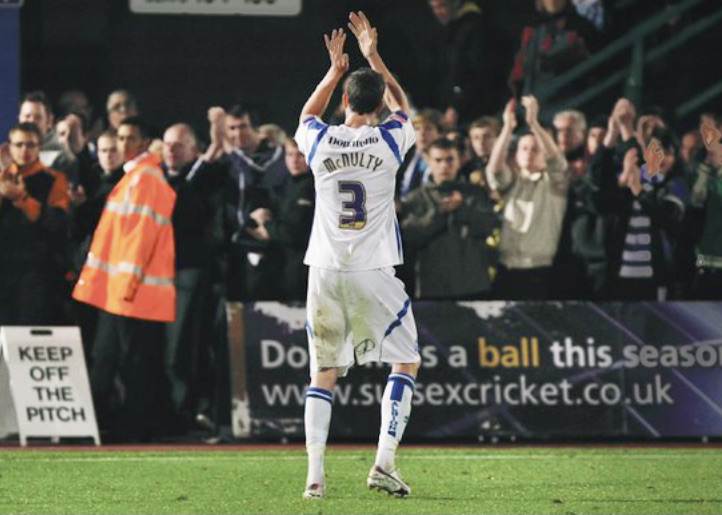
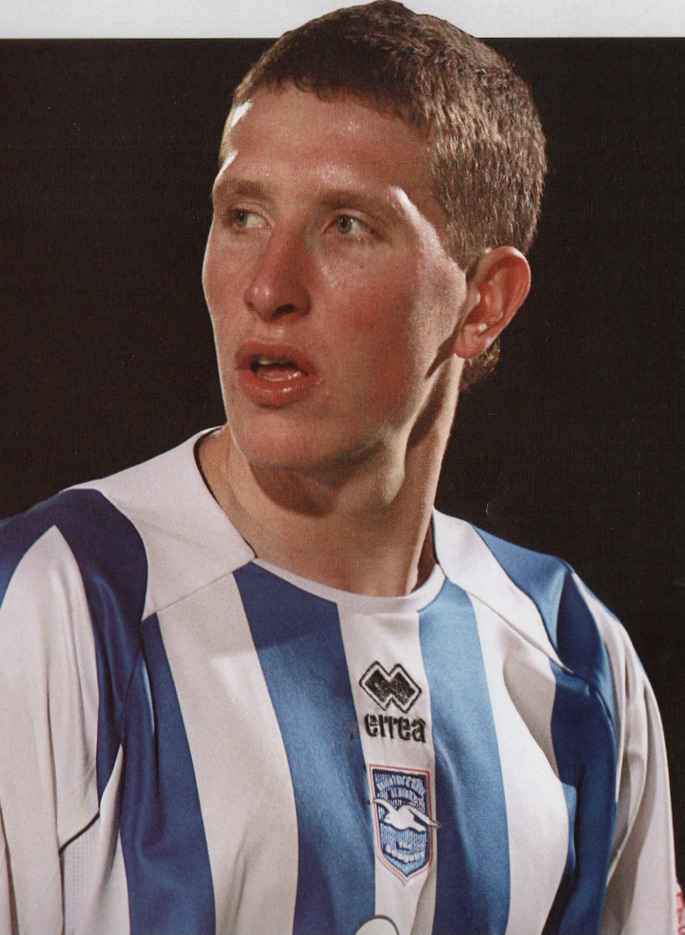
SCOUSE defender Jim McNulty, who played alongside Wayne Rooney at Everton as a schoolboy, will probably always be remembered by Brighton fans for a horror injury he suffered in a match at Withdean.

After an on-off transfer saga in which McNulty initially rejected Albion’s desire to sign him, the £150,000 signing from Stockport County scored on his debut and less than three weeks later was involved in an accidental collision that threatened to end his career at 23.

In only his fifth game after under-pressure boss Micky Adams finally landed the left back, a seemingly innocuous challenge as a Crewe defender caught him with his knee in his side quickly became much more serious when he started passing blood.

“Having walked back to the changing room I remember having the sensation of needing to go to the toilet and it was then that blood started spurting out,” he recounted. “I was also throwing up and the real scary part was the look of concern on the medical team’s faces.

“I was rushed to the Royal Sussex County Hospital for an MRI scan and had a catheter inserted as my belly was swelling up. It was then that I discovered one of my kidneys had capitulated.

“I was on the bed in the hospital after the scan when the surgeon said 90 per cent of the kidney is mush and I don’t believe you can play again,” McNulty told the club’s official website.

Nine years later, ahead of facing Harry Kane for Rochdale against Spurs in the FA Cup, McNulty told Ivan Speck of the Express: “It was instant tears. I was there with my father and fiancée, at the time. I remember crying into my dad’s chest.

“It was probably a bit of everyday information for him but, for me, football was my life and he should have stayed quiet until he was better informed. It still winds me up now.

“The FA actually got wind of the news and their doctor spoke with our club doctor. They had spoken to some rugby guys in the southern hemisphere because it’s a more common injury in rugby than it is in football.

“It was nonsense to suggest it would end my career.”

Initially, because he was a professional sportsman, the medics tried two operations to save the kidney but, when he was still passing blood three weeks later, the decision was taken to remove it.

McNulty described incredible pain he had to endure but realised once he had gone through with the operation that he would be able to play football again.

Amazingly, he was able to return to training within three months although he had a lot of work to do to rebuild his fitness. Within four weeks he was even able to play in a couple of pre-season friendlies.

However, McNulty went on to suffer a number of knock-on injuries because his posture was affected by having an empty space on the right side of his body.

“I had multiple ankle injuries because my pelvic alignment was a nightmare from that point on,” he said.

The first came just when it looked like he would make a return to league action in September 2009. He damaged his ankle ligaments on a local park pitch while training ahead of the 7-1 defeat at Huddersfield and was ruled out for a further four weeks.

His long-awaited return to first team action came in a Johnstone’s Paint Trophy tie away to Leyton Orient on 6 October, which Albion lost 1-0.

“Just to get out on the pitch and on the ball was fantastic,” he said. “I cramped up after about 70 minutes but the reaction from our fans was tremendous.”

McNulty told the matchday programme: “I have no intention of just sitting around, hoping to break into the side. I want to be playing every week now. I’m fit, raring to go and I want to help us get up the table.”

The unlucky McNulty then missed the following Saturday’s match at MK Dons, enduring yet more pain when he had to have two wisdom teeth extracted.

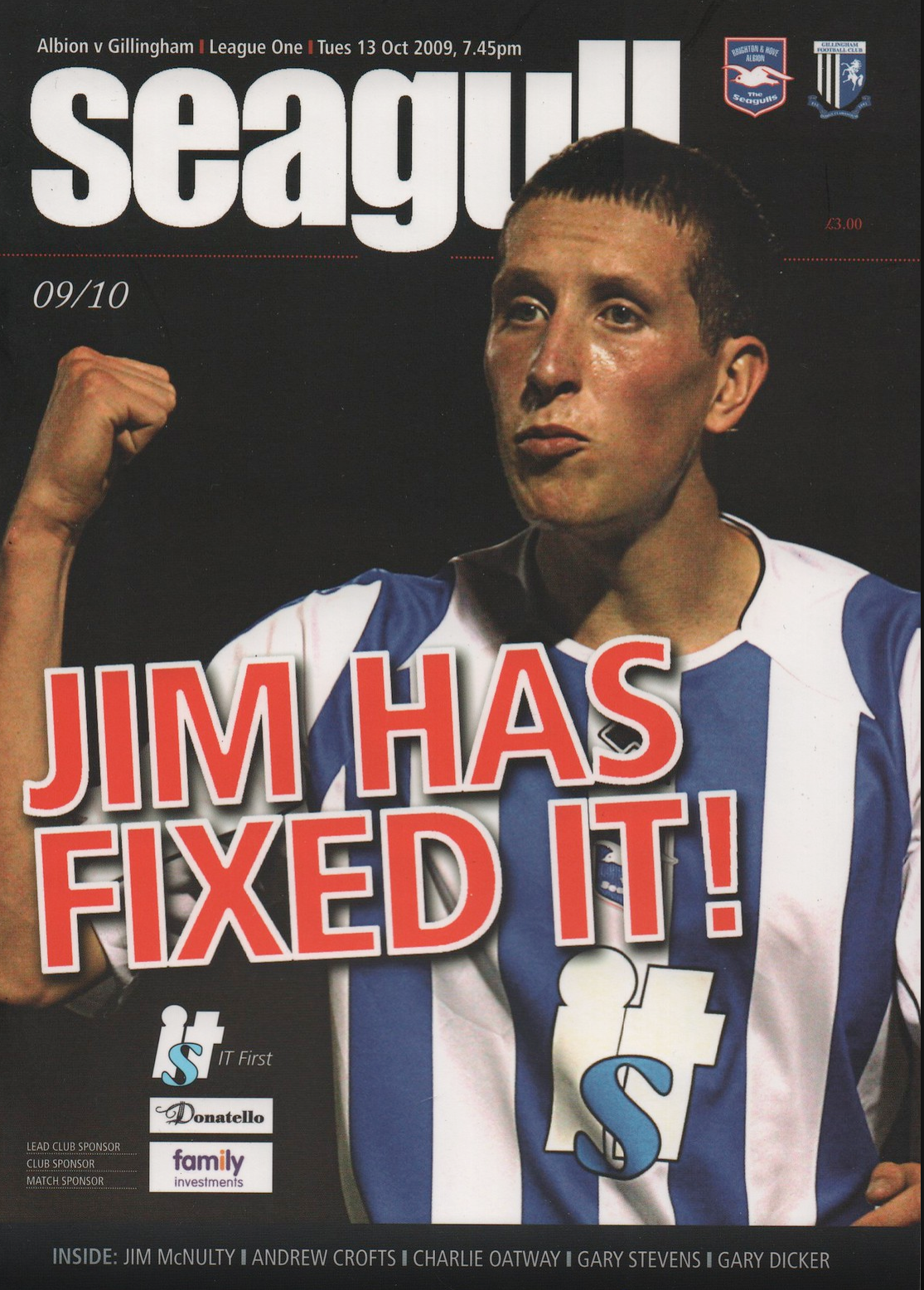
Nevertheless, McNulty’s eventual return to league action followed on 13 October in a 2-0 Withdean win over a Gillingham side which featured former Albion loanee Simon Royce in goal.

Astonishingly, the following Saturday, he lasted only 27 minutes before injury struck again in a 2-1 defeat away to Tranmere. He limped off with an ankle injury and Jake Wright was sent on to replace him. Glenn Murray scored a penalty consolation for the Albion and was then sent off for a second yellow card.

By the time McNulty was fit enough to return, the second manager of his brief time at the Albion, Russell Slade, had been replaced by Gus Poyet. His first involvement under the new boss saw him go on as a sub against: Charlton at home on 1 December.

He then went on as an 87th minute substitute for his good friend Gary Dicker at Exeter and provided the all-important cross from which Andrew Crofts headed the only goal of the game in the 92nd minute.

He had what one observer described as a man of the match involvement as a sub in the next match, a 2-1 home defeat v Colchester United. Saying the left back was “the epitome of Poyet’s ‘bravery on the ball’ mantra”, Richie Morris wrote: “Jimmy McNulty, like a rampaging glove-wearing gazelle, mercilessly attacked the left flank. Time and again he delivered teasing crosses, and time and again the ball simply would not nestle in the net.”

McNulty celebrates with goalscorer Tommy Elphick

That performance was rewarded with four starts on the trot – but then Poyet brought in the cultured Marcos Painter as his preferred left-back. McNulty was in the Albion side that put on a decent show in a 3-2 fourth round FA Cup defeat at Aston Villa, because Painter was ineligible, but he didn’t make another start that season. And, as it turned out, he didn’t play for the club again. He’d actually only played 16 times for the Albion.

Before the end of the season, to get some games, McNulty actually stepped up a level, going on loan to Scunthorpe United in the Championship, where he made two starts and a sub appearance under Nigel Adkins.

He rejoined The Iron in July 2010 on a six-month loan arrangement and played six games. But he suffered a recurrence of his ankle issues, so returned to Brighton in December.

When Albion kicked off a new era playing Championship football at the Amex, McNulty had stayed at the same level but with Barnsley, where he was voted players’ player of the year in his first season, and was made captain in his second season at Oakwell.

McNulty certainly wasn’t bitter about the way things turned out for him in Sussex. He said: “I couldn’t speak more highly of my time with Brighton. It is an unbelievable club, an unbelievable fan base, and it was an incredible place to live.

“My daughter was born there and we had a brilliant time, despite the fact that I was horrendously injured for pretty much all of that time.

“I’ve always been a 40-game-a-season man wherever I’ve been, but at Brighton I hardly played at all. Saying that, it was the club I had the best time at.”

Born in Runcorn on 13 February 1985, Liverpool and Everton were both interested in him when he was young, but it was Everton who put a contract offer in front of him.

“At the time I actually played for Everton against Liverpool in a game at Melwood,” he explained. “This would have been in the under-9s and we absolutely destroyed them.

“Ourselves and Arsenal dominated in that particular age group, right up to the under-16s – every week, every game, every season. Everton were a very dominant team and it gave me a great grounding, so I chose the right team.”

Initially a central midfield player, McNulty was switched to left-back during his time at Everton. Although Rooney was in the year below him, from under-10s, he was put up an age level. “I played with him for about four years until he jumped up again,” said McNulty. “He was playing two or three years up during the teenage years. I was just always playing at my own age.

“He was incredible, incredible. It was like watching a man play with boys in terms of his strength and aggression. He was pinging balls 70 yards as a 10- or 11-year-old boy.

“We couldn’t really lift it off the floor yet. His technique and the power that he had as a young boy, he was devastating at that age. He’d score eight goals every week. He’s one of the reasons we were so rampant as a team. Probably the main reason.”

McNulty moved on to Wrexham to make his breakthrough at senior level, ironically going on as a sub against Stockport in a Northern Section Football League Trophy game which the Welsh side lost 5-4 after extra time.

Because he had a Scottish mother, Englishman McNulty was selected for Scotland at under-17 and under-19 level, although one of his worst footballing memories came while playing for Scotland against France when they were beaten 5-0 in the European Under-19s Championship.

“I always remember being particularly mentally scarred by one player,” he said. “He was a winger and I was at left-back – and he scored four, so obviously that was mentally scarring. His name was Jimmy Briand.”

Briand went on to have a 20-year playing career in France and Germany and played five times for the senior French national team, but McNulty didn’t make it to the Scots full international side.

“There was a time when I had some genuine belief that it might happen,” he told The Sunday Post. “I had a good season in my first year at Barnsley in the Championship, in 2011, and ended up being named player of the year and made captain of the club.

“At the time, Scotland were having a bit of a defender crisis, and there was an opportunity there. I actually thought, ‘My name might come out of the hat here.’ But they ended up choosing a couple of guys who were playing in League One at the time ahead of me. That was a bit of a disappointment.”

But back to those early days, and when he didn’t make further progress at Wrexham he dropped down to League of Wales level to play for Bangor City and Caernarfon Town, but in June 2006, former Albion skipper and manager Brian Horton signed him for Macclesfield Town.

“I appreciate what Brian did for me, bringing me back into league football,” he said. “I was playing non-league football in Wales and he gave me a chance to come back and prove myself.”

He spent 18 months at Macclesfield, where he also played under Paul Ince, before moving to Stockport on a free transfer in January 2007. He became part of the County side that won promotion via the League Two play-off final at Wembley, when they beat another of his future employers, Rochdale, 3-2 in front of a crowd of 35,000.

McNulty was reluctant to give up a League One promotion tilt at County to join struggling Albion but chairman Dick Knight and manager Adams spoke of the club’s ambition and he was finally persuaded.

Albion needed a left back after loan signing Matt Richards had returned to Ipswich and

Adams said: “He fits the profile of what we are looking for. He likes getting forward and, without being disrespectful to anyone who has played there before, he is a natural defender, and he is six-foot two. At one stage it looked like we had lost out, so I am delighted to get him.”

Knight and Adams finally persuade their man to sign for the Albion

McNulty was not alone as Knight sanctioned quite a spending spree on new signings – Craig Davies, Calvin Andrew, Seb Carole, Jason Jarrett and Chris Birchall also arrived in that window, all financed by Tony Bloom, a low-profile investor at that time.

“I am very satisfied,” said Adams. “Finding a left back was a major priority. We haven’t been scoring the amount of goals we should, so we needed to look at avenues to open up teams. We have got Carole and Birchall for that.

“We also needed two strikers (Davies and Andrew) to increase the striking options and we needed a bit more physical strength in midfield, which is why Jason (Jarrett) is there, so I can’t complain.

“I had to be patient to make sure the right type of player was available and at the right price. Two of them were money buys and I am delighted that the board have backed me.”

Both Davies and McNulty were on the scoresheet when Peterborough visited the Withdean on 10 February but Barry Fry’s side took away the three points courtesy of a 4-2 win; Craig Mackail-Smith scoring for Posh along with strike partner Aaron McLean (two) and Dean Keates.

With only one League One win in six and a hoped-for tilt at silverware – the Johnstone’s Paint Trophy – gone in a penalty shoot-out defeat to Luton Town, the second coming of Adams was over. That horrendous injury to McNulty came while Dean White was caretaker manager and, when new boss Russell Slade arrived, one of his first tasks was to bring in Gary Borrowdale on loan from QPR to cover McNulty’s absence.

A change in manager often spells bad news for certain players and, after those successful first two seasons at Barnsley, McNulty found his face didn’t fit when David Flitcroft succeeded Keith Hill as manager. He’d only had one first team outing in a Capital One Cup tie against Southampton.

He grabbed the chance to join Tranmere Rovers on loan in November 2013, although he told the Liverpool Echo: “I have not even had a chance there.  I think I should still be playing for Barnsley.

“They are struggling defensively this season and had been conceding a lot of goals. But now I’m thinking about helping Tranmere.”

Rovers boss Ronnie Moore said: “Jim is a knowledgeable player and a good talker. He settled in quickly here. He is a footballing centre-back, rather than the Terry Butcher type. I don’t think you will see too many cuts and bandages around Jim’s head. He is clever. He drops off and picks the ball up.”

In January 2014, McNulty reached a mutual agreement with Barnsley to terminate his contract and he switched to Bury under old boss Flitcroft. He played 51 times for the League Two Shakers before beginning a long association with Rochdale in 2015.

McNulty in control with the Shakers

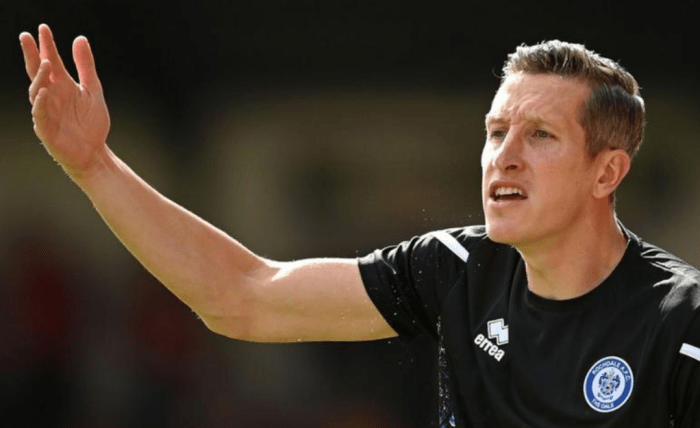
Over eight seasons, McNulty played a total of 237 matches for Dale, eventually combining coaching with playing. In August 2022, he found himself in interim charge for three matches after the club sacked Robbie Stockdale.

Former Morecambe boss Jim Bentley was appointed manager but when his services were dispensed with in March 2023, with Rochdale at the foot of League Two, 2023, McNulty once again stepped in as boss.

He was unable to prevent the club’s 102-year reign as a league club coming to an end but, in May 2023, he was appointed manager on a two-year deal.

“The opportunity to lead our team and represent our club, which the fans cherish, has always been a dream of mine,” he said.

“To be given the opportunity at a club so close to mine and my family’s hearts, is really special to me.

“As a boy, first and foremost, I dreamt of becoming a footballer, then when I did, I very quickly knew I wanted to become a manager thereafter.

“Within a couple of years of being a Dale player, I knew that this would be the club where I hoped to fulfil that ambition.”

City grounding signalled high hopes for talented Taylor

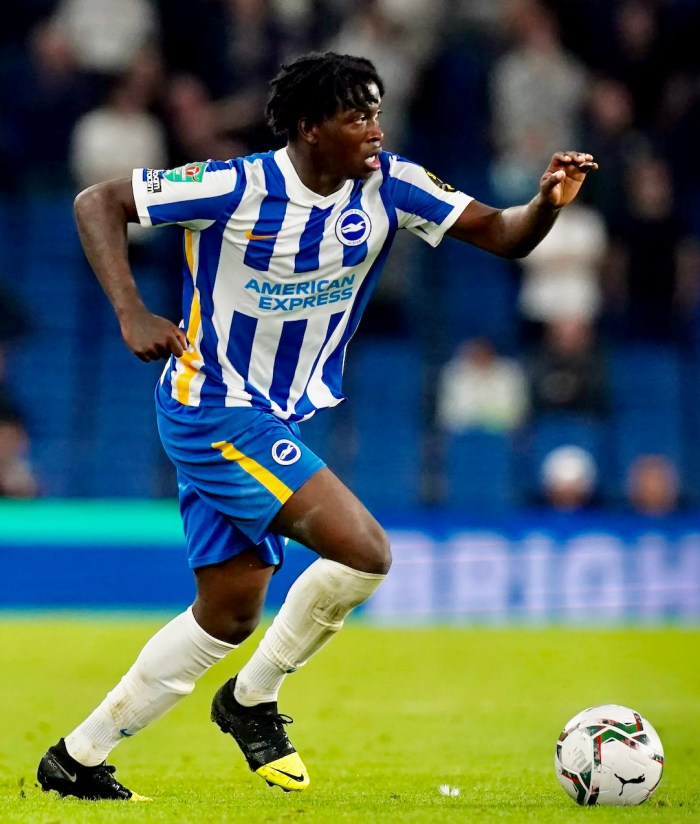
EXPECTATIONS of a bright future in Albion’s colours fizzled out for Taylor Richards after the most audacious of starts.

Richards cheekily scored with a Panenka chipped penalty in a pre-season friendly against Crawley Town which instantly made the watching supporters take notice of the new signing from Manchester City.

It was reported Albion paid £2.5 million for the 18-year-old when he decided to move on after four years moving through the youth ranks at City.

“I did not have to leave because I still had years on my contract,” he told the Argus. “I just felt that I needed a new challenge.

“When I found out that Brighton were interested in me I was also made aware that I had a chance of breaking into the first-team further down the line.

“That is all I wanted to hear, that if you do well and train well, you’ll be given opportunities.

“But I would not change my time at City for anything. The only thing I would change is probably not taking my opportunity as well as I should have done.

“When you’re in that comfortable environment, you do not always realise what you have and maybe take your foot off the gas a little, but it’s all a learning experience and one I really enjoyed.”
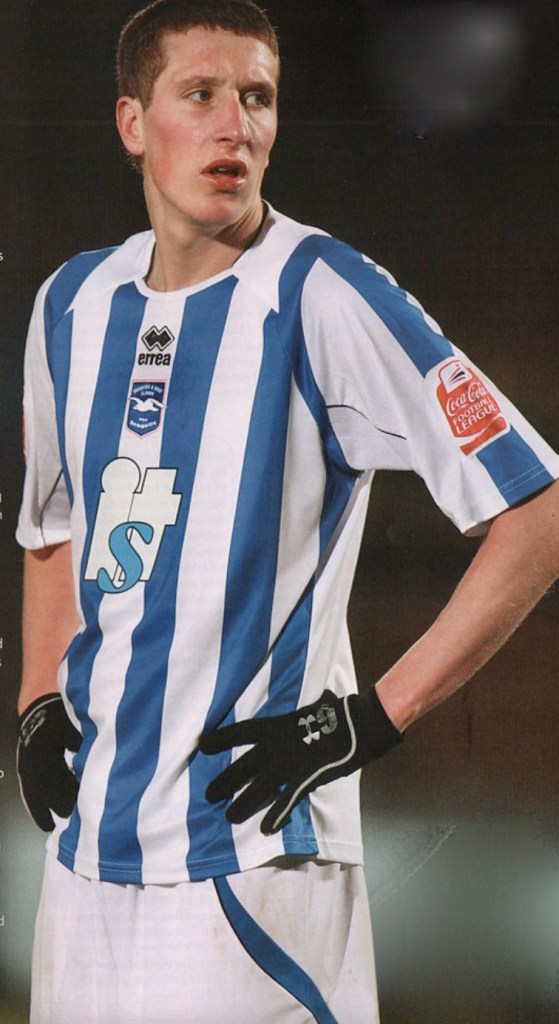
Richards did get his wish of making it through to Albion’s first team, but his involvement was very sporadic and after a season on loan at Championship side Queens Park Rangers, he eventually moved there permanently in the summer of 2023.

For Richards, it was a case of moving home. Having been born in Hammersmith on 4 December 2000, he grew up in Shepherd’s Bush – although his football journey began in the academy at Fulham.

City took him north at the age of just 14 and he earned a scholarship aged 16. Eventually, he became a regular for City’s under-18s.

In February 2017, he played for England under-17s in a tournament on the Algarve, starting in a 1-0 defeat to Portugal and going on for City teammate Phil Foden in a 3-2 win away to Germany. Two days later, he started in England’s 1-0 win over the Netherlands. That side featured Jadon Sancho, who went through the age groups at City at the same time as Richards.

“I hung around with Sancho quite a lot because we went into the academy at the same time and we had a good connection,” he said. “What’s happened with his career proves you never know what might happen. It’s all about working hard and taking your opportunity when it comes.”

Taylor made seven appearances for City’s under 23s – three in 2017-18 and four in 2018-19 – although he didn’t feature in the first team. He was on the scoresheet in a Checkatrade Trophy quarter final match in January 2019 when City fought back from 2-0 down to beat Rochdale 4-2 (former Albion player Jim McNulty was on the scoresheet for Rochdale).

“Once you’re in that environment, winning is the only thing on the table and losing is no option,” he said. “Everyone’s at it and it’s a good place to be for a young player to get you ready for the men’s game. Every age group tried to do what the first team did. It was the same philosophy that went right through the academy, so when you stepped up to the next level, it made it easier.”

Richards made an instant name for himself shortly after signing for the Albion with that penalty against Crawley. He told the matchday programme: “I knew I was going to chip it, but I took a long run-up to make the goalkeeper think I was going to smash it.

“I’ve never had the fans sing my name before, so it’s a great moment for me and one I’ll cherish for life. Hopefully that left a nice impression, but it was only my first game.”

Head coach Graham Potter told the club website: “He showed his confidence with the penalty. He’s not been here long but is ambitious and wants a taste of first-team football. That’s always the challenge for young players, to get the right next step from youth football.

“He has quality and ability, so we’ll make an assessment of him and the right pathway for him to gain that first-team experience.”

The 2019-20 season was only two months old when Richards made his Albion competitive first team debut. A team comprising several youngsters lost 3-1 to an experienced Aston Villa side in the Carabao Cup at the Amex. “I remember chasing Douglas Luiz around the whole evening,” he said. “It was a long night, but a good night, apart from the result. It helped me a lot in understanding the level and what I needed to do to play against that level of opposition.”

With further first team chances unlikely because of the competition for places, Richards was sent on a year’s loan to Doncaster Rovers in 2020-21.

The attacking midfielder scored 11 goals in 48 appearances and learned a lot from the experience. “The manager, Darren Moore, wanted us to play football, which was a similar style to Brighton, but sometimes the other teams didn’t want to play,” he recalled. “They were a bit more long-ball, more physical, and I definitely came back a better player for it.”

He signed a new three-year contract at Brighton and was a non-playing substitute in the opening Premier League matchday squad, with head coach Potter saying: “Taylor has impressed during pre-season, and he was deservedly part of the first-team squad at Burnley last weekend.

“He had a very productive loan spell at Doncaster last season, and this new contract is a reward for his hard work and progress he’s made since he arrived.”
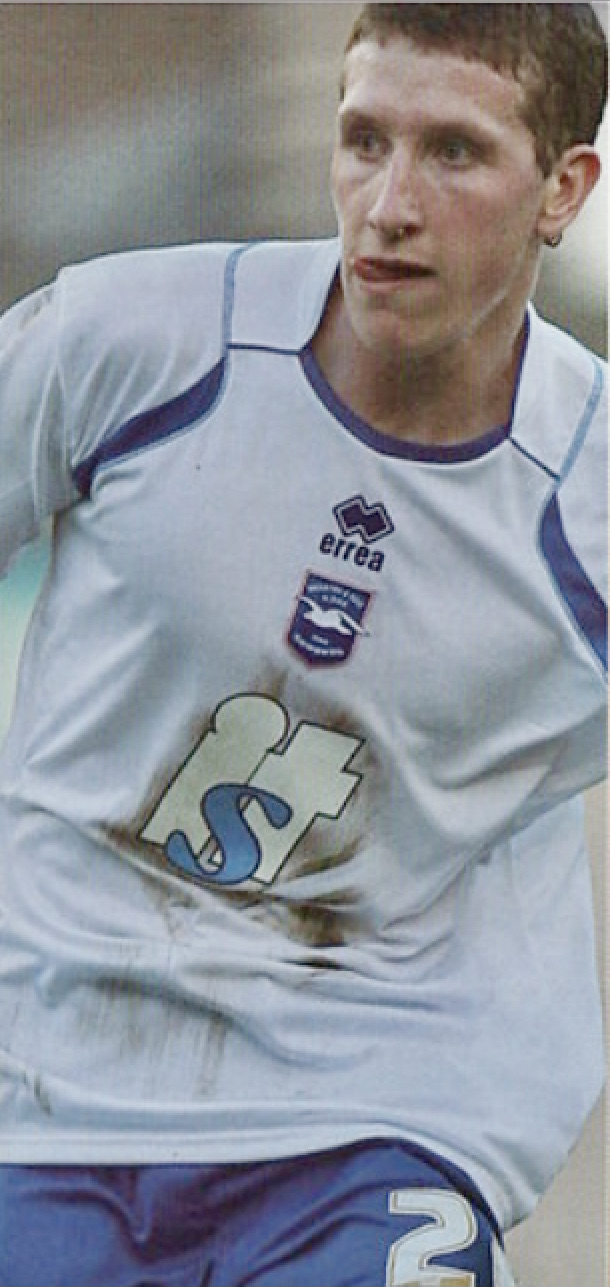
Richards made starts in two Carabao Cup matches (against Cardiff and Swansea) and went on as a sub in two league matches, replacing Jakub Moder in a 2-0 home defeat to Everton and taking over from Enock Mwepu in a 1-0 home defeat to Wolves.

Having made his league debut against Everton, with mum Shani watching on, he said: “I thought I did well. I was nervous, like most people would be, but I tried to keep the ball as much as I could, tried to give more going forward but this is my first game and I will learn from these moments and go again.

“Despite the result, because that comes first, I am happy I got on the pitch. My mum has been with me through this whole journey and she got to see me make my Premier League debut so it is a proud moment for me.”

But, in the second half of the season, he once again went out on loan, this time to Championship side Birmingham City, Albion boss Potter explaining: “Taylor has been with the first-team squad for the first part of the season, he has benefited from that time and he has made great progress during that time.

“He has played in the Carabao Cup ties and also made his Premier League debut. But we feel it is now important for him to play regular football during the second half of the season and he will get that opportunity with Birmingham, a club I know well.”
In a bizarre turn of events, it was two months before he was fit to start for the Blues because he injured an ankle doing the medical associated with the move.

Bemused Brum boss Lee Bowyer said: “I’ve never heard anything like this. It’s crazy. I have never heard of a player getting injured in the medical.”

After he had finally made his debut, Birmingham Mail reporter Brian Dick had a favourable impression. “He looked very, very neat on the ball, not afraid to take possession and retain it in tight spots and also good at finding little angles around and in the box.

“He is a languid mover with good pace and plays with his head up, looking to bring others into the game,” the reporter observed. “Of all the January recruits there was more buzz at the club about Taylor than anyone else – and the very early signs are promising.”

Bowyer pointed out: “He can score, he can assist, he can make that pass.”

However, he only made two starts for Blues, plus three from the bench, and in the summer the player switched to QPR on a season-long loan with the plan to make the move permanent.

“I haven’t got the words, it feels great to be at QPR,” said Richards, who had been taken to Loftus Road by his mum as a seven-year-old to watch his first ever game.

“I am from Shepherd’s Bush and all my family and friends support QPR,” he said. “Everyone is excited and I just can’t wait to get on the pitch, that’s where it matters.”

Mick Beale, the manager who signed him, declared: “Taylor is a very, very talented boy who I have watched extensively in the past. 

“Given his age and the fact that he’s a Hammersmith boy, I think he’s perfect for us in terms of the identity we have as a team and as a club.

“He can travel with the ball and is powerful in his play, so we’re delighted to have him.”

Excited by the player’s versatility, Beale added: “He can play as a number 10, wide left, wide right – but predominately he is an attacking midfielder, a number eight. He gives more competition and our midfield is looking stronger for it.

“He is a midfielder who can dribble at speed, from one line to another – he can score and he can play.”

But Richards made only one start throughout the whole season, joining the action from the bench on 15 occasions. Nevertheless, when Gareth Ainsworth took over from Neil Critchley in February 2023 he was quick to acknowledge the player’s attributes.

“I like Taylor. I think he is a fantastically talented boy, I really do,” said Ainsworth. “He is very similar to some of the players I have come across in my management career before.

“But I think with young players today there is so much more to them than what you see on a Saturday, and it is our job as managers to work with them day in day out and work with them and give them clarity.

“Taylor is a fantastic player. I don’t want to put too much pressure on the boy, but he has been at some top places and is highly thought of and highly thought of by this manager as well.”

Richards joined the Rs on a three-year deal ahead of the 2023-24 season.

A non-playing sub for their opening day 4-0 defeat to Watford, Richards was in the starting line-up for a first round Carabao Cup match at home to Norwich City, facing former Albion players Shane Duffy and (sub) Ashley Barnes, and the visitors edged it 1-0.

Having played only four league matches for QPR in 2023-24, in July 2024 Richards switched to League One Cambridge United on a season-long loan.

United manager Garry Monk said, “Taylor is an exciting talent who has huge potential to be an outstanding player in this league. He will bring another dimension to our team and we are very excited to work with him this season.”

Richards told the club website “It’s a big opportunity for me to come here and play some football – I just want to get out there and show what I can do. 

“I want to get back to enjoying my football and if I am enjoying it, then everything else will come along with that.”

Sammy Lee’s ugly u-turn left Hyypia in the lurch

FORMER Liverpool player and assistant manager Sammy Lee took an unpalatable u-turn after agreeing to become no.2 to Sami Hyypia at Brighton.

When in 2014 a second successive bid to reach the Premier League via the Championship play-offs had faltered at the semi-final stage, Oscar Garcia quit the Seagulls and Albion installed the inexperienced Hyypia as his successor.

The Finnish international former Liverpool centre back had earmarked Lee to bring valuable nous to his backroom team having already been turned down for the job by his first choice, Jan Moritze Lichte, from Bayer Leverkusen, where Hyypia had made his managerial bow.

Lee agreed to take on the role on 25 June 2014 and a formal announcement was made the following day. But by the morning of Monday 29 June, the bombshell news dropped that Lee was moving elsewhere on the south coast instead.

Rather than help to guide the fledgling managerial career of a player he had coached at Liverpool, Lee opted to join Dutchman Ronald Koeman at Southampton.

“I’m let down because I thought that I knew him,” Hyypia told Sky Sports, when interviewed at Lancing. “Everything was sorted and everything was agreed and he should have been here today. The way it happened was very disappointing and I couldn’t actually believe it.”

An apologetic Lee said: “I was thrilled to be offered the job at Brighton and I was excited at the prospect of working with Sami Hyypia again – but, totally unexpectedly, I have been given an opportunity to work in the Premier League.

“I fully appreciate that this is not an ideal set of circumstances and I am very sorry for the inconvenience, and any embarrassment, my change of mind, after the announcement was made, has caused.

“However, at this stage of my coaching career the opportunity to work again at the very top level of English football was not something I felt I could turn down.”

Some might argue Lee’s decision ultimately brought about the swift demise of Hyypia’s reign in the Albion hotseat: the efforts he made to implement a specific style of play have since been lauded, but a dismal set of results told a different story, and there was a parting of the ways with more than half the season still to be played.

If Albion fans hadn’t been overly impressed by Lee’s decision to leave Hyypia in the lurch that summer, they weren’t the only supporters not to be enamoured by the little man’s involvement in their club.

In a retrospective look at Lee’s brief tenure as manager of Bolton Wanderers, Marc Iles, chief football writer for the Bolton Evening News, wrote: “Lee’s frenetic 170 days in charge contained 14 games, three victories, 12 signings and the complete disintegration of the structure which had helped Wanderers secure four top-eight finishes in four years.

“The stormy period was characterised by dressing room upheaval, boardroom bitterness and the sad fall from grace of an honourable man who had the club at heart.”

Lee, previously Sam Allardyce’s assistant at the Reebok Stadium, had been handed the reins just 24 hours after Allardyce quit on 29 April 29 2007 to take over at Newcastle.

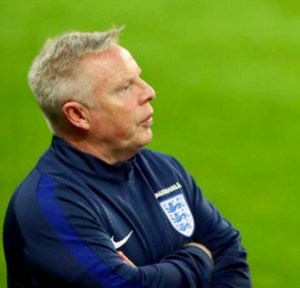
Lee was always better suited to a supporting role and, as well as at Bolton, he’s worked under Allardyce at Crystal Palace, Everton and West Brom (and during Allardyce’s brief England spell).

He rose through the coaching ranks at Liverpool after Graeme Souness took him back to Anfield at the end of his playing days.

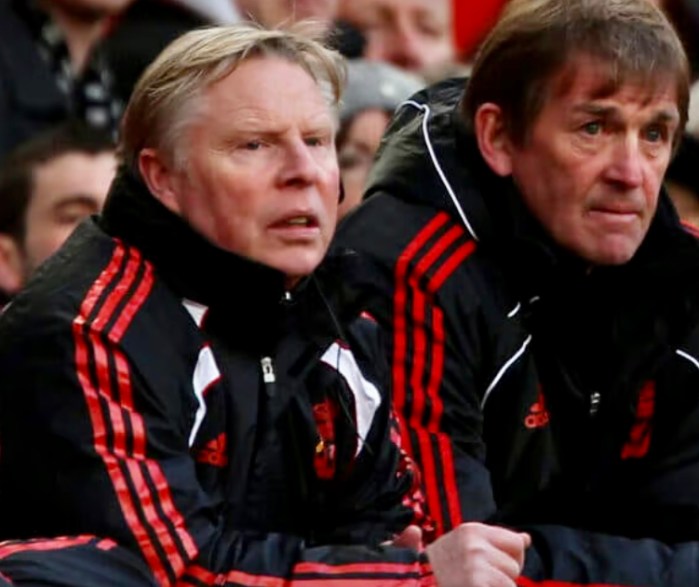
He became a first team coach under Gerard Houllier and between 2008 and 2011 was assistant manager to Rafa Benitez.

Born in Liverpool on 7 February 1959, Lee made his way through the Reds’ youth ranks and made his first team debut in April 1978.

Sammy Lee in action for Liverpool up against Albion’s Steve Foster

As chronicled on lfchistory.net, he earned a regular spot in the 1980-81 season, pretty much taking over the midfield berth previously occupied by Jimmy Case, who, at the end of that season, Bob Paisley sold to Brighton.

Albion fans of a certain generation will surely not fail to be moved by the story of Lee’s close friendship with Michael Robinson, the former Albion striker who was the midfielder’s former team-mate at Liverpool and Osasuna.

Robinson and Lee were together in a Liverpool side that in 1983-84 did the treble of the league, the League Cup and the European Cup.

Ahead of an August 2021 friendly match between the two sides to honour Robinson after his untimely death from cancer aged 61 in April 2020, Lee told The Athletic: “It is a fitting tribute and a fitting venue to have the game at, in front of the Kop.

“Michael did fantastic for Liverpool while he was there. It will be a very emotional night for everybody, particularly for Michael’s wife Chris and their children.

“He was not only a fantastic guy, a great colleague, but I consider him a brother, to be honest, I can’t put it any higher than that.”

Lee told reporter Dermot Corrigan: “Michael was very important for my professional life after Liverpool.

“You tend to think you will stay at Liverpool forever, you know, but it doesn’t happen. Michael had gone to Queens Park Rangers and he helped me to go there, and I had a nice time there. Subsequently he moved on to Osasuna, and he got me to go there. So he had a massive influence on my professional career.”

Injury eventually brought Lee’s Spanish playing days to an end and although he managed three games for Southampton and four for Third Division Bolton, it was coaching where his future lay.

In 2001, Lee became a part-time coach to the England national side under Sven-Goran Eriksson and three years later left Liverpool to join the national set up full time.

Liverpool chief executive Rick Parry said at the time: “We are very sorry that Sammy has decided to leave, but he goes with all our very best wishes for the future.

“Sammy’s been a wonderful servant to Liverpool as both player and coach. He should be proud of his contribution to the successes achieved at the club in recent years.”

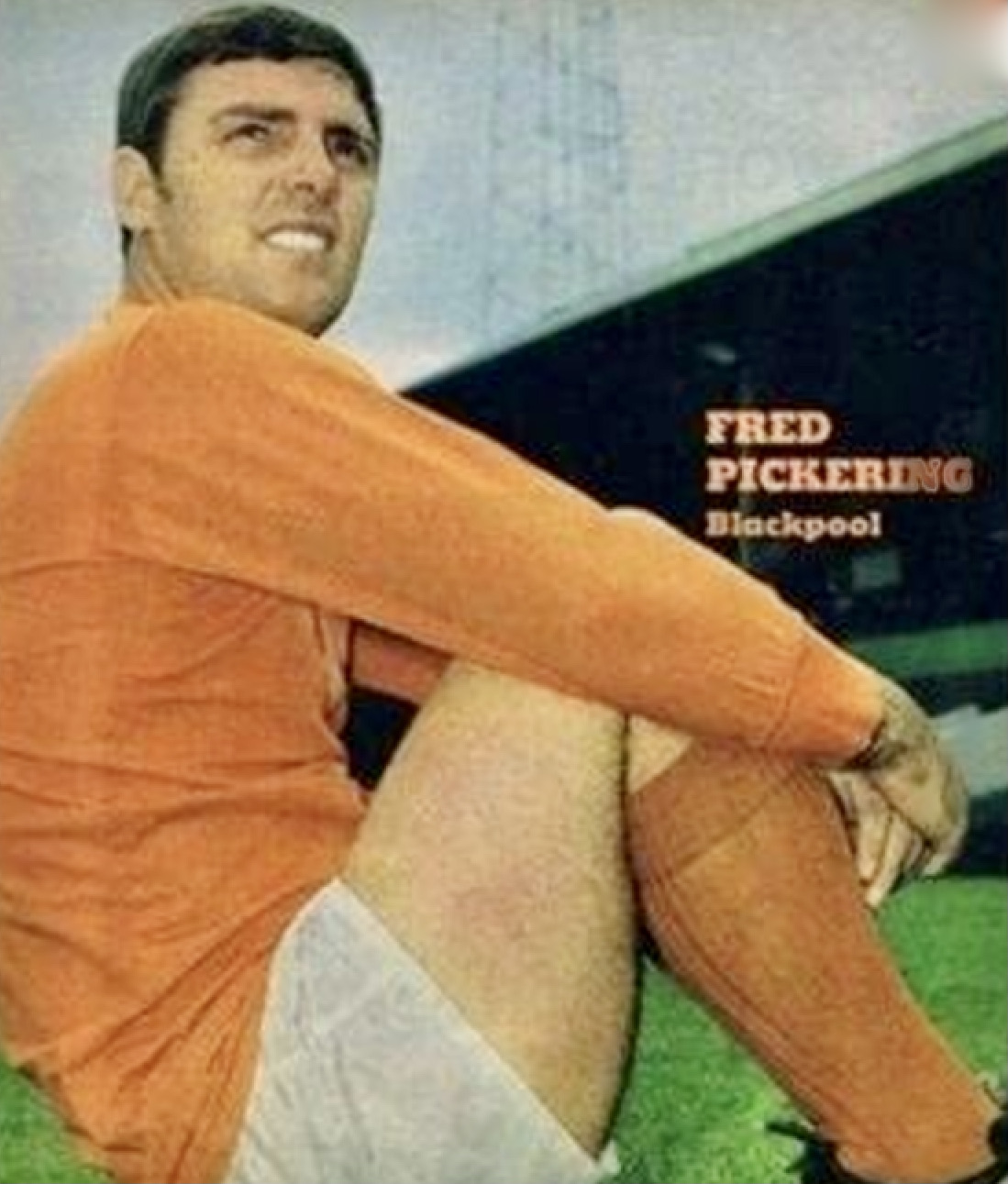
Brighton trial was curtain call for Fred Pickering’s career

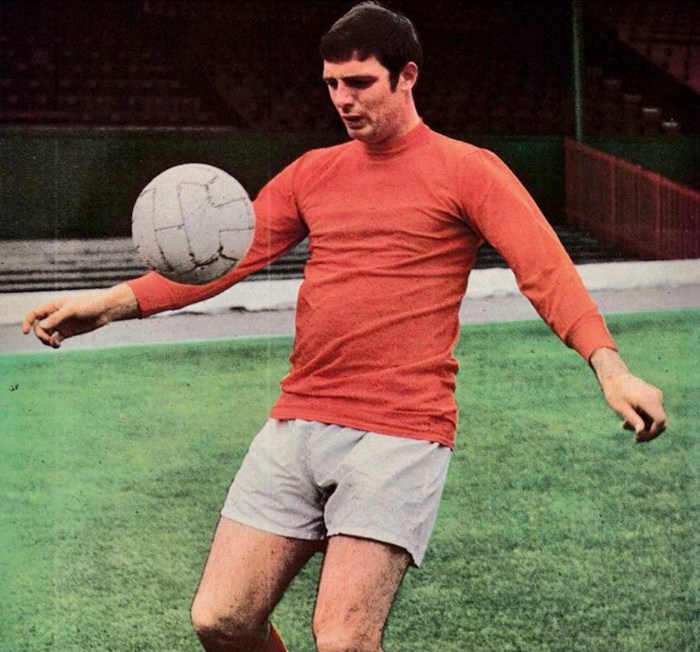
PROLIFIC goalscoring centre-forward Fred Pickering, who at his peak scored hat-tricks on his Everton and England debuts, ended his career after an unsuccessful two-month trial with Brighton.

Pickering was a transfer record signing for Everton (the previous season’s league champions) when he joined them from Blackburn Rovers for £85,000 in March 1964.

On his debut for Harry Catterick’s side, he scored three past Nottingham Forest’s Peter Grummitt in a 6-1 thrashing.

Eight years later, a player who’d played for his country and, but for injury, might have been involved in the 1966 World Cup, scored once for Brighton’s reserve side: in a 3-0 home win over Colchester United on 8 March 1972.

Brighton won promotion from the old Third Division two months later thanks in no small part to 19 goals scored by Kit Napier and 17 from Willie Irvine (Pickering’s former Birmingham City teammate Bert Murray netted 13 and Peter O’Sullivan hit 12).

Throughout the season, manager Pat Saward had been hankering for something a bit extra in the forward line. While he appreciated the skill of Napier and Irvine, he said “none had the devil in him. We wanted more thrust.”

Pickering was the second seasoned striker Saward had run the rule over, wondering whether their experience of goal plundering at the highest level several years before might be revived in third tier Albion’s quest for promotion.

Earlier in the season, he tried recruiting an ageing Ray Crawford but contract issues with the player’s last club, Durban City, meant the former Portsmouth, Ipswich, Wolves and Colchester centre-forward ended up joining the staff as a scout and coach instead.

In February 1972, 31-year-old Pickering, by then not even getting a game in Blackburn’s Third Division side, was given a chance by Saward to show he still had the goalscoring ability he had demonstrated so effectively earlier in his career.

Photographs of a rather heavy-looking Pickering training appeared in the Evening Argus and the former England striker was interviewed on Radio Brighton (as it was then) about his illustrious career. Although he played for the reserves, he wasn’t deemed fit enough to make it into the first team.

Saward eventually got the thrusting forward he sought on March transfer deadline day when he signed Tranmere Rovers’ Ken Beamish, who, at 24, was younger and fitter, and quickly endeared himself to Albion fans by scoring a handful of late goals which helped clinch promotion.

But what of Pickering? Born in Blackburn on 19 January 1941, he played junior football in his hometown before joining Rovers as an amateur aged 15.

As a schoolboy, he’d been an inside forward (a no.8 or no.10 in today’s parlance) but he was a full-back when he signed as a professional for Rovers on his 17th birthday.

Indeed, he was at left-back in the Rovers side that won the FA Youth Cup in 1959, beating West Ham United 2-1 on aggregate over two legs.

Alongside him for Rovers were future Spurs and Wales centre-half Mike England and Keith Newton, who also later moved to Everton and played for England at the 1970 World Cup. West Ham included Bobby Moore and Geoff Hurst in their line-up.

With the likes of Dave Whelan and Bill Eckersley ahead of Pickering in the Blackburn pecking order, his chances of a first team breakthrough were limited.

But after a successful outing for the reserves up front, and with wantaway Irish striker Derek Dougan dropped, Pickering was given a chance as a centre forward – and he never looked back.

He scored twice in a 4-1 win over Manchester City and went on to strike up successful partnerships with Ian Lawther, initially, and then Andy McEvoy.

“It was a big turning point for me to be playing centre forward,” Pickering told the Lancashire Telegraph. “Especially when you consider in 1961, Dally Duncan (Blackburn manager, and later Brighton guesthouse owner) told me that Plymouth wanted me and that I was free to leave. I didn’t want to go because Blackburn was my club.

“I only left in the end because the club wouldn’t give me a rise of a couple of quid. It was absurd.”

By then Pickering had scored 74 goalsin158 appearances – some strike rate – which meant he always held a special place in the hearts of the Ewood Park faithful, as reporter Andy Cryer described in a 2011 article for the Lancashire Telegraph.

“Had fate been kinder to him he could easily have been a national darling too,” wrote Cryer.

“When hat-trick hero Geoff Hurst was firing England to World Cup final glory in 1966, an injured Pickering was left reflecting on what might have been after an incredible journey took him from Rovers reserves to international stardom.”

Pickering, nicknamed Boomer for his powerful right foot, had scored five goals in three England appearances and looked set for inclusion in England’s 1966 World Cup squad having been named in Sir Alf Ramsey’s provisional selection.

But he suffered a knee injury in an FA Cup quarter final replay against Manchester City which not only caused him to miss Everton’s FA Cup final win that Spring, but also meant he had to withdraw from the England squad. Cryer reckons it also led to the subsequent demise of his career.

Pickering told the reporter: “I played three games for England and I scored in every game I played, I scored five goals and I was playing well. I was named in the World Cup squads. I was going and from that day it was the following weekend when the knee started to go.

“I watched all the Brazil games at Goodison. England struggled in their first game against Uruguay and that is when Jimmy Greaves got injured.

“Obviously that is how Hurst got in, he wasn’t even really in the set up before. There was every chance if I had been fit it that might have been me who had got in. I wouldn’t say I would have done what Geoff Hurst did but you never know what might have happened.”

Pickering had made his England debut two months after moving to Everton, in a 10-0 demolition of the USA on 27 May 1964. It was the same match that saw future Albion manager Mike Bailey play his first full international for his country. Roger Hunt went one better than Pickering by scoring four, Terry Paine got two and Bobby Charlton the other. Eight of that England side made it to the 1966 World Cup squad two years later – alas Pickering didn’t.

The same scoring rate he had enjoyed at Blackburn continued at Everton and in his first full season he scored 37 goals in all competitions – the most by an Everton player since Tommy Lawton scored 38 in 1938-39.

In three years with the club, he scored 70 times in 115 matches but his exclusion from the 1966 FA Cup final squad soured his relationship with manager Catterick, as covered in detail by the efcstatto.com website. Injuries disrupted his involvement at the start of the following season, and a cartilage operation put him out of action for nearly six months.

Although he made his comeback in March 1967, his Everton days were numbered and, in August 1967, moneybags Birmingham City bought him for £50,000 to form a hugely effective forward line with Barry Bridges and Geoff Vowden.

Pickering and Bridges played in all 50 of Birmingham’s matches in the 1967-68 season; the aforementioned Bert Murray 47. Bridges was top scorer with 28 goals and Pickering netted 15.

The Second Division Blues made an eye-catching run to the semi-finals of the FA Cup, but they lost 2-0 to West Brom (who went on to beat Everton 1-0 in the final).

The following season, Pickering scored 17 times in 40 appearances (Phil Summerill also scored 17, and Jimmy Greenhoff 15) but City finished a disappointing seventh.

That signalled the end of the striker’s time in the Midlands and he returned to his native north west with Blackpool, who paid £45,000 for his services.

It was money well spent as Pickering top-scored with 18 goals as the Tangerines won promotion back to the elite, finishing runners up to Huddersfield Town. His most memorable performance was on 13 April 1970 when he scored a hat-trick away to local rivals Preston North End in front of a Deepdale crowd of 34,000. It earned Blackpool promotion while simultaneously relegating North End to the third tier.

But the 1970-71 season didn’t go well for Blackpool or Pickering. The club got through three managers and only won four matches all season, which eventually saw them finish bottom of the pile and relegated along with fellow Lancastrians Burnley. Pickering found himself fined and excluded for breaches of club discipline (mainly involving missing training) and before the season was over he was sold back to his first club, Blackburn.

That was a blow to Preston, who had just loaned Willie Irvine to Brighton and were keen to install Pickering as his replacement. But it was to Rovers, for £9,000, that he went, but he couldn’t prevent the Ewood Park outfit being relegated to the third tier.

He scored just twice in 11 League games in his second spell at Blackburn before that two-month trial at Brighton.

After he retired from football, he became a forklift truck driver. Warm tributes were paid when Pickering died aged 78 on 9 February 2019. Well-known football obituarist Ivan Ponting said of him: “At his rampaging best, Fred was an irresistible performer.

“Though neither outstanding in the air, nor overly-physical for a man of his power, not even particularly fast, he could disrupt the tightest of defences with his determined running and a savage right-foot shot that earned him the nickname of ‘Boomer’.

“Boasting nimble footwork for one so burly – he could nutmeg an opponent as comprehensively as many a winger – he was especially dangerous when cutting in from the flank, a manoeuvre that yielded some of his most spectacular goals.”

In March 2022, a road in the Mill Hill district of Blackburn, where he lived all his life, was named after him and his family spoke of their pride as they unveiled the street sign in his honour.

Day of reckoning beckoned for talent spotter Mervyn

THE YOUNGEST goalkeeper to appear in a FA Cup final spent 20 months picking out future players for Brighton.

It was one of several different post-playing roles Mervyn Day filled for various clubs.

Day, who at 19 won a winners’ medal with West Ham in 1975, was Albion’s head of scouting and recruitment between November 2012 and the end of the 2013-2014 season under head of football operations David Burke.

At the time, his appointment was another indicator of the gear change taking place at the club as it built on the move to the Amex Stadium and sought to gain promotion from the Championship.

Day said in a matchday programme interview: “This club has come such a long way in such a short space of time.

“When you think of the debacle of the Goldstone, the wilderness of Gillingham, then Withdean, you only have to get a player through the front door at this wonderful stadium to have a chance of signing them.

“Hopefully, within the next year or so, the new training ground will be up and running and, when you’ve got that as well, you’ve got the perfect opportunity not only to encourage kids to sign but top quality players as well.

“If we are fortunate enough to get ourselves into the Premier League at some point, we’ll be able to attract top, top players.”

It was a case of ‘the goalkeepers union’ that led to him joining the Albion. Day explained he’d been chatting to Andy Beasley, Albion’s goalkeeping coach at the time, who had been a colleague when Day was chief scout at Elland Road. Beasley wondered if he’d like to help coach Albion’s academy goalkeepers but Burke, who he also knew, stepped in and offered something more substantial: the job of scouting and talent identification manager.

He certainly brought a wealth of experience to the task. He had previously been assistant manager to former Albion midfielder Alan Curbishley at Charlton and West Ham; manager and assistant manager at Carlisle United, a scout for Fulham and the FA (when Steve McClaren was England manager) and chief scout at Leeds until Neil Warnock took charge.

In addition to that background, in the days before full-time goalkeeper coaches, Day had worked at Southampton under David Jones, Chris Kamara at Bradford City and John Aldridge at Tranmere Rovers. Then in 1997 Everton came along and he joined Howard Kendall’s backroom team alongside Adrian Heath and Viv Busby. “I was living in Leeds at that time, so distance wasn’t an issue, but it was an interesting trip across the M62 in the winter months,” Day recalled in an October 2021 interview with efcheritagesociety.com.

Brighton made Day redundant at the end of the 2013-14 season following a reshuffle of the recruitment department amid criticism of the quality of signings brought in.

That assessment might have been rather harsh because during his time at the club there was a change in manager (Oscar Garcia taking over from Gus Poyet) and, although the season ended in play-off disappointment, the likes of former Hammer Matthew Upson (who’d played under Day when he was at West Ham) had signed permanently on a free transfer (having been on loan from Stoke City for half the previous season).

The experienced Keith Andrews and Stephen Ward also joined on season-long loan deals and played prominent roles in Garcia’s play-off reaching side.

It was under Day’s watch that the promising young goalkeeper Christian Walton was signed after a tip-off from Warren Aspinall. Aspinall told the Argus in 2015: “I went to Plymouth to do a match report. I set off early and took in a youth team game off my own back. He was outstanding, commanding his box. I reported straight back to Gus (Poyet). He told Mervyn Day. He went to see him, Mervyn liked him.”

It wasn’t the first time Day had played a role in securing a goalkeeper for the Albion. As far back as 2003 he had an influence on Ben Roberts’ arrival at the Albion. Manager Steve Coppell revealed: “He is one of three goalkeepers at Charlton and at the moment nearly all the Premiership clubs are very protective about their goalkeepers.

“I have seen him play a number of times, although I certainly haven’t seen him play recently. I spoke with Mervyn Day (Charlton coach) and he says Ben is in good form. It’s a little bit of a chance and it will certainly be a testing start for him, but he is looking forward to the challenge.”

Day was also sniffing around another future Albion ‘keeper when he was chief scout for Bristol City (between 2017 and 2019).  According to Sky Sports commentator Martin Tyler, Mat Ryan was on their radar in the summer of 2017 when he swapped Belgium for England. In an interview with Socceroos.com, Tyler reveals he was asked by City’s ‘head of recruitment’ (thought to be Day) to glean the opinions of Gary and Phil Neville (manager and coach of Valencia at the time) on Ryan and whether he’d be suitable for the English game.

“I got a text saying, ‘Can you find out from the Nevilles whether they rate Mat Ryan’,” Tyler said. “It wasn’t my opinion they were looking for – quite rightly – it was Gary and Phil’s. I was able to do that and both Gary and Phil gave Mat the thumbs up.”

After leaving Brighton, Day moved straight into a similar role with West Brom, where he worked under technical director Terry Burton and first team manager Alan Irvine, but he was only there a year before linking up with the Robins. He has since been first team domestic scout for Glasgow Rangers, although based in his home town of Chelmsford.

Day was born in Chelmsford on 26 June 1955 and educated at Kings Road Primary School, the same school that England and West Ham World Cup hero Geoff Hurst attended. He moved on to the town’s King Edward VI Grammar School and represented Essex Schools at all levels. He joined the Hammers under Ron Greenwood on a youth contract in 1971.

“On my first day as an associate schoolboy I got taken by goalkeeping coach Ernie Gregory into the little gym behind the Upton Park dressing room and he had Martin Peters, an England World Cup winner, firing shots at me,” Day later recounted. “As a 15-year-old that was incredible.

“The bond got even closer when my father died when I was 17. I was an apprentice but Ron signed me as a full pro within a very short space of time to enable me to earn a little more money to help out at home. A short while later he gave me another increase. He was almost a surrogate father to me.”

In the early part of 1971, Day played in the same England Youth side as Alan Boorn, a Coventry City apprentice Pat Saward took from his old club to the Albion in August 1971.

The goalkeeper was just 18 when he made his West Ham United debut, on 27 August 1973, in a 3-3 home draw with Ipswich Town.

He went on to play 33 matches in his first season and only missed one game in the following three.

Tony Hanna, for West Ham Till I Die, wrote: “In only his eleventh game for the Hammers he received a standing ovation from the Liverpool Kop in a 0-1 defeat that could have been a cricket score but for his fine display and, in his next visit to Anfield, he saved a penalty in a 2-2 draw.”

Day recalled: “As a kid, I had no fear, I took to playing in the first team really, really well. At West Ham, the ‘keeper always had lots to do as we were an entertaining team. We had forward-thinking centre-backs in Bobby Moore and Tommy Taylor, and then after Bobby came Kevin Lock.”

Mervyn Day in action for West Ham against Brighton at the Goldstone Ground, Hove.

In 1974, Day progressed to England’s Under-23 side. He won four caps that year and a fifth in 1975 but it was a golden era for England goalkeepers at the time and he didn’t progress to the full international side, despite being touted for a call-up.

By the time Day won that last cap, he had been voted PFA Young Player of the Year and, at 19, had become the youngest goalkeeper to appear in a FA Cup Final, keeping a clean sheet as West Ham beat Fulham 2-0 at Wembley.

Hanna continued: “At times he was performing heroics in the West Ham goal and he was fast becoming a fans favourite. Tall and agile, he was a brilliant shot stopper and he was playing like a ‘keeper well beyond his years.”

However, by the 1977-78 season Day’s form had tapered off as the Hammers were relegated. “His confidence was so bad he was eventually dropped and he only played 23 games that season,” said Hanna. “There are several theories to what triggered the loss of form, but one thing that did not help the lad was the stick he was getting from the Hammers supporters.

“In hindsight Mervyn said that he was ill prepared for such a tough run of form. The early seasons had gone so well that he had only known the good times and when the bad ones came he struggled to come to terms with the pressure.”

In 1979, West Ham smashed the world record transfer fee for a goalkeeper to bring in Phil Parkes from QPR and Day was sold to Leyton Orient, where he replaced long-standing stopper John Jackson, who later became a goalkeeper coach and youth team coach at Brighton.

Day spent four years at Brisbane Road before moving to Aston Villa as back-up ‘keeper to Nigel Spink. After a falling-out with Villa boss Graham Turner, he switched to Leeds under Eddie Gray and then Billy Bremner. During Bremner’s reign, he had the humiliation of conceding six at Stoke City at the start of the 1985-86 season and, in spite of vowing it wouldn’t happen again, let in seven in the repeat fixture the following season. Amongst his Leeds teammates that day were Andy Ritchie and Ian Baird.

Nevertheless, he ended up playing more games (268) for Leeds than any of his other clubs. He rarely missed a game up to the end of 1989-90, the season when was he was named Player of the Year and collected a Second Division championship medal.

Howard Wilkinson offered him a post as goalkeeping coach for United’s first season back in the elite, having lined up a £1m move for John Lukic from Arsenal. Day had a couple of loans spells – at Luton Town and Sheffield United in 1992 – but was otherwise back-up for Lukic, alongside his coaching duties, until Wilkinson saved Brighton’s future by signing Mark Beeney from the Seagulls.

After eight years at Elland Road, Day moved to the Cumbrian outpost of Carlisle in 1993. When he moved into the manager’s chair at Brunton Park, he not only led them to promotion from the Second Division in 1997, but they also won the (Auto Windscreens Shield) Football League Trophy. United beat Colchester 4-3 on penalties at Wembley after a goalless draw; one of the scorers being the aforementioned Warren Aspinall, later of Brighton and Radio Sussex.

Day worked under Curbishley at Charlton for eight years between 1998 and 2006, helping the club stabilise in the Premier League.

And, in December 2006, he followed Curbishley as his No.2 to West Ham, where the duo spent almost two years.

It was in 2010 that he returned to Leeds as chief scout, working under technical director Gwyn Williams. United manager Simon Grayson said at the time: “We’re restructuring the scouting department under Gwyn and Mervyn will be both producing match reports and watching our opposition and working on the recruitment of players.

“Merv’s knowledge and experience will prove important to the football club as we look to progress and develop what we are doing.”

‘Weirdo’ makes meteoric rise to Albion’s top football role

DAVID WEIR had something of a meteoric rise to the top football role at Brighton.

Weir, a former Rangers, Everton and Scotland international, became the club’s new technical director in May 2022 having only been appointed assistant technical director in January. He stepped up to the top job in an interim capacity only a month later after Dan Ashworth quit (and was put on ‘gardening leave’ before joining Newcastle).

Previously Weir had been pathway development manager, keeping tabs on players sent out on loan. When Weir’s appointment to the top role was confirmed, chairman Tony Bloom told the club website: “During his recent role as acting technical director he has used his experience, knowledge and ability in supporting  both Graham Potter and the men’s first-team, as we secured a record top-flight finish, and to Hope Powell and the women’s first-team. 

“In that time he has already further enhanced an already excellent working relationship with both Paul Barber and me, as well as our executive team responsible for the running of the club. David will oversee all football operations; including recruitment, analysis, medical and player welfare, across both the men’s and women’s set-up.”

Weir didn’t have long in the role before he was having to help Bloom and deputy chairman and chief executive Paul Barber find a new head coach following Potter’s defection to Chelsea. Weir found himself facing the media when Roberto De Zerbi was unveiled as Potter’s replacement.

However, as Barber said at the time of Weir’s appointment: “It is well known by Everton, Rangers and Scotland fans that David was a leader on the pitch. He has continued to show those qualities off the pitch and has quickly settled into the role.”

When the pathway development manager job was created, who better to entrust the care and progress of promising youngsters than a father of four who played more than 600 matches at the highest level in both the English and Scottish leagues, not to mention 69 games for his country.

Weir had a 20-year playing career, and was still playing for Scotland aged 40, after starting out with his hometown club Falkirk. He was at the heart of Everton’s defence for seven years, including several as captain.

“David has an excellent playing and coaching CV, has excellent contacts throughout the football world and is hugely respected within the industry,” Albion’s head of recruitment, Paul Winstanley, said at the time of his appointment.

“With an increasing number of our younger players going out on loan, this is a particular area in which we feel it is important for us to develop.

“David will be responsible for working with those players individually and collectively, during pre-season and throughout their loan spells to help their footballing development, with the aim of assisting with their graduation to long term first-team football.”

Weir told the matchday programme: “As a former manager and coach, I know the pitfalls that come with loan moves and so I put procedures in place to make sure our players gain the most from their time away from the club.

“It’s also important that we send our players to work with coaches who will enhance their experience – I think a loan move is more about sending them to the right coach rather than any particular club.”

One of the many aspects Weir keeps an eye on is how a player adapts outside the cosseted Brighton bubble.

“The loan process, to a lower league club for instance, should make them appreciate how good they’ve got it here and provide the motivation for them to want to succeed at our club.

“They will have to adapt to new surroundings, maybe bringing their own food, washing their kit or finding a gym to work out in. They have to grow up quickly but I’m available to support and help.”

Weir knows himself what it is like being far from home while trying to get your career started. He went to the United States on a scholarship deal, at Indiana’s University of Evansville, between 1988 and 1991.

Born in Falkirk on 10 May 1970, when the centre back returned to the UK he linked up with his hometown team, playing 134 matches over four seasons, before being transferred to Edinburgh side Hearts.

He was in the 1998 Scottish Cup-winning Hearts side (they beat Rangers 2-1) and featured in a total of 116 games before Everton took him to England in February 1999 for a £250,000 fee.

He was signed by Walter Smith and spent seven seasons with the club as a player, during which time he was club captain under both Smith and his successor, David Moyes.

“I spent ten years in total at Everton, so they will always be a club that means a lot to me,” said Weir. “It’s just a special club for me and one that provided me with many happy memories.”

Everton fan website toffeeweb.com summed him up thus: “Weir brought all the essentials of a great defender: big, strong, good in the air and a hard tackler, he had also shown that he was good at attacking, scoring important goals and taking set pieces.”

Weir cited the 2004-05 season when Everton finished fourth and qualified for the Champions League as one of his highlights.

“It was a team that worked hard for each other, and we had that never-say-die attitude that came from the manager (David Moyes),” he pointed out.

Weir played alongside the likes of Wayne Rooney, Duncan Ferguson, Mikel Arteta and Paul Gascoigne during his time at Goodison Park, and he went back after his playing days were over to coach the academy and reserve teams.

Weir had returned to Scotland in 2007 and, while silverware eluded him on Merseyside, he made up for it in Glasgow, where he won the Scottish Premier League title three times, the Scottish Cup twice and the League Cup on three occasions. A personal high came in 2010 when he was the SFWA Footballer of the Year and the Scottish Premier League Player of the Year.

The previous year he had taken over the Rangers captaincy from Barry Ferguson and in 2011 he became the first player to be inducted into the club’s Hall of Fame while still playing.

Weir was first selected for Scotland in 1997 and was in Craig Brown’s squad for the 1998 World Cup in France. He only scored once – in a World Cup qualifier versus Latvia at Hampden Park in 2001. He retired from international football in 2002, when Berti Vogts was the coach, but had a change of heart and returned when his old club boss Walter Smith took charge two years later.

It was in a Euro 2012 qualifying game in 2010 that Weir became the oldest player to play for his country. His 69 caps make him the nation’s seventh-most capped player.

He finally hung up his boots in May 2012 at the age of 42 and returned to Everton as an academy coach. A year later, he took over as manager of third tier Sheffield United but his tenure lasted only 13 games after a disastrous start in which only the opening game was won.

Undeterred, he became Mark Warburton’s assistant manager at Brentford and, after winning promotion to the Championship in their first season and securing a fifth-placed finish in their second season, the pair left the club after a management restructure.

In the summer of 2015, Warburton took charge of Rangers with Weir as his assistant, and after their departure from Ibrox in early 2017, they joined forces at Nottingham Forest in the Championship. 

Warburton, Weir and director of football Frank McParland were all appointed towards the end of Fawaz Al Hasawi’s ownership of the club – two months before a takeover by Greek shipping magnate Evangelos Marinakis – and lasted only nine months at the City Ground.

It was in July 2018 that Brighton took on Weir to guide the club’s loanees.

Amongst his cohort were his own son, Jensen, who went on loan to League One Cambridge United in 2021-22. The England under 20 international then joined Morecambe for the 2022-23 season.

On 20 December 2021, according to Mail Online, Everton held talks with Weir senior about him rejoining the club in a player development role at Goodison Park, but nothing came of it.

A month later, Albion announced Weir had been promoted to become the club’s assistant technical director, supporting Dan Ashworth.

Why Shane Duffy is forever grateful to Everton

SHANE DUFFY has seized the opportunity to re-establish himself at the heart of Brighton’s defence to the obvious delight of the manager who appeared to have shunned him.

With injury sidelining Dan Burn and Covid-19 isolation protocol ruling out Joel Veltman, Duffy stepped up with a solid performance in the season-opener at Burnley, and a goalscoring return to the Amex in the 2-0 win over Watford.

“It was a fantastic header from Duffy, he’s a monster in the box,” boss Graham Potter told the BBC after the televised Watford match. “He is so big and strong to stop – it was a great goal.”

Duffy’s form has been a reminder of the solid centre-back partnership he formed with Lewis Dunk as the bedrock of Brighton’s promotion from the Championship in 2017.

Although a metatarsal injury in a 3-0 defeat at Nottingham Forest meant he missed out on the run-in, Duffy was obviously confident of being restored to the line-up when the Premier League season got under way.

“I’m looking forward to going back to Everton to see a few mates but they’re all going to be big games,” Duffy said in a matchday programme article. “I feel more ready for it than I was four or five years ago at Everton, and I deserve another crack at it, but I know I’ve got to work hard.”

While additions to the squad were to be expected as the Albion sought to stay among exalted company, the Duffy-Dunk pairing at the back didn’t look much like being broken up. Certainly not under Chris Hughton.

Happy with his mainstays at the heart of the defence, Hughton allowed Connor Goldson to leave for Glasgow Rangers and Uwe Hünemeier to return to Germany and Duffy was comfortable alongside Dunk as Albion retained their top division status. And so it remained for Albion’s two first two seasons back amongst the elite.

But when Potter replaced the popular Hughton in 2019, it soon became apparent Duffy didn’t fit the mould of the sort of ball-playing centre-back he wanted in the side.

Although he started the season under Potter, his place was gradually taken over by big money signing Adam Webster. Duffy invariably ended up warming the bench and at the start of the 2020-21 season, with Ben White preferred alongside Dunk and Webster, he jumped at the chance to go on loan to Glasgow giants Celtic, the team he’d supported as a boy.

Unfortunately, it didn’t turn out to be quite the dream move Duffy had hoped for, with criticism arrowing in from all quarters as the Republic of Ireland international underwhelmed in the centre of the Hoops defence, and Celtic could only watch as city rivals Rangers won the Scottish title.

Doubtless the irony wasn’t lost on Duffy that his first match back in a Seagulls shirt saw him up against Rangers in a pre-season friendly, when the home fans ensured he was given a ‘warm’ reception.

But let’s go back to where it all started.

Born in Derry, Northern Ireland, on 1 January 1992, Duffy was playing for Northern Ireland Under-16s against England in the Victory Shield when he caught the eye of watching Everton boss David Moyes.

Duffy had been playing for his local side, Foyle Harps, at the time and, although Arsenal took him on trial and offered him a scholarship, Everton invited him to train with them and offered him a professional contract immediately.

“Of the two clubs, I just had a good feeling about Everton; obviously it was more of a family club, and there’s also the Irish connection with the city of Liverpool, so it was easy for me to settle in,” Duffy told the matchday programme.

In his second season at Goodison Park, he made his first team debut aged just 17 in a Europa League match against AEK Athens.

“David Moyes handed me my debut and I owe him a lot because he always had belief in me, whereas I could have gone somewhere else and maybe ended up back in Ireland,” he said. “I was raw as I hadn’t been with an academy before, but he was patient with me, as were all the coaches, and I came through the youth team and reserves before I got my break in the Europa League and then later in the Premier League.”

Duffy played against Brighton when the third-tier club’s youngsters (with Dunk in defence) acquitted themselves brilliantly in the fourth round of the FA Youth Cup against Everton at the Withdean on 21 January 2010 before eventually losing 2-0. The programme pen picture said of him: “Strong in the tackle and dependable in the air, Shane is considered a ball-playing defender.”

Duffy recalled: “I’d just turned 18 and had recently broken into the Everton team in the Europa League. I do remember Dunky a little bit because we were marking each other at corners.”

A month after his visit to Withdean, Duffy decided to switch allegiance to the Republic having previously captained Northern Ireland’s Under-19s. It came just as he was selected for the full international squad to face Albania in a friendly in Tirana where he was expected to receive his first cap in the absence of captain Aaron Hughes (who later spent a season with Brighton) and Chris Baird.

Disappointed Northern Ireland boss Nigel Worthington told The Guardian: “There is a loophole where a player can walk away after a lot of time and investment has gone in. Until it is resolved, that’s where we are. Shane has represented Northern Ireland all the way through from a very early age to the Under-21s.

“I am a big admirer of Shane. I like him as a player and a lot of work has gone in with different coaches. I am disappointed with the situation as he is going to be a very good player. Shane has decided, after discussing the matter with his family, to represent the Republic. As a manager, I have got to respect that.”

Duffy, who had close family ties to Donegal in the Republic, said the decision to switch his allegiance from Northern Ireland was the right thing to do to help his international career.

Speaking to evertontv, Duffy said:“It was difficult for me to leave because of what they’ve done for me in Northern Ireland since I was young. They brought me through the ranks which gave me the chance to come to Everton.

“It was hard to leave all the coaches and all the players, but it was always a case of wanting to come to my own country. I spoke to a couple of people about it because I didn’t want to disrespect Northern Ireland, but I just had to do what was best for me and I thought it would be best for me to switch.”

Astonishingly, in his first-ever training match with the Republic, under manager Giovanni Trapattoni, he was involved in a freak collision that lacerated his liver and emergency surgery was required to save his life as he lost a huge amount of blood.

After a speedier-than-expected recovery, Duffy was soon lining up for the Republic’s Under-19s and Under-21s and he went on to make 20 appearances for the Under-21s.

In 2012 he was called up to the senior squad to replace the injured Richard Dunne but missed out on the squad for the 2012 Euros. He had to wait until June 2014 to make his full debut and it was another two years before he was next involved.

He was called up to the side who famously beat Italy in a 2016 Euros group match to qualify for the final 16 but was then sent off as the Republic bowed out 2-1 against France. Nevertheless, under Martin O’Neill, Duffy became established in the side and in March 2018 was named his country’s Player of the Year. He told the matchday programme: “When I heard the news, I was shell-shocked, but when it sunk in it gave me time to reflect on how far I’ve come in a short space of time.

“So much has happened: the Euros, failing to reach the World Cup in the play-offs, winning promotion with Brighton, playing in the Premier League.

“The manager noticed a difference in me when he brought me back into the side two years later, and that’s because I went away, played games and I worked hard. I got myself properly fit, dedicated, and I feel like I’ve benefited from that.”

Reflecting on the experiences given to him by Hughton and O’Neill, Duffy pointed out: “Chris has given me the chance to play in the Premier League where I’m developing, and Martin has given me the chance to play on the big stages and in a big tournament.

“You take little things out of each one of them and it’s coming together a bit now, and hopefully there’s more to come. I’m still a bit raw in some things I do but I’m getting better and it’s a nice feeling to go out knowing you can compete with top players and feel comfortable.”

Duffy went on to captain the Republic for the first time in a 1-1 draw against Denmark in November 2019 and retained the captaincy in Stephen Kenny’s first game in charge, in September 2020; a 1-1 draw against Bulgaria.

As an established international, Duffy has nearly 145,000 followers on Twitter.

Looking back, by his own admission, Duffy had realised his early exposure to senior football at Everton was going to be short-lived, telling the club’s website at the time: “I know I’m not ready to play in Everton’s first team yet as I’m so young but if I’m needed I’ll do my best for the team. A loan would obviously make me better and make me more mature on the pitch.”

Initially that loan came at Burnley in the Championship, but he only played one game under Eddie Howe and, in 2011-12, he had a more fruitful loan at League One Scunthorpe United, playing 19 games under Alan Knill.

An injury to Phil Jagielka prompted Everton to recall Duffy from Scunthorpe in January 2012 and a week after playing against Hartlepool he found himself going on as a substitute for Sylvain Distin against Spurs at White Hart Lane.

Spurs had Gareth Bale, Luka Modric and Emmanuel Adebayor in their line-up but Duffy said: “I refused to get overawed by the occasion. I just treated it as another football match, another opponent, and only afterwards did I take in what had happened.”

He said: “Everton are a club that will always mean a lot to me because they gave me my chance as a professional and shaped the player I am today. David Moyes was a big influence on my career; he helped me a lot.”

Duffy spent the 2013-14 season on loan at Yeovil – “another fantastic learning curve for me” – when Gary Johnson’s side were in the Championship and although Moyes’ successor Roberto Martinez offered Duffy a new contract at Everton, he was warned he would have to wait to establish himself because he was still young and inexperienced.

So, in the summer of 2014, he decided to join Paul Lambert’s Championship side Blackburn Rovers and, while a knee injury restricted his appearances in his first season at Ewood Park, he became a permanent fixture alongside Grant Hanley in 2015-16.

When Gordon Greer’s imposing reign as Brighton centre-back and captain came to an end in 2016, Hughton turned to Duffy as his replacement (Greer went back to Rovers). The fee was undisclosed but was reported in The Mirror to be £4m.

It remains unclear where Duffy’s future lays although his performances in the opening two games of the season suggest there could yet be a future for him under Potter. The manager didn’t hold back in his praise for the big Irishman, but the defender didn’t get carried away.

Duffy opened up to the media after the win at Burnley, talking about what he’d been through over the previous 12 months, but he pointedly added: “It is only one game and a lot can still happen, but as long as I am here I’ll try and help the team whether that’s on the pitch or off the pitch with the younger lads. That is what I am here to do.”

He said he had “hit rock bottom” when affected by off-field problems (for example, his father Brian died aged 53 in May 2020), but he praised the Seagulls for continuing to offer him support and he added: “I am still taking it day by day and be like an 18-year-old try and impress every day, try and improve and try and help as much as I can. I feel like if you do that you get the reward sometimes when maybe you don’t expect it.”

Duffy also spoke openly and honestly to Sky Sports as part of the build-up to the game against Watford.

Pictures from Albion’s matchday programme and online sources.