O’Cearuill treated cruel on strange football odyssey

O’Cearuill given a run of games at Brighton

TEENAGE Arsenal defender Joe O’Cearuill certainly had a baptism of fire when he moved to the Albion on loan in early 2007.

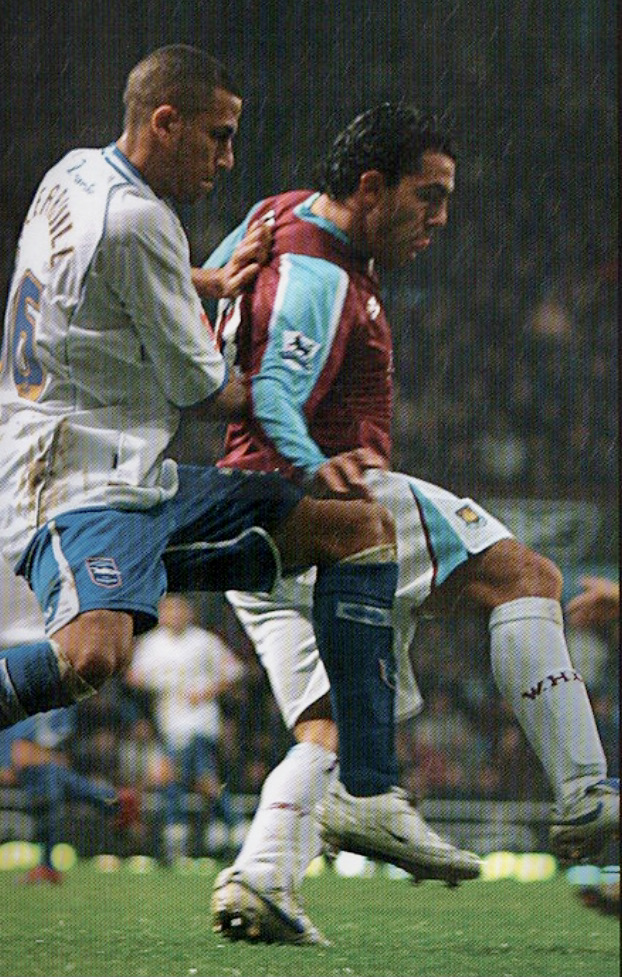
The youngster was played out of position at right-back in a third round FA Cup tie away to West Ham.

The match at the old Boleyn Ground on 6 January 2007 pitched the Premier League Hammers under Alan Curbishley up against his old Seagulls teammate Dean Wilkins, who had taken over the reigns at League One Brighton just four months previously.

West Ham, FA Cup finalists the previous season, were just too good for the mainly young lower league side on the day and, with big-money Argentine striker Carlos Tevez up front, comfortably won the tie 3-0 (Mark Noble, Carlton Cole and Haydn Mullins the scorers).

Albion put up a reasonable fight in a goalless first half although O’Cearuill was fortunate not to concede a penalty when he put in a clumsy challenge on debutant Luis Boa Morte which referee Mark Halsey chose not to penalise.

The second half was only four minutes old when Noble scored his first ever West Ham goal, Cole added a second nine minutes later before being replaced by former Albion favourite Bobby Zamora, and Mullins struck in injury time to round off the win.

Wilkins had turned to the Arsenal youngster when Jack Hinshelwood’s dad Adam suffered a cruciate ligament injury in a Boxing Day match against Yeovil that ruled him out for nine months.

O’Cearuill’s stay on the south coast lasted three months during which he made seven starts and three sub appearances. His final Seagulls match came in a 1-1 home draw against Scunthorpe United.

The Argus reckoned his form was “patchy” and at one point he was dropped to the bench “after a below-par performance” in defeat at Brentford.

Only on a couple of occasions did he get the chance to play in his favoured centre back position; those positions were occupied most of the time by Joel Lynch and Guy Butters.

But after he’d gone on for the injured Lynch in the centre away to Gillingham, he helped the visitors to a 1-0 win and Wilkins said: “I thought he fitted in well. He went into the game at a difficult period. There were a lot of high balls to deal with, which he coped with well.”

That first half of 2007 was pretty much the highlight of his career because on an end of season tour of America he won two full caps for the Republic of Ireland.

Although born in Edmonton on 9 February 1987, he elected to represent the Republic of Ireland and having played for them at under-17, under-19 and under-21 level,

A senior cap for the Republic of Ireland

His first senior cap came when he was one of six substitutes made by manager Steve Staunton in a 1-1 draw against Ecuador at the Giants Stadium, New Jersey, on 23 May 2007.

He replaced Stephen O’Halloran in the 73rd minute and managed to pick up a yellow card in his short time on the pitch. Kevin Doyle headed the Irish equaliser a minute before half time.

O’Cearuill then started at right-back three days later in the Republic’s 1-1 draw with Bolivia in Boston. Shane Long scored his first goal for his country and in the second half former Albion goalkeeper Wayne Henderson took over in goal from Barnsley’s Nick Colgan. The side was captained by Kevin Kilbane.

Curiously, O’Cearuill had been let go by both Leyton Orient and Watford before he was given a chance by Arsenal. He played 27 youth team games for the Os in 2004-05 but was released in August 2005.

Watford picked him up and he played for their youth and reserve teams for a season, but again found himself released. Then, in the summer of 2006, after impressing Arsenal’s reserve team coach Neil Banfield in a trial game against Watford, he joined the Gunners.

He made his debut in a goalless pre-season friendly at Barnet on 15 July and a week later played in half of Dennis Bergkamp’s testimonial against Ajax of Amsterdam.

On a tour of Austria, he played another half as Arsenal beat Mattersburg 2-1 and got 30 minutes as a sub when the Gunners trounced Schwadorf 8-1.

The closest he came to competitive first team action was when he was on the bench for Arsenal’s Carling Cup match away to West Bromwich Albion on October 24, 2006, although he did not get on in the 2-0 win in which Jeremie Aliadiere scored both the goals.

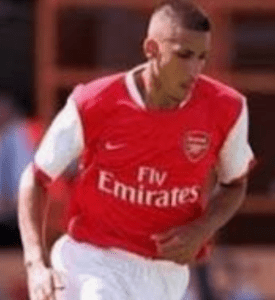
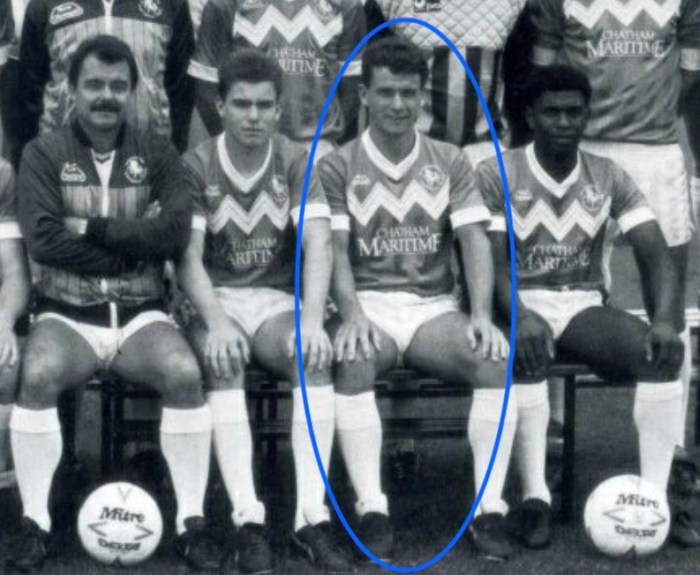
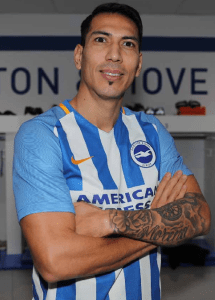
Released by Arsenal, O’Cearuill’s career then drifted from one non-league club to another: Barnet, St Patrick’s Athletic (Dublin), Harlow Town, Borehamwood, Forest Green Rovers (pictured left), Bishop’s Stortford, Tooting & Mitcham United, Haringey Borough, Enfield and Heybridge Swifts.

When he sought to resurrect his career with Conference Premier side Dover Athletic in 2015, he was suitably phlegmatic in an interview with Kent Online.

“It’s certainly been a journey,” he said. “From getting everything on a plate at Arsenal and then for Ireland, to then be washing your own kit and boots.

“I took being a professional for granted and I wasn’t really ready for it – I was too young to take it all in.

“When Arsenal released me, I discovered there was a lot more to life than playing football and I lost the motivation to play at a decent level. I even gave the game up for a while.

“I was then happy to play wherever and go with the flow. I had a couple of great years playing with my mates at Haringey Borough. But that’s all in the past now. The days for playing for fun are behind me.

“I am ready for the next chapter in my life because I’ve got the hunger and desire back to play the game at a level I know I am capable of.”

Released by Dover at the end of the season, former Albion striker Nicky Forster, by then manager of Staines Town, took him on for the Isthmian League Premier Division team.

“We are delighted to have secured the services of Joe this season, he has a great attitude for success and will sit well alongside Darren Purse at the back,” he told the club website.

His last port of call was back at Haringey in the summer of 2016 and he retired from playing in October that year.

In his LinkedIn profile, O’Cearuill describes himself as a senior manager for The Elms Sport in Schools programme.

The FA Cup semi-final hat-trick hero who wore red and blue

ALEX DAWSON was even younger than Evan Ferguson when he scored a FA Cup semi-final hat-trick.

The bull-like centre forward who broke through at Manchester United in the wake of the Munich air crash wrote his name in football record books on 26 March 1958.

Dawson was just 18 years and 33 days old when he netted three goals in United’s 5-3 win over Fulham in front of 38,000 fans at Highbury, north London. No-one that young has ever repeated the feat.

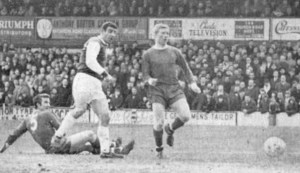
Eleven years later, Dawson scored twice for Brighton in a Third Division match against Walsall. It was my first ever Albion game. He followed up the two he got in that game with six more in four other games I saw that 1968-69 season. They were enough to sow the seeds of a lifetime supporting the Albion and the burly Dawson, wearing number 9, became an instant hero to an impressionable 10-year-old.

Dawson scored twice v Walsall in 1969

Dawson is no longer with us but the memory of his goalscoring exploits live on amongst those fans of a certain vintage who had the pleasure of seeing him in action.

A man who played alongside him at Wembley in 1958 – Freddie Goodwin – made Dawson his first signing for Brighton, for £9,000, not long after he had taken over as manager in the winter of 1968.

By then, he was plying his trade with Bury. He had left United in 1961 after scoring a remarkable 54 goals in 93 games, including one on his debut aged just 17 (in a 2-0 win over Burnley).

After losing 2-0 to Bolton Wanderers in 1958, another losing Wembley appearance followed six years later. He scored a goal for Preston North End but the Lancastrian side lost 3-2 to West Ham United.

United pair Freddie Goodwin and Alex Dawson were reunited at Brighton

Nevertheless, Dawson was prolific for Preston scoring 132 goals in 237 league and cup games over six years. The purple patch I saw him have for Brighton saw him find the net no fewer than 17 times in just 23 games, including three braces and four in an away game at Hartlepool. That was only one behind top scorer Kit Napier whose 18 came in 49 matches.

Alex Dawson in snow action at the Goldstone Ground

In a curtain-raiser to the 1969-70 season, Dawson scored four times as Albion trounced a Gibraltar XI 6-0 at the Goldstone. But the signing of Allan Gilliver and, in the New Year, young Alan Duffy, began to reduce his playing time. He got 12 more goals in 28 appearances (plus three as sub) but, when Goodwin left the club, successor Pat Saward edged him out.

Even in a loan spell at Brentford he scored seven in 11 games. Greville Waterman, on bfctalk.wordpress.com in July 2014, recalled: “He was a gnarled veteran of thirty with a prominent broken nose and a face that surely only a mother could love, but he had an inspirational loan spell at Griffin Park in 1970.”

Still smiling and scoring goals at Corby

Released by the Albion at the end of the 1970-71 season, Dawson’s final footballing action was with non-league Corby Town, where he didn’t disappoint either.

In his first season at Occupation Road, he finished top scorer with 25 goals in 60 appearances and by the time he retired from playing on 4 May 1974, his tally for the Steelmen was 44 in 123 appearances.

When the curtain came down on his career, Dawson had scored 212 goals in 394 matches – more than one every two games. A true goalscorer.

It was in the wake of the decimating effect of the Munich air disaster that Dawson found himself thrust into the limelight at a tender age.

The crash claimed the lives of eight of United’s first choice team – Dawson’s pals. Youngsters and fringe players had to be drafted into the side to fulfil the remaining fixtures that season. One was Dawson, another was Goodwin.

Thirteen days after the accident, Dawson took his place beside survivors Bill Foulkes and Harry Gregg and scored one of United’s goals as they beat Sheffield Wednesday 3-0 in the fifth round of the Cup.

He scored again as United drew 2-2 with West Brom in the sixth round, before winning through 1-0 in a replay to go up against Fulham in the semi-final.

Dawson told manutd.com: “In our first game with Fulham (played at Villa Park), Bobby Charlton scored twice in a 2-2 draw, and I was put on the right wing. I was a centre-forward really and, when we played the replay at Highbury four days later, I was back in my normal position.

“Jimmy (Murphy) said before the game: ‘I fancy you this afternoon, big man. I fancy you to put about three in.’ I just said: ‘You know me Jim, I’ll do my best,’ but I couldn’t believe it when it happened.

“The first was a diving header, I think the second was a left-footer and the third was with my right foot.

“It was a long time ago, of course, and it’s still a club record for the youngest scorer of a hat-trick in United’s history. Records are there to be broken and I’m surprised that it’s gone on for over half a century.

“I’m a proud man to still hold this record. Even when it goes, nobody can ever take the achievement away from me.”

While Dawson was my first Albion hero, when he died in a Kettering care home at the age of 80 on 17 July 2020 the esteem in which he was held by others also came to the fore in the tributes paid by each of the clubs he played for.

Born in Aberdeen on 21 February 1940, Dawson went to the same school as United legend Denis Law, but his parents moved down to Hull and Dawson joined United straight from Hull Schoolboys.

Dawson and future Preston and Brighton teammate Nobby Lawton were both on the scoresheet as United beat West Ham 3-2 in the first leg of the 1957 FA Youth Cup Final and Dawson scored twice in the 5-0 second leg win. West Ham’s side included John Lyall, who later went on to manage them.

On redcafe.net, Julian Denny recalled how Dawson once scored three hat-tricks in a row for a United reserve team that was regularly watched by crowds of over 10,000.

After that goalscoring first team debut against Burnley in April 1957, he also scored in each of the final two matches that season (a 3-2 win at Cardiff and a 1-1 draw at home to West Brom) to help United win the title and secure their passage into Europe’s premier club competition.

Obviously, circumstances dictated Dawson’s rapid rise but, with the benefit of hindsight, some say his United career may have panned out differently if he hadn’t been thrust into first team action at such a young age.

He was just short of his 18th birthday when the accident happened. In an interview with Chris Roberts in the Daily Record (initially published 6 Feb 2008 then updated 1 July 2012), he recalled: “I used to go on those trips and had a passport and visa all ready but the boss just told me I wasn’t going this time.

“I had already been on two or three trips just to break me in. I know now how lucky I was to be left in Manchester. The omens were on my side.”

Dawson went on to describe the disbelief and the feelings they had at losing eight of the team, including Duncan Edwards several days later.

“We were all so close and Duncan was also a good friend to me before the accident,” said Dawson. “Duncan was such a good player, there is no doubt about that. He was a wonderful fellow as well as a real gentleman.

“I will never, ever forget him because he died on my birthday, 21 February, and before that he was the one who really helped me settle in.”

Dawson gradually became an increasingly bigger part of the first-team picture at United, making 11 appearances in 1958-59 and scoring four times. The following season he scored 15 in 23 games then went five better in 1960-61, scoring 20 in 34 games.

He was at the top of his game during the last week of 1960 when he scored in a 2-1 away win at Chelsea on Christmas Eve, netted a hat-trick as Chelsea were thumped 6-0 at Old Trafford on Boxing Day, and then scored another treble as United trounced neighbours City 5-1 on New Year’s Eve.

A fortnight later he had the chance to show another less well-known string to his footballing bow…. as a goalkeeper!

It was recalled by theguardian.com in 2013. When Tottenham were on their way to the first ever double and had an air of near-invincibility about them, they arrived at Old Trafford having lost only once all season, and had scored in every single game.

Long before the days of a bench full of substitutes, when ‘keeper Harry Gregg sustained a shoulder injury, Dawson had to take over in goal.

Dawson excelled when called upon, at one point performing, according to the Guardian’s match report, “a save from Allen that Gregg himself could not have improved upon”.

The article said: “Tottenham’s attempts to get back into the game came to nought and Dawson achieved what no genuine goalkeeper had all season: keep out Tottenham’s champions-elect. In the end, there were only two games all season in which Spurs failed to score, and this was one of them.”

Scoring for Preston North End

Tottenham’s north London neighbours, Arsenal, finished a disappointing 25 points behind Spurs in 11th place, but United manager Matt Busby had been keeping tabs on the Gunners’ prolific centre forward David Herd (Arsenal’s top scorer for four seasons), and in July 1961 took him to Old Trafford for £35,000. It signalled the end of Dawson’s time with United.

When the new season kicked off, Dawson had a new apprentice looking after the cleaning of his boots….a young Irishman called George Best. In his 1994 book, The Best of Times (written with Les Scott),

Best said: “Alex Dawson was a brawny centre forward whose backside was so huge he appeared taller when he sat down. To me, Alex looked like Goliath, although he was only 5’10”. What made him such an imposing figure was his girth.

“He weighed 13st 12lbs, a stone heavier than centre half Bill Foulkes who was well over 6ft tall. What’s more, there wasn’t an ounce of fat on Alex – it was all muscle.”

Best’s responsibilities for Dawson’s boots didn’t last long, however, because in October that year, Busby sold the centre forward to Preston for £18,000.

In 1967, Dawson took the short journey to Bury FC where his goalscoring exploits continued with 21 goals in 50 appearances, before he joined Goodwin’s regime at Brighton.

What a career to look back on: Alex Dawson recalling his goalscoring exploits

The Harry Hotspur youngster who went west

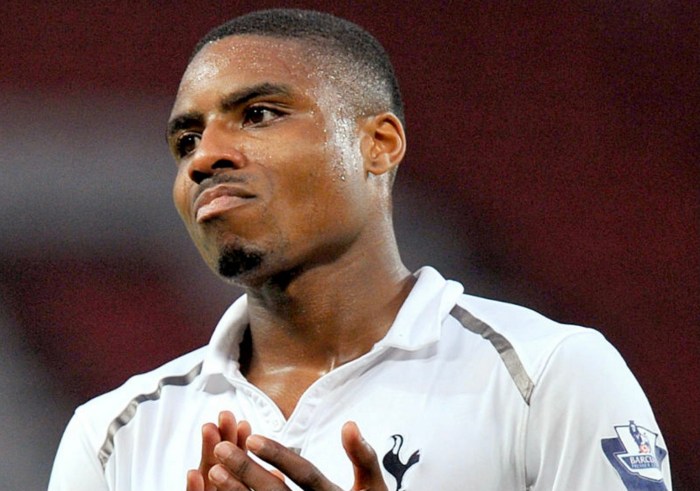
MULTIPLE loans away from parent club Tottenham Hotspur didn’t succeed in laying a path to a top level football career for striker Jonathan Obika.

One of the last such arrangements saw the young forward spend three months with the Seagulls in the 2013-14 season.

Nathan Jones, no.2 to Brighton head coach Oscar Garcia, had seen what Obika could do when the young striker had been under him as a coach on loan at Yeovil and Charlton Athletic.

Unfortunately, his impact with the Seagulls was underwhelming even though he scored on his first (and, ultimately, only) full start in a 3-1 win away to Port Vale in the fourth round of the FA Cup.

Obika salutes his one and only goal for Brighton

Albion’s other goals that day, from Rohan Ince and Solly March, were also their first for the club – generating the statistic that it was the first Albion game in 110 years in which three players had scored their first goal in the same league or cup match.

It had been an amazing goalscoring performance for Spurs reserves that prompted Albion to make a move for Obika as cover for first choice Leonardo Ulloa, especially with Craig Mackail-Smith and Will Hoskins sidelined by injury and Ashley Barnes on the brink of a move to Burnley.

The Argus reported that Obika had previously been a target but a move had been put on ice because he’d been injured. His return to fitness saw him net a double hat-trick in a friendly for Tottenham against Charlton’s under-21s, watched by Jones.

“The report coming back on him after the game was one word – lethal!” former Seagulls goalkeeper Ben Roberts, then on the coaching staff at Charlton, told the Argus.

“Like Nathan, I worked with Jon at Yeovil and then at Charlton and he’s a really good pro,” said Roberts. “He is guaranteed to score goals. He is a real predator around the box.

Obika in action for Yeovil

“I’ve been waiting for his career to really kick off. When he came to us at Charlton it took him a couple of weeks to get up to speed. But he was brilliant for us. The end of the season came too soon for us.

“He is a great signing for Brighton and he will suit the way they play.”

However, Garcia also brought in Spaniard David Rodriguez at the same time and Obika found himself down the pecking order, especially when Manchester United loanee Jesse Lingard was added to the forward options.

The Vale cup game aside, Obika made just seven appearances as a substitute but didn’t add to the lone goal and was eventually recalled by Spurs and sent out on loan to Charlton again until the end of the season.

Nevertheless, Garcia said: “He came in to give us forward cover and, while he may not have played as much as he would have liked, he has been a great professional and a pleasure to work with.”

Obika’s long association with Tottenham finally came to an end in September that year when he headed west to League One Swindon Town, where he played for three years, scoring 28 times in 108 games for the Robins.

In 2017, he switched to Town’s rivals Oxford United on a two-year deal before then trying his luck in Scotland, playing in the Scottish Premier League for St Mirren.

On the expiry of that contract, Obika moved to League One Morecambe and, in January 2022, found himself back in the news ahead of this year’s FA Cup third round when Morecambe travelled to North London to take on the club who nurtured his early career for 13 years.

Although Morecambe took a shock first half lead against Spurs through defender Antony O’Connor, it wasn’t a fairytale ending as the Premier League side eventually won the tie 3-1 with three goals in the last 16 minutes of the game.

Obika had to watch from the bench until the 58th minute when he replaced Jonah Ayunga – a Brighton reserve player between 2016 and 2018 – with Morecambe still clinging on to their slim lead.

Born in Enfield on 12 September 1990, of Nigerian parents, Obika grew up in Edmonton and it was while playing football for his primary school, St Paul’s & All Hallows, that he was scouted by Tottenham.

“I lived five minutes from the stadium, so I used to walk to training as a 10, 11-year-old,” he said. “That was my only focus back then.” He later attended Bishop Stopford School in Enfield and left with seven GCSEs.

Originally a left winger, Spurs’ under 18s coach Alex Inglethorpe was responsible for moving him to play as a central striker and in the 2007-08 season he was top scorer for the Spurs academy side.

Those goals caught the attention of first team boss Harry Redknapp and he signed his first professional contract at 18, while a second-year trainee in the academy, and earned a call-up to the first team squad.

Wearing the number 80, he made his debut off the bench in a UEFA Cup game in Holland against NEC Nijmegen on 28 November 2008. A few weeks later, he made his first senior start in front of the White Hart Lane faithful, playing against Shakhtar Donetsk in the same competition.

“I didn’t know I was starting at the beginning of the game, there were a few injuries so a lot of the youth team players trained that week and we were in the squad,” Obika remembered.

When announcing the team, Redknapp actually read out his name as John Utaka, his former player at Portsmouth, amid much hilarity. “That broke the ice,” said Obika. “I was less nervous after that. I was more relaxed and actually ended up having a good game. To play at the Lane, having grown up down the road, was a great feeling and I had all my family and friends there that night.”

Along with Inglethorpe, the coaches who most influenced his development at Spurs were John McDermott and, when he progressed to the reserves, Tim Sherwood, Les Ferdinand and former Albion full-back Chris Ramsey.

Obika and fellow Spurs youngster Andros Townsend were sent out on loan to Yeovil – it was the first of four loan spells there for Obika – as recalled by Jones in an interview with coachesvoice.com: “A host of other clubs wanted them, but I think Harry saw two young kids who wanted to play, and he saw something in us as a coaching team.

“Townsend clearly had huge drive and ambition, and Obika scored the goals that kept us in League One that season – so we will always be thankful to Harry for that.”

Obika recalled: “While I was at Yeovil, Nathan Jones was my coach and I built up a good relationship with him. He would stay behind with me while I did extra shooting: he didn’t need to, I could have done it with other teammates, but he wanted to be there and help me progress and I really appreciated that. He is a good man. He also took me to Charlton for a loan spell and, of course, to Brighton.”

Obika also had loan stints at Millwall, Crystal Palace, Peterborough and Swindon although in the 2012-13 season he did manage to get two more games for the Spurs first team, featuring in the League Cup and the FA Cup.

He went on as a 75th minute substitute for Clint Dempsey when André Villas-Boas’ Spurs side beat Carlisle United 3-0 in the League Cup in September 2012, and was a 59th-minute substitute for Gylfi Sigurdsson when Leeds dumped Spurs out of the FA Cup 2-1 in a fourth round tie at Elland Road in January 2013.

Putney printer Pearce went to Wembley with the Albion

HE took a circuitous route back to his hometown club but full-back Graham Pearce eventually made it to Brentford’s first team after Brighton had resurrected his career and given him a chance to play at the top level of the English game.

Pearce was first on Brentford’s books as a teenager between 1971 and 1976, but he didn’t make it as a pro with the Bees and, after also being turned down by QPR, he went non-league, initially with Hillingdon Borough for three years and then Barnet.

When Pearce lined up for Barnet in a FA Cup third round tie on 2 January 1982, it must have been beyond his wildest dreams to imagine just over a year later he’d be playing in that competition’s final at Wembley.

But the steady, assured performances 21-year-old Pearce put in as Alliance Premier League Barnet held Brighton 0-0 before losing 3-1 in a replay at the Goldstone impressed the watching Albion boss Mike Bailey sufficiently to sign him up for the Seagulls.

Although he was itching to join, he had to serve a week’s notice with the Putney printer where he had a full-time job because they weren’t in a position to release him sooner.

Just over a year later, when injuries depleted Jimmy Melia’s cup hopefuls the closer they got to a dream Wembley date, Pearce seized his chance to put his own name in print. Circumstances fell just right for him, but it might not have happened if the experienced left-back Sammy Nelson hadn’t been sidelined.

A packed East Terrace at the Goldstone the backdrop as Pearce faces Newcastle in the FA Cup

Pearce played in the third round 1-1 Goldstone draw with Newcastle – one of six games he played in January 1983 – but he missed the 4-0 demolition of Manchester City in the fourth round and didn’t feature again until 22 March when he was sub for the 2-2 home draw with Liverpool.

Because versatile Gary Stevens was more than capable of playing alongside Steve Foster, normal centre back partner Steve Gatting was preferred at left-back for 14 matches from the end of January.

But when right-back Chris Ramsey was suspended for the semi-final against Sheffield Wednesday, Stevens took his spot, Gatting returned to the middle and Pearce slotted in at left-back.

Because Foster was suspended for the final against Man Utd, Stevens paired up with Gatting in the middle and Pearce retained his place.

Even when Foster returned for the replay, Pearce kept his place because Ramsey had been crocked in the first match and wasn’t fit to play (Melia making the mistake of putting left-footed Gatting at right-back instead of Stevens).

In a pre-match interview with the Daily Mail, Pearce said: “There’s money to be made from appearing at Wembley but the thrill for me is just being there – a player from non-League who thought his chance of playing league football had gone.”

Pearce retained the no.3 shirt at the start of the 1983-84 season back in the second tier but, when Chris Cattlin took over from Melia, he made it clear he wanted someone with more experience in that position.

In his matchday programme notes he wrote: “With Kieran (O’Regan), Eric Young and Graham Pearce all playing together, we have three players who haven’t been long out of non-League football.

“Normally these players would have been blooded slowly into the side, instead of being plunged in the deep end. They have done well and shown the right attitude, but when we play against aggressive sides away from home, some of their inexperience has been exposed.”

Until a suitable replacement could be found, Pearce remained in the side and even poked home his first Albion goal in a 4-3 win away to Cambridge United on 29 October 1983.

But four weeks later, after a 2-2 draw at home to Shrewsbury Town, Cattlin was typically forthright in his next programme notes, declaring: “I was unhappy with our defence and our failings in this department cost us the game.”

Pearce and fellow full-back Ramsey were promptly dropped; the left-back berth going to new signing Chris Hutchings from Chelsea.

Cattlin had high praise for his new recruit as he said: “Chris Hutchings is an enthusiastic, strong and determined defender and has a lot to offer, he’s also a fine footballer.”

After 18 consecutive games, Pearce found himself out of the side for the rest of the season.

It’s interesting to note that the reserve side for the 1 May 1984 fixture at home to Southampton featured five players (Pearce, Ramsey, Gary Howlett, Gerry Ryan and Neil Smillie) who’d been in the FA Cup Final squad a year earlier.

The new season was almost three months’ old before Pearce was seen in the first team again, and, ironically, the opponent was once again Shrewsbury.

The game at the Goldstone finished a goalless draw and, with Hutchings having been switched to right-back, Pearce got a run in the side extending to 19 matches.

Unluckily for him, he was then left out of the side in favour of Martin Keown, who Cattlin managed to bring in on loan from Arsenal, and the future England international quickly proved his calibre.

Pearce made one further appearance, in a 2-1 defeat at Middlesbrough, before the end of the season but in the 1985-86 season he finally cemented his place in the side and played a total of 41 matches.

Three days after Christmas 1985, he scored a rare goal as the Seagulls beat Leeds 3-2 at Elland Road. Ian Baird – later to play for the Albion in the old Fourth Division – missed a penalty but scored one of Leeds’ goals and Pearce clinched the winner on a pitch rutted by a rugby league game played on it only two days earlier.

The matchday programme described the goal thus: “Pearce played a one-two with (Steve) Jacobs and found himself with only Mervyn Day to beat and Leeds screaming for offside. The trusty left foot of the Londoner lobbed goalwards, Day was stranded, and Pearce had scored his first goal in 26 months to give Albion another three valuable points.”

Not such a memorable game came in a 3-0 defeat away to Norwich City on 5 April 1986. The full-back went into the referee’s notebook for a foul on future Albion winger Mark Barham, who was substituted shortly afterwards. Albion had a great chance to pull a goal back when Pearce was through one-on-one with Chris Woods, but the England ‘keeper saved his effort comfortably. Then, eight minutes from time, Pearce fouled Wayne Biggins in the penalty area and Welsh international David Williams buried City’s third from the penalty spot.

Pearce played in Albion’s final game of the season, a 2-0 defeat at Hull City under George Petchey, following Cattlin’s sacking, and it turned out to be his last match in a Brighton shirt.

The returning Alan Mullery explained in his programme notes for the opening game of the new season that he released Jacobs and Pearce because “I felt we had too many defenders”.

Pearce switched to Third Division Gillingham under Keith Peacock and played a total of 48 matches as the Gills narrowly missed out on promotion when losing a play-off final replay against Lou Macari’s Swindon Town in 1987.

Following a disappointing second season with the Gills, when they finished mid-table, Pearce returned to hometown club Brentford where he played 14 times (+ 8 as sub) in Steve Perryman’s 1988-89 side. One of his teammates was fellow former Albion cup star Smillie.

Pearce joined up with Peacock again for Maidstone United’s debut season (1989-90) in the Fourth Division, which culminated in a play-off semi-final defeat at the hands of a Cambridge United side featuring Dion Dublin up front.

The following season, under Phil Holder, Pearce was back at Brentford as first team and reserve coach. He subsequently had spells as player-manager with Isthmian League clubs Enfield and Molesey. He later became a PE teacher at Homefield Preparatory School in Sutton.

Born in Hammersmith on 8 July 1959, Pearce was one of seven children (five boys, two girls) and attended Grove Park Primary School, where he was captain of their under-9 football side. He went on to play for the Middlesex County side and Middlesex Wanderers before his stop-start professional career began.

• Pictures from my scrapbook and matchday programmes.

That man from Argentina scored goals in the UK and Spain

LEONARDO ULLOA brought down the curtain on his playing career in Madrid, netting six goals in 20 appearances (plus 12 off the bench) for Rayo Vallecano in the Spanish second division.

It was to the delight of Brighton fans that 28 of his career 148 goals were scored for the Albion, where he quickly established himself as a fans favourite by scoring on his debut against Arsenal in the FA Cup.

Previously virtually unknown in England, Ulloa’s arrival in January 2013 provided the tall, goalscoring presence up front Brighton had been craving since Glenn Murray headed to Crystal Palace in the summer of 2011.

Within two months, Ulloa was cementing his place in Albion history by scoring the first ever hat-trick at the Amex, in a 4-1 win over Huddersfield Town, and it wasn’t long before fans were serenading him with his own terrace song: “Who’s that man from Argentina, who’s that man we all adore…..”

His efforts in the stripes got even better when he scored twice in a memorable 3-0 win over Palace that March giving the Seagulls their first home win over their bitter rivals for 25 years.

After the game, manager Gus Poyet told BBC Radio Sussex: “Leonardo Ulloa is making the difference. I am pleased for him. If he had been here for the first six months I can’t imagine where we would be right now.

“What a prize for him, scoring two goals against our biggest rivals. I am very happy for him.” By the season’s end, Ulloa had scored 11 goals in 16 starts (plus one substitute appearance).

While Poyet departed acrimoniously after defeat in the play-off semi-finals, Ulloa continued to thrive under new boss Oscar Garcia. Top-scoring with 16 goals, he’ll always most memorably be known for nodding in a last-gasp header from Craig Mackail-Smith’s left-wing cross to secure a 2-1 win at the City Ground, Nottingham on 3 May 2014.

It earned Albion another play-offs place in the bid to secure promotion to the Premier League, although a 6-2 aggregate defeat at the hands of Derby County meant it didn’t end well.

Sadly, not only did it mark the end of Garcia’s reign, it also led to Ulloa’s exit from the club, but the £8m record fee newly-promoted Leicester City paid for his services was difficult to resist, quite apart from the player’s desire to play at the top level.

Switching to the East Midlands was a short hop compared to the journey he had to make when he was starting out in the game.

Born on 26 July 1986 in General Roca, a city in Argentina’s northern Patagonian province of Rio Negro, Ulloa moved 700 miles from home at the age of 15 to pursue his footballing dream, as he told Brian Owen of The Argus in a 2013 interview.

It was only when he wasn’t getting much playing time in Argentina that he took the opportunity to move to Spain, initially with Spanish second-tier side Castellon in the Valencia region.

When they were relegated in 2010, he stayed in the second tier by moving to the south east of the country to join Almeria, where he scored 39 times in 90 appearances. It was from there Albion bought him for an undisclosed sum, widely thought to be £2m.

The subsequent move to Leicester couldn’t have got off to a better start when Ulloa scored Leicester’s first Premier League goal for a decade in August 2014, hitting the net on his debut against Everton at the King Power Stadium. He also scored a brace of goals in a famous 5-3 victory over Manchester United.

Indeed at the end of that 2014-15 season, Ulloa was Leicester’s top scorer with 13 goals in 31 appearances (plus nine as a sub).

Few could have imagined it was going to get a whole lot better the following season, but as Claudio Ranieri’s City shocked the football world by climbing to the summit of the Premier League and staying there, Ulloa collected a title winners medal for his contribution.

Although he made just nine starts, as Jamie Vardy and Shinji Okazaki took centre stage, he appeared 22 times as a substitute and, in his supporting role, chipped in with six – often vital – goals.

He scored an 89th minute winner to earn a 1-0 win over Norwich City after entering the fray as a 78th minute sub and, when defeat at home to West Ham looked on the cards after Vardy had been sent off, he coolly netted a penalty in the fifth minute of added on time to secure a 2-2 draw.

With Vardy suspended for the following game, Ulloa stepped up with two goals in a 4-0 win at home to Swansea City.

Phil McNulty, BBC Sport’s chief football writer, said Ulloa had fully repaid the faith shown in him by Ranieri. “When Ulloa earned the Foxes a vital point with a stoppage-time penalty last weekend against West Ham, he showed he was not a man to be perturbed by pressure – and he relished the responsibility put on his shoulders against Swansea,” he wrote, describing how Ulloa “ran selflessly all afternoon to compensate for the darting, pacy threat of Vardy, and most importantly contributed two goals that eventually made this a stroll for Leicester City”.

It all turned sour for him at the King Power Stadium the following season and with a lack of involvement his frustration went public as he sought a move away. Sunderland, fighting (ultimately in vain) relegation from the Premiership, reportedly had three bids to sign him turned down in the January 2017 transfer window.

Ulloa told Sky Sports News reporter Rob Dorsett: “I’m a bit sad about the current situation. It’s been two wonderful years at the club but now, given my situation – not playing and not being part of the team’s plans – I feel that the best way forward is I leave and I can be happy somewhere else.”

He added: “They know I am not going to be used. The best thing for both parties is they sell me to another club and I can continue playing my football somewhere else.”

However, when Ranieri was sacked the following month, Ulloa found a path to first team football re-opened under new boss Craig Shakespeare. He only made four starts but he appeared off the bench 19 times, and, in August 2017, signed a new two-year contract with the Foxes.

Speaking to LCFC TV, Ulloa said: “I am so happy because I have lived massive moments with this club and it makes me happy to stay here and fight, to help the team and increase the club’s history. That is so important and I am so happy for this two-year contract. Now I have to fight to play. I will train and give my best. I appreciate it a lot to stay here and I am so happy here now. For that, I want to continue in this in the same way by working hard and working my best for the club.”

Shakespeare added: “Leo’s goals and performances have been key to some wonderful moments for this football club since he first joined and I’m delighted to have him with us for another two years. He’s a popular member of the squad and gives us an excellent option in attack.”

All of the words came to nought however, because Ulloa was barely involved, other than sitting on the subs bench and only getting on once. So, in January 2018, he was happy to return to Brighton on loan to supplement the striking options in Chris Hughton’s squad.

But with Glenn Murray in top form and Sam Baldock and Tomer Hemed as other striker options, Ulloa only made four starts plus eight appearances as a sub. He scored twice, including opening the scoring against Manchester City at the Etihad, but Albion didn’t share the striker’s enthusiasm for a permanent return to the Seagulls.

Instead of moving back to the south coast, Ulloa headed to Mexico to join Pachucha, and a year later he headed back to Europe, and back to Spain, to sign for Rayo Vallecano.

The striker spent eight months sidelined by a serious knee injury in 2020 but returned to action in October 2020 before retiring at the end of the 2020-21 season. Ulloa received a warm reception from Albion fans when he was interviewed on the Amex pitch in March 2023 when West Ham were the visitors.

Pictures from various online sources.

The Tiger who came to Brighton and fitted to a T

DIMINUTIVE winger Brian Tawse is remembered by veteran Brighton fans for his boyish good looks…. and a stunning disallowed goal.

It perhaps does a disservice to the fact he played 109 games (plus five as a sub) in the second half of the swinging Sixties after joining the club from Arsenal.

Tawse spent two years with the Gunners and made a handful of first-team appearances but with George Armstrong ahead of him it wasn’t until he joined the Albion that he began to play regular league football.

It was a cracking strike by Tawse in the closing minutes of a FA Cup fourth round tie against Chelsea in January 1967 that stuck in people’s memories.

In front of a packed Goldstone Ground crowd of 35,000, a big upset looked on the cards when Tawse’s terrific volley flew past Peter Bonetti five minutes from the end of the game for what would have been a 2-1 win.

Unfortunately, the referee had spotted an infringement by Kit Napier and the ‘goal’ was disallowed. In the replay at Stamford Bridge, Chelsea ran out clear 4-0 winners.

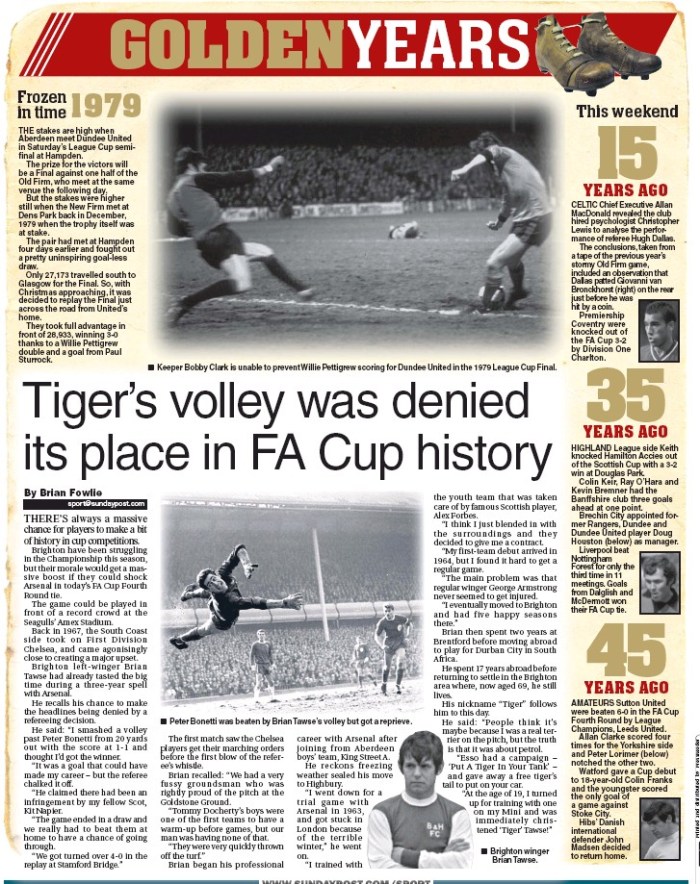
“I smashed a volley past Peter Bonetti from 20 yards out with the score at 1-1 and thought I’d got the winner,” Tawse told Brian Fowlie of the Sunday Post in 2015, ahead of Brighton’s fourth round FA Cup tie with Arsenal. “It was a goal that could have made my career – but the referee chalked it off.”

Tawse had been with the Albion for just over a year when that cup tie came around. He was one of three ex-Arsenal players in the side: the Northern Ireland international full-back Jimmy Magill joined Albion in October 1965, Tawse followed him two months later, and goalkeeper Tony Burns joined in the summer of 1966.

Albion’s boss at the time was fellow Scot Archie Macaulay, a former Arsenal player himself, who during his time at the Gunners had persuaded them to sign Alex Forbes, who later became the coach Tawse played under in Arsenal’s youth team. But more of that later.

Tawse got his first Brighton goal in only his second game, a 4-3 home win over Bristol Rovers on New Year’s Day 1966, and he went on to score six in 22 matches as the Albion finished 15th in Division 3.  

Although he started the next season in the no.11 shirt, close season arrival Howard Wilkinson became an automatic choice on one wing and Tawse found himself competing with Wally Gould for a place on the other.

Aside from the excitement of that Chelsea cup game, Tawse did find the net eight times (three times from the penalty spot) as he played in 28 games (+ one as sub) that season.

The winger couldn’t always be relied on from 12 yards, however, as contributor ‘Questions’ recalled on North Stand Chat in 2008. “Ah Tiger Tawse, he of the boyish good looks and ability to blaze a penalty over the north stand roof against Watford, I think. Good little player though….”

The majority of Tawse’s Albion games (41 + 1 sub) came in the 1967-68 season although he only scored twice as Albion finished 10th.

The signing of Paul Flood from Bohemians added forward options to the manager’s selection, but it was the £5,000 signing of speedy Dave Armstrong from Millwall in September 1968 that began to edge Tawse out.

Tawse (arrowed) in an official Albion team photo ahead of the 1969-70 season

In the 1968-69 season, which saw the arrival of Freddie Goodwin as manager in place of Macaulay, Tawse made only 16 appearances (+ three as sub), and he featured only twice between the start of December and the end of the season.

My own Albion watching journey began in February 1969 and the only game I saw Tawse play was in the Easter Saturday 4-1 win over Barnsley when he replaced Kit Napier; the only change to the side who had played 24 hours earlier, again at home, when Orient were beaten 2-0.

Goodwin mostly went for Armstrong on the left and Wilkinson on the right.

By the time the 1969-70 season arrived, opportunities were even more limited for Tawse. He was only on the bench once and started just two, his last first-team appearance coming in a 2-0 defeat away to Tranmere Rovers on 25 October 1969.

Former Albion teammate Wilf Tranter writing on North Stand Chat, said: “Brian finally lost the no. 11 shirt to Kit Napier in the 1969-70 season. He had been a very good servant to the club and was regarded with great affection by many supporters.”

Tawse with rival Kit Napier who became a good friend

Born on 30 July 1945 in Ellon, just north of Aberdeen, his footballing talent was first spotted while playing for Aberdeen boys’ team, King Street A. He told the Sunday Post’s Fowlie how the big freeze in 1963 worked in his favour.

“I went down for a trial game with Arsenal in 1963 and got stuck in London because of the terrible winter,” he said. “I trained with the youth team that was taken care of by famous Scottish player Alex Forbes.”

Forbes had joined Arsenal just after the war on the recommendation of fellow Scot Macaulay, whose place in the side he subsequently took over.

When Forbes later became youth coach at Arsenal, he took a party of Arsenal youngsters on a summer tour to South Africa, got offered a coaching job in Johannesburg and decided to make it his home for the rest of his life.

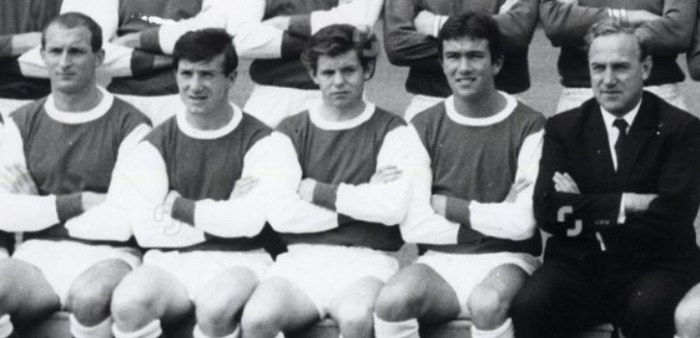
Tawse (centre) between George Armstrong and Jon Sammels in an Arsenal line-up, with Magill (far left) and Billy Wright

Billy Wright, the former England captain who’d won 105 caps for his country, was manager of Arsenal in the mid-’60s and it was he who took Tawse on as a professional.

Wright may have been a legend as a player but one of Tawse’s fellow Highbury hopefuls, John Ryan, who later starred for Fulham, Luton Town and Norwich City, was not at all enamoured.

Looking back in an interview with a Norwich archive site, he said: “Billy Wright was the only manager of the 12 I ended up playing for who I neither liked nor respected.

“He seemed to take an instant dislike to me and would single me out for some vicious treatment in front of the other young players.”

Ryan shared digs with Tawse and David Jenkins and he recalled how he found out Arsenal were letting him go. “At the end of that season (1964-65), I was sitting in the digs when two large brown envelopes and one small registered white one dropped through the front door. As I opened the small white one that was addressed to me, I wondered where the other two lads had disappeared to.

“It turned out that they’d read the situation as my letter was from the club notifying me I was being given a free transfer whilst the two brown envelopes that were for them both contained contract offers.”

Tawse made his Arsenal debut away to West Brom on 21 November 1964, a game which finished 0-0. Although his first team game time was limited, in the space of three days in February 1965 he played in successive 2-0 wins at home to Fulham and Spurs and at the end of the following month against West Ham away, another 0-0 draw.

Away to Nottingham Forest on 13 March 1965, Tawse took George Armstrong’s place on the wing – and the aforementioned Magill earned a rare outing in place of Don Howe at right back – but they lost 3-0.

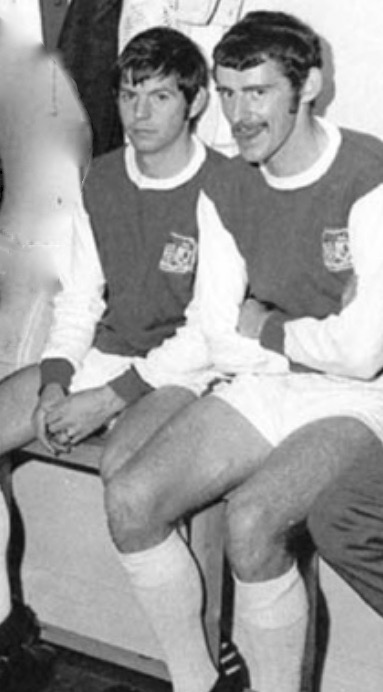
Brian Tawse alongside George Armstrong, the winger he couldn’t dislodge to gain a regular Arsenal place

Although the official record books only show those league appearances, thearsenalhistory.com details how Tawse also played twice in an end of season five-game tour in Italy. He played in a 2-2 draw against Torino and was one of the scorers in a 3-0 win over Latina.

The following season he was selected in a 5-2 friendly win over non-league Corinthian Casuals on 21 September and a month later –  on 23 October 1965 –  he was on the substitute’s bench in a 2-2 home draw against Blackburn Rovers, but that was the last of his involvement, and he moved to Albion five weeks later.

“The main problem was that regular winger George Armstrong never seemed to get injured,” Tawse told the Sunday Post.

He also dispelled a myth about how he came to get his nickname Tiger, telling the reporter: “People think it’s maybe because I was a real terrier on the pitch, but the truth is that it was about petrol.

“Esso had a campaign – Put a Tiger in Your Tank – and gave away a free tiger’s tail to put on your car.

“At the age of 19, I turned up for training with one on my Mini and was immediately christened ‘Tiger’ Tawse!”

After leaving Brighton in March 1970, Tawse moved to Brentford where he played in 13 games as new manager Frank Blunstone took the Bees to within three points of promotion from Division Four, finishing fifth just behind Port Vale.

But in the 1970-71 season he made just eight appearance (plus two as sub) and ended up on loan to Southern League Folkestone.

Still only in his mid 20s, he decided to head to South Africa and played for Durban City at a time when dozens of British players, managers and coaches were recruited by that country’s 16 clubs.

He was later joined there by former Albion teammate and fellow Scot Kit Napier and after they hung up their boots, they worked together in the motor trade.

When Napier died in March 2019, Tawse told The Argus: “We remained friends afterwards and we were both golfers. He was a very good golfer, which people probably don’t realise. He played in a lot of pro-ams.

“He was a good lad and, of course, a bit of a legend for what he did with Brighton.”

Tawse spent 17 years in South Africa but returned to the UK and settled in Westdene, Brighton…and watches the Albion from the West Stand at the Amex.

Sweet passer ‘Chippy’ became Brighton crowd favourite after Cardiff move

RICHARD Carpenter was a popular mainstay of Albion’s promotion-winnning side of the Noughties, scoring some notable goals along the way.

Billed as Brighton’s ‘star player’ in Port Vale’s 20 April 2002 programme for the last game of Albion’s promotion-winning season, Carpenter was described as “a highly effective midfielder, being strong in the tackle, a precise and sweet passer of the ball, while possessing a strong right-foot shot” – an excellent summary.

The goal he scored from a free kick against Spurs in the FA Cup at White Hart Lane on 8 January 2005 is right up there as one of my all-time Albion favourites.

Brighton, battling at the bottom of the Championship, hadn’t played Spurs since falling out of the top division in 1983 so it was a great chance for a giant-killing.

Albion ultimately succumbed 2-1, but not before Carpenter rifled home a free-kick past England ‘keeper Paul Robinson three minutes into the second half to level the score.

Carpenter told the Albion matchday programme in January 2018: “We were going to have a good time, win, lose or draw, but we also didn’t change the way we played – we made ourselves hard to beat, like we always did.

“Before my goal, I had already hit the crossbar with a half-volley from outside the box when Gary Hart teed me up. It went like slow motion and I thought it was going in.

“Obviously, I did score with a free-kick in the second half. I looked at the wall and my mind was made up to hit it. I knew it was going in by the flight of the ball and it was obviously a great feeling to score at White Hart Lane.”

Born in the village of Teynham, near Sittingbourne in Kent, on 30 September 1972, most of Carpenter’s career was centred on London and the south east, apart from one brief foray to south Wales, and Cardiff City.

Chippy began his professional career with Gillingham in May 1991 and he had clocked up 142 senior appearances for the Gills in five years before Gillingham old boy Micky Adams paid a £15,000 fee to take him to Craven Cottage, Fulham.

In two seasons at the Cottage he played a further 66 times, scoring nine goals along the way.

It was in July 1998 that he left the English capital to sample life in the Welsh capital. Cardiff paid £35,000 for his services and he helped them to promotion from the fourth tier in 1999.

Unfortunately, Carpenter’s time in Wales was also marred by a tackle he made in a Boxing Day game against Reading in 1999. His challenge on Chris Casper resulted in a double leg break for the defender which ultimately ended his career. Five years later, Casper was awarded undisclosed damages in an out-of-court settlement for past and future loss of earnings.

Nevertheless, when interviewed about his time in south Wales, Carpenter told Graham Otway, of the Daily Mail: “I had two and a half fantastic years at Cardiff. I helped them win promotion and I lived in a lovely part of the Forest of Dean, near Chepstow.

“I never wanted to leave the club but my girlfriend was expecting a baby and we wanted to move back home to Kent.”

So, after 89 league and cup appearances for the Bluebirds, he joined the Adams-managed Brighton on a free transfer in July 2000.

Away from football, it also presented him with the perfect opportunity to browse Brighton’s famous Laines searching out various antiques for his collection.

“I do like collecting nice pieces,” he told Otway. “I am mainly into collectables – watches, jewellery and old walking canes. But when it comes to furniture I am into modern stuff as well. I just have lots of interests outside of football.”

On the pitch, Carpenter was an Albion fixture under various managers and was part of promotion and relegation sides.

In the first leg of the play-off semi-finals in 2004, on a boiling hot day at the County Ground, Swindon, it was Carpenter’s deflected goal that gave Albion the advantage going into the second leg, which was played in exactly opposite conditions of torrential rain, as Albion edged it via a penalty shoot-out.

Carpenter said the 2004 play-off final at Cardiff was the pinnacle of his career, as Albion secured a 1-0 win over Bristol City to return to the second tier.

“I have played all my career in the Second and Third Divisions – apart from one in the First – and I haven’t had the opportunity to play in luxury stadiums in front of massive crowds,” he said. “The final is going to be something special for me to remember for the rest of my life.”

After Mark McGhee was replaced as manager by Dean Wilkins in September 2006, Carpenter’s Albion days were numbered.

In fact, he was red-carded in Wilkins’ first game in charge, away to Millwall, although the Seagulls won 1-0. Former Albion youth coach Wilkins was keen to introduce to the first team some of the younger players he’d helped to develop. So, at the age of 34, and after more than 278 appearances and 24 goals, Carpenter’s Seagulls playing career finally came to a close, in February 2007, when he left by mutual consent.

Albion chairman Dick Knight devoted space in the matchday programme to honour his achievements with the Seagulls.

“He has been a fantastic player and model professional for this football club ever since he arrived from Cardiff in 2000,” said Knight. “I remember Micky Adams telling fans that Richard would be a player that fans would enjoy, and he was right.”

As well as highlighting his key moments on the pitch, Knight added: “He has also been a real credit to his profession off the pitch, a tremendous role model for the youngsters coming through in terms of his dedication, honesty as a player and character.”

Manager Wilkins added: “He is the ultimate professional – on and off the pitch. His attitude and application from Monday through to Saturday was superb. I don’t think I’ve seen anybody with better work ethic, discipline and determination.”

For his part, Carpenter said: “I have got no hard feelings, although I’m disappointed with the way it’s ended this season. I haven’t played as many games as I would have liked, due to suspension and injury.

“It’s hard at my age not to be involved; this last year or so has been a struggle and it is time to move on.”

He joined non-league Welling United, where he was appointed captain and briefly caretaker manager. In 2011, he emerged from retirement for a short spell to play for Whitehawk.

After his playing days came to an end, Chippy spent four years coaching for the Albion In the Community programme. He then “worked on the railways” for five years and at the turn of 2018 said he was planning to indulge his passion for antiques.

In February 2018, prior to Albion’s FA Cup tie with Coventry, he appeared on the BBC Radio Sussex show, Albion Unlimited, and talked about how he missed the game, especially the close bond he enjoyed with teammates at all the clubs he played for.

Presenter Adrian Harms asked him about the characters he played with and he said: “We trained the way we played; we was all up for it. Individually we were strong; collectively we were even stronger.”

B Dean Chippy + Cullip

Pictures from various matchday programmes, by Bennett Dean, and the Argus.

History-maker Joel Lynch went to Town after Brighton breakthrough

SUSSEX lad Joel Lynch made Brighton & Hove Albion history when he was made first team captain aged just 19 and 186 days.

The ‘youngest-ever Albion captain’ honour was a measure of the maturity the defender had displayed in Dean Wilkins’ young line-up in April 2007, even if it was a temporary appointment in the absence of the rested Guy Butters and the injured Dean Hammond.

“I wasn’t even captain of my school team,” Lynch told Argus reporter Andy Naylor. “I am 19 years old and it is a great honour. I am grateful to the gaffer for having so much faith in me and it will be good for my confidence.”

Unfortunately, the experience against Doncaster Rovers at Withdean was marred when Lynch missed a clearance, the player he was supposed to be marking, Graeme Lee, scored and Rovers went on to win 2-0.

It was a minor blip at the beginning of a career which saw Lynch become a consistent Championship defender for more than a decade after emerging from Brighton’s youth ranks in the ‘noughties’.

Born on 3 October 1987 in Eastbourne, Lynch made his way through the age group sides with the Albion, often alongside another local youngster who went on to have a good career, Tommy Elphick.

“We played all the way through the youth teams together since the age of about ten,” Lynch told Naylor of the Argus. “Both of our games really changed and we really grew up when we went to Bognor on loan. We did really well there for Bognor and ourselves.”

 Lynch pictured in the Argus alongside Tommy Elphick when they were together as under 14s in 2001, and still together a couple of years later.

As well as being part of the Brighton team which reached the quarter finals of the FA Youth Cup in 2006, the year couldn’t have begun better for Lynch when Wilkins’ predecessor, Mark McGhee, handed him his first team debut in a narrow 2-1 defeat away to Southampton on 2 January 2006.

He went on to play 16 times that season, and also registered his first goal for the club, which is a fond memory for me and my son, Rhys. It came on Easter Saturday 2006, and we made a last-minute decision on the day to travel up to Ipswich to watch the game.

Although Albion were destined to relinquish their Championship status, they had a new-found confidence in their play thanks to the belated arrival of much-needed hold-up centre forward, Gifton Noel-Williams (on loan from Burnley).

He’d scored on his debut in a home draw against Luton and got an assist by laying on a goal for Paul Reid in a 2-0 win at Millwall two weeks before.

At Portman Road, always a favourite away ground, Albion, wearing the stylish all-burgundy away strip, opened the scoring when Noel-Williams buried a cross from Colin Kazim-Richards.

To add to the unexpected delight, teenage defender Lynch made sure our trip was a memorable one. Ipswich failed to clear a corner properly and when Reid returned the ball to the penalty area, Kazim-Richards jumped simultaneously with ‘keeper Shane Supple and the ball broke for Lynch (above left) to prod it in.

Albion, never wanting to make life too easy for themselves or their fans, allowed Ipswich to pull a goal back when Alan Lee flicked on from former Seagull Darren Currie’s cross for substitute Nicky Forster – a future £75,000 signing for Albion – to score. But thankfully it was too late for Ipswich to salvage anything from the game.

It was all to turn pear-shaped on the Easter Monday at home to Sheffield Wednesday, but for a couple of days at least the Great Escape still seemed a possibility.

In December 2006, the matchday programme devoted a two-page article to Lynch’s progress in the first team, pointing out how he had begun at left-back, stepped in as a left-sided centre-back – his more natural position – and even played right-back in the 8-0 thrashing of Northwich Victoria in the FA Cup.

Lynch spoke of the experience he had gained playing alongside the veteran defender Guy Butters, telling the programme: “I learned a lot from him, Guy’s had a great career and he is still playing great football. Hopefully I will just slot in there when the time comes and, in the meantime, I will play wherever the manager wants me to play and hopefully stay in the team. I’ve still got a lot of years ahead of me to make the centre-half slot my own.”

Lynch confessed being handed the no.5 shirt at the start of the season had given him a massive boost. “So far, I have really enjoyed this season. I have had my ups and downs and missed a few games due to my performances,” he said. “There have been things that I have had to sort out within my game, but I think I have resolved them now and I am slowly regaining my confidence and my performances have been improving week by week since I regained my place in the team.

“I feel more confident and my self-belief has improved a lot. I want to keep improving and I think that I can help the team in a big way.”

Lynch said a lot of the younger players had been inspired by Bobby Zamora’s elevation to Premiership football and added: “Hopefully a few years down the line we all will be playing at a higher level with Brighton in a new stadium.”

Interviewed by the Argus on the eve of the 2006-07 season, Lynch said: “Last season was a season to just keep on progressing and doing well.

“This season is one where I really want to push on. I want to play a major part in getting the club promoted and express myself more so maybe more clubs are interested in me or I get called up for England.”

Pretty bold stuff from a 19-year-old player still aiming to establish himself, but, having been awarded a three-year contract, he certainly wasn’t short of confidence. “I’ve got to do something really big or something big should happen,” he continued.

“We’ll take it one game at a time but you’ve got to aim for promotion. You can’t aim for anything else.”

Lynch certainly made his mark across the League One season, playing in a total of 44 league and cup games.

The following season was only a matter of a few weeks old when Lynch was sidelined by a hairline fracture in his left leg and ligament damage when twisting to clear in a game against Millwall. Then when he returned sooner than expected, he suffered a hamstring problem.

Perhaps if Albion’s move to the Amex had come sooner, Lynch might have stuck around, but he clearly felt he needed to be playing at a higher level than the Seagulls could attain at the time and, in September 2008, having made 88 first-team appearances, forced through a loan move to Nottingham Forest, with various extensions taking the loan through to the end of the season.

In July 2009, the deal eventually became permanent, with Forest paying a £200,000 fee and offering Lynch a three-year contract. Albion obtained midfielder Matt Thornhill on a six-month loan from Forest as part of the arrangement.

The young defender initially found it difficult to break through as a regular at Forest, with most of his appearances coming as a stand-in left-back.

It was in the 2011-12 season that he began to get games in his preferred position, at first playing alongside Wes Morgan and then, after Morgan’s transfer to Leicester, pairing with Luke Chambers.

In November 2011, writer Peter Blackburn waxed lyrical about Lynch’s form at Forest via the seatpitch.co.uk platform, describing him as “a tough-tackling, committed, classy and agile defender”.

Blackburn added: “Capable of reading the game, nipping in front of the attacker to steal the ball and hold his own in the air, Lynch also seems to possess the sort of driven cross-field ball out of defence not seen on the fair shores of the Trent since prodigal son, Michael Dawson so entertained the crowd.”

No doubt it would have delighted Lynch that he scored a last-gasp equaliser for Forest at the Amex in March 2012.

Four months later, he rejected a new deal at Forest to become a fifth new signing made by Simon Grayson at Huddersfield Town, and in August the same year he got onto the international stage – not for England, though, but Wales. He qualified for Wales because his father came from Barry in South Wales, and he made his debut as a substitute in a friendly against Bosnia and Herzogovina.

HuddExam LynchLynch made 22 appearances in his first season with the Terriers; nine more the following season, and 35 in 2014-15. In January 2015, Lynch was winner of the Examiner Huddersfield Town Player of the Month award, with writer Doug Thomson saying: “He scored a stunning goal to help clinch a welcome 3-1 win over Watford. But Lynch, who stung the Hornets with an overhead kick, also excelled in the centre of defence.

“And the former Brighton and Hove Albion and Nottingham Forest man played a key role when Town finally ended their long wait for an away win, and kept a clean sheet to boot, at Wigan Athletic.

“Calm and composed both on the ground and in the air, the 27-year-old brings plenty of experience to the backline. Lynch also works well alongside skipper Mark Hudson.”

lynch qprAfter making 40 appearances for Town in 2015-16, he departed Yorkshire for London and signed a three-year deal with Championship side Queens Park Rangers.

The fee was undisclosed but was believed to be something of the order of £1.2 million and the QPR manager at the time, Jimmy Floyd Hasselbaink told bbc.co.uk: “He offers us something a little bit different. He’s left-sided, which will give us better balance, and has that ability to bring the ball out from the back.”

Hamstring and foot injuries hampered opportunities to show his worth to the Loftus Road faithful, a frustrating situation he talked about in January 2018, but he has since become a regular at the heart of the Rs’ defence.

Perhaps with an eye to the future, Lynch has a profile on the professional networking site LinkedIn.

Pictures sourced from The Argus (Simon Dack / Liz Finlayson), matchday programmes, Huddersfield Examiner and QPR websites.


Gerry Ryan – ‘a special player and one of football’s nice people’

THERE WAS no shortage of tributes paid to Gerry Ryan when the former Albion winger died at the age of 68 on 15 October 2023.

Fellow Irish international Liam Brady, who appointed Ryan as his assistant when he took charge of the Seagulls in 1996, said: “Gerry was a wonderful team-mate. He was a very quick winger, very brave, and he took people on.

“We had some great games together and then we ended up on opposite sides, for Brighton and Arsenal, in the old First Division.”

Although Ryan and Brady’s time in charge happened during a turbulent time off the pitch, Brady pointed out: “We did a pretty good job in what were, of course, difficult circumstances, and I could see then just what Brighton meant to him – he was in love with the club so much.

“Off the pitch, Gerry was just a really nice guy. He was affable, unassuming and got on with everyone he came in contact with.”

That sentiment was echoed by teammate Gordon Smith who told the Albion website: “Gerry was always fired up to play.

“He was not always first choice, but he was still a very good player. He had this ability to be able to turn games around because he was quick and he could score goals.

“He was so reliable – he could fit into any position with his levels of fitness, ability and positional play.

“We were a very close group; we socialised a lot, we played golf, went to the races and Gerry was a key part of that – he was a really good laugh.”

Turlough O’Connor, another former team-mate, from his early days playing for Bohemians in Dublin, told the Irish Independent: “He was the most easygoing guy you’d ever meet, very laidback and always in a happy mood, and a very good footballer as well.

“He was comfortable both left and right, very good on the ball, and very quick, which helped. A very good crosser, he went by people, and was always a threat. He helped so many times laying on goals for me.”

Ryan was one of the most likeable Albion players for a huge number of fans, and I was one of them.

A versatile trier who was good enough to represent the Republic of Ireland on 18 occasions, the wholehearted Ryan might not make it into the all-time best Brighton XI but, if it was judged on affability, his name would be first on the team sheet.

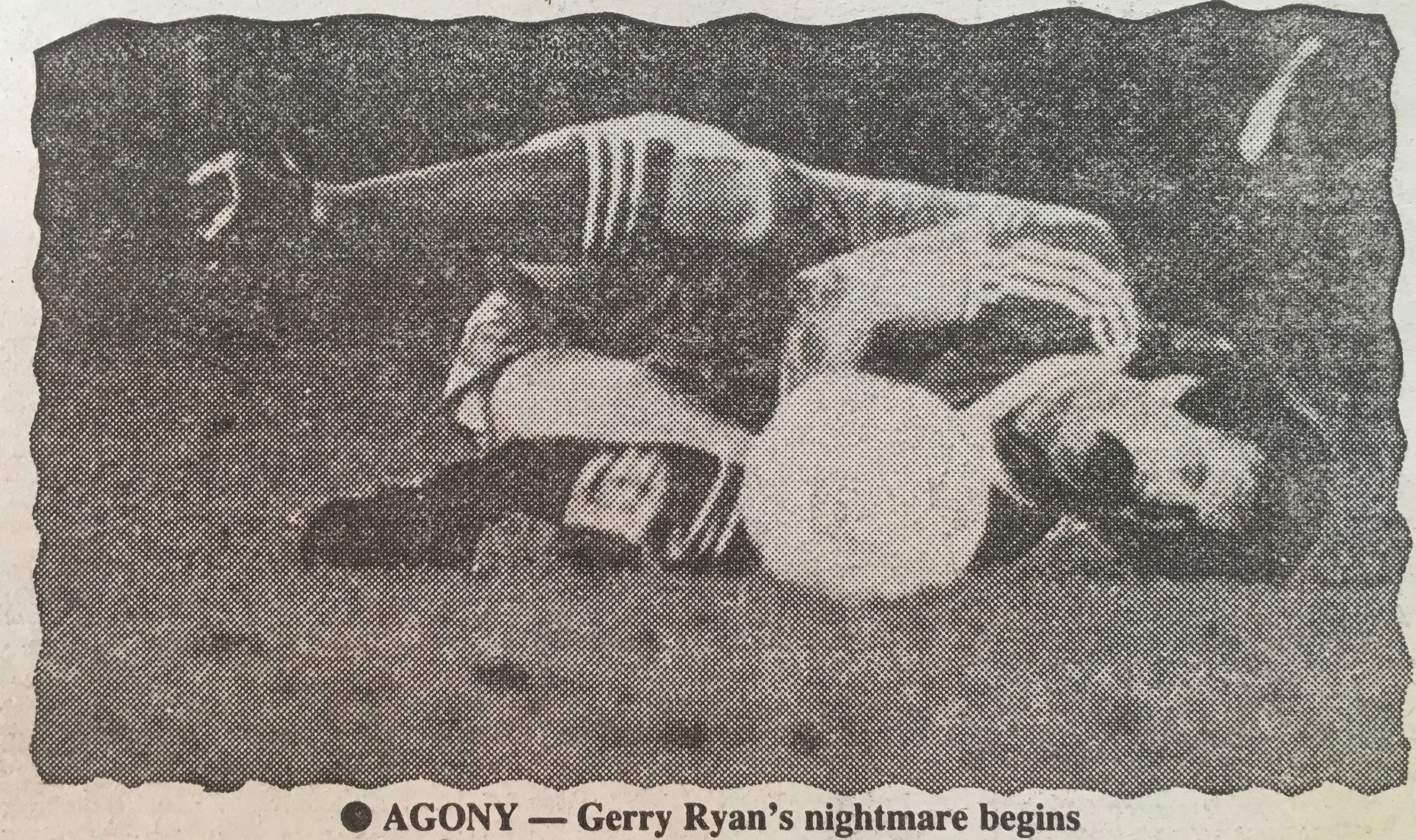
A cruel twist of fate saw his career ended in a tackle made by his Irish teammate (and former Albion boss) Chris Hughton’s brother, Henry. Typically, Ryan bore no grudges, as stressed by former Argus Albion reporter John Vinicombe in an article published in May 1986 when the genial Irishman finally accepted that his career was over.

Describing “the immense dignity and true manliness that Ryan displayed in refusing to condemn or indeed utter any harsh word against the player responsible,” he added: “Where others have sued and raged, slandered, cursed and threatened, Ryan said nothing.”

GR leg break

It was 2 April 1985 when his career was ended by that Hughton tackle in a 1-1 draw with Crystal Palace at Selhurst Park.

“Never in his life has he shirked a tackle and the one that ended his career so unfortunately at Crystal Palace was typical of many he faced in his career,” said Alan Mullery, the manager who signed him for the Seagulls.

“As a person, he is a lovely and typical Irish personality,” Mullery said in the programme for the player’s testimonial game against Spurs at the Goldstone on 8 August 1986. “I can honestly say that I have never met a player who dislikes him or has a bad word to say about him. I will remember Gerry Ryan as being a special player and one of football’s nice people.”

Mullery also referred to a Sunday lunch he and his family had with Ryan and his wife at the time he signed. “When Gerry ordered roast beef and chips I must have known then that I had a very special sort of player. At the time, I was a little dubious but afterwards I had no regrets.”

Mullery had been over in Dublin watching Albion’s Mark Lawrenson playing for the Republic of Ireland and Derby’s Ryan was playing in the same side. He had been having talks about moving to Stoke City but Mullers persuaded him to join Brighton instead, and, in a strange quirk of fate, he made his debut in a 2-2 draw away to Stoke.

After they’d become teammates, Lawrenson was among those players appreciative of Ryan’s “mercurial” qualities. He said in a matchday programme: “He wasn’t the most confident of players but he had loads of ability. For a wide player, he would come in and get goals for you.”

GR capsA week after joining the Seagulls, Ryan became an instant hit with Albion fans when he scored on his home debut in a 5-1 win over Preston. He notched a total of nine goals in 34 appearances in that first season and went on to score 39 in a total of 199 games.

Born in Dublin on 4 October 1955, Ryan was one of eight children. His early education was at the local convent in Walkinstown, a suburb to the south of Dublin where the family lived. At the age of eight he moved on to Drimnagh Castle School (it covered primary and secondary age groups).

At that stage, he was playing Gaelic football and hurling, at which he was capped at under-15 level by Dublin Schools. He didn’t play competitive football until he was 16 when he was introduced to a Dublin football club called Rangers AFC. He played alongside Kevin Moran, who later played for Manchester United, and Pat Byrne, who later played for Leicester City. Byrne and Ryan also played together for Bohemians, the oldest football club in Dublin.

Ryan joined the Dublin Corporation as a clerical officer on leaving school and played for Bohs as an amateur initially before becoming a part-timer on professional terms. By 18, Ryan was a first-team regular and, after collecting a League of Ireland Championship medal, was watched by Manchester United boss Tommy Docherty.

Docherty didn’t pounce then but, after Ryan had stayed four years with Bohemians, the ebullient Scot eventually returned to take him to England as his first signing for Derby County for a fee of £55,000.

The newly-appointed Docherty was determined to shake-up the club and while long-serving goalkeeper Colin Boulton was discarded along with striker Kevin Hector, Ryan, Scottish internationals Bruce Rioch and Don Masson, and Terry Curran and Steve Buckley were all introduced.

Ram Ryan

Ryan spoke about the way Docherty’s attitude towards him changed in an interview with Brian Owen of The Argus in 2016.

“One minute you were the blue-eyed boy, the next he wouldn’t even talk to you,” he said. Ryan made a hamstring injury worse by playing when Docherty insisted he was fit enough, and ended up sidelined for three months. “He didn’t like me then! That’s the way he was, he would turn on you, and he turned on me.”

Within a year, Docherty accepted Brighton’s £80,000 offer for Ryan and, as he was weighing up whether to choose the Seagulls or Stoke City, Ryan consulted the legendary Republic of Ireland and ex-Leeds midfielder Johnny Giles to ask his opinion.

“Gilesy said ‘Stoke have been in and out of the First Division forever but there is something going on down at Brighton. They get great crowds and it’s a beautiful place.’ I went to Brighton that weekend and absolutely loved it,” Ryan told Owen.

It was on 25 September 1978 winger Ryan arrived, prompting the departure of popular local lad Tony Towner after eight years at the Albion.

Five months before Ryan arrived at the Goldstone, he made his international debut, featuring for the first time in April 1978 in a 4-2 win over Turkey at Lansdowne Road. He only scored once for the Republic, but it was a cracking overhead kick in a 3-1 defeat against West Germany.

Ryan Eire

He was one of four regular Eire internationals playing for Albion at the time: Lawrenson, Tony Grealish and Michael Robinson the others.

His final appearance for his country came in a 0-0 draw against Mexico at Dalymount Park in 1984.

Ryan was part of some all-time history-making moments during his time with the Albion – scoring at St James’s Park in the 3-1 win over Newcastle on 5 May 1979 to clinch promotion to the top division for the first time, and burying the only goal of the game as unfancied Albion beat Brian Clough’s European champions Nottingham Forest, who’d previously not lost at home for two and a half years.

Ryan scoresMy personal favourite came on 29 December 1979 at the Goldstone when he ran virtually the entire length of a boggy, bobbly pitch to score past Joe Corrigan in the goal at the South Stand end to top off a 4-1 win over Manchester City. Ryan himself reckoned it was “the best goal I ever scored” as he recounted in a May 2020 BBC Sussex Sport interview with Johnny Cantor.

It was one of the most superb individual goals I saw scored and, when he was trying to recuperate from the horrific leg break which ultimately ended his career, I wrote to him in hospital to say what a special memory it held for me.

I was delighted to receive a grateful reply from him, and he has held a special place in my Albion memory bank ever since.

There were other stand-out occasions, two of which came against Liverpool:

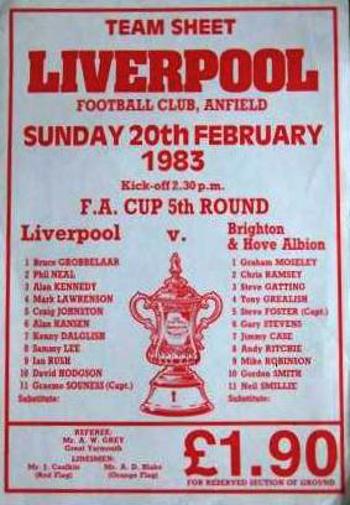
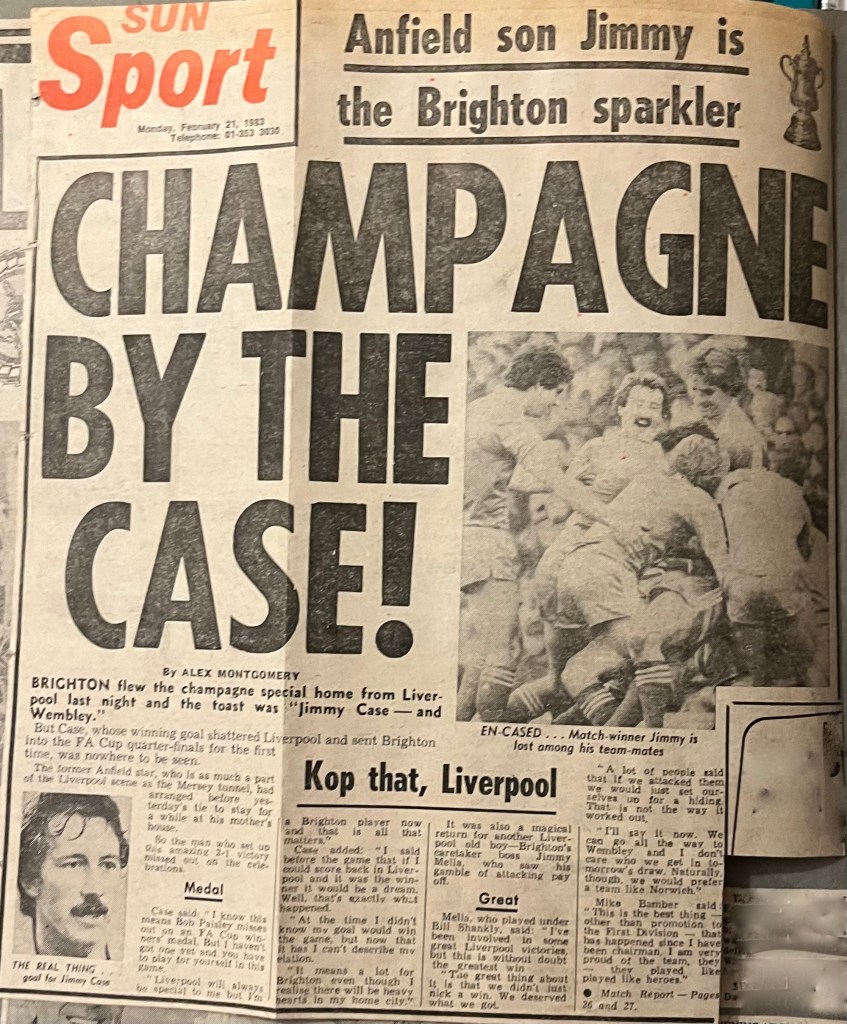
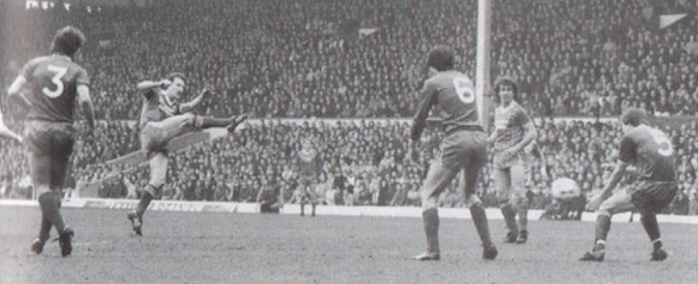
in February 1983 at Anfield when he opened the scoring in Albion’s memorable 2-1 FA Cup triumph en route to the final, and, in the following season, at the Goldstone when he and Terry Connor were on target in Second Division Albion’s 2-0 win over the Reds in the same competition, the first-ever live FA Cup match (other than finals) to be shown (previously any television coverage of FA Cup ties was only ever recorded highlights).

If the modern-day reader can’t quite put the feat in perspective, it is worth pointing out that Liverpool, managed by Joe Fagan, went on to win the League Cup, the League title and the European Cup that season.

Danny Wilson hadn’t long since joined the Albion and, in an interview with the Seagull matchday programme in 2003, he recalled: “That has to be my favourite memory from all my time at the Goldstone. Back then, Liverpool were just awesome, and to beat them like we did was virtually unheard of.”

Ryan’s involvement in the 1983 Cup run was hampered by a hamstring injury which meant he missed out on the semi-final. But, in the days of only one substitute, he was on the bench for the final and, when the injured Chris Ramsey couldn’t continue, Ryan went on at Wembley and did a typically thorough job at right-back.

GR prog snow

Following Albion’s relegation, as the big-name players departed the Goldstone, Ryan’s versatility and play-anywhere attitude came to the fore and, in his last two seasons with the club he was often selected as a centre-forward, although he was not a prolific goalscorer from that position.

After he was forced to quit playing, Ryan took what was then quite a familiar route for ex-players and became a pub licensee, running the Witch Inn at Lindfield, near Haywards Heath. Ryan and goalkeeper Graham Moseley, who he’d known from his days at Derby, were neighbours in Haywards Heath.

GR pots

However, when another of his former Republic of Ireland teammates, Liam Brady, was appointed Albion manager in 1994, it was an inspired choice for him to appoint Ryan as his assistant.

When that all-too-brief managerial spell came to a messy close, Ryan returned to his pub, and then moved back to the family home in Walkinstown. Ryan’s son Darragh played 11 games for the Albion in the late 1990s.

Sadly, in August 2007, Ryan suffered a stroke, and three years later he was diagnosed with kidney cancer. On his death, his family paid tribute to the care he was given by the staff of Our Lady’s Hospice, Harold’s Cross and to the staff of Lisheen Nursing Home, Dr Brenda Griffin, the Beacon Renal Unit, Tallaght, and Tallaght Hospital Renal Unit “for the excellent care given to Gerry over the past number of years”.

Pictures from a variety of sources but mainly from my scrapbook, the matchday programme and The Argus.

The spot kick highs and lows of penalty king Denny Mundee


SPOT KICK specialist Denny Mundee played for the Seagulls during the dark days when they nearly dropped out of the league having enjoyed better times with Bournemouth and Brentford.

His older brother, Brian, also played for the Cherries and another brother, Barry, was forced to quit football at 18 because of injury. It was a case of third time lucky when young Denny finally broke through into league football. Previous attempts to make it, at QPR and Swindon, had got nowhere.

Born Dennis William John Mundee in Swindon on 10 October 1968, Denny first showed his footballing talent at his local primary school (Liden), as a contemporary wrote some years later on the Brentford fans forum, Griffin Park Grapevine.

The poster, called ‘SmiffyInSpain’ said: “Went to primary school with Denny in Swindon and he was a class act then. Went to separate secondary schools, but still kept in contact with him as an opponent at school level football.

“Of all the players of the same age, Denny stood out by far. Of all the penalties he took against me, he never missed.”

Indeed, Mundee was noted for his success rate from the 12-yard spot, taking on the penalty taker duties at whichever side he played for.

The young Mundee was first offered an apprenticeship at Third Division Bournemouth but decided to join First Division QPR as a junior, where he spent a year.

Released in the summer of 1986, he joined home town team Swindon for a season, but again failed to make the grade. It took a drop down to Southern League Premier side Salisbury before things began to click. Scoring 20 goals in 34 appearances brought him back to the attention of Bournemouth, who snapped him up in March 1988.

Although he made his Bournemouth debut towards the end of the 1988-89 season, he had loan spells with Weymouth, Yeovil Town and Torquay United before establishing himself with the Cherries.

It was in 1991-92 that he laid claim to a regular place, and, as right-back, made 41 league appearances that season.

His winning spot-kick in a 4-3 penalty shoot-out decider in the third round of the FA Cup against Newcastle United in January 1992 earned Mundee hero status in a Cherries’ Legends Gallery put together by BBC Dorset.

United, managed at the time by Argentine legend Ossie Ardiles, were floundering at the bottom of the old Second Division, while Harry Redknapp’s Third Division Cherries had already held the Magpies 0-0 at Dean Court before taking the tie to penalties after the replay at St James’ Park had ended 2-2 on 90 minutes.

However, by the end of the following season, Mundee had become something of a utility player, slotting in to various positions, and, in August 1993, he chose to leave the south coast club on a free transfer.

In just over five years, he had started 93 games for the Cherries and come on as a sub in another 29 games.

Former Chelsea and QPR defender David Webb had taken over as manager at Brentford and Mundee was among his first signings.

Bees fans remember him being signed as a full back but, on being ‘thrown up top’, he was a revelation and finished his first season at Griffin Park with 11 goals.

Perhaps ironically, Brentford, in 16th, finished a point and a place above Bournemouth that 1993-94 season. Mundee scored 11 times, including a memorable hat-trick in a 4-3 defeat at home to Bristol Rovers.

DMHSSix of his goals that season came in a run of four consecutive games between 27 November and 27 December, four of them penalties.

Mundee found himself part of a side that featured the free-scoring Nicky Forster in attack alongside Robert Taylor.

Described as “whole-hearted” and “a crowd pleaser”, Mundee earned something of a reputation for a shuffle, or a twiddle, he would deploy to get past opponents. ‘Brickie Chap’ on griffinpark.org said of him: “A player that always tried his best. Not the most gifted we have ever had down here but deffo one for providing quality entertainment.”

Unfortunately for a player normally so reliable from 12 yards, it was a penalty he failed to convert that Brentford fans have never really got over.

Mundee’s miss in a 1995 Division Two play-off match against Neil Warnock’s Huddersfield came in what was apparently the first-ever televised penalty shoot-out featured on Sky.

It was all the more galling because Mundee had scored twice from the spot past Town’s Steve Francis the previous season but, on this occasion, he blew the chance to put Brentford two goals ahead when he was outguessed by the ‘keeper. When Jamie Bates missed too, Brentford’s season was over.

Any other year, as runners-up, Brentford would have been promoted automatically, but, because of a reorganisation of the Premier League that year, only the top team went up automatically, hence their participation in the play-offs.

Mundee’s erstwhile primary school teammate wrote: “I watched the Huddersfield match in ‘95 and I would have put my mortgage on him netting like he did for Bournemouth at Newcastle a few years earlier.”

mundeeIn two years with the Bees, Mundee made 73 starts plus 25 appearances as a sub but, when his old Bournemouth teammate Jimmy Case took over the Albion’s managerial reins from Liam Brady, he and another ex-Cherry, Mark Morris, headed to the Goldstone Ground to try to help the Seagulls’ cause.

With the poisonous off-field developments at the club an ugly backdrop to the playing side, neither could do anything to halt Albion’s slide into the bottom tier.

Things went from bad to worse and on 1 February 1997, bottom of the league Brighton drew 1-1 at Mansfield Town, Mundee scoring for the Seagulls with a follow-up after his initial penalty was parried. Albion were nine points adrift and relegation from the league was looking virtually certain.

However, as we all now know, the drop was averted courtesy of that nail-biting draw at Hereford.

Although Mundee remained on the books for the following season, in December 1997 he, Morris, Craig Maskell, Paul McDonald and John Humphrey were all released to save money.

Mundee had played 58 games plus four as sub for the Albion, chipping in with eight goals.

Also burdened by ankle and back injuries, it spelled the end of his professional career although he did manage a handful of games with various non-league outfits.

Ten years ago, a cousin of Denny’s confirmed that he had moved to Throop, a village on the outskirts of Bournemouth, and was working for the same plastering business as brother Brian.