How the career of high rise Flatts came tumbling down

MARK FLATTS was destined for a glittering career after breaking into Arsenal’s first team when only eighteen.

It was the season when George Graham’s side finished in a disappointing 10th place in the league but won the League Cup and the FA Cup, beating Sheffield Wednesday in both competitions.

Flatts got seven starts plus four appearances off the bench and the following season, after he’d been troubled with a few injuries, Graham sent him out on loan to get some games under his belt.

His first loan was at Cambridge United, then in January 1994 Flatts joined forces with former Gunners legend Liam Brady at Brighton.

The former midfield maestro who’d graced the game at the highest level as a player had not long arrived at the Goldstone Ground, creating a buzz of anticipation amongst the largely disillusioned Albion faithful.

Brighton were bumping along around the foot of the third tier table when he arrived and it augured well that Brady could use his connections with his former club to secure the services of a prodigious young talent who’d already played a handful of matches in the Premier League.

He made his debut in a cracking 4-1 New Year’s Day home win over Cambridge United when Kurt Nogan scored a hat-trick and he was only on the losing side twice during his two months at the club, helping the Albion move away from the relegation zone.

Brady wrote about it in his autobiography Born To Be A Footballer, describing how “livewire” Flatts had heated up “a freezing Goldstone” on that debut day. “He’s a lovely young kid off the field but on the park there’s a strut about him. That’s exactly what we need. He’s full of tricks.”

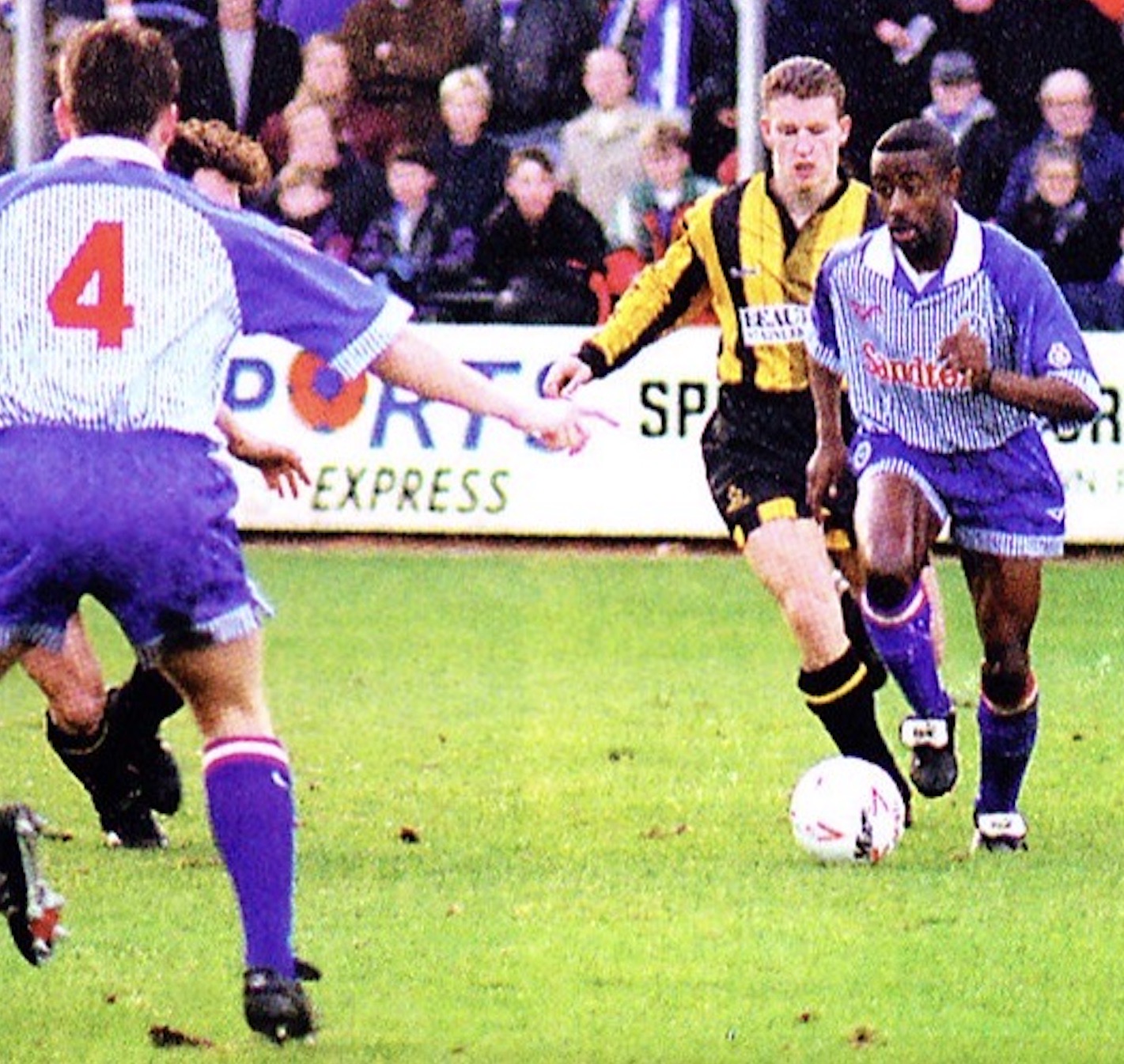
Flatts started nine matches, came on as a sub once, and scored one of Albion’s goals in a 3-2 home win over Blackpool, but it was his skill on the ball and pace that fans enjoyed most.

After he had returned to Highbury, Brady thanked him for his contribution and said in his programme notes: “He gave the place a tremendous lift. He’s a very confident lad and he did us a real favour and hopefully he’s got something out of it as well. I think he has and I think he enjoyed his time with us.”

Flatts confirmed as much recently. Although he has kept a low profile for many years, in 2020, online from his home in Norfolk, he appeared in two podcasts talking about his career.

On the Shoot the Defence podcast in April 2020, Flatts talked admiringly of his time under Brady at Brighton – “He still had it in training” – as well as the experience of playing alongside senior pros Jimmy Case and Steve Foster at the Goldstone Ground.

“Loyal fans as well. It was a good time,” he said. “I got on well with the fans and a few of them still text me, so that’s nice. Liam Brady and Jimmy Case had seen me in a few games, said they wanted me on loan, and I went there and enjoyed it.”

Born in Islington on 14 October 1972 and brought up in Wood Green, Flatts played for Haringey Borough and Middlesex County school teams and he was playing for Enfield Rangers when he caught the eye of professional clubs.

He spent time training with Watford and West Ham, but his mum and older brother were Arsenal fans so, when they invited him to join them, it was no contest. The scout responsible for picking him up for the Gunners was the former Brighton wing-half, Steve Burtenshaw.

Flatts was one of the country’s top talented 14-year-olds who went through the FA National School of Excellence at Lilleshall before becoming a trainee at Highbury after graduating.

In the first edition of a new fans’ podcast Over and Over and Over Again on 20 August 2020, Flatts talked about how he, Andy Cole and Paul Dickov up front, Ray Parlour and Ian Selley in midfield, Scott Marshall at the back and Alan Miller in goal were all going through from youth team to reserves at the same time. “It was a good strong youth team,” he said. “Pat Rice was the youth team manager who brought us through. He was a good coach.”

Flatts signed professional in December 1990 and he progressed to the reserve side who were managed by another Arsenal legend, George Armstrong.

One particular reserve match stands out as memorable – but not because Flatts scored a goal in a 2-2 draw. Ordinarily, Flatts was accustomed to playing in front of a few hundred supporters for the second string, but on 16 February 1991 it’s reckoned more than 10,000 turned up.

The Ovenden Papers Football Combination game against Reading was originally scheduled to be an away fixture but freezing conditions meant the game was swapped to Highbury because it had undersoil heating.

The reason for the surge of interest was the match saw the return to playing of Tony Adams after his release from prison, having served half of his four-month sentence for drink driving. The amazing response of the Arsenal faithful was remembered in this football.london article in February 2018.  

Often niggled by injuries, Flatts was sidelined by one he hadn’t even been aware of, other than what felt like a small discomfort. “I got a stress fracture on my ankle and was playing on it for a month without realising,” he said.

Physio Gary Lewin arranged for him to see a Harley Street specialist and it was only after he was put through tests on a running machine that the problem was diagnosed. The injury required surgery that put him out of action for over a year.

Flatts got his first real involvement with the first team on a pre-season tour of Norway ahead of the 1992-93 season, getting on as a substitute against Stabaek and Brann Bergen. He was a non-playing sub in two subsequent pre-season friendlies away to Wolves and Peterborough.

It was back to reserve team football at the start of the season but Graham selected him to travel with the squad for an away game at Sheffield United on 19 September and he made his competitive debut as a 71st minute substitute for Anders Limpar, shortly before Ian Wright netted an equaliser for the Gunners.

His next involvement came in a third round League Cup encounter with Derby County. He was a non-playing sub in the away tie but started in Limpar’s place for the replay on 1 December 1992, when Arsenal edged it 2-1.

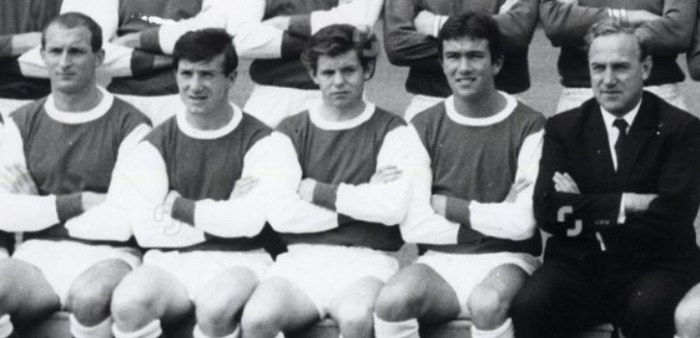
Flatts (right) celebrates Arsenal’s League Cup win with some familiar faces

He kept his place for the league game which followed four days later but was subbed off as Arsenal lost 1-0 at Southampton.

At one point, the Islington Gazette declared Flatts, Neil Heaney, Parlour and Dickov as the “next crop of Arsenal starlets who will take the club forward”.

As the year drew to a close, on 19 December, Flatts earned rave reviews for his showing in a 1-1 home draw against Lennie Lawrence’s Middlesbrough.

“It’s very unusual to have a quick player with a brain,” said manager Graham. “Mark has skill but he also has the application to go with it.”

Writing about how brightly Flatts shone in the game, Trevor Haylett, of the Independent, said: “He possesses an easy and deceptive running style which frequently carried him away from markers, and has a confidence that few of his colleagues shared in a desultory first 45 minutes.”

Haylett observed: “The problem for Graham is that his most productive line-up, with Merson in the ‘hole’ to distribute and ghost into scoring areas, leaves no room for Flatts, who amply justified his manager’s contention that he has a ‘very big future in the game’.”

Flatts kept his place for the following match, a goalless Boxing Day home draw against Ipswich Town, and was back on the bench away to Aston Villa three days later but came on for the second half in a game Arsenal lost 1-0.

The game he remembers most fondly came just over a fortnight later away to Manchester City at Maine Road. He sped past two players and crossed it for Paul Merson to score with a near post header that gave Arsenal a 1-0 win.

But competition for places was intense and he didn’t next get a start until 1 March against Chelsea at Stamford Bridge, another game that finished goalless.

He had to wait until May for his next involvement, as a sub in a 1-0 defeat away to Sheffield Wednesday, who his teammates would play twice in the space of five days later that month to win the FA Cup on penalties, both games having ended in draws.

With the first of those matches only four days away, Graham put out a young side to face Spurs in the last league game of the season, and Flatts was part of a side who lost the north London derby 3-1, Dickov getting the Arsenal goal.

After his loan spell at Brighton, Flatts got back into the first team picture at Arsenal towards the end of the 1993-94 season, featuring in three successive league games: as a sub in a 1-1 draw with Wimbledon and starting in a 2-1 win at Villa and a 1-1 home draw against QPR.

While he travelled to Copenhagen with the squad for the European Cup Winners’ Cup Final on 4 May 1994, he didn’t play in the Gunners’ 1-0 win.

Flatts wasn’t back in the Arsenal first team set-up until December 1994, when he had a four-game spell, starting in a 2-2 draw away to Nottingham Forest, being a non-playing sub away to Manchester City and then coming on as a sub in a 3-1 defeat at home to Leeds on 17 December and in the goalless Boxing Day home match with Aston Villa.

He came off the bench in a third round FA Cup replay defeat to Millwall on 18 January 1995 but the following month the manager who had supported his development was sacked, and the young wideman went out on loan to Bristol City.

Flatts didn’t reckon much of the man management skills of Graham’s temporary successor, Stewart Houston, but it was the manager who eventually succeeded him who showed the youngster the door.

“Bruce Rioch took over, and said: ‘No, you’re not good enough’ and that was it,” Flatts recalled. He had another short loan spell, this time at Grimsby Town, in the 1995-96 season, but when his contract was up in 1996, he was given a free transfer.

When Flatts left the famous marble halls of Highbury, all that early promise rapidly evaporated and despite a handful of trials at several clubs, his career fizzled out, the player admitting he fell out of love with the game.

Initially, he headed off to Italy to try his luck with Torino in Serie B. He said while he enjoyed his few months there, a limit on the number of foreign players who could play at any one time edged him out of the picture.

According to arseweb.com, back in the UK he had trial periods with Manchester City (September 1996) and Watford (October 1986), although the scathing Hornets fans website, Blind, Stupid and Desperate has a less than flattering summary of his efforts to impress at Vicarage Road. He was briefly at Kettering Town in December 1996, then Barnet (1997-98 pre-season) and Colchester United (1999-00 pre-season) but none of them took him on.

Former Arsenal striker Martin Hayes, manager at Ryman League Division One side Bishop’s Stortford, signed him during the 1999-00 season.

And his last appearance on a team-sheet was as an unused substitute for Queens Park Rangers in a 2000-01 pre-season 4-2 away defeat at Dr Martens League Premier Division side Crawley Town.

Flatts told host Richie Wakelin on Over and Over and Over Again that he kept on picking up niggling injuries too regularly. “With fitness concerns, I just lost interest,” he said. “I ain’t got no regrets. I loved it at Arsenal. I loved playing football. George Graham had faith in me and he gave me a go.”

He said his teenage son and daughter both play football and he has done some coaching at a local level and has considered setting up his own coaching school. He has also done some scouting work for Cambridge United and Norwich City.

Flatts looks back at his football career during a 2020 podcast

Pictures from Albion’s matchday programmes and various online sources.

Cobblers hero Mike Everitt started out with the Gunners

CONTACTS made as a youngster at Arsenal stood versatile Mike Everitt in good stead for the rest of his career.

He went on to play under his former Gunners teammate Dave Bowen at Northampton Town as part of one of football’s most remarkable stories and earned a place in the Cobblers’ ‘team of the century’.

Later, he joined a small enclave of former Arsenal players at Brighton. Everitt swapped Devon for Sussex in March 1968 when he moved from Plymouth Argyle for a £2,500 fee.

The man who signed him, Archie Macaulay, was a former Arsenal man himself who’d already brought three other ex-Gunners to Hove in goalkeeper Tony Burns, Irish international full-back Jimmy Magill and winger Brian Tawse.

Everitt started the new season as first choice left-back in Macaulay’s side and an uninterrupted 14-game run in the team as autumn turned to winter straddled Macaulay’s departure and the arrival of new boss Freddie Goodwin.

Everitt slotted home a penalty as Albion drew 1-1 away to Bristol Rovers on 18 January 1969 but the 3-1 home win over Crewe Alexandra the following Saturday was his last outing of the season.

Everitt, Howard Wilkinson and Dave Turner from this Albion line-up all went on to become coaches

He picked up an injury and, with Goodwin having signed his former Leeds teammate Barrie Wright from New York Generals, local lad John Templeman able to fill either full-back slot, not to mention the addition of Eddie Spearritt from Ipswich Town, Everitt couldn’t win back his place in the starting line-up.

Competition for a starting place only intensified in the summer of 1969 when Goodwin’s former Leeds teammate, Willie Bell, arrived from Leicester and was installed as the regular choice at left-back, while Stewart Henderson cemented the right-back slot to the extent he was named Player of the Season.

While Everitt deputised for Bell on a couple of occasions and filled Bobby Smith’s midfield spot for four matches, his only other involvement was as sub on a handful of occasions. He was a non-playing sub in the final game of the season (a 2-1 home defeat to Mansfield Town) and then left the club during the close season.

Born in Clacton on 16 January 1941, Everitt represented Essex Schoolboys and London Schoolboys before being taken on as an apprentice by Arsenal in 1956. He turned professional in February 1958 and, thanks to the excellent records of thearsenalhistory.com, we know that he first played in the first team in the Harry Bamford Memorial match at Eastville against a Bristol XI on 8 May 1959.

He then went on Arsenal’s end-of-season tour to Italy and Switzerland. He was an unused sub for friendlies against Juventus and Fiorentina but came on as a substitute in a 4-1 win over Lugano of Switzerland on 24 May 1959.

Everitt (circled back row) lines up for Arsenal – with (left to right trio in centre of front row), David Herd, Tommy Docherty and Jimmy Bloomfield

It wasn’t until Easter 1960 that he made his competitive first team breakthrough, but when he did it was a baptism of fire in George Swindin’s side.

He made his first team debut in front of 37,873 fans packed into Highbury on Good Friday (15 April 1960) as the Gunners beat a Johnny Haynes-led Fulham side 2-0.

Modern day players might not be able to comprehend it but Everitt also played the following day when Arsenal travelled to Birmingham City, and lost 3-0. Two days later, away to Fulham this time, Everitt was again in the starting line-up as Arsenal lost 3-0.

He kept his place for the following Saturday’s match – at home to Manchester United – and in front of 41,057 he was part of the side that beat United 5-2. Future Albion teammate Alex Dawson led the line for a United team that included Bobby Charlton and Johnny Giles.

That was the penultimate game of the season and Everitt retained his place for the final game, which ended in a 1-0 defeat to West Brom at The Hawthorns.

The 1960-61 season got off to a good start for him too as he played in the opening four matches and, into the bargain, scored Arsenal’s only goal as they beat Preston North End at home on 23 August. Unfortunately for him, a tigerish Scot called Tommy Docherty edged him out of the first team picture and in February 1961 he moved to Fourth Division Northampton Town (for a fee of £4,000) who were managed by the aforementioned Bowen.

His stay with the Cobblers spanned one of the most remarkable stories in football history as they were promoted season on season from the Fourth to the First….and then relegated all the way back down again (although Everitt had left for pastures new before they reached the basement again).

What he was part of, though, was achieving three promotions in five years. Glenn Billingham recalled that heady era in a 2017 article for thesefootballtimes.co.

In 1961-62, Everitt was a regular at wing-half and scored five goals in 41 appearances. He switched to left-back the following season and played 30 matches as Town went up as champions.

A season of consolidation in 1963-64 saw Town finish 11th in Division Two, when Everitt played 45 matches. He played in 43 games in the 1964-65 season which culminated in the historic promotion to the top-flight courtesy of finishing in runners up spot, a point behind champions Newcastle United.

Necessary investment in improving the squad was slow to materialise and Bowen initially had to rely on the same squad of players who’d got them up. Everitt was one of only five Town players who had previously played at that level.

A 5-2 defeat away to Everton in the opening fixture was perhaps a portent of what was to follow for the rest of the season. They didn’t record a win until their 14th game, at home to West Ham (when they won 2-1), but the underdogs performed heroics in their first two home matches. It must have been quite an occasion when in only the second game of the season Everitt lined up in the Northampton side to face Arsenal.

The game finished 1-1, although Everitt had to be replaced at half-time. However, he also played in the return fixture at Highbury which also finished in a 1-1 draw.

Town also drew 1-1 at home to Manchester United, stifling the attacking threat of Best, Law and Charlton, although United exacted revenge at Old Trafford where they dished out a 6-2 thrashing. Charlton got a hat-trick, Law scored a couple and John Connelly was also on the scoresheet.

Everitt made 34 appearances (plus one as sub) that season and scored two goals, one in a rare win, in the penultimate game, when the Cobblers beat Sunderland 2-1 (the Wearsiders scorer was Neil Martin, who later played for the Albion). Graham Carr (father of comedian Alan Carr) played 30 times for the Cobblers that season.

Back in the second tier, Everitt featured in 17 games but as Town plummeted straight through the division, he moved on to Plymouth Argyle in March 1967, where his former Arsenal teammate Jimmy Bloomfield had moved to from West Ham. Everitt was still only 26 when he made his debut in a 1-0 home defeat to Wolverhampton Wanderers. After 31 games for Argyle, he made the move to Brighton.

Everitt had already gained his preliminary coaching badge when still a player and after leaving Brighton in 1970 he initially moved to Plymouth City as player-manager. Within months, he seized the opportunity to move up a level when he landed the player-manager role at then Southern League Wimbledon.

In a January 2010 interview in The Guardian, it was revealed the two candidates he beat to land the position were David Pleat, who went on to manage Luton, Leicester and Spurs, and his former Albion teammate Howard Wilkinson, who won the league title with Leeds United.

Pleat recalled: “The director, Stanley Reed, went for Mike and Howard ended up at Boston United while I was eventually appointed by Nuneaton Borough in the Southern League.”

A few eyebrows were raised in 1973 when Everitt was appointed manager of newly-relegated Brentford just seven days before the start of the 1973-74 season, taking over from Frank Blunstone, who’d left to become youth team manager at Manchester United.

Greville Waterman, on a Bees fan blog, said Everitt polarised opinion, declaring: “He was undoubtedly a cheap option and received little support from the directors (now where have we heard that before) and did his best with a wafer thin squad.”

A classic example saw defender Stewart Houston sold to Manchester United for a club record £55,000 in December 1973, but the money wasn’t immediately reinvested in the squad.

Nevertheless, Waterman pointed out: “His approach did not go down well with some of his players and he brought in a number of tough bruisers. Under his management, Brentford declined rapidly, fell to the bottom of the Football League and barely escaped the need to apply for re-election.”

Legendary Brentford defender Alan Nelmes was particularly disparaging about Everitt. He didn’t have the technical expertise that Frank had and you felt as if the club wasn’t going anywhere with him. Frank was very advanced in his thinking, ahead of his time, really, and it was a step backwards to have Mike.”

Everitt finally got some backing from the boardroom on transfer deadline day. Experienced forward Dave Simmons was brought in from Cambridge United and former Everton and Southampton defender Jimmy Gabriel from Bournemouth and a 10-match unbeaten run from mid-February to early April did enough to assure the Bees avoided bottom spot even though their finishing position of 19th was their lowest position for nearly 50 years. Crowds were hovering around only 5,000 too.

It didn’t get much better the following season and in spite of getting a vote of confidence in November 1974 from new chairman Dan Tana, Everitt only lasted a few more weeks in the hotseat.

Ironically, after a poor start to the campaign, he’d begun to turn results round and lifted the side to a mid-table position on the back of four wins and a draw in a seven-game spell between late November to mid-January, but he was sacked on 16 January and replaced with John Docherty, who’d only packed up playing for the Bees the previous summer.

Everitt’s next role came as a coach (pictured above) under his old Arsenal pal Bloomfield at Leicester City, and former winger Len Glover came up with an amusing reminiscence on lcfc.com.

Glover recalled when he was 17 playing against Everitt for Charlton Athletic against Northampton.

“He had massive thighs, and had his sleeves rolled up. In the first five minutes he had kicked me when the ball was nowhere near, and now he was our coach!

“He was just the same when he was our coach. When he started, he gathered us round at the training ground. His opening gambit was, ‘You don’t know me, and I don’t know you, but we will soon change that!’

“Then he noticed Frank Worthington who was not with the group but was with the apprentices who were crossing the ball for him to volley like they did every morning. He went, ‘Oi, get over here!’ Frank went, ‘Yeah, in a minute’. Instead of saying, ‘Over here, now!’ Everitt just went, ‘Well, hurry up then’.

“Before Everitt left we went to Leeds and we got stuffed 3-0. After the game Birch (Alan Birchenall) was doing his hair with his hair dryer. Win or lose he would always do his hair. Mike Everitt came in and said, ‘It’s a pity you’re not as good with the ball as you are with that hair dryer!’ Birch replied, ‘If I was as good with the ball as I am with the hair dryer, I wouldn’t be playing for Leicester!’”

After leaving Leicester, Everitt managed Kuwaiti side Al-Shabab when another former Arsenal teammate, George Armstrong, was manager of the Kuwaiti national side (Armstrong’s daughter, Jill, posted a picture of them in Kuwait on Twitter in 2019).

Jill Armstrong posted this picture on Twitter of her with dad George and Everitt in Kuwait

After Kuwait, Everitt managed Cairo-based Egyptian teams Al Mokawloon and Al Ahly, the club Percy Tau joined in the summer of 2021.

According to Wikipedia, Everitt had particular success at Al Mokawloon, winning the 1982-83 Egyptian Premier League title and two African Cup Winners Cups.

• Pictures from matchday programmes and online sources.

The Tiger who came to Brighton and fitted to a T

DIMINUTIVE winger Brian Tawse is remembered by veteran Brighton fans for his boyish good looks…. and a stunning disallowed goal.

It perhaps does a disservice to the fact he played 109 games (plus five as a sub) in the second half of the swinging Sixties after joining the club from Arsenal.

Tawse spent two years with the Gunners and made a handful of first-team appearances but with George Armstrong ahead of him it wasn’t until he joined the Albion that he began to play regular league football.

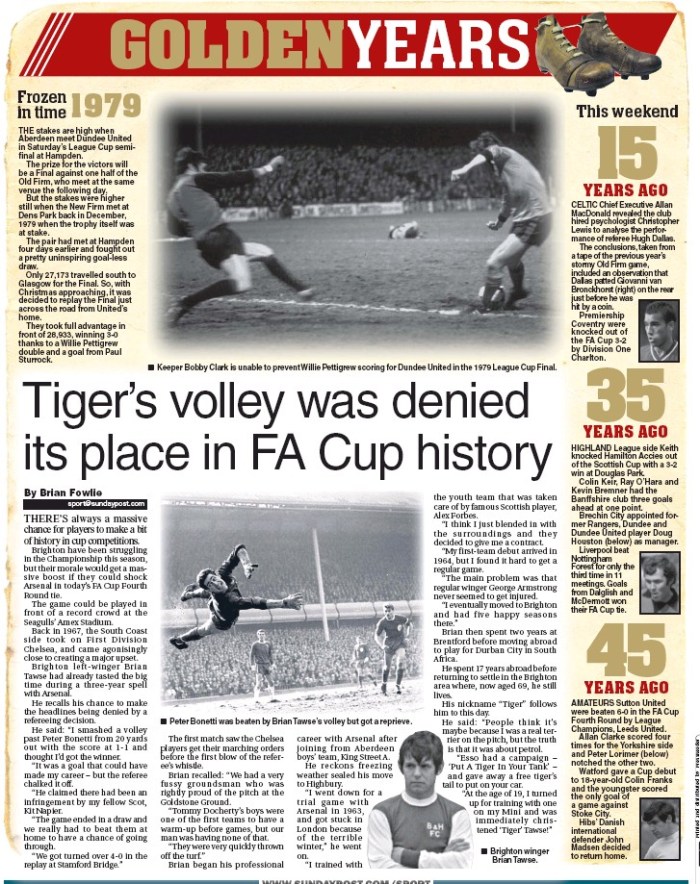
It was a cracking strike by Tawse in the closing minutes of a FA Cup fourth round tie against Chelsea in January 1967 that stuck in people’s memories.

In front of a packed Goldstone Ground crowd of 35,000, a big upset looked on the cards when Tawse’s terrific volley flew past Peter Bonetti five minutes from the end of the game for what would have been a 2-1 win.

Unfortunately, the referee had spotted an infringement by Kit Napier and the ‘goal’ was disallowed. In the replay at Stamford Bridge, Chelsea ran out clear 4-0 winners.

“I smashed a volley past Peter Bonetti from 20 yards out with the score at 1-1 and thought I’d got the winner,” Tawse told Brian Fowlie of the Sunday Post in 2015, ahead of Brighton’s fourth round FA Cup tie with Arsenal. “It was a goal that could have made my career – but the referee chalked it off.”

Tawse had been with the Albion for just over a year when that cup tie came around. He was one of three ex-Arsenal players in the side: the Northern Ireland international full-back Jimmy Magill joined Albion in October 1965, Tawse followed him two months later, and goalkeeper Tony Burns joined in the summer of 1966.

Albion’s boss at the time was fellow Scot Archie Macaulay, a former Arsenal player himself, who during his time at the Gunners had persuaded them to sign Alex Forbes, who later became the coach Tawse played under in Arsenal’s youth team. But more of that later.

Tawse got his first Brighton goal in only his second game, a 4-3 home win over Bristol Rovers on New Year’s Day 1966, and he went on to score six in 22 matches as the Albion finished 15th in Division 3.  

Although he started the next season in the no.11 shirt, close season arrival Howard Wilkinson became an automatic choice on one wing and Tawse found himself competing with Wally Gould for a place on the other.

Aside from the excitement of that Chelsea cup game, Tawse did find the net eight times (three times from the penalty spot) as he played in 28 games (+ one as sub) that season.

The winger couldn’t always be relied on from 12 yards, however, as contributor ‘Questions’ recalled on North Stand Chat in 2008. “Ah Tiger Tawse, he of the boyish good looks and ability to blaze a penalty over the north stand roof against Watford, I think. Good little player though….”

The majority of Tawse’s Albion games (41 + 1 sub) came in the 1967-68 season although he only scored twice as Albion finished 10th.

The signing of Paul Flood from Bohemians added forward options to the manager’s selection, but it was the £5,000 signing of speedy Dave Armstrong from Millwall in September 1968 that began to edge Tawse out.

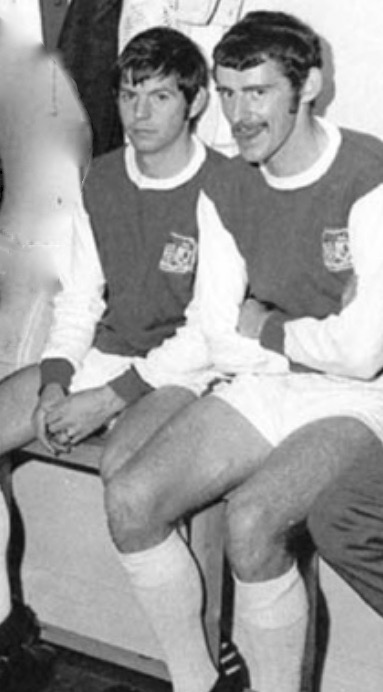
Tawse (arrowed) in an official Albion team photo ahead of the 1969-70 season

In the 1968-69 season, which saw the arrival of Freddie Goodwin as manager in place of Macaulay, Tawse made only 16 appearances (+ three as sub), and he featured only twice between the start of December and the end of the season.

My own Albion watching journey began in February 1969 and the only game I saw Tawse play was in the Easter Saturday 4-1 win over Barnsley when he replaced Kit Napier; the only change to the side who had played 24 hours earlier, again at home, when Orient were beaten 2-0.

Goodwin mostly went for Armstrong on the left and Wilkinson on the right.

By the time the 1969-70 season arrived, opportunities were even more limited for Tawse. He was only on the bench once and started just two, his last first-team appearance coming in a 2-0 defeat away to Tranmere Rovers on 25 October 1969.

Former Albion teammate Wilf Tranter writing on North Stand Chat, said: “Brian finally lost the no. 11 shirt to Kit Napier in the 1969-70 season. He had been a very good servant to the club and was regarded with great affection by many supporters.”

Tawse with rival Kit Napier who became a good friend

Born on 30 July 1945 in Ellon, just north of Aberdeen, his footballing talent was first spotted while playing for Aberdeen boys’ team, King Street A. He told the Sunday Post’s Fowlie how the big freeze in 1963 worked in his favour.

“I went down for a trial game with Arsenal in 1963 and got stuck in London because of the terrible winter,” he said. “I trained with the youth team that was taken care of by famous Scottish player Alex Forbes.”

Forbes had joined Arsenal just after the war on the recommendation of fellow Scot Macaulay, whose place in the side he subsequently took over.

When Forbes later became youth coach at Arsenal, he took a party of Arsenal youngsters on a summer tour to South Africa, got offered a coaching job in Johannesburg and decided to make it his home for the rest of his life.

Tawse (centre) between George Armstrong and Jon Sammels in an Arsenal line-up, with Magill (far left) and Billy Wright

Billy Wright, the former England captain who’d won 105 caps for his country, was manager of Arsenal in the mid-’60s and it was he who took Tawse on as a professional.

Wright may have been a legend as a player but one of Tawse’s fellow Highbury hopefuls, John Ryan, who later starred for Fulham, Luton Town and Norwich City, was not at all enamoured.

Looking back in an interview with a Norwich archive site, he said: “Billy Wright was the only manager of the 12 I ended up playing for who I neither liked nor respected.

“He seemed to take an instant dislike to me and would single me out for some vicious treatment in front of the other young players.”

Ryan shared digs with Tawse and David Jenkins and he recalled how he found out Arsenal were letting him go. “At the end of that season (1964-65), I was sitting in the digs when two large brown envelopes and one small registered white one dropped through the front door. As I opened the small white one that was addressed to me, I wondered where the other two lads had disappeared to.

“It turned out that they’d read the situation as my letter was from the club notifying me I was being given a free transfer whilst the two brown envelopes that were for them both contained contract offers.”

Tawse made his Arsenal debut away to West Brom on 21 November 1964, a game which finished 0-0. Although his first team game time was limited, in the space of three days in February 1965 he played in successive 2-0 wins at home to Fulham and Spurs and at the end of the following month against West Ham away, another 0-0 draw.

Away to Nottingham Forest on 13 March 1965, Tawse took George Armstrong’s place on the wing – and the aforementioned Magill earned a rare outing in place of Don Howe at right back – but they lost 3-0.

Brian Tawse alongside George Armstrong, the winger he couldn’t dislodge to gain a regular Arsenal place

Although the official record books only show those league appearances, thearsenalhistory.com details how Tawse also played twice in an end of season five-game tour in Italy. He played in a 2-2 draw against Torino and was one of the scorers in a 3-0 win over Latina.

The following season he was selected in a 5-2 friendly win over non-league Corinthian Casuals on 21 September and a month later –  on 23 October 1965 –  he was on the substitute’s bench in a 2-2 home draw against Blackburn Rovers, but that was the last of his involvement, and he moved to Albion five weeks later.

“The main problem was that regular winger George Armstrong never seemed to get injured,” Tawse told the Sunday Post.

He also dispelled a myth about how he came to get his nickname Tiger, telling the reporter: “People think it’s maybe because I was a real terrier on the pitch, but the truth is that it was about petrol.

“Esso had a campaign – Put a Tiger in Your Tank – and gave away a free tiger’s tail to put on your car.

“At the age of 19, I turned up for training with one on my Mini and was immediately christened ‘Tiger’ Tawse!”

After leaving Brighton in March 1970, Tawse moved to Brentford where he played in 13 games as new manager Frank Blunstone took the Bees to within three points of promotion from Division Four, finishing fifth just behind Port Vale.

But in the 1970-71 season he made just eight appearance (plus two as sub) and ended up on loan to Southern League Folkestone.

Still only in his mid 20s, he decided to head to South Africa and played for Durban City at a time when dozens of British players, managers and coaches were recruited by that country’s 16 clubs.

He was later joined there by former Albion teammate and fellow Scot Kit Napier and after they hung up their boots, they worked together in the motor trade.

When Napier died in March 2019, Tawse told The Argus: “We remained friends afterwards and we were both golfers. He was a very good golfer, which people probably don’t realise. He played in a lot of pro-ams.

“He was a good lad and, of course, a bit of a legend for what he did with Brighton.”

Tawse spent 17 years in South Africa but returned to the UK and settled in Westdene, Brighton…and watches the Albion from the West Stand at the Amex.

Cup winner Bert Murray: Brighton’s People’s Player

5-bert-v-villaON HOLIDAY in Jersey in 2016 my eyes were drawn to a picture on a display in St Helier’s Fort Regent entertainment complex.
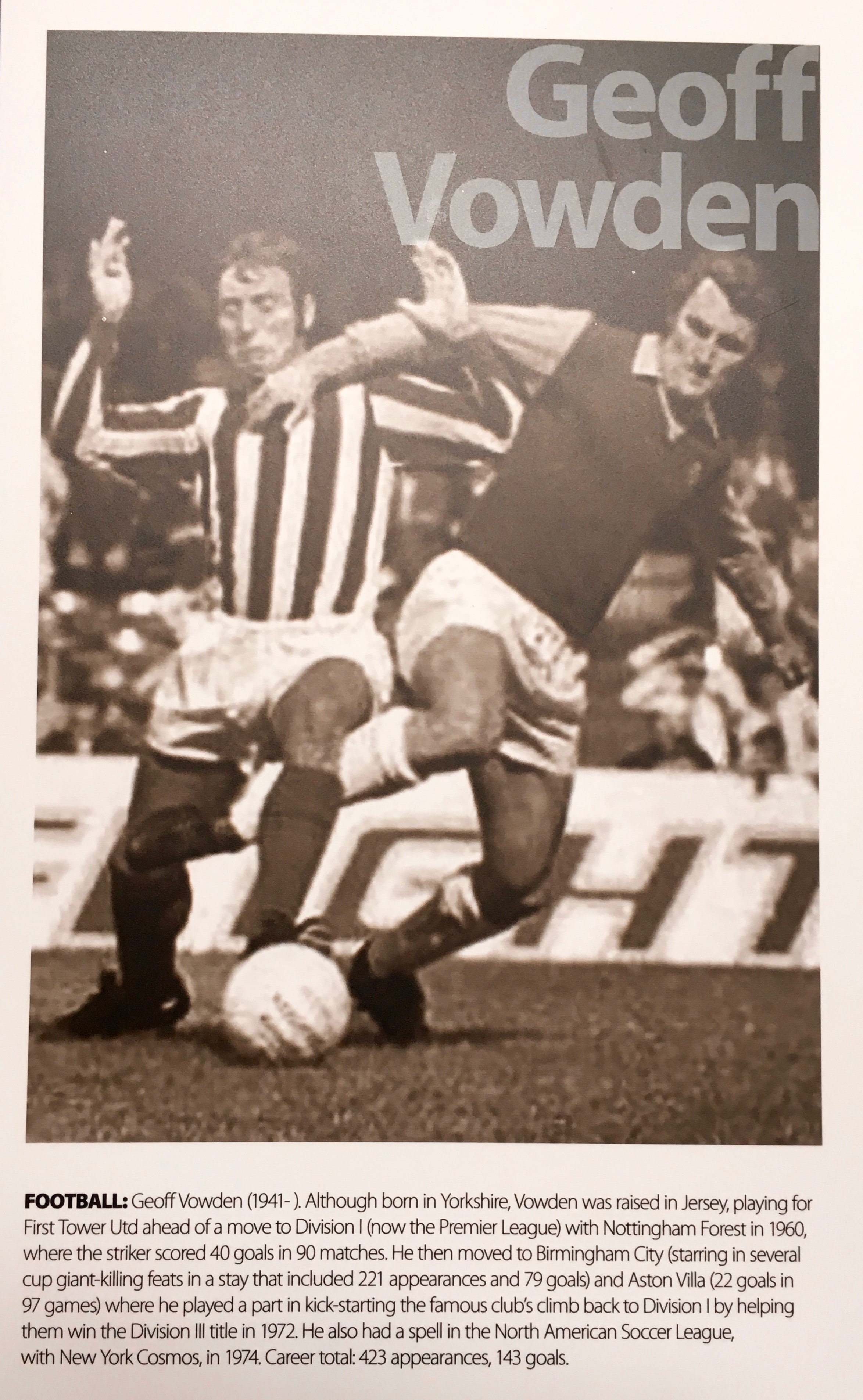
“That’s Bert Murray,” I declared to my bemused wife, and, let’s face it, who would have thought Brighton & Hove Albion’s combative former Chelsea and Birmingham City winger would still be on a public display 45 years after the picture was taken?

The display featured sports stars from Jersey who had gone on to make a name for themselves – and, ironically, the picture in which Bert appeared (below) was about Geoff Vowden (born in Barnsley but raised in Jersey), then with Aston Villa, but a player who had been a teammate during Murray’s five years at St Andrew’s.

1-jersey-posterVersatile Murray – mainly a winger but equally adept at right back – wrote himself into the Albion’s history books when he was bought from Birmingham with funds raised by fans.

But let’s go back to the beginning. Born in Hoxton, London, on 22 September 1942 Murray started his football career with Chelsea in 1958 and scored in the first leg of their 1960 FA Youth Cup Final win against Preston as part of a team which spawned many future star players, such as Peter Bonetti, Terry Venables and Bobby Tambling.

Bert made his Chelsea first team debut in 1961 and in 1963 was part of the squad that won promotion from Division 2. His form for Chelsea attracted the England selectors and in the 1964-65 season he played in six of England under 23s’ seven games, scoring on his debut.

That was on 25 November 1964 in a 5-0 romp over Romania at Coventry’s old Highfield Road ground when Alan Ball, Mick Jones, Alan Hinton and Martin Chivers also scored.

Sadly for Bert, that was the only win he experienced as an England player: in the remaining games there were four 0-0 draws and a 1-0 defeat to West Germany. Other big name players who were part of the same team included Nobby Stiles, Norman Hunter and George Armstrong

Murray’s final international was in front of 70,000 fans in Austria on 2 June 1965 when his Chelsea colleague Bonetti had taken over in goal from Gordon West and Ball, who, like Stiles would become part of the following year’s England World Cup winning team, was sent off.

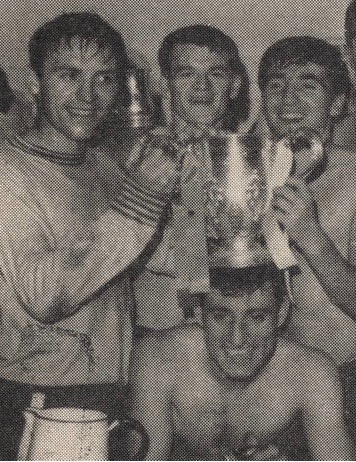
2-1965-lge-cup-winnersAt least at club level in 1965 Murray won some silverware (above image discovered on The Shed End Chelsea fans website), playing alongside Bonetti, Venables, Eddie McCreadie, Barry Bridges and John Boyle as Tommy Docherty’s Chelsea won the League Cup in April via a narrow 3-2 aggregate win over Leicester.
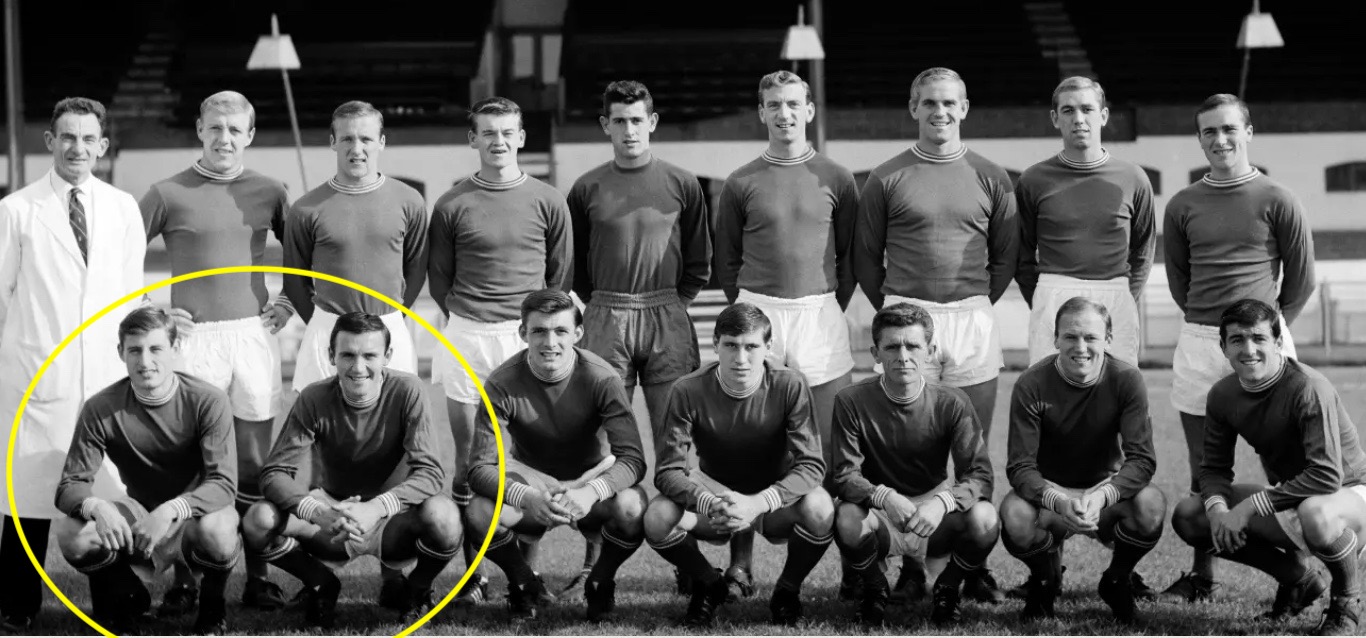
Murray + Bridges ChelseaMurray and Bridges alongside each other in a 1963-64 Chelsea team picture.
In the same season, Chelsea were top of Division One for nearly the whole season, and were looking good for the domestic treble but lost 2-0 to Liverpool in the FA Cup semi-final.

The young team started to show signs of strain and slipped to third in the league. Murray and Bridges were amongst a group of eight players who defied a curfew when the team were staying in Blackpool prior to a game against Burnley and the manager sent them home. The team Docherty put out capitulated 6-2.

According to ‘Bluebeard’ on theshedend.com the following nearly-but-not-quite season – fifth in the league, beaten FA Cup semi-finalists again and Fairs Cup semi-finalists – led to Docherty breaking up the team and selling Murray, Venables, Bridges and George Graham.

So, in 1966, having scored 44 goals in 183 games, Murray was transferred to Birmingham for £25,000 and Bridges went too, as Birmingham’s new wealthy owner, Clifford Coombs, splashed the cash for manager Stan Cullis.

3-brumbertThe pair were part of the side which in successive seasons got to the semi-final of the League Cup (in 1967) and FA Cup (in 1968) only to lose on both occasions. Because these things are important in the Midlands, joysandsorrows.co.uk remembers Murray as part of the 1968 Blues side who beat rivals Villa home and away. In five years, he played 132 games scoring 22 goals.

murray brum

It was the Blues former Brighton manager Freddie Goodwin who loaned him to his old club in early 1971. The loan became a permanent move thanks to £10,000 raised through innovative manager Pat Saward’s famous Buy-a-Player scheme which saw fans respond to the club’s lack of cash to bring in new players by coming up with sponsored walks and suchlike to raise the necessary money to enable Saward to bring in new faces. Thus Murray was swiftly dubbed the People’s Player.

4-bertwillie1971Saward brought in Willie Irvine on loan from Preston at the same time and the pair combined well on 10 March 1971 (pictured above by the Evening Argus before the game) as high-flying Fulham were beaten 3-2. In Irvine’s 2005 book with Dave Thomas, Together Again, he recalls how the pair hit it off and began a friendship that endures.

Murray was an influential right winger who made and scored goals and he became a reliable penalty taker too, notably keeping a cool head from 12 yards in the 12-game unbeaten run in 1972 which culminated in promotion as runners up behind Aston Villa.

In the famous game televised by BBC’s Match of the Day at home to Villa in April 1972, Saward moved Murray to right back to replace previously ever-present Stewart Henderson. It wasn’t completely alien to him, though, because he’d slotted into that role on occasion at Birmingham.

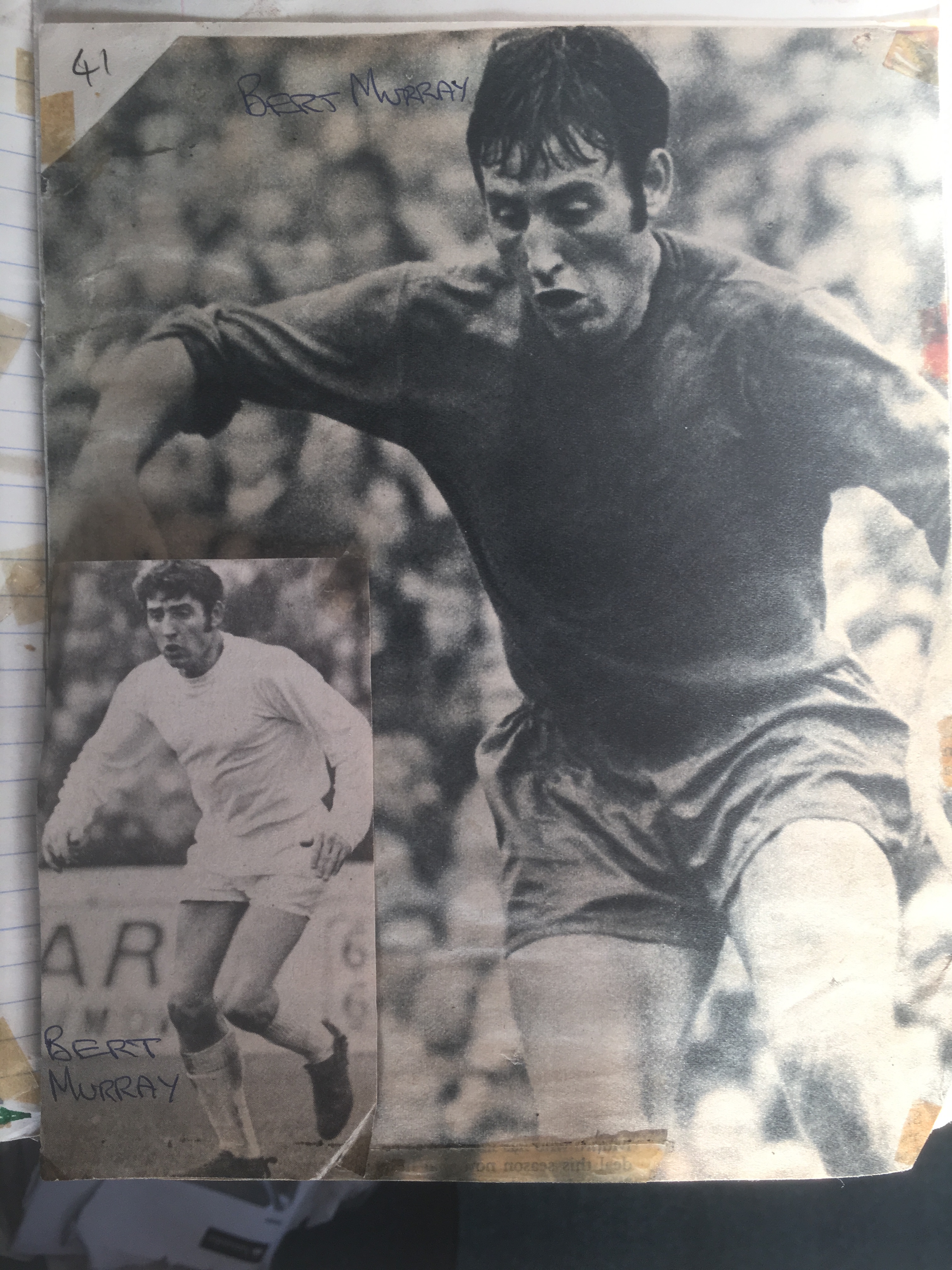
The photographers were busy during that tightly-fought 2-1 win against Villa and several different shots of Bert’s tussle with Villa’s talented winger Willie Anderson appeared in the newspapers and magazines following the game (see pic at top of article).

While others might have been grabbing the bulk of the goals and the headlines, Murray’s consistent performances earned him the player of the season award (below, receiving the award from chairman Tom Whiting).

murray poy

The newly-promoted side struggled badly and Saward chopped and changed the line-up, bringing in a host of new faces – including Bert’s old Chelsea colleague Bridges – as he tried in vain to find the right formula to keep the Albion up. But Murray was one of the few who kept his place at the higher level, mainly back in midfield. He took over the captaincy from Ian Goodwin and contributed nine goals in 39 appearances.

Although eventually the side clicked in the final third of the season, the damage had been done early on and the recovery wasn’t enough to avoid an immediate return to Division 3.

Murray wrote in the matchday programme: “The last two months have been amazing and although I say it myself I beleive that we have played some really good football recently. I also believe we deserve a better fate.”

He added: “We must hope we have learned our lessons well for next season.” Murray appeared in the front row of the 1973-74 team line-up but his time on the south coast was drawing to a close – along with manager Saward. Murray was involved in only two games as a substitute in October and after a total of 102 games and 25 goals he moved on to Peterborough United, initially on loan and then signing permanently.

It was Noel Cantwell, the man Saward had served as assistant manager at Coventry City, who signed Murray for Posh. “He needed a right midfielder,” Murray said in a 2012 interview with the Argus. “I went up there and had four wonderful years. I still see some of the lads now.”

Saward, with his own days at the Goldstone numbered and, without naming any names, wrote some cryptic programme notes for the 13 October home game against Halifax. “In deciding that a player can leave a club, the manager must consider the player’s contribution to the club and decide whether he fits into his plans for the future,” he wrote.

“When a manager decides it is time for the player and club to part he is not necessarily governed solely by the ability of the player but he has to look at his squad as a whole and assess whether there are younger players with longer futures waiting their chance to come through.

“A governing factor must be that the strongest possible team should be fielded at all times and the manager must decide when other players should take over from established favourites.”

In the programme for the 24 October game with Southport – by which time Saward himself had been sacked – there was a brief paragraph under the headline ‘Bert Murray Leaves’.

At 31, Bert still had plenty of football left in him and he went on to make 123 appearances for Posh, scoring another 10 goals, before retiring and going into the pub trade, in Market Deeping, nine miles north of Peterborough.

Many have been the occasions Albion fans following the team at London Road have taken a detour to pop in to see Bert and chat over old times over a pint.

In 2013, when he had his 70th birthday, The Society of Independent Brewers did an article about his 20 years running Everards pub The Bull in Market Deeping with his wife Eileen. They had also spent 17 years at two other pubs in the town, The Winning Post and The White Horse.

“Everards have been good and seem happy with what we are doing here. So if they are happy, Eileen and I plan to keep on going for a few more years yet as we really enjoy running the pub,” he said.

In September 2013, Bert returned to Stamford Bridge for a 50th anniversary reunion with the Chelsea ‘class of ‘63’ – chatting over old times over dinner with Terry Venables, John Hollins, Peter Bonetti, Barry Bridges, Ken Shellito and Bobby Tambling.

Pictures from my scrapbook , the internet and the Albion matchday programme.

Below, the Goal magazine feature ‘The Girl Behind The Man’