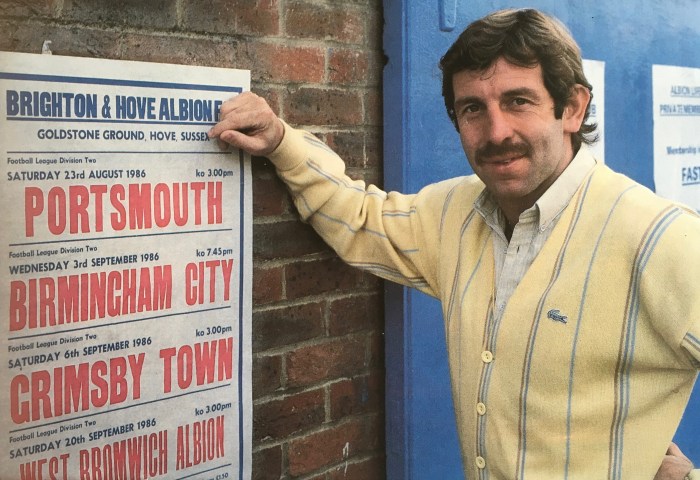
World Cup legend Armstrong too often warmed Albion bench

IMG_3807

IN THE SPACE of 10 weeks, Gerry Armstrong went from 71st minute substitute for Northern Ireland against Brazil at the 1986 World Cup in front of 51,000 in the Estadio Jalisco, Guadalajara, Mexico, to centre forward for Brighton & Hove Albion in front of 13,723 at the Goldstone Ground in a season-opening 0-0 draw against Portsmouth.

That 3-0 defeat to the mighty Brazilians signalled the end of an international career in which Armstrong had written his name in Northern Irish football history at the 1982 World Cup in Spain four years earlier. He had scored 12 goals in 63 appearances for his country but none as important as the one which beat hosts Spain to send the Irish through to the quarter-finals, which I shall come on to.

Screenshot

Four years later, while away with Ireland in Mexico, former Spurs striker Armstrong took a call at the team’s hotel from someone else who had made his name with the North London club – Alan Mullery – who had recently been restored to the managerial chair at Brighton.

“Alan knew I was a free agent and I promised to talk things over with him when I got back from Mexico,” Armstrong said in a matchday programme article. “I was impressed by the manager’s ideas for the future and Brighton appealed to me because I have always liked the club,” he said.

“I always got the impression that there is a good, family atmosphere here and I liked that.

“In many ways, Brighton reminds me of Watford. I had three very happy years there and I’m looking forward to enjoying myself just as much here at Brighton.”

Born in Belfast on 23 May 1954, Armstrong grew up in the Falls Road area and initially played Gaelic football and could have made that his chosen sport. But while he was banned from playing, he took up soccer with junior Irish clubs St Paul’s Swifts and Cromac Albion before beginning a three-year spell playing semi-professionally with Bangor between 1972 and 1975.

Spurs manager Terry Neill had family in Bangor and Tottenham paid a £25,000 fee for Armstrong’s services in November 1975. He made his Spurs debut in a 3-1 defeat at Ipswich Town on 21 August 1976. The season ended in relegation for the North Londoners but the young Armstrong was trying to make his way.GA Spurs

He said: “I was basically big, strong and courageous but that wasn’t enough alone so Spurs made me skilful as well.

“I set myself the task of gradually playing more first team games each season and managed to achieve it.”

After scoring 16 goals in 98 league and cup games for Spurs, Armstrong was sold to Watford for £250,000 in November 1980.

When the Hornets made it to the top division for the first time in their history, Armstrong scored their first goal at that level, against Everton, and they finished the season as runners up.

“Graham Taylor influenced me more than anybody,” he said. “My time at Spurs was going stale because they were using me in all sorts of different positions but, at Vicarage Road, Graham taught me about forward play and then gave me the chance to repay him.”

Nevertheless, it was breaking through at Spurs that helped Armstrong onto the international stage. He made his debut for Northern Ireland playing up front with George Best in a 5-0 defeat to West Germany in Cologne in April 1977. And in November the same year he scored his first goals for his country, netting twice in a 3-0 win against Iceland in Belfast.

His stand-out moment in football which fans still talk about came when Northern Ireland were minnows at the 1982 World Cup in Spain. In front of a crowd of 49,562 – mostly Spanish – packed into Valencia’s Estadio Luis Casanova, on 25 June 1982, Ireland beat the hosts 1-0 and Armstrong fired home the only goal of the game in the 47th minute.

“I cracked it in between a couple of defenders, but couldn’t really believe it because there was this deathly hush. Fifty-five thousand people (a bit of Irish overstatement) all there to see Spain, and we ruined the party!”

He added: “It was a very satisfying one to get for the team, because it was a great win for us. “The odds were against us because there was a huge crowd in the stadium and virtually all of them were backing Spain. Nobody really gave us a chance, but it was a great team performance.
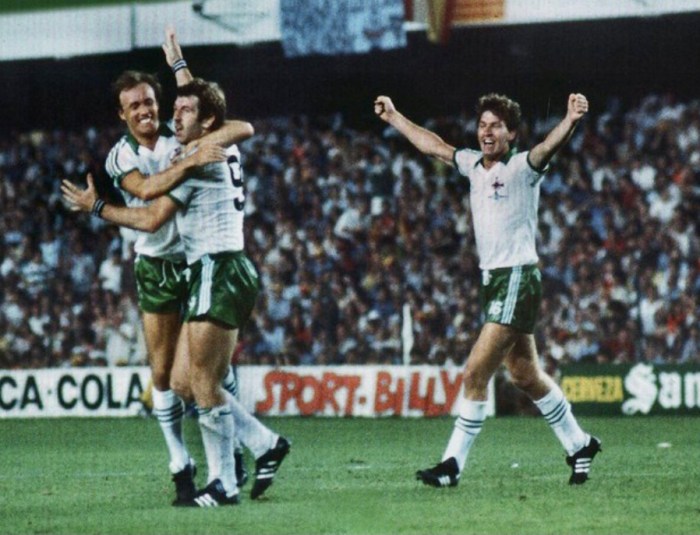
Armstrong Spain

“All the players worked hard for each other and that game summed up the excellent team spirit I have enjoyed with the national side over the years.”

Armstrong also scored Ireland’s only goal in their 4-1 quarter-final defeat to France.

The Spanish climate obviously agreed with Armstrong because in the summer of 1983, having scored 12 goals in 76 league games for Watford, Real Mallorca signed him for £200,000. Although he got stick from certain sections of Spanish supporters who remembered the goal he scored against them, he spent two years with Real Mallorca scoring 13 times in 55 league games.

On his return to the UK in August 1985, he initially signed for West Brom on a free transfer but struggled with travelling to and from London to train and play, didn’t see eye to eye with manager Ron Saunders, and picked up some injuries. He spent the second half of the season at Chesterfield, where former Spurs teammate John Duncan was boss, so he could get some game time to put him in contention to be selected by Northern Ireland for the upcoming World Cup.

irish news gerry arm

A free agent on his return, he joined Mullery’s Brighton having heard good things about the former Spurs captain from his Irish international colleague Pat Jennings, who’d played in the same Tottenham team as Mullery. However, it was 17 games before Armstrong managed to get on the scoresheet – in a 3-1 defeat at Leeds – although he did score again in the very next game, as Shrewsbury were beaten 3-0 at the Goldstone.

When Mullery’s second spell as manager ended rather abruptly, in January 1987, Armstrong was loaned to Millwall. New manager Barry Lloyd did restore him to the Albion line-up for the final eight games of the season, but the side finished in bottom place.

Back in Division 3, Armstrong was transfer listed along with Steve Gatting and Chris Hutchings as Lloyd was forced to shuffle the pack. He stayed with the club, but only got one full game, in a league cup tie, all season: he came off the bench 11 times and was a non-playing sub on 14 other occasions.

He was suitably philosophical about his involvement from the bench, however, and said in another matchday programme interview: “Over the years I’ve gained a bit of a reputation for grabbing goals when it matters most, and I figure that if I only get on for the last 20 minutes then there’s even more reason to take the game by the throat and get stuck in.”

In the 1988-89 season, Armstrong managed four starts but was once more on the bench more often than not and eventually was appointed reserve team player-coach.

But his time with the club ended ignominiously. In a Sussex Senior Cup tie at Southwick in January 1989, following the first ever red card of his career, as he walked off, he took exception to a comment from a supporter, jumped into the crowd and headbutted the person concerned.

The incident is referred to amongst the annals of assaults by players on fans. Armstrong left the club a fortnight after the altercation but the matter ended up in court and the footballer received a conditional discharge.

His final games as a player were at Glenavon back in Ireland after he had spent some time as a player-coach at Crawley Town, who were in the Beazer Homes League at the time.

In November 1991, he became manager of Worthing and led them to a promotion before being appointed assistant manager of Northern Ireland by his former teammate Bryan Hamilton.

He continued to live in Hove, though, and worked as a cable advisor for Nynex Communications. He even carried on playing football for Sussex Sunday League side James Lytle.

Although he left the national assistant role in 1996, he reprised it under Lawrie Sanchez between 2004 and 2006. Then, in 2011, the Irish FA recruited him as an elite player mentor – in essence to try to persuade young Catholic Northern Irishmen considering playing for the Republic of Ireland (a choice made by Shane Duffy, for example) to stick with the country of their birth.

Throughout all of this time, Armstrong has also forged a successful media career and is probably best known for his work with Sky Sports coverage of La Liga.

In 2015, the Belfast Telegraph did an interview with Armstrong and his wife Debbie in which they spoke about running a restaurant in Majorca, and his involvement as part-owner of a football club in Portugal.

The player’s autobiography, Gerry Armstrong: My Story, My Journey, written in conjunction with Dave Bowler, was published in November 2021 by Curtis Sport.Armstrong autobiog

Pictures from the Albion matchday programme and in the international shirt from the Irish News.

‘Save of the season’ one of few bouquets for goalkeeping florist Alan Blayney

blayney intenseGOALKEEPER Alan Blayney only played 15 games on loan to Brighton from Southampton but if finances had been better at the time he could have signed permanently and his career may have taken a different turn.
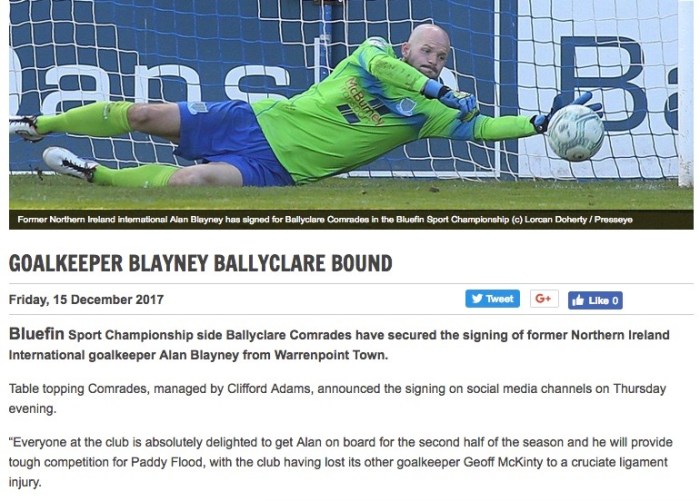
Blayney is still playing, nifootballleague.com reporting only in December 2017 a move to Ballyclare Comrades from Warrenpoint Town. He also runs a florist business with his wife Laura in Newtownabbey.

Only a month earlier he opened his heart to the belfasttelegraph.co.uk and talked about the demons he’s had to face during a career that rarely hit the heights in England but has seen him represent his country and enjoy success in his native Northern Ireland.

Born in Belfast on 9 October 1981, Blayney was picked up by the city’s Irish league side Glentoran at 16 before moving to the UK aged 19 to join Premier League Southampton.

Blayney was initially loaned out to Stockport County, but his time there was cut short by a broken finger.

He also had a couple of games along the coast at Bournemouth when he suffered one of his most embarrassing goalkeeping moments. In a Q and A for the Albion programme, Blayney told interviewer Dan Tester: “I’d rolled the ball outside the 18-yard box in readiness to kick it up field. The Rochdale striker, my former Northern Ireland under 21 teammate Lee McEvilly, was running away and it hit him on the head and flew over mine into the back of the net.”

Back at Southampton, the young ‘keeper finally got a first team chance in May 2004, a couple of months after Paul Sturrock had replaced Gordon Strachan as manager.

It was some debut because the game against Newcastle United finished 3-3 and a save Blayney made from an Alan Shearer header won him the accolade of Sky Sports save of the season.

The young Irishman kept his place for the following game, a 2-1 defeat at Charlton and he played twice more the following season, in a 2-2 league draw against West Bromwich Albion and a 5-2 League Cup defeat to Watford.

With future Albion goalkeeping coach Antti Niemi and Paul Smith ahead of him in the pecking order, Blayney went on loan to Rushden & Diamonds, where he played four games, before securing the first loan to Brighton in early 2005.

Albion’s regular ‘keeper Michel Kuipers had sustained a horrific shoulder injury in a home game against Nottingham Forest and the no.2 at the time, Chris May, had no experience so manager Mark McGhee needed emergency reinforcements.

Initially he obtained David Yeldell from Blackburn Rovers and also brought in Rami Shabaan from Arsenal, but Blayney, no doubt recommended by McGhee’s old pal Strachan, became the preferred option and played seven games at the end of the season.

Amongst several impressive displays was a game I went to with my son, Rhys, at Burnley, on 16 April 2005.

Against the odds, it finished 1-1 but the media was keener to focus on the post-match news that striker Mark McCammon had been ordered off the team bus by McGhee for his reaction to being substituted at half time.

Reporter Peter Gardner, on telegraph.co.uk, said: “The incident overshadowed a rousing second-half comeback to a game Brighton might ultimately have won, not least through the contribution of Jake Robinson, McCammon’s half-time replacement.

“However, McGhee’s men were equally fortunate not to have been overwhelmed by the home side in the opening 45 minutes when only splendid saves by Alan Blayney from Graham Branch (twice) and Mo Camara, plus Burnley’s own profligacy, prevented an avalanche of goals.”

Blayney was also between the sticks for the nail-biting final game of the season when a 1-1 draw with Ipswich Town kept the Seagulls in the Championship by the skin of their teeth.

Such had been Blayney’s contribution that McGhee was keen to sign him permanently, the manager telling skysports.com: “Alan did absolutely brilliantly here for us. We have to see how realistic an option that is, and whether they’re even prepared to consider letting him go, and what the conditions would be.”

The answer was that Brighton couldn’t afford the fee Southampton wanted so at the start of the following season Wayne Henderson was brought in instead on a three-month loan from Aston Villa.

When Henderson returned to Villa, McGhee was keen to buy him outright but in the meantime brought Blayney back for an eight-game stint.

Blayney told BBC Southern Counties Radio: “If I don’t perform they’ll end up going for Wayne instead of me. I have to come in and show I’m as good as Wayne, if not better. This first game at Stoke is really important.”

Unfortunately, the game at Stoke ended in a 3-0 defeat and a 3-2 reverse at home to Crystal Palace followed.

After a point was gained away at Cardiff City, Blayney saved a penalty from Inigo Idiakez in a 0-0 draw with Derby at Withdean on 26 November 2005, and the following week he helped earn another point, repeating the feat against Watford’s Marlon King.

The Watford Observer reported: “King passed up a glorious chance to fire Watford ahead on 58 minutes when he saw his penalty saved. King’s tame penalty was parried by Blayney, who dived low to his left, and the keeper then gathered the rebound.”

After a 5-1 hammering away to Reading, Blayney returned to Southampton in mid-December and within a matter of weeks Southampton’s technical support director, Sir Clive Woodward, informed him he had been sold to Doncaster Rovers for £50,000.

Blayney told the Belfast Telegraph in November 2017: “My response was, ‘Do I not have any say in this?’ He said the deal was done but I didn’t want to live in Doncaster. I loved it in Southampton. I didn’t settle in Doncaster, they gave me an apartment, but it was a tip. If I was getting those wages now I would bite your arm off but then it felt I wasn’t getting much and it was a terrible time.”

Although he started out as no.1, and made 24 appearances for Rovers, following an ankle injury he slipped to third choice behind Ben Smith and Jan Budtz, and came to an agreement to terminate his two and a half year contract early.

Blayney admitted in his Belfast Telegraph interview: “I do regret going out and drinking in my later career in England when I was at Doncaster. I was getting injuries and was a bit disillusioned with the game. I regret it because people had opinions of me at that club which is not the real me. They only saw me behave like that for a few months.”

He wasn’t quite done with England, though, and in February 2007 joined League One Oldham Athletic until the end of the season, after impressing in a reserve team match. However, he only played one first team game, in a 1-2 home defeat against Bournemouth.

There had been the possibility of a return to Brighton to replace Henderson, who had been sold to Preston, but the Argus reported on 2 February 2007: “Albion are not re-signing goalkeeper Alan Blayney after all. They have not been able to agree a length of contract with the former loan signing.”

On his return to Northern Ireland, he initially managed just three games as an understudy at Bohemians, but then he played 32 times for Ballymena United in 2008-09 as a prelude to what would turn out to be the most successful period of his career.

In five seasons with NIFL premiership side Linfield, he played 164 games and, in 2010-11, when Linfield won the league and cup double, he was named Ulster Footballer of the Year.

His form for Linfield also earned him a recall to the Northern Ireland squad. He had initially made his debut in 2006 under Lawrie Sanchez on a summer tour of the United States.

An appearance from the bench in a drawn friendly against Morocco in November 2010 saw Blayney concede an embarrassing goal as his clearance rebounded off Marouane Chamakh, then of Arsenal, to give the Africans the lead.

Manager Nigel Worthington put the incident into context after the game, telling the media Blayney had travelled to the ground just hours after his partner had given birth to a son.

“I was disappointed for Alan but it has been a terrific day for him and we have come out of the game unbeaten,” said Worthington. “He’s fine and I have given him every encouragement. It is one of those you learn from. You cannot take a split second to delay.”

Blayney said it was the worst moment of his career. He told the Belfast Telegraph: “I came on at half-time for Jonny Tuffey but took a terrible touch and Chamakh came in to challenge me. I kicked the ball off him and it went into the net.

“Everybody had welcomed me onto the pitch and you don’t forget moments like that. You aren’t used to playing against players who are as quick as that. I looked up and he was there. I wanted the ground to swallow me up but earlier that same day Phoenix was born. It was a bittersweet day.”

In May 2011 Blayney shared goalkeeping duties with Tuffey as an inexperienced Northern Ireland team endured an embarrassing Carling Nations Cup defeat to the Republic of Ireland. Although left exposed by a threadbare defence, Blayney was culpable in at least two of the goals in a 5-0 hammering, one of which was scored by debut-making Stephen Ward, a future left back loanee for the Seagulls. bbc.co.uk reported: “Blayney was badly at fault six minutes later as he spilled a tame Treacy cross which allowed Ward to poke home from close range.”

With Linfield, Blayney continued to rack up honours until they signed Tuffey in 2013, and he was no longer first choice. In January 2014, he joined Ards on loan but couldn’t help them avoid relegation.

After spending 2014-15 with Glenavon, he returned to Ballymena where he had two successful seasons, before losing his place. In January 2017, he dropped down to the Premier Intermediate League with Dundela. At the start of this season, he returned to the higher division with Warrenpoint Town but, in December, moved to be closer to home, with semi-professional Ballyclare.

Blayney savedec 17 blay cutBlayney cover

Further reading

https://www.not606.com/threads/whatever-happened-to-alan-blayney-part-5-of-many.126334/

https://www.belfasttelegraph.co.uk/sport/football/irish-league/footballers-lives-with-alan-blayney-why-ive-been-gripped-by-selfdoubt-and-how-i-almost-died-after-training-36284956.html

http://news.bbc.co.uk/sport1/hi/football/teams/b/brighton/4102810.stm

http://nifootball.blogspot.co.uk/2006/08/alan-blayney.html