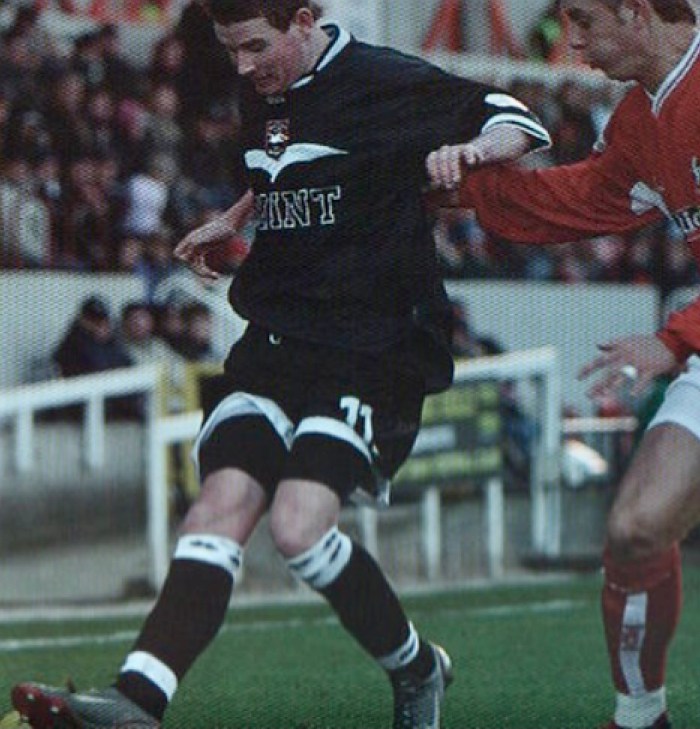
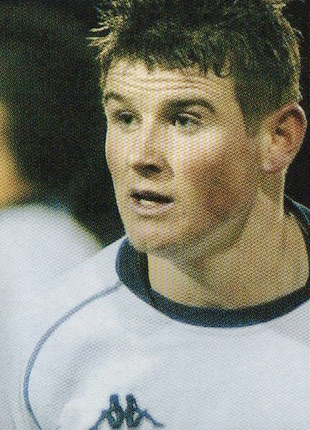
Crunching tackler ‘Tank’ Clark: a legend at two seaside clubs

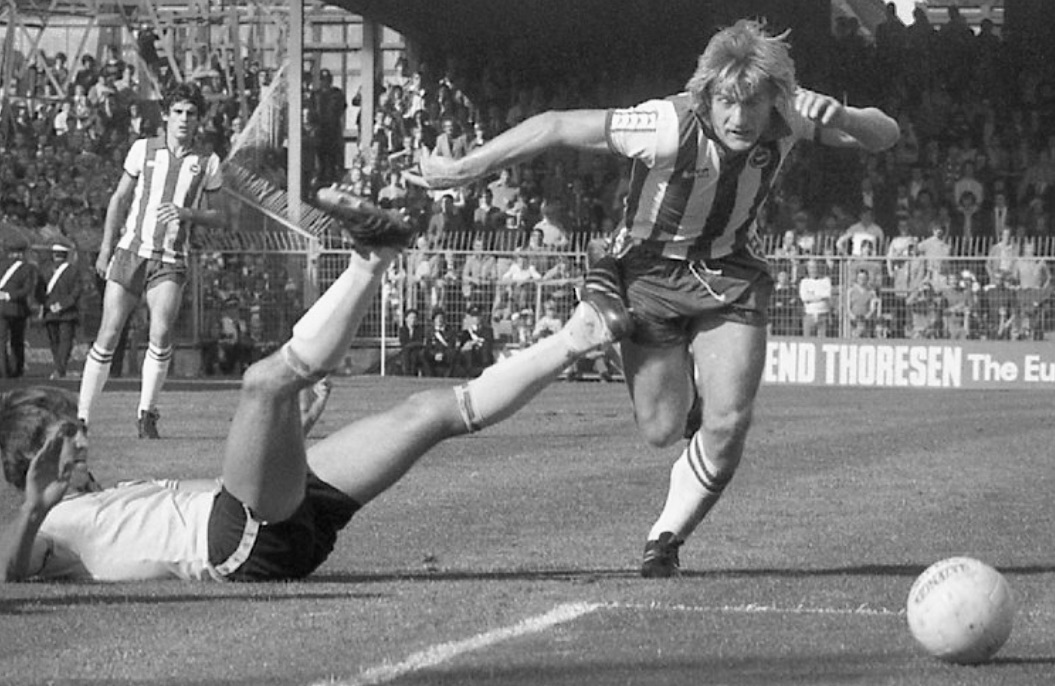
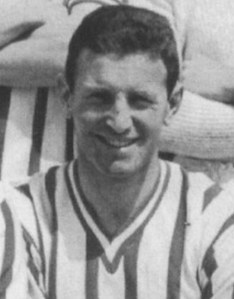
VIKING lookalike Paul Clark made a lasting impression on plenty of players with robust tackling which earned him ‘legend’ status among fans of Brighton and Southend United.

Described in one programme article as “the big bustling blond with the biting tackle”, Clark was given the nickname ‘Tank’ for his no-nonsense approach. A Southend fan lauded “his crunching tackles and never say die attitude”.

Clark himself reflected: “Wherever you go the supporters tend to like someone who is wholehearted and when it came to 50-50 challenges, or even sometimes 60-40, I didn’t shy away from too many, and the supporters just took to it.”
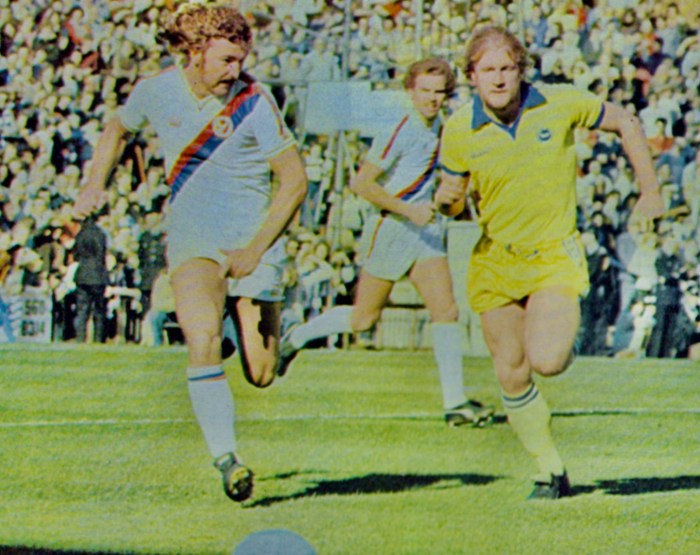
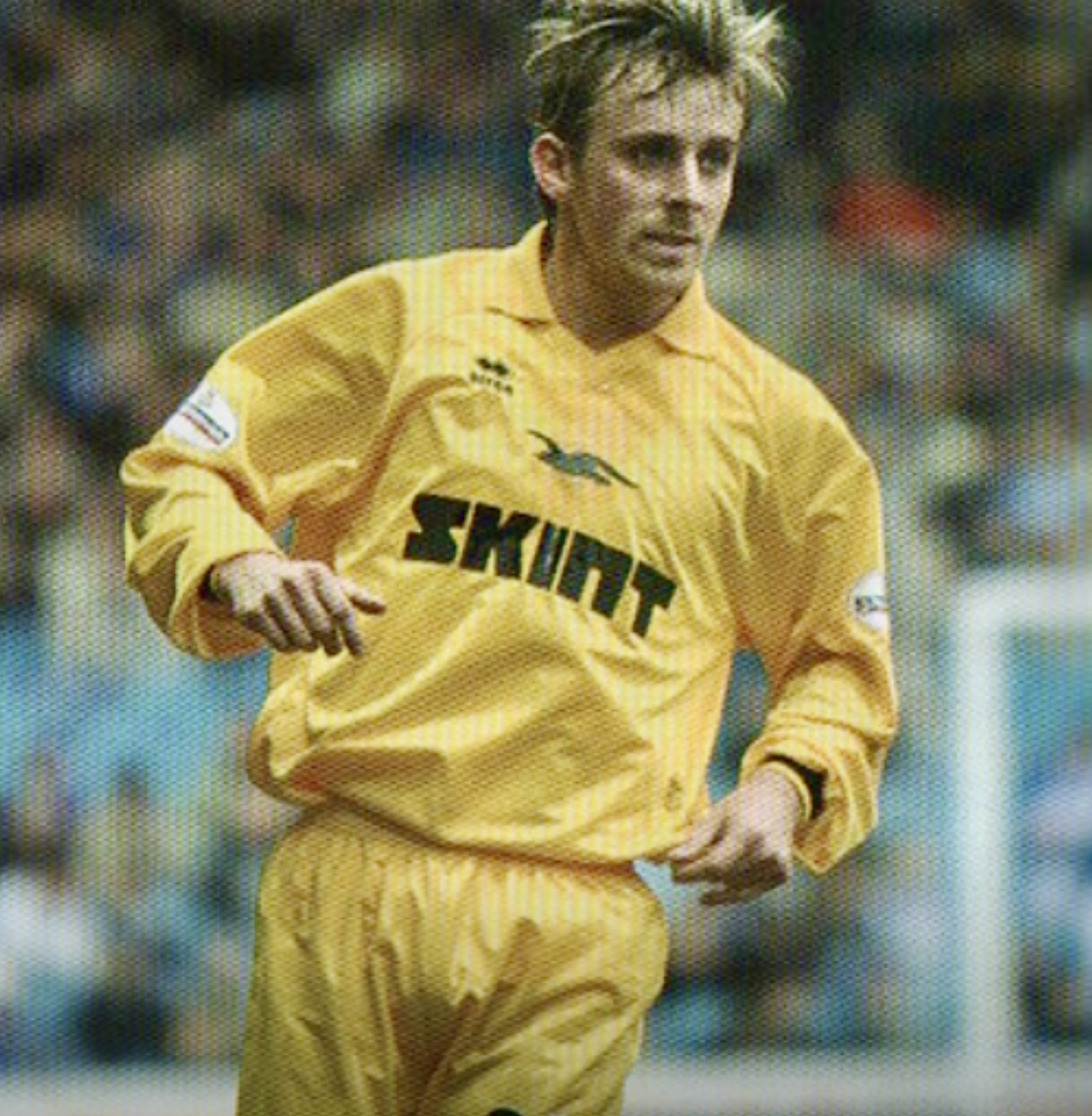
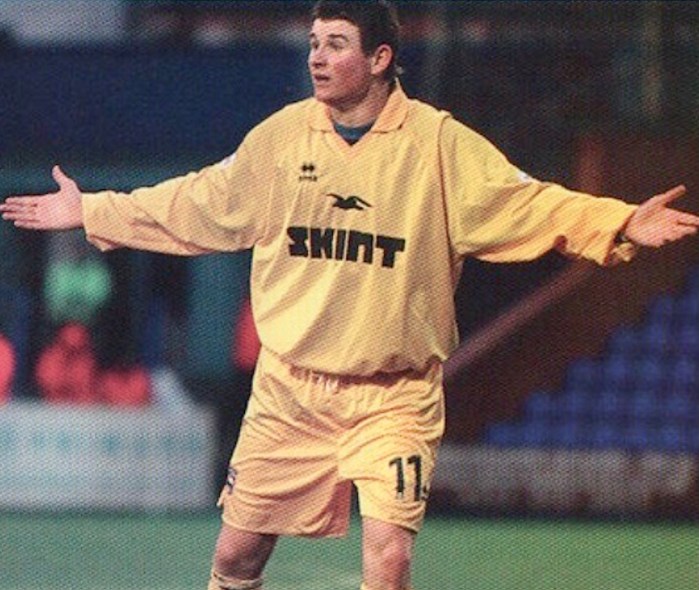
In Albion yellow against Palace

Giving further insight to his approach, he said: “You can go right up to the line – as long as you don’t step over it, then you’re OK.

“I used to pick up a booking during the first five or 10 minutes, then I knew I had to behave myself for the rest of the game. Despite the reputation I had, I was never sent off in over 500 games.”

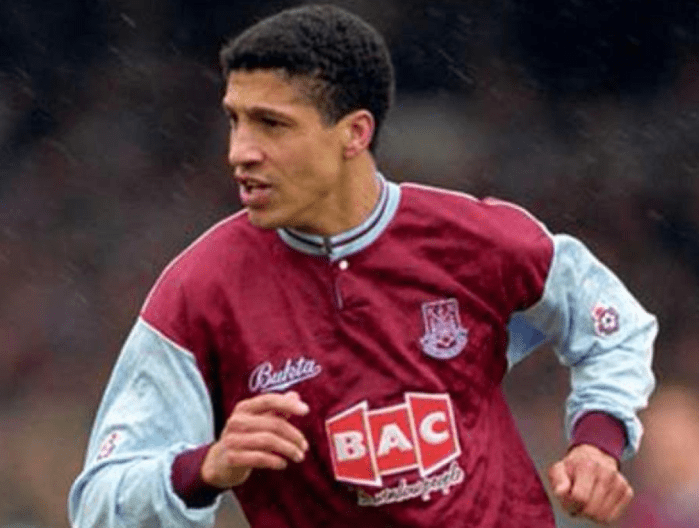
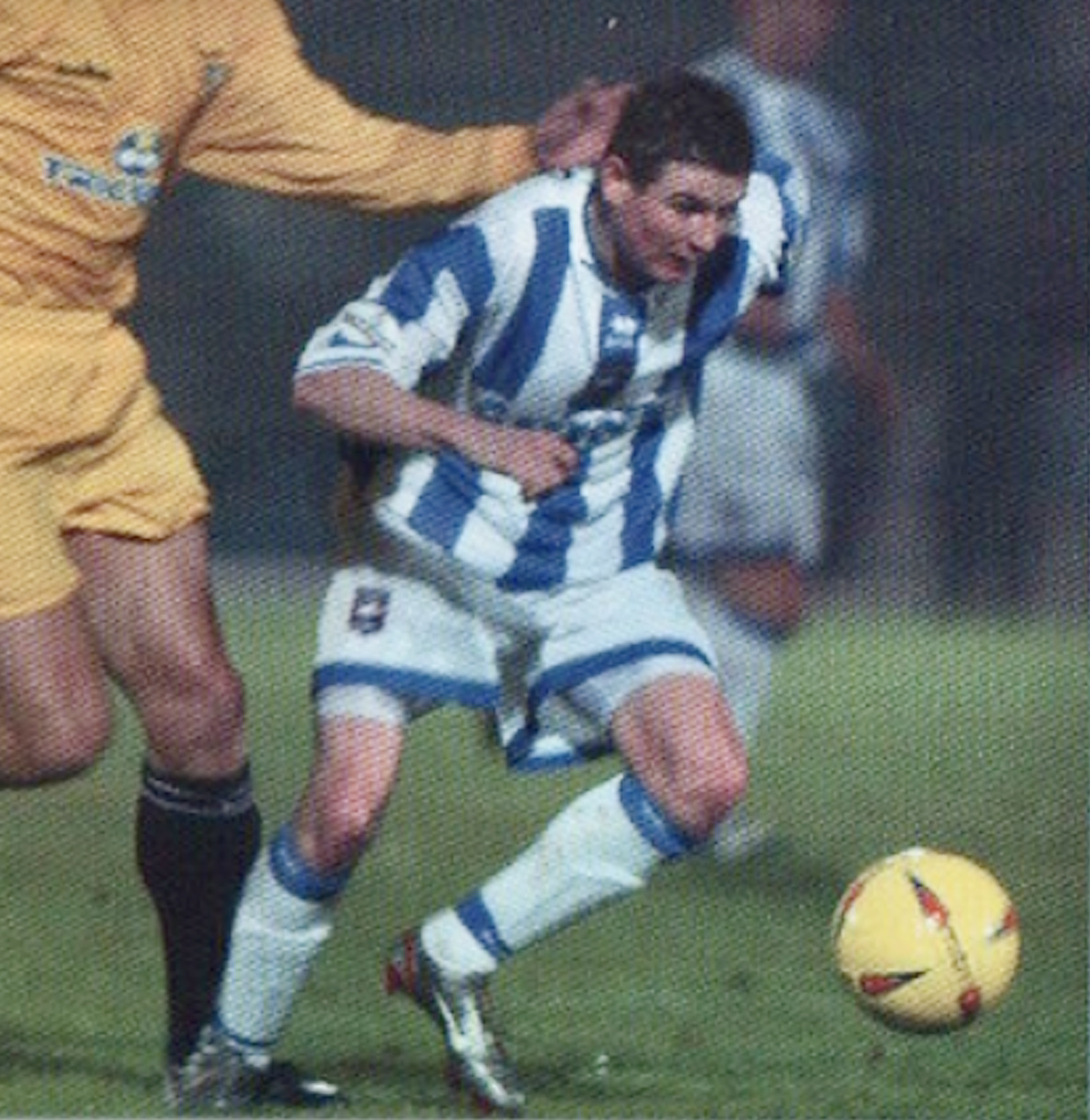
A trademark strike at home to West Ham

Former teammate Mark Lawrenson said of him: “You would hate to have to play against him because quite often he would cut you in two. With him and ‘Nobby’ (Brian Horton) in the side, we definitely didn’t take any prisoners. One to rely on.”

A former England schoolboy international, it was said of the player in a matchday programme:

“Paul is the first to admit that skill is not his prime asset but there is no doubt as to the strength of his tackle. He is a real competitor and is also deceptively fast, being one of the best sprinters on the Goldstone staff.”

Born in south Benfleet, Essex, on 14 September 1958, Clark went to Wickford Junior School where he played for the school football team and the district primary schools’ side. When he moved on to Beauchamp Comprehensive, selection for his school team led to him playing for the Basildon Schools’ FA XI.

Clark as an England schoolboy

This in turn led to him being selected to play for England Schools at under 15 level, featuring against Scotland, Ireland, Wales, West Germany and France before going on a tour of Australia with the same age group. Contemporaries included future full time professionals Mark Higgins, Ray Deakin, Kevin Mabbutt and Kenny Sansom.

Clark left school at 16 before taking his O levels when Fourth Division Southend offered him an apprenticeship. He made his first team debut shortly before his 18th birthday in a 2-1 win over Watford.

Two months later, he won the first of six England Youth caps. He made his debut in the November 1976 mini ‘World Cup’ tournament in Monaco against Spain and West Germany alongside future full England internationals Chris Woods, Ricky Hill and Sammy Lee.

The following March, he played in England’s UEFA Youth tournament preliminary match against Wales when they won 1-0 at The Hawthorns. Sansom was also in that side. And he featured in all three group matches at the tournament that May (England beat Belgium 1-0, drew 0-0 with Iceland and 1-1 with Greece). Teammates included Russell Osman and Vince Hilaire.
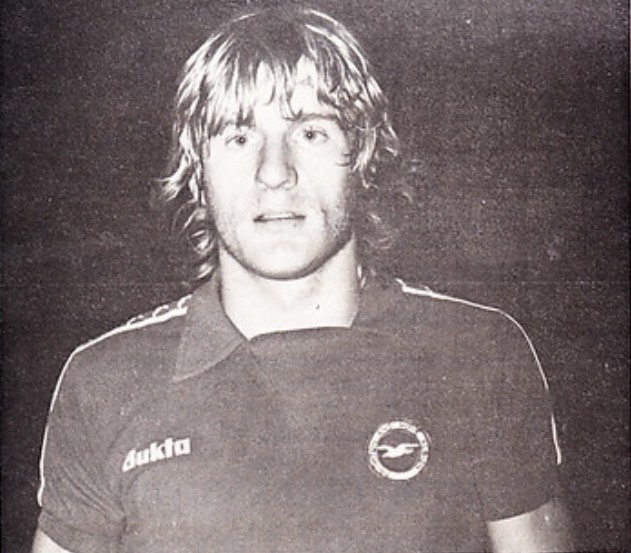
Clark was only a third of the way into his second season at Southend when Alan Mullery sought to beef up his newly-promoted Brighton side in the autumn of 1977, and, in a part exchange deal involving Gerry Fell moving to Roots Hall, Clark arrived at the Goldstone. He made his debut for the Seagulls in a goalless draw at White Hart Lane on 19 November 1977 in front of a crowd of 48,613. And he came close to crowning it with a goal but for an outstanding save by Spurs ‘keeper Barry Daines.

In full flight, as captured by photographer George Erringshaw

When Spurs visited the Goldstone later that season, Clark put in a man of the match performance and scored a memorable opener, following a solo run. A subsequent matchday programme article was suitably poetic about it.

“It showed all the qualities looked for in a player: determination, speed, skill and most of all the ability to finish….if any goal was singled out, Paul’s was certainly one to treasure.”

Albion went on to beat Spurs 3-1, although the game was remembered more because it was interrupted twice when the crowd spilled onto the pitch.

After only 12 minutes, referee Alan Turvey took the players off for 13 minutes while the pitch was cleared of Albion fans who’d sought safety on the pitch from fighting Spurs’ hooligan fans.

In the 74th minute, with Spurs 3-1 down and defender Don McAllister sent-off, their fans rushed the pitch to try to get the game abandoned. But police stopped the invasion getting out of hand and the game continued after another four-minute delay.

Clark’s goal on 16 minutes had been cancelled out six minutes later when Chris Jones seized on a bad goal kick by Eric Steele but defender Graham Winstanley made it 2-1 just before half-time.

Albion’s third goal was surrounded in controversy. Sub Eric Potts claimed the final touch but Spurs argued bitterly that Malcolm Poskett was offside.

Clark remembered the game vividly when interviewed many years later by Spencer Vignes for the matchday programme. The tenacious midfielder put in an early crunching tackle on Glenn Hoddle and after the game the watching ex-Spurs’ manager Bill Nicholson told him: “Well done. You won that game in the first five minutes when you nailed Hoddle.”

Said Clark: “I was 19 at the time so to get a pat on the back from him was much appreciated.”

It was one of three goals Clark scored in his 26 appearances that season (nine in 93 overall for Albion) but he wasn’t always guaranteed a starting berth and in five years at the club had a number of long spells stuck in the reserves.

Midfield enforcer or emergency defender were his primary roles but Clark was capable of unleashing unstoppable shots from distance and among those nine goals he scored were some memorable strikes.

For instance, as Albion closed in on promotion in the spring of 1979, at home to Charlton Athletic, Clark opened the scoring with a scorching 25-yard left foot volley in the 11th minute. Albion went on to win 2-0.

The following month, Clark demonstrated his versatility at St James’ Park on 3 May 1979 when Albion beat Newcastle 3-1 to win promotion to football’s elite level for the first time. Clark played in the back four alongside Andy Rollings because Mark Lawrenson was out injured with a broken arm.

Celebrating promotion with Peter O’Sullivan and Malcolm Poskett

“Not many people can say they played in a side that got Brighton up to the top flight,” said Clark. “It’s something I’m still immensely proud of.”

Once they were there, Clark missed the opening two matches (defeats at home to Arsenal and away to Aston Villa) and had an ignominious start to life at the higher level when he conceded a penalty within three minutes of going on as a sub for Rollings away to Manchester City on 25 August 1979.

Some observers thought Clark had played the ball rather than foul Ray Ranson but referee Pat Partridge thought otherwise and Michael Robinson stepped up to score his first goal for City from the resultant penalty. It put the home side 3-1 up: Teddy Maybank had equalised Paul Power’s opener but Mike Channon added a second before half-time.

Partridge subsequently evened up the penalty awards but Brian Horton blazed his spot kick wide of the post with Joe Corrigan not needing to make a save. Peter Ward did net a second for the Seagulls but they left Maine Road pointless.

Ahead of Albion’s fourth attempt to get league points on the board, Clark played his part in beating his future employer Cambridge United 2-0 in a second round League Cup match.

Three days later, he was on the scoresheet together with Ward and Horton as Albion celebrated their first win at the higher level, beating Bolton Wanderers 3-1 at the Goldstone.

It was Clark’s neat one-two with Ward that produced the opening goal and on 22 minutes, Maybank teed the ball up for Clark, who “belting in from the edge of the box, gave it everything and his shot kept low and sped very fast past (‘Jim’) McDonagh’s right hand,” said Evening Argus reporter John Vinicombe.

Gerry Ryan replaced Clark late in the game and after 12 starts, when he was subbed off three times, and four appearances off the bench, his season was over, and it wasn’t even Christmas.

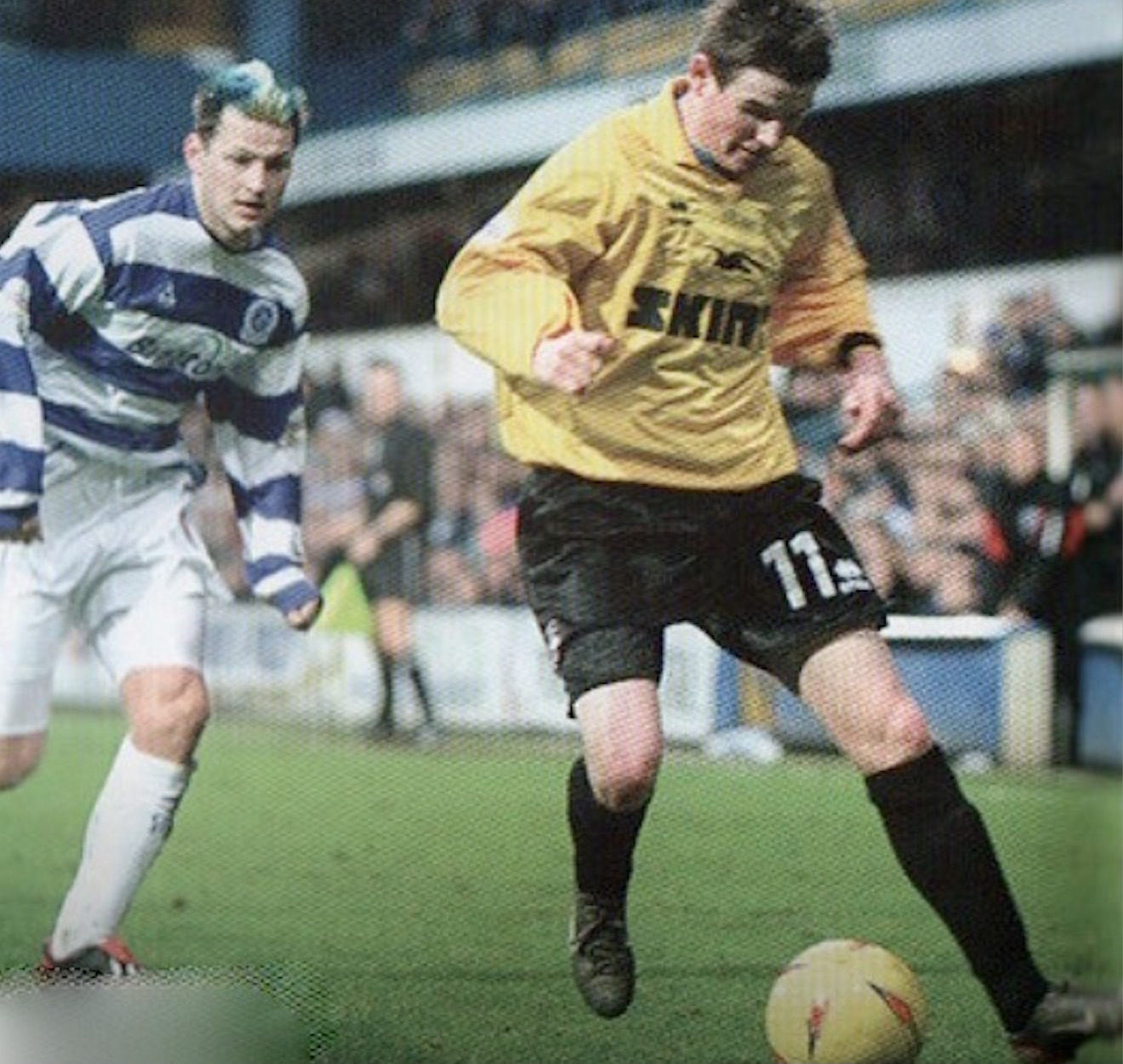
A colour photo of a typical Clark tackle (on QPR’s Dave Clement) adorned the front cover of that season’s matchday programmes throughout but he didn’t start another game after a 4-0 League Cup defeat at Arsenal on 13 November.
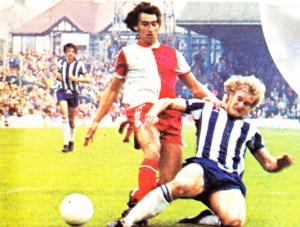
Programme cover shot

He was sub for the following two games; the memorable 1-0 win at Nottingham Forest and a 1-1 draw at Middlesbrough, but Mullery had signed the experienced Peter Suddaby to play alongside Steve Foster, releasing Lawrenson to demonstrate his considerable repertoire of skills in midfield alongside skipper Horton and Peter O’Sullivan.

Young Giles Stille also began to press for a place and later in the season, Neil McNab was added to the midfield options, leaving Clark well down the pecking order in the reserves. Portsmouth wanted him but he rejected a move along the coast, although he had a brief loan spell at Reading, where he played a couple of games.

But Clark wasn’t finished yet in Albion’s colours and, remarkably, just over a year after his last first team appearance, with the Seagulls struggling in 20th spot in the division, he made a comeback in a 1-0 home win over Aston Villa on 20 December 1980.

Albion had succumbed 4-3 to Everton at Goodison Park in the previous match and Mullery told the Argus: “We badly needed some steel in the side and I think Clark can do that sort of job.”

Under the headline ‘The forgotten man returns’ Argus reporter Vinicombe said Mullery hadn’t changed his opinion that Clark was not a First Division class player, but nevertheless reckoned: “Paul’s attitude is right and I know he’ll go out and do a good job for me.”

For his part, Vinicombe opined: “The strength of Clark’s game is a daunting physical presence. His tackling is second to none in the club and Mullery believes he will respond to the challenge.”

Clark kept the shirt for another nine matches (plus one as a sub), deputising for Horton towards the end of his run, but his last first team game was in a 3-1 defeat at Norwich at the end of February.

Clark remained on the books throughout Mike Bailey’s first season in charge (1981-82) but, with Jimmy Case, Tony Grealish and McNab ahead of him, didn’t make a first team appearance and left on a free transfer at the end of it.

Back to Southend

He returned to Southend where he stayed for nine years and was player-manager on two occasions. Fans website shrimperzone.com moderator ‘Yorkshire Blue’ summed up his contribution to their cause thus: “In the top five all-time list for appearances, an inspiration in four promotions, one of the toughest tacklers of all-time and a man whose commitment for his home-town club could never be doubted.”

Clark was still only 27 when he had his first spell as manager, in caretaker charge after Dave Webb had quit following a bust-up with the club chairman, and he managed to steer United to promotion back to the third tier.

When Webb’s successor Dick Bate lasted only eight games of the new season, Clark was back at the helm, in turn becoming the youngest manager in the league.

His first hurdle ended in a League Cup giant killing over top flight Derby County (who included his old teammate John Gregory) when the Us had another former Albion teammate, Eric Steele, in goal.

A Roy McDonough penalty past England goalkeeper Peter Shilton at Roots Hall settled the two-legged tie (the second leg was goalless at the Baseball Ground) which the writer described as “arguably their biggest ever cup shock”.

In the league, player-manager Clark guided Southend to a safe 17th place but it went pear-shaped the following season. Clark only played 16 games, Southend were relegated, and Webb returning midway through the season as general manager.

Back-to-back promotions in 1989-90 and 1990-91 proved to be a more than satisfactory swansong to his Southend career, and in the first of those he found himself forming an effective defensive partnership with on-loan Guy Butters in the second half of the season.

In 1990-91, he missed only six games all season as the Shrimpers earned promotion to the second tier for the first time in their history, and he had a testimonial game against Arsenal.

But, after a total of 358 games for Southend, he left Roots Hall to join Gillingham on a free transfer.

Over three seasons, he played 90 league games, and was caretaker manager in 1992, before retiring at the end of the 1993-94 season. Gillingham’s top goalscorer with 18 that season was a young Nicky Forster and other Albion connections in that squad included Mike Trusson, Paul Watson, Neil Smillie, Andy Arnott and Richard Carpenter.

After Gillingham, Clark played non-league for Chelmsford City but left to become assistant manager to Tommy Taylor at Cambridge United. In 1996 he followed Taylor in a similar role to Leyton Orient.

Southend fans hadn’t heard the last of him, though – quite literally. He became a co-commentator on Southend games for BBC Radio Essex.

In the 2009-10 season, Clark was temporarily assistant manager to Joe Dunne at Colchester United.

Outspoken Scot whose words and tactics divided opinion

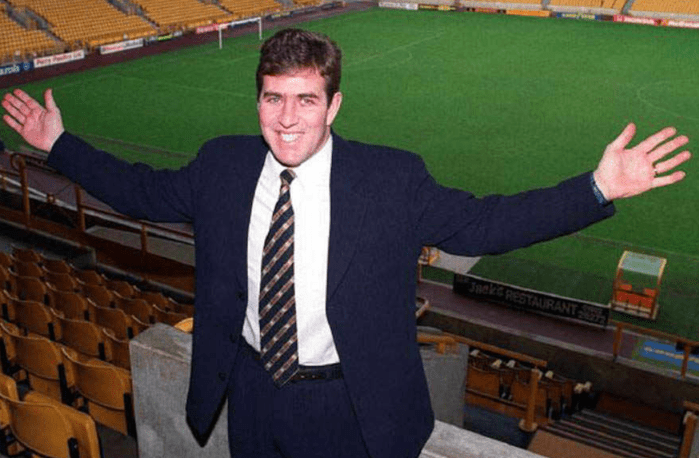
MENTION Mark McGhee to supporters of Wolverhampton Wanderers and most are less than complimentary about the Scot who won third tier promotion with Brighton in 2004.

Steering the Seagulls to that 1-0 play-off final win over Bristol City at the Millennium Stadium, Cardiff, (as I covered in my previous blog post about McGhee) emulated his feat of taking Millwall out of the same division three years previously, and certainly helped to repair a reputation sullied by his experience at Wolves.

A play-off winners’ medal at last for Mark McGhee

It also delivered much relief for a manager who’d previously only experienced play-off heartache, seeing Wolves’ hopes of returning to the Premier League dashed by a play-off semi-final defeat to Crystal Palace in 1997 and losing to Birmingham with the Lions at the same stage in 2002.

After cutting his managerial teeth at Reading and Leicester, McGhee succeeded former England boss Graham Taylor at Wolves, appointed by chairman Jonathan Hayward, the son of owner Sir Jack Hayward (the pair subsequently had a big falling out and McGhee was caught in the crossfire).

McGhee’s three years at Molineux weren’t all bad – many supporters said he certainly rated higher than the hated Glenn Hoddle – and he couldn’t be faulted for spotting genuine talent having given Irish striker Robbie Keane his Wolves debut as a 17-year-old away to Norwich. “I always believed he could be special,” he said. “Even at that age he was sensational.”

Young Mark McGhee on his arrival at Molineux

But fans of the boys in old gold disliked his managerial style of winding up forthcoming opponents with disparaging remarks. They also felt some of his signings weren’t up to it – a feeling echoed in the spat that emerged between Sir Jack and Jonathan.

“Nice man, Mark, and he had done well enough at Reading and Leicester. But he didn’t buy very well, did he? You have to ask questions about the quality of the players he brought to this club,” Sir Jack told reporter Paul Weaver in January 1999.

“We should never have let Graham Taylor go. Graham is an outstanding football manager. I’m afraid we bowed to pressure from the fans. We didn’t give him enough time. Then we gave McGhee plenty.”

For many, the final straw in the McGhee reign was when he left club legend Steve Bull on the subs bench in favour of much-derided Steve Claridge when Wolves lost the 1998 FA Cup semi-final to Arsenal.

“No turning back after that really, he’d lost it,” said ‘Bend It Like Dennison’ on molineuxmix.co.uk. “A very negative manager, prone to making stupid comments which wound opposition teams up and made us one of the most hated teams in the division,” opined ‘Nashie’ on the same platform.

“I had high hopes for McGhee and sometimes I quite liked the way he wound up the opposition with his arrogance, however, while he could talk the talk, he couldn’t quite walk the walk!” said ‘Bill McCai’.

The Scot was never afraid to speak his mind and even his former Newcastle boss, Bill McGarry (a figure well known to Wolves fans from his days as manager between 1968 and 1976) told him:  ‘Mark, you talk too much. Tone it down a bit.’

“I tried to take his advice, give nothing away in media briefings. Then, somebody would say something interesting and I wasn’t able to stop myself,” McGhee admitted in an interview with theleaguepaper.com.

On molineuxmix.co.uk, ‘stuj4z’ reckoned: “McGhee started to believe his own hype and became a parody of himself. Stupid signings were his downfall because overall I thought his tactics were ok. McGhee wasn’t the devil incarnate and did do some good things for the club.”

‘Florida Wolfey’ maintained: “McGhee was a decent manager and he certainly cared about this football club. He was unfortunate not to get us up in his first season and we never really recovered from that failure. Like all managers he made some good decisions and some decisions he’d rather have made again.”

When the axe fell, McGhee admitted to Nick Townsend of The Independent: “For that first month after I was sacked by Wolves, until I got over the initial shock, I never really opened the door. I became a recluse. I was feeling angry and frustrated.”

Townsend observed that having previously walked out on Reading and Leicester to take the Wolves’ job, “many supporters among his former clubs relished the spectacle of the assured and articulate McGhee being thrown from the steed of his own galloping ambition, his features ground in the dirt”.

“I was 100 per cent justified in leaving Reading after John Madejski gave me permission to talk to Leicester” McGhee told Townsend. “Leaving Filbert Street, a year later, was different. I knew when I walked out of there that it was, in a sense, wrong.

“I knew I’d let their chairman, Martin George, down badly, and the players I’d brought in. People thought, when Wolves dangled the bait, that was me, off and out, no hesitation, no qualms, and that’s where I got my reputation. But it wasn’t like that. It was torture.

“Two minutes before I made the decision to go, I was staying. There was pressure from all kinds of people I respected to go. Against my own conscience, I took the job.”

He added: “I read the papers and I don’t recognise myself. But, obviously, people are thinking that a guy who can up and leave Leicester after a year like that must be one kind of arrogant, callous bastard. All I can do to fix that impression is to go on from here and prove to people that’s not the way I am.”

As it turned out, he feared the football community had turned its back on him when no further managerial opportunity surfaced for nearly two years. It was only a regular punditry slot on Sky Sports that reminded people he was still around.

When he eventually got back in the game as manager of Millwall in September 2000, McGhee garnered a sympathetic ear from The Guardian football writer Roy Collins.

“I don’t think I got a bad deal,” McGhee told Collins. “I think I got exactly what I deserved. The biggest mistake I made was in underestimating the reaction of people when I walked out on Leicester. That is not to say that I regret leaving Leicester but it tarnished my reputation in such a way that Wolves’ fans never really accepted me.

“I was only fulfilling my ambition but I’ve learned that sometimes you have to think twice and maybe it would have been right for me to have said, no matter how much I want to take what I see as a bigger job, I can’t have it.”

McGhee admitted to the reporter he’d had sleepless nights and restless days wondering whether any club would forgive him, so he was grateful for the chance Millwall gave him, admitting: “This is a second chance for me and if I mess it up, I won’t get a third.”

A relieved McGhee told the Evening Standard: “To say I am very pleased to get back into the game is an understatement. I am absolutely ecstatic, but I would not have come back for any job.

“I haven’t been applying for everything that has been going because I felt the opportunity had to be one I was motivated by.

“It did not have to be the biggest club, or in the top league, but I had to really want to do it. I got a gut feeling about some jobs and I had that for Millwall.

“You get a feel for the place and I had an idea what they were about because I am a good pal of their old manager Mick McCarthy.

“In my playing career I was at Newcastle and Celtic. They have demanding, but passionate fans and I know that is the same at Millwall. It is very exciting.”

Millwall chairman Theo Paphitis admitted: “Mark was not always the front runner for the job, but got himself into the position at the interview.

“He said the right things. I believe he was sincere and I am very pleased we have him on board. He is the right person for the job.”

When there was a mutual parting of the ways in October 2003, Paphitis said: “He took over in September 2000 with the brief to get the club into the First Division that season which he duly achieved.

“We then enjoyed a very successful first season at this level, reaching the play-offs the following year. Last season was a frustrating one for the club and whilst expectations were high at the start of the current campaign, we have struggled to live up to them.”

Interestingly, when he was shown the door at Brighton, likewise there was appreciation rather than dismay at what he had brought to the club.

Powering up

“No matter where you stand on the club’s decision to part company with the former Scottish international, you can’t say he didn’t leave us without one or two golden memories, especially during his first season in charge,” the matchday programme reminded readers.

“There are more than a few supporters out there who rate what happened inside the Millennium Stadium that May day in 2004 as their top Albion moment, above Wembley 1991 and – whisper it – even 1983. Why? Well, for once, we actually won on a big stage. But there was more to it than that: thirty thousand fans invading Wales and laying siege to what is generally regarded as one of the finest stadiums in the world.”

The piece reminded supporters that in the higher division, against clubs with hugely superior resources, Albion beat the likes of Leeds United and Sunderland at humble Withdean as well as nicking unlikely wins at Leicester City, West Ham and Sheffield United.

Even in the season (2005-06) when they weren’t able to retain that hard-earned status, they managed a first win in 22 years at Selhurst Park, toppling the old rivals on their own patch with the only goal of the game scored by loanee Paul McShane.

After a fascinating 3-3 draw at Elland Road, home boss Kevin Blackwell observed that McGhee had “the hardest job in football”.

The programme pondered: “One can’t help but wonder what McGhee’s record would have been had the club been playing inside a stadium worthy of the upper echelons of the English game, with some finance to burn and facilities good enough to tempt Championship and Premier League calibre players to Sussex.” Indeed.

Lift engineer Hughton took Seagulls to a different level!

TOTTENHAM HOTSPUR was a key part of Chris Hughton’s life for more years than any of the other clubs he went on to serve.

While Brighton fans will always appreciate his four-year tenure taking the Seagulls from the Championship into the Premier League, he spent the first 19 years of his playing career at Spurs as well as 14 and a half years as a coach (and occasional caretaker manager) at White Hart Lane.

Hughton joined Tottenham’s youth set-up at the tender age of 13 in 1971, as he recounted in an In The Spotlight feature in the Spurs matchday programme for their September 2024 game v Brentford. It was the year the club won the League Cup captained by Alan Mullery with a side that included Phil Beal, Joe Kinnear and Martin Chivers, who scored both goals in the 2-0 victory over Aston Villa.

Hughton attended inner city school St Bonaventure’s in Newham, many years later attended by loanee striker Chuba Akpom who told Andy Naylor in an exclusive for the Argus: “When I was in school there used to be pictures of the gaffer there. The kids used him like an inspiration and motivation. I did as well: seeing someone come from the same area and the same school as me to become such a big and successful person.”

Other footballing St Bon’s alumni included Hughton’s brother Henry, John Chiedozie, Jermaine Defoe and Martin Ling (briefly an Albion player under Micky Adams).

Hughton’s progress as a youngster took a slightly unconventional turn when, at 16, Spurs told him he hadn’t done quite enough to be taken on as an apprentice.

“There was still that chance, though – a small window of opportunity,” he recounted to coachesvoice.com. “So, while I started a four-year apprenticeship as a lift engineer, I stayed on at Tottenham as an amateur.

“That meant working all day, then on two nights a week getting the bus or train to the training ground – apart from those days when I ended up working late and just couldn’t get there in time. Then, on Saturdays, I’d play for the youth team. I lived that life for two years.”

Football-wise, by the age of 18 Hughton had done enough to persuade Spurs to offer him a professional contract – but he didn’t want to cut short his lift engineer apprenticeship, so he turned them down but continued playing for the club as an amateur.

“I was fortunate,” he said. “My window of opportunity stayed open, and at 20 I finally became a professional footballer for Tottenham… as well as a qualified lift engineer.”

It was during Keith Burkinshaw’s eight-year reign as manager that Hughton enjoyed most of his success as a Spurs player, usually filling the left-back spot of a side that won the FA Cup in 1981 and 1982 and the 1984 UEFA Cup.

“It was a period that had a big impact on me, and on who I became,” said Hughton, who played alongside the likes of World Cup winners Ossie Ardiles and Ricky Villa, the gifted Glenn Hoddle and goalkeeper Ray Clemence, and Steve Perryman, “the best captain I played under”.

Born in Forest Gate, east London, on 11 December 1958, it might have been West Ham territory but it was Spurs that took on trial a group of five lads who had been playing in the district of Newham side.

“I ended up staying there,” he told the Argus in a November 2017 interview. “My upbringing was different. I was always playing. Although my dad is very much now a football fan, I didn’t have a family background of football.

“I think I went to West Ham once, a family friend took me. I was a football fanatic but always playing. I never really had an allegiance to any team. But I’m very much a West Ham lad.”

Hughton qualified to play for the Republic of Ireland – home of his mother Christine. His father Willie was Ghanaian (Hughton later became that country’s coach).

He made his debut for Eire in 1979 and won 53 caps over the next 12 years, including playing in three matches at the 1988 Euros. Although he was in the 1990 World Cup squad, he didn’t play any matches. He was the Republic’s assistant manager to Brian Kerr between 2003 and 2005.

Being of mixed race, Hughton suffered plenty of racial abuse both from the terraces and from opposition players, as he revealed in an interview with broadcaster Ian ‘Moose’ Abrahams for whufc.com in November 2023.

“You suffered it by yourself because you were the only one who was receiving that type of abuse, you were the only one that almost understood it, and being the only black player in the team you took all of that on your own shoulders,” he said.

“Sometimes it’s hard to think back now and comprehend how you coped with that, and the coping mechanism is because firstly you are used to it, and secondly your mentality had to be that you’re better than that. You generally suffered by yourself.”

Hughton continued: “There were numerous times over that period, especially in the reserve team, and yes, even in the first team that I suffered racial abuse [from opposing players].

“I reacted to it, but I knew the boundaries, because you knew if you went too far you were going to get sent off.”

A knee injury at the age of 28 was a signal for Hughton to begin to consider what he might do once his playing days were over, and he did some coaching sessions at soccer schools. “I started to think this was what I wanted to do,” he said.

When he was no longer guaranteed a starting berth at Spurs, Hughton moved across London to the club closest to where he grew up: West Ham. Hughton signed for the Hammers initially on loan in November 1990 to cover for the injured Julian Dicks, and then permanently on a free transfer.

“My parents still live in Upton Park, so I was born and brought up very close to the stadium,” Hughton recalled in a November 2017 Argus interview.

Signed by Billy Bonds, he was with the Hammers for just over a year, helped them win promotion from the old Division Two in 1990-91and played a total of 43 matches (plus one as a sub).

“It was a really enjoyable period of time,” he said. “Billy Bonds was the manager. He was not only a great manager but a great individual.”

In February 1992, he moved on a free transfer to then Third Division Brentford, whose squad included Neil Smillie and Bob Booker. Graham Pearce was a coach. They won the divisional title but the following season Hughton’s troublesome knee forced him to retire at the age of 34.

“By the time I signed for Brentford at the age of 33 I was certain that I wanted to coach,” Hughton told coachesvoice.com. “I was taking far more interest in things like tactics and the thinking behind training sessions. Brentford’s manager at the time, Phil Holder, even allowed me to take a few sessions.”
Hughton added: “It actually set me up for my coaching career as I learned a lot in that time.”

After he’d called time on his playing days, he didn’t have to wait long for an opportunity to open up for him as a coach because his former teammate Ardiles, who’d not long since taken over as Spurs manager, invited him to help out back at White Hart Lane.

“We’d been good friends since our days playing for the club, so he knew all about my coaching aspirations and brought me in as the under-21s’ and reserve team coach,” Hughton explained. “I’ve always been very grateful to him for giving me that first opportunity.”

For the first year or so, he worked alongside the former West Ham player Pat Holland, who he described as “an excellent tactical and technical coach”.

Hughton explained it was a period in which he discovered how to transition from being a player to a coach. “As much as you’ve been part of a changing room thousands of times as a player, taken part in countless training sessions and listened to more team talks than you can remember, none of those things have ever been your responsibility before.

“In that respect, football is no different to any other aspect of life. If someone has spent years working on a shop floor, then moves up to management and has to govern a group of people, they have to make that same transition. It’s not easy.”

As managers came and went, Hughton remained on the coaching staff. After Ardiles came Gerry Francis and Christian Gross. Hughton was in caretaker charge for six matches before George Graham took over from Gross. Next in the hot seat was Glenn Hoddle, followed by Jacques Santini and then Martin Jol.

“Such a long apprenticeship might not be for everyone and some can go straight from player to manager at a young age, but I wouldn’t have been ready,” said Hughton.

“There was always something new to learn and experience. It was exciting to see what each new manager would be like, how he would involve me and what I would learn.

“The club could easily have said, ‘Now that the manager has left we won’t be keeping you on’, but they showed faith in my abilities and, in return, I provided some continuity.”

Hughton was assistant manager to Jol and said: “We had three years together, and in terms of league positions they were successful ones.”

By the time he was shown the door at Spurs, along with Jol, after a difficult start to the 2007-08 season, he felt ready to become a manager in his own right.

But before that happened, a different proposition emerged when Kevin Keegan asked him to become first team coach at Newcastle United.

“I’d spent my entire playing and coaching career in London, but any apprehension I felt at relocating to another part of the country was outweighed by the excitement,” he told leadersinperformance.com.

“I was going to a legendary club with an incredible tradition, rich history and great fan base and I was going to assist Kevin Keegan. I learned a lot from him during our time together, especially from his strengths in man-management.”

• What happened next in Hughton’s career is the subject of my next blog post. Thanks for reading!

‘One of the most influential and progressive coaches of his generation’

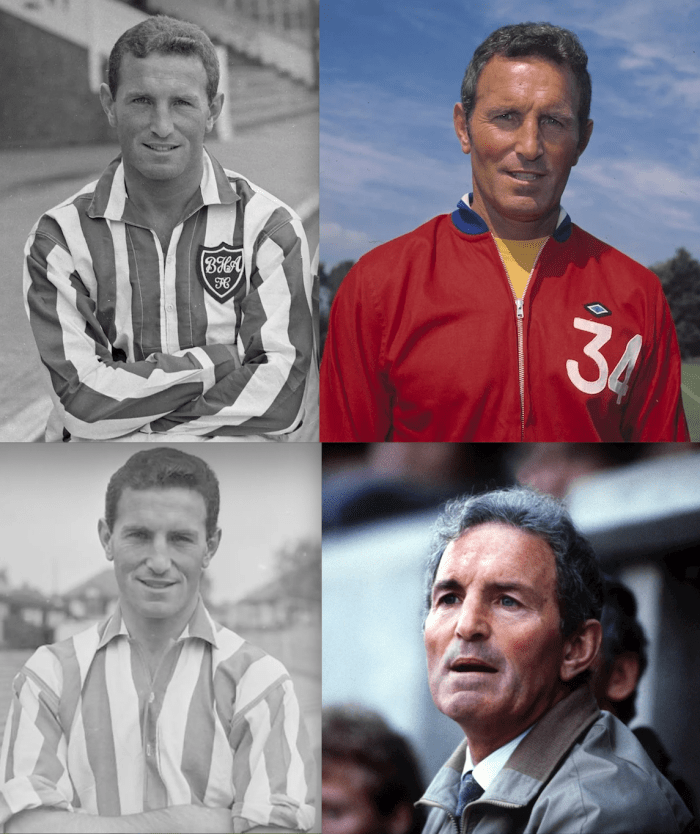
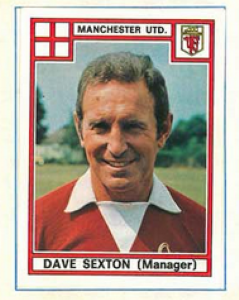
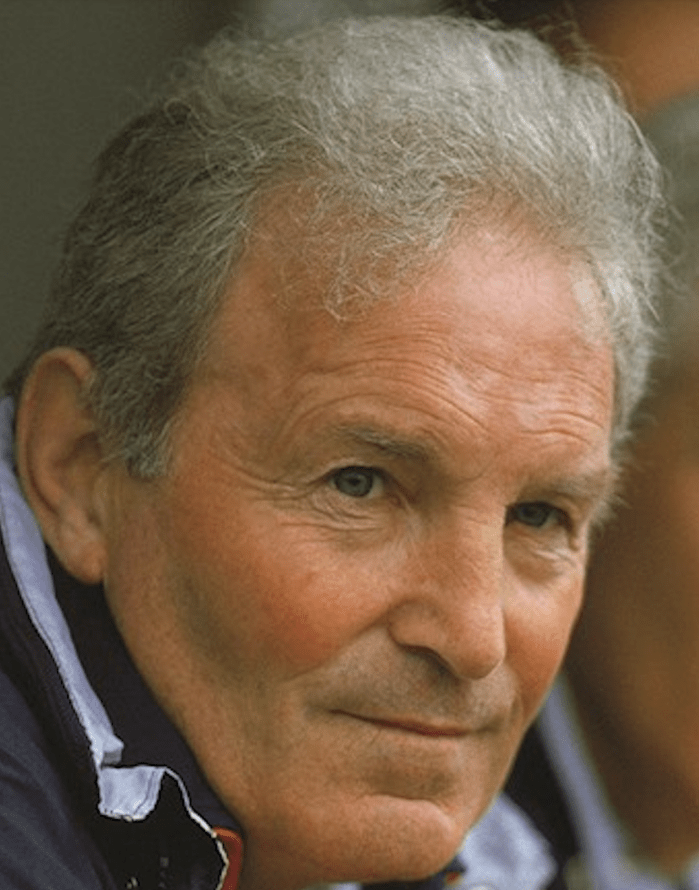
ALTHOUGH I wasn’t even born when Dave Sexton was winning promotion with Brighton, I remember him well as a respected coach and manager.

The record books and plenty of articles have revealed Sexton scored 28 goals in 53 appearances for Brighton before injury curtailed his playing career.

As a manager, he took both Manchester United and Queens Park Rangers to runners-up spot in the equivalent of today’s Premier League and won the FA Cup and European Cup Winners’ Cup with Chelsea.

On top of those achievements, he was the manager of England’s under 21 international side when they won the European Championship in 1982 and 1984, and worked with the full international squad under Ron Greenwood, Bobby Robson, Terry Venables, Glenn Hoddle, Kevin Keegan and Sven-Göran Eriksson.

Sexton coached under several England managers

On his death aged 82 on 25 November 2012, Albion chief executive Paul Barber said: “I know Dave was an extremely popular player during his days at the Goldstone Ground and, as a friend and colleague during my time working at the FA, I can tell you that he was held in equally high esteem.

“He was a football man through and through. I enjoyed listening to many of Dave’s football stories and tales during our numerous hotel stays with the England teams and what always came through was his great love and passion for the game.

“Dave was a true gentleman and a thoroughly nice man.”

Former West Ham and England international, Sir Trevor Brooking, who worked as the FA’s director of football development, said: “Anyone who was ever coached by Dave would be able to tell you what a good man he was, but not only that, what a great coach in particular he was.

“In the last 30-40 years Dave’s name was up there with any of the top coaches we have produced in England – the likes of Terry Venables, Don Howe and Ron Greenwood. His coaching was revered.”

Keith Weller, a £100,000 signing by Sexton for Chelsea in 1970, said: “I had heard all about Dave’s coaching ability before I joined Chelsea and now I know that everything said about his knowledge of the game is true. He has certainly made a tremendous difference to me.”

And the late Peter Bonetti, a goalkeeper under Sexton at Chelsea, said: “He was fantastic, I’ve got nothing but praise for him.”

One-time England captain Gerry Francis, who played for Sexton at QPR and Coventry City, said: “Dave was quite a quiet man. You wouldn’t want to rub him up the wrong way given his boxing family ties, but you wanted to play for him.

“Dave was very much ahead of his time as a manager. He went to Europe on so many occasions to watch the Dutch and the Germans at the time, who were into rotation, and he brought that into our team at QPR, where a full-back would push on and someone would fill in.

“He was always very forward-thinking – a very adaptable manager.”

Guardian writer Gavin McOwan described Sexton as “the antithesis of the outspoken, larger-than-life football manager. A modest and cerebral man, he was one of the most influential and progressive coaches of his generation and brought tremendous success to the two London clubs he managed.”

Born in Islington on 6 April 1930, the son of middleweight boxing champion Archie Sexton, his secondary school days were spent at St Ignatius College in Enfield and he had a trial with West Ham at 15. But, like his dad, he was a boxer of some distinction himself, earning a regional champion title while on National Service.

Sexton played 77 games for West Ham

However, it was football to which he was drawn and, after starting out in non-league with Newmarket Town and Chelmsford City, he joined Luton Town in 1952 and a year later he returned to West Ham, where he stayed for three seasons.

In 77 league and FA Cup games for the Hammers, he scored 29 goals, including hat-tricks against Rotherham and Plymouth.

It was during his time at West Ham that he began his interest in coaching alongside a remarkable group of players who all went on to become successful coaches and managers.

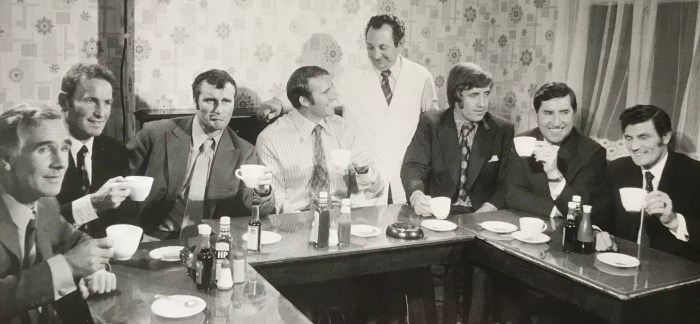
He, Malcolm Allison, Noel Cantwell, John Bond, Frank O’Farrell, Jimmy Andrews and Malcolm Musgrove used to spend hours discussing tactics in Cassettari’s Cafe near the Boleyn ground. A picture of a 1971 reunion of their get-togethers featured on the back page of the Winter 2024 edition of Back Pass, the superb retro football magazine.

One of the game’s most respected managers, Alec Stock, signed Sexton for Orient but he had only been there for 15 months (scoring four goals in 24 league appearances) before moving to Brighton (after Stock had left the Os to take over at Roma).

Albion manager Billy Lane bought him for £2,000 in October 1957, taking over Denis Foreman’s inside-left position. Sexton repaid Lane’s faith by scoring 20 goals in 26 league and cup appearances in 1957-58 as Brighton won the old Third Division (South) title. But a knee injury sustained at Port Vale four games from the end of the season meant he missed the promotion run-in. Adrian Thorne took over and famously scored five in the Goldstone game against Watford that clinched promotion.

Nevertheless, as he told Andy Heryet in a matchday programme article: “The Championship medal was the only one that I won in my playing career, so it was definitely the high point.

Sexton in Albion’s stripes

“All the players got on well, but a lot of what we achieved stemmed from the manager’s approach. It was a real eye-opener for me. We were a free-scoring, very attacking side and I just seemed to fit in right away and got quite a few goals. It was a joy to play with the guys that were there and I thoroughly enjoyed those two years.”

Because of the ongoing problems with his knee, he left Brighton and dropped two divisions to play for Crystal Palace, but he was only able to play a dozen games before his knee finally gave out.

“I suffered with my knee throughout my playing career,” said Sexton. “In only my second league game for Luton I went into a tackle and tore the ligaments in my right knee.

Knee trouble curtailed his Palace playing days

“I also had to have a cartilage removed. The same knee went again when I was at Palace. We were playing away at Northampton, and I went up with the goalkeeper for a cross and landed awkwardly, my leg buckling underneath me, and that sort of finished it off.”

In anticipation of having to retire from playing, he had begun taking coaching courses at Lilleshall during the summer months. Fellow students there included Tommy Docherty and Bertie Mee, both of whom gave him coaching roles after he’d been forced to quit playing.

Docherty stepped forward first having just taken over as Chelsea manager in 1961, appointing Sexton an assistant coach in February 1962. “I didn’t have anything else in mind – I couldn’t play football any more – so I jumped at the chance,” said Sexton. “It was a wonderful bit of luck for me as it meant that my first job was coaching some brilliant players like Terry Venables.”

The Blues won promotion back to the top flight in Sexton’s first full season and he stayed at Stamford Bridge until January 1965, when he was presented with his first chance to be a manager in his own right by his former club Orient.

Frustrated by being unable to shift them from bottom spot of the old Second Division, Sexton quit after 11 months at Brisbane Road and moved on to Fulham to coach under Vic Buckingham, who later gave Johan Cruyff his debut at Ajax and also managed Barcelona.

Perhaps surprisingly, Sexton declared in 1993 that the thing he was most proud of in his career was the six months he spent at Fulham in 1965. “Fulham were bottom of the First Division. Vic Buckingham was the manager. He had George Cohen, Johnny Haynes . . . Bobby Robson was the captain. Allan Clarke came. Good players, but they were bottom of the table, with 13 games to go.

“I did exactly the same things I’d been doing at Orient. And we won nine of those games, drew two and lost two – and stayed up. It proved to me that you can recover any situation, if the spirit is there.”

When Arsenal physiotherapist Mee succeeded Billy Wright as Gunners manager in 1966, he turned to Sexton to join him as first-team coach. In his one full season there, Arsenal finished seventh in the league and top scorer was George Graham, a player the Gunners had brought in from Chelsea as part of a swap deal with Tommy Baldwin.

When the ebullient Docherty parted company with Chelsea in October 1967, Sexton returned to Stamford Bridge in the manager’s chair and enjoyed a seven-year stay which included those two cup wins.

In a detailed appreciation of him on chelseafc.com, they remembered: “Uniquely, for the time, Sexton brought science and philosophy to football: he read French poetry, watched foreign football endlessly and introduced film footage to coaching sessions.”

In those days Chelsea’s side had a blend of maverick talent in the likes of centre forward Peter Osgood and, later, skilful midfielder Alan Hudson. No-nonsense, tough tackling Ron “Chopper” Harris and Scottish full-back Eddie McCreadie were in defence.

As Guardian writer McOwan said: “Sexton was embraced by players and supporters for advocating a mixture of neat passing and attacking flair backed up with steely ball-winners.”

I was taken as a young lad to watch the 1970 FA Cup Final at Wembley when Sexton’s Chelsea drew 2-2 with Leeds United on a dreadful pitch where the Horse of the Year Show had taken place only a few days earlier.

Chelsea had finished third in the league – two points behind Leeds – and while I was disappointed not to see the trophy raised at Wembley (no penalty deciders in those days), the Londoners went on to lift it after an ill-tempered replay at Old Trafford watched by 28 million people on television.

Sexton added to the Stamford Bridge trophy cabinet the following season when Chelsea won the European Cup Winners’ Cup final against Real Madrid, again after a replay.

But when they reached the League Cup final the following season, they lost to Stoke City and it was said Sexton began to lose patience with the playboy lifestyle of people like Osgood and Hudson, who he eventually sold.

The financial drain of stadium redevelopment, and the fact that the replacements for the stars he sold failed to shine, eventually brought about his departure from the club in October 1974 after a bad start to the 1974-75 season.

Sexton wasn’t out of work for long after parting company with Chelsea

He was not out of work for long, though, because 13 days after he left Chelsea he succeeded Gordon Jago at Loftus Road and took charge of a QPR side that had some exciting talent of its own in the shape of Gerry Francis and Stan Bowles.

Although the aforementioned Venables had just left QPR to work under Sexton’s old Hammers teammate Allison at Crystal Palace, Sexton brought in 29-year-old Don Masson from Notts County and he quickly impressed with his range of passing, and would go on to be selected for Scotland. Arsenal’s former Double-winning captain Frank McLintock was already in defence and Sexton added two of his former Chelsea players in John Hollins and David Webb.

Sexton said of them: “The easiest team I ever had to manage because they were already mature . . . very responsible, very receptive, full of good characters and good skills. They were coming to the end of their careers, but they were still keen.”

Sexton was a student of Rinus Michels and so-called Dutch ‘total football’ – a fluid, technical system in which all outfield players could switch positions quickly to maximise space on the field.

Loft For Words columnist ‘Roller’ said: “Dave Sexton was decades ahead of his time as a coach. At every possible opportunity he would go and watch matches in Europe returning with new ideas to put into practice with his ever willing players at QPR giving rise to a team that would have graced the Dutch league that he so admired.

“He managed to infuse the skill and technique that is a hallmark of the Dutch game into the work ethic and determination that typified the best English teams of those times.

“QPR’s passing and movement was unparalleled in the English league and wouldn’t been seen again until foreign coaches started to permeate into English football.”

His second season at QPR (1975-76) was the most successful in that club’s history and they were only pipped to the league title by Liverpool (by one point) on the last day of the season (Man Utd were third).

Agonisingly Rangers were a point ahead of the Merseysiders after the Hoops completed their 42-game programme but had to wait 10 days for Liverpool to play their remaining fixture against Wolves who were in the lead with 15 minutes left but then conceded three, enabling Liverpool to clinch the title.

Married to Thea, the couple had four children – Ann, David, Michael and Chris ­– and throughout his time working in London the family home remained in Hove, to where he’d moved in 1958. They only upped sticks and moved to the north when Sexton landed the Man Utd job in October 1977.

He once again found himself replacing Docherty, who had been sacked after his affair with the wife of the club’s physiotherapist had been made public.

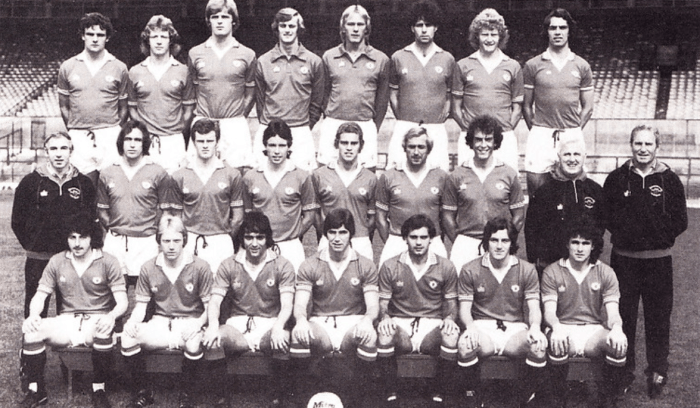
Sexton (far right) and the Manchester United squad

It was said by comparison to the outspoken Docherty, Sexton’s measured, quiet approach didn’t fit well with such a high profile club which then, as now, was constantly under the media spotlight.

The press dubbed him ‘Whispering Dave’ and although some signings, like Ray Wilkins, Gordon McQueen and Joe Jordan, were successful, he was ridiculed for buying striker Garry Birtles for £1.25m from Nottingham Forest: it took Birtles 11 months to score his first league goal for United.

Sexton took charge of 201 games across four years (with a 40 per cent win ratio) and he steered United to runners-up spot in the equivalent of the Premier League, two points behind champions Liverpool, in the 1979-80 season. United were also runners-up in the 1979 FA Cup final, losing 3-2 to a Liam Brady-inspired Arsenal.

As he said in a subsequent interview: “I really enjoyed my time at United. You are treated like a god up there and the support is fantastic. I had mixed success but it’s something that I wouldn’t have missed for the world.

“It’s tough at the top however and while other clubs would have been quite happy in finishing runners-up, it wasn’t enough for Man Utd. That’s the name of the game and I bear no grudges over it at all.”

As it happens, Sexton’s successor Ron Atkinson only managed to take United to third in the league (although they won the FA Cup twice) and it was another seven seasons before they were runners-up again under Alex Ferguson’s stewardship.

But back in 1981, United’s loss was Coventry’s gain and their delight at his appointment was conveyed in an excellent detailed profile by Rob Mason in 2019.

The new Coventry boss saw City beat United 2-1 in his first game in charge

“By the time the name of Dave Sexton was being put on the door of the manager’s office at Highfield Road the gaffer was in his fifties and a highly regarded figure within the game,” wrote Mason. “That sprang from the style of pass and move football he liked to play. His was a cultured approach to the game and Coventry supporters could look forward to seeing some attractive football.”

One of the happy quirks of football saw his old employer take on his new one on the opening day of the 1981-82 season – and the Sky Blues won 2-1! They won by a single goal at Old Trafford that season too, but overall away form was disappointing and in spite of a strong finish (seven wins, four draws and one defeat) they finished 14th – a modest two-place improvement on the previous season.

On a limited budget, Sexton struggled to get a largely young squad to make too much progress but he did recruit former England captain Gerry Francis, who’d been his captain during heady days at QPR, and he was a good influence on the youngsters.

Sexton’s second season in charge began well but ended nearly disastrously with a run of defeats leaving them flirting with relegation, together with Brighton. One of his last league games as City manager was in the visitors’ dugout at the Goldstone. Albion beat the Sky Blues 1-0 courtesy of a Terry Connor goal on St George’s Day 1983 – but it was Sexton’s side who escaped the drop by a point. Albion didn’t.

Coventry’s narrow escape from relegation cost Sexton his job (although he remained living in Kenilworth, Warwickshire) and it proved to be his last as a club manager, although he was involved as a coach when Ron Atkinson’s Aston Villa finished runners up in the first season (1992-93) of the Premier League – behind Ferguson’s United, who won their first title since 1967.

Villa beat United at home and nicked a point at Old Trafford and ahead of the drawn game Richard Williams of The Independent dropped in on a Villa training session to interview Sexton.

Sexton was happy to be working with the youth team, the young pros and the first team. “Mostly I’ve been concerned with movement, up front and in midfield. Instead of the traditional long ball up to the front men, approaching the goal in not such straight lines,” he explained.

The quiet Sexton had a valid retort to the reporter’s surprise that he should be working in the same set-up as the flamboyant Atkinson. “It’s like most stereotypes,” he said. “They’re never quite as they seem to be. Ron’s got a flamboyant image, but actually he’s an idealist, from a football point of view.

“He’s got a vision, which might not come across from the stereotype he’s got. I suppose it’s the same with me. I’m meant to be serious, which I am, but I like a bit of fun, too. And, obviously, the thing we’ve got in common is a love of football.”

Relieved to be more in the background than having to be the front man, Sexton told Williams: “The reason I’m in the game in the first place is that I love football and working with footballers, trying to improve them individually and as a team.

“So, to shed the responsibility of speaking to the press and the directors and talking about contracts, it’s a weight off your shoulders. Now I’m having all the fun without any of the hassle.”

Atkinson had invited his United predecessor to join him at Villa after he had retired from his job as the FA’s technical director of the School of Excellence at Lilleshall, and coach of the England under 21 team.

It had been 10 years since Bobby Robson had appointed him as assistant manager to the England team (Sexton had coached Robson at Fulham). He had previously been involved coaching England under 21s alongside his club commitments since 1977 leading the side to back-to-back European titles in 1982 and 1984. The 1982 side, who beat West Germany 5-4 on aggregate over two legs, included Justin Fashanu and Sammy Lee, and in a quarter final v Poland he had selected Albion’s Andy Ritchie, somewhat ironically considering he had sold him to the Seagulls when manager at United.

In April 1983, Albion’s Gary Stevens played for Sexton’s under 21s in a European Championship qualifier at Newcastle’s St James’ Park, which was won 1-0. The following year, Stevens, by then with Spurs, was in the side that met Spain in the final, featuring in the first of the two legs, a 1-0 away win in Seville. Somewhat confusingly, his Everton namesake featured in the second leg, a 2-0 win at Bramall Lane. England won 3-0 on aggregate. Winger Mark Chamberlain, later an Albion player, also played in the first leg.

After the Robson era, Sexton worked with successive England managers: Venables, Hoddle and Keegan. When Eriksson became England manager in 2001, he invited Sexton to run a team of scouts who would compile a database and video library of opposition players – a strategy Sexton had pioneered three decades previously.

Viewed as one of English football’s great thinkers, Sexton had a book, Tackle Soccer, published in 1977 but away from football he had a love of art and poetry and completed an Open University degree in philosophy, literature, art and architecture. He was awarded an OBE for services to football in 2005.

Sexton was always a welcome guest at Brighton and here receives a reminder of past glories from Dick Knight

Calderwood’s switch to promotion rivals backfired

Hughton’s not so loyal assistant

SCOTTISH international Colin Calderwood played for and managed Nottingham Forest in a lengthy playing and managerial career that has spanned a host of clubs across the country.

His 21 months as assistant manager to Chris Hughton at Brighton came to an abrupt end that drew harsh criticism at the time but thankfully didn’t hinder Albion’s upward trajectory.

Calderwood worked under Hughton at three other clubs: Newcastle United, Birmingham City and Norwich City.

The pair first met on the same A licence coaching badge course and Hughton was later a coach at Tottenham when Calderwood was a player. He then played a part in Calderwood becoming reserve team coach at White Hart Lane after his playing days were over.

Calderwood went on to become a manager in his own right at League Two Northampton Town, where he got them promotion at the end of his second season (in 2006).

Two and a half years as boss at Forest followed, during which he got them promoted from League One to the Championship. In 2007-08, his Foest side took four points off the Albion, winning 2-0 at Withdean but being held to a goalless draw at home.

Forest were promoted in second place behind champions Swansea City (Albion finished seventh) but Calderwood was sacked just before Christmas in 2008 with the side struggling in the Championship relegation zone.

When Hughton succeeded Sami Hyypiä at the start of 2015, it wasn’t long before he turned to trusted ‘lieutenant’ Calderwood to help Albion’s cause.

The no.2 had first worked with him at Newcastle in 2009 when, after relegation from the Premier League, the pair led the Magpies back to the elite as Championship champions in 2010.

Hibernian in Edinburgh lured him to try a third spell as a no.1 but, after just 13 months in charge, and only securing 12 wins from 49 matches, he was sacked. He was not out of work for long, moving later the same month to Birmingham to become Hughton’s assistant at the Championship side, where another of Hughton’s backroom team, Paul Trollope, was first team coach.

When Hughton left for Premier League Norwich in June 2012, Calderwood, Trollope and chief scout Ewan Chester (who also later joined him at Brighton) all decamped to Carrow Road. City dispensed with their services in April 2014.

Having helped steer Albion to the Championship promotion near-miss of 2015-16 (when they suffered the agonising play-off semi-finals defeat to Sheffield Wednesday), the Seagulls were well geared up to go one better the following season.

So it came as something of a shock when Calderwood quit in November 2016 to become assistant manager to Steve Bruce at promotion rivals Aston Villa.

Hughton was said to be “very disappointed” and “very surprised” by his assistant’s departure, “particularly at this stage of the season”. Albion watcher Andy Naylor reckoned that amounted to a “withering condemnation” from the normally placid manager.

In an excoriating article for the Argus, Naylor wrote: “He clearly feels let down – and he is entitled to feel that way. Is there any justification for treating Hughton the way he has?”

It emerged that the move gave Calderwood a much shorter daily commuting distance from his home in Northampton, but, even so, Naylor reckoned Hughton deserved better.

Thankfully, there was a ready-made replacement in the wings because Trollope had just lost his job at Cardiff City.

Naylor wrote: “Trollope is in the right place at the right moment to bring his promotion-winning mentality as both a player and manager into the camp. Let’s hope he demonstrates more loyalty than Calderwood.”

Perhaps it was the supreme irony that as Albion marched to promotion from the Championship the following spring, the side Calderwood had moved to only finished in 13th place – although the last-game draw at Villa stymied Albion’s chances of going up as champions.

Nevertheless, there were no bitter recriminations on Calderwood’s part. “Chris did a terrific job turning around the shape and the balance of the team,” he recalled in an interview with the Argus in January 2021.

Ahead of his subsequent club Blackpool’s visit to the Amex for a fourth round FA Cup tie (Albion won 2-1), the former assistant boss said: “We found, as I’ve found at most clubs I’ve been at, there’s a core group of players that have an appetite and an ability level that can give you a chance of success.

“When it falls into place, it is really nice to watch and it is very heart-warming and you feel justified in what you preach and practice.

“A lot of the time you are determined by the quality of the person and the player within the club. We found some really good people down there.”

Born on 20 January 1965 in Stranraer, Calderwood didn’t play professionally in Scotland, instead joining Mansfield Town as a 17-year-old in 1982.

He realised in hindsight that he learned a lot from Town’s manager at the time, the experienced Ian Greaves, and he went on to play over 100 matches for the Stags before Swindon Town boss Lou Macari signed him for £27,500 in 1985.

“Ian and Lou were the ones that built the foundations of my career,” he told the Albion matchday programme.

The centre back spent eight seasons at the County Ground and is recognised as a Swindon legend having featured in 412 matches (plus two as a sub).

At only 21, he was made club captain and, despite a difficult start, led Town to back-to-back promotions as they won the Division Four title in 1986 and overcame Gillingham in a Division Three play-off final replay in 1987.

Promotion winner with Swindon Town

Calderwood was said to be “a rock at the heart of the defence” and eventually led Town to their first promotion to the top-flight, after beating Sunderland in the play-off final at Wembley in 1990. But Swindon were demoted due an irregular payments scandal in which Calderwood was implicated: he was arrested just four weeks before the Wembley match but released the same day without charge.
Calderwood missed five months of the 1990-91 season following a horror tackle by Wolves legend Steve Bull but he returned stronger than ever and was ever present when, under Glenn Hoddle, Swindon were promoted at the end of the 1992-1993 season, beating Leicester 4-3 in the play-off final.

But instead of featuring for Swindon in the Premiership, Town’s former manager Ossie Ardiles took him to Tottenham for a fee of £1.25 million.

Playing in the top division for Spurs earned him international recognition. He made his Scotland debut aged 30 in a Euro 1996 qualifier against Russia and was a regular under Craig Brown, winning 36 caps in four years, including playing at the 1998 World Cup.

According to Spurs fan website mehstg.com (My Eyes Have Seen The Glory), Calderwood was “a solid defender, who could tackle and was good in the air, but lacked the pace and distribution skills to be a top class centre half.

“Calderwood gave Spurs a tough presence in the middle of the back four they had been missing for some time and showed that Ardiles’ judgement had been sound.”

After 198 appearances for Spurs (more than 150 in the Premier League), he left White Hart Lane in March 1999 when a £230,000 move saw him join Aston Villa under John Gregory. A year later, he switched to David Platt’s second tier Forest for £70,000.

He had only been at Forest a month when, ironically at Birmingham’s St Andrews ground, Calderwood, by then 35, suffered an injury that would ultimately force him to retire.

Forest goalkeeper Dave Beasant had already been injured in a clash with City’s Jon McCarthy earlier in the game but recovered. Calderwood wasn’t so fortunate. He ended up being stretchered off after a collision with the same player. He had fractured his leg and dislocated his ankle, causing ligament damage.

The injury overshadowed Forest’s 1-0 win and it meant he played only a handful of games at the City Ground. He later had a brief spell on loan at neighbours Notts County before calling it a day.

Calderwood initially returned to Spurs as reserve team manager before leaving for Northampton in October 2003. Spurs director of football and caretaker manager, David Pleat, said: “Colin leaves us with our very best wishes. He’s had two-and-a-half years here as a coach which I’m sure has been valuable experience.

“Colin is young, he has energy, ideas and, most importantly, ambition. This could be a terrific apprenticeship for him and everyone at the club wishes him well in his new role.”

Fast forward 15 years, and after he left Villa along with Steve Bruce in October 2018, two months later he was back in the game at League Two strugglers Cambridge United. He was given an initial 18-month contract and a year later he was given a two-year extension on his deal.

However, after a 4-0 home defeat to Salford City in January 2020 which meant Cambridge had taken only one point from their previous six games, he was sacked.

In October that year he was taken on at Blackpool as part of Neil Critchley’s managerial team and was part of the set-up that saw the Tangerines win a place in the Championship in 2021.

In June 2021 Calderwood returned to his old club Northampton as assistant manager to Jon Brady, and he told the League Two club’s website: “I have learned a lot in the years since I was last at the club and hopefully I can put all of that experience to good use.

“The situation here is similar to the situation I arrived in at Blackpool in working with a talented young manager.
“I have spoken with Jon Brady a number of times, that relationship will build quickly and I am really looking forward to working with him and the rest of the coaching staff.”

The Cobblers finished fourth in League Two and made it through to the division’s play-off semi-finals where they lost 3-1 on aggregate to Calderwood’s first club, Mansfield.

They made up for it in 2022-23 when they earned automatic promotion in third place behind Leyton Orient and Stevenage.

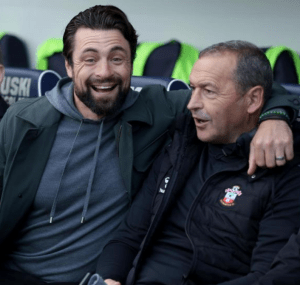
Nevertheless, in October 2023, Calderwood returned to Championship level as part of Russell Martin’s backroom team at Southampton.

Teaming up with Russell Martin

“First and foremost, he’s a brilliant human being. I really trust him and know him very well,” Martin told the Daily Echo

“We worked together at Norwich many moons ago when he was the assistant manager. I used to moan all the time to him and he had a brilliant way of being able to deal with that.

“He just has a great relationship with the players, and he’s a coach throughout my career who I’ve stayed in real constant contact with and discussed football.

“We’ve spoken a lot even when he’s not worked with me. I tried to get him at my two previous clubs and it couldn’t quite happen for various reasons.

“He’s been a manager, an assistant manager, he’s helped some young managers recently get promoted in Neil Critchley and Jon Brady, and added huge experience and value to them.”

When the ball hits the goal it’s not Shearer or Cole it’s Zamora!

EVERY NOW AND AGAIN as a football supporter a truly special player stands out well above the rest you’ve watched. Bobby Zamora was most definitely in that category.

As the new year dawns on what will be my 55th year supporting Brighton & Hove Albion, it is perhaps fitting to spend a little time remembering just how good Zamora was for the Seagulls before his outstanding ability to score goals was taken to higher levels: Tottenham Hotspur, West Ham, Fulham and ultimately, and, quite deservedly, England.

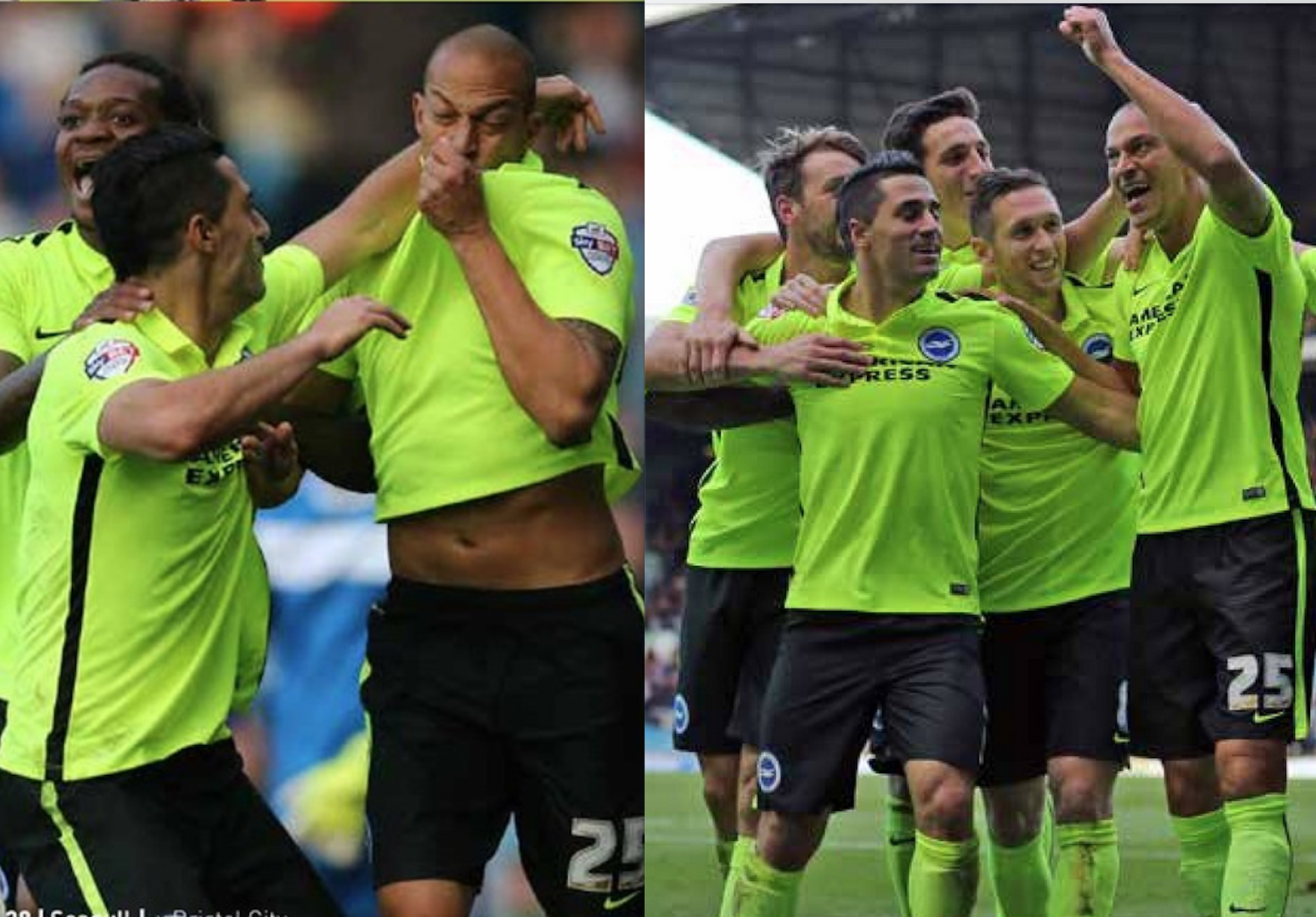
That he came back to the Albion from QPR as his career began to ebb was nothing short of a bonus­ – and, while I’m not a big gambler, I was delighted to get a modest return from the bookies when my punt on him being the last goalscorer came good after he had gone on as a sub at Elland Road on 15 October 2015 and chipped the winner (below) to register his first goal since rejoining!

“That goal was definitely the highlight of my season,” Zamora told interviewer Adam Virgo in a Seagulls World interview. “It was my first goal since coming back and to score the winner so late in the game was unbelievable. It was a special moment for me, and it settled the nerves knowing that we’d got the three points.”

Just four days later, Zamora repeated the feat going on as a 76th-minute substitute for Tomer Hemed at home to Bristol City and beating goalkeeper Frank Fielding with a low shot from 15 yards out. Albion won 2-1; Sam Baldock having levelled things up against his former club after Derrick Williams opened the scoring for City.

Unfortunately, Zamora managed just five more in that second spell. He made 10 starts plus 16 as a sub in Chris Hughton’s side but he was struggling with a hip injury.

It eventually caught up with him and prevented him from contributing further to Albion’s aim of promotion back to the elite; his last game being as a sub in a 0-0 draw at home to Sheffield Wednesday on 8 March 2016. “If I was fit, I would have scored some goals and we’d have been promoted automatically,” he told the UndrThe Cosh podcast (pictured above).

Thankfully another returning striker in the shape of Glenn Murray completed that task the following season and went on to cement his own place in Albion’s history: his 111 goals in 287 appearances putting him second in the list of Brighton’s all-time top goalscorers.

Golden goalscorers: Zamora + Murray

Each of the different eras I’ve watched the Albion has thrown up truly memorable players who have generated their own air of excitement and anticipation because of the goals they scored.

The first one for me was Alex Dawson, who netted seven in the first five games I watched in 1969. Then along came Willie Irvine whose goalscoring in third tier Albion’s promotion-winning season of 1972 earned him an unexpected recall to the Northern Ireland side – and an appearance (that I went to watch) in a 1-0 win against England at Wembley.

Next, of course, was the truly outstanding Peter Ward, who jinked his way past defenders with apparent ease and scored goals for fun, his 36 goals in 1976-77 smashing a decades-old record. Like Zamora, he came back to the scene of past glories (albeit only on loan) and scored a magnificent winner against the team he supported as a boy, Manchester United.
Garry Nelson, with 32 goals, and Kevin Bremner were a superb front pair in another third tier promotion-winning line-up in 1988 while, in 1990-91, Mike Small and John Byrne combined brilliantly to take the Seagulls within a hair’s breadth of a return to the big time.

The arrival of a beanpole of a kid with an eye for goal in Zamora completely transformed Albion’s fortunes under Micky Adams and he was the talisman in back-to-back promotions following years in the doldrums.

Zamora’s Albion story is pretty well known but let’s remind ourselves of how it all began.

Depending on whose account you believe more, it was either Dick Knight or Adams who had the foresight to bring Zamora to the Withdean.

Adams said: “The first time I saw him he came onto the training ground; he looked like a kid. But he was tall and gangly with a useful left foot; there was potential there.”

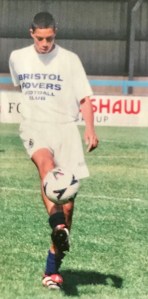
In fact, Zamora might never have arrived in Sussex if Albion had been successful in securing a permanent deal for on-loan Lorenzo Pinamonte. When Brentford outbid Brighton for the services of the Bristol City loanee, Albion turned their attention to Zamora (left), a Bristol Rovers player who was only getting sub appearances under Ian Holloway but had scored eight goals in six games on loan at nearby non-league Bath City.

“He was six foot one and we knew he had a very good first touch and could hold the ball up well, the type of player we wanted,” Knight recounted in his autobiography Mad Man: From The Gutter to the Stars (Vision Sports Publishing, 2013).

Zamora duly arrived on loan and scored six in six matches (including a hat-trick in a 7-1 away win at Chester). He scored an equaliser and was named Man of the Match on his debut v Plymouth and by the end of February was Player of the Month.

Hat-trick ball at Chester

While Knight and Adams wanted him to stay, he insisted on returning to Rovers where he thought he might force his way into Holloway’s starting line-up. But it was back only to the bench as Nathan Ellington, Jason Roberts and Jamie Cureton were ahead of him in the pecking order.

As preparations began for the new season, Albion offered £60,000 for Zamora but Rovers chairman Geoff Dunford wanted £250,000. An incredulous Knight said he wouldn’t go higher than £100,000 and couldn’t believe they could demand such a figure for someone who hadn’t actually started a first team game.

Zamora had Rovers’ youth team coach Phil Bater to thank for forcing through the move. He accompanied the shy youngster into a meeting with Holloway, who tried to say he’d get some games if he stayed. Bater reckoned the youngster was being strung along and argued Zamora’s cause saying he stood more chance of playing if Rovers let him join the Albion.

After some brinkmanship from each club’s respective chairmen, with Knight threatening to walk away from the deal, it finally went through two days before the start of the season, although Albion’s chairman reluctantly agreed to a 30 per cent sell-on clause for the player.

Zamora instantly became one of the top earners on £2,000 a week with a goal bonus built in.

“It was an absolute coup that we had finally secured this player,” said Knight. “I could only see good things in him, could only see that he would be a huge asset to us.

“Football is all a matter of opinions. There is little science to it. For me, Zamora was the best signing I ever made.”

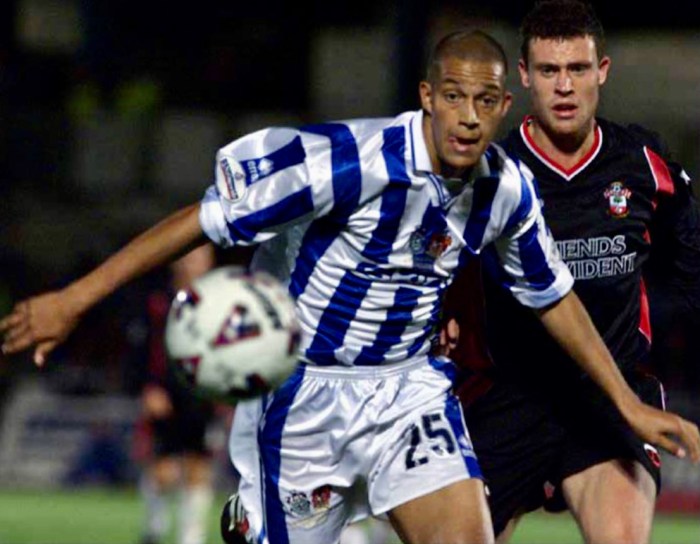
Zamora has eyes on the ball closely watched by a young Wayne Bridge for Southampton

Not only did Zamora manage to score 31 goals as Albion won promotion from the basement division, he went one better when they went straight to the top of the third tier the following season, netting 32 times in 46 matches.

A significant number of those goals came courtesy of Zamora’s excellent understanding with left-footed right-back Paul Watson, of whom he said: “He created a lot of goals for me with those quick free kicks. He didn’t put a foot wrong too often and was very underrated. He never got the credit his hard work deserved.”

Expanding on it in another interview, he said: “Whenever Watto got the ball I knew precisely where I needed to run to and he knew where to deliver it. It was such a great connection: Watto has an absolutely wonderful left foot and it made my job as a striker so much easier when you get deliveries like that.”

Declaring that even in the Premiership he hadn’t come across anybody with a better left foot, he added: “I was very lucky to have played in the same team as him; he created numerous goals for me; not only with his deliveries but with his intelligent play as well.”

Watson had arrived at the club with Charlie Oatway and was part of a cluster of players who had served under Adams at Brentford and Fulham. When Adams and assistant Bob Booker steered Albion to promotion as fourth tier champions, Zamora was player of the season and he and Danny Cullip were named in the PFA divisional XI.

Not long into the following season, the lure of taking over as manager at a Premier League club saw Adams quit Brighton, initially to become Dave Bassett’s no.2 at Leicester City, but with the promise of succeeding him.

“While I thought I had a shot at another promotion, it wasn’t a certainty,” Adams explained. “I knew I had put together a team of winners, and I knew I had a goalscorer in Bobby Zamora, but football’s fickle finger of fate could have disrupted that at any time.”

His successor, Peter Taylor, knew how fortunate he was to inherit an experienced squad, and said: “Of course the greatest asset we had was Bobby Zamora. Having him meant that we could play a front two at home and away from home we could play him on his own and he would still get us a goal out of nothing. He was an incredible player and miles too good for that level.”

And Zamora wasn’t only a star on the pitch, as Knight spoke about in his autobiography. “When he was at his zenith at Brighton, the requests we got for him to visit schools, hospitals and go to prize-givings far outweighed all the other players together, but he was always amenable. He was never starry, never refused. I couldn’t speak more highly of Bobby Zamora as a person.”

Knight recounted in his book how, after a 1-0 win at Peterborough, when Zamora missed a penalty but also scored the only goal of the game, Albion’s promotion to the second tier was confirmed and in his own inimitable way Posh boss Barry Fry said to Brighton’s star striker: “You’re a fucking great player and you’ll play for England one day, I’m fucking sure of it.”

Zamora was still only 21 when Tottenham signed him from relegated Brighton in July 2003. He left the south coast having scored a total of 83 goals in 136 appearances but in his last season in the stripes he netted just 14 as the Seagulls battled unsuccessfully to retain their tier two status.

Unfortunately, he missed eleven matches with a dislocated shoulder and, had former Premier League striker Paul Kitson been fit to play alongside him (he managed only seven starts plus three off the bench), the season may well have had a different outcome.

Everton’s Bill Kenwright had offered £3m for Zamora during the season but their manager Walter Smith seemed less convinced and, with Kevin Campbell and Wayne Rooney likely to be ahead of him, Zamora stayed in Sussex.

But chairman Dick Knight promised not to stand in his way if an opportunity was presented at the end of the season and that came from Tottenham. Manager Glenn Hoddle and assistant Chris Hughton had been to see Zamora in action at the Withdean on a number of occasions.

Spurs chairman Daniel Levy played hardball over the deal. Eventually, Knight settled on a £1.5m fee but, because of the original sell-on clause, £450,000 was due to Bristol Rovers.

Hoddle told The Guardian: “He has got good pace and great movement on and off the ball. No disrespect to Brighton, they have got a good team down there, but we have got players here who can make the most of his movement.”

The player’s agent Phil Smith told the newspaper: “The fee for Bobby is £1.5m which is a decent price in today’s market for a Second Division striker.

“It has been a long time coming for Bobby but he is delighted to be going into the Premiership. It has always been an ambition.”

Disappointed Albion manager Steve Coppell observed: “It is a big move for Bobby and nobody really expected we could hang onto him for much longer. But it has blown a big hole in any plans I had. I don’t have a better option than playing with Bobby Zamora up front.”

When he arrived at Spurs, one of the senior pros who took him under his wing was none other than Gus Poyet.

“As a young guy coming into the team, he was one of the senior pros who would always talk to me and encourage me,” Zamora told the matchday programme. “He didn’t have to do that, but he went out of his way to do so and you could see he had coaching qualities. He would often point things out on the pitch that you’d pick up on, and when he spoke, you’d listen.

“He wasn’t starting every game either, so in training I did more things with him than maybe the rest. I really got on well with him.”

As it turned out, Zamora made only 18 appearances for Spurs (11 as a substitute) and only scored once – ironically a single goal that knocked West Ham out of the Carling Cup in October 2003.

In January 2004, Spurs chose to use him as a makeweight in taking Jermain Defoe from the Boleyn Ground to White Hart Lane.

Phlegmatic Zamora didn’t look on it as a failure but embraced the “learning curve” of training alongside the likes of Poyet, Robbie Keane, Darren Anderton and Jamie Redknapp.

“I came away a better player and with more experience,” he said. “Glenn Hoddle had signed me and then he got sacked not long afterwards. David Pleat took charge and we didn’t really see eye-to-eye, but the lads and the club were brilliant and I learned so much from my time there.

“I took a chance by stepping back down to the Championship with West Ham – but it was the opportunity of playing regular football again that was the pull for me.”

The moment Lee Hendrie felt ten feet tall at Brighton

SKY SPORTS pundit Lee Hendrie has reached heights and plumbed depths in a life that saw him stop off at third-tier Brighton in 2010 after 17 years with Aston Villa.

Hendrie was something of a forgotten man of football when Gus Poyet snapped him up for the Seagulls on loan from Derby County in March 2010.

Hendrie featured in eight Albion games in the last six weeks of the season: four wins, two draws and two defeats.

Turning out in League One was quite a fall for a player Glenn Hoddle selected for England, but he told the matchday programme: “The main thing is to play football. If you’re not playing then you tend to get forgotten but hopefully I can get some game time between now and the end of the season.”

And he later said to football.co.uk: “I went to Brighton to get my face back out there. Gus Poyet was brilliant. He got the lads together in a circle and said, ‘******* hell, we’ve got Lee Hendrie here’. Let me tell you, after feeling so unwanted I suddenly felt 10 feet tall.”
Hendrie made his debut as a 75th minute substitute for Sebastien Carole in a 3-0 home win over Tranmere Rovers, and he told the matchday programme: “We could have had more than three goals and I should have scored.”

But Hendrie was bubbling after his involvement and said: “Listening to the gaffer in the changing room, you can see why the lads are playing with a lot of confidence and have improved so much.

“I’ve played under a few managers, but not many, can I say, are like Gus, who is so enthusiastic and tells the players to go and enjoy themselves. There is nothing a player wants more than a gaffer telling you to enjoy your game.”

Of Albion’s midfield triumvirate of Gary Dicker, Alan Navarro and Andrew Crofts, it tended to be Dicker who was edged out by Hendrie’s arrival.

However it was in Crofts’ place that the loanee got his first start, in a 2-0 Easter Monday defeat at Hartlepool in which former Albion loanee ‘keeper Scott Flinders prevented the visitors from leaving with a point. Hendrie was subbed off on 58 minutes when Kazenga LuaLua took over.

Hendrie went on as a sub for Dicker in the following home game against Carlisle United and it was his cross that set up what looked like a late equaliser by Tommy Elphick, only for Gary Madine to nick all three points with a second for United two minutes from the end.

Hendrie started in place of Dicker away to Gillingham but gave way to the Irishman in the 79th minute and the game ended 1-1. Hendrie started once again in the 1-0 win away to Southend, but Dicker replaced him on 65 minutes.

Hendrie’s third successive start in place of Dicker came at home to Bristol Rovers, when Albion won 2-1, but once again he didn’t last the 90 minutes as Dicker took over on 74 minutes.

In the penultimate game of the season, away to MK Dons, the game finished goalless although Alex Rae and Diego Arismendi were red carded for brawling. Hendrie started and Dicker replaced him on 58 minutes.

The on-loan midfielder’s only full 90-minute appearance came in the last game of the season when Yeovil were beaten 1-0 at the Withdean Stadium; Elliott Bennett scoring the only goal of the game a minute before half-time.

The chances of a permanent deal for Hendrie looked unlikely with Poyet admitting: “We were very pleased with him and he was pleased to be here. We will wait to see if, when we start putting the squad together, there is a possibility of it happening. It’s not an easy one, because of the wages.”

Born in Solihull on 18 May 1977, football was in Hendrie’s blood: Scottish dad Paul had played for Villa’s arch rivals Birmingham City and he was playing professionally for Portland Timbers at the time his son was born. He later played for Bristol Rovers, Halifax Town and Stockport County.

For someone who became Villa through and through, Hendrie admitted to the Birmingham Mail that he had actually been at city rivals Birmingham’s school of excellence before ‘Big’ Ron Atkinson snapped him up as a teenager.

As well as his dad having played for them, his nan was a City season ticket holder and his uncle also supported them. “Villa didn’t come and scout me at the time and Blues were the first club that did. It was an opportunity for me to get myself into the pro ranks and see what it was all about. Dad said it would be good to go and have a feel for it, which I did.”

But ever since he’d scored two goals in a schools’ cup final victory for his school, Washwood Heath, against Hodge Heath at Villa Park, he had dreamed of playing for Villa.

The dream came closer when Hendrie signed on the dotted line as a 14-year-old at Villa’s Bodymoor Heath training ground, although he remembers his dad tempering his excitement.

“When we came out after I’d signed, I’d got given a load of training clobber and I thought this was it, I’d made it,” he said. “My dad said: ‘Take a step back, you, you ain’t got anywhere yet, this is the start of a long road. Just because you’ve got all the kit it doesn’t mean you’re a professional footballer and an Aston Villa player – relax yourself’.”

Hendrie and his best mate Darren Byfield, who had been strike partners in Erdington Star and Erdington & Saltley district team as kids, developed a reputation as a dynamic duo on and off the pitch, and soon became Atkinson’s ‘teacher’s pets’.

Atkinson converted Hendrie from a centre forward to left winger (even predicting he’s one day play for England in that position) and the duo continued to do well for the Villa youth team.

As it turned out, it was Atkinson’s successor, Brian Little, who ended up giving Hendrie his first team debut – although it was memorable for all the wrong reasons!

It came two days before Christmas in 1995 when he went on as a 33rd minute substitute for Mark Draper away to Queens Park Rangers. He collected a yellow card for kicking the ball away and was red carded in stoppage time; a second booking for an innocuous foul on Rufus Brevett. Into the bargain, Villa lost 1-0.

A devastated Hendrie revealed it was the opposition player-manager, Ray Wilkins, rather than Little, who put a comforting arm round him. “Someone who I’ve seen play football, a legend of the game, to come and console me and say: ‘This is football, welcome to football, these are the ups and downs you’re going to have in your career’.

“He said there’s lot of people who are talking highly of you, you’ve got a big future in the game, kid. As he got up, he tapped my shoulder and said: ‘Keep that up’.”

Few subsequent chances were given to him under Little but, when John Gregory took over, he became more established.

He would go on to make a total of 308 appearances for Villa (243 league and cup starts), scoring 32 goals, with his best performances coming in Gregory’s tenure. He wasn’t quite the same player under Graham Taylor or David O’Leary.

It was on November 18 1998 that he won his one and only England cap, sent on by Glenn Hoddle as a 77th minute substitute for Villa team-mate Paul Merson in a 2-0 win over the Czech Republic at Wembley. Two other Villa teammates, Dion Dublin and Gareth Southgate, were also part of Hoddle’s squad.

Unfortunately for Hendrie, Hoddle was sacked two months later and no subsequent England bosses called on him. “It’s a regret that I didn’t go on and make more of my England career,” he said. “It’s great that I’ve got a cap and it’s something you can’t take away from me, but I hate being classed as a one-cap wonder.”

Hendrie’s days at Villa came to an end in August 2006, his last involvement being from the bench in Martin O’Neill’s first match in charge, a 1-1 Premier League draw at Arsenal on the opening day of the 2006-07 campaign.

While Hendrie, by then 30, was excited about playing for O’Neill, the new boss had other plans and told him he was not part of them.

Initially he joined Stoke City under Tony Pulis on a season-long loan but Bryan Robson at Sheffield United outbid the Potters for his services on a permanent basis, and he signed a three-year deal at Bramall Lane at the start of the 2007-08 season.

Unfortunately, when Robson swiftly parted company with the Blades, Hendrie didn’t see eye to eye with his successor, Kevin Blackwell, who accused the player of being a money-grabber.

“Sheffield United was just the worst thing I could have done,” he told the Claret & Blue podcast.

“Kevin Blackwell was one of the worst managers I have ever, ever been under. He put the nail in the coffin for (my career).”

Blackwell sent him on loan to Leicester City, where he played nine games, and he later went to Blackpool too. United moved him on to Derby County but when he struggled for games there, he joined Brighton.

If the spell at Brighton was a temporary relief from his mounting problems, he revealed in a Guardian interview with Donald McRae that 2010 turned out to be one of the worst years of his life, and he attempted suicide on several occasions.

A property empire he had built up amassed insurmountable debts which even saw his mother’s home repossessed. He lost his own house as well, and it sent him into depression. Divorce and bankruptcy made the situation even worse.

“The football was almost over and my head was gone. I’d been trying to sell property, but the housing market crashed,” he said. “I got to the stage where I just wanted to end it all. I’d hit rock bottom.”

The ups and downs of Hendrie’s colourful life have featured in various media interviews.

The rise and fall tale was charted by the sporting.blog and Hendrie’s spoken about his troubles on Sky Sports, where he later became a pundit.

He was in tears on Harry’s Heroes: Euro Having A Laugh discussing his depression struggles with Vinnie Jones. The BBC radio programme You and Yours highlighted his plight in a March 2013 episode.

On the footballing front, a brief spell at Bradford City was followed by a host of short stopovers at Bandung (2011), Daventry Town (2011), Kidderminster Harriers (2011-12), Chasetown (2012), Redditch United (2012) and Tamworth (2012-13) before he retired as a professional.

He then played for Corby Town (2013), Highgate United (2013), Basford United (2013 – 2015), Montpellier (2016-17), Redditch United (2016), Nuneaton Griff (2019) and Highgate United (2019) on a non-professional basis.

As he tried to find a new purpose in life, alongside his media work, Hendrie set up FootieBugs, a football academy for kids aged from three to 12.

Hendrie chats on TV with Dion Dublin, a former Villa teammate

Fate dealt blows throughout Essex lad David Lee’s career

IT MAY simply have been David Lee’s misfortune that he joined Brighton at a time when they weren’t short of decent midfield players.

Nevertheless, a player who had gone through the ranks at Spurs alongside the likes of Peter Crouch and Ledley King might have been expected to make more of an impression.

As it was, the manager who signed him moved on and he ended up starting just one league game in two and a half years with the club.

Ultimately a horror injury brought a premature end to Lee’s career at the age of 28, but he stayed in the game as an agent – Lewis Dunk being one of his clients.

It was in January 2002 that Peter Taylor, a one-time Spurs player himself, brought Lee to the Albion from Hull City in direct exchange for fringe player Matthew Wicks.

Taylor had been close to signing him when he was manager of Gillingham but, after moving on to Leicester City, Taylor recommended him to Southend United instead.

By the time Lee arrived at the Albion, they were already on an upward trajectory towards promotion from the third tier and he had to be content largely with reserve team football and a seat on the first-team subs bench.

The first Albion fans got to see of him came on 23 February 2002 at home to Wrexham when he went on as a 23rd minute substitute for Gary Hart alongside inexperienced Chris McPhee, who was playing in the absence of goal king Bobby Zamora.

Wrexham brought Albion’s run of five straight home wins to an end in what the Argus described as “a dour deadlock” and in the process became the first side to stop the Seagulls from scoring at Withdean Stadium for 13 months.

In fact, sharper-eyed Albion watchers might have recognised the newcomer as a player who’d scored against the Seagulls twice the previous season.

He marked his debut for Southend in the opening match of the 2000-2001 season with an 83rd-minute second goal that sealed a 2-0 win for the home side.

Then, in the reverse fixture, he scored again as United completed the double over the Seagulls on a quagmire of a pitch at Withdean on New Year’s Day 2001. On that occasion, Lee went on as a 77th minute substitute for Ben Abbey and scored five minutes later as the Shrimpers again won 2-0.

Described by Spurs history website ‘My Eyes Have Seen The Glory’ as “a slightly built, but athletic midfielder, who had an eye for an attacking option as he used his passing to try and open up opposition defences”, Lee spent a season at Roots Hall, initially under Alan Little, scoring 10 goals in 52 games. “I played nearly every game so it couldn’t have gone much better really,” Lee told the Basildon Canvey and Southend Echo.

But after just one season with Southend, Lee joined Division Three Hull City, managed by previous manager Little’s brother Brian (better known for his time in charge of Leicester and Aston Villa). It was a decision Lee later rued.

“Looking back, I do regret it,” he said. “I left because the (Southend) manager Dave Webb said he thought I’d had a good season and that Leicester were interested in me.

“My form wasn’t good at the end of the season so he told me they would be coming back to have another look at the start of the next season. Then he told me I’d have to take a pay cut to stay.

“At the same time, Hull offered to double my money for three years.” Hence he ended up with the Tigers.

He made his debut as a substitute in the League Cup and followed up that appearance with brief cameo roles off the bench in the league. One saw him score Hull’s fourth goal in a comprehensive 4-0 thumping of York City for whom Graham Potter was playing!

Lee made a rare start in a 1-1 draw away to Shrewsbury Town and kept his place for the next game (a 1-0 win over Torquay United), but it was back to appearances off the bench after that.

It was Taylor, fired by Leicester but installed as Micky Adams’ replacement at promotion-seeking Albion, who rescued him from Hull, signing him on a two-year contract in January 2002.

Unsurprisingly, Lee saw it as a “massive blow” when Taylor quit the Albion after steering the side to promotion because he didn’t believe enough was going to be spent on investing in the squad to compete at the higher level.

“I’m disappointed because he brought me to the club in the first place,” Lee told the Argus. “When I came, he wasn’t looking for me to get straight into the first team.

“He told me next year he would look to get me more involved. Now he has left it’s going to be difficult. When the new manager comes in, I have got to make sure I am fit and try to impress him.

“It’s a huge stage for a young player in the First Division and I need to be playing.”

Of course, if Lee had hung on at Hull slightly longer, he’d have been joined there by Taylor!

“I should have stayed there for longer but I went to Brighton,” Lee told the Basildon Canvey and Southend Echo. “I did three and a half years there (ed. it was two and a half) and had some great times winning the promotions but I never did hold down a first team place and, when Peter Taylor left, I was well out of it.”

Indeed, in the 2002-03 season, Lee didn’t make a single league or cup appearance for the Albion, although, in October 2002, after Steve Coppell’s appointment as manager, he appeared – and scored – in the first half on a rainy, gale-battered evening alongside trialists Simon Rodger and Dean Blackwell when an Albion XI beat Hassocks 5-0 in a game to mark the opening of a new stand for the County League side. While Blackwell and Rodger subsequently signed up, Lee was sent on loan to Bristol Rovers, but only stayed for a month.

Pretty clear his future didn’t lie with the Albion, on 23 April 2003 he played in a trial match for Cambridge United’s reserves against Gillingham in a 3-0 win. Impressing in another reserve match against Colchester, the U’s manager said he would like to sign Lee on a permanent basis. But nothing came of it, and he remained on Albion’s books.

As if to emphasise what they missed out on, in August 2003 Lee scored against Cambridge in a comprehensive Albion Reserves win. The 3-0 win was the opening fixture for the Seagulls’ second string in the Pontin’s Holidays Combination League.

A short spell on loan to Ryman League Thurrock followed in October 2003 but, in the time he was away, Brighton had a new manager; Mark McGhee replacing Coppell, who had moved to Reading.

And so it was, in December 2003, that Lee finally made his full Albion debut, away to QPR in the LDV Vans Trophy. Albion narrowly lost 2-1, and he was subbed off on the hour mark, being replaced by Gary Hart, but McGhee defended his selection in the following matchday programme.

“I saw the game as an opportunity to find out about players who haven’t had the chance since my arrival,” he said. “The inclusion of David Lee and Dan Harding in particular did not result in us losing the game. Basic defensive errors led to the defeat. However, I did learn a lot about Dan and David and I do believe that both players will continue to make a contribution this season. So, as an exercise, there were positives to take out of the game.”

While Harding would go on to become an established member of McGhee’s side, Lee was a perennial bench warmer and only started one league match: a 2-1 defeat at Sheffield Wednesday on 27 March 2004.

“That was a nice surprise,” he said. “I thought I did okay, apart obviously from the result.”

But Lee realised his Albion future was up in the air, telling the Argus: “I’ve had a meeting with the gaffer and he said he is going to have to wait and see where we are next season, so it’s touch and go for me.”

He admitted he’d been close to moving to Grimsby just before the transfer deadline, but Town boss Nicky Law had chosen alternative options.

Lee was able to join in the celebrations that followed Albion’s promotion via the play-off final win over Bristol City at the Millennium Stadium in Cardiff, but he was only ever on the periphery.

He was given one last chance to prove himself when he was handed a three-month deal in July 2004. But, over that period, Albion brought in Darren Currie and Alexis Nicolas, so, on the expiry of the short term deal, Lee was released.

Assistant manager Bob Booker said: “David worked extremely hard but just fell a little short to make the first team.”

While Lee told the Argus: “I never really got started all the time I was at Brighton. But I worked really hard in the summer, and I did quite well pre-season. That’s why I am disappointed to be going now.”

Born in Basildon, Essex, on 28 March 1980, Lee went to Gable Hall School in Thurrock from 1991 to 1996 and his young footballing talent was spotted as an under 10 by Spurs scout Lenny Cheesewright.

Lee talked at length about his career to Lennon Branagan in August 2020 for the excellent SuperHotspur blog.

He developed through the different age groups at Spurs under various coaches, citing in particular Tommy Cunningham really putting him through his paces aged 15-16, then Bobby Arber after he’d signed a scholarship. “He was a real top coach who taught me a lot about tactics and positioning and the ugly side of the game.”

The highlight of his time at Spurs came when he was captain of the 1996 Spurs youth team that won the Northern Ireland Milk Cup, an annual international youth tournament. Spurs beat Blackburn in the final by a single goal scored by John Piercy, who later also moved to Brighton.

Another memorable moment came when Lee, aged only 16, scored the winning goal for Spurs Reserves against Bristol City in a testimonial for Leroy Rosenior (father of Liam).

In Spurs’ youth team, Lee was managed by the former West Ham winger Patsy Holland, who he felt never really rated him. Eventually, in Spurs’ reserve side, he was managed by Chris Hughton – “one of the best coaches that I’ve played for and had the pleasure of working with”.

While contemporaries such as Luke Young progressed to the first team, Lee fell just short and he was honest enough to admit: “Looking back now, I think the thing that you look at was did I really show the coaches that I wanted it enough? And did I really give absolutely everything to be a top player? And probably the answer’s no, if I’m being honest with myself. That’s the biggest regret or the real shame that I have really.”

Ironically, it was when his friend Piercy got a first team call-up instead of him that he decided to move on from Spurs although, once again with the benefit of hindsight, he reckons he was probably too hasty in his decision.

George Graham was manager at the time and Lee reckoned he wasn’t his type of player. Although he still had 18 months left on his contract, he decided to move on because he couldn’t see himself making it at Spurs. But not long afterwards, Glenn Hoddle took over as manager and Lee reckons if he had stayed he might have had a better chance of training with the first team a bit more, and improving as a player.

After the Seagulls released Lee in September 2004, he trained with Oldham Athletic and signed on a non-contract basis for a month but was not retained.

He returned to Thurrock, had a trial at Kidderminster Harriers, signed for Conference side Stevenage Borough in February 2005, but then changed his mind and signed for Aldershot instead.

Football agent Lee

It was during a game for the Shots against Canvey Island in August 2005 that he suffered a horrific injury that doctors told him would end his career.

“I was actually only an hour away from losing my foot and it was all quite worrying as you would expect,” said Lee. “When I was in hospital they told me I would never play again.”

The injury forced him to miss the majority of the 2005-06 season, and, although he extended his contract by a year on 30 May 2006, he eventually left the Shots at the end of January 2007 and signed for Ryman League Division One Harlow Town. That didn’t last long; he had a short spell with Braintree, then AFC Hornchurch and then Canvey Island.

In an interview with Chris Phillips of the Basildon Canvey and Southend Echo in June 2008, Lee said he was pleased to have proved the doctors wrong in managing to get back playing football, but he admitted: “I’ve been playing non-league this season, but my heart hasn’t been in it.”

Lee turned to football agency work that year and has continued in that line ever since. He was with Skillequal for 10 years before switching to ICM Stellar Sports in April 2018.

Lowe and behold, the centre back who couldn’t get a game

KEITH LOWE is one of those curious cases of a player who joined the Albion on loan but didn’t kick a ball in anger!

He played one game for the reserves and sat on the first team bench for five matches without getting on.

Lowe was just 20 and well down the centre half pecking order at Wolves when Mick McCarthy had just taken charge.

At the beginning of the 2006-07 season, Albion’s first choice centre backs, Adam Hinshelwood and Guy Butters, were both out injured, and Joel Lynch was a doubt after picking up a niggle in a pre-season game. So, manager Mark McGhee took the opportunity to get Lowe on loan for a month.

Candid former Wolves manager McGhee told the Albion matchday programme how the club had done its homework on the youngster, who he described as a “no frills central defender who gets in where it hurts to head it and boot it. Obviously, that’s something we need – a big lad in our box to head it away. With the absence of Guy Butters, we’ve missed that sort of height in pre-season so I hope he will do well for us.

“Obviously I know people well at Wolves, so we don’t think for a minute that we are signing Rio Ferdinand, but we’ve signed a steady young player who’s determined to make a career for himself and wants to do well.”

For his part, Lowe told the Argus: “I’ve found out that there are a few injuries in the defence here so hopefully I’ll get into the team as soon as possible and play as much football as I can.”

Born in Wolverhampton on 13 September 1985, Lowe had progressed through the Wolves academy and was given a first team debut by Dave Jones in the League Cup at the beginning of the 2004-05 season, three weeks before his 19th birthday. Two months later Lowe was awarded a three-and-a-half-year contract and he said:“My family are all Wolves supporters so it’s a bit of a dream come true.”

Although he made 13 appearances at either right-back or centre-back that season, he only played three matches for them under Glenn Hoddle the following season although he gained experience out on loan, at Burnley (under Steve Cotterill), and QPR in the Championship, and Swansea in League One.

“A lot of people have left Wolves but the one thing they have got is a lot of defenders and they have scrapped their reserve team now so it was best to go and play somewhere else,” Lowe told Andy Naylor of the Argus. “I’m looking to play as many games as I can. I wasn’t getting the opportunity I would have liked at Wolves so I jumped at the chance to come and play some football.”

Lowe said that even though McCarthy had not long been in charge, he had already got his starting eleven in mind. “I hadn’t asked to go out on loan yet, but from what I can gather the manager here ‘phoned up our manager and it seemed like the ideal place to come,” he said. “I’ve not been down to Brighton before but my first impressions, even from the drive in, were it seems really nice and I’m really looking forward to it.”

He added: “My aim is to get noticed at Wolves but I’m open to anything that happens. If it’s not going to happen for me at Wolves then I’ll stay here as long as the management staff want me.”

Unfortunately for Lowe, Lynch recovered from a pre-season thigh injury in time to make the starting line-up for the season opener at Rotherham, and he never did manage to force his way into the side.

By mid-August, he confessed in another Argus interview: “I’m very disappointed. I came down here to play football but it hasn’t happened. You’ve got to be professional about it, keep working hard and hopefully it will come.

“We kept clean sheets in our first two games and, when things like that happen, you can’t really go knocking on the gaffer’s door and say: ‘Why am I not in the team?’ The lads have done really well but I’ll just keep working hard in training and hopefully he’ll take note.”

Lowe pressed his claims for a place by scoring on his debut for the Reserves, heading an equaliser from a Tommy Fraser corner on 54 minutes, in front of McGhee, in a 2-1 win away to QPR. He said: “It was nice to get 90 minutes under my belt and it was a good performance and result, so I was pretty pleased.

“Hopefully I’ve caught the gaffer’s attention. I thought I did well enough and I’m just trying to push to get into the team.”

It didn’t happen, though, and McGhee was at pains to point out the circumstances. “We brought him here to play but then Joel got fit and suddenly looked absolutely fine.

“By the time we got Keith down here we weren’t sure he had trained with us enough and done enough work with us. Joel was there and we decided not to gamble with Keith but to play Joel, who has then played so well, so things have conspired against him a wee bit.”

McGhee added: “He did fine at QPR. In the second half, particularly, when we pushed them up the park and asked them to defend in behind, he did it well.”

Lowe might have got a chance in the Carling Cup against Boston United but Wolves were only prepared to allow him to be cup-tied if Albion intended keeping him longer – and McGhee had decided to add to his defensive options by signing veteran Georges Santos.

Lowe headed back to the Black Country, but the following month he went on loan to Cheltenham Town, where he finally saw some league action, playing in 18 matches. It sowed the seed for a later period in his career: he played 133 games for League Two Cheltenham between 2010 and 2014 in a career that ultimately embraced 617 appearances for 13 different clubs.

Lowe spent the final season of his Wolves contract on loan at League One Port Vale. Signed by Martin Foyle, Lowe also featured under his successors Dean Glover and Lee Sinnott, playing in 31 matches. But Vale were relegated in 23rd spot and the defender finally bade farewell to his boyhood club in May 2008.

He dropped out of the league for the 2008-09 season, appearing in 52 games for Conference Premier League side Kidderminster Harriers.

Budget issues meant he was released at the end of the season and the following campaign he was back in the league with Hereford United, playing 26 games for the League Two Bulls under John Trewick and former Wolves boss Graham Turner. That spell at Cheltenham came next.

During two years at York City, Lowe collected no fewer than four Player of the Year awards in 2014-15 – three from supporters’ groups and one from local newspaper The Press.“Keith deserves the awards for his consistency,” City boss Russ Wilcox told the newspaper. “To play every league game is always an achievement. It shows you are doing things right on and off the pitch. It means you look after yourself, train properly and are a good professional.”

Released by new York boss Jackie McNamara, Lowe returned to Kidderminster, by then in the National League, where he spent another 18 months, much of it as club captain.

National League Macclesfield Town was his next port of call and he played in all of their matches as they won promotion back into the league in 2017. However, it ended on a sour note in 2019 when he was one of six players to issue the club with a winding up order for unpaid wages.

The 2019-20 season saw him turn out for three different clubs: Southern League Nuneaton Borough, National League North side Bradford Park Avenue and latterly (until the Covid pandemic called a halt to the league) Kidderminster for a third spell.

At the end of the 2021-22 season, he announced his intention to concentrate on developing a career as a teaching assistant. He told the Kidderminster club website: “I’m not ready to stop yet and am very much planning to play part-time next year, but it feels like now is the time to move away from the full-time game and think about the future and the career I’ve been building in schools.”

McGhee provided Albion platform for playmaker Mark Yeates

TRICKY playmaker Mark Yeates spent five years as a Tottenham Hotspur player but it was with Brighton that he played his first competitive football.

Yeates looked like a useful loan signing when he joined new manager Mark McGhee’s Albion squad in November 2003. He drew plenty of admirers and featured in 10 games over two months.

It wasn’t long before McGhee was talking about the possibility of signing him on a permanent basis, but Spurs had other ideas. He eventually had to leave north London to pursue his career but he ultimately made nearly 500 professional appearances.

Eighteen-year-old Yeates arrived on the south coast shortly after Zesh Rehman had also signed on loan (from Fulham), Albion having lost midfield duo Charlie Oatway and Simon Rodger to injuries.

The diminutive Irishman made his debut in McGhee’s first match in charge: a 4-1 defeat to Sheffield United at Withdean.

The matchday programme’s assessment was thus: “The second half was better. Mark Yeates moved into the centre of midfield and so had an opportunity to show what he can do. He could beat players, look up, and try a perceptive through ball. Wide on the left in the first half, he’d been exposed and given the ball away too often.”

On the day England won the Rugby World Cup, Yeates was one of six Albion players booked as the Seagulls beat Notts County 2-1 at Meadow Lane; an eventful game which saw Adam El-Abd make his league debut, Leon Knight score twice and John Piercy sent off for two bookable offences.

After only his third game, Yeates was off on international duty, playing for the Republic of Ireland under 19s away to France.

It was in early December that McGhee spoke about wanting to take Yeates on a permanent basis, telling the club’s website: “I’ve said already that I knew before he came here what a good player he is and I imagined he would do well in this team, and he has done that.”

McGhee told the Argus: “He has a kind of Gaelic confidence. Robbie Keane had it and Mark is similar in that respect.

“His character is perfect really for the way he plays. It goes with the ability and flair.”

Yeates hailed from the same Tallaght district of Dublin as Keane – a player McGhee knew well having given him his English football debut at 17 when manager of Wolves.

After extending his stay at the Albion to a second month, Yeates told the Argus: “Before I came here I had never really played in the centre of midfield. I usually play up front off a big man.

Yeates takes control watched by Adam Hinshelwood

“The gaffer tried me up front in the first half at QPR (in the LDV Vans Trophy) but we didn’t get the ball into mine and Leon’s feet, and with two little men you are not going to get much joy.

“At Tottenham we play with wingbacks and two holding midfielders and I am allowed a free role.

“I have to be a bit more disciplined here. Sometimes I can go running about a bit, it’s just up to the lads to call me back in to help out.”

Yeates appreciated the opportunity Albion had given him to taste senior football, telling the newspaper: “It’s great for me just to be getting first team football, plus the reason I am staying here is because they are a good bunch down here.”

He observed: “It’s a lot more fast and furious because everyone is playing for their living. You have to give a bit more and get more out of yourself which you probably wouldn’t get in a reserve game.

“In reserve football, players are going through the motions. It’s just a matter of playing a game.”

After he’d played his final game on loan, a 0-0 home draw with Oldham Athletic, the matchday programme observed: “Yeates showed some neat touches and was Albion’s most creative outlet once again.”

When Albion struggled to beat Barnsley 1-0 in the FA Cup, the matchday programme noted: “The passing abilities of Mark Yeates, and his desire to get into the penalty area, were sorely missed.”

Back at Spurs, Yeates had to wait until the very last game of the season to make his Premier League debut. He’d previously been an unused substitute when Glenn Hoddle’s Tottenham were thrashed 5-1 by Middlesbrough at the end of the 2002-03 season.

But in May 2004, David Pleat selected him to start in a side also featuring Ledley King, Jamie Redknapp, Christian Ziege, Jermain Defoe and Robbie Keane.

The fixture at Molineux ended in a 2-0 win for the visitors and Yeates helped Spurs take the lead against the run of play, laying on a cross for Keane to score against his former club. Defoe netted a second to seal the win.

Born in Tallaght on 11 January 1985, Yeates was the eldest son of former Shelbourne, Shamrock Rovers, Athlone Town and Kilkenny City striker Stephen Yeates, who died aged just 38 following a tragic accident, just as Mark was making his way through the youth ranks at Spurs.

The young Yeates first played competitive football with Greenhills Boys, a club who his grandfather and father had been involved with, and then moved on to Cherry Orchard, a Dublin side renowned for producing a number of players who went on to have successful professional careers.

In an extended interview with Lennon Branagan for superhotspur.com, Yeates recalled how Tottenham scout Terry Arber did a two-day coaching course at Cherry Orchard, after which he, Willo Flood (later to play for Manchester City and Dundee United) and Stephen Quinn (who went on to play for Sheffield United) were invited to London for a trial with Spurs.

Yeates was only 15 but he was taken on and had to up sticks from home and move into digs in London.

“As a skilful dribbler who was regularly a source of assists and goals in the youth set-up, Yeates quickly demonstrated to the coaching staff at Tottenham that he possessed the raw materials required to graduate to the next level,” wrote Paul Dollery in an October 2021 article for the42.ie.

Sadly, his progress through the youth ranks was interrupted by the shock news of his father’s death in an accident. Yeates told Dollery how it could have all gone the wrong way, but he thankfully remained focused.

“It was really tough, but you’d ask yourself what else you could do if you didn’t keep going – go home to your estate in Tallaght, drink cans every weekend and get roped into whatever else? 

“I could have done that, or I could look at the three-year contract that was on the table at Tottenham and get my head down to go after that.

“It was hard, but a bit of willpower and the desire to be a footballer – which I had since I started kicking a ball – got me through it.”

In his interview with Branagan, Yeates said: “I started to train with the first team at a decent age and really being involved quite a bit as well as being a regular with the reserves group with Colin Calderwood and Chris Hughton at the time.

“I’ve just got so many unbelievable things to say when I look back now and I can only say so many good things about Spurs because it sort of built me and gave me so much.”

It was in January 2005 when Yeates next appeared for the Spurs first team, Martin Jol sending him on as a sub in the third round FA Cup tie against Brighton at White Hart Lane when Tottenham edged it 2-1.

The following week he once again replaced Pedro Mendes as a sub when a star-studded Chelsea side won 2-0 on their way to winning their first Premier League title under Jose Mourinho. He also got on in the next game, as Spurs crashed 3-0 at Crystal Palace,

While he could have continued to bide his time at Spurs, he preferred to go out on loan again to get some games under his belt. He played four times for League One Swindon Town and then had a season-long loan at Colchester United, helping them to promotion from League One in 2005-06 in a squad which included Greg Halford and Chris Iwelumo.

Further loan spells followed at Hull City and Leicester City but, in the summer of 2007, he joined Colchester on a permanent deal.

Yeates scored 21 goals in 81 games for United drawing him to the attention of future England manager Gareth Southgate who took him to Middlesbrough (who had just been relegated from the Premier League) for a £500,000 fee.

On signing a three-year deal, Yeates said: “This is massive for me. There was interest from other clubs but there was only one thing on my mind once my agent told me Middlesbrough had been in touch.

“This club belongs in the Premier League, the fans deserve to be there and I can’t wait to play in front of them. It’s a Premiership club in my mind – all you have to do is look around the facilities, the training ground, the stadium, everything is spot on.”

Yeates reckoned his versatility would suit Boro. “I can play on the right or the left,” he said. “I played a full season’s Championship football on the right for Colchester, while I played most of last season on the left. But then, in probably eight of the last 10 games, I played behind the front two.

“For a winger, I think my goals record is quite good,” he added. “I got 14 last season and nine by Christmas the season before I got injured.

“I like to get on the ball and take on defenders. The number one job of being a wide man is creating chances and I certainly like to do that, but scoring goals isn’t a bad habit to have either. I promise the fans I’ll give 110 per cent. I’m hungry to prove that I deserve to be here.”

Fine words but it didn’t pan out well for him because Southgate was sacked in October 2009 and his successor Gordon Strachan shunned the Irishman. By January 2010, Yeates was on the move again, this time to Sheffield United.

Blades boss Kevin Blackwell told the club’s website: “He’s a player we have looked at before, I’ve had my eye on him for a year or two but we couldn’t agree terms with Colchester. I’m delighted to finally get my man, although I was surprised that Boro would let him go.”

Yeates was reunited with Stephen Quinn and another former Albion loanee, Darius Henderson, was up front for the Blades. Yeates reckoned he had his best ever spell playing under Blackwell’s successor, Gary Speed.

“He was just an unbelievable man and, going back to when I was at Tottenham as a young lad, he was the prime example of the player you should aspire to be like,” he said. “He had faith in me.”

Unfortunately, when Speed left to manage Wales, former Albion boss Micky Adams took charge and the pair didn’t see eye to eye, as he explained to watfordlegends.com.
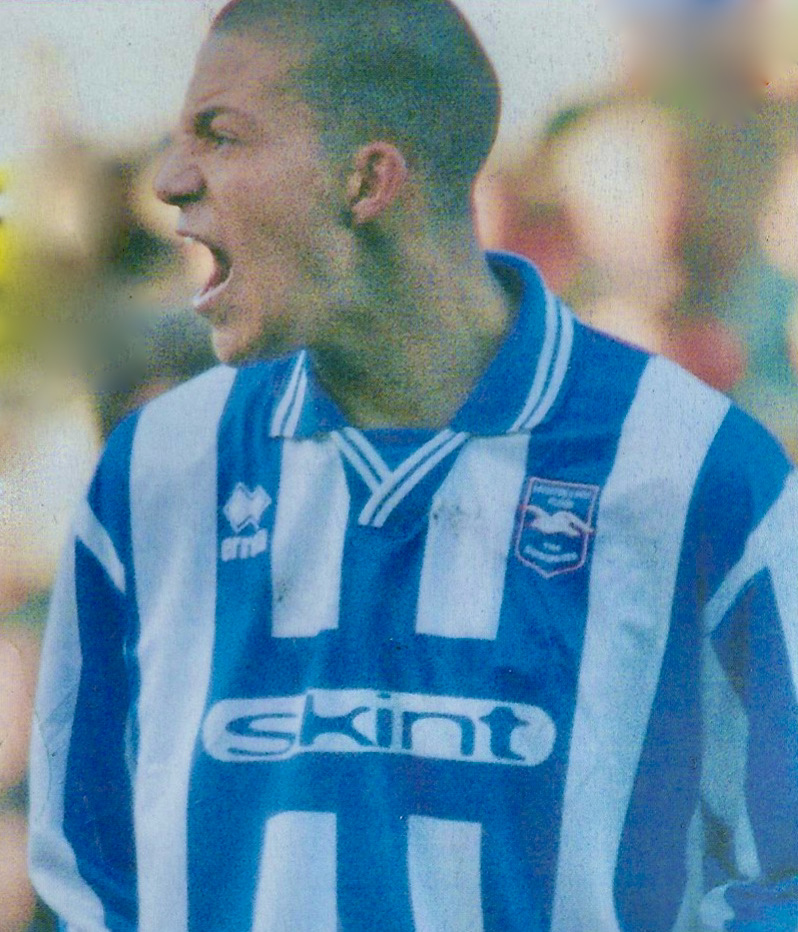
“I was at Sheffield United and it was the season when we went from the Championship to League One. Micky Adams was the manager and we weren’t getting on. In the summer Micky was sacked and Danny Wilson came in as manager.

“I trained for the full pre-season with the club, but I was aware that there were a couple of clubs keeping an eye on my situation throughout the summer. It was Blackpool and Watford who put in offers for me, and I spoke with both clubs, but when I met Dychey (Sean Dyche) I decided to sign for Watford.

“I still had a house in Loughton so overall it was a good opportunity to get back down south, and everything that Sean said to me on the phone really appealed to me.”

Yeates was at Watford for two seasons, initially under Dyche and then Gianfranco Zola, but his contract wasn’t renewed in the summer of 2013 and he decided to link up once again with his former Colchester and Hull boss, Phil Parkinson, at League One Bradford City.

He was one of the goalscorers for Bradford when they completed a massive upset by beating Premier League table toppers Chelsea 4-2 at Stamford Bridge in the fourth round of the 2015 FA Cup.

However, released that summer, he switched across the Pennines to join Oldham Athletic and six months later was on the move again, this time to Blackpool.

“Since leaving Hull it’s been a bit up and down,” he told Branagan. “I was on a short term deal at Oldham which went alright before then deciding to go to Blackpool because of a longer contract which was put in front of me which I don’t regret, as I’ve been living around the St Annes area now for five years and my children have grown up here and are at school and it’s a great area to raise a family in.”

His final league club as a player was Notts County, who he joined on a short-term deal in January 2017, and he appeared in 11 games plus three as a substitute as new manager Kevin Nolan’s side turned what at one point looked like relegation from the league into a 16th place finish (although two years later County lost the league status they’d held for 157 years).

After playing non-league for Eastleigh, in 2019 Yeates moved closer to home and signed for AFC Fylde. In September 2021, he became an academy coach at Fleetwood Town, although he continued to keep his hand in as a player at Bamber Bridge.

Reflecting on the player’s career, Dollery wrote: “With a ball at his feet, Yeates was one of the most technically accomplished Irish players of his generation, cut from the same cloth as the likes of (Wes) Hoolahan and Andy Reid.

“That such a claim isn’t backed up by international achievements can perhaps be partly explained by his own admission that he didn’t marry his talent with a devotion to other aspects of the game that were beginning to play a more prominent role in the life of a professional footballer.

“If fitness coaches scheduled a gym session, Yeates felt his time would be better spent by staying on the training pitch to perfect his free kicks. A predilection for crisps, fizzy drinks and nights out didn’t aid his cause either.”

Yeates recognised he could have done things differently and said: “The reality was that I didn’t live like a saint.

“Everyone who knows me would know that that’s just not my personality. I’ve always been a fella who likes a bit of craic; just a normal Irish lad from an estate who happened to love playing football.”

• Pictures from the Albion matchday programme and various online sources.