

PADDY McCourt put a dent in Brighton’s promotion hopes when he scored for managerless Barnsley at the Amex. Eight months later he joined the Albion’s renewed attempts to lift themselves out of the Championship.
The mazy dribbler from Derry lit up the evening of Tuesday 3 December 2013 when he gave the bottom-of-the-table Tykes an unlikely first-half lead.
Barnsley arrived at Falmer having just sacked manager David Flitcroft and when McCourt teased and tormented the retreating Seagulls defenders to net in the 35th minute it ended a sequence of nearly five hours without a goal.
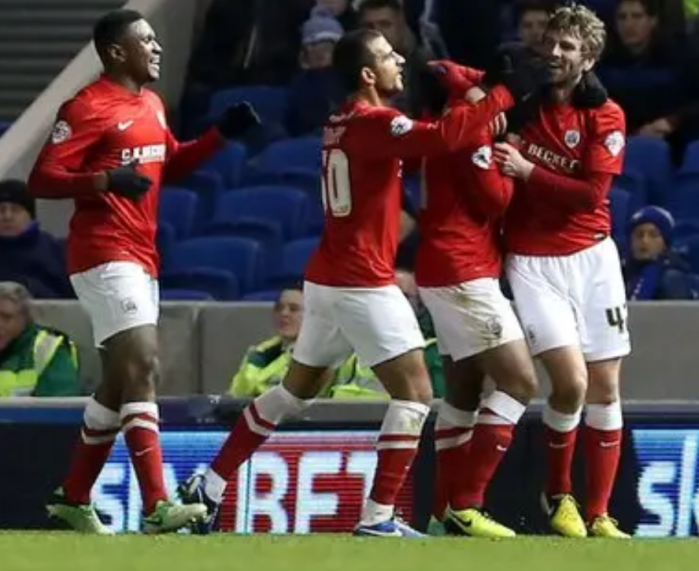
Recalling what was something of a trademark finish by the bearded Irishman in a 2018 post wearebrighton.com described howMcCourt picked up a loose ball 40 yards out from goal, dribbled round Liam Bridcutt and Andrew Crofts, drifted past Matt Upson with a quick step-over, nutmegged Gordon Greer before playing a quick one-two with Worthing-born Marcus Tudgay, then ghosted round Stephen Ward before slotting the ball into the bottom corner of the goal past Tomasz Kuszczak in Albion’s goal.
Five minutes after the restart, the visitors went further ahead through Jacob Mellis before Upson pulled a goal back with a header from a Craig Conway corner. Barnsley had on-loan goalkeeper Jack Butland to thank for ensuring they left with all three points, making notable saves from subs Will Buckley and Leroy Lita (who moved to Barnsley the following year).
While Albion went on to finish sixth under Oscar Garcia but failed to get further than the play-off semi-final for the second year running, Barnsley, who’d appointed former Albion captain Danny Wilson as Flitcroft’s successor, exited the division the wrong way, finishing in 23rd place.
Barnsley’s top scorer, Chris O’Grady, stayed in the division by signing for the Albion and a month later his former teammate, 30-year-old McCourt, released on a free transfer at the end of the season, joined him in Sussex after impressing new Seagulls boss Sami Hyypia in a trial period.
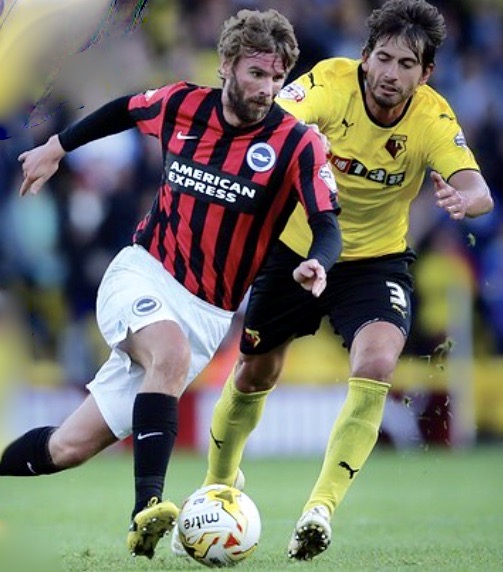
“We have seen enough of Paddy in the last week or so to know that he is a player who has quality going forward,” said Hyypia. “He is the type of player who can pick a pass and create a chance.”
That said, Hyypia only gave McCourt starts in two League Cup games (v Burton Albion and Tottenham Hotspur); his 11 other Albion appearances were all as a substitute.
When he did start, away to Burton, he set up goals for Rohan Ince and Craig Mackail-Smith in Albion’s 3-0 win and he told the matchday programme: “There’s nothing like playing games for your fitness and I’m sure that the more I play the better I will feel.”

Hyypia kept his feet on the ground, though, pointing out: “He needs to realise what he needs to do to improve and to be a very important player for the team defensively as well.”
Often described as a ‘maverick’, McCourt’s response was: “I like to get on the ball and be creative; that’s always been part of my game and something I’ve always been good at. I love taking on players, creating chances and now I just hope I can get a run in the team and show what I can do on a regular basis.”
He certainly couldn’t have been accused of lacking ambition, maintaining: “I still have aspirations to play in the Premier League and hopefully that will happen in my time here.
“I’ve played international football, I’ve played Champions League and Europa League football with Celtic, so the next step for me would be to play at the highest level in England – I would love that to happen.”
That international career was as strange as much of his career. There were 13 years between the first and last of 18 caps for Northern Ireland: he made his debut under Sammy McIlroy in 2002 (a 5-0 defeat against Spain) then had to wait seven years before he was selected again. That was in a 3-0 World Cup qualifier win over San Marino, when he went on as an 81st minute sub for future Albion teammate Aaron Hughes.
He scored twice in Northern Ireland’s 4-0 win over the Faroe Islands in a Euro 2012 qualifier in August 2011 (when Hughes scored his first goal for his country in his 77th appearance!).
McCourt’s second goal that day was reckoned to be one of the best ever goals seen at Windsor Park. According to the Belfast Telegraph, he “collected the ball just inside the opposition half and left three defenders in his wake with magical dribbling skills and impeccable close control before outfoxing another… then to cap it off he produced a stunning left foot chip over the bemused goalkeeper which floated into the net.”
McCourt helped manager Michael O’Neill’s side reach the Euro 2016 finals, but was not available for the finals in France because his wife Laura was seriously ill (more of which later).
“I really enjoyed it,” he told BBC Northern Ireland’s Mark Sterling in a lockdown interview in 2020. “Any time I was picked I turned up, and to be involved in the Euros qualifying campaign was fantastic.
“Everybody wants to play international football, The fans took to me straight away, were always singing my name and I hope I gave them some good memories.”
Born in Derry on 16 December 1983, McCourt’s early footballing promise was nurtured by Eunan O’Donnell, his PE teacher at Steelstown Primary School. At the club he joined as a youngster, Derry-based Foyle Harps, it was club chairman Gerry Doherty “who deserves more credit than anyone else” according to McCourt’s brother Leroy (who was his agent).
However, McCourt reckoned: “The street is where I learnt how to play football.”
In that lockdown interview with BBC’s Sterling, he said: “When I was younger there was more emphasis on players to develop themselves. We trained once a week for an hour with our clubs, when you might only get 40 or 50 touches of the ball at most, with 20 kids in a session.
“It was up to you to go out into the streets with your mates and practice your skills in small-sided games. We’d play for six or seven hours, there might only be four of you and you’d get thousands of touches.
“You were probably playing with older kids and on concrete as well, so that would improve your balance.”
Although given the moniker of the greatest Brazilian footballer of all time, McCourt’s boyhood hero was Robbie Fowler. “I’m a Liverpool and Celtic fan, and for some reason he was a player I just absolutely adored growing up,” he said.
“My memories are of seeing Fowler scoring – left foot, right foot, header – it didn’t seem to matter to him. He just had this unbelievable talent for putting the ball in the back of the net.”
McCourt’s first taste of professional football in England came at Third Division Rochdale, joining them in 2000 aged 17. But in an open and honest question and answer session in March 2018 at the Talent Development Academy Elite Soccer Coaching event, at the Magee Campus of the Ulster University, the player spoke about how youthful wrong lifestyle choices meant he blew the opportunity.
“I was nowhere near ready for it and the events that transpired in the next couple of years proved that. It’s very hard to know the situation you’re going into when you’re not prepared for it.
“I was coming from Foyle Harps, playing junior football and then going into a professional environment. It wasn’t that big of a jump in terms of what you did differently because Rochdale was a small club and you went in and trained and were home for 1pm living in digs and I didn’t drive at the time.
“You had so much spare time on your hands and as a young lad, you do daft stuff and make mistakes and I admit I made plenty. It was basic stuff like going out too much and not eating the right food.”
Although he made 94 appearances for Rochdale, around half were as a substitute and after unsuccessful trials with Motherwell and Norwich City he was eventually released in February 2005 and returned to the League of Ireland with Shamrock Rovers.
“Initially when I was at Rochdale I did quite well and broke into the first team quite early but when I came back I took stock. I made mistakes and wasn’t really living my life to be a professional footballer.
“I had six months with Shamrock Rovers where I didn’t make many changes to my lifestyle but I was doing quite well on the pitch.”
It was only when he returned to his home town and played at Derry City where things began to change under the positive influence of future Republic of Ireland manager Stephen Kenny.
“I learned what it takes to become a proper athlete because you need to live a clean lifestyle to make it as a footballer and I wish I knew back then what I know now,” he said.

“There was a bit of sports science starting to come in at Derry in terms of what to do leading up to a game, and then your recovery sessions on a Saturday morning after a game. It was tiny, basic stuff but it started to kick in then and that helped me because I was getting information I didn’t have before. It was up to yourself to buy into it and I started to buy into it a bit more and started to see the benefit.”
Between 2005 and 2008 with Derry, McCourt won an FAI Cup, three League Cups, was involved in a league runners-up spot (2005) and was part of a UEFA Cup run in 2006.
He then got the chance to join Celtic, the side he’d supported as a boy, signing for a fee of £200,000 in June 2008. Hoops boss Gordon Strachan told the Derry Daily: “Paddy is as gifted a footballer as I’ve ever seen. Some players can pass but can’t dribble. Others can dribble but can’t pass. Paddy can do both.”
It wasn’t until the 2009-10 season that he forced his way into the first team and his first goal for the club was in a 4-0 League Cup win at Falkirk in September 2009 when he skipped past five defenders before chipping the goalkeeper.
His own favourite was his first goal at Parkhead in a 3-0 win over Hearts on 11 September 2010 which realised a lifetime ambition.
“I actually had dreams of scoring at Celtic Park,” he said. “I felt I had let that go when I had that setback at Rochdale. Self-doubt creeps in but I remember the night. It was Hearts at home and it was a very proud moment.
“It might never have happened if I hadn’t made the sacrifices I made and I have a lot of people to thank for that.”
When Aiden McGeady left Celtic for Spartak Moscow in August 2010, Celtic manager Neil Lennon challenged McCourt to step into his shoes and said: “He’s wonderful to watch. He’s beautifully balanced and he’s got great vision and great feet and that’s why we decided to get him on a longer-term contract. He’s pleased and we’re pleased.”
In his five years in Glasgow, McCourt scored 10 goals in 88 appearances for the Hoops although he actually only made 20 starts. He collected medals for his part in Scottish Premier League title wins in 2011-12 and 2012-13 as well as Scottish Cup wins in 2011 and 2013.
That 3-0 2013 final win over Hibernian was his last game for Celtic before he joined English Championship Barnsley, who were managed by his former Rochdale teammate David Flitcroft.
The goal against Brighton in December 2013 was one of only two he scored for the Tykes in 15 starts plus eight appearances off the bench and Barnsley fans certainly had mixed views about his contribution.
Online chat group contributor ‘Jay’ posted: “At his best he was as good as I’ve ever seen. Be nice if he can produce that sort of form consistently, even if it’s not for us. All that talent shouldn’t go to waste.”
Another, ‘JLWBigLil’ reckoned: “One of the most skilful players I’ve ever seen play for Barnsley in all my years of going down to Oakwell. Possibly the right player at the wrong time for us.”
Whereas ‘MarioKempes’ opined: “There was no doubting his ability but the other key aspects such as workrate, fitness, stamina and heart were sadly lacking from his game.”
It almost certainly didn’t help McCourt’s cause at Brighton that new boss Hyypia struggled to get to grips with the task in hand and chopped and changed the line-up. The addition of several loan players didn’t help matters either.
Frustrated Albion fans reckoned McCourt should have had a bigger involvement than his few cameos off the bench, citing his influence in helping to salvage a point away at Watford, and planting the ball on Gordon Greer’s head to score a consolation goal from his corner kick at Middlesbrough.
After Hyypia left the club before Christmas, McCourt’s last Albion appearance was as a sub in the home Boxing Day 2-2 draw with Reading (on loan Glenn Murray scored twice for the visitors; Jake Forster-Caskey and Inigo Calderon for the Albion), going on for Danny Holla.
Nathan Jones was in caretaker charge that day and the pair were subsequently reunited at Luton Town the following season.
Before then, unable to get games under Albion’s new boss Chris Hughton, McCourt dropped into League One on loan at relegation-bound Notts County.
He scored County’s winner in their 1-0 win at Colchester on 3 March 2015 but they went on an 11-game winless run after that and went down with Crawley Town and Leyton Orient.
Released by Brighton that summer, McCourt joined the League Two Hatters under John Still in July 2015 and was followed there a month later by Mackail-Smith.
After a run of three starts in September, when Town won all three matches, McCourt played in a 1-1 draw with Leyton Orient on 20 October, before being restricted to a role on the bench.
On his return to the starting line-up in January 2016, away to Mansfield, he scored his fist Luton goal after just seven minutes in a 2-0 win. He told Luton Today: “It was great, all players want to play from the start and it’s been disappointing to sit on the sidelines.
“It was very frustrating because we’d just won three or four games in a row, then I came back from an international double header, was on the bench, played in the draw against Leyton Orient and that was it, I didn’t play again.
“I don’t know why, I didn’t ask the manager and he ended up getting the sack, but it was very disappointing as I felt that although I wasn’t where I wanted to be in terms of performance, I was playing, we were winning games.”
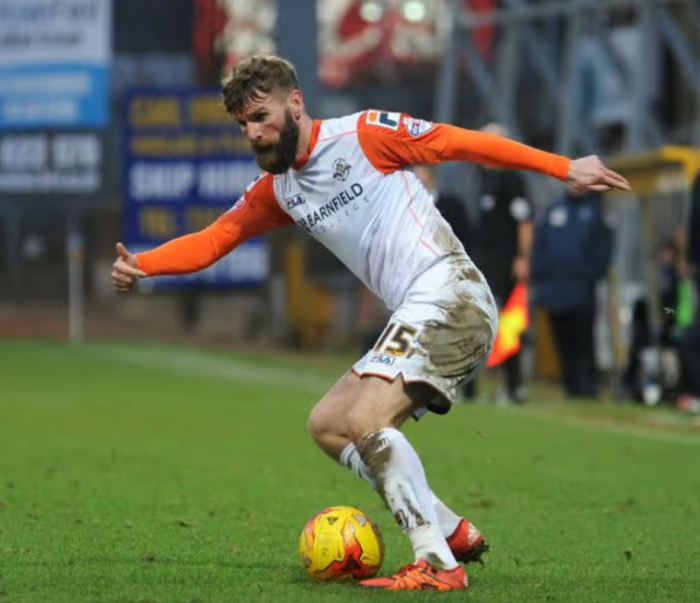
When former Brighton coach Jones was appointed as Still’s successor, McCourt told Luton Today: “He’s a coach who wants to play football, ball from the back, get between the lines, bring a wee bit of flair and creativity back to Luton, so hopefully I can play a big part in that.”
Unfortunately, he cut short his stay at Kenilworth Road after 16 starts and nine appearances off the bench to return to Ireland because his wife Laura had to undergo treatment for a brain tumour. She recovered after a successful operation and O’Court resumed playing at Glenavon.
According to the Belfast Telegraph: “It ended up being a disappointing half-season at Mourneview Park and was followed by a move to Finn Harps, where he was able to roll back the years, not least when he ghosted past a whole host of Sligo players and dinked home the finish with his inimitable swagger.”
That was in 2018 before he retired from playing and began coaching academy players at Derry City. He later became the club’s technical director and left in January 2024 before taking up a role as assistant to manager Declan Devine at Irish Premiership side Glentoran.
Perhaps the last words should go to reporter Daniel McDonnell, who wrote in the Irish Independent: “Football is nothing without entertainers. Punters paying cash to watch a game want to see individuals capable of doing things that the ordinary player could only daydream about. McCourt could do things that top pros were unable to manage.”
While recognising McCourt’s CV might have glittered more brightly, he declared: “There are players who will retire with more medals and more money that will never garner a comparable level of affection.
“Mention McCourt’s name to those who had the pleasure of watching him in full flight and responses will be delivered with a smile.”
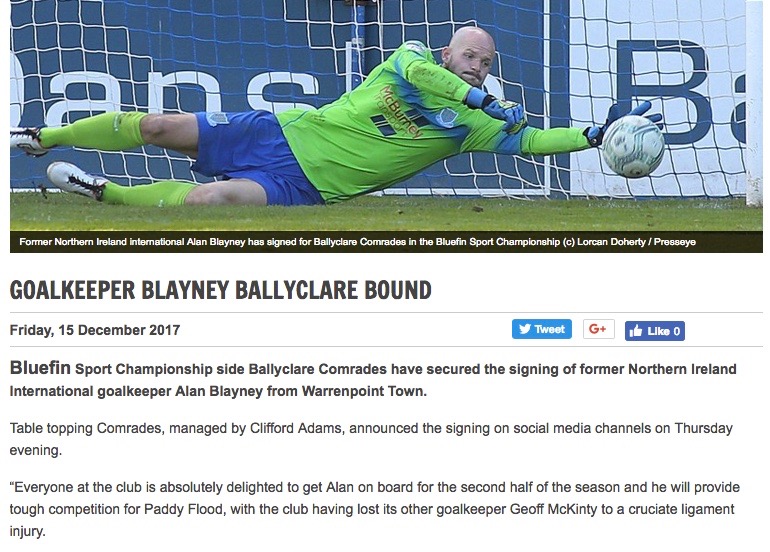
 GOALKEEPER Alan Blayney only played 15 games on loan to Brighton from Southampton but if finances had been better at the time he could have signed permanently and his career may have taken a different turn.

 In parallel lines